Established as a national park in 2020, New River Gorge is one of the newest additions to the national park system, and it provided us with some memorable firsts. The park is renowned for its rugged beauty, rich history, and the New River, which is one of the oldest rivers on the continent. Spanning over 70,000 acres, the park boasts over 100 miles of trails, offering a variety of experiences from strenuous hikes to scenic walks–although on the rainy, overcast morning we visited, the view was somewhat obstructed until later in the day.
We began our journey by taking a quick look around the Visitor Center, where we familiarized ourselves with the park’s history and features. The park ranger provided valuable information about safe exploration routes, ensuring our hike would be both enjoyable and secure. From the Visitor Center, we headed to the section of the New River Gorge that houses the Castle Rock Trail and the Grandview Rim Trail. These trails, totaling about 3.2 miles out and back, promised a mix of strenuous and scenic experiences.
Our group split up to tackle the different trails. Professor Yawn, Cinthia, Olivia, and Chrissy set out on the Castle Rock Trail, navigating its more strenuous, rocky terrain.
Meanwhile, Stephanie and I took the Grandview Rim Trail, which led us through a beautiful tunnel of luscious vegetation.
The trails eventually converged, and we all continued together toward our final destination, the Turkey Spur Overlook. When we arrived at the “overlook,” we were mostly looking over clouds.
But the sky slowly cleared, and we were able to see some of the river and train tracks in the gorge.
There were also stairs (150, to be exact) to a lookout that gave us an additional perspective.
But with the rain returning, we took shelter briefly under an overhang….
…and then returned to the car….
…while making the most of nature views along the way…
We even gave Flat Sammy a chance to explore!
…Although he didn’t much appreciate the rain.
New River Gorge is a National Park with multiple units, consisting of not only the “Grandview” area, but also Sandstone Falls and the Bridge. We were unable to visit the Falls, but we did make sure to see the Bridge, which was pretty magnificent.
It is the longest (3,030 feet) steel span bridge in the United States, and the third highest (876 feet), and it is really an architectural marvel and beauty from multiple perspectives.
Looking away from the bridge, visitors are graced with beautiful views of the gorge and a distant bridge.
The smaller bridge in the photo above was the former means of traversing the gorge, a route that takes some 45 minutes to drive. With the New River Gorge Bridge, that trip is now less than a minute.
The natural beauty of the area shone through, even in less-than-ideal conditions. Most importantly, this trip allowed me to check off another first with LEAP, creating lasting memories with a wonderful team and making my first national park visit an unforgettable experience.
After a morning devoted to taking our LSAT Prep Course, we headed out to Charleston, the capital of West Virginia. This was a chance to build on some of the relationships we had built at the Southern Legislative Conference, and also to learn about the workings of other state capitals–the latter being of particular interest to those of us interested in the Austin Internship Program.
West Virginia State Capitol Building
by Michelle Cardenas
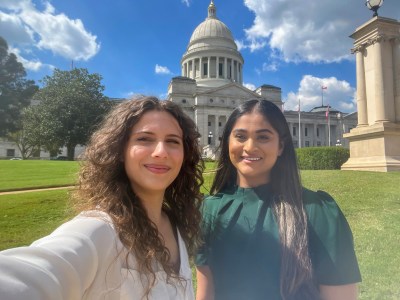
The West Virginia State Capitol Building, designed by the renowned architect Cass Gilbert, is a testament to the state’s resilience and rich heritage. Gilbert, who also designed the nation’s Capitol in Washington, D.C., which we visited during our spring break, was commissioned to construct the West Virginia Capitol in 1921. His style is unique, and you can see the similarities with many of his works.
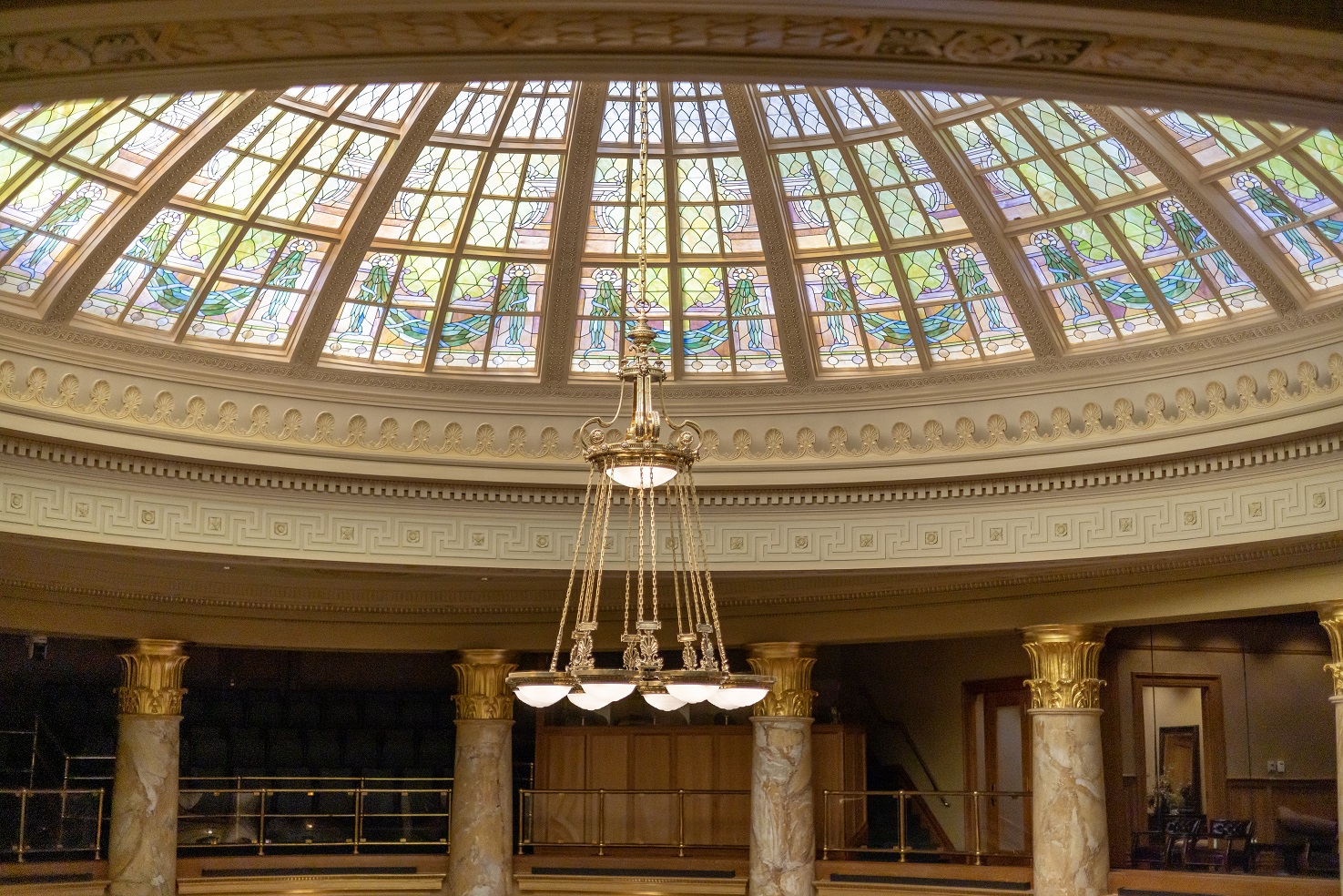
Upon entering the Capitol, we were immediately struck by the grandeur of the dome. The murals here vividly depict various significant stages in West Virginia’s timeline, including the Civil War…
…the scenic beauty of Seneca Rocks, the historical significance of Harpers Ferry, and even the contemporary state of West Virginia.
The intricate design elements throughout the Capitol reflect West Virginia’s unique character. Gold leaf is a recurring theme in the chandelier and lamps inside, mirroring the golden dome on the exterior.
Some of the ceilings are adorned with floral motifs resembling the magnolia, oak, and sugar maple trees, symbolizing the state’s natural beauty.
Our visit even included a House of Representatives and Senate tour. In the House, the room is divided by party lines and organized by committee memberships, leadership, and seniority.
The layout and décor, including more gold leaf accents, highlight the importance and formality of the legislative process. We also had a chance to stand where Speaker Hanshaw presides over the House Chamber, a point that had special meaning since we have met Speaker Hanshaw.
The Senate chamber was equally impressive, seating a total of 34 senators.
We observed intricate decorations outside the chamber with a border on the ceiling representing various disciplines central to West Virginia’s identity: the bull symbolizes agriculture, the eagle with books represents education and art, the shield stands for coal and mining, and the scales of justice denote the legal system. We also admired their state seal, which has two figures representing agriculture and industry; the date that West Virginia was admitted to the Union; and their motto, “Mountaineers are always free.”
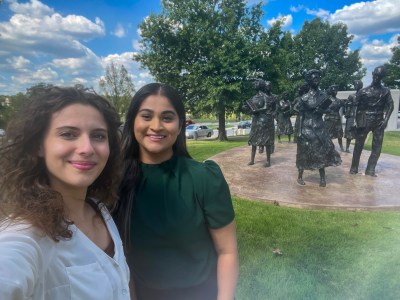
Adding to our understanding of West Virginia’s history, we learned that it became the 35th state due to its decision to remain loyal to the Union during the Civil War, primarily influenced by President Lincoln. Due to Lincoln’s role in the formation of the state, there is a large monument depicting the former president in front of the Capitol.
The West Virginia State Capitol has a fascinating yet tumultuous history; six buildings have served as the state’s government seat over time, and these buildings have experienced various expansions, relocations, and even two tragic fires. Each element of the Capitol, from its design to its décor, tells a part of West Virginia’s story, seamlessly connecting its storied past with its vibrant present. This rich history adds to the significance of our visit, making our exploration of the current Capitol a deeply enriching experience.
West Virginia State Museum
by Cinthia Villarreal
After visiting the beautiful West Virginia State Capitol Building, we stopped by the West Virginia State Museum. After driving through the state for the past few days, we looked forward to learning more about West Virginia’s rich and varied history.
As we entered the front doors, the museum greeted us with a magnificent exhibit of colorful quilts.
Founded in 1892, West Virginia has a storied past that reflects its resilience and unique cultural heritage.
The museum meticulously chronicles this narrative, from the Native American tribes who first inhabited the land to European settlers’ arrival and the state’s eventual formation during the Civil War.
One of the museum’s exhibits pays homage to John Brown, a pivotal figure in American history and a passionate abolitionist whose raid on Harpers Ferry in 1859 marked a significant turning point in the fight against slavery. Brown’s legacy is intricately woven into West Virginia’s history, showcasing his commitment to justice and equality.
No aspect of West Virginia’s identity resonates more deeply than its connection to coal mining. From the early 19th century to today, coal has been vital to the state’s economy, fueling industrial growth and shaping communities.
The museum’s section on coal mining explores the industry’s evolution, labor struggles, technological advancements, and environmental impact, providing a nuanced perspective on its complex legacy.
A highlight is the 4,000-pound piece of coal, once enclosed in glass and used as a reception desk.
West Virginia’s blown glass industry is cherished in its cultural tapestry. The museum celebrates this tradition with a dedicated exhibit showcasing beautiful glassworks crafted by skilled artisans.
Whether you’re a history enthusiast, a nature lover, or simply curious about West Virginia’s rich past, the West Virginia State Museum highlights pivotal moments and key figures that shaped the state’s identity.
Cathedral Falls
On our return to Lewisburg, WV, we stopped at Cathedral Falls. Despite literally being a road-side stop about a mile from Gauley Bridge, it offered a great view.
The falls are approximately 60 feet, and they descend from a concave area in bluffs–likely the reason for the name “Cathedral.” We stopped for about 20 minutes, savoring the beautiful site that capped an activity-filled day.
Following an exploration of historic Lewisburg, WV, where we visited stores, investigated historic sites, and met with the Visitors Bureau staff…
…we changed into our conference clothes, readied ourselves for the beautiful Greenbrier, and prepared ourselves for a different type of learning.
The Rest is History: Historic Preservation Tax Credits and Economic Development
by Chrissy Biello
Our favorite session was titled Historic Preservation Tax Credits and Economic Development, an appropriate topic inasmuch as three of us had completed internships with the Economic Development Department for the City of Huntsville. For this session, The speakers included Eric Nelson, a West Virginia State Senator; Danielle Waltz, Partner at Dinsmore & Shol LLP; and Shaw Sprague, VP of Government Relations at the National Trust for Historic Preservation.
The speakers provided a comprehensive overview of the federal Historic Tax Credit (HTC) program. Initiated in 1978 with a 10% credit and made permanent in 1986, the program now offers a 20% credit based on qualified expenditures. This federal credit is available only for commercial properties and is distributed over five years at a rate of 4% annually. This detailed explanation was enlightening, as it clarified how federal policies are structured to support long-term preservation efforts.
They further discussed how transferable credits can significantly impact financing for preservation projects. Transferable credits are valuable because they allow property owners with limited tax liability to sell their credits to other taxpayers, thereby facilitating the financing of historic renovations. This concept is crucial for cities seeking to revitalize older areas without relying solely on their own financial resources.
The speakers also covered how states can optimize various tax sources to support these programs. For instance, Texas, which lacks an income tax, leverages business or insurance taxes to fund preservation efforts. This strategy was particularly interesting to me because it showcases how states can creatively utilize available resources to achieve their preservation goals.
An illustrative example from West Virginia was the Wesbanco Building, a 17-story office building built in 1972. Despite its initial drawbacks, such as not having a sprinkler system and being abandoned, a developer acquired it for only $5 million and utilized HTCs to renovate the property! This truly demonstrates how historic tax credits can transform underperforming assets into valuable community resources.
Another example shared was from Fayetteville, West Virginia, where old schools are being repurposed into community assets. Ms. Waltz explained how an elementary school is being converted into a 20-24 unit apartment building, with additional townhomes planned. This project, supported by HTCs, has created 30 construction jobs and will provide 25 permanent jobs upon completion.
The speakers effectively offered a new perspective (to us) on the complexities and benefits of preserving historic buildings and towns, making it another great session at the Southern Legislative Conference.
To make the experience even better, we had the opportunity to speak with Senator Nelson and Mr. Sprague following the event. Senator Nelson, showing the kind of constituent service that has helped him win reelection since 2010 in West Virginia, helped us with our plans in Charleston, WV for the following day.
Following a day full of learning, we had an evening full of activities–some for everyone. We began by taking the scenic route to The Greenbrier, which involved going to the Herns Mill Covered Bridge, one of many such historic structures in West Virginia.
To divert ourselves for a bit, we sent Chrissy into the one-lane bridge. We figured if a car came from the other direction, we could see how fast Chrissy was capable of running in high heels. Just our luck, though, no car came through.
Consequently, we had to take her to The Greenbrier, where the SLC, in creating Family Night, had something on tap for everyone.
For Chrissy, we had smores.
Cinthia, meanwhile, summoned her inner Lizzie Borden, and she ventured into axe-throwing for the first time.
This proved to be a popular sport among the group, and Professor Yawn noted, with some concern, that we could be pretty accurate when motivated.
Olivia proved to be the marksman with a bow and arrow. She managed kill shots in two of the three targets, earning her the moniker, “Killer in High Heels.”
She displayed greater fear, however, when confronted with a live animal.
Michelle, on the other hand, was the Dr. Doolittle of the group…
…and the falconry proved popular, being the only activity every member of the group engaged in.
Cinthia, however, seemed to have the most fun with it.
When we weren’t fiddling around with animals or weapons, we took advantage of the opportunity to see expert fiddler and West Virginia native Philip Bowen, who has earned praise from NPR and other national media for his authentic sound and bow virtuosity.
And what would a Southern Legislative Conference be without hearing from a legislator? This year, we again heard from West Virginia Speaker Roger Hanshaw…
…who welcomed everyone to the conference, spoke of things to come, and helped us feel at home–in a very nice home.
And, reflecting on a day that saw us go to Carnegie Hall, rub shoulders with legislators, throw axes, serve as a perch to a falcon, shoot arrows, and enjoy smores, we headed back to our hotel (a Holiday Inn) to find some rest before another busy day.
Not everyone can say they made it to Carnegie Hall–but, following a recent trip to the Southern Legislative Conference, the LEAP Ambassadors can! While in the charming historic town of Lewisburg, West Virginia, Ambassadors toured the downtown and its curtilage, coming across Lewisburg’s own Carnegie Hall, one of four continuously used Carnegie performance halls in the world.
While the Hall was actually closed, the organization’s Box Office Manager, Sheila Hutchinson, cheerfully offered us a tour, allowing us to see the building and learn about its operation. The Hall was originally constructed in 1902, with almost $27,000 coming from Andrew Carnegie, and another $10,000 coming from the local community.
For the past 35 years, the Carnegie Hall Inc, a non-profit organization, has operated the building.
The repurposed building now serves as a performance venue, gallery space, and arts education programming open to the community–and passersby, including ourselves!
As we entered the 400-seat auditorium, we were had the pleasure of meeting Cathy Rennard, the president of the non-profit; and Mary Leb Foster, the Performance Director. They were extremely kind to share their experiences from working at Carnegie Hall, including their preparation for their upcoming musical, The Hunchback of Notre Dame.
Their work involves not only the things you typically think about when running a theatre (sets, sales, casting), but also community building, something close to our heart. The staff work hard to earn community buy-in, to collaborate with community stakeholders, and to offer a point of pride for West Virginia.
Thank you for the tour and your commitment to the Lewisburg community!
During our recent trip for the Southern Legislative Conference, the LEAP Ambassadors had the privilege of dining at 1010 Bridge, a Charleston gem that has recently captured national attention. Chef Paul Smith, the creative force behind this establishment, made history by winning the prestigious James Beard Award for Best Chef: Southeast.
Chef Paul Smith and Carrie Smith at James Beard Ceremonies (Taken from 1010 Bridge Website)
This recognition puts West Virginia on the map, showcasing Charleston’s growing reputation as a hub for culinary and economic innovation.
1010 Bridge Staff (Taken from 1010 Bridge Website)
Chef Smith’s achievement is not just a personal triumph but a testament to his dedication to elevating the local food community. As the Culinary Ambassador for Capitol Market, he partners with local farmers and producers, using quality, locally grown ingredients to build his menu.
His efforts extend beyond his own restaurants as he actively participates in community cooking classes and serves on various boards, enriching the Charleston community in numerous ways.
Thanks to some facilitation by West Virginia Senator Eric Nelson, we were fortunate to spend two enlightening hours with Chef Smith, where he shared his philosophy on what being a public servant means in the kitchen.
His approach is inspired by the belief that success is not about competition but collaboration, echoing JFK’s idea that “a rising tide lifts all boats.” Chef Smith sees his peers not as competitors but as partners in the mission to promote West Virginia’s culinary arts.

We started with an array of appetizers: White Cheddar Pimento Cheese, Bacon Wrapped Dates, House Cured Pork Belly, Fried ‘Nashville Hot’ Oysters, and Whipped Feta.
(Taken from 1010 Bridge Website)
Each dish showcased Chef Smith’s creativity and commitment to local flavors. He noted that he wants his dishes to be an elevated, but encouraging dining experience. By using ingredients and elements of well-known dishes, his menu can be an approachable experience to fine dining. Feeling particularly moved by Chef Smith’s words, I decided to try oysters for the first time! As someone who usually has an aversion to seafood, having the ability to enjoy a dish I would normally avoid was a pleasant surprise.
This surprise was also shared by Cinthia, who tried bacon-wrapped dates–and loved them! This was a surprise because (1) she doesn’t like dates, and (2) she doesn’t like bleu cheese, with which the dates were stuffed. She was very surprised to learn that ingredients she didn’t like resulted in a dish she did like.
Cinthia learning that a dish she loved contained Bleu Cheese
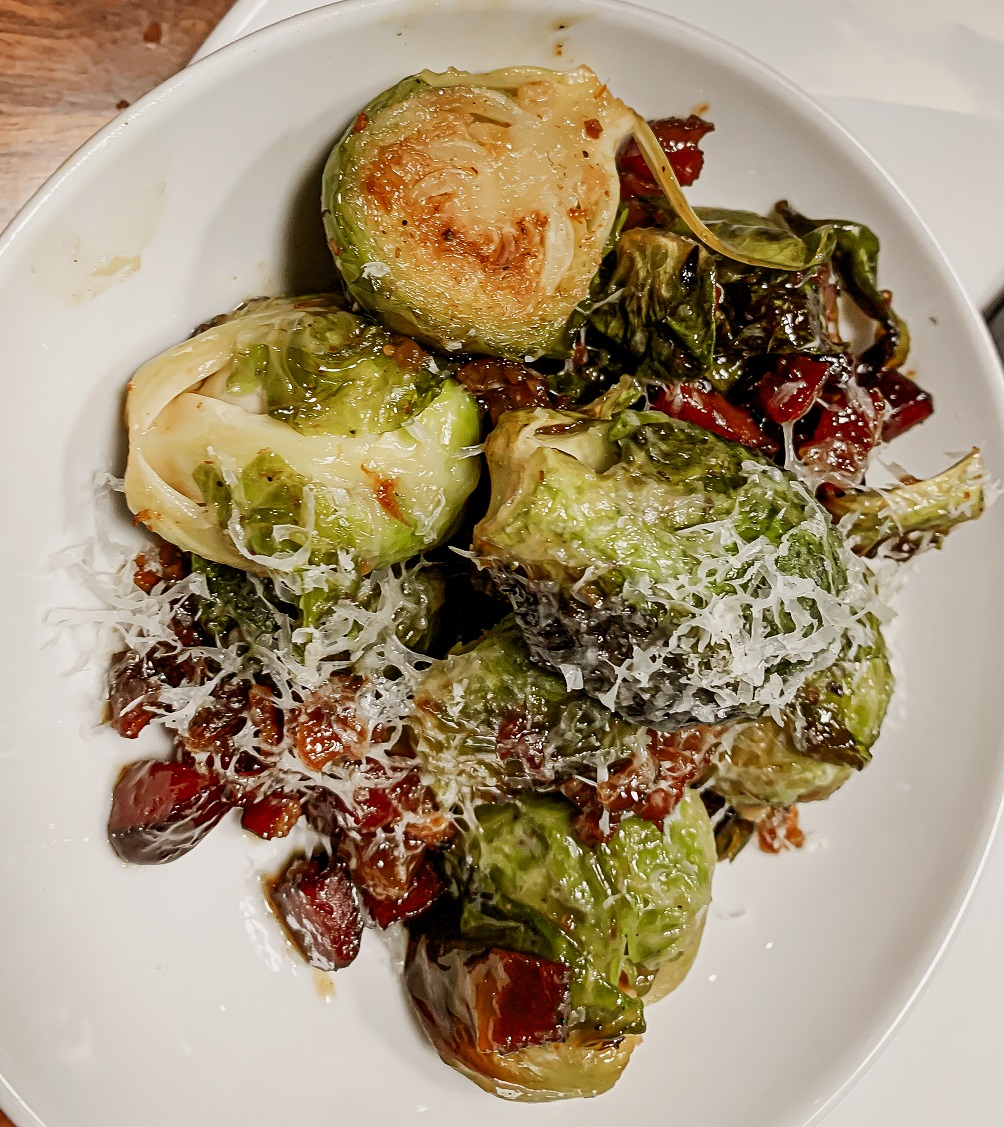
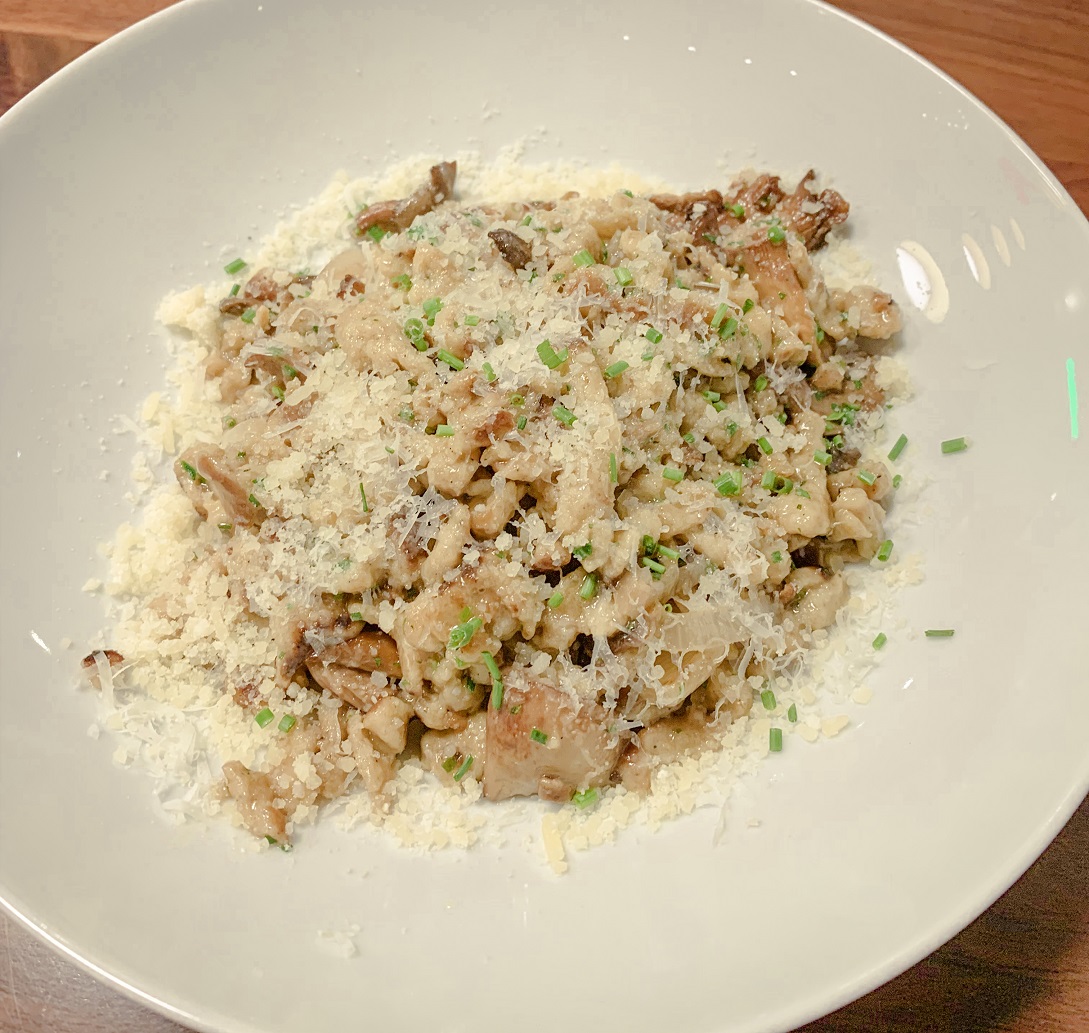
Our dining experience was unforgettable. Melissa, our server, was fantastic and clearly knowledgeable about the cooking process, local ingredients and restaurants, and the history of the restaurant, adding a further elevated aspect to our meal. Chrissy and I enjoyed a pasta Bolognese, Cinthia savored a risotto, and Michelle tried the salmon with pea and mint agnolotti. Everything was nothing short of exceptional!
Of course, we couldn’t leave without sampling some of the desserts on the menu. We tried the peach bread pudding, lemon gelato, and crème brûlée, each offering a delightful end to our meal.
Thank you very much, Chef Smith, for your time and perspective.
We congratulate you on the well-deserved award and look forward to the opportunity to return someday.
Whenever LEAP Ambassadors have the opportunity to travel, we make the most of it. So it was that on an off morning of conference sessions, we stepped foot into the Lost World Caverns which, for many of us, was the first time stepping foot into a cave.
Discovered in 1942, these caverns have become a popular destination, offering a fascinating glimpse into the subterranean world carved out over millions of years by the relentless force of water.
Originally, the only way into the cave was through a hole in the ground, and “visitors” had to be lowered in by rope, and then hauled out in reverse.
For us, it was much easier. We entered through a man-made opening, we were immediately struck by the chill in the air, a stark contrast to the surface temperatures. The sound of dripping water echoed (literally!) around us, setting the stage for the natural wonders we were about to witness.
Inside, the caverns revealed spectacular dripstone speleothems, including stalactites and stalagmites.
These formations, created by the slow deposition of minerals from dripping water, were breathtaking. We were particularly fascinated by the columns referred to as “soda straws” or “pencil stalactites,” delicate formations that looked as though they could be easily snapped.
The formations themselves, with whimsical names like the “Pig Tail,” and “The Veil” left us in awe. Each turn in the path revealed a new and stunning sight, and it was hard not to be overwhelmed by the beauty and intricacy of the cave’s interior.
I didn’t really know what to expect, but from the beginning, it was clear that this was a unique and special place.
The views were unlike anything I had ever seen before, with each rock formation appearing both immense and intricately detailed.
It’s amazing to know that the Earth presents its beauty not only on the surface but also beneath it. Most importantly we all had fun caving in to our sense of adventure!
After two days of learning on the road, we had another full day planned. Following our regular Sunday LSAT Prep Course class, we were returning to a more formal educational setting for our learning–and what a setting! Much of our activity today took place at The Greenbrier Resort, a home-away-from-home for celebrities, presidents, legislators, and….us!
The GreenbrierResort
by Christina Biello
As with all our adventures, I did a little pre-experiential preparation, learning about the hotel’s rich history. The Greenbrier, which opened in 1778, served as a hospital for 24,000 soldiers needing surgery and rehabilitation during the Second World War. After the war, it underwent extensive renovations, resulting in the look it has today, one that has attracted the wealthy and powerful.
As we strolled along the pathways, the beauty of the property was evident in the flowers and greenery. Upon turning the corner, the sight of the expansive and luxurious resort took our breath away. While I had seen numerous photos beforehand and was tremendously excited, nothing could have prepared me for it in person.
Upon entering the building, the first thing that caught my eye was the abundant and colorful (some might say “busy”) designs. From grand drapes to elaborate wallpaper and opulent chandeliers…
…the Greenbrier showcased meticulous attention to detail in its design.
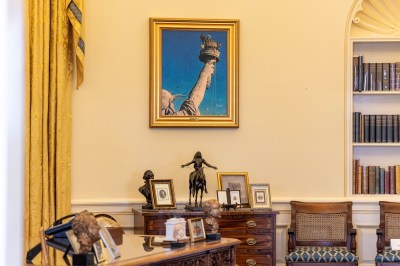
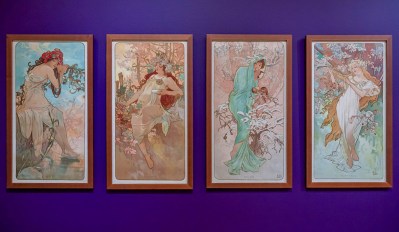
Walking through the many rooms, we encountered works by artists such as Thomas Sully, Gilbert Stuart, and James Stuart. Cinthia and Olivia delighted in recognizing these artists whose works they admired.
We also stumbled upon a chandelier that was featured in Gone with the Wind. As a movie enthusiast, it was a thrill to see it up close and imagine stepping into Ashley Wilkes’ home.
Photo from The Greenbrier
Next, we proceeded to Drapers Restaurant for lunch, named after Dorothy Draper, whose distinctive decor transformed the Greenbrier in 1948 after the resort reopened. This style, which one website referred to as “anti-minimalist,” is known as “Hollywood Regency.”
Photo from The Greenbrier
Personally, I admire her style and could envision drawing inspiration from it for my own home one day.
The restaurant exuded her signature taste, with glamorous touches of pink that prompted us to point out various details to each other. A portrait of Ms. Draper was even on one of the walls.
Photo from The Greenbrier
During lunch, Olivia and I tried grits for the first time, and everyone savored the cherry vanilla milkshake. When my meal arrived, I was momentarily taken aback by its generous portion size and the elaborate dinnerware.
We did our best to finish our meals, but we were also cognizant of not overdoing it, not wanting to be in a food coma when our afternoon conference sessions took place.
Conference Session: Adapt and Survive: Artificial Intelligence in the Classroom
by Olivia Discon
Our first session of the conference offered a compelling exploration of how ArtificialIntelligence (AI) and educational technology are shaping modern learning environments. As students directly impacted by the ever-changing world of AI, we were very intrigued to hear from those addressing these issues head-on.
The discussion highlighted a significant finding: studies show people are more likely to believe misinformation generated by AI compared to that created by humans. This requires ethical and responsible use of AI tools in education. The panelists emphasized that while AI can be a powerful educational resource, it should be utilized as a tool and not as a replacement for traditional teaching methods.
A key focus of the session was the promotion of critical thinking in the classroom. The panelists stressed the importance of using AI as a “thought partner” to enhance students’ cognitive skills rather than to replace critical thinking. They advocated for fostering an environment where students are encouraged to question and analyze information, ensuring that technology serves as an aid rather than a crutch (this was a focus of a book recently recommended to me, Academically Adrift).
Equitable access to AI tools was another major point of discussion. The panelists noted that for many students, particularly in rural or economically disadvantaged areas, schools may be the primary source of access to advanced technology. Ensuring that all students have the opportunity to benefit from these tools is essential for creating a level playing field in education.
The session also included a visual comparison of generative AI outputs from 2022 and 2023, highlighting the rapid advancements and potential of these technologies. The panelists pointed out that while these changes may seem dramatic, they are part of a continuous evolution in technology. Just as we adapted to the advent of the internet, we need to find ways to integrate AI responsibly into education.
Overall, the session emphasized that while the landscape of technology in the classroom is rapidly changing, it is crucial to balance innovation with critical thought and ethical considerations.
Welcome Night
The Southern Legislative Conference began with an outstanding welcome evening that truly set the tone for the event. Held in the stunning Colonial Room, we marveled at its elegance and opulent pink design.
The buffet-style dinner was a mix of local ingredients and favorites, all with a healthy helping of sides.
Sierra Ferrell, a West Virginia native, took the stage for the evening, delivering an impressive, two-hour performance.
Her folk and country music, tinged with jazz, pop, and even calypso influences, captivated everyone.
In between songs, she offered opinions on everything from the water supply to elite control of the country to love, hate, and authenticity.
Exploring the great outdoors offers a fantastic sense of adventure and discovery, especially when it involves chasing waterfalls. Accordingly, we embarked on a series of hikes to some of West Virginia’s most picturesque trails, each boasting its own unique charm and natural beauty.
Albert Falls, nestled in the formidable forests of West Virginia, captivated us with its tranquil atmosphere and stunning cascades of water. The trail meandered through lush greenery, and despite an amusing mishap where our professor took an unexpected plunge (much to everyone’s amusement), the experience was unforgettable.
Sammy, our trusty hiking companion, added to the camaraderie, making it a day filled with laughter and shared memories.
At Blackwater Falls State Park, anticipation built as we approached the main attraction: Blackwater Falls–a breathtaking, thundering waterfall framed by rugged cliffs. The name, “Blackwater,” derives from the water, which is darker because of the chemicals in the leaves that populate the trees in the State Park.
We made our way down a boardwalk that leads to several overlooks, offering views of the 57-foot tall waterfall. While there, we had opportunities to (1) race our professor and (2) see a beaver doing its thing. We even saw its home, a dam downstream from the waterfall, prompting Chrissy to say, “It has its own little Fallingwater”!
But our water fall adventures were not complete. Also in Blackwater Falls State Park is Elakala Falls, which provided a more tranquil yet equally captivating adventure. The trail wound through a tranquil forest, leading us to a smaller but still beautiful waterfall. Venturing into the river’s edge, we explored underneath the falls, marveling at the sheer power of nature. The slippery rocks added an element of excitement, reminding us to tread carefully while soaking in the beauty surrounding us.
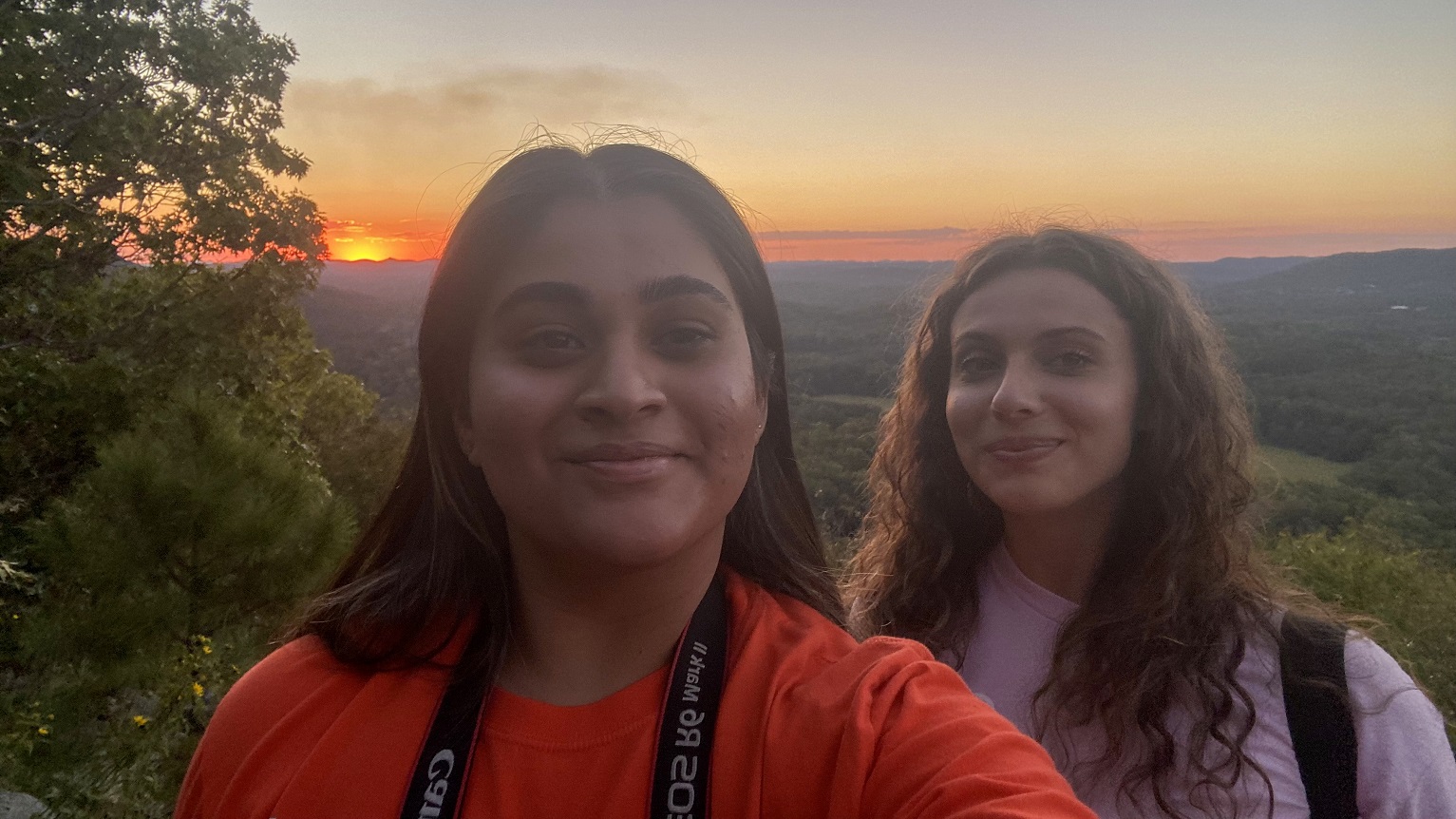
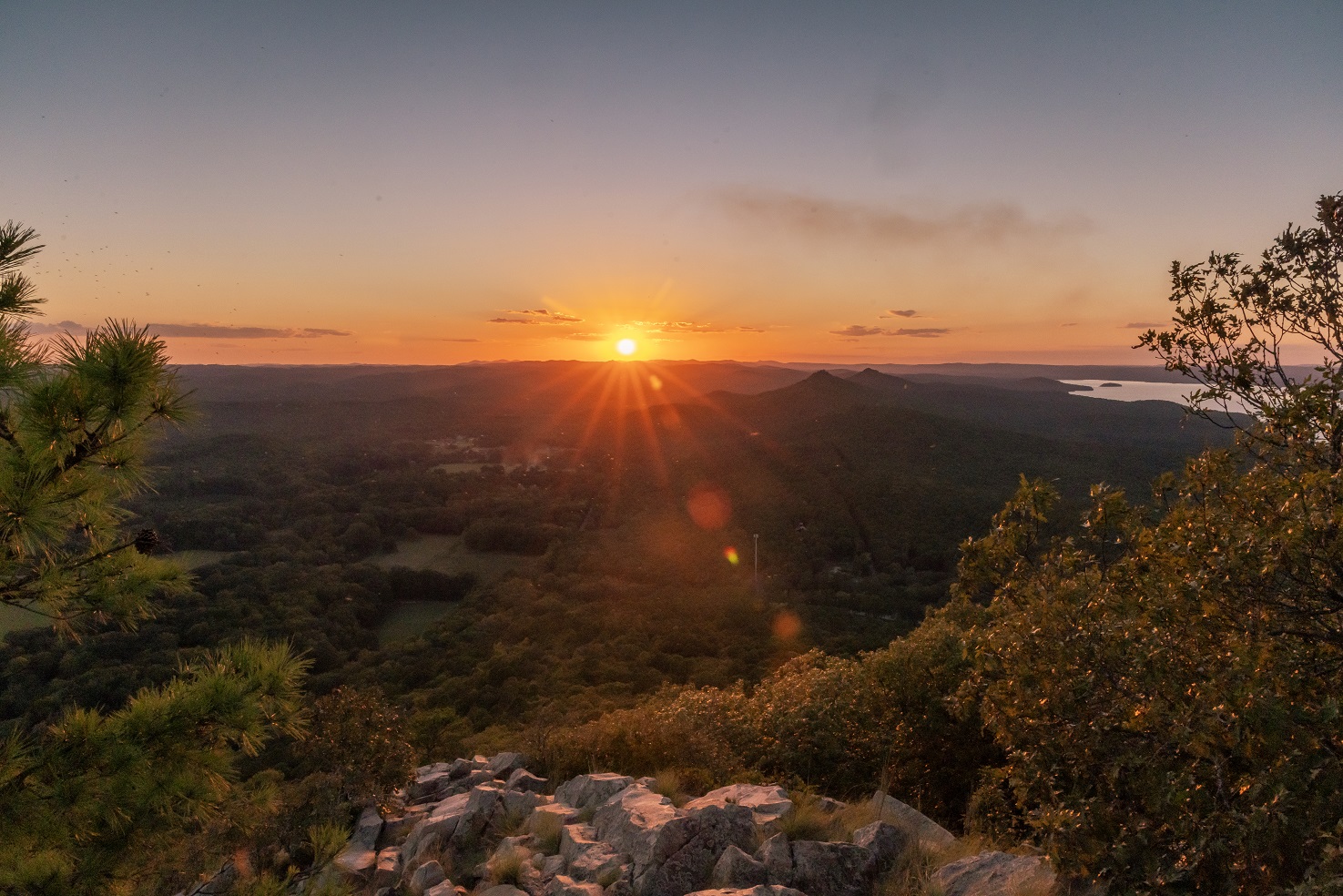
Before the night ended, and before we left the Park, we also had the opportunity to enjoy the sunset!
Each of our adventures offered a glimpse into the natural wonders of West Virginia, from serene forest trails to dramatic waterfalls to a beautiful sunset. These experiences not only rejuvenated our spirits but also strengthened our bond as adventurers seeking to uncover the beauty of our world, one trail at a time.