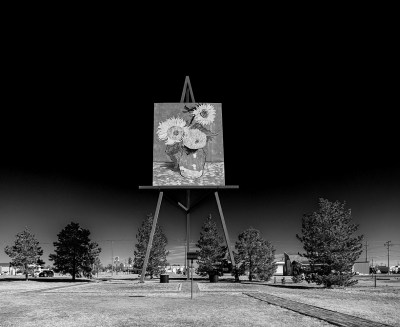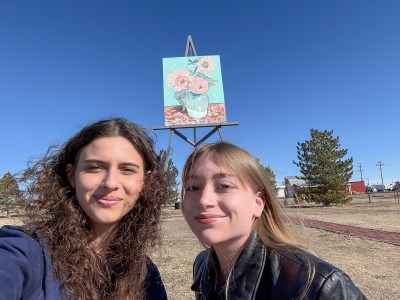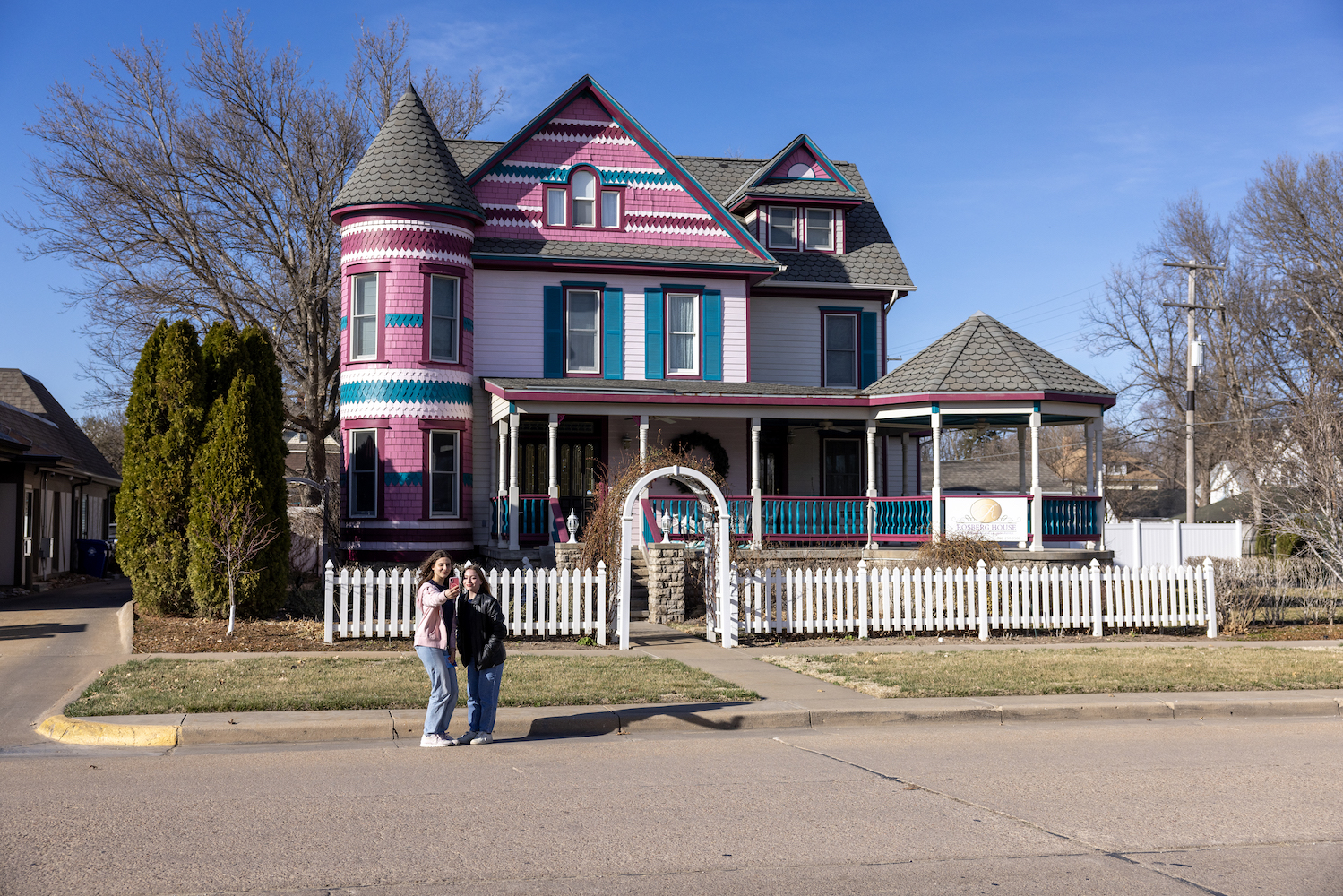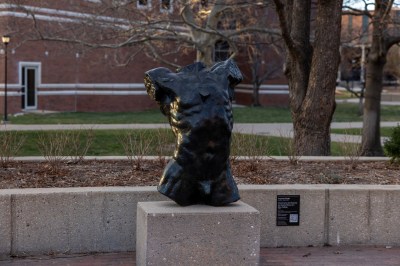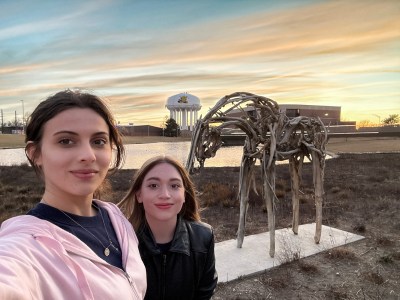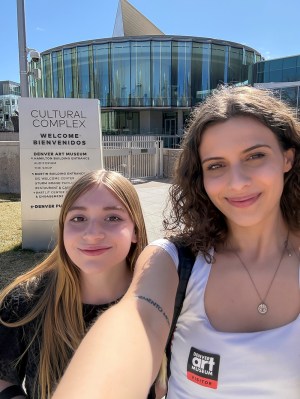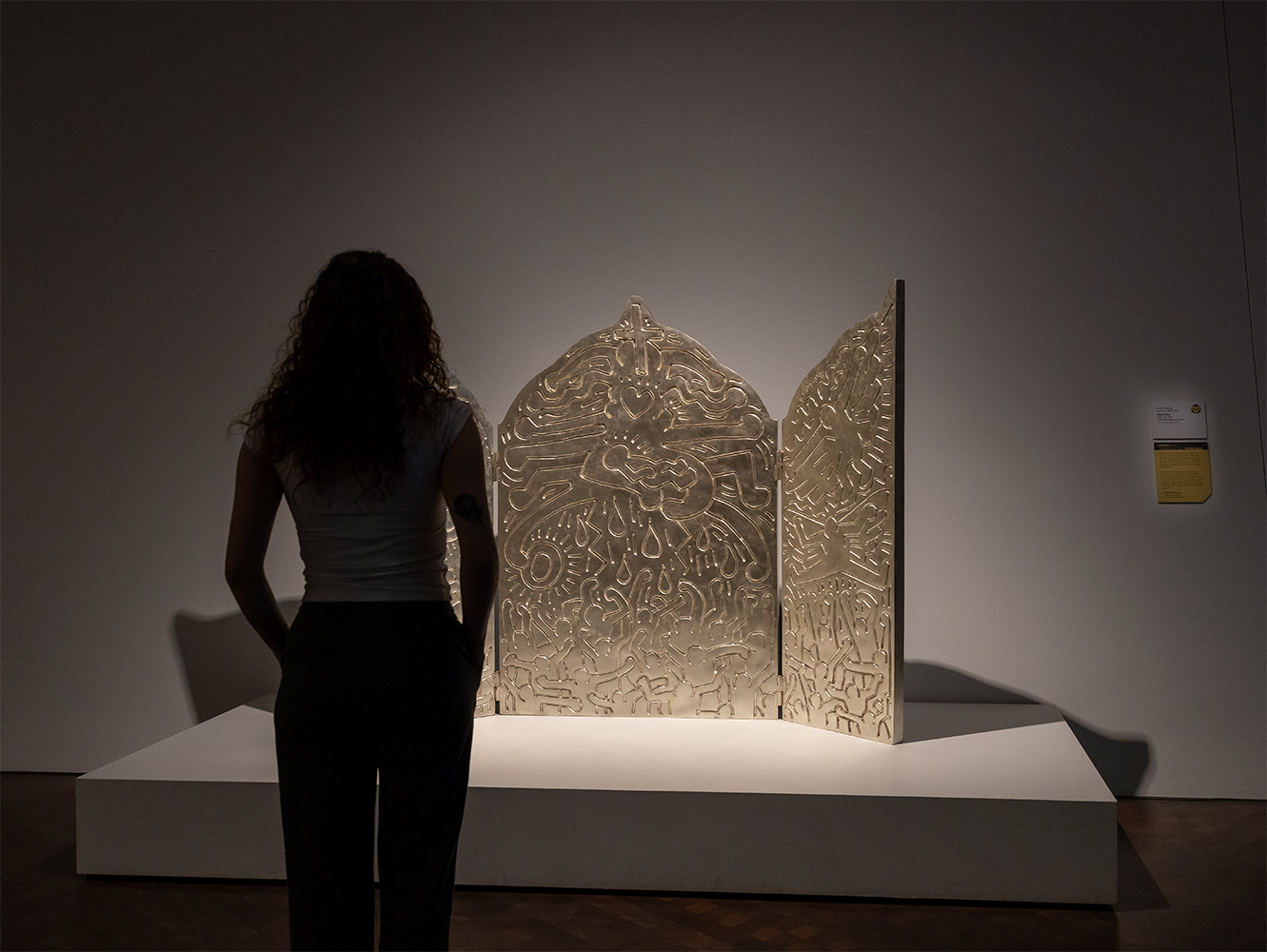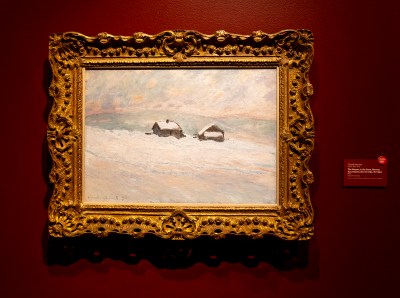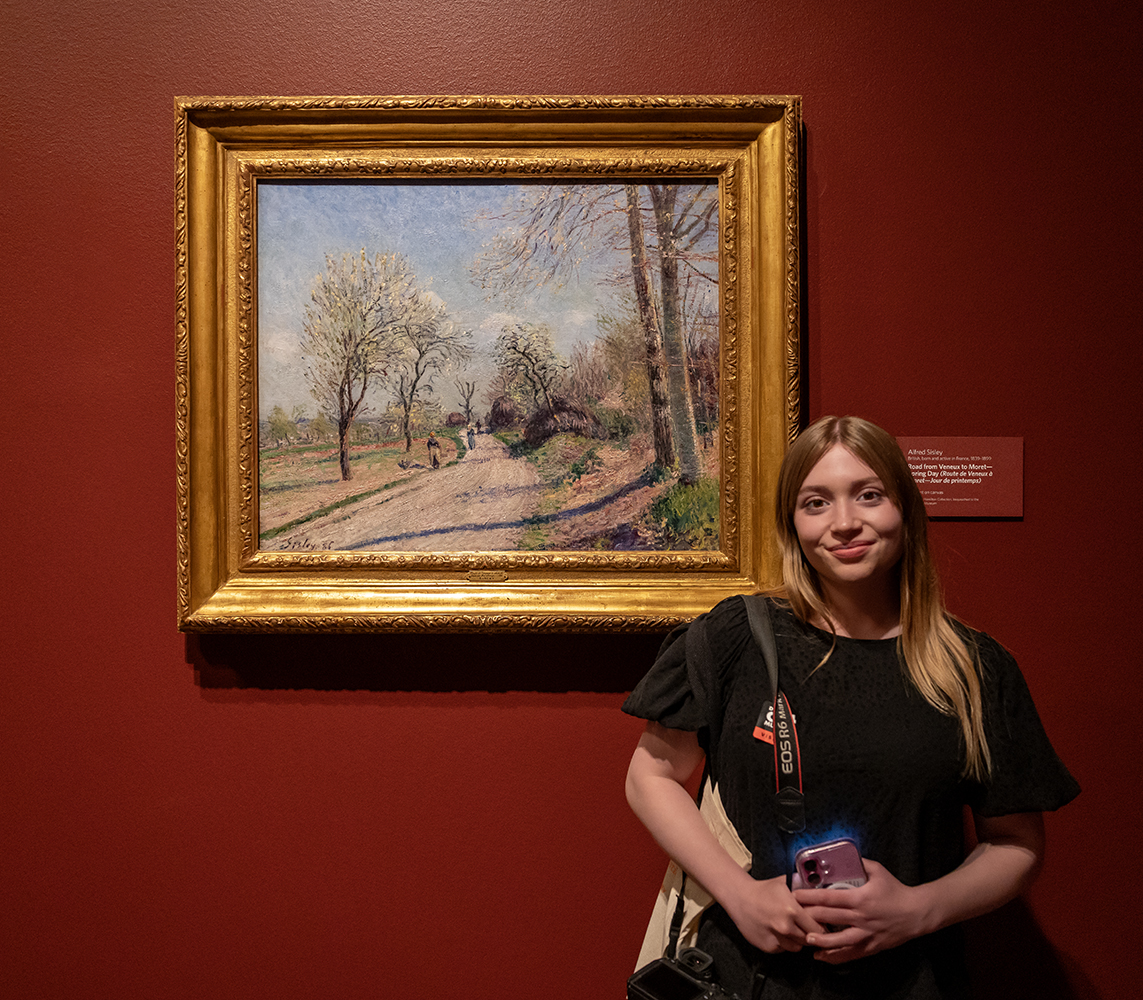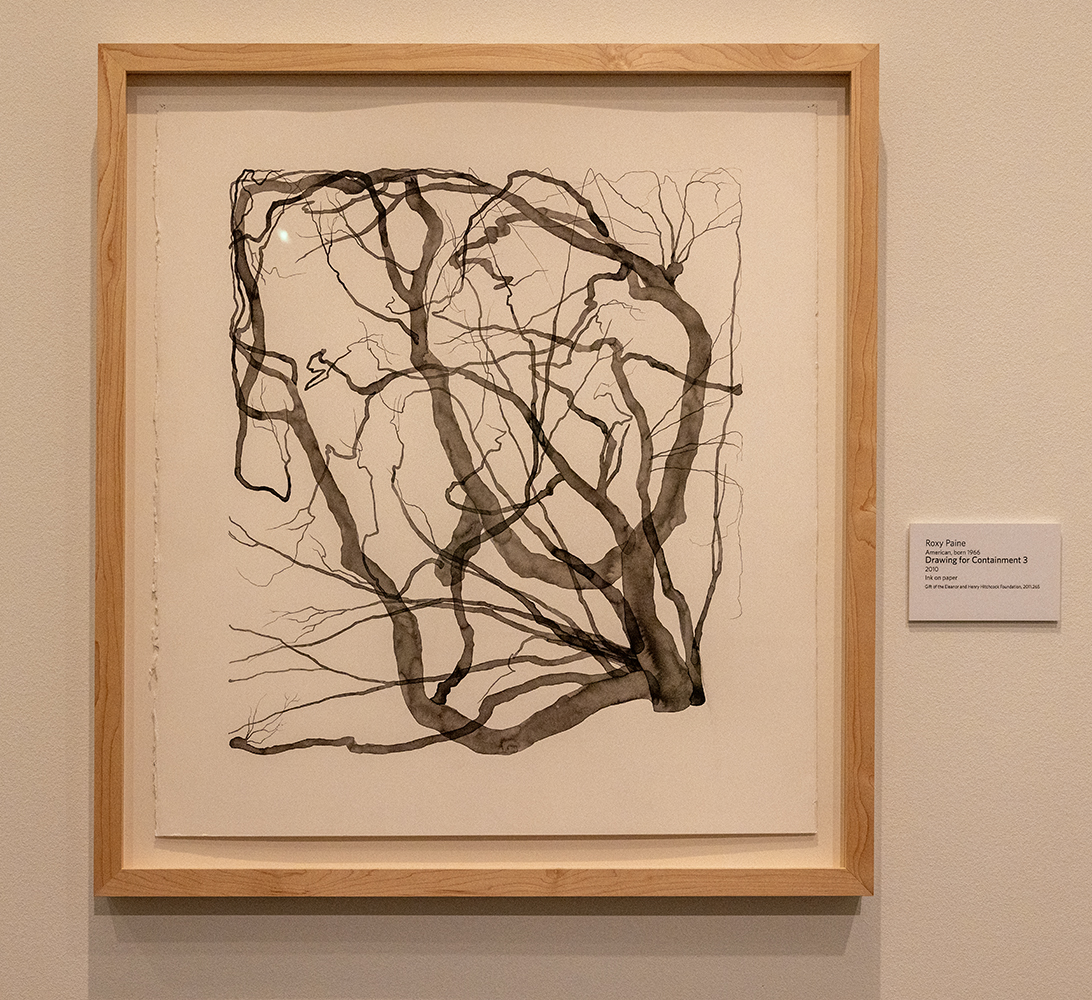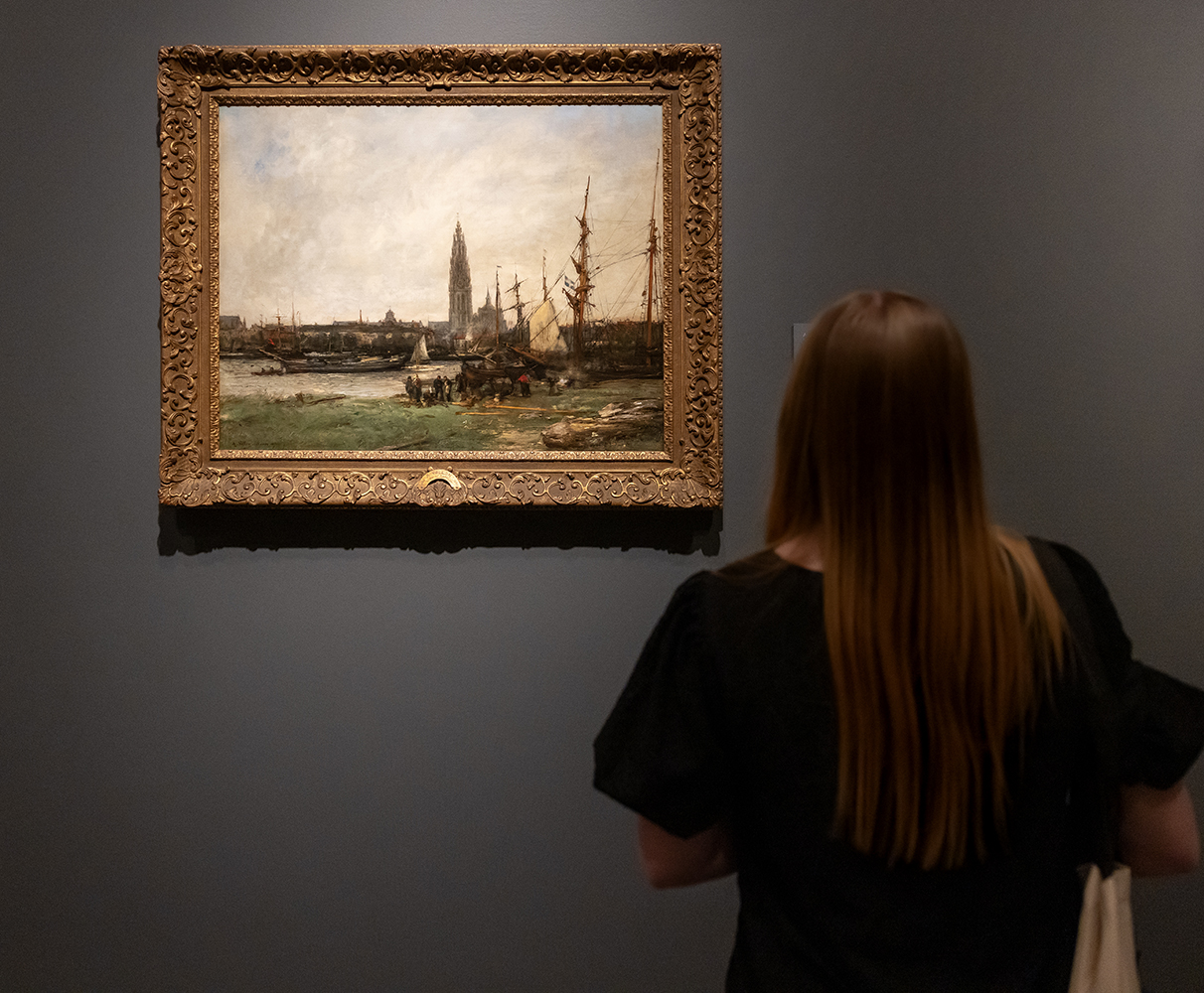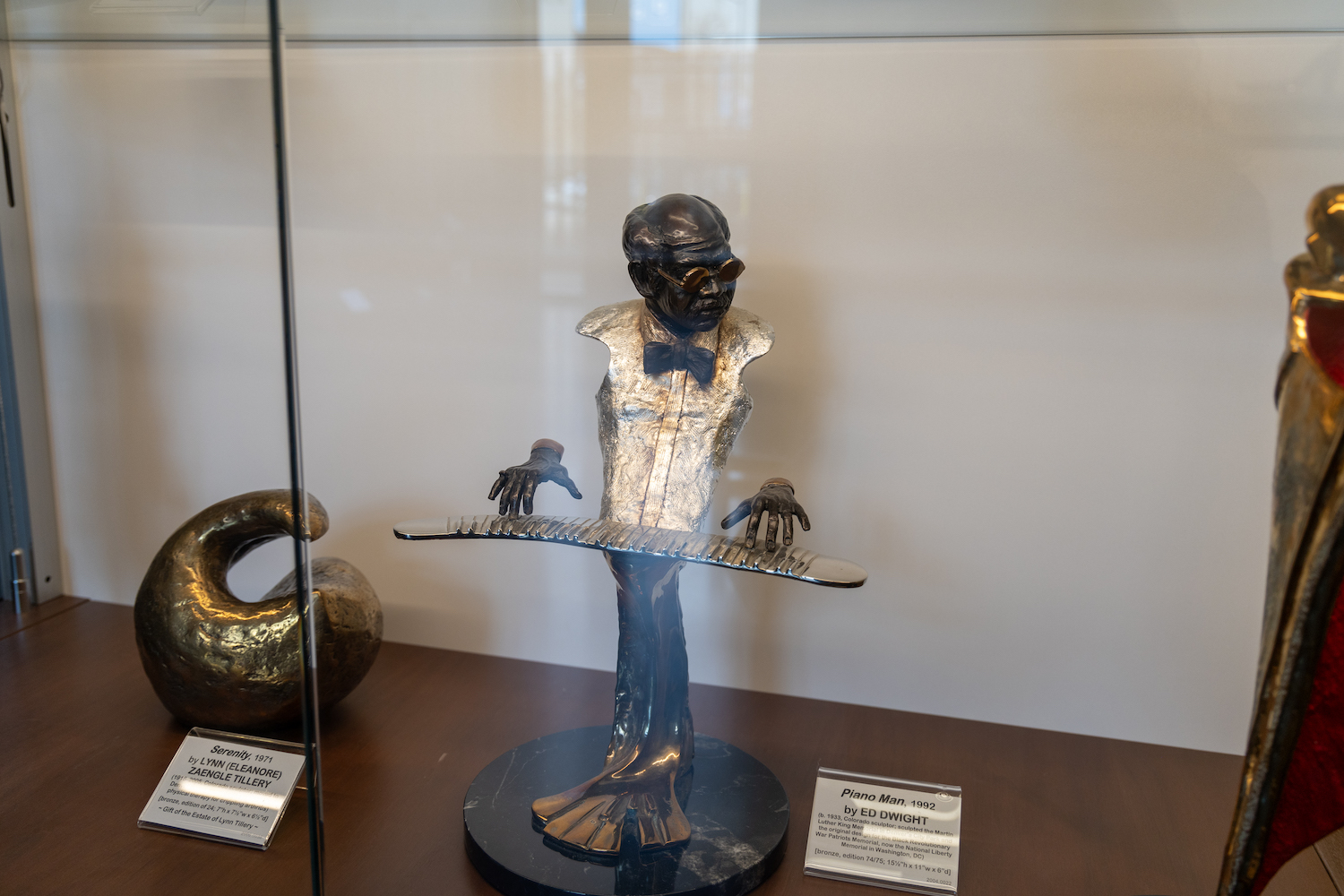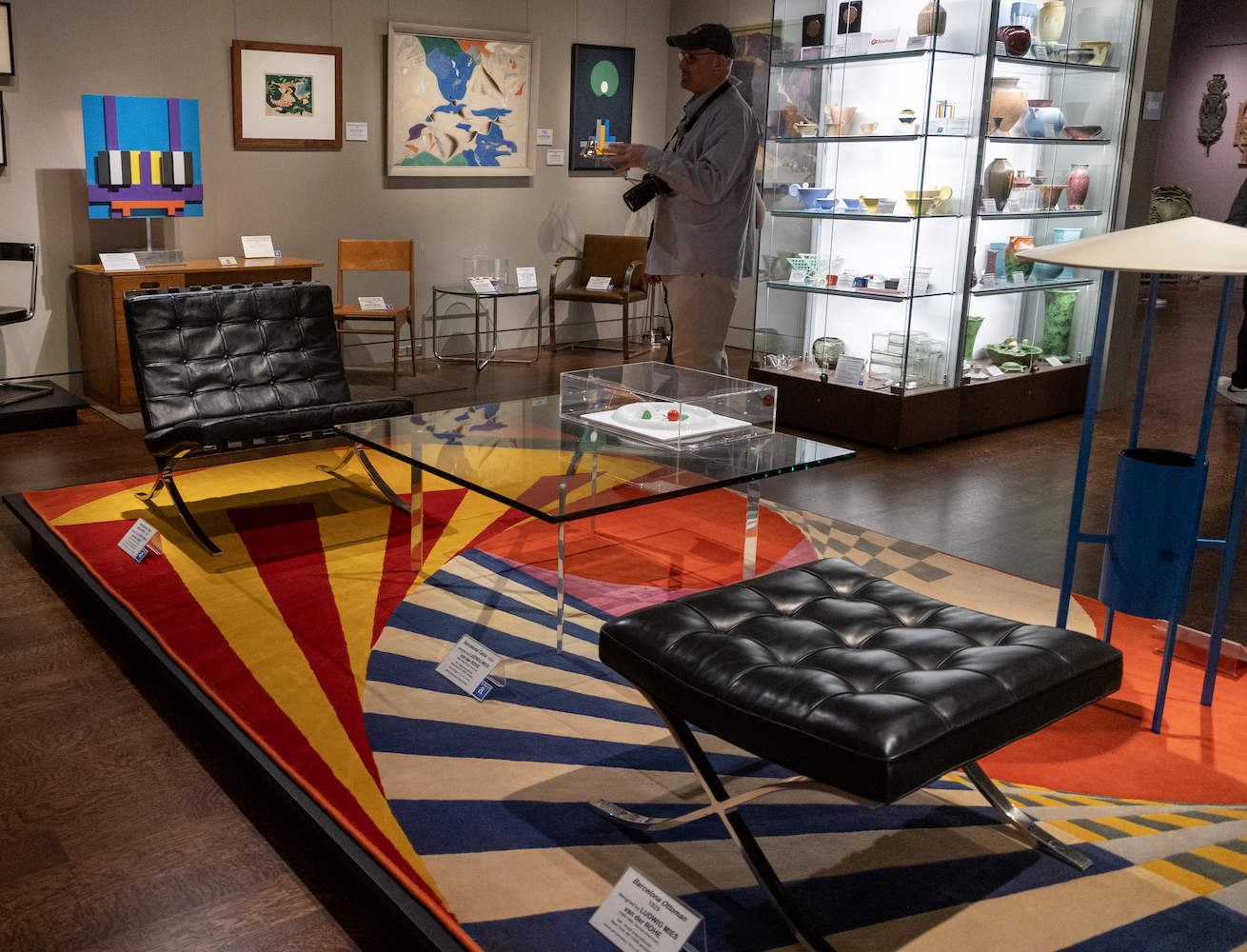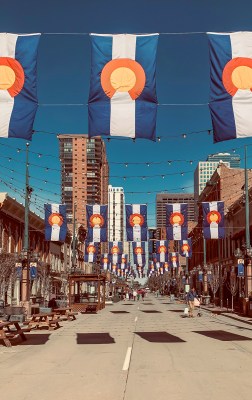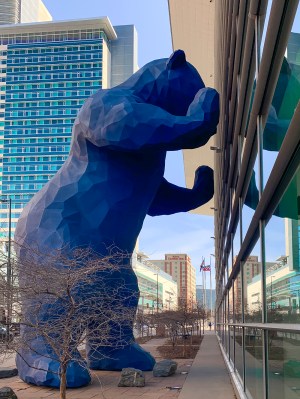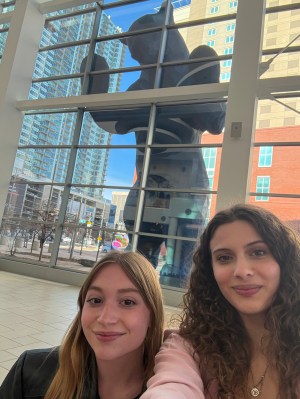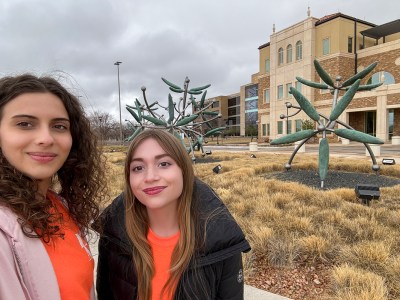
En route to Denver, Colorado for a conference presentation, our travels brought us through the vast expanse of west Texas. This path gave us the opportunity to see two charming western towns, Abilene and Lubbock. In Abilene, we hoped to spend some time in their historic downtown district, while Lubbock was on our radar because it is a possible law-school destination for both Olivia Discon and Chrissy Biello. Exploration was in order!
Grace Museum
by Olivia Discon
Abilene, Texas, has a lovely and historic downtown.
Known as the Storybook Capital of Texas, the city is truly proud to bear the title. Around the area, you can find public sculptures…
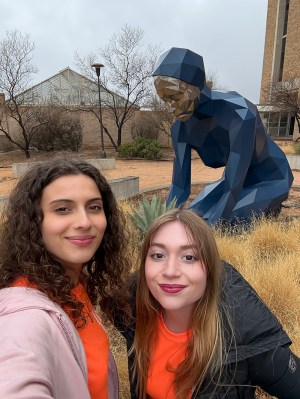
Olivia Discon and Chrissy Biello with Luis Jimenez’s “Mesteno” in Abilene
…cartoon characters, bookstores, and other fun literary-themed spots. We stopped by the mini sculpture walk in Everman Park, and Chrissy and I had a great time reminiscing about the titles and book characters that marked our childhood and our respective love of reading at an early age.
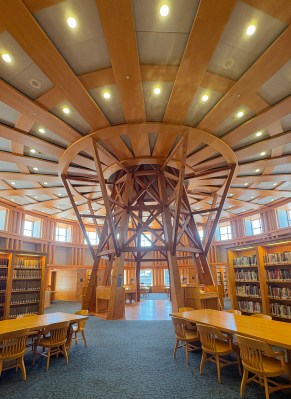
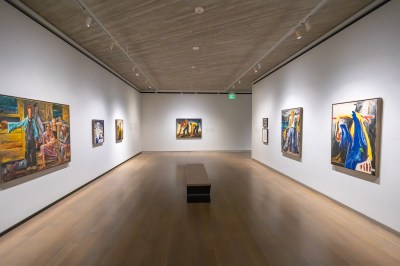
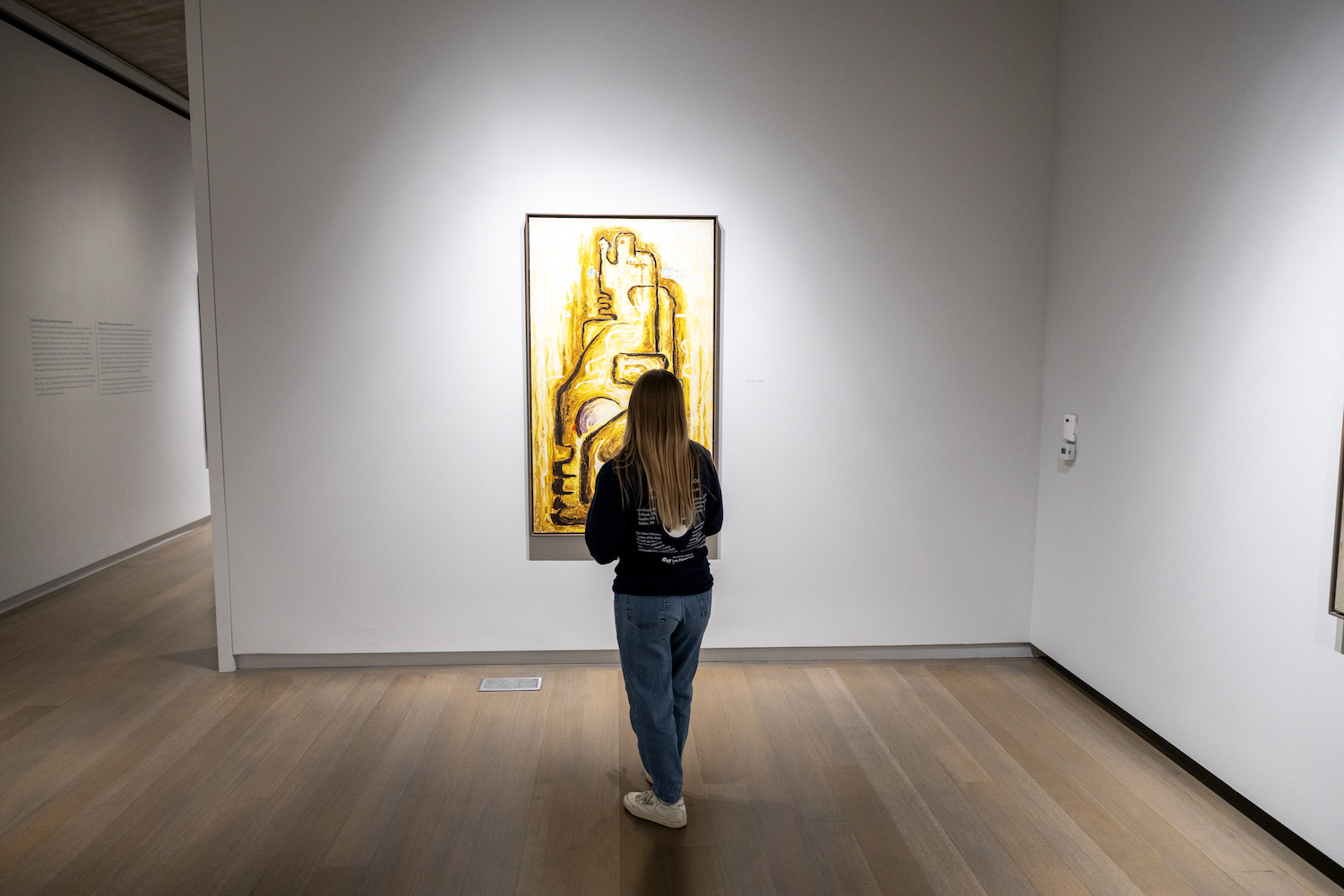
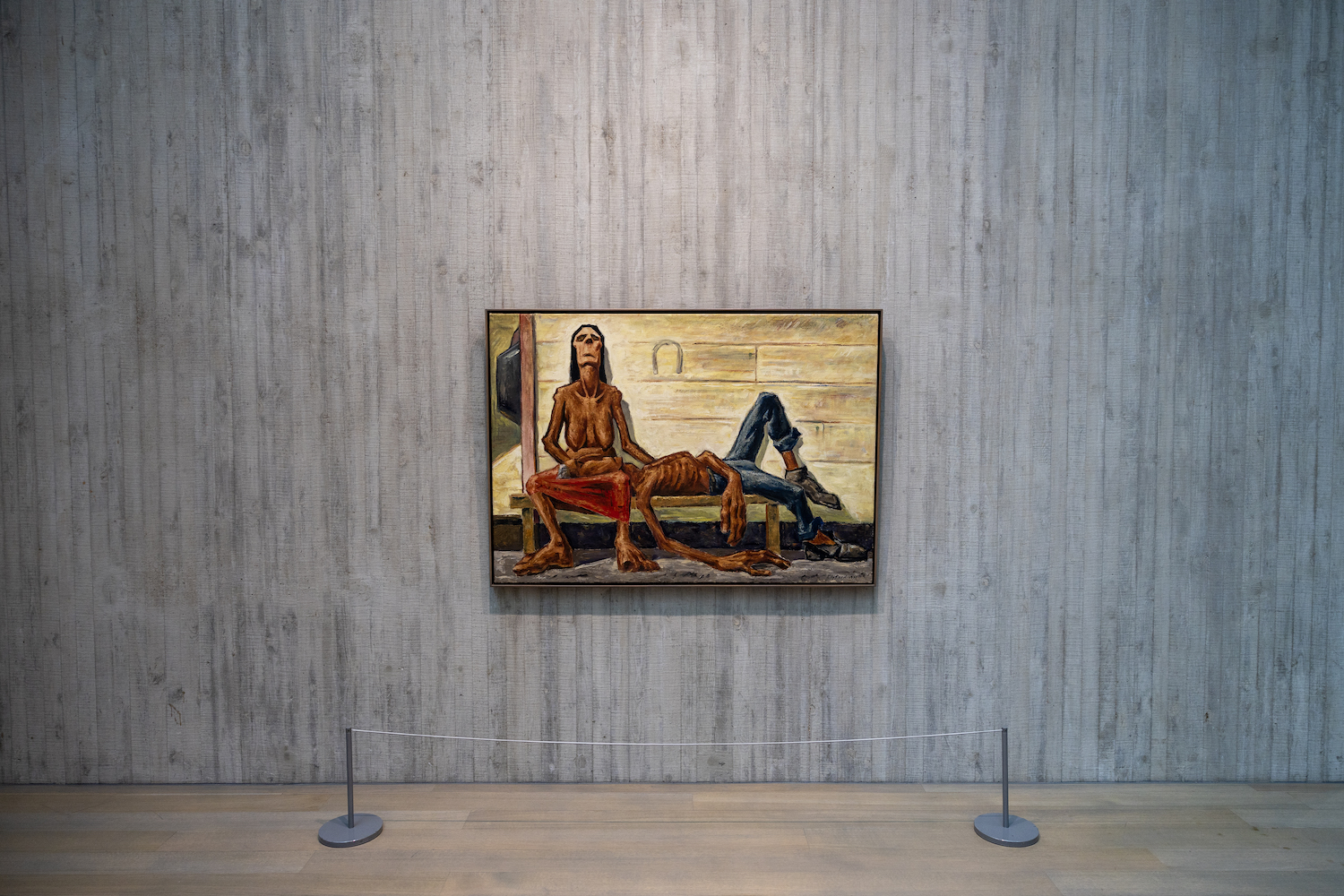
After that, we went into the historic Grace Museum. The building itself is beautiful, and the current exhibit was really interesting. Within the exhibit, there was a handmade wooden “chapel” displaying about 20 paintings that depicted contemporary or average-looking people in religious scenes, which was thought-provoking and very well done. What stood out to me the most were the gold leaf paintings and the creative ways biblical stories were referenced.
There was a book in the gallery that explained which biblical story matched up with the modern figures in the paintings, which I thought was a nice touch. Yawn and Chrissy were more into the nature scenes, which were different from the religious imagery but still detailed and visually appealing.
One of my favorite parts of the museum, though, was the Youth Art Month gallery. Local students had their work displayed, and it was honestly so fun to see. There was a range of ages (and maybe a range of talent, too), but the community engagement aspect was the best part. I did something similar as a kid, and I still remember the feeling of pride seeing my art displayed, standing next to my parents as they took pictures. But more than that, it’s about showing kids that they belong in these spaces—that they can be part of the art world, even at a young age.
Having the privilege to have gone to several museums with LEAP, I can say that this visit became an unanticipated favorite!
With that pleasant surprise on our minds, we stopped for a quick bite to eat at the highly-rated Jay’s BBQ…
…found the restaurant to live up to its ratings in both hospitality and taste, and we headed to Texas Tech University to visit their law school and get a glimpse, perhaps, of our futures.
Texas Tech Law School and University
by Chrissy Biello
Known for its nationally ranked Advocacy Program and commitment to public service, Texas Tech Law School is filled with immense opportunities that sets their students up for success. Thanks to Dean Saavedra, Assistant Dean of Admissions, and Ms. Moorhead, Director of Admissions, Olivia and I had the chance to tour the law school.
As she took us through the law school, there were many appealing aspects that would draw many students in. One aspect that I found particularly intriguing was the Lanier Auditorium, where the law school hosts many programs for its students. Ms. Moorhead explained they are usually during the lunch hour, allowing students to have the option to attend as there are no classes scheduled during that time.
With multiple clinics, organizations, and externships to choose from, there is something no matter what you are interested in. From this, one is able to go down many different paths to determine what truly aligns with them.
In all, Texas Tech Law School is not only nestled in an area with astounding architecture and art, but it also contains a plethora of ways for students to grow by giving them the resources to do so. Olivia and I would like to thank Ms. Moorhead for giving us a great tour and experience at Texas Tech Law School; it truly gave us a glimpse into the life of a law student at Texas Tech.
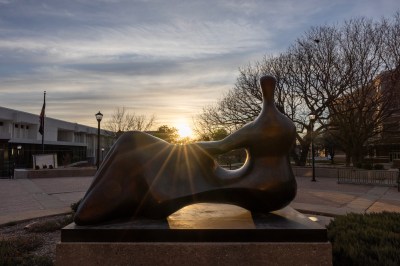
As we were on the Texas Tech campus, we decided to take the chance to walk around and see the art that the students are able to experience everyday. With multiple Moroles sculptures on campus, we LEAPed at the opportunity to go and see them. They were all very striking, and made us feel at home, as Huntsville has many Moroles sculptures as well.
We also enjoyed Deborah Butterfield’s “Wind River” sculpture. Having the previous experience of seeing one of her horse sculptures at the Besthoff Sculpture Garden in New Orleans, I was happy to be making that connection at Texas Tech.
One that is a quite funny play on words is the “Read Reader.” This bronze sculpture is multiple books stacked upon each other, ultimately creating a man reading. Terry Allen, the artist, is actually from Lubbock and is also known for being a great musician!
James Surls, a Sam Houston State University alumni, has a piece in front of the Texas Tech Health Sciences Center. This turquoise sculpture has three different sections and was different than the traditional wooden Surls sculptures I have seen.
One of the most appealing aspects of Tech’s campus is its beautiful mediterranean architecture, landscaped grounds, and the art that adorns those grounds. One sculpture that combined these latter two components was “Agave Dreams” by Juilan Voss-Andreae.
Before leaving Lubbock, we also had to explore the downtown district, as well as the Museum honoring the city’s most famous son: Buddy Holly. We, of course, had to get a photo inside the large glasses that resembled Holly’s.
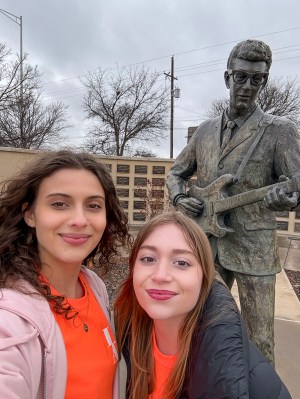
We then concluded our time by taking a selfie with the Buddy Holly sculpture nearby…
…and looking at some of the names on the Buddy Holly Walk of Fame, spying Texas luminaries such as Roy Orbison, Terry Allen, Mac Davis, Guy Clark, and Bob Wills.
It was a fitting end to a day that is unlikely to “fade away,” with thoughts of our future in law and reflecting on a day with art.
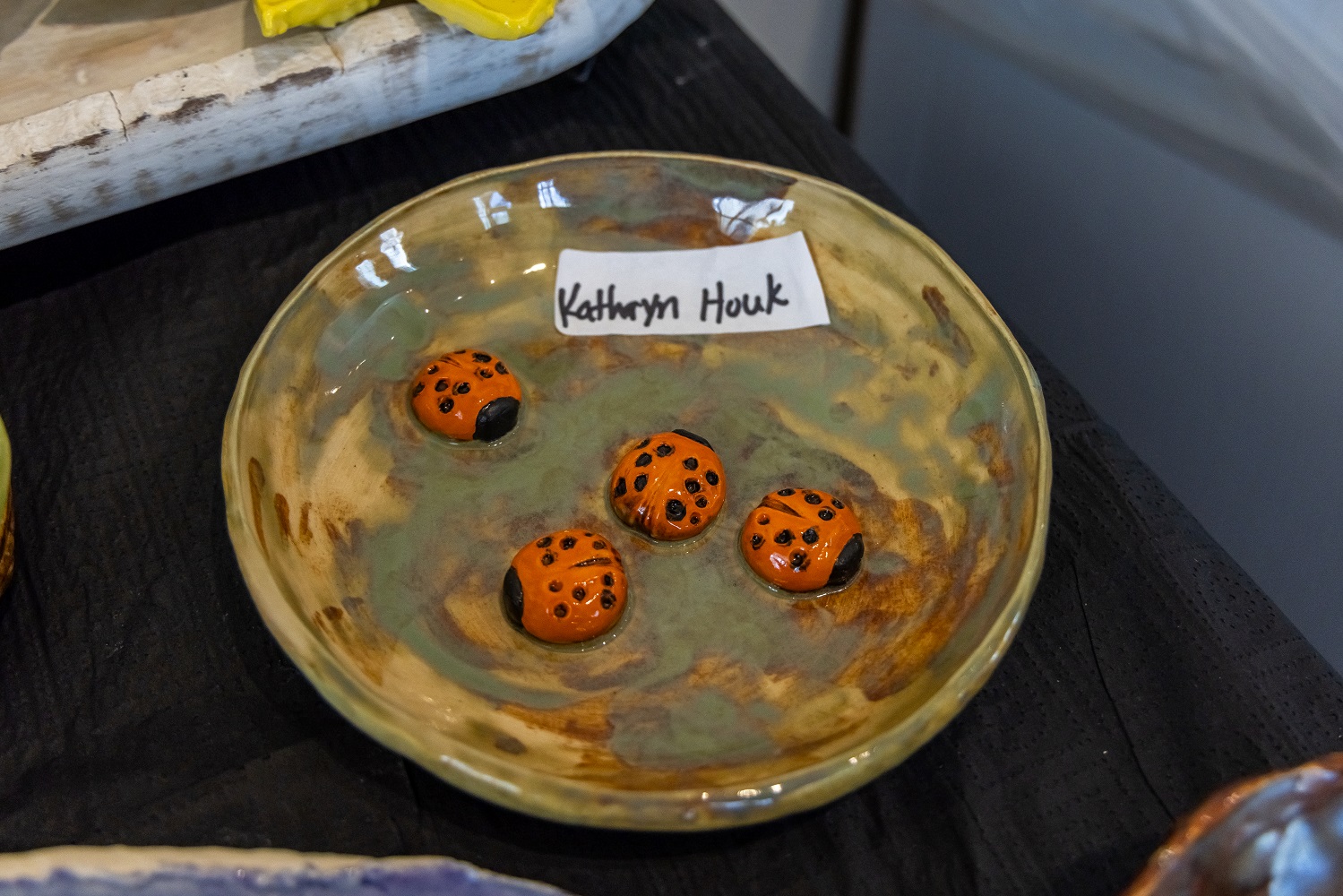
In 2007, SHSU student Sarah Lisenbe volunteered for the Montgomery County Food Bank, and she learned about, and assisted with, a program called Empty Bowls. The next year, she interned for the Wynne Home, and she worked with local artist Tamara Chasteen to put on the program in Walker County. For 18 years, this program has been helping fight food insecurity in Walker County by benefitting the Walker County Senior Center and the “Meals on Wheels” program.
The Wynne Home has led this charge, with Angela Robinson spearheading this effort the past several years, and the LEAP Ambassadors assisting each year since the program’s inception.
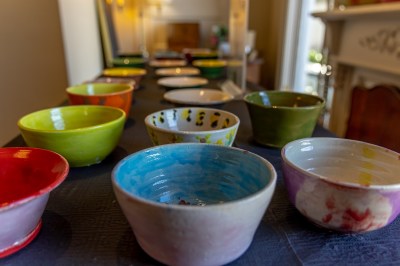
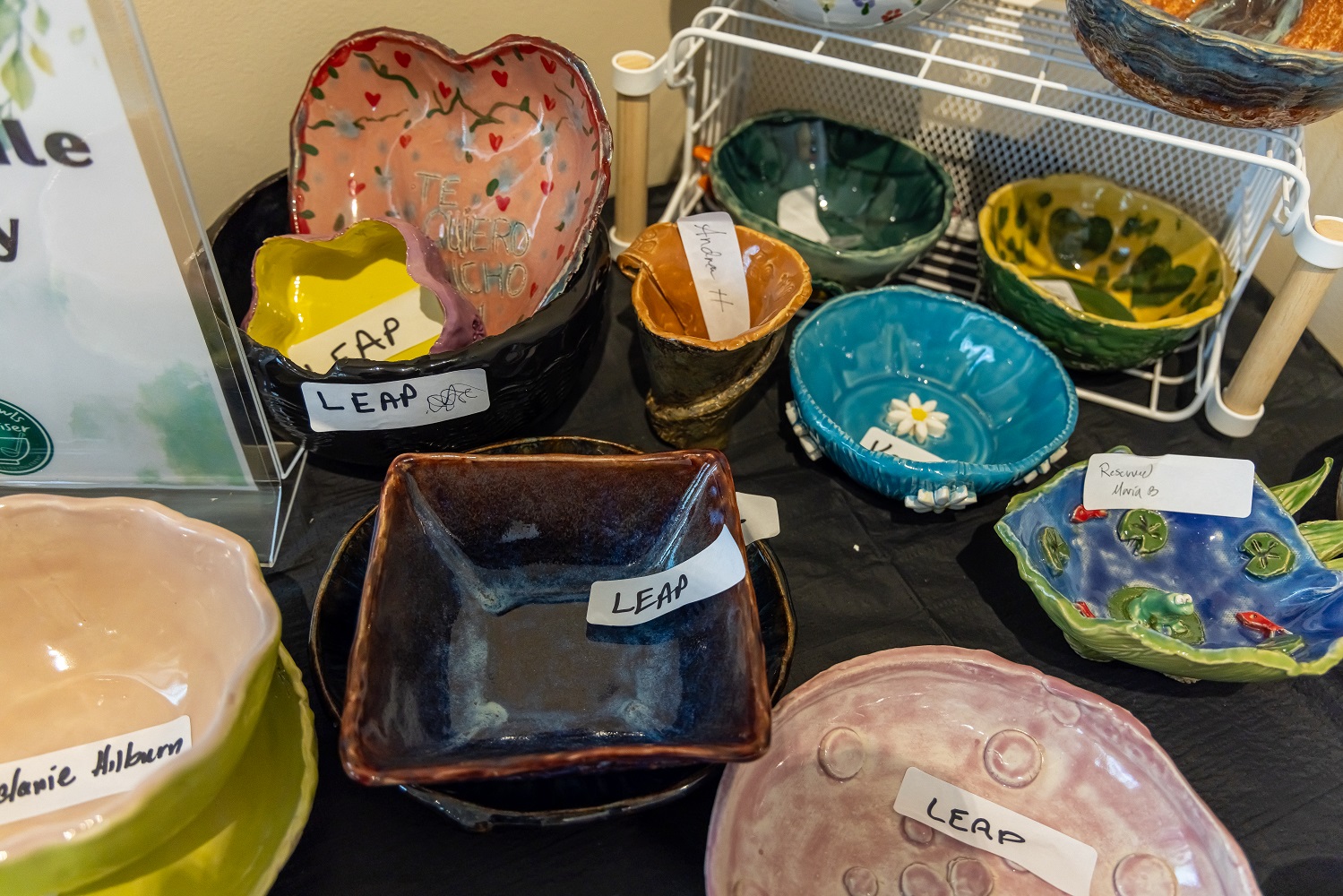
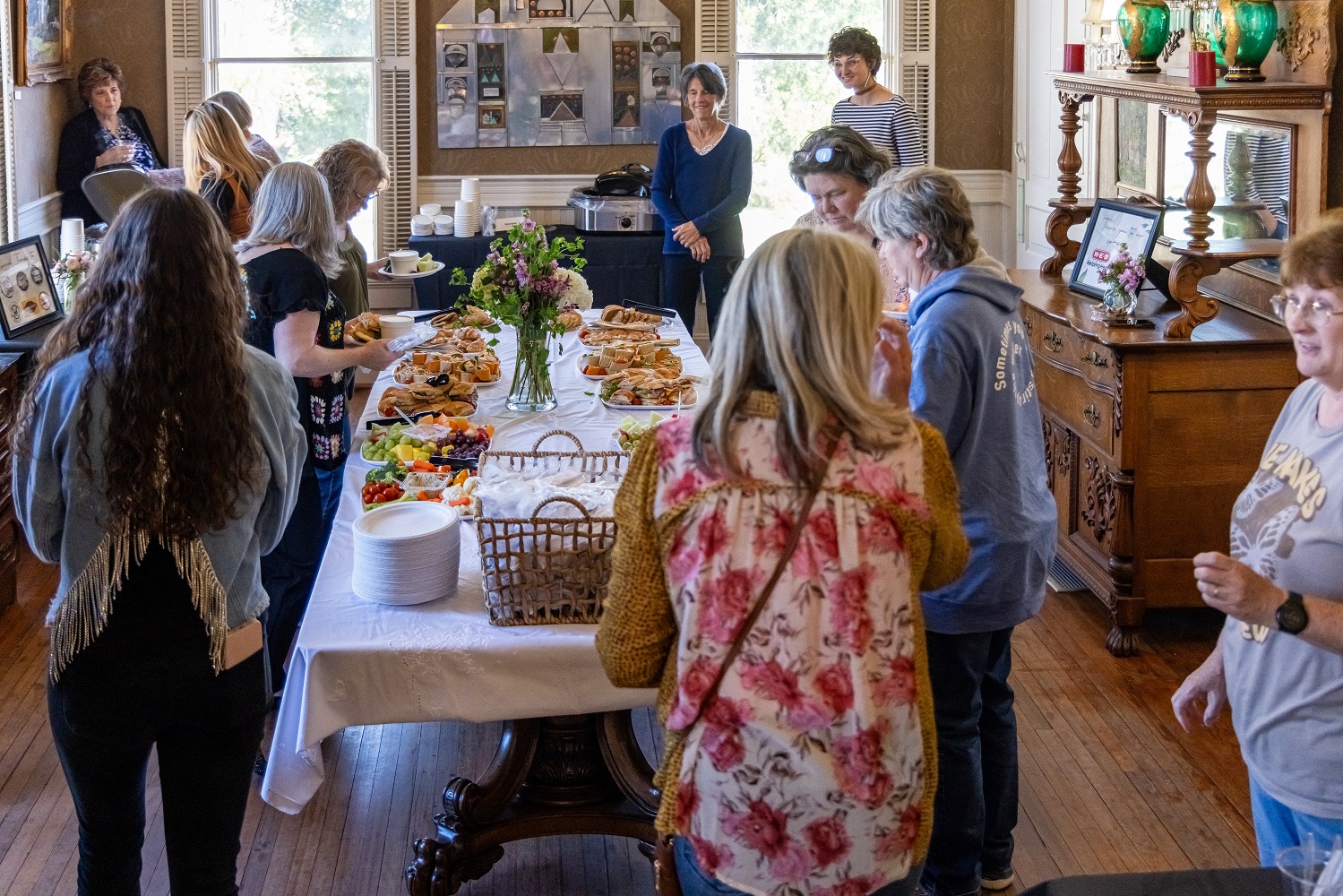
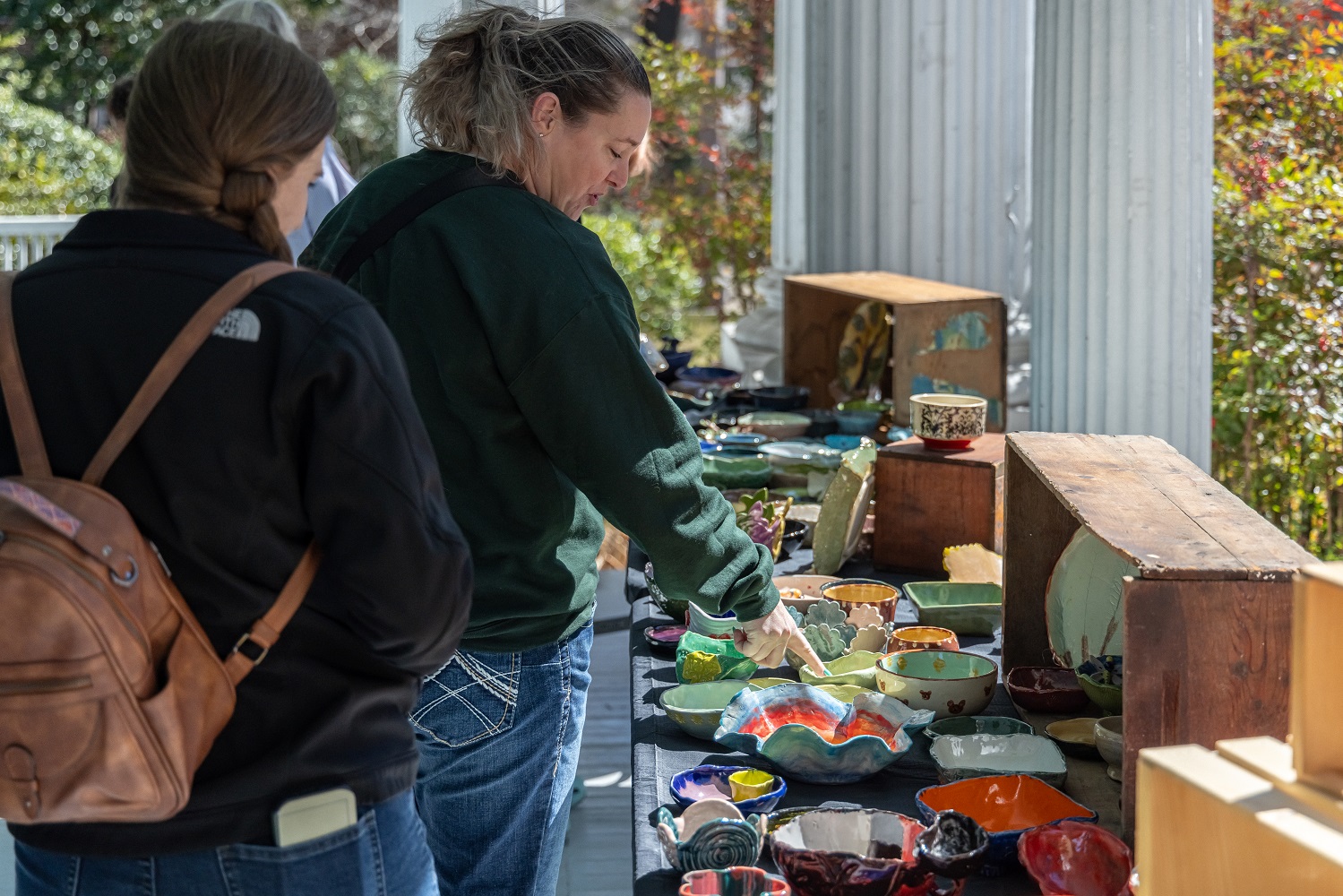
The program involves two broad phases. First, art teachers offer classes to community members bowls are created and glazed. Second, just before or during Lent, the community comes to the Wynne Home, and with a suggested donation of $15, they can select a ceramic bowl, and then enjoy a hot meal donated by area businesses. For 2025, the generous sponsors were Five Loaves Deli, City Hall Cafe, Sam’s Table, Potato Shack, Huntsville High School Culinary Class, and HEB.
This year, under Robinson’s leadership and the assistance of many talented art teachers, the program produced more bowls (300) and, if preliminary reports are accurate, a record amount of donations (approximately $7,200)–to which the LEAP students contributed almost $600.
But it is a true community event. Teachers promote the arts in the community by hosting pottery sessions; local residents learn to mold and shape and glaze bowls; businesses donate to the worthy cause (Diego Varela, owner of Sam’s Table not only donated soup, he stopped by to donate!); and locals come to support the fight against food insecurity, see the Wynne Home, and enjoy each other’s company.
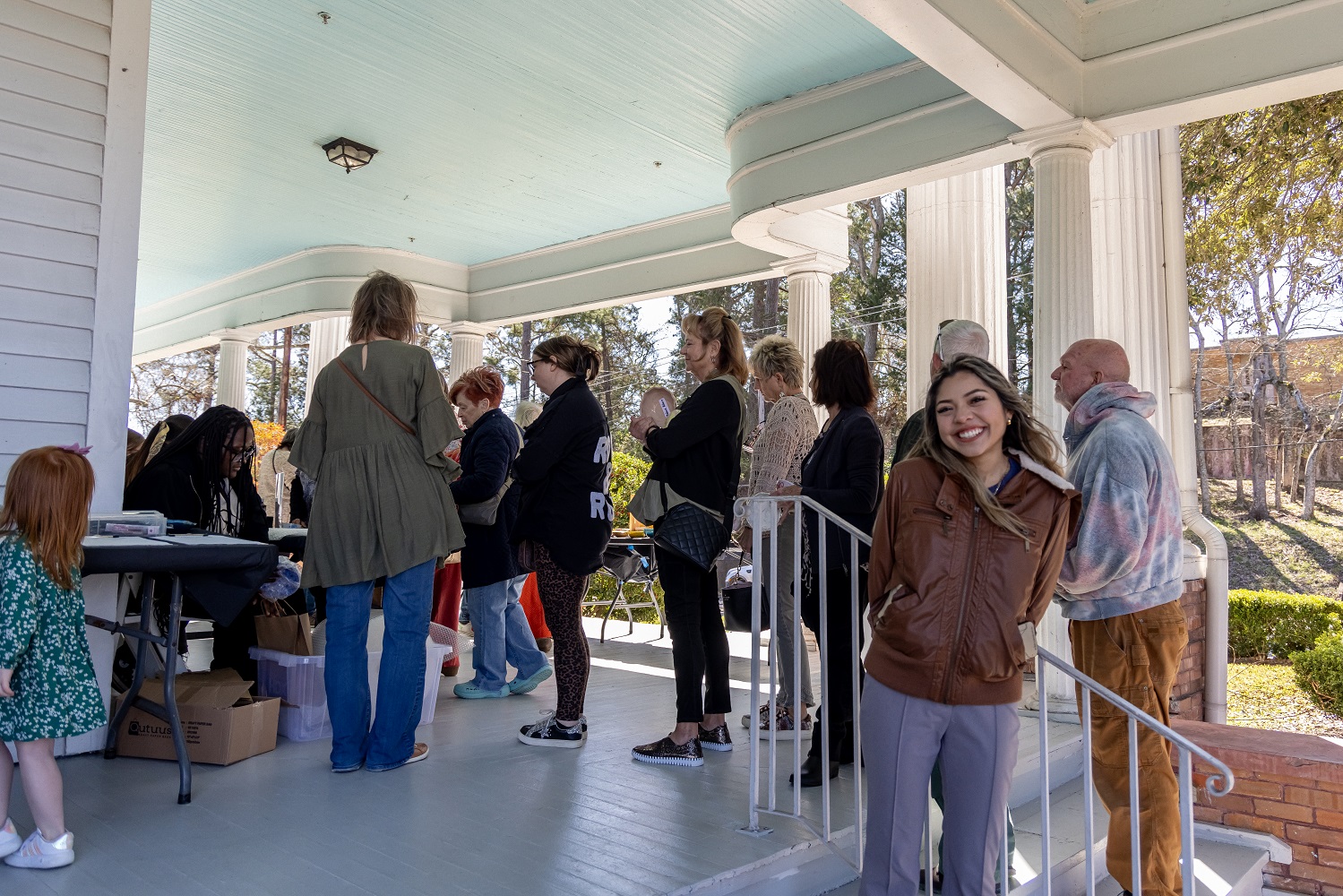
This was on full display today, with elected officials, city employees, non-profit leaders, and more than a hundred others supporting the cause. It was an Ash Wednesday to remember, but it’s purpose is to help fight food insecurity year-round. So, with each ceramic bowl that a local resident takes home, they have a reminder not only of the beauty and creativity inherent in art, but also that there are others who are suffering from a lack of the basic necessities. That is, they lack even food to put in bowl.
But, with the help of events such as “Empty Bowls,” there are fewer such bowls in Walker County.
Music, murder, mayhem: what’s not to love? That’s pretty much how LEAP students felt about Bob Fosse’s “Chicago,” performed this week in College Station.
Performed at the Rudder Theater on Texas A&M University’s Campus, “Chicago” is in the midst of a seemingly endless national run. This tour included Taylor Lane (Velma Kelly), Ellie Roddy (Roxie Hart), Connor Sullivan (Billy Flynn), Andrew Metzger (Amos Hart), Illeana Kirven (as “Mama”), with Lane and Kirven as particular standouts (the latter is from Tyler, TX).
For those who haven’t seen it, the play is a satire on the strange world of celebrity in the United States, particularly the country’s tendency to elevate the most notorious of criminals. Written in the 1970s, the musical anticipates a world in which people such as O.J. Simpson, Kim Kardashian, Brittney Spears, and the “Hawk Tuah” girl are seen as influencers.
Such individuals not only escape the criminal justice system, but they also seem to win in the court of public opinion, maintaining a celebrity status.
In the musical, the story of Roxie Hart is told through songs. Hart, who is indicted for the murder of her lover, obtains a not guilty verdict through the “Razzle Dazzle” of her Johnny Cochran-like attorney, Billy Flynn. As salacious as Hart’s case is, however, she competes with the girls of the “Cell-Block Tango” among others for attention from the media and the public.
With a rewritten narrative of the murderous night (“We both reached for the gun“) and the manipulation of Roxie’s hapless husband, Amos (Mr. Cellophane), Roxie is acquitted.
But in a world where everyone receives 15 minutes of fame, Hart’s fame gives way to others, and she and Velma Kelly are relegated to Vaudeville, a kind of forerunner to TikTok.
For a group of aspiring lawyers in the 21st century, it was a worthy fable and a wonderful night of entertainment.
Indeed, different aspects of it appealed to each of us. For Chrissy, she enjoyed Bob Fosse’s choreography and the song “Nowadays.” Olivia enjoyed “Cell Block Tango” and, even more so, “We Both Reached for the Gun.” Michelle, on the other hand, favored “Me and My Baby” and the satire and irony that suffused the production–the very first play she has seen! For Mike and Stephanie, a “favorite” is less clear, but “All That Jazz” never gets old.
Nor does “Chicago: The Musical,” which is why it is the longest-running American musical in Broadway history. And the third time–but not the last–that LEAP Ambassadors have seen the production!
Over the past couple of months, the LEAP Ambassadors have had the opportunity to contribute to one of Huntsville’s most impactful community events: Empty Bowls. This annual event supports the community by combining art, creativity, and a shared commitment to helping those in need.
The Empty Bowls Fundraiser
Empty Bowls involves a series of activities promoting the arts which culminate in a fundraiser for the Senior Center, a local non-profit that, among other things, combats food insecurity.
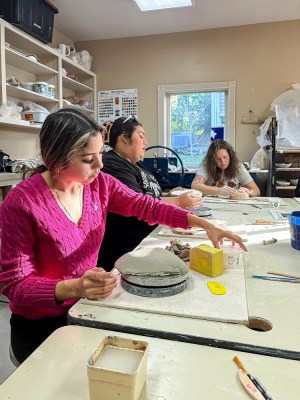
With grants that provide clay to the Wynne Home, local community members–under the tutelage of skilled ceramicists–create bowls; they then gather again to glaze the bowls; and then the community comes together to purchase soups (donated by local restaurants), obtain a commemorative bowl, and support the local Senior Center.
Creating Our Bowls
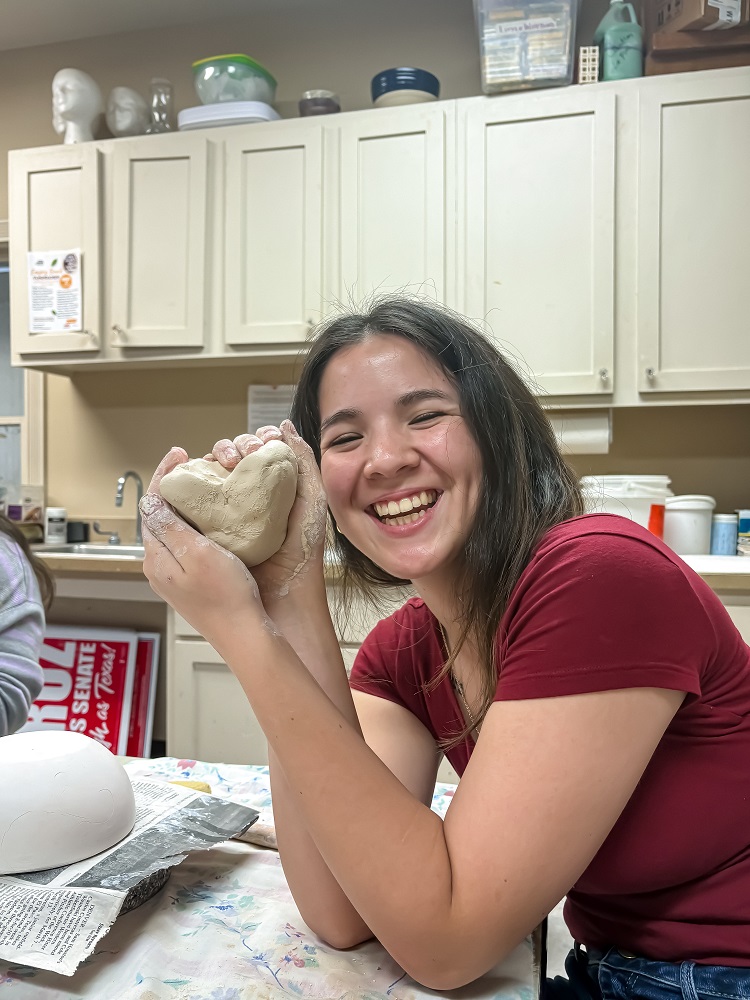
Under the guidance of instructor Leara Phillips, we created nine ceramic bowls as part of the Empty Bowls project. For many of us, it was our first time working with clay, and Leara made the process both accessible and enjoyable.
Glazing Our Bowls
After our bowls were put in the kiln, we went in shifts (necessitated by the fact that some of us are in Austin doing internships; and others are in Huntsville) to the Wynne Home, where we glazed and painted our bowls.
One of the many pleasant aspects of this process is getting to meet or reengage with people. For example, we (Cinthia and Saara) had a chance to meet Dr. Maria Botero, who is a professor of Philosophy at SHSU, while also spending time with our instructor (Dakota Dube) and other community members.
Supporting the Community
The beauty of Empty Bowls lies in its ability to bring the community together. It’s not just about making or purchasing a bowl; it’s about creating something tangible that supports a larger mission. Each bowl symbolizes community service and the art of paying it forward, reminding us that small acts of kindness can have a profound impact.
Our student group is honored to be part of this initiative. This semester, we’re looking forward to helping with the painting process and assisting at the event on March 5. We hope everyone will come to the Wynne Home on March 5 between 11am and 2pm to purchase a lunch ($15), pick out your souvenir bowl, and support some great causes!
We had a full day ahead of us, with a stop for a hearty brunch, a visit to the Harry Ransom Center, and a tour of the Texas Supreme Court, led by Justice Evan Young. With that in mind, we loaded up in the car, ready to tackle the day.
Joe’s Bakery
by Chrissy Biello
Experiencing LEAP means discovering amazing places worth remembering, and many even start making a checklist. A must-have on that list is James Beard Award winners and nominees. Joe’s Bakery, which won the James Beard America’s Classic Restaurant Award in 2022, was packed when we tried to step inside, suggesting we had picked the perfect lunch spot.
The restaurant has a rich history dating back to 1935, when it was established as La Oriental Grocery & Bakery by the current owner’s mother and stepfather. Their introduction of traditional pan mexicano to the community made it a gathering space that many would come together to. Although the original bakery closed in 1957 after 22 years of operation, Joe later reopened the establishment with his brother in law in 1962, expanding it into both a bakery and restaurant.
The sense of community was immediately apparent as we waited. Customers greeted each other warmly, which is unusual in a city as large as Austin; however, Joe’s has clearly maintained a loyal customer base that treats the establishment as a second home. While waiting, our group discussed our typical food preferences. Michelle, having grown up eating seafood, generally gravitates toward healthier options. Jacob, though not having tried much Tex-Mex food, expressed enthusiasm about trying something different.
When our turn came to order, Michelle and Jacob both selected the Caldo, a beef and vegetable soup…
Jacob was surprised when his meal arrived, indicating he didn’t know it was a soup–despite “soup” being clearly stated in the menu description. I opted for the beef tacos. Both Michelle and Jacob thoroughly enjoyed their selections, and my tacos were excellent.
In all, Joe’s Bakery proved to be a top choice for experiencing some of what Austin culture has to offer. From the strong sense of community to the classic appeal of the entire restaurant, it was a great spot to cross off of our LEAP checklist!
Harry Ransom Center
by Jacob Wessels
After having brunch at Joe’s Bakery, we headed over to the Ransom Center on the University of Texas at Austin campus. As we walked inside, we were immersed in a world of history, art, and innovation, surrounded by incredible artifacts that showcased human creativity and achievement.
We started our tour by looking at a Frida Kahlo self-portrait, a piece that showed her unique style and deep emotions. Unfortunately, we couldn’t take any pictures.
Next, we explored one of the most significant artifacts in the history of photography—the Niepce Heliograph. Created by Joseph Nicéphore Niépce in the 1820s, this is widely considered the world’s first surviving photograph. At first, we had a hard time seeing the picture until we were told that the best way to view it was from the middle of the doorway.
One of the most impressive things at the museum was the Gutenberg Bible, one of only 49 copies left in the world. Printed in the 1400s by Johannes Gutenberg, this book changed how people shared information and led to the start of mass printing. The pages had beautiful writing and detailed designs, showing why this book is still considered so important today.
Next, we admired the stunning landscapes captured by Ansel Adams.
One that Professor Yawn, Chrissy, and Michelle became particularly intrigued in was Moonrise, Hernandez, New Mexico. Scanning a barcode to learn more about the photograph, Chrissy read the description out loud.
In 1941, Adams was driving in New Mexico when he quickly jumped out of his vehicle after noticing something that caught his eye: snow-covered mountains, a church, and the moon rising over a graveyard. It was a beautiful photograph to observe, one that showed Adams truly had a “photographer’s eye.”
Moving through the exhibit, we came across a stereoscope—the first 3D viewing device. Looking through the device through the glass enclosure, we could see the image inside in 3D. While we did this, a lady walking by informed us she had one of her very own, passed down from her grandmother!
Besides these highlights, the Harry Ransom Center has a huge collection of old books, important documents, and historical items. This was largely centered around PEN America, an organization that was founded in 1922 to promote the freedom of speech and human rights through literature in America.
The Harry Ransom Center is a great place for anyone who loves art, history, or literature. After gaining new insights—whether about ourselves, our personal interests, or a piece of history—we made our way to the Texas Supreme Court for a discussion with Justice Evan A. Young…
Tour of the Texas Supreme Court by Justice Young
by Michelle Moya
Throughout the years, LEAP has had several traditions of engaging in judicial court experiences. To carry on with this tradition, we, alongside SHIAP interns, went on a tour visit to the Texas Supreme Court, guided by Justice Evan A. Young himself!
Interestingly enough, few people realize that Texas has one of the nation’s most unique judicial systems. Along with Oklahoma, it’s one of just two states with a bicameral supreme court—one for criminal cases and the Texas Supreme Court for civil and juvenile matters.
To start off, Amy Starnes, the Court’s Director of Public Affairs, warmly welcomed us to begin our tour. Our first stop was the courtroom where justices hear oral arguments and deliver their rulings.
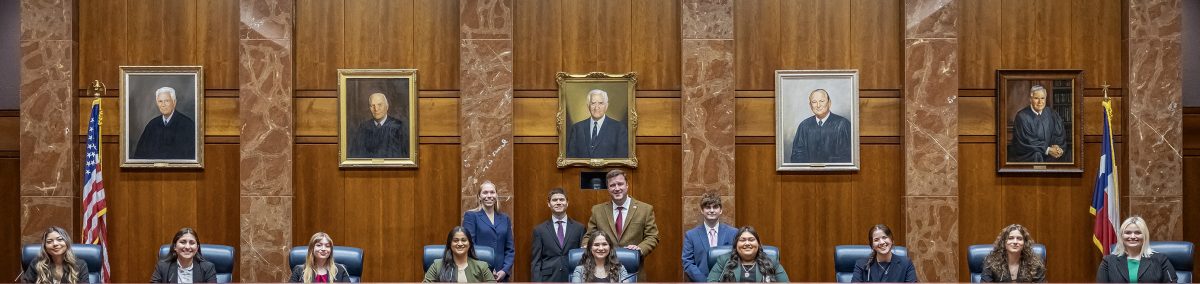
The room’s walls display portraits of former Justices, Justice Young touching on the idea that these Justices past decisions will forever be remembered, even if the justices deciding upon them might not be. Notably, one of the displayed Justices being Robert Gammage, a Sam Houston alum!
Justice Young offered particularly compelling insights into our judicial system and informed voting. He emphasized Texas’s distinctive history of putting judicial selection in citizens’ hands while stressing the importance of researching candidates before casting our ballots. This helps us preserve the quality of our state, and these nominees are just a reflection of the citizens that vote them in.
He then shared candid reflections about the challenges judges face, especially the crucial task of interpreting law without letting emotions guide decisions—a valuable lesson for our group of, hopefully, legal professionals.
The tour continued to the judges’ robing room, which is a private space where justices can retreat for breaks, discussions, and moments of respite. (A fun detail: there’s a TV showing the courtroom, hence the need to whisper!)
One highlight was returning to the courtroom for a photo opportunity at the justice’s bench—a moment none of us will soon forget. Although I have attended many Austin trips, this will surely be in the books for my favorite!
Justice Young concluded by showing us the conference room where Justices deliberate cases, emphasizing its confidential nature. As we departed, Mrs. Starnes pointed out a fascinating historical artifact: a portrait commemorating three women judges from 1925, highlighting the advocacy for women’s rights in Texas and empowering women in the legal profession!
The LEAP Ambassadors enjoyed a six-day tour of the East Coast as part of their “Democracy Tour.” During this tour, the students had a chance to visit more than half a dozen art museums, James Beard award winning restaurants, and many historic sites. What follows is their favorites from their experiences.
Favorite Restaurants:
Lehja’s in Richmond received the most votes, with all of the food receiving high marks from the diners. The James Beard nominations appear justified!
Casa Mexico in Philadelphia was a hit among the students, with the barbacoa being particularly popular. This was an altogether pleasant dining experience in an interesting and busy neighborhood in Philadelphia. Chef Christina Martinez was named “Best Chef” in the mid-Atlantic region in 2022 by the James Beard Foundation.
Metzger’s Bar and Butchery was perhaps the most interesting and innovative of the restaurants we visited. While the pork schnitzel was the favorite entree, the “squash sundae,” was the favorite dessert and the biggest surprise.
Ambassadors also found favorites in Katz’s Deli in New York, a restaurant world-famous for its pastrami.
And, of course, we also enjoyed Jim’s South St., which specializes in Philly Cheesesteaks.
FavoriteArt Museum: Olivia and Chrissy visited four art museums in New York, and they split on their favorite, with Chrissy favoring The Whitney…
…while Olivia resisted picking a favorite and, instead, picked a top two: The Met and MOMA. She did, however, have a favorite: The Lovers.
Although smaller and less heralded than its New York and Philadelphia counterparts, the Virginia Museum of Fine Arts was one of the clear favorites among the group.
The favorites of the group reflected the diversity of the art in the Museum’s collection.
Of course, the most famous paintings among the NY, Philadelphia, and VA museums were also popular among the Ambassadors.
Finally, the group also greatly enjoyed seeing Philadelphia City Hall, the Liberty Bell, Independence Hall, and the Virginia Capitol Building. For Cinthia, Olivia, and Michelle, it marked the third–the complete collection–of extant Jefferson designs in the world.
While the Ambassadors are always happy to get back to Huntsville and SHSU (or, this semester, Austin and SHSU), they left the east coast with a lot of memories, new-found knowledge, and much nostalgia.
This was–we thought–our last day, and we were determined to enjoy it! In that spirit, we had planned out a day of history and art, with a tour of the Virginia Museum of Fine Arts, the Capitol, the Old City Hall, the Edgar Allan Poe Museum, and some interesting restaurants.
Lehja Indian Restaurant
Saara Maknojia
Keeping our streak alive of eating at (affordable) James Beard nominated restaurants, LEAP Ambassadors stopped by Lehja, a contemporary take on Indian food. Indian food is not a foreign concept for the Ambassadors so knowing the classics we ordered a plate of aloo (potato) samosas.
For a change we also experienced a new dish, as our server recommended the Chef’s Daily Selection, Chaat Du Jou. The chaat consisted of flashed fried curry leaves with various species, topped with a tangy tamarind yogurt chutney, paired with refreshing pomegranate seeds. Although both appetizers were tasty, the consensus favored the Chaat Du Jou!
Olivia, being the biryani connoisseur, ordered the classic chicken biryani, which is additionally paired with raita, a spiced yogurt sauce.
Bringing out the contemporary aspect of Lehja, Cinthia and Michelle ordered a plate of Tandoori Chicken Tikka. Traditionally, chicken thighs are marinated in yogurt with various tandoori spiced to bring out a smoked flavor when grilled. Lehja, however uses chicken breasts and serves with a platter of grilled market vegetables. To my surprise Cinthia, who is not the biggest fan of spicy food enjoyed the chicken tikka without breaking a sweat.
The Regional Classics for Lehja’s include various curry dishes. I found the Kofta Chaman Dilkhush appetizing, mainly because the term “Dilkhush” refers to a happy heart and what better way to leave a restaurant than with a happy heart! The vegetable kofta’s in this dish were perfectly fried with a soft potato filling, complementing the cashew-tomato curry base. Kicking the spice level up a notch, I found spice level three to best for this hearty meal.
Professor Yawn and Stephanie also tried a Regional Classic dish, the spicy garlic, ginger, and chilly based curry included tender goat meat which fell right off the bone. Eating the meal in a traditional Indian fashion way, we shared our entrees with each other to fully taste the flavor spectrum and enjoy the company of one another.
Eating Indian food always makes me personally happy, but it is always a much better experience when those around you have the willingness to try new foods to enhance their understanding of cultures, apart from theirs. Lehja’s serves its purpose as a contemporary Indian restaurant but also keeps its traditional roots with the hospitality given to us during our visit. We are grateful to have a shared experience at yet another James Beard nominated restaurant.
Virginia State Capitol Building
by Saara Maknojia
Marking off yet another Capitol building, LEAP Ambassadors spent the afternoon touring the Virginia State Capitol. Rich with history, the Virginia Capitol reflects the vision of Thomas Jefferson, who was the primary architect for the structure.
Our tour guide, Mrs. Snellings, took us through the Museum, showcasing the wonderful architecture, functions, and art. In the Rotunda, is a Jean-Antoine Houdon sculpture of George Washington.
This sculpture is considered the best likeness of Washington. Houdon took a plaster cast of the first President’s face and exact measurements of his body–no other statue of Washington reflects this level of detail.
We had a chance to peek into the House Chambers…
…and we also had a chance to visit, and spend more time in, the Old House Chambers, the largest room in the structure.
The center of the room features a ten-pound mace, made from solid silver with a 24-karat gold finish. Also gracing the room are busts of Chief Justice John Marshall and Patrick Henry, both of whom served in the VA House of Delegates.
On the opposite side of the room out of reach of our cameras, are busts of Sam Houston (who was born in Virginia) and Cyrus Hall McCormick (born in the same county as Sam Houston!).
This room also hosted the 1807 trial of Aron Burr, who was charged with treason. As Chief Justice of the United States Supreme Court, John Marshall returned to the building in which he once served as Representative, and he presided over the trial.
Walking into the Old Senate Chambers, we noticed many artworks on the walls. One piece that Mrs. Snellings highlighted was a painting of Pocahontas.
She explained the true history behind her story, correcting the common myth that Pocahontas was married to Captain John Smith (also pictured in the room).
In fact, she was married to John Rolfe, a tobacco planter.
Next, Mrs. Snellings directed our attention to the back of the room, where she pointed at a painting by Griffith Bailey Coale. The painting depicted three ships: the Susan Constant, the Godspeed, and the Discovery. Mrs. Snellings explained that this scene represented the arrival of these ships in 1607, marking the beginning of the first permanent English settlement in America at Jamestown, Virginia. She pointed out the flags atop the ships, noting that they symbolized the United Kingdom.
The largest painting in the room, by Eugene Louis Lami titled Storming a Redoubt at Yorktown captures the Battle of Yorktown 1781, as British Troops approach the American forces. Mrs. Snellings pointed to a small figure in the painting and asked if we had any guesses for who it might be. After waiting for a response, she exclaimed with excitement, “It’s General George Washington!”
The architectural features of the building were beautiful, from the central rotunda…
…and the stairwell, which at one time, housed a steam-powered elevator.
Although our time at the Capitol was brief, we left with a valuable history lesson about the foundations of American democracy and the fight for independence! We would like to thank our tour guide, Mrs. Snellings, for providing a fantastic tour and sharing insights that many of us had not known before.
Old City Hall
Also on the Capitol Square–with the Capitol and Executive Mansion–is the old City Hall, a Gothic Revival Structure built in 1894.
For more than seven centuries, it housed city offices and courts, but as early as the 1920s, there were calls to tear down this beautiful structure and replace it with a more modern city hall. These calls were partially heeded in the 1970s, when a new City Hall was built, but, thankfully, the Historic Richmond Foundation led efforts to save it. The structure re-opened in the 1980s and in the 2010s, the building was restored to its original look–a restoration that required approval from the Virginia Department of Historic Resources, Architecture Review Board, and Capitol Square Preservation Council.
At 30,000 square feet, it remains the largest granite building in Richmond, while also being the city’s finest example of Gothic architecture.
It was designed by architect Elijah Myers, who also designed the TX Capitol building (where three of the LEAP Ambassadors currently work) and the Colorado Capitol Building (which two of the Ambassadors will visit in March), as well as the capitol buildings of Utah, Idaho, and Michigan.
Today, the structure is used for state offices, and only the first floor is accessible to visitors.
But even a restricted visit is worth it for the view of the impressive clock tower on the exterior of the building, the four-story atrium…
…detailed faux-graining of the bases of the Corinthian columns…
…and the exquisite detailing of the interior.
Virginia Museum of Fine Arts
by Michelle Cardenas
The Virginia Museum of Fine Arts (VMFA) offered an experience that was both exciting and full of discovery. Originally opened in 1936, the museum has continued to evolve, with a major renovation in 2010 and plans for further expansion to accommodate even more incredible works of art. The museum’s location carries historical significance as well, sitting on what was once a Confederate camp, adding another layer of depth to our visit.
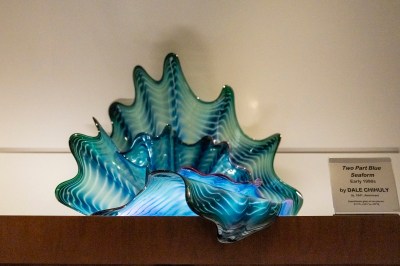
Instead of our usual self-guided exploration, we opted for a highlights tour, which provided an excellent overview of the museum’s diverse collection. Before even stepping inside, we were captivated by the stunning outdoor sculptures by renowned artists such as Dale Chihuly and Henry Moore, which set the tone for what was to come.
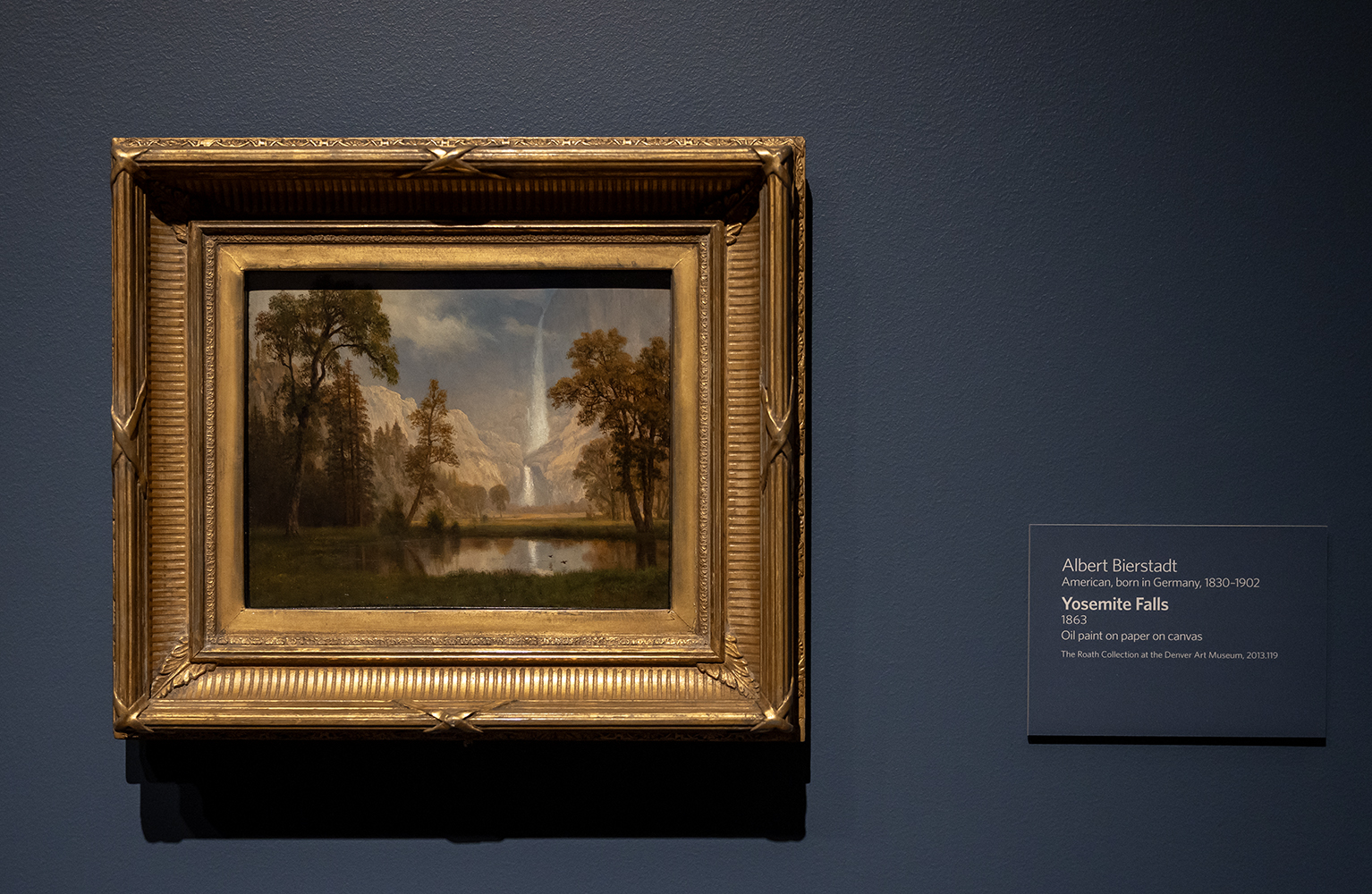
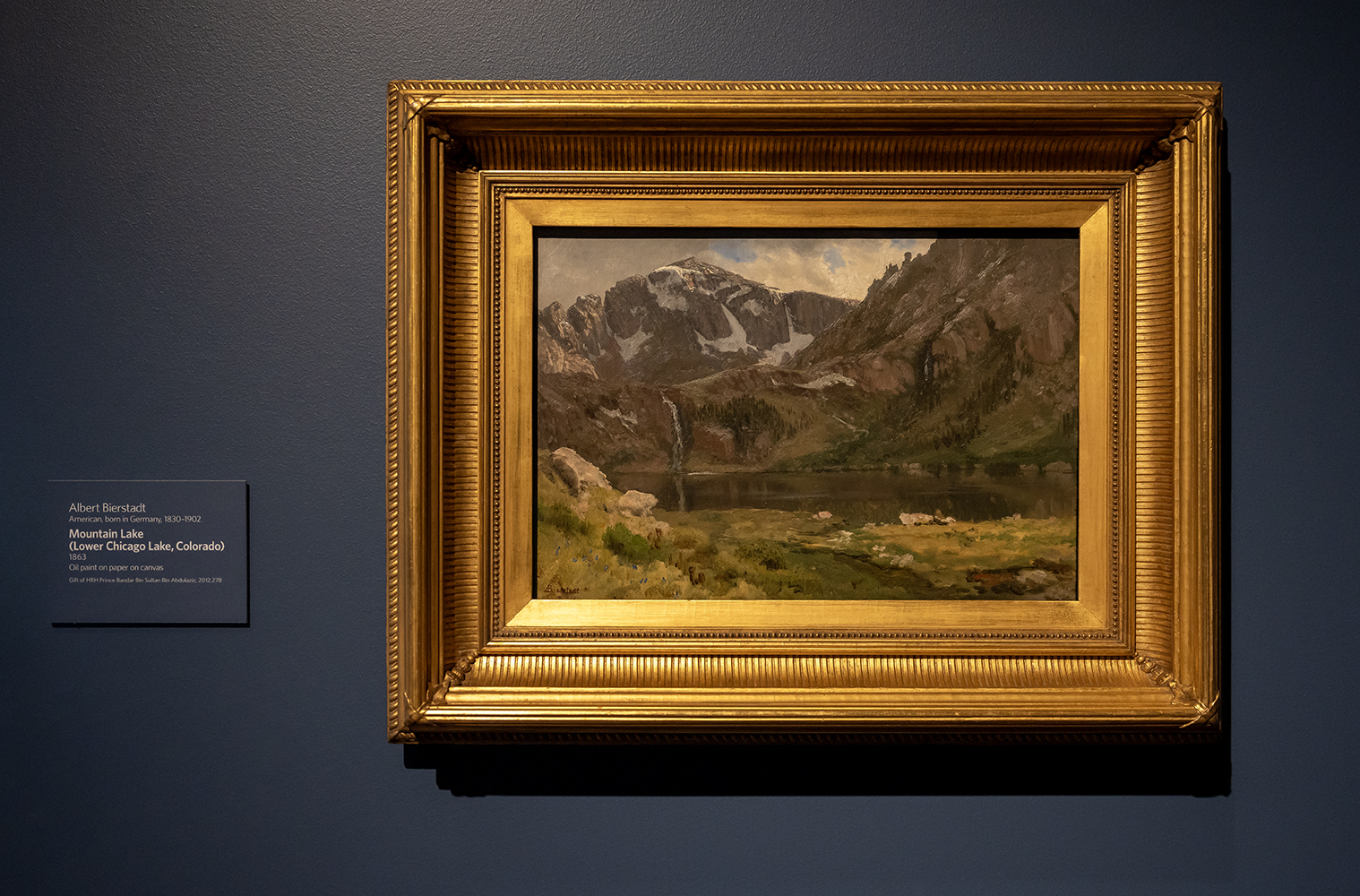
One of the standout sections for me was the American Art collection, where I was particularly drawn to Moonlight in Yosemite by Albert Bierstadt. Seeing one of his pieces with muted colors–almost black and white in places–was unexpected and fascinating, offering a different perspective on his usual style.
Another highlight was the Fabergé collection, featuring beautifully intricate Easter eggs that showcased incredible craftsmanship and history.
As we continued through the museum, we encountered works by well-known artists such as John Roberts, Kehinde Wiley, Ellsworth Kelly, Andy Warhol, Van Gogh, Degas, and Monet. Recognizing these names and seeing their masterpieces up close is incredibly rewarding—especially when I think back to when I first started and hardly knew any artists at all.
Each of us found pieces that resonated on a personal level. Cinthia was drawn to Edward Hopper’s House at Dusk, appreciating its quiet and reflective atmosphere. Olivia enjoyed the works of Andrew Wyeth, admiring his detailed and emotional portrayals.
Saara was captivated by Edwin Lord Weeks’ The Hour of Prayer at Moti Masjid…
…which stood out due to its rich colors and cultural depth. Chrissy’s favorite was John Singer Sargent’s The Sketchers, which impressed her with its lively and spontaneous feel.
Visiting museums like the VMFA is always a rewarding experience. No matter how many we explore, there’s always something new to learn and appreciate. Each visit offers a chance to see the world through different perspectives, and we’re grateful for the opportunity to continue discovering and growing through art.
The Poe Museum
by Chrissy Biello
Mystery, Madness, and Mayhem, three words that many would use to describe Edgar Allan Poe. Nevermore, that might not be the full story….
Edgar Allan Poe is known by many as an American short story writer and poet. His themes largely center around darkness, such as death, despair, and fear. He is widely credited with pioneering the modern detective story and significantly contributing to the emerging genre of science fiction.
Today, we had the chance to visit his home in Virginia, where we learned much about him. The museum began on a particularly somber note, discussing how his mother passed away when Poe was only two years old, leaving him orphaned.
Upon seeing a coffin, Olivia could not resist the urge to climb in. Surprisingly, it fit her perfectly, not to mention befitting her increasingly pallid complexion!
To give you some context, this coffin was placed here to symbolize the intense fear people in Poe’s era had of being buried alive. Due to this widespread anxiety, special coffins were designed with a mechanism that allowed the occupant to ring a bell from inside to call for help. However, when Olivia got inside, she chose not to ring the bell…
One aspect of the exhibit that I found especially intriguing was the pocket watch that Poe heard while writing “The Tell-Tale Heart.” I have always found this short story engaging and mysterious, as I tend to be drawn to darker subjects.
And, there has been considerable debate surrounding whether Poe was the artist of a watercolor painting or simply the gifter. The painting, which depicts a weeping woman, is quite interesting to observe. I appreciated the detailed wrinkles in her dress and the overall droopy appearance of the painting.
Another fascinating mystery in the museum concerns Poe’s hair. After his death, locks of his hair were cut from his head. Although the cause of his death remains a mystery, many have attempted to solve it. In 2002, a sample of his hair was analyzed, revealing the presence of many heavy metals, which were believed to have contributed to his death.
The museum also shed light on Poe’s posthumous reputation, largely shaped by his adversary, Rufus Griswold. Griswold painted Poe as a madman and drunkard in a posthumous biography. Ironically, this portrayal fueled Poe’s fame, but as mentioned earlier, we learned that Poe may not have been as crazy as everyone believed, leaving his legacy steeped in mystery and intrigue.
Before leaving the museum, we visited an upstairs section of the house featuring paintings. One painting, in particular, was quite amusing. It was titled Vincent Van Poe by Chris King and depicted Starry Night in the background, with Poe, a black cat, and a raven in the foreground.
As a fan of Poe, I thoroughly enjoyed the museum, especially since it was Poe’s actual home. It was also delightful to see a black cat, aptly named Edgar, moving around the building, setting the perfect atmosphere for reading and learning about Poe!
Metzger Bar and Butchery
For our last planned dinner of the trip, we opted for Metzger Bar and Butchery, whose chef, Brittany Anderson, is a two-time James Beard semi-finalist.
We started the evening with a recommendation of our server, the Charred Cabbage, whose menu description was enigmatic: “Miso Bagna Cauda, Cured Egg, Gremolata, Calabrian Chili.” Whatever it was, it was great! We also had a bread baked in house (“cottage-cheese rolls”), which came with house-made butter adorned with radish slices.
Three of our party went with the Pork Schnitzel, and the general consensus was that this was the best dish available. But we also tried the Chicken and the Steak, and all of it was excellent.
Although we were full, we were willingly talked into dessert, which included an Olive Oil Cake, the Heirloom Corn Funnel Cake, and a Honeynut Squash Sundae. The latter dessert made us pause–a squash sundae? But it was the favorite of the group!
It was a rich and fulfilling end to a busy and rewarding day.
With a full day in Philadelphia ahead of us, LEAP students ventured into town this morning to explore the beautiful public art around the city. Our first stop, of course, had to begin with Philadelphia City Hall, the largest in the nation! Afterall, this eye-catching building is grounded in one of the most historical states. The building itself is noticeable from many miles away, with a statue of William Penn, founder of Pennsylvania. The statue, sculpted by Alexander Milne Calder (Not to be confused with contemporary abstract artist Alexander “Sandy” Calder), brings not only the state’s historical aspect to the City Hall, but also connects other notable pieces of artwork to the artist.
Ambassadors in front of City Hall (and Oldenburg Sculpture)
Just a short stroll down Logan Square, we encountered Three Discs, One Lacking by Sandy Calder, grandson of Milne. Further down the Benjamin Franklin Parkway, the Calder legacy continues with the Swann Memorial Fountain, which was created by Alexander Stirling Calder, the father of Sandy Calder. These pieces not only highlight the artistic legacy of the Calder family but also illustrate how thoughtful city planning can weave art into the very fabric of a community. The alignment of these sculptures offered us a unique opportunity to reflect on how art connects generations and transforms public spaces.
As we continued exploring Logan Square, a lovely red caught the eye of many. Surely enough, we were met with yet another LOVE sculpture by Robert Indiana!
“LOVE,” by Robert Indiana
By the end of the day, we’d spotted three of Indiana’s works, including the AMOR sculpture, which added a multilingual flair to the city’s celebration of brotherly love.
“Amor,” by Robert Indiana
One artist that I was unfamiliar of during this tour was Zenos Frudakis. His sculpture Freedom, however, quickly became my favorite. The theatrical movement of the statues and the intricate details within each sculpture made every piece a part of a larger narrative, expressing an individual’s desire to abandon a life of comfort in pursuit of freedom.
“Freedom,” by Zenos Frudakis
We also encountered a mural by Richard Haas, another artist familiar to LEAP students. Keeping his famous trompe l’oeil style, the piece depicted Benjamin Franklin and William Penn and spans an entire wall to capture the essence of Philadelphia’s historical and cultural heritage.
Richard Haas Mural, 2300 Chestnut
Haas even drew inspiration from the Benjamin Franklin Statue by John Boyle, located on the University of Pennsylvania campus.
Philadelphia’s public art left us with a deeper appreciation for the city’s vibrant cultural identity. From the Calder family’s generational influence to the iconic works by Indiana, Frudakis, and Haas, each piece added a layer of history, creativity, and connection to our journey. By the end of the day, we realized that the city itself is a canvas, where every corner invites reflection and inspiration.
Lunch at Casa Mexicoand South Philly Barbacoa
by Israel Gallegos
For our much-needed lunch break, we went to Casa Mexico and South Philly Barbacoa, a joint restaurant heading towards the southern part of Philadelphia. The restaurant’s head chef, Cristina Martinez, is a James Beard Award recipient for Best Chef in the Mid-Atlantic region in 2022. So, we took this as a great sign to cross this off our trip list!
We ordered an array of dishes to get the full Mexican experience with a twist of Philadelphian culture. Accompanying our dishes, the group ordered horchata and jamaica, which passed Cinthia’s freshness test, and the guacamole, which was excellent.
The course started with half a kilo of barbacoa for the group, followed by chiles rellenos, a staple Mexican dish. The group also enjoyed enchiladas verdes. Personally, having tried enchiladas verdes many times, I can attest to the quality of the enchiladas at Casa Mexico.
To top off the main course, we had mole, which was my personal favorite as it tasted like home.
To end the meal, we of course had to indulge in our sweet craving and try both the tres leches cake and flan!
Somehow, we still found a bit of space in our stomachs, so we walked down the street in the freezing temperatures to get warm cups of coffee. The establishment, Rim Café, an Italian American café, was decorated as if they were collectors of timepieces depicting the true Italian American culture. Our Italian in the group, Olivia, was the judge, and she said the place reminded her of her uncle’s garage. I take that as the place doing a good job embodying a part of the culture.
Sticking to the classics, we ordered the original and chocolate cannoli (both of which were devoured in seconds).
Nevertheless, my favorite sight at Rim Café was an affogato that Saara got, it consisted of tiramisu gelato on the outside and hot espresso in the middle of it, providing a perfect mixture of hot and cold. Although I got the after-lunch dip, we kept moving to our next stop, the Barnes Foundation.
Experiencing the Philadelphia Barnes Collection
by Cinthia Villarreal
Dr. Barnes started his ambitious collection of art in 1912 and during four decades went on to collect what is now known as a highly regarded assemblage of art. With over 170 paintings of Renoir, and multiple works of Picasso, Van Gogh, Degas, Modigliani, and Seurat, we were all looking forward to visiting the Barnes Foundation in Philadelphia.
After a brief delay caused by an over-zealous security guard (take your jackets off!”). we entered the main room, and we could see the beautiful pieces decorating the four walls. Impressionism, characterized by short, broken brushstrokes and unmixed colors, is one of my favorite styles of art, so I was absolutely delighted as I saw Renoir’s name repeat itself throughout the walls.
As we moved through the exhibit, we started recognizing names from past museum visits, including Olivia’s favorite piece from Goya.
A unique feature of Barnes Foundation is that they do not use the common labels with the title and artist next to each of the pieces. Instead, they have brass plaques fixated with the artist’s name on each of the ornate frames.
To assist those who would like to understand a piece further, the Foundation allows one to scan the paintings with a phone to learn more about the composition and history of the piece.
Isreal, who’s less exposed to the art scene, found a particular liking for the European art, as well as Michelle, who’s favorite was El Greco’s.
In all, we greatly appreciate expanding our understanding of the humanities, especially when it highlights the contrast between where we started and how much we’ve grown. The Barnes Foundation in Philadelphia was a great end to our day, filled with experiencing the city and all that it has to offer!