Waite(ing) for “Baskerville” at Murder by the Book

Olivia Discon

We were at Murder by the Book, and we had some time to “kill.” We leafed through the Michael Connelly, thumbed the Agatha Christie, photographed the many Sherlock Holmes artifacts on display…

…and even bought a “Hound of the Baskervilles.”

But the real reason we were there was to see Todd Waite.

With 25 years at the Alley Theatre and an incredible 135 productions under his belt, he’s an institution in Houston theater. When he announced that he will be semi-retiring following his upcoming lead role in Baskerville: A Sherlock Holmes Mystery, we felt the “weight” of the occasion. It was “elementary:” we purchased tickets.

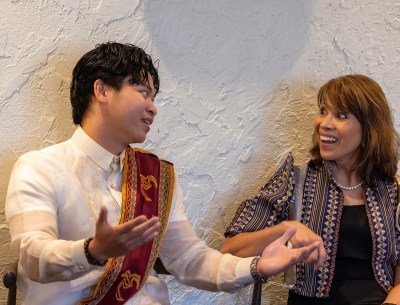
As a prelude to opening night, Waite spoke at Murder by the Book, where he took the stage to the delight of a full house.

During the discussion, Waite discussed his love of language, a passion instilled in him by his mother, an English teacher who taught him early on to appreciate the weight of every word. This foundation shaped his approach to performance, where even the smallest vocal shift—from “ah” to “oh”—can redefine a line’s meaning.

He spoke about the complexity of human emotion and how, beyond the broad categories we assign feelings, true depth is conveyed through inflection, gesture, and tone.

His role as an actor, he explained, is to bring those nuances to life in a way that honors the writer’s intent. He illustrated these ideas with stories from his career, sharing insights from specific productions that influenced his philosophy.

Theater, he notes, is a form of alchemy—combining words, movement, and presence to create something greater than the sum of its parts, and this is something the LEAP Center tries to capture in its approach to education, incorporating the fine arts, history, law, politics, and literature into its curriculum. It is perhaps appropriate, then, that a majority of LEAP students have seen their first professional play with Waite on the Alley Theatre’s stage.

LEAP Students / Alumni at the Alley’s “Thirty-Nine Steps”

The Alley Theatre itself is something of an anomaly in contemporary American theatre. According to Waite, the Alley employs a full-time, year-round resident company—one of the few, if not the only, to do so. And this, of course, allows the residents of Houston and the surrounding areas, to see first-class theatre year-round.

Although we bid farewell (for now) to Waite’s (Murder by the Book) performance, we eagerly anticipate seeing him take the stage once more as a resident of the theatre company on April 13. We anticipate Baskerville leaving audiences “howling” for more.

Mile-High Art

Following panels where we had a chance to see some SHSU professors and staff, we proceeded to explore the art scene in Denver. With four major art museums in the city, Denver is considered a high-profile art destination–a reputation we wanted to assess for ourselves.

Denver Museum of Art

After a quick lunch break, we decided to spend our afternoon stimulating our minds in a different fashion by visiting the Denver Museum of Art. Not knowing what to expect, besides a “scavenger hunt” list provided by Professor Yawn, we were eager to explore and curious to know what we would come across.

LEAP Ambassadors with a Claes Oldenburg Sculpture at the Denver Art Museum

To our great surprise, there were several incredible pieces from many of the great artists, especially in both contemporary and western art. The building, which is quite modern in and of itself, was filled with names such as Keith Haring, Louise Bourgeois, Victor Higgins, Donald Judd, and Birger Sandzén (more on Sandzen in upcoming blogs).

There were some important outliers to be noted in this collection. Chrissy especially enjoyed a wintery scene by Monet, which she fondly associated with the film, Citizen Kane.

She also enjoyed some modern pieces, and if you know Chrissy, that is a true surprise! Particularly, she preferred works by Roxie Paine in varying mediums.

It’s been a pleasure to see her immersion into becoming an art enthusiast, branching out into more types of art.

Sure, it did require a phase of Andy Warhol, but it was worth it!

It is too bad fellow LEAP Ambassador Michelle Cardenas was not with us; she is a big fan of the idealized paintings of Albert Bierstadt, Thomas Cole, and Thomas Moran, and there were many of these to be seen!

As for me, I enjoyed tying in themes in this trip, and seeing some newfound favorites reinforced their name and style further. Allan Tupper True…

…Alexander Phimster Proctor…

… and Victor Higgins.

I also saw some of my all-time favorites! Among Deborah Butterfield’s herd of bronze-casted horses, we came across three, including the best one I’ve seen in person, which was a horse lying down.

Butterfield’s work is interesting. Not only does she create horses from broad solid objects not typically associated with horses, but the material is often disguised. The above piece, for example, appears to be pieces of wood put together to resemble a horse, but in fact, this piece was made of metal. The metal was cast from wood and then assembled to create the horse.

In the past, we’ve seen Butterfield pieces in DC (the Kennedy Center), NOLA (Besthoff Sculpture Garden), Lubbock (Texas Tech University), and Fort Worth (Fort Worth Museum of Modern Art), but we’ve never seen three in the same place!

Kirkland Museum of Fine and Decorative Art

by Chrissy Biello

When people think of art, they might not immediately picture chairs, tables, clocks, or other everyday objects. However, these ordinary objects become extraordinary when designed with unique styles that allow individuals to showcase their personalities and express what truly makes them who they are. The Kirkland Museum of Fine and Decorative Art in Denver, Colorado, highlights this idea by showcasing a diverse collection, offering visitors a unique museum experience.

One of the museum’s most distinctive features is its chronological layout. Rather than grouping pieces by type or artist, the collection is arranged by time period, starting in 1870 and continuing to the present. This approach allows visitors to see how artistic styles and design trends evolved over the decades.

Among the many artists featured, the museum showcases the work of Vance Kirkland. His early paintings focused on realism, as seen in Moonlight in Central City

Later in life, his style shifted toward abstract expressionism, reflecting a dramatic change in his artistic approach.

For those curious about Kirkland’s creative process, his personal studio is preserved within the museum. It features a spacious area where he painted, and in front of this space stands a large bookshelf spanning the back wall. The books include artists such as Matisse, Cézanne, and Botero.

Beyond paintings, the museum features an impressive collection of furniture. One highlight is the Taliesin Dining Chair, designed by architect Frank Lloyd Wright in 1955. The name comes from Wright’s home, which was destroyed in a fire in 1914 and rebuilt. The chair’s “Taliesin edges” are a signature element in his designs. 

Many other Wright pieces can be found throughout the museum…

The museum also displays work by Philip Johnson. Johnson is known for designing the PPG Building in Pittsburgh and the AT&T building in Houston. His Floor Lamp, created with lighting designer Richard Kelly, offers visitors a look at different approaches to lighting and design.

Another highlight is the collection of works by Charles and Ray Eames, a husband-and-wife duo known for their work in architecture, graphic design, and filmmaking, though they are best recognized for their innovative chair designs. Their chairs, displayed throughout the Kirkland Museum, differ from modern furniture yet remain highly functional.

In terms of trinkets, you can find a Noguchi bird compact, a ceramic pitcher designed by Pablo Picasso, and small tea cups designed by Alexander Calder. 

Additionally, visitors can view a piece by Dale Chihuly…

…and a set of Roy Lichtenstein dinner plates!

In all, the Kirkland Museum of Fine and Decorative Art offers a unique experience for those accustomed to traditional art museums. With its diverse collection of paintings, furniture, glassware, and more, there is truly something for everyone to enjoy.

A Day in West Texas

En route to Denver, Colorado for a conference presentation, our travels brought us through the vast expanse of west Texas. This path gave us the opportunity to see two charming western towns, Abilene and Lubbock. In Abilene, we hoped to spend some time in their historic downtown district, while Lubbock was on our radar because it is a possible law-school destination for both Olivia Discon and Chrissy Biello. Exploration was in order!

Grace Museum

by Olivia Discon

Abilene, Texas, has a lovely and historic downtown.

Known as the Storybook Capital of Texas, the city is truly proud to bear the title. Around the area, you can find public sculptures…

Olivia Discon and Chrissy Biello with Luis Jimenez’s “Mesteno” in Abilene

…cartoon characters, bookstores, and other fun literary-themed spots. We stopped by the mini sculpture walk in Everman Park, and Chrissy and I had a great time reminiscing about the titles and book characters that marked our childhood and our respective love of reading at an early age.

After that, we went into the historic Grace Museum. The building itself is beautiful, and the current exhibit was really interesting. Within the exhibit, there was a handmade wooden “chapel” displaying about 20 paintings that depicted contemporary or average-looking people in religious scenes, which was thought-provoking and very well done. What stood out to me the most were the gold leaf paintings and the creative ways biblical stories were referenced.

There was a book in the gallery that explained which biblical story matched up with the modern figures in the paintings, which I thought was a nice touch. Yawn and Chrissy were more into the nature scenes, which were different from the religious imagery but still detailed and visually appealing.

One of my favorite parts of the museum, though, was the Youth Art Month gallery. Local students had their work displayed, and it was honestly so fun to see. There was a range of ages (and maybe a range of talent, too), but the community engagement aspect was the best part. I did something similar as a kid, and I still remember the feeling of pride seeing my art displayed, standing next to my parents as they took pictures. But more than that, it’s about showing kids that they belong in these spaces—that they can be part of the art world, even at a young age.

Having the privilege to have gone to several museums with LEAP, I can say that this visit became an unanticipated favorite! 

With that pleasant surprise on our minds, we stopped for a quick bite to eat at the highly-rated Jay’s BBQ…

…found the restaurant to live up to its ratings in both hospitality and taste, and we headed to Texas Tech University to visit their law school and get a glimpse, perhaps, of our futures.

Texas Tech Law School and University

by Chrissy Biello

Known for its nationally ranked Advocacy Program and commitment to public service, Texas Tech Law School is filled with immense opportunities that sets their students up for success. Thanks to Dean Saavedra, Assistant Dean of Admissions, and Ms. Moorhead, Director of Admissions, Olivia and I had the chance to tour the law school. 

As she took us through the law school, there were many appealing aspects that would draw many students in. One aspect that I found particularly intriguing was the Lanier Auditorium, where the law school hosts many programs for its students. Ms. Moorhead explained they are usually during the lunch hour, allowing students to have the option to attend as there are no classes scheduled during that time.

With multiple clinics, organizations, and externships to choose from, there is something no matter what you are interested in. From this, one is able to go down many different paths to determine what truly aligns with them. 

In all, Texas Tech Law School is not only nestled in an area with astounding architecture and art, but it also contains a plethora of ways for students to grow by giving them the resources to do so. Olivia and I would like to thank Ms. Moorhead for giving us a great tour and experience at Texas Tech Law School; it truly gave us a glimpse into the life of a law student at Texas Tech. 

As we were on the Texas Tech campus, we decided to take the chance to walk around and see the art that the students are able to experience everyday. With multiple Moroles sculptures on campus, we LEAPed at the opportunity to go and see them. They were all very striking, and made us feel at home, as Huntsville has many Moroles sculptures as well.

We also enjoyed Deborah Butterfield’s “Wind River” sculpture. Having the previous experience of seeing one of her horse sculptures at the Besthoff Sculpture Garden in New Orleans, I was happy to be making that connection at Texas Tech.

One that is a quite funny play on words is the “Read Reader.” This bronze sculpture is multiple books stacked upon each other, ultimately creating a man reading. Terry Allen, the artist, is actually from Lubbock and is also known for being a great musician! 

James Surls, a Sam Houston State University alumni, has a piece in front of the Texas Tech Health Sciences Center. This turquoise sculpture has three different sections and was different than the traditional wooden Surls sculptures I have seen. 

One of the most appealing aspects of Tech’s campus is its beautiful mediterranean architecture, landscaped grounds, and the art that adorns those grounds. One sculpture that combined these latter two components was “Agave Dreams” by Juilan Voss-Andreae.

Before leaving Lubbock, we also had to explore the downtown district, as well as the Museum honoring the city’s most famous son: Buddy Holly. We, of course, had to get a photo inside the large glasses that resembled Holly’s.

We then concluded our time by taking a selfie with the Buddy Holly sculpture nearby…

…and looking at some of the names on the Buddy Holly Walk of Fame, spying Texas luminaries such as Roy Orbison, Terry Allen, Mac Davis, Guy Clark, and Bob Wills.

It was a fitting end to a day that is unlikely to “fade away,” with thoughts of our future in law and reflecting on a day with art.