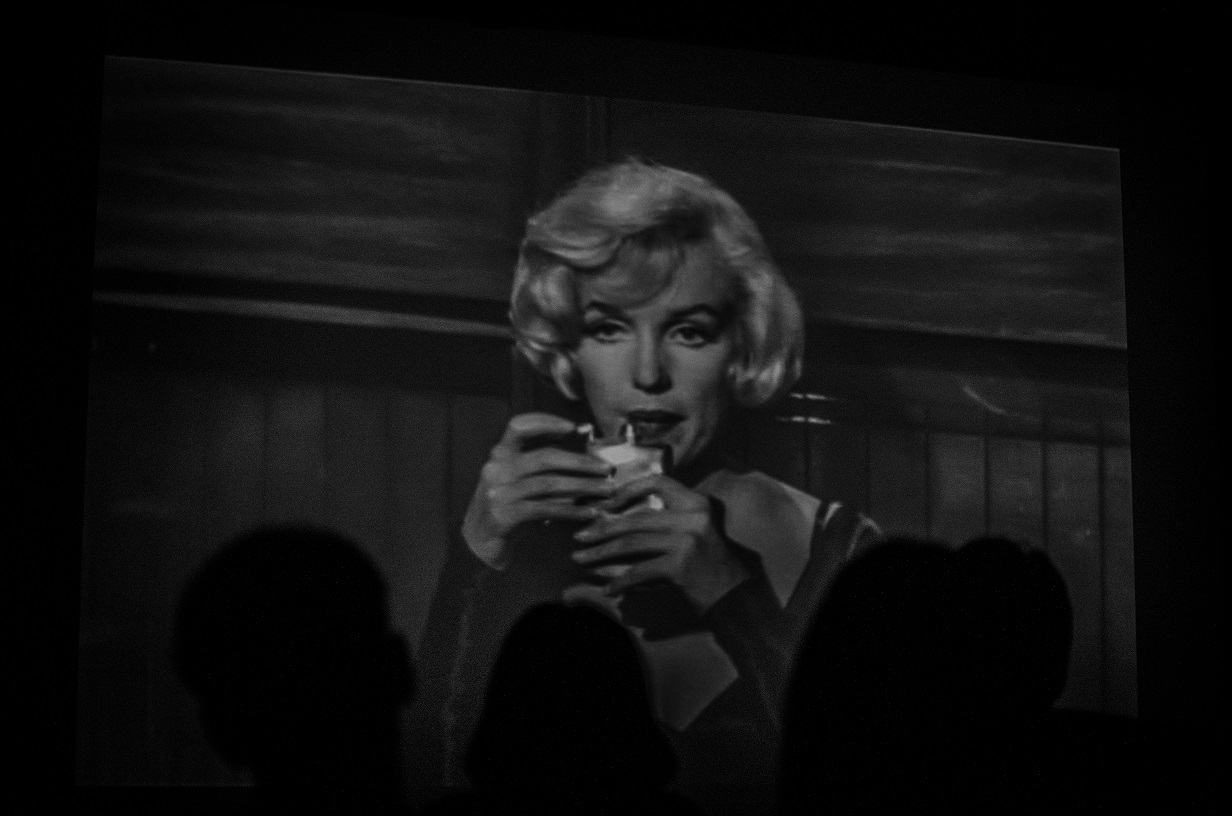
Although she died at the age of 36 in 1962, Marilyn Monroe’s appeal has been both timeless and classic. During her lifetime, her life was the subject of six books, mostly brief works, quickly done to capitalize on her popularity. Since her death, however, there have been some 300 books written about her. Two of these were written by Dr. Carl Rollyson, the LEAP Center’s guest speaker during a screening of “Some Like it Hot” at the Walker Education Center.
Students and local citizens dropped in for a pre-screening reception, where the guests enjoyed cookies, candy, and punch.
Dr. Rollyson was on hand during the reception to sign books…
which included not only the two Marilyn Monroe books, but also a well-received book on Huntsville native Dana Andrews.
Following an introduction by Dr. Rollyson…
…”Some Like it Hot” proved to be a crowd-pleaser, as it has been for the fifty-five years since its release in 1959. According to the American Film Institute, Some Like it Hot is the greatest film comedy of all time, and with a cast of Monroe, Tony Curtis, Jack Lemmon, George Raft, and Joe E. Brown, some great songs by Monroe, and an enduring appeal, it’s tough to argue with that choice.
The film was directed by Billy Wilder, one of the great Hollywood Directors. In addition to what may be the film industry’s greatest comedy, he also directed what might be the industry’s greatest film noir (Double Indemnity) and one the great romantic comedies (Sabrina) and melodramas (Sunset Boulevard), as well as one of the first films to deal seriously with alcoholism (The Lost Weekend). Some Like it Hot was his second film with Monroe; they previously did The Seven Year Itch; and Wilder knew how to direct Monroe.
Rollyson discussed the reversal motif apparent throughout “Some Like it Hot,” from the gender reversals to the literal reversals that recur throughout the chase scenes.
Most people know that Tony Curtis adopts a Cary Grant persona when wooing Marilyn Monroe, but it may be less known that he also used his Grant impersonation to ask out his most famous Hollywood date: Janet Leigh. According to Leigh in her memoir, Curtis called her up and pretended to be Cary Grant asking for a date. Leigh was speechless, and as she stammered, Curtis revealed the gag. This might be something of a questionable tactic, seemingly setting up the date for a letdown, but it seemed to work for Curtis, who ended up marrying Janet Leigh.
Dr. Rollyson also noted that, while Curtis was doing his Cary Grant impersonation in Some Like it Hot, Jack Lemmon adopted the mannerisms of Joe E. Brown, his co-star (and film love interest!). The introduction added to the enjoyment of an already-enjoyable film.
Following dinner, the group enjoyed dinner and additional conversation at The Homestead. While sampling the Spicy Tomato and Red Pepper Soup and the Fresh Mozzarella and Garlic stuffed Tenderloin Filet, a handshake deal was made to bring Dr. Rollyson back in 2015, when his biography of Walter Brennan will be published. Tune in!
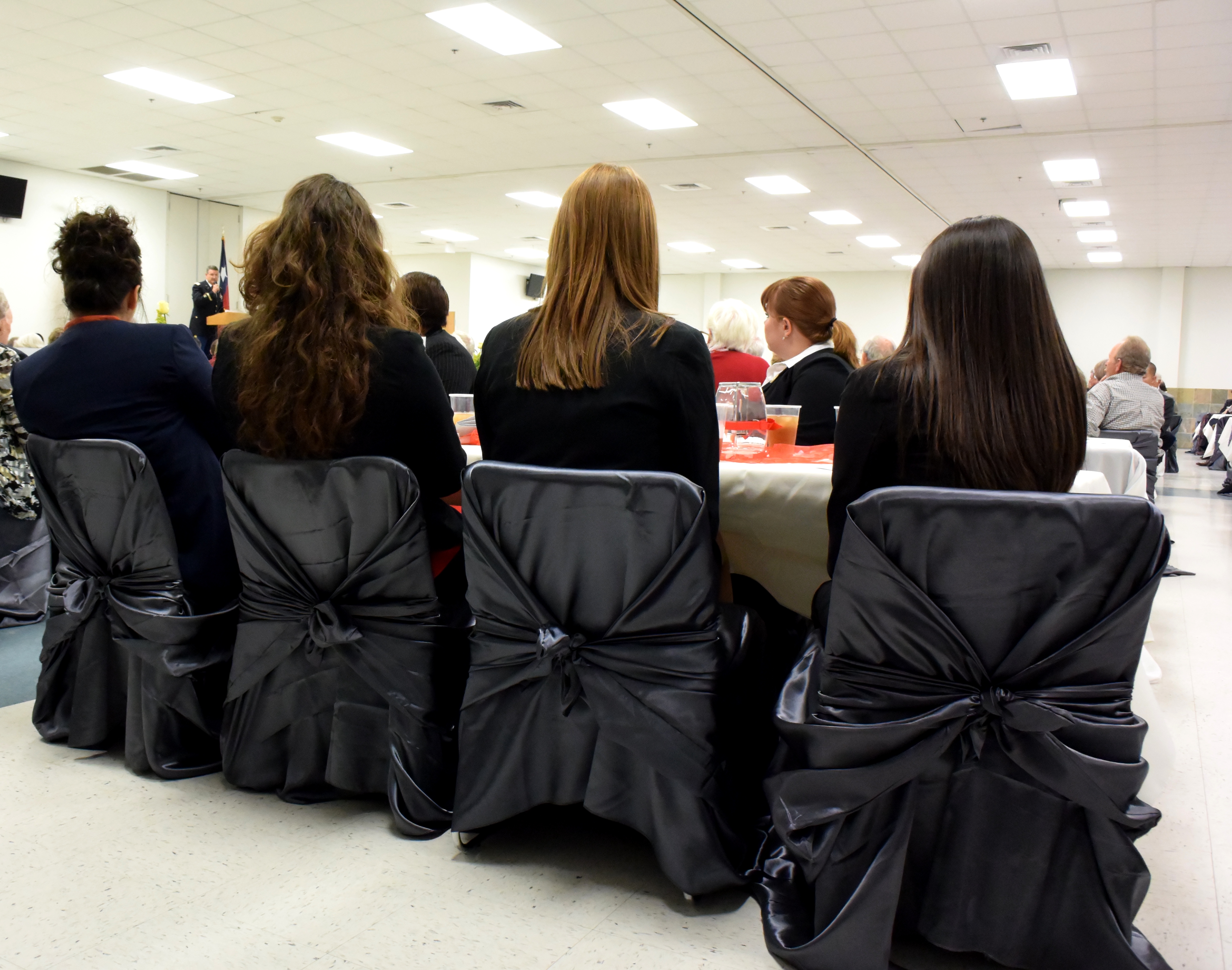
The HEARTS Veterans Museum held their 15th Annual Veteran’s Day Banquet, appropriately, on Veterans Day, November 11, 2014. A silent auction, catered dinner, and a short but moving program rounded out the evening. We were fortunate to be asked to help in greeting attendees as they arrived, assisting with the silent auction, and meeting community members and leaders, and learning more about veterans and their sacrifice.
LEAP Center Students Listen to Champe Miller Discuss Veterans Day
It was heartening to see soldiers, former and current, old and young, men and women, from all walks of life, stand while the Huntsville Community Men’s Choir performed a rendition of the Armed Forces Medley. All five branches of our nation’s armed forces were represented by local veterans. Air Force, Army, Coast Guard, Marine Corps, and Navy veterans and current soldiers stood during their service’s song. You didn’t have to look far to see that not all eyes were dry.
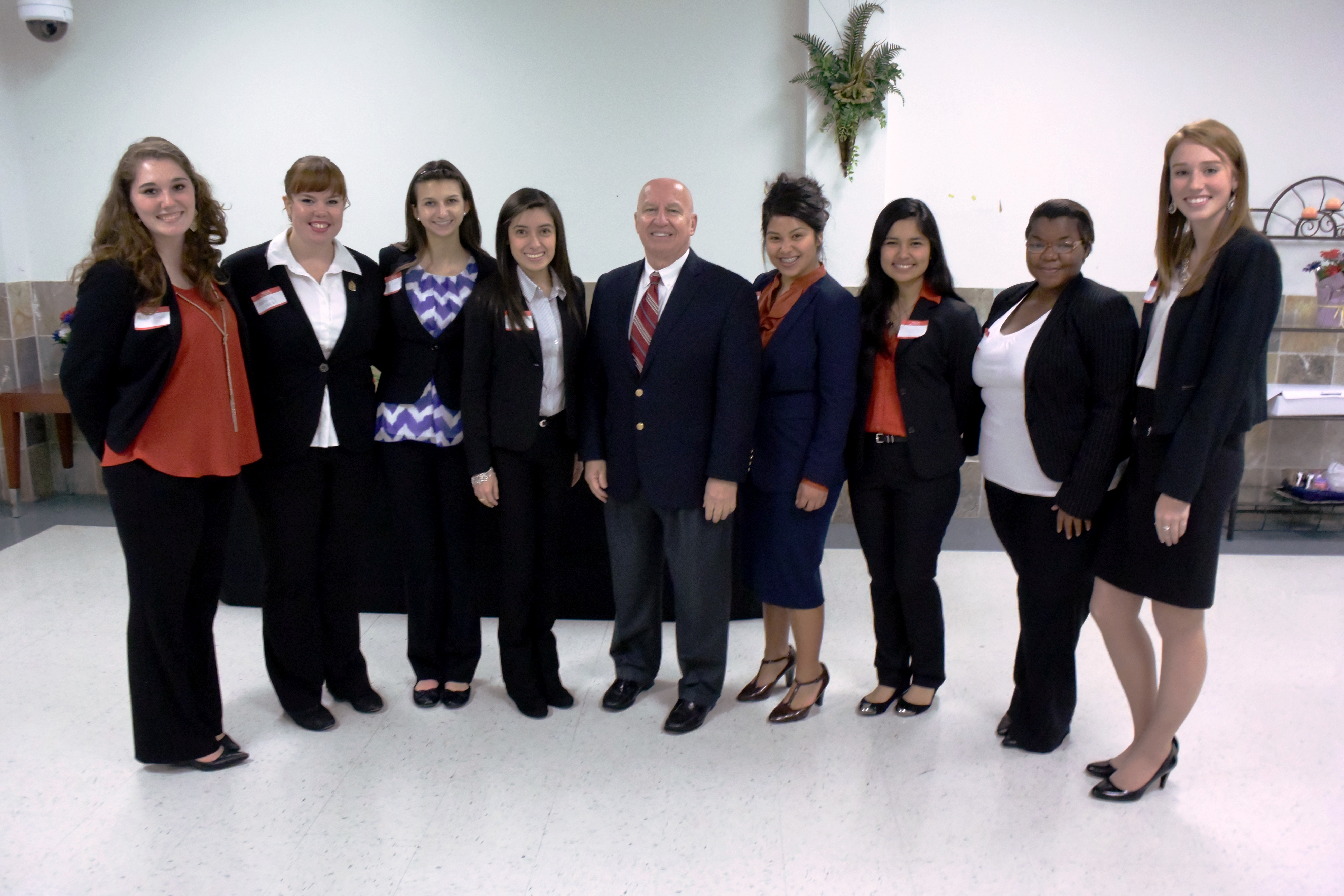
There was a short presentation on putting the various services for Texas veterans in the palm of their hands – à la the new “Texas Veterans App” (free, available on iPhone and Android devices) by former TX Representative Suzanna Hupp. We were also able to meet several elected officials who took the time to honor those who have served to defend and protect our freedoms, including Congressman Kevin Brady.
Congressman Brady & LEAP Students
It was a great evening, for a great cause – honoring our heroes and our history. For more information on the history of Veterans Day, see the U.S. Department of Veterans Affairs website.
The LEAP Center brought students to the Annenberg Conference Center at the Bush Presidential Library to celebrate the 25th Anniversary of the fall of the Berlin Wall.
Among those on hand was Dr. Jeffrey Engel, Director of SMU’s Director of the Presidential History Center. Although Dr. Engel is a distinguished scholar, he was not the most distinguished person in the room. Within a dozen feet of the students sat former Bush (43) Chief of Staff Andy Card, former Bush (41) National Security Advisor Brent Scowcroft, Barbara Bush, and President George H. W. Bush.
(L-R) Brent Scowcroft, Barbara Bush, President Bush, and Dr. Engel
President Bush received an award for his work in promoting freedom throughout the world…
…and the LEAP Center students received the treat of being in close of proximity of former President Bush.
Although she’s been to numerous Bush Presidential Library events, it was the first time Jessica Rodriguez has seen President Bush. “It was so nice to be able to see him. It was particularly nice to have a lecture on presidential history while sitting next to one of history’s makers. I enjoyed it very much.”
It was the fifth president Rodriguez has met while at SHSU while participating in LEAP Center events.
After an exciting afternoon meeting David Berg, attorney and author of Run, Brother, Run, we packed up two cars and headed for Nacogdoches! We could feel the excitement build the closer we got to Nacogdoches, anticipation of our observation of a Moot Court Scrimmage and, more immediately, an adventurous evening of zip lining.
We arrived in Nacogdoches around 7:10pm and headed for the Zip Line course, ZipNac. The tour guides quickly suited us up and instructed on how to use the equipment safely and the proper procedures for a fun zip line. It was exciting to say the least.
LEAP Center Students Ready to Zip Line!
I won’t forget the adrenaline rush I felt on that first drop down or walking over a suspension bridge in the dark.
Megan Chapa on the Bridge
Or the fun time we were able to spend together, whether it was Sura Omar and Ariel Traub…
Sura Omar and Ariel Traub
…or Constance Gabel and Jessica Martinez….
Constance Gabel & Jessica Martinez
…or Jasmine Moss and Megan Chapa…
Jasmine Moss & Megan Chapa
…or the whole group….
…or whether it was Kaitlyn Tyra flying home in record time…
Kaitlyn Tyra’s Finale
…we all had a great time.
After zip lining we made our way to a local restaurant called Jalapeno tree, to enjoy a nice Mexican dinner. The appetizers consisted of chips, salsa and queso. My main course was chicken enchiladas, homemade rice and charro beans. The food was authentic and very delicious. At the restaurant we met with Gene Roberts, an attorney who is the Director of Student Legal Services at SHSU. He is in Nacogdoches to judge the Moot Scrimmage, and he will be helping us understand what to expect at the scrimmage, how the performances are judged, and tips for law school.
I am looking forward to another exciting day tomorrow watching the Moot Scrimmage and looking back at the wonderful memories made. It is moments like these that make me appreciate all that the LEAP center and Sam Houston State University do for us…
…After a short night of sleep, we were able to watch numerous Moot Court Scrimmages, which turned out to consist of a series of intriguing contests.
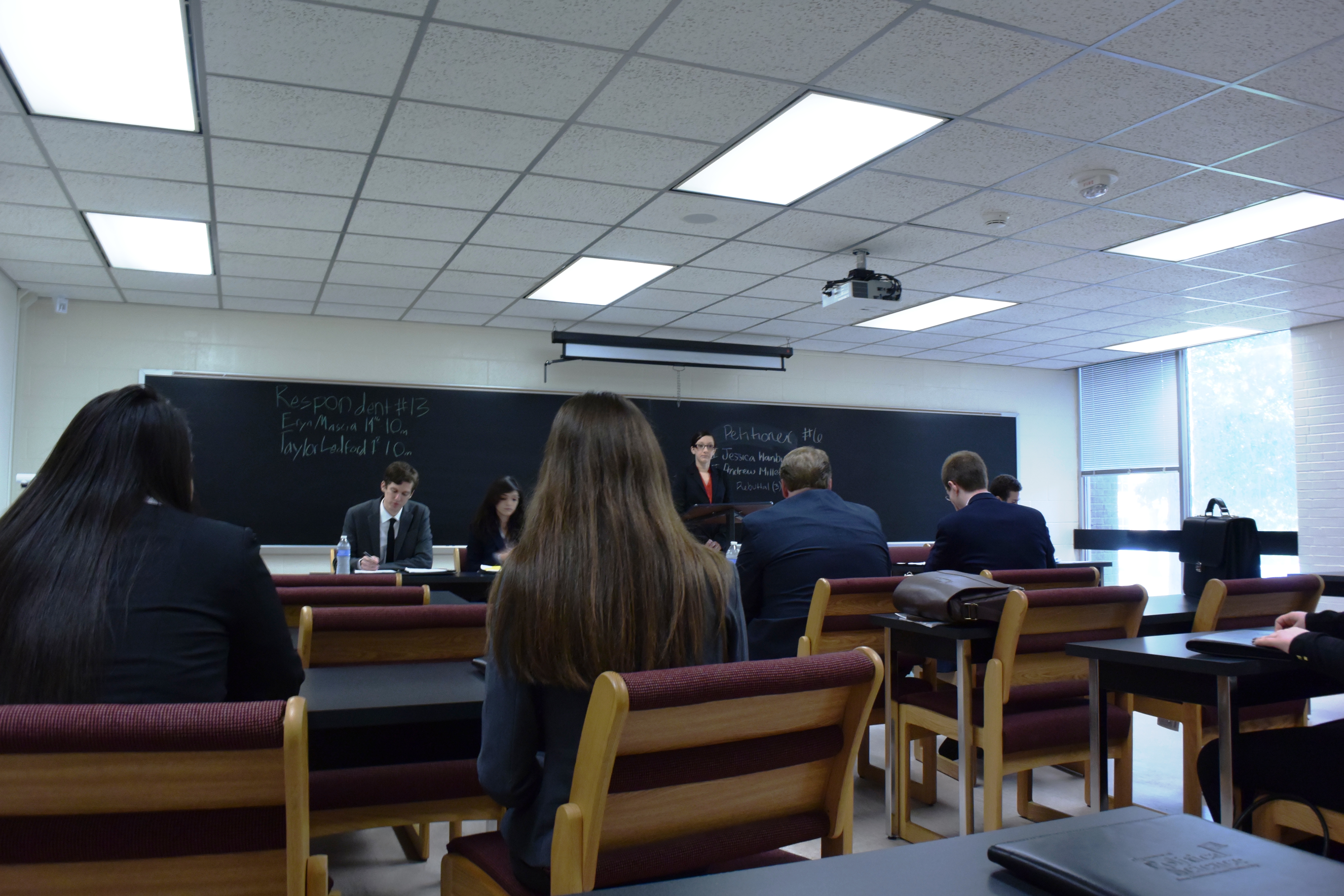
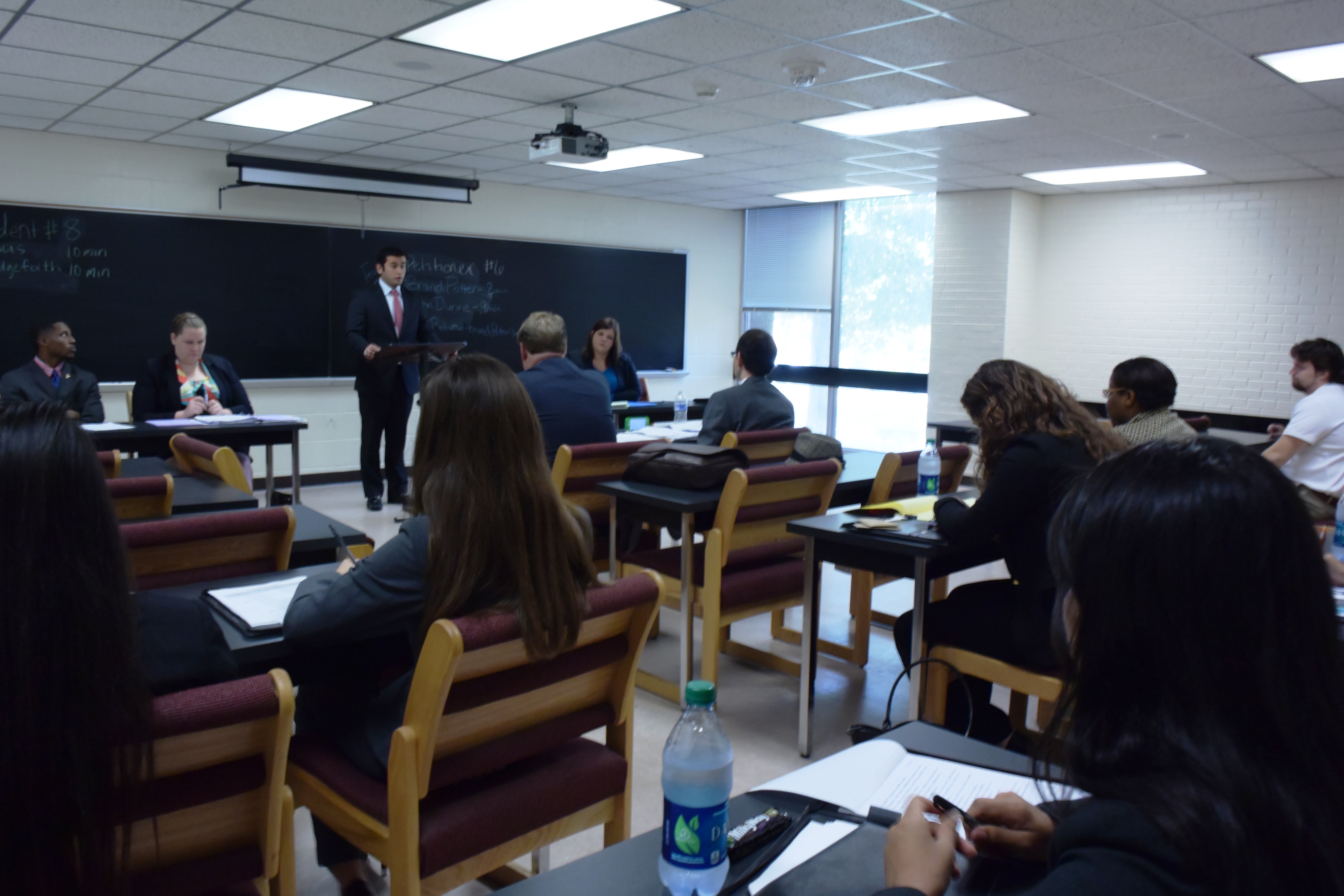
In all, we watched four contests. The morning contest was the most competitive. The students were highly skilled and very knowledgeable. The speakers displayed knowledge of the material, confidence, and spoke articulately about the legal matters they have been given to study. It could have been intimidating.
The second panel wasn’t as intimidating. The students struggled at times to articulate their ideas and occasionally seemed to struggle with the facts of the case. We learned later that we had seen the most and least prepared of the students, giving us a strong sense of the range of competition at these events.
A moot court competition is designed to mimic the appeals court process. Incidentally, the LEAP Center hosts four trials from the 10th Court of Appeals on campus every year, so many of us had seen that action. What we hadn’t seen was students try to replicate the work of appeals attorneys. Even the students who struggled helped us understand the process and, as always, we sympathized with those who have speak in public, a difficult task in almost any circumstance.
The afternoon groups fell within the range we had seen in the morning, and all of the teams taught us something about the law, the process of the moot court scrimmage, and ourselves. We are particularly grateful for Dr. Donald Gooch, the pre-law advisor at SFA, and Gene Roberts.
Following our observation, the general consensus was that we should form a Moot Court team at SHSU, and that many of us were game for the competition!
David Berg has been an attorney for more than four decades, becoming an internationally renowned specialist in white-collar crimes. But as he became more successful legally, he found himself reflecting more on the death of his brother, which occurred when he was a fledgeling Houston attorney in 1968. Alan Berg was killed, according to David, by Charles Harrelson (the father of Woody Harrelson) but never convicted.
David revisited the events leading up to the murder in his non-fiction book, “Run, Brother, Run,” which received very favorable reviews by the New York Times, the Christian Science Monitor, NPR, and others. He also dropped by SHSU to discuss the book and the murder with SHSU faculty, staff, students, and local citizens.
David Berg Speaking at SHSU
Berg mixed his presentation with a discussion of crime, law, family relationships, and boom days of Houston, Texas, providing substance for everyone in the audience. Many in the crowd had their own recollections of Harrelson, who spent time in Trinity and Huntsville (in and out of prison). Eventually, Harrelson was convicted of murdering Judge John Wood in San Antonio in 1979. It was the first assassination of a federal judge in the 20th century.
Afterward, Berg spent time speaking with the crowd, giving encouragement to pre-law students…
We started the day by attending the 2014 Film and History Conference! We attended two panels each lasting an hour and thirty minutes.
The most interesting one that we attended, however, was about classical Hollywood film musicals of the 1930’s and 1940’s. During this panel, two separate professors, Brent Phillips and Gail Sheehan spoke about their research on the topic. Gail Sheehan spoke about voice dubbing in films during the 1930’s as well as gender and race in the American musicals during that time period. Gale focused on two films in particular: “Gold Diggers of 1933” and “Professional Sweetheart.”
Gail Sheehan spoke about voice dubbing in the film, “Gold Diggers of 1933.” In the film, Joan Blondell is the female lead and has several musical numbers throughout the movie. Mrs. Sheehan showed several scenes from the movie in which it appeared that Blondell was singing, however, the voice was actually Etta Moten’s voice. Voice dubbing was a common practice during that time period because it was often difficult to find a woman that fit the necessary physical appearance of character as well as superb singing capabilities to accompany the looks.
Sheehan also spoke about gender roles in the film, “Professional Sweetheart.” The title of the film changed several times throughout the filming process with the final product resulting in a controversial title because the woman goes against convention and the title insinuates prostitution. The video is a satire about radio personalities during the 1930’s. The main character is played by Ginger Rogers and her name is Glory, a radio personality. Her African-American maid, Vera, played by Theresa Harris, is constantly by her side and living in her shadow. However, when Glory decides to quit the radio, Vera gets her chance to shine. In the end, Glory takes her job back and steps on Vera in order to achieve her reinstatement. This film really portrayed how African American women were treated during that time period especially because Theresa Harris was never credited for her role in the film.
The last presentation of the panel was about Charles Walters’s career by Brent Phillips. Charles Walters lived an extraordinary life and was both a movie director and a dance director. Charles Walters did not like to be called a choreographer because he felt that in order to orchestrate a successful number, you had to have the right angles and cater the dance number to the actor/actress’s abilities. He composed several numbers throughout his career with notable actors and actresses of that time such as Grace Kelley, Debbie Reynolds, Lucille Ball and Judy Garland. The first dance number that he created occurred in the movie, “Let’s Face It.” While he loved to create dance numbers for films, he had a burning desire to do more; a desire to direct the films himself.
Charles Walters began directing films in 1947 and was able to insert his own dance numbers into the movies. Charles Walters also directed several films and he had a unique directing style. Walters absolutely could NOT direct from the chair. He would often insert himself in both male and female roles and play each of them the way he had envisioned in his mind. This allowed the actors and actresses a better understand of what he was looking for as a director. His skills behind the camera and on the dance floor really set him apart from other directors in the industry and made him truly memorable.
After the conference, we took a meandering drive through the Wisconsin countryside in pursuit of the home of the famous architect, Frank Lloyd Wright. After a mere forty-five minute drive, we pulled up at the visitor’s center for the home of one of the most influential American architecture prodigies. Surrounded by farmland and the Jones-Wright valley, we took a van up a scenic drive to the home on the side of the hill. We pass a crisp water garden and tumbling waterfall along the way, providing the imagery for Wright’s thoughts that falling water is the music of architecture.
Finally up the steep driveway, we made our way towards what we think is the front door, as Wright is known for hiding the entrances to his homes. Guided by his subtle hints in architecture, we came to the see the rest of the valley on the left and the front of the home on the right. Our sweet tour guide, Kate, did an impeccable job of clearly indicating the signs of Wright’s style as we made our way up the steep stone steps and into the architect’s office. Interestingly enough, this was the home that served as a classroom, as well, to the Fellows Wright brought in to instruct. This was seen through the many places utilized for drawing and creating along the walls and the many windows available to bring in the natural light of the countryside. Wright is known for utilizing every space, but also making it strikingly beautiful or unique in the same right.
We sat with Kate in front of the fireplace, just as Wright did with many of his Fellows, and reflected on the many things that could have happened in this room. From drawing to measuring and building windows, learning under Frank Lloyd Wright would never leave a moment dull.
Awed by his eye for detail and strange geometric shapes, we moved from his office building and back outside to view the garden. The lush green grass and harsh stone rock provided the perfect contrast for the eye to digest, although it was easy to see that the view would be even more picturesque in the spring. We finally were able to enter the home and make our way down a tight passageway, which highlighted Wright’s use of compression. From this tight passageway, we opened the door to enter a large open room (“The Great Room”), exemplifying the expansion technique Wright demonstrated in his other structures.
The Great Room is a large living room, used by Wright for parties and social gatherings. Three walls of the room are glass, allowing for an amazing view of the countryside surrounding the property and of the water gardens below. Almost every furniture piece in the room has more than one use to it. In fact, along the glass wall, are lines of flat couches, divided by wide wooden armrests. The wooden armrests are movable and can be used for various purposes, such as a small table for two people. Next to the fireplace, on the left side of the Great Room, sits a couch that serves also as a bed, and as a desk or table, because its armrest is fairly large and can be used for various purposes.
Wright liked to use Taliesin as an experiment in architecture, and he frequently modified it and added to it. Interestingly, when he was 88 years old, a famous magazine wanted to come and take pictures of the property and, despite his advanced age, Wright designed an entirely new room, with glass on three sides. Because the room is exposed to the harsh winter elements, the preservation staff periodically moves out the valuable pieces of art and furniture of the room and stores it in a safer place until spring. The room is located and designed to not only admire the countryside from it, but also the entire house. In fact, a long hallway that is the entrance to the room, also holds the entrance to the Great Room, and on the sides, entrances to the guest room, and all the other rooms of the house.
It was interesting to visit Taliesin. Kate was an excellent, knowledgeable, and amicable tour guide. Thanks to the tour we gained a better understanding of Wright’s point of view on how to admire and interpret his architecture. He knew very well what he wanted to achieve with his work and how he wanted people to see it and admire it.
Our Midwestern Trip second day was especially busy. After a short night and a hearty breakfast, we headed to the Ulysses S. Grant National Historic Site, located in Webster, Missouri.
First, we watched a short video that covered Grant’s life and career, emphasizing the loving relationship between him and his wife Julia, as well as covering his military and presidential careers.
US Grant
Grant was originally from Ohio, and later graduated from the United States Military Academy at West Point, where he met his roommate and future brother-in-law, Fred Dent. He actually resigned from the military to be closer to his family but re-entered when the Civil War began. He rose to prominence with excellent military skills and led the Union to victory. A few years later, he was elected President of the United States.
The National Historic Site features White Haven—his residence—which, incidentally, is green.
White Haven
It was Julia’s childhood home, and home to Ulysses and Julia for many years of their marriage. Julia’s father, Fredrick Dent, named it White Haven in honor of another property he had; subsequent caretakers of the house during Grant’s ownership painted it green. Inside, as we walked through the halls and rooms filled with pictures and quotes from the Grant family, we imagined how life was over a century ago.
After lunch we ventured deep into St. Louis to tour the Gateway Arch. The closer we got to the Arch, the more intimidating the monument became – it was stunning, elegant. The panes reflected the light so as to make it look iridescent.
We made our way underground to the visitor’s center where we bought our tickets to ride to the top. The Gateway Arch was designed by the Finnish architect Eero Saarinen; it took $13M and a little over three years to complete. Comprised of stainless steel, it reaches a staggering 630 feet high, making it the world’s tallest arch. To get to the top of the Arch – and the spectacular views – we traveled in a small pod (emphasis on small) that offered a rocky trip up the arch.
After checking out the beautiful views…
St. Louis from the Arch
…it was, back down to the visitor’s center to begin our next adventure to the Old Courthouse.
The Courthouse looked much like a capitol in that it had a large dome and several levels that were separated by beautiful spiraling staircases.
On a more substantive level, this is the building in which Dred Scott sued for his freedom, winning in state court, but losing when his case made it to the Taney-led Supreme Court.
This much we knew going into the building, but what we didn’t know is that Mr. Scott was granted his freedom by his “owner” and, although he died a short year later, he died a free man.
Ariel Traub, the Old Courthouse, and Dred Scott
Feeling rather free and adventurous ourselves, we walked through several local parks, took a picture with the “running man…”
The Running Man and the Standing Girls
…and, of course, took selfies…
…and then ventured through several historical buildings. We saw the Wainwright Building, which was constructed in 1981 by Ellis Wainwright and designed by Louis H. Sullivan, who would go on to mentor Frank Lloyd Wright. The Wainwright Building became the father of the contemporary skyscraper and was a turning point in architectural history.
The Wainright Building
We learned about the difference between modernism, which has an accompanying slogan that “less is more,” and post-modernism, with the slogan that “less is a bore.” Modern buildings consist largely of glass windows and steel, whereas post-modern buildings have unique designs and shapes—often incorporating many styles from the past—that make the buildings one-of-a-kind.
Regaining energy with a Starbucks break, we left to further our learning in the state of Illinois. We arrived in Springfield just in time to eat and take a nighttime tour. We mollified our hunger at Lake Pointe Grill where, according to Silvia, there is such a thing as too much arugula on a pizza. Lake Pointe Grill boasts the only wood-burning grill in Springfield, clearly showcased by the delicious fare we enjoyed. We did not dally at dinner, as the Capitol was drawing us in, in all its glory.
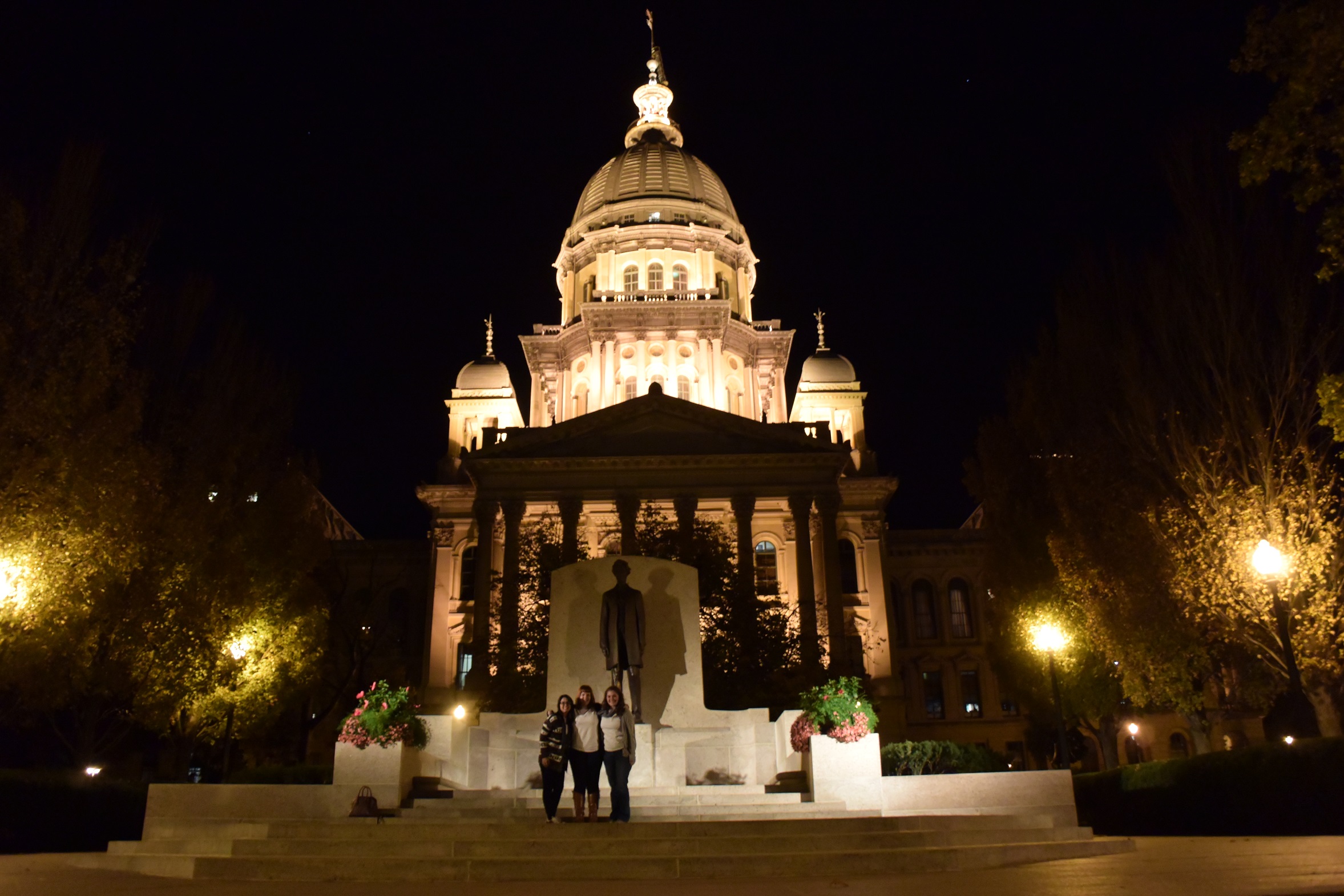
Our first night stop was in front of the Capitol building, where our architecture lessons continued. Showcasing a French Renaissance style, the building lit at night seemed spectacularly imposing. The current capitol building happens to be the sixth Capitol building since Illinois became a state. Designed by Cochrane and Garnsey out of Chicago, the immensity of the building begged exploration. Even though we were not able to enter, we were successful in taking a photograph with Abe Lincoln before making a regrettable leave to our next stop.
Lincoln’s influence in his hometown does not end at the Capitol. Mr. and Mrs. Lincoln’s home sits smack in the middle of town. After searching the park full of many historical homes, we finally found the former President’s home on the corner of Eighth Street. The home clearly fit the spacial needs of the Lincoln family, compared to its original (smaller) size when they bought it from Rev. Charles Dresser.
To finish our nighttime explorations of Springfield, Illinois, we juxtaposed the very proportionate and grand architecture of the state house with a Frank Lloyd Wright home. Mr. Wright built the early 1900s home for Dana Thomas, with imposing walls and sunken bricks representing the change from the open, trusting social life to the more guarded, private lives of the early 1900s. Even though it was dark, we could clearly make out his trademark hidden front door, taunting us with what is inside. So different from the vertically enhanced capitol building, Wright’s horizontal home seemed to sink into the ground and succeeded in representing the plains of America.
Back in the van, we headed to Chicago to continue our journey in the “Windy City.” As we ended another long day, we anticipated a chilly, activity-packed day –to hopefully fulfill our goal to learn more about the art and architecture the White City has to offer.
It was a nice day at the Capitol building. LEAP Center students visited the Texas Legislature to learn more about the operation of the Texas Legislature. With the help of Scott Jenkines, Representative Armando “Mando” Martinez’s Chief of Staff, they learned quite a lot.
Most House offices, according to Jenkines, have a Chief of Staff positions, a District Director/Administrator, a Policy Director, and a Staff Associate, although these positions may be fully filled only during the session. There are also committee staff positions available. Senators, with five times the number of constituents as House members, have additional staff. Both the House and the Senate offices offer internships, and an SHSU student, Bianca Kyle, worked for Jenkines during the last session (Spring 2013).
Jenkines spent considerable time discussing expectations of interns and their duties. He praised Kyle, whom he indicated was more of a “Staff Associate than an intern,” noting that she was “a natural” with constituents. Jenkines, who has worked with more than sixty interns in the legislature, expects interns to be on time, to be professionally dressed, and to maintain a good attitude with both staff and the public.
As Chief of Staff, Jenkines allows interns to represent the office at various functions and even attend committee meetings on behalf of the office (Rule: “If you go, you have to stay the entire time”.) For more technical skills, he trains the student and, in fact, typically offers them the chance to initiate research in a policy area.
SHSU Business Major Jessica Rodriguez, who is interested in becoming an Austin Intern, asked Jenkines what kind of policy work a student might be engaged in. Jenkines allows interns to attend Committee hearings, but he does have a rule: “If you go, you have to stay the whole time.” Moreover, Jenkines typically allows students to initiate research in a policy area.
“We’ve had great support from the offices in which we’ve placed interns,” noted Mike Yawn, Director of the Austin Internship Program. “Students have had the chance to work on policy, plan events, and see the process up close. We’re very grateful for the offices that have helped us place the SHSU interns.”
Note: Sam Houston’s Austin Internship Program, which began in the 2013 session, has placed students in the following offices:


















 Center for Law, Engagement, and Politics