Skip to content

Center for Law, Engagement, and Politics

Leap At SHSU!

  • About LEAP
  • LEAP Ambassadors
Center for Law, Engagement, and Politics

Category: Civic Engagement

Celebrating Civil Rights: The Americans With Disabilities Act at 30

Thirty years ago, President Bush signed the Americans with Disabilities Act into law.  In the speech announcing the enactment, President Bush noted that “We will not accept…discrimination in America” and his desire to  “take a sledgehammer to another wall,” effectively equating this legislation to the end of Communism as a marker for freedom.

SHSU, LEAP Center, Center for Law Engagement And Politics, Americans with Disabilities Act, President George H. W. Bush, Bush School at TAMU

Surrounded by disabled Americans who had worked on the legislation, President Bush empathized: “prejudices,” he noted, “separated Americans from a freedom they could glimpse but could not grasp.”  He closed by exhorting businesses to help make this a success by complying with the law and its requirements, and encouraged all Americans to help ensure that the “shameful wall of exclusion” will “come tumbling down.”

That was 30 years, but near the anniversary of the signing (which was on July 26, 1990), the Bush School at TAMU brought in PBS News Hour journalist Judy Woodruff to moderate a great panel–all of whom had something to do with the Act’s passage.

Indeed, the Bush School thought this so momentous an occasion that they invited President Obama to introduce the event…

SHSU, LEAP Center, Center for Law Engagement And Politics, Americans with Disabilities Act, President George H. W. Bush, Bush School at TAMU

…because the first section addressed a new documentary–produced by the Obamas–called “Crip Camp,” about one of the few places in the 1960s-1970s that allowed the disabled freedom to be who they were and participate in what most Americans consider everyday things.

SHSU, LEAP Center, Center for Law Engagement And Politics, Americans with Disabilities Act, President George H. W. Bush, Bush School at TAMU

The co-directors, Jim Lebrecht (who attended the camp) and Nicole Newnham…

https://www.imdb.com/title/tt8923484/?ref_=fn_al_tt_1

…were on hand to discuss it.  You can learn more about the film here, and you can watch it here.

Woodruff then brought in one of the Senate heroes of the bill: Senator Bob Dole, who had just celebrated his 97th birthday.

SHSU, LEAP Center, Center for Law Engagement And Politics, Americans with Disabilities Act, President George H. W. Bush, Bush School at TAMU

Dole is now in a wheelchair, but his disabilities stem back some 80 years, when he was in World War II.  He was shot by a machine gun, which hit his shoulder and right arm. Soldiers who found him expected him to die, but they administered morphine and, using Dole’s blood as ink, wrote “M” on his forehead, so that in the event he was found by medics, they would not administer a second (and potentially fatal) dose of the medicine.

Dole survived, but barely.  He was in a body cast for 9 months, paralyzed from the waist down.  When he got out of his cast, the 6′ 3″ former athlete weighed 110 pounds.  He would recover movement in his lower body, but the right side of his body would be partially immobilized for the rest of his life.

Dole said a few words, and then turned over the discussion to Carolyn Osolinik (former Chief Counsel for Senator Ted Kennedy) and Audrey Coleman (archivist at Robert J. Dole Institute of Politics) who discussed the strategies of getting the bill through the US Senate.  Osolonik called the bill a “sea change,” and emphasized that the bill was about “empowerment.”  It was not a bill to give away things; it was a bill to remove barriers so they could achieve what they were capable of.  Senator Kennedy called it the “emancipation proclamation for people with disabilities.”

SHSU, LEAP Center, Center for Law Engagement And Politics, Americans with Disabilities Act, President George H. W. Bush, Bush School at TAMU

Kennedy’s Counsel: “sea change” “empowerment.”  Kennedy called it “emancipation proclamation for people with disabilities”

Serving his first time in the US Senate during this time was Tom Harkin, the Chair of the Senate Policy Committee, who ultimately introduced the bill on the Senate floor.  For part of the introduction, he introduced the bill in sign language so that his brother, who is deaf, could follow along.  Harkin joined the panel to discuss his recollections…

SHSU, LEAP Center, Center for Law Engagement And Politics, Americans with Disabilities Act, President George H. W. Bush, Bush School at TAMU

…noting that the bill had four main goals:

    • Full participation of disabled in US society;
    • Equal opportunity;
    • Independent living;
    • Economic self sufficiency.

Harkin noted that the bill was ambitious: “we wanted these things to be the norm, the baseline, not an aspiration.”  To this end, he noted, “President Bush never wavered.  He stood behind the bill from the very beginning.”

Tony Coehlo, who helped engineer the bill’s passage in the House, was also on hand.

SHSU, LEAP Center, Center for Law Engagement And Politics, Americans with Disabilities Act, President George H. W. Bush, Bush School at TAMU

The bill encountered much more resistance in the House, where it was actually assigned to five different committees (typically a delaying tactic by leadership).  The bill did not lack support from rank-and-file members–it would eventually pass with 252 sponsors, but in the legislature, leadership is crucial, and without that support, passage was delayed.

One way to break through legislative logjams is through White House support, so Woodruff invited C. Boyden Gray (White House Consel), Lex Frieden (a disabled activist), and John Sonunu (White House Chief of Staff) to the show to discuss these efforts.

SHSU, LEAP Center, Center for Law Engagement And Politics, Americans with Disabilities Act, President George H. W. Bush, Bush School at TAMU

Frieden, interestingly, was scheduled to meet with President Ronald Reagan in 1986, to provide a recommendation of a bill such as ADA.  That day, however, the Space Shuttle Challenger exploded on liftoff, and the meeting was “rerouted” to the Vice President.  While this was no doubt disappointing to Frieden and the other activists on hand, it turned out to be fortuitous.  Vice-President Bush discussed his sympathies with the bill’s sentiment, and he said he thought the bill could become the “voice for 36 million Americans.” When he became President two years later, the passage of the bill became a potential reality.   And a year and a half after he became President, the bill was signed into law.

SHSU, LEAP Center, Center for Law Engagement And Politics, Americans with Disabilities Act, President George H. W. Bush, Bush School at TAMU

This bill was different than other civil rights legislation in that it imposed proactive requirements on businesses, governments, and non-profits.  It was seeking simply to remove impediments; it was requiring bearing actual costs: building ramps, adding elevators, reconfiguring buildings.  In some cases these costs were enormously expensive, and it took much political will to convince people that it was the correct thing to do.

Of course, the bill’s passage has not ended the barriers that the disabled face.  To discuss these challenges, Woodruff invited former Governor Tom Ridge (he also served as Director of Homeland Security) to discuss his role as Chair of the National Organization on Disability.

SHSU, LEAP Center, Center for Law Engagement And Politics, Americans with Disabilities Act, President George H. W. Bush, Bush School at TAMU

He was joined by Carol Glazer (President, National Organization on Disability), who argued that the most progress has been made in physical accessibility, symbolic areas (as more people with disabilities achieve positions of prominence), but, as expected, fighting people’s prejudices is the most difficult aspect of achieving progress.  The work ahead, she noted, will deal with fighting the “stigma” of disabilities, the “locked-in stereotypes,” and the “tyranny of low expectations.”

With Glazer and Ridge were William “Tipper” Thomas, an engineer, and actor Danny Woodburn.  Thomas was “4 or 5” when this passed, but in his senior year in high school, he was the innocent victim of a shooting, one which ended his football career and relegated him to a wheelchair.  He is now the principal engineer for Northrop Gruman Corporation.

SHSU, LEAP Center, Center for Law Engagement And Politics, Americans with Disabilities Act, President George H. W. Bush, Bush School at TAMU

Danny Woodburn is a little person and an actor (IMDB here), with, as he describes it, “strikingly good looks.”  When he was born, his doctor told his parents: “You’re son is a midget, like what you see in a circus.”  Woodburn noted much progress, but also said that there is little engagement with the disabled in civil rights conversations, noting that he’s often told, “We’re going to focus on cultural or racial diversity.”

Jack Chen (Product Counsel for Google) and Moeena Das (Chie of Staff, National Organization on Disability) also discussed their experiences navigating the still-difficult post-ADA waters.

SHSU, LEAP Center, Center for Law Engagement And Politics, Americans with Disabilities Act, President George H. W. Bush, Bush School at TAMU

Chen, for example, noted that while he works in the field of technology, which can make things better for people, it can also exacerbate inequalities, something most people don’t consider.

To conclude the program, Judy Woodruff invited former President George W. Bush on.  This, too, was fitting, because in the early 2000s, the Supreme Court ruled against some of the requirements of the ADA, and the way to help the law fulfill its original objectives was to amend the legislation in a manner that met Court scrutiny.  President Bush signed those amendments into law, with his dad (far left) looking on…

SHSU, LEAP Center, Center for Law Engagement And Politics, Americans with Disabilities Act, President George H. W. Bush, Bush School at TAMU

George W. Bush said that he believed the bill was what his father was most proud of accomplishing, and described his father as a “man of enormous compassion, who cared about all people, and the ADA reflected that spirit.”

SHSU, LEAP Center, Center for Law Engagement And Politics, Americans with Disabilities Act, President George H. W. Bush, Bush School at TAMU

By the end of his life, President George H. W. Bush was also disabled.  Parkinsons disease had attacked his body, and he began using a walker and then a wheelchair.  But that didn’t stop him from parachuting out of a helicopter at the age of 90!

SHSU, LEAP Center, Center for Law Engagement And Politics, Americans with Disabilities Act, President George H. W. Bush, Bush School at TAMU


Also of note, Director of the Bush Foundation, Andy Card…

SHSU, LEAP Center, Center for Law Engagement And Politics, Americans with Disabilities Act, President George H. W. Bush, Bush School at TAMU

…came on to note that, with the help of Lex Frieden (which he called the “conscious” of the ADA), they would be issuing  a new Bush Medal to “those making a difference to the disability community.”

SHSU, LEAP Center, Center for Law Engagement And Politics, Americans with Disabilities Act, President George H. W. Bush, Bush School at TAMU

In the midst of coronavirus and civil unrest, which in many ways have hit the disabled community the hardest, this program on the ADA and the progress made was a welcome reflection.

SHSU, LEAP Center, Center for Law Engagement And Politics, Americans with Disabilities Act, President George H. W. Bush, Bush School at TAMU

Many thanks to the Bush School at TAMU for the opportunity to experience these programs.  You can see this event in its entirety here.


Unknown's avatarAuthor mikeyawnPosted on July 30, 2020Format AsideCategories Civic Engagement, Civil Rights, Law, PoliticsTags Americans with Disabilities Act, Bush School at TAMU, Center for Law Engagement And Politics, LEAP Center, President George H. W. Bush, SHSULeave a comment on Celebrating Civil Rights: The Americans With Disabilities Act at 30

Pandemics in 2020: A Discussion from the Scowcroft Institute

Each year, the Scowcroft Institute the Bush School hosts a summit on pandemics, which brings together experts who discuss the biggest challenges to successful responses to pandemics.

SHSU, LEAP Center, Center for Law Engagement And Politics, Bush School at Texas A&M University, Scowcroft Institute, Dr. Christi Blackburn, Dr. Gerald Parker, Professor Andrew Natsios, Dr. Oyewale Tomori, Pandemics

And each year, they prepare a white paper summarizing and extending the discussions at the summit.  This year, they marked the release of the White Paper with a FB Live event featuring Dr. Oyewale Tomoroi (Senior Fellow at Scowcroft Institute and Professor of Virology in Nigeria); Dr. Gerald Parker (Director for the Pandemic and Biosecurity Policy Programs at the Scowcroft Institute and administrator in many government divisions, including the Department of Homeland Security and Health and Human Services), Andrew Natsios (Executive Professor at the Scowcroft Institute; and manager of reconstruction programs in Afghanistan, Iraq, and Sudan); and moderated by Christi Blackburn (Deputy Director of the Scowcroft Institute’s Pandemic and Biosecurity Policy Program).

After introducing the guests, Dr. Blackburn…

SHSU, LEAP Center, Center for Law Engagement And Politics, Bush School at Texas A&M University, Scowcroft Institute, Dr. Christi Blackburn, Dr. Gerald Parker, Professor Andrew Natsios, Dr. Oyewale Tomori, Pandemics

…posed a number of questions to the panelists.  Dr. Tomori led off, noting the importance of responding to pandemics with speed and quality information and resources, and that this is especially true in remote areas, where resources may be scarce.

Dr. Parker then tackled the thorny problem of vaccinations.  He emphasized the importance of having development and dissemination plans.  While there has been much discussion of a vaccination for COVID, vaccinations are not typically easy to develop, nor are they often developed quickly (although not discussed here, I have read that the shortest time in history for the development of a vaccine is four years).

SHSU, LEAP Center, Center for Law Engagement And Politics, Bush School at Texas A&M University, Scowcroft Institute, Dr. Christi Blackburn, Dr. Gerald Parker, Professor Andrew Natsios, Dr. Oyewale Tomori, Pandemics

The keys are: (1) developing sufficient supplies, suppliers, and training to ground-level forces, and (2) distribution, which is the most difficult (“the final mile is the hardest”).  In the latter phase, Parker emphasized that vaccines are distributed all at once.  Vaccines have to be developed, and the supplies take time to get to everyone, so who gets the vaccine first?  Parker suggests, of course, health care workers, but a whole prioritization list needs to be developed for the entire rollout.  Also key is a plan by developed countries to get the vaccine to less wealthy countries, something that is both logistically difficult and sometimes politically fraught.

Professor Natsios elaborated on this with some interesting facts. First, he noted that the Russians were active on social media, using bots to spread messages both pro and con for vaccinations.  They know that, in a democracy, if you can confuse people to what the truth is, you can thrown democratic processes into confusion.  Further, polls show that approximately 30-50 percent of Americans indicate they are hesitant to avail themselves of a COVID vaccination.

The solution, according to Natsios, is to work with local leaders–religious, community, medical, even sports–and do publicity campaigns for vaccinations.

SHSU, LEAP Center, Center for Law Engagement And Politics, Bush School at Texas A&M University, Scowcroft Institute, Dr. Christi Blackburn, Dr. Gerald Parker, Professor Andrew Natsios, Dr. Oyewale Tomori, Pandemics

Dr. Blackburn switched topics, going to how to develop effective early warning systems in pandemics.  Natsios, who had extensive experience with detecting and responding to famines from his government days, also fielded this topic.

Noting that satellite photos could determine crop health and allow advance warnings for famines, Natsios pointed out that the same tools can be used for pandemics.  In a fascinating discussion, he pointed out that satellite photos of Wuhan, China from August of last year show increased vehicular ( (a measure that includes bicycles) occupancy in China hospitals.  Intelligence agencies have complemented this with social media content analysis, which shows a significant uptick in questions about symptoms–symptoms correlating strongly with those produced by COVID–at the same time.  The conclusion, of course, is that COVID was probably hitting Wuhan in August of last year, before the world–and probably even China–knew about it.  These remote sensing tools (which include monitor of cemetery and crematoria activity) can be useful in detecting pandemics early.

Natsios concluded by emphasizing the importance of early detection, noting that if the pandemic is caught in time, its contagion can be extraordinarily curtailed.

Dr. Blackburn then fielded questions from the audience, which included:

    • Is there a single agency in charge of biosecurity?
      • No, although one is desperately needed.  Both Parker and Natsios agreed that, unless a directive was sent straight from the White House, most agencies wouldn’t implement with the efficiency needed, often because of interdepartmental conflicts.  The discussion of interdepartmental conflicts–conflicts which apparently included Parker and Natsios while they were in different departments, let to some humorous recollections.SHSU, LEAP Center, Center for Law Engagement And Politics, Bush School at Texas A&M University, Scowcroft Institute, Dr. Christi Blackburn, Dr. Gerald Parker, Professor Andrew Natsios, Dr. Oyewale Tomori, Pandemics
    • How do we balance Technology and Privacy?
      • Although this wasn’t answered directly, the information provided was interesting.  Natsios noted that Germany had very good privacy laws, but shifted topics somewhat by noting that the US had a “frontier mentality,” which affected its balancing of individual vs. collective rights.  Because of this “frontier mentality,” many argue that the government has no right to ask them to wear a mask–a belief contradicted by court rulings dating back to at least 1820.
    • How do we deal with unknown pandemics?
      • All agreed that all pandemics are unknown–even if they come from known diseases, they are often a mutated or novel version.  The panel agreed on increased spending, and, perhaps befitting employees of Texas A&M, home of one of the best Veterinary Schools in the US–suggested the importance of studying zoonotic diseases.  Natsios noted that 70 percent of the new diseases in the past 40 years have come from animals, with HIV being, obviously, the most notable example.

This fascinating and timely discussion can be viewed here in its entirety and the white paper can be found here.  Thanks again to the Bush School for its wonderful programming!


Unknown's avatarAuthor mikeyawnPosted on July 26, 2020Format AsideCategories Civic Engagement, Health, PoliticsTags Bush School at Texas A&M University, Center for Law Engagement And Politics, Dr. Christi Blackburn, Dr. Gerald Parker, Dr. Oyewale Tomori, LEAP Center, Pandemics, Professor Andrew Natsios, Scowcroft Institute, SHSULeave a comment on Pandemics in 2020: A Discussion from the Scowcroft Institute

An Introduction to The World, with Richard Haass and the World Affairs Council

One of our favorite activities is to be part of a World Affairs Council event, and thanks to the magic of Zoom, we can continue our participation in the age of COVID.

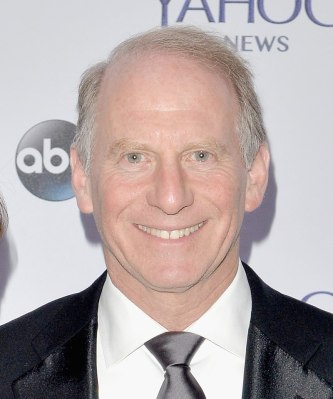
This program was particularly special, as it featured Richard Haass, whose unparalleled career has included stints at the Department of Defense, Department of State, National Security Council, Council of Foreign Relations, Harvard’s Kennedy School of Government, Brookings Institute, and is a recipient of the Presidents Citizens Medal.  He is widely regarded as one of the most knowledgeable public figures on foreign policy.

SHSU, LEAP Center, Center for Law Engagement And Politics, World Affairs Council Houston, WAC Houston, Richard Haass

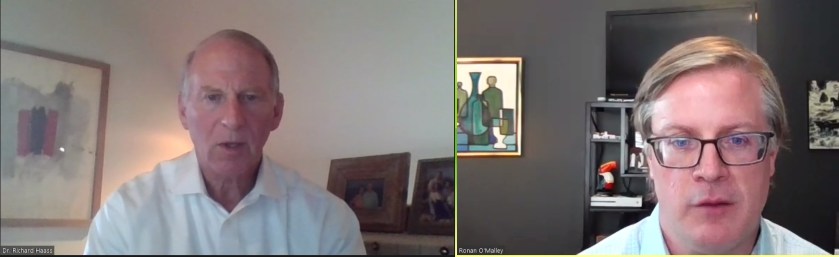
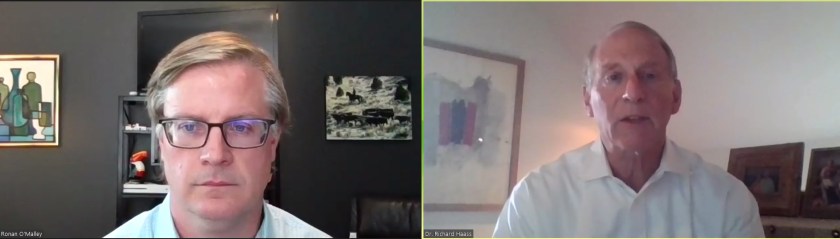
Accordingly, Haass set out to write an accessible book about international affairs and foreign policy.  Ronan O’Malley, Program Director at WAC, moderated the discussion with Haass and focused on the ideas in The World: A Brief Introduction.

The book begins with the year 1648 and the Peace of Westphalia, which established the idea that countries are sovereign and control affairs within their borders.  This, Haass believes, helps us understand the modern nation state, while also being aware of how some things have changed.  In an era of globalization, what happens within a country’s borders can have global consequences–whether it be the destruction of Brazil’s rainforests, the rise of militant and terrorist organizations such as the Taliban, or the spread of a virus.  While they may begin within a country’s sovereign borders, they are likely to have world-wise ramifications.

SHSU, LEAP Center, Center for Law Engagement And Politics, World Affairs Council Houston, WAC Houston, Richard Haass

Haass sets out to establish a framework in which we can maintain the positive aspects of sovereignty, without allowing a country’s sovereign actions to encroach negatively on another country’s sovereignty.

The author was motivated, in part, by a world he saw becoming increasingly in disarray, largely a result of the United States’ lack of engagement with the world, a phenomenon he refers to as “American Abdication.”  Noting that President Obama began “pulling back” in mid 2010s, President Trump has taken disengagement even further.

Haass argues what might seem obvious: (1) the World matters, and (2) Isolation is not a workable response.

SHSU, LEAP Center, Center for Law Engagement And Politics, World Affairs Council Houston, WAC Houston, Richard Haass

While engagement is appropriate, Haass also notes that the solution is not an over reliance on presidential personality.  Haass noted that “there’s a long history” of presidential hubris, from FDR believing he understood Stalin and his goals, President George W. Bush saying he looked “into Putin’s soul,” and Trump taking things into a whole new level with his association with autocrats.  The key, he argues, is to have workable coalitions and structural frameworks that allow for long-term solutions and equilibria.

O’Malley also conveyed a series of questions from the audience:

    • What to do about NATO?  Keep it, strengthen it, but don’t enlarge it;
    • Nuclear proliferation? We have a new arms race with the Russians, we have lost hope of containing North Korea’s nuclear development, but we may still be able to work with Iran on limiting what they have done;
    • Globalization and Trade: He’s for fair trade, which in his eyes, means being less concerned with trade imbalance and more about not manipulating currencies, removing tariffs.  Further, he argues that job losses are not from trade agreements, but from increases in productivity in the US, mostly having to do with robotics, computers, and artificial intelligence.  Haass believes that these trends will accelerate with COVID-19, and argues that the US needs to begin an aggressive retraining program.
    • Chinese and Russian Disinformation Campaigns: Haass argues that China’s disinformation isn’t that effective, but that Russia’s program is more developed and has had a greater impact, arguing that Russia is seeking to “change the context in which the UY

SHSU, LEAP Center, Center for Law Engagement And Politics, World Affairs Council Houston, WAC Houston, Richard Haass

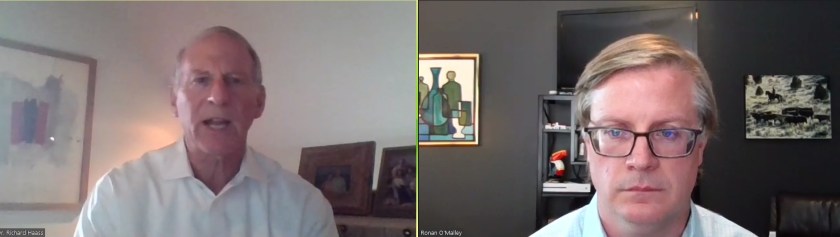
O’Malley ended with a political question, asking Haass if he had thoughts about Biden’s Vice-Presidential selection.  Haass noted that Biden had already committed to picking a woman, and that there are “many qualified women to choose from.”  He argued that Biden will likely use three criteria: (1) Who would make a good president? (2) Who can he partner with to run the government? (3) And who will help him get elected?  Haass also noted the importance of the pick–although he did not broach Biden’s age–by noting that the Vice-Presidency has grown in importance since the 1990s.


SHSU, LEAP Center, Center for Law Engagement And Politics, World Affairs Council Houston, WAC Houston, Richard Haass

It was another great program by the World Affairs Council, and, indeed, a great introduction to “The World.”

Unknown's avatarAuthor mikeyawnPosted on July 21, 2020Format AsideCategories Civic Engagement, PoliticsTags Center for Law Engagement And Politics, LEAP Center, Richard Haass, SHSU, The World: An Introduction, WAC Houston, World Affairs Council HoustonLeave a comment on An Introduction to The World, with Richard Haass and the World Affairs Council

Talking COVID with Dr. Blackburn: July 2020

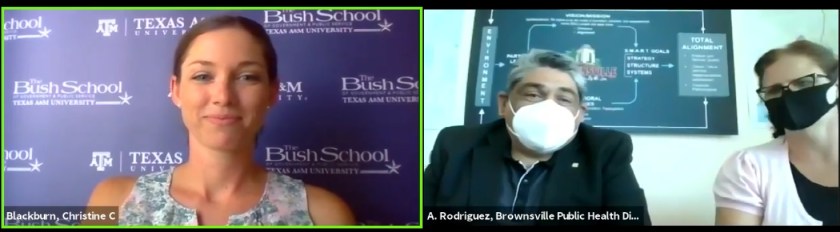
The Scowcroft Institute at Texas A&M has been offering regular COVID updates for viewers, and this month’s update, with Dr. Christine Blackburn, featured medical officials from Brownsville, Texas, where the Coronavirus has been particularly destructive.

 SHSU, LEAP Center, Center for Law Engagement And Politics, Texas A&M Bush School, Scowcroft Institute, Dr. Christine Blackburn, Dr. Art Rodriguez, Michelle Jones, Brownsville TX     

Blackburn’s guests were Michelle Jones, an epidemiologist, and Dr. Art Rodriguez.  Both live and work in the Brownsville area.\

SHSU, LEAP Center, Center for Law Engagement And Politics, Texas A&M Bush School, Scowcroft Institute, Dr. Christine Blackburn, Dr. Art Rodriguez, Michelle Jones, Brownsville TX

Dr. Blackburn, who is the Assistant Director for the Scowcroft Institute’s Pandemic and Biosecurity Policy Program, led off with updates.  In the US, we have approximately 3.3 million cases and 136,000 deaths.  In Texas, we have about 274,000 cases and 3,300 deaths.

Following her updates, Dr. Blackburn turned it over Dr. Rodgriguez and Michelle Jones.  In Brownsville, Dr. Rodriguez noted, the area is showing a surge in case positivity, with 30 percent of the tests coming back positive.  Moreover, the hospital capacity in Brownsville is 400 beds, and right now, the hospitals are at 95 percent, with ICU and ER beds being beyond capacity.

SHSU, LEAP Center, Center for Law Engagement And Politics, Texas A&M Bush School, Scowcroft Institute, Dr. Christine Blackburn, Dr. Art Rodriguez, Michelle Jones, Brownsville TX

Ms. Jones added that, one of the confounding variables in Brownsville is that there is much foot traffic between the City and Mexico, making collaboration with Mexican officials important.

SHSU, LEAP Center, Center for Law Engagement And Politics, Texas A&M Bush School, Scowcroft Institute, Dr. Christine Blackburn, Dr. Art Rodriguez, Michelle Jones, Brownsville TX

Both Rodriguez and Jones highlighted some of the steps Brownsville has taken to combat the issue.  The City of 185,000 people, has unveiled a five-level threat matrix, which offers suggestions at each stage on how to mitigate the threat; they are taking steps to double their daily testing capacity, which should be complete by next week; and they are working with the local college to lead sanitation classes, which will help educate the public on mitigation and containment strategies.

Dr. Blackburn then took questions, some of which were political, a sensitive area, especially if the questions involve your employer.  “How will Texas A&M bring back in-person classes without a spike in cases?”  This is, Dr. Blackburn noted, “a significant challenge,” which will be “very, very, very difficult.”  

And: “Why doesn’t Brazos County Office of Emergency Management report the percent of positive cases in their testing and their contact tracing more quickly?”  This is a “labor intensive process,” and Brazos County Health Department is “doing all they can, and working very hard to respond” to the community’s needs.

These questions were fielded with a smile, perhaps an acknowledgement of the difficulty of answering such questions.

SHSU, LEAP Center, Center for Law Engagement And Politics, Texas A&M Bush School, Scowcroft Institute, Dr. Christine Blackburn, Dr. Art Rodriguez, Michelle Jones, Brownsville TX

One question, which is on many minds, is the question of immunity.  How long will it last?  Dr. Blackburne noted that no one knows that yet.  Preliminary reports indicate that antibodies may not long linger in the body, limiting the amount of immunity they will provide.  But she believes that t-cells might be a fruitful research direction, noting that even if “immunity can last a year, the public could get seasonal vaccines.”

But the discussion was also sobering, with all three panelists seeing this is a long-term issue.  It’s not clear that we will return to normal in the foreseeable future, and the panelists suggested we should prepare for “hills and valleys.”  The key, Dr. Blackburne noted, is coming up with strategies that can effectively mitigate the spread and impact of COVID but “which can also be sustained.”  

Given the level of noncompliance with existing strategies (social distancing, masks), it’s not clear that sustainable and effective strategies exist for our current level of knowledge about the virus.

Many thanks to the Scowcroft Institute, Dr. Blackburn, Dr. Rodriguez, and Ms. Jones for their very informative presentation.  The program can be seen in its entirety here.
SHSU, LEAP Center, Center for Law Engagement And Politics, Texas A&M Bush School, Scowcroft Institute, Dr. Christine Blackburn, Dr. Art Rodriguez, Michelle Jones, Brownsville TX


Unknown's avatarAuthor mikeyawnPosted on July 15, 2020July 15, 2020Format AsideCategories Civic Engagement, Health, PoliticsTags Brownsville TX, Center for Law Engagement And Politics, Dr. Art Rodriguez, Dr. Christine Blackburn, LEAP Center, Michelle Jones, Scowcroft Institute, SHSU, Texas A&M Bush SchoolLeave a comment on Talking COVID with Dr. Blackburn: July 2020

Talking Higher Education: With Rep. Chris Turner, Chancellor Brian McCall, and Chancellor James Milliken

As a student at Sam Houston State University and a LEAP Ambassador, I am always interested in the goings-on in higher education, and I had the chance to learn up-close-and-personal with Representative Chris Turner’s FB Live program.

SHSU, LEAP Center, Center for Law Engagement And Politics, Texas State University System, Chancellor Brian McCall, Representative Chris Turner, Chancellor James Milliken

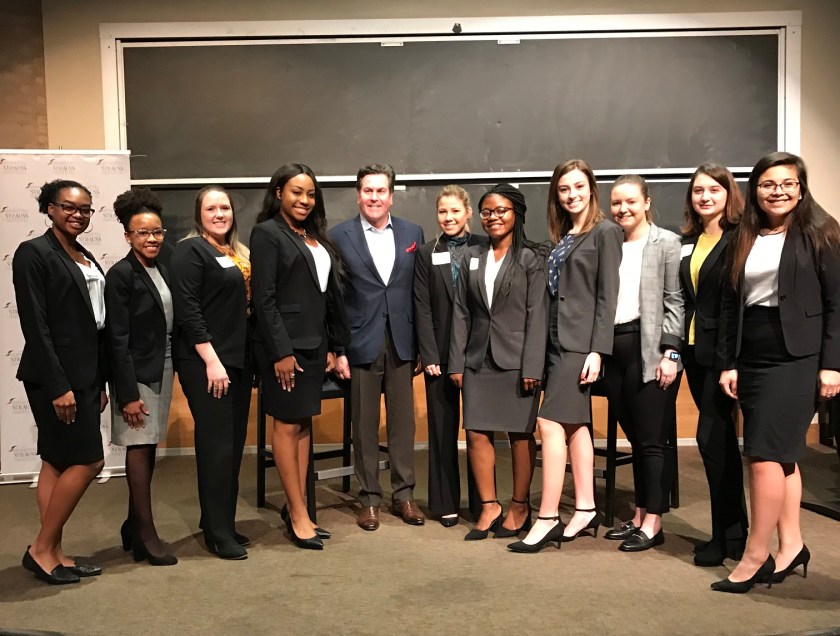
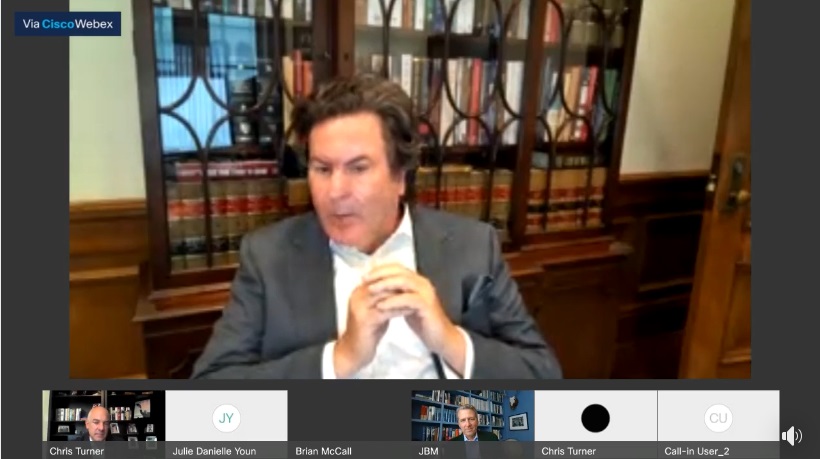
His guests were two Chancellors: Brian McCall (TSUS) and James Milliken (UTS).  It’s always a pleasure to hear from Dr. McCall, who has been a big supporter of LEAP’s Austin Internship Program.

SHSU, LEAP Center, Chancellor Brian McCall, SHAIP, Sam Houston Austin Internship Program, Center for Law Engagement And Politics

Turner, who is the Chair of the Higher Ed Committee in the Texas House (and who housed one of LEAP’s interns in the Spring of 2019), kicked off the meeting by allowing Chancellor McCall to introduce SHSU’s new president.  McCall gave effusive praise for the leadership of President Hoyt, and he then welcomed President Alisa White, whom he described as a “remarkable individual.”  She will begin on August 10, and we are grateful to be students at a time when we have had a chance to experience the leadership of President Hoyt…

SHSU, Academic Success Center, Center for Law Engagement And Politics, LEAP Ambassadors, Kat Talks, President Dana Hoyt

…and the chance to welcome President White to our friendly University.

The Chancellors had a chance to highlight some of their most impressive programs.  Chancellor McCall, for example, announced that TSUS had recently implemented a program  at three of their Universities (SHSU, Lamar, and Texas State) that will provide tuition-free education for students whose families make less than $65,000 per year.  Amazingly, that is more than 90 percent of the system’s freshmen students.

At the UT System, Chancellor Milliken has a similar program, noting that this is an important part of an adage that guides him: “Talent is equally distributed, but opportunity is not.”  Both systems, by offering affordable education to less-fortunate students, help equal the opportunity playing field.

SHSU, LEAP Center, Center for Law Engagement And Politics, Texas State University System, Chancellor Brian McCall, Representative Chris Turner, Chancellor James Milliken

The big topic, of course, was the impact that COVID has had on the TSUS and UT systems.  Both Systems discussed pride in their faculty for shifting to online so quickly in the spring (editor’s note: “Thank you, thank you very much.) and noted that their summer enrollment is actually up, a reflection, one hopes, of students’ satisfaction with their education.

Both Chancellors expressed pride in their students’ resilience, as well.  McCall noted that some students did homework in University parking lots to get onto wi-fi systems, having exhausted their own data plans.

While touting the technological advances available today, both Chancellors expressed a desire–assuming it’s safe, of course–to get back to in-person learning.  Many class types (such as labs), research activities, and student socialization are not conducive for on-line learning, and both, while lauding the value of online enhancements to the learning process, seem intent on keeping in-person learning the predominant delivery system, safety permitting, for the time being, especially for undergraduates.

SHSU, LEAP Center, Center for Law Engagement And Politics, Texas State University System, Chancellor Brian McCall, Representative Chris Turner, Chancellor James Milliken

Of course, to return to an in-person teaching environment, alterations to the learning environment will be necessary.  While it will differ by the institution, some discussions of steps that could be taken to mitigate risk include:

  • Reduced class sizes, held in larger class rooms
  • Signage directing students as a means of avoiding crowds and bottlenecks
  • Movement of large classes online
  • Alternating from class period to class period online and in-person (so only half the class is in the room at any one time)
  • Mask wearing
  • Limiting out-of-class interaction

Of course, even these tools are contingent on the COVID infection rates not getting significantly worse.

Both also made a strong case for tuition revenue bonds to create and expand facilities for their systems.  Chancellor McCall, in particular, highlighted the space deficit that the TSUS institutions faced.  And both Chancellors pointed out that higher-education funding was one of the near sure-fire ways of increasing productivity–and revenue–down the road.  As Chancellor Milliken said, “almost everything that is positive goes up with higher-education attainment levels.”

SHSU, LEAP Center, Center for Law Engagement And Politics, Texas State University System, Chancellor Brian McCall, Representative Chris Turner, Chancellor James Milliken

And on that optimistic note, Representative Turner closed the program, thanking the Chancellors for their leadership and wishing everyone a happy and safe 4th of July. (And reminded folks to “wear a mask and stay home as much as possible!”)SHSU, LEAP Center, Center for Law Engagement And Politics, Texas State University System, Chancellor Brian McCall, Representative Chris Turner, Chancellor James Milliken


Unknown's avatarAuthor mikeyawnPosted on July 1, 2020July 1, 2020Format AsideCategories Civic EngagementTags Center for Law Engagement And Politics, Chancellor Brian McCall, Chancellor James Milliken, LEAP Center, Representative Chris Turner, SHSU, Texas State University SystemLeave a comment on Talking Higher Education: With Rep. Chris Turner, Chancellor Brian McCall, and Chancellor James Milliken

Artistic Landmarks: Nancy Rubins’ “Monochrome”

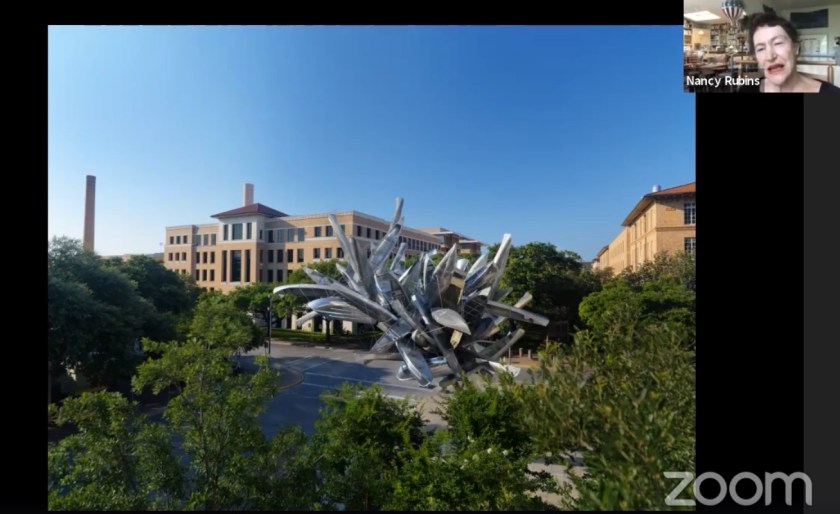
Whenever the LEAP Center heads to Austin, which is often, we do our best to visit the wonderful “Landmarks” art installations on UT’s campus.  Among the most astounding pieces of art is Nancy Rubins’ “Monochrome.”  Whenever students see it for the first time, they step away from it–not only to get a better look, but also for fear that it might fall on them.

SHSU, UT, University of Texas, Sam Houston State University, LEAP Center, Center for Law Engagement And Politics, Nancy Rubins, Jaime Garza, Landmarks

But between the creative vision Nancy Rubins and engineer Jaime Garza, this sculpture is not going to fall.

The story behind the art and the engineering was presented by Landmarks yesterday, and it involved quite a panel: Andree Bober (Director of Landmarks), Professor Tricia Clayton (Cockrell School of Engineering), and Jaime Garza (the project Engineer), and Dean Sharon Wood (Cockrell School of Engineering.

Rubins began by describing how she modeled the art work…

SHSU, UT, University of Texas, Sam Houston State University, LEAP Center, Center for Law Engagement And Politics, Nancy Rubins, Jaime Garza, Landmarks

…beginning with the structure and moving into a full-blown study…

SHSU, UT, University of Texas, Sam Houston State University, LEAP Center, Center for Law Engagement And Politics, Nancy Rubins, Jaime Garza, Landmarks

..to what it is today, “at the crossroads of the University’s science and humanities” parts of the campus.

SHSU, UT, University of Texas, Sam Houston State University, LEAP Center, Center for Law Engagement And Politics, Nancy Rubins, Jaime Garza, Landmarks

Rubins began incorporating boats into her work in 2006, after seeing her husband work on her canoe.  She was drawn to the canoes’ surface, as well as its combination of figurative and abstract elements.  This attraction was deepened by the different look that the canoes manifest in the rain, in the light, and other changing atmospheric conditions.

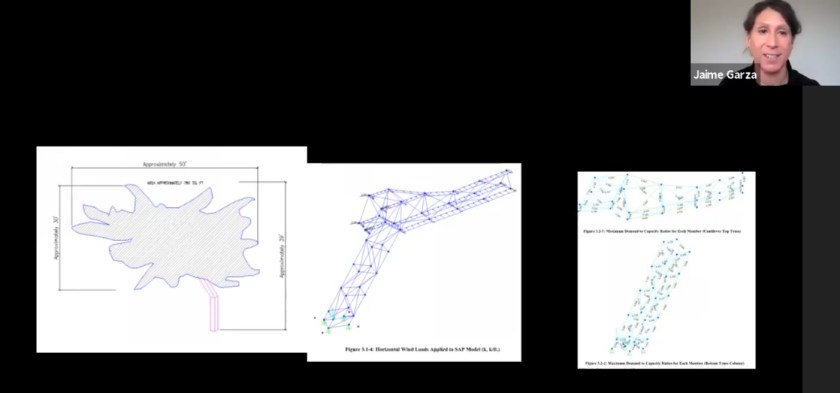
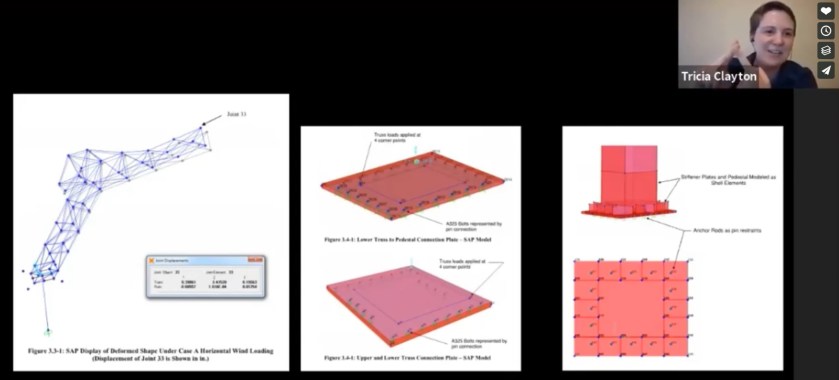
After Rubins’ discussed her artistic vision, Professor Clayton prompted Garza to describe the technical challenges associated with such a sculpture.  These challenges did, indeed, become rather technical…
SHSU, UT, University of Texas, Sam Houston State University, LEAP Center, Center for Law Engagement And Politics, Nancy Rubins, Jaime Garza, Landmarks

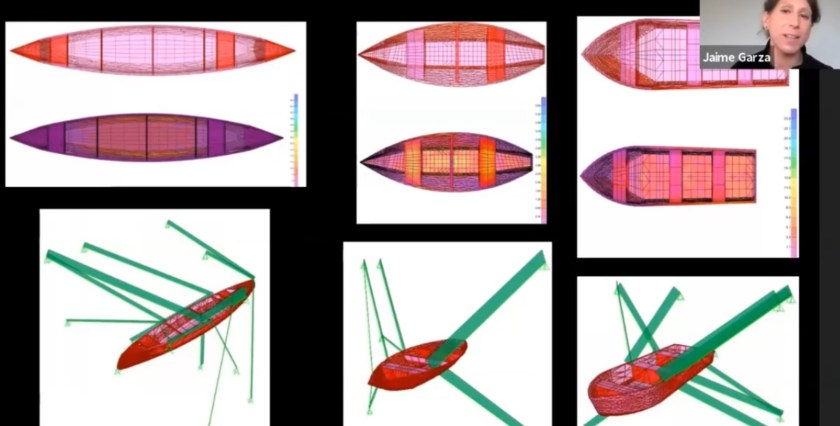
In this case, Nancy came up with the original model, which Garza then analyzed, making suggestions as to what would work best from an engineering perspective.  The diagram on the right indicates the stress points of the sculpture, with the blue and green colors representing “low stress.”
Rubins wanted the sculpture to be applicable to “anywhere in the world.”  What that means in practical terms is that it needs to hold up under any conditions: snow, rain, earthquakes, heat, and hurricanes.  So Garza imagined “worst-case scenarios” for different parts of the world, ensured that the sculpture could survive those (with a lightning rod installed, also), and then also ensured that the sculpture could also meet the building codes of Austin.

SHSU, UT, University of Texas, Sam Houston State University, LEAP Center, Center for Law Engagement And Politics, Nancy Rubins, Jaime Garza, Landmarks

Interestingly, the sculpture goes more than 30 feet into the ground, which, obviously, helps stabilize the sprawling sculpture.

In this particular sculpture, Garza needed to demonstrate that the sculpture was sound, so rather than doing load testing (which would have taken too long), they did “finite element models” to demonstrate the structural integrity.

SHSU, UT, University of Texas, Sam Houston State University, LEAP Center, Center for Law Engagement And Politics, Nancy Rubins, Jaime Garza, Landmarks

In the end, the structure is sound, as this photo (my favorite!), attests…

SHSU, UT, University of Texas, Sam Houston State University, LEAP Center, Center for Law Engagement And Politics, Nancy Rubins, Jaime Garza, Landmarks

…and these young folks seem to have confidence in it.

SHSU, UT, University of Texas, Sam Houston State University, LEAP Center, Center for Law Engagement And Politics, Nancy Rubins, Jaime Garza, Landmarks

In closing, Rubins noted that her “team is super proud of the quality and safety of the work.”  And after five years, there “have not been any issues” (although she knocked on wood as she said that…), and she predicted that it would last at least 40 years.  We hope so.

SHSU, UT, University of Texas, Sam Houston State University, LEAP Center, Center for Law Engagement And Politics, Nancy Rubins, Jaime Garza, Landmarks


Unknown's avatarAuthor mikeyawnPosted on June 25, 2020June 25, 2020Format AsideCategories Art, Civic EngagementTags Center for Law Engagement And Politics, Jaime Garza, Landmarks, LEAP Center, Nancy Rubins, Sam Houston State University, SHSU, University of Texas, UT1 Comment on Artistic Landmarks: Nancy Rubins’ “Monochrome”

Smith-Hutson Scholars: Success Stories at SHSU

Although it has been quite some time since the Smith-Hutson Scholars hosted their spring banquet, now seems an appropriate time nonetheless.  Each year, the Smith-Hutson program hosts their scholars at a banquet, and this year, they allowed seniors to invite a faculty member of their choice.  Makayla Mason, a graduating senior, invited me to an event that impressed me greatly.

SHSU, LEAP Center, Center for Law Engagement And Politics, Makayla Mason, Smith-Hutson Scholar

So why would be appropriate to blog about this event now, five months after the event took place?  Well, Makayla graduated in May and in about a week, she is moving to Michigan, where she will begin her graduate studies at Michigan State University, one of the finest schools for Criminal Justice in the country.  So, in addition to a blog about the Smith-Hutson program, it is also a fond remembrance of Ms. Mason’s time at SHSU–four years that was funded and enriched by the Smith-Hutson program.

The banquet involved all 105 then-current Smith-Hutson scholars–who are eligible for up to $18,500 an academic year.  It is one of the most generous scholarship programs on campus, and it has helped more than 300 students graduate in its 24-year history on campus.  Makayla Mason was one of the program’s recent graduates, and few students across the entire campus got as much from an SHSU education as Ms. Mason.

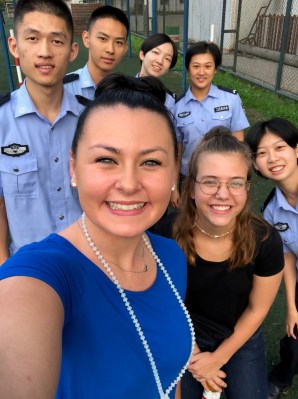
She spent 3.5 years as a LEAP Ambassador, and she spent her last year at SHSU as the program’s president.  She visited numerous US states during her time at SHSU…

SHSU, LEAP Center, Center for Law Engagement And Politics, Makayla Mason, Smith-Hutson Scholar

…participating in numerous educational field trips and research projects, and she was even able to visit China for research which was later published in a leading CJ academic journal.

SHSU, LEAP Center, Center for Law Engagement And Politics, Makayla Mason, Smith-Hutson Scholar

She did this as a first-generation college student, while working her entire time through college (Student Money Management Center) and volunteering at the Texas Special Prosecution Unit, the City of Huntsville, and many other non-profits and government agencies.

SHSU, LEAP Center, Center for Law Engagement And Politics, Makayla Mason, Smith-Hutson Scholar

While no program can guarantee the type of success Ms. Mason enjoyed, the Smith-Hutson has achieved remarkable things for its students, as the spring banquet highlighted.  The program honored Dean Mitchell Muehsam and the late Jim Bexley, while welcoming Dr. Brian Loft, who, as Associate Vice Provost, will oversee the program.

The Smith-Hutson Coordinator, Chris Garcia, was the emcee for the evening, deftly recognizing the students who participate, ensuring alumni were recognized, and providing Dawn Wesneski, the Assistant to the Donor, a platform to discuss the donor’s objectives.

They both welcomed alumni Noe Negrete and Veronica Davis, who spoke a few inspirational words of advice to the current Smith-Hutson Scholars.  And all of this occurred while the Smith-Hutson Scholars (and their guests!) were enjoying a wonderful dinner.

As I listened to Garcia, Wesneski, Muehsam, Loft, Negrete, and Davis, I was struck by the devotion the participants had to the program.  It was clear that the donor and the SHSU representatives were committed to the program, and had the best interests of the student at heart.  I was also struck by the students: Of the 105 scholars, about 90 percent were present, an amazing percentage.  In addition, the students were dressed well, behaved professionally, and stayed for the entire program.  While this may seem basic, it is not.  On campus, many students will arrive late, dress however they want, leave early, or spend a lot of time on their phones–they aren’t necessarily being rude, but they simply may not know better.  Not this crowd.  This crowd was professional and attentive.

It provided me with insight into how other successful programs operate, provided me with more information about the Smith-Hutson Scholars, and also helped me understand the great success of Makayla Mason through her time in college.  (While I mentioned some of her extra-curricular activities, I should mention that she graduated with a 3.92 GPA.)

It was a great reminder of what makes SHSU a special place, and I appreciate both Makayla Mason and the Smith-Hutson program for my wonderful evening and for the good work that goes on at SHSU.

SHSU, LEAP Center, Center for Law Engagement And Politics, Makayla Mason, Smith-Hutson Scholar

Unknown's avatarAuthor mikeyawnPosted on June 18, 2020Format AsideCategories Civic EngagementTags Center for Law Engagement And Politics, LEAP Center, Makayla Mason, SHSU, Smith-Hutson ScholarLeave a comment on Smith-Hutson Scholars: Success Stories at SHSU

How to Catch a Spy: The Art and Future of Counter Intelligence with James Olson

by Makayla Mason

 I always enjoy and look forward to World Affairs Council events, but I was particularly excited about this webinar. I have been reading James Olson’s book Fair Play: The Moral Dilemma of Spying. and he has recently come out with a new book: To Catch a Spy: The Art of Counterintelligence. I have also had the opportunity to see Mr. Olson speak in person multiple occasions at the Texas A&M Bush School; I was even able to speak to him after an event a couple of years ago….

SHSU, LEAP Center, Center for Law Engagement And Politics, TAMU, World Affairs Council Houston, Jim Olson

…and Olson was generous enough to come to SHSU and speak at a program hosted by LEAP–which resulted in a packed house.

SHSU, LEAP Center, Center for Law Engagement And Politics, Jim Olson, CIA, Spying

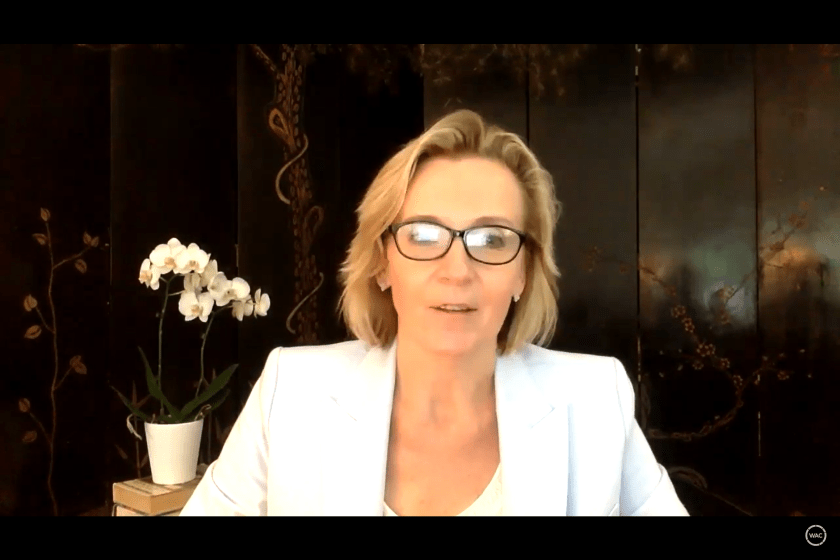
The webinar began with a brief introduction by World Affairs Council’s Sandjia Bayot.

SHSU, LEAP Center, Center for Law Engagement And Politics, TAMU, World Affairs Council Houston, Jim Olson

She informed us that over 700 people were registered for the event! She of course introduced the man of the hour, James Olson.

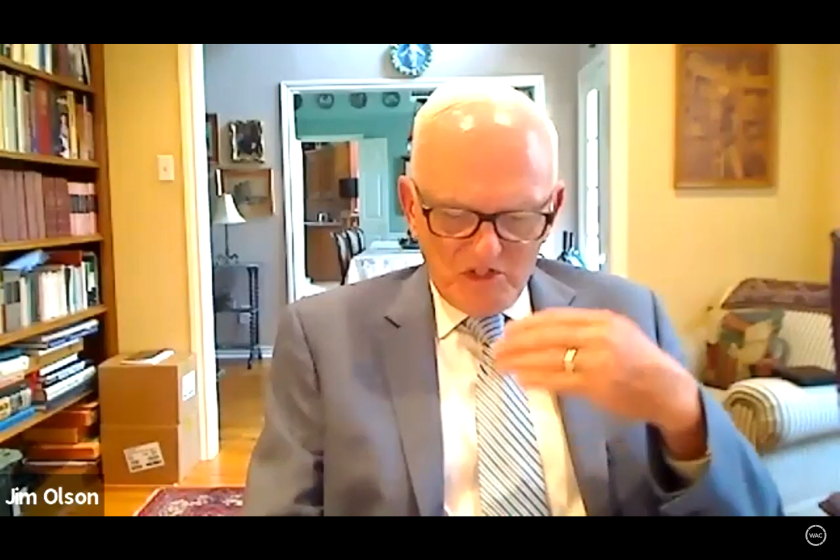
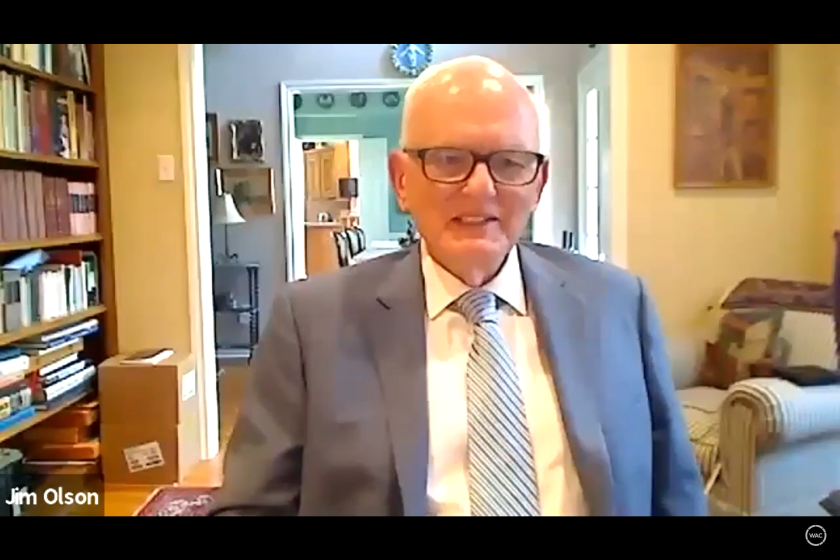
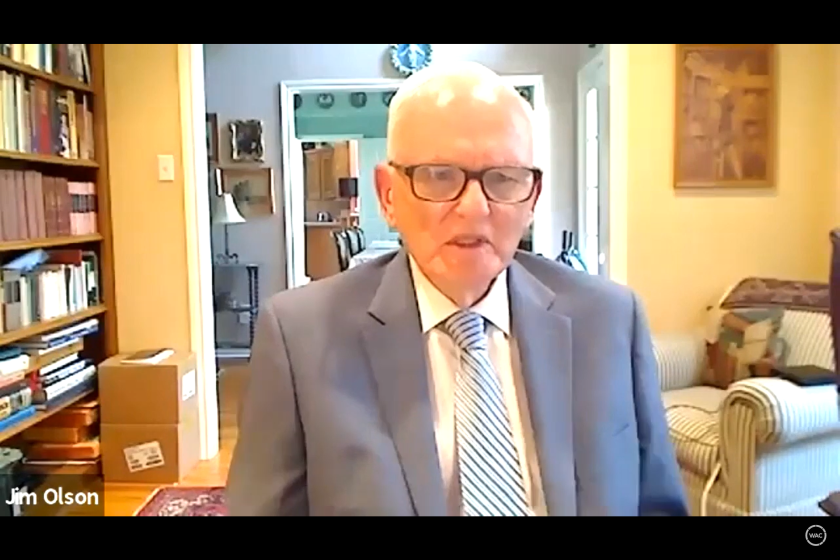
Mr. Olson served for over thirty years as the Directorate of Operations for the Central Intelligence Agency (CIA). He is currently a professor, teaching intelligence and counter intelligence, at the Texas A&M Bush School of Government and Public Service.

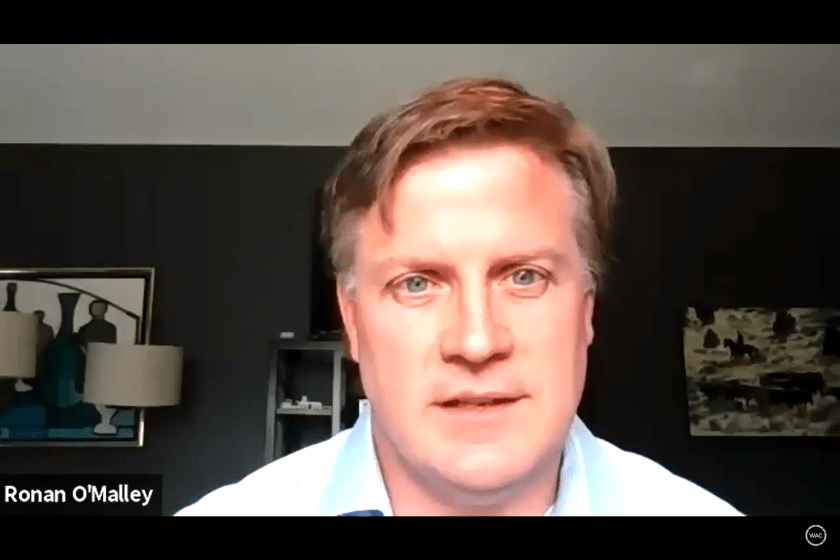
The moderator for the event was World Affairs Council’s Ronan O’Malley.

SHSU, SHSU, LEAP Center, Center for Law Engagement And Politics, TAMU, World Affairs Council Houston, Jim OlsonCenter, Center for Law Engagement And Politics, TAMU, World Affairs Council Houston, Jim Olson

Ronan dove right in, asking about the three most threatening nations to the United States: China, Russia, and Cuba, with a particular emphasis on China.

Professor Olson described China as having a level of threat higher than he has ever seen before. Stating that China is overwhelming our defenses and stealing anything that could benefit them in any way. It is cheaper for them to steal from us than come up with their own ideas. The biggest thing they are wanting to steal from us is our technology. We are currently losing this counter intelligence war.

SHSU, LEAP Center, Center for Law Engagement And Politics, TAMU, World Affairs Council Houston, Jim Olson

Mr. Olson then described how the Chinese use their exchange students aggressively to steal information. These students can get offers from high level jobs, receive green cards, and after 5 years of having a green card, can become citizens.  The Chinese Government then infiltrates these Chinese Americans and appeals to their sense of loyalty to their home country, sometimes leveraging the former students’ families (in China) to add additional pressure.

SHSU, LEAP Center, Center for Law Engagement And Politics, TAMU, World Affairs Council Houston, Jim Olson

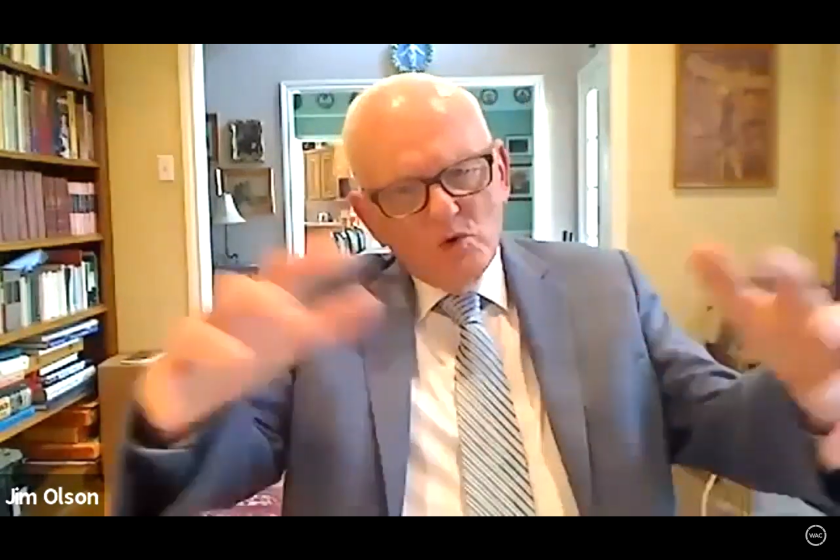
When asked what he would recommend to end the counter intelligence war with China, Mr. Olson said the most important thing to do is be offensive. We cannot sit back and try to protect our secrets. We need to have more frequent double agents. He stated that if he was still in-charge, he would flood China with double agents. The best counter intelligence is penetration, and double agents are gold in counter intelligence.

SHSU, LEAP Center, Center for Law Engagement And Politics, TAMU, World Affairs Council Houston, Jim Olson

The second threat is Russia.

Mr. Olson stated that there is more Russian spying now than during the Cold War and that Vladimir Putin is very interested in influencing our politics and our elections. In the 1950s, some Americans still shared Communist “ideals,” perhaps cultivated during the 1930s, during the Great Depression.  By the 1980s, however, agents who spied for Russia were doing so just for money, not for Communist ideals.

When discussing the cultural disadvantages that the US has compared to China and Russia, Mr. Olson stated that we have ethics and a high standard of proof to meet. The US cannot access any kind of employment records, financials, or physically surveillance of individuals until there is probable cause, and he is proud of that.

SHSU, LEAP Center, Center for Law Engagement And Politics, TAMU, World Affairs Council Houston, Jim Olson

The third threat to the US is Cuba, but Mr. Olson said he would rank Cuba as #1 in terms of “obnoxiousness.”

Mr. Olson described Cuba’s intelligence as better than the KGB’s and more disciplined. At the height of Castro’s power, Cuba had 38 Cuban double agents working against the US.

SHSU, LEAP Center, Center for Law Engagement And Politics, TAMU, World Affairs Council Houston, Jim Olson

Ronan then mentioned polygraph tests, which Mr. Olson very much favors. He sees polygraphs as quite useful in finding double agents, as well as for screening new employees. More individuals, he notes, are removed from the hiring process due to the polygraph than the background check. He admits that polygraphs are not perfect, but they are a valuable counter intelligence tool.

SHSU, LEAP Center, Center for Law Engagement And Politics, TAMU, World Affairs Council Houston, Jim Olson

Mr. Olson was asked what are some of the ideal qualities they are looking for in hiring federal agencies. He said the number one quality for federal agents and law enforcement across the board is character. He also finds it ironic that they hire people who are honest, reliable, and have good morals, but then train them to lie, cheat, and steal. We want people who know where the line is, and will do their job for the US, not against the US. If there are warning signs in the hiring process, he sticks with the motto: “When in doubt, keep them out.”

SHSU, LEAP Center, Center for Law Engagement And Politics, TAMU, World Affairs Council Houston, Jim Olson

As the webinar wrapped up, Mr. Olson had a few more things to say about spying: You have few friends in the intelligence world. Everyone spies on everyone. Everyone is in the business of stealing from America. Many countries who we consider allies have been caught spying on us. When you catch an ally spying on you, call them out, give them a slap on the wrist, but do not end the relationship.

Mr. Olson declared that his true love is spy catching, and that if he and his wife (who also worked for the CIA) could start all over again, they would get into the China program and learn Mandarin, because they are currently the #1 threat.

Mr. Olson ended the webinar by stating that the first line of defense is an informed public–which, as a former LEAP Ambassador, I agreed.

SHSU, LEAP Center, Center for Law Engagement And Politics, TAMU, Jim Olson


Unknown's avatarAuthor mikeyawnPosted on June 13, 2020June 13, 2020Format AsideCategories Civic Engagement, Civil Rights, PoliticsTags Center for Law Engagement And Politics, Jim Olson, LEAP Center, SHSU, TAMU, World Affairs Council HoustonLeave a comment on How to Catch a Spy: The Art and Future of Counter Intelligence with James Olson

Posts pagination

Previous page Page 1 … Page 53 Page 54 Page 55 … Page 107 Next page

LEAP Ambassadors Are Involved!

This slideshow requires JavaScript.

Follow Us On Facebook!

Follow Us On Facebook!

Catch Up With Us

  • Pre Law Society and Public Safety March 27, 2026
  • Firearm Possession, Sexual Abuse, and Drug Possession on Tap for SHSU Courtroom March 19, 2026
  • Past as Prologue: An Evening with Jon Meacham March 18, 2026
  • Pre-Law Society hosts Dr. Rhonda Beassie March 16, 2026
  • Filling Empty Bowls: A Community Tradition March 13, 2026

Join The Conversation!

Multi-Platform Media… on Fun and Flavor: Chilly at the…
Highlights from the… on Glazing-A-Trail with Lauren…
The Civic Leadership… on Foundational Activities of the…
The Civic Leadership… on The Philosophical Foundations…
LEAPing Into Action… on The Philosophical Foundations…

Find Previous Posts

We also have Twitter!

My Tweets

LEAPing Into LEARNing

This slideshow requires JavaScript.

  • About LEAP
  • LEAP Ambassadors
Center for Law, Engagement, and Politics Blog at WordPress.com.
  • Subscribe Subscribed
    • Center for Law, Engagement, and Politics
    • Join 490 other subscribers
    • Already have a WordPress.com account? Log in now.
    • Center for Law, Engagement, and Politics
    • Subscribe Subscribed
    • Sign up
    • Log in
    • Report this content
    • View site in Reader
    • Manage subscriptions
    • Collapse this bar
 

Loading Comments...