Ring after ring flew from their hands, aimed at the point of a witch’s hat. Three at the floor, one hitting the mark, and one hitting a human hotdog. But alas, at least one hat had been hooped around by the ring and was merit for a prize of chalk or bubbles. Why so much scary, carnival fun at the square? Why, it was the annual Huntsville Scare on the Square.
Last Saturday the LEAP Center hosted a booth at Scare on the Square. Scare on the Square is an annual Halloween event sponsored by The Huntsville Main Street Program. About 40 different businesses, schools, and local organizations host games and activities for community children. Scare on the Square is sponsored by local businesses and it is a safe atmosphere for families to enjoy themselves.
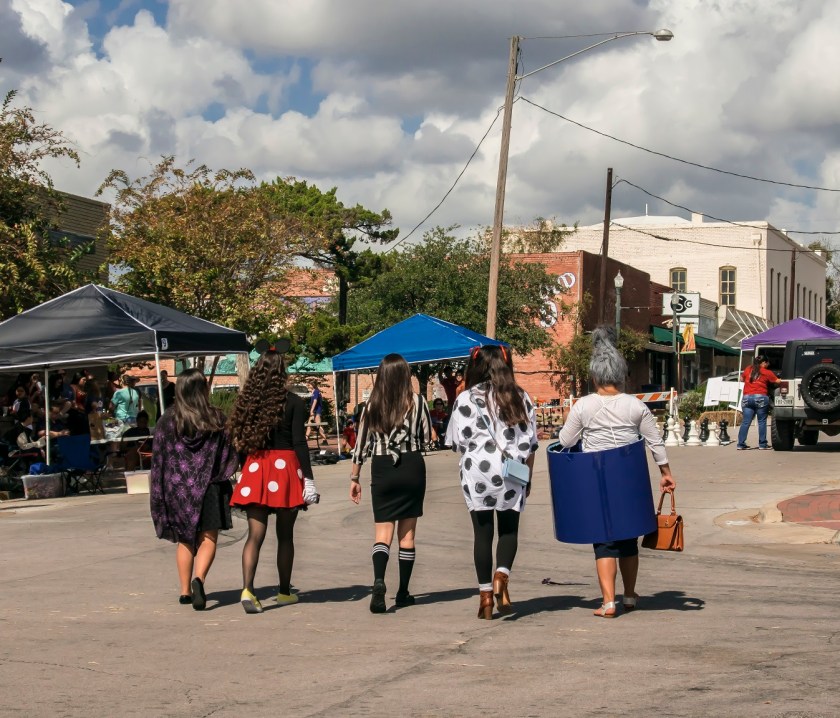
If you are creative and wear a costume it will spare you from having to pay the entrance fee of one dollar. Embracing this costume-wearing practice, the LEAP students arrived in a variety of costumes themselves from Minnie Mouse to Charlie Chaplin.
With weeks of anticipation prior to Scare on the Square, the LEAP center engineering team (aka a few of the LEAPsters) designed a game built to increase levels of happiness to the maximum. In the end, we created the “Witch’s Hat Ring Toss.” Similar to a bean bag toss, it required the competitor to loop hat dressed cones with a pool ring. Let’s just say that hand-eye coordination was important in order to successfully master this enchanted game.
This slideshow requires JavaScript.
With smiling faces, all the children (and even some LEAPsters) patiently waited in line to play, ready to ring one or two witch hats.
We had a few future athletes who knew at exactly what angle to throw the rings. Yet even more children measured wind speed, warmed up their best throwing arm, made their marks, and walked right up to the cones to place the ring into the hat.
In between handing out rings and giving out candy, we amused ourselves by noticing the creative Spidermen, Pikachus, Elsas, Super Girls (we even had our own superwoman!), as well as some actually frightening costumes.
But even more rewarding was the look on their faces when they looped a hat (without cheating).
With the LEAP center’s 1800 pieces of candy gone, we packed our tent and witchy game satisfied with the 400 plus jolly children that had visited us. We are grateful for the sponsors and coordinators of these events that allow us to interact with the community!
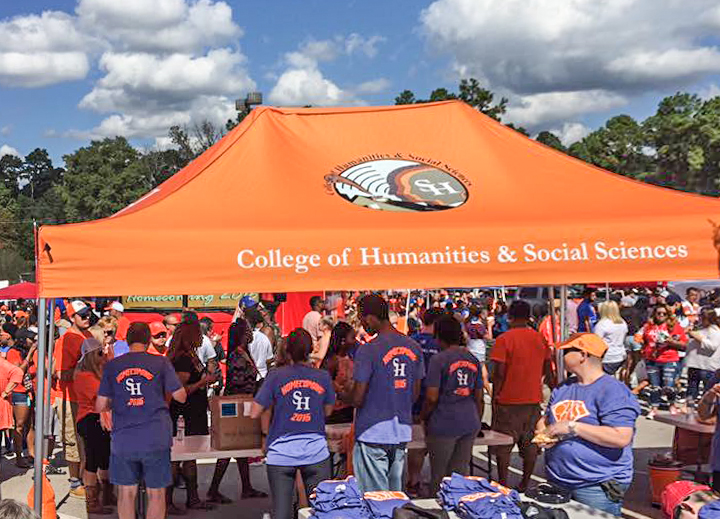
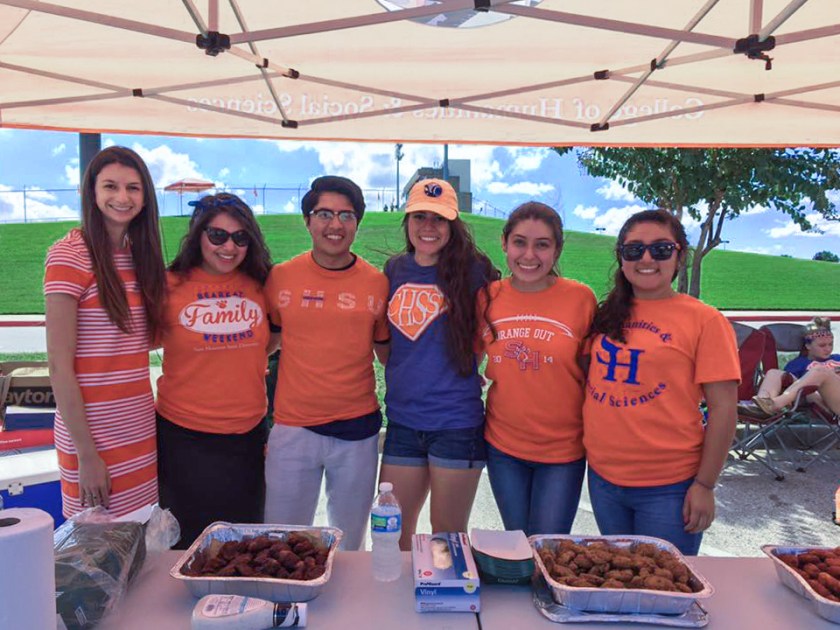
Nonstop chanting filled the backstreets of SHSU as the community gathered for the 2016 Homecoming tailgate. As the first college tailgating experience for most of the LEAP students, we took on the crowds of students, parents, fans, pets, and Huntsville community members. The College of Humanities and Social Sciences (also known on campus as CHSS) kindly allowed the LEAP Ambassadors to join their tailgate celebration.
As volunteers, our duties were simple; set up and help pass out food.
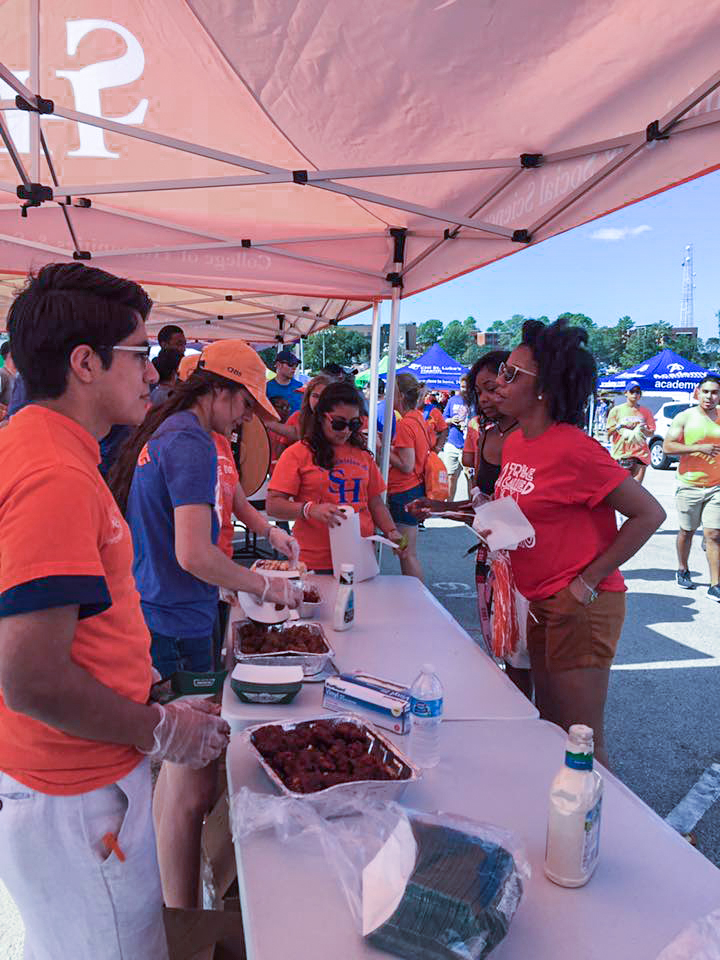
We passed out over 1,200 chicken wings and they went fast! Many lined up to win a prize from the CHSS booth and get a sample of the savory wings. Although hot and crowded, the tailgate was a fun experience. Dean Abbey Zink and Associate Deans Rhonda Callaway along with Jerry Bruce also joined our pre-game celebration. It was great to see the community and faculty come together for our homecoming game against Abilene Christian University.
After our shift with CHSS ended, many of the LEAP students explored the other booths to scout out their prizes and food. We ate pizza, turkey legs, sausage wraps, popcorn, and topped it off with some sweet tea. Various booths blared music and gave free SHSU merchandise. These school spirited trinkets and momentos where used to represent our school at the game which had begun right after the festivities. The chants continued all the way to victory against ACU (48-21). The LEAP Ambassadors are always happy to try new things, especially when it involves delicious food, fun football, and volunteerism!
Tis the season for pumpkin spiced everything, Bearkat Football, cooler days and–for the Huntsville community–the Fair on the Square! Huntsville’s annual Fair on the Square attracts an average of 15,000 people to support small businesses and community engagement. Everyone, from Walker County and farther, congregated in Huntsville’s downtown square to shop for antiques, carnival food, crafts, and other treats.
Glad to assist, the LEAP Ambassadors volunteered with the Walker County Republican Party and the Walker County Republican Women among this ocean of booths. Thus, we spent a morning selling jewelry, registering voters, and taking donations for campaign buttons, yard signs, bumperstickers, and t-shirts. With a variety of booths showcasing all sorts of curiosities, from engraved pens to apparel from the Andes, the Fair attracted so much people that the streets flooded with shoppers eager to visit every inch of the Square. So being, the excited Republicans among the crowd visited our booths with an overwhelming eagerness to demonstrate their pride in their political activism. The day was a success for the Party as they sold out of many items, registered more than thirty voters in Walker County, and raised a bountiful amount of funds for local campaign efforts.
For the LEAP Ambassadors, it was a nice way to spend a Saturday morning by learning about local businesses, shopping, and volunteering with the Republican Party and Women. We were also fortunate to catch up with the Battle of Piney Woods game afterward (Go Bearkats!!). With such an amazing Fair on the Square Saturday, the LEAP Ambassadors are already looking forward to volunteering next year!
Although our trip’s primary purpose is to assist Mr. Jeff Guinn with his research, our path to and from Detroit consists of various related (and otherwise educational) stops. Today, the stops included the World War I Museum in Kansas City, the Capitol of Missouri in Jefferson City, and some historical sites in Springfield, IL.
World War I Museum
With a towering concrete edifice, the World War I Monument was recognized as the national commemorative memorial of the war’s destructive toll.
Liberty Tower, World War I Monument
Standing at the foot of the tower, we looked up to a blinding peak, which seemed to scratch the sun. With such an admiring sight, we found the elevator to climb the approximately ten-story structure. As we stepped onto the balcony of the memorial our sights were lost among the mesmerizing vista of Kansas City.
Kansas City Skyline
Perched on our elevated vantage point, we spotted various spouting fountains riddled amidst the city, appropriately nicknamed the City of Fountains.
After descending the 90-year old elevator–a very cozy metal enclosure hanging over rickety wires-we returned to the ground. We then rendezvoused outside the memorial and returned inside the museum, ready to view the exhibits of diverse aspects of the Great War.
With a brief overview of the complexity of the war’s inception, composed of treaties and alliances among the European nations, we began the tour with relics of the nations’ emperors and rulers.
Paul Examines the World War I Timeline
Such antiquities included marksmanship trophies, luxurious smoking pipes and flasks, and other royal artifacts. As we followed the museum’s exhibits we also viewed the different models of the combatant’s firearms with pistols and rifles from each of the European countries. This exhibit provided a sense of the period’s need for manufacturing, where each nation used its resources and laborers to mass produce their own firearms. Among the exhibits were showcased other aspects of the war which had not been experienced prior to the Great War, such as chemical warfare. With masks worn by these trench soldiers, grenades which contaminated the air with hazardous gas, and the spray of mustard gas which would burn the flesh of patriotic fighters, the atrocities witnessed in this war were unlike any other. Furthermore, the dugouts in which the military denizens took, what could loosely be termed, refuge, imposed a very deplorable, unsanitary, demoralizing lifestyle for the fighters of World War I. To further exhibit the effects of industrialization on war, there were also maquettes and life-size models of the war’s u-boats, primitive military air-crafts (some made out of cloth and wood!). and missiles.
Most notably, in the American campaign section of the museum, we found two modified Ford Model T’s which would have been used during the war.
Paul and Ryan Examine the War-Purposed Model T
Even though the war acted as a catalyst for the modern industrial culture and economy, it also began a new age of catastrophic war. No other showcased artifact was able to capture this horror than Wilfred Owen’s “Dulce Et Decorum Est,” which we listened to inside one of the museum’s powerful exhibits. It was this poem that spoke the truth of the war’s atrocious effects on the lives of those who died and survived World War I. After this reflective visit to the museum, we went back to our traveling mini-van and got back on the road in order to reach Jefferson City on time for our tour of Missouri’s Capital Building.
Jefferson City, Missouri’s Capital
After the two hour drive into Jefferson City, we hopped on an already-started capitol tour. Our tour began on the second floor, where there are sixteen murals done in a style called three point perspective, where, at different angles, objects in the painting seem to be altered. For example, in one mural depicting a civil war battle, Union forces look to be attacking, while Confederate forces are retreating, but, at another angle, the roles of the opposing sides seem to switch.
On this same level are the House and Senate chambers. On the house side, there is the House Lounge room, where Thomas Hart Benton, a native Missourian, painted a mural covering all of the walls.
Thomas Hart Benton’s Murals in the House Lounge
The murals depict the history of Missouri, both good and bad, from French traders and farmers trading with the natives, to the time of Tom Pendergast, also known as “Boss Tom” (seen in the mural above on the bottom right).
When Boss Tom was arrested on tax fraud and sent to prison, one senator snuck in at night and carved Pendergast’s prison number on the back of his suit. Other congressmen would put out their cigars and cigarettes on his face, and Mr. Benton had to come back years later to repair the mural.
All the faces in the murals are native Missourians, except for one: an Osage Native American who was living on a reserve in Kansas, since natives were removed from their lands in Missouri.
Interestingly and sadly, when Mormons settled in Missouri, they were hated by many, and the governor passed an executive order in 1838 to allow anyone to drive them off of their land by any means necessary, whether that be tar and feathering, burning their house, or murder.
Benton Depicts the Treatment of Mormons in Missouri’s Early History
On the third floor is a hall of famous Missourians, where busts of well-known natives of the state are featured. Two in particular—Emmet Kelley, a famous clown, and Stan Musial, a famous baseball player—are special in that, if you take a picture of them with the flash on, you see features not visible to the naked eye. With Kelley, for example, you can see his clown makeup when photographed with a flash.
With Makeup Apparent
Makeup Less Visible
When Stan Musial is photographed with flash, the red “SL” on his cap is visible; without the flash, or by the naked eye, the SL is visible, but not in Cardinal red.
With Flash
Without Flash
Also on this floor is the grand staircase, a huge staircase which leads from the grounds outside to the third floor, the largest bronze doors cast since the Roman Empire, and a 9,000 pound bronze chandelier suspended from the ceiling of the dome. Having finished the tour of one of the “most interactive capital buildings” (according to Brian Aldaco), our hunger was calling our attention.
Missouri’s Capitol Rotunda
For lunch we went to a place called Arris, right next to the beautiful Missouri Capitol. Arris is a Greek pizzeria. Every pizza that they serve is named after a different figure from Greek mythology or history, including Achilles, Athena, Atlas, Poseidon, and Plato. Curiously, it seems that the philosopher has determined that eating animals is unjust, as the Plato was a vegetarian pizza. We went for a meat option.
Between the LEAPsters we split the Aiyaiys pizza, made up of cheese, mushroom, green peppers, and sausage. Professor Yawn got a gyro sandwich of Illiadic proportions in lieu of pizza. We also discovered that Greek pizza bears more resemblance to Italian pizza than American pizza. “Like the Italian pizza, this one had less tomato sauce, and a thinner crust,” commented Paul Oliver. Having tasted among the finest in Greek pie we drove towards Springfield, Illinois in hopes that we would make there on time before the closing of Lincoln’s burial grounds.
Lincoln’s Tomb
After another long car ride we arrived at Lincoln’s Tomb. It is an impressive edifice, boasting a central obelisk that rises to a point high above the rest of the mausoleum.
A statue of Lincoln adorns the front, his hand outstretched before him. Beneath him various statues of heroes stand. At the base of the tomb is a heavy, metal door that allows entrance into his sepulcher.
The rest of the necropolis was quite beautiful as well. The landscape of lush, green grass and tall trees provided a verdant resting place for the dead. Most curiously, adjacent to Lincoln’s tomb was the old home for the tomb’s caretaker. Due to an edict issued by the governor at the time of the crypt’s construction, all government buildings had to be made in a gothic style. The caretaker’s home is therefore made of stone bricks, and has a presumably faux-watchtower built into its side, as well as battlements upon the roof.
As the tower’s bell knoll marked the time for the cemetery to close, we rode to take a peak of Illinois’ Capital Building. On its grounds stood a statue of Abraham Lincoln…
The LEAP Guys with Abraham Lincoln and the Illinois Capitol
….and Stephen Douglas which we were fond of (he appeared to be strutting). After admiring the very dramatic architecture…
…we rode a few blocks in search of Frank Lloyd Wright’s Dana-Thomas home.
Unlike the Usonian homes we had visited in our previous trip, the Dana-Thomas home was designed in a more oriental-inspired design but it still stood as a home far ahead of its time. Even though it was built a hundred years ago, due to its very modern appearance, it could have very well been built yesterday.
To continue on our search for interesting homes, we also went in search for Lincoln’s Springfield home. Situated along South 8th St. and East Jackson St., the homes that surround the former Illinois senator’s residence are preserved as they were in the 19th century. With the street left unpaved, walking towards Lincoln’s home was an enjoyable stroll down a period of American history that is left frozen in time in those few blocks near The Great Emancipator’s home. As we caught the last glimpses of the residence, with the sun already beneath the horizon and fireflies glittering along the dirt road, we hoped onto our minivan ready to make our three-hour ride to Chicago. With a very satisfying day of historical learning coupled with an estimated total travel time of eleven hours we deemed it appropriate to pat ourselves on the back for having enjoyably finished the second day of our trip.
The LEAP Center’s mission is to offer unique educational opportunities for students. An example of this is the Center’s annual trip to the Southern Legislative Conference, to which the LEAP Ambassadors are invited to attend. While the conference offers the opportunity to learn about policies among 15 southern (and near-southern) states, the travel to and from the conference also presents learning opportunities.
Following the students’ 11-day trip across eight states and more than 20 educational sites, the seven students selected their favorite destinations across categories such as food, historical landmark, museums, and cities. The results are below:
Favorite Cities:
Eureka Springs, AR: This quaint little town proved to be the favorite of the group, with almost every student placing it on their top three.
LEAP Ambassadors in Front of “Flatiron Building” in Eureka Springs, AR
Lexington, KY: The site of our conference also proved popular. With its beautiful horse farms, pretty downtown, and attractive parks, students enjoyed four days in the horse capitol of the country.
The LEAP Ambassadors at Triangle Park, Lexington
Hot Springs, AR: This was a surprise to our professor, but the students enjoyed seeing the springs, the historic architecture, and meeting other SHSU students by happenstance!
LEAP Ambassadors in Front of Ozark Bathhouse, Hot Springs, AR
Little towns ruled the culinary arts on this tour!
Favorite Works of Architecture:
Frank Lloyd Wright House (Bachman-Wilson House) at Crystal Bridges was the favorite, edging out some other top designs. The large living room won the day!
LEAP Ambassadors Outside of Frank Lloyd Wright’s Bachman-Wilson Home
Anthony Chapel at Garvin Gardens, Hot Spring, AR was one of three Fay Jones’ Chapels the student saw, and it proved the favorite. Although larger than the other two (which are in Bella Vista and Eureka Springs), the three designs are very similar.
Garvin Gardens by Fay Jones, Hot Springs, AR
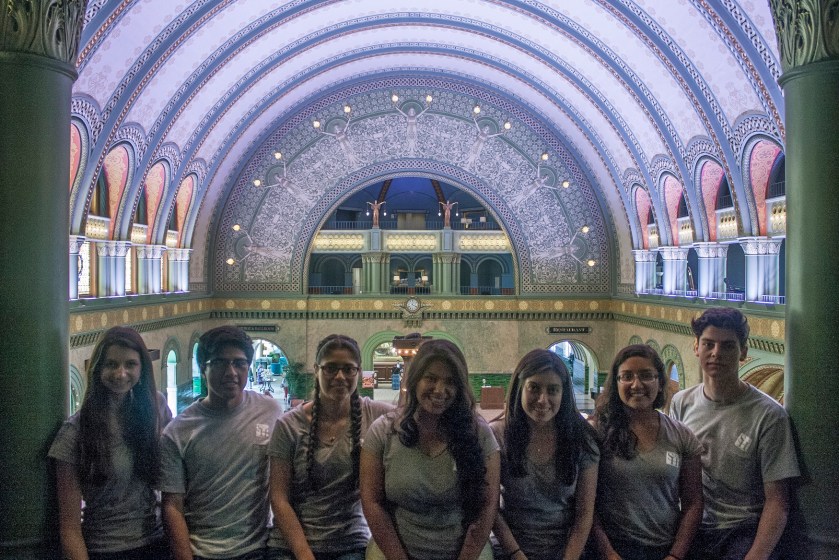
Honorable Mention should go to several structures. The students very much enjoyed the Gateway Arch in St. Louis, the Union Station in St. Louis…
LEAP Ambassadors at Union Station, St. Louis, MO
…the Old Mill is always a favorite stop.
LEAP Ambassadors at Old Mill, Little Rock, AR
…and The Parthenon proved a favorite as well.
The LEAP Ambassadors at the Parthenon, Nashville, Tennessee
Favorite Works of Art
The Turrell Skyscape, “The Way of Color” at Crystal Bridges:
This slideshow requires JavaScript.
Au Cafe, by Stanton MacDonald-Wright was also popular, providing much head-scratching and discussion.
“Au Cafe,” by Stanton MacDonald-Wright
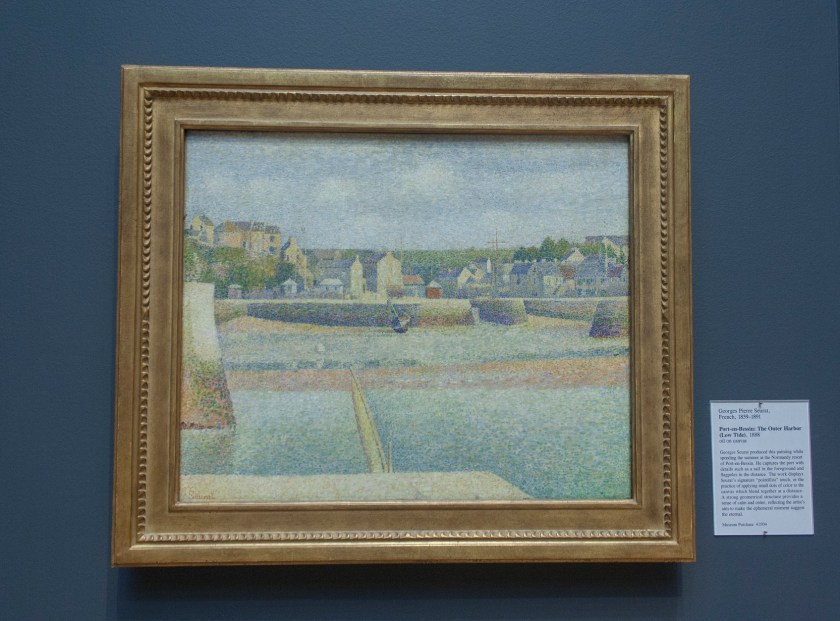
George Seurat’s “Outer Harbor” at the Crystal Bridges Museum
George Seurat’s “Outer Harbor” at the St. Louis Art Museum
Activities
Hiking: The students enjoyed both their hike at Pinnacle Mountain…
LEAP Abassadors at the Peak of Pinnacle Mountain
…and Devil’s Den State Park…
LEAP Ambassadors at Devil’s Den State Park
Ropes Course at Megacavern in Louisville, KY
Karla Rosales and Ryan Brim at the MegaCavern
Tie: Skeet Shooting…
Brian Aldaco Hitting Targets
…and meeting Blair Hess and Cameron Ludwick, authors of “My Old Kentucky Road Trip.”
LEAP Ambassadors with Authors Blair Hess and Cameron Ludwick
It was another enormously rewarding road trip, providing us with the opportunity to learn about history, art, architecture, civil rights, politics, law, and public policy. It was a happy eleven days!
Rejuvenated from sleep, we woke ready for our day, which would consist of touring the University of Arkansas Law School, hiking and catching a movie to wind down.
University of Arkansas School of Law
When we arrived at the University of Arkansas School of Law, we met with Ms. Kalesha McGraw, the Assistant Director of Admissions, and she welcomed us to the school before taking us to the student lounge for a quick overview of the law school. We learned about the admissions process, the class schedules and sizes, and the student life in Fayetteville. We also learned about notable (former) faculty such as Bill and Hillary Clinton. If Hillary Clinton becomes elected, University of Arkansas -Fayetteville will be the first law school to have more than one faculty member become President of the United States. The rest of the Q&A section with Ms. McGraw consisted of questions that ranged from the cost and the admissions process to the actual courses and the structure of the classes.
After our informative Q&A session, we walked upstairs to observe Professor Day’s Professional Responsibility class. This is a required course and helps students prepare for the Multi-State Professional Responsibility Exam (MPRE). This exam is a prerequisite for taking the Bar Exam and tests law students’ knowledge on ethics. During the summer fewer students are on campus, but classes are still in session. The topic of discussion for class today was on conflicts an attorney may face during their practice. Throughout the class, the Professor explained conflicts using cases where ethical issues arose. To explain a complicated scenario, the Professor and students even role played a scene which presented the situation in an interesting and clear way. We enjoyed the class and our Professor’s informative teaching methods!
Following class, we took a quick tour around the building visiting places like the courtroom and the library. The law school was even nice enough to provide lunch for us! Satisfied, we stopped to admire the Jesus Moroles sculptures in the courtyard…
LEAP Ambassadors at University of Arkansas School of Law, Jesus Moroles’ Sculptures
…and the front of the school on our way out.
Front of U of A Law, With Additional Moroles Sculptures
Many thanks to Ms. McGraw and the University of Arkansas- Fayetteville Law School for their hospitality!
After a morning filled with learning and a long trip, some of us decided to take a mental and physical break. Others, however, soldiered on, readying ourselves for a brief bit of shopping and a hike in Devil’s Den State Park.
Before driving down highway 170 into Devil’s Den State Park, we stopped to peak into some shops in town. Once everyone was satisfied with what they had purchased, we began our journey to Devil’s Den. As our second hike of the trip, the first being the climb up Pinnacle Mt. near Little Rock, we felt prepared and pumped up for the rugged expedition that we were about to take part of. With the sun falling on the horizon, the weather was a prime condition to explore inside the woods.
Devil’s Den
This 2,500 acre state park offers myriad outdoor activities, from rafting to camping to hiking. We chose the latter, embarking on the Devil’s Den Self-Guided trail, which is 1.5 miles round-trip.
As we began on our trail we descended down masonry steps. Such modifications to the trails and other man made structures within the state park were once Civilian Conservation Corps projects from the Great Depression. The engineering talent of these laborers is clear when taking these steps and observing how strong they still are, even after almost a century of its construction! The traces of useful man made structures became fewer as we went deeper into the woods.
Ahead of us stood trails traced through the rocky cliffs with trees filtering the sun and casting a serene shadow over the whole scene. Then, the trail neared a river, waters sonorously rushing through and echoing through the woods. This sound at times kept us focused, as we knew that as long as we kept the river at our left shoulders we were going the right way. Along the trail, at times encountering uneven, slippery and rocky ground, we found caves in which the temperature inside would lower presumably by ten-twenty degrees.
LEAP Ambassadors in One of Devil’s Dens’ Caverns
The trail also goes by the more descriptive name of “Double Falls” Hike, so named because of two falls that appear about halfway through the trail. For us, though, the trail could have been named “Triple Falls,” because, hearing water of the main trail, we made tracks over a hill to find a small waterfall.
To get there, we had to cross a log bridge…
…but this only added to the excitement of our discovery.
Having safely traversed the fallen-tree bridge, we frolicked in the waterfalls…
…okay, frolicked may be too strong of a word. But we did have fun.
We found additional falls further along our hike.
Waterfalls in Devil’s Den State Park
Only a few feet beyond these falls was another waterfall, equally as delightful.
Waterfalls at Devil’s Den State Park
From our trek we had worked our selves into perspiration and slight exhaustion. The refreshing, cool water of these natural showers, however, were just the perfect manna we needed to continue on our journey through Devil’s Den.
From the falls, the hike wends it way downhill, which offers another striking view of the falls.
And this perspective provided additional photo ops.
This slideshow requires JavaScript.
We even found another log bridge on which to climb.
LEAP Ambassadors Enjoy Devil’s Den State Park
As we completed the 1 1/2 mile hike, ducking our heads to evade pesky spider webs threaded from tree to tree…
…we contemplated our accomplishments. We had finished another hike on our trip! With tiring limbs and sweaty backs, we climbed the van with a sense of victory and ready to relax and catch a movie.
But, first, we made two more stops. We picked up food from Hammontree’s, an excellent grilled cheese specialty restaurant in Fayetteville. We also made our way to Mt. Sequoyah, the highest spot in Fayetteville, where we watched the sunset.
LEAP Ambassadors at Mt. Sequoya
It was, we thought, a fitting end to a wonderful trip.
Movies and Winding Down
Once we had freshened up at the hotel, we climbed back into the van and drove to a near by movie theater to watch the remake of Ivan Reitman’s hit movie, Ghostbusters. Even though the original film is about 30 years old, most of us had previously watched it and waited in anticipation through the previews to see how similar this remake would be to our beloved original.
We found many differences between the new film and the original Ghost Busters film, an obvious one being that women instead of men were playing the lead roles. Most of us focused more attention to the fact that Paul Feig’s film also includes multiple nods to Reitman’s original and Sigourney Weaver, Dan Akroyd, Ernie Hudson, Annie Potts and even Bill Murray make appearances. After an hour and forty-seven minutes filled with laughs that echoed in the theater (mostly Megan’s), we were ready to turn in for the night to prepare for our long journey home tomorrow morning.
Our morning brought excitement with a splash of sadness, both from the prospect of our first day of rain and facing what would be our final day of the Southern Legislative Conference. With that in mind, we vowed to make the most of the day, with experiences extending to the world of politics, liquor, and musical entertainment.
We boarded our ever-familiar tour bus bound for Kentucky’s capital city of Frankfort, and enjoyed the green rolling hills on the short drive from Lexington (~45 minutes). As we neared the bend that would lead into Frankfort’s main street, the trees embraced the city, making it seem every building was surrounded by its own mini forest, an impressive landscape.
The Old Statehouse
Our first stop was the state’s third capitol building, “The Old Capitol,” built in 1803. Its location was the same as the first two state capitol buildings, both of which met their demise through fire. Following the second fire, officials requested submissions for a new design, which would be selected through a competitive process. The winning design was submitted by Gideon Shryock (fresh out of college!) on a dare.
The Greek revival structure was erected as a symbol of Kentucky’s democratic strength, the massive pillars flanking the entry underlining that statement.
Old State Capitol: Frankfort, Kentucky
The limestone walls, quarried from the Kentucky River, stand as impressive as the day as they were placed. Through this grand, but windowless, entrance, we turned first into the “new” library, relocated from its original second-floor location due to weather damage to the books. In the corner of this room stood a desk that had belonged to then-Governor, Thomas Bramllette. Under his orders, the desk was ordered to contain a secret compartment. However, upon arrival, there was no sign of any such compartment. After complaining to the cabinetmaker and demanding that he be told the whereabouts of the desk’s secret, the designer refused to reveal it for “if [he] were to reveal it then it wouldn’t be a secret anymore.” The secret compartment was never found.
We left the library, and gathered under a floating staircase. Reputedly one of the only staircases of its kind in a public building, the whole structure will supposedly stay in place regardless of whether walls stand around it – it requires no external support. As designed by architect Shryock, this is an impressive feat of architectural and aesthetic design. As we walked up the staircase, admiring its simple yet intriguing structure, quite a few tour participants not-so-surreptitiously checked out the number of people on the stairs at once.
Another pleasant detail was found in the plaster floral designs on the ceiling. As with most capitol buildings, the legislative chambers were the largest. At the entrance of the Senate and House chambers, we were greeted with lighting from magnificent gold French chandeliers, as lavish as when they were lit for the first time. In the House, the desks were sectioned for two legislators to share one table. As we walked onto the senate chamber, we entered a much more intimate room. We sat down on both the house and senate desks, taking in the building’s history, imagining what it would have been like in the past. When the visit of the Old Statehouse was over, we were very sad. However, our hopes were regained after remembering that this was only the beginning of our grand tour.
Center for Kentucky History
Because we spent so much time in the Capitol building, our next stop was correspondingly curtailed. Thus, we only had about 15 minutes at the modern Center for Kentucky History, which was clearly not sufficient. Some of us went into the gift shop while others toured the Hall of Governors, which consisted of painted portraits and biographies of Kentucky’s governors. It started with Isaac Shelby, the first governor of the state. He was an interesting character. Even though he served two full terms believing and practicing his constitutional duties, in his autobiography of four hundred plus pages, he only included one sentence of his tenure as governor. Another notable character was Martha Layne Collins, the first female governor. She was known for bringing a Toyota plant to Kentucky, which provided many economic opportunities to the state. Despite the brief time allotted to this portion of the tour, we enjoyed the artifacts and exhibits we saw.
Governor’s Mansion
After the tour of the Kentucky History Center, we visited the Governor’s Mansion for lunch with the Lieutenant Governor of Kentucky. As we approached the mansion, we were fascinated by the beautiful architecture and colorful garden.
Kentucky Governor’s Mansion: Frankfort, Kentucky
We learned that the architecture was designed to model Queen Marie Antoinette’s villa of the palace of Versailles in France—not the last time we would find French influences in the Bluegrass State. The interior also reflected the French interest of the Beaux-Arts period. Walking into this grand architecture, the Lieutenant Governor, Jenean Hampton, and some of her staff, greeted us. We were then directed to the dining room for lunch.
She welcomed our group very warmly into the governor’s home and spoke about the great state of Kentucky.
Kentucky Lt. Governor Jenean Hampton at the KY Governor’s Mansion
After learning we were from Texas, she expressed her love for the Lone Star State.
LEAP Ambassadors with Lieutenant Governor Jenean Hapton
We felt that she was very genuine and kind! After having greeted her, we then proceeded to eat lunch consisting of a traditional Caesar salad and grilled chicken.
Kaitlyn Tyra and Megan Chapa at the Kentucky Governor’s Mansion
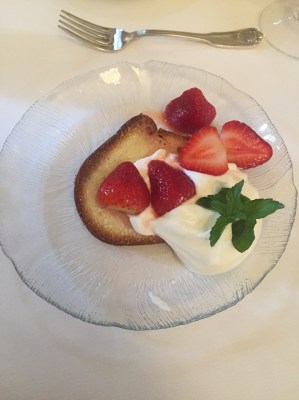
For dessert, we had a light, summery strawberry shortcake.
And as an added desert of sorts, we had the wonderful opportunity to explore the Governor’s Mansion.
LEAP Ambassadors Relax at the Kentucky Governor’s Mansion
Kentucky State Capitol
Following the lunch at the Governor’s mansion, we toured the fourth and current Kentucky state capitol. Our tour began in the rotunda with five large statues, each a famous (or infamous) Kentuckian. These include Henry Clay, Alben Berkley, Jefferson Davis, Ephraim McDowell, and Abraham Lincoln.
Abraham Lincoln, with Jefferson Davis in the Background
The dome that sits above the rotunda is inspired by Les Invalides, Napoleon’s tomb. Interestingly, the interior of the dome changes colors periodically…
This slideshow requires JavaScript.
The building houses all three branches of government: the executive is on the first floor, the judicial is on the second, and the legislative is on the third. This is one of very few state capitols that still houses three branches. In the state supreme court, the judges convene about three days a month, hearing about only nine cases a month.
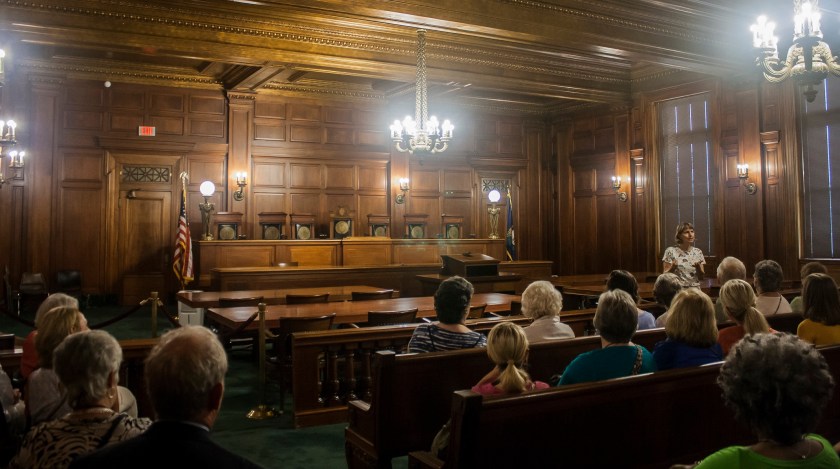
Kentucky Capitol: Supreme Court
The justices can serve as many ten-year terms as they can get elected to.
The Kentucky legislature is unusual in that they only meet for 90 days every two years. During even numbered years, the Kentucky legislature will meet for up to 60 days, and in odd numbered years, the 38 Senators and 100 House members will meet for no more than 30 days.
House of Representatives, Kentucky
House members, as well as Senators, have two year terms, but no term limits.
Overall, we were impressed by the symmetrical design of the capitol, both the interior…
Kentucky Capitol Interior
…and the exterior…
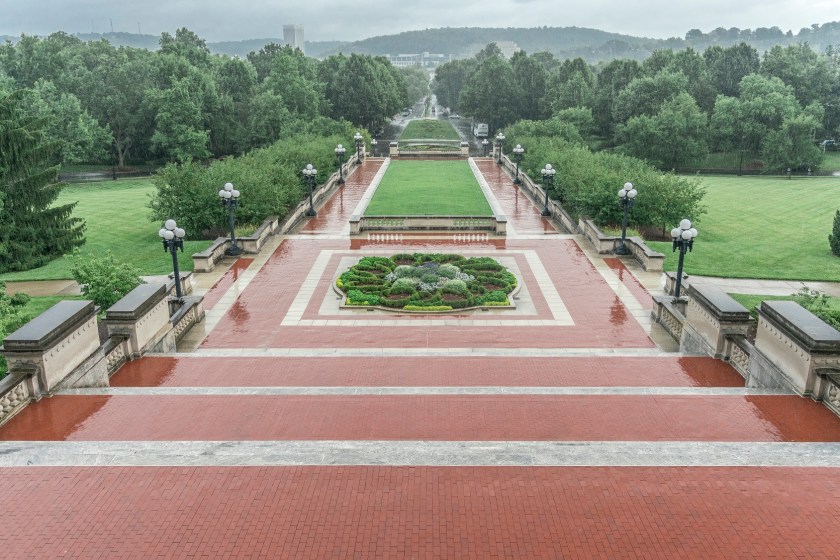
Walkway to the Kentucky Capitol
…as well as the views from the balcony.
This slideshow requires JavaScript.
In fact, it’s rare in a capitol to even be allowed on the balcony, so this was a treat indeed.
Buffalo Trace Distillery
No doubt the offices of the Kentucky Capitol building were witness to much drinking, in order to, as one politician told us, “lubricate the wheels of governance.” Some of those drinks were likely distilled, aged, and bottled in our next destination: Buffalo Trace. Liquor has been manufactured on the site of Buffalo Trace since 1787, when Willis and Hancock Lee first built a still. Although the companies of liquor and processes have changed, the site—located near the Kentucky Capitol building— has always been dedicated to distilling primarily bourbon.
Buffalo Trace Distillery in Frankfort, Kentucky
This was true even during Prohibition. As our tour guide noted, alcohol could still be manufactured for “medicinal purposes.” Each “patient” could be prescribed up to a pint every ten days. During this period, the illnesses must have been both “contagious and chronic,” because often an entire family would need the prescriptions refilled indefinitely. This legal loophole allowed the distillery to stay in business.
Thankfully, that subterfuge was no longer necessary following Prohibition, and the distillery could distribute its liquor the old-fashioned way. In more recent years, there has been a type of anti-prohibition, and bourbon drinking has become fashionable. In fact, Buffalo Trace is in the process of tripling the size of its operations, expanding from 140 to 420 acres.
Some people believe that only Kentucky sells bourbon. That’s not true, but as our tour guide says, most of the bourbon in the US comes from Kentucky. “Kentucky sells 95% of the nation’s bourbon,” he clarified, “and 100 % of the good bourbon.”
Much of that comes from Buffalo Trace. Indeed, they recently manufactured their six-millionth barrel. That’s a lot of bourbon, especially when each barrel contains about 200 bottles.
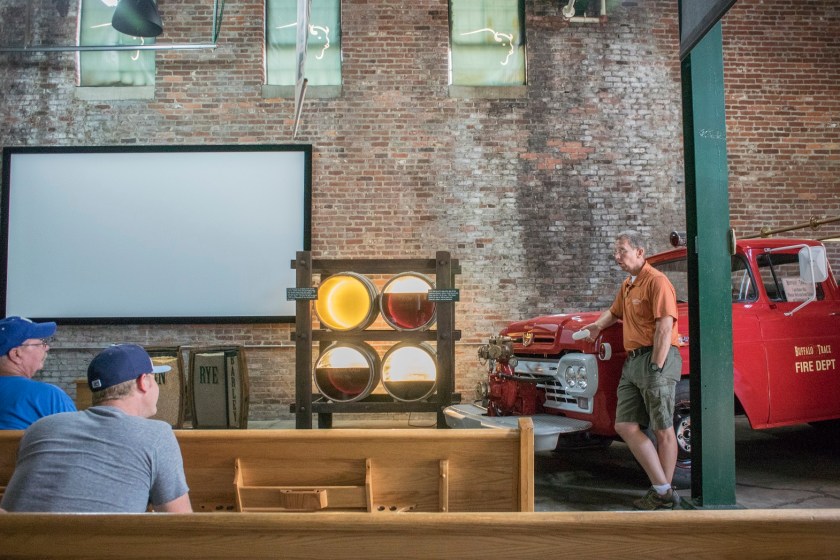
Bourbon Barrels, Buffalo Trace Distillery
And it is this process that is perhaps most interesting. To qualify legally as bourbon, the liquor must meet six criteria:
Its content must be at least 51 % corn;
Distilled to no more than 160 proof;
Barreled at no more than 125 proof;
Aged in new, charred barrels;
Bottled at 80 proof or higher;
And, all of this must occur in the United States.
The Aging Process of Bourbon, Buffalo Trace Distillery
This last requirement stems from the fact that in 1964 the US Congress passed a resolution recognizing bourbon as indigenous to the United States, much in the same way, for example, that Scotch is associated with Scotland.
This was a lot of information to take in, especially for some of the students who had almost no exposure to alcohol. But even for those more familiar with the product, the distinctive and specific process was a lot to ingest.
And speaking of ingesting, our tour concluded with a whiskey tasting. The under-21 crowd skipped this part, but a few of the students had a chance to distinguish (in very small doses!) the difference between four types of whiskey: (1) a blended vodka, (2) a mash whiskey at 125 proof, (3) an 8-9 year old bottle of bourbon, and a (4) 10 year-old bourbon aged on a lower floor of the storage. (The lower floor is a cooler location, which means less mixing with the barrel, which, in turns, less of the woody or caramel flavor.)
Bourbon Tasting at the Buffalo Trace Distillery
Opinions from the group were positive toward the bourbon, but there was general agreement that the 125 proof mash was strong medicine indeed.
Our samples were far too small to lubricate any kind of political deals at the conference, but that doesn’t mean we weren’t interested in expanding our professional networks and seeing what opportunities we could find. To that end, we headed back to Lexington, where we planned to socialize at the state dinner.
State Dinner
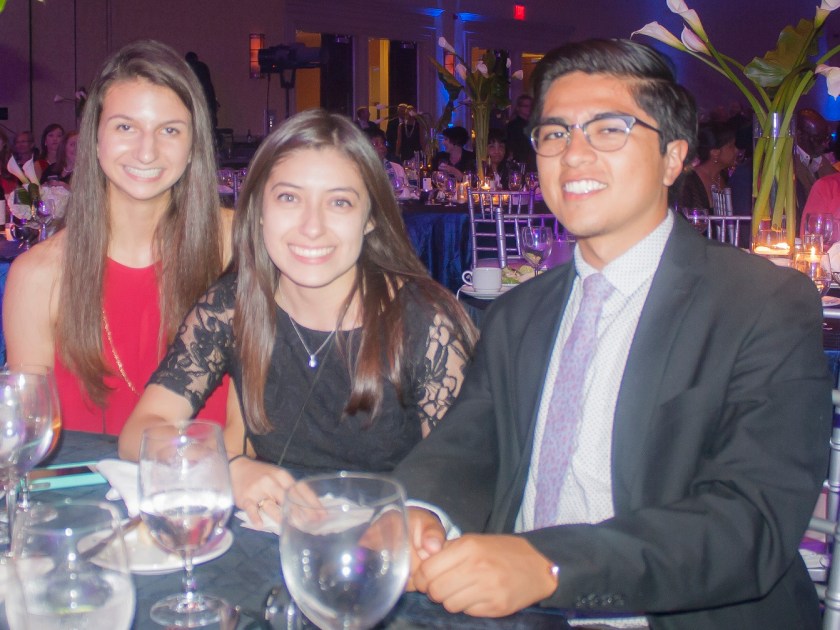
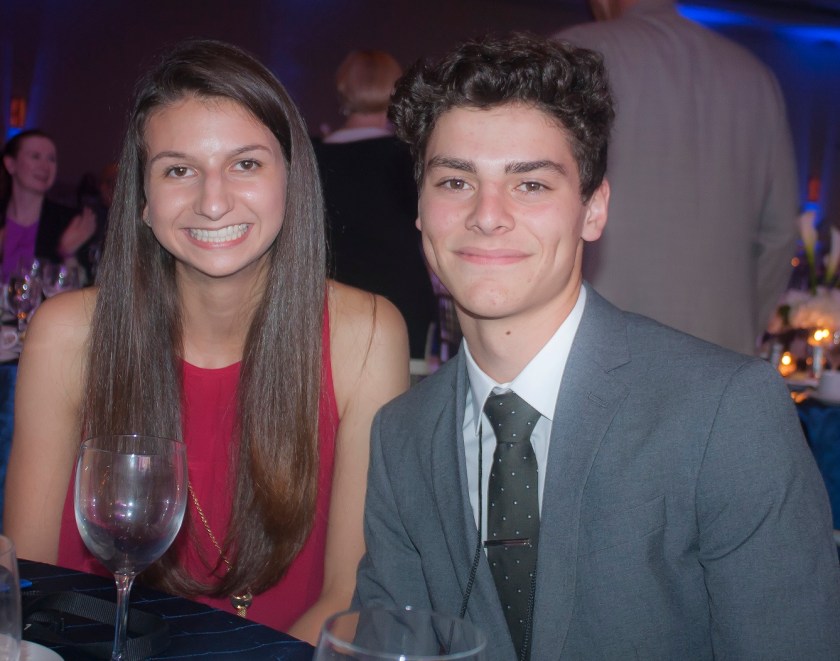
Dressed to the nines, the LEAPsters strode into the Rupp Arena Ballroom. Although we were prepared to enjoy the State Dinner…
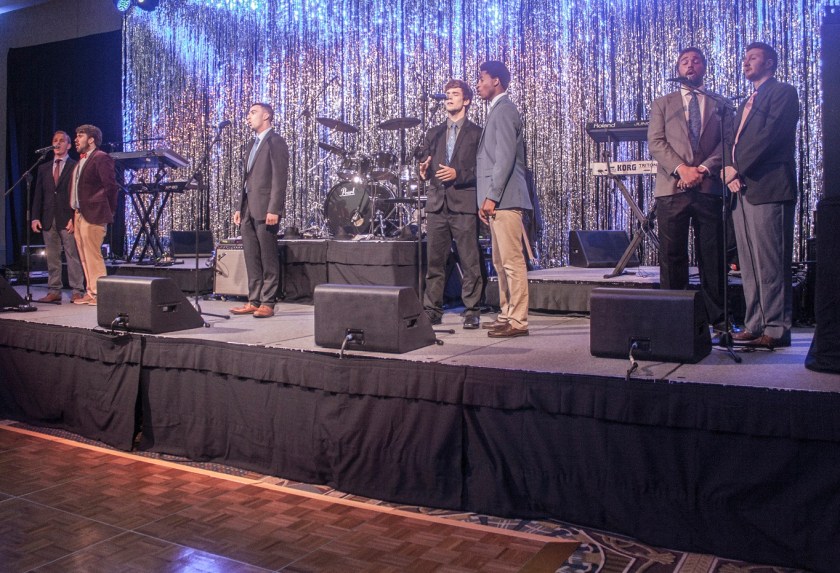
…we were not prepared for the beautiful sounds of the a capella group acoUstiKats, from the University of Kentucky. They introduced the evening with a wonderful rendition of the “Star Spangled Banner” and “My Old Kentucky Home.”
The acoUstiKats from the University of Kentucky
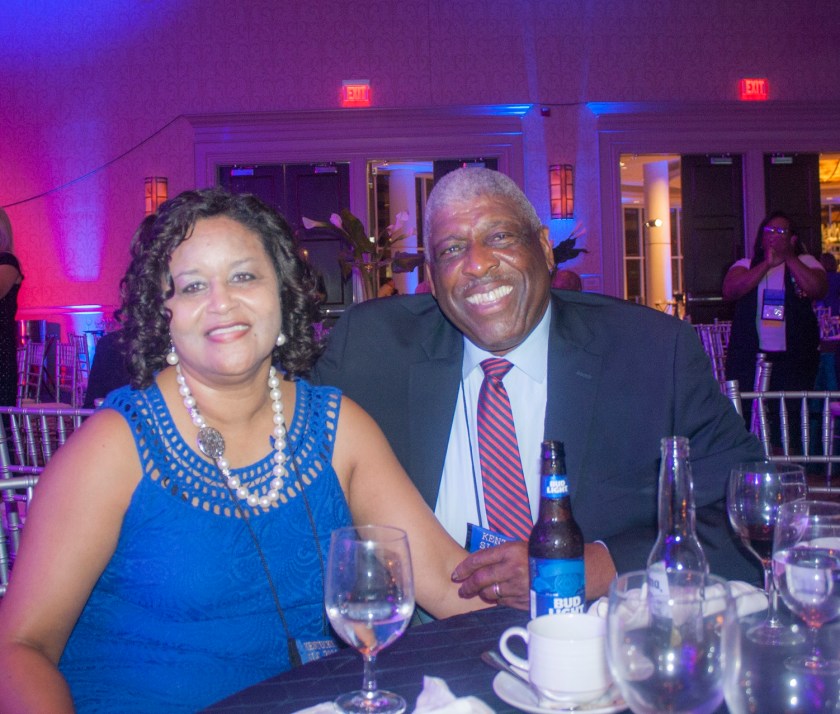
Our dinner mates included Senator Floyd Nicholson and his wife, Mamie, who were from South Carolina and very nice!
Senator (SC) Floyd Nicholson and his wife, Mamie
Later, Kentucky Senator Stivers gave a speech and recognized two different programs for their work under the STAR program. This program promotes the creation of innovative ideas for more programs to help communities. The most proactive are chosen and recognized for their accomplishments.
After the meal was over and we had finished the last bit of cheesecake…
…the entertainment started. Rick Dees kicked off the evening’s entertainment…
Rick Dees at the Southern Legislative Conference State Dinner
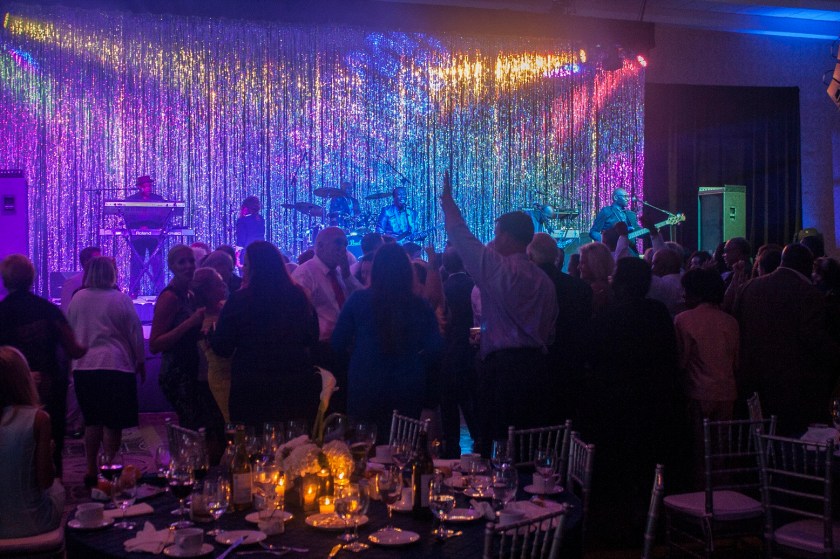
…but he soon turned it over to Midnight Star, an R&B band who enjoyed many hits in the 1970s and 1980s, including “Operator,” “No Parking on the Dance Floor,” and others.
Midnight Star Performs at the Southern Legislative Conference
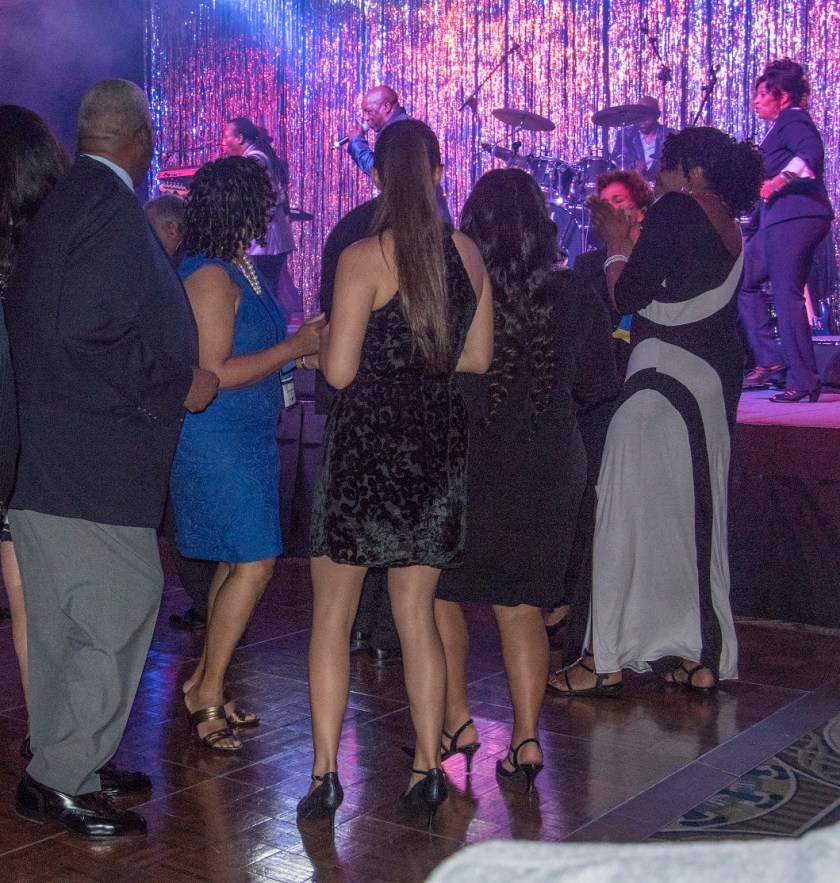
Their music soon drew a crowd of dancers, many of whom were elected officials apparently drawn to the dance floor by courage borne of bourbon.
Not to be outdone, the LEAP Ambassadors showed off their adaptability and busted out a few dance moves of their own.
LEAP Ambassadors Dance at State Dinner
Others, of course, mostly stayed rooted to the dinner table…
Nonetheless, it was an energetic end to a four-day tour of Kentucky and its world of politics, entertainment, and history.
LEAP Ambassadors with Floyd and Mamie Nicholson at the SLC State Dinner
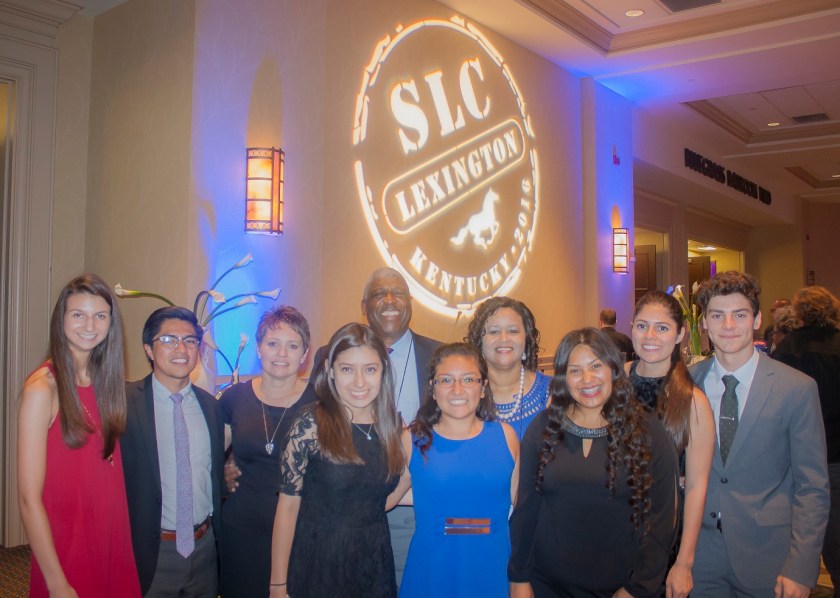
But with a four am departure looming, we posed for a final Kentucky photo op…
LEAP Ambassadors Enjoy Lexington, the Horse Capital of the World
…we headed back to the hotel. Our sleep was destined to be brief, but we were eager to awake to the Midwestern leg of our southern/Midwestern tour of the United States.
Tennessee is known as the volunteer state, so named because of the disproportionate number of volunteers they have provided to the US Military in wartime. While none of the LEAP Ambassadors have served during wartime, we do volunteer a lot, so we felt a distant kind of kinship.
The first stop planned for our third day of the Southern leg of our trip was The Hermitage, Andrew Jackson’s home.
Our tour began with museum exhibits describing the history of the seventh President of the United States in chronological displays. The exhibit began with the wars in which Andrew Jackson played important roles, the War of 1812 and the Battle of New Orleans in 1815.
Original artifacts, such as swords used by the British and the Americans during these historical events, were also displayed in glass cases allowing each visitor to stop and admire the details of each. Larger artifacts, such as his carriage, were displayed on the floor of the exhibit space.
The exhibits were packed with history, but also well-organized, making it easy to follow and understand.
We learned not only about Andrew Jackson’s life, but also much about his wife, Rachel.
After the indoor museum exhibits, we moved on to a self-guided audio tour of the grounds that led us to Jackson’s mansion.
The guides on the tour discussed every room in the 8,000 sq. foot mansion. The parlor downstairs off the entryway was covered in elegant wallpaper that General Jackson ordered from France, along with many original artifacts. Although the mansion was beautiful, it does not have all the modern conveniences that homes today have, such as indoor plumbing! The second floor houses guest rooms and the grandchildren’s rooms. And as a special treat, the upstairs tour guide pointed out one of the guest rooms where Sam Houston slept during one of his visits to see General Jackson.
After the mansion tour, we meandered the garden, still guided by the audio tour. In the garden, elaborate for its time, we saw the tombs of the Jacksons, along with several family members.
The garden was originally made for Rachel as a place for her to relax, a much-needed respite from the stress of her husband’s political career. Sadly, she passed away days after Andrew Jackson was elected President; and it is said that the political stress caused her death. After the tour of the museum exhibits, the mansion, the garden, and a quick photo-op on the $20 bill…
…we had worked up an appetite, so we made our way to The Pharmacy for a quick fix.
We know what you’re thinking, but no, we didn’t go to the local drugstore for lunch! The Pharmacy is actually a burger parlor and beer garden, although we didn’t sample the latter. The restaurant has been named the “wurst burger joint” around because of the German influences in their food and beverages. The phosphate and crème sodas, Wurst, and beer make this Nashville spot distinct and popular. The restaurant was cozy with a large outside patio garden. The patio was beautiful; however, we sat inside to cool off after a morning of sunshine at The Hermitage.
We ordered different varieties of burgers made from 100% Tennessee beef. Beatriz, ordered the Farm Burger, with bacon, egg, and ham and other fixings, while others tried the Biergarten Platter, which had a variety of wurst sausages and mustards. All the food and cream sodas were satisfying and we were more than ready for our next stop, The Parthenon.
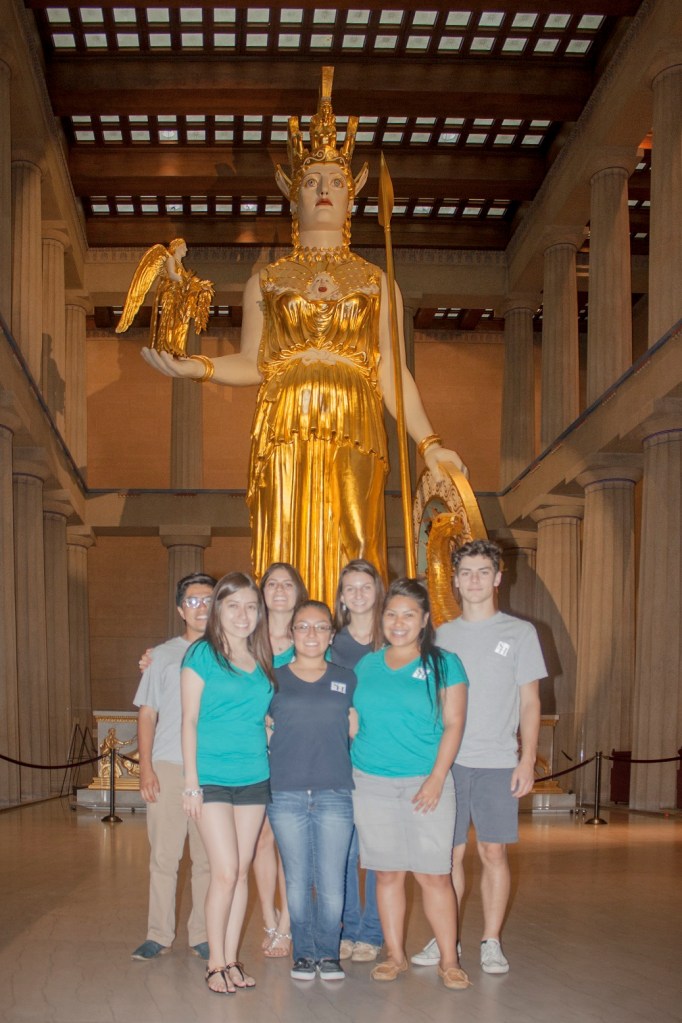
Gryphons stared down at us serenely as we climbed up the steps of Nashville’s Parthenon. We entered through the west side, noticing that atop the majestically stoic Doric columns a scene was unfolding depicting Athena being crowned by Nike (the winged goddess of victory, not the shoe brand). Built in 1897, this replica Athena’s shrine was at one point meant to be temporary. Due to Nashville’s love of the thought of having their own Parthenon (they were known as “the Athens of the South”) and since it had quickly grown in popularity, it stayed.
LEAP Ambassadors at the Parthenon–Nashville, Tennessee
As we set foot into the structure of classical architectural style, not only did we travel across space towards Athens, Greece where the real Parthenon lay, but we also stepped into a place of art. Literally. The Parthenon is both a bona fide replica of the authentic Parthenon and a museum housing more than 60 pieces of art donated by Mr. James M. Cowan under a strange circumstance…he had donated the pieces of art with only one condition: that he remain anonymous as the donor until after his death.
We moved upstairs where we were able to see the goddess of wisdom herself. Made of a number of materials, including 3.6kg of gold leaf, she stands impressively tall with Nike in her right hand and her faithful shield in the other.
One of the many interesting things about Nashville’s Parthenon are the gargantuan bronze doors. Measuring up to 6.5 ft. in height and weighing about 7.5 tons, these doors are thought to be the largest set of bronze doors in the world. However, even the smallest of our group could easily move them.
After digesting much great Greek mythology, art, and architecture, we passed by a gryphon one last time…
…Beatriz giving it a fist bump of gratitude for its great work at guarding Athena.
With that last goodbye, and a last glance at the great Athena, we left wiser on the subjects of art, architecture, Nashville history, and a bit of the goddess of wisdom herself.
From there, we visited the Tennessee Capitol.
Like many other major building projects, construction of their capitol was behind on schedule and way over budget, taking fourteen years instead of three, and costing about three times as much as the initial budget.
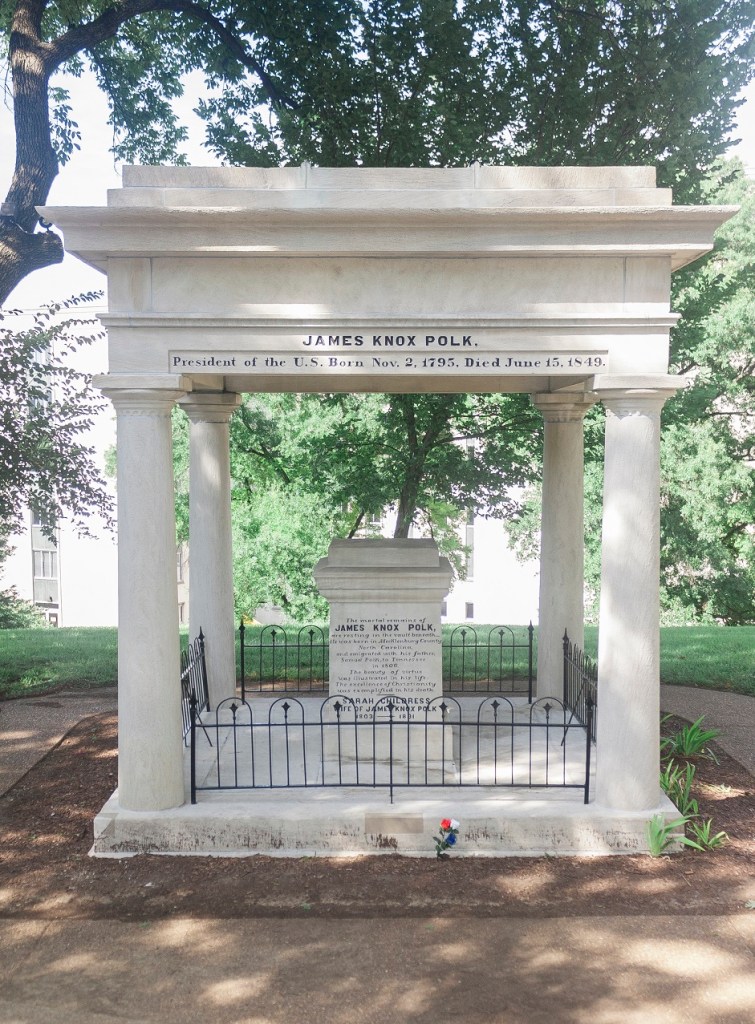
The Tennessee Capitol is one of 13 state capitols which does not have a dome. Instead, it was built in a Greek revival style. Not only is it different in architecture, but this capitol is the only one to be home to three deceased people, the first being the architect who designed it, William Strickland. Strickland is buried in the walls of the building, which he regarded as his greatest work. Along with Strickland, Samuel Morgan, the original building commissioner, is also buried on the site (actually, in the walls of the building). And wrapping up the list are President James K. Polk, and Polk’s wife, Sarah, are bured on the grounds (but not in the walls).
We learned much about Polk and the other two presidents from Tennessee (Andrew Jackson and Andrew Johnson). As we went along our tour, our guide (who was very knowledgeable and one of the best tour guides we’ve had!)…
…pointed out a bearded Sam Houston, who was governor of both Tennessee and Texas.
Although one LEAPster, who shall remain nameless (Megan), failed to recognize him, it was nice to see that General Houston was given credit for the work he’d done in Tennessee.
Tired of waiting for the entire capitol building to be built, the Supreme Court of Tennessee decided to move right in and start hearing cases. One judicial record, the tour guide explained, indicates the Court held a construction company in contempt of court for making too much noise while working on the building.
Even so, the tour was great, filled with humor and interesting facts, such as the two occasions in which a president chose a vice-president with the last name Johnson, which didn’t work out so well for the presidents, who both ended up dying in office. Our cheerful tour guide made the tour one of the most interesting capitol tours we’ve been on.
This slideshow requires JavaScript.
To top it off, we even got to use the old-timey state seal press to emboss our programs.
So, as the day and the tour came to a close…
…we knew it was time to move on to our next destination, Louisville, Kentucky.
The LEAPsters are always up for adventure no matter how frightening it may appear. One member of group stated that completing the fully-underground, aerial ropes challenge course at Louisville Mega Cavern truly embodied the LEAP spirit.
As we opened the front “door,” it was apparent that the cavern’s interior had been refurbished with artificial ceilings and walls in order to accommodate the recreational attractions inside. Louisville Mega Cavern houses a bike course, ropes course, “mega” zip line, and holds tours of the cavern’s mines.
This night we were set for the elevated, trapeze-style obstacles on the ropes course.
Several of us are not fond of heights, and regardless of the multiple, secure straps attached to every elevated obstacle, fear of falling was still prominent.
Our pseudo phobias did not deter us from trying as many hanging rope bridges within our time limit, though. Bridges between the platforms varied in size, shape, difficulty and amount of balance required to traverse, from suspended, unbalanced planks to tension ropes to challenges that simply cannot be described without seeing them.
For Alex, acrophobia kicked in while trying to balance over this system of suspended ropes and planks: At these moments my blood would rush in anticipation of hitting the ground, my palms would start to perspire inside my leather gloves making them almost slide off my hands, and my head would be showered in more sweat as I noticed how high off the ground my struggling body hovered. I would tightly clench the rope from which each overpass was suspended and inch my way through with each move coordinated to keep balance. No matter how much I wished to stay safely footed on the floor, I mustered all the courage my shaky spirit could supply.
For the most part, though, we successfully walked, crawled, and hopped, and prayed over the obstacles without falling.
And all the LEAPsters made it to the grand finale: the zip line.
Some jumped off, some slid off, and at least one asked to be pushed off, but we all made it off the platform at least once. We wrapped up the late night and with blistering hands and muscles strained from the continuous stress of cheating an unwelcome dive to the hard ground, we climbed in our traveling van, ready to reach our hotel for some much-needed rest.




























 Center for Law, Engagement, and Politics