Although the LEAP Ambassadors have attended many events sponsored by the World Affairs Council, this was our first event at the Glade Gallery, an art gallery in The Woodlands.
Gregory Gause, a professor at the Bush School at Texas A&M University, spoke to the attendees about the tragic events of 9/11, the relationships and origins that preceded the attack, and how those relationships have evolved since the attack.
After we reconnected and caught up with the wonderful WAC Staff, we began to make our way around the Glade Gallery. Never missing an opportunity to fine new favorite pieces, we began maneuvering around the gallery taking notice of all the contemporary art.
Sandija Bayot, the WAC’s Chief Development Officer, informed the crowd about several upcoming events and then surprised everyone with a pop quiz!
Sandija then asked five questions about upcoming events and handed out books as prizes to those that got the answers correct. Heather Noman correctly answered the capital of Yemen, and Morgan named the fourth Ambassador joining WAC for a luncheon the next day. Congratulations LEAP Ambassadors!
Ray Cunningham, WAC’s Executive in Residence in The Woodlands…
introduced the guest speaker of the night, Dr. Gregory Gause.
Dr. Gause is the Department Head and Professor of International Affairs at the Bush School in College Station. Professor Gause described some of the threads that converged in 2001 to lead to the 9-11 attacks, including the US supporting the anti-Soviet forces in the Middle East–some of whom evolved in to more overtly terrorist organizations.
Following quick success in retaliating against the 9-11 attacks, groups such as ISIS emerged as more powerful, and Iran has gained visibility and influence in the region. As ISIS gained power and Iran showed little inclination in curbing such power, the early US success in Iraq and Afghanistan eroded, culminating in President Biden’s decision to withdraw last year. Gause notes that there is little to no support to go back in. People’s experiences influence their willingness to support policies, and military action is no exception.
Near the end of the lecture, Dr. Gause answered a couple of questions from the crowd.
The questions were excellent, with several posted by local professors and other knowledgeable attendees. Gause focused on each question….
…and responded at length. Inevitably, questions turned to Russia and Ukraine, a direction that really brought home the relevance of our policies in response to aggression. While there was some agreement that China may be a longer-term threat than Russia, there was also acknowledgement that much suffering was likely to result from this invasion and, anytime you are dealing with a country that has control of nuclear weapons, even larger conflagrations are of great concern.
Following the event, we spent time with staff along with a couple of professors from the Bush School, who proved very interesting.
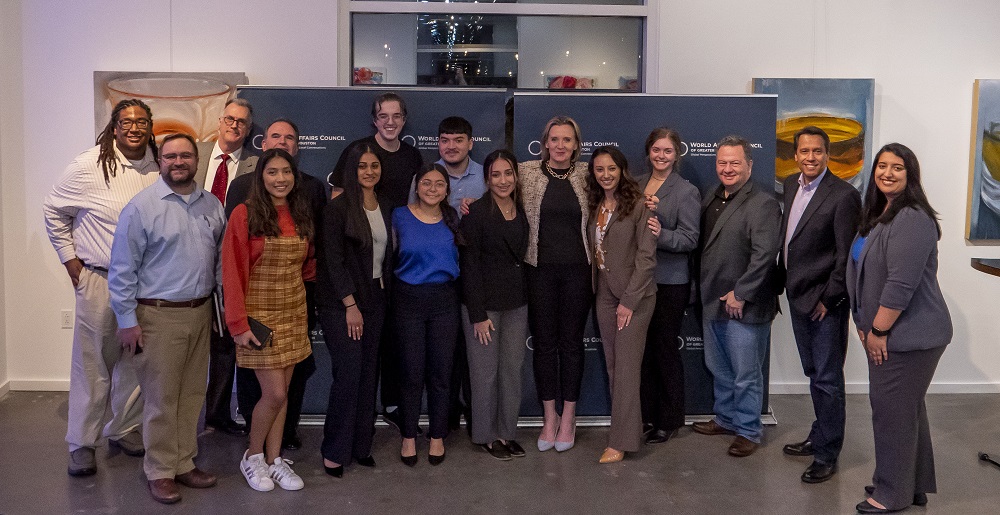
We also posed for a group photo with students from some high schools and the always-friendly, always-professional staff of the WAC.
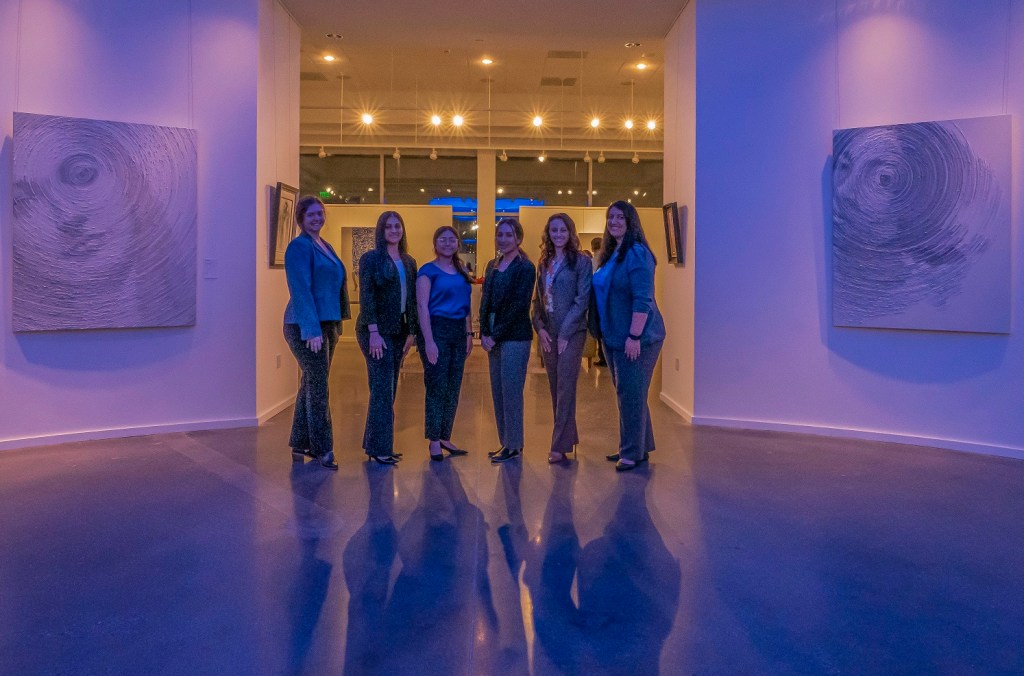
And, of course, we took a minute to pose for a group photo in the midst of the beautiful gallery.
Following the event, we headed to Genghis Grill (the only nonbar, it seems, that stays open past 9pm in The Woodlands) and had an enjoyable dinner, while also reflecting on the discussion, and contemplating the implications of Russia’s invasion of the Ukraine.
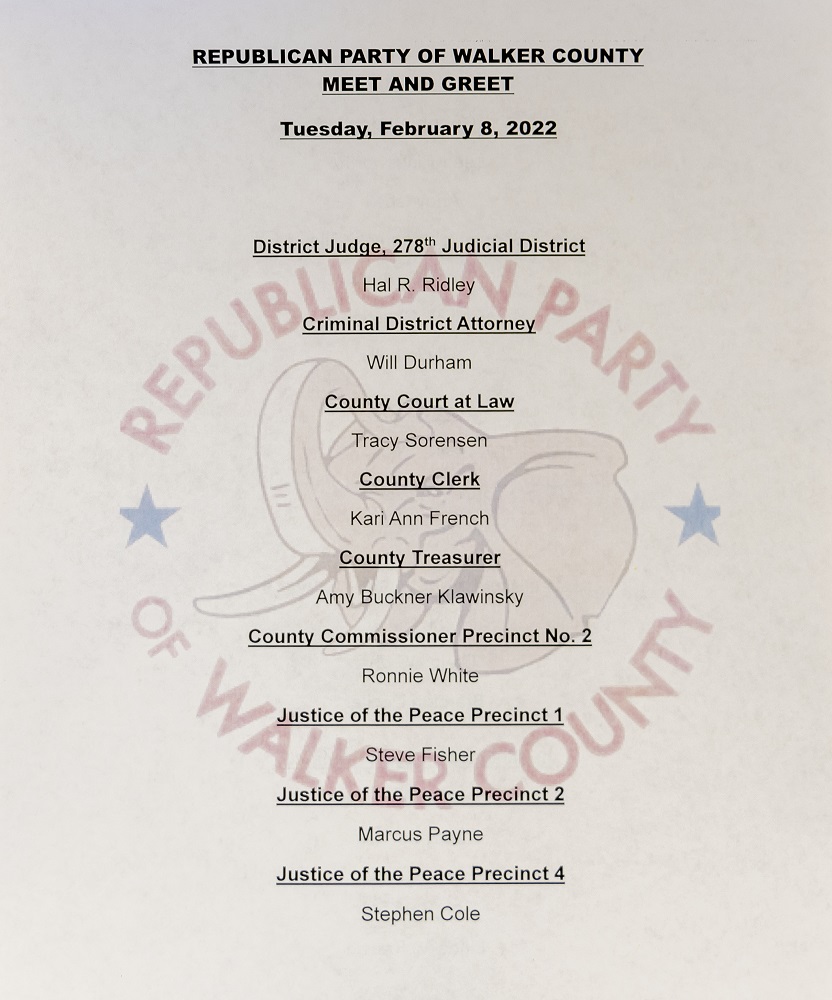
On Tuesday, February 8, 2022, the Walker County Republican Party hosted a Meet and Greet for the upcoming March 1 primary election. Members from the community were able to hear from most of the Candidates who are running.
Along with a few other college students, the LEAP Ambassadors assisted with check in and set up.
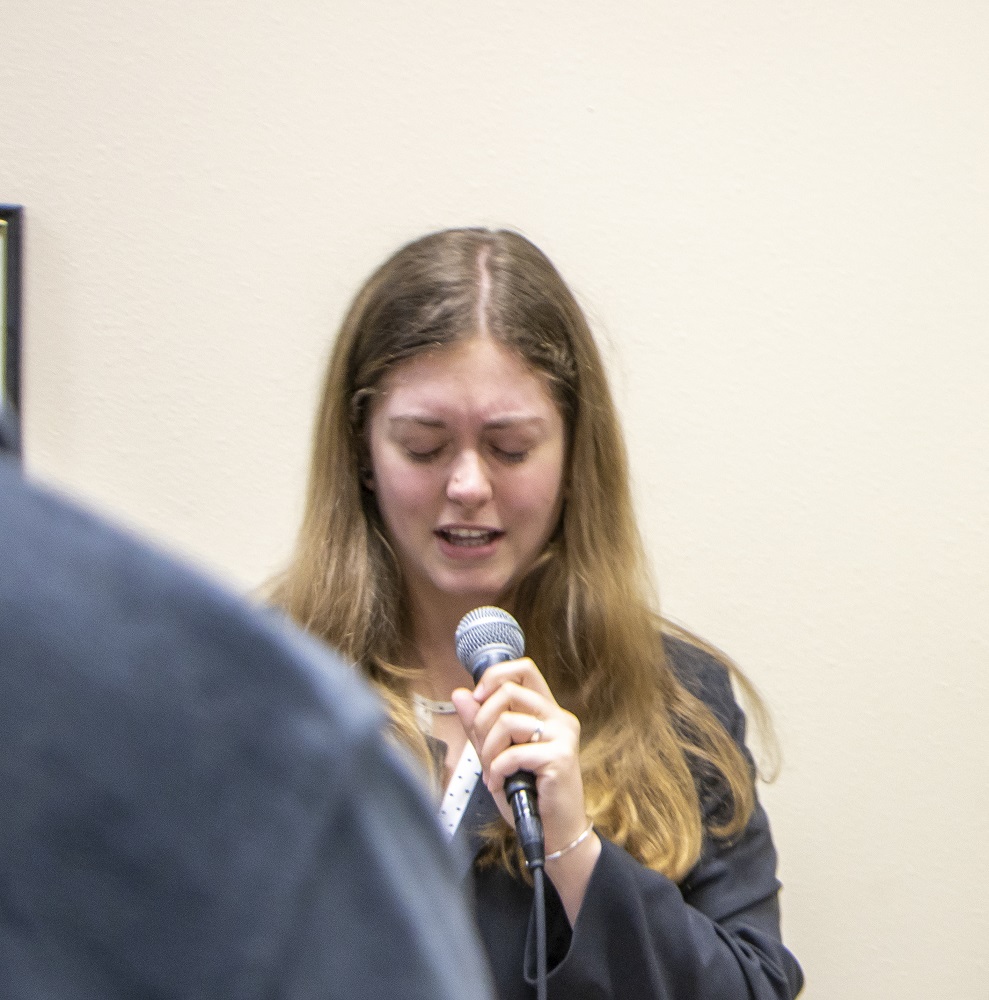
And Morgan led with the invocation.
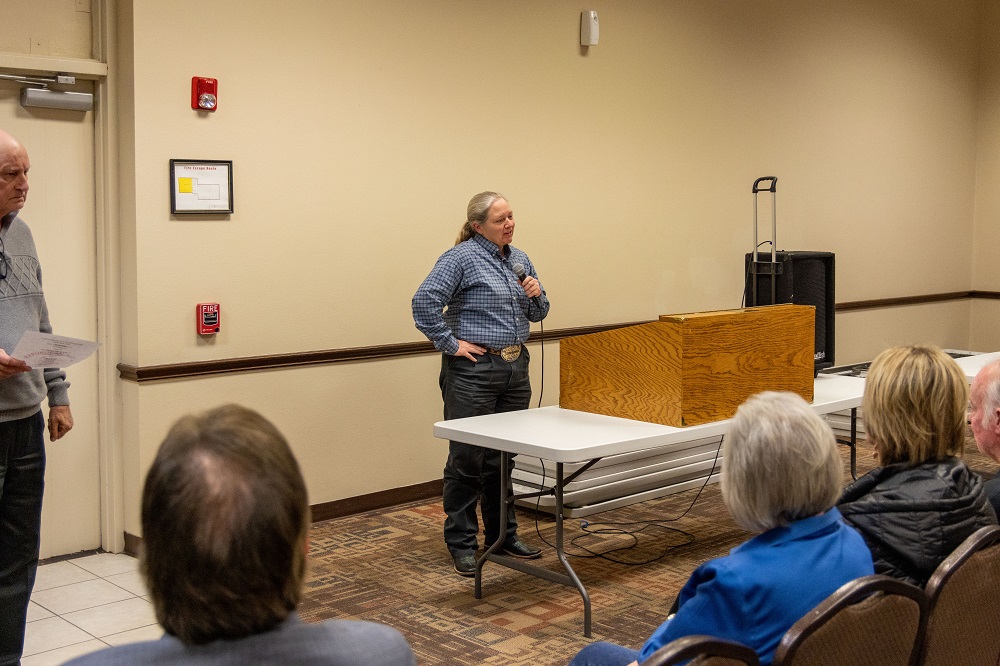
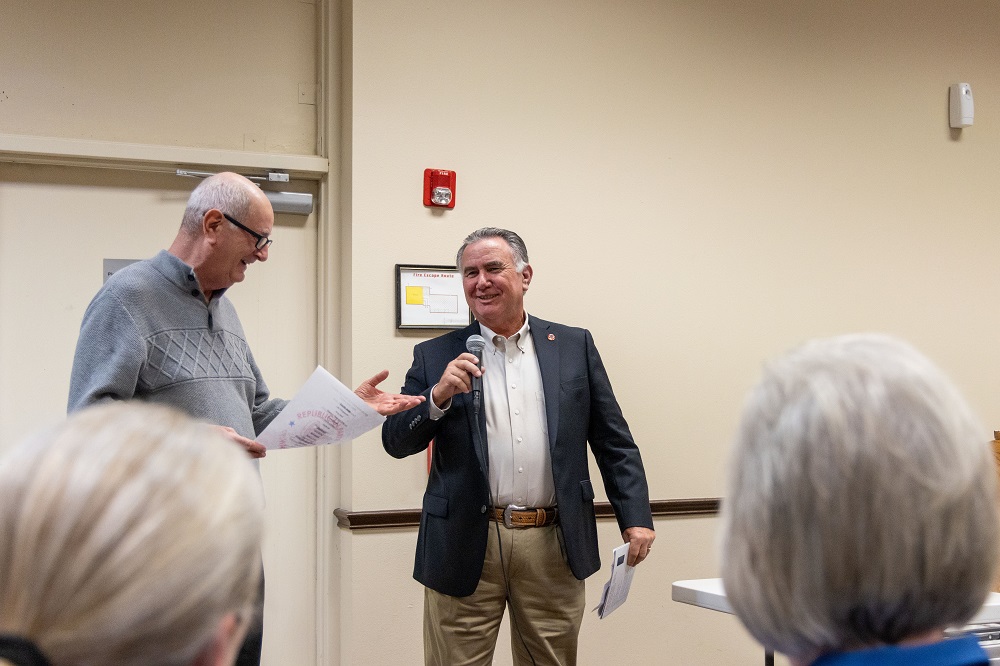
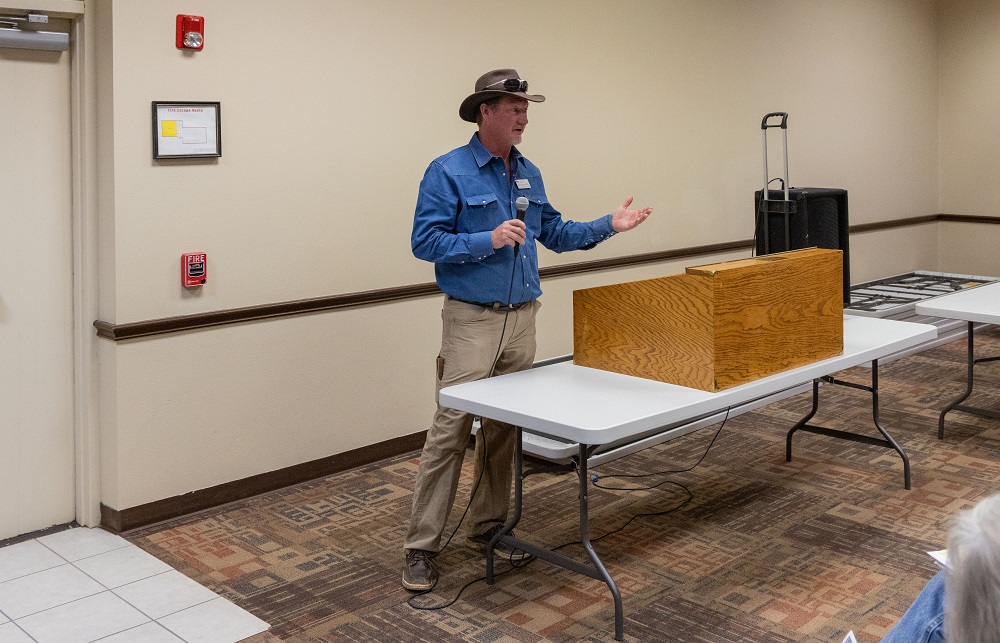
Richard Yawn moderated, and a very large crowd showed up for the event.
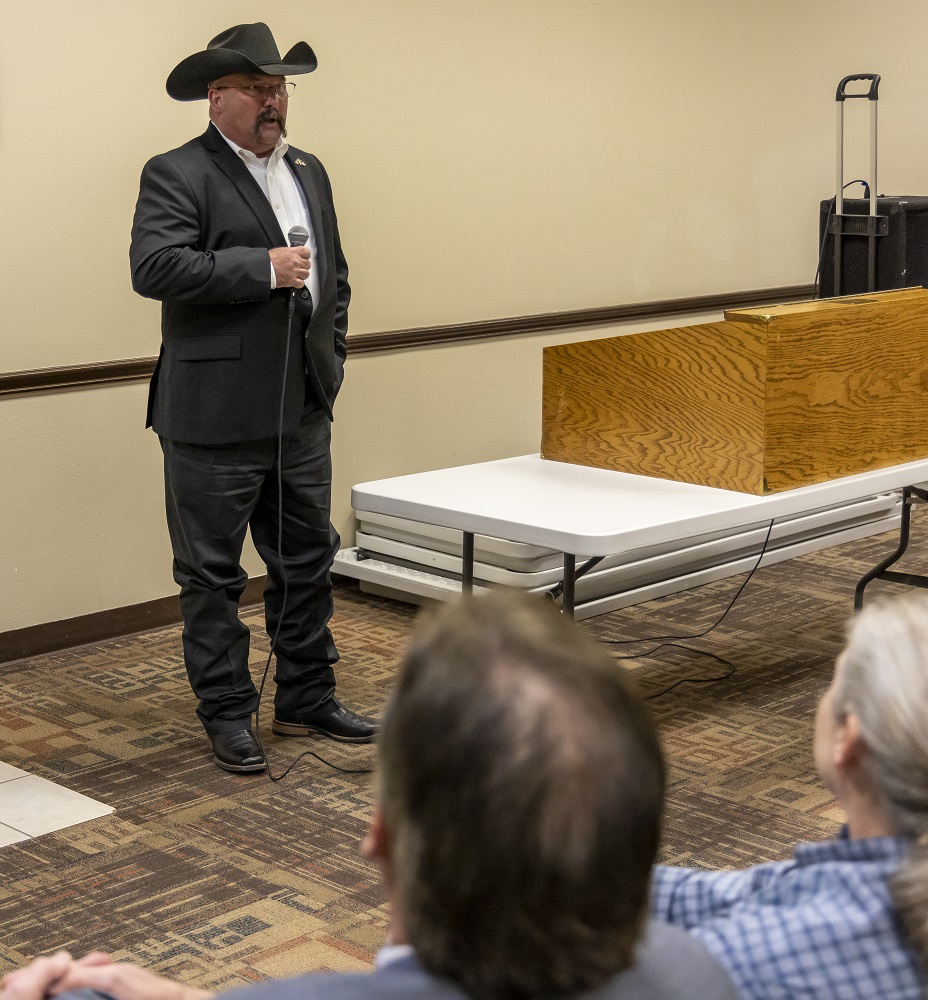
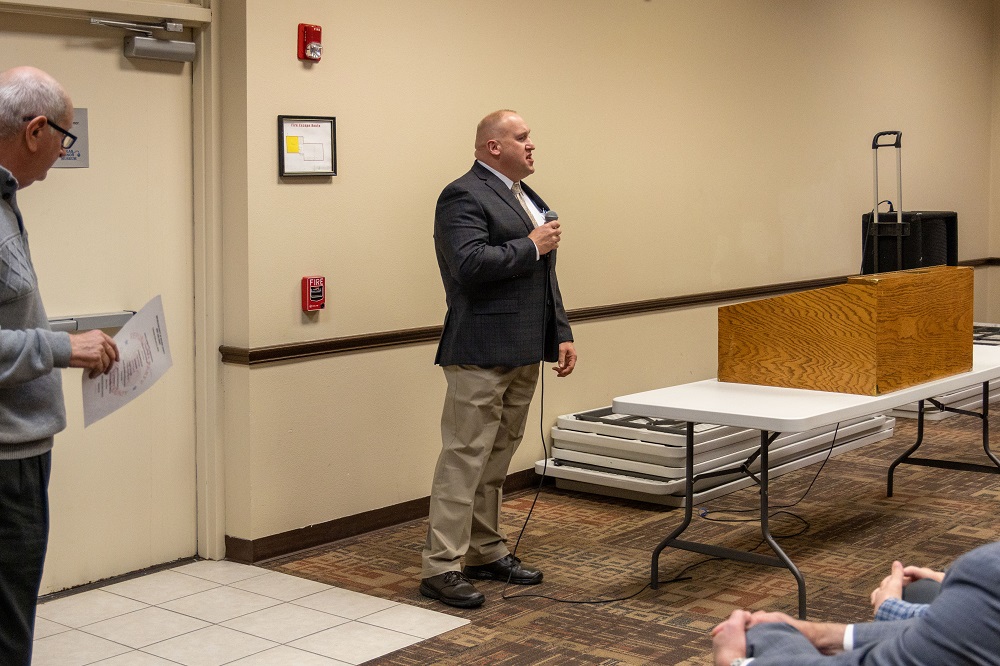
Those who are running unopposed gave 1-minute speeches: Criminal District Attorney, Will Durham, County Court-at-law, Tracey Sorensen, County Clerk, Kari Ann French, County Treasurer Amy Klawinsky, County Commissioner Precinct 3, Steve Fisher, Justice of the Peace Precinct 2, Marcus Payne, and Justice of the Peace Precinct 4, Steven Cole.
Criminal DA, Will Durham observed that his goals for his office are to “Seek truth, Pursue Justice, and always be prepared.”
Kari French, County Clerk explained the importance of maintaining the history of the county, and Steve Fisher, Justice of the Peace Precinct 2 expressed his desire to never slow down and to ensure hears everyone. Each candidate made the best use of their time by outlining their time in their current positions, and why they serve Walker County.
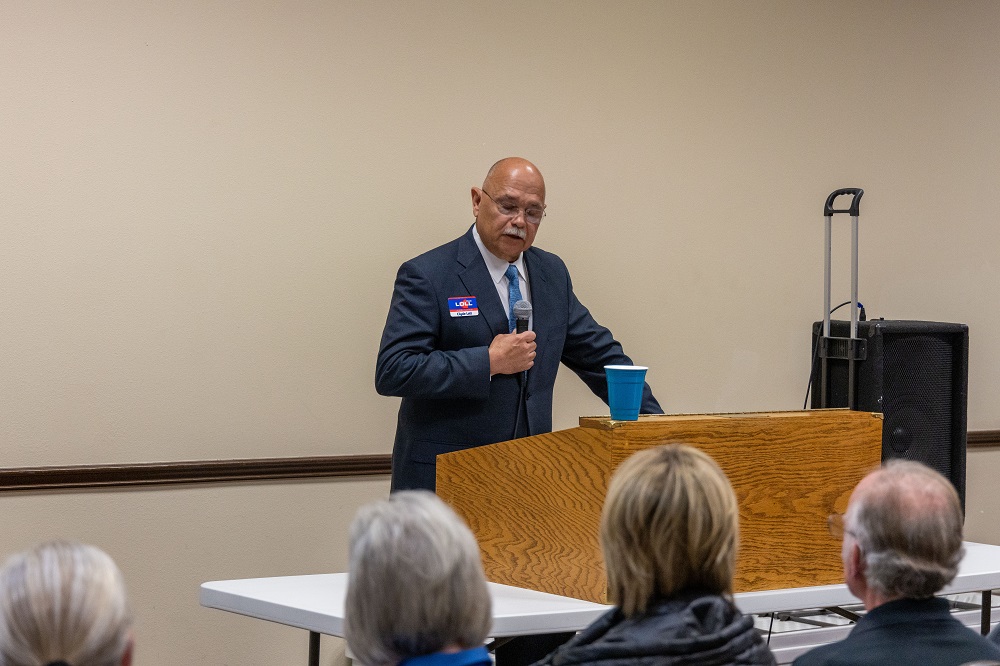
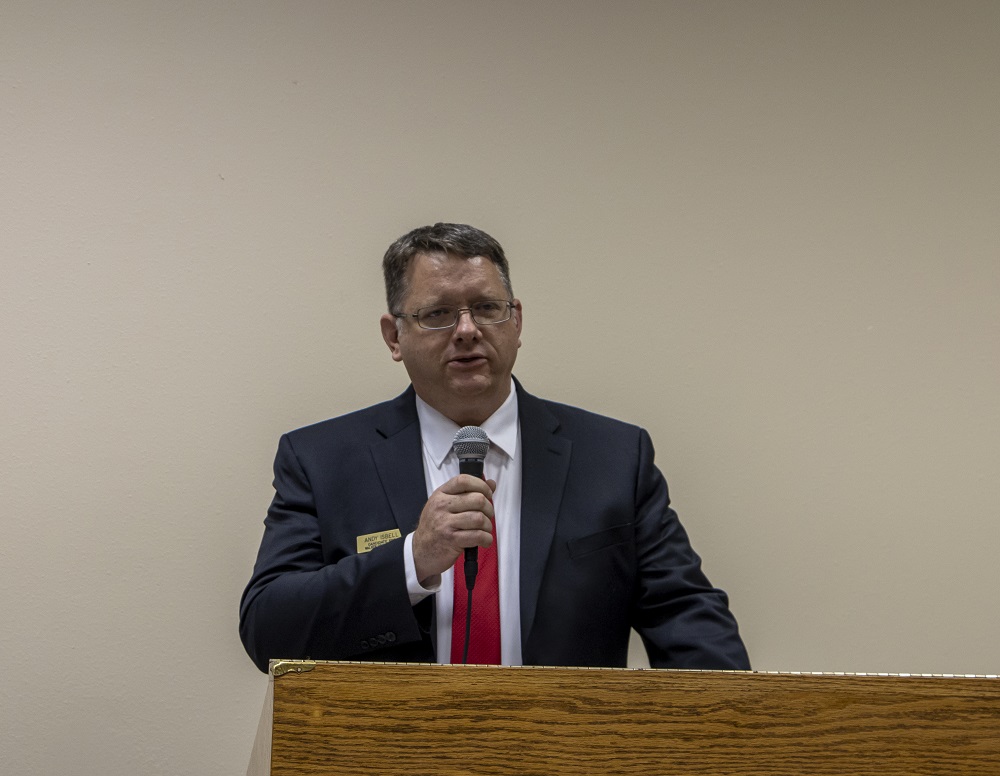
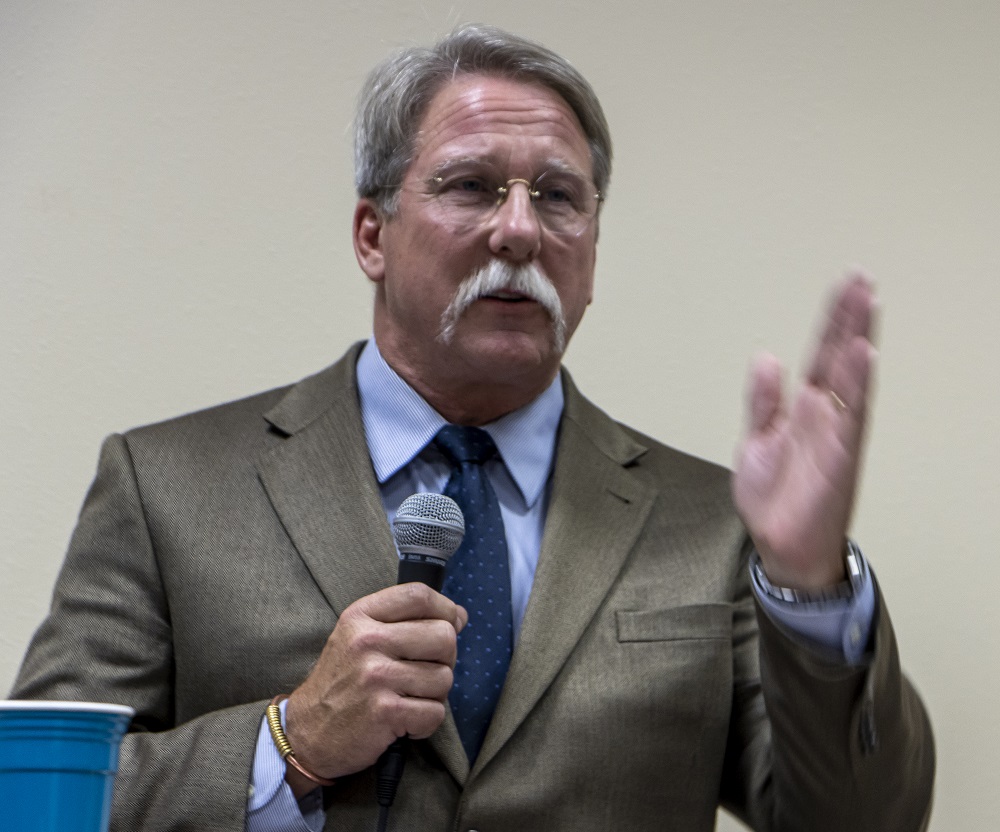
Running for County Judge of Walker county are 6 eligible Candidates. Lee Killingsworth, Andy Isbell, Shannon “Shadrack” Riley, Frank Olivares, Colt M. Christian, and Clyde Loll. Each one spoke for the allotted 5 minutes, and briefly explained who they are and what they plan on doing as County Judge. In one capacity or another all the Candidates pledged to keep and or lower taxes (which members of the crowed definitely appreciated).
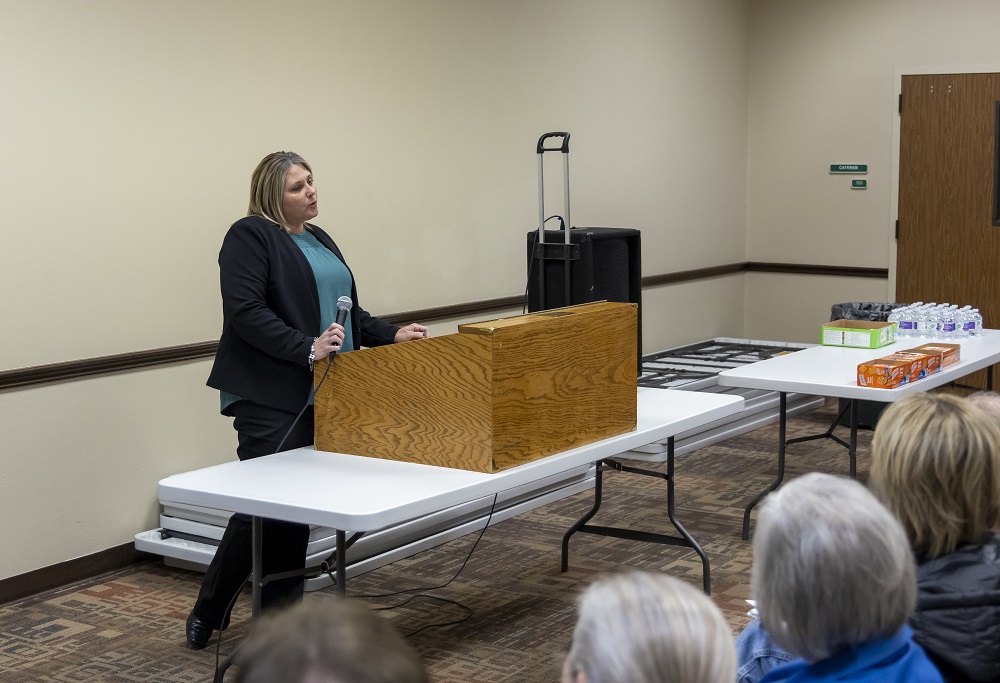
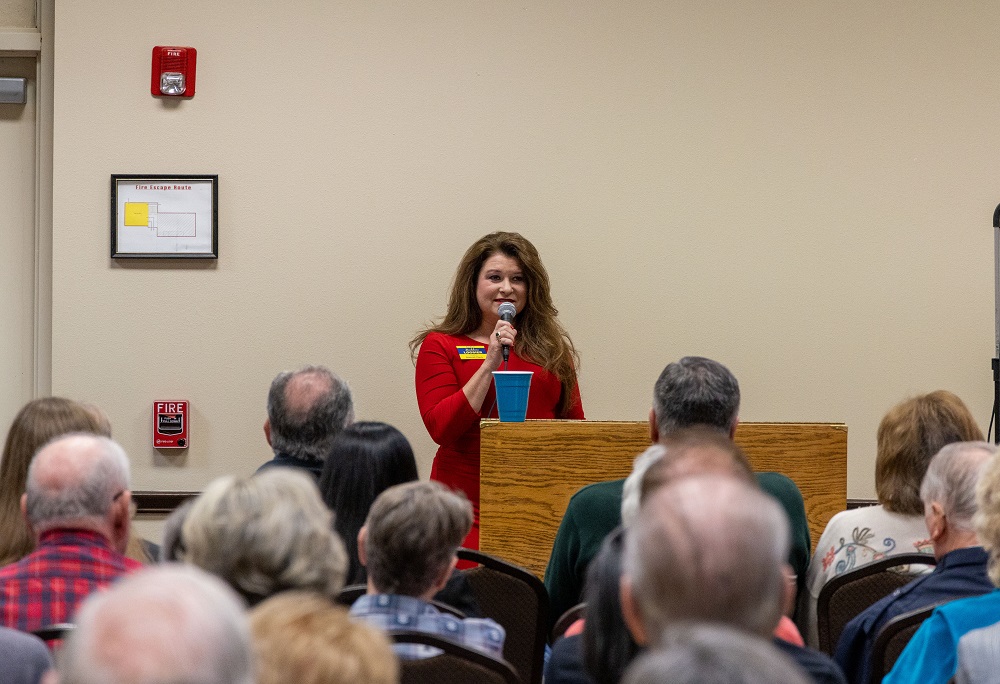
Leslie Woolley, April Farquhar, and Madeline Loosier are running for District Clerk. The candidates talked a bit about their backgrounds and why they are best suited for the job. Leslie shared more about her background in the Criminal Justice system, April explained more about her job and the drug testing process, and Madeline spoke more about her time as a business owner and her personal experiences.
Three people are running for County Commissioner Precinct 4, Frank Novark, Craig Wieghat, and Branden Decker. Unfortunately, Frank Novark was unable to attend due to a accident in which he broke his hand. Wieghat and Decker both spoke on their passion for the position and why they would be best suited to represent their precinct.
Running for Justice of the Peace Precinct 3 are Mark Holt and Randy Jeffcoat. Holt, the current Justice of the Peace, talked discussed his experiences in the position and his vision of the future. Jeffcoat expressed his desire to approach the position with fresh eyes, and indicated he is excited to run.
Running unopposed for her current position is County Chair Linda McKenzie. Mrs. McKenzie expressed her gratitude for Walker county and its citizens for creating a wonderful community and her desire to continue serving that community.
For us as students, the whole experience was a wonderful foray into civic engagement and what it means to run for local office. The evening offered many memorable scenes and moments…
…and we are grateful for the community members who showed up and those who desire to serve their community.
As the Lone Star State increases its share in the Electoral College to 40 votes, such gains also bring redistricting, with the government attempting to redraw districts so that they have equal populations. With new lines drawn, Walker County will be split into two districts: rt of Walker County will continue to be represented by the Texas’s 8th Congressional District (currently help by Congressman Kevin Brady) and the northern part will be represented by TX Congressional District 17 (Congressman Pete Sessions).
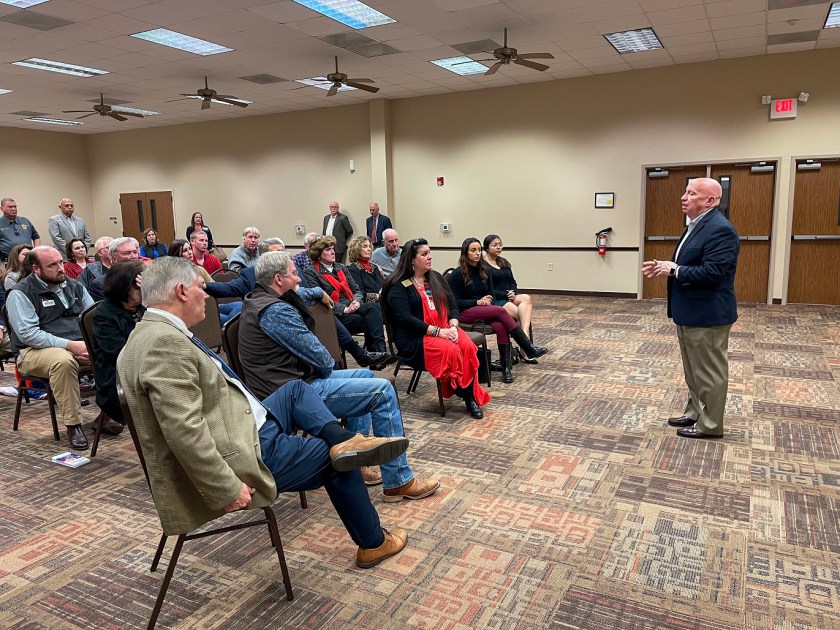
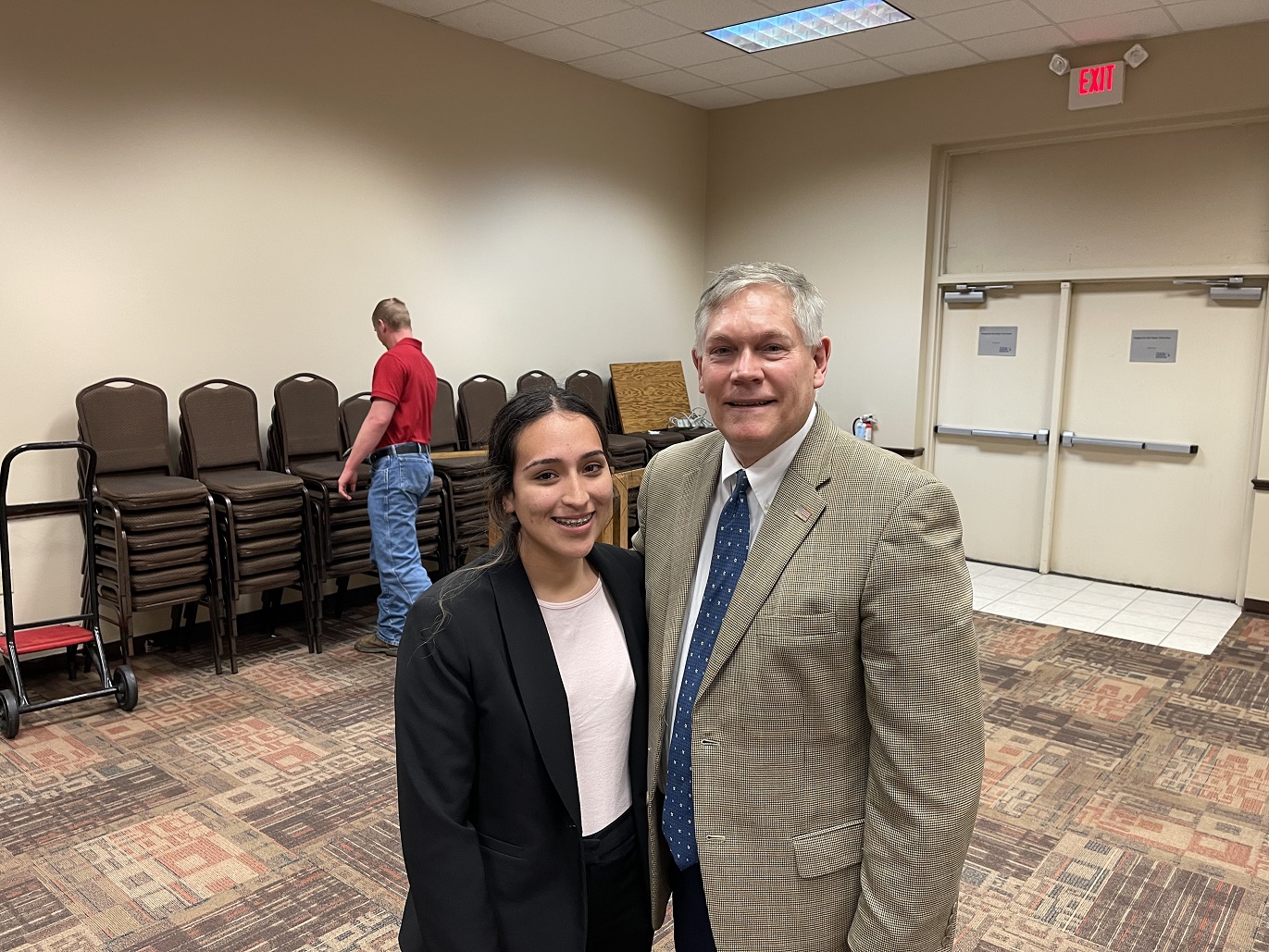
At the Texas Prison Museum, we had the opportunity to meet our current (Brady) and (likely) new (Sessions) Congressman! Some local and state candidates were also in attendance, and some even took the opportunity to ask Congressman Pete Sessions questions. The LEAP Ambassadors, almost front and center, listened attentively.
An audience member pressed Congressman Pete Sessions on his stance on a bill filed by Congressman Kevin Brady. The bill, also known as the “High-Speed Rail Land Acquisition Assurance Act,” was filed on January 10, 2022. This bill ensures that Texas Central’s high-speed rail and other high-speed rail projects cannot seize taxpayer land for projects that will never be started.
As filed, the High-Speed Rail Land Acquisition Assurance Act will require companies to acquire all the land needed to finish a high-speed rail project before construction can begin.
In his response, Congressman Pete Sessions reassured the citizens that he opposed private interest corporations using eminent domain to take someone’s private property. He plans to work diligently with Congressman Kevin Brady in protecting Texas citizens’ rights.
With the transition of redistricting and his retirement announcement, Congressman Kevin Brady reminded Walker County’s people of his commitment to finish the job until the very end. After serving for over two decades, Congressman Kevin Brady’s absence will be felt in Walker County. To offer just a small example, the LEAP Center has placed more than 20 interns in Congressman Brady’s office, and he has hired eight of them as staff.
With this history in mind, the LEAP Ambassadors are looking forward to similar opportunities in both CD 17 and 8.
To kick off this semester, the LEAP Center and Pre-Law Society hosted the biannual ice cream social, followed by a panel of experts discussing one of the world’s hottest topics: human trafficking. With more than 120 people attending the combined events, we were able, we hope, to kick off the semester on a fun, educational note.
The ice-cream social offered great finger foods, the chance to learn more about LEAP’s many upcoming events, and also the opportunity to win some back-to-school prizes.
We hope the students had a good time, even when they had to address head-palm moments….
Mostly, though, we hope they learned about our upcoming events, such as our workshops with Nancy Bocskor, our planned small-group meeting with former Attorney General Alberto Gonzales, our hosting the 10th Court of Appeals on campus, the Citizenship Preparatory Course we offer to local immigrants, our volunteerism at the Wynne Home for the annual Empty Bowls program, and our participation in the upcoming “College Bowl” competition hosted at the Texas City Managers Association Conference.
At the meeting, Heather touched on some housekeeping like the upcoming events, the next meeting, and the last day to pay dues which will be February 16th.
In addition to the panelists, we were honored to have a guests from off campus. Dr. Manis from the College of Osteopathic Medicine in The Woodlands joined us, as did Mr. Ken Holland, a member of the Huntsville ISD School board.
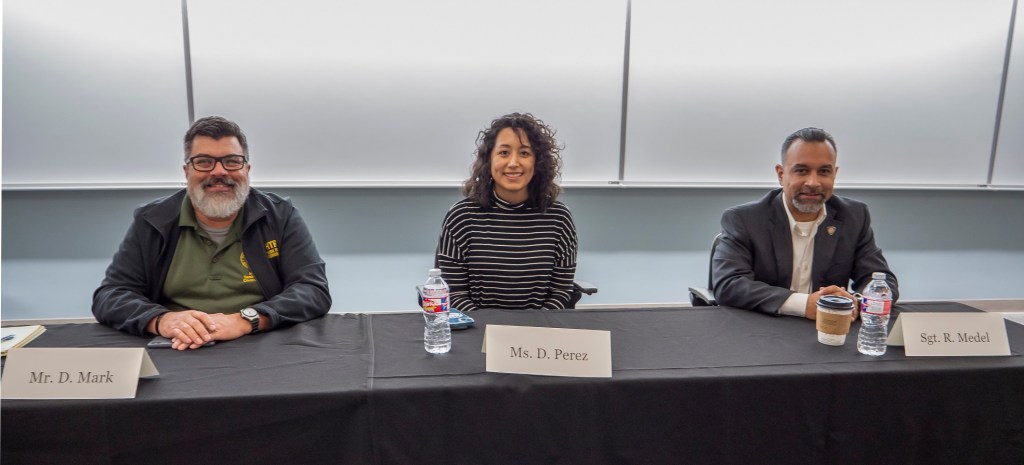
For the main event, Professor Yawn introduced our guest speakers: Dennis Mark, who is a Task Force Coordinator at Human Trafficking Rescue Alliance; Daniella Perez an Outreach Coordinator with Love146; and Sergeant Robert Medel with the Houston Police Department (Vice and Human Trafficking Unit).
L-R: Dennis Mark, Daniella Perez, and Sergeant Robert Medel
Professor Yawn began the session asking where Houston ranks in the nation in terms of trafficking. The answer, sadly, is first–Houston’s access to the border, its transportation accessibility, as well as the number of entertainment options, special events, and its remarkably diverse population, all contribute to its potential for trafficking.
Mr. Mark added that Houston has one of the oldest and most experienced forces investigating trafficking, allowing it to also be one of the most successful agencies at combating trafficking.
Because of the proliferation of trafficking, it is happening everywhere. “Anywhere there are people,” Sergeant Medel noted, “there are people being taken advantage of.” And this, continued Medel, is at the heart of trafficking, which is defined as “the exploitation of someone by means of coercion.”
There is no one definitive type of human trafficking victim, but most victims have had early trauma or “adverse childhood experiences” (ACEs). Many of these women (and it is mostly women) may enter trafficking through drugs, prostitution, or online pornography, but there are many victims outside of the stereotype. Mr. Mark,. for example, shared the story he helped recover: she was a University of Texas student by day, passing her classes and seemingly doing well, but in the evenings and night, she was engaging in online pornography at the behest of a “handler.”
The victims, according to the panel and Professor Yawn, often suffer from either Stockholm Syndrome (when the victim bonds with her captor) or cognitive dissonance (when the victim believes two contradictory elements simultaneously), and this makes it difficult for them to find the strength to leave. Sergeant Medel stated that “It takes a victim seven times to realize they are victims and to leave permanently.”
Ms. Perez highlighted the many problems (“co-morbidities”), physical and mental, associated with trafficking. These include sexually transmitted diseases, broken bones, addiction, depression, even tuberculosis. These problems are cumulative, in part because handlers don’t want the victims going to the doctor’s, which may raise red flags.
The panelists closed–prompted by a question from Ken Holland–with a discussion of how we may be able to identify victims of human trafficking. There are numerous such indicators, but some common ones include malnourishment, avoiding eye contact, allowing others to answer or speak for them, and tattoos.
Possibly the most inspiration words were those Mr. Mark made in closing. “To the ladies, know your self-worth and value, do not let anyone else determine that. And to the men, do not believe the culture of women being objects. Be careful, guard your mind and heart. Be honorable in all you do and how you treat women.”
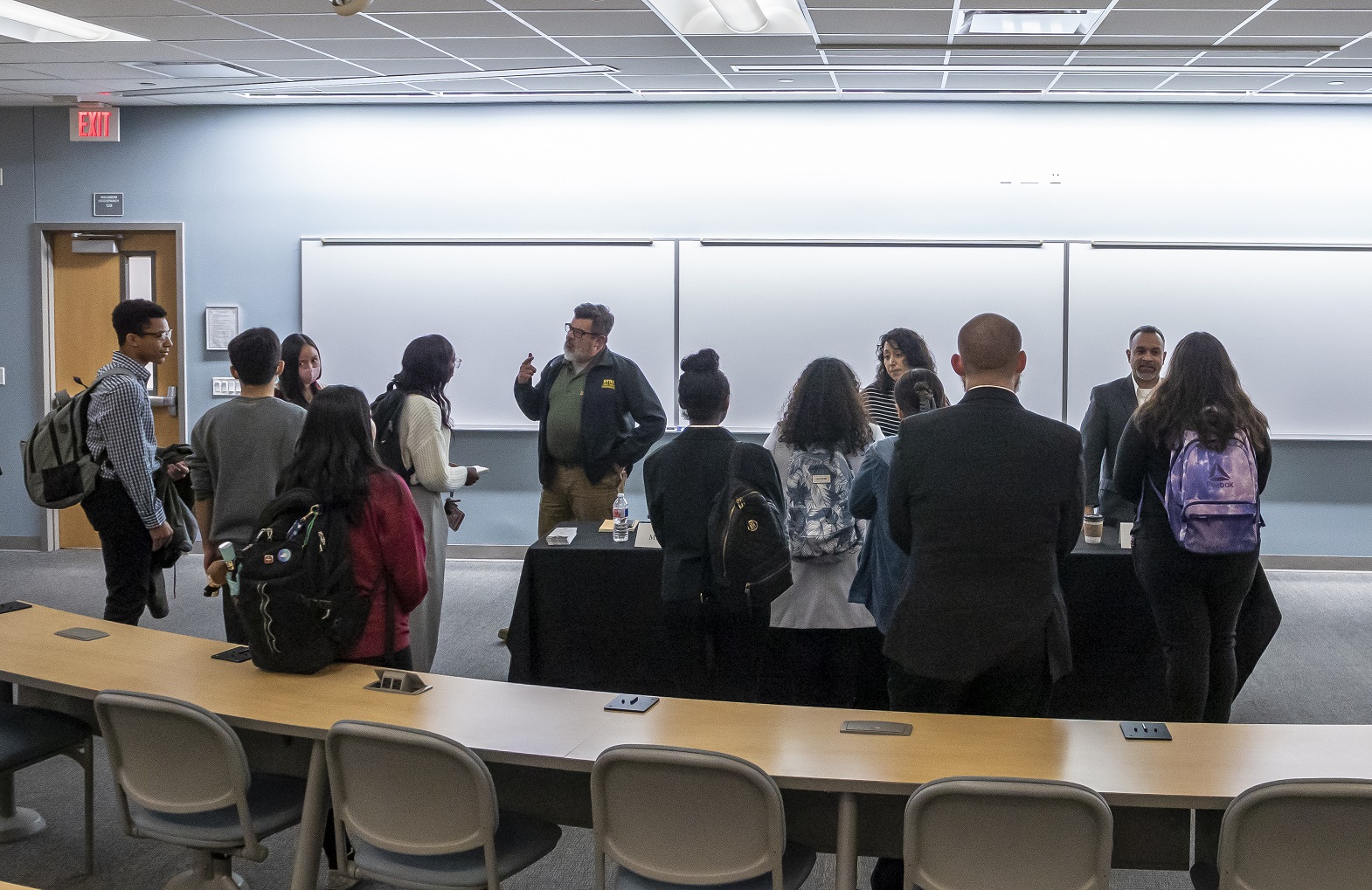
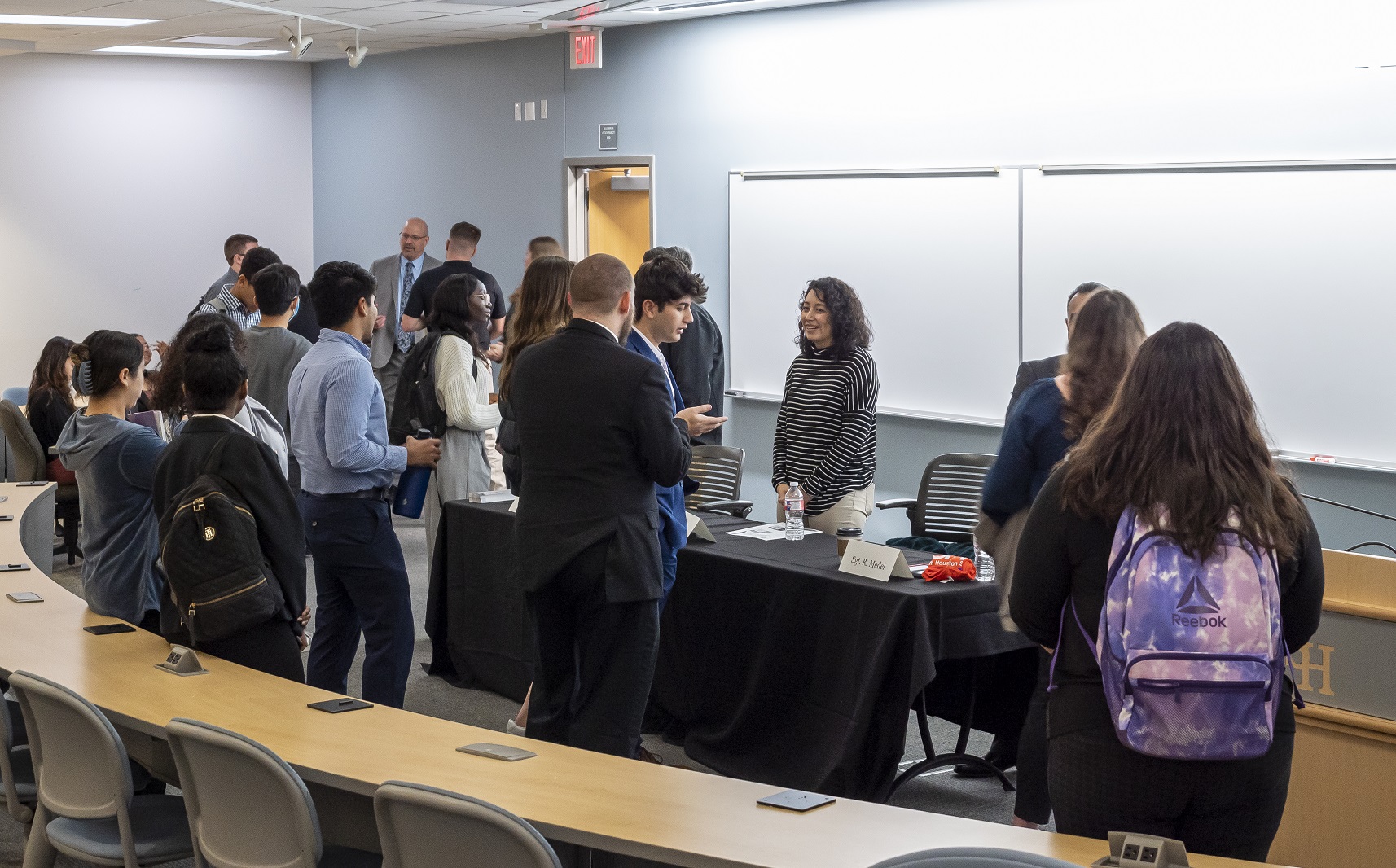
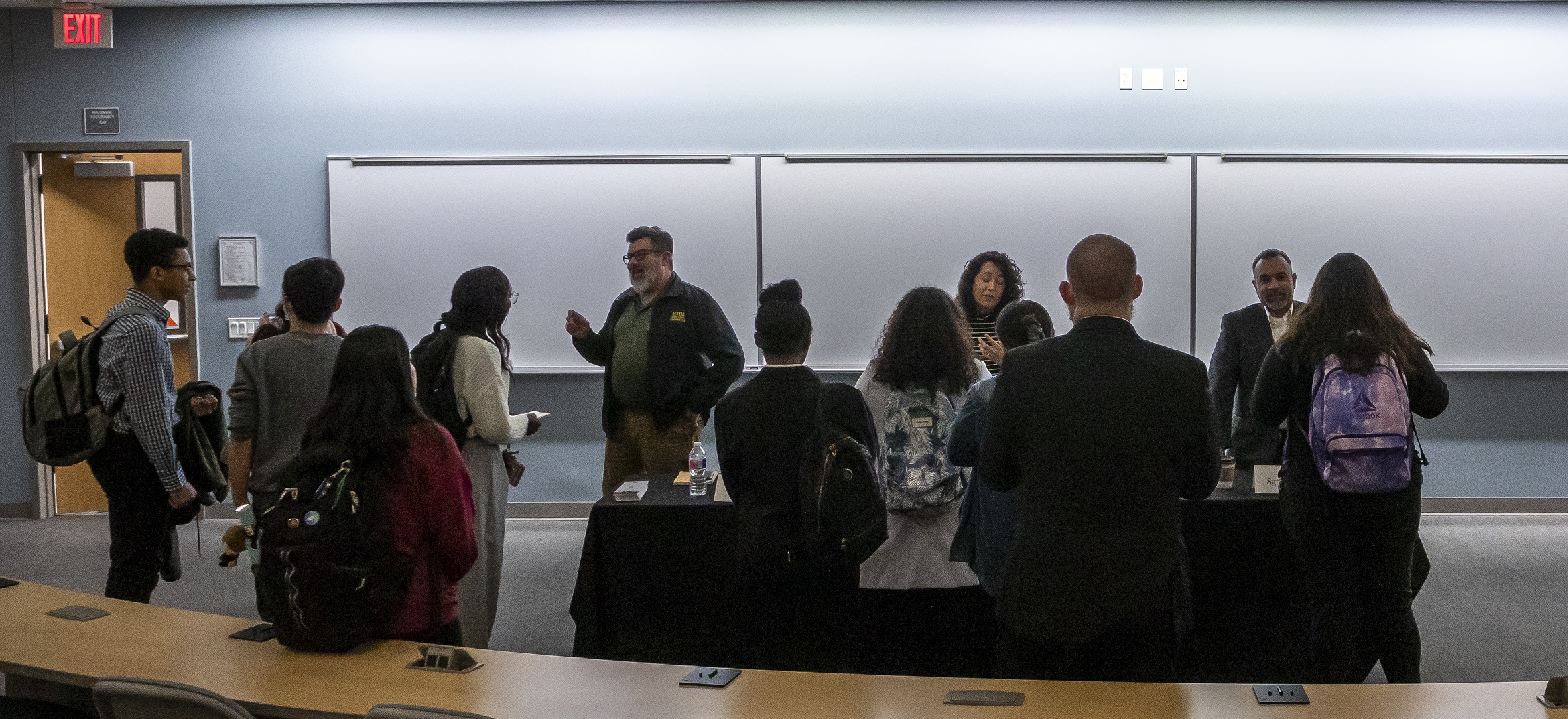
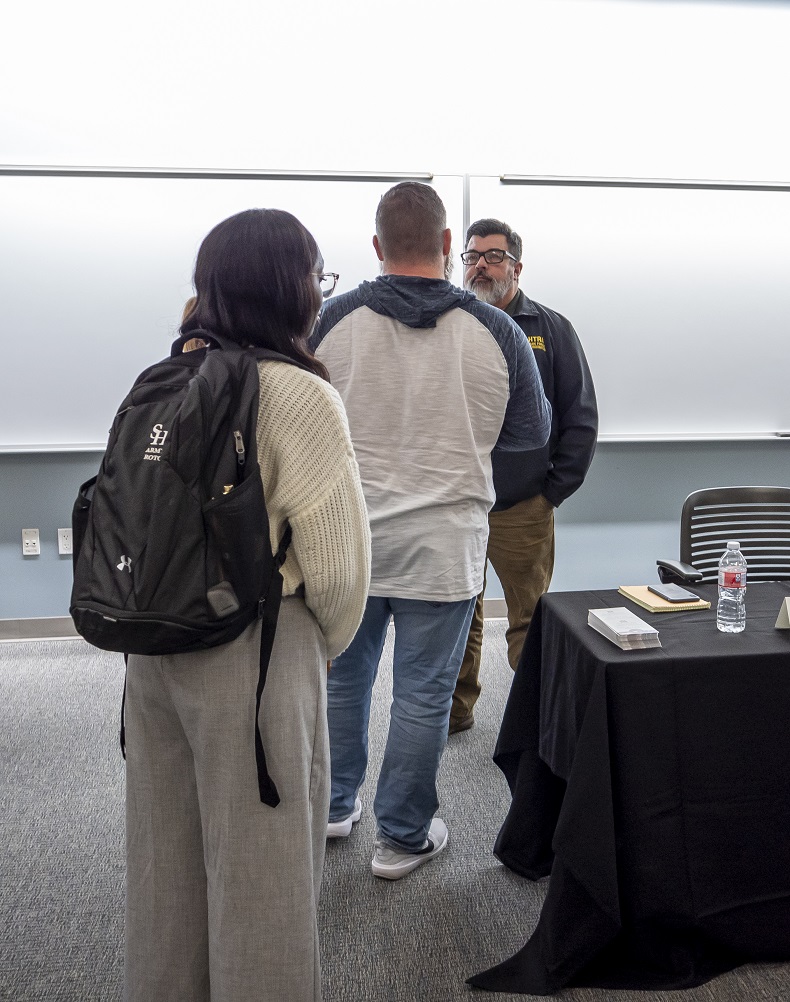
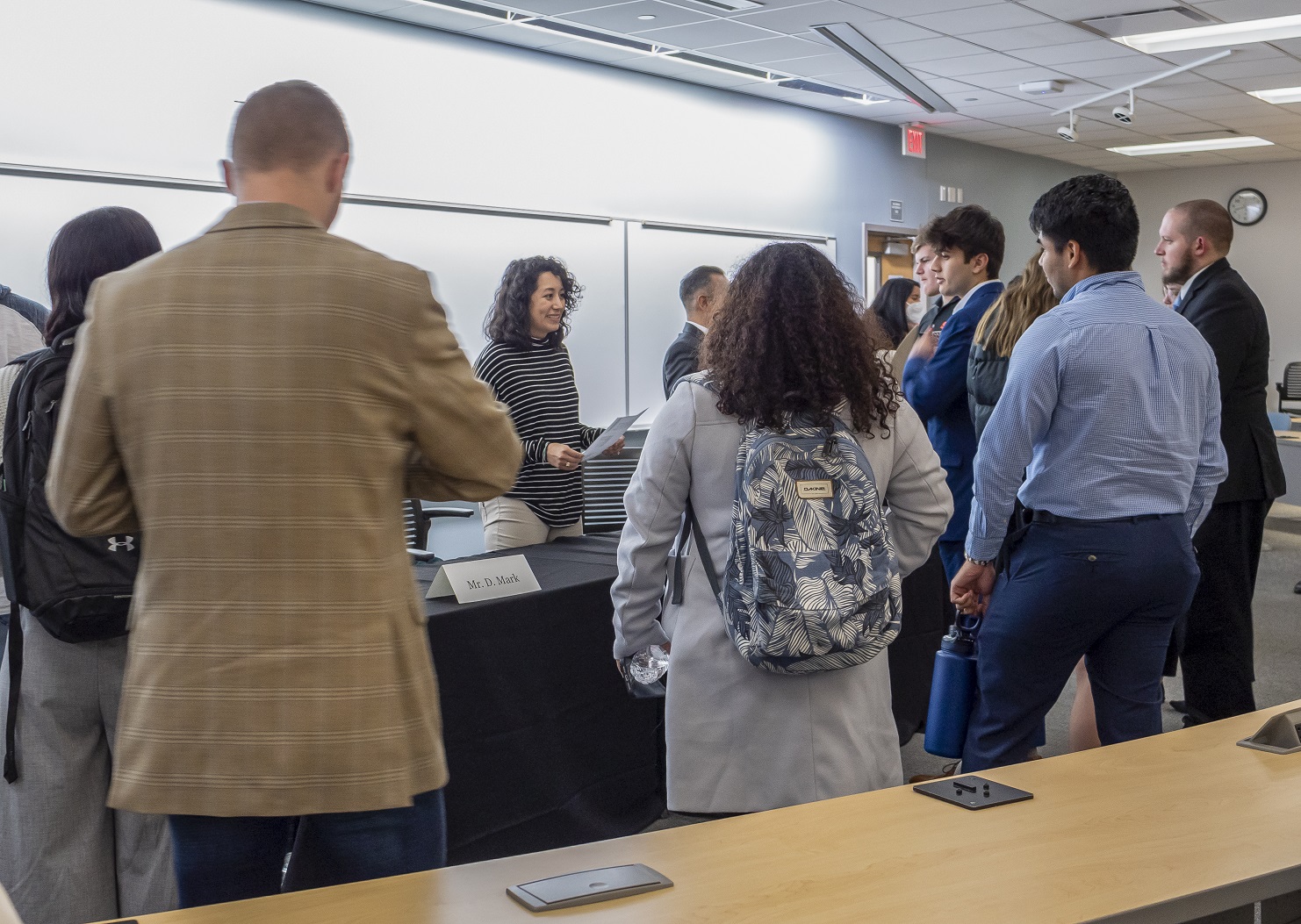
With Mr. Mark’s words reverberating through our minds, we wrapped up the formal event. But the panelists, graciously, agreed to stay and answer questions, an opportunity many students availed themselves of.
In addition, Professor Yawn and Mr. Mark discussed the possibility of internships, the LEAP Ambassadors offered gifts to the panelists as a “thank you,” and we posed for a final photograph to help us remember a wonderful and educational evening.
To kick off the new year some of the (Republican) LEAP Ambassadors spent the final night of winter break volunteering and attending the annual Reagan Dinner (while other LEAP Ambassadors attended a World Affairs Council event), which featured Texas Agricultural Commissioner Sid Miller. We coordinated with the College Republicans and Linda McKenzie to determine our roles, familiarized ourselves with the layout…
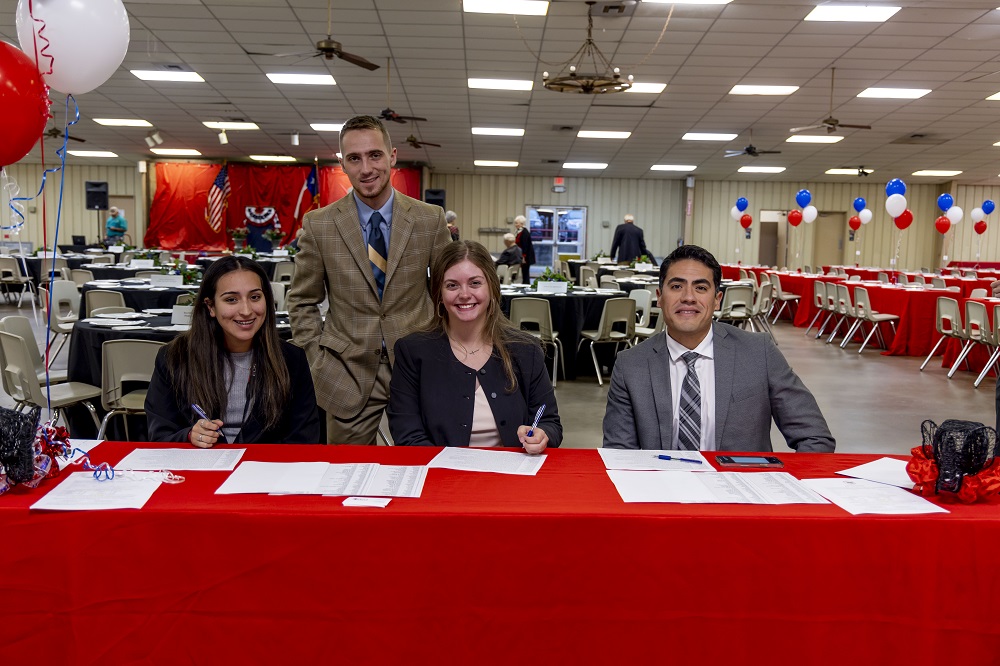
… and began welcoming people. With Mario, Erin, and myself signing people in, and Hunter, Jessica, and Yvette escorting, we quickly found a rhythm as the crowd steadily increased.
Everyone seemed to enjoy perusing the silent auction put on by the Walker County Republican Women and placing bids on all the delicious desserts. As people bid, socialized and enjoyed each other’s company, we were impressed by the community spirit found in Walker County.
Linda McKenzie, the County Chair, began the evening by expressing her gratitude for everyone in attendance and introducing all of the Council members and candidates.
Annel Guadalupe led everyone in prayer, and following that, I was honored to say the pledges for the night.
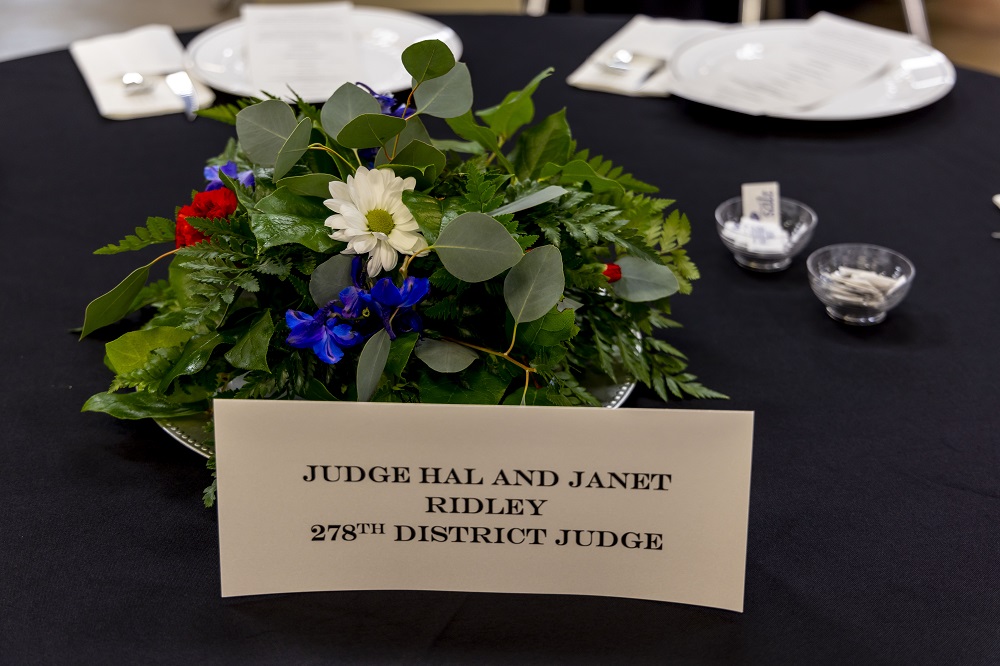
We were all graciously invited to sit with different table sponsors, including Judge Hal Ridley, Linda and Jim McKenzie, and Congressmen Kevin Brady. Hunter, Jessica, Yvette, and I were fortunate enough to sit with Attorney Jack and Choate and District Attorney Will Durham. We had great conversations, and we enjoyed learning from people who excel in their careers.
One of the conversation pieces was how wonderful the food was–food catered by Humphreys American Grill. After the LEAP Ambassadors and College Republicans finished eating, we made our way over to the silent auction table, and we and began distributing the desserts to the highest bidders.
Agricultural Commissioner Sid Miller was the guest speaker for the dinner.
He highlighted a few very interesting stories from his career and mentioned all that his department oversees–including, oddly enough, the weighing of ping pong balls!
Commissioner Miller also emphasized the importance of events like these and how important it is to the community. We were even fortunate enough to snap a picture with him!
As the evening ended, all of the councilmembers and candidates posed for a picture with Commissioner Miller, and several thanked him for his time and speech.
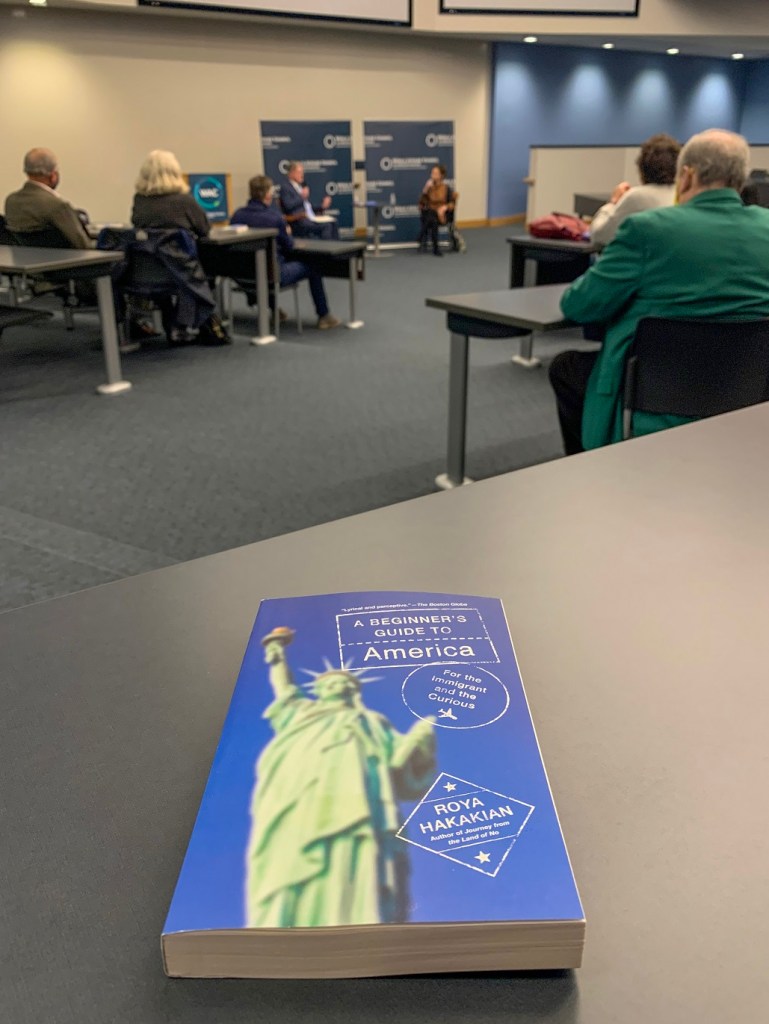
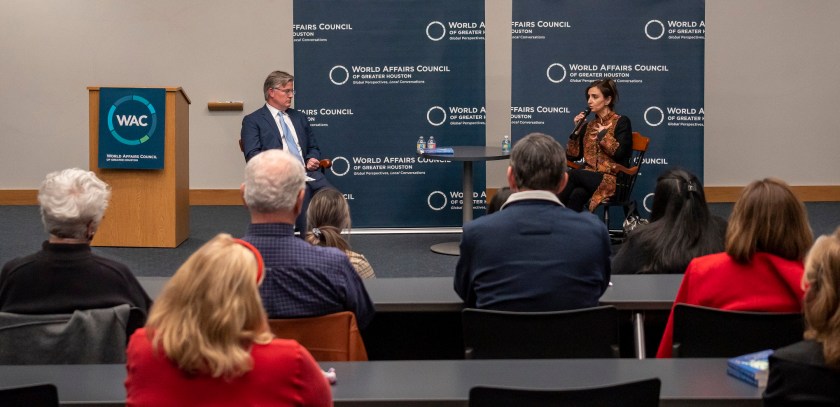
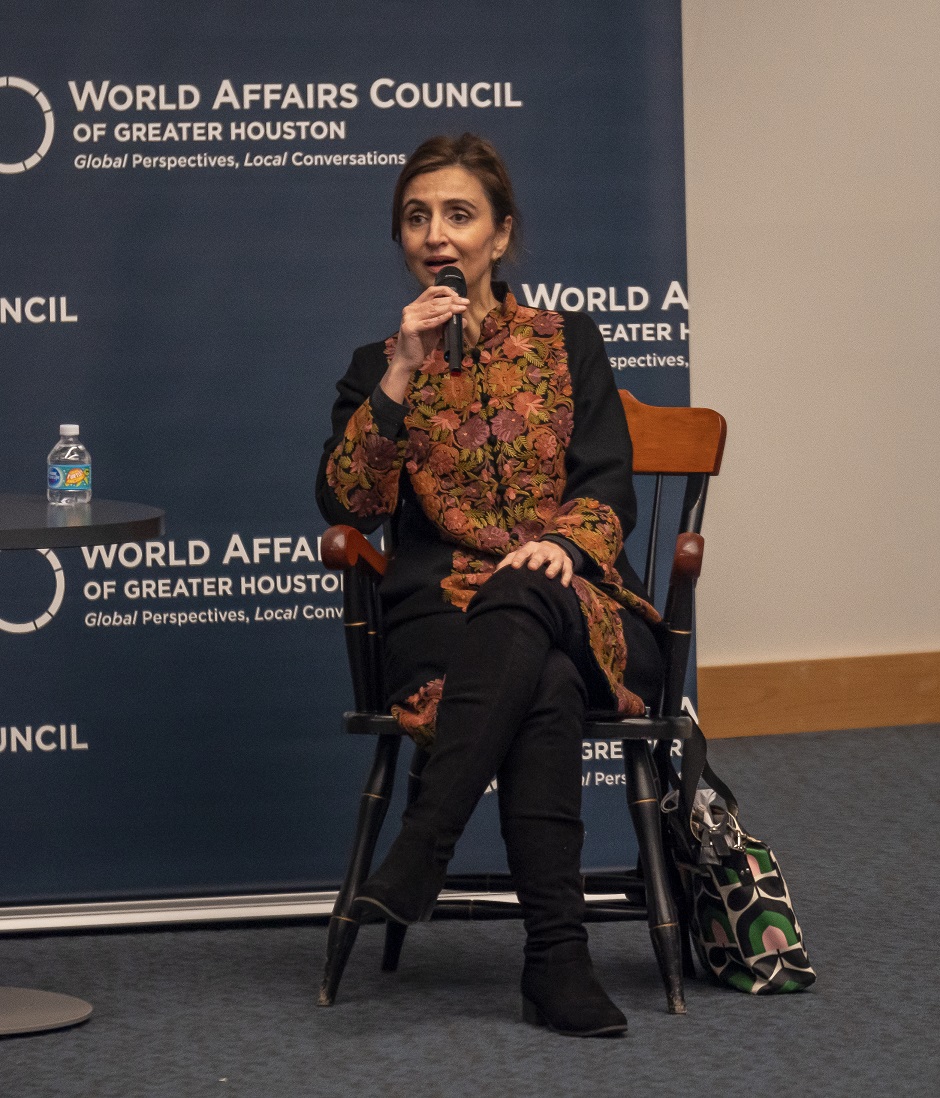
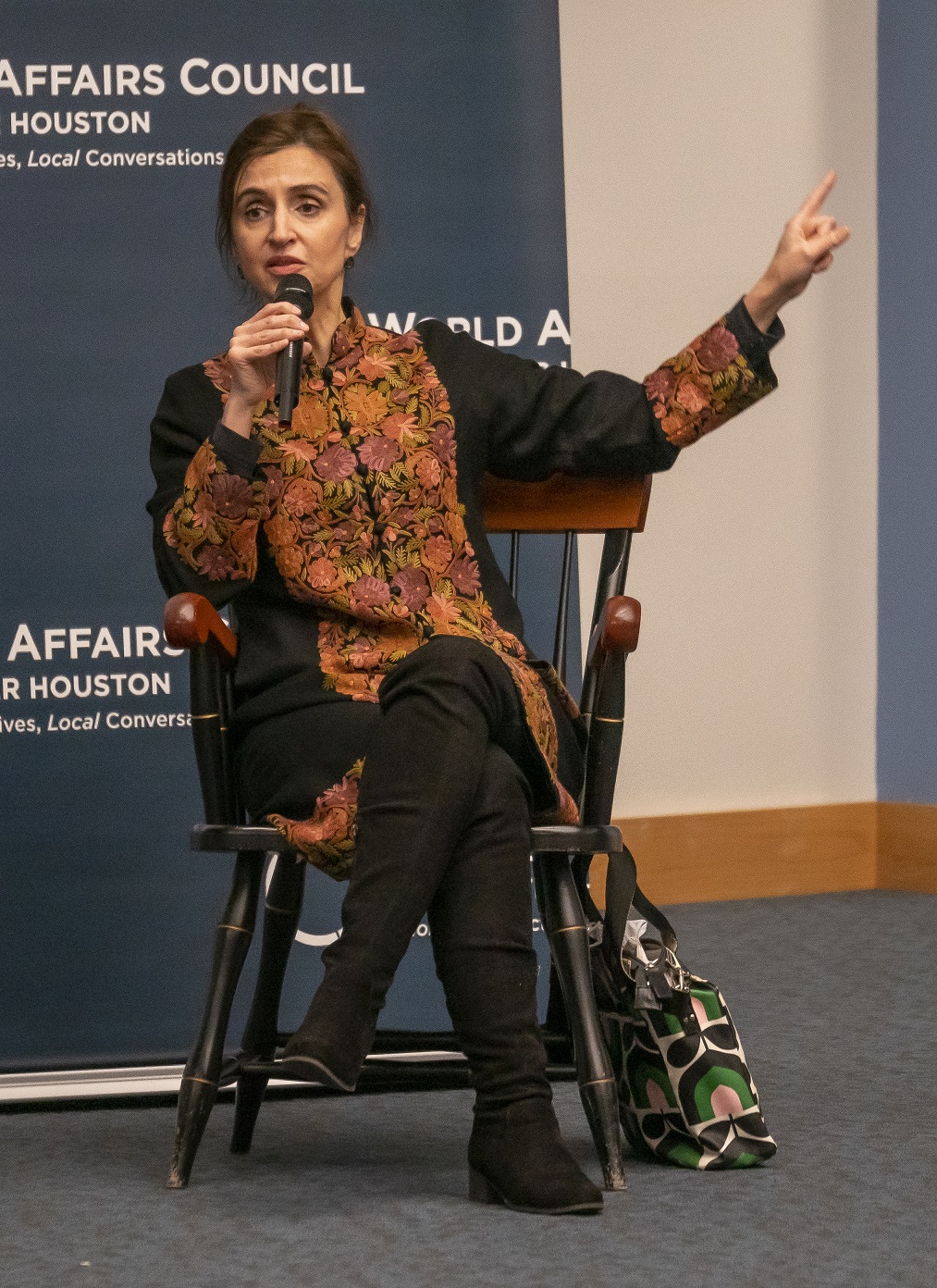
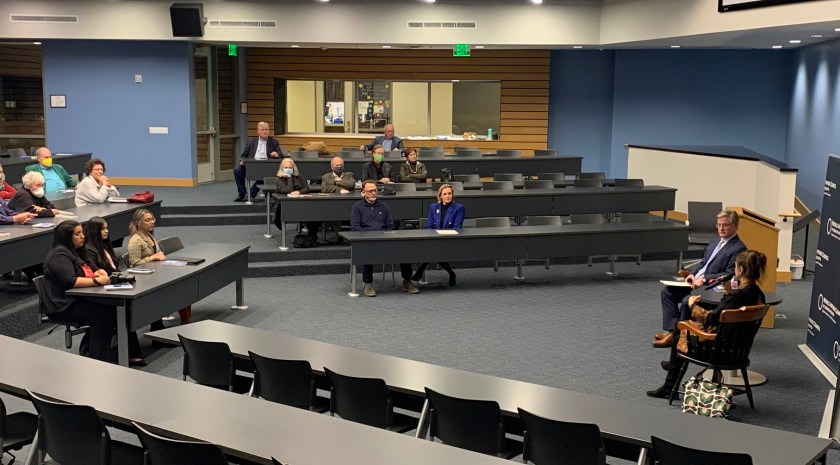
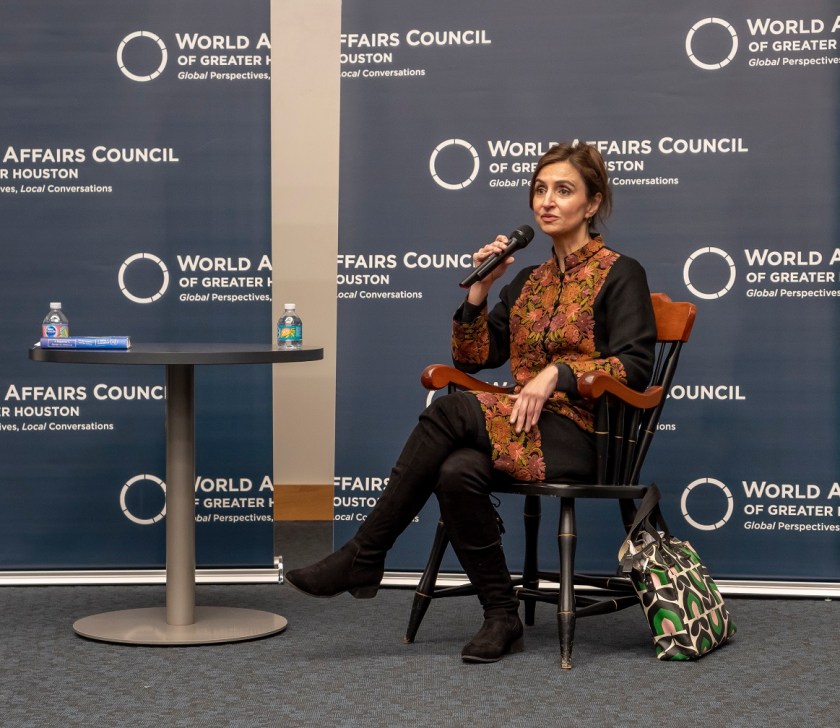
To kick off the new semester, Heather Barodi, Jocelyn Vazquez, and I traveled to The Woodlands representing LEAP and Sam Houston State University for the first event of the year hosted by the World Affairs Council (WAC). This event showcased the journey of an immigrant into America featuring Roya Hakakian, an Iranian immigrant and her experience into the “land of the free!”
Upon our arrival to the venue, the LEAP students were greeted by the always-friendly, always-professional staff of the World Affairs Council! In fact, we were given a copy of Hakakian’s book, A Beginner’s Guide to America.
Considering that Ms. Hakakian a Guggenheim Fellow and Lesley Stahl referred to Hakakian as “the most eloquent interpreter of ‘the immigrant'” writing today, this was a real treat.
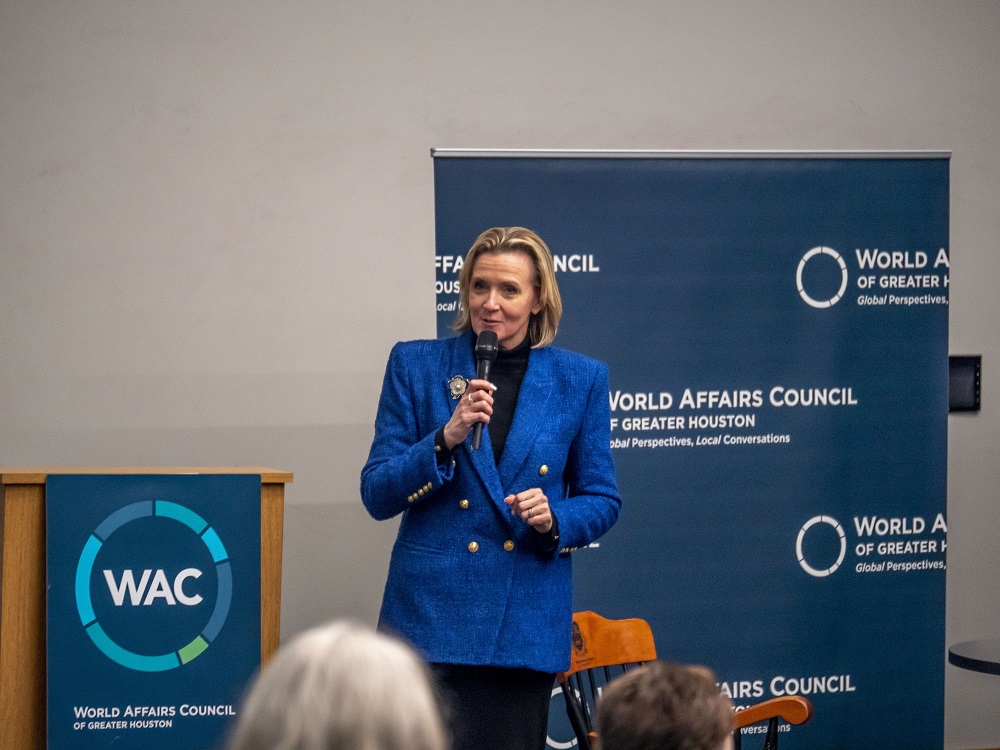
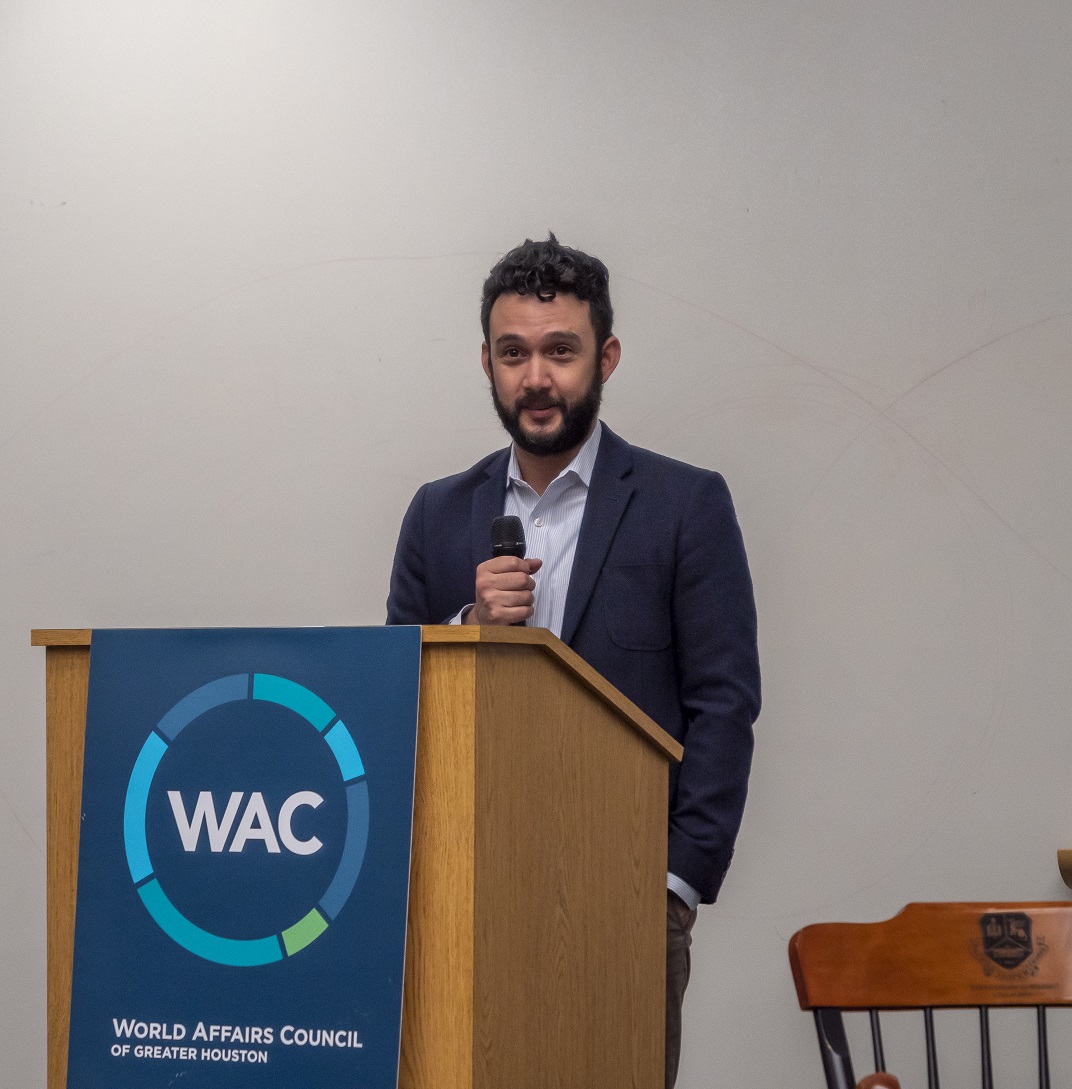
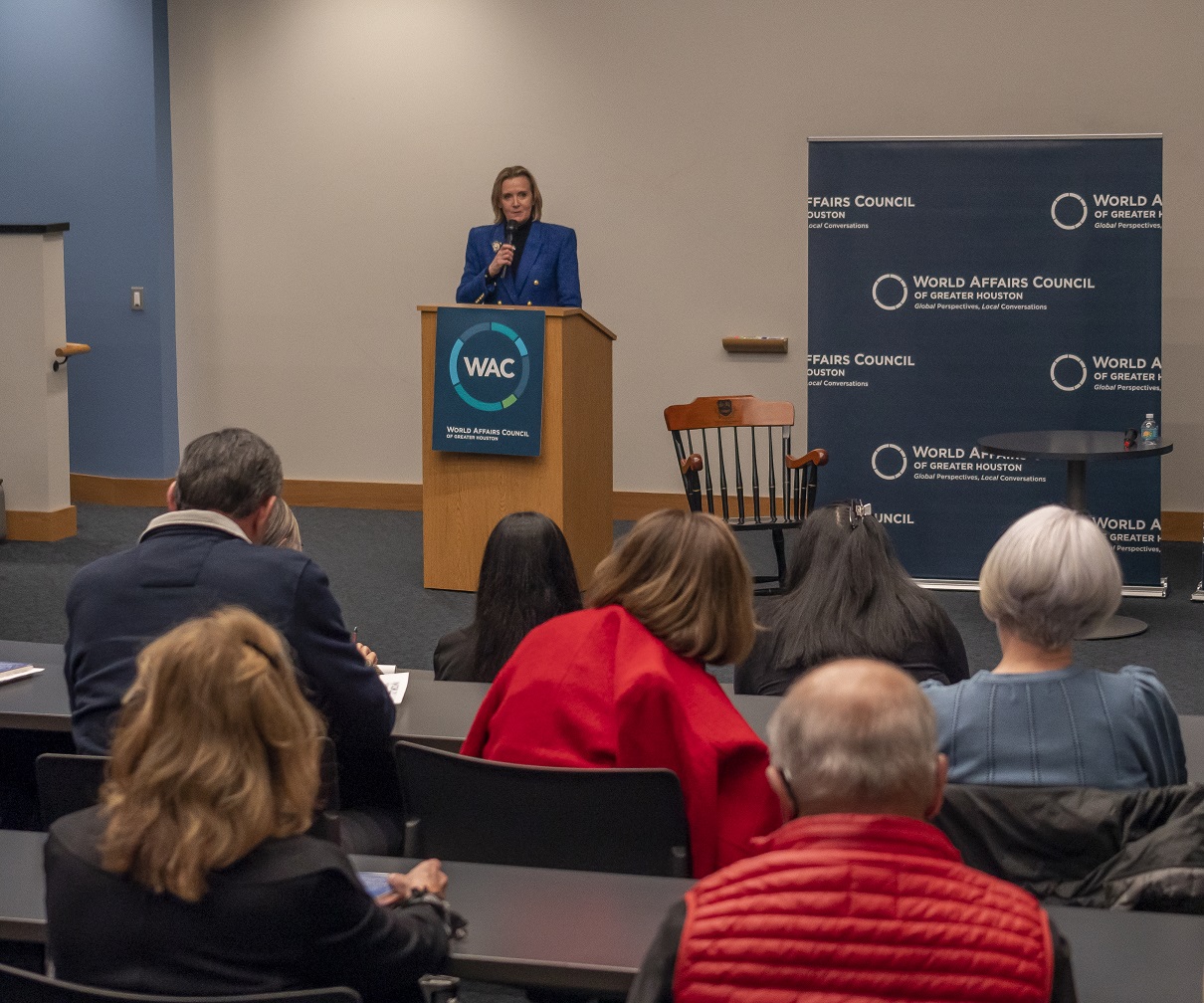
After introductions from the WAC staff…
…Ronan O’Malley moderated the event, asking questions about Hakakian’s experiences on her journey to–and in–the United States.
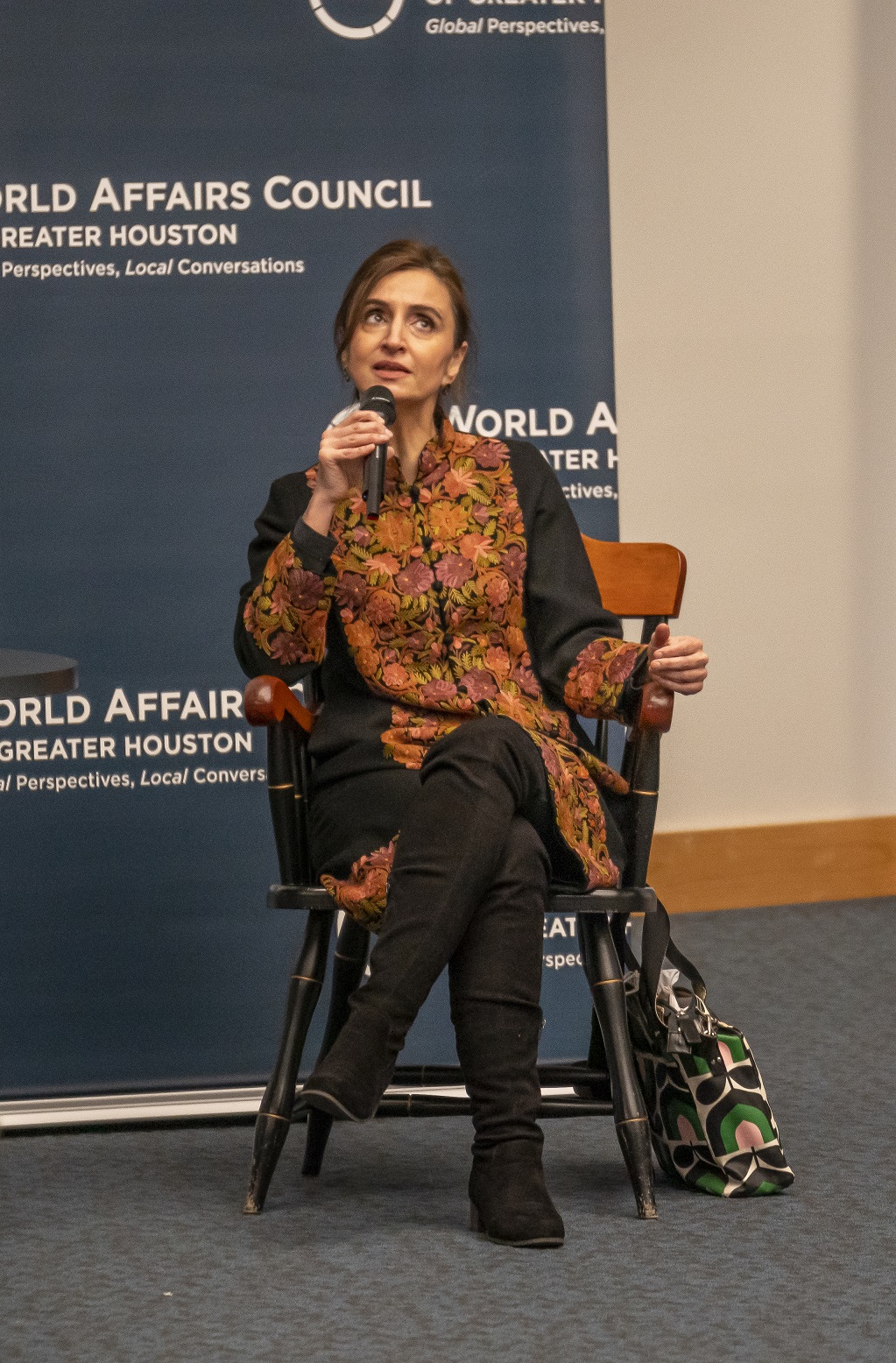
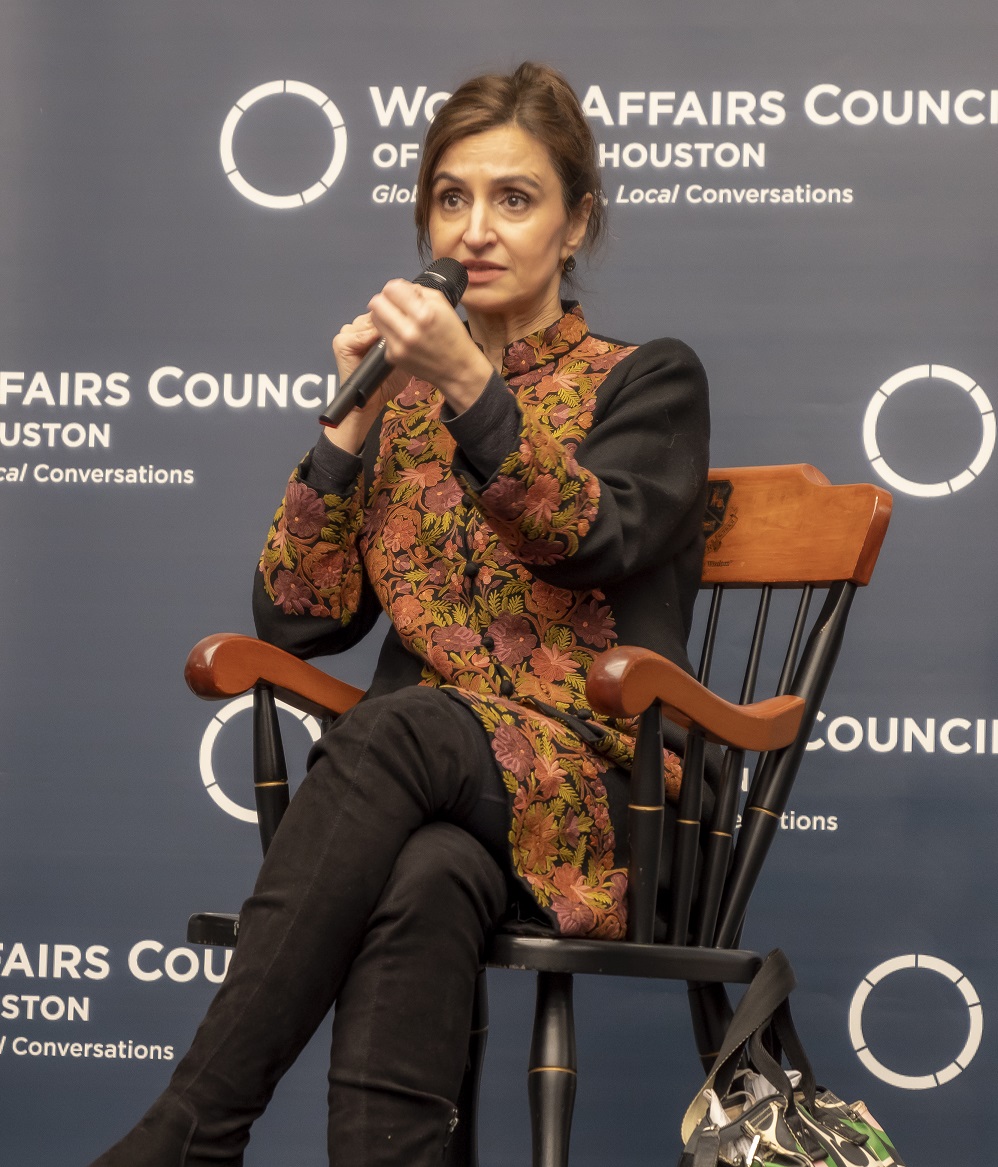
At the age of 19, Roya came into the U.S. with the hope of becoming successful in this large and unknown land. Ms. Hakakian explained her perceptions of the differences between the US and Iran and why it was such a cultural adjustments.
These observations spoke to us, particularly since of the three of us, one is a first-generation immigrant, and two are second-generation immigrants. We could all identify with at least some of what she had to say.
Toward the end of the session, the Mr. O’Malley took questions from the audience, and Ms. Hakakian responded to two LEAP questions! The insight into immigration and its challenges opened up many doors to knowledge and allowed us to see this process in a new light!
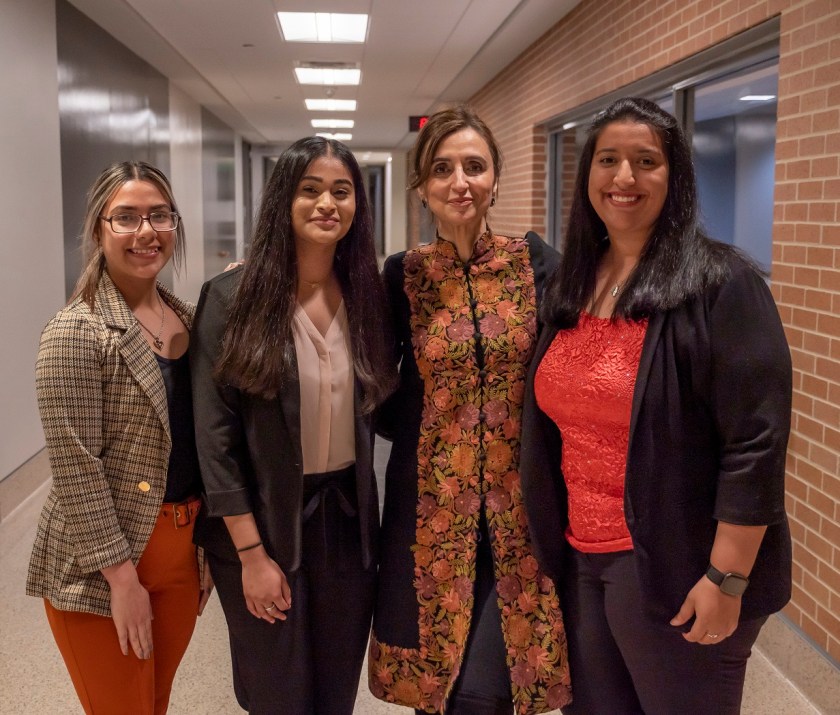
Roya Hakakian met with the LEAP students after the event and kindly signed our copies of her book A Beginner’s Guide to America. The LEAP students were thrilled to hear from her and learn from her experiences!
With another semester wrapped up, a few of the LEAP Ambassadors headed to Houston for–of course–another World Affairs Council event. We arrived a bit early, as we try to do, and we enjoyed the Christmas ambience.
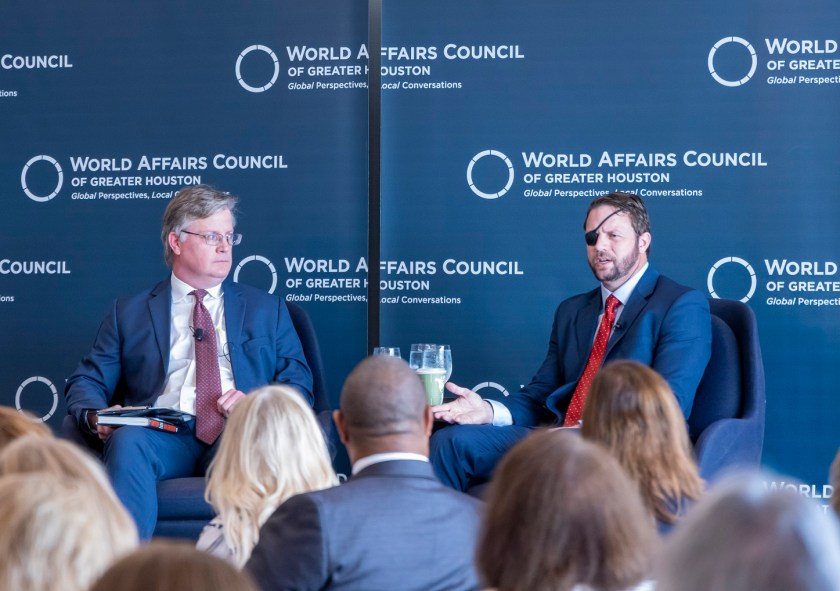
As with all WAC events, we were learning about foreign affairs, but this time it was from an ex-soldier’s point of view. And not just any former soldier: Dan Crenshaw.
Representative Crenshaw was introduced by WAC Director, Maryanne Maldonado, who welcomed us all to a wonderful lunch and program.
Congressman Crenshaw was a part of SEAL Team 3 that served in both Iraq and Afghanistan. He was injured while serving, leaving him with only one working eye, an outcome resulting in his ever-present patch–and two Bronze Star Medals, the Purple Heart, and the Navy and Marine Corps Commendation Medal with Valor.
After retiring in 2016 from the military as Lieutenant Commander, Congressman Crenshaw began to consider a political run, and in 2018, he was elected Congressman for Houston’s 2nd Congressional District.
Moderator Ronan O’Malley, the World Affairs Council’s Program Director, asked questions written by the attendees and directed them towards Congressman Crenshaw.
He began by discussing a few issues within our government: specifically, the adverse effects of withdrawing from Afghanistan “too soon.” Another topic discussed was the situation at the border, as the number of undocumented immigrants has increased in recent months.
Congressman Crenshaw spent part of his youth in Ecuador and Columbia, is proficient in Spanish, and he believes the US is currently spending insufficient resources developing relationships with countries in South America. Doing so, he believes, would alleviate some of the current problems, at least in the long term.
On all of the issues discussed, Representative Crenshaw noted that he is grateful for being a veteran, which he believes has given him a different approach when addressing issues.
He also reminded the audience several times about the book that he published, Fortitude: American Resilience in the Era of Outrage, noting, somewhat jokingly, that it would be an excellent gift for a loved one for the holidays.
When asked about his potential future ambitions in the political spectrum, he left the audience with a cliffhanger: “We’ll see what comes.” And, with that, he left for his next event, leaving many in the audience wondering what the future, in fact, holds for Representative Crenshaw.
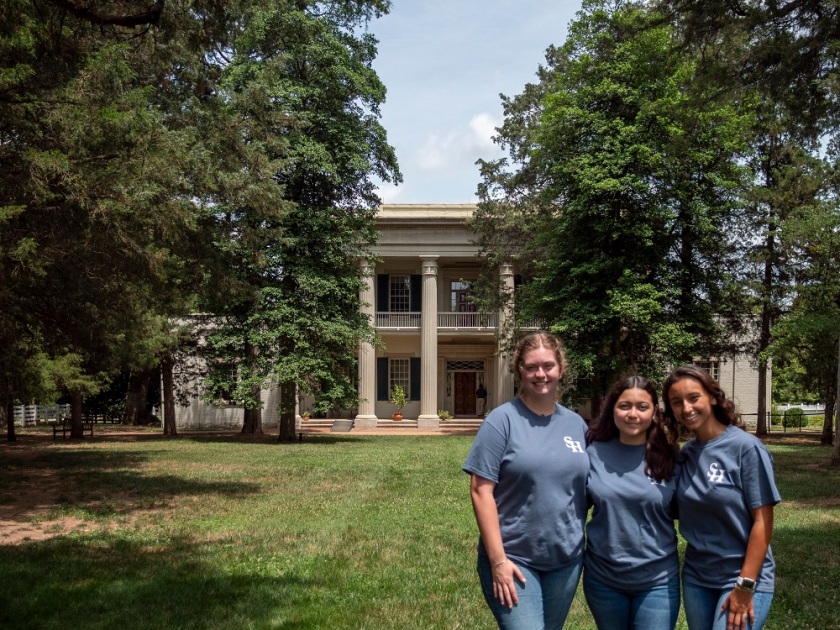
Seeking another historic home on day four, the LEAP Ambassadors ventured to Andrew Jackson’s Hermitage. This visit gave us a vivid perspective of the 1800’s lifestyle through his marvelous home and informative museum alongside it. In addition to having a tour of the Hermitage we walked through his personal idyllic garden and the cemetery where Andrew Jackson and his family currently rest.
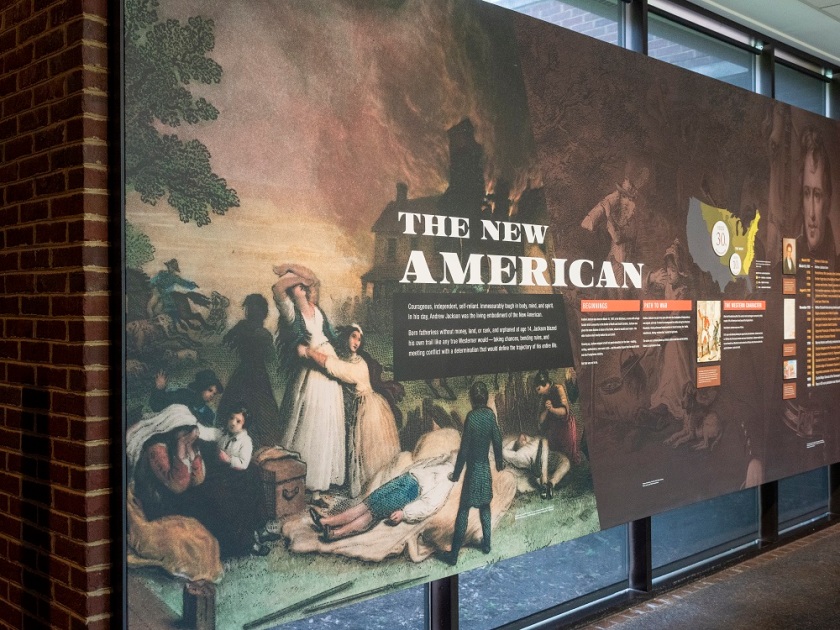
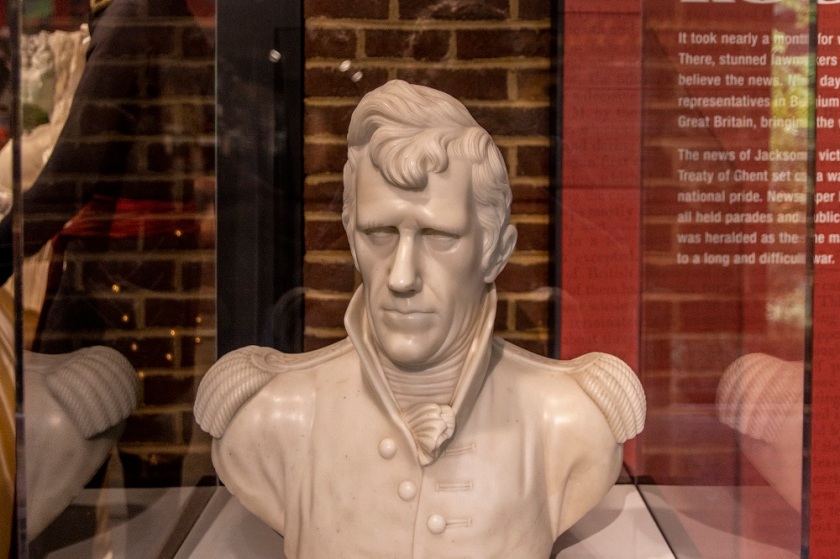
Former president Andrew Jackson was known as “the People’s President,” because he was the first “frontier” President, and he broadened the voting process, resulting in many changes in society.
Walking through the Museum we saw his accomplishments as an attorney, soldier, and president of the United States. Viewing artifacts, Jackson effectively led the battle of the Creek War in 1801 as Colonel of Tennessee and the battle of New Orleans in 1812. After courageously serving in these wars fighting the British and the Indians, Jackson was elected president, and he is now known as the founder of the Democratic party.
As for Jackson’s day-to-day life he lived with his wife Rachel Jackson and adopted children in a Greek-styled home where he allowed any guest comfort in his home with food and a place to stay.
Jackson was known to receive many visitors, including Sam Houston and former presidents, at his 1,120 acres of land at the Hermitage. Having guests stay made it a hectic household from managing the farm, servants, and attending to important guests.
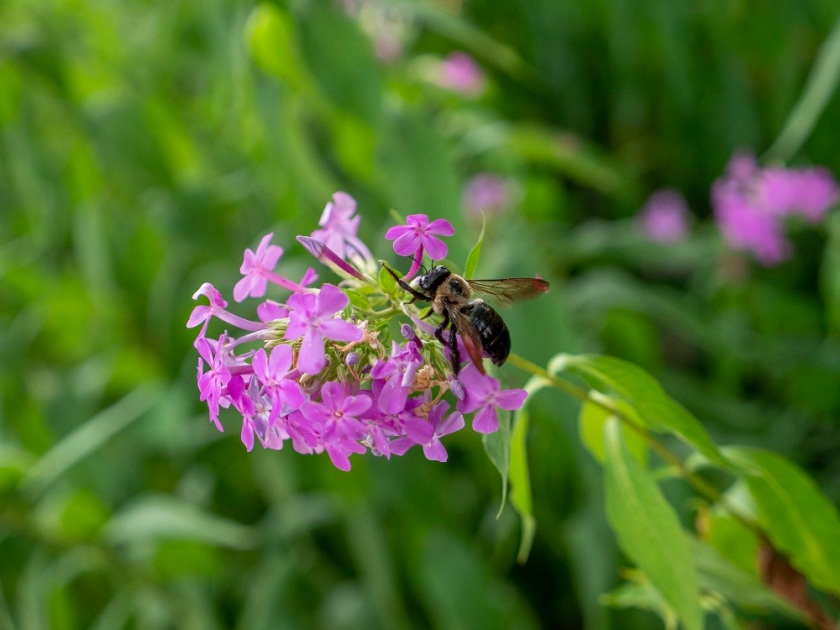
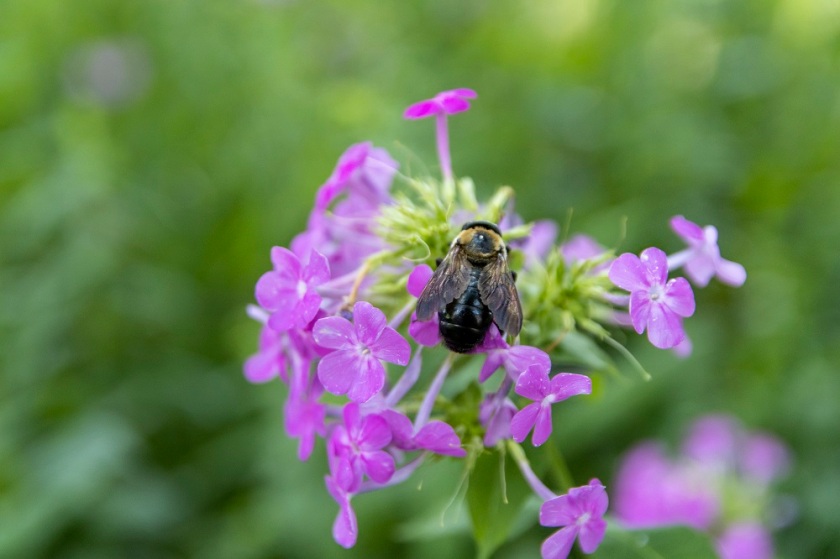
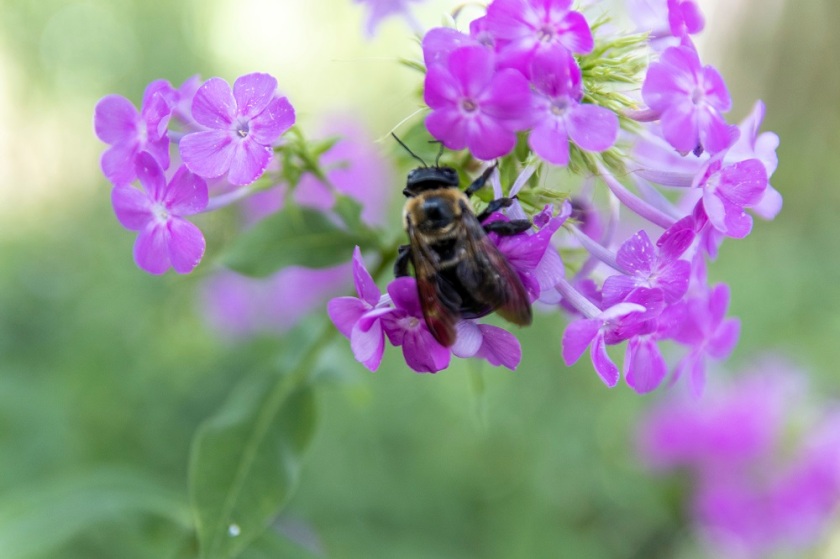
Each LEAP Ambassador had their own favorite part of the Hermitage Jessica being the massive newspapers in Jackson’s library. Morgan enjoyed the kitchen outside since it was like Sam Houston’s kitchen in Huntsville, Texas. Whereas mine was farther away from the home being the garden. As we all entered the garden I fell in love with the bumblebees flying around the brightly colored flowers that all led up to the tombstones.
The garden and grave site rounded off a nice sentimental testament to our 7th president.
Lunch
Yvette Mendoza
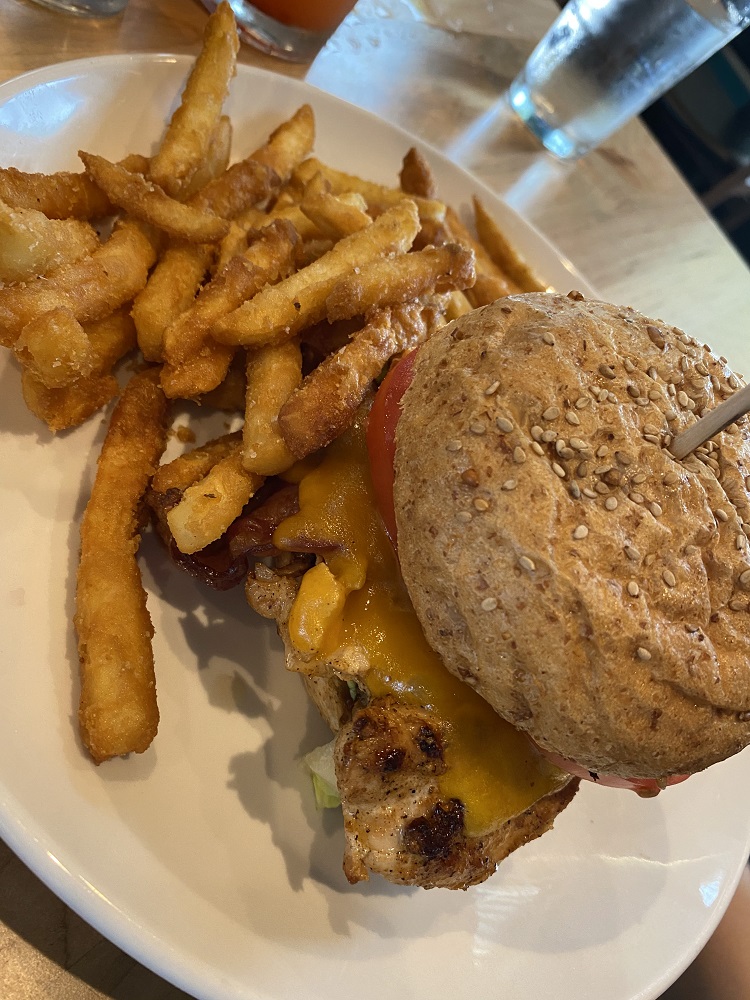
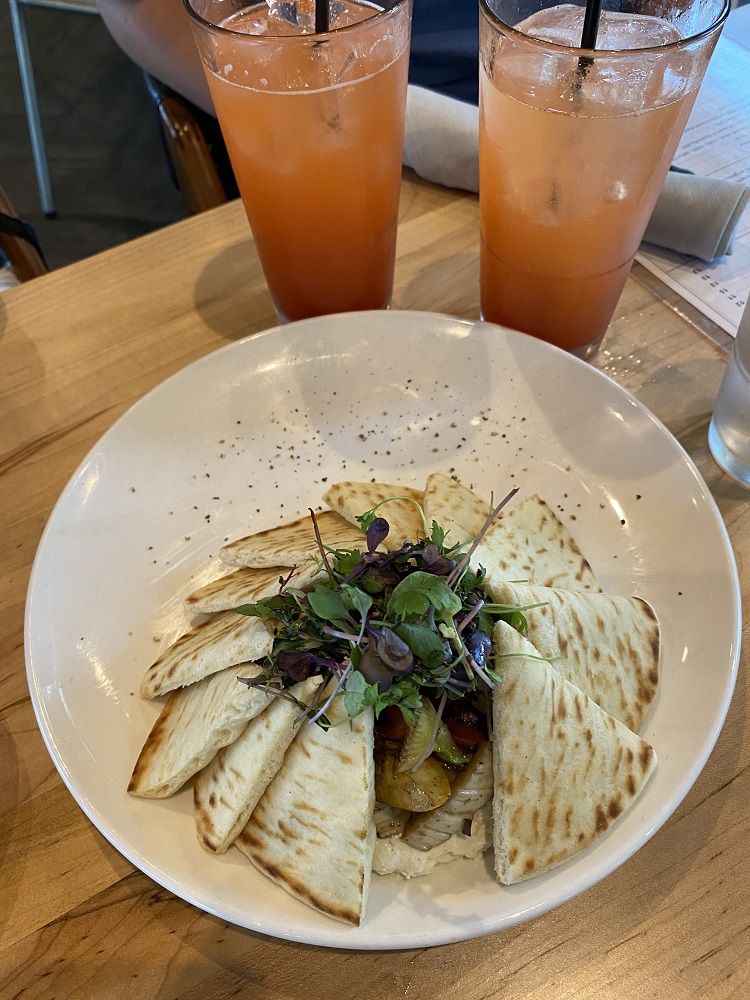
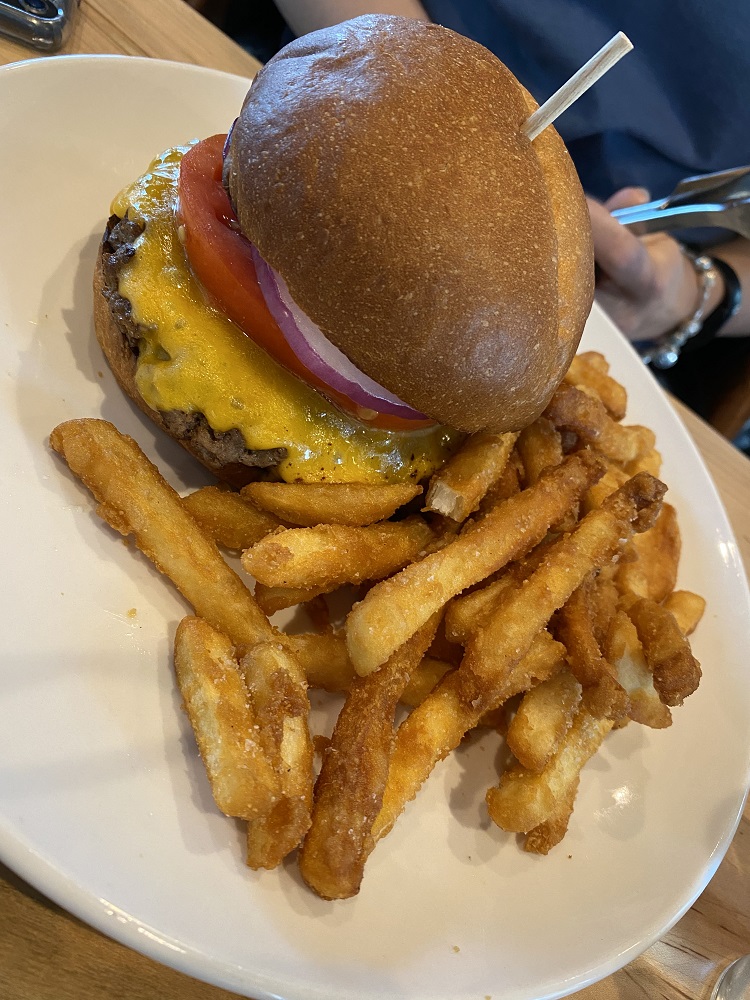
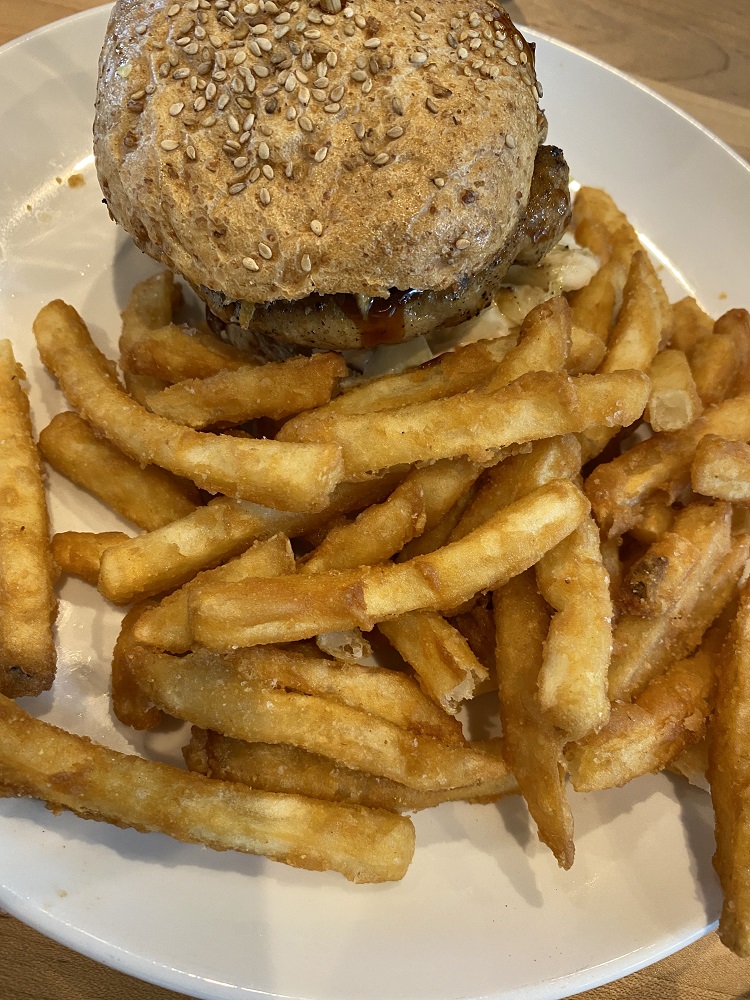
Diving into our first meal in Nashville at the Flat Iron southern fare restaurant ended up being a perfect choice. With the menu full of variety we started off with American classics by ordering whipped goat cheese filled with grilled cucumbers, onion, and tomatoes served with fresh warm pita. For our meals Morgan and Jessica got burgers, one being a tuna-patty burger and the other a grilled chicken burger. As for me, I got a waffle grilled cheese with a complimentary tomato bisque dipper. Each meal was delectable, and everyone had a delicious side of french fries. Our first taste of Nashville made us eager to try more.
Parthenon Tour
Morgan Robertson
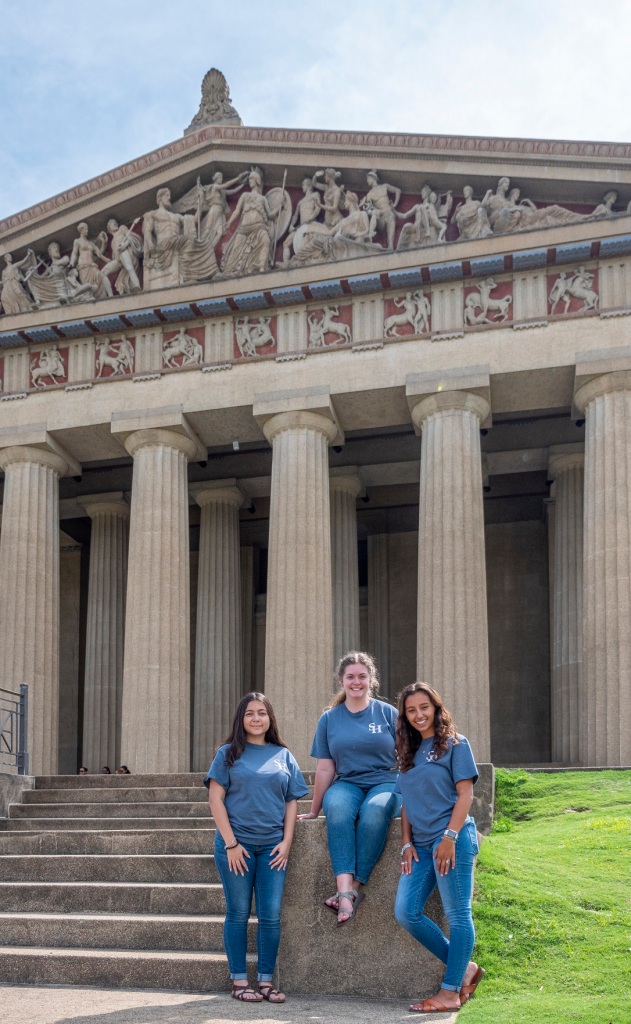
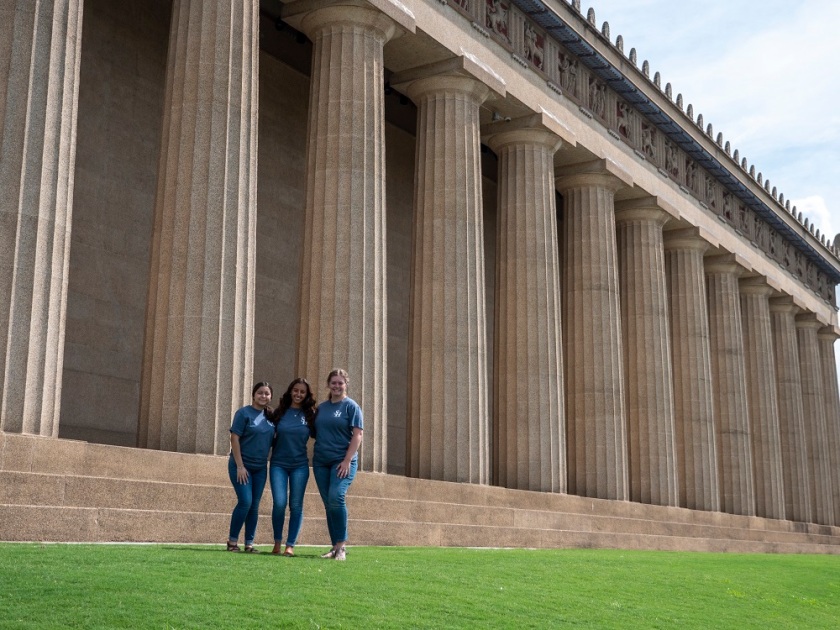
After seeing General Jackson’s home, we ventured into a City formerly known as “the Athens of the United States”–Nashville, where the great Parthenon in Athens, Greece is replicated. Initially, the project was supposed to be a temporary attraction like everything else commissioned for Tennessee’s 1897 Centennial Explosion. However, people were so impressed with its beauty and the cross-cultural connection, the Parthenon was preserved, becoming the focal point in what is now Centennial Park.
While the Nashville Parthenon is a well depicted replica of the authentic one in Athens, there are some major differences. The first difference being the materials in which the structure was constructed. The Parthenon in Greece is made of white marble, which would have been easily accessible at the time. However, in Nashville, Tennessee, there are no quarries of white marble. Using what was at hand, Architect William Crawford Smith designed the structure with wood, brick and stone, giving the Parthenon a yellowish-brown color.
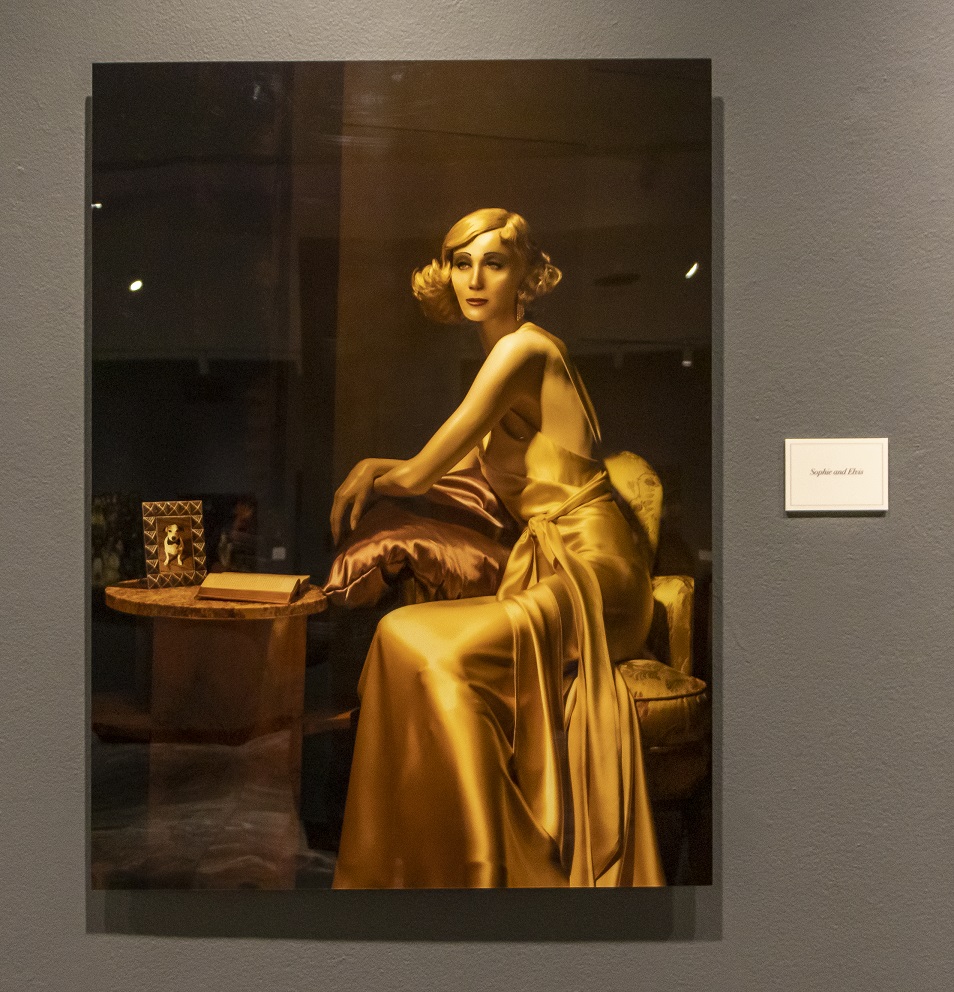
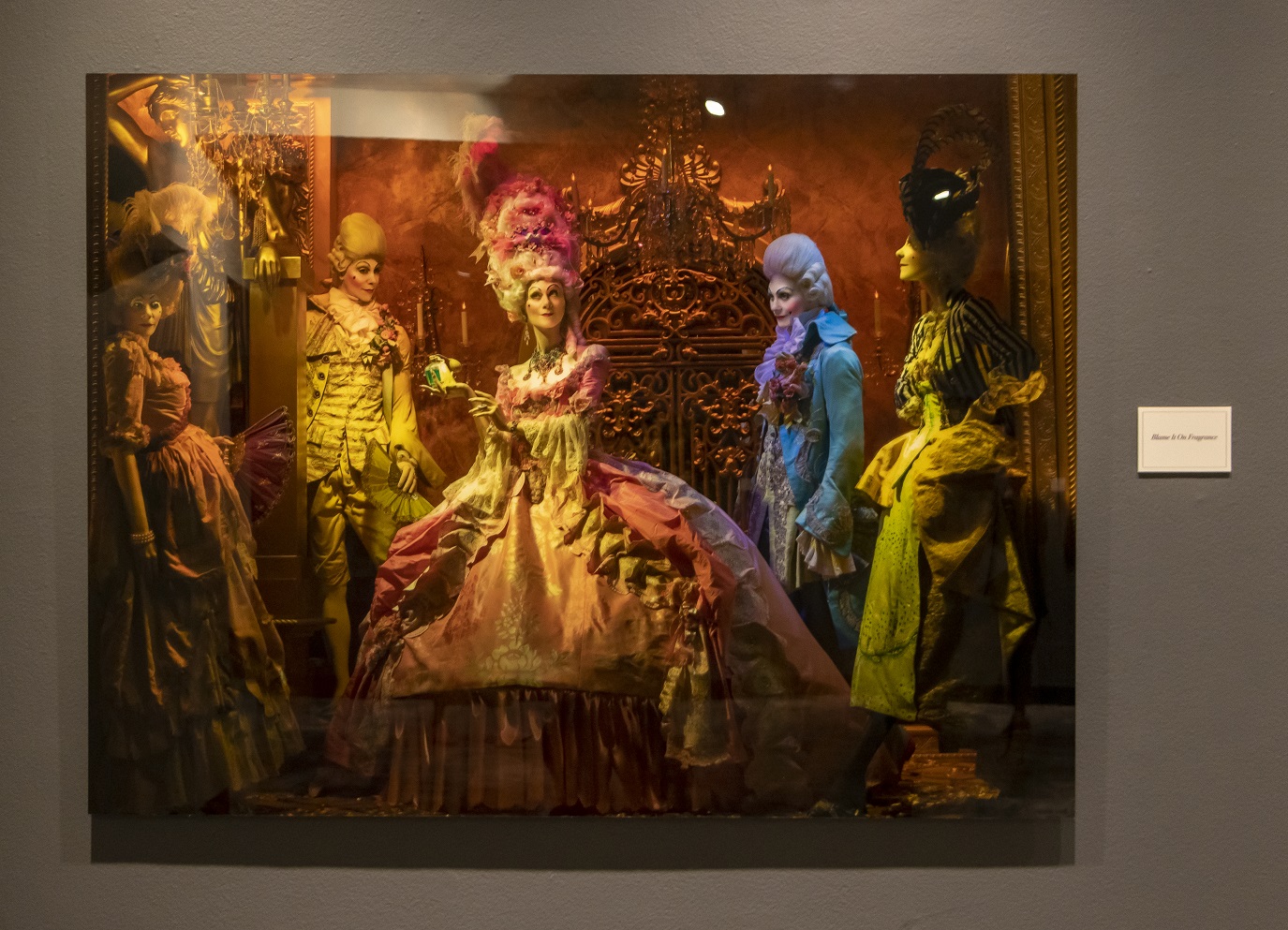
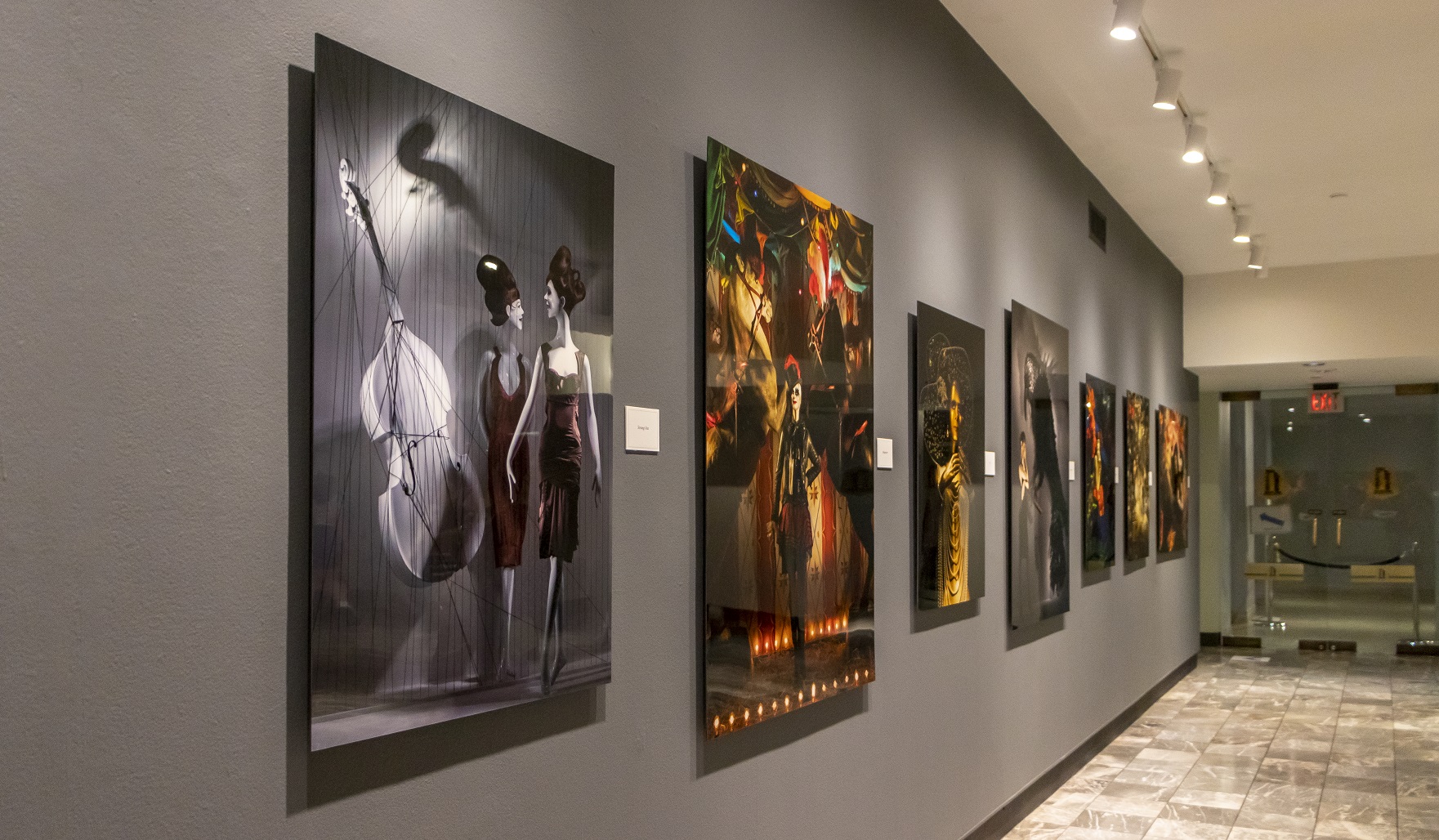
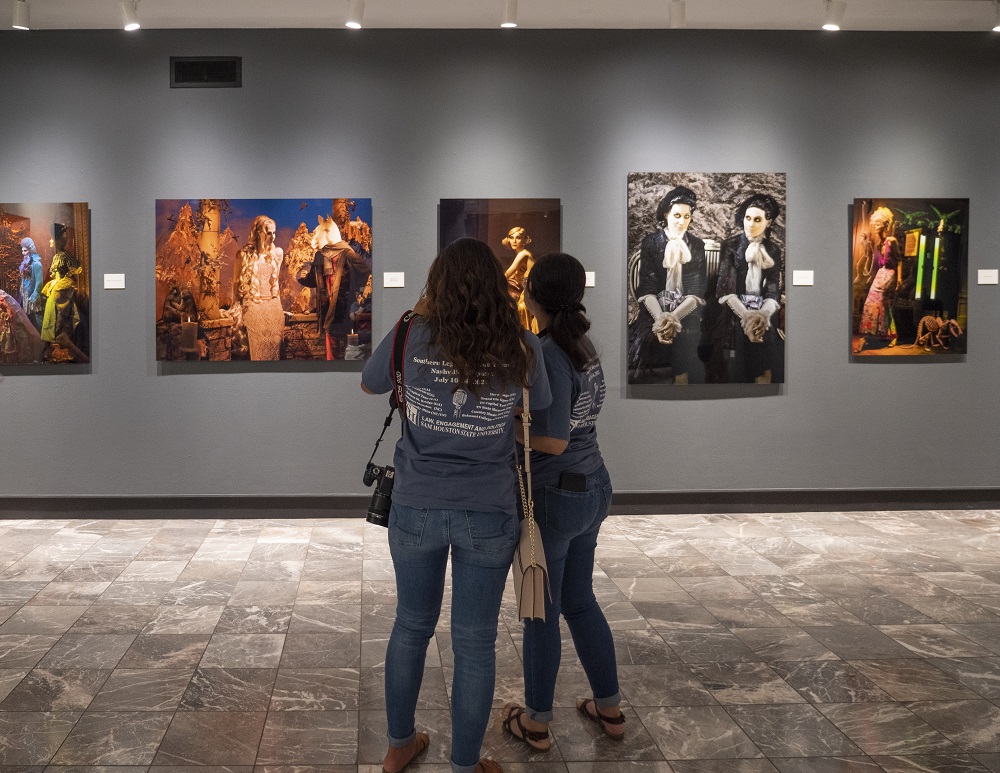
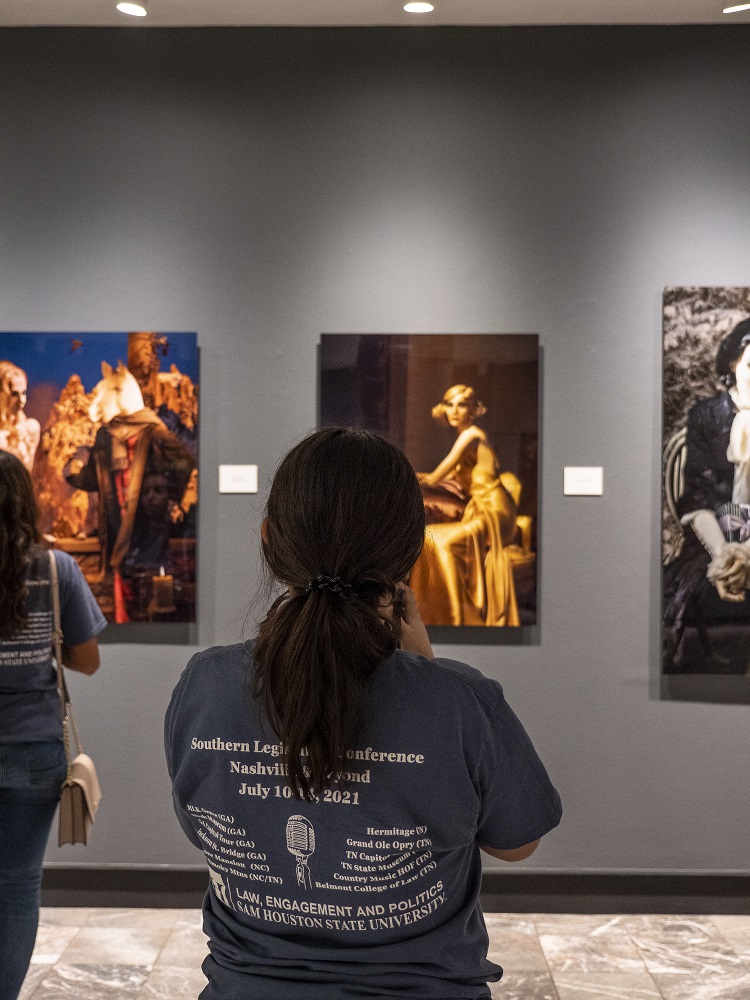
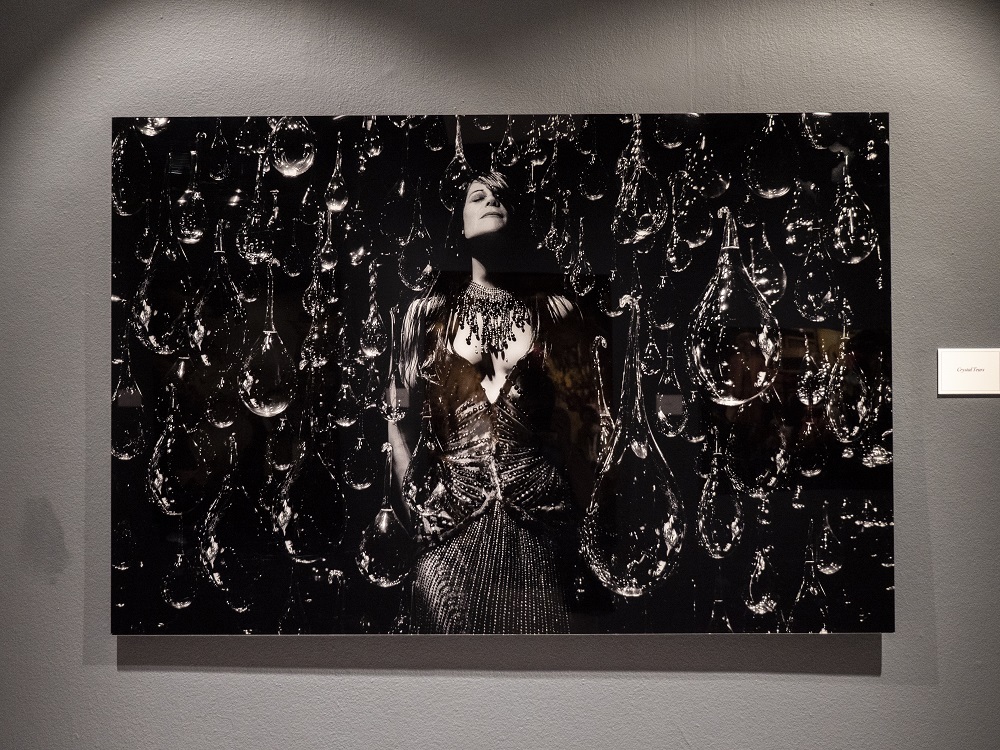
Another interesting feature that I was not expecting was the art museum on the lower floor of the Parthenon. In one of the rooms was an exhibit for artist Lynn Goldsmith whose interesting photography art is printed on metal, with each photo containing up to fifty exposures.
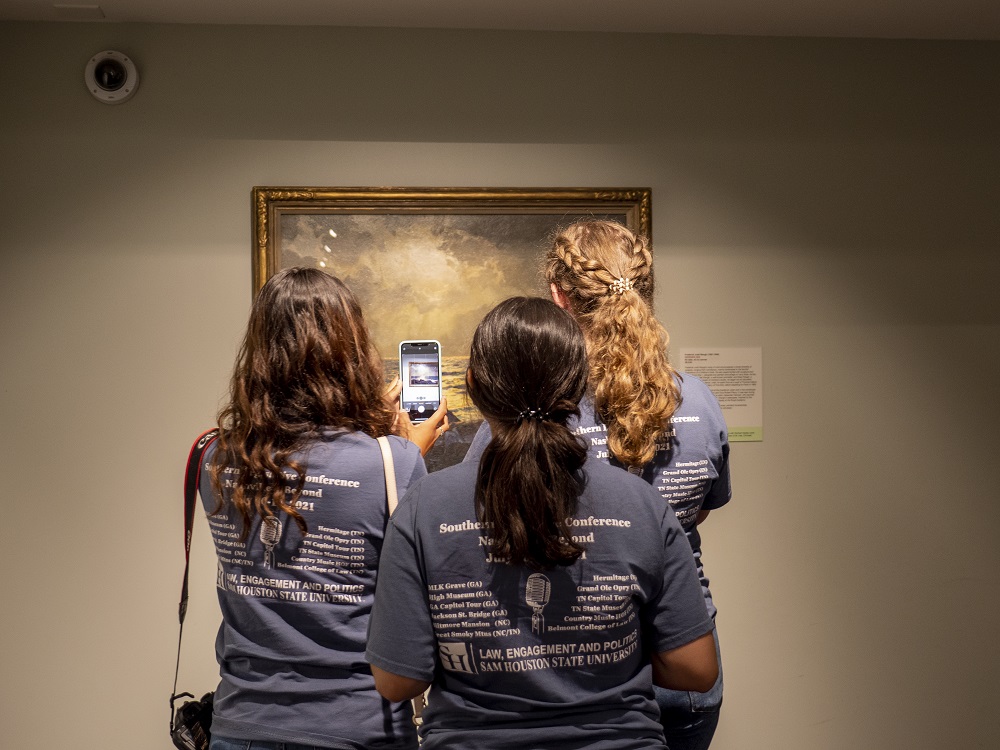
The second space was James M. Cowan’s personal collection of American art, including pieces from Durham, Moran, and Bierstadt, serving as a nice contrast to the first collection.
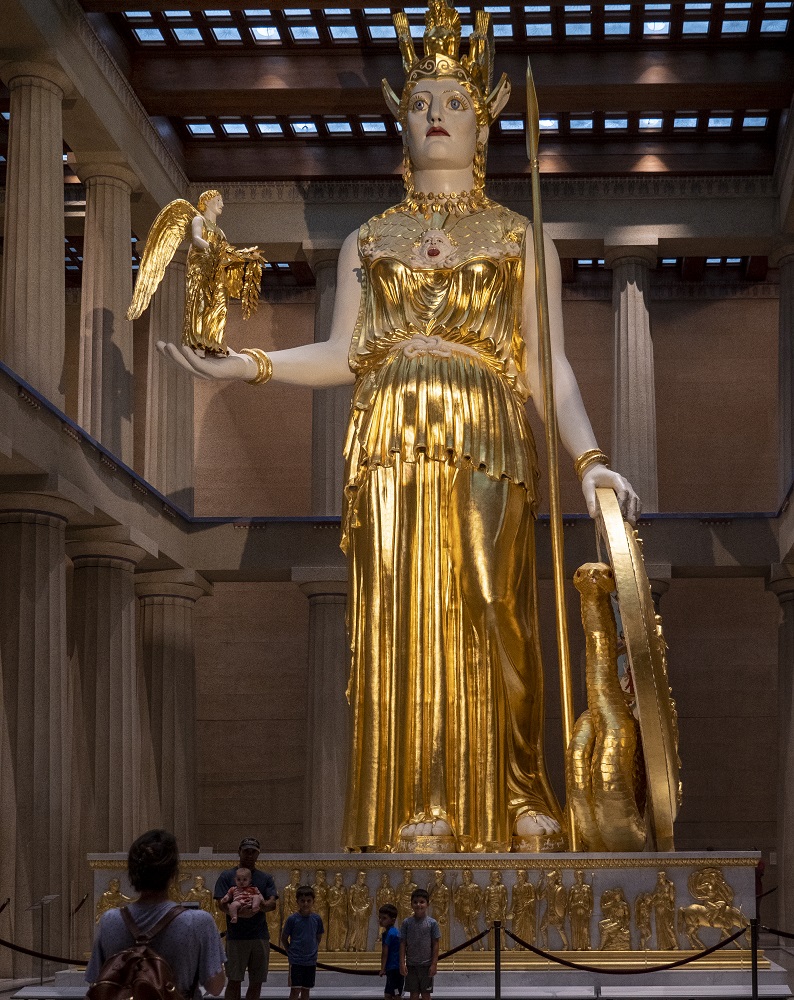
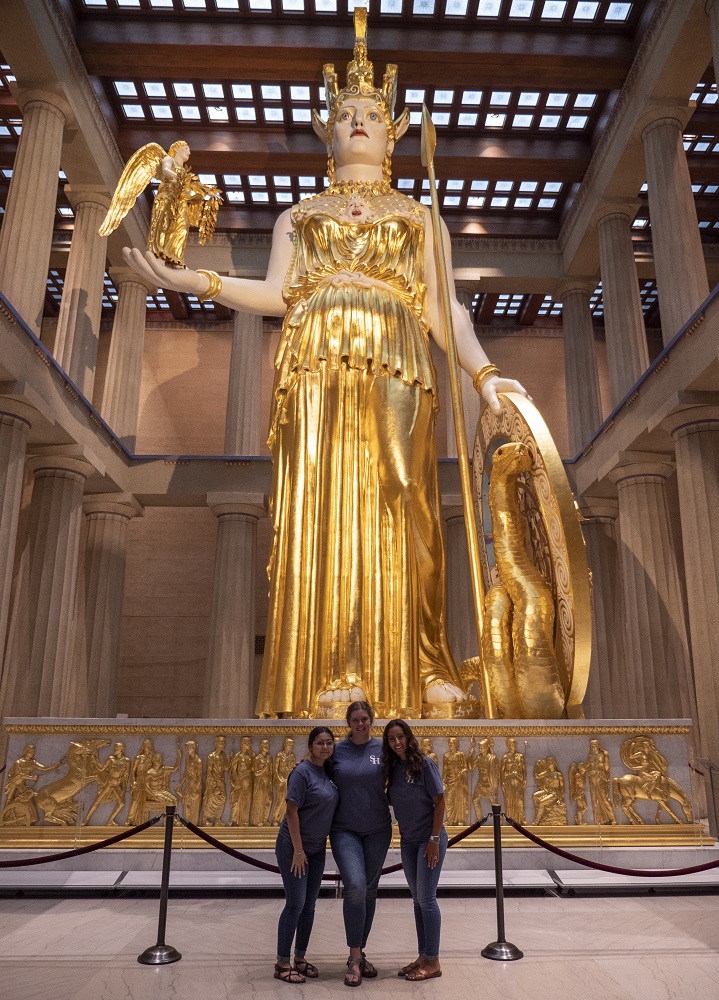
Keeping with the Greek style and culture, a 42-foot-tall statue of the Goddess Athena resides in the central room of the Parthenon. Standing tall as the Goddess of Wisdom, Athena holds the god Nike in her right hand with a shield and a snake to her left. When entering the central room of the Parthenon, the goddess is visible between the massive Doric columns, with her gold dress and accessories appearing as though they are glowing.
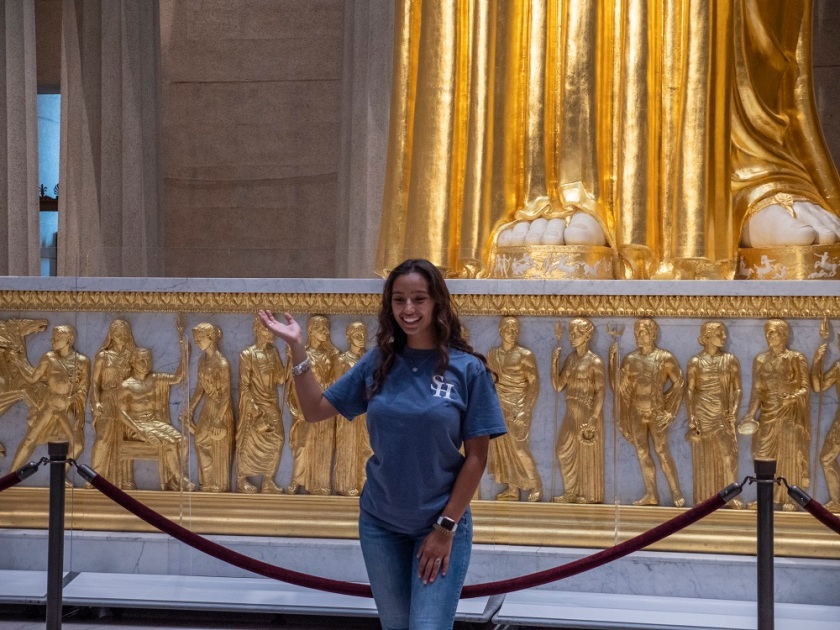
Surprisingly, we found the Parthenon to be a popular picture spot for tourists and natives. There were two Quinceañera parties, a baseball team, and even a wedding set up for pictures. We of course joined the trend and posed for several pictures inside and outside of the Parthenon before heading back to await for what would come next.
Opening Night at the Country Music Hall of Fame and Museum
Jessica Cuevas
It is the opening night of the Southern Legislative Conference in Nashville, Tennessee. The LEAP Ambassadors were curious to know what to expect at the Country Music Hall of Fame and Museum as they walked to join the line for the trolley across the street. We congregated with the other attendees and waited for our turn to board the trolley. We met two friendly lobbyists from New York, Jonathan and Monisha, and a policy analyst from Ohio who each talked to us about what they do, how they got to their positions, and future advice for young professionals. Our conversations carried on into the short trolley ride on our way to the Country Music Hall of Fame and Museum. It was refreshing to meet people so passionate about their work, and who are living what we are actively learning.
Once we arrived we were given the option to go up to the sixth floor for food or start off at the museum on the third floor. We listened to our stomachs, which drove us to the sixth floor to be greeted by live music and lots of people.
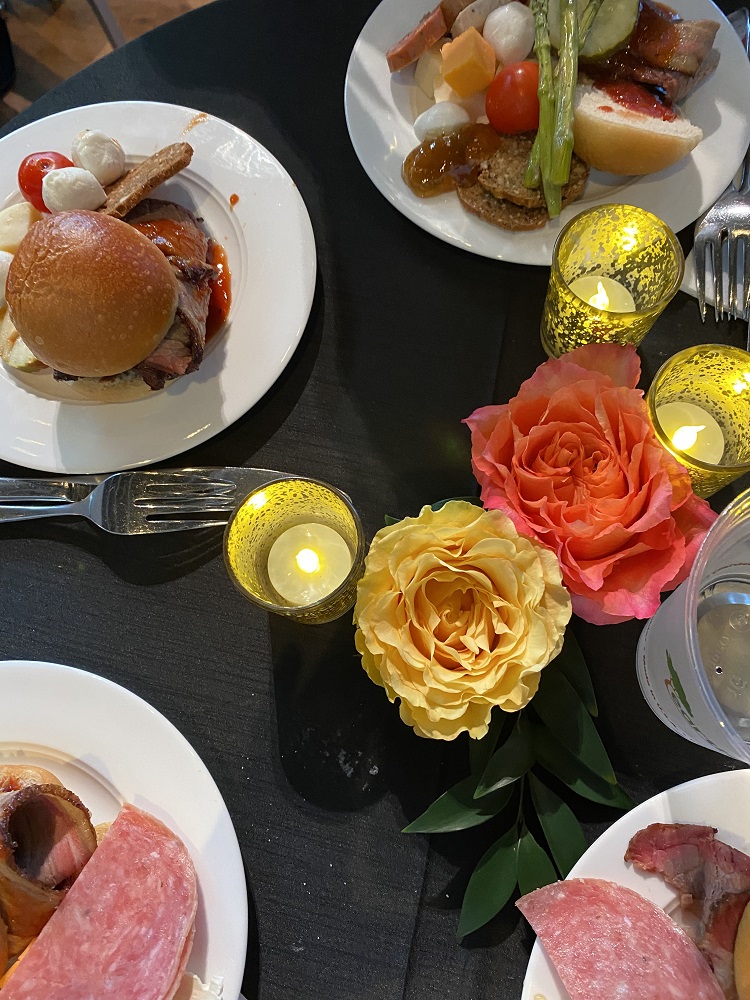
The LEAP Ambassadors were able to meet and converse with a Tennessee Senator before making our way to the colorful assortment of a Charcuterie board with different cheese, bread, cold meats, and vegetables.
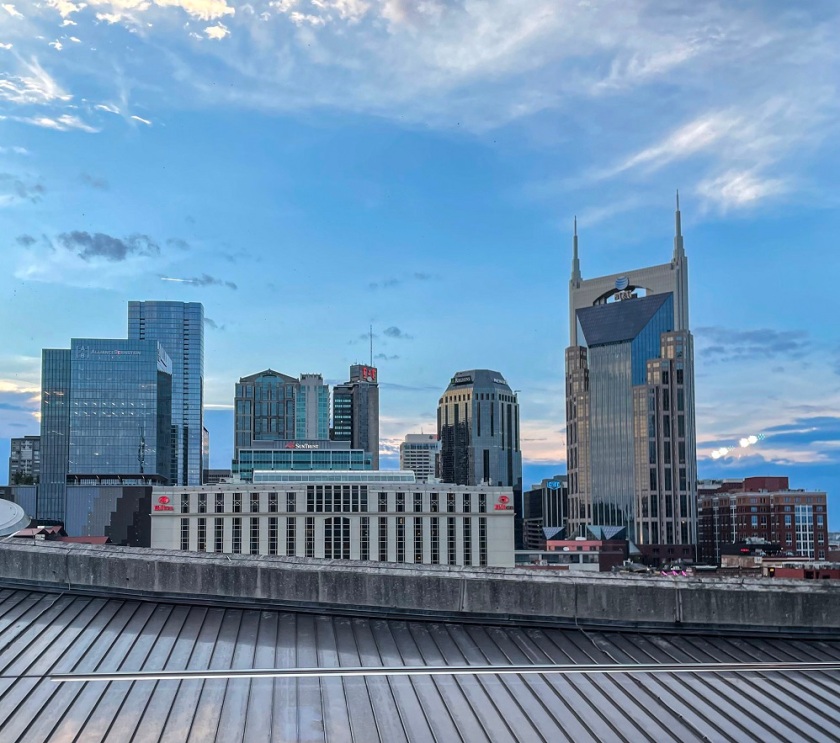
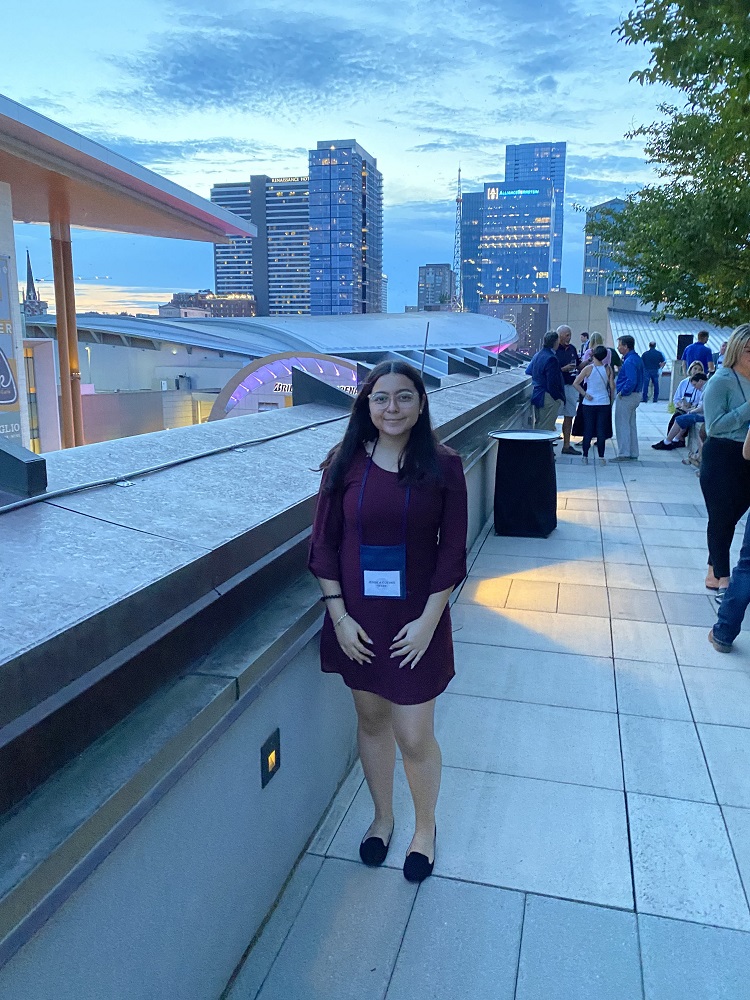
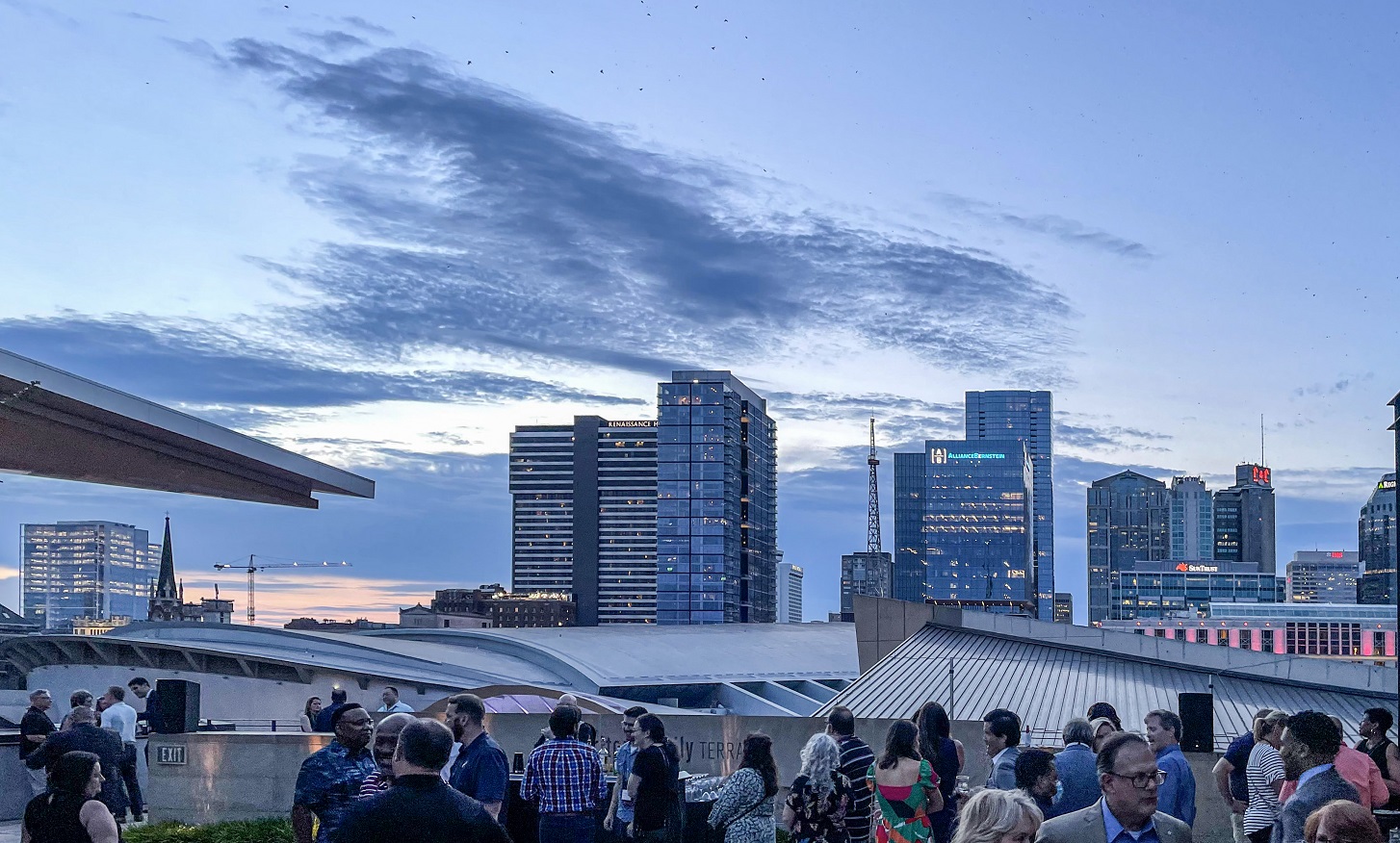
There was a beautiful view of downtown Nashville…
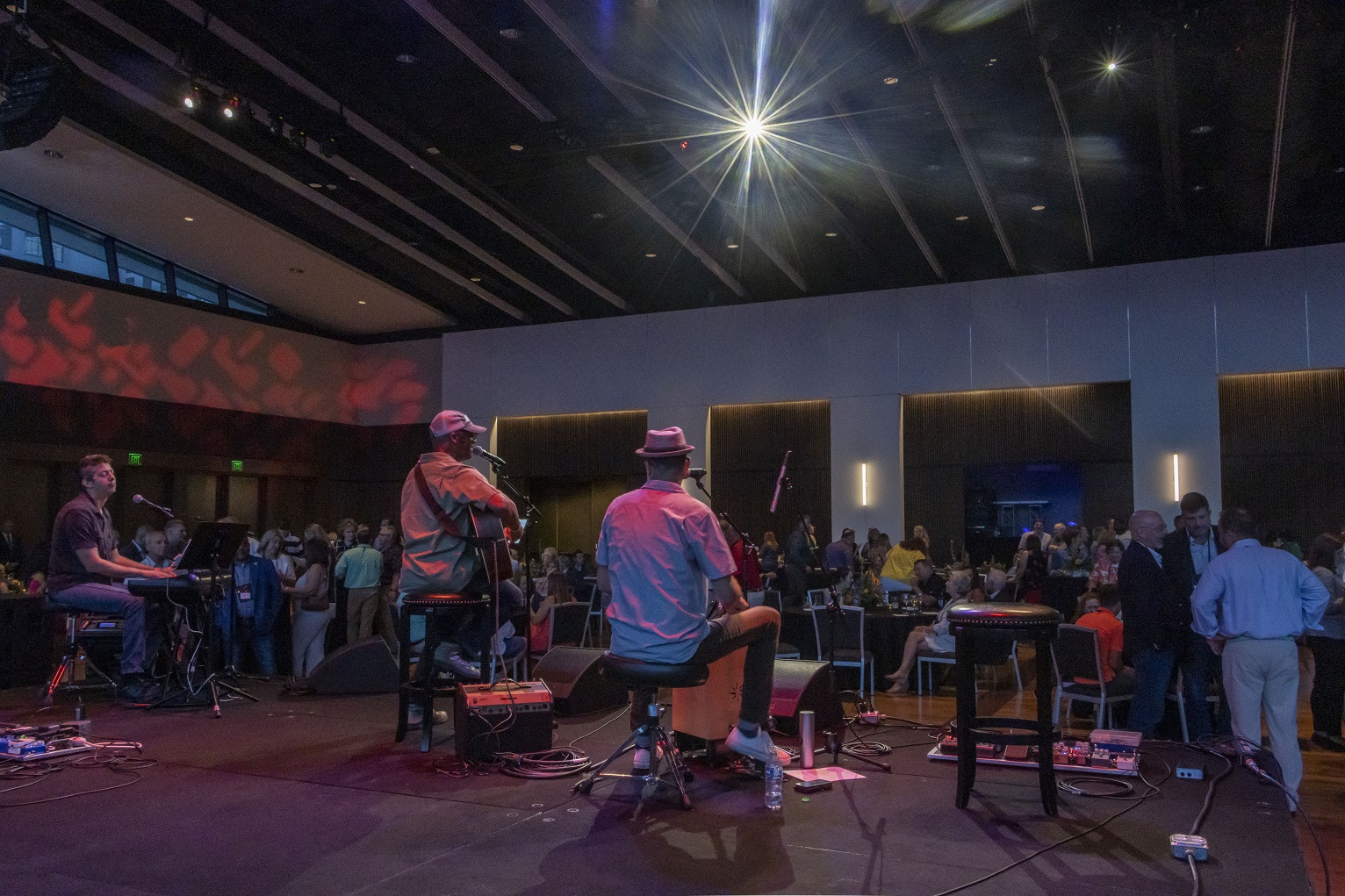
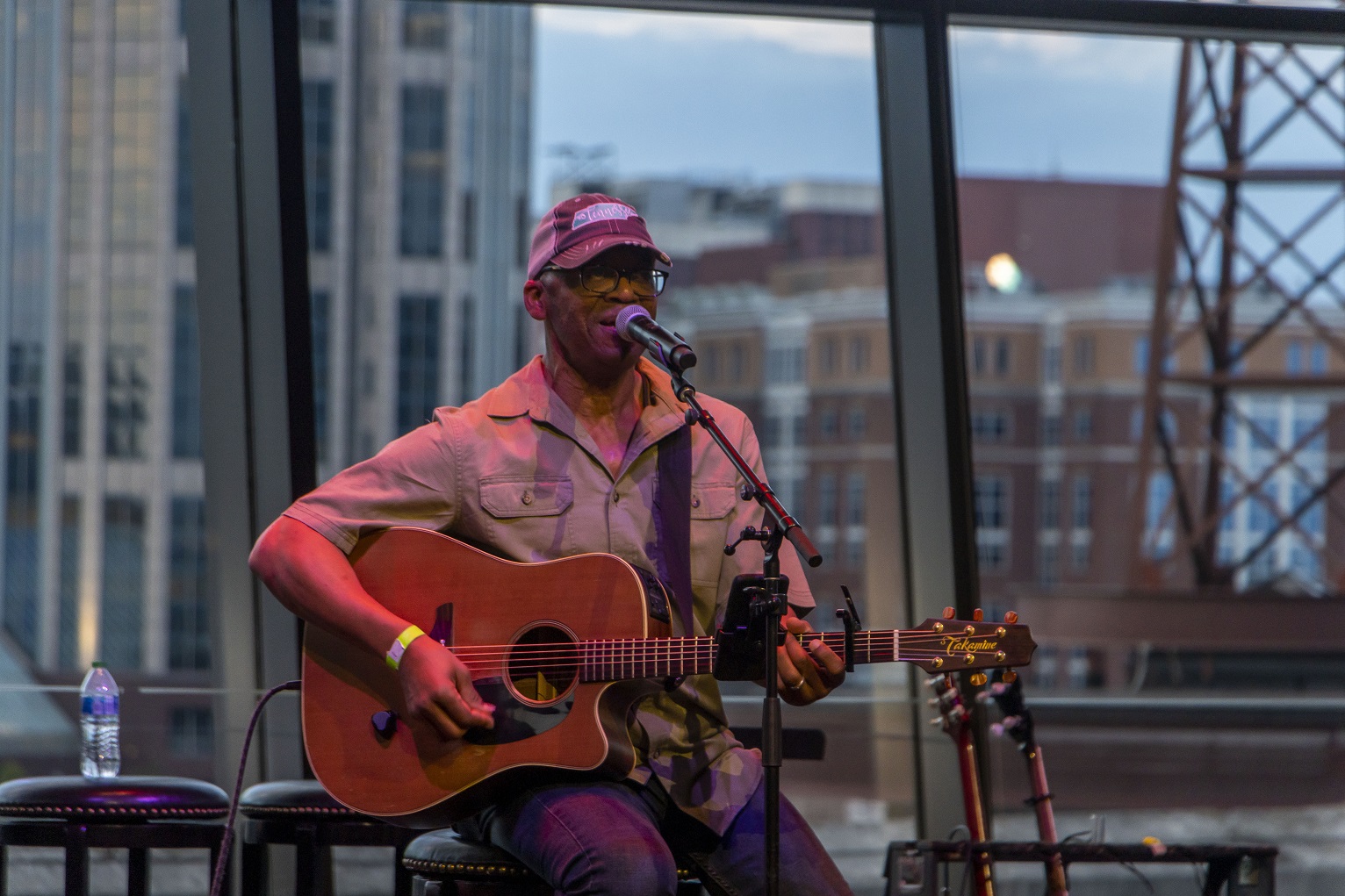
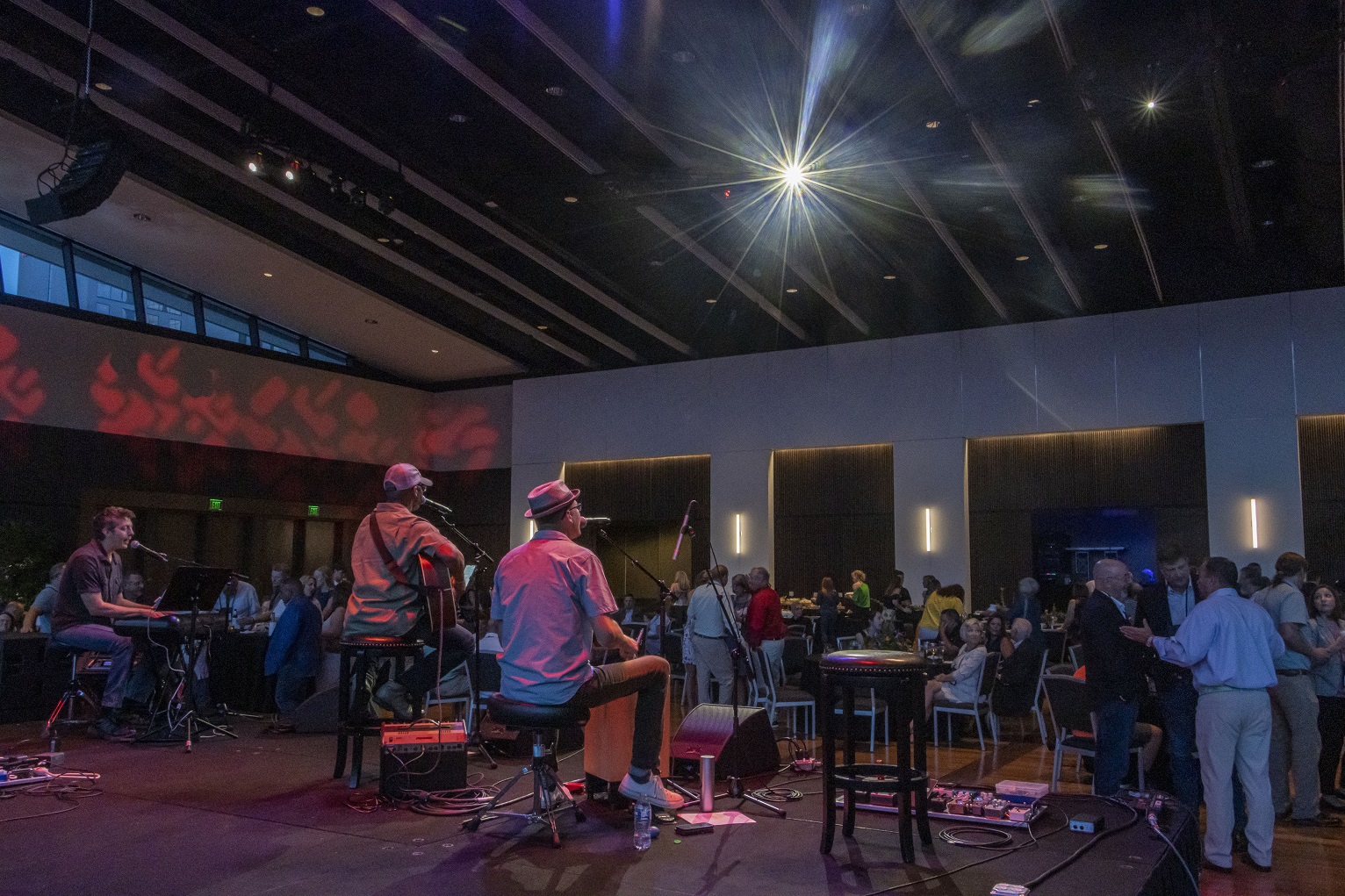
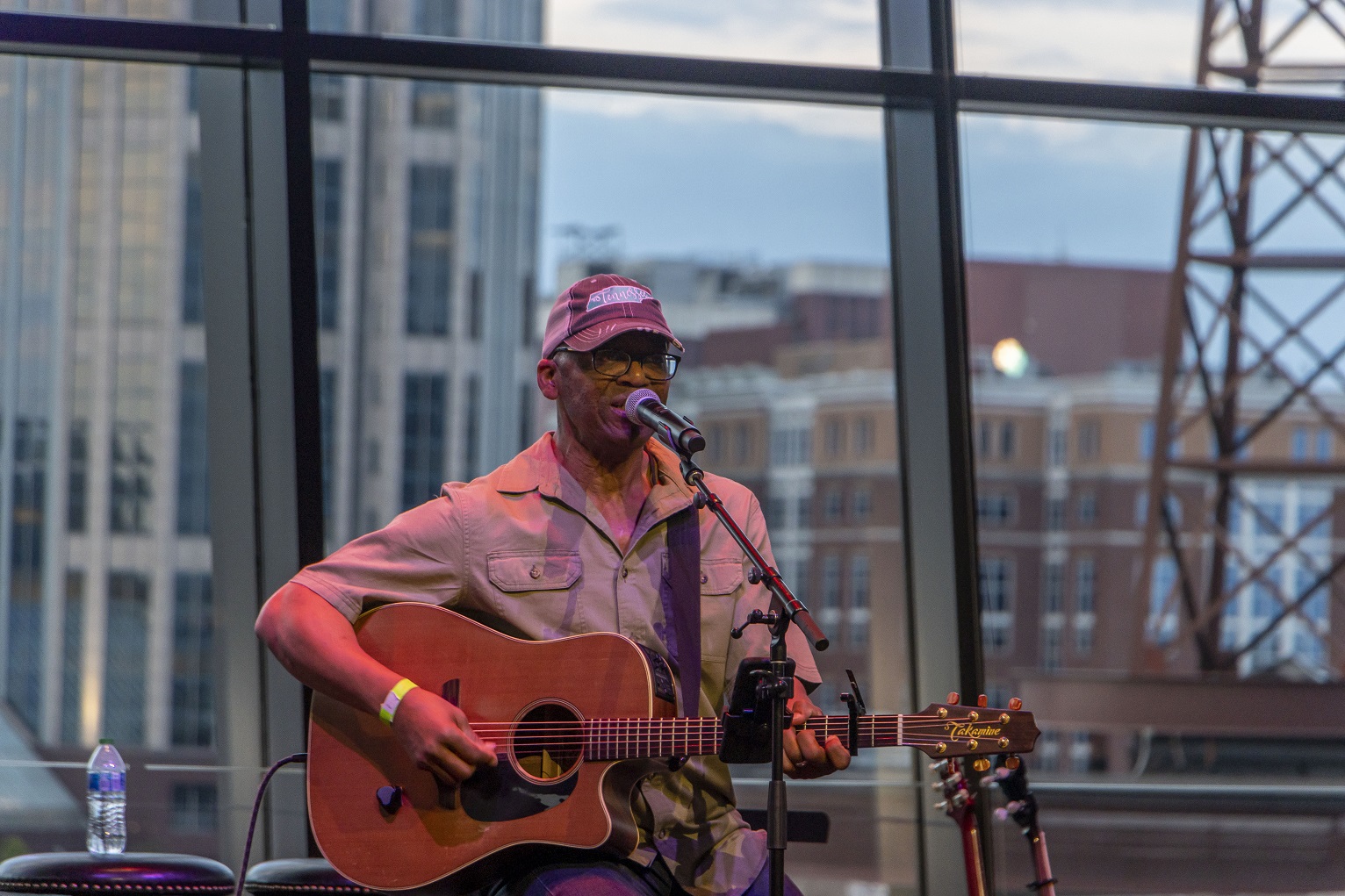
…and a live band playing covers of artists such as Willie Nelson, The Beatles, The Nitty Gritty Dirt Band.
On the balcony, where families were playing Jenga, Corn Hole, and enjoying the nice weather, the view of the Nashville skyline was amazing.
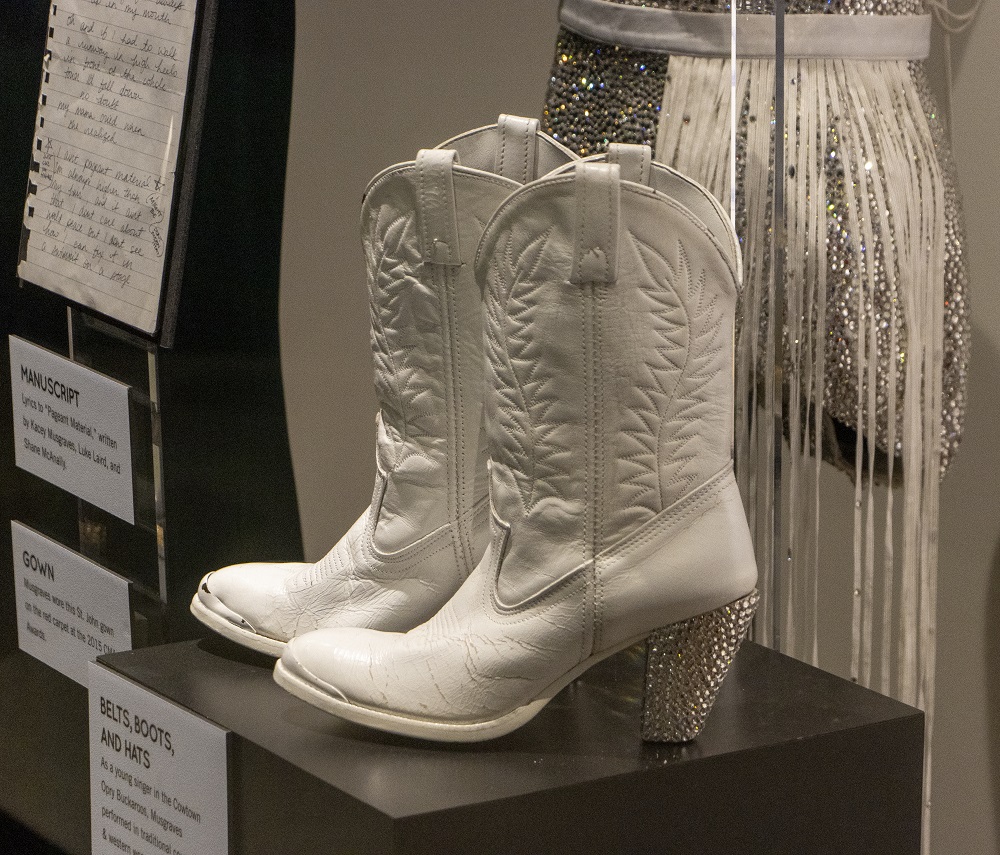
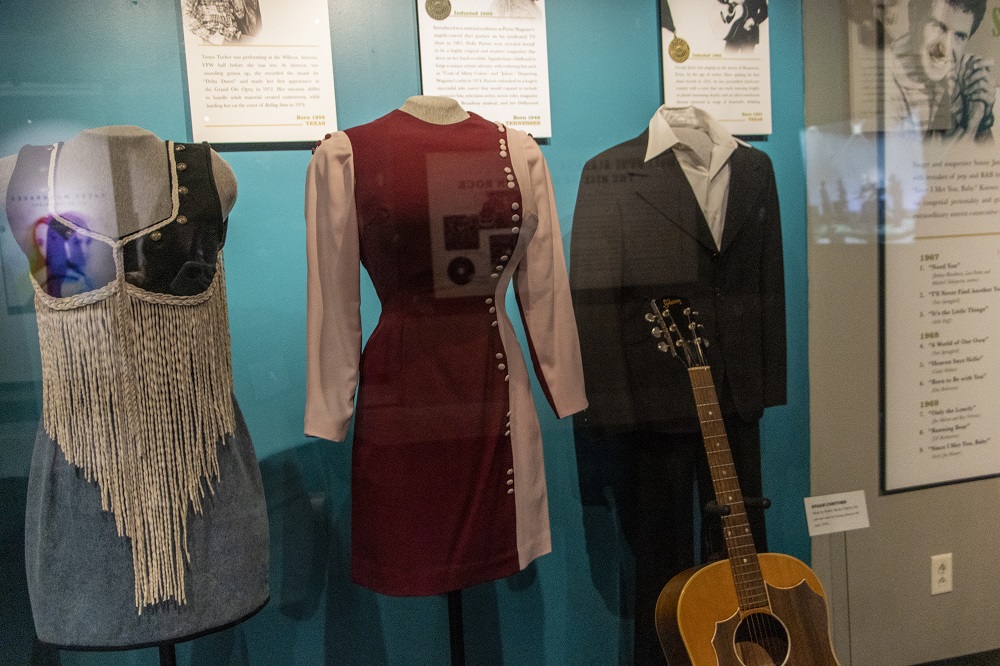
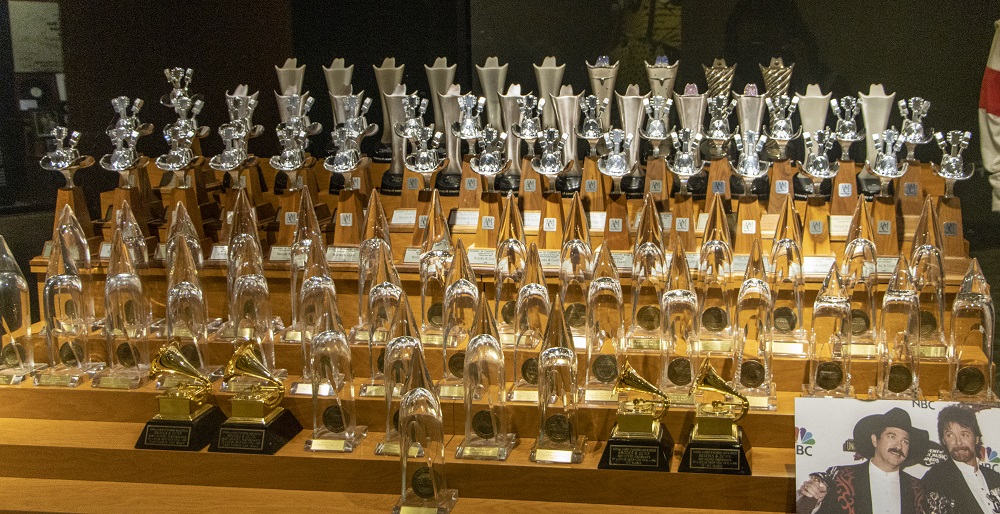
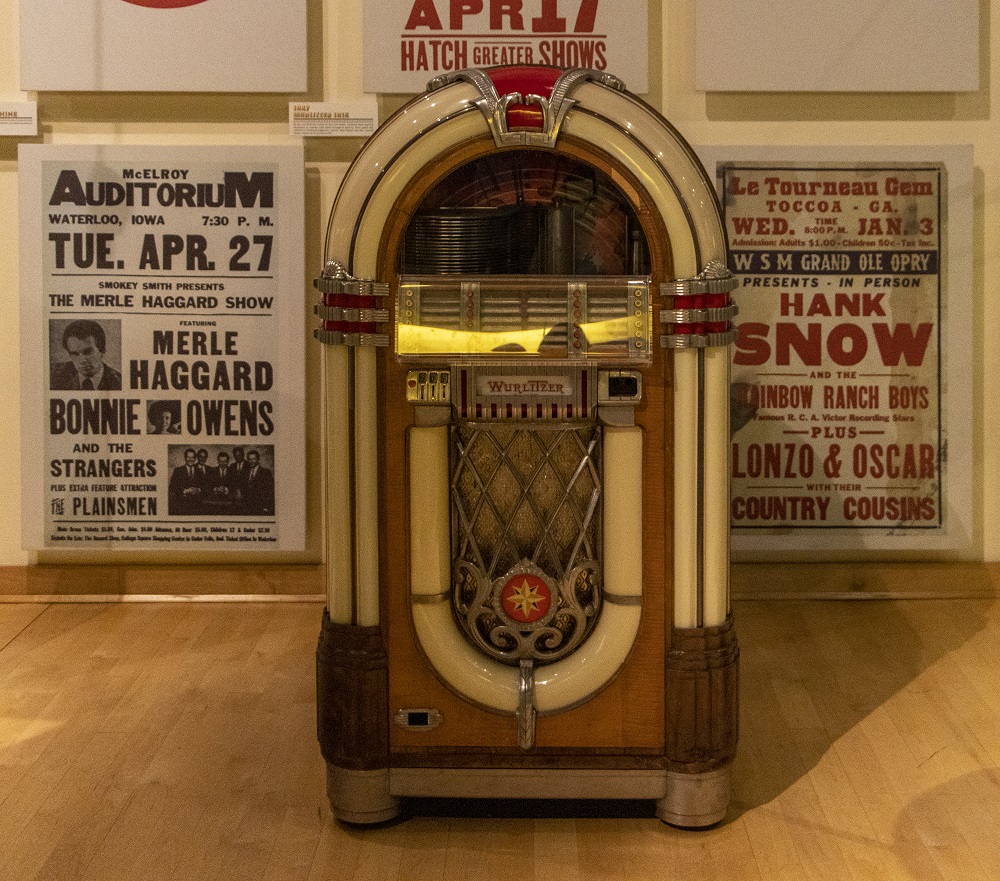
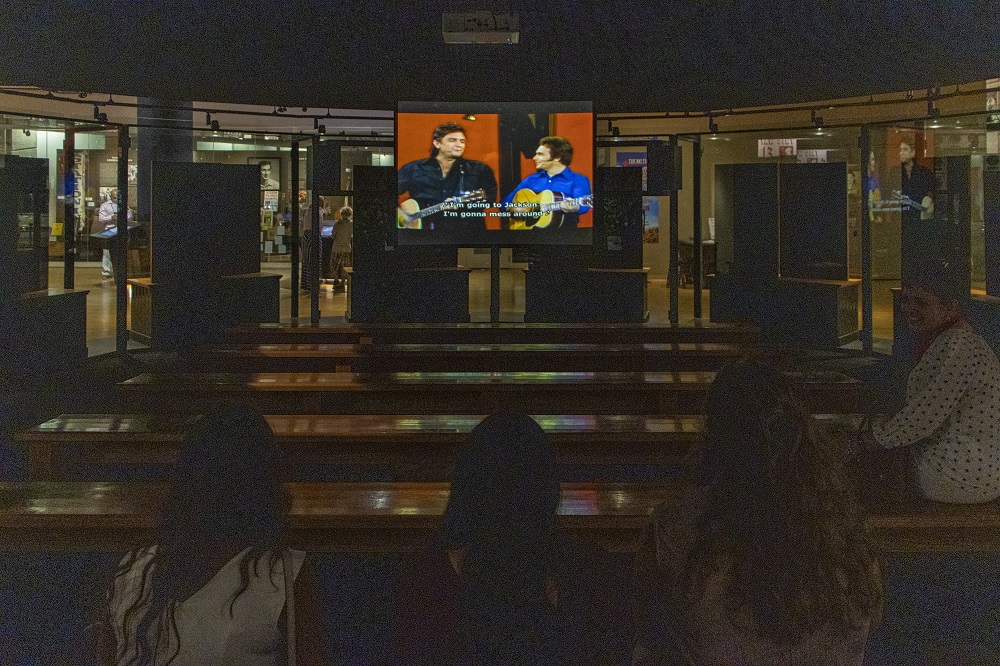
After dinner, we toured the museum, where there were artifacts such as their costumes and suits….
…cars, guitars, fiddles, drafts of written songs, even a whole wall dedicated to the golden records of many of the singers .
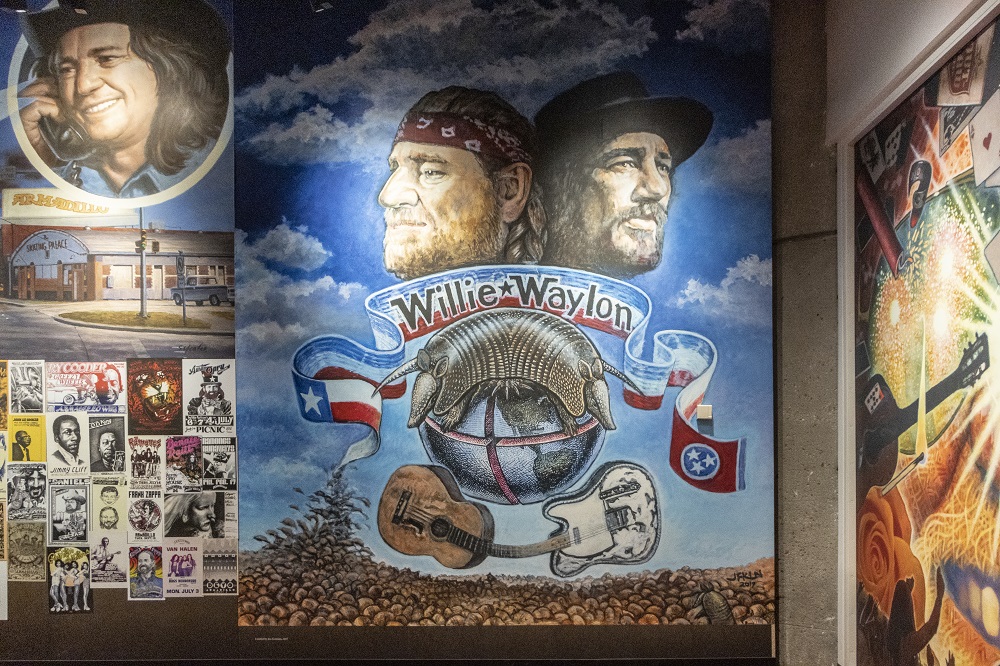
Many of these artifacts were associated with famous acts such as Johnny Cash, Elvis Presley, Dolly Parton (whose statue we saw the night before), and Willie Nelson.
Our night ended with a trolley ride back to the hotel taking in the view of the city after dark. The trolley ride should have been a 4-minute drive back to the hotel, the half mile drive seemed to take twice that time if not longer due to traffic and nightlife. The glowing city was buzzing and alive, as we were full and amazed by the opening night of the conference.













































 Center for Law, Engagement, and Politics