A Wintery (Art) Mix in Philadelphia

Exploring the Art in the City of Philadelphia

by Saara Maknojia

With a full day in Philadelphia ahead of us, LEAP students ventured into town this morning to explore the beautiful public art around the city. Our first stop, of course, had to begin with Philadelphia City Hall, the largest in the nation! Afterall, this eye-catching building is grounded in one of the most historical states. The building itself is noticeable from many miles away, with a statue of William Penn, founder of Pennsylvania. The statue, sculpted by Alexander Milne Calder (Not to be confused with contemporary abstract artist Alexander “Sandy” Calder), brings not only the state’s historical aspect to the City Hall, but also connects other notable pieces of artwork to the artist.

Ambassadors in front of City Hall (and Oldenburg Sculpture)

Just a short stroll down Logan Square, we encountered Three Discs, One Lacking by Sandy Calder, grandson of Milne. Further down the Benjamin Franklin Parkway, the Calder legacy continues with the Swann Memorial Fountain, which was created by Alexander Stirling Calder, the father of Sandy Calder. These pieces not only highlight the artistic legacy of the Calder family but also illustrate how thoughtful city planning can weave art into the very fabric of a community. The alignment of these sculptures offered us a unique opportunity to reflect on how art connects generations and transforms public spaces.

Alexander Calder, “Three Discs, One Lacking,” Association for Public Art

As we continued exploring Logan Square, a lovely red caught the eye of many. Surely enough, we were met with yet another LOVE sculpture by Robert Indiana!

“LOVE,” by Robert Indiana

By the end of the day, we’d spotted three of Indiana’s works, including the AMOR sculpture, which added a multilingual flair to the city’s celebration of brotherly love.

“Amor,” by Robert Indiana

One artist that I was unfamiliar of during this tour was Zenos Frudakis. His sculpture Freedom, however, quickly became my favorite. The theatrical movement of the statues and the intricate details within each sculpture made every piece a part of a larger narrative, expressing an individual’s desire to abandon a life of comfort in pursuit of freedom.

“Freedom,” by Zenos Frudakis

We also encountered a mural by Richard Haas, another artist familiar to LEAP students. Keeping his famous trompe l’oeil style, the piece depicted Benjamin Franklin and William Penn and spans an entire wall to capture the essence of Philadelphia’s historical and cultural heritage.

Richard Haas Mural, 2300 Chestnut

Haas even drew inspiration from the Benjamin Franklin Statue by John Boyle, located on the University of Pennsylvania campus.

Philadelphia’s public art left us with a deeper appreciation for the city’s vibrant cultural identity. From the Calder family’s generational influence to the iconic works by Indiana, Frudakis, and Haas, each piece added a layer of history, creativity, and connection to our journey. By the end of the day, we realized that the city itself is a canvas, where every corner invites reflection and inspiration.

Lunch at Casa Mexico and South Philly Barbacoa

by Israel Gallegos

For our much-needed lunch break, we went to Casa Mexico and South Philly Barbacoa, a joint restaurant heading towards the southern part of Philadelphia. The restaurant’s head chef, Cristina Martinez, is a James Beard Award recipient for Best Chef in the Mid-Atlantic region in 2022. So, we took this as a great sign to cross this off our trip list!

We ordered an array of dishes to get the full Mexican experience with a twist of Philadelphian culture. Accompanying our dishes, the group ordered horchata and jamaica, which passed Cinthia’s freshness test, and the guacamole, which was excellent.

The course started with half a kilo of barbacoa for the group, followed by chiles rellenos, a staple Mexican dish. The group also enjoyed enchiladas verdes. Personally, having tried enchiladas verdes many times, I can attest to the quality of the enchiladas at Casa Mexico.

To top off the main course, we had mole, which was my personal favorite as it tasted like home.

To end the meal, we of course had to indulge in our sweet craving and try both the tres leches cake and flan!

Somehow, we still found a bit of space in our stomachs, so we walked down the street in the freezing temperatures to get warm cups of coffee. The establishment, Rim Café, an Italian American café, was decorated as if they were collectors of timepieces depicting the true Italian American culture. Our Italian in the group, Olivia, was the judge, and she said the place reminded her of her uncle’s garage. I take that as the place doing a good job embodying a part of the culture.

Sticking to the classics, we ordered the original and chocolate cannoli (both of which were devoured in seconds).

Nevertheless, my favorite sight at Rim Café was an affogato that Saara got, it consisted of tiramisu gelato on the outside and hot espresso in the middle of it, providing a perfect mixture of hot and cold. Although I got the after-lunch dip, we kept moving to our next stop, the Barnes Foundation.

Experiencing the Philadelphia Barnes Collection

by Cinthia Villarreal

Dr. Barnes started his ambitious collection of art in 1912 and during four decades went on to collect what is now known as a highly regarded assemblage of art. With over 170 paintings of Renoir, and multiple works of Picasso, Van Gogh, Degas, Modigliani, and Seurat, we were all looking forward to visiting the Barnes Foundation in Philadelphia.

After a brief delay caused by an over-zealous security guard (take your jackets off!”). we entered the main room, and we could see the beautiful pieces decorating the four walls. Impressionism, characterized by short, broken brushstrokes and unmixed colors, is one of my favorite styles of art, so I was absolutely delighted as I saw Renoir’s name repeat itself throughout the walls.

As we moved through the exhibit, we started recognizing names from past museum visits, including Olivia’s favorite piece from Goya.
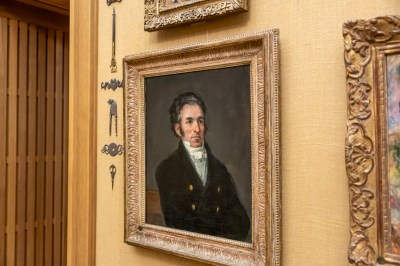
A unique feature of Barnes Foundation is that they do not use the common labels with the title and artist next to each of the pieces. Instead, they have brass plaques fixated with the artist’s name on each of the ornate frames.

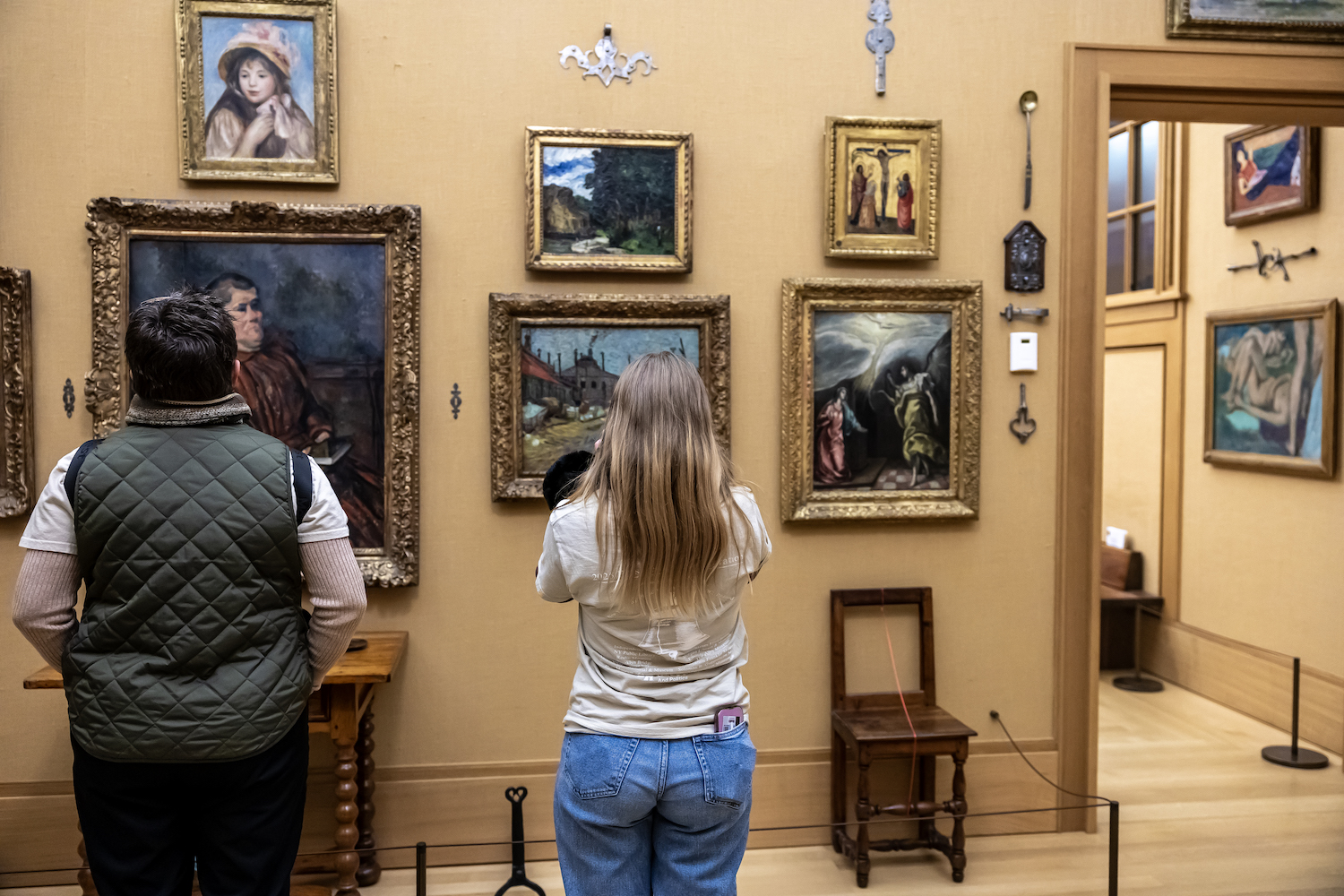
To assist those who would like to understand a piece further, the Foundation allows one to scan the paintings with a phone to learn more about the composition and history of the piece.

Isreal, who’s less exposed to the art scene, found a particular liking for the European art, as well as Michelle, who’s favorite was El Greco’s. 

In all, we greatly appreciate expanding our understanding of the humanities, especially when it highlights the contrast between where we started and how much we’ve grown. The Barnes Foundation in Philadelphia was a great end to our day, filled with experiencing the city and all that it has to offer!

New York Stories

Art in the Heart of New York

by Chrissy Biello

On day two in New York, we woke full of hope and to clear blue skies…

…albeit with a pronounced chill in the air.

Despite the cold, we were ready to explore the city on foot–not, perhaps, expecting to get in more than 30,000 steps while visiting four museums and two libraries!

With a busy schedule for the day, we hoped to experience all that was possible, including the Whitney Museum of American Art, The Metropolitan Museum of Art (The Met), Solomon R. Guggenheim Museum, and the Museum of Modern Art (MoMA). 

Although these museums host art from myriad genres and movements, we focused on three primary areas: American, European, and Modern/Contemporary, finding that this was more than enough to keep us busy over a long day while also expanding our knowledge of the arts.

American

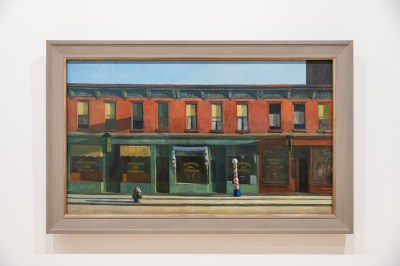
With us bringing different levels of knowledge about art to the trip, there was something for everyone to enjoy–and learn about–among the Museums’ many collections. Speaking for myself, I had many opportunities for learning, and my first such experience of the day involved coming across Early Sunday Morning, by Edward Hopper, at The Whitney.

The American collections had many great pieces, showcasing the depth and diversity of American art. Edward Hopper’s Early Sunday Morning (Whitney) drew me in…

“Early Sunday Morning,” by Edward Hopper

…which was perhaps appropriate, inasmuch as Hopper was born near New York, and he died in Manhattan, not far from where we were seeing his work. This particular piece, I learned, reflected his most commonly emphasized colors (red, yellow, blue, green), as well as the sense of loneliness and isolation that so often characterizes his art.

The museums also showcased Thomas Hart Benton, one of Professor Yawn’s favorite artists. His piece The Lord is my Shepherd (Whitney), Cotton Pickers (The Met), and America Today (The Met), highlighted the regionalist style, while also showcasing Benton’s sense of artistic rhythm.

The representation of African American artists was particularly moving, including Jacob Lawrence’s emotionally charged War Series, which captured collective anxiety…

…and Horace Pippin’s compelling Cabin in the Cotton (Whitney).

We should also mention a work of art in its own (W)right: The Guggenheim Museum. Although all of us appreciate Frank Lloyd Wright’s work none of us had been inside one of the last major architectural works of Wright’s story career, In addition to scoping out the art around the walls and alcoves, we also spent much time simply looking at the interior from various angles and perspectives. Beyond the many genres of art we had a chance to experience, we added to this list American architecture.

European

The European collections presented numerous memorable works. One of the day’s highlights was getting a selfie with Vincent van Gogh’s Self Portrait with a Straw Hat (The Met) and seeing a study of Georges Seurat’s magnificent A Sunday on La Grande Jatte (The Met). Other notable works included John Singer Sargent’s Wyndham Sisters (The Met) and Renoir’s Woman with Parakeet (Guggenheim). 

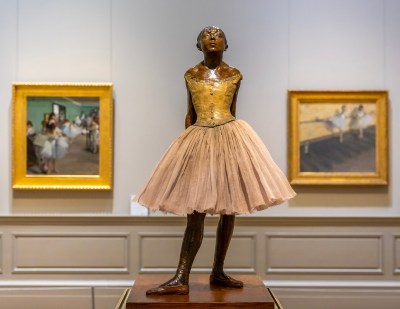
Moreover, I was particularly excited to see more pieces by Edgar Degas, especially after seeing a copy of his famous sculpture Little Dancer of Fourteen Years outside the Degas House in New Orleans. One that I was fond of is his Dancer Moving Forward (Guggenheim) sculpture. 

Modern

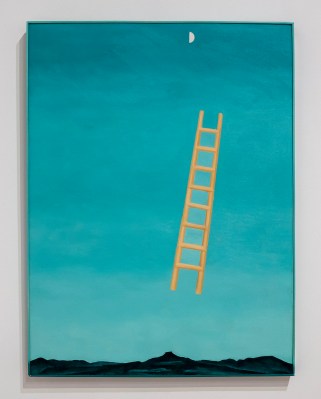
The modern collections sparked much reminiscence and contemplation. Georgia O’Keeffe’s Ladder to the Moon (Whitney) initially made our group think of Leandro Erlich’s Too Late for Help piece in the New Orleans Museum of Art Besthoff Sculpture Garden, and it was a different look than what we were used to seeing from Ms. O’Keeffe.

And, Keith Haring’s Untitled 1981 piece (Whitney) was enjoyed by everyone and left us thinking of his other known works. 

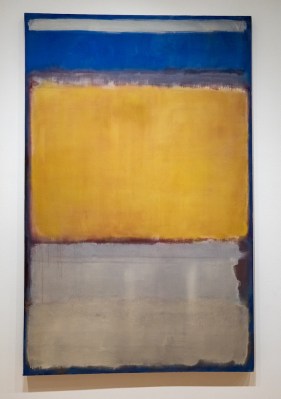
Further, we discovered interesting connections, like learning that Mark Rothko’s Number 10 (MoMA) was donated by Phillip Johnson, whose architectural work we had admired at University of Saint Thomas Cathedral in Houston, the PPG building in Pittsburgh, and the Water Gardens in Fort Worth!

Rene Magritte’s The Lovers (MoMA) particularly excited Olivia, while Salvador Dali’s The Persistence of Memory (MoMA) proved even more captivating in person than in reproductions. 

Jackson Pollock’s One: Number 31 (MoMA) captivated us with its scale and abstract expressionist techniques. And, seeing Vincent van Gogh’s Starry Night (MoMA) in person was a treat, a piece Olivia and I had long hoped to experience!

Seeing art from these diverse categories has helped structure my understanding. As I learn more about art, it becomes enjoyable to identify artists before reading the placards. I hope to develop this skill further, aspiring to reach the expertise level of Stephanie, Professor Yawn, and Olivia!

NY Stroll

Walking to four art museums allows for quite a lot of site-seeing, and we tried too make most of our journeys on foot. We began by hoping to photograph the Statue of Liberty, but we were foiled by New York’s never-ending construction. The Statue of Liberty was visible only by boat or through a window, and we only had time for the latter–definitely not the photo we hoped for.

As if to compensate, we had an unexpected photo opportunity, when we all witnessed what Olivia described as “the most New York thing I’ve ever seen”–a squirrel eating a bagel.

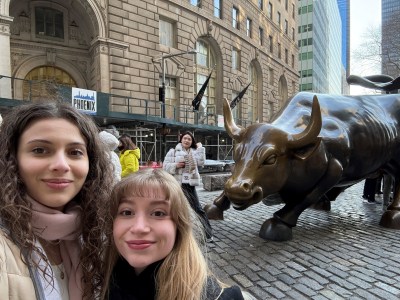
We also made our way past the “Charging Bull”, which judging by the sides of the crowds, was probably one of the most popular sites in NYC.

Nearby, we saw the statue of the defiant and vigilant girl, who keeps watch on the New York Stock Exchange.

Because this trip was designed for us to see the presidential inauguration, we also stopped by “Again”, the Federal Hall, to get another and better photo of the George Washington Statue. This significant site was witness to the first ever presidential inauguration and, later, to the writing of the Bill of Rights.

Probably the biggest treat for us was visiting the grand New York Public Library. We stopped for a selfie here, named after the two famous lions who stand guard to the front of the building.

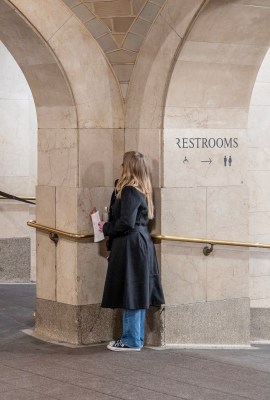
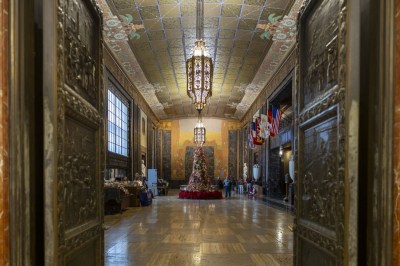
One of these lions is named Patience; one is named Fortitude. No one, it seems, knows which is which, and because they are identical, we’re not sure it matters. Inside the NY Public Library, we visited the periodical reading room, which features 13 murals by Richard Haas. After some negotiation with the paid staff, we were allowed to take a few pictures. Haas, of course, has done 15 murals in our adopted hometown of Huntsville, Texas. Interestingly, New York has the most interior murals of Richard Haas, while Huntsville has the most exterior murals of his in any city in the world. Not to brag, or anything. (Thank you Linda Pease.)

Of course, we had to stop into the nearby Grand Central Station, which we found to be beautiful.

Chrissy also found the “whispering wall,” where a vocalization on one corner will transmit to the other corner, with those in between none the wiser.

All of the above occurred fairly early in our 15 hour day. Our trip back to the hotel, however, was at the end of the day through Times Square, which Chrissy regarded as a special hell on Earth. Having walked more that 30,000 steps, Chrissy’s ankles were literally bleeding, and her misery quickly became ours.

In fairness, Times Square is a bit much, even by American standards. After spending the day reviewing the classics of art, it was a bit jarring to be amidst the gawkers, wannabe influencers, and loiterers. This, combined with the loud sounds and bright, multicolored lights, provided more than enough stimulation for everyone.

Amidst this chaos, we found Hope, literally. In 2008, Robert Indian transformed his classic LOVE sculpture into a HOPE sculpture, reflecting one of President Obama’s campaign messages. As Robert Indiana fans, we paused for a selfie, and in our head tallied up how many said large scale sculptures we have seen. Chrissy, 2; Olivia 4. And on this optimistic note, we wrapped up day two of our five-day democracy tour.

Hope Springs Eternal in Arkansas!

Saara Maknojia 

For the final stop of our Arkansas trip, we headed north to Hot Springs! We took in the stunning views from the Hot Springs Mountain Tower, enjoyed a quick tour, and refreshed our knowledge of the city’s rich history.

One of the city’s most notable landmarks is the Arlington Hotel, which has burned down twice and hosted historical figures like Babe Ruth, Al Capone, and President Ronald Reagan. The city is also home to historic bathhouses, as well as a variety of restaurants and shops. 

I was especially intrigued by the artifacts on display at the Mountain Tower, particularly an old Arlington Hotel menu from the early 1900s, where a sirloin steak cost an eye-popping five dollars!  But the views of the town and the Ozarks that were most inspiring.

Though we reached the top of the tower in under a minute via elevator, Professor Yawn challenged us to put our “hiking” skills to the test by walking down the 216-foot tower. To my surprise, I was the first to make it down the long flight of stairs—a satisfying redemption after my setback at Pinnacle Mountain! 

Fordyce Bathhouse

by Olivia Discon

After we conquered the Hot Springs Mountain Tower, Saara and I headed to the Fordyce Bathhouse Visitor Center and Museum, a time capsule to an age when people believed these hot springs could cure just about anything.

Built in 1915, the Fordyce Bathhouse was once the go-to spot for people looking to treat illnesses like arthritis, skin conditions, and as you could imagine, chronic stress. We talked about how long some of these people would stay—weeks, sometimes even months—soaking in the mineral waters, hoping for a miracle cure.

The Fordyce is part of Bathhouse Row–several historic bathhouses that line Hot Springs’ main street–but it was the first to close. Just two decades after the development of penicillin, bath houses were seen as obsolete, and in 1962, the Fordyce closed. Since that time, the National Park Service has taken great steps in renovating the houses and re-opening them to the public as museums.

As we walked through the museum, we got a sense of just how elevated of an experience this must have been. With stained glass ceilings and marble accents throughout, it was clear that the treatment prescribed grandeur and luxury.

After our tour, Saara and I explored some of the rooms, and we found the gym to be the most interesting.

It was filled with old equipment and gymnastic apparatus, There was no shortage of details in what a long term stay would require.

While these baths might not have been miracle cures, they certainly forced relaxation and offered an escape from everyday life!

What I found especially interesting was that the entire area, including Bathhouse Row, is now maintained by the National Park Service and, indeed, much of the downtown area falls into the Park System. Indeed, some of our most memorable scenes were in the downtown area.

We only had a day in Hot Springs and we didn’t actually soak in any springs, but we greatly enjoyed our time, and left with a sense of rejuvenation.

Milling about in Little Rock

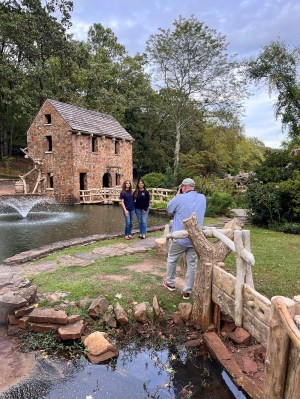
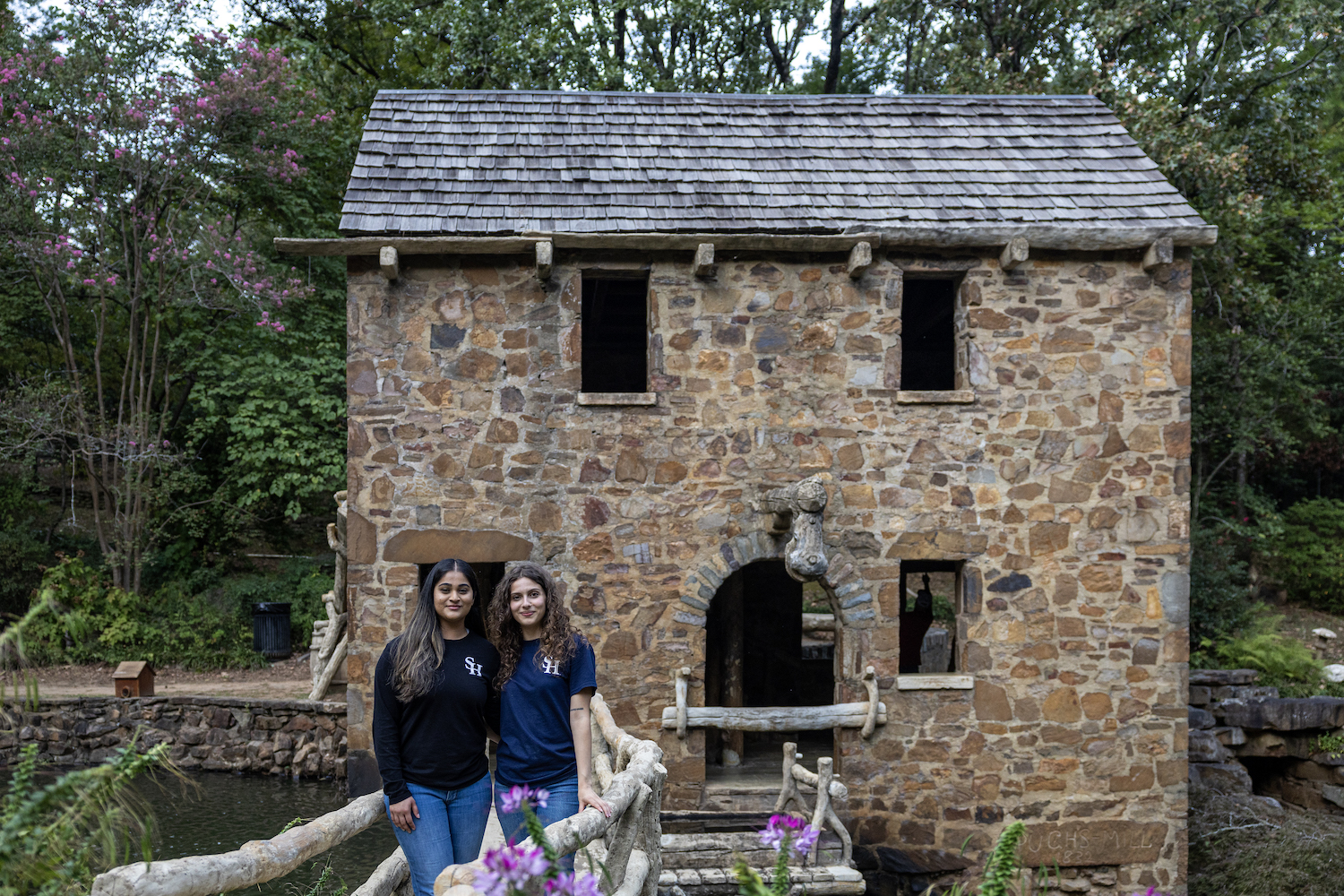
One of the pleasant things about Little Rock, AR is the mix of major museums and attractions and smaller, more intimate points of interest. Thus, after spending a few days attending a major book festival, visiting the Little Rock Central High Civil Rights Museum, and the Clinton Presidential Library, the LEAP Ambassadors prepared for a short respite at Old Mill Park in North Little Rock, AR.

The site is perhaps most famous as the last surviving set of Gone With the Wind (where it appears for approximately two seconds at the beginning of the film), but it is now a destination for any individuals or groups who want a beautiful place for photos.

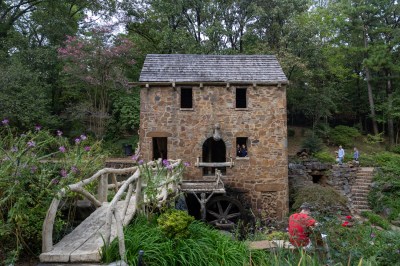
The park has several bridges…

…several water features…

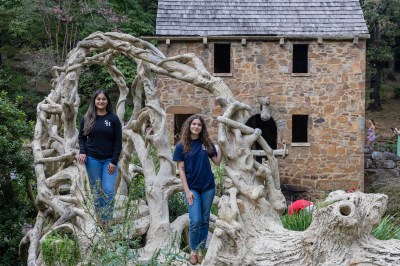
…an intriguing stone structure…

…and, of course, a mill, which is also a water feature.

For us, it was a pleasant way to spend an early evening, relaxing and enjoying the beauty of the Natural State.