It was a day to remember: we had already luxuriated in the extravagance of the Newport Mansions; enjoyed the sun, the wind, and the rush of parasailing. And still we had much to do. We wanted to spend a little time on the beach on Aquindeck Island, seeing wildlife and enjoying the coastal breeze; trying some of Rhode Island’s tastier dinner spots; and witnessing first-hand the famed installation art Waterfire.
Aquindeck Island
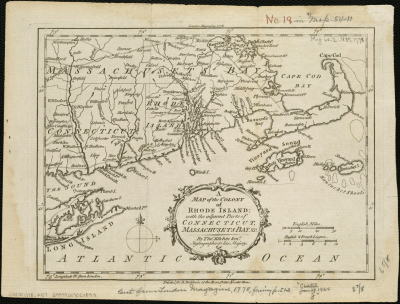
You might be forgiven if you think that Rhode Island is surrounded by water. That is, after all, the definition of an island. But the state of Rhode Island isn’t an island. Originally, Rhode Island consisted of settlements such as Newport and Portsmouth, which are, in fact, on an island, plus the territory on the mainland (Providence). This, then, is the Rhode Island in the State’s name, which was technically, “Rhode Island and the Providence Plantations.”
No one, however, used the full name of the island. Still, the State stuck with “Rhode Island and the Providence Plantations” for some 300 years, only changing its name officially in 2020.
Nonetheless, Rhode Islanders do have quick access to the shore; in fact, by our calculations, everyone in the state can get to the ocean or a bay in less than 35 minutes. It may not be an island, but it can fairly call itself “The Ocean State.”
Accordingly, as part of our Rhode Island explorations, we spent considerable time alternating between land and sea–and, as we noted in our prior blog, the air.
But we also wanted a closer, more tactile feel of the Rhode Island Coastline. So we drove along Ocean Drive, walking on the rocks; traipsing along the shore, where the wet waves tickled our feet; and overall gaining a different sensory perspective of Rhode Island.
We saw more evidence of the wealth that populates the coastline…
…and we observed and listened to some of the coastal wildlife.
It was, as the photos attest, a very different experience than the beaches with which we were familiar (e.g., Galveston).
All this touring, parasailing, beachcombing, and wildlife watching helped us build up a hunger, which made (most of) us think of seafood. To that end, we researched restaurants en route to our evening conference destination, and we found Track 15, a food court on the river.
Track 15
What kind of dining establishment, you ask, is named “Track 15?” In this case, it is a dining destination at the former Union Station (1898), which housed 14 separate railroad tracks. The food court, then, is an extension of a key transportation hub in Providence’s history, the 15th Track.
The 15th Track doubles as a “third place,” a place that brings people together while also allowing the past and present to intermingle. The restaurants are adjacent to Providence’s Waterplace Park, an urban park where the land and sea merge and people gather, coming together. Even the experience of dining is reimagined, bringing the past to the present: some of the eating establishments offer menus in the shape of arrival/departure boards of the old railroad stations; and the table tops on which we and others ate were made from wood recycled from the old rail cars.
True to Rhode Island’s proximity to the sea, we enjoyed an excellent (small) seafood platter (clams, mussels and shrimp), fish, and a lobster roll.
But we mixed it up a bit, and we also tried some pasta; true to the spirit of being in a former transportation hub, we also wanted some food more common to other places.
The food was excellent. The pasta was hand-rolled and featured subtle flavors that came together just right. The lobster was creamy and fluffy; the fish buttery and flaky; and the seafood platter a surprising variety of flavors: the clams were sweet and light; the mussels more tender and briny; and the oysters clean and less salty than one would imagine.
We also enjoyed the people watching. There is both indoor and outdoor seating, and the latter features games, versatile seating, and alcoves. People played cornhole; mothers danced and laughed with daughters; and others just relaxed and listened, delighting in the nice weather.
Following this enjoyable sensory experience, we ambled on to our next stop, Waterplace Park.
Waterfire
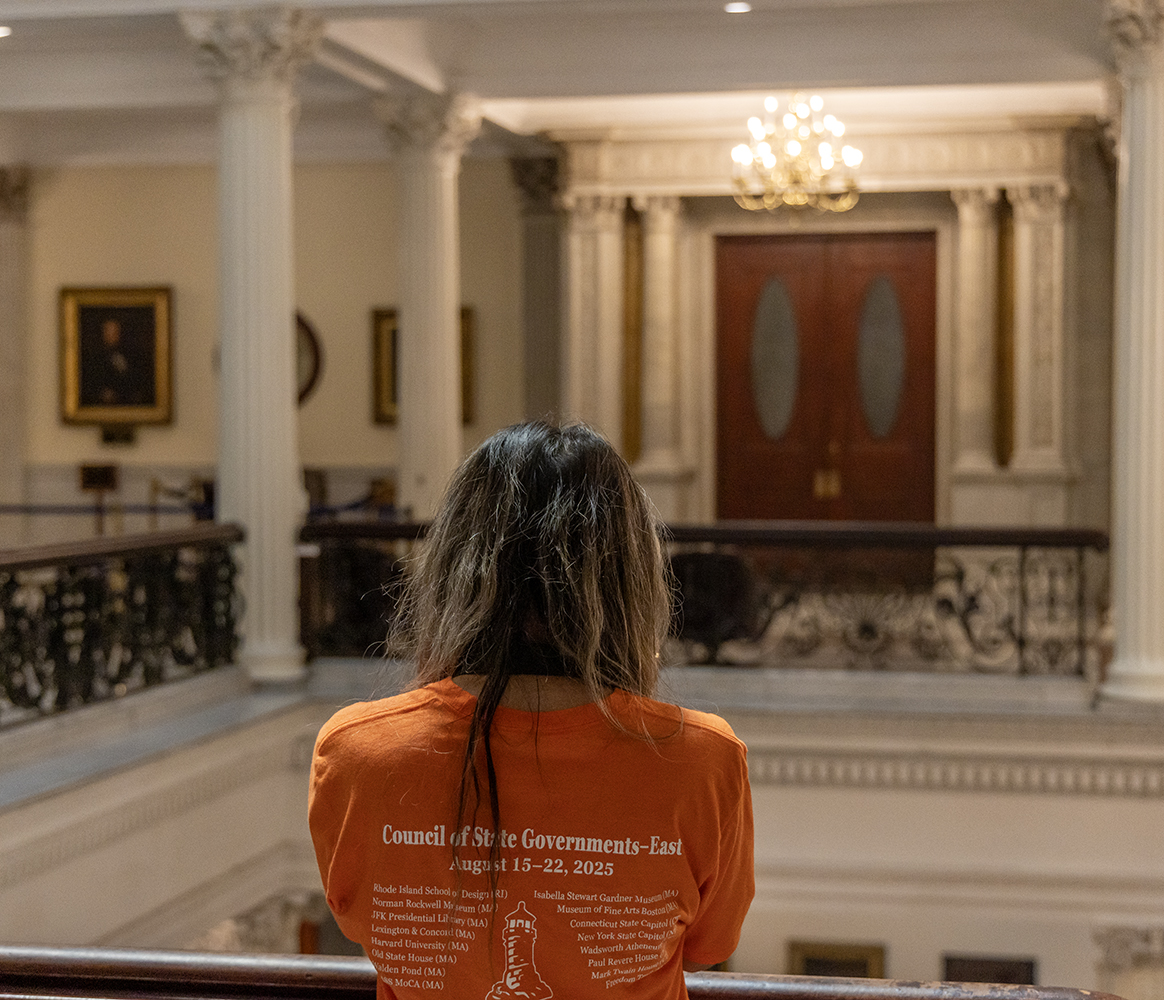
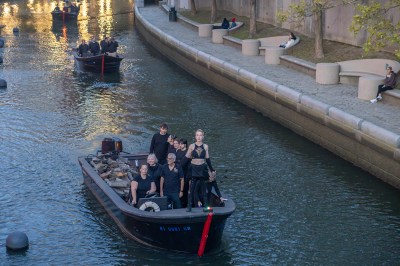
To end our day, we attended a reception in downtown Providence organized for us by the Council of State Governments and operated by WaterFire , a nonprofit dedicated to revitalizing city life through visual and performance art.
We set up stations and split into two groups to capture different photos and videos of the evening. Hundreds of people were in attendance, including legislators, conference participants, local residents, and passersby.
As the crowd filled the beautiful space, the event began with a ceremonial gong. An eclectic playlist emanated from speakers in the park. Myriad musical styles were represented: African, Latino, 60s Rock, Classical, Rap, and Alt-Contemporary. The music was selected consciously, offering a global scope to the ceremony, reflecting the goal of bringing people together.
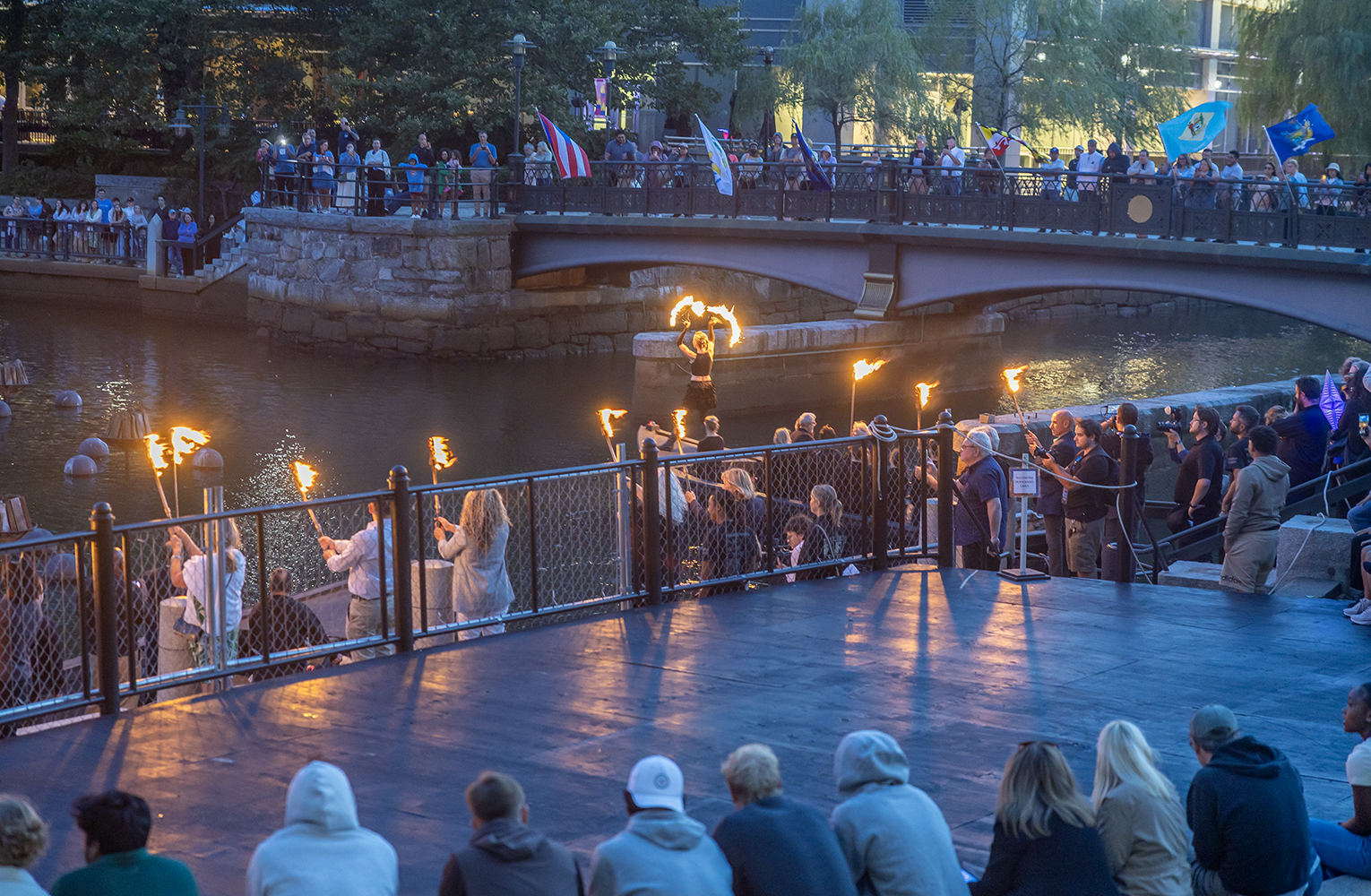
The installation sculpture incorporates the world’s four elements. humans sit on the earth surrounding the water. The Fire Dancer enters…
…while fire starters and fire tenders light logs on fire, and as the wind sweeps along the river, sparks fly in the air.
Conceived as performance art, the ceremony is multi-sensory: the sound of the music, the touch of the wind and the heat on the skin, the smell of the fire, and, of course, the visual spectacle of a fire coming forth from water.
The event was effective in stimulating our senses, while also playing with our expectations. What we all agreed on was that it was a thought-provoking and interesting event that brought strangers and friends together while highlighting the beauty of Providence, Rhode Island.
It was a sense-sational way to end a full day in Providence, Rhode Island.
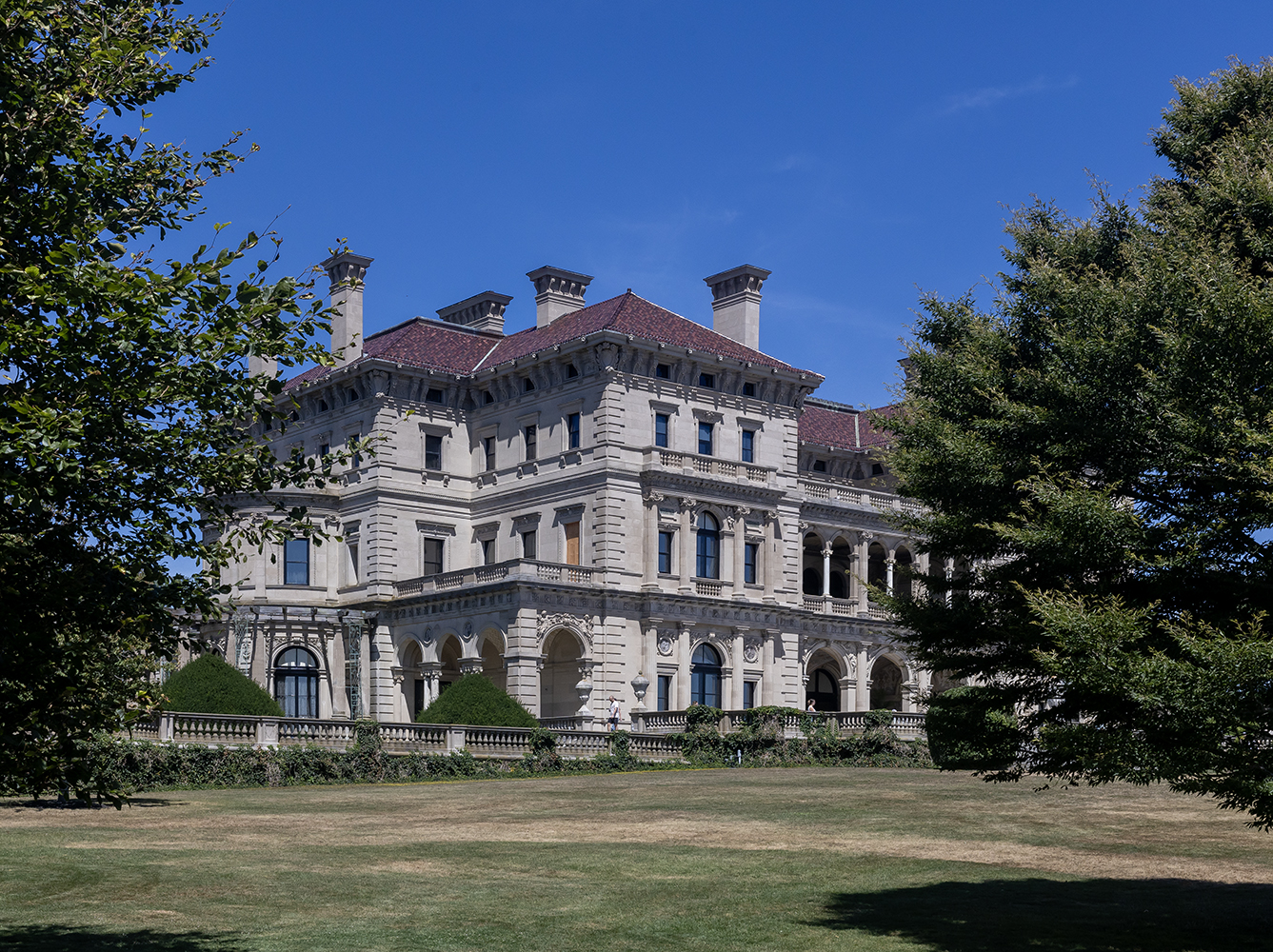
It was an excursion day at the conference, where guests had the opportunity to go to Newport, Rhode Island and see some of the Host State’s most intriguing sites. In Rhode Island, this involves a slew of Gilded Age Mansions, and we managed to fit in three separate homes: The Breakers, the Marble House, and Rosecliff.
Newport, Rhode Island has beauty, temperate summers, and its location on a picturesque coastline have made it an ideal location for summer homes for the wealthy. Over the decades, however, not all of the owners’ descendants have wanted to maintain these homes, nor is it easy to find buyers for structures worth, according to recent estimates, 500 million.
Fortunately, the Preservation Society of Newport County purchased many of these homes over the past sixty years, and they have made them available for touring to the general public. For those interested, ticket options include The Breakers + 1 or The Breakers + 2 or specialty tours (e.g., “Under The Breakers Tour”). We opted for The Breakers + 1, with the idea that after seeing the main attraction, we would “breakup” and see different houses (Moya and Discon: Rosecliff; Mike and Stephanie: The Marble House).
The Marble House
The wealthy had lived in Newport prior to the construction of “The Marble House” by William Vanderbilt, but this home was the first of the stone-built mansions that would eventually dot the coastline. An aptly-named structure if ever there was one, the Marble House was designed by Richard Morris Hunt, featured fifty rooms, 140,000 square feet of space, and 500,000 cubic feet of marble.
William Vanderbilt gave it to Alva as a gift for her 39th birthday, which makes you wonder what he would have given to her for, say, her fiftieth birthday. We’ll never know, because she divorced him not long after, and she kept the house.
Done largely in a Beaux-Arts style, the home was unparalleled in opulence when it was completed in 1892. It sits on the Atlantic coast, overlooking the ocean, features two-story Corinthian columns, and its western facade somewhat resembles the White House. With its size and splendor, the home has been the setting for many films and television shows, including The Great Gatsby (1974), 27 Dresses, The Buccaneers, and The Gilded Age.
For those visiting in person, however, the entry is through two doors (with WV on the front) that weigh one-and-a-half tons each, an entry that offers a breath-taking view of the grand staircase.
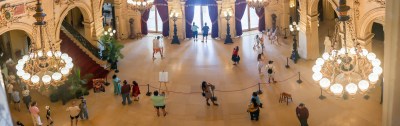
This two-level room is inspired by both the Palace of Versailles and the Louvre. The banister is wrought iron with bronze gilding, the room gleams with yellow Siena marble, and an eighteenth century mural graces the ceiling, above a gold and crystal chandelier.
Each room offers similarly notable features. The dining room–which was unlike any room we have dined in–showcases a large table with bronze chairs with gold leaf–each weighing seventy-five pounds.
The ceiling decor included game such that might be served for dinner.
The gold room is, as one might expect, predominately gold, but it is accented by green silk drapes (by Prelle) and black.
The most ornate room, however, was the gothic room, which featured Alva Vanderbilt’s collection of medieval art and artifacts, all situated in a room with gothic elements.
By itself, the Marble House offers a class in architecture, interior design, art, history, and excess.
But it is also interesting as a window to an age in which the wealthy competed with each other for even greater conspicuous splendor, which we weren’t sure was even possible until we visited The Breakers.
The Breakers
by Olivia Discon
It’s difficult to select a favorite house, but there is a reason that The Breakers is common to most of the tours. Built in 1895 and designed by Richard Morris Hunt for the Cornelius Vanderbilt family, the home boasts 70 rooms and 138,000 square feet. With a fortune built on shipping and railroads, the Vanderbilts were one of America’s wealthiest families, and their wealth is evident everywhere in the home.
Visitors to the home first see “The Great Hall,” which was inspired by an Italian Courtyard. Not wanting a true open roof, the family opted for a ceiling with a trompe l’oeil mural to mimic the open sky.
Built in a perfect cube–50 by 50 by 50–this single room is larger than the average American house. The term “great” simply doesn’t do the hall justice.
The Billiard Room was another favorite of the group. The mosaic floor was adorned with coastal details, the walls featured “arches” painted in gold leaf, and the room was designed with numerous elements, making for a fun “I Spy” type game for visitors.
Although we were a bit tired from waking up so early, we couldn’t help but fall in love with the “Morning Room.” The room faces east, allowing the sun to pour into the chamber, and the warm lighting and yellow-hued adornments provided a welcoming warmth. The idea of having a room so opulent and just for the morning hours is such a Vanderbilt type of luxury.
One of most interesting aspects of the house is that each room offers intricate and elaborate details that are ripe for overlooking things. To take an example, the Morning Room features panels with cherubs, which, at first glance, appear to simply be classically-themed lagniappe. Upon closer look, however, you see that one cherub is holding an anchor; the other is holding a railroad spike and hammer. Both tie back into the source of the Vanderbilt’s income–the income that made such decor possible.
Each room offered something special. The Loggia offered a breath-taking view of the ocean;
…the bedrooms, although described by the owners as more “austere” than the public-facing rooms, were still opulent, each featuring separate baths, dressing rooms, and walk-in closets;
…and the library was perhaps the most stunning, with the wood doors that had gold leaf pressed into them to give an appearance of a storybook cover, and upper walls lined with green Spanish leather, providing the look of a hide-bound book.
It’s difficult to fathom that such a home was used for only part of the year, a reminder that we live in different worlds and a different age than the Vanderbilts.
Rosecliff
by Michelle Moya
After exploring The Breakers, Olivia and I were especially excited to visit another Newport mansion renowned for its elegance and beauty—Rosecliff Mansion—and it absolutely lived up to its reputation.
Commissioned in 1899 by silver heiress Teresa “Tessie” Fair Oelrichs and designed by architect Stanford White, Rosecliff draws inspiration from the Grand Trianon at Versailles. Its pale limestone façade and French neoclassical design create an elegant lightness that sets it apart from Newport’s other grand estates. While Olivia and I are still learning about various architectural styles, visiting both these homes provided a perfect opportunity to deepen our understanding.
Rosecliff’s history includes dramatic turns: it was sold for a mere $21,000 in 1941, but endured severe winter damage before the Monroes refurbished it in 1947. In 1971, the Preservation Society received the mansion as a donation, and it is now considered a historic house museum, event space, and more.
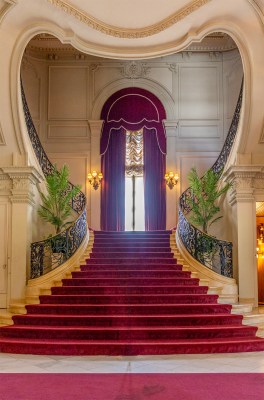
Upon entering, the first thing that caught our eye was the stunning heart-shaped frame surrounding the staircase. This feature lends the entrance hall a theatrical elegance—a design element I found particularly beautiful.
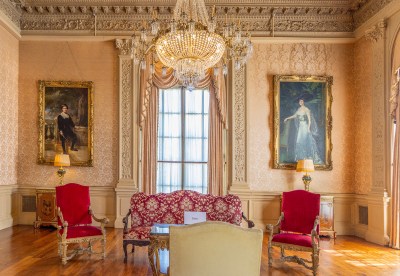
Our self-guided tour began in the French Renaissance salon, which quickly became my favorite space.
The room has coffered ceilings and classical pilasters, with chandeliers adorned by musical instruments—a homage to Teresa’s talents as a master of the flute, piano, guitar, mandolin, and banjo! Similarly, portraits of society members, painted in the grand European tradition, line the walls.
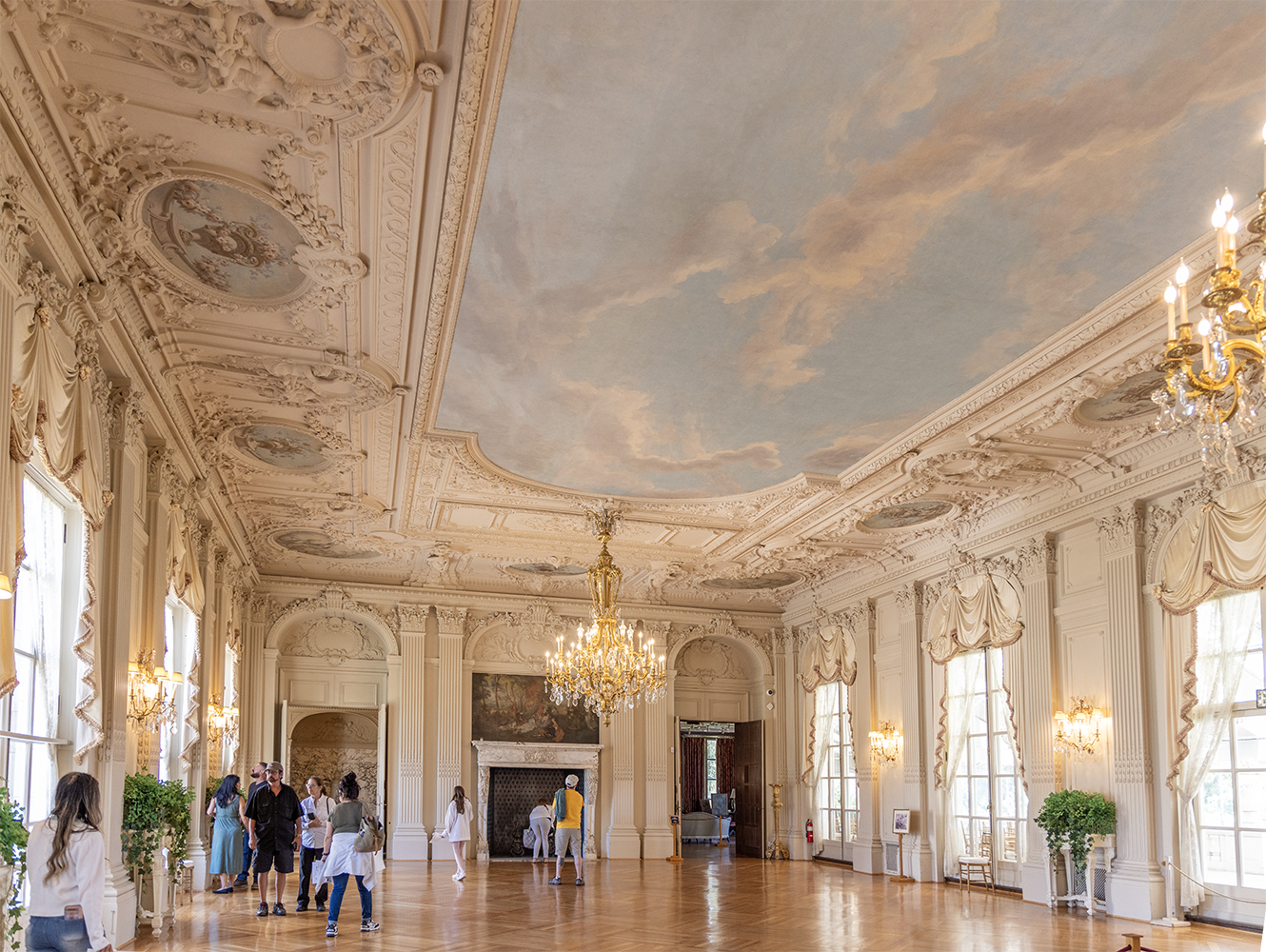
Next, the tour leads to the mansion’s crown jewel: its ballroom. The ballroom measures 40 by 80 feet with high 22-foot ceilings, making it Newport’s largest private ballroom. There are windows along both sides, creating an airy ambiance, while a masterful trompe-l’œil ceiling depicts a sky-like garden landscape. This room was Olivia’s favorite, and it’s easy to see why.
While we were reading about this space, we also learned that Teresa Fair Oelrichs truly embodied Gilded Age excess, especially in fashion. Wealthy families ordered wardrobes from Charles Frederick Worth in Paris, with ladies visiting the House of Worth twice yearly, spending roughly $30,000 per visit, the equivalent of $600,000 today. This translates to annual clothing expenditures of about $1.2 million in today’s currency, which we found absolutely crazy!
The first floor also houses the Library (or Billiard Room), showcasing Stanford White’s Jacobean styling with bleached English oak paneling and a distinctive white paint.
Additionally, the Dining Room, which is now painted white, having been originally pea-green walls, was filled gold accents, silk draperies by Jules Allard, and landscape panels.
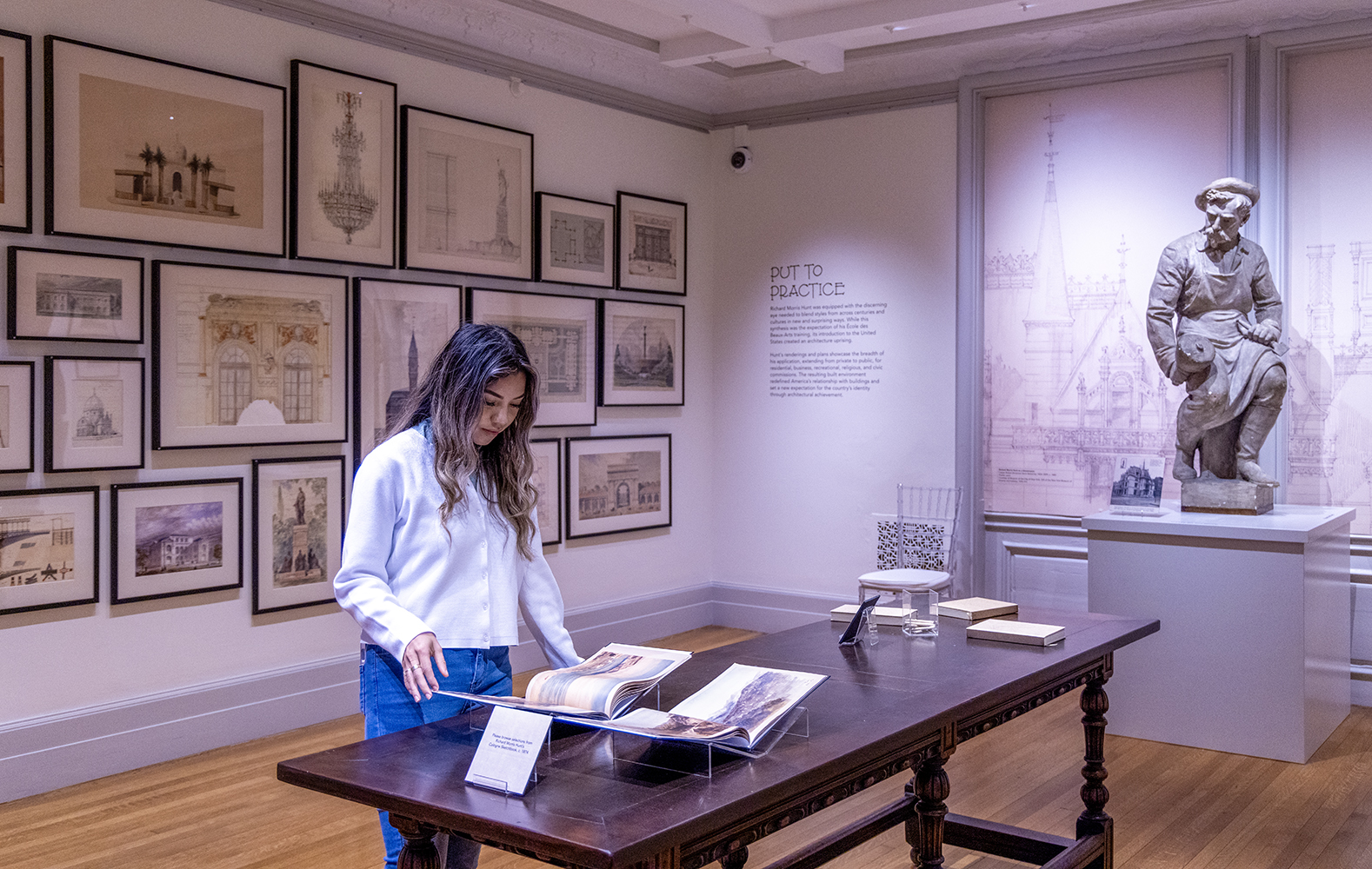
The second floor of the mansion offers additional rooms and rotating exhibits. Currently, the room hosts “Richard Morris Hunt: In a New Light,” showcasing the architect’s contributions and career.
The exhibit displayed his personal sketchbooks…
patron collections, and his creative journey…
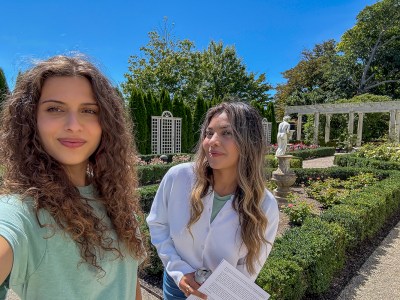
After a stop at the gift shop, the tour led us to the mansion’s rear, where a walkway opens onto breathtaking grounds—a view we both instantly fell in love with. Rosecliff’s 21 acres of formal gardens…
oceanfront landscapes…
…and beautiful rear exterior…
…create a stunning contrast between refined architecture and Rhode Island’s rugged coastline.
Today, Rosecliff continues to host elegant gatherings and has appeared in films such as the The Great Gatsby, True Lies, Heaven’s Gate, Amistad, 27 Dresses, and many more. It stands as a great reminder of Gilded Age grandeur and a cultural treasure that Olivia and I loved exploring!
Concluding Thoughts
As noted above, The Great Gatsby, written by F. Scott Fitzgerald, was filmed at various locations on the Newport Coast. The film tries to capture visually the spirit of the book, which addresses themes such as the American Dream and materialism of the Gilded Age and its vestiges that carried over through the 1920s, when the novel was written. It’s a harsh view of the United States, and it is perhaps unfair.
But our visit to the Newport Mansions did drive home a point made by Fitzgerald in a short story described as “an extension of ‘The Great Gatsby’, “Let me tell you about the very rich. They are different from you and me….They think, deep in their hearts, that they are better than we are because we had to discover the compensations and refuges of life for ourselves….They are different.”
Our visit to the Newport Mansions was a wonderful learning experience. We had a rare chance to see the splendor that only a few people ever get to experience, and even fewer have a chance to experience as a way of life. It was a moment to soak in, a chance to see the beauty, the craftsmanship, and the intricacy that the world’s great artists and architects could create, and it was a reminder that those who lived here enjoyed very different lives than the rest of us.
Our latest day in Boston was a blend of history, art, literature, and even a little fine dining. It was a journey of exploration: a first look at the pivotal battlegrounds of the Revolutionary War; a reflection on the legacy of literary giants; an in-depth look at the presidency of John F. Kennedy, and even a foray into the halls of Harvard. In short, it was a look at much of what has been and a glimpse into what can be.
This is the third presidential library I have visited, and it is the fifth that Olivia has visited. Progress in our educational travels!
The Kennedy family is central to Boston’s identity, and this library serves as both a monument and a memorial to the 35th president. Designed by I.M. Pei and completed in 1979, the Library’s striking glass pavilion overlooks Boston Harbor, creating a contemplative atmosphere with natural light flooding the museum.
We began with Young Jack, a candid look at Kennedy’s childhood and school years. Rather than presenting a sanitized version of his youth, the exhibit honestly portrayed his struggles as a student, making his later achievements feel all the more inspiring.
From there, we watched an introductory film narrated by Kennedy himself. The film offered a clear overview of his early life, political rise, and the moment he realized his presidential ambitions, essentially guiding us through the museum experience that followed.
This led naturally into the Campaign Trail exhibit, one of my favorites, which captured the energy of the 1960 election. We explored Democratic National Convention memorabilia, many of Kennedy’s campaign signs, and a large map illustrating Kennedy’s narrow victory over Nixon–an interesting way to understand the election results in context.
The museum then shifted focus to Kennedy’s presidency, offering multiple perspectives on his time in office. This exhibit showcased footage of his inauguration in 1961, Chief Justice Earl Warren administering the oath of office, and many stages in his life as president.
Particularly fascinating was the exhibit on Kennedy’s literary achievements, including his Pulitzer Prize–winning book Profiles in Courage, which celebrates political leaders such as Sam Houston and John Quincy Adams.
Equally impressive was the museum’s full-scale replica of the Oval Office, complete with Kennedy’s presidential desk, which gave a tangible sense of life in the White House.
The “Presidential Pets” special exhibit was an unexpected highlight, revealing the lighter side of life in the White House. From FDR’s Scottish terrier Falla to Clinton’s cat Socks–the first “First Cat” to capture widespread media attention–these animals brought warmth and personality to the presidency. The exhibit ended with an interactive display where we could add our own pet’s name, creating a fun, personal connection to the exhibit.
We wrapped up our visit with a photo in front of the American flag with Boston Harbor stretching behind us-a perfect ending to what had become my new favorite presidential library!
Boston Public Library
By Olivia Discon
Following our visit to the Kennedy Library, the torch was passed to a different type of library. The Boston Public Library rivals the best libraries in the country, and it is my favorite stop thus far in our trip.
Designed by Charles Follen McKim, the Library possesses a grandeur that leads visitors to expect much from the interior.
The entrance was breathtaking. Much like the Library of Congress in Washington, DC, the high ceilings are covered in mosaic tiles with the names of some of the greatest minds in history. In the context of this trip, it was especially meaningful to see the names of Nathaniel Hawthorne…
…and Thoreau, as well as Charles Bulfinch, the architect of the Massachusetts State House. With its yellow Siena marble, the entire building is just unbelievably beautiful.
At the top of the stairs, we were met with two lion sculptures. Stephanie, who took the lead on this tour, told us that they were actually memorials to two Massachusetts Civil War volunteer infantry units. Tradition says that rubbing the lion’s bottoms brings good luck, and with the LSAT coming up, I figured I could use all the good fortune I could get, so I did not pass up the chance.
The murals along the staircase were painted by Pierre Puvis de Chavannes. Interestingly, he refused to paint them in Boston and instead created them in France, then had them shipped to the library.
We then went into the Abbey Room, which used to be a waiting room for people requesting books. Its walls are filled with Edwin Austin Abbey’s mural cycle, The Quest and Achievement of the Holy Grail. Even the waiting rooms here are more elaborate and impressive than most buildings today.
The third floor was the most awe-inspiring of all. Covering the ceiling is John Singer Sargent’s monumental series, The Triumph of Religion. It consists of 19 panels that capture key symbols and stories from different religions. In true Sargent style, the figures are powerful and striking, and the work overall is stunning.
It was moving to see a public space created with such thought and artistry during the early years of the nation. It makes sense that a young country trying to define its cultural identity would invest so heavily in these kinds of spaces.
Wusong Road
by Olivia Discon
For lunch, we stopped at Wusong Road, a tiki bar and restaurant that brought a little Hawaiian flair into our day. The bright, tropical theme made for a fun change of pace. Even if we weren’t having tiki adventures, we certainly had a culinary one!
Our table shared a mix of dishes: crab rangoon, brussels sprouts, pork fried rice chicharrón, and ceviche.
Michelle, true to her love of seafood, especially enjoyed the ceviche. Professor Yawn and I leaned toward the crab rangoon as our favorite, while Stephanie was pleasantly surprised by how much she liked the ceviche. With a mix of productivity and good conversation, we felt ready to take on the rest of the day.
A Walk Through Harvard’s Campus
On a trip filled with recurring themes of idealism, it felt fitting that Michelle, Stephanie, Professor Yawn, and I walked through Harvard University. The campus has shaped some of the greatest minds in American history, and it naturally invites reflection on what kind of nation we have become. It was also a nice touch that JFK, one of Harvard’s most famous graduates, helped us connect the political and educational themes of the trip.
The campus itself is gorgeous. The red brick buildings, many of which date to the 18th century, add the appropriate sense of history, while the modern buildings remind visitors that this is a cutting-edge educational institution.
And the campus is punctuated by green space, public art (although less than we expected), and myriad monuments.
Nearby, we saw Harvard Law School, which, for aspiring law students, is a surreal experience. It is hard to process fully how much influence this one institution has had: nearly 19 percent of U.S. Supreme Court Justices and almost 18 percent of U.S. Presidents have graduated from Harvard Law.
Harvard Art Museum
The impressive history of Harvard Law is matched by its Art Museums, which are free and open to the public! (But don’t even ask about parking.) The structure itself is impressive. Designed by Richard Morris Hunt (who also designed Biltmore, the pedestal to the Statue of Liberty, and MOMA’s fifth avenue building.
The art equaled the architecture in impressiveness. In one gallery alone, we found three Van Goghs, three Degas, two Monets, two Renoirs, and three Picassos. All of the pieces were part of Maurice Wertheim’s collection, and he, a class of 1906 graduate, donated the work to Harvard. It’s good to have successful alumni.
From there, the names just kept coming. Klimt, Munch, Fenninger, Pollock, Moore, Mondrian.
Olivia, on her first guess, identified the Gustav Klimt piece, an impressive feat considering its atypical color scheme.
For Professor Yawn, a favorite was by Lionel Fenninger, “The Bird Cloud.”
…while Olivia most enjoyed the Hopper piece, “Schumann House”…
…and Michelle found a favorite in Jehan Vibert’s “Apotheosis of Louis-Adolphe Thiers.”
With an art collection as impressive as Harvard’s, it was impossible to not find art to like.
The Shot Heard Around the World
Our third educational leg of the day involved a mix of history and literature, which connected in ways we did not anticipate prior to our preparation for this trip. We drove to Lexington, MA, where the first battle of the Revolutionary War took place. Having seen Paul Revere’s House yesterday, we travelled somewhat in his footsteps today, visiting the Hancock-Clarke House.
This is the home where John Hancock and Samuel Adams were staying as guests on April 19, 1775, when they were roused from sleep as Paul Revere rode by shouting, “The Redcoats are Coming.” Indeed, much of the town was roused, answering the call to arms. Later that day, the Colonial Militia—Minutemen–faced off against the professional British Army on the town’s Lexington Green, where “the shot heard round the world” was fired. Eight colonists were killed, and while the British suffered no significant casualties, the colonists believed—correctly–that they had performed creditably.
To commemorate this “shot heard ’round the world,” Lexington has preserved the space on which the battle occurred and erected a statue in honor of the colonial soldiers.
While the militia did not offer impenetrable resistance, the action helped galvanize the colonists. When the British reached Concord, they faced more aggressive, reflecting the increased preparation, enhanced training, and stiffer resolve of the colonial militias.
Some two months later, when the British moved on Boston and the colonial redoubt on Bunker Hill, the colonists were ready. Twice the British charged the hill, faced extensive casualties, and were rebuffed. Only on the third advance did the British make significant ground, and the colonial militia withdrew in organized fashion. Ultimately, the British took the Hill but at a prohibitively expensive cost: 1,000 dead or wounded.
Today, this battle site is marked by a large obelisk monument that was originally erected in 1825, on the 50th anniversary of the battle. It is 221 feet high, composed of 3,000 stones, and it weighs more than 7,000 tons. Standing on a hill overlooking the City of Boston, however, it appears even more imposing, supplemented too by the symbolic weight of the event that it memorializes.
This struggle for independence had long-lasting ramifications, not only for democratic movements the world over, but also in the spheres of philosophy and literature. Born in the aftermath of this revolution, men such as Ralph Waldo Emerson, Henry David Thoreau, and Nathaniel Hawthorne would forge their own literary path. Emerson, born in 1803, explicitly called on Americans to break with their European traditions and draw upon the “beauty, convenience, grandeur of thought, and quaint expression” of the American systems and culture to forge a “transcendent destiny”.
Henry David Thoreau took Emerson’s advice, forsaking custom and, to a large extent, society, by leaving on July 4 to live at Walden Pond, where he would remain for two years, two months, and two days.
And with Nathaniel Hawthorne, the United States would produce its first great novelist. Drawing on the young country’s history, Hawthorne explored the world of Puritan New England and themes of how the past impinges on the present and, of course, the future.
Collectively, these writers helped lay the foundations for a distinctively American literature and philosophical thought. And it was forged in the same New England atmosphere as that which spurred the citizens to revolt against the British. Emerson, Thoreau, and Hawthorne lived in Massachusetts, in and around Boston, and remarkably, all three are buried within 100 feet of one another (and from Louisa May Alcott) on “Author’s Ridge,” in Sleepy Hollow Cemetery.
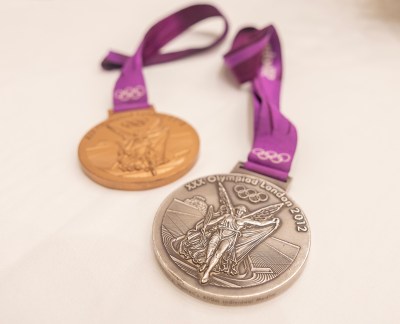
And much to our delight, we had the opportunity to visit Walden Pond. Although it has suffered from development in recent years, we were able to get some photos that captured some of the magic that must have drawn Thoreau to the site in the mid-19th century.
Walden Pond, 2025
This beauty and its corresponding history prompted us to pause and to reflect on the importance of self-reliance, in both government and literature.
Winding Down
We closed a productive day with more productivity: dinner at Fox & The Knife. Although Boston has a rich Italian culinary heritage, The Fox & The Knife has set itself a part. Indeed, Chef Karen Akunowicz, a James Beard Foundation “Best Chef” winner, is known as “The Queen of Boston Pasta.”
It wasn’t that we doubted this designation; we just wanted to confirm it. We took our spirited waiter’s advice on starters, trying fried chickpeas, which were wonderfully snackable; carne cruda crostini, which offered a riot of flavors, with steak tartare, leeks, and parmesan somehow creating a balanced, intriguing, and pleasurable taste; the bietola & burrata, which was creamy and flavorful; and the prosciutto e melone, with a melange of melons and tender, savory prosciutto.
For entrees, we split two items: the arrosto di maiale vignorola, a tender fried pork dish; and the tagliatelle bolognese, which featured “wild boar” complemented by thyme and the restaurant’s flavorful parmesan.
The restaurant, we confirmed, was as advertised: a wonderful Italian culinary experience, a lively atmosphere, and a taste of the best of Boston, straight from the Queen of Pasta. It was a great way to end the day.
With our longest driving day of the trip (8.5 hours in the car), we set out to see as much as we could while driving across the “Sunflower State.” While some may think of the Plains as plain, we were determined to see interesting spots, and we did!
The Largest Easel
Goodland, KS is the unlikely destination of artist Cameron Cross’s “The Big Easel” installation. The art project includes not only the titular easel, but also a replication of Vincent Van Gogh’s “Three Sunflowers in a Vase.”
Cameron Cross’s Homage to Van Gogh in Goodland, KS
Interestingly, it is one of seven such pieces that Cross has either created or hopes to create, with the other completed projects being in Emerald, Central Queensland; Altona, Manitoba; and Arles, France.
In all, the Goodland structure is eighty-feet tall, and it is a creditable replica of Van Gogh’s masterpiece.
Further, it is located in the midst of a city park, complete with a pagoda, a lending library, and some walking trails. It was a pleasant stop while traversing the western corridor of Kansas.
Lindsborg, KS
Nestled amidst the plains of Kansas is Lindsborg, KS, otherwise known as “Little Sweden USA.” The moniker derives from the fact that city was founded by a hardy group of Swedish immigrants in 1869, led by pastor Olaff Olssen. Even today, thirty percent of the population is of Swedish origin, and it is home to the biennial Svensk Hyllningsfest.
Downtown Lindsborg
It is a lovely town and a delight to explore. The street is lined with “Dala” horses, a representation of Swedish culture and heritage. They are cleverly done, with a “one-Dala” horse being painted green and adorned with features from US Currency; a “Blue-Colla Dala,” recognizing the workhorses in the community; and, probably our favorite, a “Salvador Dala” horse, featuring the Spanish artist’s characteristic surrealist landscape.
Salvador Dala
We also loved City Hall…
City Hall, Lindsborg, KS
…a historic bank building originally built in 1887 (and reminiscent of the Roche Building in Huntsville, TX)…
…the quaint downtown streets, which were wonderfully walkable…
…and Swedish-themed telephone booth, as charmingly anachronistic as the town.
Small World Gallery
by Chrissy Biello
Jim Richardson is a legend in the field of photography, with countless features in National Geographic and a long list of prestigious awards to his name. His work has shaped how people see the world, especially Scotland and Midwestern America. But despite his global recognition, he calls the small town of Lindsborg, Kansas, home, where he owns a Main Street gallery and studio called Small World.
Small World Gallery
I recently had the chance to take Richardson’s The Working iPhone Photography Class over Zoom. The two-session course, each lasting two hours, completely changed the way I look at phone photography. Before, my approach was basically point, click, and hope for the best. But Richardson’s class made me realize just how much potential my iPhone camera had if I actually took the time to use it properly.
Jim Richardson’s “iPhone Photography” Class
During our trip to the Academy of Criminal Justice Sciences Conference, I tried to put some of Richardson’s lessons into practice. I was not sure if I was using his advice correctly, but I made an effort to be more intentional with my photos.
On the day we left Colorado and entered Kansas, we decided to stop in Lindsborg and visit Small World. To our surprise, Richardson was there in person. It also happened to be the first day of a new exhibit featuring some of his latest photographs from Scotland, Kansas, and other areas of interest.
Inside the studio, there was a lot to take in. Along with Richardson’s prints, there were books, drawings from other artists, and handmade jewelry crafted by his wife Kathy and Briana Zimmerling. Every part of the space had something interesting to look at.
Seeing Richardson’s work in person gave me a new appreciation for his photography. His photos capture people in a way that feels natural and genuine. His landscapes and wildlife shots show the same kind of attention to detail and care.
“Wheat Fields,” by Jim Richardson
While looking around, we had the chance to talk with Richardson. Since I had taken his class online, I was excited to meet him in person. He was just as engaging and knowledgeable as he had been on Zoom. He even gave Olivia a photography tip, suggesting she use her hand as a shade when harsh light was hitting the frame. She later tried it while photographing a Henry Moore sculpture at Wichita State University, and sure enough, it worked like a charm.
Henry Moore’s “Reclining Figure”
Of course, we could not leave without taking a few prints home. Choosing just one was nearly impossible, but after much debate, we each settled on the piece that spoke to us the most. As a bonus, each print purchase came with a free postcard; Olivia and I chose one that featured the Great Sand Dunes National Park as we had just visited.
Jim Richardson
Before we left, Richardson took the time to personally sign all our purchases, making them even more special. The visit had already been unforgettable, but this was a very thoughtful gesture that meant much to us all.
It is clear that Richardson is not only an exceptional photographer but also a truly kind and genuine person, qualities reflected in both his work and how he connects with others. It was an honor to meet him and have the opportunity to learn from him, even if only for a few hours. I gained valuable insights and look forward to applying them to my future photography.
Birger Sandzen Museum
One of the city’s most famous native sons is Birger Sandzen, a world-renowned artist who also taught art at the local Bethany College. Indeed, Sandzen was part of the Bethany faculty for an astounding fifty-two years.
Sandzen was known for his impressionist paintings, which he created using impasto strokes and vivid, sometimes unnatural colors. The result is a striking, three-dimensional effect, making Sandzen a highly collectable artist. Indeed, his work is in the Denver Art Museum, the Smithsonian American Art Museum, Art Institute of Chicago, the Nelson-Atkins Museum, the Brooklyn Museum of Art, and many others. But it is the Birger Sandzen Museum in Lindsborg, KS, that has the most works on display at any given time.
Birger Sandzen Memorial Art Gallery
The Museum, founded in 1957–three years after Sandzen’s death–now houses an impressive collection of the artist’s body of work, which was voluminous. It is tastefully displayed in two galleries, with three additional galleries devoted to rotating exhibits
Sandzen’s work, which ranges from small, monochrome lithographs to expansive, colorful landscape, is effectively showcased in the gallery.
We enjoyed looking through the rooms, seeing his body of work, distinguishing among his different styles, and picking our favorites.
Chrissy’s favorite featured Rockport Massachusetts, one of several paintings Sandzen did while visiting the Bay State.
Olivia’s favorite featured the Garden of the Gods, a wonderful area in Colorado Springs, CO, where Sandzen taught in 1923 and 1924. The artist painted several such pieces in the area, and his work in Colorado was featured in 2016 at the Colorado Springs Fine Art Center.
Professor Yawn’s favorite was “Early Moonrise,” where Sandzen ventured into pointillism, producing a work with strong overtones of Paul Signac.
Beyond the main gallery, the Museum also featured an exhibit by Wayne Conyers, who had some clever riffs on other artists and some very nice ceramics.
In our group, other pieces from the Museum’s collection stood out prominently. Professor Yawn found Grant Wood and Thomas Hart Benton pieces; Chrissy was surprised to see works by Rembrandt; and Olivia spotted two Albrecht Durer works!
Wichita State University
Following a day of driving and art-themed exploration, we doubled down and did some more! We ventured onto the grounds of Wichita State University…
…which has a public art collection of almost 100 pieces, and we soon learned that many luminaries were among them.
We began with some big-hitters–Jesus Moroles, Joan Miro, and one of Robert Indiana’s “LOVE” sculptures.
LEAP Ambassadors with Robert Indiana’s “LOVE”
We then did a walking tour of the campus, where we met many oddly friendly squirrels, and we saw even more great art. There was Oldenburg’s “Inverted Q”…
Claes Oldenburg’s “Inverted Q”
…one of George Rickey’s kinetic sculptures…
One of George Rickey’s Kinetic Sculptures
…Auguste Rodin’s “The Cathedral”…
Rodin’s “Cathedral”
…another Rodin, “Grand Torse de L’homme qui Tombe”…
…a “Reclining Figure” by the incomparable Henry Moore…
…Louise Nevelson’s “Night Tree;” and a large and attention-drawing Luis Jiminez sculpture, “Sodbuster San Isidro.”
Luis Jimenez Sculpture: “Sodbuster San Isidro”
We noticed that many of these pieces had been donated by (1) collectivities of students (such as cohorts or organizations); (2) alumni; or (3) funds from the Student Government Association. As LEAP Ambassadors and students who are passionate about arts, we have been excited about TSUS’s recent emphasis on the arts. We have also offered our own arts programs, and we hope to do so again.
But seeing the investments made by current students and the SGA on WSU’s campus provided examples of how collective action by students and governing organizations could be used to beautify the campus, engage the student body, and raise the profile of the University.
as another day closed on our art tours, and we headed to Oklahoma City–following a brief stop at the Allen House, by Frank Lloyd Wright– en route to a return to SHSU.
Being in Denver, we felt compelled to visit Rocky Mountain National Park on an off day, so we set out early to do just that! Along the way, we visited the Pearl Street Mall in Boulder to explore the local shops. One store we stopped at was the Boulder Bookstore, where Olivia purchased a notebook, a copy of Martyr! by Kaveh Akbar, and a set of beautiful notecards. It was an excellent bookstore, and I am sure we all wished we had more time to explore it.
Nearby, we saw the Boulder County Court House, a building designed in the art deco style.
Finally, to prepare for our trip, we went to a local market in Lyons called St. Vrain Market, Deli, and Bakery. At the deli, we picked up sandwiches to enjoy on the mountain.
Rocky Mountain National Park
by Olivia Discon
The trails were a patchwork of ice and untouched snow, the lakes frozen over into eerie stillness. A single blue Stellar’s jay flitted between bare branches, watching us with the kind of judgment only nature can provide.
Rocky Mountain National Park in winter is a mix of beauty and betrayal.
The meadows stretched wide and open, peaceful and quiet under the weight of the season.
Trails wove through icy patches and steep layers of snow. Every step was a guessing game—solid ground or sudden sinkhole?
We crunched through the meadows, the wind howling low across the open expanse, until we reached the rocks.
That’s when things escalated.
Professor Yawn and I decided, in our infinite wisdom, that we should climb them. Not just once. Not just some rocks. No, we scaled rock faces like mountain goats who had lost all sense of self-preservation.
One climb turned into another, and before we knew it, we were standing at a questionable height, looking out over the vastness of the park.
And that’s when we heard it.
A faint, disembodied voice from below.
It was Chrissy.
From where we stood, she was just a tiny figure, barely visible, shouting up at us as if we had ascended into some divine realm. The wind carried our voices down to her, but to her ears, it must have sounded like the echoes of gods speaking from the mountaintops. We, of course, did not correct this perception.
“Chrissy, we see all,” I replied, as if we had unlocked some kind of mountain-wisdom. “We are everywhere and nowhere.”
She was not impressed. But she did eventually find her way up.
And we were able to share in the beautiful views.
We eventually made our way back down, the snow still unpredictable beneath our feet, the air crisp and unforgiving.
But it was as beautiful as it was unforgiving.
And we explored that beauty by circling the perimeter of Sprague Lake (on the East side of the Park, where it was much snowier)….
Note: Chrissy and Olivia in Distance
…where we witnesses to a proposal!
The winds were brutal, but the scenery was just compensation.
And we ultimately enjoyed our time on the Lake–so much so that we decided to go to another!
The Brutality – Scenery tension was a bit more on the side of Brutality at Bear Lake. The snows were deeper, so much so that the trail was indiscernible, except for the occasional signs that were almost buried in the snow.
Note “Bierstadt Lake,” Named for Artist Albert Bierstadt
Few people were on the trails, for good reason.
But we ventured on, trudging through the snow, around rocks, and even on the frozen lake!
It was quite a different experience than we were accustomed to in Texas on spring break.
As we made additional forays into the park, we made additional discoveries, such as deer (we ended up seeing almost 50).
On one case, when returning to the van, Stephanie interjected, saying, “Moose. Don’t step any further.”
Little did we know, there were two of them—the first that Chrissy and I had ever seen.
They moved through the trees, pausing only to munch on whatever food they could find amidst the snow. Later, on our drive out, we saw even more moose, casually grazing along the roadside. Professor Yawn and Chrissy, feeling adventurous, hopped out to get closer for photos. Stephanie and I, however, stayed in the car, content with admiring from a safe (and smart) distance.
Despite the unpredictability of nature, we thoroughly enjoyed Rocky Mountain National Park.
It became, by a wide margin, our favorite National Park experience. It was immediately understood why painters and romantic poets expressed the sense of awe provided by America’s vast and inspiring landscape.
When LEAP Ambassadors travel, they aim to make the most of it, unsure of when they might be able to return. Today exemplified that spirit, as we tried interesting food, dropped in to our ACJS Conference site, roamed the Denver Public Library, toured the Clyfford Still Museum, explored the Colorado State Capitol Building, and visited a National Wildlife Refuge.
Denver Public Library
The Denver Public Library is not only the home of thousands of books, ideaLAB Makerspaces, and research materials, but it also owns some impressive art, and that is one of the major reasons we stopped by.
Along the way, we saw some impressive pieces, such as a Frederic Remington…
…but we also had a chance to see the work of artists new to us, such as Marie McFarland, Chase Varney, and, especially, Otto Kuhler.
Perhaps most impressive among the paintings was an Albert Bierstadt!
Although we also just loved some of the spaces, such as one of the reading rooms…
Our experience suggests that a robust library system across a wide variety of services benefits the community greatly. They promote literacy; allow for research in the community, which foster a sense of community identity; if done correctly, they can beautify the community; and, perhaps most important, they bring a community together. And this is what we witnessed in Denver: a friendly staff, a beautiful interior–further beautified by the art; and a diverse group of users, which included us!
Clyfford Still Museum
The Clyfford Still Museum gave us a chance to see the evolution of an artist who refused to conform to the art world’s expectations. The galleries were arranged to show the progression of his work, starting with his early pieces, which were more representative and realistic, before gradually shifting toward abstraction.
I found his earlier works particularly interesting, especially the ones featuring figures with large hands and elongated faces.
While I’m still not entirely sure what to make of them, they seem to reflect struggle and resilience, possibly tied to the hardships of the Great Depression.
What stood out to me the most, though, was Still’s complete rejection of the art industry. He despised galleries, museums, and critics, believing they distorted the meaning of art and prioritized profit over artistic integrity. He was known to pull out of exhibitions and refused to title his paintings, even going so far as to remove preexisting titles to prevent outside interpretation.
His frustration was clear in a statement he made in 1971: “I am deeply outraged that my entire life is being interpreted as a long struggle to be recognized by some damn fool art critics or to be sold successfully in the galleries or even to find their way into art museums because I consider these institutions to be corrupt in the purpose and their meaning and their effect on the artist and society.”
One of the more unexpected features of the museum was the use of canvas screens to partially cover certain pieces, allowing them to be revealed while also being preserved.
As we moved through the galleries, we could see how Still’s work became more abstract and how much control he maintained over his legacy.
Even after his death, his wishes shaped how his art was displayed and handled. Unlike many of his peers, his work wasn’t scattered across various museums or private collections—it was kept together, exactly as he intended. He may have been a particular man, but he was also a particularly fascinating man.
Colorado State Capitol Building
by Chrissy Biello
The Colorado State Capitol took fifteen years to complete, finishing in 1901 at a cost of nearly three million dollars. Despite its distance from Texas, the building evokes a sense of recognition among many Texas visitors. This familiarity comes from its design by Elijah E. Myers, the same architect who designed the Texas State Capitol. In fact, Myers’ influence extends beyond these two states, as he also designed the Michigan State Capitol in Lansing.
Walking into the building, visitors can see many features that connect it to significant landmarks across the country.
Moreover, the building showcases rare Colorado Rose Onyx, a pink-hued stone found only in a quarry near Beulah in Pueblo County. Nearly the entire known supply was used in the Capitol’s construction, making it the only building in the world to feature this material.
For sci-fi fans, one particular design in the Rose Onyx resembles the likeness of Princess Leia‘s hair from Star Wars…
And one interesting detail for those interested in city government is that John Hickenlooper, the 42nd Governor of Colorado, was the mayor of Denver from 2003 to 2011. His gubernatorial portrait stands out dramatically among the gallery of solemn official paintings in the West Foyer. Instead of opting for a conventional formal pose, Hickenlooper is captured atop the dome of the Capitol with the Denver City and County Building behind him, dressed casually in a plaid shirt.
When touring the Capitol, one will also notice how some of the building’s design nods to the British Parliamentary system. The Senate chamber is filled with red-colored stencils on the wall, while the House features green.
In the Senate, there are multiple stained glass portraits of some of the state’s most influential figures. Ruth Stockton, the first woman to serve as President pro tem of the Senate, is one that is frequently mentioned. She made history not only by being the first woman in that role but also by serving longer than any other woman in the legislature (24 years).
While the Senate has several stained glass portraits, the House Chamber has just one: a stained glass portrait of Barney L. Ford. Ford was an escaped slave who became a civil rights leader and fought for voting rights for African Americans in Colorado.
The ending highlight of touring the Colorado State Capitol is the opportunity to go up to the dome.
However, you will need to brace yourself for the 99-step climb, which is also pretty steep.
From this elevated vantage point, the panoramic view encompasses significant landmarks throughout the city.
Straight ahead, one can spot the Denver City and County Building featured in John Hickenlooper’s gubernatorial portrait.
To the left, one can see the Colorado Supreme Court building. Most notably, the Rocky Mountains can be seen in the distance, providing a stunning backdrop that highlights Denver’s unique geographical setting.
Rocky Mountain Arsenal National Park
To end the day on an even higher note of adventure, we headed eight miles northwest of Denver, where forty years ago, the United States Army operated a chemical weapons manufacturing plant—scary stuff. After an expensive clean-up process, the site is now the Rocky Mountain Arsenal National Wildlife Refuge, an expanse of land that hosts more then 330 species of animal.
We did not see all of those species, but we saw a sufficient amount to make our afternoon.
We saw rabbits and deer. We have, of course, seen these species previously, but on this day we saw more than 60 deer on the eleven-mile driving tour!
Moreover, we saw some species that, for us, were first-time spottings. A favorite was Prairie Dogs, which we saw scurrying from the sound of our vehicle, barking a warning to their fellow Dogs, or simply going about their business of eating. They were a delight.
We also saw several species of birds, including the ever-present Canadian Geese…
…Robins, Red-Tailed Hawks, Canvasbacks, a Tri-Colored Heron, Northern Shovelers, European Starlings, Red-Winged Blackbirds, and a murder of crows–one of which was carrying a bone.
That may not sound exciting, but we also saw a Bald Eagle (Chrissy’s first), , numerous Magpies (first for both Chrissy and Olivia), and three Wild Turkeys (another first for both Chrissy and Olivia).
Of course, the big find was the herd of Bison. Numbering more than 100, they spent most of their time eating, but they were surrounded by some amazing scenery, as they roamed the prairies with the towering and snow-capped Rocky Mountains in the background.
We even saw part of the herd begin to run, kicking up dust all the way, as they rejoined part of the herd from which they had separated. It was a majestic sight at a majestic site.
As we headed to the close of the wildlife drive, we were able to spot the Denver skyline framed against the beautiful Rocky Mountains.
Tocabe
Our final stop of this long and adventurous involved additional adventure: dinner. Keeping with the LEAP tradition of exploring food consistent with the cultures we are visiting and/or learning about, we decided to eat at Tocabe, which is co-owned by a member of the Osage Nation, and which bills itself as a restaurant offering meals that tell the stories “of our American Indian culture through native-sourced recipes and ingredients.”
We tried a variety of dishes and did some sharing, hoping to get sampling of their entire menu. Professor Yawn tried the Indian Fry Bread, stuffed with shredded Bison; Olivia opted for the chicken; and Chrissy explored the ground Bison; and we also ordered a bowl of Bison chili and, for desert, we tried Wojapi with Indian Fry Bread (with cinnamon and sugar, of course).
It was a fulfilling way to end the day, providing insight into the culinary traditions of Native Americans, offering a new food experience, and whetting our appetite for more Bison and Wojapi.
Two LEAP Ambassadors, Chrissy Biello and Olivia Discon, are presenting at their first conference, the Academy of Criminal Justice Sciences conference in Denver, CO. There is a certain amount of dread associated with your first formal academic conference, and Biello and Discon are not immune from such anxieties. Fortunately, having arrived a day early to the conference–LEAP Ambassadors are punctual–they had a day to prepare and to explore the mile-high city, having as much food and fun as they could bear.
Coffee:
Being coffee fiends, we explored two coffee shops on our first day in Denver. The first, “Dandy Lion Coffee,” is a coffee and boutique plant shop. While we admit that we are not exactly world travelers, we suspect that this is not a common combination. But it works in this charming cafe, which is located in the Park Hill neighborhood of Denver.
The shop’s plants are warm and colorful, and they add a vibrant, down-home quality that is reinforced by the friendly and professional staff.
The warm and welcoming ambiance had its desired effect. The store was filled with customers, some speaking with each other, some mixing in small groups, and others doing their own thing, but they all exuded a comfort borne of an environment that was cozy without being crowded.
While the shop was pleasing, we were there for the coffee. And it, too, delivered. With an enormously helpful and friendly barista named Taylor leading the way, we tried an “everything croissant,” which was excellent, and we sampled a chocolate croissant–which was excellent and chocolate.
The drip coffee was very good, and the iced vanilla latte, which is what the store is famous for, was very, very good.
This was the perfect pick-me-up spot for what would prove to be a long day. Also, please note that while the pronunciation of the cafe suggests a weed, the name of the coffee-plant shop is referring to a well-dressed king of the jungle–monocle and all.
Needing an afternoon burst of energy and a place to work, we also visited Novo Coffee, a third-wave coffee shop indigenous to Denver. We each enjoyed a vanilla latte and settled into a cozy and productive atmosphere, where the hum of conversations and the scent of freshly brewed coffee fueled our focus. Novo offered just the right balance—bustling enough to be lively but quiet enough to get some work done.
Food
After being on the road for a couple of days and eating like scavengers in a desert, we made the most of a city filled with restaurants. For lunch, we had Giordano’s Pizza, an Italian eatery on the famous 16th-Street (pedestrian) Mall in Denver.
With garlic bread and a “meat and more meat” pizza, we may have overdone it.
This did not, however, get in the way of us finishing the pizza and the bread sticks. And, in our defense, it did not get in the way of us also getting some work done and, several hours later, searching for a hearty dinner to bookend our day of culinary adventures.
Dinner took us to the world of Asian cuisine in the form of Chopstickers, where we sampled chicken potstickers, soup dumplings, and edamame. The food was excellent, though one of us (who shall remain nameless) had a slight mishap that led to an unfortunate spill. Let’s just say soup dumplings live up to their name. Still, no mess could ruin the experience, and we left satisfied, if slightly damp.
Exploration
With a conference presentation approaching (have we mentioned that?) and with us impersonating foodies, we didn’t have a whole lot of time for exploration. But we did manage to walk almost half-a-mile of the 16th-Street Mall, venture down many other streets, and see a bit of what Denver has to offer.
It is a very walkable city. Indeed, it’s downtown and capitol hill area have a 94 walkability score, and at least one publication ranks Denver second in walkability, trailing only New York City. Interestingly, this means we have walked the two most walkable cities in the United States in the past two months!
We also saw our share of critters. With a lot of food establishments and many pedestrians, there are also a lot of pigeons. Generally speaking, they are not scared of humans. We were also visited by some aggressive squirrels. One squirrel actually ran a circle around us, as if he was determined to singlehandedly surround us and demand food–despite already having a nut in his mouth!
By far the most interesting animal we encountered, however, was a blue bear.
As fearsome as he looks from below, he is rather tame and endearing. He simply wants to see what the humans are doing in the Colorado Convention Center.
The bear, a creation of the late artist (and art professor) Lawrence Argent, is titled “I See What You Mean” and was installed in Denver in 2005. Over the past two decades, he has become a symbol of Denver.
He certainly brought a smile to our faces, and with his whimsical blue color, curiosity, and potential for ferocity, he provided just the attitude we were looking for to approach our first-ever conference.
The LEAP Ambassadors enjoyed a six-day tour of the East Coast as part of their “Democracy Tour.” During this tour, the students had a chance to visit more than half a dozen art museums, James Beard award winning restaurants, and many historic sites. What follows is their favorites from their experiences.
Favorite Restaurants:
Lehja’s in Richmond received the most votes, with all of the food receiving high marks from the diners. The James Beard nominations appear justified!
Casa Mexico in Philadelphia was a hit among the students, with the barbacoa being particularly popular. This was an altogether pleasant dining experience in an interesting and busy neighborhood in Philadelphia. Chef Christina Martinez was named “Best Chef” in the mid-Atlantic region in 2022 by the James Beard Foundation.
Metzger’s Bar and Butchery was perhaps the most interesting and innovative of the restaurants we visited. While the pork schnitzel was the favorite entree, the “squash sundae,” was the favorite dessert and the biggest surprise.
Ambassadors also found favorites in Katz’s Deli in New York, a restaurant world-famous for its pastrami.
And, of course, we also enjoyed Jim’s South St., which specializes in Philly Cheesesteaks.
FavoriteArt Museum: Olivia and Chrissy visited four art museums in New York, and they split on their favorite, with Chrissy favoring The Whitney…
…while Olivia resisted picking a favorite and, instead, picked a top two: The Met and MOMA. She did, however, have a favorite: The Lovers.
Although smaller and less heralded than its New York and Philadelphia counterparts, the Virginia Museum of Fine Arts was one of the clear favorites among the group.
The favorites of the group reflected the diversity of the art in the Museum’s collection.
Of course, the most famous paintings among the NY, Philadelphia, and VA museums were also popular among the Ambassadors.
Finally, the group also greatly enjoyed seeing Philadelphia City Hall, the Liberty Bell, Independence Hall, and the Virginia Capitol Building. For Cinthia, Olivia, and Michelle, it marked the third–the complete collection–of extant Jefferson designs in the world.
While the Ambassadors are always happy to get back to Huntsville and SHSU (or, this semester, Austin and SHSU), they left the east coast with a lot of memories, new-found knowledge, and much nostalgia.