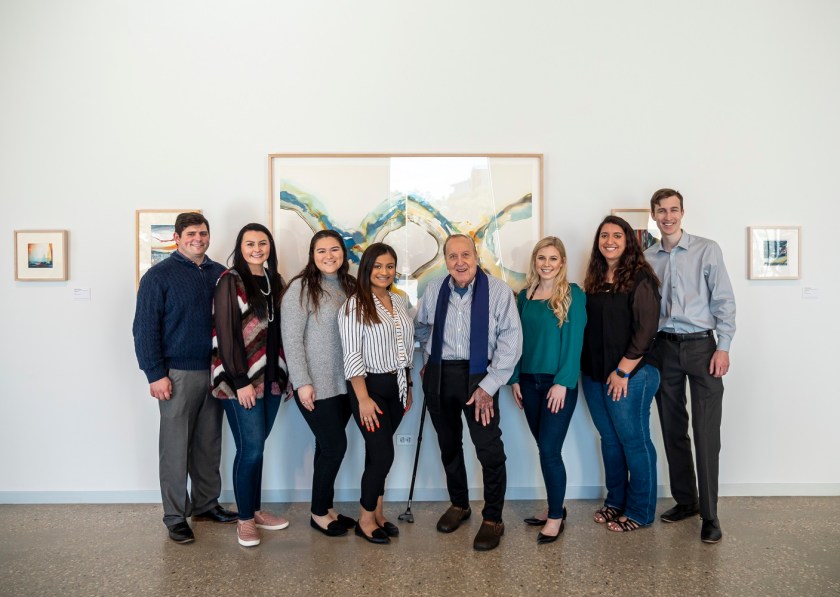
Our main objective in coming to Dallas was to hear Jeff Guinn speak. Guinn, the former award-winning investigative journalist and the bestselling author of numerous books, has been generous to LEAP students, and we were excited to hear about his latest book.
While there, we met Amy Berry (HPUMC Library Coordinator), Suzanne Lanksford (HPUMC Wellness Ministry), Michael Merschel (author), Richard Stanford (HPUMC Senior Ministry), and Janet McLeod (Hauteur Public Relations), all of whom were more accommodating to us than we had any right to expect.
A main point of this trip was to learn more about the adventures of Thomas Edison, Henry Ford, Harvey Firestone, and other celebrities, detailed in his latest book: The Vagabonds.
This book is special to us, because several LEAP Ambassadors had a chance to assist Mr. Guinn (in a small way) with the book. Brian Aldaco, Ryan Brim, and Paul Oliver traveled with Mr. Guinn to Detroit and looked through archives at the wonderful Henry Ford Museum. It was a fun, educational trip, and we were eager to hear the results of Mr. Guinn’s impressive research.
When we arrived, Guinn was sitting with a crowd of fans eagerly awaiting to meet him. His face lit up when he saw us, and he immediately stopped what he was doing to greet us.
While he had never met any of the current LEAP Ambassadors, he generously acted as if we were all well acquainted, and he soon introduced us to the gathering, while saying nice things about the LEAP organization.
After having our books signed and chatting with Guinn…
…we all made our way into the auditorium for his talk.
Amy Berry, Suzanne Langford, Richard Stanford, and Michael Merschel handled introductions…
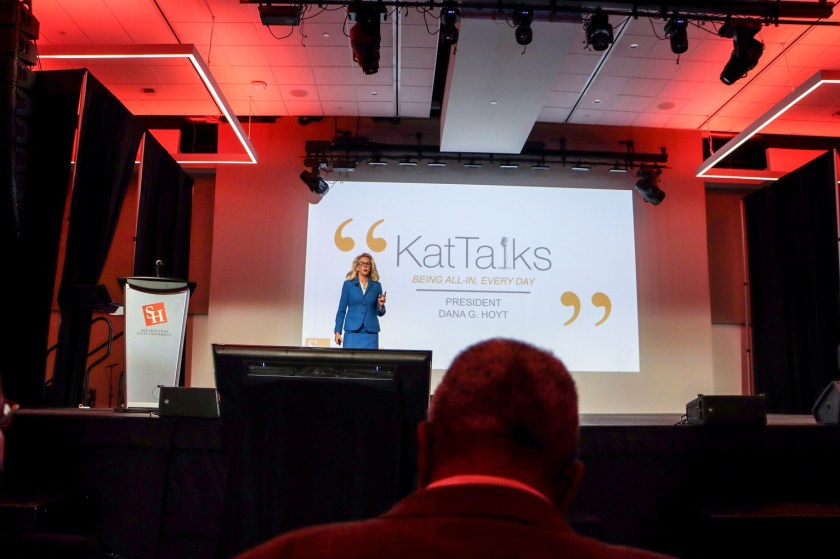
…and when Guinn took the stage in front of an audience of 900 (!)…
…he spent the first five minutes expressing his gratitude to specific individuals who had helped put the event on and otherwise encouraged the act of reading.
It was a thoughtful and professional way to introduce himself to the audience.
The rest of the discussion was filled with interesting anecdotes and information regarding The Vagabonds and all the research that went into it.
Walking the stage like a boss…
…Guinn entertained, informed, and joked. He introduced the little-known inventor Oliver Evans, who invented an early (1805!) version of the car, discussed the backgrounds and personalities of Henry Ford and Thomas Edison…
…and took questions from the audience.
He even engaged in a little audience participation…
…interacting extensively with the audience…
..and answering questions, some of which were head scratchers.
When he ended, the audience erupted in applause and just about everyone filed into the church lobby to either buy the book or have their copy signed.
If you did not know Jeff Guinn before you entered that church, like us, you surely left admiring him.
LEAP Ambassadors enjoy getting to meet with friends, but it was time to eat — we were all famished from our road trip. We ended up at The Biscuit Bar. Much like Huntsville’s Potato Shack, this restaurant makes one staple food the central component of their entrees.
Even though we arrived late into the night, the service was expeditious and soon the table was cluttered with our biscuit dishes. Among them was The F.A.B.B (sweet fig preserves, arugula, brie, bacon), Hot Hot Chicken (southern fried Nashville-style hot chicken, dill pickles, house made ranch), The HOSS, and for dessert, the Hot Chocolate Biscuit, topped with chocolate fudge and marshmallow fluff.
Everything was soon devoured. Enough said.
After dinner, we tucked into the hotel and awaited our road trip back in the morning.
Presidential libraries are a favorite stop for LEAP Ambassadors, making the George W. Bush Presidential Center a must-see destinbation during our short time in Dallas.
Located on the beautiful campus of Southern Methodist University (“SMU”), the Center had its grand opening on April 25, 2013. In attendance were former Presidents and First Ladies: Jimmy and Rosalynn Carter, George H. W. and Barbara Bush, Bill and Hillary Clinton, George W. and Laura Bush, then-President Barack Obama and First Lady Michelle Obama, and more than 10,000 guests.
Once inside, we started with the special exhibit, “Away from the White House: Presidential Retreats.”
This exhibit was all about the invaluable getaways Presidents have taken over the years to get away from the pressures of the White House. Each President had a special home away from the White House that provided them with a sense of normalcy and time for relaxation and family while maintaining the everyday responsibilities of the President of the United States.
We then made our way into the museum part of the Center. We learned all about President Bush’s life and time while he was in office. Of course, a significant event during Bush’s presidency was the September 11 attacks on the World Trade Center (a.k.a. “9/11”). The museum had on display steel beams from the Twin Towers—which we also had the opportunity to see while at the National September 11 Memorial Museum in New York City this past spring.
We learned that, in the aftermath of 9/11, the Department of Homeland Security was developed to help foster communication efforts between agencies. In this information age, it’s hard to comprehend lack of communication and coordination, but it wasn’t that long ago that those barriers existed.
We also had the chance to use interactive technology in a couple of areas in the Center.
In one space, we used touch screens to review decisions made during the War on Terror in Afghanistan and Iraq.
In another, the Decision Points Theater, we had to make a crucial decision regarding Hurricane Katrina as if we were President.
The Center even had a complete replica of the Oval Office. We took advantage of the opportunity to pose as President….
…while checking out the art that Bush highlighted in the Oval Office, such as this piece from Tom Lea.
And after our usual visit to the gift shop, we stopped outside for another photo op.
Each of us has now seen four presidential libraries (both Bushes, FDR, and JFK), but LEAP as an organization has seen eight. We are happy to keep adding to our–and our organization’s–total.
Our last day in North Texas was short, but still allowed us to see a couple of interesting places that tied into other art, artists and architects we’ve been exposed to during this trip.
Modern Art Museum of Forth Worth
The Modern Art Museum of Fort Worth (“The Modern”) was completely different from the Kimbell Art Museum we visited earlier in the trip. There is a clear distinction between classic, older art and modern, newer art. And the name belies it’s rich history: The Modern is actually the oldest museum in Texas and one of the oldest museums in the western United States, founded by 20 women when Texas was only 47 years old.
Much of the permanent collection was displaced by two special exhibits: “David Park: A Retrospective” and “Disappearing—California, c. 1970: Bas Jan Ader, Chris Burden, Jack Goldstein.” Park, like many avant-garde American artists, engages the viewer with his expressionism and nonobjective painting. We did not spend a lot of time in Park’s exhibit, but we did find his portrayal of human figures interesting.
Park, David
Despite its level abstraction, the human figure is still commonly used in Modern Art, as in Henry Moore’s “Reclining Figure.”
It took Miranda and me a few moments to figure out, but we did catch it when looking at it from the correct angle. Miranda, like many, prefers art that is more representational and not as abstract. Esmie’s favorite (and we all agreed, the creepiest) art was in the “Disappearing” exhibit. These artists poignantly “disappeared” as a response to the anxiety of the 1970s—racial tensions, political assassinations, the war in Vietnam, and the war on poverty.
The exhibit was mostly black and white (color disappeared), and showcased such tangible items as the survival kits from the artists.
In “The Reason for the Neutron Bomb,” for example, Chris Burden covers the floor with 50,000 matches and 50,000 pennies, each representing one Soviet tank, a symbol of the tension and fear of the Cold-War era.
We also saw Jenny Holzer’s work. Holzer uses language to communicate her art, and this piece illustrates her style well.
It was a beautiful structure, and we learned some interesting new artists, but we had one more stop before calling it a trip.
Thanks-Giving Square
Our last stop on the trip was Thanks-Giving Square in downtown Dallas. Thanks-Giving Square was designed by Philip Johnson, who also designed the Fort Worth Water Gardens which we visited earlier in the trip. Thanks-Giving Square was created with a sunken design.
By sinking the park below ground and incorporating water features into the park, visitors have a peaceful place to contemplate, free from the typical noises of a downtown area. The Thanks-Giving Square also features a mosaic by Normal Rockwell, “Golden Rule” (Rockwell places himself in the mosaic, in a cameo).
We both really enjoyed the Thanks-Giving Chapel with the featured “Glory Window” by Gabriel Loire. The “Glory Window” is a stained glass piece that cascades up in a spiral to the top of the chapel.
This Sunday, the sun was shining which illuminated the stained glass, making it very beautiful, and a positive spin to the end of a positively engaging trip.
TCMA Session: Inaugural University Competition – Managing Today for Tomorrow (a.k.a. “College Bowl”)
Conference “Day 2” started with the Inaugural University Competition. The “College Bowl” Tournament was comprised of teams from universities with Masters of Public Administration (“MPA”) and Masters in Public Policy (“MPP”) programs, including: The University of Texas at San Antonio, St Mary’s University, The University of North Texas, The University of Texas, Texas State University, Texas A&M University, and The University of Texas at Dallas. These MPA/MPP students started work towards becoming the First College Bowl Tournament Champion months ago by engaging in various activities: (1) a community-service project, (2) a research component; and then (3) by earning points on Conference “Day One” by networking and connecting with professionals before and after the sessions.
The final portion of the competition, the “College Bowl,” started with a spirit contest for each university.
This slideshow requires JavaScript.
Following that, each university team selected five students to compete in a series of game-show styled events. The first event, “Jeopardy”…
…included questions about categories such as: City Manager, Economic Development, Human Resources, Planning, and Budget & Taxes.
Then, the teams with the two highest points (UNT and UTSA) played “Family Feud” to determine the winner.
To gather responses for Family Feud, TCMA surveyed 100 City Managers with questions ranging from “What should you not touch in an office?” to “What game should never be played at the office?”
In the end, UNT won the tournament and became the first ever TCMA College Bowl Champions.
It was inspiring to watch the process unfold – so inspiring that we are started making plans for next year – for Sam Houston to put together a highly competitive team.
TCMA Session: Ethics
From watching the fun of the College Bowl unfold, we moved back to the TCMA’s regular programming. The Ethics session was presented by Julie Couch (City Manager, Fairview); Paul Hoffman (City Manager, City of Bellaire), and Nicholas Finan, TCMA Ethics Chair and Executive Director of Management Services, City of Texas City.
Mr. Finan had an engaging assignment with the audience through a questionnaire. Most questions were directed for members of the TCMA, but I enjoyed learning much about the ethics of city management in particular. While a member of TCMA, you cannot endorse anyone for public office, run for public office, or, of course, take substantive gifts of free services.
We also learned ways to create an ethical culture within an organization through implementing and incorporating values, ethics training, and written policies and procedures, working directly with vendors and organizations, having an employee commitment statement, and conducting roundtables. Employees’ actions impact and reflect the organization and both employees and the organization benefit from learning to be ethical, or people of strong character.
Fort Worth Segway Tour (Nation Tours)
In the early evening we had the opportunity to tour Fort Worth – on a Segway. As we approached the building where we would start our Segway tour, I was nervous. (Well, we both were!) Sure enough, Esmie struggled a bit with turns and balance during the trial run….
…but she soon got the hang of it and began enjoying it!
For Miranda, fear a bit more palpable…
..but she too got comfortable and enjoyed the tour.
“Team Mom” Stephanie joined us…
…as did Huntsville City Manager Aron Kulhavy…
Although it was distracting to listen while trying to get comfortable at first, by the end of the tour, we both felt like champions for not falling off or getting injured (well, “no bloody kneecaps!”). And Tour Guide Jimmy was good – patient and helpful in getting us up to speed on the Segway, and then with stops on the tour.
The tour began with Fort Worth’s Tarrant County Courthouse.
There we learned the origin of Fort Worth and more about the early days of the city. Through the beginning of the tour we were able to see historic buildings like the city’s first fire station (currently a yoga studio, and so small, Jimmy explained, because the 1900s horse-drawn fire trucks were much smaller than our current motorized ladder trucks)…
…the building where Butch Cassidy and the Sundance Kid were photographed, Bass Performance Hall…
…and others. Esmie was most intrigued by the antique AMC theater—AMC theaters are much modernized today, but more atttractive. Jimmy informed us that it was the 9th AMC theater to be built.
The Flatiron Building stood out the most, though, because of its unique “flatiron” structure. The inspired design for the building was Manhattan’s Flatiron building, in which William Jenkins Worth—after whom Fort Worth was named—was buried in the basement. The Fort Worth Flatiron Building was one of the first steel-framed buildings and one of the tallest commercial buildings in north Texas is the early 1900s, even though three stories were cut from the building due to budgetary constraints.
The Flatiron Building, along with other areas dotted around downtown, has the presence of a panther. Jimmy explained that Fort Worth is known as “Panther City” after the indigenous animal was spotted sleeping in the streets of downtown, back in the day.
The panther is a symbol of hope and strength that remains today as part of Fort Worth’s history.
Finally, we had a chance to visit the JFK Statue that is, incidentally, just across from our hotel. As it turns out, JFK stayed at our hotel in November 1963, the night before he was assassinated in Dallas. The hotel (Hilton Fort Worth) not only has numerous JFK-related memorabilia inside, but also the memorial outside.
For students majoring in Political Science (as well as MCOM and CRIJ–we are double majors), it was a fitting and interesting end to the tour.
Bird Café
For dinner we visited Bird Cafe in Fort Worth’s downtown Sundance Square. Our appetizers included Smoked Pimento Cheese, House Made Hummus, and Roasted Bone Marrow.
We shared entrees Shrimp & Homestead Grits and Duck and Dumplings. The diablo shrimp and jalapeno gravy packed a pleasant, spicy taste. The duck was very tender, and the dumplings had a savory delicious flavor to them. We finished off dinner with blueberry bread pudding and peach cobbler.
After dinner we walked around Sundance Square and downtown Fort Worth. Our favorite part was re-seeing some of our favorite stops on the Segway tour like the Bass Performance Hall and the historic AMC theatre illuminated in the evening.
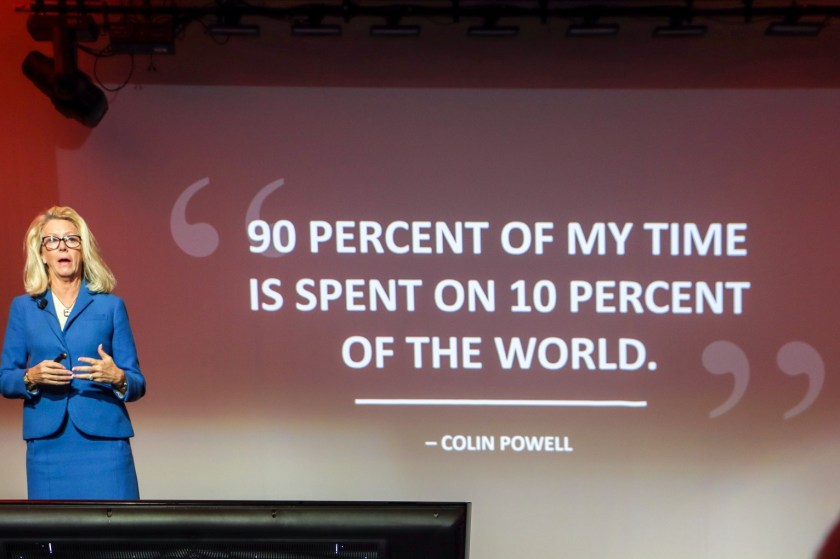
The Texas City Management Association’s (TCMA) Annual Conference started on Friday with a warm welcome from TCMA’s President and City Manager of Granbury, Chris Coffman, followed by other welcome messages by the Mayor of Fort Worth, Dennis Shingleton, followed by the City Manager of Fort Worth, David Cooke, and Karen Pinkos, President of the International City/County Management Association (ICMA). Pinkos spoke about the important role city managers hold, and how their job is not only to value, but also to include people in the community. Pinkos also spoke about a new ICMA program for assisting service members transitions into local government. Cooke then introduced the keynote speaker, Dr. Bertice Berry. In her keynote address, “Living and Working in Purpose,” Berry captivated the audience with her humor and her sincere message.
Dr. Berry also encouraged the audience to leave a legacy–not when you pass away, but every time you leave a room. “When you walk with purpose, you collide with destiny.” Dr. Berry’s keynote speech made the audience laugh, tear up, and excited for the conference’s start.
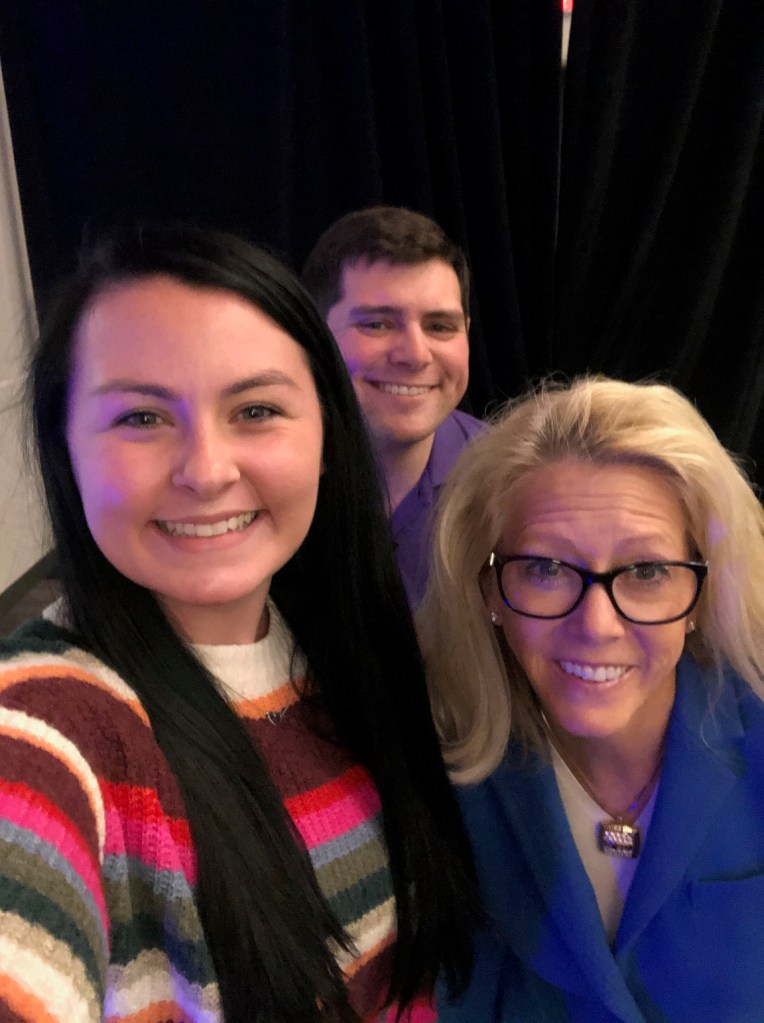
The speech definitely worked for me, and I was fortunate to get a photo with her after her speech.
Texas A&M University School of Law (Esmeralda Mata)
I had the opportunity to meet Jeff Green, Graduate Programs Coordinator, and tour the beautiful campus building, from the library to classrooms and even the administrative offices.
Since purchasing Wesleyan Law School, Texas A&M has worked hard bring in top law professors, recruit good students, and make the law school competitive in every way. This is great news for students, but it also means that each year the school becomes more competitive. Mr. Green explained this on our tour, while also describing TAMU’s rich traditions, such as the “12th Man” and “The Big Event,”activities that “demostrate A&M’s core values.”
Mr. Green was also helpful in discussing the general process for getting into law school: preparing for the LSAT, taking the LSAT, getting letters of recommendations, and, of course, earning great grades.
It was a great tour, and I am very appreciative to Mr. Green for his time and insight.
Second Morning Session:
To maximize the coverage and education we will receive, we split up and attended both the “Valuing Equity, Diversity, and Inclusion” session as well as the “Managing Health Case Costs” session.
“Valuing Equity, Diversity, and Inclusion” included three panelists: Karen Daly (ICMA, Mountain Plains Regional Director); Carla Scales (Founder, Scales Consulting), and Mike Land (City Manager, City of Coppell). They emphasized the importance of qualifications; as Ms. Scales noted, “If my house catches on fire, I would like the most qualified firefighter to go to my house.” But they also emphasized strategies for getting diverse applicants: recruit from top and key institutions; post openings in a wide geographic range; and be thorough in your vetting. With Texas being a majority-minority state very soon, the emphasis on diversity becomes ever important.
The “Managing Healthcare Costs” was particularly enlightening, with presentations by Samantha Dean (Workforce Services Director, City of Carollton) and Brian Dickerson (HR Director, Fort Worth). We learned, for example, that the two most expensive costs in a City’s health care program are (1) retirees and (2) spouses.
These cities have taken different approaches to reducing costs, such as (1) negotiating with companies for the cheapest rates, (2) making preventitive care mandatory (penalties are actually imposed if you don’t get a checkup, for example), and (3) not covering spouses–only if spouses have access to care from their own jobs.
Lunch at the Little Red Wasp
Walking into Little Red Wasp, the bright red chairs and minimalistic arrangement drew our attention immediately. Our server was attentive, and the food was amazing. For lunch, we weren’t very adventurous, choosing the boring (but really good) crispy chicken sandwich with cabbage slaw, spinach, tomato, and tapenade…
…while Professor Yawn ordered a roasted Portobello sandwich with goat cheese, spinach, tomato, and tapenade. We were all pleasantly surprised with our options – and agreed that the various ingredients and condiments corresponded well with each other. We recommend!
“Breaking into the Profession,” featured a panel including City Managers Sereniah Breland (Pflugerville), Robert Camareno (New Braunfels), and Gina Nash (Sachse), and Karen Daly, ICMA Mountain Plains Regional Director. All the panelists spoke about their own untraditional path to being a city manager. Several emphasized the importance of networking and forming connections whenever you can. Our favorite portion of the panel was the advice from Sereniah Breland to the young professionals: “If you wait until you’re ready, you’ll never do anything. Do it, and if you’re scared, then do it scared.” We would meet Ms. Breland again on this rewarding trip.
Kimbell Art Museum
After the conference we had the opportunity to visit the Kimbell Art Museum, designed by architect Louis I. Kahn. The sun was still shining in the early evening which allowed the natural light to pour into the building and illuminate the paintings, which appealed especially to Esmeralda, on her first visit to an art museum.
The Kimbell has pieces by several famous artists such as…Rembrandt van Rijn….
…Vincent Van Gogh (whose painting was prohibited from photographing)…Piet Mondrian…
…Cezanne…
…and others…
This slideshow requires JavaScript.
The Kimbell’s current special exhibition is “Monet: The Late Years” which showcases a collection of pieces from Claude Monet’s works in the twenty years or so years prior to his death in 1926. The exhibit is laid out in a more or less chronological progression of his works from 1900 to his final piece in 1926.
Throughout the exhibit you can see how Monet’s struggle with cataracts influenced elements of each painting in the colors he used and the size of each brush stroke. For example, the detail in this piece suggests it was one of the earlier pieces in this exhibit.
And, indeed, the piece above was painted in 1904. The piece below, on the other hand, was painted in closer to his death, when his eyesight and style had changed, moving him in a more abstract direction.
Miranda’s favorite painting from the exhibit was entitled “Roses,”
and Esmeralda’s was “Weeping Willow.”
We both enjoyed seeing the layout of Monet’s estate, and his garden, where he drew his inspiration for his paintings.
Reata Restaurant
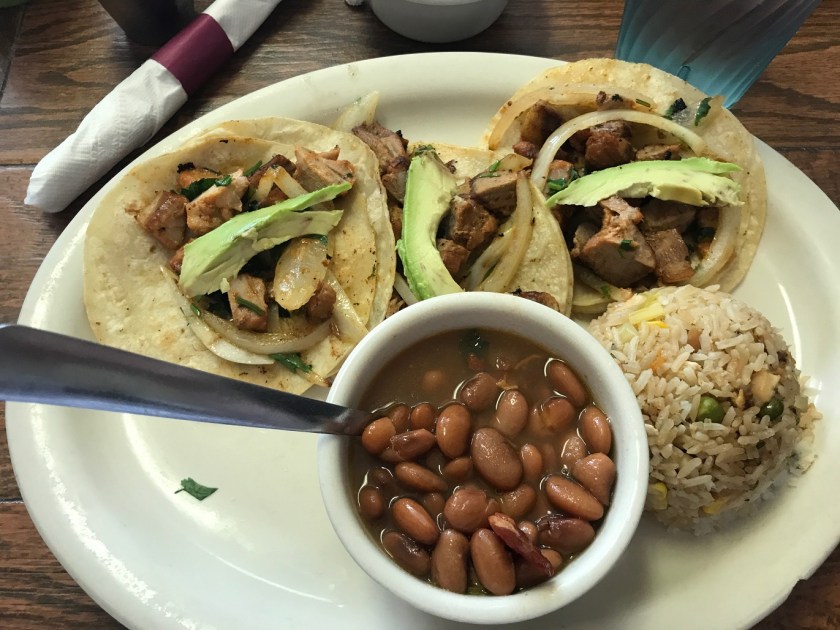
Reata Restaurant was definitely a new experience — a mix of country and fancy, with expensive cigars displayed at the entrance, and raised candle centerpieces. Given the atmosphere, we were surprised that it was a more “Mexican” place to eat, evidenced on the menu. For starters, we ordered jalapeno and cheese elk sausage…
tenderloin tamales with pecan mash…
and Reata’s classic cornbread with butter. Those who had them especially enjoyed the tamales – they were nontraditional to say the least. For our entrees, we ordered boring food…grilled chicken breast topped with tomato bleu cheese salad, and chicken chile rellenos served with roasted corn chowder, and one slightly more adventurous chef’s special = quail. With a few minor exceptions, everyone else seemed to enjoy their food (Esmeralda was not a fan of the bleu cheese on her entrée). For dessert, we shared molten chocolate cake with drunken berries and vanilla cream, and a cappuccino crème Brule.
Miranda absolutely loved her dessert; it was my first-time tasting crème Brule, and while I was a bit anxious, I enjoyed it – it tasted like a melted cappuccino from Starbucks, with a buttery texture. We all agreed while it was nice to try new things, we had eaten too much over the course of the day!
Sight-Seeing
To walk off a few of the calories from dinner, we decided to visit “Sundance Square” in Fort Worth, which features places for people to congregate, water fountains, and a beautiful Richard Haas Mural, “The Chisholm Trail.”
This location held particular interest for Esmeralda, who is interning with Linda Pease at the Wynne Home. Ms. Pease was responsible for having Richard Haas do some fourteen mural projects in Huntsville in the 1990s, and it was definitely interesting to see another of his large-scale works.
We also made our way over to the Forth Worth Water Gardens, which were designed by the great architect Philip Johnson in the 1970s. The site was used in the science fiction film “Logan’s Run,” as evidenced in this scene:
We made sure we used this opportunity to get some nice photos.
Megan Chapa served as a LEAP Ambassador for more than three years, filling the role of Vice-President, President, and Past President. She also served as founding President of the Pre-Law Society, and she will be a 3L at South Texas College of Law this fall. She volunteered to write this guest blog on her experiences at SHSU and as a LEAP Ambassador.
I am a third-year law student at South Texas College of Law Houston. I served as a LEAP Ambassador from 2014-2017 as I earned by Bachelor’s degree from Sam Houston State University. Those three years were the most influential years of my educational experiences, and the opportunities I was offered and the people I met as a LEAP Ambassador have served me extremely well in law school.
Chapa at Capitol Hill in Washington, DC, where she interned her senior year
As a LEAP Ambassador, I learned to not only balance my school, work, and internships, but also leadership positions.
Megan Chapa at the Arkansas Supreme Court
This meant managing my time appropriately. Thinking back, many of those days were similar to my first year of law school. I remember some days as a LEAP Ambassador, I would go to class in the morning, intern in the afternoon, and then, about three times a week, I’d attend one of the many programs we participated in or attend a community meeting.
Chapa and Karla Rosales with KSAM’s Larry Crippen
I would get home with just enough time to study and prepare for the next day. Gaining the skills to manage my time, set me up well for law school.
I served as the President of the LEAP Ambassadors for a full year, a normal term for a LEAP President. During these times, I learned to sharpen my emotional intelligence to better understand how to lead others. I encouraged my colleagues to build on their strengths and work together on tackling the task ahead, and I also had key public speaking opportunities.
Chapa speaking in a mock City Council
I used similar skills during my tenure as a Mid-Law Senator for the Student Bar Association—South Texas College of Law Houston Chapter. As my experience in LEAP taught me, I did my best to use my strengths in my leadership.
One of my favorite memories as a LEAP student was meeting Michael Morton.
Alex Galvan, Michael Morton, Megan Chapa, and Kaitlyn Tyra
Michael Morton was wrongfully convicted for the murder of his wife in 1987. After spending over twenty-five years in prison, he was exonerated of this crime. Morton spent some of his incarceration in a Huntsville prison. When I met Mr. Morton, he explained to me that it was his first time back in Huntsville since his incarceration. In that moment, I felt honored that the LEAP Ambassadors had arranged that, enabling him to return to the community under more pleasant circumstances and allowing SHSU students to learn from his experiences.
I did not realize that moment would only scratch the surface of how much it really meant to me. In law school, I learned the importance of the Michael Morton Act, an act that requires an open discovery process, and how this act has impacted prosecutors throughout the state of Texas. The fact that I had the opportunity to meet such an influential person in the criminal law community early on, made the world of difference in understanding the importance of integrity and pursuit of justice.
Of course, I had many more opportunities with LEAP, from traveling to other states, such as Arkansas…
…Missouri…
Ryan Brim and Megan Chapa in one of the elevator pods at the Gateway Arch in St. Louis
…Georgia (and about twelve other states)…
Chapa, Tyra, and Rosales visiting Coca Cola, with the Coca Cola Polar Bear
…visiting Presidential Libraries…
…meeting artists such as Richard Haas…
…and David Adickes…
…attending conferences with state legislators….
…and even presenting at conferences…
…and also doing charitable work, such as Huntsville’s “Great Muddy Escape”….
…or public services such as our “John Wayne Film Festival.”
…and meeting attorney David Berg, who, at my first LEAP event, shared with us his experiences as a lawyer and his personal family history, including the murder of his brother, as he recounted in his book, “Run, Brother, Run.”
Currently, I am an intern at the Harris County District Attorney’s Office where I hope to be employed in the near future. Applying the time management skills, the leadership skills, and taking advantage of the connections I made with others as a LEAP Ambassador have made me the student I am today. I have no doubt that LEAP made a difference in my life. I am a better professional because of my experience with LEAP, something that I think can be said by all the students involved in the program.
It is our last day, and we are determined to get the most out of it!
Art Institute of Chicago
Ilexus Williams
The LEAP Students headed to the Art Institute of Chicago, which was established in 1878.
It is one of the oldest and largest art museums in the U.S, and it has a permanent collection of more than 300,000 pieces. This was by far the largest art museum the LEAP Students have visited. It would be nearly impossible to see all of the exhibits. However, we managed to get a sense of everything the museum had to offer.
First, we started with The Great Wave by Katsushika Hokusai.
This piece is one of the most famous Japanese woodblock prints, and it is the most recognized. The print shows an enormous wave risking the safety of three boats. In the distance, at the base of the wave, is Mount Fuji.
Next, we viewed Marc Chagall’s America Windows, which shows a beautiful set of stained glass windows. Chagall’s stained windows were inspired by the United States adherence to cultural and religious freedom, and we saw a similar window at the United Nations earlier this year!
We saw many pieces that exemplified impressionism, an art style that is a reaction to the creation of photography. Instead of taking days catching every detail in a painting, artists would paint based on how they felt in that moment and paint an “impression” of that scene. Painting incorporated emotion rather than emphasizing technical accuracy. One of our favorite pieces was Icebound by John Henry Twachtman. Twatchman did not want to depict winter as a solitary and desolate scene because he found beauty and life in this season.
The most notable impressionist artist is Claude Monet. Monet is a French artist, and he is credited as the founder of the impressionist technique. One of his most recognized piece is Sacks of Wheat. Claude Monet captured this image outside of his farmhouse. The wheat sacks are said to be a symbol of sustenance and survival. He is also very known for his Bridge paintings, which we also enjoyed.
This slideshow requires JavaScript.
Another influential impressionist or post-impressionist artist is Georges Seurat, well known for pointillism. Pointillism is an art style created by making small clusters of colored dots to form an image. His most prominent work that displays this technique is A Sunday on La Grande Jatte.
We also saw a self portrait of Vincent Van Gogh.
Next, we moved to the modern American art exhibit. Here we saw remarkable pieces such as Edward Hopper’s Nighthawks.
We also recognized an artist that the LEAP students are familiar with: Georgia O’Keeffe. She is acknowledged as the Mother of American Modernism. Her work often depicts magnified images of flowers…
…and also often incorporates images of animal remnants.
Another interesting piece was by Ivan Albright. All of his pieces, at least that we saw, were gory, morbid, and disturbing. For instance, his piece Picture of Dorian Gray was inspired by Oscar Wilde’s novel. In this story the main character has a portrait of himself painted as a young man. Later in the novel, he trades his soul for everlasting youth. However, he continues to live an immoral lifestyle. As the story unfolds, his self portrait that once captured youth had turned disgusting, reflecting his sins and decadence.
The most recognized piece in the Modern exhibit is Grant Wood’s American Gothic. While visiting Iowa, Grant spotted a Carpenter Gothic style farmhouse and wanted to paint individuals that he believed would inhabit the home. Grant believed that his subjects needed elongated faces to match the house. As a result, Grant used his sister and his dentist to portray a farmer and his daughter. His subjects stood as a symbol of rural American survival.
Before leaving the Modern American Art wing, we took a picture of a work by a LEAP favorite: Ellsworth Kelly.
Before heading to the Contemporary portion of the museum, we stopped to view the ‘Sky above the Clouds IV’ by Georgia O’keeffe.
In the Contemporary art exhibit we viewed many well known artists such as Andy Warhol…
….Jackson Pollock…
….and Pablo Picasso.
The LEAP students had a great time exploring the Art Institute of Chicago. It was incredible to see such a wide variety of art.
Chicago Style Pizza at Uno Pizzeria & Cloud Gate (aka, The Bean)
Maggie Denena
Our next stop after the art museum was to eat lunch at Pizzeria Uno, a deep dish pizza restaurant that was founded in 1943.
I had never had an original deep dish pizza before, and my expectations were high because we were in Chicago.
But first, we had to stop back by Cloud Gate to see the work in the daylight. There were tourists and families everywhere around Millennium Park; it was so crowded it was hard to get a good picture in front of the Bean. As beautiful as the sculpture is on a sunny day like Saturday, I am glad we were able to go the night before and appreciate the art without the crowds.
We did our best to get a few good “LEAPing” pictures that we couldn’t get in the dark, and then continued on our way to lunch.
We also detoured to see Frank Gehry’s Pavillion…
…replete with his rolling titanium curves.
We took a taxi the rest of the way to Pizzeria Uno—my first time in a taxi as well. The taxi ride was an interesting experience. Even though it was about 2:30pm by the time we arrived at lunch, the restaurant was still packed! The hostess told us there would be about a 30 minute wait and took our pizza order at the front so that the pizza would be ready for us when we were finally seated, which I thought was quite efficient.
Professor Yawn and I ordered a medium Numero Uno to share, a deep dish pizza topped with a bit of everything, including Uno’s signature chunky vine ripened tomato sauce. Ilexus ordered a small Farmer’s Market, a vegetarian deep dish topped with onions, spinach, and sun dried tomatoes along with other pizza toppings.
We were seated about 20 minutes after arriving and the inside of the restaurant was small and cramped but had a fun and original vibe to it. The booths and tables were close together, really emphasizing the authentic atmosphere of the location. Not long after we were seated our pizza was brought to our booth table. We definitely over ordered, not knowing how large the pizza’s would be. The deep dishes were fresh out of the oven and since we hadn’t eaten since breakfast, I was eager to dig in. Honestly, the Farmers Market was my favorite between the two because I felt that it was a bit different than any other pizza that I have had, not that the original Numero Uno let me down at all. The deep dish pizzas at Numero Uno really rounded out our Chicago experience, and I hope to be able to go back there again someday!
That afternoon, we headed towards the 360 Chicago Observation Deck at the John Hancock Center located in the Magnificent Mile district. The skyscraper is 100 stories tall, coming in at 1,128 feet high. When the building was topped off on May 6, 1968, it was the second tallest building in the world, second only to one in New York City. It is now the fourth tallest in Chicago and the ninth tallest in the world. Another neat fact is that it has the second highest resident population in the United States, behind Trump Tower in Chicago. Although it isn’t the tallest building in Chicago, it is home to the “TILT” thrill ride where an enclosed platform tilts you over the edge of the building, looking down toward a seemingly impending doom. The TILT is at a 30-degree angle from the building. Ilexus and I did the TILT first, and then Professor Yawn after us. I was less distraught and more disoriented after looking down over the city. The ride probably lasted less than a minute, but my upper body strength was slacking as I braced myself above the glass enclosure from 1,030 feet in the air.
The 360 observatory is located on the 95th floor and offers a view of up to four states, 80 miles in the distance.
After tilting off of the John Hancock Center while more than 1,000 feet in the air, the LEAP students decided to spend their final night in Chicago with their feet planted firmly on the ground at the Navy Pier.
The Navy pier is a 3,300 foot long pier off of Lake Michigan’s shore. While exploring the pier, we noticed that there were musical performances, so we followed the music and it led us to the Chi- Soul Fest. This festival was established as a way to celebrate Black Music Appreciation Month, which is during the month of June. We heard covers of famous artists such as Prince, Erykah Badu, India Arie, Kanye West, John Legend, Kool & The Gang, and Curtis Mayfield. The performances were truly captivating.
So much so that almost everyone listening could not sit still. You either wanted to get up and dance or just nod your head to the beat.This truly was a soulful experience.
Next, we walked the pier and enjoyed the beautiful view it gave of Lake Michigan and Chicago’s Skyline.
We had hopes of riding the ferris wheel, but the line was extremely long. However, we did manage to get great pictures.
Our time was slowly winding down in the Windy city of Chicago, and it truly hurt that we had to part from this beautiful city. This trip has been nothing short of miraculous, and I am genuinely thankful to have the opportunity to explore so many parts of the world. See you later Chicago!
Before leaving Wisconsin on day five of our Midwestern Journey, the LEAP students, both of whom have aspirations to become attorneys, toured the University of Wisconsin Law School.
The Law School, which is considered a top-tier law school nationally, was founded in 1868. It has concentrations in business law, criminal law, estate planning, family law, international law, labor and employment law, and real estate law. The School motto, which both of us found to be significant is “law in action.” This motto is practiced throughout the entire program. There are numerous opportunities to give students hands-on experience with the law, including 14 in-house clinics–such as their Family Court Clinic, Immigrant Justice Clinic, Criminal Appeals Project, and Federal Appeals Project. They even have the Wisconsin Innocence Project, which is a clinic that works to exonerate wrongfully convicted individuals.
They also have three student journals: Wisconsin Law Review, Wisconsin International Law Journal, and Wisconsin Journal of Law, Gender, and Society. In student journals, law students will take articles that law professors or other professionals in the legal field have written and will give their review of the article. Interestingly, in the Wisconsin International Law Journal, one of the professors helped write the constitution for South Africa after the abolition of Apartheid.
The University of Wisconsin Law School has a Law Library, which we were warned we would spend many hours in. Oddly, we would rarely use the copious amount of books that lined the shelves and would rely, instead, on many online resources and carrels for study space.
Next, we headed to the Quarles and Brady Reading Room, which is another popular study spot.
This room has a notable mural by John Steuart Curry titled “The Freeing of Slaves”.
The University of Wisconsin Law School also has more than 36 student organizations. A few of those organizations include Women’s Law Student Association, Wisconsin International Law Society, Wisconsin Association of Criminal Defense Lawyers, Latino/a Law Student Association, and the Black Law Student Association. Additionally, there are both Moot Court and Mock Trial teams. We even were able to see where the teams practice.
The University of Wisconsin Law School is filled with interesting traditions. At every homecoming football game, third year law students will run from the north end of the football field to the South end of the field with bowler hats and walking canes. The students attempt to throw their canes over the goalpost. If they catch the cane on the other side of the goalpost, then it is said that he or she will win their very first case.
Overall, we enjoyed our first law school visit and we may even consider becoming future Badgers!
Sadly, this concluded our Wisconsin visit. Just like that, we were on the road again headed for Chicago!
Frank Lloyd Wright homes(Chicago Frank Lloyd Wright District)
Before we made it to Chicago, the LEAP students stopped by the Frank Lloyd Wright Historic District in Oak Park, Illinois. We decided to hunt, on foot, for Mr. Wright’s homes. There were many Frank Lloyd Wright look-alikes, but we managed to spot many of Mr. Wright’s original well-known Prairie Homes and even some of his early Queen Anne Style homes.
This slideshow requires JavaScript.
We also stumbled across Ernest Hemingway’s Birthplace!
Chicago
Maggie Denena
Getting back into Chicago was a mess; I’ll never complain about Houston traffic again! We stayed at The Palmer House Hilton Hotel, which is located between State Street and Michigan Street, in the middle of all the action. We had an Architectural Tour of Chicago (by boat!) scheduled for 7:30 that evening, so after we got our stuff moved into our rooms we headed straight into the crowded streets and started walking towards the river.
It was a nice crisp walk, and I am thankful I remembered to grab my jacket before we left the hotel. Despite being in June, the temperature was in the 50s with wind. We were doing the Chicago Architecture tour with Chicago’s First Lady Boat Tours. This tour is considered a “must do” by most tourists and locals. The tour was 90 minutes, and we had a volunteer speaker to teach us about some of the architecture and buildings unique to Chicago. I really enjoyed being able to go in the evening and seeing the city after dark, which really gave a different perspective to the Chicago skyline; it was like something from my imagination.
We learned that one of the things that sets the city’s architecture apart from other cities is the Great Chicago Fire in 1871 that burned for 3 days and leveled over 3.3 square miles of the city. The fire is said to have been started when “Daisy the milk cow” kicked over a kerosene lamp in her barn (this may be a legend…) leaping across the polluted river, the town and water burned like wildfire.
Despite the devastation, it turned out well for Chicago. The rebuilding occurred at a time when technological innovations allowed the city to rebuild with new materials and, notably, much taller buildings than previously. Talented architects and builders moved to Chicago to get part of the action. The result was a brain gain, followed by skyscrapers and other innovations.
Along the tour, we saw the early skyscrapers…
….some Art Deco….
….and a whole lot of postmodern or contemporary architecture, including the Willis Tower…
…and the Marina Towers…
…which were the setting for a notable scene in Steve McQueen’s “The Hunter.”
We finished the tour by going out to Lake Michigan…
…and getting a just-after-sunset tour of the beautiful city skyline.
Our tour guide was articulate and knowledgeable about the city’s history of architecture and development. Overall, the boat tour was a great experience and it is definitely something I would do again if I find myself in Chicago again.
After exiting the boat, we began the walk back to our hotel, stopping to take some pictures in front of Trump Tower, but that was mainly for my benefit.
We headed towards the Ghirardelli store where we each ordered a sweet drink. Even though it was the end of June, I still ordered a hot chocolate because of the colder conditions up north than we have been experiencing here in Texas. Professor Yawn ordered a chocolate shake that looked delicious, and Ilexus ordered a drink that was basically melted Ghirardelli chocolate in a cup.
She was generous enough to let me try the rich chocolaty drink. My hot chocolate really hit the spot, especially after spending the chilly evening on the boat.
Our next stop on the way back to our hotel was to Anish Kapoor’s Cloud Gate which was finished in 2006.
The sculpture is located in Millennium Park and took two years to complete. Popularly known as “the Bean”, visitors can walk under the sculpture’s 12-foot arch. Normally, there is a large crown around the Bean, but since we went at night there weren’t too many people around. I honestly enjoyed it more because we had more time and space to take some fun pictures of each other and appreciate the art.
It is a stainless-steel structure that was designed to mimic the reflection and movement of liquid mercury. Showing a distorted reflection of the city’s skyline, it provides a cool perspective for photographs.
Anish Kapoor also designed the Cloud Column in Houston, Texas, which the LEAP Ambassadors have visited!
And, on a trip last summer with the LEAP Center, I was able to get a good picture of his Upside Down, Inside Out design at the Phoenix Art Museum.
And the LEAP Ambassadors again had a chance to see Kapoor’s work at the Massachusetts Museum of Contemporary Art.
But, back to this trip, we also had a chance to enjoy Jaume Plensa’s “Crown Fountain” sculptures…
…which are 50 foot tall digitized faces, that, in addition to having water trickle down the front of the sculpture, also occasionally have water spouting of the faces’ mouths.
With the reflecting pool in between the two sculptures, we were able to get some especially nice photographs!