Dr. Rozelle is the Hellen F. Farnsworth Senior Fellow at Stanford University. He began by explaining his interest in international affairs, specifically China. Dr. Rozelle quickly identified the massive divide seen in China amongst the Urban and Rural areas. This divide is fueled by the long-lasting impact of rural farming and developing industry in the urban areas. Literacy rates and education is at an all time low for those found in rural China, while urban areas are growing and thriving.
Dr. Rozelle also entertained the idea that with the way things are moving, China is becoming more susceptible to an economic crisis–which would, of course, affect the rest of the world and, especially, those who rely on China heavily.
Dr. Rozelle noted that, in China, citizens are given an Identification card that states whether they are from a rural or urban part of China. Upon hearing this, Ziwen reached for her wallet to show us her Identification card that highlighted her urban status.
After the lecture, Ziwen was gracious enough to tell us more about the culture in China, which we learned about while eating Chinese food, selected by Ziwen.
As we expanded our knowledge on the culture and customs in China, Ziwen also taught me how to write her name and my name in Chinese characters.
I was nowhere close to perfection in copying my symbols, but it was fun to practice and learn more about the Chinese culture.
Heather Barodi, Emma Anderson, Erin Juarez, and I were eager to begin our recruitment for the Pre-Law Society at Saturdays at Sam. This event is held in the Lowman Student Center mall area where almost all 250 organizations at Sam attended. Each organization had their own table and were ready to teach students more about what their organization consisted of. Our table had displayed a Pre- Law Society shirt, a pamphlet, and some sweet treats!
Although the turn out was not great, we tried our best to be as engaging and informative in describing what the Pre- Law Society has to offer. We informed students about past and future events and opportunities we have. While we were able to teach others, we also expanded our knowledge on what other organizations are doing on campus.
Towards the end of the event, we had a special guest come. My dog, Pupito, made an appearance that attracted students and other organizations to our table. It was a great way to finish off Saturdays at Sam with smiles on each volunteers face and a furry friend helping recruit.
This past week, LEAP Ambassadors, Pre-Law Cohort members and LEAP LEADs members ventured to the Woodlands for a World Affairs Council event featuring Jim Olson, former Central Intelligence Agency operative. Attendees included Yvette Mendoza, Jessica Cuevas, Lucy Mccool, Emma Anderson, Erin Juarez, Mario Ocampo, Saara Maknojia, and me.
Upon arriving at the John Cooper School we were shocked by the beauty of the school and admired their layout. Fortunately, we arrived early enough to meet the Program director and many other staff members.
Also, we were able so grateful we had the chance to meet and visit with Mr. James Olson before his presentation, he inquired about our plans after undergrad, and we told him that most of us are planning on applying to law school. Mr. Olson shared with us a little about his time at Iowa University of Law and the difficulties of law school.
After the brief conversation, we found our way to our seats and anxiously waited to hear a few of Mr. Olson’s stories. He was introduced by staff from the John Cooper School and the WAC….
…and we enjoyed our second row seats.
With much of my knowledge about the CIA and other government organizations being from media and tv shows, I was happy to learn from a first-hand source about what it was truly like.
Mr. Olson spoke on many topics ranging from meeting his wife Mrs. Meredith Olson at “work,” to his favorite operations, and officially retiring to accept his current job as a professor at the Bush school.
With every new topic he spoke on, I found myself with even more questions than before.
Toward the end, he took questions from the audience, and two of our questions were selected!
Afterwards, Mr. Olson graciously posed for pictures with SHSU students as well as signed copies of his books with personalized messages.
It is clear Mr. Olson has a passion for meeting and working with students, which in turn, inspires further generations and maybe even operatives.
My favorite aspect of the night was Mr. Olson’s display of pride in his work and in our country. Hearing him speak is enough to leave a listener looking for a signup sheet for the CIA (though that is not the only way to be spotted…).
Genghis Grill
October 5, 2021
Saara Maknojia
As we headed out from the World Affairs Council event with Jim Olson, the LEAP members went to a restaurant specialized in Mongolian cuisine, called Genghis Grill. We were kindly seated by the working staff at the beautifully decorated restaurant. The vivid red and black interior was eye-catching like no other, giving it a very realistic feel of East Asia. The cultural food presented to us was well garnished and customized to each of our likings.
Together as a group, we ordered the Mongolian Dragon Balls which were covered in a delicious chili garlic sauce, as well as the pork and chicken potstickers.
The LEAP members had entrees that all consisted of flavourful bowls of their choice of a base, protein, and amount of eggs. The variety of bases were an assortment of rice and noodles. Students went up to the assembly line where they picked and chose what toppings and meats they would like. The members favorite meats were chicken and steak garnished with the savory teriyaki sauce or the spicy sweet and sour sauce. Genghis Grill allowed us to grasp a better understanding of the cultural foods that are presented from the regions of Mongolia in China.
This past weekend was rather eventful for the LEAP Ambassadors, and on Saturday evening Jessica and I volunteered at the Wynne Home Arts & Visitor Center Harvest Festival. We arrived a few hours early before the event to assist with a fall festival at the beautiful historic home and art center. Inside the outdoor classroom, Cultural Services Manager Sarah Faulkner and Admin Assistant Caitlin King had begun to set up the food, which included a candy bar, pita chips with an assortment of hummus, and Frito Lay Scoops for chili from McAlister’s. After we were satisfied with the display of the food, we began setting up the drinks table, craft tables and all other decorations that needed to be placed on the yard.
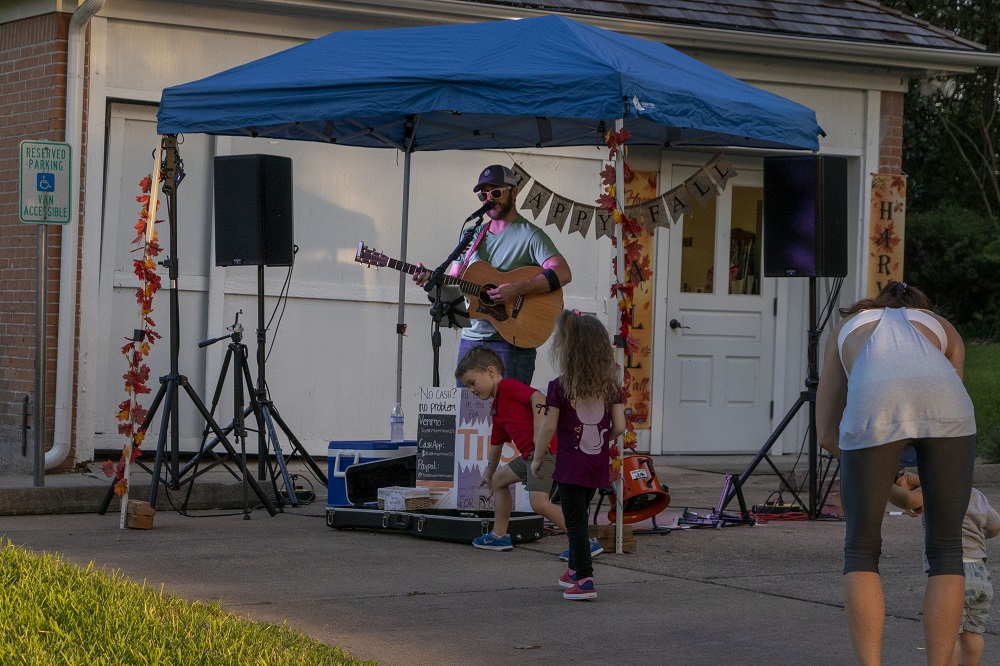
Needless to say that The Wynne Home’s beautiful backyard was fully utilized during the Harvest Festival, with the two craft tables set up in the yard and dispersed lawn chairs for the crowd that came to listen to musician Scott Morrison.
He presented a variety of songs by different musicians such as Frank Sinatra, Johnny Cash, and more for the crowd to choose from. The crowd loved him and were appreciative of Scott for allowing them to choose what song he should play next.
The first craft table included mini-foam pumpkins where guests, mainly the children, could express their artistic abilities by painting and adding stickers to them.
The other craft required a little bit more attention to detail and more fine motor skills since they had to trace a leaf pattern onto festive paper, cut it out and then decorate it with glitter and stickers using mod-podge. Then if desired, the leaves could be hole-punched and strung on a twine string to be displayed as a garland decoration, or an ornament.
All of the LEAP Ambassadors as well as SHSU student Erin Juarez, made their own leaves and connected them on a string. The Wynne Home kept our leaves and said that they would hang them up inside the home! I can imagine Ms. Stephanie or Professor Yawn having a laugh while trying to identify which leaf belonged to whom if they were to see them hung up.
Before the event wrapped up, Ms. Faulkner and Caitlin drew out a name from the raffle bowl to see who would be walking away with a fall-themed coffee basket. To add to the suspense, they had Scott announce the winner, but he did not announce it right away. Instead he told the crowd that in his hand he was holding the name of the winner but would not announce it until after he played another song. At the end of the song, he announced that the lucky winner was SHSU Geology Professor David Moss. Afterwards, he continued to play more songs and closed with one of his favorite songs, during which the children of professor Moss came up and donated money in his guitar case.
It was a fun way to spend our Saturday evening, and we are glad we were able to help the community and Ms. Faulkner.
Erin Juarez and I spent the evening time traveling to the 50’s at the Old Town Theatre’s Tribute to Frank Sinatra. This authentic concert, performed by Dave Halston, created an atmosphere of romance and nostalgia. The Theatre’s Sinatra Experience attracted almost 300 guests that came from all over Texas (some even from San Antonio) to Huntsville! The crowd was eager to come in before showtime just as much as we were to volunteer at the Old Town Theatre.
We had the opportunity to enjoy a beautiful concert and meet the audience members, from councilmembers to a Vietnam veteran, as we ushered them to their seats. The crowd kept growing as they began swarming the entrance to the Theatre, and Erin and I had the warmest smiles to greet such well-dressed and kind families and friends.
Getting closer to show time, more Sinatra fans were settling down in their seats.
At last, the piano accompanist began to play, and the words “Come fly with me” were being sung.
Everyone’s eyes were star struck at the beautiful music being played. While Erin and I were admiring the music, we had quickly switched gears from ushering to grabbing the camera and capturing the magic of Frank Sinatra’s music being performed.
Moving all around the theater we created the gorgeous star effect through the camera when capturing Dave Halston’s movements that mimicked Sinatra.
We continued to snap as many pictures as possible…
…and then it was time for a brief intermission. At that time Erin and I helped with the raffle ticket drawing. We were very successful collecting money to help fund the non-profit, Old Town Theatre. Now it was finally time to draw the winning tickets.
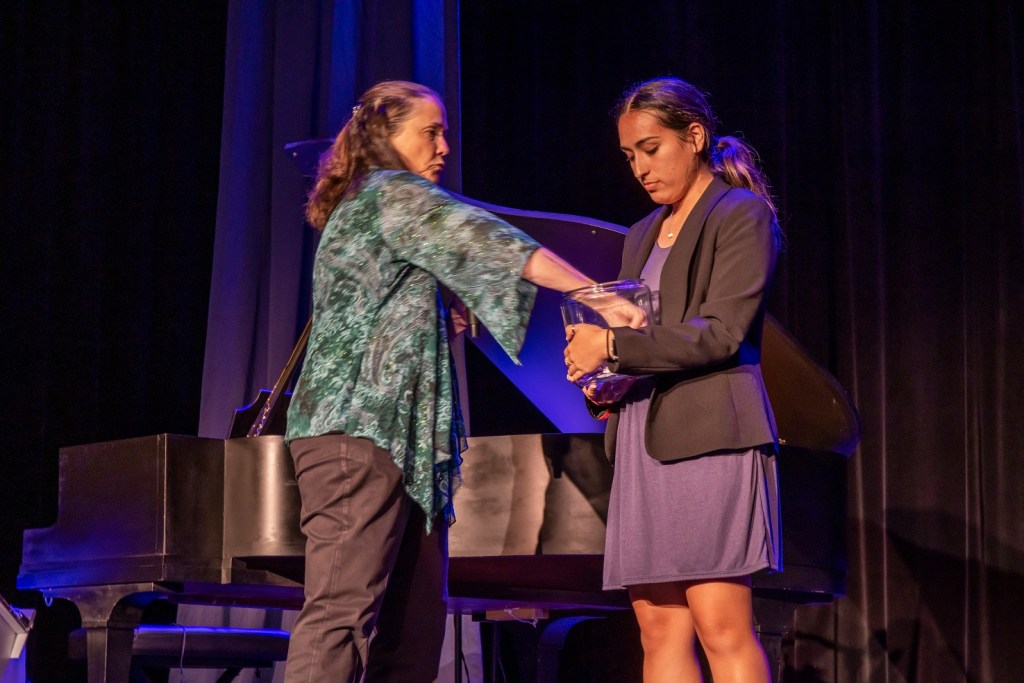
Erin went on stage with Mrs. Lauren Edwards to choose the winning raffle tickets. The crowd lit up when the winners were announced and given their free tickets to the next concert!
LEAP LEADs members enjoyed another eventful and informative evening at their third meeting of the fall semester. Discussion and presentations covered a variety of topics, from local government to professional strategic thinking (e.g., resumes, thank-you cards) and more.
We kicked off the evening with a discussion on personal-professional growth, expanding on our previous discussions on having a growth mindset, by examining a self-improvement method of sorts: becoming a more “T-shaped” person, with respect to knowledge base, developing not only breadth of knowledge and awareness on some topics, but also deeper depth of knowledge on specific areas most interesting to us.
We then went over the importance of a resume and how to properly write one. This helped us prepare for future jobs.
As part of our continued community exploration, we enjoyed local fare from El Gordo Taqueria for dinner. Dishes ranged from the very simple Nachos with Chicken Fajita meat to the more traditional plates such as Mexican Enchiladas, Carne Asada, and Mole Chicken. The portions were generous, and we all enjoyed getting to try out another “new” restaurant. (A special shout-out to the staff for the fast, friendly, and professional service – it can be tough to get 15 separate take-out dinners correct, but we had no problems!)
After dinner, we dove into a different sector from our two previous meetings, broadening our ‘micro’ discussions on law enforcement into a more ‘macro’ conversation on local (‘city’) government. Our two special guests, Mayor Andy Brauninger and City Councilmember Joe Rodriquez, provided their insight on how Huntsville works, and how a city should work, from the governance perspective.
Prior to our guests’ arrival, we had spent some time reviewing basic facts about city government structure, using the City of San Antonio’s organizational chart to compare and contrast types of departments and offices with the City of Huntsville. (Is it a coincidence that the author of this blog is from San Antonio…? Maybe – maybe not!) It was interesting to discover that, in spite of the size difference (San Antonio =1.4M+; Huntsville = 42000+), Texas cities are structured very similarly – we noted the cohesion of department types and office names.
Mayor Brauninger shared how his career in business was a very different animal than local government, and how he overcame the steep learning curve between the speed of private business and the care needed in the governance of a city.
Councilmember Joe Rodriquez’s telling of his journey resounded a little more closely with a few of our Hispanic members, who were intrigued by his long history of public service.
Thank you to both Mayor Brauninger and Councilmember Rodriquez, for not only sharing your stories and insight into local governance, but also both for demonstrating such care for community now, and for your military service to our country. More than a few of our group felt inspired, which showed when multiple hands were raised to volunteer to write thank-you cards, the topic on which we closed our evening.
After my shift for the Smith-Hutson Scholarship table at Saturday at Sam, I ventured to Huntsville’s downtown square to the Touch-a-Truck event, a community event for “the young at heart” to learn and interact with various commercial drivers and their vehicles, such as a S.W.A.T. truck, police car, fire truck, EMT, commercial trash pick-up, construction trucks and more.
My first stop was the S.W.A.T. truck, the driving factor that brought me out to this event. We had seen the exterior of the truck at our recent tour of the HPD, but I had never seen the interior, where all the gadgets exist.
There was a bit of a line to see the front of the vehicle since that’s where all the children were drawn for the opportunity to press on the two siren buttons. So I saw the inside of the back portion of the vehicle…
…took a seat and took a few photographs from the inside. The inside consisted of two benches for the S.W.A.T. team to sit on when being transported to a scene with just enough space for their equipment and it had two hatches on the roof, that were open for exhibiting purposes.
It was not until I was making line for the front of the vehicle that I discovered Professor Yawn was a few people behind me. I lost my place in line and formed line with him as we talked about what we had both already seen. When it was our turn, I got to sit in the passenger seat and release my inner child as I too pressed on the buttons for the sirens to go off multiple times.
I found that the longer I pressed the button the longer the sirens sounded. They had two different sirens that were extremely loud and obnoxious, especially up close. That fact did not diminish my fascination with them, nor prevent me from pressing the buttons repeatedly.
The buttons, plus the chance to visit again with Corporal Warner, made this a fun part of the visit.
Having had previously seen a firetruck, it was interesting to be able to draw the similarities and differences of a Harris County Firetruck to one of Walker County.
Although I did not see the ladder on the Harris County one, I was amazed to see the 100-foot-tall ladder on the WC firetruck extended on the square where children and adults were posing for photographs.
Next up was the Commercial trash pick-up truck, which at first I did not think would be that interesting, but I was quickly proven wrong when I spoke to Mario. Unlike older trash trucks that needed two individuals to throw the trash in, this one was automatic and picks up the bins with its equipped arm from the local businesses.
Another interesting fact that I found out was that they come equipped with a GPS screen that organizes all their stops into the best and more efficient route for them, and if another stop gets added it will create a new route for them. They even have cameras that will take pictures at each of their stops to track where they have been.
All in all I had a good time and was able to see and interact with community members such as Tammy Gann the city’s Economic Development Director…
As the event came to an end, I helped the Mainstreet Manager Annel Guadalupe and Molli Thompson-the Mainstreet Intern, clean up, bring down their tent, and carry items up to their office.
If you were unable to make it out this year, I encourage you to participate at the next Touch-a-Truck!
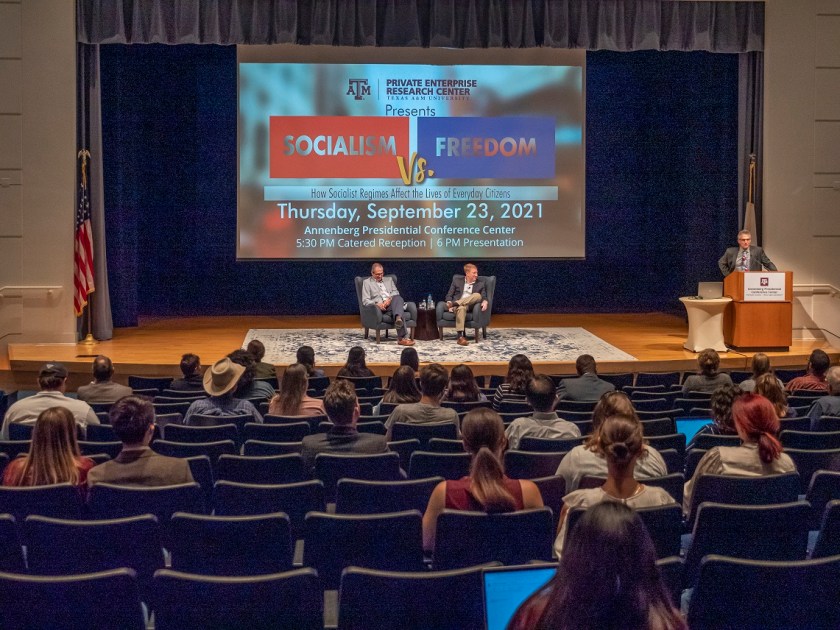
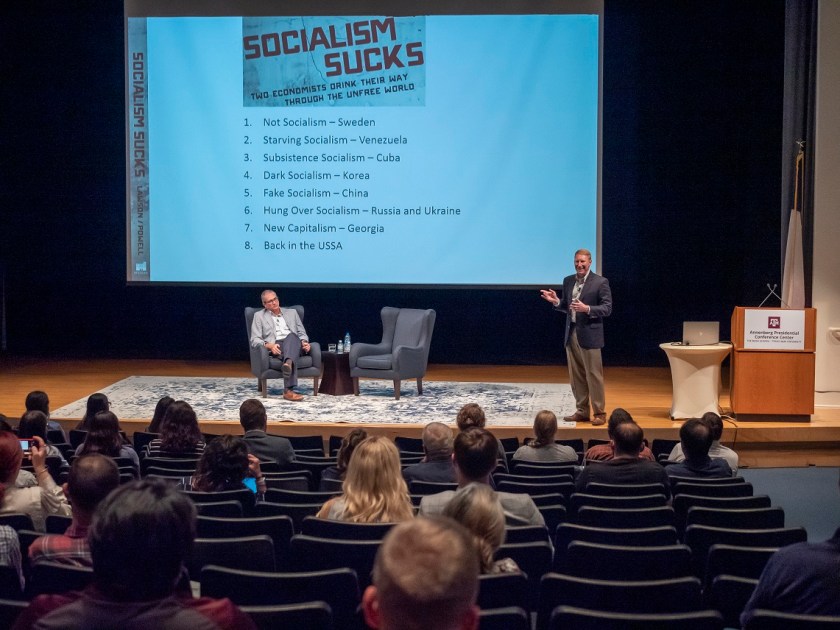
Powell and Lawson gave a presentation of the impact socialism has on our everyday lives. They started by defining socialism as a “collective ownership of means of production” and then proceeded to discuss why the countries they visited are or are not socialist.
To our amusement, their reoccurring theme was about the quality of beer or lack of beer in each of the countries. Sweden had good beer, Venezuela had run out of beer, Cuba had beer but only two types of which they did not like the flavor, Korean beer was toxic, Chinese beer was good, and Georgia (the country) has better wine.
The first of the countries was Sweden, which they deemed not socialist since they had private property and a free market.
Next up, was Venezuela which they titled as “starving socialism” ever since Hugo Chavez came into power. Where we also learned that all Venezuelans must travel to Columbia to purchase just about anything. However, Venezuelans are not allowed to travel by car but must walk on foot across the border.
Cuba was deemed subsistence socialism since all state-owned buildings, such as hotels, stores, and restaurants (even the private ones) operated at the minimum and lacked options due to their limited chain of supply.
We even learned that their 1950s cars sell for 15K, which is absurd and unreal since those cars no longer exist in the United States. It is hard to imagine that an 80-year-old car could be worth much of anything if it isn’t an antique in prestige condition, but for Cubans, a car like that is their most valuable asset.
Korea was categorized as dark socialism, China as fake socialism-trying to be totalitarian while having economic freedom, Russia and Ukraine as hung-over socialism–by which they mean that private property was reestablished and operates without a central plan but still suffering the effects from socialism, and the former Soviet Republic of Georgia is capitalist.
Their presentation was followed up with a short Q&A session…
…and as they wrapped it up, we walked up to them and thanked them for this amusing but informational presentation. They were even kind enough to allow us to take a picture with them.
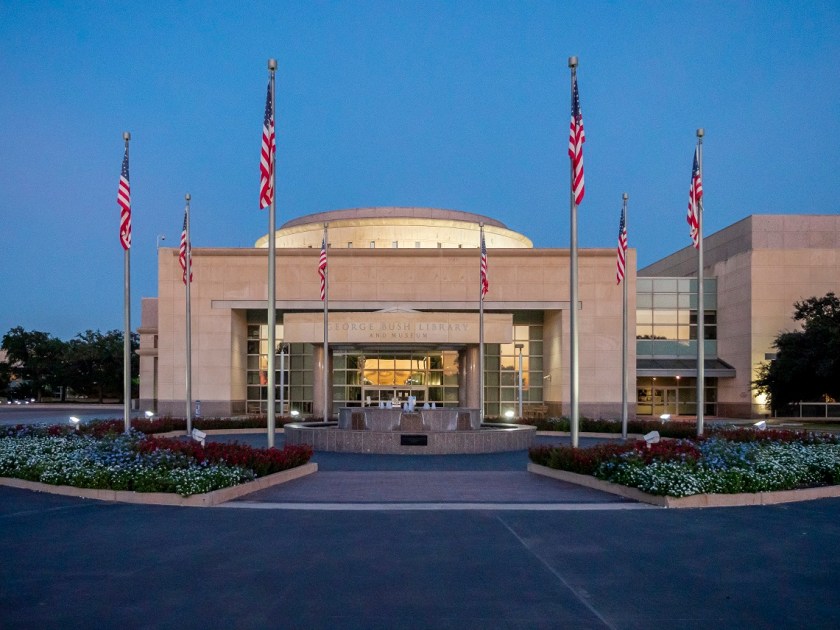
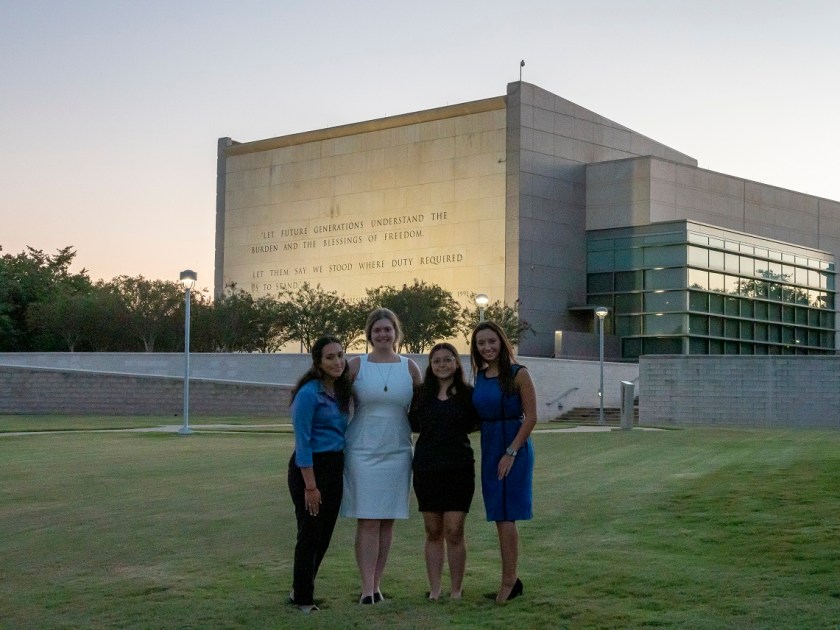
We then continued our night by strolling the beautiful grounds of the Bush Center where we saw President George H.W. Bush’s Presidential Library…
… a sculpture dedicated in his honor, the rose garden and presidential pond, the Bush Family’s Gravesite…
…and the inspirational quote on one of the exterior walls of the Presidential Library.
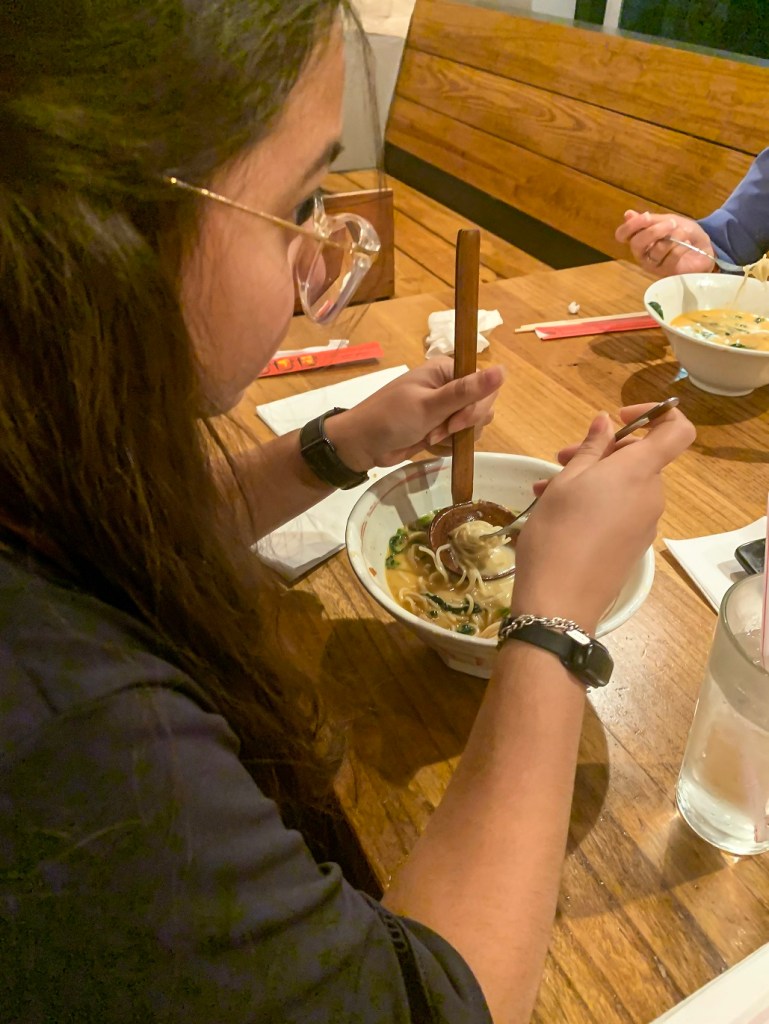
With the night still being young, we ventured on to a nearby local restaurant, Tanaka Ramen. Our dinner consisted of their chicken and beef bun…
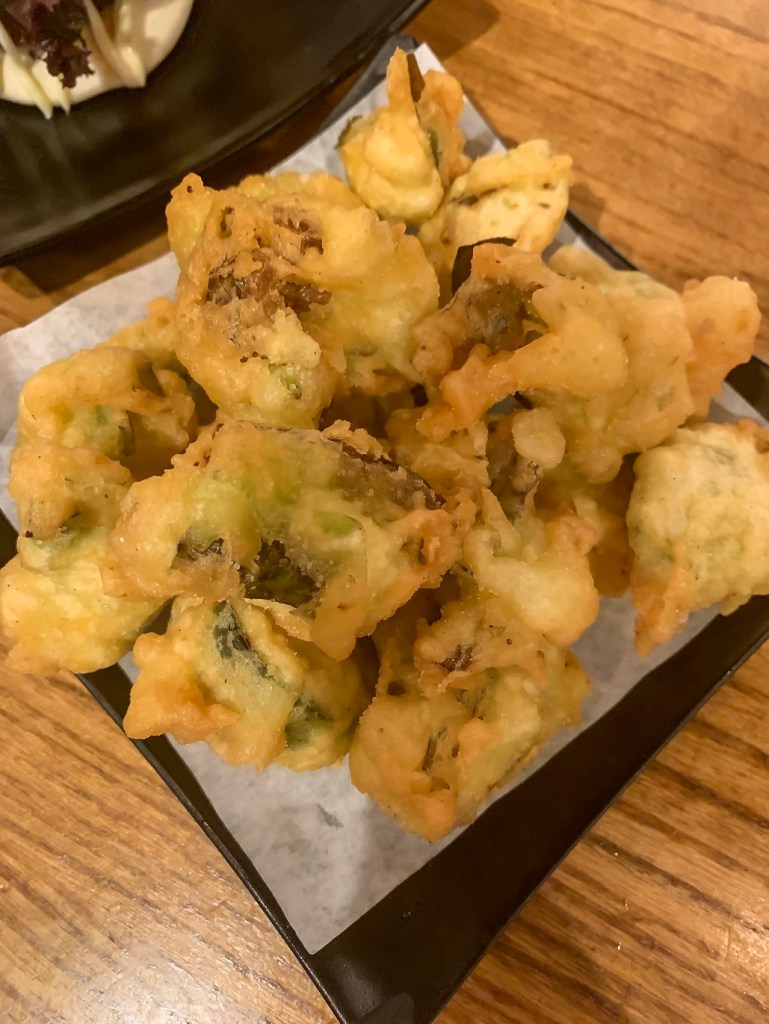
…Tempura Brussel Sprouts…
…potstickers…
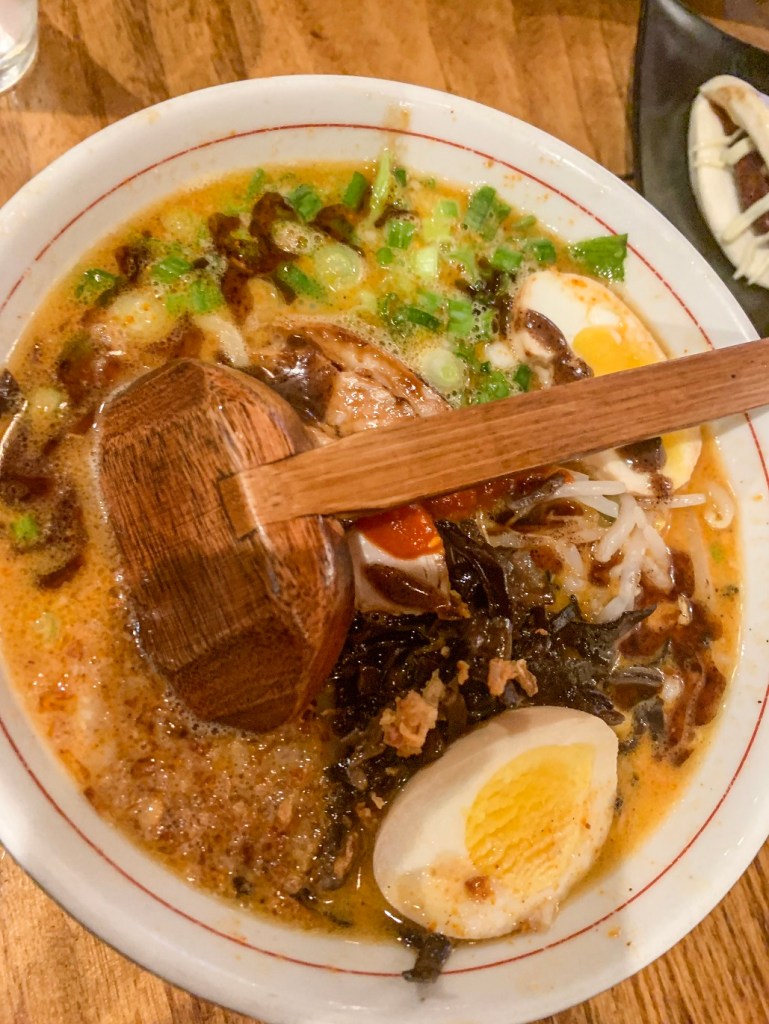
…Tanaka Chicken, Tanaka Classic, and the Tanaka Spicy Miso.
It blew the mind of at least one LEAP Ambassador…
While we all enjoyed our bowls of ramen, we could not leave without having some of their delicious mochi treats.
The most popular flavor was mango out of our other two options, chocolate, and red bean.
It was a great treat on a night that was also a treat, for reasons of fellowship, food, and education.

















 Center for Law, Engagement, and Politics