When LEAP Ambassadors have the opportunity to travel, they follow a process that is in line with their approach to education: prepare, experience, and reflect–sometimes called the P.E.R. model. In this manner, the Center promotes learning, while also providing the flexibility and individual discretion to have fun and find their experiences personally rewarding.
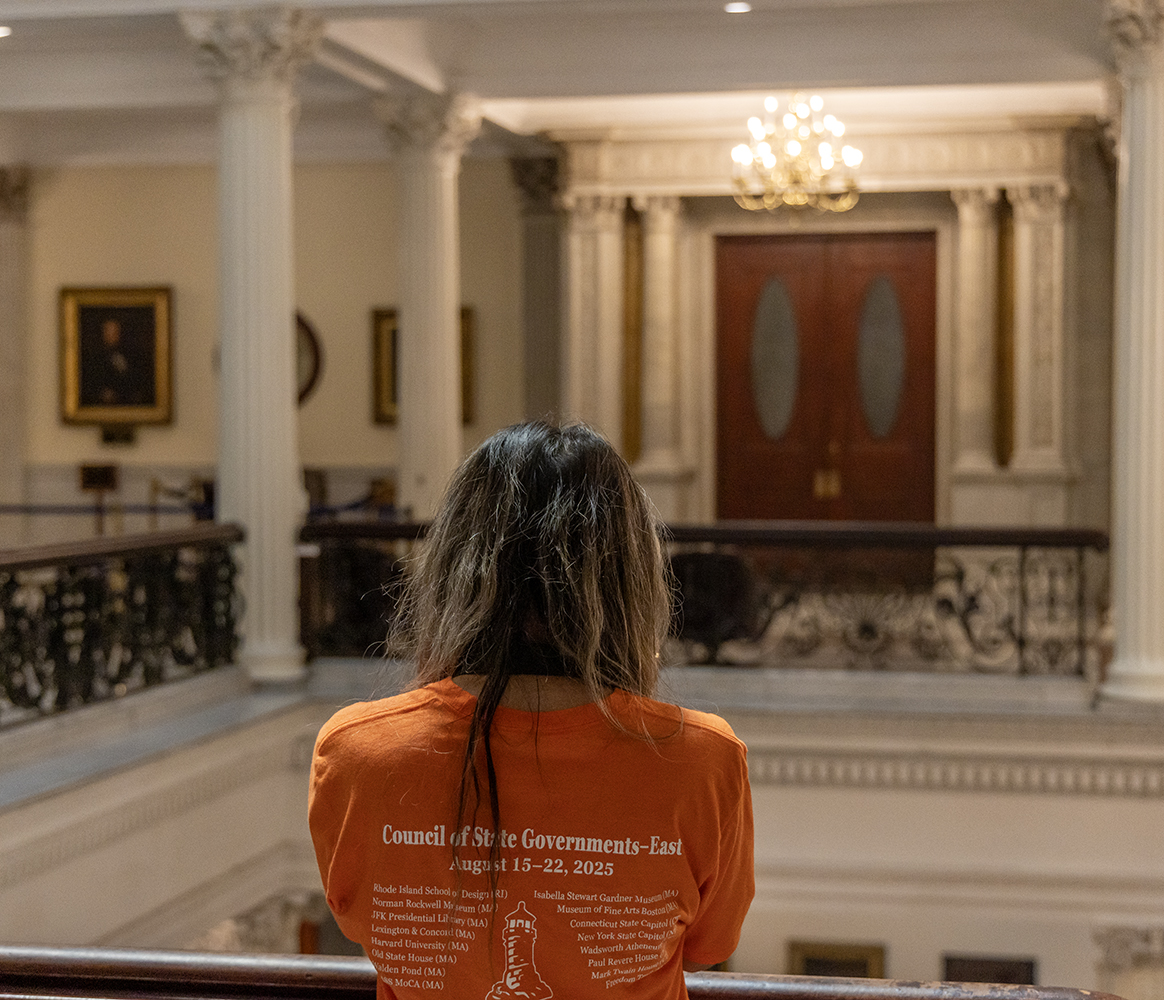
In advance of the students’ participation in the Council of State Governments Conference, they prepared by doing various levels of research on the many sites, people, and locations they would explore. For the students, this also involves research the sites, the costs, allocating their own funds, and creating the trip-themed t-shirt.
The central aspect of the learning process, however, is the experience, and there were many on this eight-day trip. To help with the refection, the students write blogs such as this one, of course, but they also select their favorite experiences from a trip–like all LEAP travel–that involved much diversity in experiences, perspectives, and geography.
Restaurants
The overwhelming favorite among restaurants was Boston’s ‘Fox & the Knife,” which is no surprise in that Chef Karen Akunowicz won the “Best Chef: Northeast,” in 2018. The service was impeccable, and the food was even better, with the Carne Cruda Crostini and the Tagliatelle Bolognese standing out as favorites, with the fried chickpeas as a surprise favorite snack.
Another favorite was Track 15 in Providence, Rhode Island, a refurbished railroad station with half a dozen restaurant choices. We made the most of these, and the combination of the food and the environment made this a favorite.
Art Museum
The clear favorite of the art museums was the Boston Museum of Fine Arts, owing no doubt in part to the Van Gogh exhibit on display when we arrived. The students had a chance to see three different Van Gogh self portraits (Olivia has seen 5-6 or at different museums across the country), a giant piece by Dale Chihuly, and explore some others that became favorites.
Most LEAP Ambassadors come into the program with little knowledge of art, and with varying degrees of art affinity. Olivia came in with a love of art, but with very little experience visiting museums. She had only visited one museum in her life–a science museum–and she has now visited approximately 80 museums across 18 states, all of which she visited on LEAP trips.
Favorite ArtPieces
A favorite among both Michelle and Olivia was Rodin’s “Eternal Springtime,” on display at the Boston Museum of Fine Arts. Interestingly, Olivia was exposed to this at both the Metropolitan Museum of Art in NYC and the High Museum of Art in Atlanta, GA, making this her third viewing of a version of this sculpture.
Another favorite was Thomas Cole’s “Expulsion from the Garden of Eden,” a good example of the Hudson River School–appropriate, since we crossed the Hudson River on this trip!
And of course, there were some “comfort favorites” from the Norman Rockwell Museum, including a rendering of Stockbridge, MA, where we stayed; his famous self-portrait; “Freedom from Want,” a copy of which hangs in Huntsville’s Wynne Home Arts Center; and “New Kids in the Neighborhood,” by Norman Rockwell.
Literary Sites
New England is rich in literary landmarks, and Ambassadors carefully planned their travel maximize their exposure to such sites. While many of these involved mere photo ops, they were able to see the homes of Herman Melville, Edith Wharton, Ralph Waldo Emerson, and Mark Twain, while also seeing the graves of Nathaniel Hawthorne, Henry David Thoreau, Emerson, and Louisa May Alcott–not to mention Thoreau’s cabin and Walden Pond!
But the favorite literary site of the trip was Mark Twain’s Hartford home.
Our enthusiastic tour guide (Josh), the home’s beauty, and the monumental stature of Mark Twain separated this site from the others we visited.
State Capitols
As students of political science, the Ambassadors made a point of visiting the capitols of the states they were in: Massachusetts, Rhode Island, Connecticut, and New York. While it’s perhaps not fair to compare (we didn’t receive full tours of all; some were self tours), the overwhelming favorite was the Rhode Island Capitol building.
Our tour guide, Tony was very knowledgeable, and when a special tour arrived, other staff from the tour office came in to relieve Tony, showing us the Museum portion of the capitol. It was a beautiful building, well complemented by the tour, and we believed, a microcosm of the state’s beauty and interesting history.
Favorite Activities
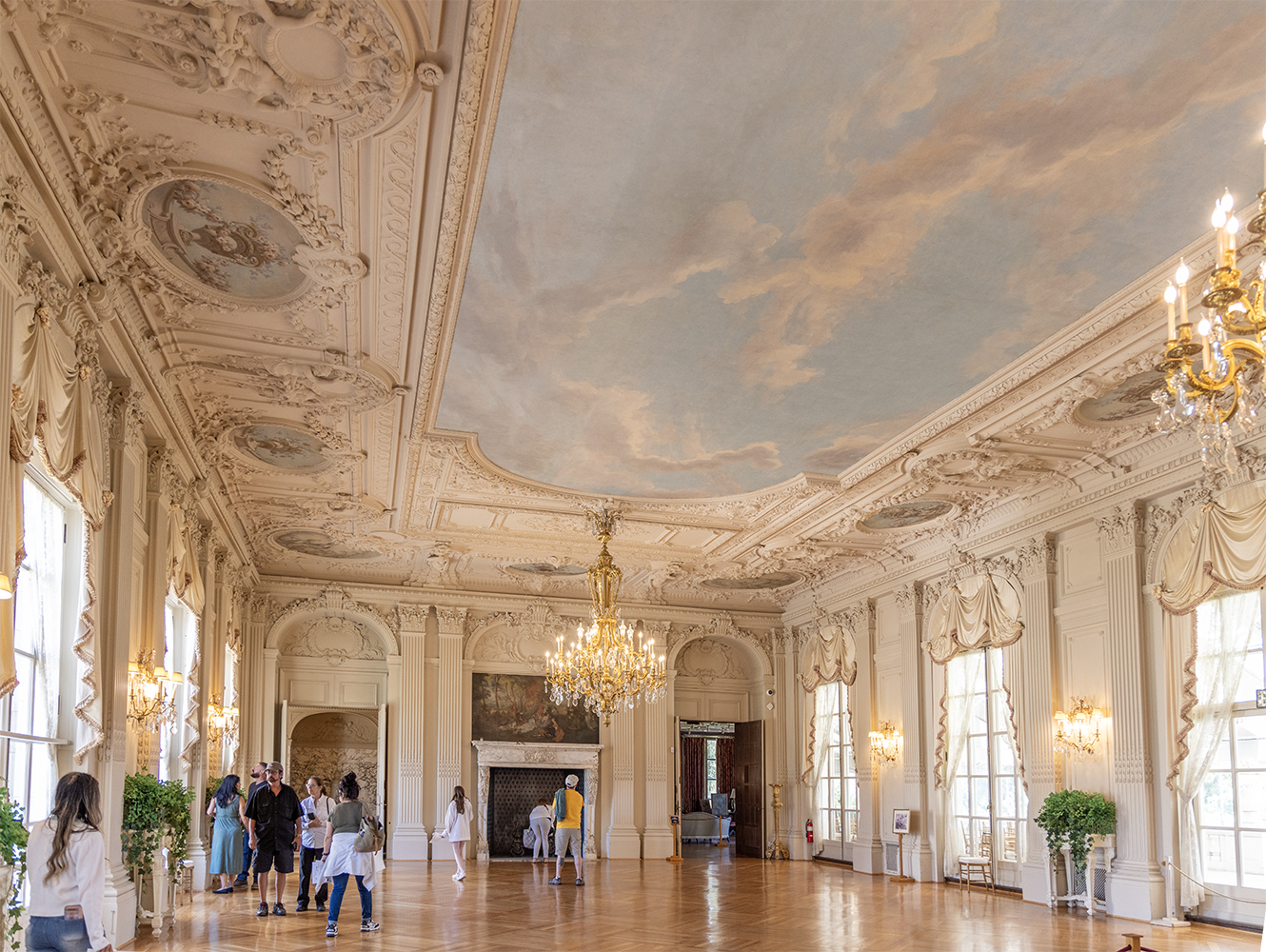
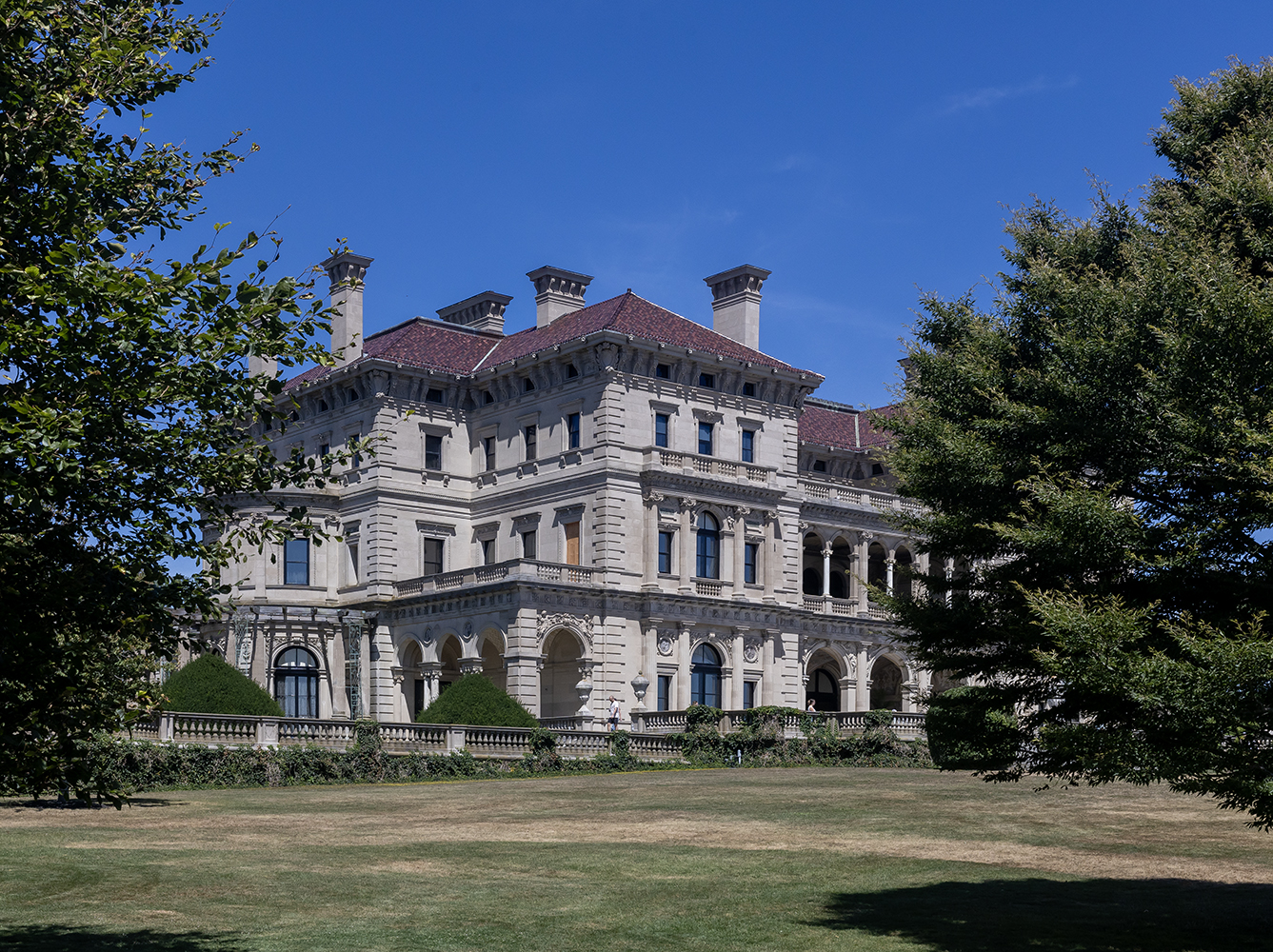
When the students weren’t engaged in conference activities or scheduled tours, they made time for additional fun and educational activities. Their favorites among these including touring the Breakers and Rosecliff (students were split on their favorite).
Of course, when Parasailing in the Atlantic Ocean is one of your activities, it is likely to be a favorite. It was both students’ first time to parasail, and it was Olivia’s first time on a boat!
They made the most of it!
Concluding Thoughts
“They made the most of it,” might just be the best phrase for capturing LEAP Ambassadors’ approach to their college education. These trips can be difficult, involving much preparation, many activities, a lot of writing, photography, and both writing and photo editing, but this is the work that goes into making the travel rewarding.
This program, however, only works with the help of generous donors and a small group of bright, motivated, and civic-minded students who are truly interested in “making the most of it.”
After arriving in Boston early Friday morning, LEAP officially kicked off our visit to New England! We’re here for the Council of State Governments East conference, but like any LEAP trip, we make time to absorb the cultural and intellectual atmosphere of the region.
Massachusetts State House
by Olivia Discon
Even as we approached the building, we noticed the gold dome, and we used that as a guidepost for directions to the structure. The dome, as we would later learn, was originally covered with wood shingles, but as they deteriorated, the government opted for a sturdier material. They chose Paul Revere to plate the dome, but as it weathered and turned green, another element was sought. They settled on 23-karat gold, which is, of course, distinctly different. Interestingly, the original gilding cost $3,000 (in 1872); but they expect to cost approximately 3,000,000 dollars to refurbish it today.
We learned all this from Luke, our tour guide, who gave us a great overview of the building, which was designed by Charles Bullfinch, who also designed the Maine Statehouse, University Hall at Harvard, and the updating of the US Capitol.
A highlight was the beautiful rotunda, which featured stained-glass windows and murals depicting scenes from the founding of the country. The room was built with imported Italian stone and craftsmanship, reflecting the influence of Massachusetts’ large Italian immigrant population.
From there, we entered the Great Hall of Flags, which displays 351 flags, one from each municipality in Massachusetts. The design wasn’t just symbolic, though; the flags also help improve the room’s acoustics, making it suitable for ceremonies and events.
Having seen 12 state capitol buildings, I’ve learned that the legislative chambers are often the most interesting aspects of the statehouses. In Massachusetts, the House of Representatives has 160 members, each serving two-year terms. In and of itself, this is not unusual. What is unusual is this one features a fish: a cod. The cod is such a central symbol of Massachusetts’ maritime roots that the chamber refuses to conduct business without it, although that didn’t stop Harvard students from stealing it in 1933, stopping legislative business for three days, before it miraculously returned. The sculpture is today so valued, it is known as the “Sacred Cod.”
Across the building, the State Senate chamber is home to 40 senators, also elected for two-year terms and representing roughly 175,000 people each. Their chamber is arranged in a round-table style, designed to encourage equal discussion, which is of course different from the tiered seating most state legislatures use. Indeed, Massachusetts takes this to great lengths. To ensure full equality, they actually change the heights of each chair around the table in a manner designed to ensure that each member is of equal stature while literally and figuratively occupying a Senate seat.
And because the House wouldn’t share the Sacred Cod, the Senate decided they would have their own divine creature: the “Holy Mackerel.”
In all, this visit to the Old State House was a great way to kick off the trip. It was the perfect precursor to the rest of the day and almost certainly to our time in New England.
Freedom Trail
by Michelle Moya
While the Massachusetts’ State House can serve as a standalone site, it is also part of Boston’s official Freedom Trail, a 2.5-mile path (fully paved with red bricks) that winds through downtown and connects 16 historically significant sites. The trail proved to be the perfect introduction to the city–part history lesson, part sightseeing tour–allowing us to stand where many of the pivotal moments in America’s fight for independence unfolded.
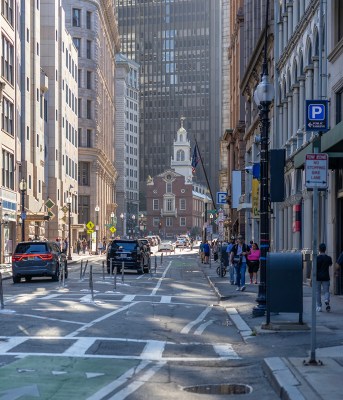
In most states, a capitol built in 1798 would be the old state house but not in Massachusetts. The Bay State’s “Old State House” was built in 1713 and is Boston’s oldest surviving public building. Its Georgian architecture stands in stark contrast to the towering skyscrapers surrounding it. For decades, it served as the seat of the Massachusetts General Court and a symbol of royal power in the colony. But it also became a birthplace of revolution: on July 18, 1776, the Declaration of Independence was read aloud from its balcony for the first time to the citizens of Boston, transforming this seat of British authority into a herald of American freedom.
Just steps away lies the Boston Massacre Site, marked today by a simple ring of cobblestones. Modest as the marker may be, this spot witnessed a tragedy that would galvanize the colonies. On March 5, 1770, angry Bostonians clashed with British troops stationed in the city. What began with snowballs, sticks, and insults escalated when confusion gave way to gunfire. Private Hugh Montgomery, knocked down by the crowd, fired his musket, and others followed suit. Amid escalating tension, five colonists were killed: Crispus Attucks, Samuel Gray, James Caldwell, Samuel Maverick, and Patrick Carr.
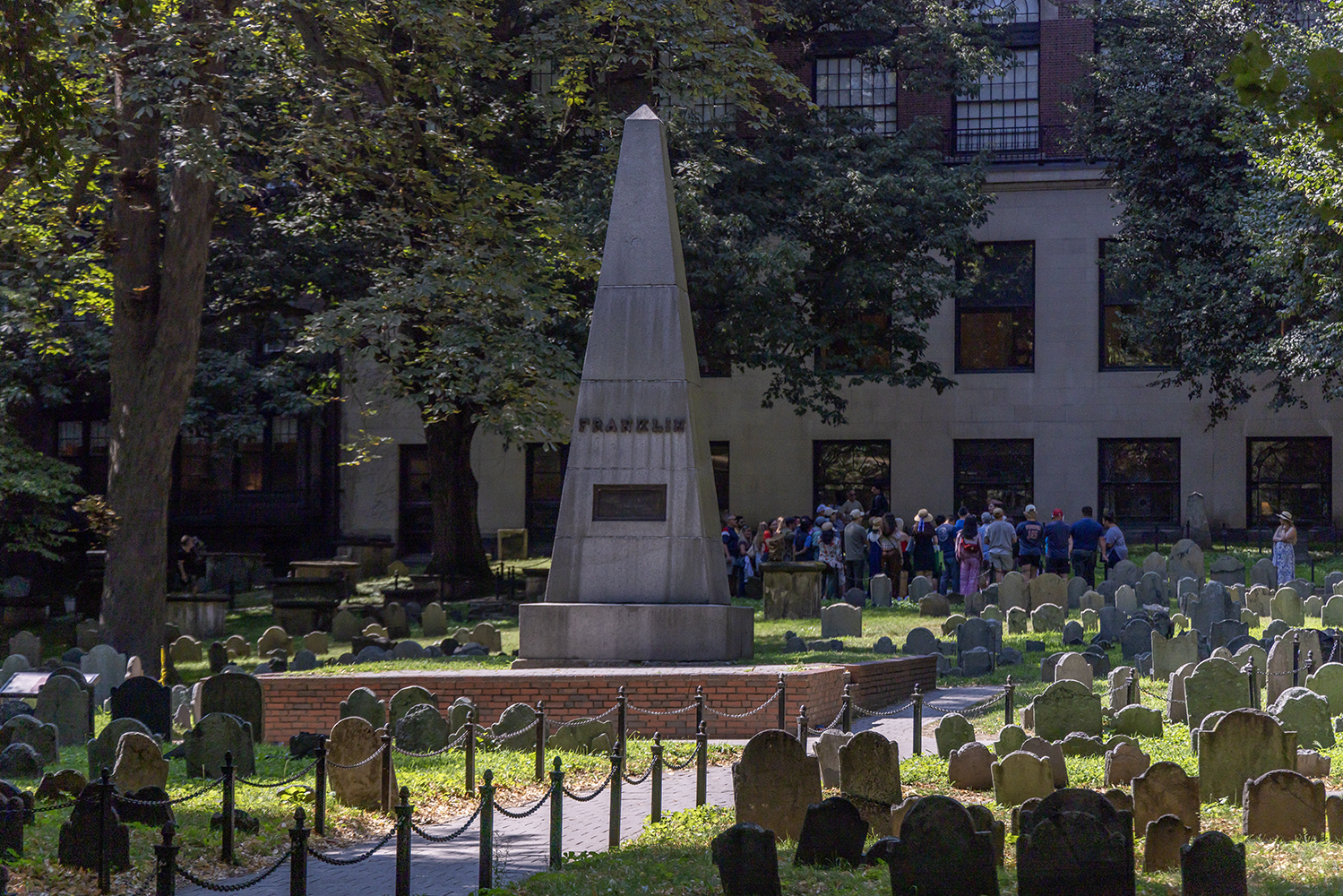
The consequences of that night are poignantly reflected at the Granary Burying Ground, established in 1660 and one of Boston’s three-oldest cemeteries.
Though only about 2,300 headstones remain visible, nearly 5,000 people are believed to be buried in this hallowed ground, including some of the Revolution’s most illustrious figures such as Paul Revere, Samuel Adams and John Hancock, and among these is one of the five victims of the Boston Massacre, Crispus Attucks. Of African and Native American descent, Attucks was a sailor and dockworker who stood at the front of the crowd that evening. His death marked not just the beginning of America’s struggle for independence but also highlighted the diverse coalition of people who would sacrifice for that cause.
A few blocks away, the trail leads us to the Paul Revere House, built around 1680 and now the oldest surviving home in downtown Boston. Modest in size and structure, the weathered wooden dwelling still fits in among the varied architectural buildings of modern-day Boston. Revere lived here from 1770 to 1800, balancing his work as a silversmith with his pivotal role in the Patriot cause, including his famous midnight ride that would become the stuff of legend.
The Freedom Trail offered a concise, firsthand look at Boston’s role in the nation’s founding. The trail provides both residents and visitors a clear window into the events and figures that shaped early America, making it a must-see for anyone looking to understand Boston’s historical significance and, for us, a great start to exploring a new city.
Lunch and Larks
Befitting our historic tour, we had lunch at the Union Oyster House, which opened in 1826, making it the United States’ oldest restaurant. The building in which it is housed dates back even further–at least 250 years, although no firm date has been established. In addition to some Boston staples (New England Clam Chowder, oysters, Boston Cream Pie)–which we enjoyed–the restaurant has also hosted many notable public figures. Daniel Webster was a regular customer as was John F. Kennedy. Indeed, Kennedy had the Oyster House’s Clam Chowder shipped in for his inauguration.
We also plotted out paths to some sites we wanted to see that didn’t fit a themed route. This included the remnants of a partially obscured Richard Haas mural at 31 Milk Street, which someone, inexplicably, decided should be covered up by a parking garage. For a city that cares about its history–or for any city–it was an unfortunate decision.
Also of interest to us was Ten Post Office Square, which was originally home to the Boston Latin School (1635), the oldest public school in the United States. Luminaries such as John Hancock, Samuel Adams, Cotton Mather, and Benjamin Franklin attended here. Franklin, however, dropped out, a fact which partially prompted city fathers to erect a statue of him on the site in 1865, the first such public statue in the city of Boston. The site was also been home to the Suffolk County Courthouse and, in 1865, the City built a new Town Hall on the site. It is the structure that occupies the location today, a building that provided office space for 38 separate mayors, including John Fitzgerald–the future President’s grandfather.
Boston Museum of Art
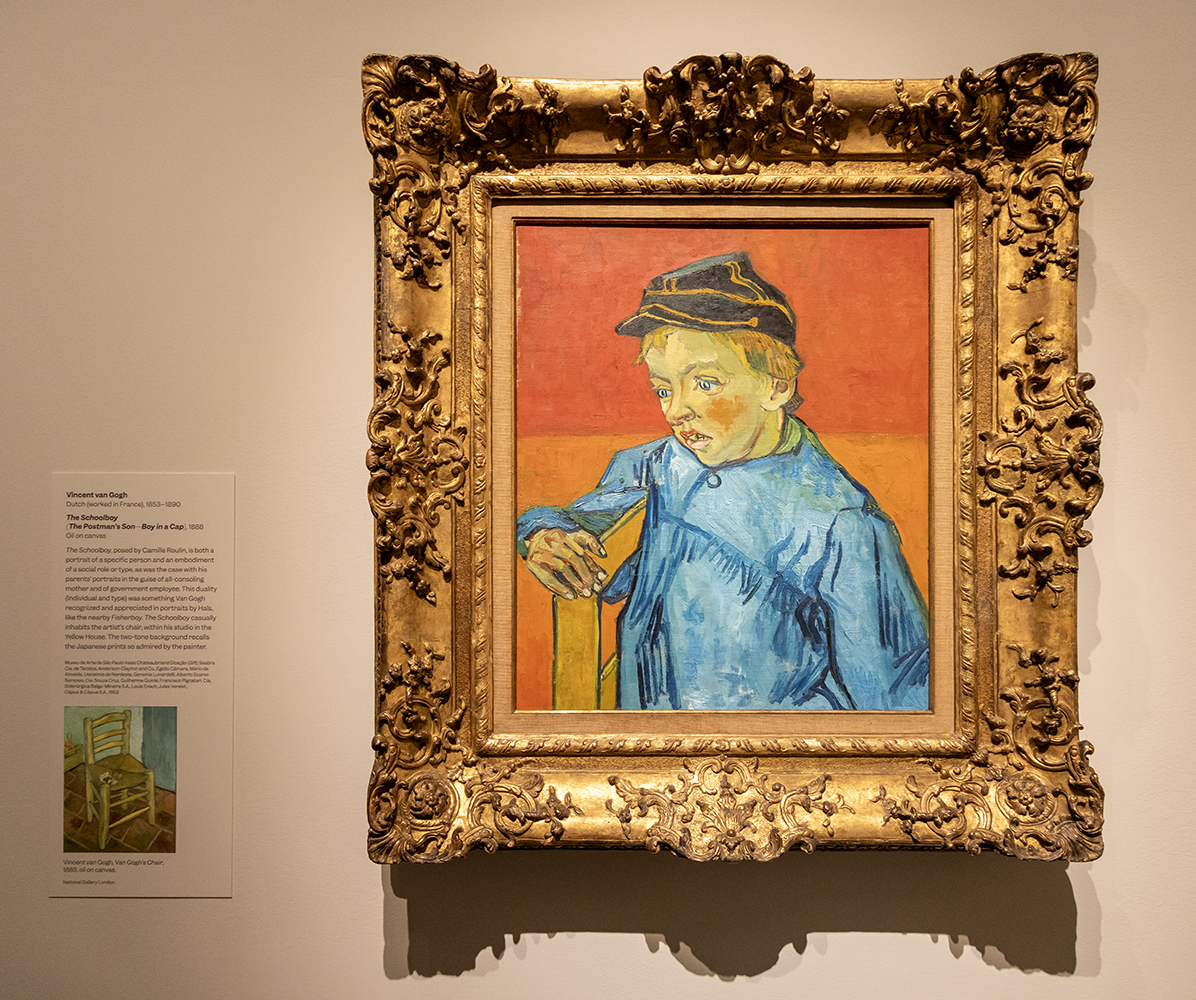
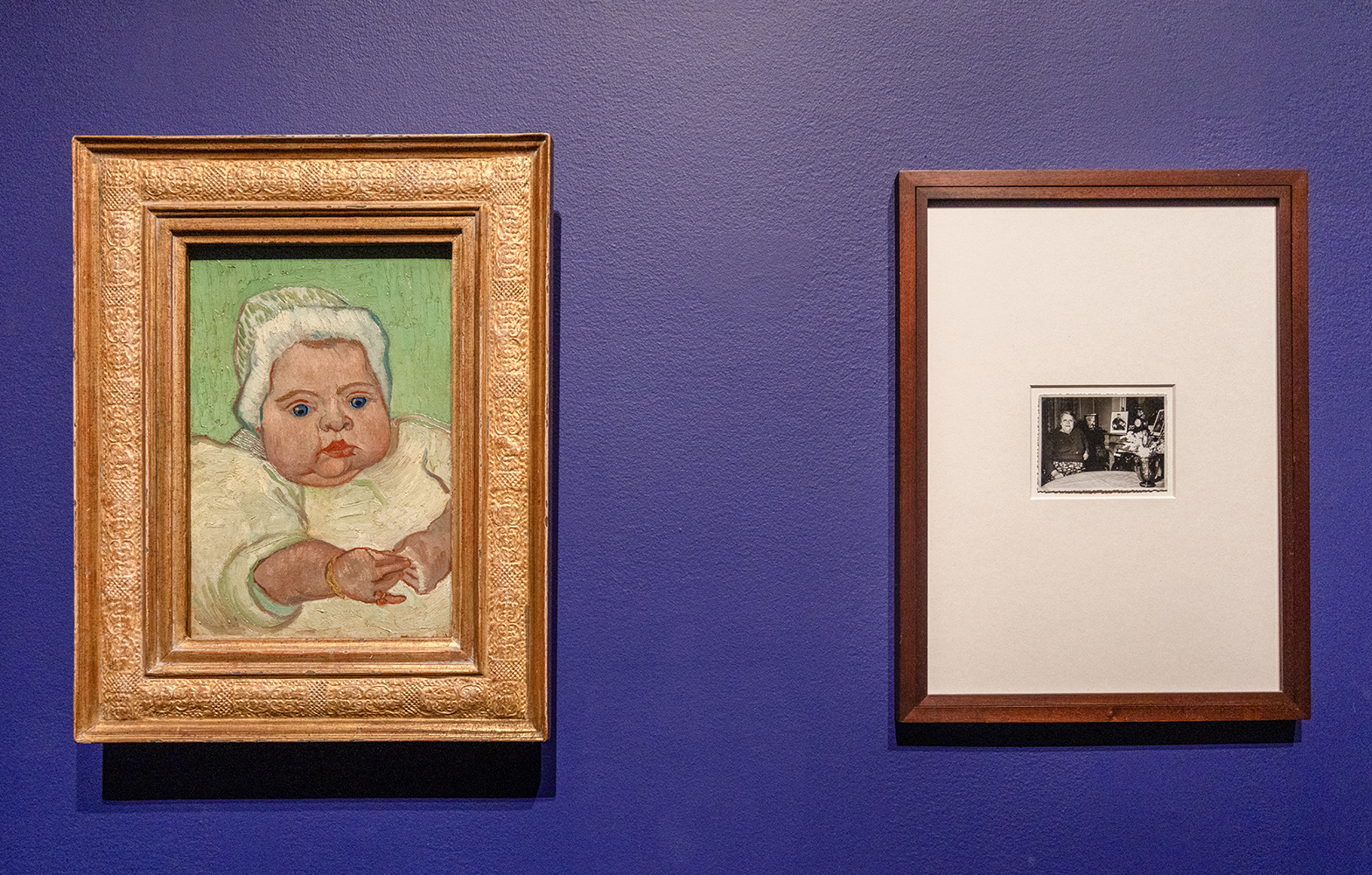
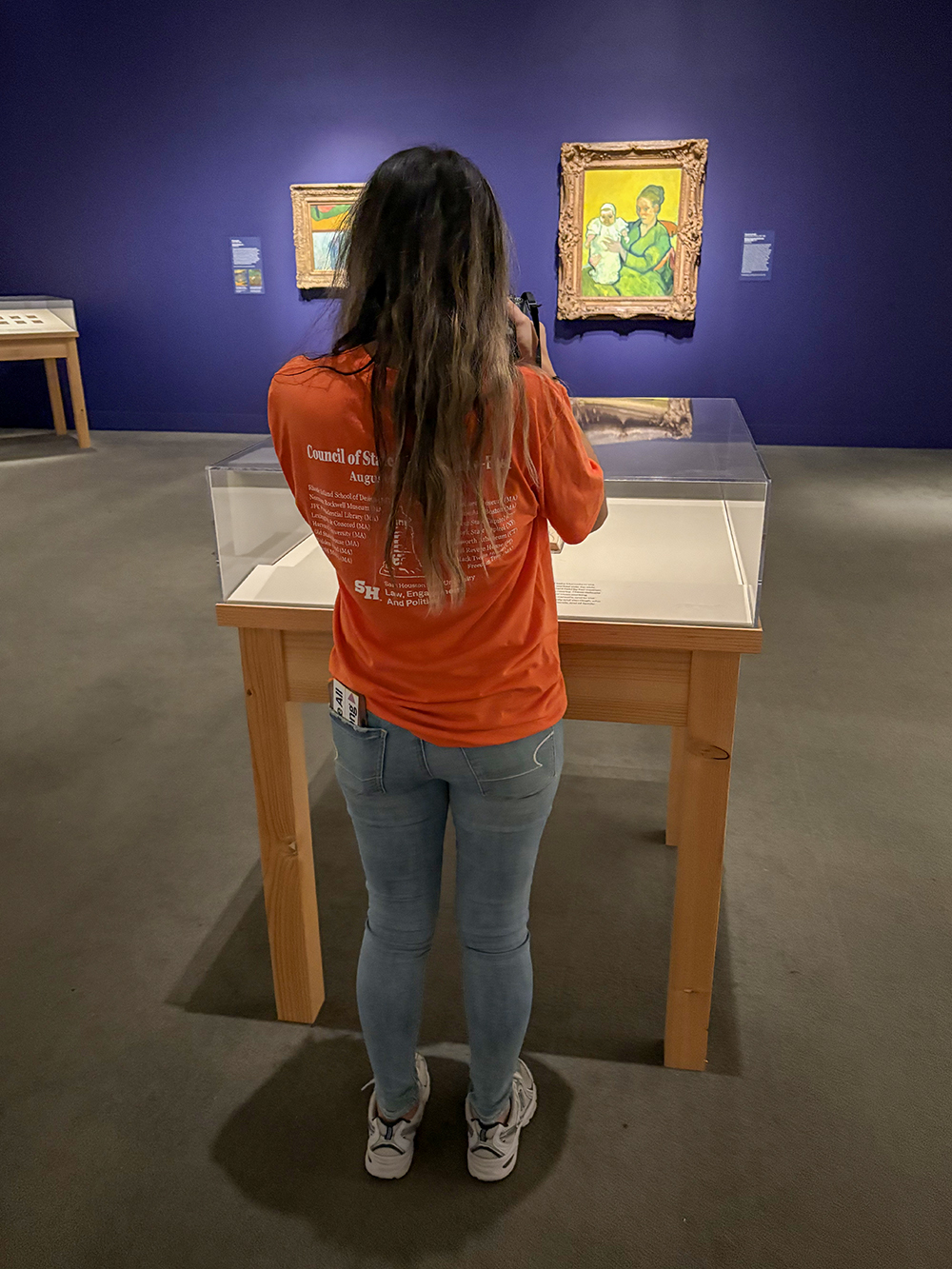
After a packed first day in Boston, we headed to the Museum of Fine Arts to see “Van Gogh: The Roulin Family Portraits”- the MFA’s first Van Gogh exhibition in 25 years. With 23 works on display, many borrowed from all over the country, this represents the largest collection of Van Gogh’s work currently showing in the United States.
The exhibition focuses on Van Gogh’s 26 portraits of the Roulin family-his neighbors in Arles, France. Fourteen of these paintings are displayed together here, something that rarely happens given how scattered they are across museums worldwide.
Joseph Roulin, a local postman, appears in several portraits wearing his postal uniform…
His wife Augustine dominates the “La Berceuse” series, where Van Gogh painted her as a maternal figure meant to comfort sailors and working people.
Their three children each get distinct personalities: Armand with his serious expression,
young Camille caught between childhood and adolescence,
and baby Marcelle with tender vulnerability.
The exhibition also includes other works from Van Gogh’s productive Arles period. The Bedroom immediately caught my attention, given its bold, simplified colors.
Alongside these, Van Gogh’s Self-Portrait from this period shows the artist at his most direct, painted just months after his breakdown in Arles…
The curators also included works by artists who influenced Van Gogh, including pieces by Rembrandt, creating a clear artistic lineage that shaped his approach to portraiture.
The exhibition ends with Van Gogh’s actual letters, written during his mental health struggles in Arles.
Continuing On!
By Olivia Discon
From there, we wandered through the rest of the museum, trying to take in as much as we could before the end of day one.
Michelle is still figuring out her taste in art, so this visit was a great chance to see a wide range of styles and time periods all in one place.
In the American Art collection, we started in a way that mirrored the country’s own development. Early American painters leaned heavily on European influences, but as we moved forward, you could see the work gradually step into a style of its own.
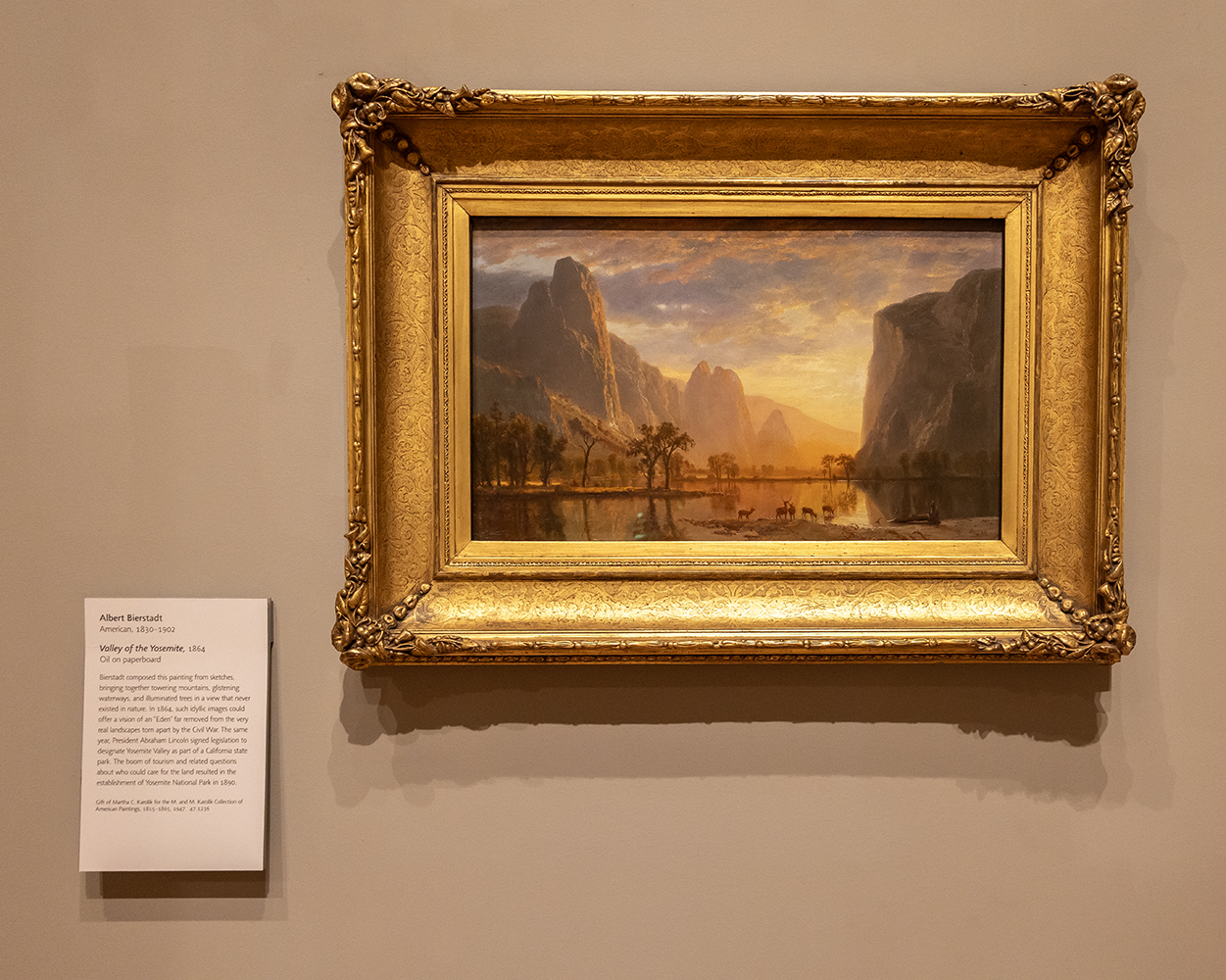
Moya has grown fond of the transcendentalist crowd—Heade, Thomas Cole, and Bierstadt especially.
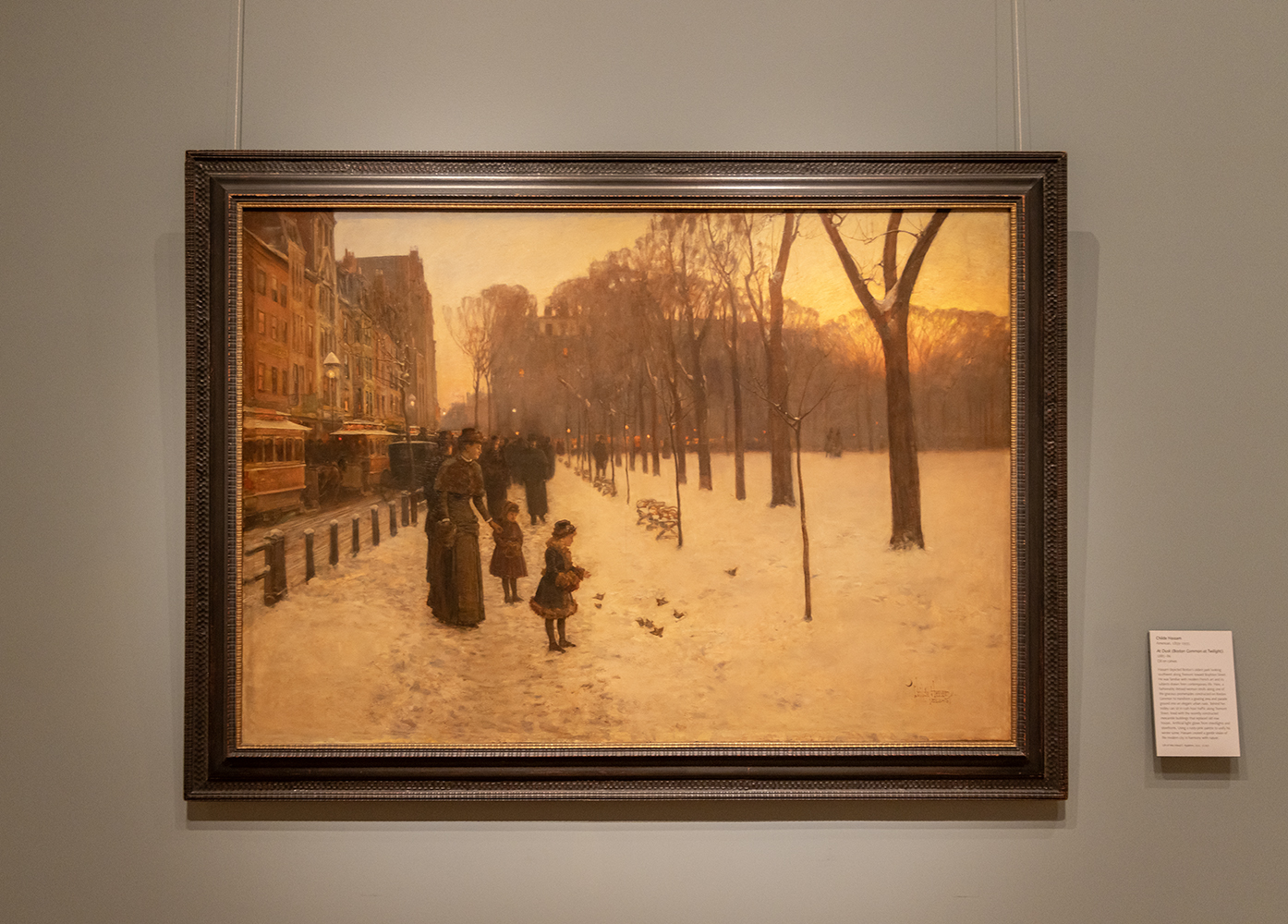
For me, highlights included John Singer Sargent, Childe Hassam, and Rodin.
We also stumbled on an Andy Warhol that needed a little context. After I explained the, let’s say, “golden phase” of his work, Michelle was no closer to being a Warhol fan.
There was also an impressive lineup of Monets, including one from his cathedral series. That 33-painting project captures the same cathedral at different times of day. This is pivotal to art history, and I was pleased to have seen one of them in person.
And then came Degas’ Little Dancer. One of the 28 bronze casts, it’s indeed an incredible piece. However, if you’d rather not become disillusioned with another art piece in this blog, you probably shouldn’t ask me the backstory on this one.
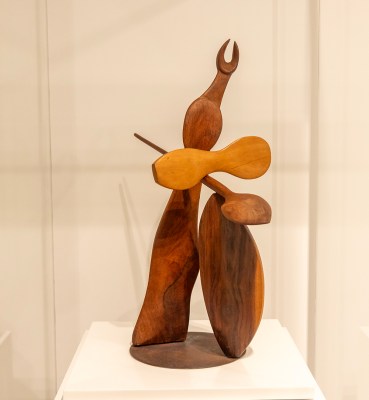
On our way out, we caught sight of some Alexander Calder pieces! The wooden sculpture was particularly striking to me, and an excellent find on our way out of the museum.
Concluding Thoughts
It was such a busy day, it was easy to forget that we woke up in Houston, Texas, and spent only a partial day in Boston, MA. Nonetheless, we managed to spend a full twelve hours seeing sites, exploring a part of the country that is new to us, and reflecting anew on our nation’s history and the meaning of freedom.
In Texas, it takes up to 10-12 hours to get out of state, so it’s nice to be in New England, where you can go through 2-3 states in a single day. Thus it was we left Connecticut in the morning, spent most of the day in Rhode Island, and ended up in Massachusetts.
Rhode Island State Capitol – Francisco Peña
Our first goal of the day was to get to Providence, Rhode Island, where we had planned 2-3 stops. Almost immediately after arriving in Providence, we were welcomed by the Rhode Island State House, a building we agreed looked similar to our own Texas State Capitol. (Well, in Texas, Canadian geese don’t roam the front lawn and there’s no snow for throwing snowballs.)
The building was designed and constructed by New Yorkers between 1895 and 1904 in the capital city of Providence. A statue guards the top of the dome, which we later learned is referred to as the Independent Man (originally named “Hope”).
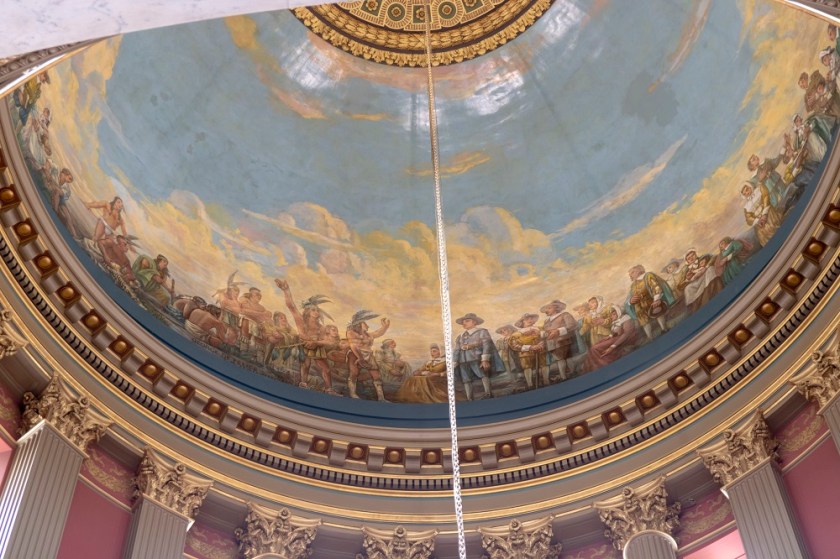
Our enthusiastic and well-informed tour guide, Liam, began with an explanation of the interior of the capitol’s dome. On the ceiling is a mural (sometimes called the “justice blue”) of Roger Williams’ arrival as the founder of Rhode Island and his relationship with the American Indians.
Just beneath the mural are large medallions at the four corners which support the dome’s structure, along with four female figures that depict Education, Justice, Literature, and Commerce.
Liam shared with us that the Rhode Island State House’s rotunda is the fourth largest self-supporting dome in the world; right under St. Peter’s Basilica, Minnesota’s State Capitol, and the Taj Mahal. It was impressive.
We visited the Rhode Island Senate chamber which accommodates 38 members; interestingly, there are 39 state senatorial seats, relating to each city in Rhode Island, but with two cities being so small, they’ve combined their representation. (That is unlike anything we experience in Texas government.)
Directly opposite the senate chamber is the House of Representatives, which seats 75 members. Each chamber is distinctive in its own way. In the Senate chamber above the rostrum are the seals of the original thirteen states, with a public gallery underneath the seals.
The House chamber holds two public galleries, and each representative has a small but solid oak desk.
Covering two walls are silk tapestries of ancient Rome and Greece, with some Rhode Island references added. This room is also where the Governor gives the State of the State Address.
The State Room, an entrance to the Governor’s office, includes several portraits of Rhode Islanders who were a major influence in the state. We took the opportunity to take pictures at the Governor’s podium.
Who would have imagined that we would get to see a cannon with a cannonball still lodged in the barrel?
The cannon was damaged during the Battle of Gettysburg. Along the walls where the cannon is staged were battle flags carried by Rhode Island regiments dating from the Revolutionary War through World War I.
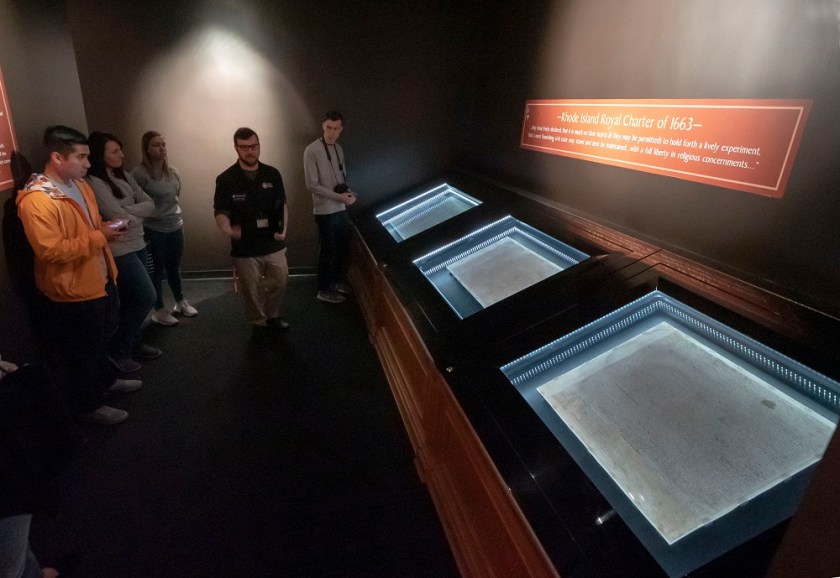
Our last stop was the Charter Museum. The museum displayed priceless documents and artifacts.
We were fascinated to see the Royal Charter of 1663 granted by King Charles II of England, even if we couldn’t decipher the elaborate Old-English calligraphy.
This was probably our favorite Capitol tour, and although we had many good tour guides, Liam was tops.
Rhode Island School of Design (“RISD”) Museum – Sawyer Massie
Tucked away in the urban district of Providence is the Rhode Island School of Design, a university founded in 1877 (two years before Sam Houston State University). The exterior of the building was unique in that it was a modern style of architecture while adjacent edifices were more Colonial.
Combined with the actual school, the museum did not encompass the entire building. We found a good starting point, a gallery with modern and contemporary art mixed in with new media and paintings. New media, as we soon found out, translates to fashion, textile art, and carpentry. Therefore, when the elevator doors opened, we were greeted with a furniture set designed by Frank Lloyd Wright, a familiar name for the LEAP Ambassadors by now, and an original painting by Picasso.
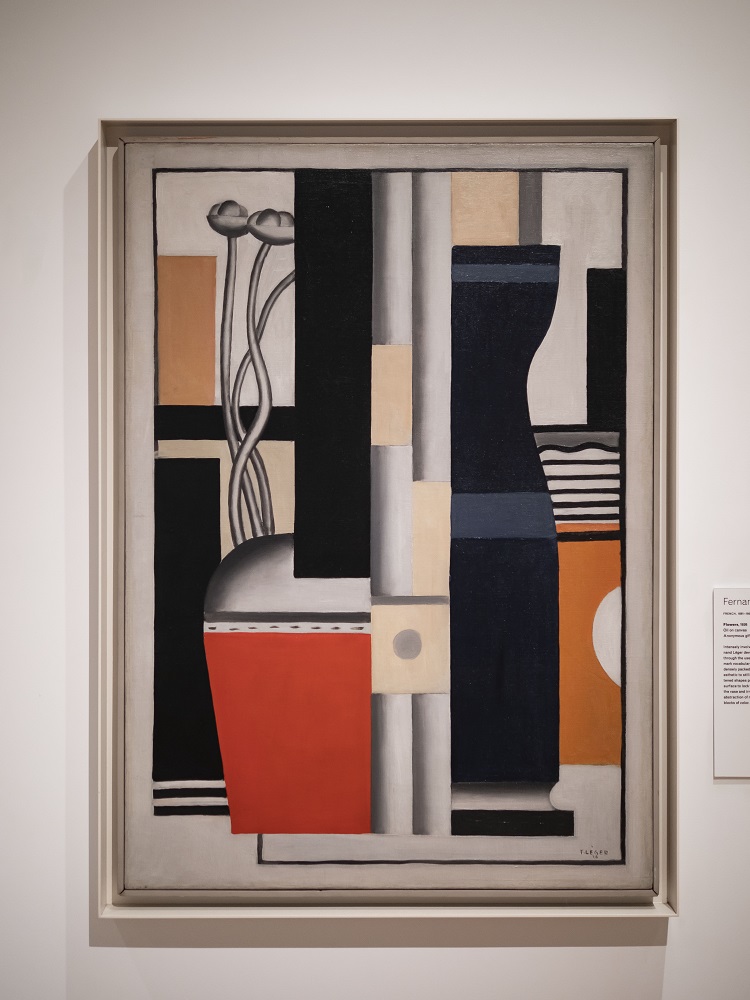
We stopped and marveled at a piece done by Fernand Léger, who taught Huntsville’s famous sculptor, David Adickes.
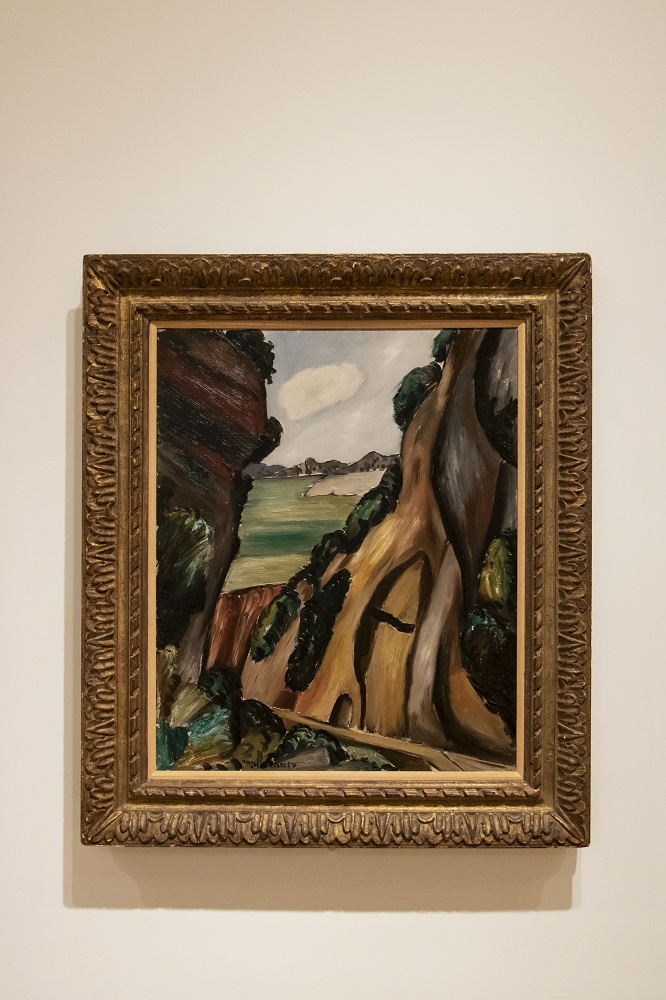
Other most notable pieces were done by Marsden Hartley…
…Jackson Pollock…
…Edgar Degas…
…Winslow Homer…
…Louise Bourgeois…
and Alexander Calder…
…one of the most frequently seen by LEAP this trip.
Unfortunately, one floor was closed for renovations, so we could not take the elevator, but this led to us most serendipitously finding a hidden gem. Hanging above the landing of the stairs we used was an elegant glass sculpture created by none other than Dale Chihuly. The chandelier, entitled “Gilded Frost and Jet,” was my favorite piece in the Museum.
In the modern gallery, we were hardly surprised when we saw paintings by Picasso, Van Gogh, and Cassatt – some of the most well-known in the world. What did astonish us, however, was the room dedicated solely to French impressionists. This room contained a large selection from artists we had not seen as often in our recent art museum excursions. Among these people were Édouard Manet, Camille Pissarro, Paul Cézanne, and Claude Monet.
We breezed through the rest of the galleries, as contemporary art of the 19th century in the forms of furniture and bedroom sets was not as appealing as lunch at this point in the day.
Providence Oyster Bar (or locally known as “POB”) – Sawyer Massie
The rule for all LEAP events (as possible) is that we eat at restaurants that reflect the location or events that we are attending. In Rhode Island, this led us to the Providence Oyster Bar, a fresh food eatery located just across town from the RISD Museum. We were told that all fish and shellfish is brought in daily from the harbor so, naturally, we ordered an entire platter of raw clams and oysters. Already, this was a new experience for two Ambassadors since they had never eaten either before. When the order was delivered to our table, they were first to try them. Surprisingly, both enjoyed them! After our entrees arrived, the table was cluttered with lobster bisque, clam chowder, and the most delicious (and only) lobster roll I have ever tasted. We couldn’t have asked for a better Rhode Island dining experience.
Lizzie Borden Bed & Breakfast and Museum – Victoria McClendon-Leggett
Perhaps eating, even a great meal, before visiting the scene of a historically gruesome crime was not the best idea. A couple of us already knew the story of one of America’s most infamous murder cases, but others didn’t, and this gave them the opportunity to learn about Lizzie Borden, a homely townswoman accused of brutally murdering her mother and father. With an axe. We were taken through the events of that fateful day in the order they occurred, starting with breakfast that morning. Our tour guide was adamant that Lizzie did not commit the heinous crime, and we became convinced, too, as he gave us more history on Lizzie and the rest of her family. Or, perhaps we just wanted to be agreeable because he carried an axe.
We started in the front room, then were led through the dining room and several upstairs bedrooms as our tour guide explained how the day transpired. We learned that Abby Borden died first while she was cleaning the upstairs guest room…
…and, a few moments later, Andrew Borden was attacked on the couch in the first floor living room.
Lizzie was at home at the time of the murder but claimed to have been in the basement. Lizzie was the original suspect, but women were not allowed to serve on juries at the time. This worked to her favor because the men on the jury (like most men at that time) viewed women as fragile and could not imagine a lady committing such horrible acts.
Lizzie was found not guilty after ten minutes of deliberation, seven of which were spent waiting out of respect for the murdered victims.
The tour ended in the kitchen in the back of the house, where we learned about how Lizzie Borden lived out her days after she was acquitted.
She bought a new house to try and start over after the tragedy, and she was a model citizen until her death in 1927. We left the house shivering a bit, mostly from the cold, and headed to our next destination.
The Adams House – Sawyer Massie
On our way to Boston, we stopped at the house that two presidents lived in: John Adams and John Quincy Adams. Although it was closed, we certainly enjoyed seeing such a beautiful and historically-significant American landmark.
Plymouth Rock – Sawyer Massie
We detoured to the place at which the Plymouth Colony was first founded: Plymouth Rock. It is said that this is the exact rock at which the Mayflower docked.
Upon arriving, we were greeted with a magnificent view of the Atlantic Ocean with lighthouses on tiny islands dotting the horizon.
The Plymouth Rock, ensconced beneath a granite canopy, left us awestruck. Although it is solely a boulder with the engraved year “1620,” we couldn’t believe we were in the presence of a relic that we had previously only read about in textbooks.
Boston Museum of Fine Arts – Makayla Mason
Founded in 1870, the original Museum of Fine Arts, Boston was built in Copley Square and opened to the public on July 4, 1876, during the Nation’s Centennial celebrations. In 1909, the museum moved to its current location on Huntington Avenue. Now, the MFA is one of the most comprehensive art museums in the world with more than 450,000 works of art.
It did not take us long before we found the 42.5 foot tall glass sculpture by Dale Chihuly titled “Lime Green Icicle Tower” installed in the spacious café and sitting area. In fact, it’s hard to miss!
Including the ground floor, we had four floors to explore. We started with the Art of the Americas section across multiple floors and included many portraits, furniture, and hand-made items such as chinaware and lamps. We found several portraits by Gilbert Stuart, known for his portraiture. Most notably, Stuart is known for the portrait of George Washington that we see every day on the $1 bill.
For the rest of our time at the museum we split up and explored different exhibits including the Art of Asia, Oceania, Africa, Art of the Ancient World, and Contemporary Art. We saw some of our favorites, including Edward Hopper…
…Piet Mondrian…
…Winslow Homer…
…Georgia Okeeffe…
…Thomas Cole…
…Freda Kahlo…
…Claude Monet…
…Albert Bierstadt…
…and John Singleton Copley, and his famous painting “Watson and the Shark.”
We also found a bronze statue of Abraham Lincoln sculpted by Daniel Chester French, the artist who created the Lincoln Memorial.
We even stopped and took a picture at the mirrors for the rotunda.
Full of art, but empty of stomach, we called it a day after sightseeing for 14 hours and picked up a homemade pizza or two from Prince’s Pizza on Broadway, and tucked in for the night.




























 Center for Law, Engagement, and Politics