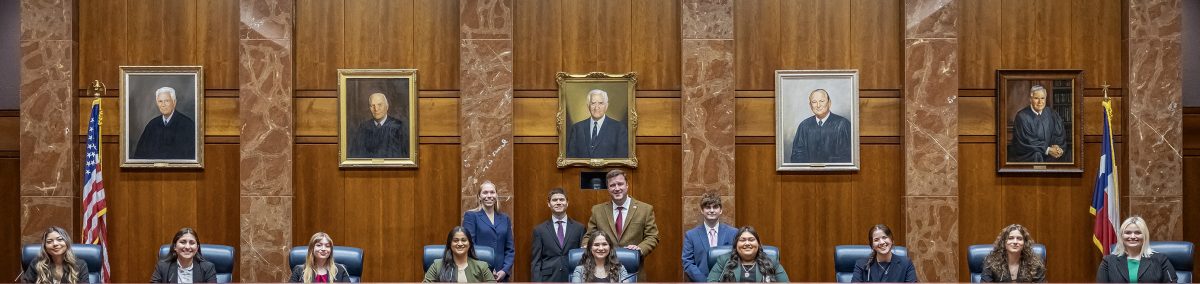
After two learning-laden days in Little Rock, we turned our attention primarily to the Book Festival and the authors on hand to present. One of the joys of Little Rock is that the downtown area is more akin to a small town than a larger, capital city, and we were able to walk to the book festival with no trouble–while still enjoying coffee stops, capitol views, and public art…

A Discussion on Authenticity and its Cost with Garrard Conley
by Olivia Discon
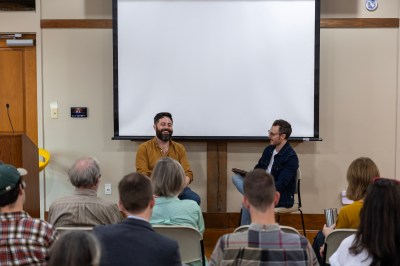
While others in LEAP attended more learned sessions, I attended a book talk with Garrard Conley for my first session at the Six Bridges Book Festival, where he discussed his new book, All the World Aside. He described the novel as a character study set in 18th-century Puritan New England, covering modern conversations about love, faith, and identity within the strict religious society of the time.

Conley emphasized how the characters’ internal struggles resonate within the modern context, despite the historical backdrop.
During the session, Conley read a passage about the protagonist’s mother struggling with depression, and it was reminiscent of Flannery O’Connor’s The River. During the Q&A, I asked if O’Connor had been an influence in his work, and to my surprise, he lit up with excitement.

He made mention that he had taken classes covering her short stories in college and was greatly inspired by her ability to navigate the complexities of a changing society within the scope of region, time, and politics. I was glad I asked, and it was nice to see that he appreciated the connection.
To make this experience even more special, after the session, when I went to buy a copy of the book, a generous Arkansan offered to purchase it for me. It was an unexpected but incredibly kind gesture that tied into the theme of Arkansan Traveler with which we have become well acquainted.
A Deep Dive into Cultures, Immigrants, and Natives
by Saara Maknojia
The Covid-19 pandemic had a significant impact on the nation’s economy, leading to a decline in business profits. This period was particularly difficult for immigrants working in the meatpacking industry, who were exploited and forced to work under inhumane conditions. Executives from companies like Tyson told workers that if they didn’t continue supplying food, the entire nation would starve.

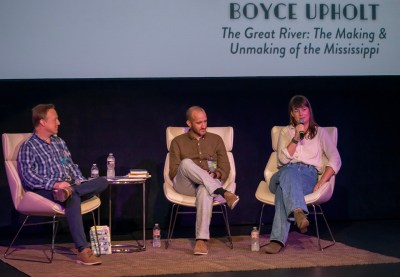
In my first session at the Six Bridges Book Festival, I learned from Alice Driver (and Boyce Upholt–see below), author of Life and Death of The American Worker: The Immigrants Taking on America’s Largest Meatpacking Company, who shared her investigative research into the experiences of immigrant workers at Tyson Foods. Her work sheds light on the exploitation that takes place within multi-billion-dollar companies.

According to Driver, undocumented immigrants were threatened by Tyson executives during the pandemic—told that if they didn’t comply with the company’s demands, they would be arrested and jailed. This exploitation of vulnerable individuals has been ongoing for years and continues to shape their experiences today.

At the end of the session, I asked Driver about the techniques she used to comfort the immigrants and help them share their stories. I also inquired about how these perspectives might affect the immigrant community facing similar challenges in other workplaces.

She explained that she needed to offer comfort because these workers were alone and misinformed. As for the broader impact, she noted that immigration is still seen as a turbulent issue in the U.S., even though the country depends heavily on immigrant labor. Sadly, these workers often don’t receive the credit they deserve.
This session deeply inspired me, as it demonstrated how one person can truly impact a community. Alice Driver played a crucial role in reassuring these immigrants of their rights and protecting them from the company’s threats.

As an immigrant myself, the stories of others are always something that I find myself relating to some extent. The courage shown by these workers, who risked their lives and faced potential legal battles to share their experiences, serves as a powerful reminder of the human cost behind corporate profit. Their bravery emphasizes the critical need to hold corporations accountable for prioritizing profit over people. It also reminds us of the strength and resilience of immigrant communities, who deserve recognition not only for their contributions to the economy but for their invaluable role in shaping the moral compass of our society.

Sharing the stage with Ms. Driver was Boyce Upholt, author of numerous books, including his latest, “The Great River: The Making and Unmaking of the Mississippi.” Upholt was the perfect author to share the stage with Driver, inasmuch as he is well-read and, although he is primarily a “nature” writer, this has obvious connections to food writing. In fact, he won the James Beard Foundation Award for his work on herbicides in, “A Killing Season.”
Upholt’s erudition also came to light when discussing Ms. Driver’s book: Upholt was able to quote passages from Upton Sinclair’s “The Jungle” as it pertained to Driver’s “The Life and Death of the American Worker.”

But his most interesting discussions came when discussing the “Great River,” the Mississippi, and the impact it has had on food, culture, racial conflict, and the environment. A central theme in Upholt’s book is the Western concept that man can, at least to an extent, control nature. This has, according to Upholt, worked to some degree: the Mississippi floods less often now, thanks to an extensive levee system devised in the last two centuries. But, when it does flood, it floods more catastrophically, killing hundreds and causing billions of dollars in damages.

According to Upholt, this should lead to a realization that man will not, in the long run, be able to control nature. Indeed, as the weather becomes more volatile in the coming years, our ability to influence the forces of nature may prove humbling, costly, and deadly.

Cultivating Our Knowledge: A Gardening Workshop with Lana Williams
by Olivia Discon
We couldn’t contain our excitement that the Six Bridges Book Festival had a gardening workshop! Having recently published her book, The Container Garden Recipe Book, Lana Williams gave us the lowdown on a new method of gardening. Using a diversified array of plants within a repurposed pot has become a minimalist, economical, and eye-catching fad that requires lots of forethought to execute.

As Lana went into depth on different tactics, she assembled two container gardens with beautiful foliage while answering questions throughout the presentation.


Saara, who takes pride in her personal garden was immediately inspired to take the lessons learned from the workshop back home, such as avoiding “root rot”, types of soil to utilize, and frequency of maintaining the plants depending on climate. This session ended with a particularly optimistic note, being that “there is no such thing as having a black thumb.” While some might describe my efforts to maintain plants as borderline herbicidal (editor: She’s a herbicidal maniac), it was quite interesting to experience a tutorial from a professional.
Eli Cranor and Gabino Iglesias
One of the highlights of the day was the join session of Eli Cranor and Gabino Iglesias, moderated by Jonathan Portis–Editor of Arkansas Gazette, author of “The Comeback Kid,” and brother of Charles Portis (author of True Grit).

Portis, although undoubtedly knowledgeable, fumbled a bit as moderator, tripping on his introduction, appearing to stammer a bit, and letting the conversation wander.

When left to their own devices, however, Cranor and Iglesias were excellent, offering humorous anecdotes, relating interesting stories, and providing real insight into their writing practices. Iglesias, for example, has to write his novels in between various other obligations, including a hefty travel schedule and writing articles for the New York Times.

Cranor, too, had to do much of his writing at 5:00am, before his daughter awoke and in his lunch period or free period while teaching high school.

This was less of a problem for Iglesias when he was eleven, and he wrote his first short story. He had time and imagination, and he wrote a story for class about a monster that lived in a basement of his hometown, and when the monster got too big for the basement, he went on a murderous rampage around town. Iglesias, ever a stickler for accuracy, used real names of the murder victims, which one imagines, he delighted in killing off. Understandably, this caught the attention of the teachers (it was not noted whether a teacher was among the victims), who called his parents. His father stood beside him, asking only one question: “Was it well written?”

Cranor also had the experience of writing about a small town in Arkansas, while living in a small town in Arkansas. Portis suggested that there might be some push-back from residents who didn’t care for how their town–or the townspeople–were portrayed. Cranor, however, indicated that he has not run into a lot of problems with that, although he did note that his column in the Arkansas Democrat-Gazette does, occasionally, rankle people, and he hears about it.

Iglesias also hears from critics, and when the author thinks the critics are unfair, he simply puts them in his next book–often as the villains. It’s unclear what the long-term effects of this strategy will be, but Iglesias seems to enjoy his ability to highlight the often unsolicited and often irrational responses to fiction and art from the public.

If nothing else, we are learning that irrespective of genre, fiction, or non-fiction, it’s maybe not a great idea to argue with people who buy ink by the barrel.
Wrapping Up
The real takeaway, however, is the importance of taking opportunities to learn. In our case, it paid off beautifully, with lessons on gardening, nature, pandemics, workers, crime fiction, journalism, the writing process, and more generally, the importance of travel, which as Mark Twain noted, “is fatal to prejudices.”











 Center for Law, Engagement, and Politics