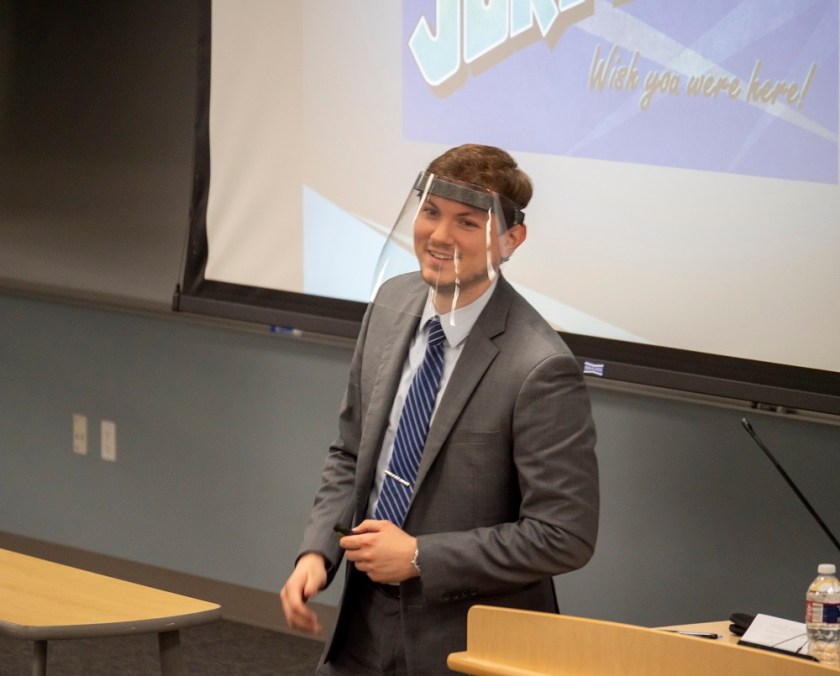
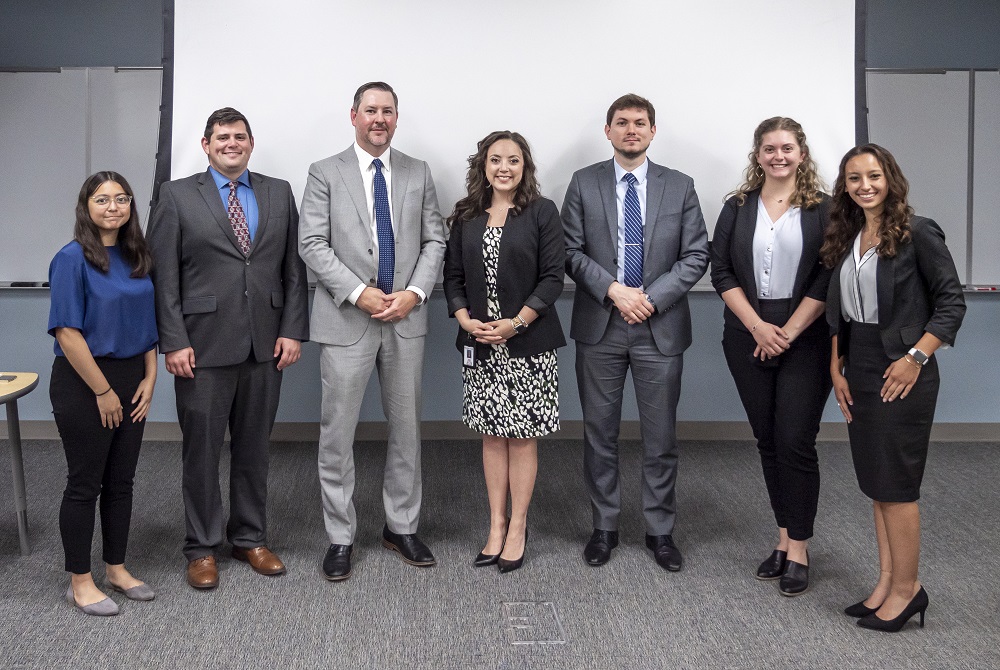
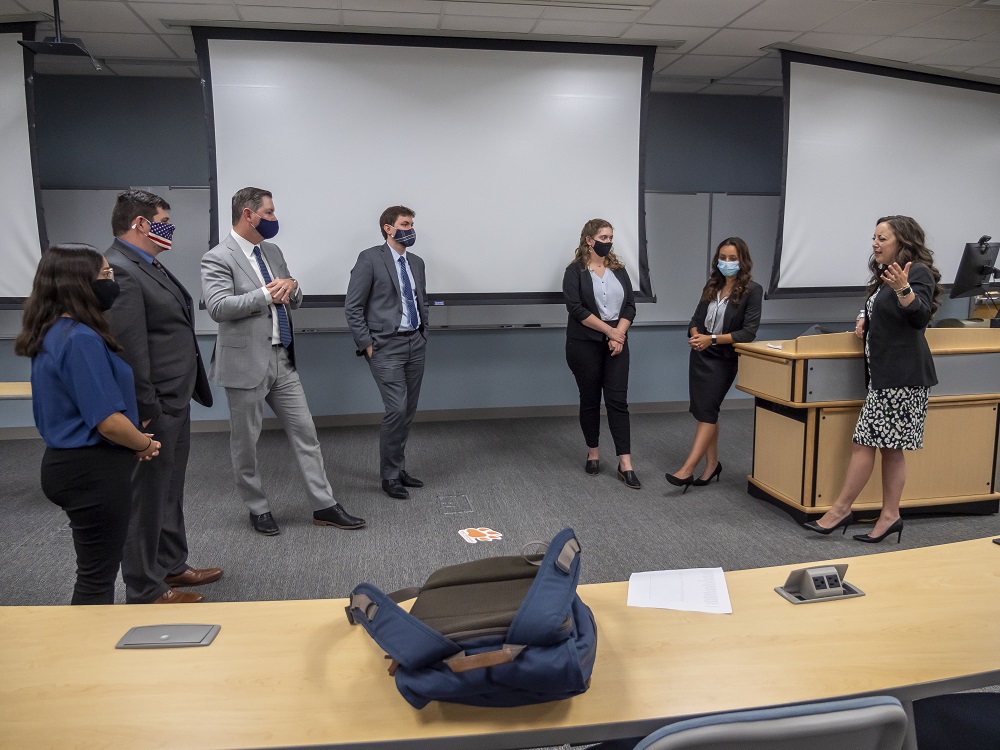
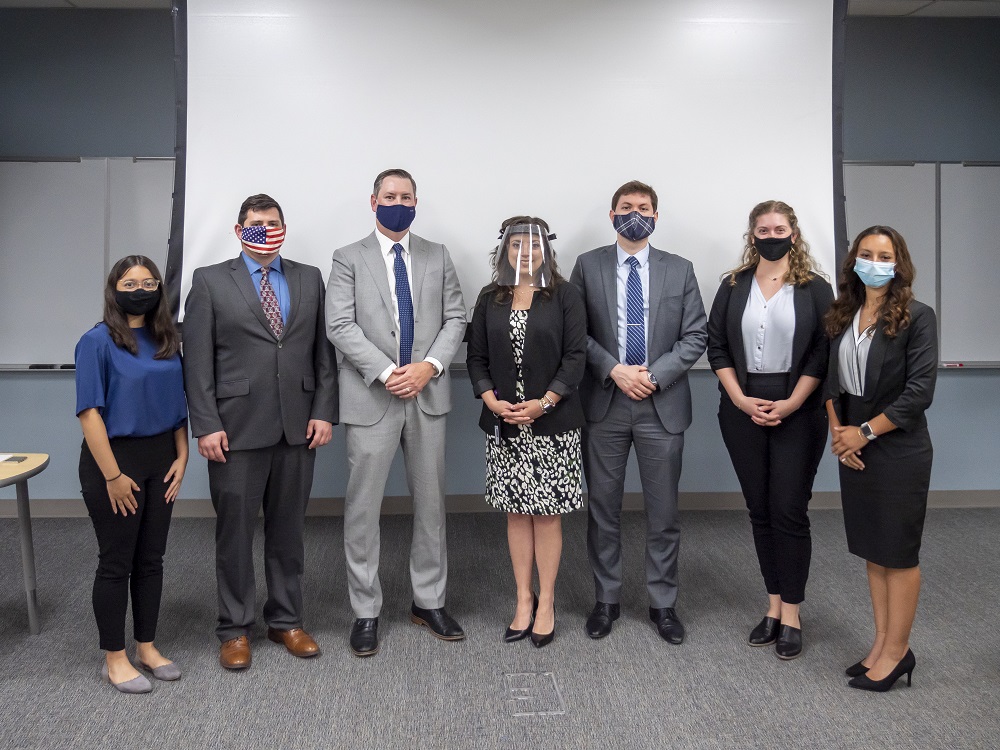
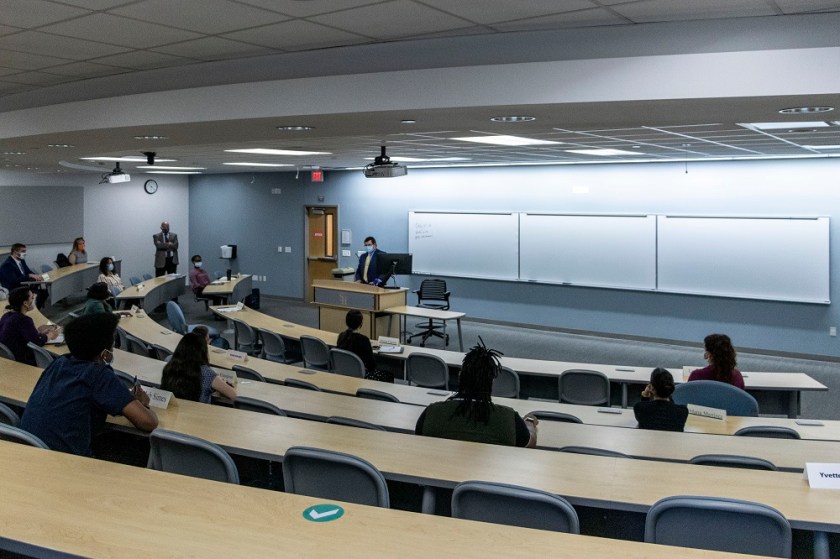
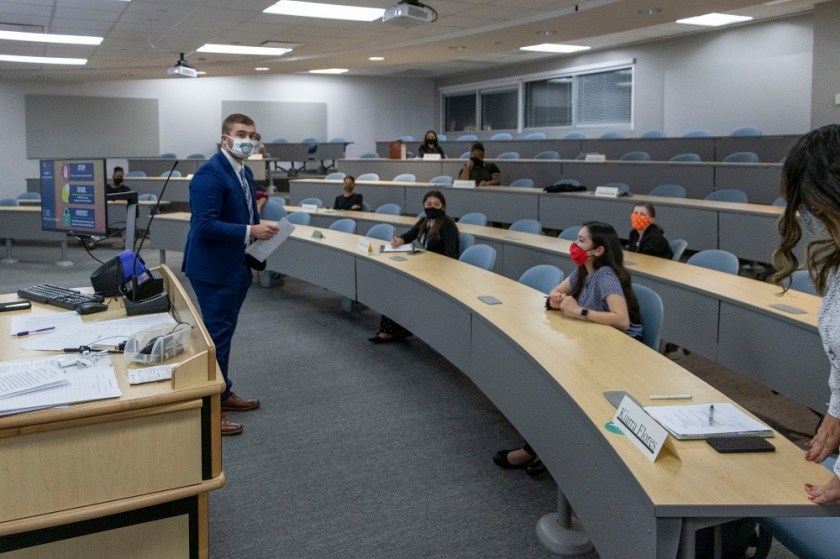
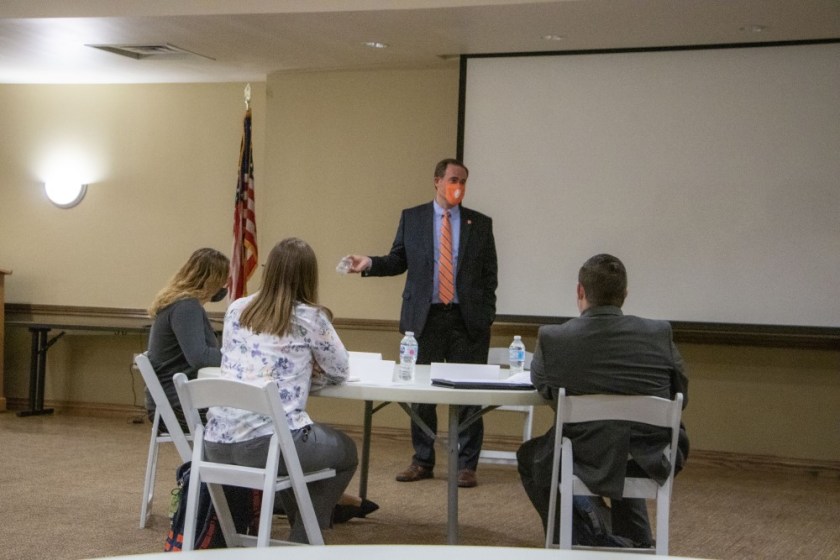
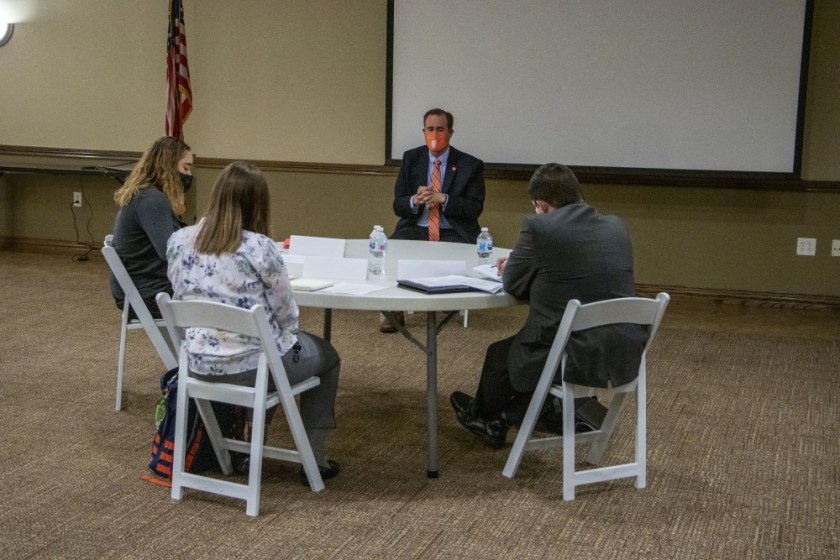
This past Wednesday, the LEAP Ambassadors hosted the District Attorney’s office, which sponsored a simulated voir dire, to help students better understand the jury selection process. Speaking to student participants from diverse majors, attorneys Stuart Hughes, Malori Martin, Phil Faselar, Taylor Carter helped the students understand the entire jury selection process. With this demonstration and the attorneys’ recaps, were able to see firsthand how voir dire factors into the trial process.
We acted as a group of potential jurors three separate times, each time learning a different attorney’s approach and method of getting to know a jury. An attorney’s job during this time is to find the type of juror they want to serve during the trial by asking broad questions that are relevant to the case. Members took on different personas and, to the full extent of their abilities, tried to answer questions as 56-year-old school district employees, 28-year-old graduate employees, and 45-year-old gas station cashiers–biographies provided to them by the LEAP Center. Members enjoyed the challenge of thinking on their feet and answering questions in character.
After the final voir dire, PLS members were able to ask questions about law school, learn about the different positions our guests held throughout their careers, and inquire about internships. Overall, it was an eye-opening experience for everyone involved. We saw a more in-depth view of the trial process and were able to offer a practice opportunity for the DA’s office coming out of a post Covid-19 world. Thank you to the Walker County District Attorney Office for coming to Sam Houston State University and teaching us about the voir dire process.
With a random number generator in hand, Val Ricks, Professor at South Texas College of Law, introduced himself to 16 pre-law students who registered to attend a virtual Mock Law School class on March 3, 2021. The class was taught by Professor Val Ricks, whose qualifications include a Juris Doctorate from Brigham Young University’s J. Reuben Clark Law School, legal work as an associate attorney with Kirton & McConkle, and almost 25 years teaching at South Texas College of Law. The Mock Law School class is a unique partnership between SHSU’s Center for Law, Engagement, And Politics and South Texas College of Law.

The students came to class prepared; they had already read and briefed the case which involved a contract dispute between the singer Mariah Carey and her stepfather. After Professor Ricks recited the facts of the case, he used the random number generator to select a student to discuss the legal issue of the case. Employing the Socratic Method of questioning, Professor Ricks skillfully led the pre-law students through the analysis of the legal issues in the case, the rule of law, and how the court applied the rule of law.
In evaluating the Class, several students commented that the Mock Law School Class gave them an opportunity to experience the real feel of law school while still being an undergraduate. Jessica Cuevas was grateful for the “amazing opportunity for a glance into the future of how my law school experience may be like regarding study habits and classroom settings. Attending the Mock Law Class solidified my decision to attend law school.”
In working through the logic of the Mariah Carey case, Professor Ricks homed in on some specific word choices in the opinion and mentioned synonyms for the legal terms. In this way, Ricks alluded to how language and law are closely linked.
After discussing the case, Professor Ricks asked some thought-provoking questions regarding the policies underlying the rule of law in the case and whether the court reached the correct result. In addition, like a question on a final law school exam, Ricks presented a hypothetical set of facts and asked the class to analyze the issue of the hypothetical based on the facts. Then, using the Mariah Carey case as precedent, he asked how a court would rule on the issue in the hypothetical case and what reasoning the court would use.
Professor Ricks followed up with some valuable advice for the pre-law students. He explained that law school is about studying old settled law so that as a practicing attorney, you have confidence in applying the law correctly to new fact patterns presented by clients. He suggested that students in law school take the Socratic questioning by law professors in class as a challenge and an opportunity to have a conversation with the professor. Ricks emphasized that the process of learning the law and applying it is more important than the specific legal cases. Yvette Mendoza commented, “ I loved this last part of the class because I was able to ask the law professor questions about law school.”
Professor Ricks advised the students of the importance of clearing everything off their calendar and devoting time to law school, especially in the first year of law school. Ruona Odharo asked a question about paying for law school. Ricks pointed out that South Texas College of Law strives to keep tuition as low as possible.
In response to Yvette Mendoza’s question on whether a student needs to go to a prestigious law school to get a good legal job, Ricks said that every law school teaches the same material using the Socratic Method, and that “excellence depends on you.” A great lawyer can come from any law school.
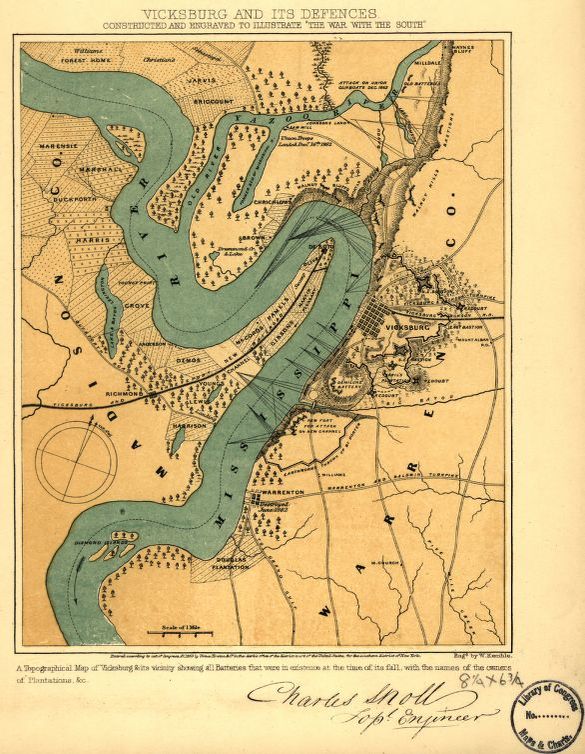
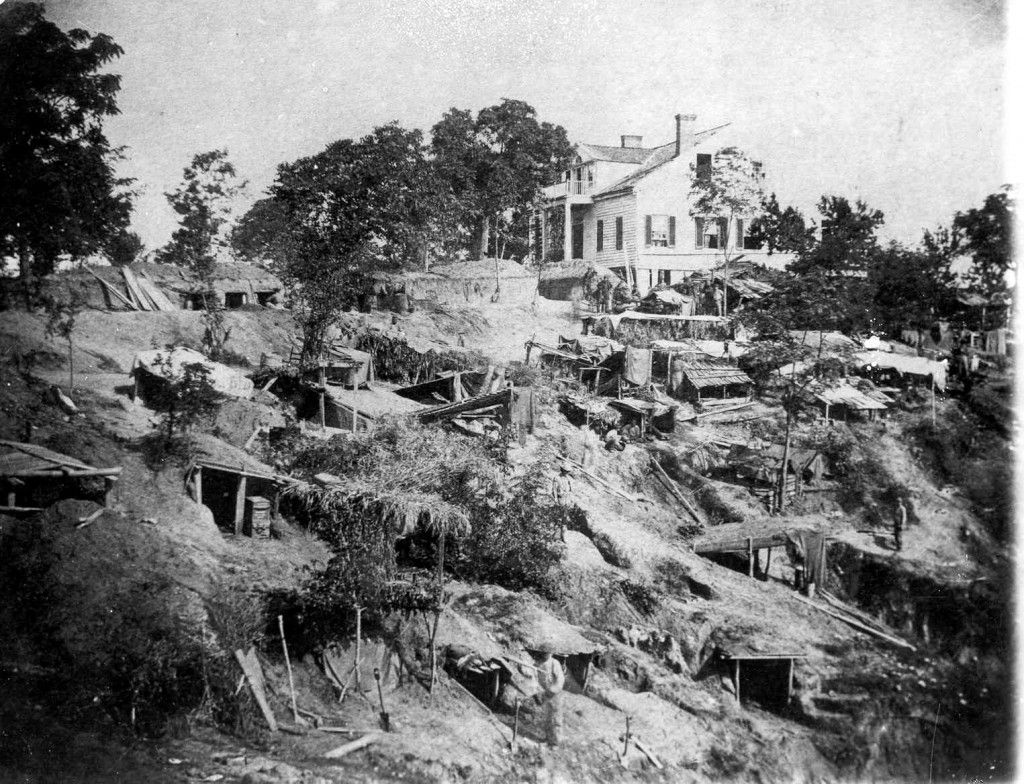
The second day of our LEAP adventures continued to focus on expanding our knowledge of civil rights, and today that began with us visiting the National Battlefield Site of Vicksburg in Mississippi. The siege of Vicksburg was a crucial strategic key point in the Civil War, a part of the Anaconda Plan, which spanned from May 18, 1863 to July 4, 1863. Vicksburg belonged to the Confederates initially, and it was crucial because it is located right next to the Mississippi River, which was very advantageous since it allowed for supplies, goods, and reinforcements to be easily transported. Another strategic advantage of the river is its course; it creates a C-like shape, where a piece of land is surrounded on three of its sides by the river like a peninsula, which allowed whoever had control over Vicksburg to place infantry along the banks and shoot the cannons at any ships or boats from the opposing side.
If the Union could take control of the Vicksburg area, they would have control and access to the river without having to worry about being attacked, and this is what happened. Conversely, for the Confederates, it meant that the Union cut off their supply chain, which left them with three options: fight to regain, retreat, or surrender. After 47 days, General Ulysses S. Grant’s move to strangle them from any resources led General John C. Pemberton to surrender.
While at the battlefield site, we visited two monuments: the Illinois monument and the Texas monument.
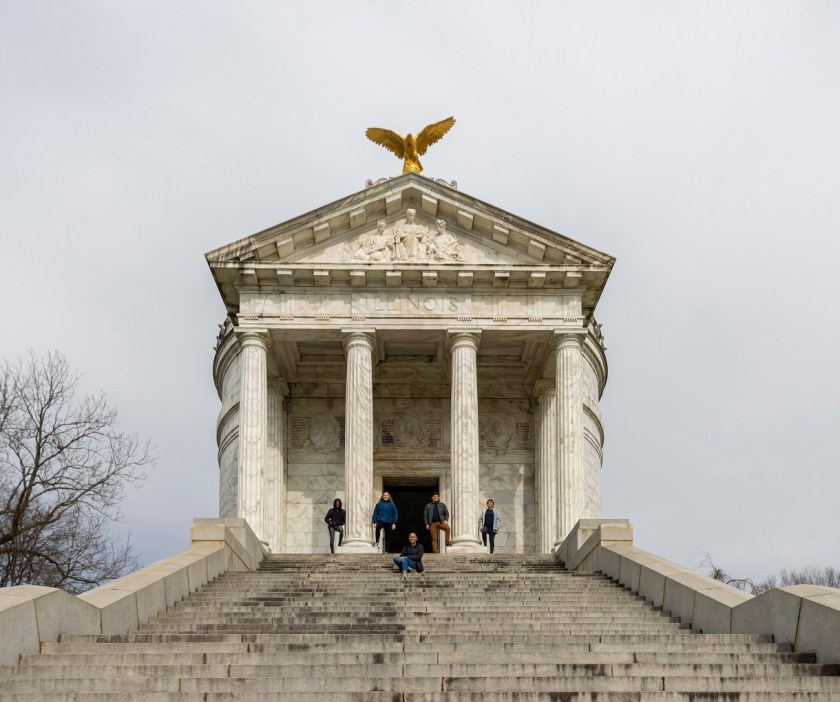
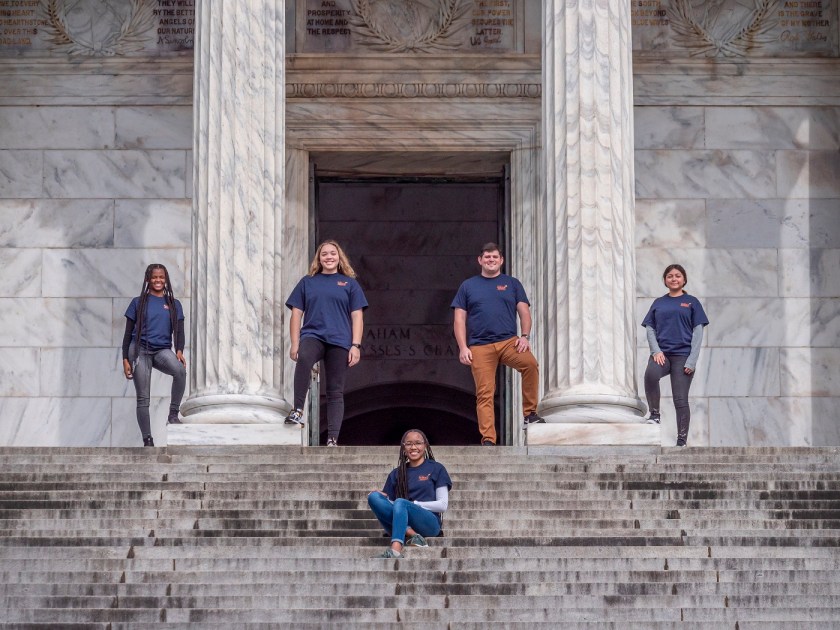
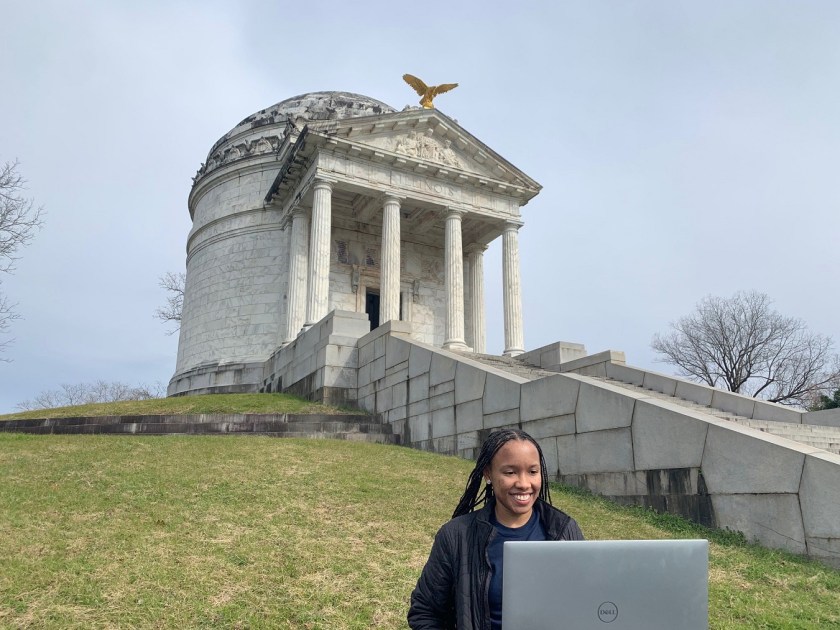
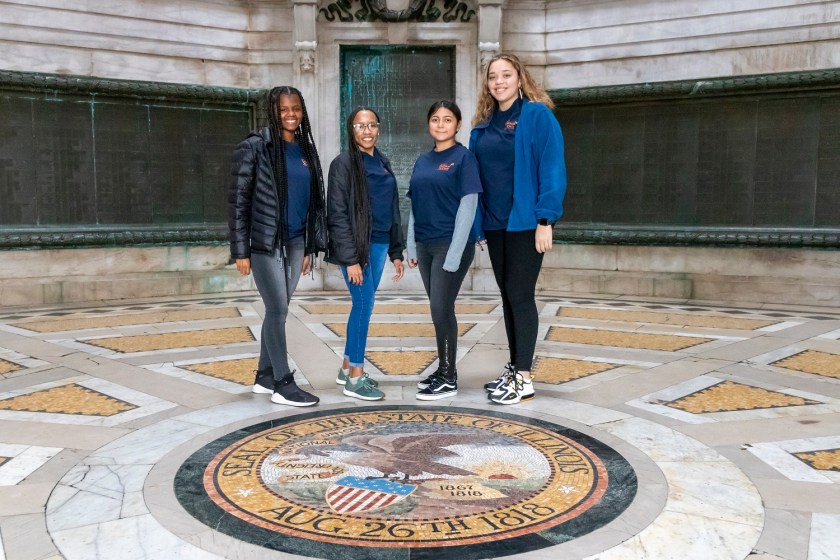
The first monument that we stopped to look at was the Illinois monument, which was dedicated in 1906.
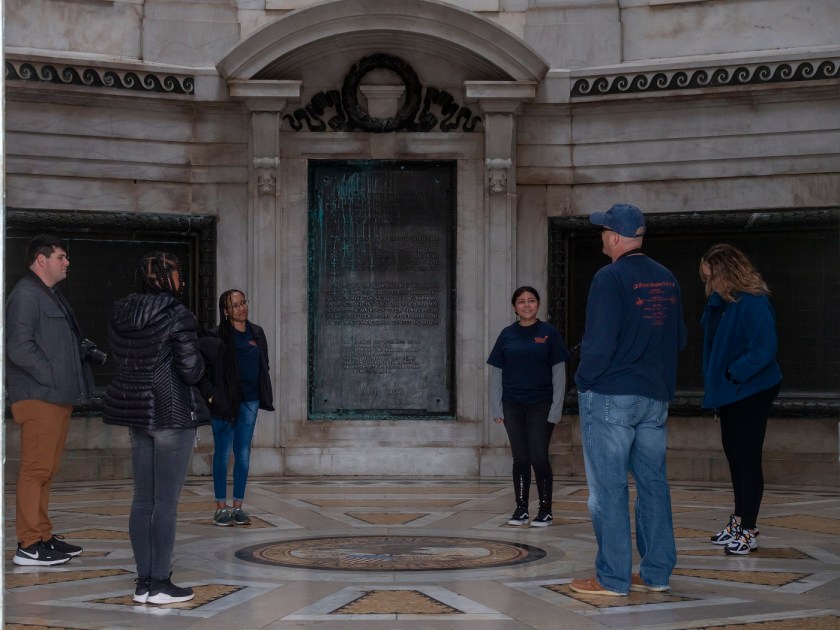
It has an ornate Roman-style architecture and somewhat resembles the Roman Pantheon. This monument has 47 steps in its stairway – I counted them as I worked my way up – which symbolic of the 47 days of the battle.
Inside of this building are bronze tablets with the names of 36,000+ Illinois soldiers who fought in this battle.
Another architectural note that I appreciated is the acoustics of the monument, a result of the domelike ceiling, which causes an echo of any noise within the structure.
As a sidebar, it’s worth noting that Ilexus Williams was interviewed by KBTX here.
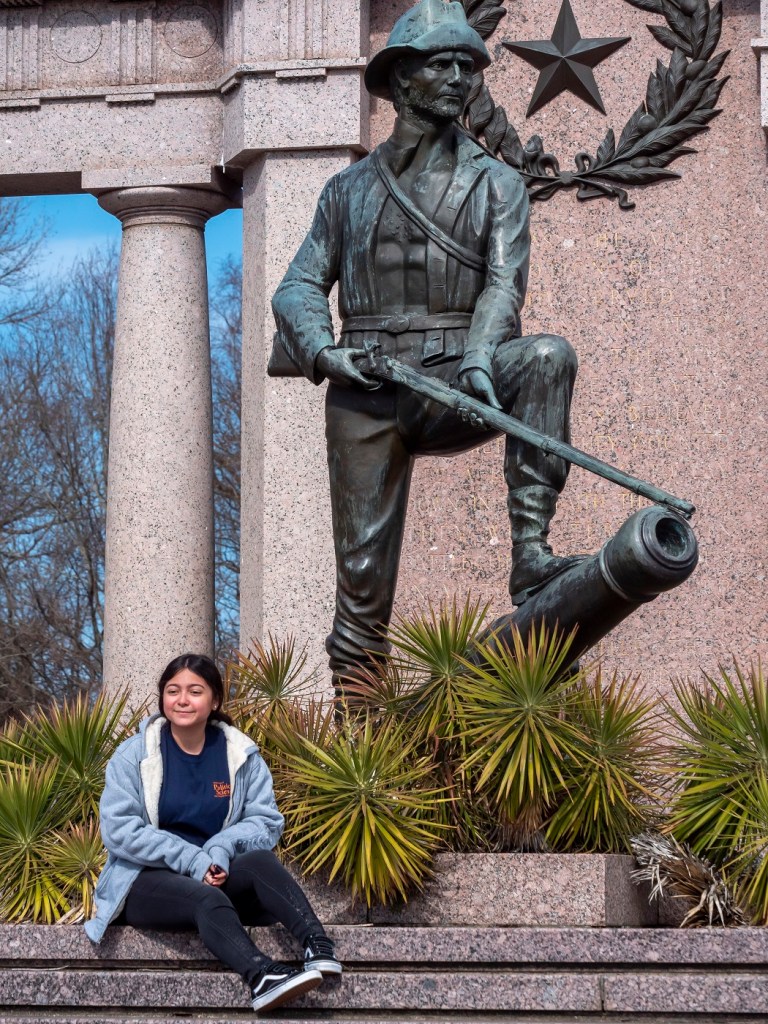
The second monument was the Texas monument, which was dedicated on November 4, 1961. This monument was in its own unique way very Texan since it was a completely different type of grand as compared to the previous one.
This monument has 11 steps which symbolize and honor the 11 states in the Confederacy. A bronze statue in the foreground displays a Texan soldier, and symbolizes the Texans who helped to seal the breach in the Vicksburg front line.
Both the architecture and the history of this national site have given us a profound new outlook about the impact the Civil War had on paving the way toward Civic/Social equality. Moreover, we discovered that the Texas Monument has an SHSU connection, in that the monument quotes John Thomason, for whom SHSU’s “Thomason Building” and “Thomason Room” in the library are named.
This was a great way to kick off the day, and ranks as one of our favorite parts of the trip thus far!
Sweetie Pies Frying Bird
Ilexus Williams
A day full of travel struck up growing appetites for the LEAP students. For lunch, we traveled to Sweetie Pies Flying Bird to satisfy our hunger with food that is nourishing to the soul: soul food.
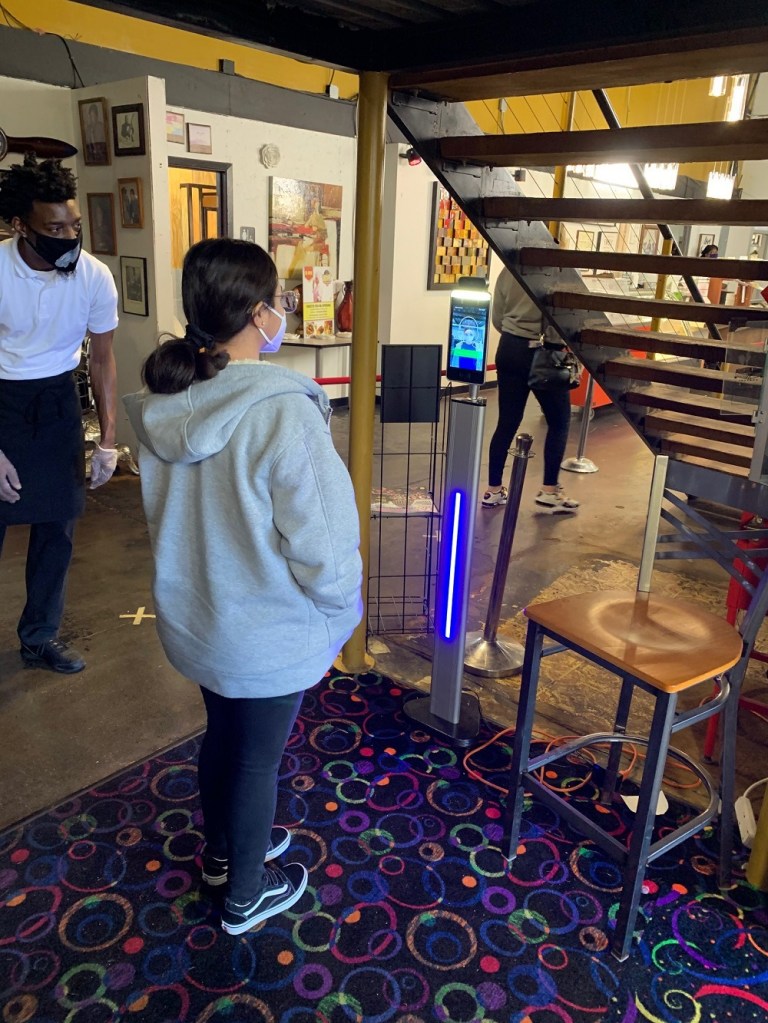
We were pleased to see that not only did the restaurant require masks, they also took customers’ temperature at the entry way.
We ordered an assortment of items including fried chicken, neck bone, fried fish, macaroni & cheese, green beans, candied yams, and black-eyed peas.
Favorites of the group were the macaroni & cheese and candied yams.
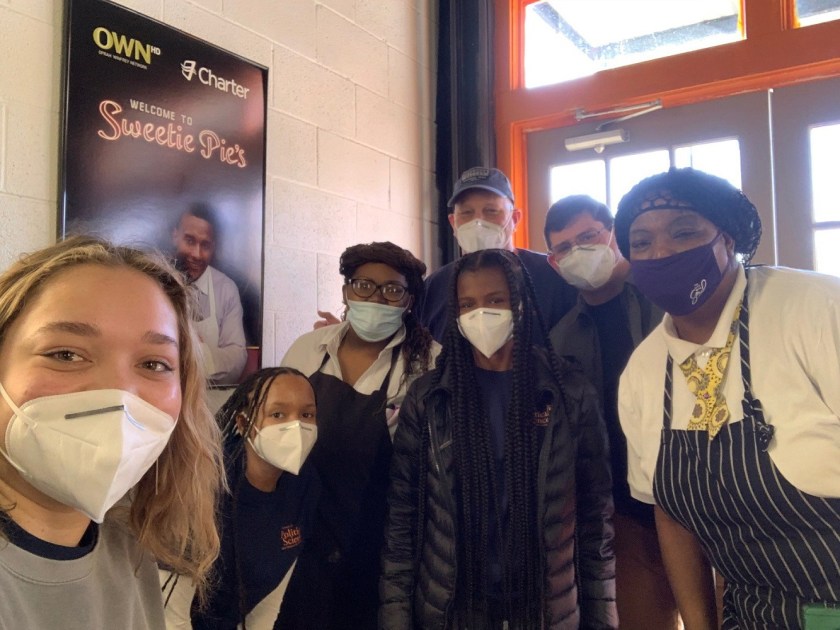
The staff at Sweetie Pie’s were nice enough to take a photo with us, which we did masked, but still managed to convey the sense of stomachs well satisfied.
And this gave us some needed energy to undertake our tour of the MS State Capitol building.
Capital Tour
Ava Garrett
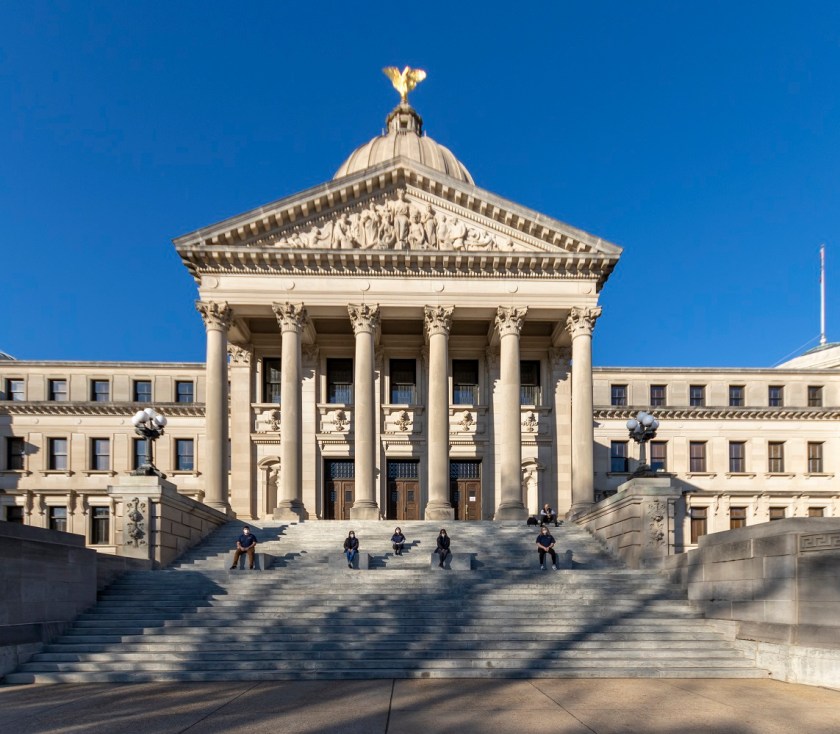
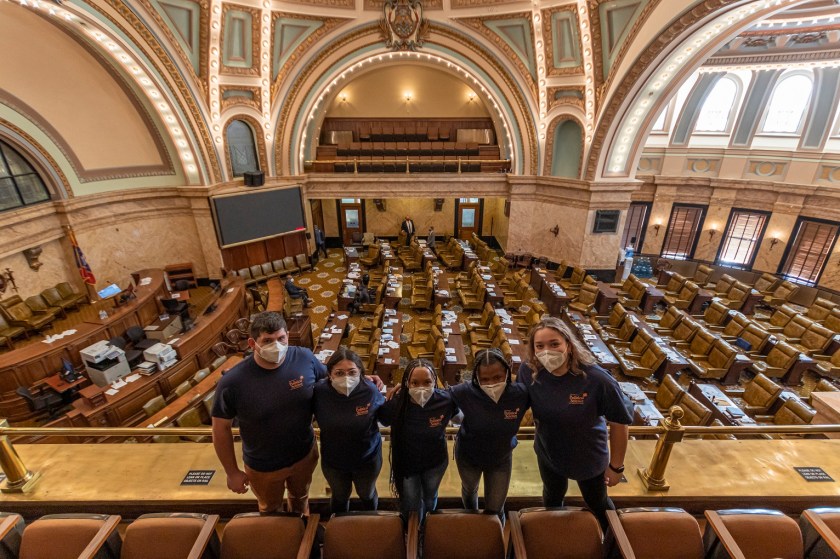
On yet another of our many stops on our inaugural trip, we visited the Mississippi state capitol which is located in Jackson. The capitol was built in just 28 months from 1901-1903, on the site of the old state penitentiary.
Just like many of the places we have visited on this trip, such as the Starr home and the Vicksburg National Battlefield, the capitol building’s architecture had a Roman and Greek influence, evident in the columns lining the entrance and the magnificent dome above it. The architect, Theodore Link, definitely worked to give the capitol a grand, elegant design appropriate for a state capitol building. Just before entering the building at the south entrance you can’t miss the beautifully crafted stained glass windows, which looked even more breathtaking from the inside when the sun shined through.
After stopping in the rotunda…
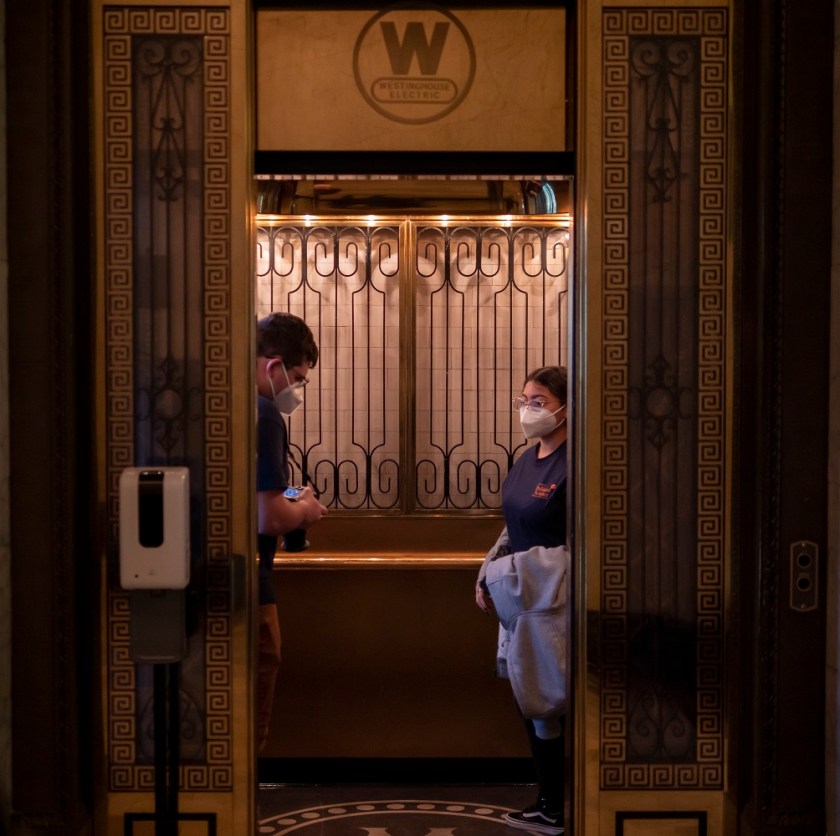
…and gazing up at the Italian white and black marble and taking in images of the blindfolded Lady Justice, we took the golden elevator…
…upstairs and made our way to my favorite room in the capitol: The House of Representatives chamber, which was bustling as the legislative session was under way (the bustling activity was just underneath us, and not visible in this photo)…
Just being in that room made me really excited; it was cool to see the room being used and in action. The only other capital I have visited – the Texas capital – was much less active the last time I went.
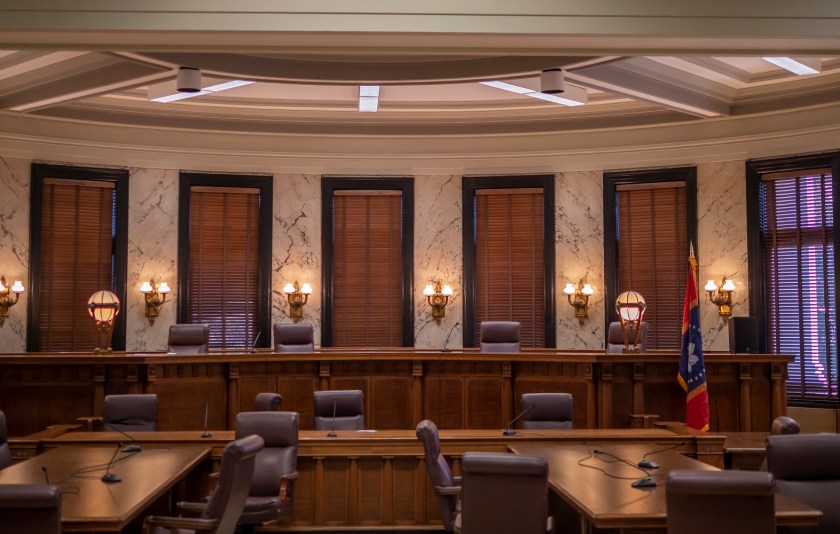
Sadly, we could not visit the Senate due to COVID-19 restrictions, but I’m sure it would have been just as interesting as the rest of the building, and we did get to see the former Supreme Court….
…and the art in the rotunda, painted as part of the WPA program, and designed to highlight MS history.
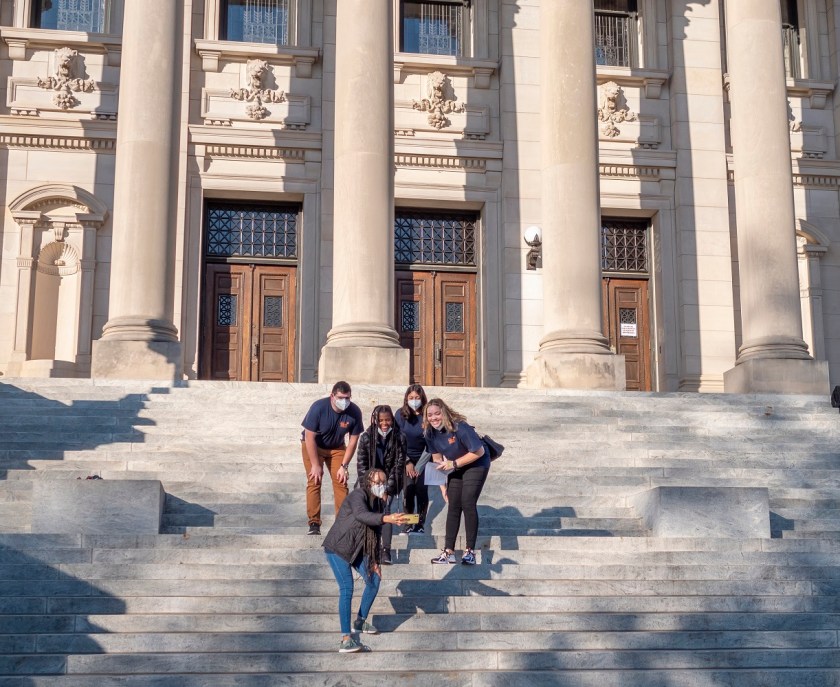
On our way out, we were able to pick up some fun souvenirs such as brochures, stickers, and even a pin with the capitol building on it. Finally, to wrap up our self-guided capitol tour we got to take some fun photos of us standing on the capitol steps.
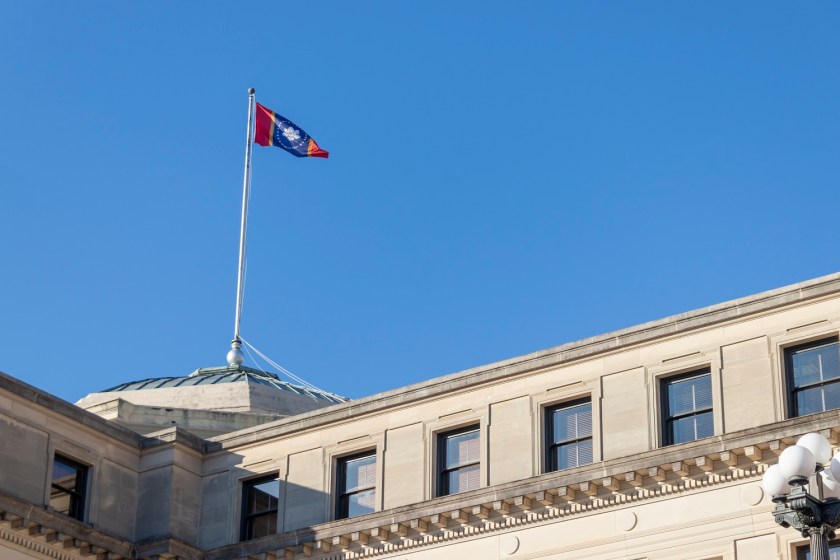
One other thing is worth noting: In November, MS voted to remove the confederate symbol from its state flag. They replaced it with a Magnolia Bloom, fitting for MS, which is the “Magnolia State.” We all agreed it was a much more inviting symbol for the state, and matched the residents’ friendly and charming natures.
Now I can officially say I have been to 2 out of 50 capitol buildings!
Medgar Evers Home
Ilexus Williams
After immersing ourselves in the history of the Mississippi State Capitol, we visited the Medgar and Myrlie Evers Home National Monument, more commonly known as Medgar Evers Home. The home is located in the Elraine Subdivision, which was the first planned middle-class subdivision for African Americans in Mississippi following World War II. Medgar Evers and his wife purchased the home in 1953 and lived in the home until 1963.
Medgar Evers was an influential Civil Rights Activist in Mississippi. Before embarking on his commitment to fighting for civil rights, Medgar Evers served in the United States Army, during World War II from 1943 to 1945. Evers even took part in the D-Day invasion on the shore of Normandy on June 6, 1944 during his service.
Following his time in the military, Evers began his work in civil rights as the president of the Regional Council of Negro Leadership. In this organization, Evers worked to establish measures to impact civil rights. One of the measures taken included a boycott of all gas stations that denied African Americans access to the stations’ restrooms.
To challenge the U.S. Supreme Court’s decision on segregated public schools, Evers partnered with the NAACP and submitted a Law School application to the University of Mississippi as a test case. Evers was denied admission solely because of his race. Evers’ effort to desegregate public schools brought him praise from the NAACP, so in 1954, Evers became the first Mississippi state field secretary of the NAACP. As a state field secretary, Evers organized voter registration, demonstrations, boycotts of businesses that had discriminative policies, and investigated crimes against African Americans.
Due to his activism, Evers was the most prominent civil rights leader in Mississippi. Because of this, Evers and his family experienced countless threats. On June 12, 1963, Medgar Evers was assassinated in his driveway. Although his life was cut short, Medgar Evers’ contribution to the civil rights movement and the fight for equal treatment for all will never be forgotten.
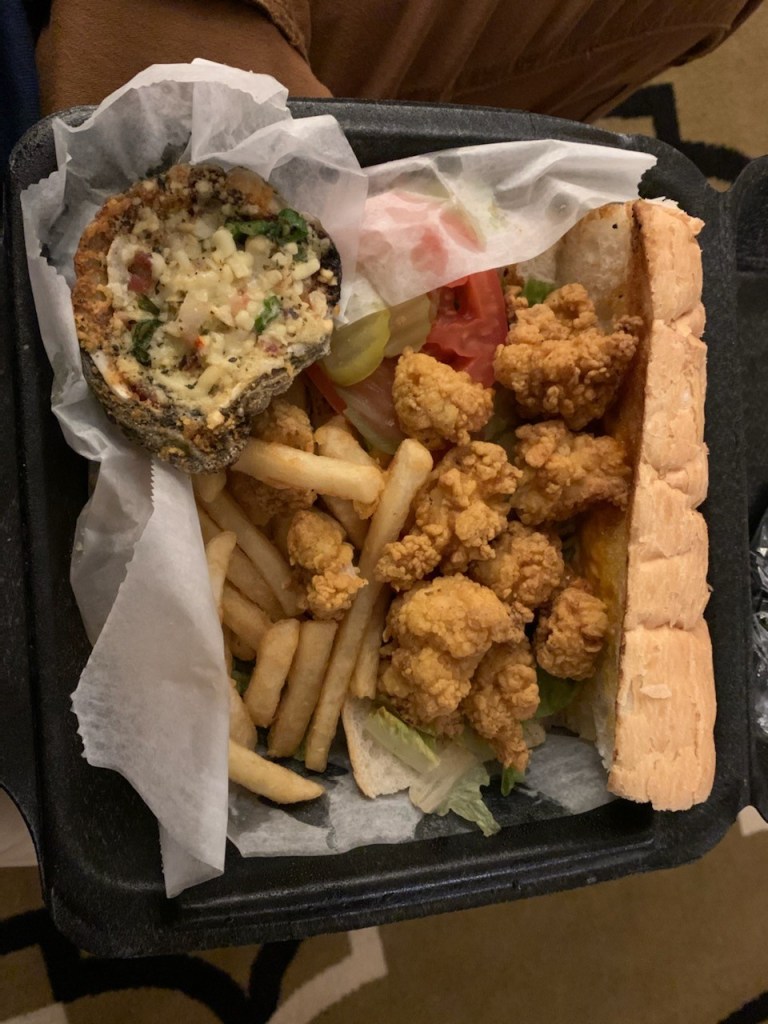
The evening came to a close as we arrived in New Orleans, Louisiana, where we settled in and sampled some creole cuisine from Creole House Restaurant & Oyster Bar, where we got to try alligator po-boys, muffaletta, blackened chicken jambalaya…
…and some delicious caramel bread pudding and pecan cobbler. We have a full day tomorrow, and we cannot wait to explore New Orleans over the next two days!
Our second meeting of the fall semester was a success. The meeting began with our president, Quinn Kobrin, introducing the new officers to the Pre-Law Society members.
After that, we briefly discussed law school preparation. Michael Freeman (senior), asked, “How long does it take for law schools to let you know their admissions decision?” Professor Yawn explained that it can take weeks, if not months, and it depends on factors such as your LSAT score and GPA, and how badly they would like you to come to their school. It was then suggested that members use all available resources to help prepare for the LSAT, especially asking members who have already taken their LSAT for help and advice.
We were then showed a video of Texas’ 10th Court of Appeals on a Zoom call to learn how they discuss oral arguments during the pandemic, and see what challenges are presented by the virtual experience. It was apparent that both the attorneys and the judges were still adjusting to the format, as there were a few awkward moments where individuals dealt with connection or sound issues.
Our members were then in for an unexpected treat. We watched two short clips from the movies, Death Wish and Fargo. Death Wish showed a mugging that ended in three murders, and Fargo showed an aggravated burglary. While watching these videos, an actor walked in and took an envelope – which our members believed contained the organization’s cash on hand – from right under our president’s nose.
With these three crimes committed, witnesses were chosen from the group and taken to another room to write witness statements. We selected a number of attorneys to question the witnesses, including Michael Freeman, and Jase Brazzil (senior). One by one, witnesses were brought back into the room and an attorney was given their statement. It was then the attorney’s job to either get the witness to reaffirm their story or to catch inconsistencies to determine whether or not the witness was credible.
While doing this activity, despite the challenge of communication presented by wearing masks, we had a good laugh and discussion about what the suspects looked like and what really happened in the “crimes.” The exercise was a good reminder that not all witness accounts are reliable because we all perceive things differently.
This activity concluded the meeting, and we are looking forward to our final meeting of the fall semester, which will be on November 18th.
In a continuation of the LEAP Center’s Facebook one-on-one series, Professor Yawn interviewed Professor Jim Olson about his life during and after his career as a CIA case officer. This having been my first time hearing Mr. Olson speak, I was astounded at how little I knew about the world of counterintelligence.
Olson began the conversation with a definition of counterintelligence. He explained that its purpose is to protect the United States from other nations who may try to steal our secrets and technology. Much to my surprise, he told us that there are approximately 80 countries spying on us right now.
The conversation then turned to Olson’s 31-year career in the Clandestine Service. He was asked about his cover identity, which he could not share in great detail, but he explained that when he was in another nation, he would often have a cover as a U.S. diplomat, so he would have diplomatic immunity if he got into trouble. Sometimes, however, he was in other countries without working as a diplomat, and therefore would be subject to that country’s justice system if he were caught.
He shared that he and his wife – also a case officer within the CIA – never anticipated to come out from their cover identities, because doing so posed a threat to themselves and to their family. However, he was approached by President George H.W. Bush and George Tenet (former Director Central Intelligence) to work at the Bush School of Public Service. Olson was excited for the opportunity, but there is a CIA policy that does not allow officers to go onto college campuses covertly (which was news to me). So, he was forced to give up his cover.
In a similar vein, he was asked about how he and his wife broke the news to their children that they were officers in the CIA, and how they took it. Apparently, when he was stationed in Vienna, terrorists managed to get ahold of his address and sent him a death threat. They decided to tell their oldest son, who was sixteen at the time, and asked him to look after his siblings. As each of their children learned, he said, they took the information in with a sense of pride. He told us that each of his children has now gone on to pursue a career in the service of others.
Next he discussed CIA recruitment methods. We learned that the CIA seeks out a variety of candidates who may be cut out for a career as a case officer. Mainly, they are looking for character; they want recruits who are reliable and trustworthy.
To prepare for a career in the Clandestine Service (one of the most commonly asked questions of the event) Olson said that a bachelor’s degree usually would not be enough, and that students should aim to get a graduate degree of some kind. He suggested learning new languages, taking on roles of leadership, and working in positions that might allow you to travel abroad.
Aldrich Ames
On the subject of character, he spoke briefly about some former CIA officers who betrayed the United States. He spoke vehemently about his former colleague Aldrich “Rick” Ames, who he considers the worst traitor to the country for turning over to the KGB. He explained that Ames had identified Russians who were working for the CIA to the KGB, which led to their imprisonment or execution.
To wrap up the session, we asked Olson what he wanted people to know about the CIA. He explained that CIA case officers are public servants. They do not do what they do for money, power, prestige, or status. They do what they do with honorable intentions.
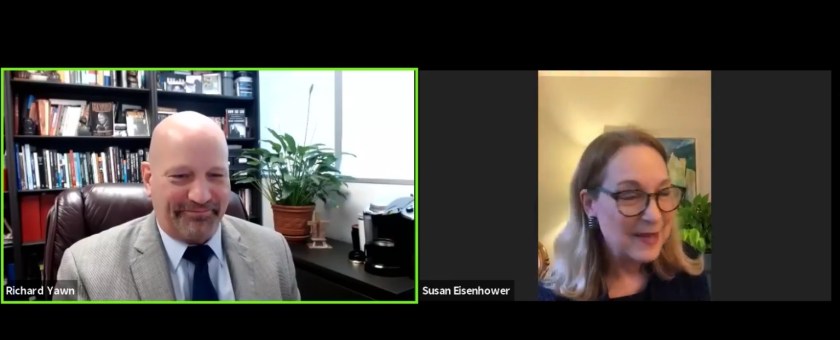
Despite all of the challenges of COVID-19, the Center for Law, Engagement, and Politics continues to provide engaging and interesting learning opportunities for students. Most recently, students were able to watch a Facebook live interview with President Dwight D. Eisenhower’s granddaughter, Susan Eisenhower, where she discussed her grandfather’s leadership in World War II and as president. Author of the biography How Ike Led, she had much to share about his life and overall legacy.
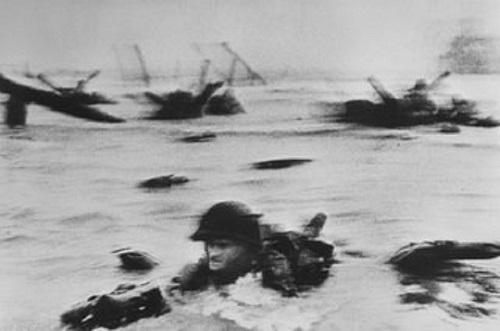
The interview began with a look at President Eisenhower’s role in D-Day,
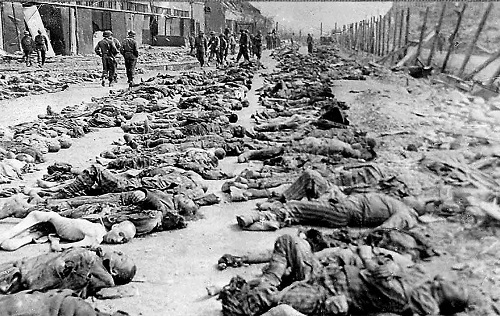
liberating Europe from Nazi rule, and his handling of the discovery of concentration camps. It was explained that Eisenhower opted for a broad, slow advance to defeat the Nazi empire, rather than a fast and hasty one. He wanted to bring an end to the regime, and prevent it from rising to power again, and for his approach he was criticized by some who wanted a quicker–but riskier–approach.
In spite of his critics, this slow advance would be an important factor that led to the discovery of concentration camps. When he learned of the atrocities, he took it upon himself to examine every corner of the camps to understand what had happened and how it had come to pass.
She told us that he then issued orders for as many people as possible to document and bear witness to the camps. He brought in journalists, elected officials, and everyone fighting on the front lines.
He then had townspeople from surrounding areas marched through to see what their denial and willful ignorance had led to, and many were made to give burials to the deceased.
As she discussed the importance of Eisenhower’s foresight, and how he was able to anticipate that many people would not believe what had happened in the camps, Susan Eisenhower reminded us that Germany is one of the few countries in the world with zero tolerance of Holocaust denial. LEAP ambassadors learned about Germany’s efforts to reverse the wrongs of the Holocaust and its lingering effects earlier this year.
As the discussion transitioned to Eisenhower’s post-war service, I learned several interesting facts about his commitment to service and duty…
Apparently, on more than one occasion, President Truman offered not to run for reelection after his term, and instead let Eisenhower run for the Democratic nomination. Eisenhower refused each time because he was not in search of power. His granddaughter reminded us that he had wielded more power than most other leaders during World War II, and did not want run for president except when he felt it was his absolutely duty to do so.
A few other aspects of his commitment to duty were his refusal to wear a helmet because they should only be worn by those serving in combat, and his refusal to accept the Congressional Medal of Honor for the same reason – it was meant for those who had shown valor in combat.
The conversation then pivoted to Eisenhower’s leadership style as president of the United States. It was made clear that he did not engage in personal attacks; he was strategic and methodical in his political approach. When dealing with Senator McCarthy and his infamous hearings, Eisenhower did not call him out directly. Instead, he gave speeches about what American democracy should look like, insisted on televising the outrageous investigations, and let the Senate come to censure McCarthy on their own.
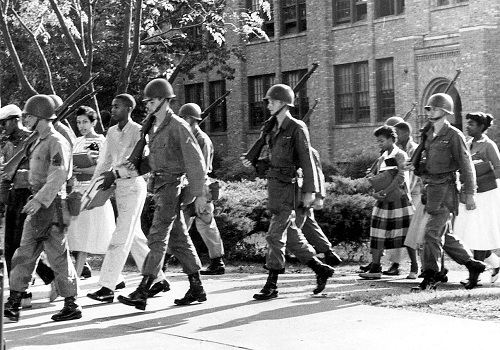
President Eisenhower also suffered no nonsense when it came to dealing with issues of race. As LEAP ambassadors learned in January of this year, the governor of Arkansas – Orval Faubus – dragged his feet in complying with the decision of Brown v. Board of Education, and made every effort to not desegregate schools. In response to this, Eisenhower mobilized the Arkansas National Guard and deployed 101st Airborne (paratroopers he had commanded on D-Day) to protect a group of African American students, immortalized in history as the “Little Rock Nine,” as they desegregated Little Rock Central High.
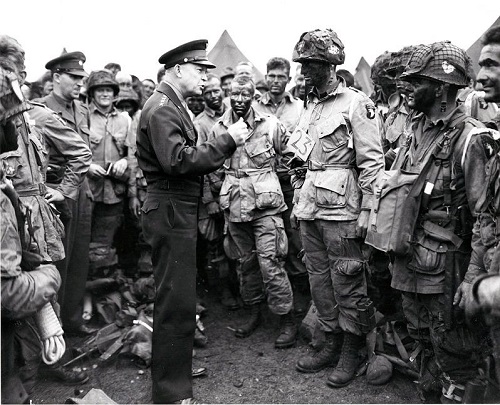
Susan Eisenhower then spoke about how her grandfather was a leader through study and discipline, and was naturally empathetic. He knew what people needed to hear, and tried to be relatable and genuine whenever he could. We saw a picture of him speaking with members of the 101st Airborne Division prior to D-Day and were told that he was discussing fly-fishing techniques with Lt. Wallace Strobel, rather than giving a pep talk about their mission. He wanted to remind them of their humanity.
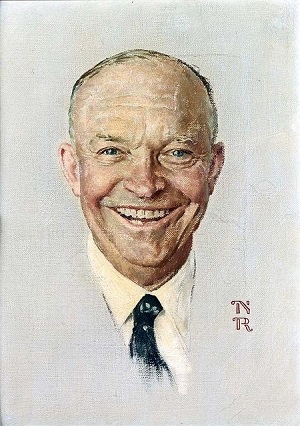
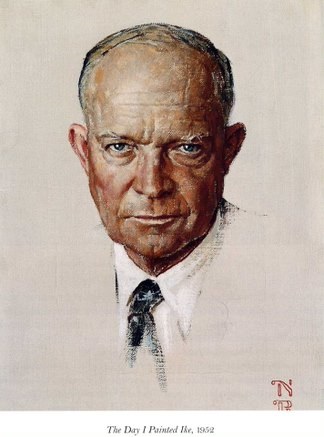
Finally, President Eisenhower’s legacy of leadership and empathy are embodied eternally in Norman Rockwell’s portraits of him, which at various times depict him both serious and smiling. As his granddaughter explained, the big, toothy grin we saw was his trademark smile, as he was generally in good spirits around his family.
As the meeting came to a close, Susan Eisenhower reminded us that we will “be better as people if we can understand the views of those who come from…different backgrounds,” encouraging us to be ‘like Ike’ when it came to how we view and deal with those who are different than us.
This interview was so interesting and informative, and we were incredibly lucky to hear from Susan Eisenhower. We are grateful for her time and insight, and look forward to the possibility of meeting her in person someday soon.
In our sixth and final meeting in September for LEAP LEADs, we had the privilege of learning from SHSU Vice-Provost Chris Maynard and legendary Washington Post reporter (and author) Bob Woodward. The night was as entertaining as it was educational.
Dr. Chris Maynard serves as Vice Provost, a position that is a mystery to most students. He attended our LEAP LEADs meeting to help de-mystify that position and to provide larger lessons about the University structure.
Dr. Maynard drew on a wealth of experience: he has been a Dean, Chair, (University of North Alabama) and a Professor (University of North Alabama and Dakota State University). The conversation with Dr. Maynard was as broad as his education and experience.
He provided advice to students considering law or graduate school (“Have a game plan–make sure you pursuing goals and that those degrees fit in with those goals”) and on being successful in our chosen fields (“find successful people in our area, and learn as much as possible from them”–good advice for people doing just that in LEAP LEADs!).
He also discussed the disruption caused by COVID, from everything to changing the way we market and offer classes, to dealing with media concerns, to providing students the “University” experience. He was adamant that, despite the vexations caused by COVID, the University degree and experience is valuable and worthwhile–something with which we all agree.
We also had a chance to ask Dr. Maynard about his area of expertise: political history. And while he did discuss history (see below), he also discussed the future and the challenge we face in cybersecurity. During the Cold War, there were two super powers and their allies coalesced against each other, but there was a type of stability. Now, “a person with the right skill set and a laptop can hack into a government’s system and wreak havoc.”
Of course, we also asked many questions about the end of the Cold War and the careers of Ronald Reagan, George H. W. Bush, and James Baker. He described the different styles of Reagan and Bush, while also discussing the unique talents of James Baker, about whom we also had the pleasure of watching a Texas Tribune Festival presentation (featuring Mark Updegrove, Susan Glasser, and Peter Baker).
The discussion of these men and their accomplishments set the stage, bathed in high-contrast light, for our final event of the evening: hearing Bob Woodward discuss his new book, “Rage,” on the Trump Administration.
We enjoyed our dinner from Carbonero as we watched Woodward discuss the Trump Administration and the conclusions he drew from 17 separate interviews with President Trump–both before and after the COVID-19 outbreak.
Woodward’s report, which sometimes contained various expletives (all while quoting Trump administration officials), portrayed Trump as a contradictory figure. At times the President acknowledged the danger posed by COVID; other times, he seemed indifferent or dismissive of the threats it presented. And even as these important discussions were taking place, Trump, according to Woodward, would be fixated on things like photos he took with world leaders. It was an unsettling discussion, one made more unsettling by the news that broke shortly thereafter about the President contracting COVID.
We’ve learned quite a lot this fall, but one thing has been made most clear: all these discussions–whether on local government, University administration, national politics, or COVID–are all related.
Following several meetings with guest speakers such as Commissioner Bill Daugette and (virtual) Rep. Senfronia Thompson as part of our LEAP LEADs program, our educational odyssey continued with additional training and guest speakers.
Tonight, in our fifth meeting, we began with an introduction from Ms. Fors, who provided us with tips on email etiquette and how to create an email signature block. We were reminded to (1) keep emails short unless length is absolutely necessary, (2) to use a subject heading that is accurate and telling, (3) and to ensure that the email employs good grammar and correct spelling.
After Ms. Fors’ extremely instructive discussion, we moved on to watch the Texas Tribune Festival’s discussion with Peter Hotez, the dean at the National School of Tropical Medicine at Baylor College of Medicine and an expert in vaccine development.
As optimistic as we all were about the current COVID-19 situation, watching this talk with Hotez certainly put a damper on our hopes about the virus. Hotez shared that “vaccines may not be introduced until spring 2021” and that we are likely to have a third surge in COVID-19 cases–and that it could be even worse than before. Though this discussion wasn’t filled with the best of news, it most definitely provided us with new information to keep in mind as we continue to navigate through this new COVID lifestyle that we may begin to call “normal” pretty soon.
The highlight of our night was a Q&A with Dr. Christine Blackburn, the Assistant Research Scientist, lecturer, and Deputy Director of the Pandemic and Biosecurity and Policy Program at the Scowcroft Institute of International Affairs.
During this Q&A the eight LEAP LEADs’ students were able to engage in an interactive conversation with Dr. Blackburn on her career, her advice to young people and the substantive aspects of the Coronavirus–which was very educational.
We learned, for example, the 3-4 phases a vaccine must go through to become approved.
We, apparently, are nearing phase three trials, which means tightly controlled experiments on humans should begin.
One of the interesting things about Dr. Blackburn is her educational background. She has an “individual interdisciplinary Ph.D.” in “Political Science, Communications, and Veterinary Science.” The idea is that, as the world becomes more specialized and silo-like, people with interdisciplinary degrees can cut across multiple domains. She persisted in this degree despite others telling her, “No one is going to hire someone with that combination of degrees.” But, of course, the ability to cut across domains is exactly what is needed in a pandemic because it affects supply chains, economics, food and, of course, health–all the while being entangled with politics.
In conclusion, we asked Dr. Blackburn what her goals were and what she hopes to accomplish. She prefaced her response by saying it was a “cliche,” but that she went into her field just “hoping to make the world a better place.” And for a group of students who signed up for LEAP LEADs, in part, to make the world a better place, it was a validating answer.
Finally, our eventful night ended by us getting our dinner from Farmhouse Café and talking amongst ourselves about how interesting and inspiring our talk with Dr. Blackburn was. Though it was only our fifth meeting of the semester I am excited to continue to learn and grow along side other individuals who are eager to do the same.