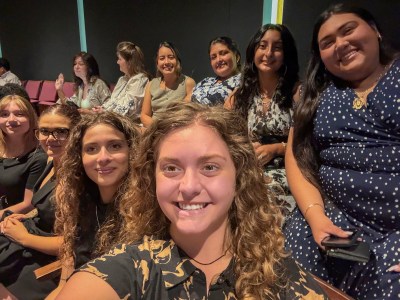
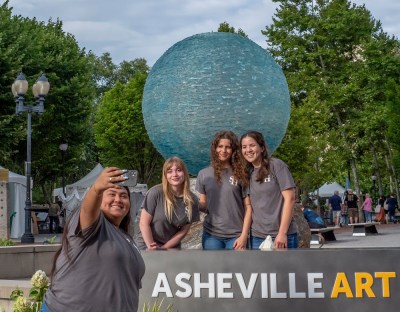
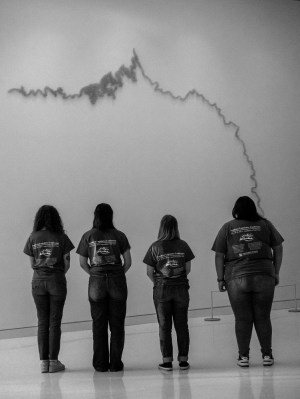
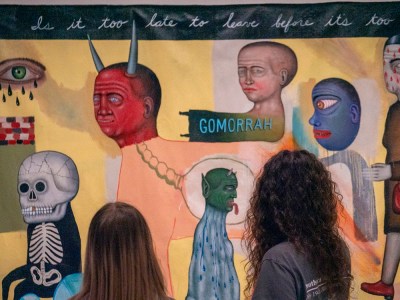
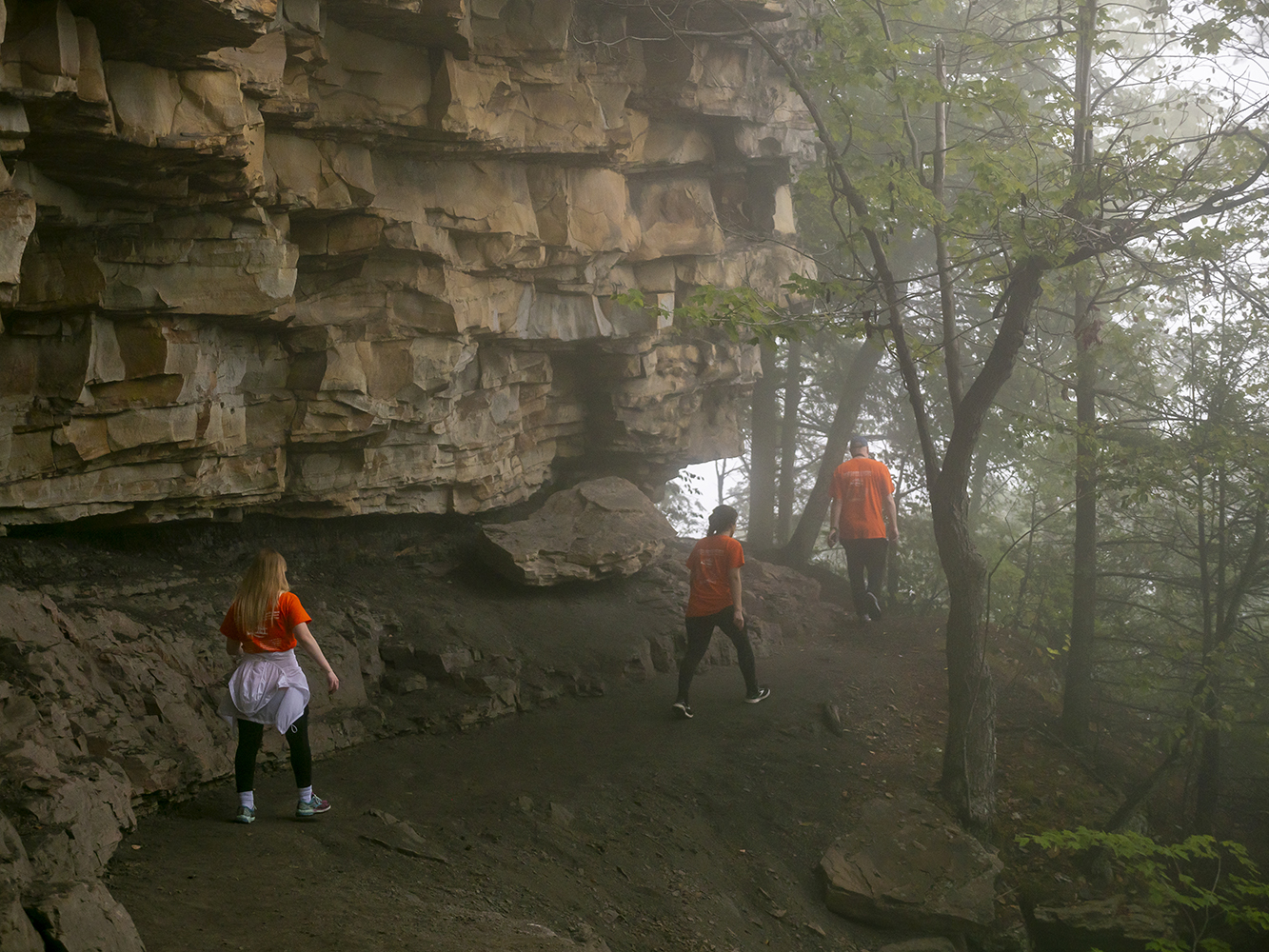
Working on little sleep, and following an eighteen-hour first day, LEAP Ambassadors arose at 6am to explore architecture in and around Pittsburgh, with a stop at PPG Place, a mural by Richard Haas, and two major works by Frank Lloyd Wright.
PPG Place
Our first stop was PPG place, a six-building, “glass gothic” design by Philip Johnson.
As part of our LEAP travels, we had seen Johnson buildings in Houston, and we had watched a documentary on him in preparation for this trip, but PPG place was a place like no other.
Completed in 1984, its towering glass spires and sleek facades embody Johnson’s signature postmodern style, blending classical elements with contemporary materials. Its gothic detailing pay homage to Pittsburgh’s industrial heritage, its all-glass encasing embraces the future with innovative design, and its central plaza allows for a nice place to gather, which we did!
Richard Haas Mural As a teenager, Haas spent a summer apprenticing for Frank Lloyd Wright, so it is no surprise that his murals take on an architectural quality. Indeed, Haas’s website describes him as an “architectural muralist,” an apt sobriquet.
We know Haas primarily through his 15 works in Huntsville, but we’ve also seen his work in Fort Worth, which is a masterpiece. So it was with excitement that we tracked down his Pittsburgh mural, which is near the corner of Sixth and Fort Duquesne Boulevard.
As you might expect, it features an industrial scene, an homage to Pittsburgh steel-making history, with nods to its central location at the juncture of multiple rivers.
It’s always a pleasure to see Haas’s work, but this was especially true today, when we would also have a chance to see the work of his former boss, Frank Lloyd Wright.
Kentuck Knob
The first of our Frank Lloyd Wright site visits was to Kentuck Knob, which is nestled in the mountains of southwestern Pennsylvania. Designed in 1953, Kentuck Knob embodies Wright’s principles of organic architecture, seamlessly blending with its natural surroundings–and, in this case, adorned with a healthy helping of artwork, by artists such as Anthony Caro, Scott Burton, and George Rickey. We learned much of this thanks to our wonderful tour guide, Jan.
Among Wright aficionados, Kentuck Knob is known as a “Grand USoNian.” Wright’s USoNian homes were designed for middle-class residents. They were, relatively speaking, affordable, while still serving as an interesting, sculptural domicile.
Kentuck Knob had Wright’s characteristic overhanging eaves…
…adorned with clerestory windows;
…a double carport (he hated garages, which he regarded as receptacles for junk); and a “compression and release” entrance to the house.
The home follows is structured as a series of parallelograms, giving the home an interesting look and an aesthetic cohesiveness.
We were particularly struck by the beautiful living room with floor-to-ceiling windows (which could also serve as doors to the patio), beautiful Wright-designed furniture, and the unique touches for which Wright was famous.
But it was the way the home interacted with the environment that we most enjoyed. The home is about five miles from Fallingwater, and the owners wanted their own “water element,” so they added a small rockfall and pool on the patio. The home is also perched on the brow of the hill, not atop the hill. Wright did this to ensure that the home merged with the environment (rather than overtaking the environment), and with a short walk along the property, we were able to see the beautiful art-adorned grounds and a view that even real-estate agents could not exaggerate.
Fallingwater
After visiting Kentuck Knob, another of Frank Lloyd Wright’s masterpieces, we headed to Fallingwater. Seeing Kentuck Knob had piqued my interest, and I was even more excited to explore another of Wright’s creations.
Frank Lloyd Wright was a fascinating and complex architect, known for his innovative USoNian homes—affordable, stylish, and functional houses for middle-class Americans. He also pioneered organic architecture, harmonizing structures with their natural surroundings, which Fallingwater epitomizes. Designed in 1935 and built directly over a waterfall in 1938 for the Edgar J. Kaufmann family, this house, which blends stone, concrete, steel, glass, and wood, celebrates what Wright termed “organic architecture.”
With the help of our tour guide, Millie from West Virginia, we approached the house. At first sight, Fallingwater was magnificent. Wright’s design philosophy was evident in the “hidden” doorway, a narrow entrance that transitioned into open spaces meant to connect inhabitants with nature. The structure is supported by concrete beams that project out over the waterfall, creating an impression of weightlessness.
The entrance repeated Wright’s “compression and release” philosophy, and he continued the cantilever motif, making much of the furniture and design elements an echo of the home’s overall design. The living room’s open design encouraged social interaction while the more intimate upstairs rooms offered privacy. The master bedroom, with its large balcony over the waterfall, provided a serene and breathtaking view.
We noticed Wright’s attention to detail, such as the seamless glass-to-glass windows, which eliminated barriers between the indoors and the natural world, as well as the art work in the home–much of which also repeated the cantilever design.
Indeed, art was a theme throughout the house, with a Picasso, several Audubon works, and a Diego Rivera (Frida Kahlo was a guest at the house!).
Our tour concluded with a view of the waterfall from across the home, capturing the full splendor of Wright’s integration of architecture and nature.
We all sat momentarily, taking in the beauty and snapping photos, cherishing the experience.
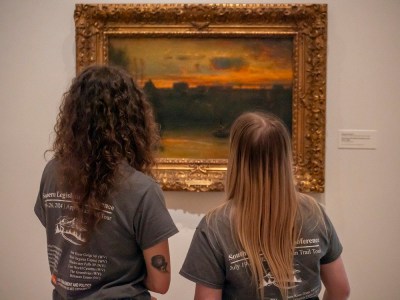
Our group’s arrival in Pittsburgh for the Southern Legislative Conference marked the beginning of an enriching journey through art, culture, and history. Eager to delve into the city’s offerings, we kicked off our exploration at the renowned Carnegie Museum of Art.
Our visit to the Carnegie Museum of Art was a journey through time and artistic expression, a tapestry woven with modern marvels and timeless classics. As we entered the galleries, we were greeted by a vibrant array of contemporary artworks that challenged our perceptions and sparked our imaginations.
With familiar artists such as Mark Rothko, Jackson Pollock, Vincent Van Gogh, and Isamu Noguchi, our group was fully immersed in the Museum’s collection.
Cinthia and I found a familiar touchstone in Georgia O’Keeffe’s painting of an adobe church. Having recently visited New Mexico, where these structures dot the landscape, we were transported back to the sun-drenched vistas and rugged beauty of the Southwest. O’Keeffe’s ability to capture the essence of these structures resonated deeply with us, bridging our past experiences with the present moment.
In contrast to the contemporary pieces, the hall of Greek sculptures offered a glimpse into ancient mythology and classical beauty. Among the serene depictions of gods and goddesses, one sculpture stood out—a modern twist on antiquity. An oversized figure sat casually, engrossed in a smartphone, a stark commentary on contemporary culture.
The contrast between the timeless marble and the modern device held a mirror to our society’s evolving relationship with technology.
As we explored further, we encountered the dynamic works of Stanton MacDonald-Wright, whose vibrant compositions danced with color and rhythm. His mastery of synchromism, a style he co-founded, brought a sense of harmony and movement to the canvas, captivating us with its energy and vitality.
However, it was in the surreal and unexpected that we found our deepest connections. René Magritte’s “The Spirit of Family” challenged us to confront the discomfort of recognizing the familiar in the unfamiliar, echoing themes of surrealism that provoke and intrigue. For me, surrealism isn’t just about aesthetics—it’s about delving into the subconscious, where dreams and reality merge in unexpected ways.
Not far behind, Michelle, with her unwavering love for Impressionism, led us straight to the Monet Lilies, where she stood in awe of their ethereal beauty. Her eyes gleamed with admiration as she traced the delicate brushstrokes that brought Monet’s gardens to life.
Cinthia, on the other hand, found herself captivated by Renoir’s “The Garden in the Rue Cortot, Montmartre.” The painting’s vibrant hues and tranquil atmosphere transported us to a serene Parisian afternoon, where we could almost feel the warmth of the sun and smell the fragrant flowers.
Our journey took an unexpected turn when I almost missed Francis Bacon’s haunting painting. Titled simply but evocatively, Bacon’s work captured the raw intensity of human emotion in a way that both unsettled and captivated us. It was a poignant reminder of the power art holds to provoke and stir our innermost thoughts.
As we wandered through the museum’s corridors, each artwork seemed to tell a story, inviting us to unravel its mysteries and absorb its messages. From Degas’ delicate sculptures to the bold strokes of Francis Bacon, every piece sparked conversations that ranged from artistic techniques to philosophical musings on life and existence.
Our visit wasn’t just about admiring famous names on canvas—it was a journey of discovery, where we uncovered new passions and deepened our appreciation for the artists who shaped the course of art history. The Carnegie Museum of Art became more than a collection of paintings; it became a sanctuary of inspiration and contemplation.
As we bid farewell to the museum, our hearts and minds brimmed with newfound insights and shared experiences. The day had been a celebration of friendship, curiosity, and the enduring power of art to provoke thought and stir emotions. It was a reminder that amidst our hectic lives, moments of cultural exploration with friends are not just enriching but essential for nurturing our souls.
The Carnegie Museum of Art had not only expanded our artistic horizons but had also reinforced the bonds of friendship that drew us together. It had ignited a passion for creativity and a hunger for knowledge, leaving us eagerly anticipating our next adventure in the world of art and culture.
Ambassadors enjoy a Warhol Self-Portrait at Carnegie, in anticipation of the Warhol Museum
Next, we ventured to the Cathedral of Learning, an architectural marvel at the University of Pittsburgh.
Its Gothic spires soared above us as we explored the intricately designed commons area.
It was a beautiful building, one that reminded us that the architecture can play a large role in education and receptivity to learning.
Exploring Art and Nature at the Phipps Conservatory and Botanical Garden
Our recent visit to the Phipps Conservatory and Botanical Garden was a delightful blend of art, nature, and learning.
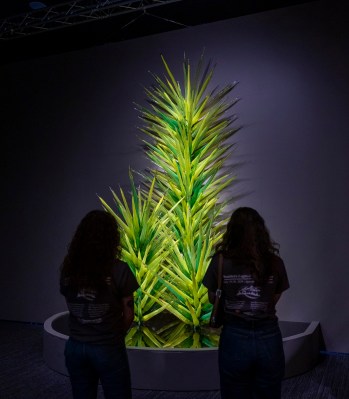
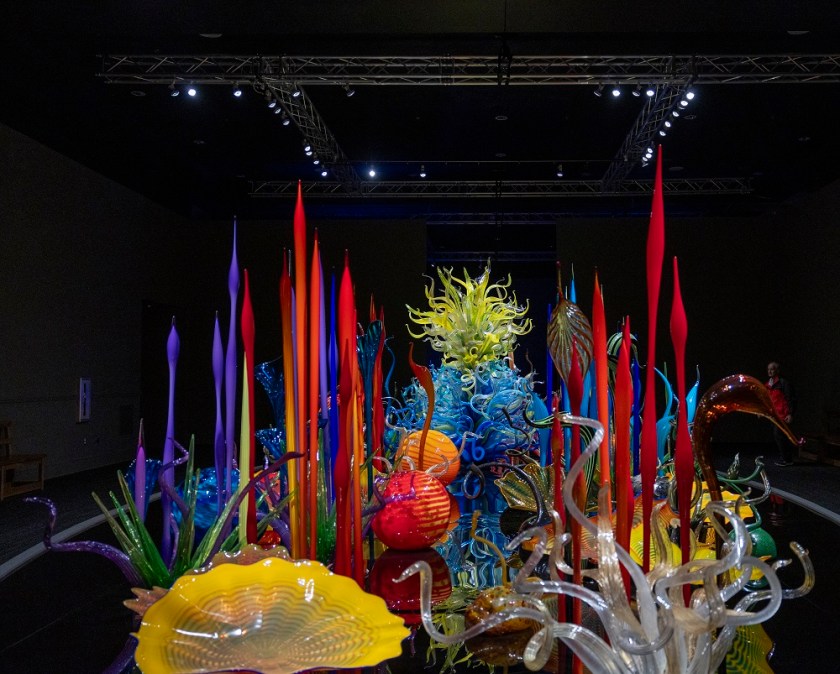
As we stepped into the conservatory, we were immediately greeted by the mesmerizing Goldenrod, Teal, and Citron Chandelier, which hung magnificently from the dome of the welcome center. This stunning piece by Dale Chihuly set the tone for the rest of our visit, showcasing his extraordinary talent in manipulating glass into captivating forms and colors.
Wandering through the various rooms and pathways, we encountered several other Chihuly installations that added vibrant and artistic touches to the already beautiful garden setting. The delicate Cattails and the bold, colorful Paint Brushes were among the many pieces that stood out, each one enhancing the lush greenery and floral displays around them. Chihuly’s art, with its intricate designs and brilliant hues, created a magical atmosphere that enriched our visit.
Beyond the captivating glasswork, the conservatory was a botanical wonderland teeming with life. We found ourselves surrounded by hundreds of different plants and flowers, each adding to the garden’s rich tapestry of colors and scents.
One of the most thrilling parts of our visit was exploring the Butterfly Forest. This enchanting area allowed us to witness a variety of butterfly species fluttering around, creating a truly magical ambiance. The Monarch and Zebra Longwing butterflies were particularly memorable, their vibrant colors and delicate wings adding a sense of whimsy and wonder to the experience.
Adding to the enchantment, we encountered many beautiful flowing fountains, fish, and other creatures crafted entirely out of flowers and plants.
As we continued our journey, we discovered the Orchid Room, a space dedicated to the stunning diversity of orchid species. This room was a feast for the senses, with an array of beautiful orchids in every imaginable color and shape adorning the space. Some of our favorite species were the Vanda Orchid and the Lady Slipper Orchids.
Overall, our visit to the Phipps Conservatory and Botanical Garden was both fun and educational.
We thoroughly enjoyed exploring the beautiful gardens, marveling at Chihuly’s art, and learning more about the diverse plant species.
Max’s Allegheny Tavern
Energized by our cultural immersion, we savored traditional German-inspired cuisine at Max’s Allegheny Tavern. The quaint charm of the restaurant was evident from the moment we walked in, with its cozy ambiance accentuated by adorable lamp shades casting a warm glow.
As a newbie to German food, Michelle and Cinthia were eager to try some of the region’s specialties. The potato pancakes were a revelation, crispy on the outside and fluffy inside, served with applesauce for a perfect blend of flavors. The bratwurst was hearty and satisfying, accompanied by tangy sauerkraut that complemented its savory goodness. And who could forget the schnitzel? Tender and perfectly breaded, it melted in my mouth with every bite.
Overall, Max’s Allegheny Tavern surpassed my expectations, not just with its delicious dishes but also with its inviting atmosphere. It’s definitely a place we hope to return to for more culinary adventures
Duquesne Incline
Visiting Pittsburgh for the first time was an unforgettable experience, made even more magical by a ride on the Duquesne Incline. As the sun set, we boarded the historic cable car that ascended Mount Washington. The city’s skyline, illuminated against the darkening sky, unfolded before me in a breathtaking display of lights and architecture. It was a view that truly encapsulated Pittsburgh’s charm and beauty.
The incline itself, with its rich history dating back to the late 19th century, added a sense of nostalgia to the journey. Originally built to transport workers up and down the steep hillside, today it serves as both a historic landmark and a beloved tourist attraction.
The weather that evening was perfect—a cool breeze complemented by a clear sky—making the experience even more enjoyable. Arriving at the summit, I found myself surrounded by panoramic views of Pittsburgh’s twinkling lights and shimmering rivers. It was the perfect end to a day filled with exploration and discovery in a city that had already captured my heart.
The Duquesne Incline not only provided a literal and metaphorical high point of my Pittsburgh visit but also set the stage for a day filled with new experiences and cherished memories.
Andy Warhol Museum
Being in Pittsburgh for the first time has been a fantastic experience; from the weather to the beautiful architecture, it has all been breathtaking. The variety of new foods from Max’s Tavern was an adventure, preparing us for the sensory feast at the museum. Our latest adventure took us to the Andy Warhol Museum, blending art, history, and personal discovery. Having recently watched a documentary on Warhol, I was particularly excited to see his artistic evolution across the museum’s seven floors.
The Andy Warhol Museum takes visitors on a chronological journey through Warhol’s life and work, from his early years on the top floor to the final years of his prolific career on the ground floor. This layout allowed us to see the progression of his style and the expansion of his artistic repertoire in a way that felt like stepping through a living biography.
On the top floor, we were introduced to Warhol’s early life, trying to identify him in old-school photos. This personal touch made the experience more intimate. Warhol’s early commercial art, including his advertisements and product illustrations, hinted at his future as a leading figure in pop art.
Descending the floors, we encountered various works, from his famous Campbell’s Soup Cans to his iconic Brillo Boxes.
We marveled at his silkscreen technique, which he used to create the vibrant Marilyn Monroe series and the striking Elvis Presley prints. Seeing these pieces up close highlighted the bold colors and repetitive patterns that defined his style.
One of the most playful parts was the Silver Clouds room, filled with giant, reflective silver balloons. We could not resist gently pushing them around, feeling the air lift them up.
Before leaving, Cinthia, Olivia, and I took pictures on the museum’s famous red couch, a nod to Warhol’s studio. Connecting the documentary insights with the exhibits added depth to our visit, making it a memorable chapter in our Pittsburgh adventure.
Reflecting on our enriching day, Pittsburgh emerged not only as a city of steel and industry but also as a vibrant cultural hub. Each visit—from the Carnegie Museum’s artistic splendors to the Cathedral of Learning’s educational marvels, Max’s Allegheny Tavern’s culinary delights, the Duquesne Incline’s panoramic views, and the Andy Warhol Museum’s artistic legacy—contributed to a deeper appreciation of Pittsburgh’s diverse and dynamic character. As our journey with the Southern Legislative Conference continues, Pittsburgh remains an inspiring destination where art, culture, and history converge to create lasting memories for all who visit.
As we prepare for the next leg of our Southern Legislative Conference trip, Pittsburgh a highlight of our trip—a city where art, history, and culture converge to create an unforgettable experience for all who visit.
On the third week of May, cities across the country celebrated National Public Works Week, which seeks to recognize and appreciate local employees for their vital hard work throughout the year.
Naturally, the City of Huntsville joined in the celebration by hosting their annual ROAD-E-O, organized by the Public Works Administrative Assistant, Linda Hicks. Chrissy, Olivia, and I were thrilled to attend and even participate!
Huntsville city employees gathered at the new training room of the recently inaugurated Service Center to enjoy lunch. While they were waiting in line for their food, Mrs. Hicks and I handed each employee a goodie bag, which included a gift card for a free Chick-Fil-A breakfast and a $20 coupon for Color Bar, as well as a ticket to the thrilling raffle.
With full stomachs and a lucky ticket, we headed outside, where the ROAD-E-O games awaited. The employees look forward to this tournament throughout the year, and now that I witnessed it, I understand why.
The ROAD-E-O is composed of several “games,” the Backpack Blower, which tests the participant’s ability to guide a tennis ball between traffic cones with a leaf blower (this was exceedingly fun to watch), and the Mower Madness, which made the participant drive a mowing machine through a predetermined course in the least time possible, are just a couple of examples.
One that left us all in awe was the Mini X Challenge. The operator had to meticulously move the claw to nudge six tennis balls that were placed on top of traffic cones, without touching the cones. As if this wasn’t complicated enough, the participant had to move the claw around a couple of barriers in the least amount of time possible. This particular game left me amazed as it shows not only composure and precision from the player but also their experience with the machine.
Another fan favorite was the Pumper Race which Olivia participated in, along with our city manager, Aron Kulhavy, and the Assistant Police Chief, James Barnes. They had to work together to connect a hose to a firetruck, get water running, and tilt a traffic cone placed a few feet away.
As the games came to a close, we came together for the long-awaited raffle, which included a variety of objects, ranging from gift cards to coolers and from a saber…
…to SHSU football tickets. Most of these prizes were donated by local businesses and community folks, including SHSU, 3 Spoons, Carbonero’s, McKenzie’s, and more!
The trophies for the tournament were also awarded…
…with the Water Department winning the overall best department by earning the most trophies!
As the day came to an end, we reminisced on everything city employees do to keep Huntsville moving forward every day and we grew appreciative of the long hours and late nights they dedicate to this community. Huntsville would not be the city it is today without its most vital workers, and we are grateful that we have the opportunity to know them, and even better, work and learn from them.
The LEAP Ambassadors were founded on the same principles that animate many community organizations, so it was a pleasure to be invited to the Lions Club meeting last week.
It was an event we looked forward to, and one made all the more special when we learned that Michelle Spencer of Walker County Boys & Girls Club was the guest speaker!
We had a chance to meet the Lions new President, Julie Hill, who presided over her first meeting.
We also had a chance to see old friends, such as Dottie Fulton, Greg Smith, Casey Spencer, Brian Blalock, Glenn Schumacher, Gaye Clements, and Brenda Poe. In fact, it was Ms. Poe who invited, a thanks for participating in their “Flag Project,” which we are happy to do.
Although we know much about the Walker County Boys & Girls Club, we learned more with the opportunity to hear from Ms. Spencer.
It was gratifying to hear again of the hundreds of children, K-12, who benefit from the non-profit’s organizations; but we also learned more about their adult literacy programs.
Of course, we knew of their ESL classes, because we partner with them on our Citizenship Program; but we also learned about their efforts to help local residents obtain their GED.
In fact, we learned that, with their instruction and classes, students aged 16-67 have obtained that distinction!
We also learned of their upcoming Oktoberfest Bingo, which takes place on Saturday, October 12, 2024 from 6-10pm. Programs such as these are not only great fun, but the money raised supports a great cause, and donations and grants provide the large majority of the Boys & Girls Club annual budget, so participation is much needed.
In fact, we pondered ways we might be able to help, a matter to be addressed at LEAP’s next annual meeting.
We were grateful for the invitation to attend the Lions Club meeting, another golden opportunity for us to see the community in action.
Organizations such as the Lions Club support important causes globally, provide key programming locally, and help connect components of the community that foster collaboration–and these actions, in turn, produce stronger communities. It was a pleasure to be part of it for the day.
Some LEAP Ambassadors are Republican; some are Democratic; and some are independent. Whatever their partisan identification, they are encouraged to be involved in democratic processes, and so it was that Ambassadors Morgan Robertson and Jessica Cuevas attended their party’s Precinct Conventions followed by the Walker County Republican Party Convention this spring, which we decided to post just before the two parties’ national conventions this summer.
While this was Morgan’s second time attending this convention…
…it was my first time, and I must say that after interning at the Texas Capitol last spring it was very interesting to see how the convention works and to take part in voting on resolutions.
Upon arriving at the Northside Baptist Church, we were provided breakfast and were asked to find the table where our precinct was so that we could join and partake in our precinct conventions. I had a lovely conversation with the delegates present from Precinct 201, as did Morgan with the delegates present from Precinct 102. One of the main goals for the precinct convention was to see if anyone within your precinct had a resolution that they were interested in passing. These would later be voted on by the 54 delegates present in the County Convention.
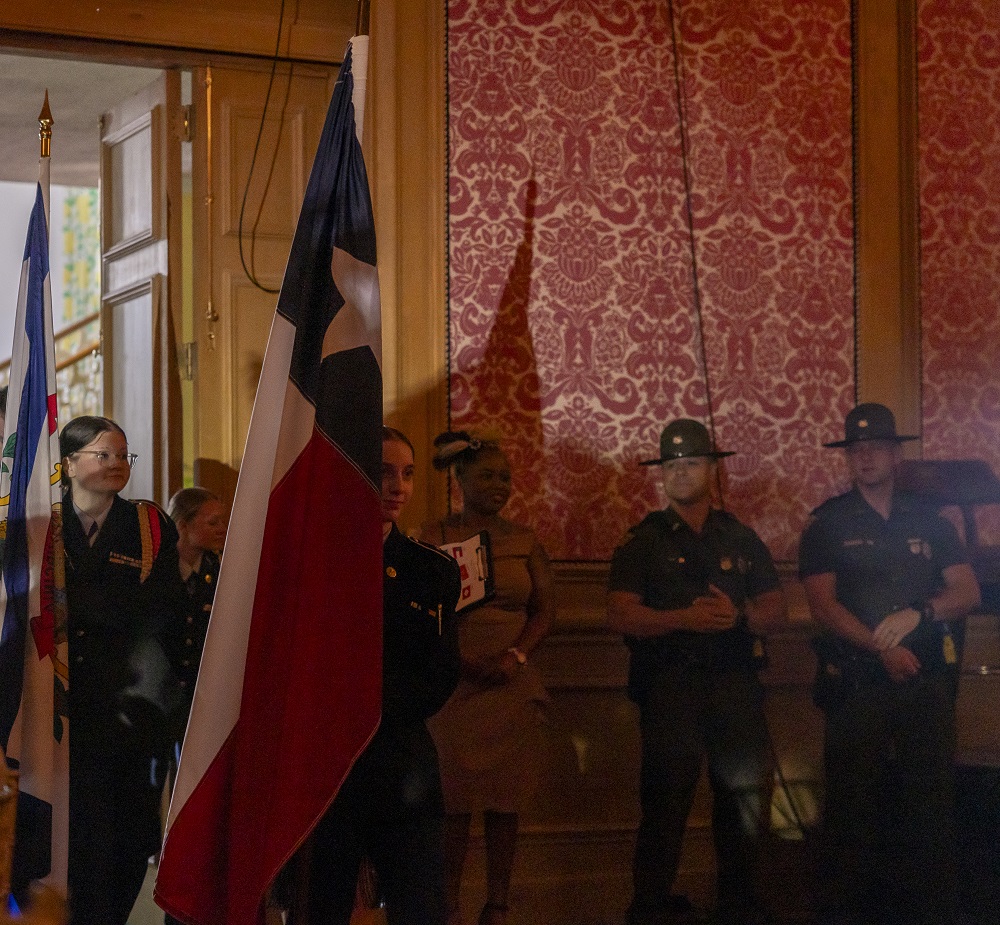
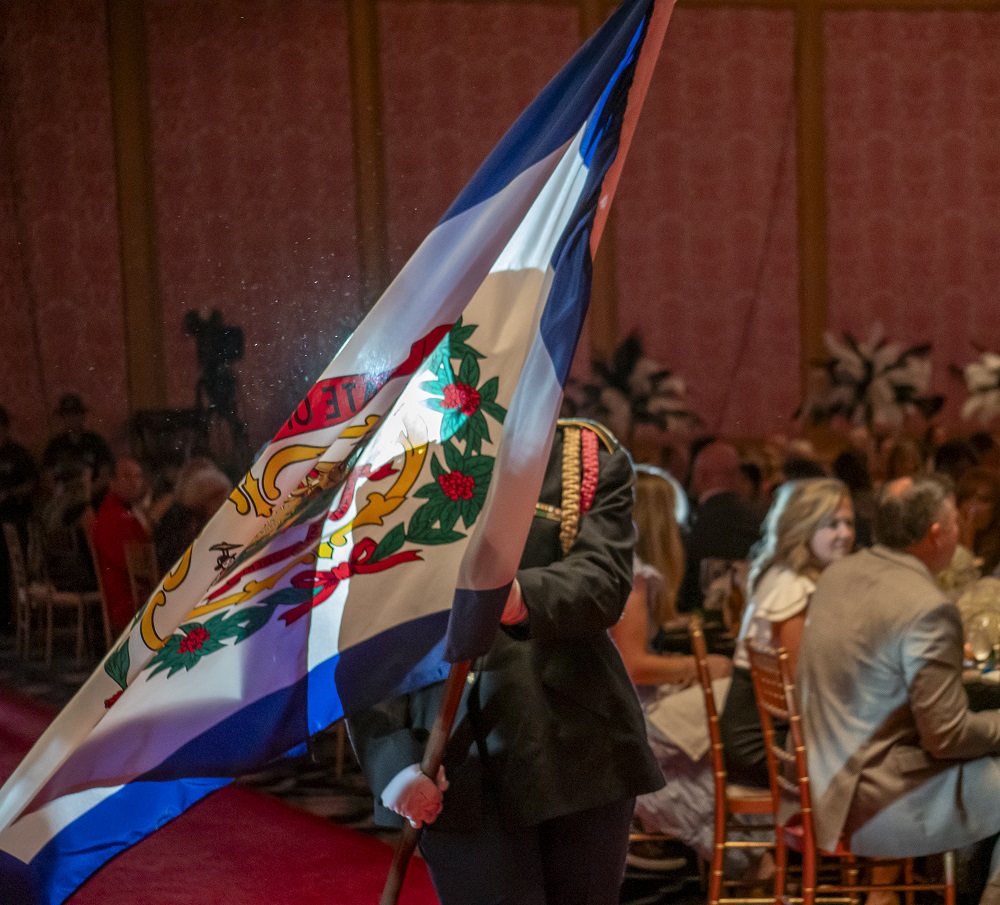
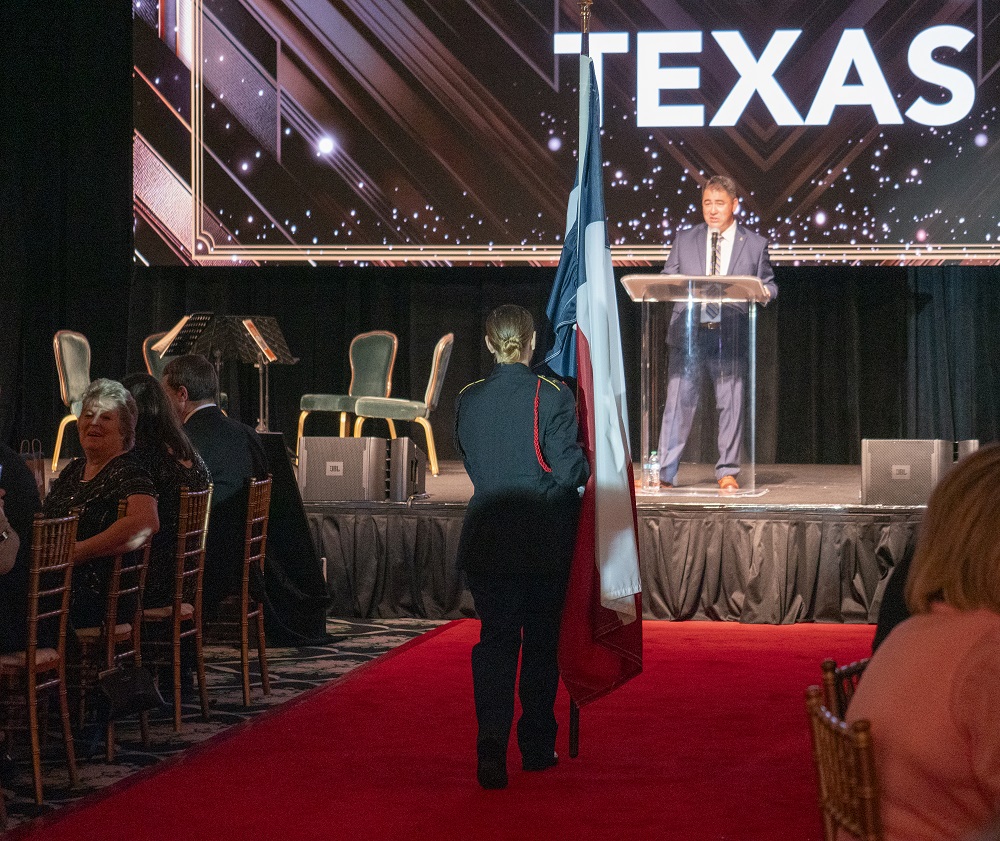
Following our Precinct Conventions, Morgan and I were asked by Walker County’s Republican Party Chairwoman, Linda McKenzie to lead the pledges at the start of the County Convention.
Chairwoman McKenzie explained what would occur before we broke off into a small break for committees to start meeting and complete their business.
I was selected to be on the Organization Committee whose sole purpose was to nominate the County Convention Chair, Secretary, and Sergeant of Arms.
Our nomination for County Convention Chair was Judge Tracy Sorensen…
…Mallory Martin for Secretary, and Shane Loosier for Sergeant of Arms.
These nominations would be presented by Committee Chair Thomas Leeper to the delegates present who would approve of our recommendations.
Morgan was selected to be on the Nominations Committee, whose mission is to nominate delegates and alternative delegates to attend and represent the Walker County Republican Party at the State Convention on May 23-25. Having served on this committee in 2022, Morgan had a better understanding of how this process worked but because of redistricting, this year it was slightly different given that Walker County is divided and is represented by two congressmen: Congressman Pete Sessions in District 17 and Congressman Morgan Luttrell in District 8. This committee had to rank the delegates that applied to attend the state convention based on the districts they lived in since only 11 people from District 8 could attend and 14 from District 17.
I was surprised to be nominated as a delegate from District 17 to attend the Republican Party State GOP Convention which will be hosted in San Antonio this year!
After the presentation of the delegates, there was more business conducted before it was time to vote on the 18 resolutions that were worked on by the Resolution Committee which reflected the priorities our delegates had. Before voting, delegates who wished to discuss the resolution could but were limited to six people overall, with three being for and three being against.
When our votes were divided for certain resolutions, we would practice precinct votes by conferring with the delegates in our precinct which our precinct chair would then tell County Chair Judge Sorensen how many Aye’s, No’s, or Abstains we had.
After each precinct voted, Secretary Mallory Martin would record the raw votes and would then tell Chair Judge Sorensen the weighted vote since each precinct has a specific amount of votes which were calculated by how many people voted in the previous primary for Governor Abbott.
Although this was my first time attending this convention it was very educational and interesting. We met new people, saw some candidates for office…
…had a chance to see democracy in action at the grass roots level….
….and saw some familiar and friendly faces…
I would like to thank Precinct Chair Mitchell Ray and County Clerk Leslie Ray Woolley for mentoring me through my first Precinct and County Convention, as well as Republican Chairwoman Linda McKenzie for putting this convention together.
For the last 17 years, the Huntsville Public Library and the LEAP Center have come together to host a free citizenship preparatory course where Professor Yawn, Yajaira Gutierrez (Intern at the Huntsville Public Library and supervised by Mary Kokot), and LEAP students volunteer their time to help local immigrants prepare for their naturalization process.
For the month of April, we held weekly classes with more than two dozen participants, who immigrated from a variety of countries including places as far flung as Canada, El Salvador, Japan, and Mexico.
In the first class of the course, Professor Yawn offered an overview of the requirements for eligibility and the process of applying for citizenship, such as the oral interview, where applicants are quizzed about their American history knowledge as well as their ability to speak English.
The course is designed to provide an overview of the different components of naturalization, from paperwork, to oral interviews, to English tests for speaking and writing, and, of course, the “Civics” portion of the test. This component consists of 100 questions that the immigrants must know.
Each week, we alternate between short lectures by Professor Yawn to breakout sessions at each table, with the volunteers doing a mix of tutoring, reinforcing, and translating–or, in Chrissy and Olivia’s cases, nodding when others translate.
LEAP also leans heavily on its mission of civic engagement and community collaboration to bring in other groups with similar goals. Thus, we work closely with Michelle Spencer and Salvador Favela from the Boys and Girls Club for recruitment and volunteers; the Daughters of the American Revolution provide “swag bags” with patriotic study materials…
…and Robert Cates, a local immigration attorney, provides his expertise on immigration law.
For the last week of the course, we held our very own Thanksgiving, where the participants were encouraged to bring desserts while Stephanie provided her very famous, and delicious, hot dogs. In many ways, this last meal together captures the essence of the course. One component of the Civics Exam is US Holidays, and the first one we discuss in the course is Thanksgiving and what that represents in the United States. Accordingly, “our” Thanksgiving is our true way of saying thanks to each other while reinforcing some of the class material.
Gregoria McGuire, who works for the Sam Houston Memorial Museum, even brought flowers as an expression of gratitude.
Esperanza, a participant from last year’s course, was also there. She applied for her citizenship shortly after finishing our course and within a few months, her identification card came in the mail. She attended the meeting to encourage other participants and to show them that if they put their mind to it, they can do it too.
Esperanza was accompanied by her son and daughter-in-law, and her granddaughter, Ali.
This course has been a transformative learning experience, not only for the future applicants but for the volunteers as well. Being an immigrant myself, this volunteerism has hit very close to home. Seeing the resilience of the participants that work for a better future has inspired me and reminded me of the hardships that my family had to go through for me to be where I am today.
This course has been a great testament to what a privilege it is to be a United States Citizen. This label, which many take for granted, not only comes with responsibilities and duties, but grants tranquility, confidence, and freedom.
Cinthia and I recently had the pleasure of attending the opening reception for the Cafe Raven Exhibit at the Sam Houston Memorial Museum. This special exhibit, titled “The Cafe Raven: Honoring Sam Houston,” celebrates the Cafe Raven and its nearly 40 years in business, its deep-rooted community support, and its unique relationship with the history of Sam Houston.
In the spirit of the occasion, Cinthia and I volunteered as 50’s-era servers. For the evening, we took on the personas of Betty and Erma, adding a touch of nostalgia and fun to the event.
Olivia and Cinthia, as “Betty” and “Erma”
It was wonderful to see so many familiar faces from the community come out to support this exhibit. From the University, General Glaser, Matt Bethea, Dr. McCartney Johnson, Hollie Garza, and Charlie Vienne; and, of course, those from the Museum: Derrick Birdsall, Jude Routh, Megan Buro, and Nancy Gahan; and from the Huntsville Community, Mac and Leanne Woodward, Jeff Murski, and Lee Jamison. Interestingly, Jamison, an accomplished artist, painted a replica of Cafe Raven’s signage for the occasion!
The Cafe Raven, which was located in downtown Huntsville, was named after Sam Houston’s Cherokee name, Colonneh, or The Raven. Opened in 1930, the cafe quickly became a beloved local institution. The current exhibit features rare photos of one of the restaurant’s founders, Abe Dabaghi, who later became its sole owner. His legacy of warm hospitality, civic involvement, and authentic French cuisine lives on through this exhibit. To our great surprise, some of Dabaghi’s family members, including his son Bill, were in attendance!
One of the most fascinating aspects of the Cafe Raven was its role in Huntsville’s history. The restaurant served as the mess hall for Company F, the local army reserve unit, as it was being activated for World War II.
Company F, to the North of Cafe Raven
Additionally, the Cafe Raven was the first in Huntsville to offer air conditioning, a grand ballroom, and a neon sign, making it a trailblazer in many ways. It was a favorite among U.S. Senators, Congressmen, judges, civic luminaries, and other leaders.
The exhibit beautifully captures the essence of Cafe Raven’s impact on Huntsville. It’s not just about the delicious food and elegant ambiance; it’s about the stories and memories that were created within its walls. The Sam Houston Memorial Museum’s wonderful staff has done a fantastic job curating this exhibit, and it was an honor to be a part of it for the evening.
If you haven’t had the chance to visit the Cafe Raven Exhibit, I highly recommend it. It’s a journey through time, celebrating a cherished part of Huntsville’s history and honoring the legacy of Sam Houston.
The exhibition runs from May 21 to September 1, 2024, and it’s a must-see for anyone interested in Huntsville’s rich history.
During his tenure as President of the French Republic from 2012 to 2017, François Hollande confronted a cascade of formidable challenges both within France and on the global stage. These trials ranged from combating extremist groups in Africa to grappling with the escalating threats posed by climate change and the spate of terrorist attacks that shook the nation.
Following an introduction by Professor Escobar-Lemmon…
…President Hollande first discussed his perspectives on the critical global issues confronting Western democracies today. This was followed by a panel discussion moderated by Professor Bearce.
Chief among Hollande’s concerns was the resurgence of authoritarianism, exemplified by the actions of states like China and Russia.
He cautioned against a deepening divide between democracies and authoritarian regimes, drawing parallels to the Cold War era and stressing the need for continued cooperation between the United States, Europe, and outreach to other nations.
Hollande’s discourse encompassed a broad spectrum of challenges, including the evolving face of global terrorism and the urgent implications of climate change. He emphasized the imperative for sustained international collaboration to address these pressing issues, which he described as existential threats to democratic societies.
Moreover, he highlighted emerging challenges such as global pandemics and the disruptive impact of technologies like artificial intelligence, which he argued have profound implications for global stability and democratic governance.
Following President Hollande’s formal presentation, he engaged in a moderated discussion with Dr. David Bearce of the Bush School. While President Hollande had delivered his prepared remarks in English, he engaged in this discussion in French, which we listed to through a translation app provided by the Bush School.
This portion of the discussion was lively, with President Holland interjecting humor and intrigue into the discussion.
The evening concluded with Hollande honoring Dr. Richard Golsan, Director of the French Institute, with France’s prestigious Ordre des Palmes académiques in recognition of his scholarly contributions to French culture and education.
In his remarks, Hollande praised Golsan’s outstanding achievements and expressed his appreciation for the enriching exchange of ideas during his visit to Texas A&M University.
Golsan made gracious and brief remarks, striking just the right tone for the evening.
Overall, Hollande’s visit underscored his commitment to fostering dialogue on pressing global issues and his belief in the power of international cooperation to navigate an increasingly complex and interconnected world. His insights resonated deeply with the audience, leaving a lasting impression on the importance of solidarity and collaboration in safeguarding democratic principles and addressing shared global challenges.