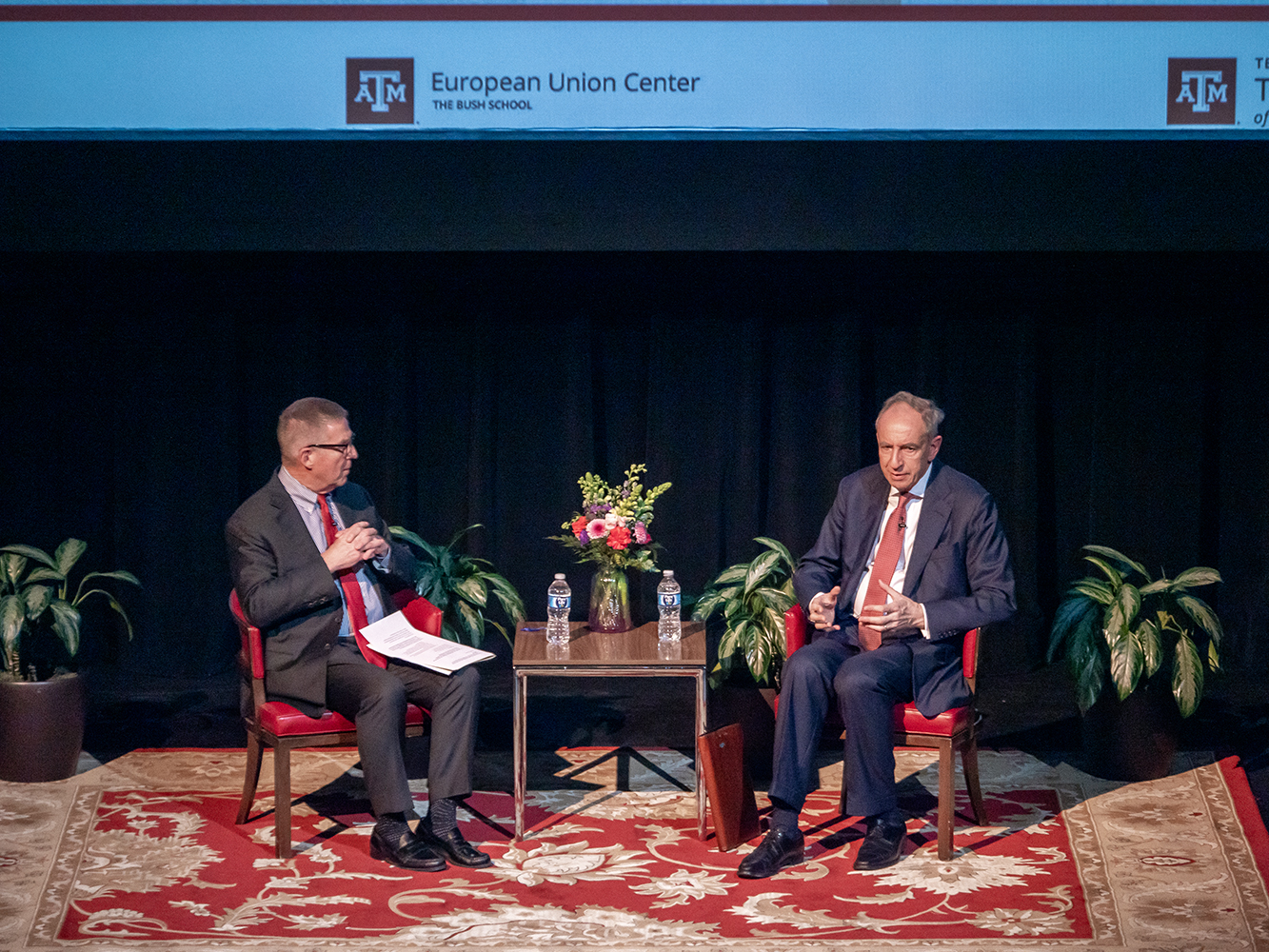
With a new president in office, evolving policies, and shifting global dynamics, it’s more important than ever for LEAP Ambassadors and friends of LEAP to gain a broader understanding of our country’s role in world affairs. What better place to do so than at an event hosted by the World Affairs Council of Greater Houston?
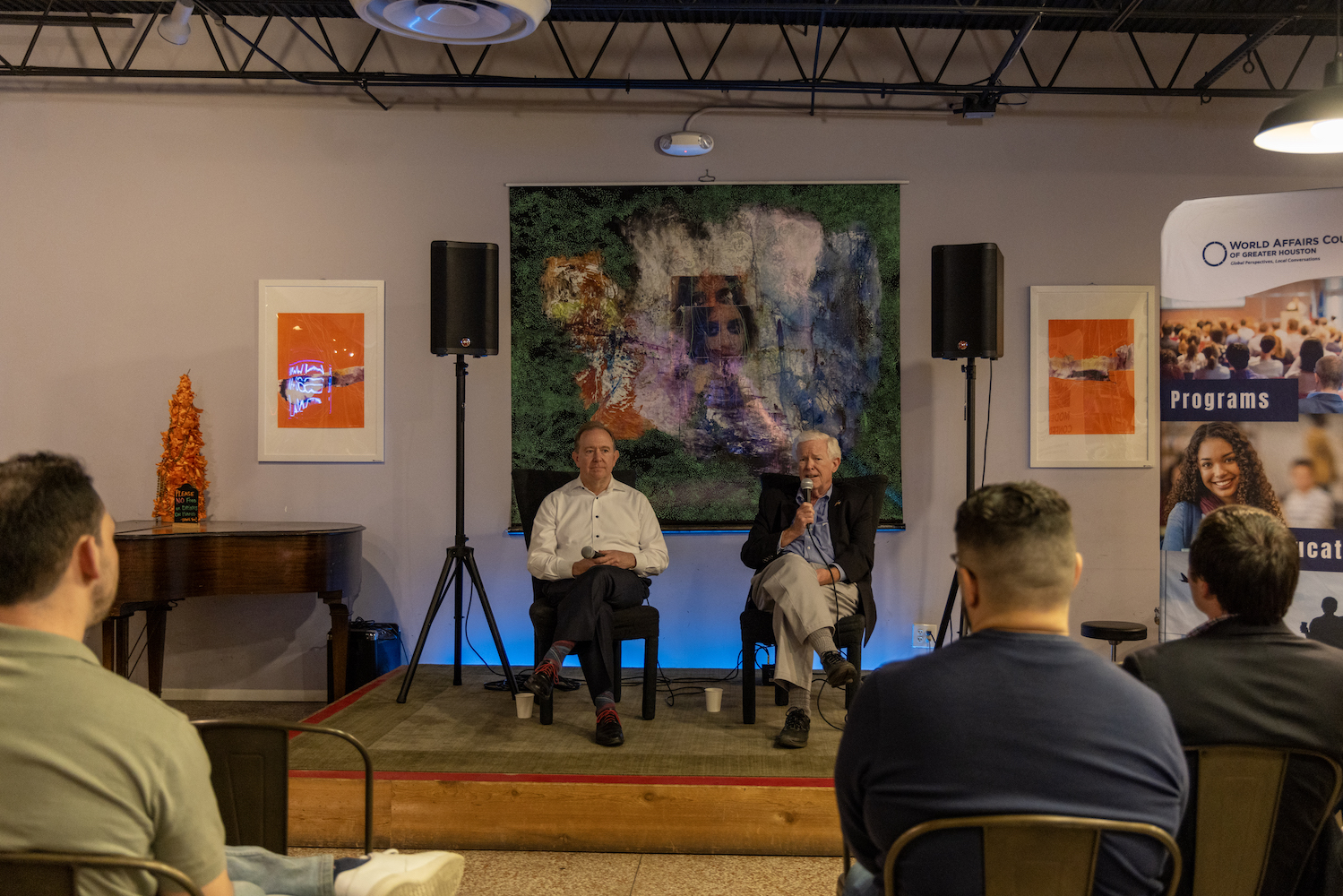
This time, however, WAC hosting in a different place: a coffee shop, Mercantile, which offered an intimate, cozy Q&A-style event, a fitting backdrop to the conversation, given the current era of navigating through “concepts of a plan.”
The discussion featured former Ambassador of Madagascar Michael Pelletier and Professor Richard Sindelar, both bringing expertise in diplomacy and global affairs, offering key insights into what to watch for during the Trump administration.
The conversation covered a broad range of topics, from USAID and foreign aid, to the ongoing competition between global superpowers and the shifting forces shaping diplomacy today. Naturally, Elon Musk’s name came up more than once, not always in a positive tone.
Despite their diplomatic backgrounds, the panelists’ responses were candid—so much so that they frequently found themselves apologizing for being undiplomatic. It was a great chance to hear honest perspectives from experts who have navigated the complexities of global affairs and studied them deeply. While the conversation may have felt a tad pessimistic, it was an invigorating event to attend.
Mala Sichuan Bistro
by Michelle Moya
LEAP has become my passport to global cuisines, taking me from the platters of Ethiopia to India and the delicious sausages of Germany. Tonight, after an insightful day at the World Affairs Council event, our culinary compass pointed us toward Mala Sichuan Bistro.
The restaurant’s ambiance enticed us in upon entering with classic Chinese architectural components such as hanging lanterns and Chinese art on the wall, creating an authentic environment. While the background music seemed out of place, the meticulously chosen artwork and carefully curated interior design choices transported us right into Chinese culture.
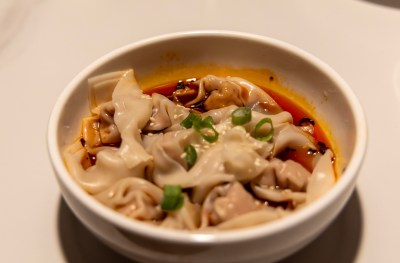
Our appetizer spread showcased Sichuan’s bold flavors. The red oil dumplings emerged as my personal favorite, especially because the oil provided a touch of spice.
Everyone bravely ventured into the Fuqi Feipian, commonly known as “Husband and Wife Lung Dish.” Although the dish traditionally contains slices of beef heart, tongue, and tripe, lung is not always used, and it was not clear what the exact ingredients of this dish were. I especially wouldn’t know because I avoided it…
Then we decided to get sour and spicy wontons, rounding out our starter selection, which I enjoyed a lot, mentioning again, due to their hint of spice.
Our main courses reflected the diversity of Sichuan cuisine. Jack ordered the Peppercorn Chicken, Olivia got the Shredded Beef with Seasonal Vegetables, while my Pickled Pepper Fish Fillet arrived in a creamy sauce perfectly balanced between richness and the sharp heat of red chili.
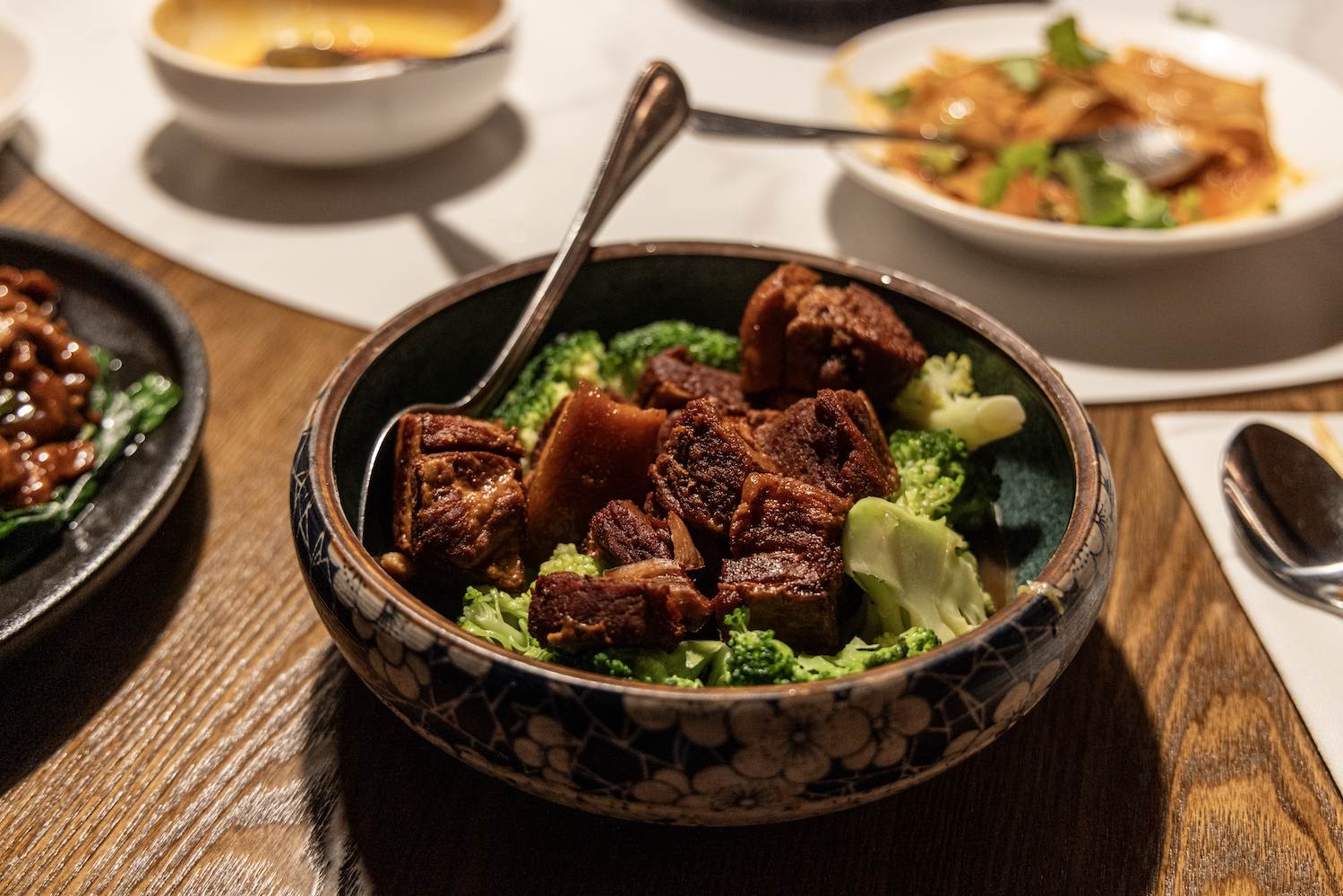
Macey kept it classic with fried rice, while Professor Yawn took our server’s suggestion—the Jiggling Pork Belly, a dish that lived up to its interesting name.
The best part wasn’t even the food. It was sitting around the table and chatting, making this an educational adventure. In the ever-expanding anthology of LEAP dining experiences—Mala Sichuan Bistro? Definitely one for the books.
Over the past couple of months, the LEAP Ambassadors have had the opportunity to contribute to one of Huntsville’s most impactful community events: Empty Bowls. This annual event supports the community by combining art, creativity, and a shared commitment to helping those in need.
The Empty Bowls Fundraiser
Empty Bowls involves a series of activities promoting the arts which culminate in a fundraiser for the Senior Center, a local non-profit that, among other things, combats food insecurity.
With grants that provide clay to the Wynne Home, local community members–under the tutelage of skilled ceramicists–create bowls; they then gather again to glaze the bowls; and then the community comes together to purchase soups (donated by local restaurants), obtain a commemorative bowl, and support the local Senior Center.
Creating Our Bowls
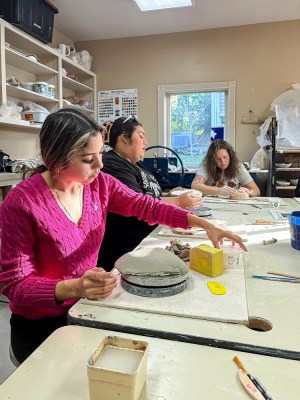
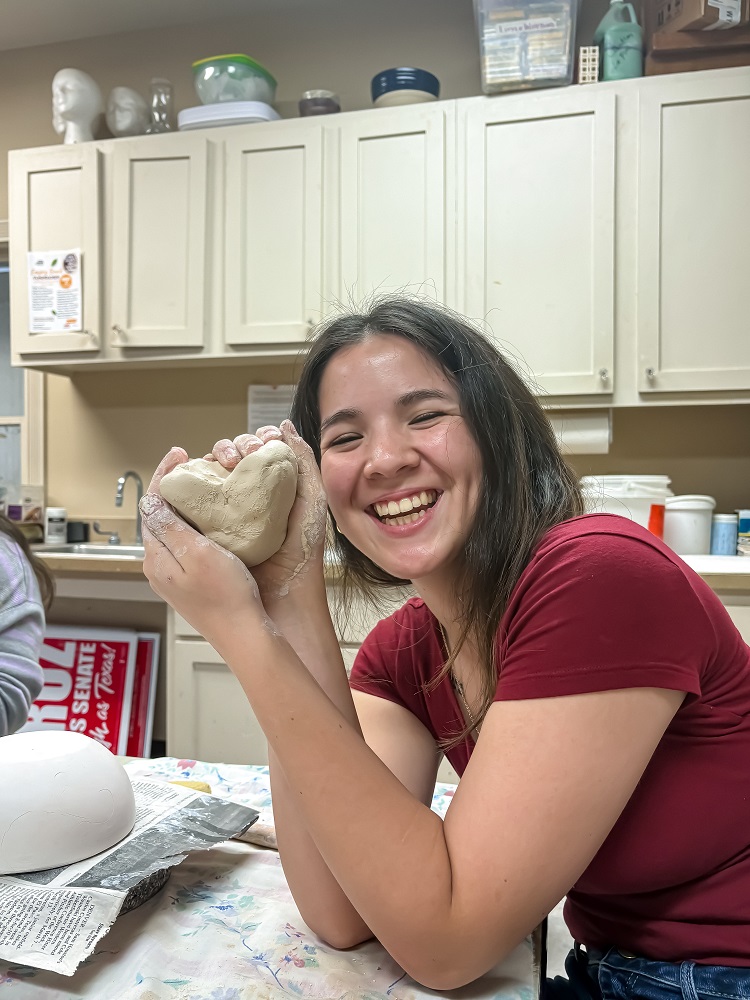
Under the guidance of instructor Leara Phillips, we created nine ceramic bowls as part of the Empty Bowls project. For many of us, it was our first time working with clay, and Leara made the process both accessible and enjoyable.
Glazing Our Bowls
After our bowls were put in the kiln, we went in shifts (necessitated by the fact that some of us are in Austin doing internships; and others are in Huntsville) to the Wynne Home, where we glazed and painted our bowls.
One of the many pleasant aspects of this process is getting to meet or reengage with people. For example, we (Cinthia and Saara) had a chance to meet Dr. Maria Botero, who is a professor of Philosophy at SHSU, while also spending time with our instructor (Dakota Dube) and other community members.
Supporting the Community
The beauty of Empty Bowls lies in its ability to bring the community together. It’s not just about making or purchasing a bowl; it’s about creating something tangible that supports a larger mission. Each bowl symbolizes community service and the art of paying it forward, reminding us that small acts of kindness can have a profound impact.
Our student group is honored to be part of this initiative. This semester, we’re looking forward to helping with the painting process and assisting at the event on March 5. We hope everyone will come to the Wynne Home on March 5 between 11am and 2pm to purchase a lunch ($15), pick out your souvenir bowl, and support some great causes!
In the fall, summer, and spring, the LEAP Center opens up internship opportunities to all SHSU students. These internships are paid, come with a modest scholarship, and provide unique professional development opportunities.
The program is called “City Fellows,” because students are placed primarily–but not exclusively–with the City of Huntsville. The students may work for Huntsville Main Street, the Wynne Home Arts and Visitors Center, Economic Development, Public Works, Parks & Recreation, Development Services, the Huntsville Public Library, or in the non-profit sector, with organizations such as the Boys & Girls Club, CASA of Walker County, the Old Town Theatre, or the like.
Students can earn anywhere from 3-6 hours of academic credit in these positions, while also working on a project-based job. Examples may include helping to plan Scare on the Square, assist with a hiring fair, developing a marketing plan for an office, or putting together a fundraising plan.
Moreover, students have the opportunity for extensive learning. Not only do students learn on the job, but a couple of times a month, they engage in professional development activities. Over the course of the semester, these include (1) leading a tour of their work environments and discussing their class project…
(2) going on a tour of Eastham-Thomason Park to learn about the environment and tax base;…
(3) touring the Huntsville Police Department…
(4) learning Parliamentary Procedures…(5) volunteering in the community…and
(6) presenting to community officials about their work.
The program is designed to meet real needs in the community, while also allowing students to develop needed skills for their own careers and the workforce more generally.
The program begins accepting applications on April 1 for the summer; August 1 for the fall; and November 1 for the spring. Students can learn more here. Government offices, non-profits, or law firms can contact Professor Mike Yawn at mike.yawn@shsu.edu.
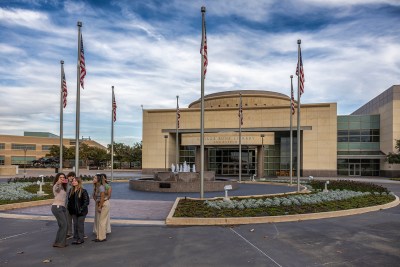
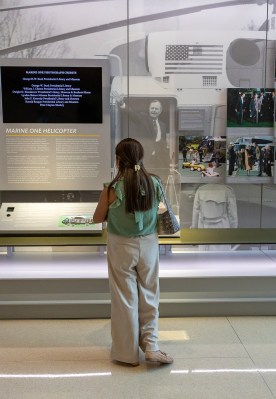
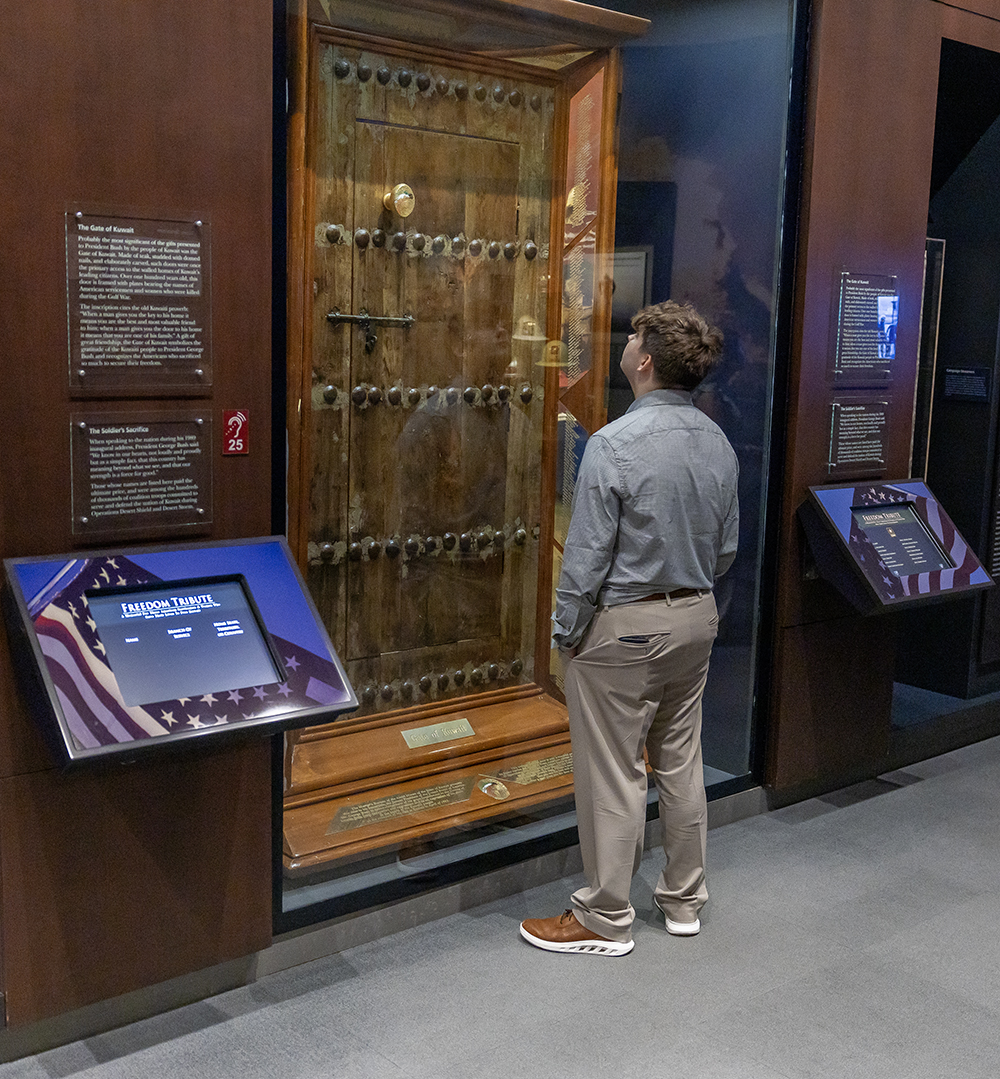
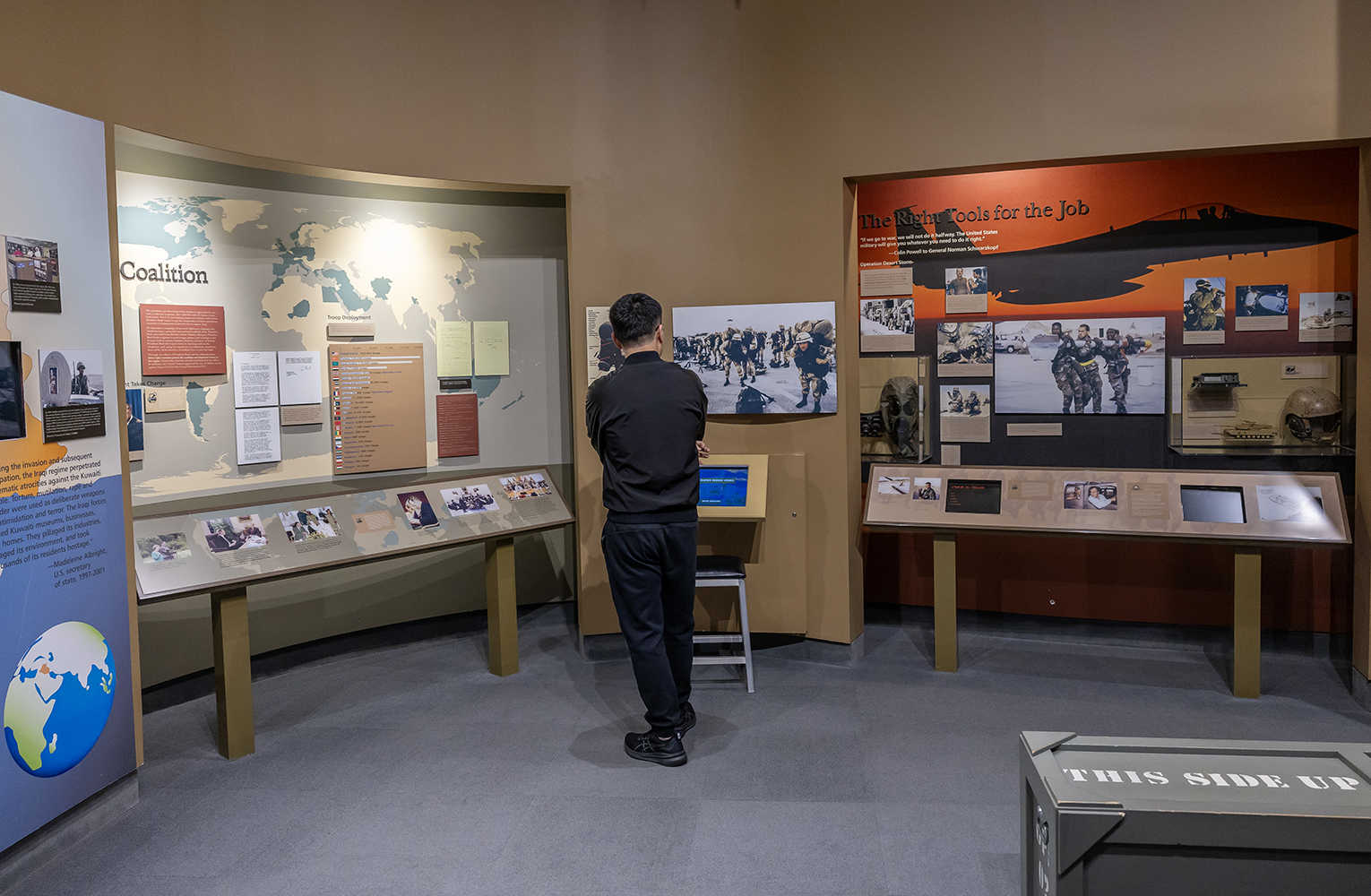
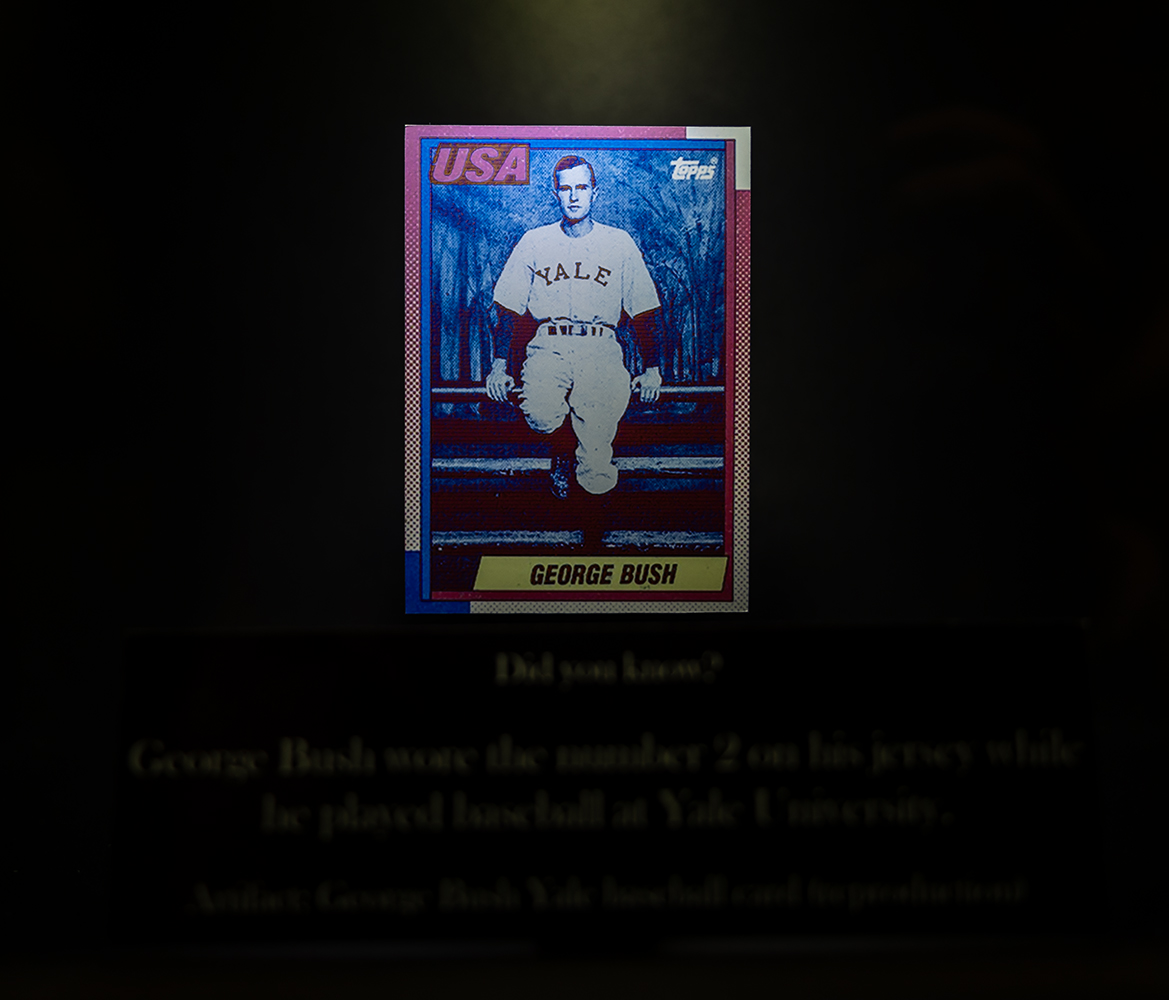
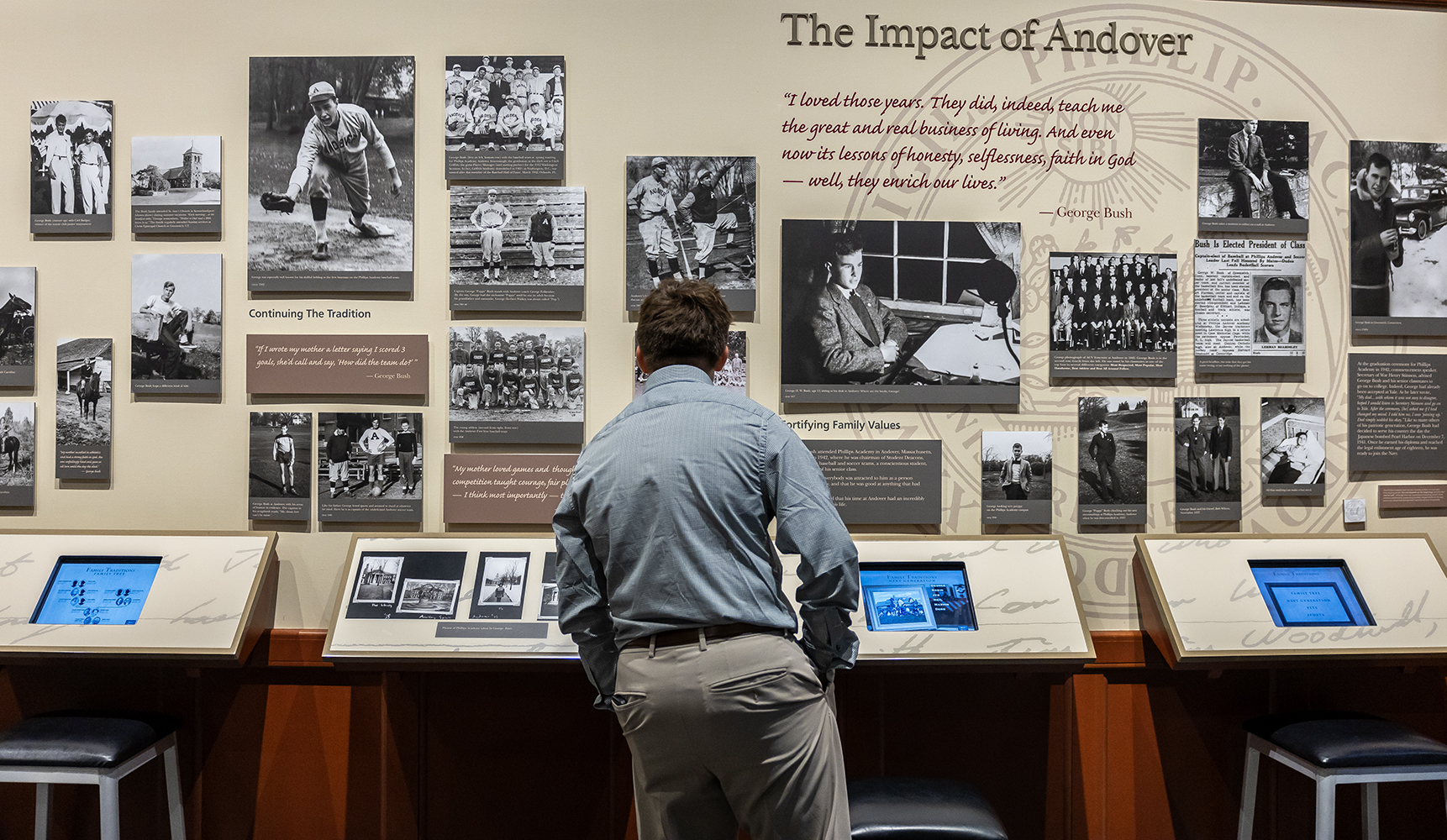
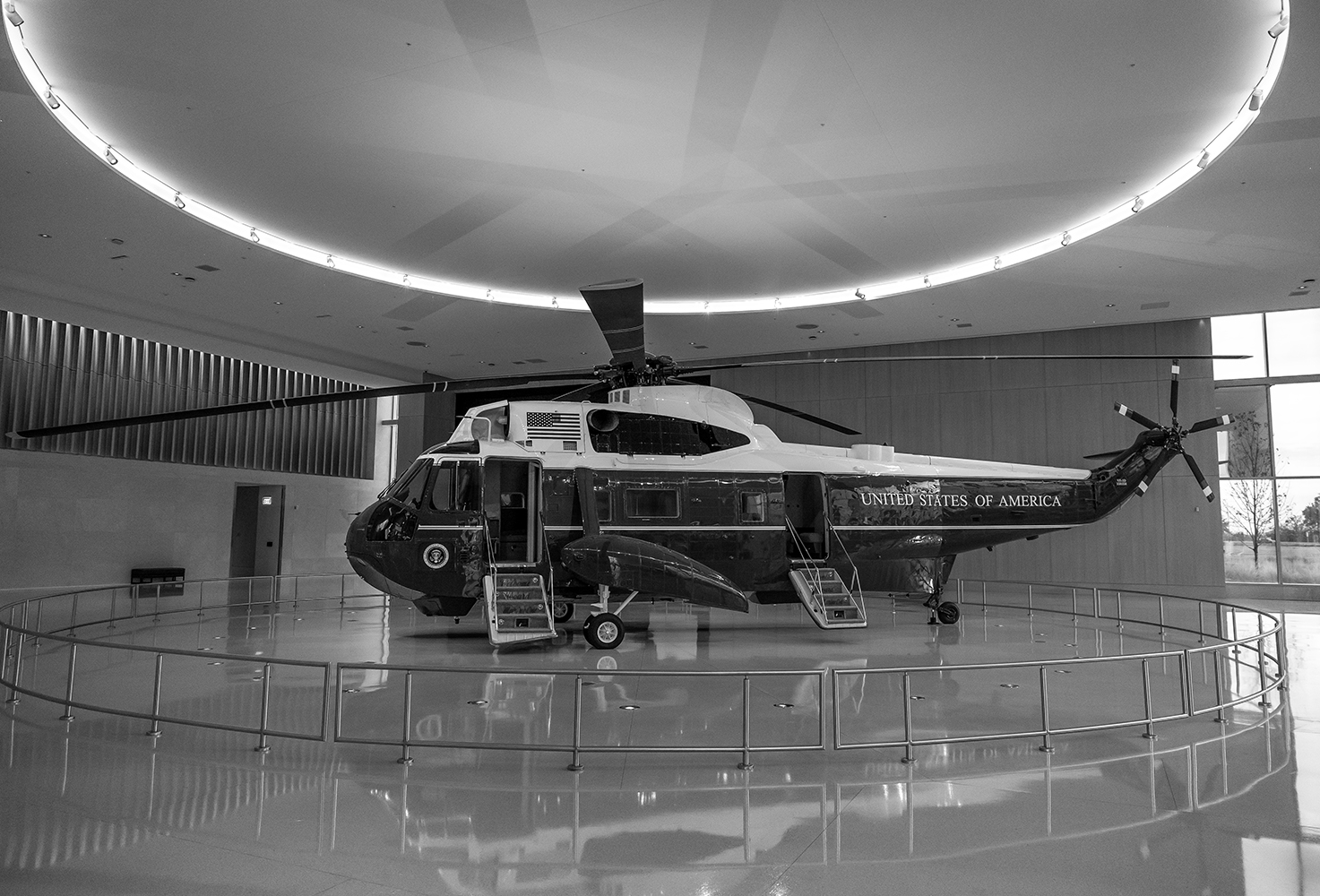
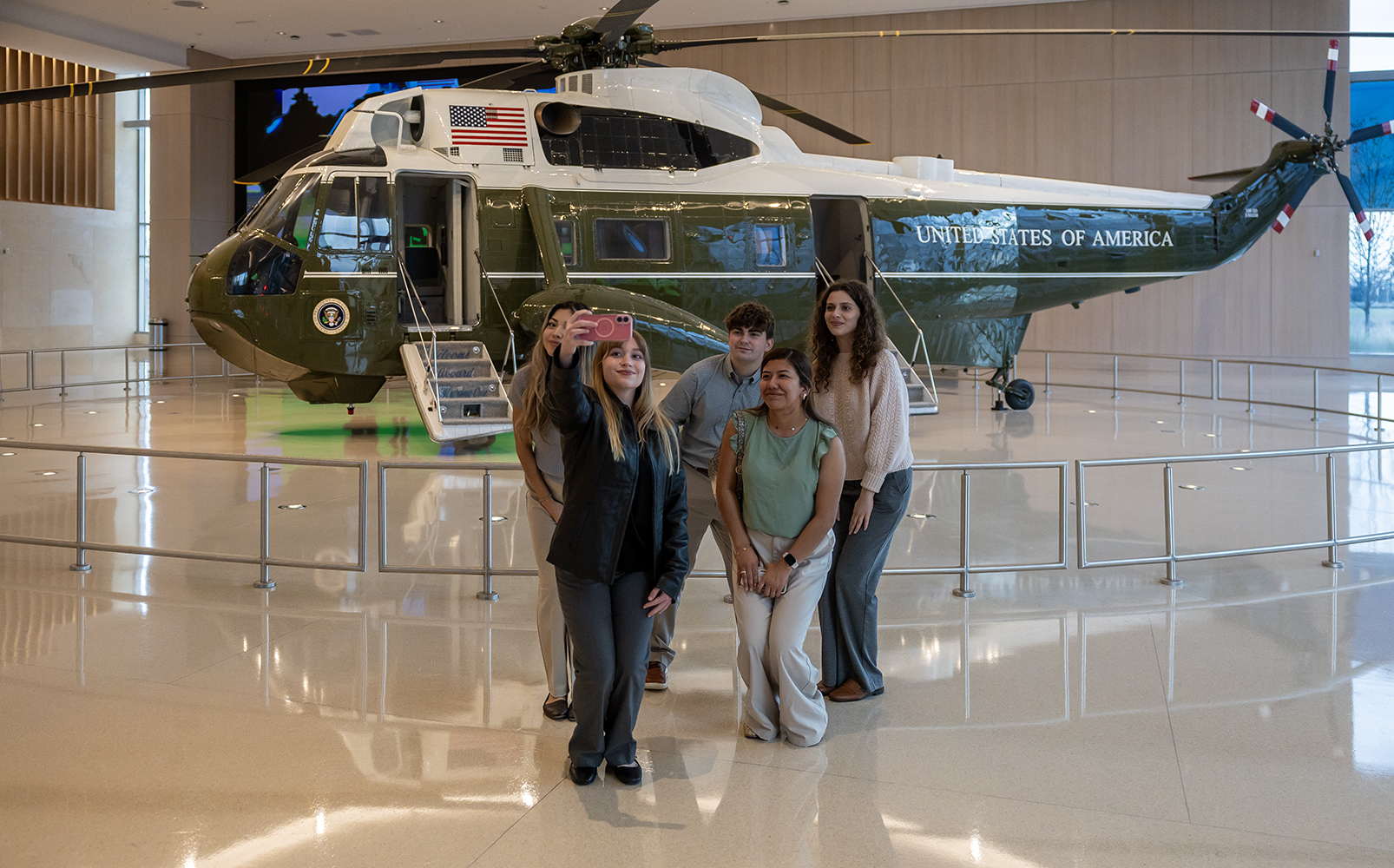
Experiences have a peculiar way of deepening our appreciation for history. As part of my experiences with LEAP, I’ve developed a growing fascination with presidents—particularly through one of my personal favorite trips—presidential museums! With this, we felt it a necessity to visit one of Houston’s notable presidents, the George H.W. Bush Library and Museum.
As we made our way to the museum, one point was clearly evident through the artifacts. George H.W. Bush’s impact extends beyond his political successes and presidential initiatives. He heavily believed in a lifetime that public service is a noble calling and that leadership is putting the country ahead of oneself.
I found the museum to reveal layers of his character: the Points of Light which showed his belief in the power of volunteer service, the World War II veteran who understood sacrifice, and the father who raised a family while serving his country. From his early days as a young Navy pilot to his post-presidency humanitarian work, every chapter of Bush’s life testified to his unwavering commitment to service.
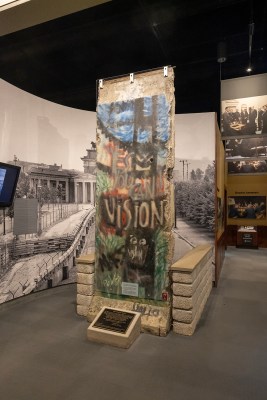
One thing that caught our eye was the large piece of the Berlin Wall displayed in the museum. Its extreme height was a stark reminder of the division it once represented. It made the historical significance of its fall during Bush’s presidency.
As we neared the end of our tour, I finally discovered what I’d been eagerly anticipating—President H.W. Bush’s beloved boat “Fidelity.” Perhaps most touching was the tribute to Sully, his faithful service dog who stayed by his side in his final years.
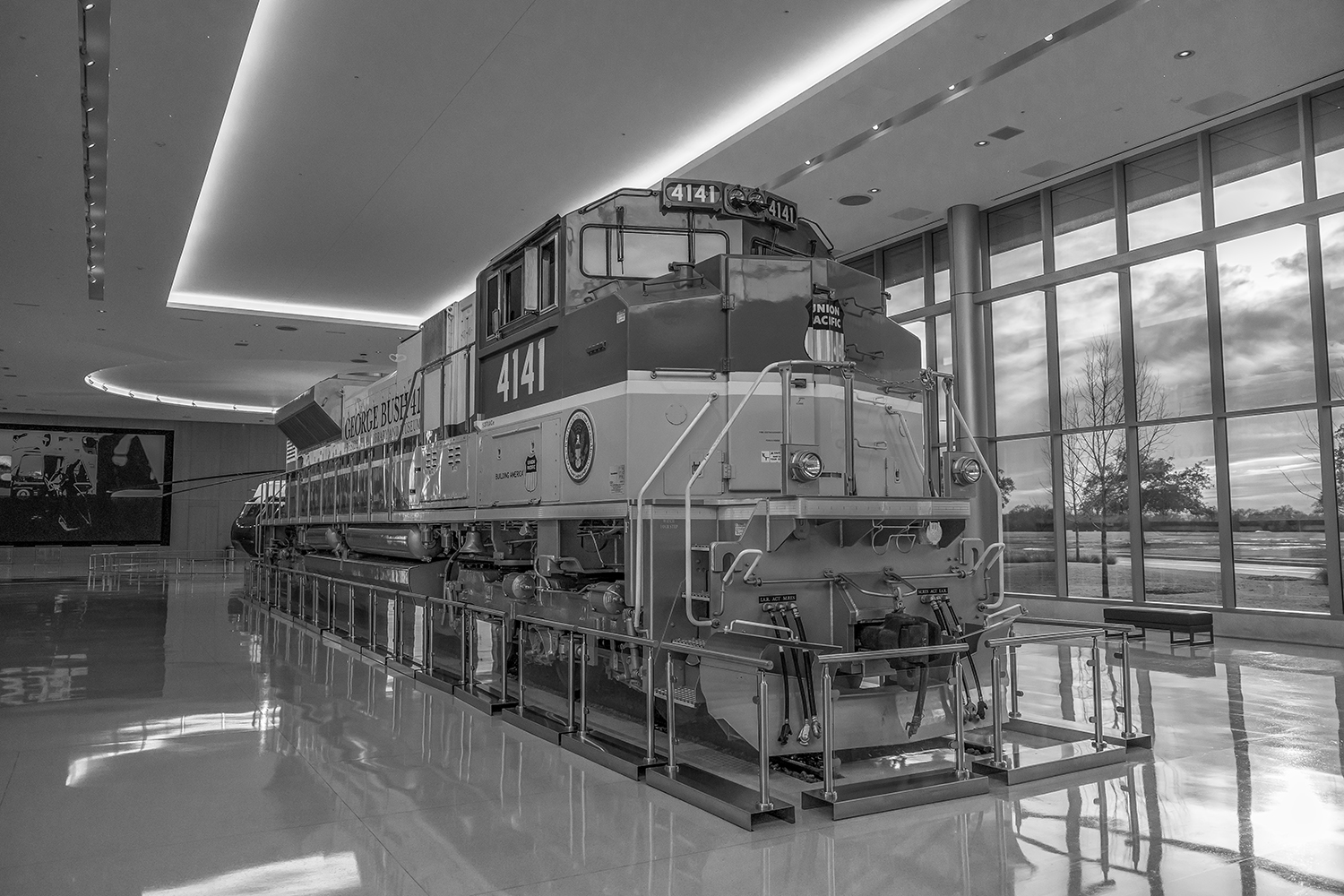
We finished off by seeing the Union Pacific locomotive 4141, painted in the colors of Air Force One, which carried President Bush on his final journey. Notably, something Professor Yawn was able to see driving by in Magnolia, TX!
This presidential museum was my favorite one this far. President Bush’s approach to governance—marked by dignity, compromise, and an unwavering focus on the greater good—serves as a guiding light for my own path.
In a time of increasing political division, his legacy reminds us that public service is about more than partisan victories; it’s about serving the people with integrity and compassion. The essence of President H.W. Bush’s legacy lives on not just in his time as president but in the hearts of those he continues to inspire.
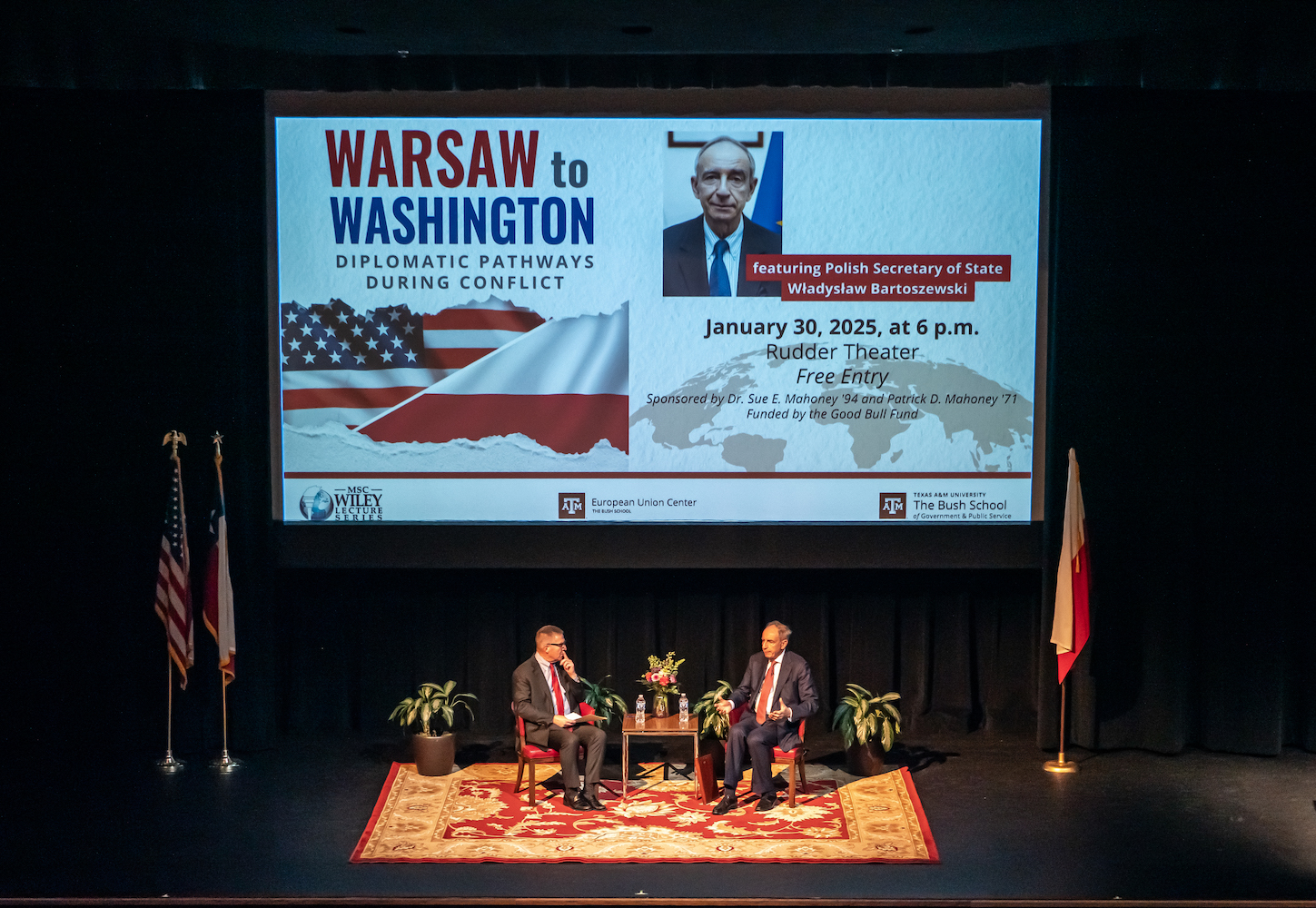
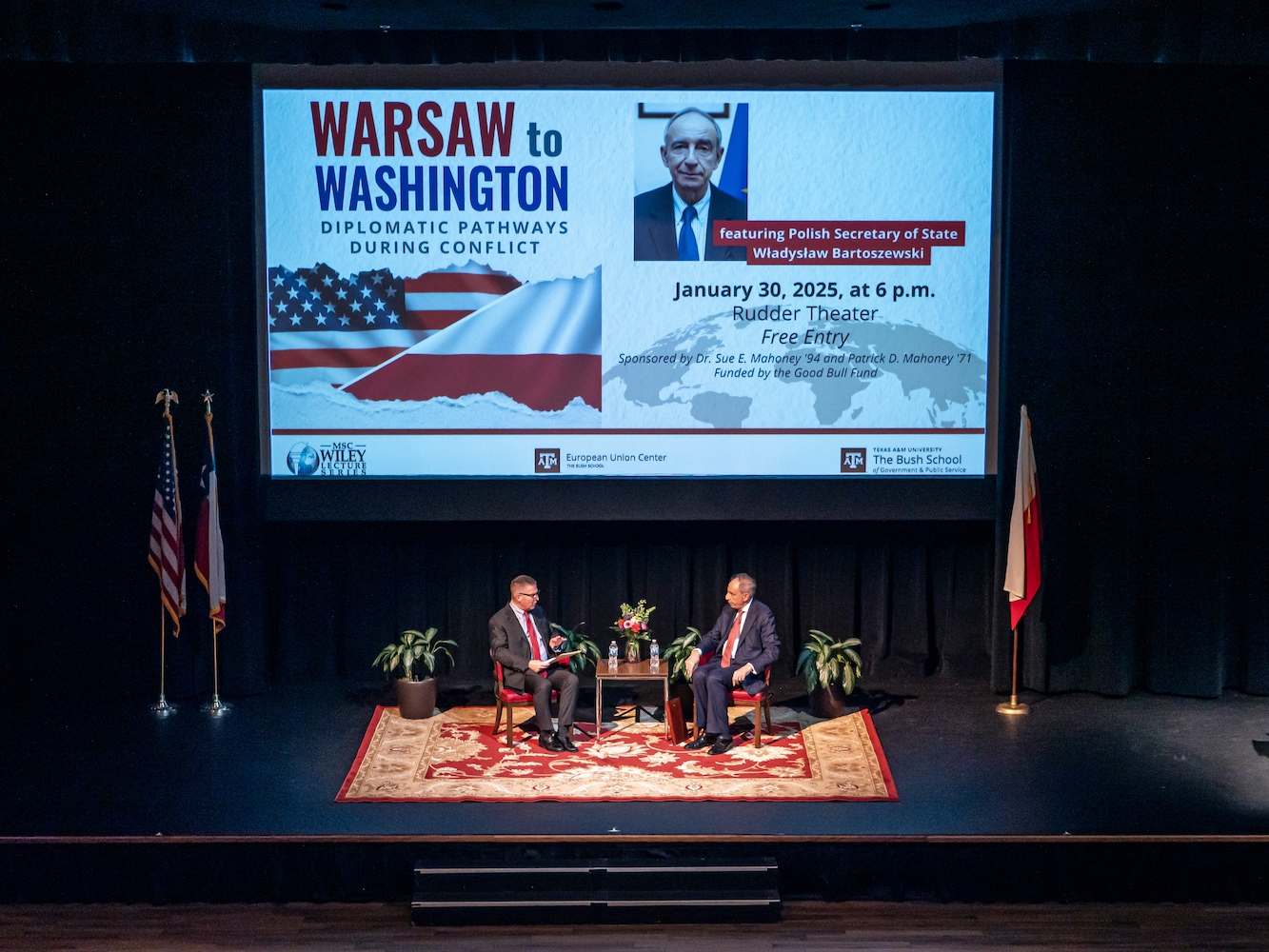
Warsaw to Washington: Diplomatic Pathways During Conflict
by Chrissy Biello
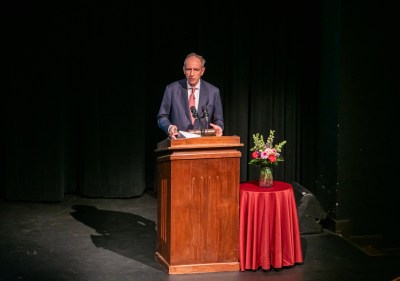
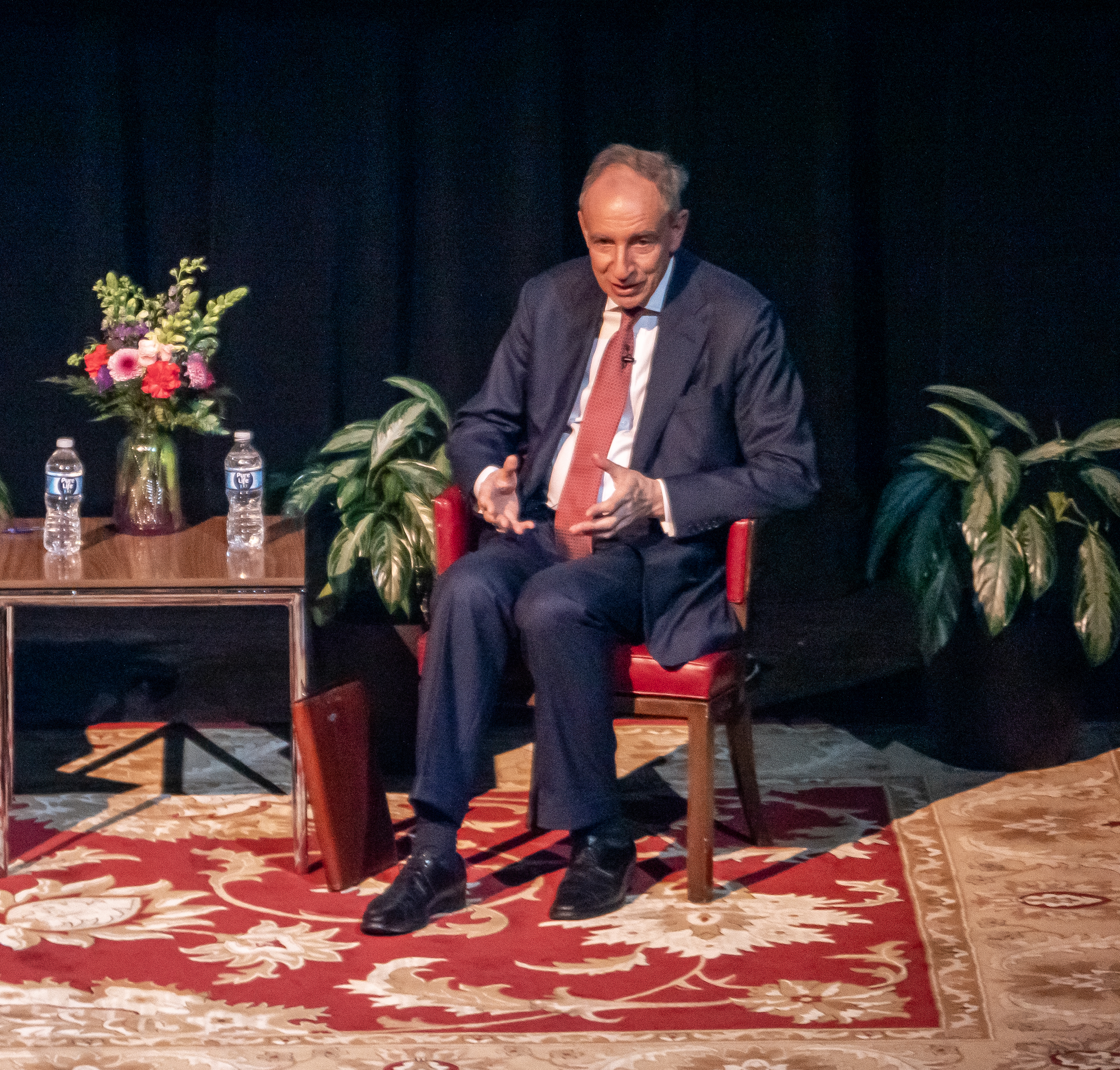
With global conflicts on the rise, understanding the state of world affairs has become increasingly vital. The Bush School of Government and Public Service recently provided us with a valuable opportunity to learn from the Polish Secretary of State, Władysław Bartoszewski, offering firsthand insights into European perspectives on current worldwide challenges.
Secretary Bartoszewski opened his discussion by reflecting on Poland’s journey through history, starting with the 1919 Treaty of Versailles; this agreement restored Polish independence after 150 years. He traced Poland’s path through the decades, highlighting another significant milestone: the country’s entry into the European Union in 2004. He noted how this development opened new opportunities for Polish citizens, particularly in terms of labor mobility across EU member states.
He then spoke extensively about the Russian-Ukrainian conflict, emphasizing Russia’s multifaceted threat to global security. He explained that Russian aggression extends beyond traditional military invasion; it manifests through sophisticated cyber warfare capabilities that can cripple critical infrastructure, disrupt financial systems, and compromise national security operations. His message was clear and sobering: Russia poses a threat to all nations, not just its immediate neighbors.
Poland’s commitment to supporting Ukraine emerged as a central theme. Secretary Bartoszewski noted that Poland ranks as the third-largest donor to Ukraine, contributing 4.7% of its GDP; only the United States and Germany provide more assistance. He observed that while the United States often enters global conflicts later than other nations, its eventual support consistently proves decisive and substantial.
Addressing concerns about war expenditure, the Secretary provided historical context. He reminded the audience that during World War II, the United States dedicated over 40% of its GDP to the war effort. His response to critics who prioritize social welfare spending was particularly poignant: there can be no social welfare system in a conquered nation.
During the question-and-answer session moderated by Dr. Todd Kent, Director of Undergraduate Programs at the Bush School, Secretary Bartoszewski emphasized practical solutions. He identified modernized infrastructure and transportation systems as crucial to supporting Ukraine’s defense efforts. The Rzeszów-Jasionka airport, he explained, serves as a vital hub for delivering military aid to Ukraine. His candid assessment of military operations brought unexpected humor to the serious discussion; he summarized effective military strategy as “Arrive, Kill, Then Leave.”
Secretary Bartoszewski’s expertise and candid discussion style provided a rare insight into complex global dynamics from a European leader’s perspective. As my first experience at the Bush School of Government, this presentation was both engaging and thought-provoking, leaving me with plenty to reflect on.
Each semester, the LEAP Ambassadors join one of their friends at KSAM, News Director Larry Crippen, for an “Around Town,” where they have a chance to fill in the public on upcoming activities with which they are involved. So Olivia Discon, Chrissy Biello, and newly minted LEAP Ambassador Michelle Moya arrived at KSAM at 8:30am last week to go on air!
Each of the students had a chance to discuss recent and upcoming events, with a heavy emphasis on their recent travels on the east coast for the presidential inauguration.
In approximately eight minutes, they were able to fit in quite a bit of information, which you can listen to here.
This is, of course, part of LEAP’s efforts to not only help the community, but also to enhance the skills of the students who are helping the community. An event such as the taping of “Around Town” not only increases awareness of events, but also sharpens the Ambassadors’ media skills.
Of course, if you don’t want to listen to the entire broadcast, you can also review our upcoming events, below. We hope you can make some of them!
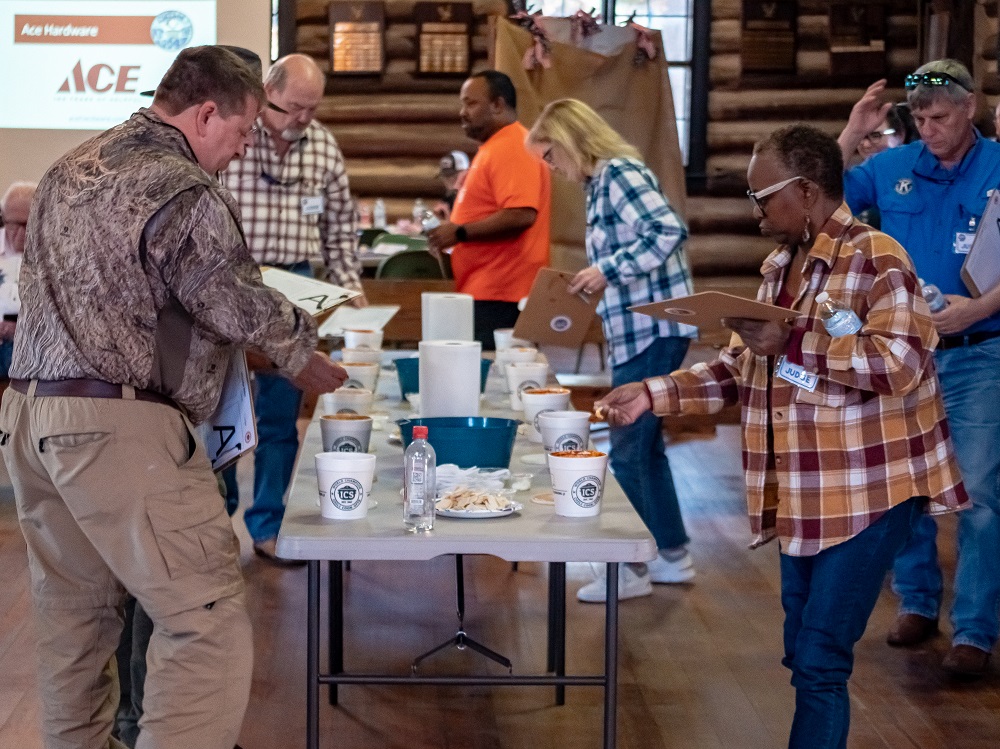
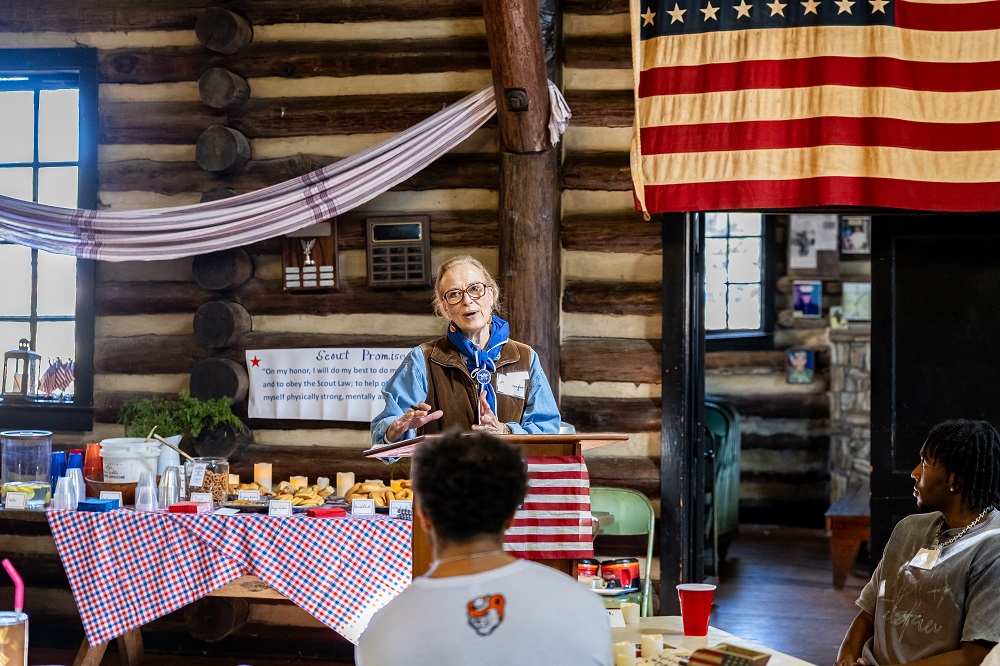
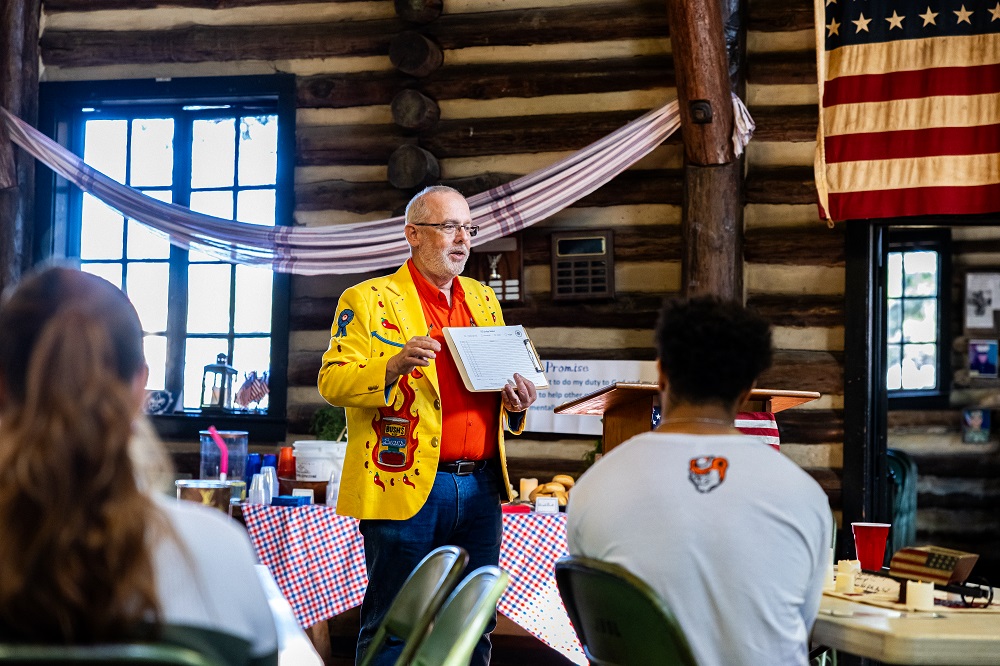
If it’s the first Saturday in February, then the LEAP Ambassadors are at the Chilly at the Lodge–along with, as it turns out, much of Huntsville! With numerous vendors, almost 100 bowls of chili available for tasting, and tours of the lodge available, there was quite enough fun for everyone.
The central feature of the event is a chili cookoff recognized by the International Chili Society. In fact, on hand to guide the judges was Don Cullum, an SHSU Alum and the 2024 ICS Homestyle Champion.
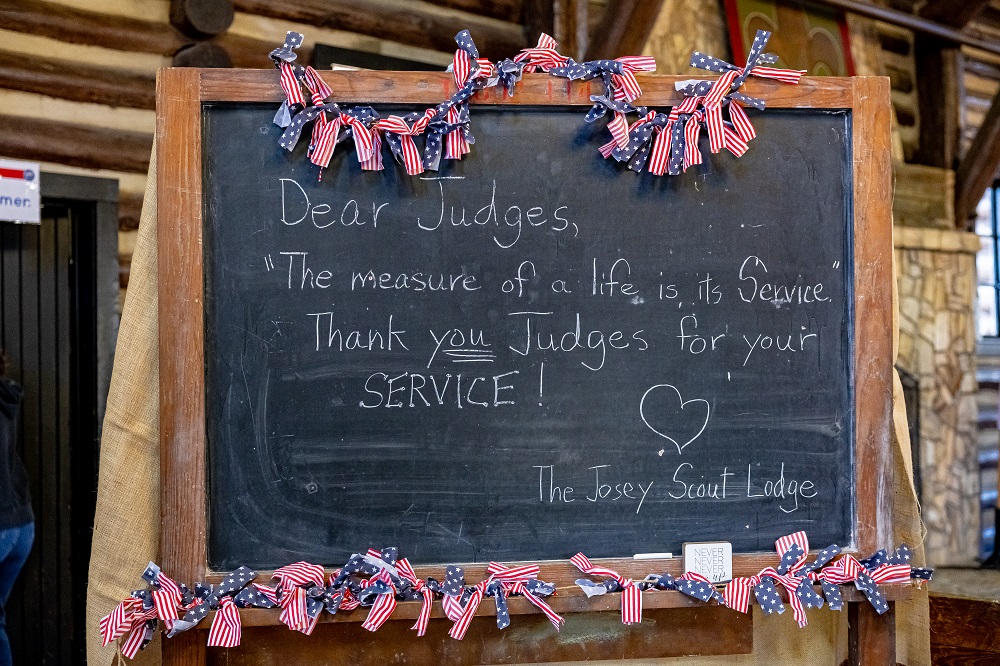
And under the guidance of Karla Christian and the entire Josey Scout Lodge Foundation Board, Cullum and the “celebrity judges” helped select the winning contestants in the categories of (1) Homestyle, (2) Traditional Red, (3) Chili Verde, and (4) Vegetarian Chili. In addition, chili enthusiasts could opt to compete in “community adult” or “community youth” categories. (See categories and rules here).
Even casual attendees can participate in the judging by filling out their “community ballots,” voting on their favorites as they roam the chili booths on the Josey grounds.
On those grounds were vendors from the region, with items such as t-shirts, objects of art, tamales, spices and herbs, and other goods for the curious shopper.
The real attraction, however, was the chili on the grounds. Cooks from all over the United States were on the grounds, offering samples of their chili. For five dollars, visitors can get six tickets, each of which is a ticket to a booth. Or, for more hearty eaters (which applied to at least one of the LEAP visitors), a $20 armband can provide an unlimited number of tickets.
The event organizers also provide entertainment for visitors in the form of music, with more than a dozen musical acts on hand for performances throughout the day.
But the serious work is the judging, where community members assess the chili cooks’ entries, and this part of the process takes two days, Saturday and Sunday.
With dozens of entrants–including six world champions–it’s a competitive process.
Organized by Leanne Woodward and overseen by Don Cullum, the process worked smoothly.
Moreover, the winning contestants in each category have the opportunity to go on to the ICS World Championship in Myrtle Beach later this year. Accordingly, Cullum and others identified the winners…
…and put the scorecards on a color-coded score board.
Two of the LEAP Ambassadors were judges, and we enjoyed the opportunity to judge the chilis.
For us, it is an opportunity to explore our culinary interest, meet new people, spend time with friends and community leaders, and, of course, to support a good cause.
Of course, with such a long day, some would inevitably get tired and thirsty…
But we held up well and greatly enjoyed the event.
Many thanks to the Josey Scout Lodge Board for hosting such a wonderful event!
This was–we thought–our last day, and we were determined to enjoy it! In that spirit, we had planned out a day of history and art, with a tour of the Virginia Museum of Fine Arts, the Capitol, the Old City Hall, the Edgar Allan Poe Museum, and some interesting restaurants.
Lehja Indian Restaurant
Saara Maknojia
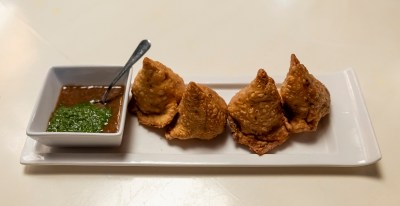
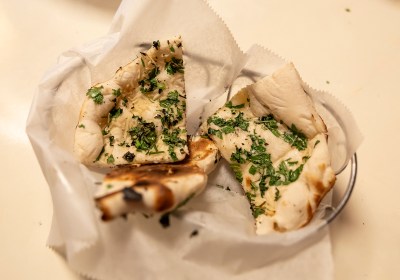
Keeping our streak alive of eating at (affordable) James Beard nominated restaurants, LEAP Ambassadors stopped by Lehja, a contemporary take on Indian food. Indian food is not a foreign concept for the Ambassadors so knowing the classics we ordered a plate of aloo (potato) samosas.
For a change we also experienced a new dish, as our server recommended the Chef’s Daily Selection, Chaat Du Jou. The chaat consisted of flashed fried curry leaves with various species, topped with a tangy tamarind yogurt chutney, paired with refreshing pomegranate seeds. Although both appetizers were tasty, the consensus favored the Chaat Du Jou!
Olivia, being the biryani connoisseur, ordered the classic chicken biryani, which is additionally paired with raita, a spiced yogurt sauce.
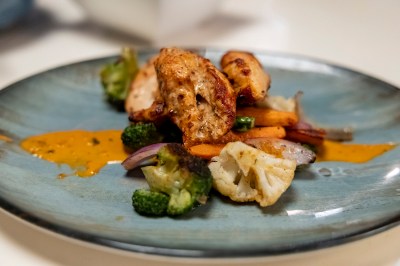
Bringing out the contemporary aspect of Lehja, Cinthia and Michelle ordered a plate of Tandoori Chicken Tikka. Traditionally, chicken thighs are marinated in yogurt with various tandoori spiced to bring out a smoked flavor when grilled. Lehja, however uses chicken breasts and serves with a platter of grilled market vegetables. To my surprise Cinthia, who is not the biggest fan of spicy food enjoyed the chicken tikka without breaking a sweat.
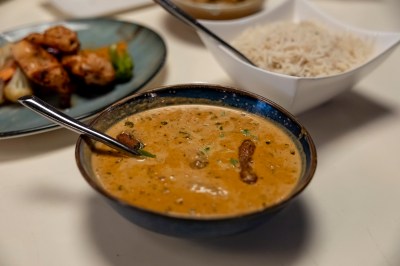
The Regional Classics for Lehja’s include various curry dishes. I found the Kofta Chaman Dilkhush appetizing, mainly because the term “Dilkhush” refers to a happy heart and what better way to leave a restaurant than with a happy heart! The vegetable kofta’s in this dish were perfectly fried with a soft potato filling, complementing the cashew-tomato curry base. Kicking the spice level up a notch, I found spice level three to best for this hearty meal.
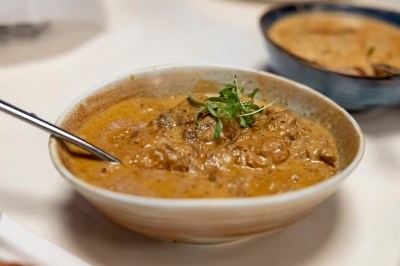
Professor Yawn and Stephanie also tried a Regional Classic dish, the spicy garlic, ginger, and chilly based curry included tender goat meat which fell right off the bone. Eating the meal in a traditional Indian fashion way, we shared our entrees with each other to fully taste the flavor spectrum and enjoy the company of one another.
Eating Indian food always makes me personally happy, but it is always a much better experience when those around you have the willingness to try new foods to enhance their understanding of cultures, apart from theirs. Lehja’s serves its purpose as a contemporary Indian restaurant but also keeps its traditional roots with the hospitality given to us during our visit. We are grateful to have a shared experience at yet another James Beard nominated restaurant.
Virginia State Capitol Building
by Saara Maknojia
Marking off yet another Capitol building, LEAP Ambassadors spent the afternoon touring the Virginia State Capitol. Rich with history, the Virginia Capitol reflects the vision of Thomas Jefferson, who was the primary architect for the structure.
Our tour guide, Mrs. Snellings, took us through the Museum, showcasing the wonderful architecture, functions, and art. In the Rotunda, is a Jean-Antoine Houdon sculpture of George Washington.
This sculpture is considered the best likeness of Washington. Houdon took a plaster cast of the first President’s face and exact measurements of his body–no other statue of Washington reflects this level of detail.
We had a chance to peek into the House Chambers…
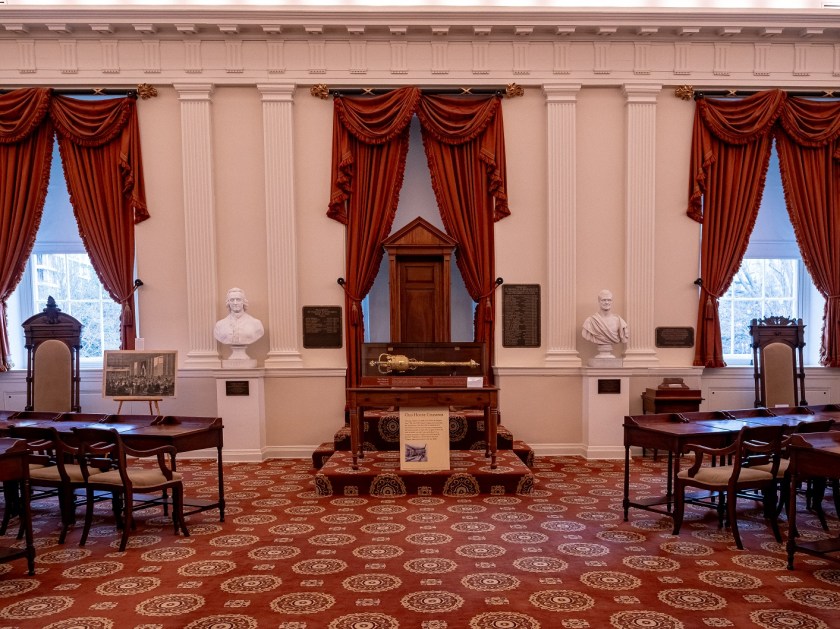
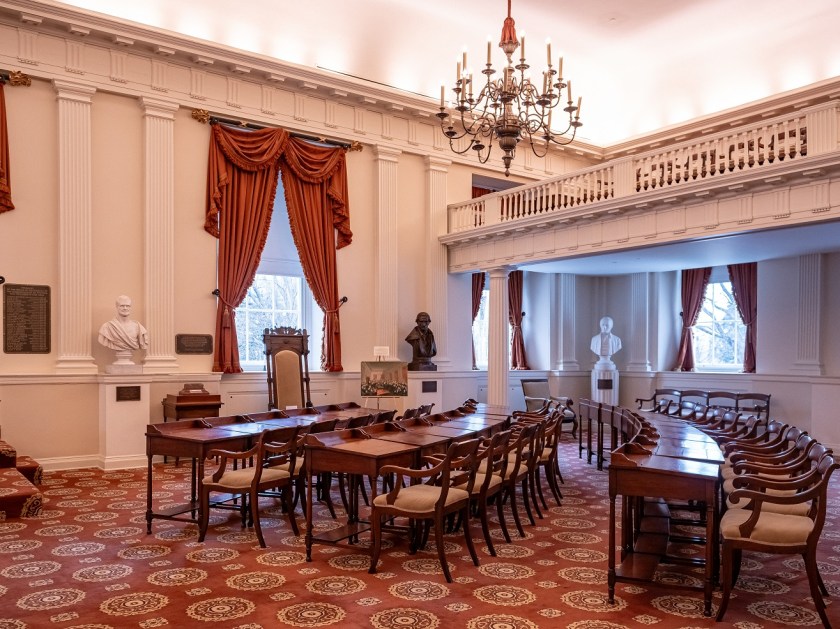
…and we also had a chance to visit, and spend more time in, the Old House Chambers, the largest room in the structure.
The center of the room features a ten-pound mace, made from solid silver with a 24-karat gold finish. Also gracing the room are busts of Chief Justice John Marshall and Patrick Henry, both of whom served in the VA House of Delegates.
On the opposite side of the room out of reach of our cameras, are busts of Sam Houston (who was born in Virginia) and Cyrus Hall McCormick (born in the same county as Sam Houston!).
This room also hosted the 1807 trial of Aron Burr, who was charged with treason. As Chief Justice of the United States Supreme Court, John Marshall returned to the building in which he once served as Representative, and he presided over the trial.
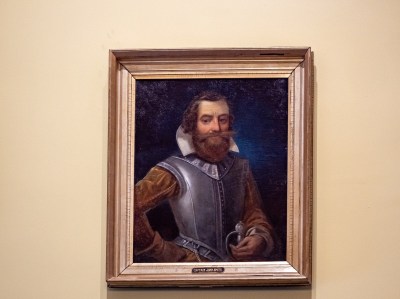
Walking into the Old Senate Chambers, we noticed many artworks on the walls. One piece that Mrs. Snellings highlighted was a painting of Pocahontas.
She explained the true history behind her story, correcting the common myth that Pocahontas was married to Captain John Smith (also pictured in the room).
In fact, she was married to John Rolfe, a tobacco planter.
Next, Mrs. Snellings directed our attention to the back of the room, where she pointed at a painting by Griffith Bailey Coale. The painting depicted three ships: the Susan Constant, the Godspeed, and the Discovery. Mrs. Snellings explained that this scene represented the arrival of these ships in 1607, marking the beginning of the first permanent English settlement in America at Jamestown, Virginia. She pointed out the flags atop the ships, noting that they symbolized the United Kingdom.
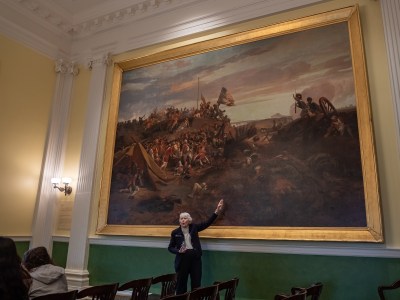
The largest painting in the room, by Eugene Louis Lami titled Storming a Redoubt at Yorktown captures the Battle of Yorktown 1781, as British Troops approach the American forces. Mrs. Snellings pointed to a small figure in the painting and asked if we had any guesses for who it might be. After waiting for a response, she exclaimed with excitement, “It’s General George Washington!”
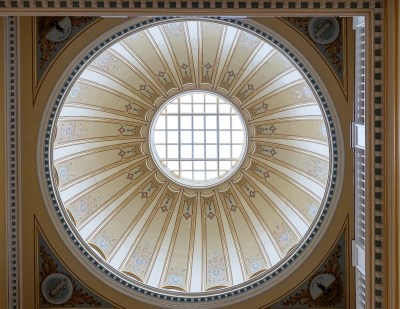
The architectural features of the building were beautiful, from the central rotunda…
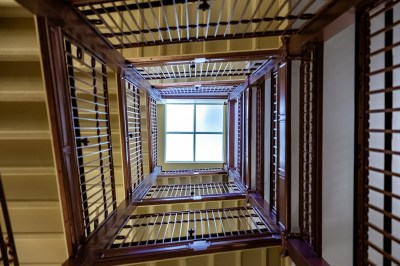
…and the stairwell, which at one time, housed a steam-powered elevator.
Although our time at the Capitol was brief, we left with a valuable history lesson about the foundations of American democracy and the fight for independence! We would like to thank our tour guide, Mrs. Snellings, for providing a fantastic tour and sharing insights that many of us had not known before.
Old City Hall
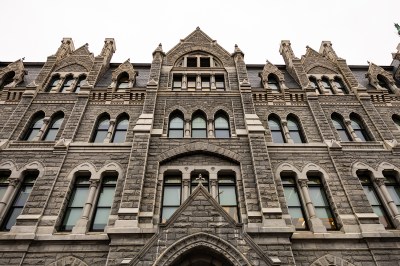
Also on the Capitol Square–with the Capitol and Executive Mansion–is the old City Hall, a Gothic Revival Structure built in 1894.
For more than seven centuries, it housed city offices and courts, but as early as the 1920s, there were calls to tear down this beautiful structure and replace it with a more modern city hall. These calls were partially heeded in the 1970s, when a new City Hall was built, but, thankfully, the Historic Richmond Foundation led efforts to save it. The structure re-opened in the 1980s and in the 2010s, the building was restored to its original look–a restoration that required approval from the Virginia Department of Historic Resources, Architecture Review Board, and Capitol Square Preservation Council.
At 30,000 square feet, it remains the largest granite building in Richmond, while also being the city’s finest example of Gothic architecture.
It was designed by architect Elijah Myers, who also designed the TX Capitol building (where three of the LEAP Ambassadors currently work) and the Colorado Capitol Building (which two of the Ambassadors will visit in March), as well as the capitol buildings of Utah, Idaho, and Michigan.
Today, the structure is used for state offices, and only the first floor is accessible to visitors.
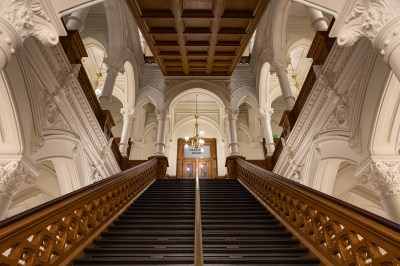
But even a restricted visit is worth it for the view of the impressive clock tower on the exterior of the building, the four-story atrium…
…detailed faux-graining of the bases of the Corinthian columns…
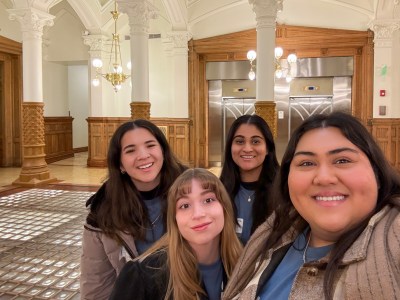
…and the exquisite detailing of the interior.
Virginia Museum of Fine Arts
by Michelle Cardenas
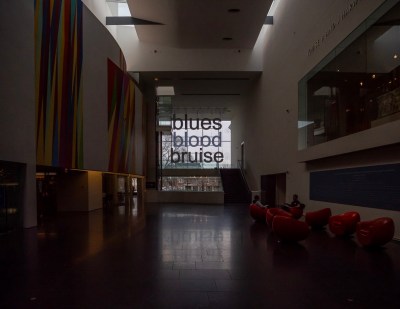
The Virginia Museum of Fine Arts (VMFA) offered an experience that was both exciting and full of discovery. Originally opened in 1936, the museum has continued to evolve, with a major renovation in 2010 and plans for further expansion to accommodate even more incredible works of art. The museum’s location carries historical significance as well, sitting on what was once a Confederate camp, adding another layer of depth to our visit.
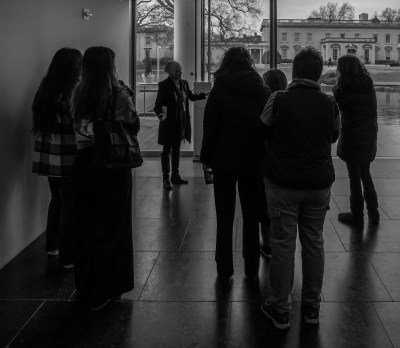
Instead of our usual self-guided exploration, we opted for a highlights tour, which provided an excellent overview of the museum’s diverse collection. Before even stepping inside, we were captivated by the stunning outdoor sculptures by renowned artists such as Dale Chihuly and Henry Moore, which set the tone for what was to come.
One of the standout sections for me was the American Art collection, where I was particularly drawn to Moonlight in Yosemite by Albert Bierstadt. Seeing one of his pieces with muted colors–almost black and white in places–was unexpected and fascinating, offering a different perspective on his usual style.
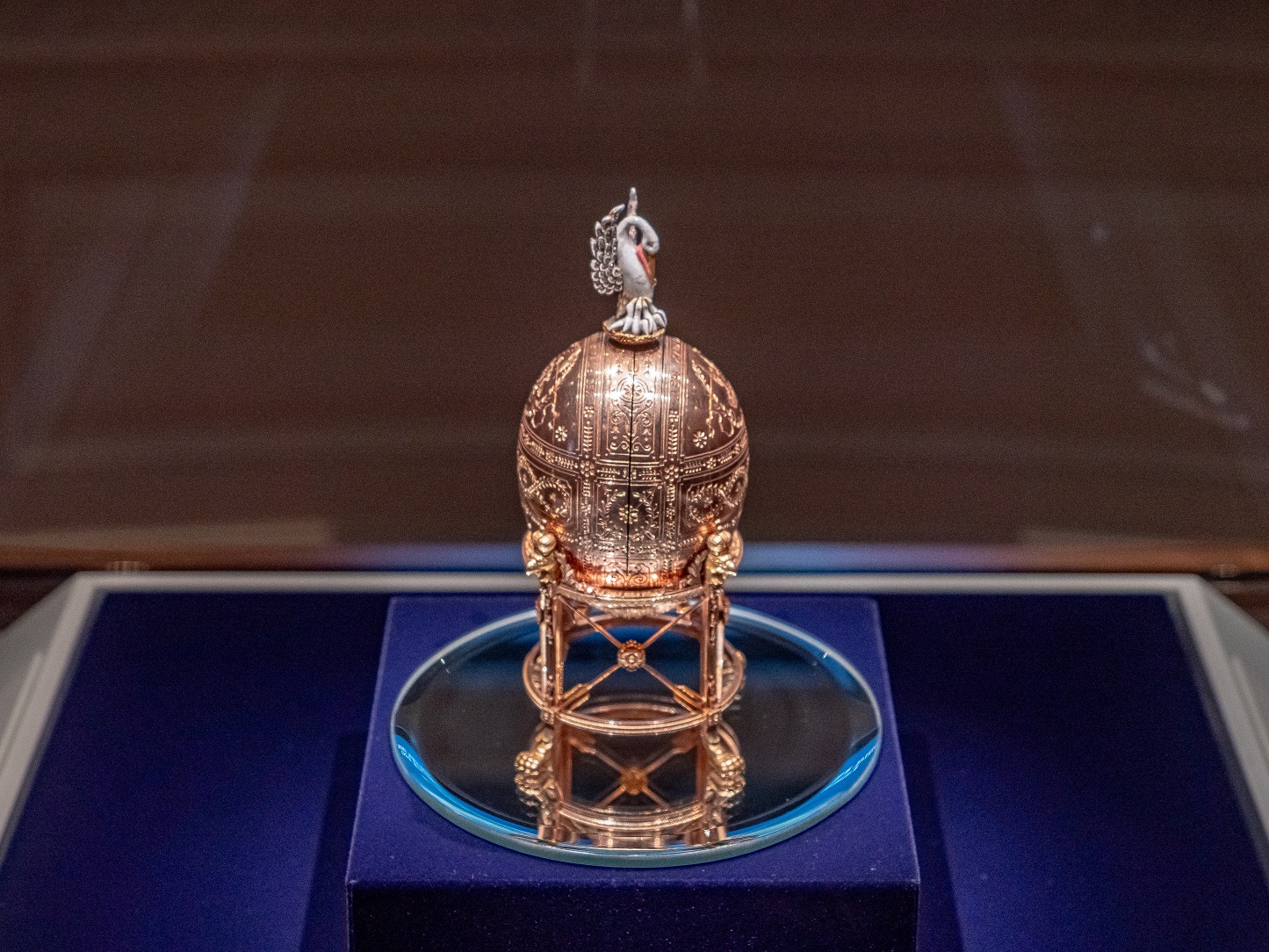
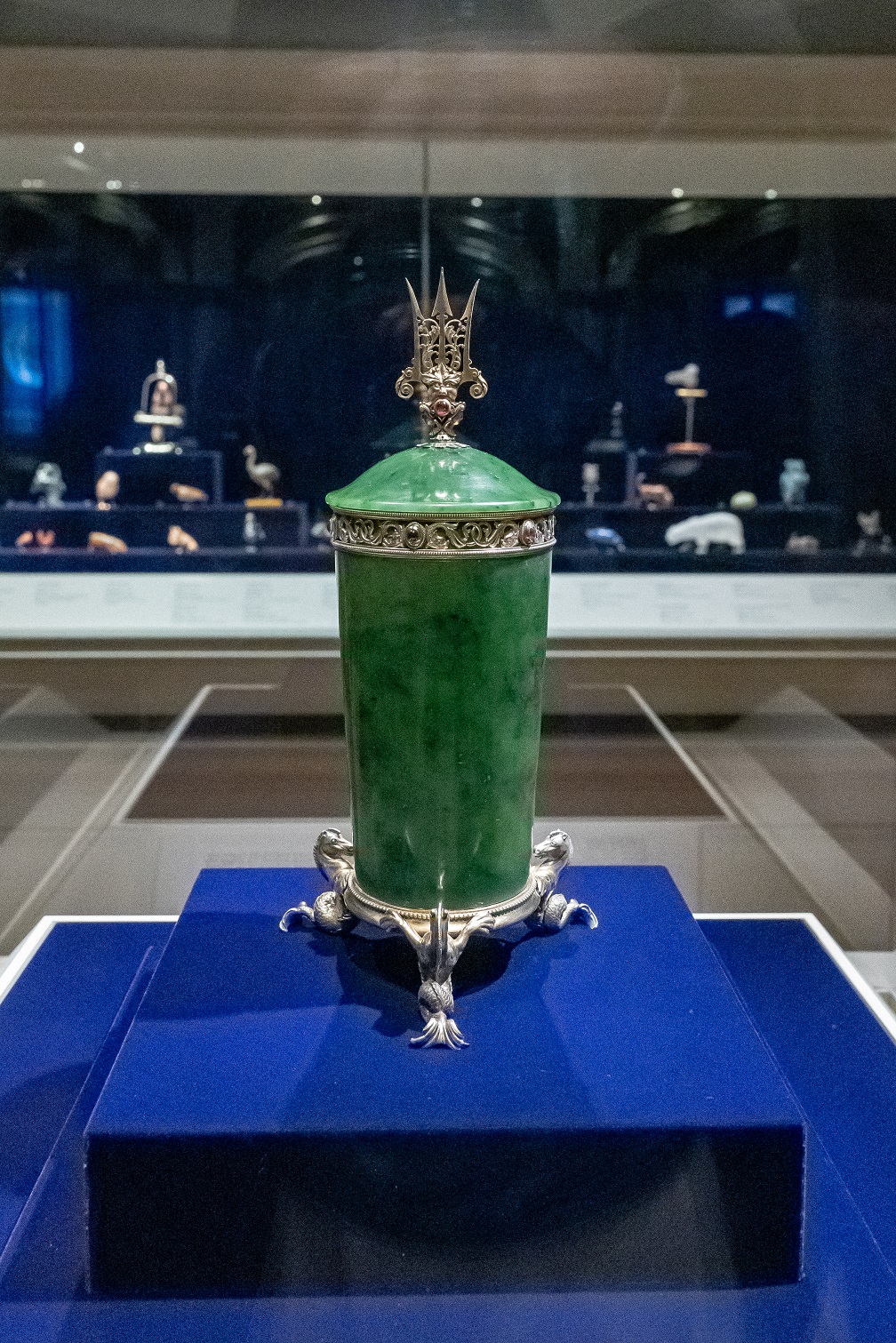
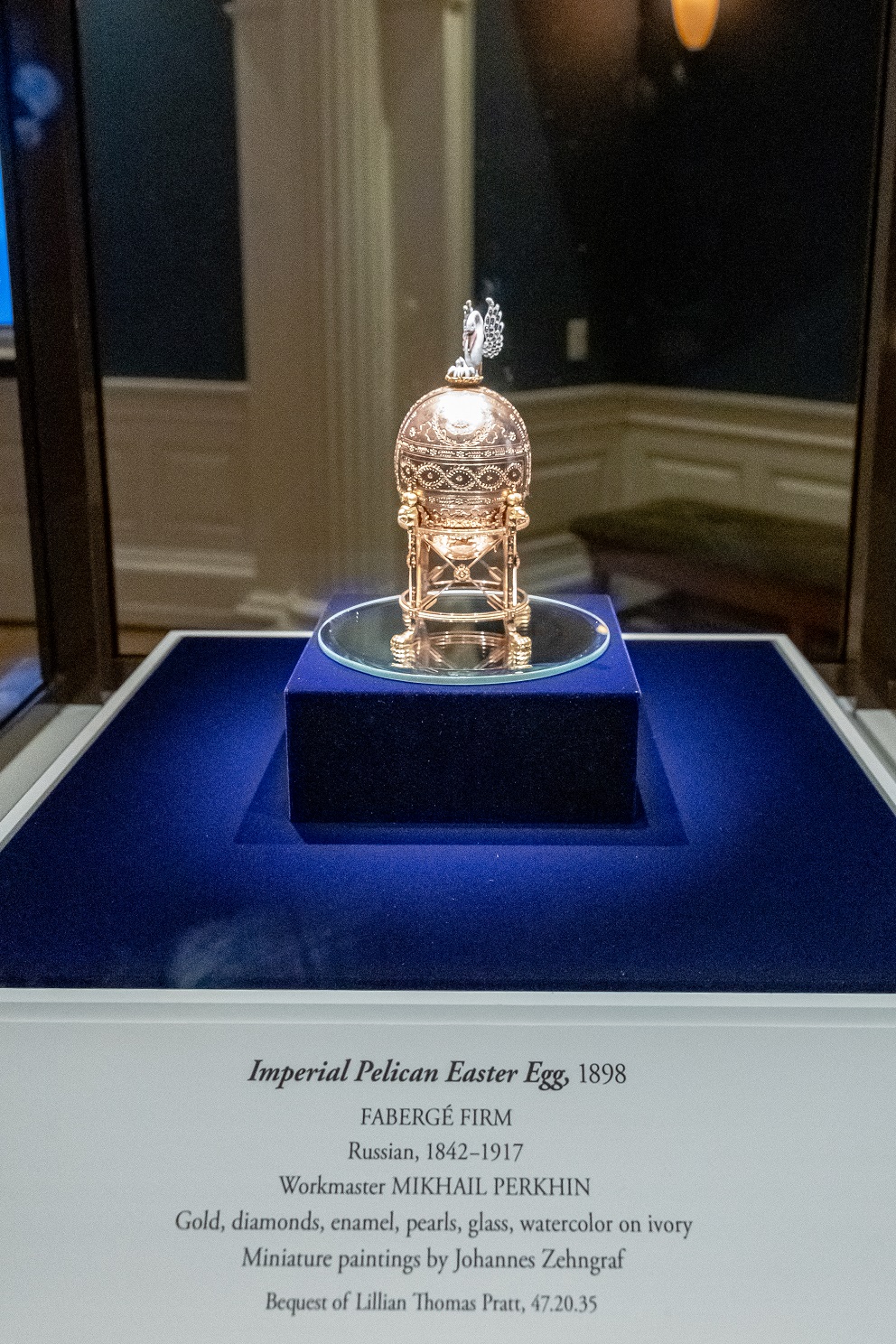
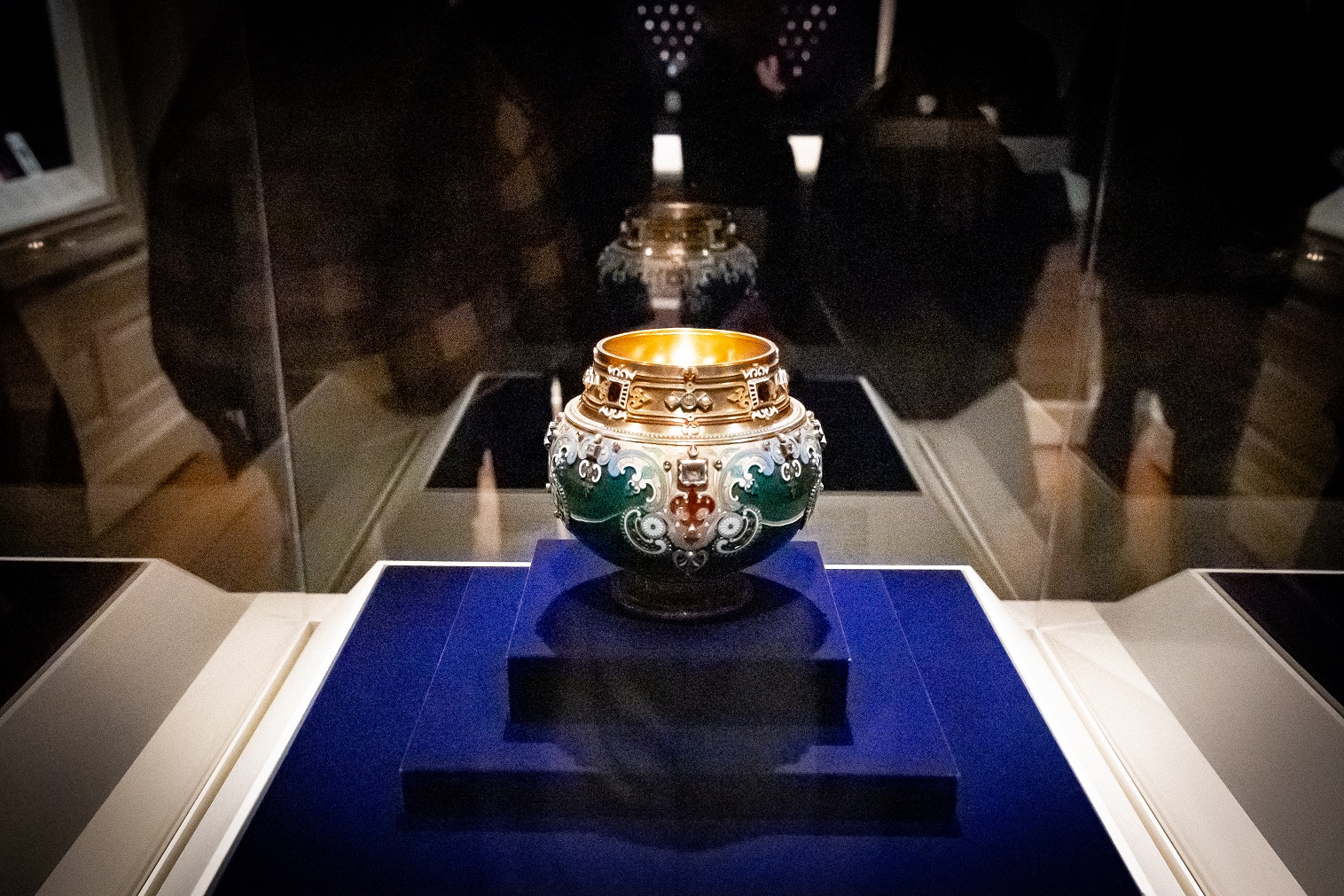
Another highlight was the Fabergé collection, featuring beautifully intricate Easter eggs that showcased incredible craftsmanship and history.
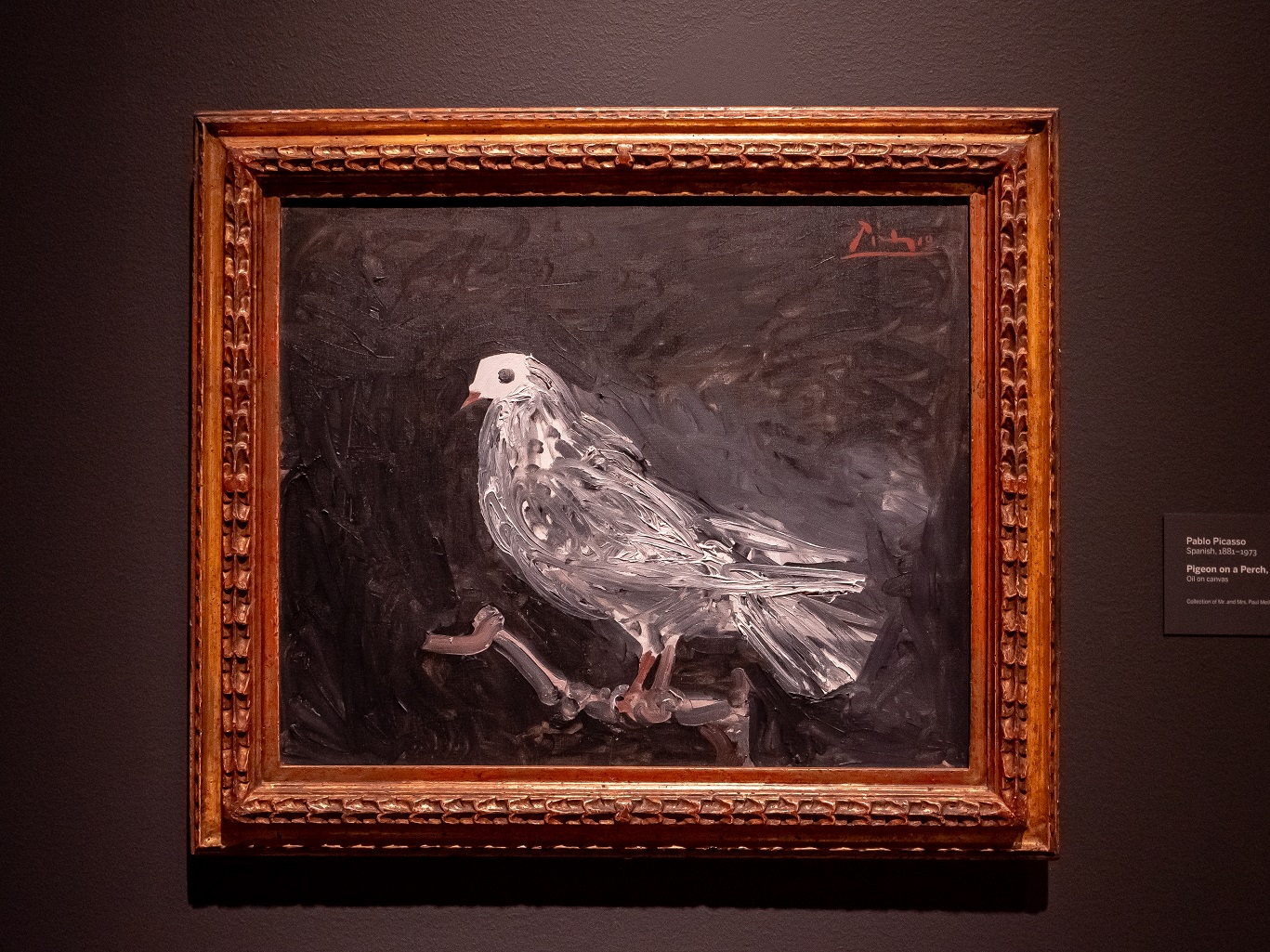
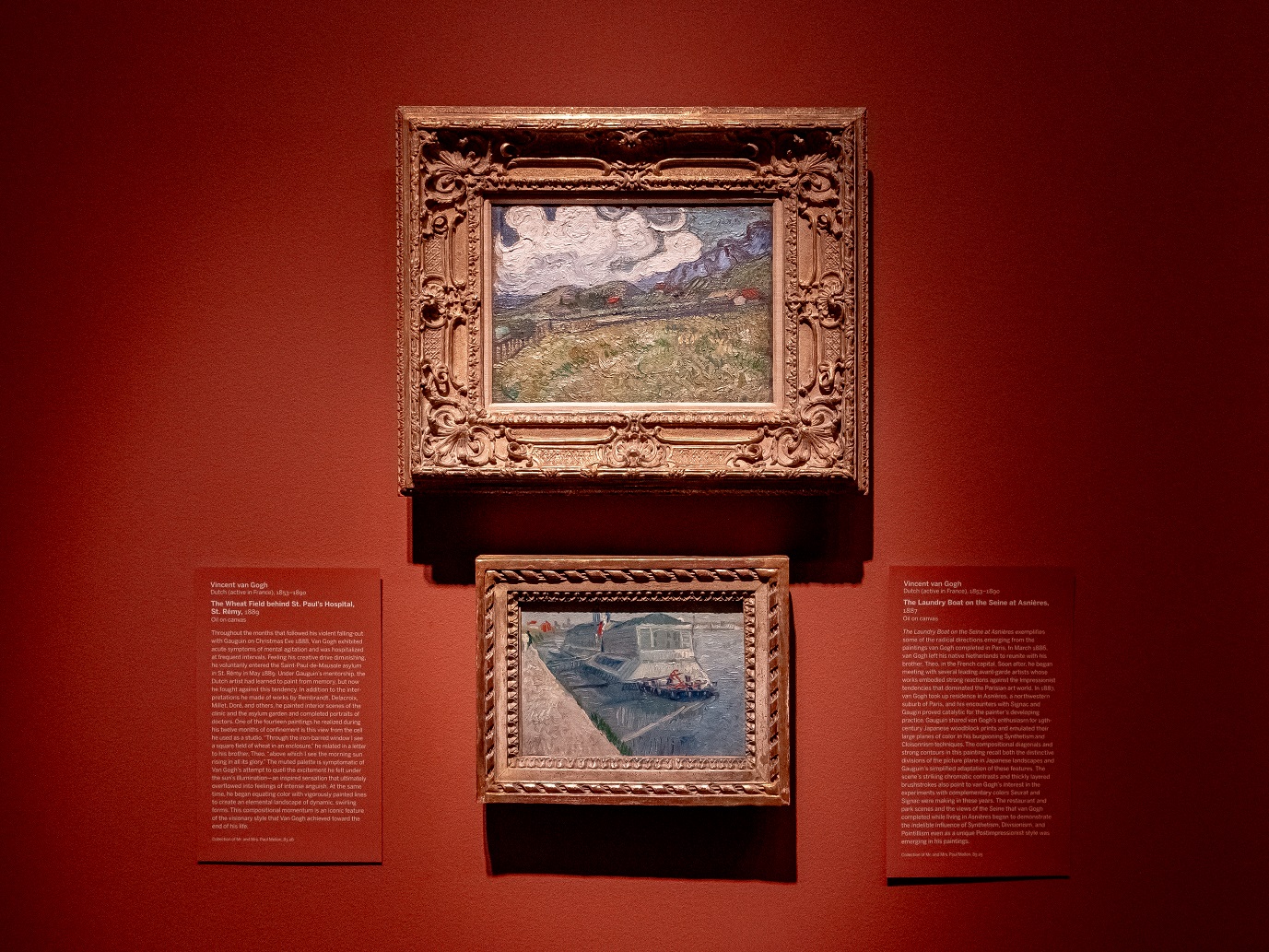
As we continued through the museum, we encountered works by well-known artists such as John Roberts, Kehinde Wiley, Ellsworth Kelly, Andy Warhol, Van Gogh, Degas, and Monet. Recognizing these names and seeing their masterpieces up close is incredibly rewarding—especially when I think back to when I first started and hardly knew any artists at all.
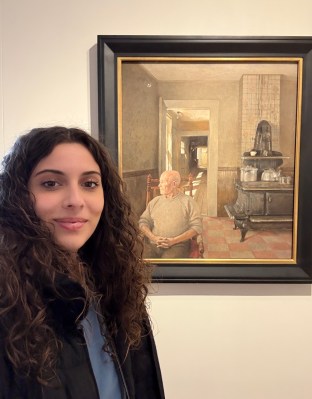
Each of us found pieces that resonated on a personal level. Cinthia was drawn to Edward Hopper’s House at Dusk, appreciating its quiet and reflective atmosphere. Olivia enjoyed the works of Andrew Wyeth, admiring his detailed and emotional portrayals.
Saara was captivated by Edwin Lord Weeks’ The Hour of Prayer at Moti Masjid…
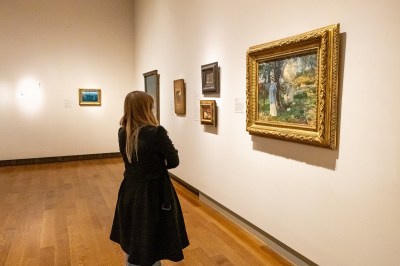
…which stood out due to its rich colors and cultural depth. Chrissy’s favorite was John Singer Sargent’s The Sketchers, which impressed her with its lively and spontaneous feel.
Visiting museums like the VMFA is always a rewarding experience. No matter how many we explore, there’s always something new to learn and appreciate. Each visit offers a chance to see the world through different perspectives, and we’re grateful for the opportunity to continue discovering and growing through art.
The Poe Museum
by Chrissy Biello
Mystery, Madness, and Mayhem, three words that many would use to describe Edgar Allan Poe. Nevermore, that might not be the full story….
Edgar Allan Poe is known by many as an American short story writer and poet. His themes largely center around darkness, such as death, despair, and fear. He is widely credited with pioneering the modern detective story and significantly contributing to the emerging genre of science fiction.
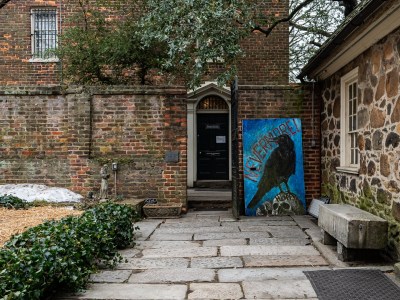
Today, we had the chance to visit his home in Virginia, where we learned much about him. The museum began on a particularly somber note, discussing how his mother passed away when Poe was only two years old, leaving him orphaned.
Upon seeing a coffin, Olivia could not resist the urge to climb in. Surprisingly, it fit her perfectly, not to mention befitting her increasingly pallid complexion!
To give you some context, this coffin was placed here to symbolize the intense fear people in Poe’s era had of being buried alive. Due to this widespread anxiety, special coffins were designed with a mechanism that allowed the occupant to ring a bell from inside to call for help. However, when Olivia got inside, she chose not to ring the bell…
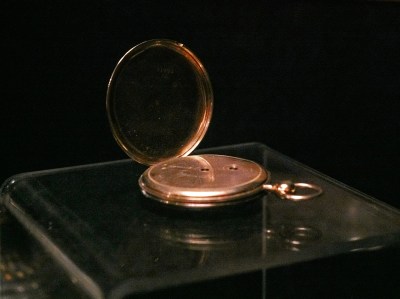
One aspect of the exhibit that I found especially intriguing was the pocket watch that Poe heard while writing “The Tell-Tale Heart.” I have always found this short story engaging and mysterious, as I tend to be drawn to darker subjects.
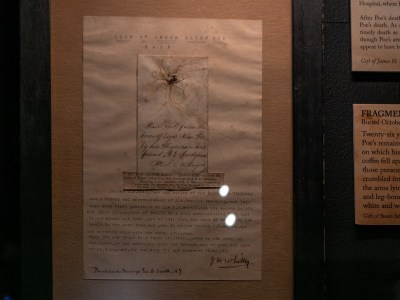
And, there has been considerable debate surrounding whether Poe was the artist of a watercolor painting or simply the gifter. The painting, which depicts a weeping woman, is quite interesting to observe. I appreciated the detailed wrinkles in her dress and the overall droopy appearance of the painting.
Another fascinating mystery in the museum concerns Poe’s hair. After his death, locks of his hair were cut from his head. Although the cause of his death remains a mystery, many have attempted to solve it. In 2002, a sample of his hair was analyzed, revealing the presence of many heavy metals, which were believed to have contributed to his death.
The museum also shed light on Poe’s posthumous reputation, largely shaped by his adversary, Rufus Griswold. Griswold painted Poe as a madman and drunkard in a posthumous biography. Ironically, this portrayal fueled Poe’s fame, but as mentioned earlier, we learned that Poe may not have been as crazy as everyone believed, leaving his legacy steeped in mystery and intrigue.
Before leaving the museum, we visited an upstairs section of the house featuring paintings. One painting, in particular, was quite amusing. It was titled Vincent Van Poe by Chris King and depicted Starry Night in the background, with Poe, a black cat, and a raven in the foreground.
As a fan of Poe, I thoroughly enjoyed the museum, especially since it was Poe’s actual home. It was also delightful to see a black cat, aptly named Edgar, moving around the building, setting the perfect atmosphere for reading and learning about Poe!
Metzger Bar and Butchery
For our last planned dinner of the trip, we opted for Metzger Bar and Butchery, whose chef, Brittany Anderson, is a two-time James Beard semi-finalist.
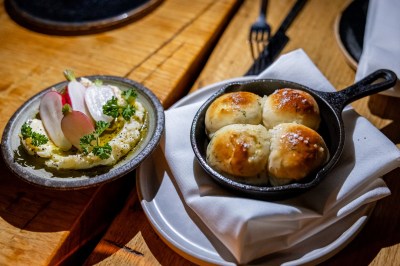
We started the evening with a recommendation of our server, the Charred Cabbage, whose menu description was enigmatic: “Miso Bagna Cauda, Cured Egg, Gremolata, Calabrian Chili.” Whatever it was, it was great! We also had a bread baked in house (“cottage-cheese rolls”), which came with house-made butter adorned with radish slices.
Three of our party went with the Pork Schnitzel, and the general consensus was that this was the best dish available. But we also tried the Chicken and the Steak, and all of it was excellent.
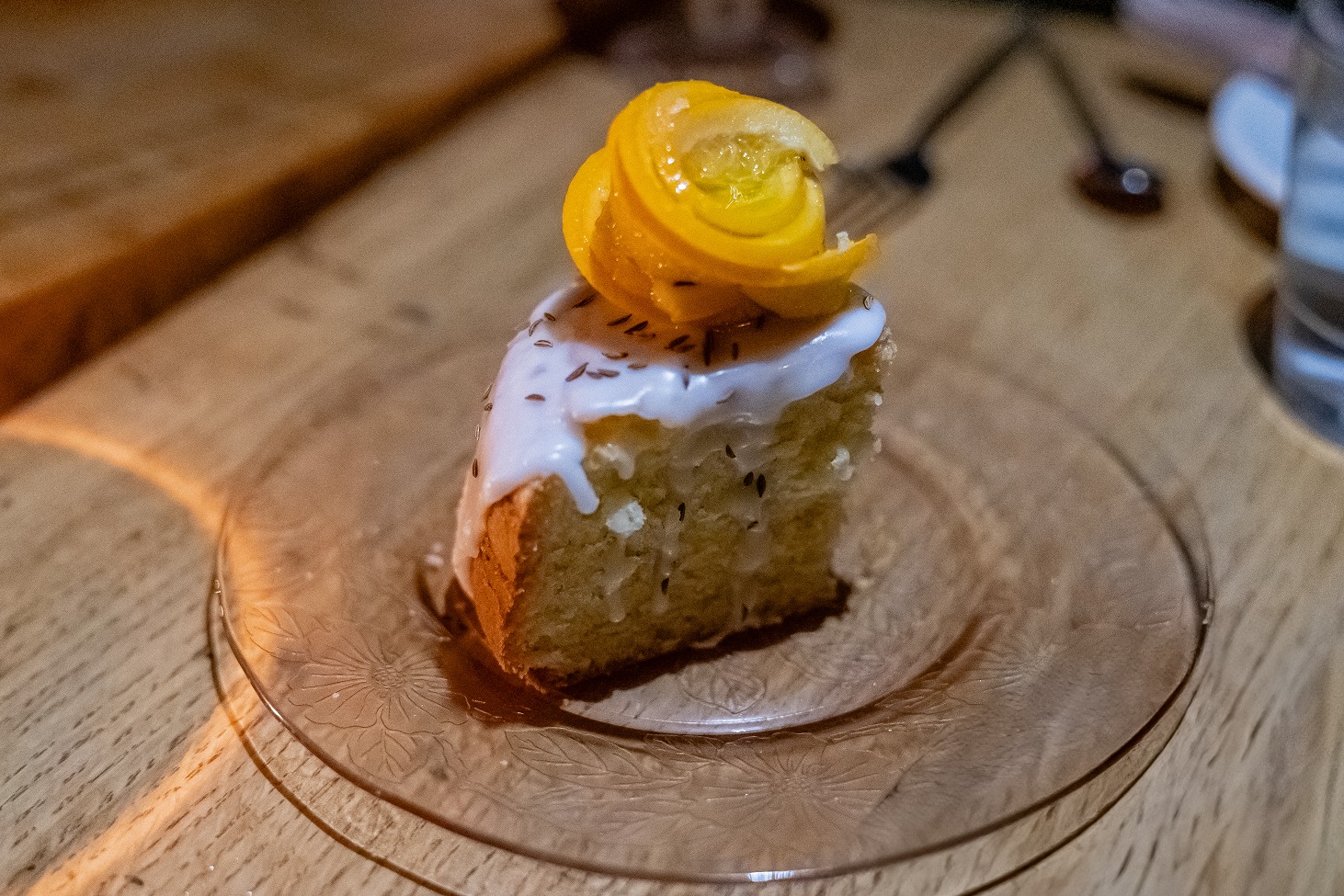
Although we were full, we were willingly talked into dessert, which included an Olive Oil Cake, the Heirloom Corn Funnel Cake, and a Honeynut Squash Sundae. The latter dessert made us pause–a squash sundae? But it was the favorite of the group!
It was a rich and fulfilling end to a busy and rewarding day.
On our first day in New York City, we decided it would be a good idea to explore the area and familiarize ourselves with the surroundings, including the subway system. It turned out to be a great decision, as we encountered many fascinating and exciting sights along the way!
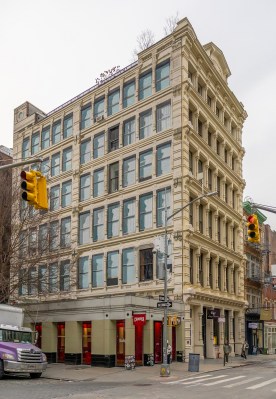
As we began walking through the city, Professor Yawn noticed our proximity to the historic Prince Street. Along this notable street stands the first Richard Haas mural, which Olivia enthusiastically recognized and pointed out as we approached.
Richard Haas’s First Mural, 1974
The mural, gracing 112 Prince Street since 1974, features intricate details that have been thoughtfully added over the years. But even as an early work, it reflects Haas’s artistic and architectural sensibilities, as well as his ability to transform a space through art.
Haas, who lives in New York, once spent a summer working for Frank Lloyd Wright, before embarking on a successful career as what the New York Times referred to as an “urbanologist.”
Thanks to the work of Linda Pease, Haas brought his Urbanology to Huntsville, TX, where he has completed 15 exterior murals–the most of any city. Thus, despite being strangers in the strange land of New York City, we felt oddly at home.
Continuing our walk, Chinatown emerged as a fascinating destination; its narrow streets offered an authentic glimpse into this vibrant New York neighborhood.
To our delight, we found the New York City Hall, a magnificent French Renaissance Revival structure still bearing the inscription “New Amsterdam;” a beautiful reminder of the city’s Dutch origins.
Next on our route was Federal Hall, which was erected in the 19th century as a Customs House. Prior the construction of the present building, however, the site hosted many milestones in the formulation of the United States government. The US Congress, such as it was, met here in the 1780s, when the (semi) United States of America was governed under the Articles of Confederation, and even as the US Constitution was written to supersede the Articles, the First Congress met on this site–and the Bill of Rights was first proposed here. More relevant to our current trip, George Washington was inaugurated on the balcony of the old Federal Building–the first-ever US Presidential inauguration! Standing on this site, therefore felt particularly resonant, considering we will be witnessing the 47th presidential inauguration in DC on Monday!
Approaching the Brooklyn Bridge, we began to make the long way up; winds from the surrounding waters grew increasingly cold.
This suspension bridge, one of the oldest in the United States, goes over the East River and connects Manhattan and Brooklyn.
When we reached the top, the spectacular view, however, made the chilly walk (the wind chill was in the teens) entirely worthwhile!
A shift in the atmosphere became apparent when we visited the 9/11 Memorial. The names etched in bronze, the twin waterfall pools, and the One World Trade Center made us all feel reflective. Saturday, we will get the chance to visit the museum, something we are greatly looking forward to as it will allow us to educate ourselves more on that disastrous day.
Before heading back to prepare for our evening of theater (Hadestown and Sunset Boulevard), we stopped at Zuccotti Park to observe Mark di Suvero’s “Joie de Vivre.” The 70-foot red steel sculpture definitely stands out against the Financial District backdrop, with its modern design creating an interesting contrast with the surrounding area.
Finally, we returned to the subway, hoping our earlier experiences had made us experts. Despite our optimism, we still struggled to navigate the system (particularly myself), but successfully made our way back to the hotel to prepare for an evening of theater.
Katz’s Deli
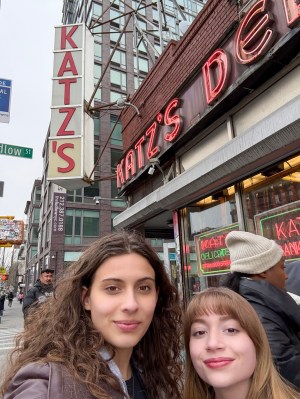
Although our time in NYC is short, we hope to squeeze in as many quality (and affordable) restaurants (and coffee shops) as possible. Thus, amidst our rambles on New York’s sidewalks, we espied Katz’s Deli, which was rated as the “Best Deli” in the Big Apple by Zagat, while also regularly appearing in the New York Times’ various “best of” lists. It is also notable for the many films that have set scenes in the Deli, including Donnie Brasco, We Own the Night, The Sidewalks of New York, and most famously, When Harry Met Sally.
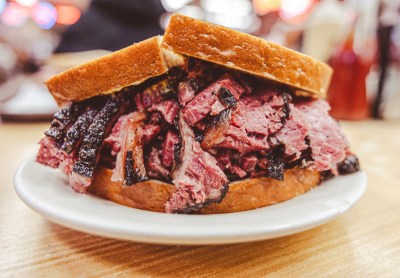
Being new to the place, we weren’t familiar with the unique ordering system of Katz’s. When you enter, you are handed a ticket, which you then take to a counter where one of approximately 15 “cutters” are stationed. The cutters, so named because they cut the meat in front of you, offer suggestions and samples, and so it was that Professor Yawn ordered Pastrami…
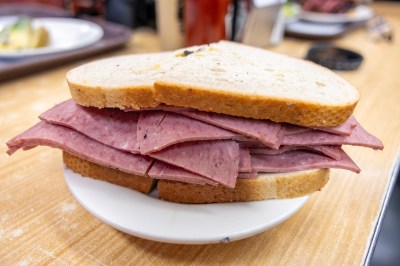
…and Olivia ordered a Reuben.
Chrissy, for her part, took a different approach, veering from the “I’ll have what she’s having” custom at Katz’s. To hear Chrissy tell of her upbringing–an upbringing that changes upon retelling, depending on her energy level and degree of coherence–she was fed baloney, almost exclusively, for the first six or seven years of her life.
If we followed this narrative correctly, this prompted her to order “soft salami.” Despite gentle nudges from the cutter to consider the pastrami, Ms. Biello remained obdurate, insisting on the salami. The cutter, clearly disappointed, complied, although his look of disappointment was palpable.
Just because we ordered separate foods, however, doesn’t mean we actually ate separately. Chrissy shared in both the pastrami and the Reuben, while all of us sampled all the food at our table.
While we can’t compare Katz’s to other NY Delis, we were in general agreement that we don’t get Pastrami or Corned Beef as good in Texas…and we have a full appreciation for why the New York Times called this institution–in business since 1888–the “king of New York delis.”
Hadestown on Broadway
by Olivia Discon
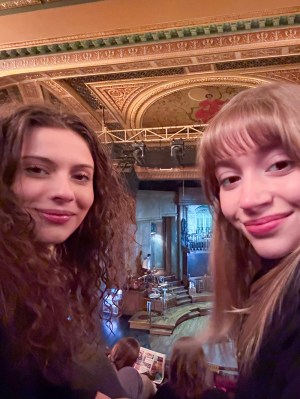
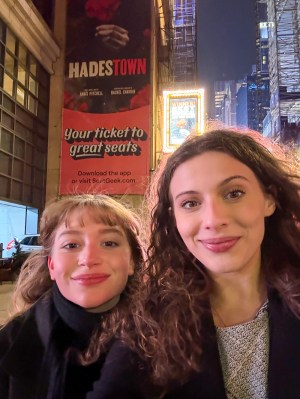
After spending the day exploring New York, Chrissy and I ended the night with a Broadway show—Hadestownat the Walter Kerr Theatre. Watching a production in this historic venue was an incredible experience, and Hadestown lived up to its reputation as one of Broadway’s best.
Written by Anaïs Mitchell, Hadestown is a retelling of the ancient Greek myth of Orpheus and Eurydice. The story follows Orpheus, a musician, and his journey to the Underworld to rescue his love, Eurydice, from Hades. The story covers some heavy hitting subjects while successfully executing a modern day retelling of the tragedy.
Chrissy and I both thoroughly enjoyed the set design.
The stage featured three spinning circles that worked like a treadmill, adding fluidity to the choreography and creating a sense of constant motion. This small but awesome detail elevated the performance and made every scene feel dynamic and alive.
The live jazz band, positioned on stage, was another highlight. Their presence both in song and in sound effects elevated the entire experience. It sort of reminded me of the live band that played at the first play I saw with LEAP, Chicago!
For Chrissy, Hermes (played by Malcolm Armwood) was the standout character, while I loved Persephone (played by Allison Russell). Both actors were incredibly talented and brought vastly different elements to the production. This cast can sing!
Seeing Hadestown has been a dream of mine for years, and getting to experience it with LEAP made it even more special. It’s a night I’ll cherish for a long time.
















































 Center for Law, Engagement, and Politics