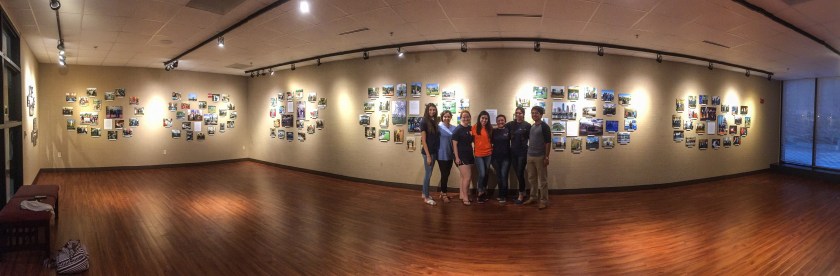
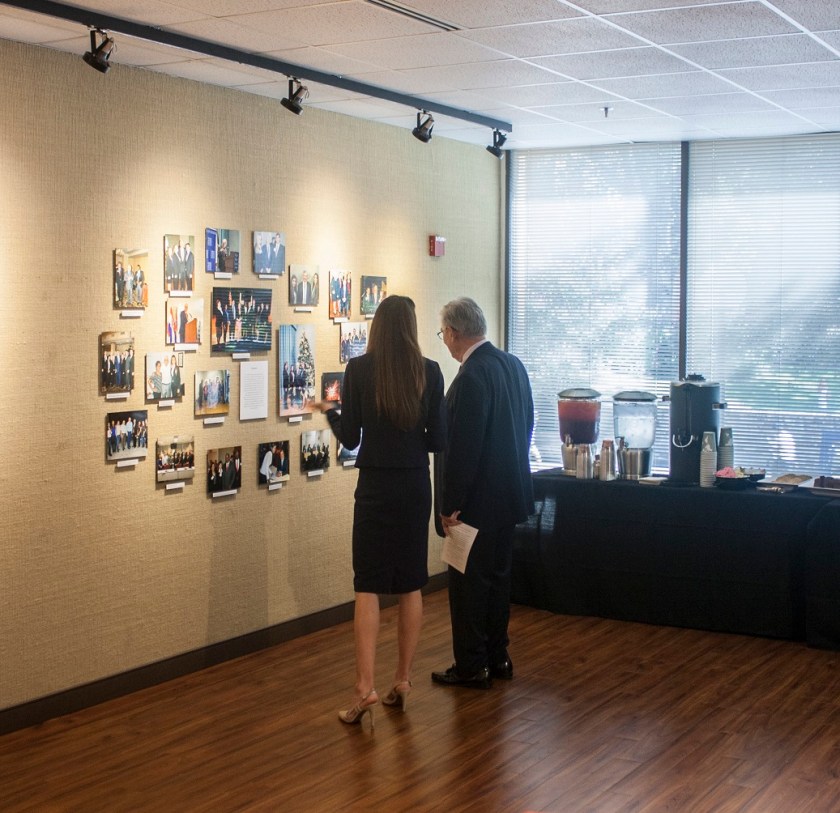
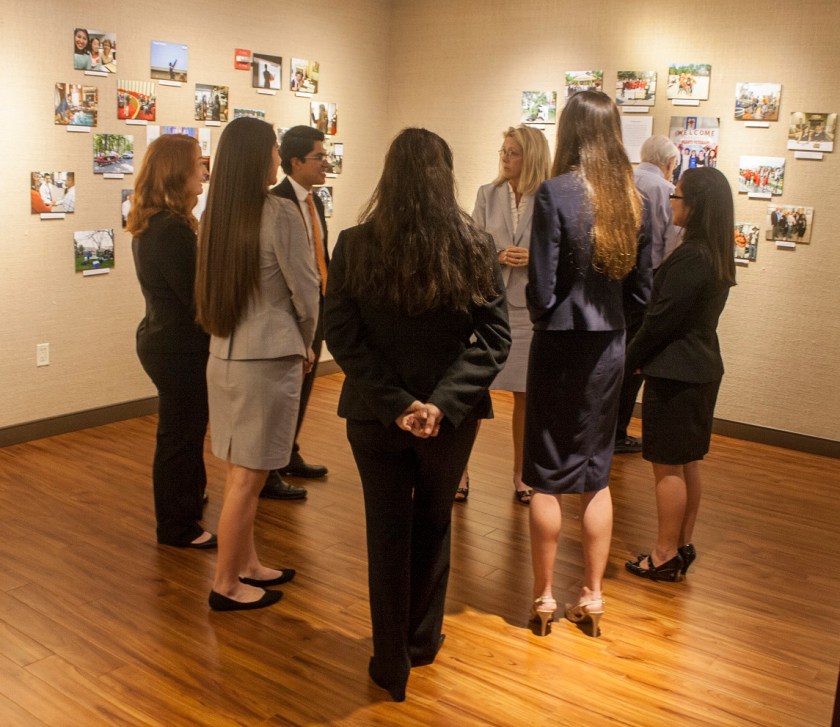
In an effort to educate the campus and community about what the LEAP Center is, the LEAP Ambassadors compiled pictures of events to showcase the organization in the LSC Art Gallery.
The exhibit, which was open from September 2-September 16, showcased some 160 photographs (culled down from more than 90,000) across six categories: speakers, travel, fine arts, volunteerism, experiential learning, and programs.
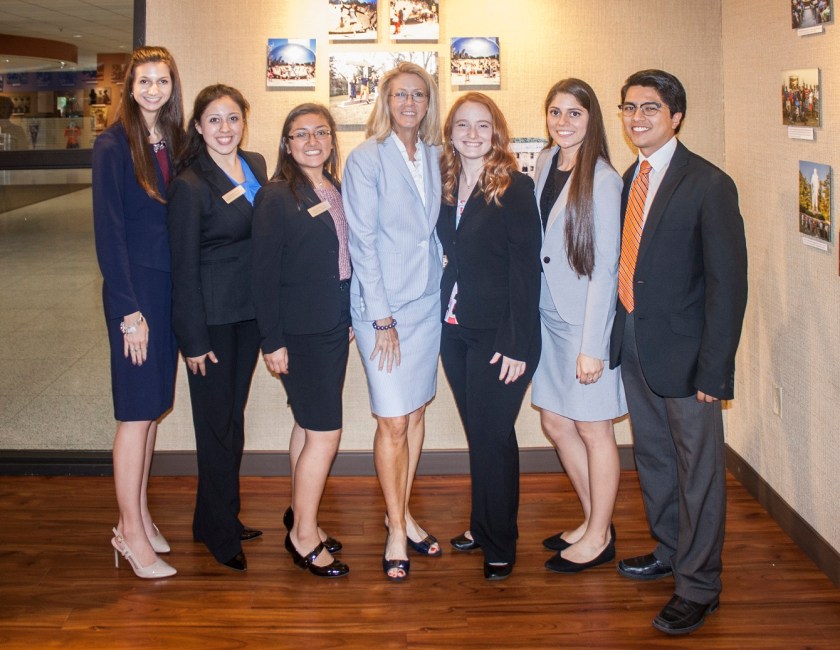
LEAP Ambassadors Following Installation of Art Exhibit
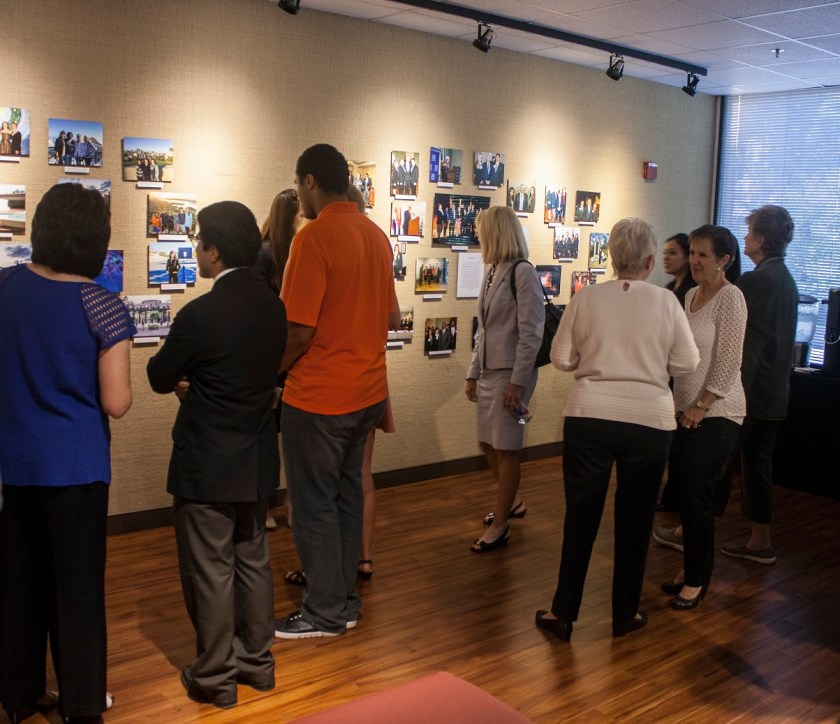
This past September 14th the LEAP Center hosted an opening reception for the art exhibit. Many students, University staff, and community members came out to support the LEAP Ambassadors and learn more about what the LEAP Center does.
Each category emphasized our favorite and most notable events. For example, LEAP Ambassadors have traveled twice to see Stephen Hawking present a lecture, and we have also seen public figures such as Alan Alda, Bill Schneider, Douglas Brinkley, Governor Abbott, and Vicente Fox. All of these photos appeared under “Speakers” and, of course, additional photos were featured in the other categories.
The LEAP Center is thankful for the opportunity to showcase the organization. Numerous students attended, some of whom might make for good LEAP Ambassadors themselves someday!
We were also grateful for the support from University officials such as Provost Eglsaer…
…President Hoyt…
…Mac Woodward, Charlie Vienne, Gene Roberts, and many others. We also had a chance to see some of our favorite community people, including Linda Pease, Terry Stivers, Carol Hays, and others.
Excited murmurs could be heard from Art Building F as people were flooding in for the LEAP Centers’ 2nd annual heART of Huntsville program. Art enthusiasts from SHSU and the community are annually invited to this four-week program where they can explore various art media created by local artists around the SHSU campus and the picturesque town of Huntsville.
We started out in one of the many classrooms of the Art Department. The LEAP ambassadors were elated to see many of our community friends such as former mayor Mac Woodward and Wynne Home Director, Linda Pease; as well as friends on campus such as English Professor, Dr. Ralph Pease and Political Science Professors, Dr. Tom Haase and Wen-Jiun Wang.
After everyone had finished their survey of local art and artists (not without a few grumbles), Dr. Micheal Henderson, chair of the art department, welcomed us to the the Gaddis-Geeslin Gallery.
Inside the gallery, Dr. Henderson presented us the “Selections” exhibit by revealing the type of art that could be found within. The art gallery consisted of creations from alumni dating as far back as the late 1930’s up until the Spring semester of 2016. There were many pieces from former SHSU professor Ken Zonker. The artist had a special resonance for Leap ambassador Beatriz Martinez, a previous Wynne Home Intern who had organized a Zonker exhibit.
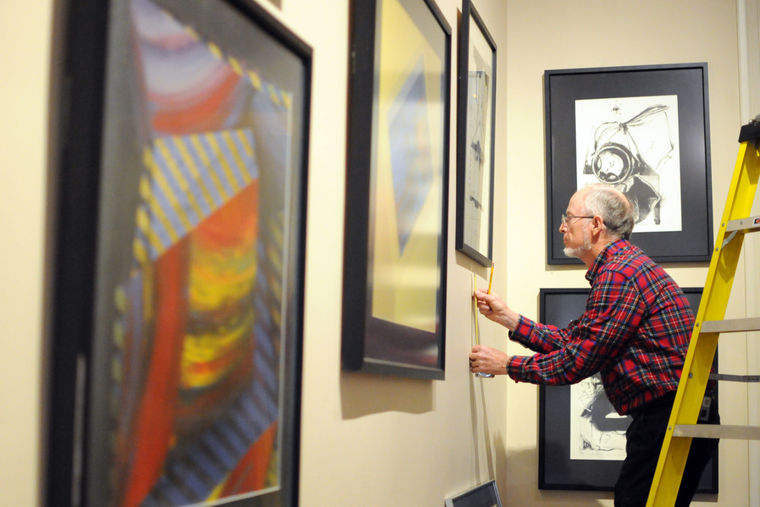
Dr. Wes Sanders Hangs Art by Ken Zonker at the Wynne Home
There were also pieces by Zonker’s apprentice, J Miller, who had actually painted a portrait of Mr. Zonker. Exhibited was also a painting by the renowned sculptor James Surls (whose art would appear later in the tour). Titled Cockfight, Surls produced the work in the late 1960s while he was still a student at SHSU. At this, few of the attendants revealed how the had been friends of Surls at a younger age, and we spoke with Dr. Keri Rogers, who several years ago helped hang this piece in the LSC.
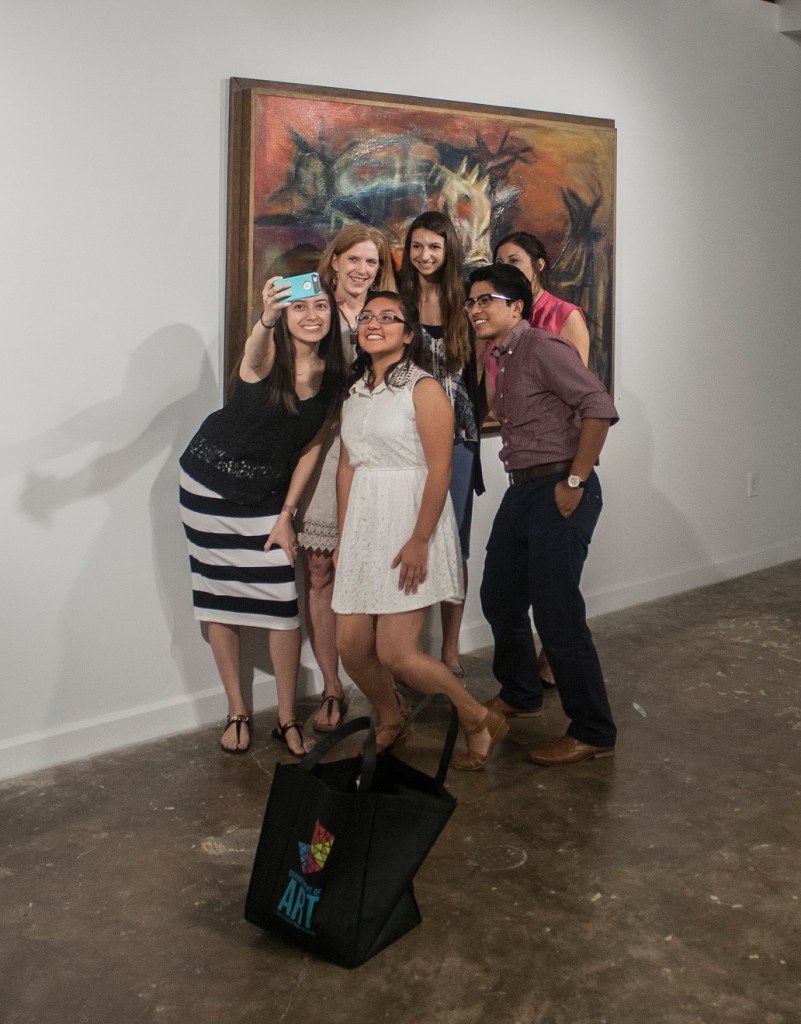
LEAP Ambassadors and Keri Rogers With James Surls’ “Cockfight”
After seeing more SHSU faculty and alumni art…
…we decide to head on over to the second stop: the College of Humanities and Social Sciences (CHSS).
As we got closer to the CHSS building, we stopped outside to gaze at the Water Wall by Jesus Moroles. This 9-ft wall was erected to harmonize the elements of earth, stone, and water. The attendees where then amused by how Jesus Moroles (as a lover of multimedia art), had planned to unveil the sculpture by having SHSU dance majors dance atop the CHSS building’s roof.
Fortunately for us (and the dancers), their platform became the top of the Water Wall. The Water Wall’s intended function was to offer a venue for outside lectures. Currently it is most often used as a great study spot for students, and is occasionally seen hosting CHSS socials. Once inside, we saw a piece by Bruce Marion, Confluence, lining the walls. Seeing as how the Humanities and Social Sciences college deals with human interactions and circle of connections, Marion transitioned colors and interwove circles to showcase these two ideals.
The group later traversed through the summer heat to the Lowman Student Center Art Gallery, which was probably the LEAP Ambassadors’ favorite gallery, as they had spent many hours, nails, and mounting squares in order to set up their very own LEAP exhibit. Showcasing the various features of the LEAP center, such as special speakers, fine arts, volunteerism, experiential learning, programs, and travel, it gave heART of Huntsville participants an opportunity to gain a further insight of the different fields in which LEAP Ambassadors engage.
From there, we went to the Nancy Gaertner Performing Arts Center where Craig Brossman, the facilities manager of the building,was waiting to give us a tour.
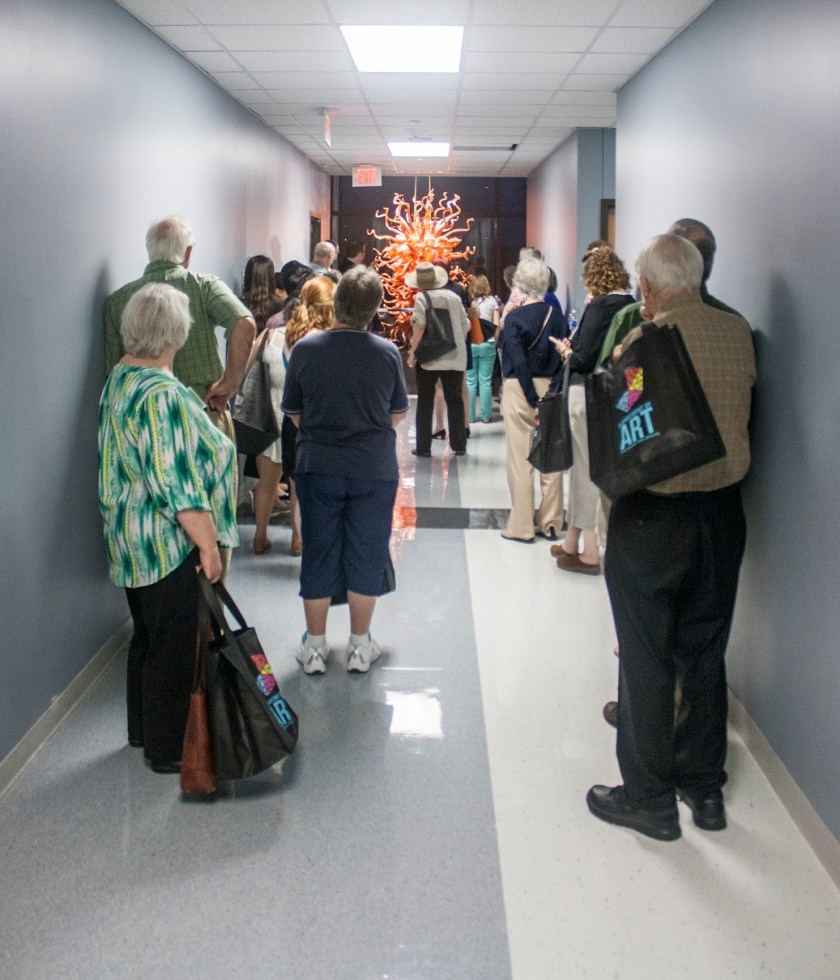
We toured the Concert Hall, which impressed the heArt of Huntsville participants as it has been named one of 25 best art venues in the nation. Equally impressive was the dance theater with a sprung floor which is tailored to fit a dancer’s needs. There are only 2 or 3 like it in the state, and about a dozen in the nation. We proceeded to view Kathleen Ash’s Elements, Stanley Lea’s Four Seasons, and a serpentine marble sculpture by Jesus Moroles. The most prominent installation was the 16 ft, wood and steel, Around the Flower Wall by James Surls. We also got to see some art from Charles Pebworth, whose first and biggest sculpture lies in the Woodlands at about 40ft tall. As we were exiting, we saw Jason Lawrence’s Firedance, our last beacon of crystalline light as we retired for the night.
Or at least until we got to Austin Hall. This historic building awaited us with food to be deliciously devoured upon as we interacted with the other participants and shared our anticipation for next Monday’s adventure, which will start at the grand Sam Houston Statue on Monday, September 19.
With the presidential elections around the bend, the LEAP Ambassadors attended the Walker County Republican Women’s non-partisan meeting on the various aspects of voting this Monday, August 29. The evening’s agenda included speakers focused on new voting ID requirements, the history of political parties, and the nearly unfathomable electoral college. The LEAPsters therefore were more than delighted to start off the semester with proper political education.
The first speaker, County Tax Assessor and Elections Officer Diana McRae, headed the conversation on new voter ID laws.
Walker County Tax Assessor Collector Diana McRae
With experience running more than fifty elections, McRae outlined the various kinds of identification that a voter may present at their polling station. From a normal driver’s license (acceptable even if expired for up to four years), to military identifications, those present are at peace knowing that this upcoming November they will be ready to present the proper requirements to vote.
Followed thereafter was SHSU’s own Political Science Professor Yawn. With a presentation focused around the history of political parties Yawn touched on the early years of American politics from the Federalists and the Anti Federalists, the Whigs, the Democratic- Republican party, finally reaching our present day decided political spectrum.
Professor Mike Yawn Speaks About the History of Political Parties
Highlighted were also presidents that shaped those political parties such as George Washington, Abraham Lincoln, John F. Kennedy and many more. As her first time seeing Professor Yawn teach outside the classroom, Christina (one of the newest additions to the LEAP Ambassadors) deemed the presentation “as a very interesting one.” As a political science major however, this was to be expected. As for the rest of the non-student audience, they occasionally responded to Yawn’s presentation with laughter–not out of spite but as a result of the amusing presidential tales from Yawn’s dynamic presentation.
To finish the evening’s meeting Michael Ethridge, Huntsville’s field representative for U.S Congressman Kevin Brady, elucidated the audience on “How the President Really gets Elected.”
Michael Ethridge Discuss Presidential Elections
His main topic was the electoral college and how it affects the way presidents are voted into office. He showed us how one county can change the outcome of the entire state, like Ohio. He also answered questions related to our electoral college, and the process of voting. He showed a time line of the electoral process between November and January of election years. One thing he emphasized on was that voting is important. As college students who share his beliefs, the LEAP Ambassadors all thought it was an important message to share. Likewise the efforts of the Walker County Republican Women reflected this political responsibility of educating the community on voting, political history, and the electoral process.
Our morning brought excitement with a splash of sadness, both from the prospect of our first day of rain and facing what would be our final day of the Southern Legislative Conference. With that in mind, we vowed to make the most of the day, with experiences extending to the world of politics, liquor, and musical entertainment.
We boarded our ever-familiar tour bus bound for Kentucky’s capital city of Frankfort, and enjoyed the green rolling hills on the short drive from Lexington (~45 minutes). As we neared the bend that would lead into Frankfort’s main street, the trees embraced the city, making it seem every building was surrounded by its own mini forest, an impressive landscape.
The Old Statehouse
Our first stop was the state’s third capitol building, “The Old Capitol,” built in 1803. Its location was the same as the first two state capitol buildings, both of which met their demise through fire. Following the second fire, officials requested submissions for a new design, which would be selected through a competitive process. The winning design was submitted by Gideon Shryock (fresh out of college!) on a dare.
The Greek revival structure was erected as a symbol of Kentucky’s democratic strength, the massive pillars flanking the entry underlining that statement.
Old State Capitol: Frankfort, Kentucky
The limestone walls, quarried from the Kentucky River, stand as impressive as the day as they were placed. Through this grand, but windowless, entrance, we turned first into the “new” library, relocated from its original second-floor location due to weather damage to the books. In the corner of this room stood a desk that had belonged to then-Governor, Thomas Bramllette. Under his orders, the desk was ordered to contain a secret compartment. However, upon arrival, there was no sign of any such compartment. After complaining to the cabinetmaker and demanding that he be told the whereabouts of the desk’s secret, the designer refused to reveal it for “if [he] were to reveal it then it wouldn’t be a secret anymore.” The secret compartment was never found.
We left the library, and gathered under a floating staircase. Reputedly one of the only staircases of its kind in a public building, the whole structure will supposedly stay in place regardless of whether walls stand around it – it requires no external support. As designed by architect Shryock, this is an impressive feat of architectural and aesthetic design. As we walked up the staircase, admiring its simple yet intriguing structure, quite a few tour participants not-so-surreptitiously checked out the number of people on the stairs at once.
Another pleasant detail was found in the plaster floral designs on the ceiling. As with most capitol buildings, the legislative chambers were the largest. At the entrance of the Senate and House chambers, we were greeted with lighting from magnificent gold French chandeliers, as lavish as when they were lit for the first time. In the House, the desks were sectioned for two legislators to share one table. As we walked onto the senate chamber, we entered a much more intimate room. We sat down on both the house and senate desks, taking in the building’s history, imagining what it would have been like in the past. When the visit of the Old Statehouse was over, we were very sad. However, our hopes were regained after remembering that this was only the beginning of our grand tour.
Center for Kentucky History
Because we spent so much time in the Capitol building, our next stop was correspondingly curtailed. Thus, we only had about 15 minutes at the modern Center for Kentucky History, which was clearly not sufficient. Some of us went into the gift shop while others toured the Hall of Governors, which consisted of painted portraits and biographies of Kentucky’s governors. It started with Isaac Shelby, the first governor of the state. He was an interesting character. Even though he served two full terms believing and practicing his constitutional duties, in his autobiography of four hundred plus pages, he only included one sentence of his tenure as governor. Another notable character was Martha Layne Collins, the first female governor. She was known for bringing a Toyota plant to Kentucky, which provided many economic opportunities to the state. Despite the brief time allotted to this portion of the tour, we enjoyed the artifacts and exhibits we saw.
Governor’s Mansion
After the tour of the Kentucky History Center, we visited the Governor’s Mansion for lunch with the Lieutenant Governor of Kentucky. As we approached the mansion, we were fascinated by the beautiful architecture and colorful garden.
Kentucky Governor’s Mansion: Frankfort, Kentucky
We learned that the architecture was designed to model Queen Marie Antoinette’s villa of the palace of Versailles in France—not the last time we would find French influences in the Bluegrass State. The interior also reflected the French interest of the Beaux-Arts period. Walking into this grand architecture, the Lieutenant Governor, Jenean Hampton, and some of her staff, greeted us. We were then directed to the dining room for lunch.
She welcomed our group very warmly into the governor’s home and spoke about the great state of Kentucky.
Kentucky Lt. Governor Jenean Hampton at the KY Governor’s Mansion
After learning we were from Texas, she expressed her love for the Lone Star State.
LEAP Ambassadors with Lieutenant Governor Jenean Hapton
We felt that she was very genuine and kind! After having greeted her, we then proceeded to eat lunch consisting of a traditional Caesar salad and grilled chicken.
Kaitlyn Tyra and Megan Chapa at the Kentucky Governor’s Mansion
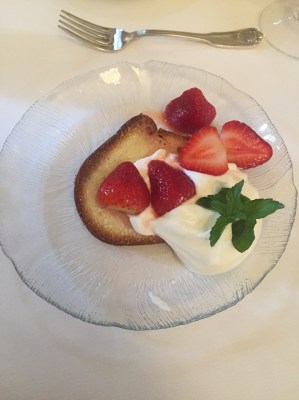
For dessert, we had a light, summery strawberry shortcake.
And as an added desert of sorts, we had the wonderful opportunity to explore the Governor’s Mansion.
LEAP Ambassadors Relax at the Kentucky Governor’s Mansion
Kentucky State Capitol
Following the lunch at the Governor’s mansion, we toured the fourth and current Kentucky state capitol. Our tour began in the rotunda with five large statues, each a famous (or infamous) Kentuckian. These include Henry Clay, Alben Berkley, Jefferson Davis, Ephraim McDowell, and Abraham Lincoln.
Abraham Lincoln, with Jefferson Davis in the Background
The dome that sits above the rotunda is inspired by Les Invalides, Napoleon’s tomb. Interestingly, the interior of the dome changes colors periodically…
This slideshow requires JavaScript.
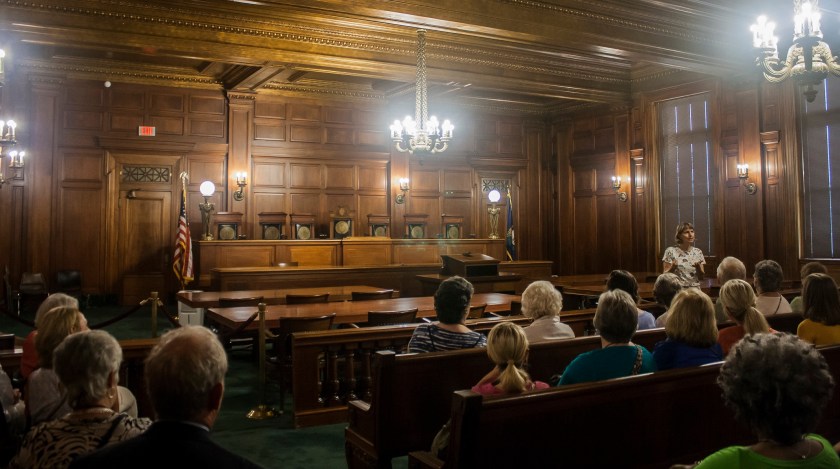
The building houses all three branches of government: the executive is on the first floor, the judicial is on the second, and the legislative is on the third. This is one of very few state capitols that still houses three branches. In the state supreme court, the judges convene about three days a month, hearing about only nine cases a month.
Kentucky Capitol: Supreme Court
The justices can serve as many ten-year terms as they can get elected to.
The Kentucky legislature is unusual in that they only meet for 90 days every two years. During even numbered years, the Kentucky legislature will meet for up to 60 days, and in odd numbered years, the 38 Senators and 100 House members will meet for no more than 30 days.
House of Representatives, Kentucky
House members, as well as Senators, have two year terms, but no term limits.
Overall, we were impressed by the symmetrical design of the capitol, both the interior…
Kentucky Capitol Interior
…and the exterior…
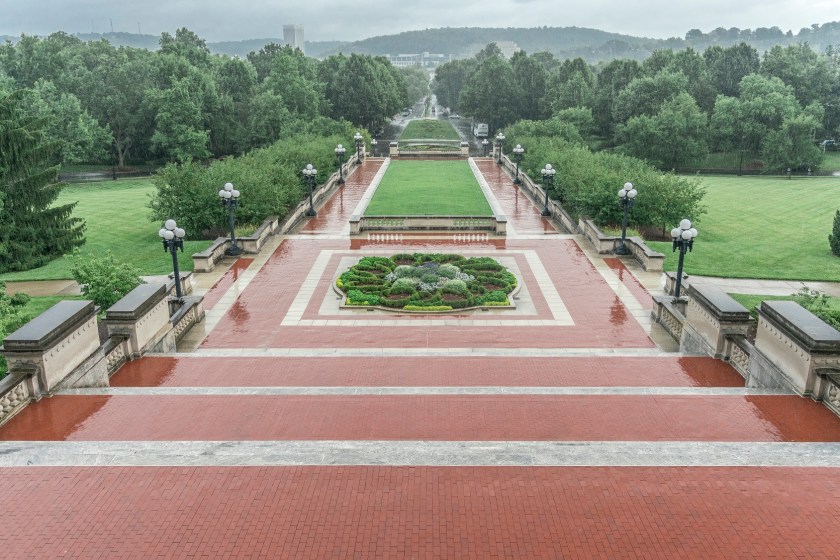
Walkway to the Kentucky Capitol
…as well as the views from the balcony.
This slideshow requires JavaScript.
In fact, it’s rare in a capitol to even be allowed on the balcony, so this was a treat indeed.
Buffalo Trace Distillery
No doubt the offices of the Kentucky Capitol building were witness to much drinking, in order to, as one politician told us, “lubricate the wheels of governance.” Some of those drinks were likely distilled, aged, and bottled in our next destination: Buffalo Trace. Liquor has been manufactured on the site of Buffalo Trace since 1787, when Willis and Hancock Lee first built a still. Although the companies of liquor and processes have changed, the site—located near the Kentucky Capitol building— has always been dedicated to distilling primarily bourbon.
Buffalo Trace Distillery in Frankfort, Kentucky
This was true even during Prohibition. As our tour guide noted, alcohol could still be manufactured for “medicinal purposes.” Each “patient” could be prescribed up to a pint every ten days. During this period, the illnesses must have been both “contagious and chronic,” because often an entire family would need the prescriptions refilled indefinitely. This legal loophole allowed the distillery to stay in business.
Thankfully, that subterfuge was no longer necessary following Prohibition, and the distillery could distribute its liquor the old-fashioned way. In more recent years, there has been a type of anti-prohibition, and bourbon drinking has become fashionable. In fact, Buffalo Trace is in the process of tripling the size of its operations, expanding from 140 to 420 acres.
Some people believe that only Kentucky sells bourbon. That’s not true, but as our tour guide says, most of the bourbon in the US comes from Kentucky. “Kentucky sells 95% of the nation’s bourbon,” he clarified, “and 100 % of the good bourbon.”
Much of that comes from Buffalo Trace. Indeed, they recently manufactured their six-millionth barrel. That’s a lot of bourbon, especially when each barrel contains about 200 bottles.
Bourbon Barrels, Buffalo Trace Distillery
And it is this process that is perhaps most interesting. To qualify legally as bourbon, the liquor must meet six criteria:
Its content must be at least 51 % corn;
Distilled to no more than 160 proof;
Barreled at no more than 125 proof;
Aged in new, charred barrels;
Bottled at 80 proof or higher;
And, all of this must occur in the United States.
The Aging Process of Bourbon, Buffalo Trace Distillery
This last requirement stems from the fact that in 1964 the US Congress passed a resolution recognizing bourbon as indigenous to the United States, much in the same way, for example, that Scotch is associated with Scotland.
This was a lot of information to take in, especially for some of the students who had almost no exposure to alcohol. But even for those more familiar with the product, the distinctive and specific process was a lot to ingest.
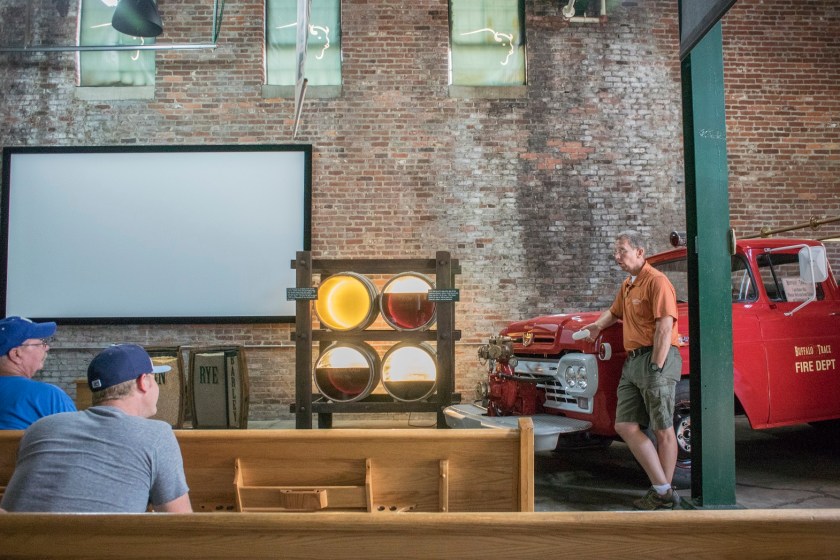
And speaking of ingesting, our tour concluded with a whiskey tasting. The under-21 crowd skipped this part, but a few of the students had a chance to distinguish (in very small doses!) the difference between four types of whiskey: (1) a blended vodka, (2) a mash whiskey at 125 proof, (3) an 8-9 year old bottle of bourbon, and a (4) 10 year-old bourbon aged on a lower floor of the storage. (The lower floor is a cooler location, which means less mixing with the barrel, which, in turns, less of the woody or caramel flavor.)
Bourbon Tasting at the Buffalo Trace Distillery
Opinions from the group were positive toward the bourbon, but there was general agreement that the 125 proof mash was strong medicine indeed.
Our samples were far too small to lubricate any kind of political deals at the conference, but that doesn’t mean we weren’t interested in expanding our professional networks and seeing what opportunities we could find. To that end, we headed back to Lexington, where we planned to socialize at the state dinner.
State Dinner
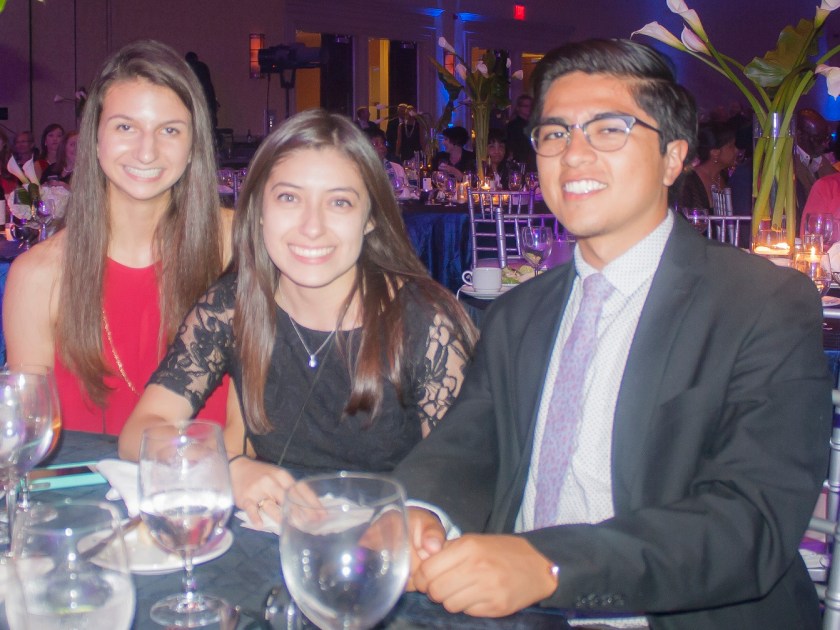
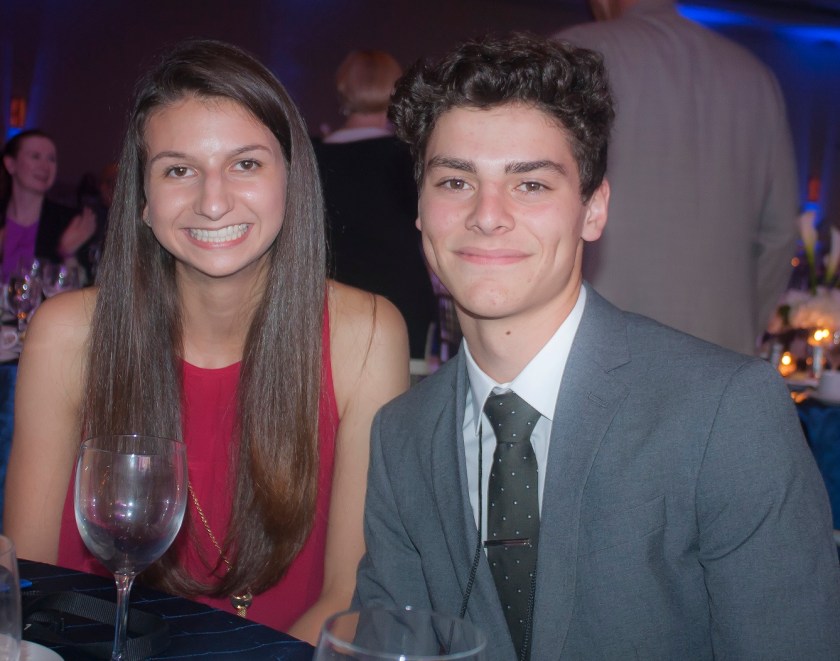
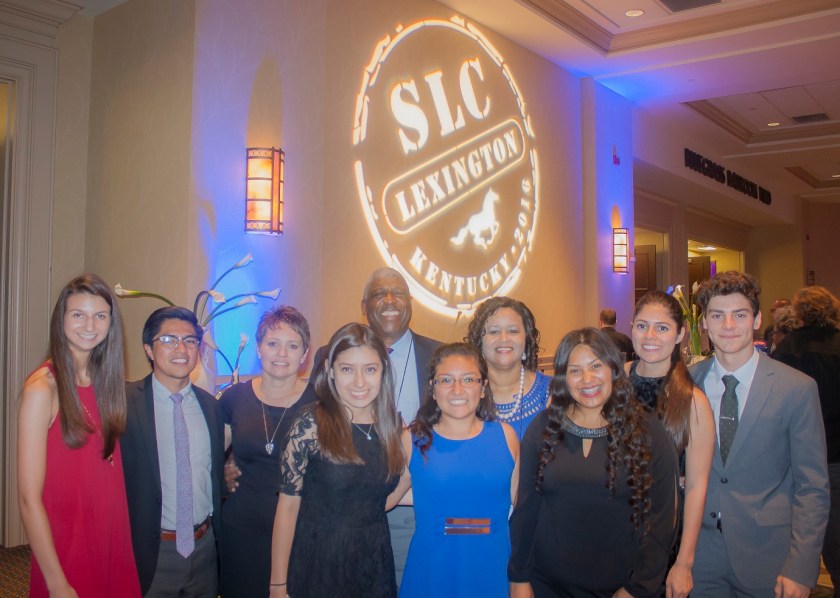
Dressed to the nines, the LEAPsters strode into the Rupp Arena Ballroom. Although we were prepared to enjoy the State Dinner…
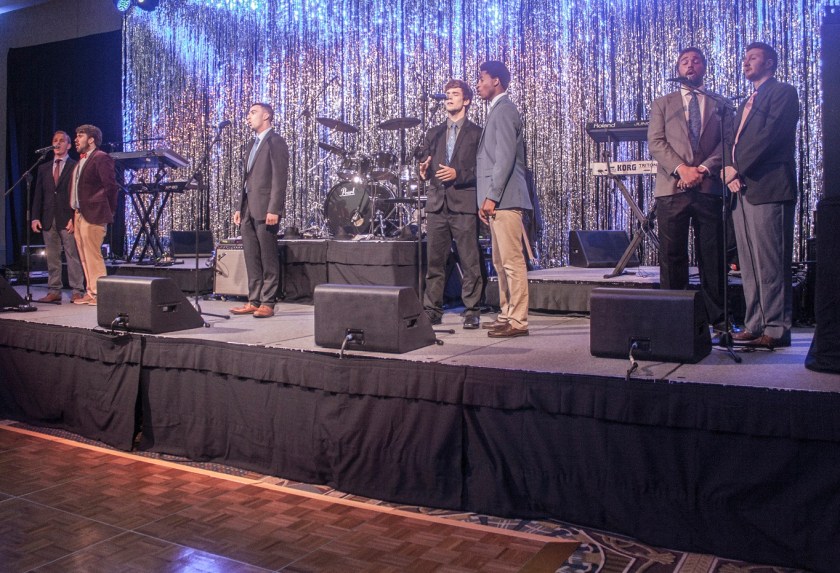
…we were not prepared for the beautiful sounds of the a capella group acoUstiKats, from the University of Kentucky. They introduced the evening with a wonderful rendition of the “Star Spangled Banner” and “My Old Kentucky Home.”
The acoUstiKats from the University of Kentucky
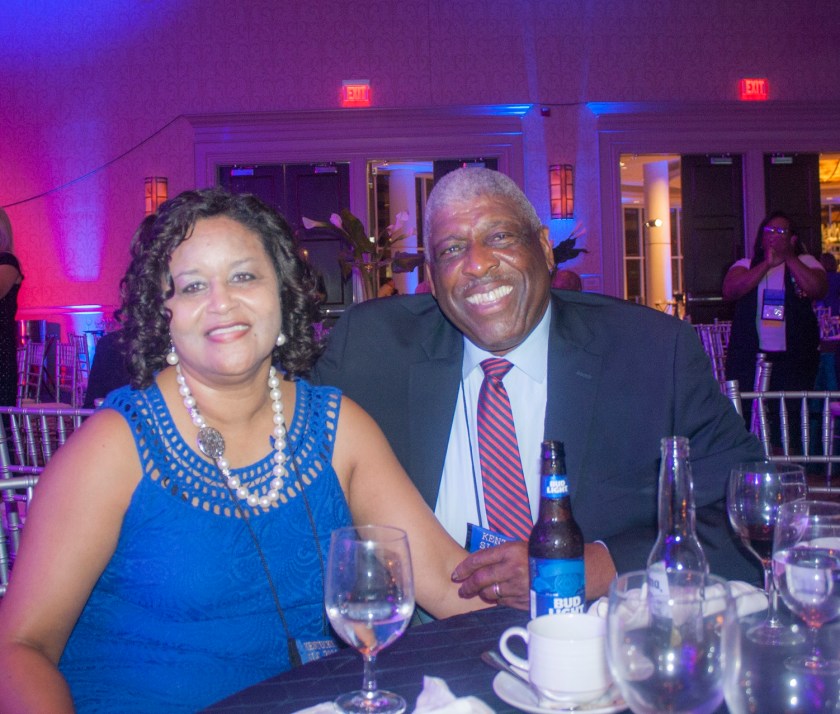
Our dinner mates included Senator Floyd Nicholson and his wife, Mamie, who were from South Carolina and very nice!
Senator (SC) Floyd Nicholson and his wife, Mamie
Later, Kentucky Senator Stivers gave a speech and recognized two different programs for their work under the STAR program. This program promotes the creation of innovative ideas for more programs to help communities. The most proactive are chosen and recognized for their accomplishments.
After the meal was over and we had finished the last bit of cheesecake…
…the entertainment started. Rick Dees kicked off the evening’s entertainment…
Rick Dees at the Southern Legislative Conference State Dinner
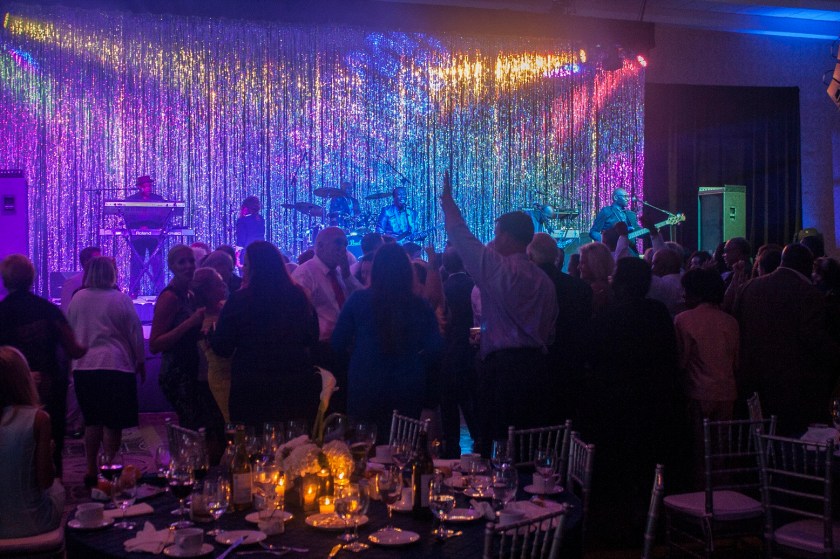
…but he soon turned it over to Midnight Star, an R&B band who enjoyed many hits in the 1970s and 1980s, including “Operator,” “No Parking on the Dance Floor,” and others.
Midnight Star Performs at the Southern Legislative Conference
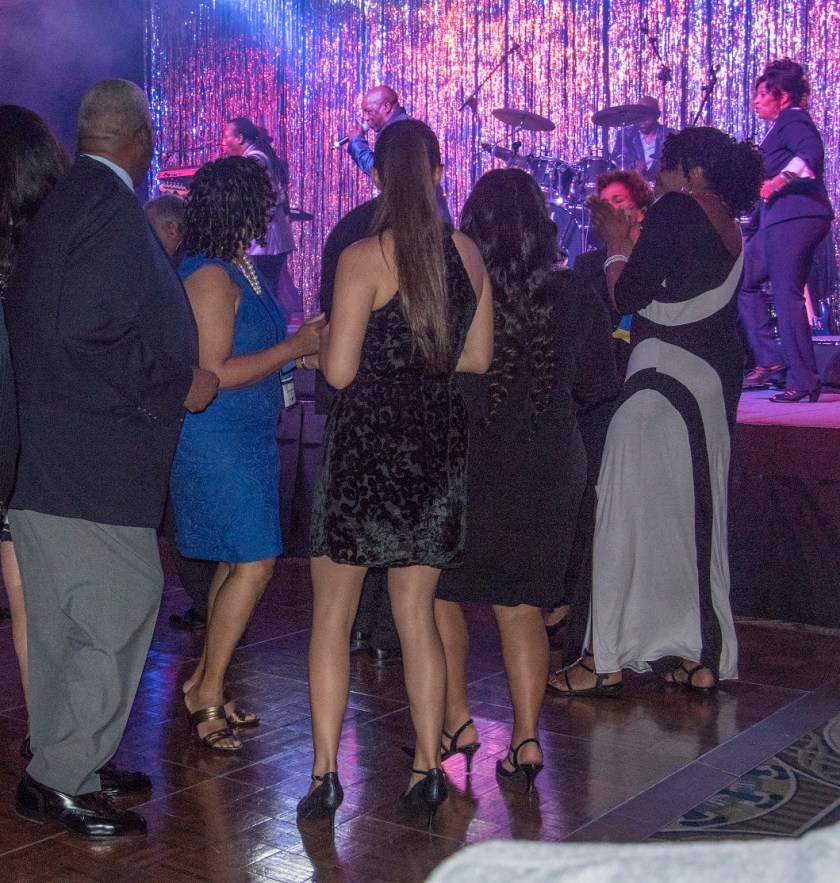
Their music soon drew a crowd of dancers, many of whom were elected officials apparently drawn to the dance floor by courage borne of bourbon.
Not to be outdone, the LEAP Ambassadors showed off their adaptability and busted out a few dance moves of their own.
LEAP Ambassadors Dance at State Dinner
Others, of course, mostly stayed rooted to the dinner table…
Nonetheless, it was an energetic end to a four-day tour of Kentucky and its world of politics, entertainment, and history.
LEAP Ambassadors with Floyd and Mamie Nicholson at the SLC State Dinner
But with a four am departure looming, we posed for a final Kentucky photo op…
LEAP Ambassadors Enjoy Lexington, the Horse Capital of the World
…we headed back to the hotel. Our sleep was destined to be brief, but we were eager to awake to the Midwestern leg of our southern/Midwestern tour of the United States.
Although my time at the Capitol has been short and passed too quickly, my experience has been extremely enriching thus far. On the fourth day of my week long internship, I walked into the Capitol eager to gain as many new experiences as possible.
On top of seeing whatever I could of Austin…
…I spent the first half of the work-week working in Senator Lois Kolkhorst’s office. Senator Kolkhorst’s office represents Senate District 18, however she used to represent Huntsville. Senator Kolkhorst’s office was very welcoming and willing to teach me some of the tasks required by interns. I spent time answering the phone, talking with concerned constituents, and researching for the Policy Advisor and General Counsel. This research allowed me to learn more about policy issues I was previously unfamiliar with. Additionally, I helped prepare for the Senate Health and Human Services Committee meeting that was to take place later in the week by compiling a binder for Senator Kolkhorst, who is the vice chair of the committee. I am thankful to have had the opportunity to work in such a great Senate office!
Today (Thursday), I worked in Senator Charles Schwertner’s office. When he isn’t at the Capitol during Session, Senator Schwertner works as an orthopedic surgeon. He represents Senate District 5, which ranges from Georgetown to Bryan to Huntsville and, of course, SHSU. Ariel Traub, former LEAP President, former Austin Intern for Senator Schwertner’s office, and currently a District Representative for Senator Schwertner, trained me as an intern for the week.
Senator Schwertner is the Chair of the Health and Human Services Committee. Today was an exciting day for our office because the Health Committee met to hear testimony regarding potential issues to be addressed in the 85th Legislative Session.
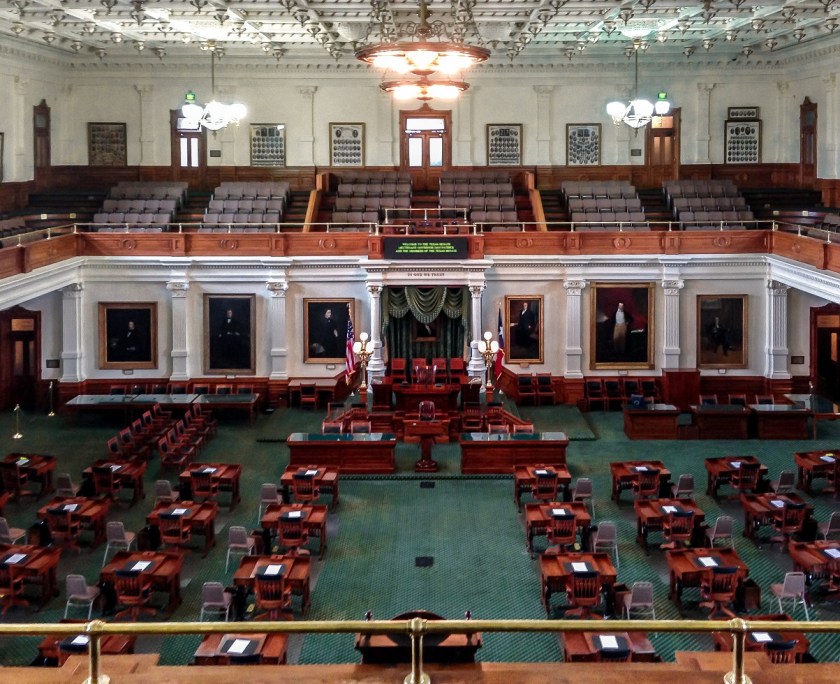
Ariel and I walked over to the Senate floor to observe the Committee meeting. Karla met us there and we were even allowed to sit on the Senate Floor like real staffers!
We listened to the beginning procedures and the first testimony before heading back to the office. Although we did not stay for the entire committee hearing (it lasted over 7 hours!), I still learned about the actions, responsibilities, and procedures of Senate Committees. I spent my afternoon learning bill analysis, constituent correspondence, and the Correspondence Management System (CMS), all of which are extremely important to a Senate office. Thankfully, I had a wonderful team to help explain the many intricacies of the office. At the end of the day, I was thankful to have spent time in Senator Schwertner’s office and was already looking forward to the next day!
Just because our work day was finished, that didn’t mean our entire day was over!
We took time today to take formal pictures to capture our experience of the mini-internship…
…Goya’s work also expressed his belief in principles of progress, liberty, and tolerance during the Enlightenment.
After enjoying the Goya exhibit, we transitioned upstairs where two pieces of Luis Jimenez were beautifully displayed. Both of his sculptures are made out of fiberglass and painted with automotive paint to give each piece a glossy shine. I respected his artwork because they depict the American West through a different perspective than a traditional painting or sculpture would.
Also catching our eyes was the artwork of Cildo Meireles, Missao/Missoes (How to Build Cathedrals), which consisted of 2,000 bones and 600,000 pennies (all from the year 2005).
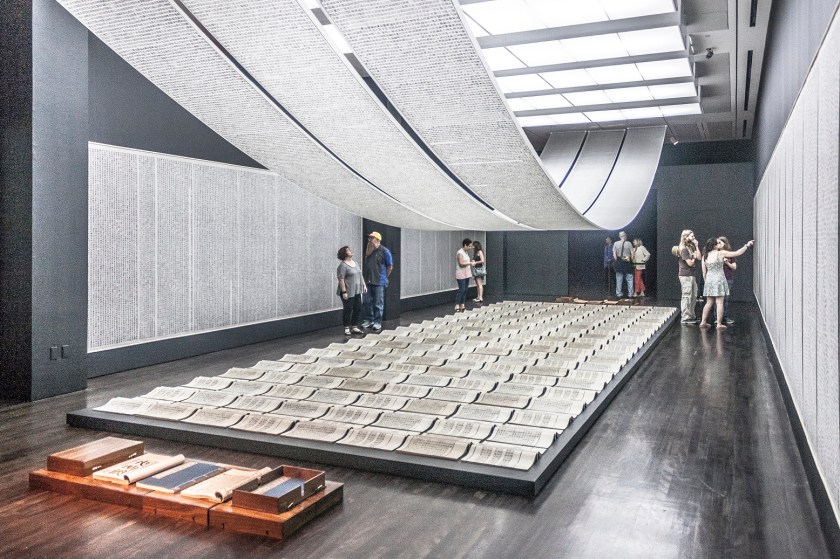
There was also the work “Book from the Sky”, by Xu Bing, which featured some 4,000 invented characters to resemble the Chinese language in the form of printed documents on walls, floors, and, of course, from the sky.
On a smaller scale, we also enjoyed works by Andy Warhol…
…and David Sequeiros…
After enjoying the many works of art, we departed to Kerby Lane Café for dinner before our movie!
A short drive later, we arrived at Kerby Lane Café, just off the edge of UT’s Campus. I was excited to try Kerby Lane Café because I kept hearing great reviews. Kerby Lane did not disappoint! Known for so many excellent dishes, it was hard to pick one! I ate the Portobello omelet with home fries and fruit with warm apple pie for dessert. It was a delicious meal and just what we needed after a busy day at the Capitol! This was our favorite meal of the week thus far!
More than a century old, Paramount Theatre’s beauty stands out on Congress Ave at night. As part of their Summer Classic Film Series, Paramount Theatre presented Butch Cassidy and the Sundance Kid. Paul Newman and Robert Redford starred in the classic Western movie. The movie is a classic for many reasons, some more obvious than others. For example, Professor Yawn explained that the movie was one of the first to incorporate a musical montage scene! Following the journey of western outlaws, the movie provided many laughs and was enjoyed by the LEAP Ambassadors!
Upon conclusion of the film, we got a view of the upstairs of the theater. It was beautiful!
But as the clock neared midnight, it was time to head back to the hotel to prepare for the final day of our mini-internship. Many thanks to Senator Kolkhorst and staff, Senator Schwertner and staff, the LEAP Center, and Professor Yawn for planning a week full of experiential learning!
As we moved into the third day of our internships in Austin, we remained excited about heading to work in the monumental granite building that symbolizes Texas’s enduring pride–and, for us, symbolizes opportunity. There’s just something about entering the Capitol building and starting work in a legislative office.
Traveling Through Time in Texas
Unlike the other SHSU interns, I had a somewhat different morning planned. I met with Speaker Straus’s staff and some of their interns, and we headed to the Stephen F. Austin building that houses the oldest agency in Texas: the General Land Office (GLO).
After Texas declared its independence in 1836, the GLO was created to determine “who owned what, and where.” This agency was used to end land disputes that were created during the migration to Texas after the Texas Revolution and to determine appropriate land grants to those who had served in the war. During the tour we were exposed to rare documents such as Davy Crockett’s land grant of 1,240 acres that was given to his family after the war. While reading the grant, we noticed a discrepancy in the dates. The document states: “Having served faithfully for the term of six months from the eighth day of January until the sixth day of March”(sic). But, of course, January to March isn’t six months. The discrepancy, we learned, stems from the fact that the office gave the families of those who died “more time” in Texas to ensure they earned more land.
Also of note was the letter William B. Travis wrote while under siege at the Alamo. Addressed to “The People of Texas and All Americans in the world,” Travis made a call for volunteers and promised to fight until “Victory or Death.”
Two other documents that sparked my interest were one of two original drafts of the Texas Constitution…
…and a land patent signed by none other than the man himself, Sam Houston!
Being able to see Sam Houston’s original signature is now the peak of my Bearkat pride.
In this era, the GLO manages state lands, operates the Alamo, helps Texans recovering from natural disasters, helps fund Texas public education through the Permanent School Fund, provides benefits to Texas Veterans, and manages the vast Texas coast and is the home of many original maps of Texas.
Lunch at Frank & Angies
After this interesting tour taking my back in Texas’s history, I, along with Kaitlyn, Megan, Karla and Beatriz had lunch at Frank and Angie’s with Eiman Siddiqui, the current Capitol Director for Representative Galindo and future chief of staff for the newly elected Representative Tom Oliverson, whose alma mater is SHSU!
While we all indulged in a supreme and a veggie pizza, Eiman was able to tell us about his past experiences as an intern at the capitol, a staff member and soon he might even tell us about being a chief of staff! We received invaluable advice from Eiman on what to do and what not to do while being an intern during the legislative session. We impersonated sponges during this conversation, absorbing all the information he had to share. We all appreciated the time that Eiman took out of his day to have lunch with us, and all of the advice that he was kind enough to share in such a short time frame.
New Offices
It was now time for another exciting change: at the official half-way mark of the week, we all (except for Beatriz) switched offices. Our switches included:
Megan Chapa with Rep. Todd Hunter
Megan going from Representative Zerwas to Rep. Hunter’s Office
Kaitlyn going from Senator Kolkhorst to Senator Schwertner’s Office
Karla going from Senator Schwertner’s Office to Representative Zerwas’s Office
And me going from Representative Hunter’s office to Senator Kolkhorst’s office.
Having met her on a couple of occasions, I was looking forward to this experience.
I was given a tour as part of my orientation, and it was immediately clear that Senate offices are larger. After this short introduction, I was given the office manual, a newsletter sent by Senator Kolkhorst to her constituents, a packet covering intern duties, and a 15-minute new employee video to watch.
I learned more about Senator Kolkhorst, my duties, and how the office and the senate work. Also, I learned more about a hearing that takes place tomorrow, one that Senator Kolkhorst will attend!
Although summer is a slow time in the legislature, I helped greet two groups of students (one elementary, one high school) who stopped by to speak with staff, became acquainted with the staff, and learned the office equipment: phones, copiers, scanners, faxes, and printers.
It was an educational and productive day, one I hope lays the foundation for many more to come!
After a day of getting our feet wet in the Capitol and of renewing acquaintances with LEAP Alumni, we were ready bright and early for Day Two in the Texas Legislature.
Megan Chapa Heads to Work
Like yesterday, it was a day of learning. I am doing my learning, at least for the first half of the week, in Representative John Zerwas’s office.
Zerwas represents District 28–an area with which I am familiar because I was actually raised in the district. A graduate of Baylor College of Medicine, Rep. Zerwas is an Anesthesiologist who has served in the House of Representatives since 2006. He currently serves as the Chair of the Higher Education Committee, and he is a member of the Public Health Committee.
Dr. Zerwas’s chief of staff, Nelda Hunter, welcomed me and quickly assigned my duties. My project was to do research on Texas higher education admission policy and compare it to other states who have similar demographics or size. I had the unique opportunity to attend a briefing hosted by Representative Zerwas’s office. The briefing was a presentation done by a representative from Educate Texas, an advocacy council that specializes in post-secondary education in Texas. Its mission is to offer policy recommendations that improves the overall quality of higher education. This council is made up of education experts.
Less glamorous but as important, I was also able learn how to use the phones and the Correspondence Management System (CMS). Although it was only two and a half days in Representative Zerwas’s office, everything I learned was truly valuable and appreciated.
During my lunch “break,” Alex Galvan and I were able to meet with Erin Daly-Wilson, who works for Speaker Joe Straus. During the meeting she stressed the importance of interning and gave us tips on how to be an effective professional. I learned that the committee appointments are made within the first three weeks of session and the Speaker is elected on the first day of session by the House Members. Speaker Straus was elected in a special election in 2005 and now has three bodies of constituents: his San Antonio District, the House, and the entire state of Texas. The Speaker of the House is the 3rd most important position in the legislature only following the Governor and the Lieutenant Governor. It was great meeting with such an experienced and dedicated individual and we were grateful she carved time out of her busy day for us.
Immediately following our work day we headed to Gourdough‘s, an extreme donut restaraunt, for a sweet meeting with Representative-Elect Ernest Bailes and his future chief of staff, Nick Raymond. Representative-Elect Bailes will be representing Huntsville in the State Legislature, so it was an honor to spend some time with him.
As a student who would like to intern during the Session, I asked Mr. Bailes numerous questions about the qualities he looks for in an intern and took mental note of his wise words.
Every interaction is an interview. Represent yourself well;
Open up and converse. People want to feel welcome when they walk into an office;
Offices look for young people who will be reliable, professional, and skilled.
Tuesday Night Excursion: Mount Bonnell
After a day of (we hope) climbing the ladder of success, we decided to also climb Mount Bonnell.
Climbing is a bit of an overstatement, because Mount Bonnell is more of a stroll, but it does offer very pretty views, to the east and the Austin Skyline…
The Austin Skyline from Mount Bonnell
…and to the West…
The Colorado River at Sunset from Mount Bonnell
The elevation, sunset, and beautiful views prompted some fun photographs…
This slideshow requires JavaScript.
…many of them utilizing all of Bonnell’s 780-foot elevation to prime advantage…
Near the Peak of Mount Bonnell, at Sunset
Mount Bonnell is part of Austin’s impressive park system, one that helps the state’s capitol rank high in the “most fit cities” lists that crop up now and then. But although there are some trails on Mount Bonnell, it’s more of a place to enjoy the sunset…
…or to enjoy a group outing…
LEAP Ambassadors with Professor Yawn on Mount Bonnell
…or simply to contemplate nature and the future…
And after a day of building our skills, learning from others, and pursuing our dreams, we did indeed feel as though we had gotten a glimpse into a bright future.
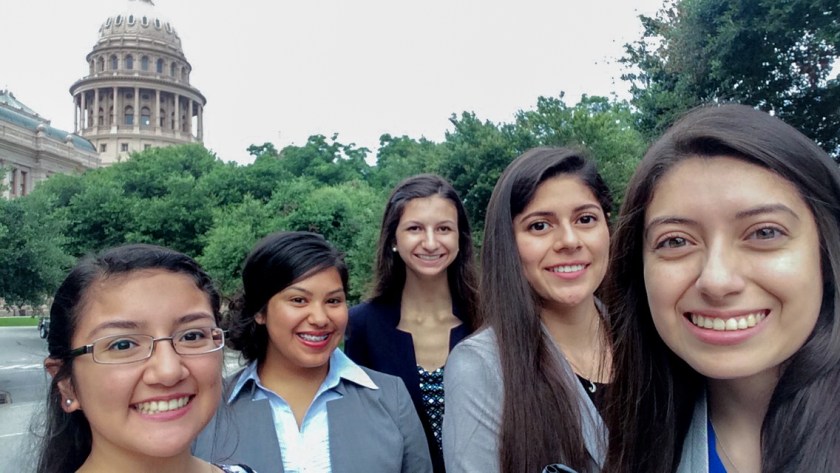
On June 13, 2016 Alex Galvan, Kaitlyn Tyra, Megan Chapa, Karla Rosales, and I headed into the Capitol for our first day as Austin interns.
SHSU Interns at the Texas Capitol
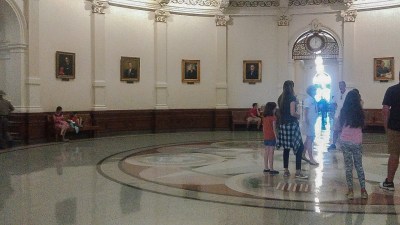
Unlike the rest of the SHSU students, however, this was my first time in Austin, and I could not help but look in awe at the marvelous building I would be working in for the week. As we got further inside, I stood on top of the terrazzo floor tiles forming the six seals of the six nations that had governed Texas…
and I stood looking up at the dome.
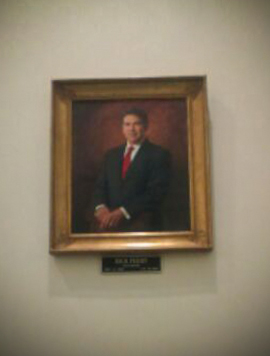
I spun in a circle and all around me I saw portraits of governors.
Looking further up, I noticed that every floor had various portraits all around the rotunda and at the very top was a star painted on the dome. With the sun shining through the windows all around me, I hoped it was a premonition of the day ahead and that the wonder would be only a taste compared to the amazing things I would later discover.
As soon as I entered through the door of Representative Armando “Mando” Martinez’s office, I was cheerfully greeted by his Chief of Staff, Scott Jenkines. Mr. Jenkines made me feel right at home as he explained the expectations and rules of the office. With Mr. Jenkines being from Weslaco, we reminisced about the Rio Grande Valley, and discussed the many issues the people there were facing, as well as different possibilities that Representative Martinez was trying to implement to try and help these issues get fixed.
To start off the day, Mr. Jenkines led me through the maze that was the Capitol and took me to get my photograph taken for my ID. He also offered a quick tour and, again, my head spun round and round, as we took turn after turn, leading me deeper and deeper into the Capitol. I was shown where the Capitol Grille was, the place to go when anyone inside was hungry; we passed by the post office (grabbing the mail in the process); and we saw the different committee offices, especially Transportation and Higher Education, which are two of the committees Representative Martinez is heavily involved in.
The House of Representatives, where Representative Martinez votes, was closed for renovation, but the Senate Gallery was open and splendid!
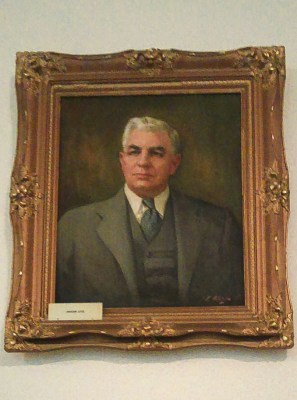
One of the most interesting things I learned about the Capitol was the process of hanging the governors’ portraits. Heading back, Mr. Jenkines explained that when a new governor’s portrait was added (only after they leave office), each of the portraits has to be moved exactly one spot backwards, meaning every single portrait has to be removed and rehung.
At another stop on the tour, we visited the library, almost directly beneath Representative Martinez’s office. On the library walls are paintings of the judges. One stood out: The Portrait of the Unknown Judge.
It is interesting that an unknown judge could make it on to the wall of the capitol and yet not have anything known about him.
Once I got back to the office, I got to meet Jack Walls, a Baylor intern who is also be interning at Representative Martinez’s office. He showed me the basics of the typical office day for an intern: answering phone calls, navigating the computer system, and communicating with people. Then I was left to my own devices so that I could read and learn more in depth about bills, statutes, and committees.
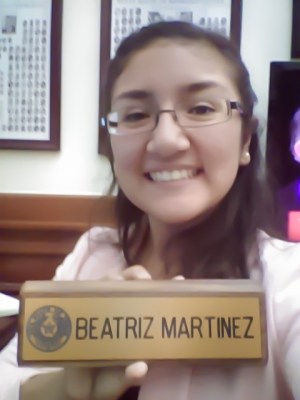
Later in the day, Mr. Jenkines received a call that my ID was ready. As we were heading back up to the office I got to show off my brand new name tag.
Later, still, I would get a nameplate, just like a real employee!
At the office, Mr. Jenkines mentioned a leadership program called “Subiendo”. This program was aimed at high-school students so that they can gain leadership skills during a training in which they can learn about and address different issues going on in the real world today. This event takes place on Wednesday, and I will have the chance to go along as part of the Representative Martinez team.
At the end of the day, Professor Yawn took us to a vegetarian restaurant called Mother’s. We were greeted by Blake Roach, Melva Gomez, and Emily Johnson who were alumni and part of the Junior Fellows when they were at SHSU. Everyone relaxed and spent a pleasant evening in this quaint little restaurant. We were all a bit thrown off by the lack of meat (Vegetarian isn’t big in the Valley), but it was an interesting experience to see the wonderfully creative recipes they had instead. I had the plate called Momma’s Quiche. We left after various elaborated talks of the past memories and the new ones being created.
It was a special day, one made so by my boss, Scott Jenkines; and by Megan Chapa and Alejandra Galvan, who made a trip to the Valley to take me to Austin; and the opportunities that come with being an SHSU student.
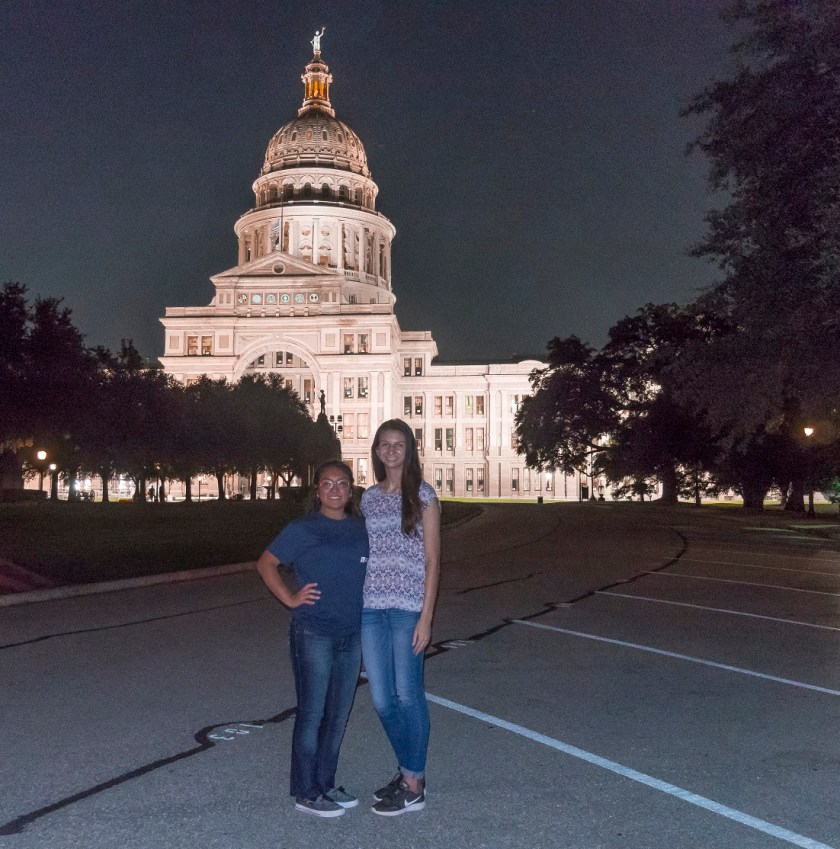
Beatriz Martinez and Kaitlyn Tyra at the Capitol
Beatriz Martinez is finishing her first year at SHSU. She is eighteen-years old but, amazingly, has completed 100 hours, compiling a cumulative GPA of 3.90 (and a 4.0 at SHSU). She is the youngest of the LEAP Ambassadors.























 Center for Law, Engagement, and Politics