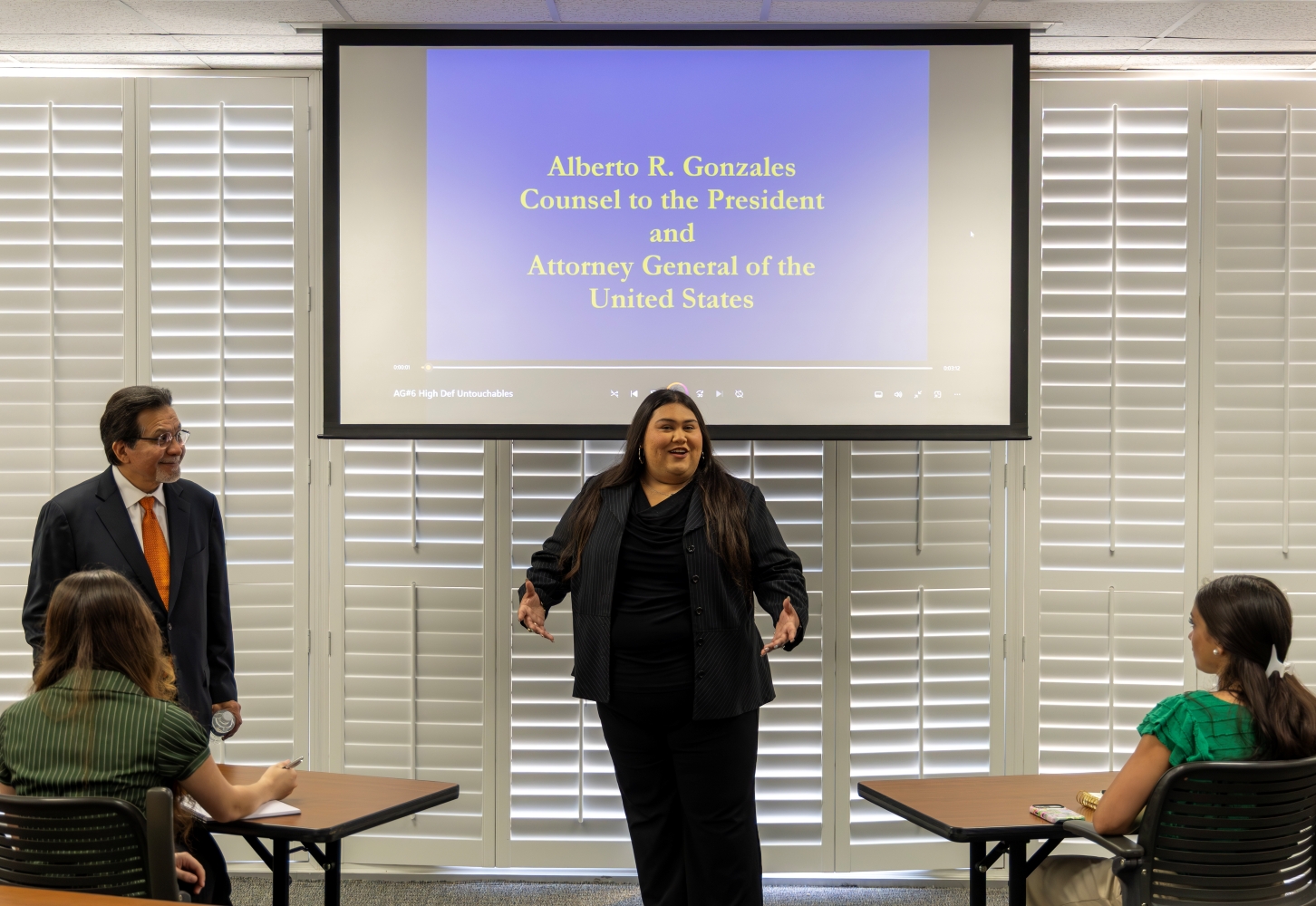
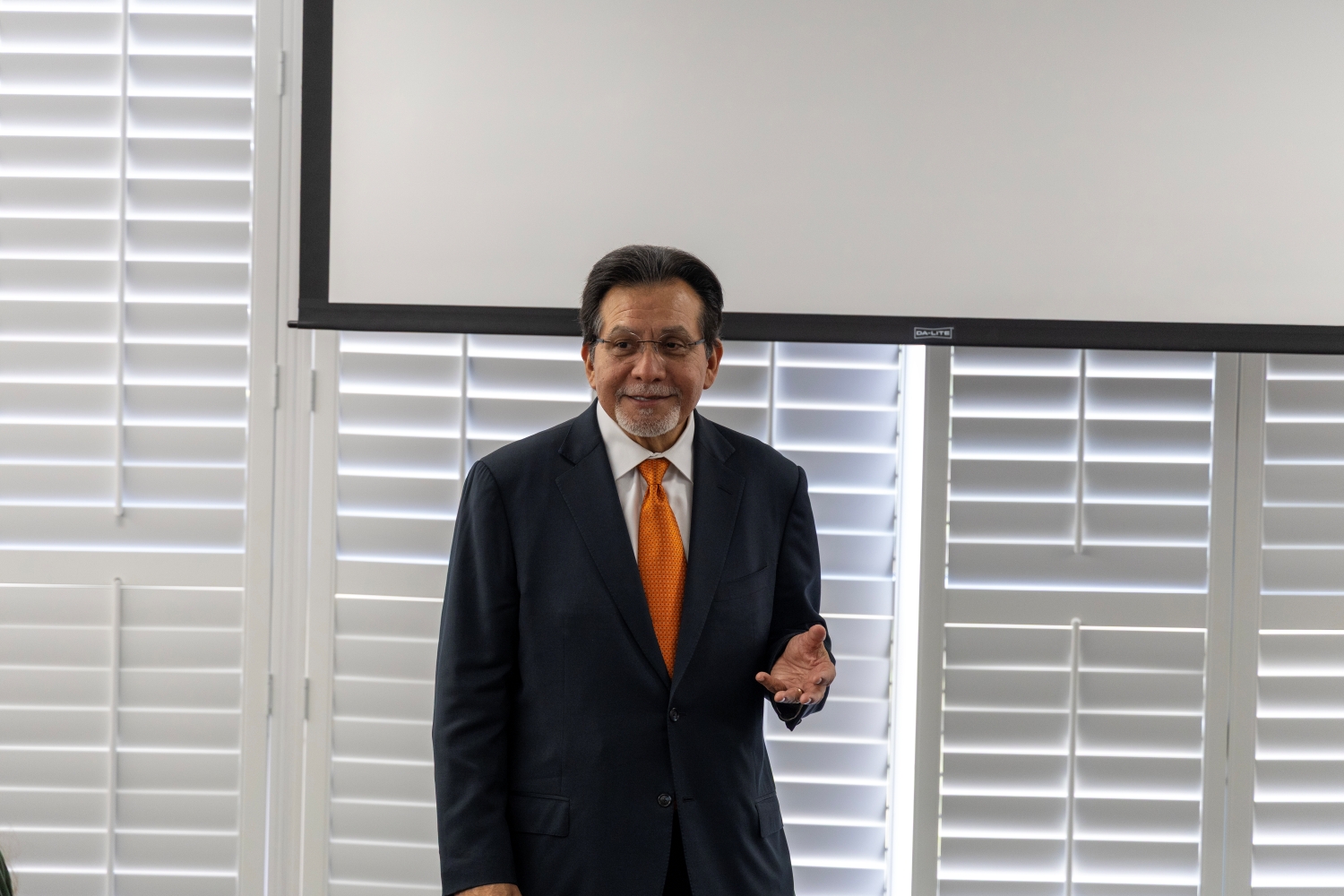
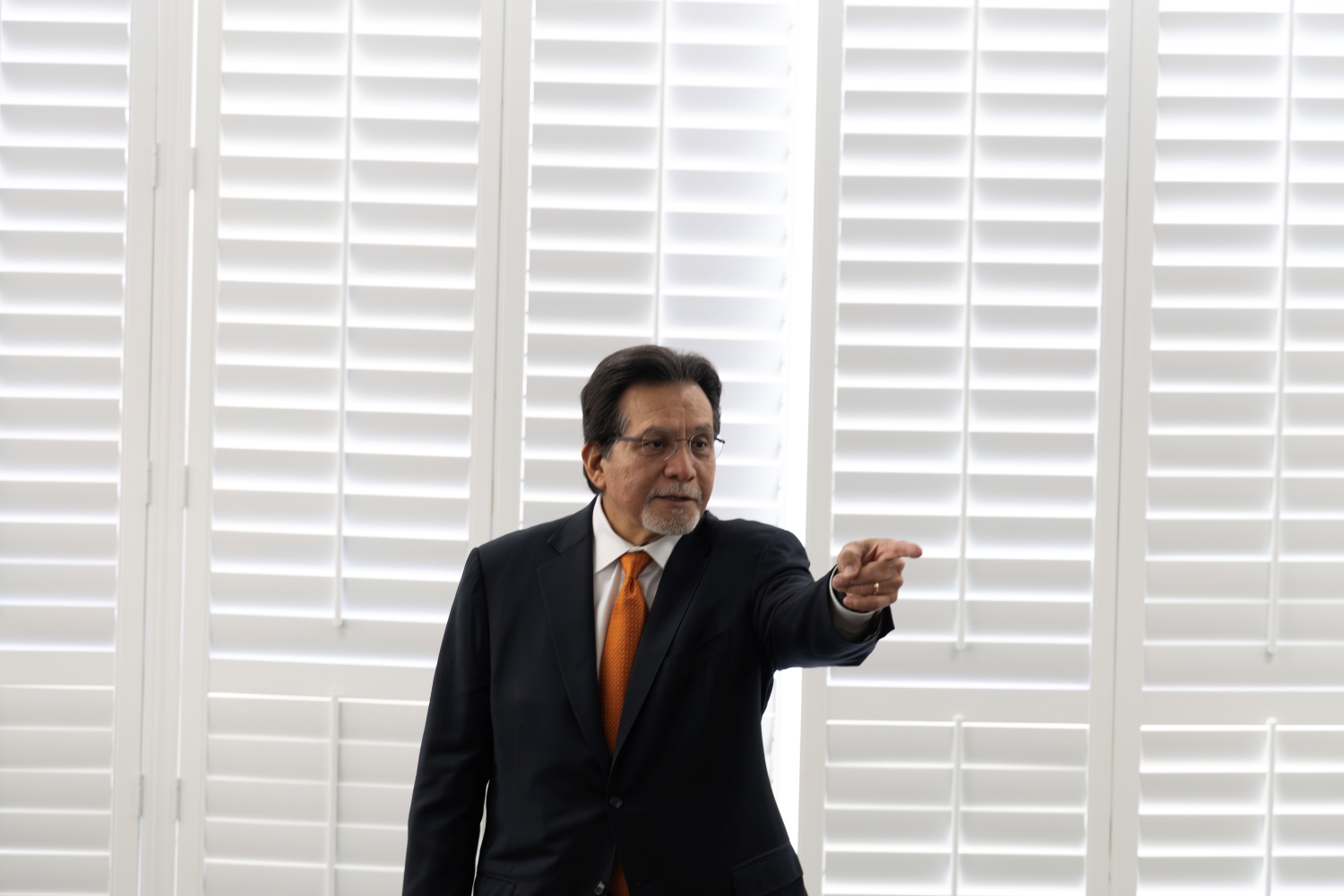
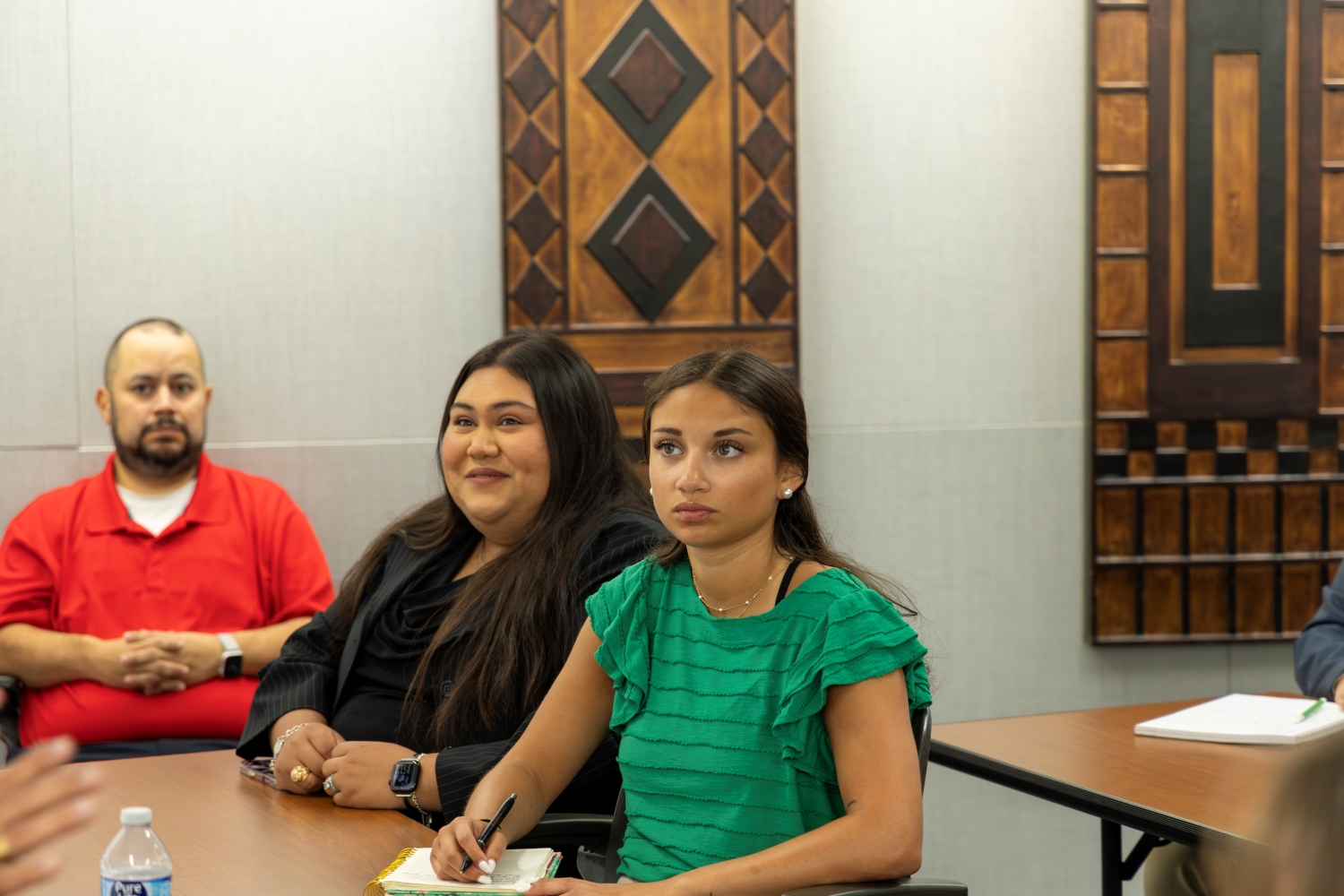
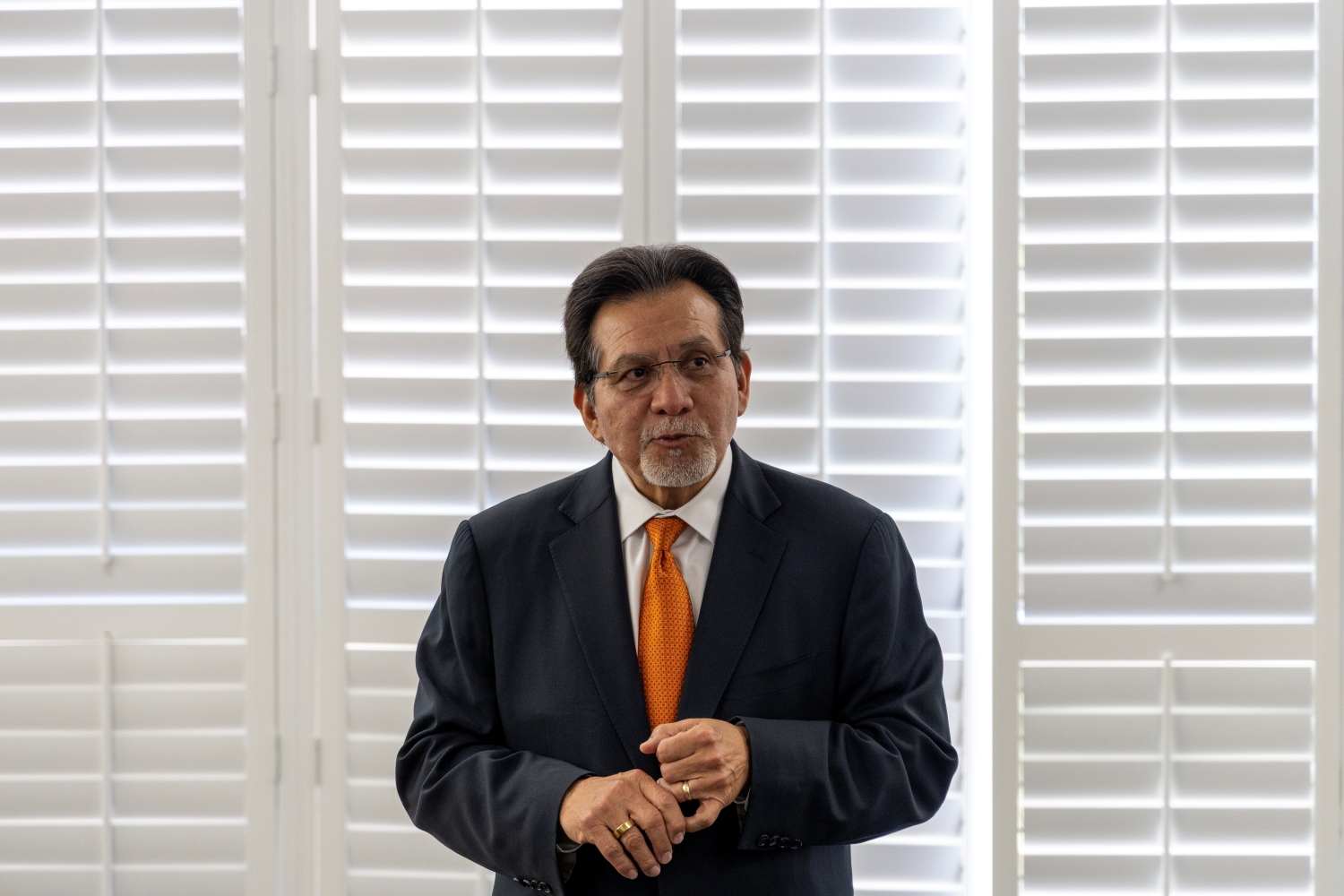
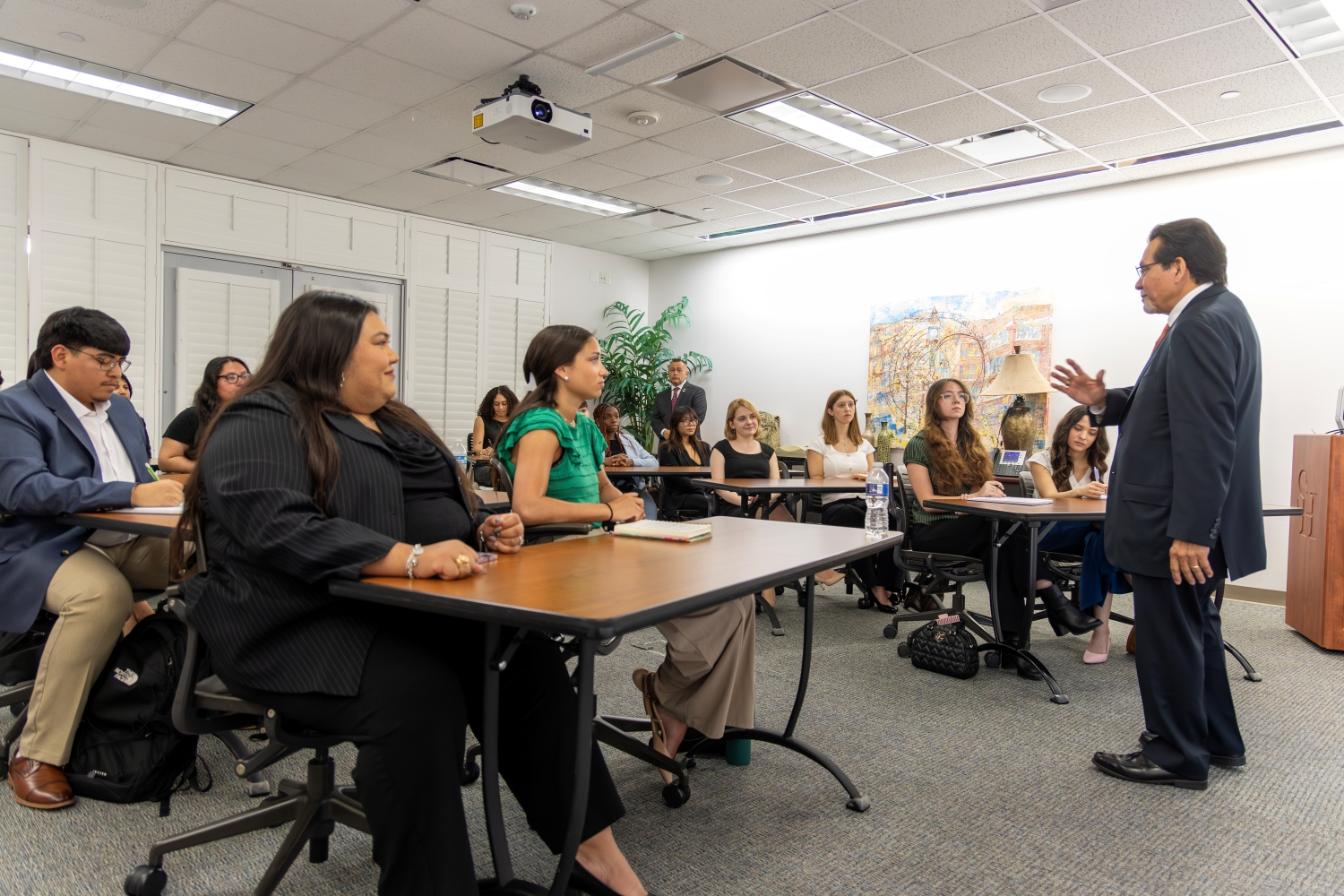
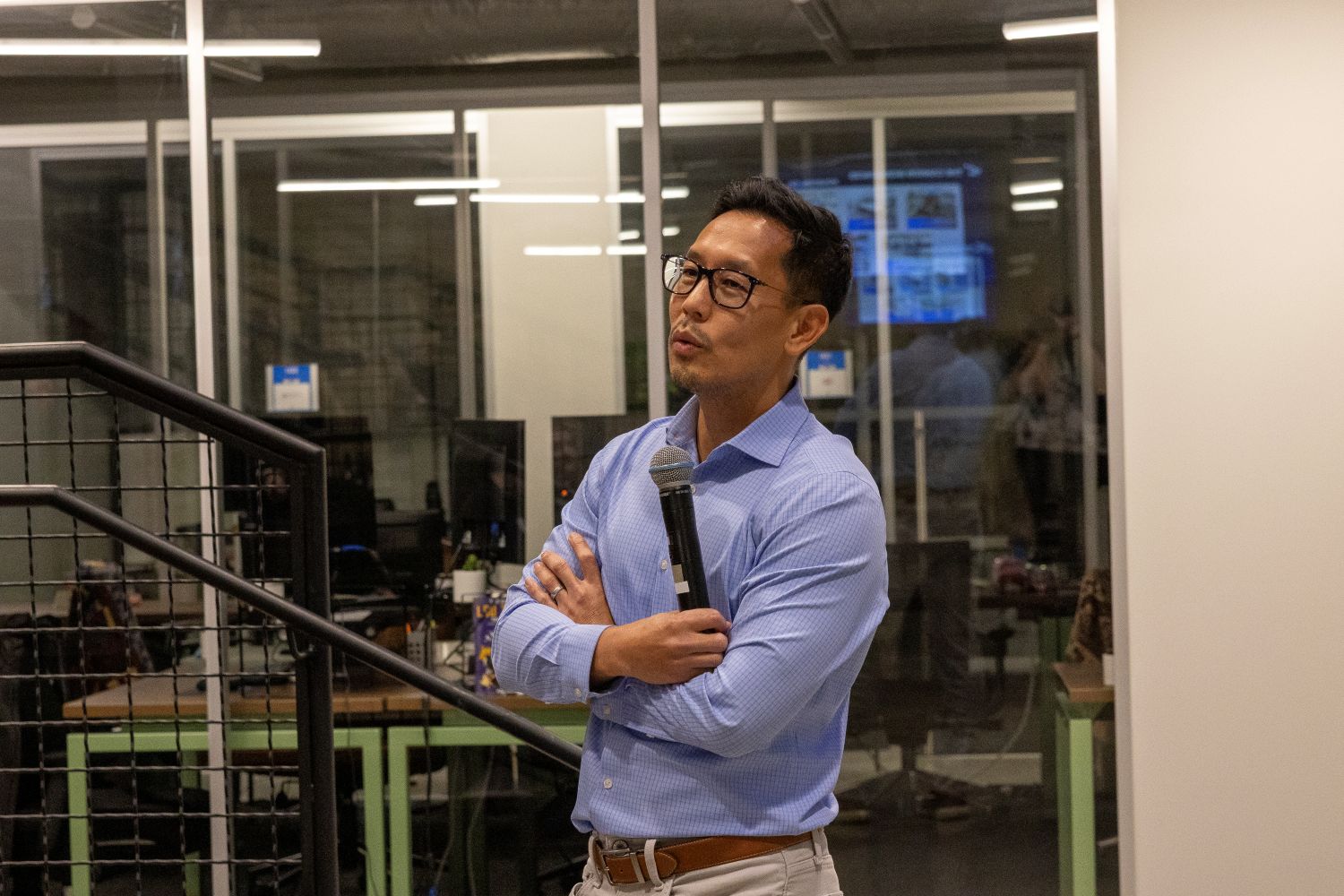
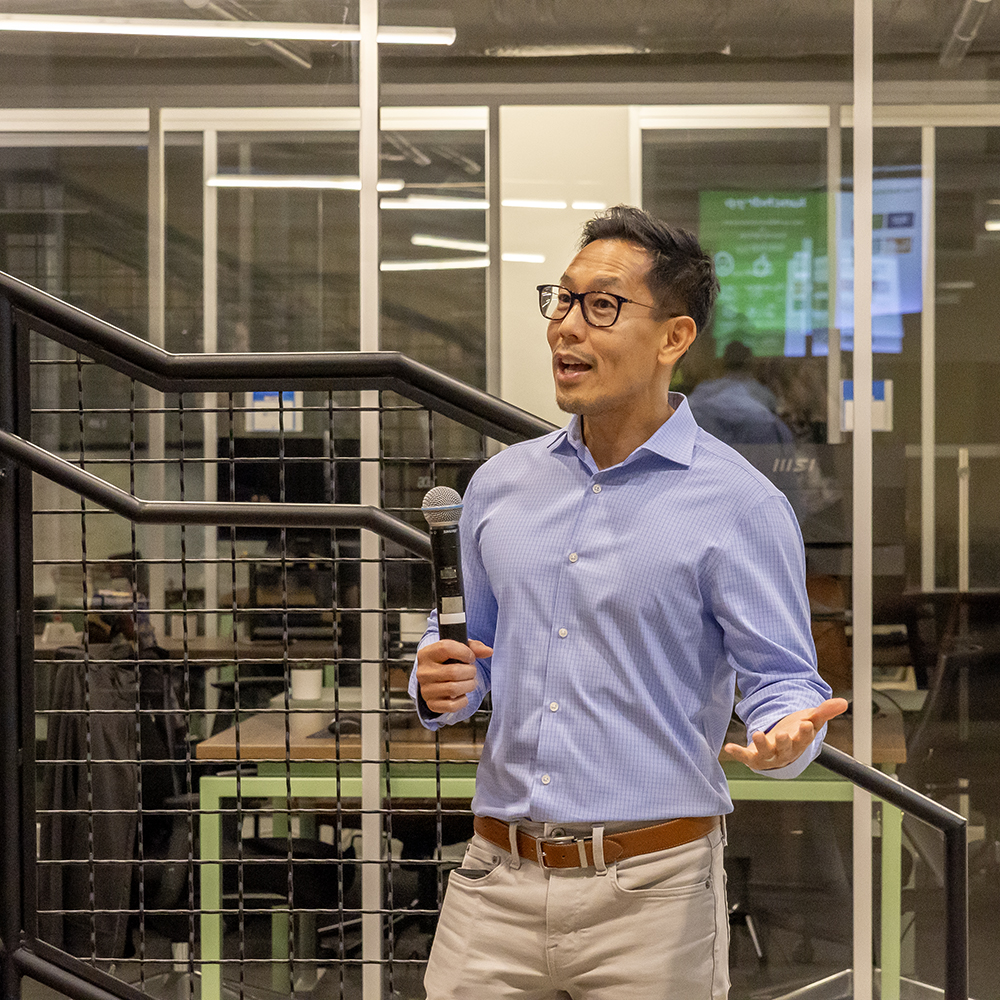
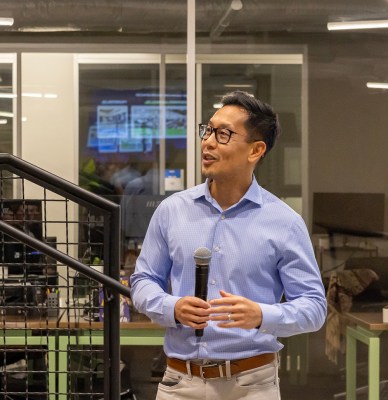
Through the many roles he served in over his career, Alberto Gonzales gained valuable knowledge in helpful principles, career advice, and getting past setbacks. Once again, LEAP students had the opportunity to hear from Mr. Gonzales himself, along with David Yebra (formerly Colonel Yebra), the Senior Associate Vice Chancellor for Lone Star College.
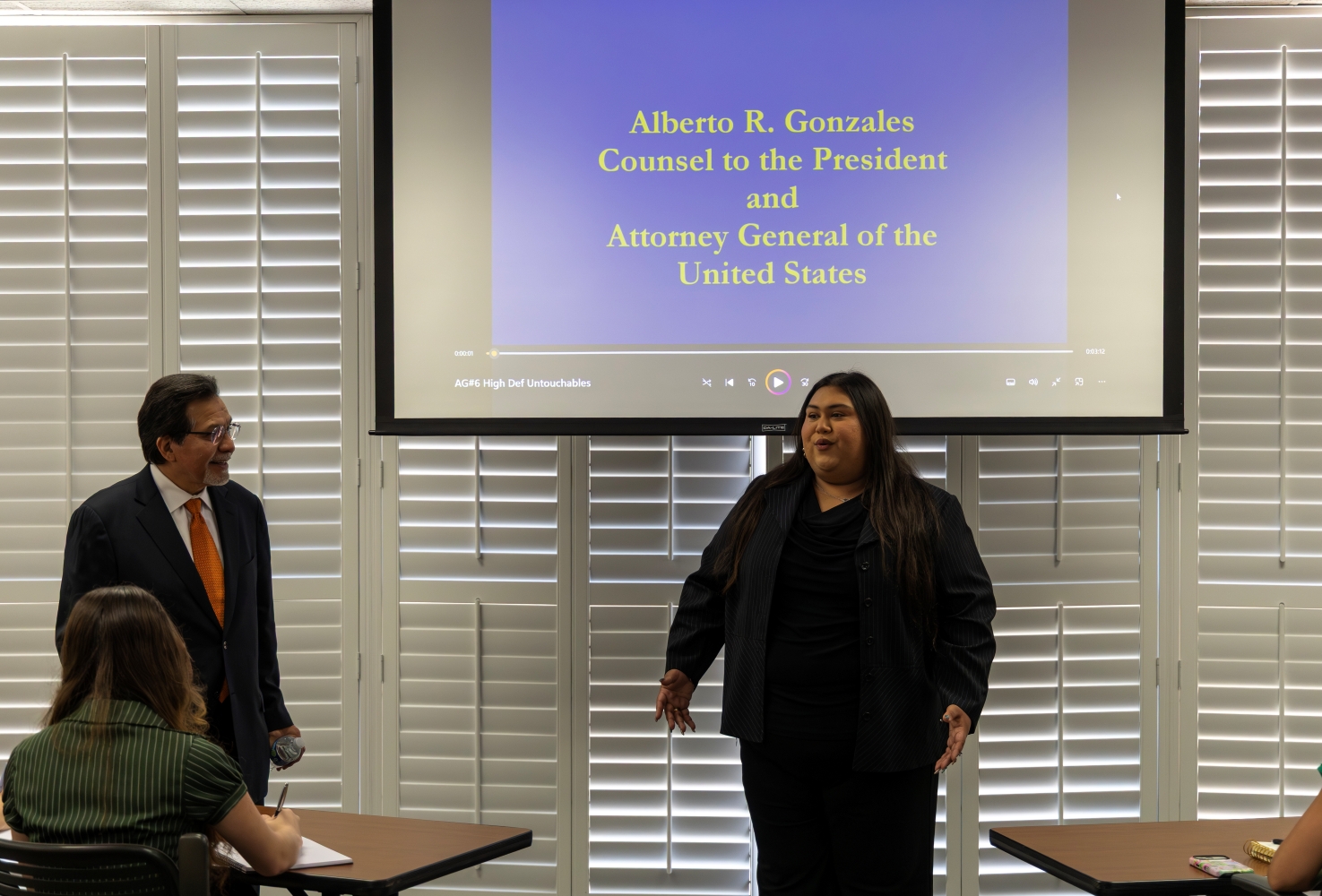
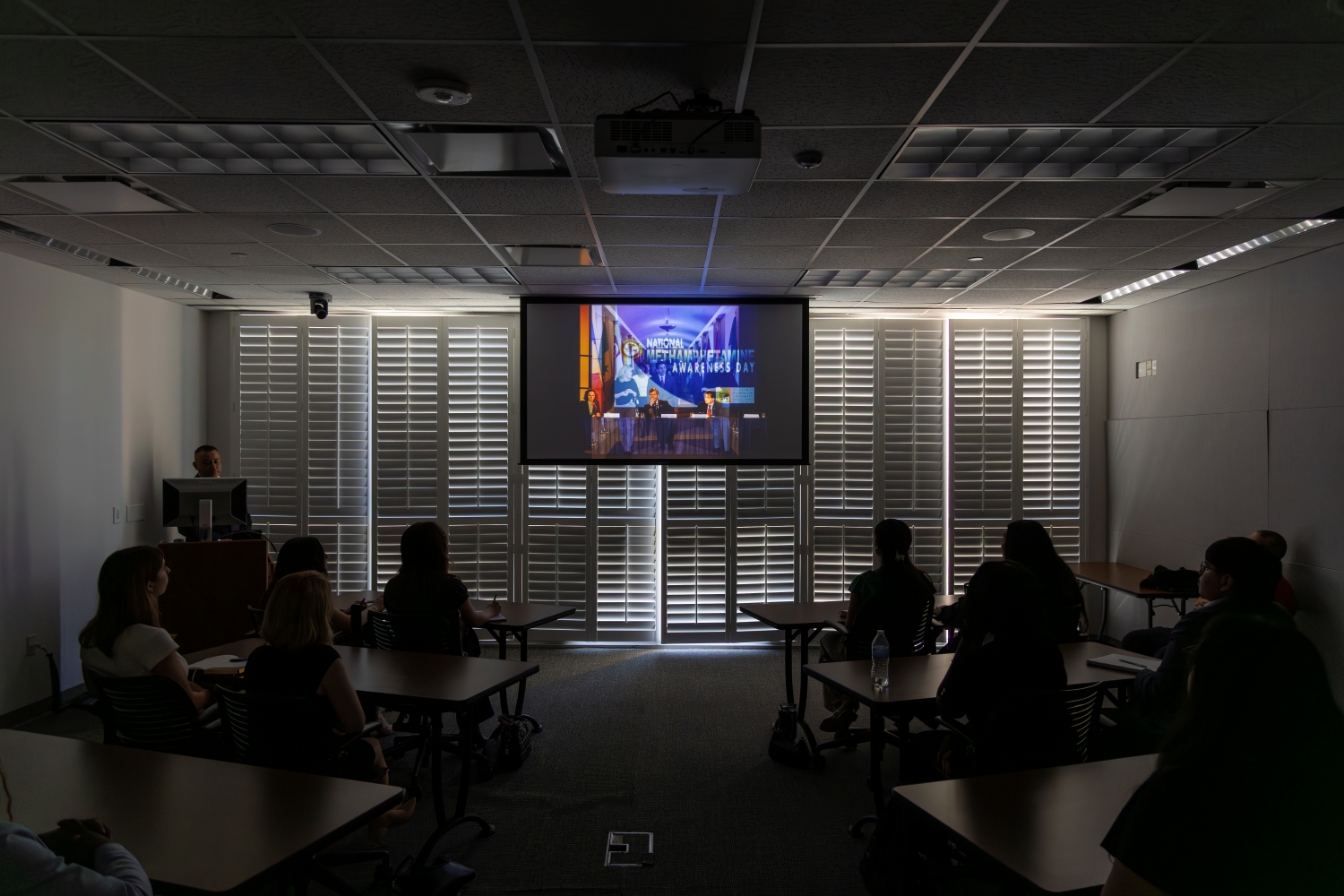
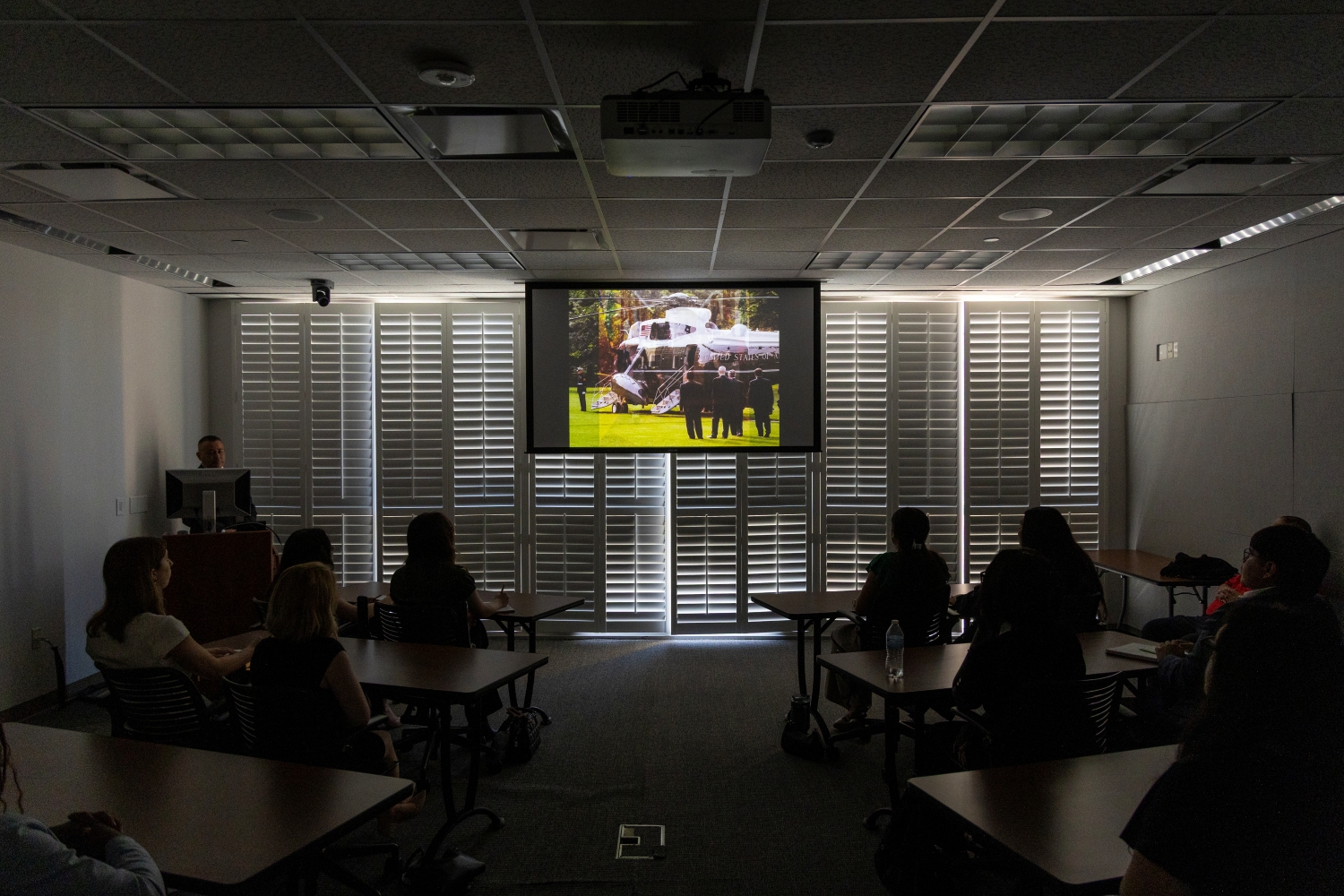
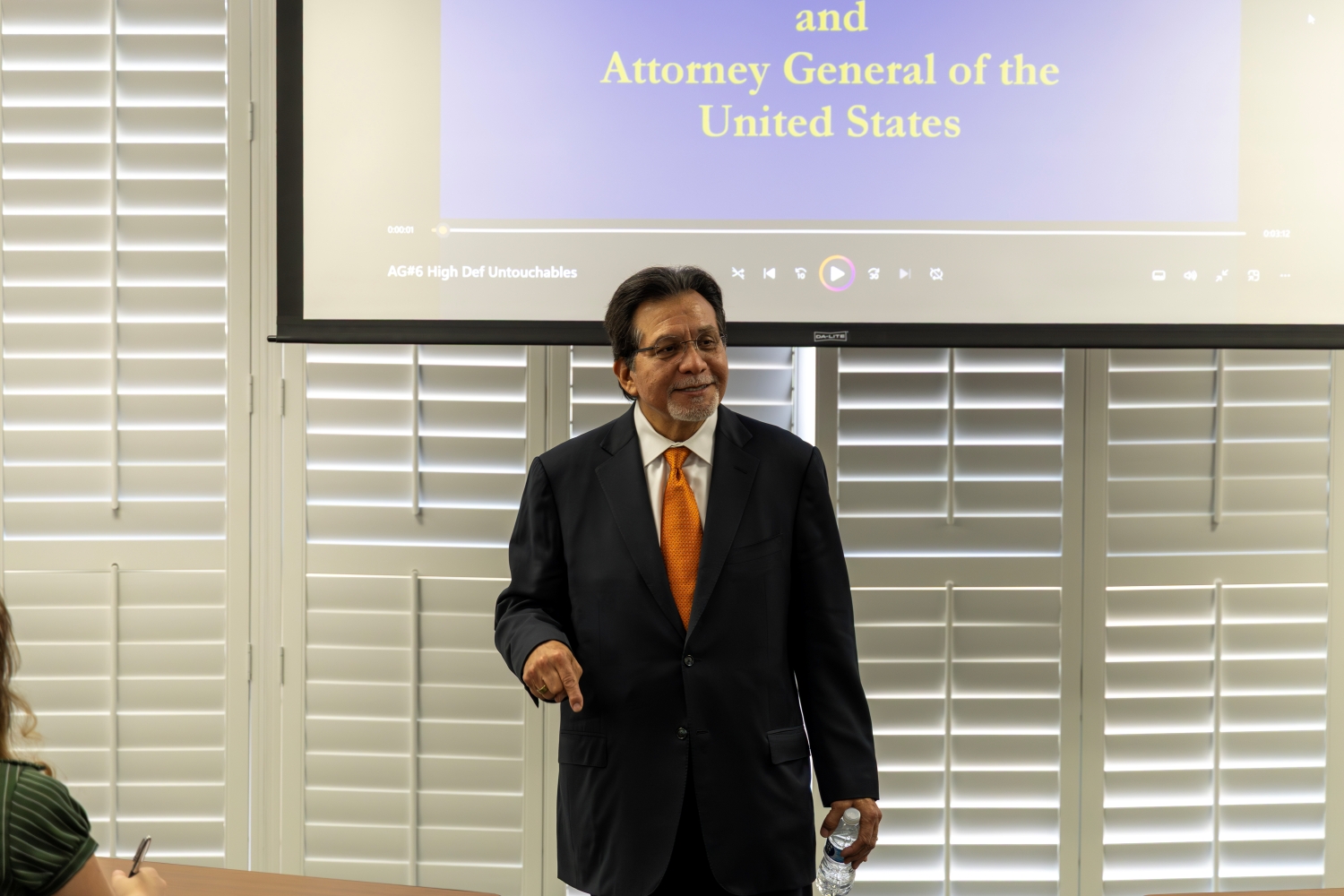
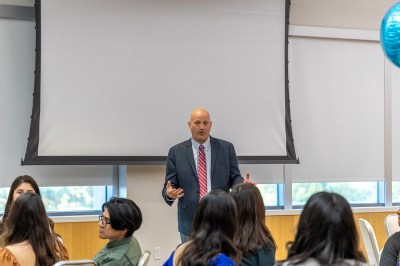
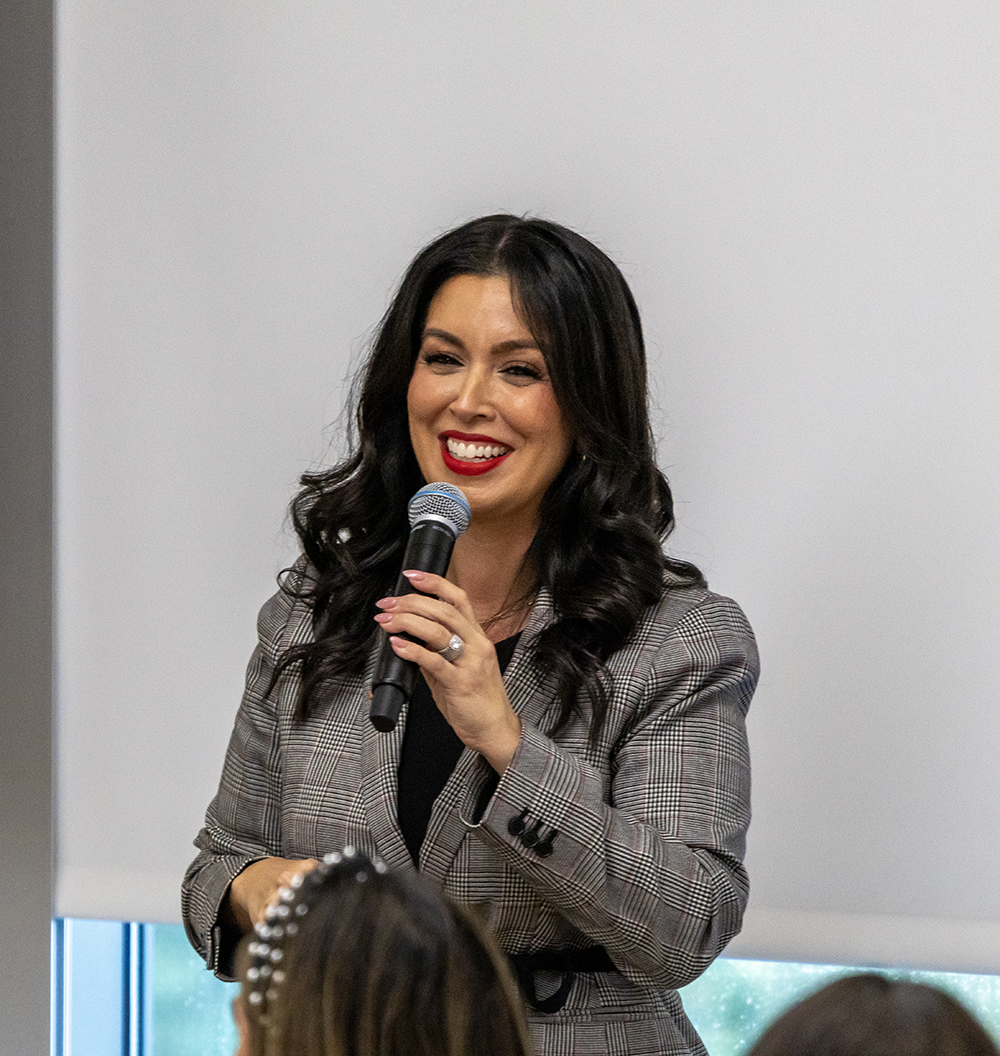
After a fitting introduction from Michelle Cardenas, Mr. Gonzales showed us a short video featuring photos of his career highlights, a career that includes the first minority partner at Vinson & Elkins, Texas Supreme Court Justice, White House Counsel to President George W. Bush from 2001-2004 and Attorney General from 2005-2007. With this career, he was well qualified for his post-government role as Dean of the Belmont College of Law.
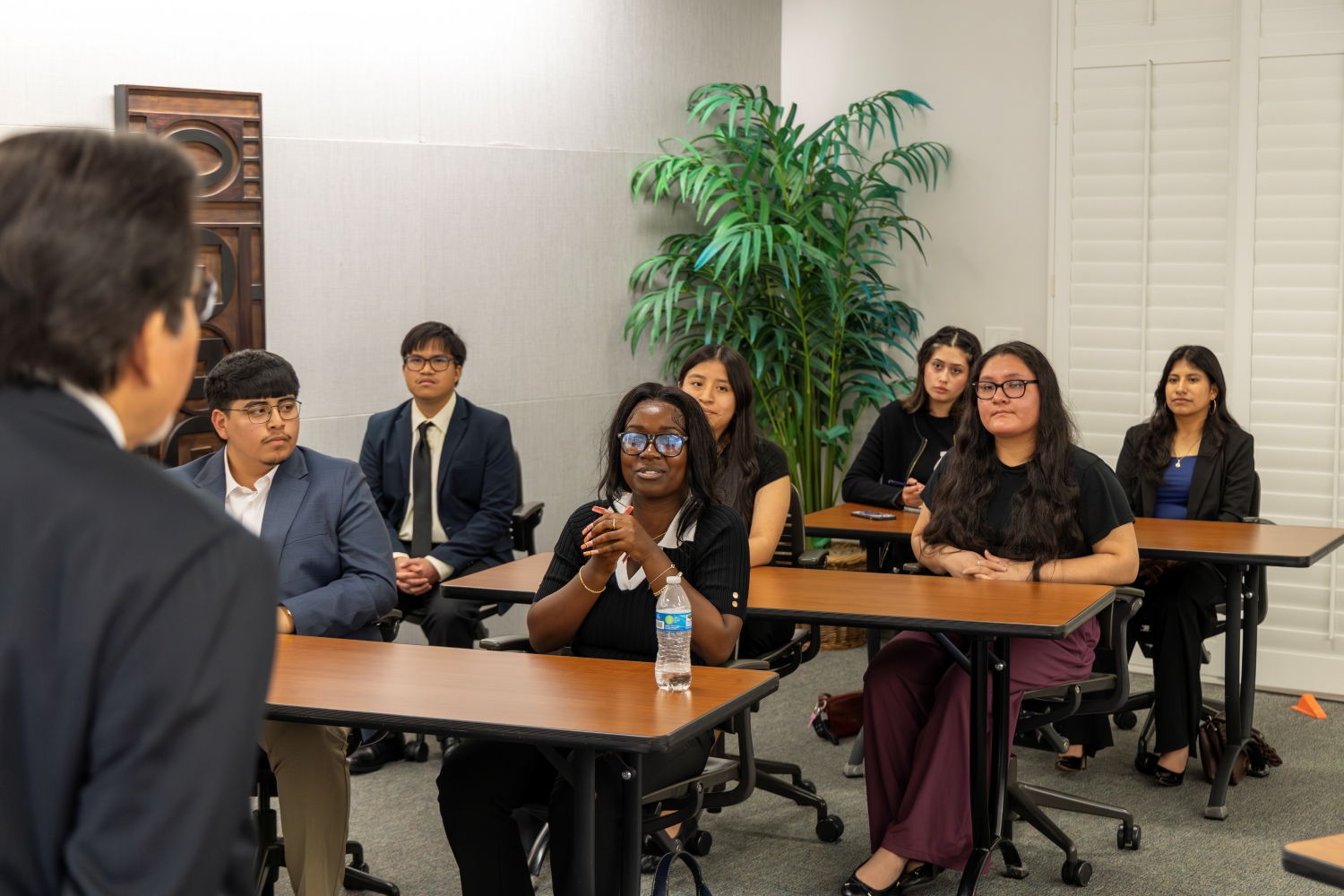
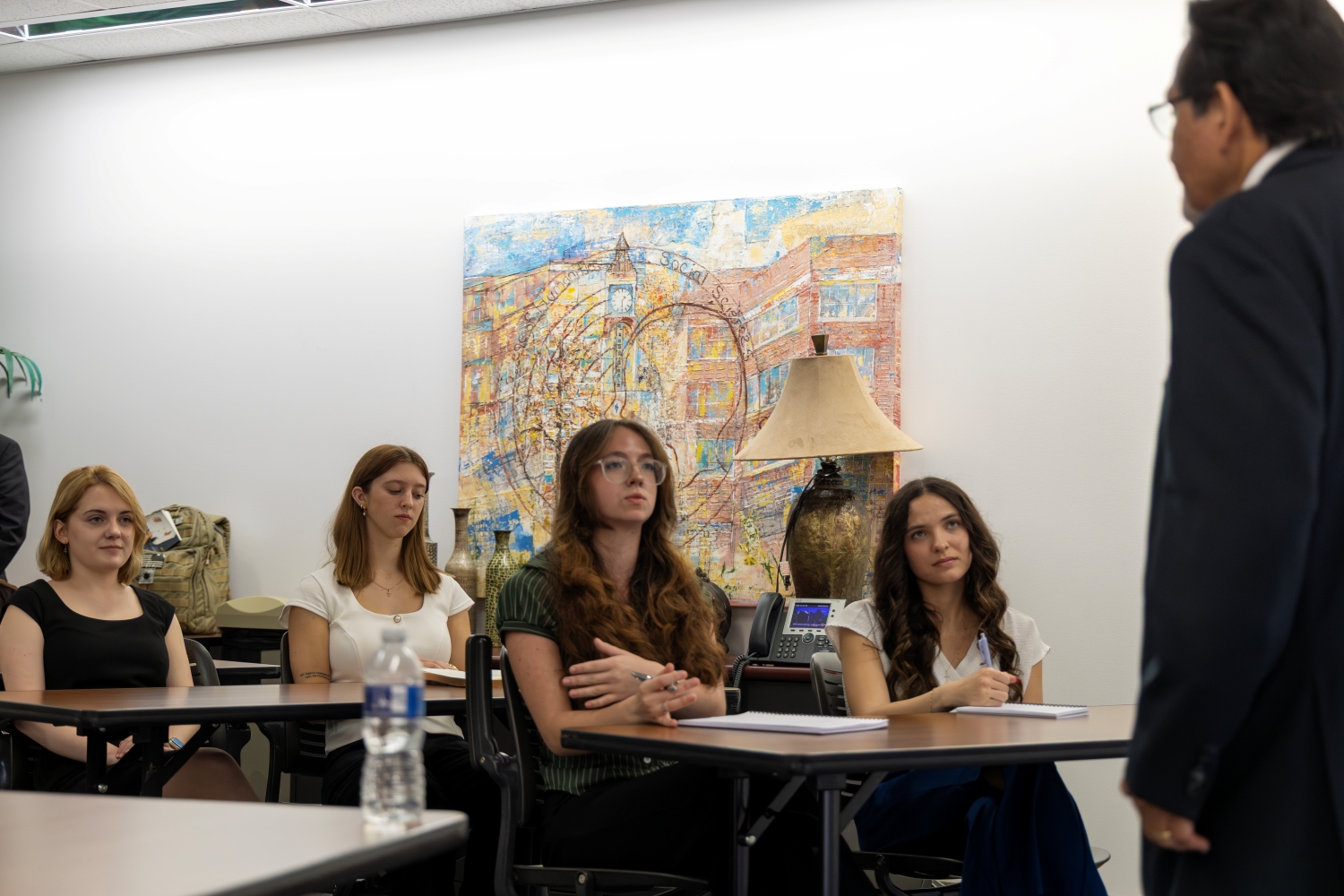
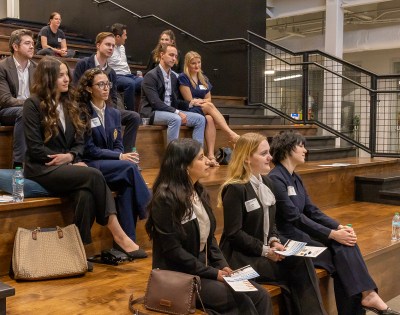
The floor quickly opened for questions, with many of us eager to absorb as much wisdom as we could from Mr. Gonzales.
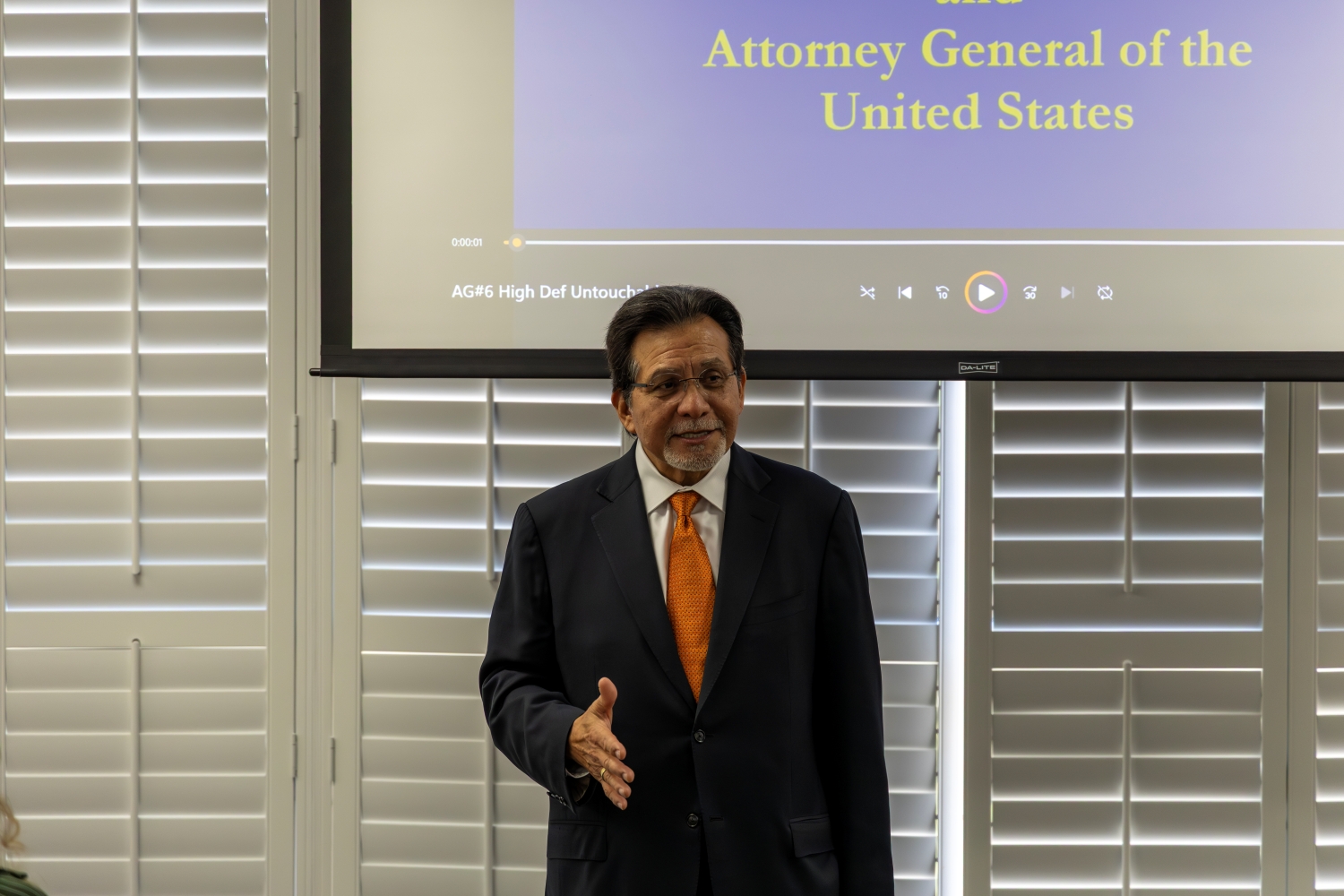
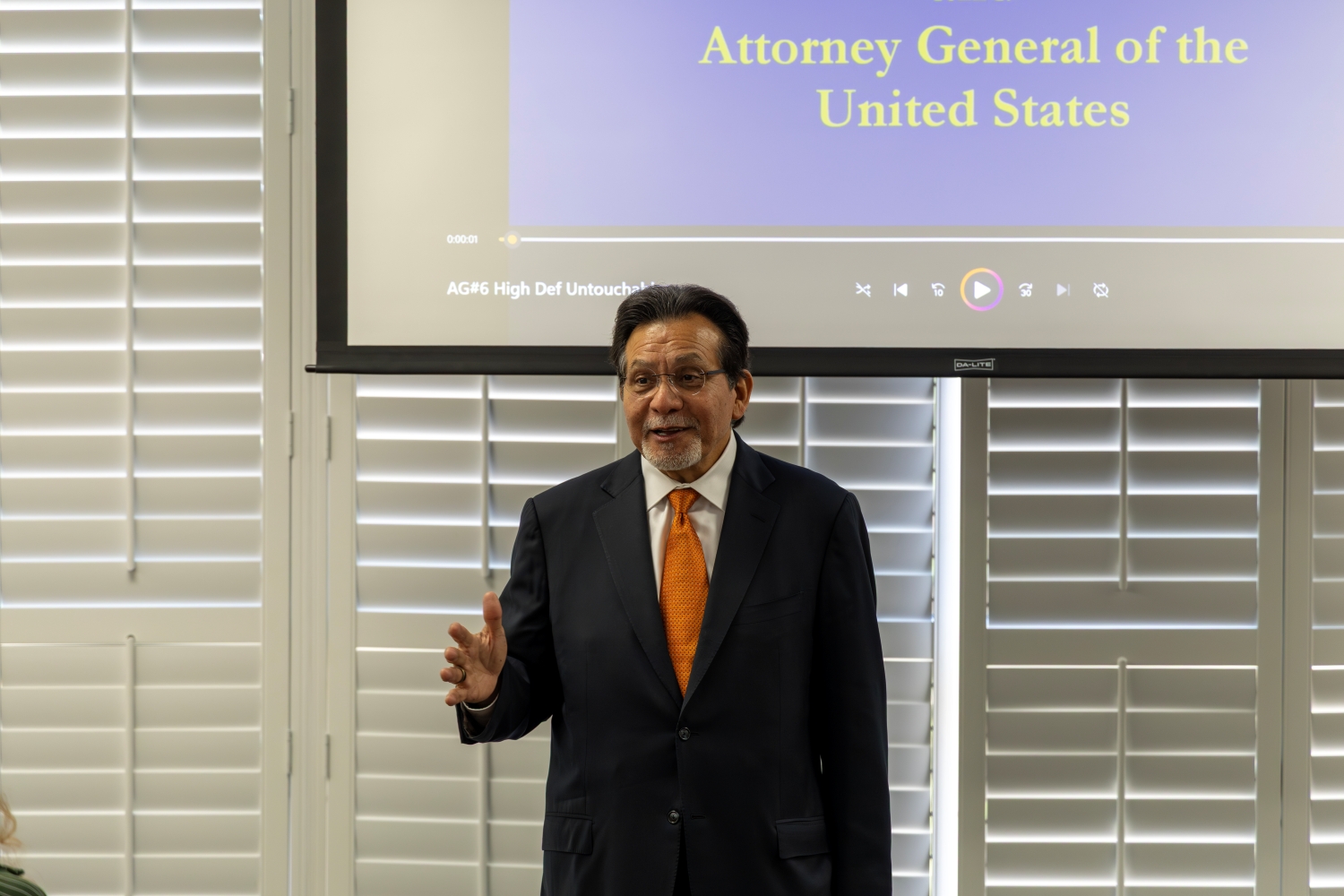
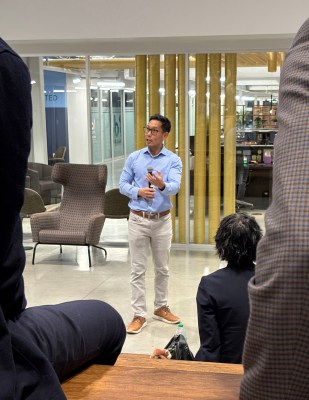
He discussed his humble beginnings as a first-generation college student, which he afforded by joining the military. Moreover, he emphasized the values instilled by his parents: (1) being reliable–“showing up and doing your job, reliably” and (2) accepting challenges to continue growth.
When asked about how he dealt with any setbacks during his career, Mr. Gonzales told us that perseverance calls for struggle. Even when facing hardships, as he did while serving as the first Hispanic American Attorney General, you must trust that if you put in the work, things will work out in the end. As important, he reminded us to dream big. While not all of our dreams will work out, they definitely won’t work out if they aren’t pursued.
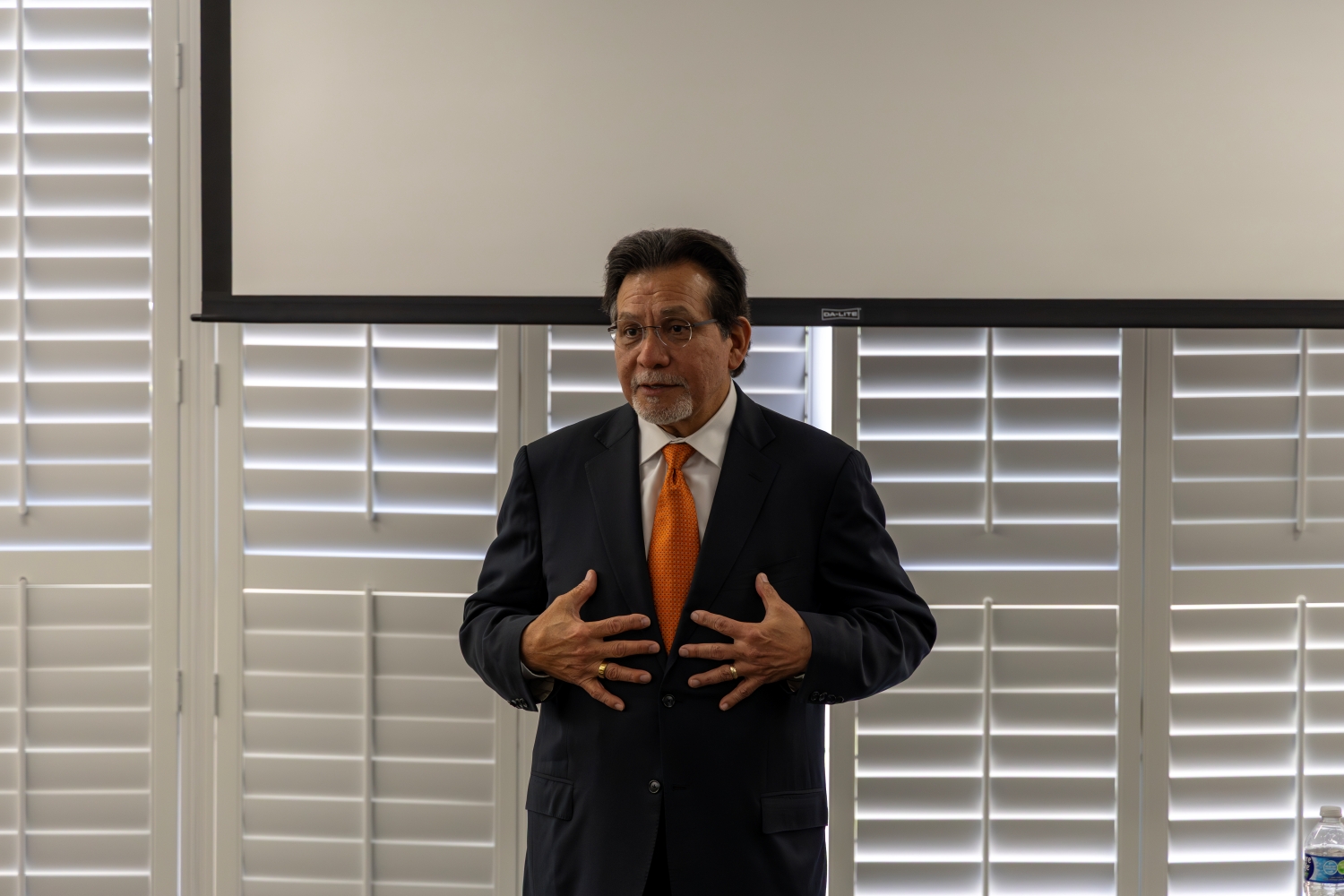
Both Mr. Gonzales and Mr. Yebra highlighted the importance of building relationships during their talk. Judge Gonzales emphasized the importance that George W. Bush played in his career, and Colonel Yebra stressed the importance of building relationships built on professionalism, trust and reliability.
Colonel Yebra reminded us to surround ourselves with people that we can learn from while understanding that our role serving others allows for greater professional growth–and, simultaneously, more responsibility. The aspect of serving others is a distinct value LEAP holds in everything we do so it resonated with all the students present.
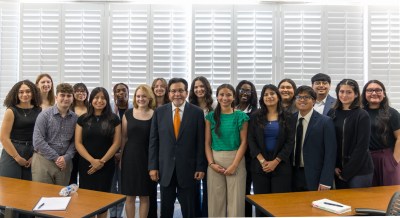
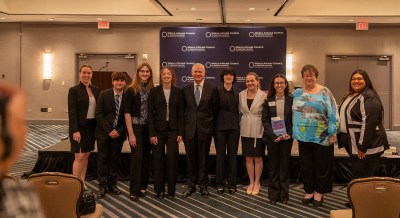
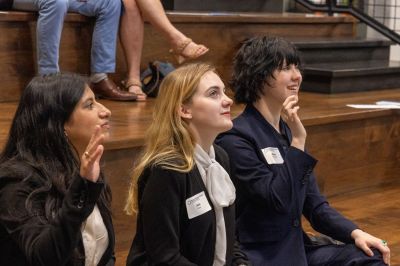
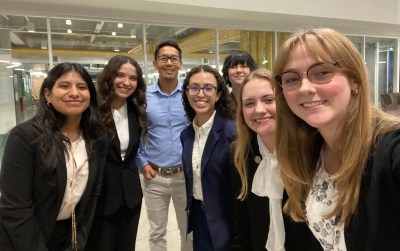
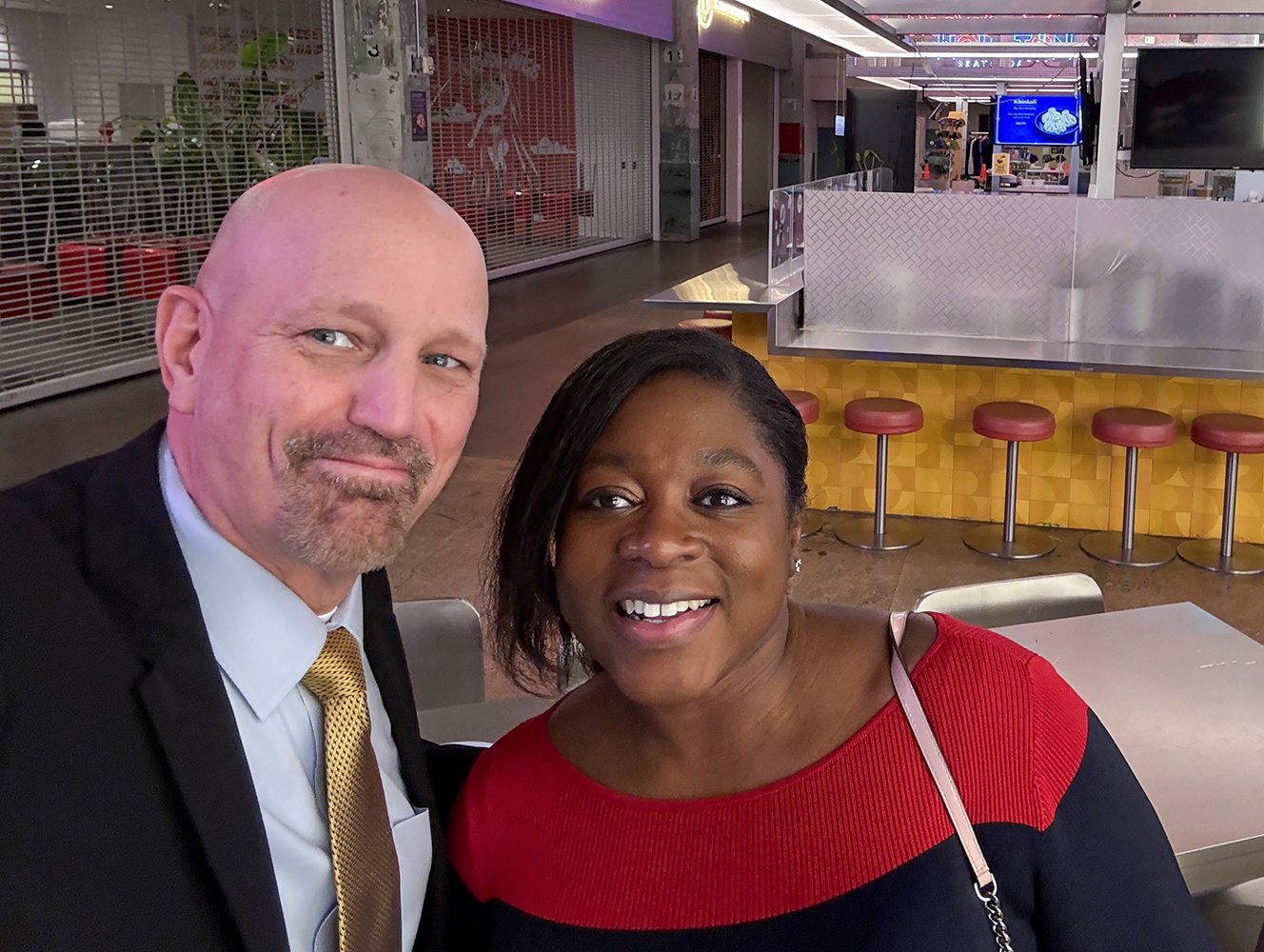
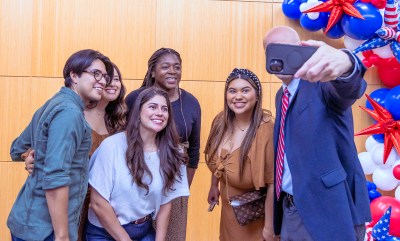
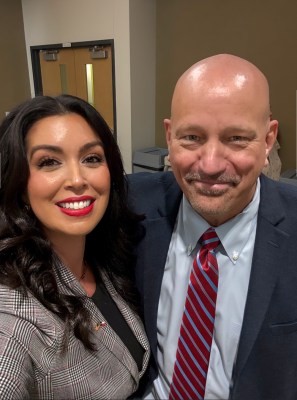
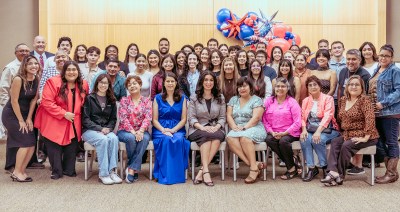
Once our time with Mr. Gonzales was up, we snapped a quick photo to add to the many taken with him over the years, from when he so kindly came to visit us at SHSU. All of us present took away profound insights we can use in our own lives. We look forward to seeing Mr. Gonzales and Colonel Yebra again in the future!
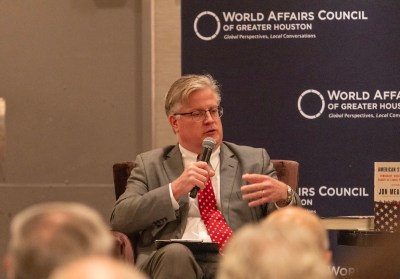
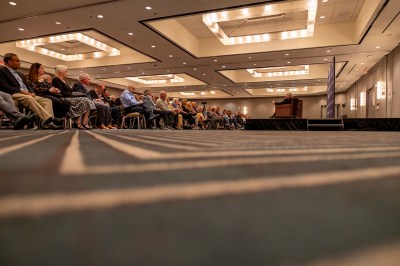
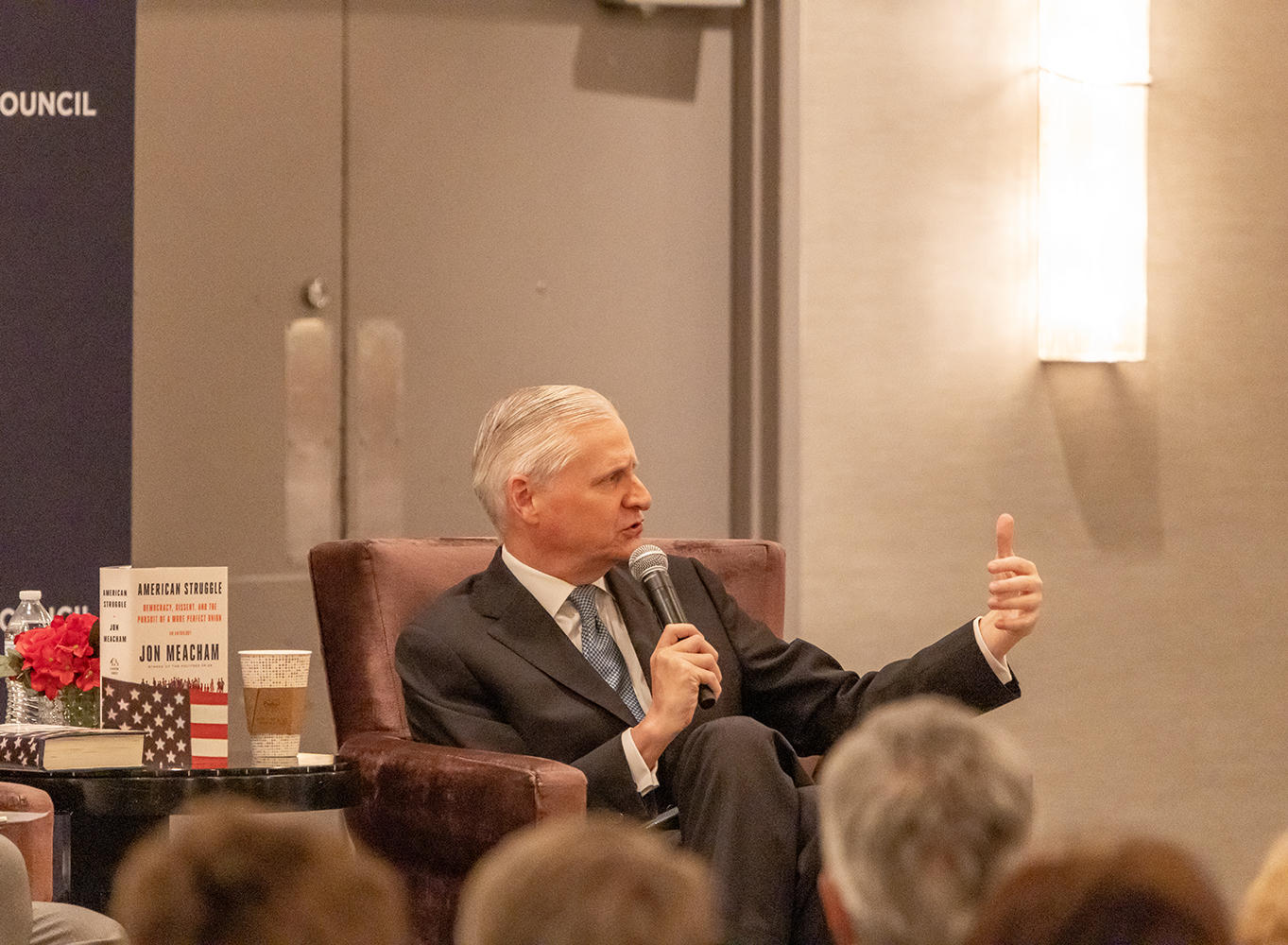
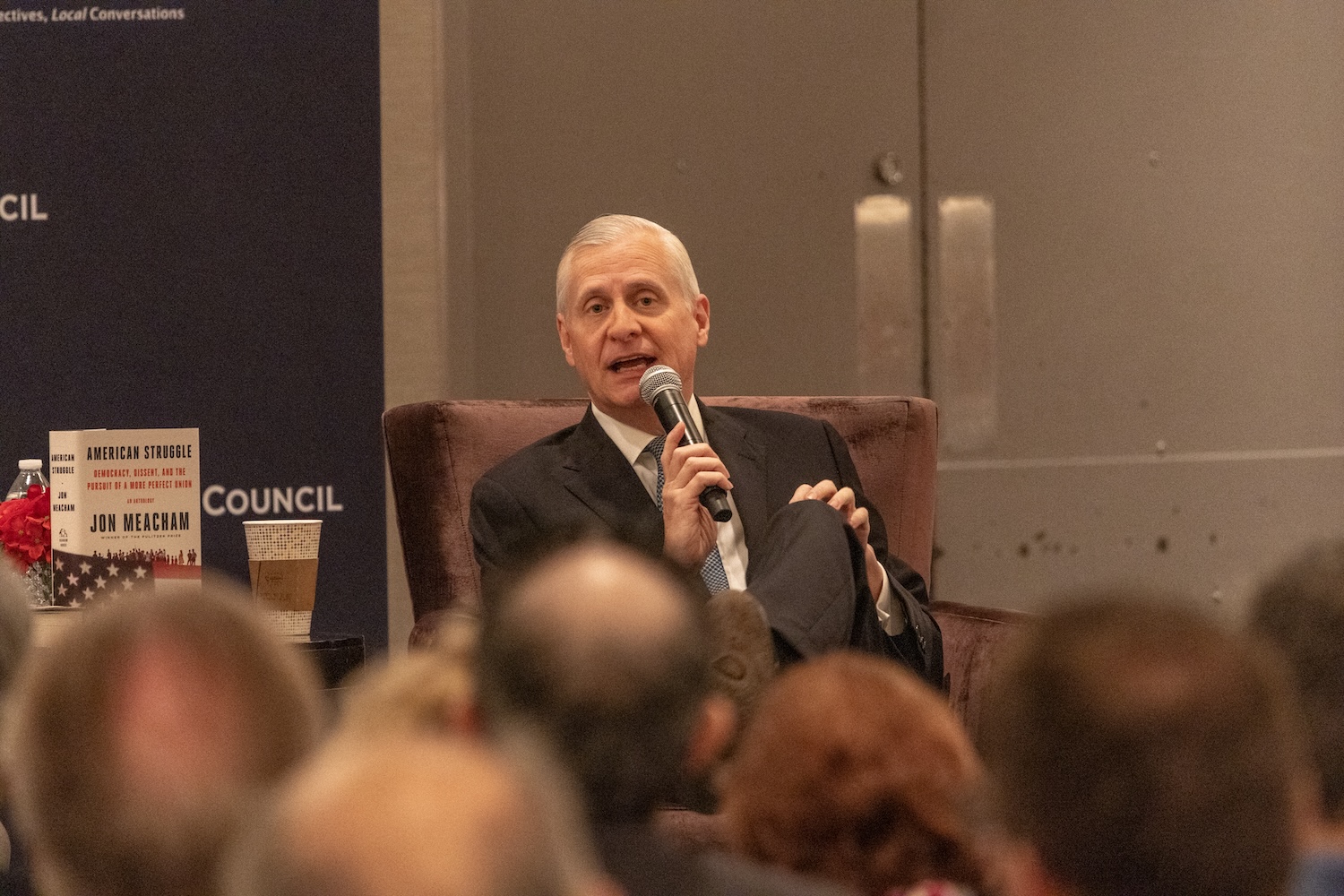
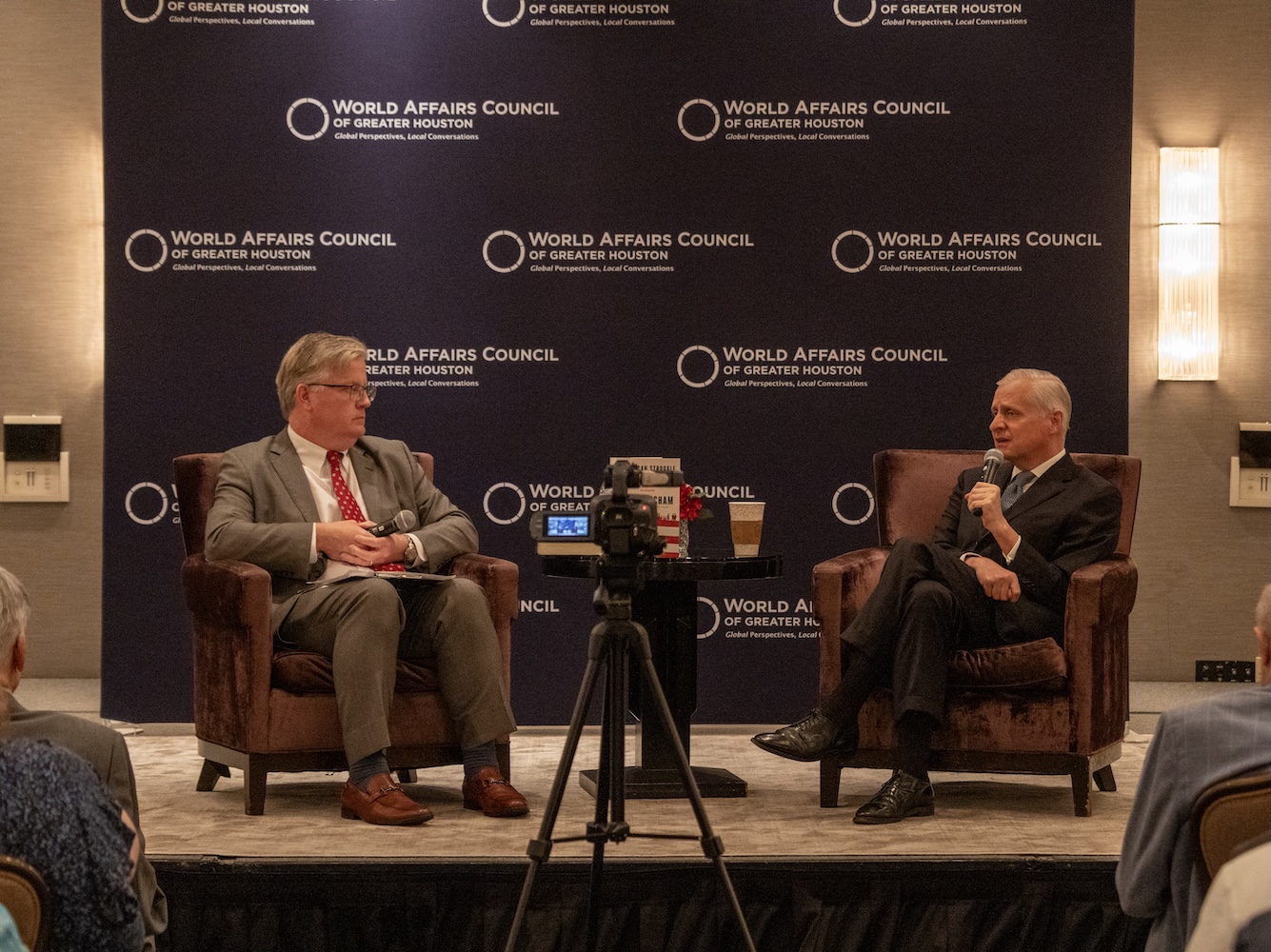
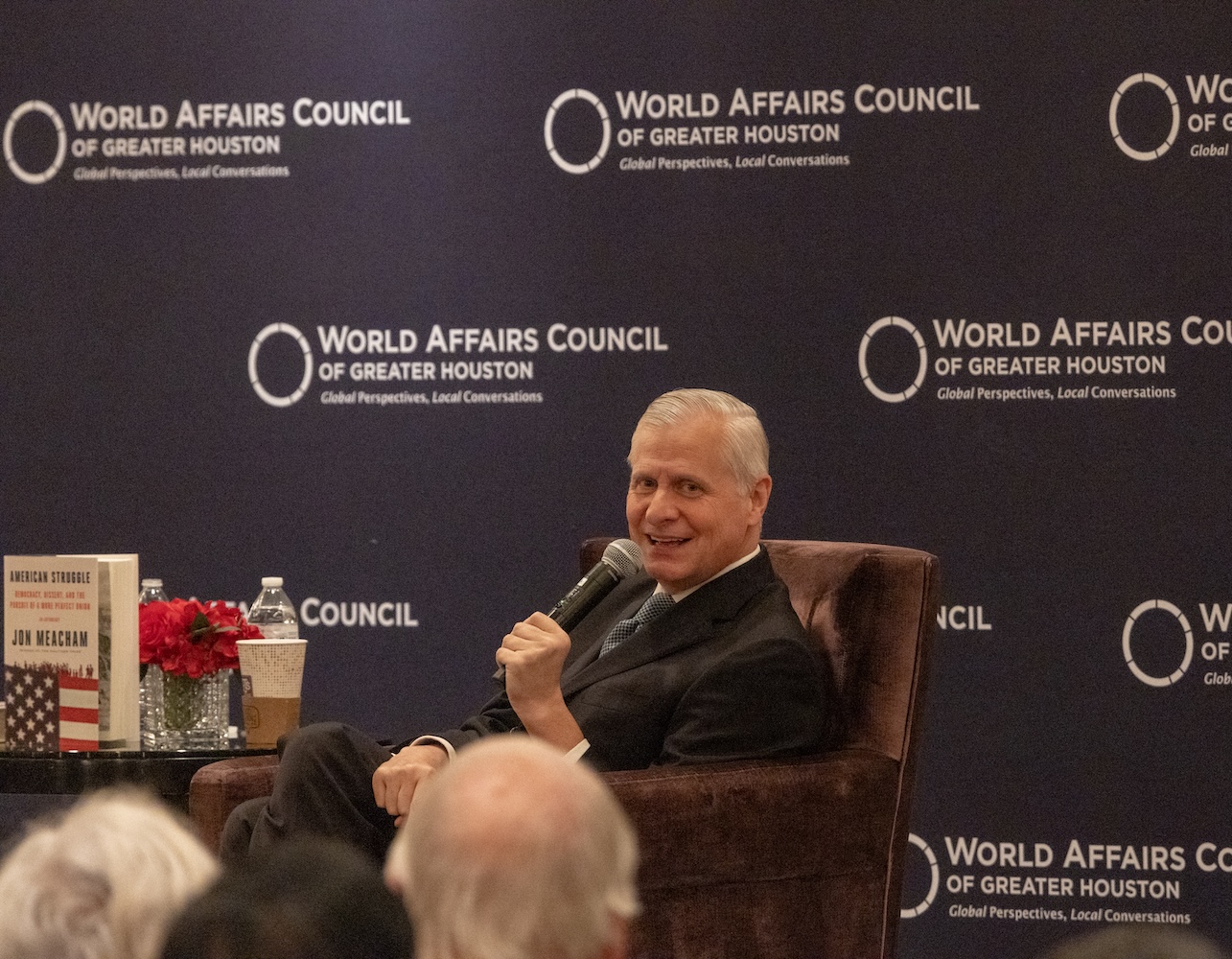
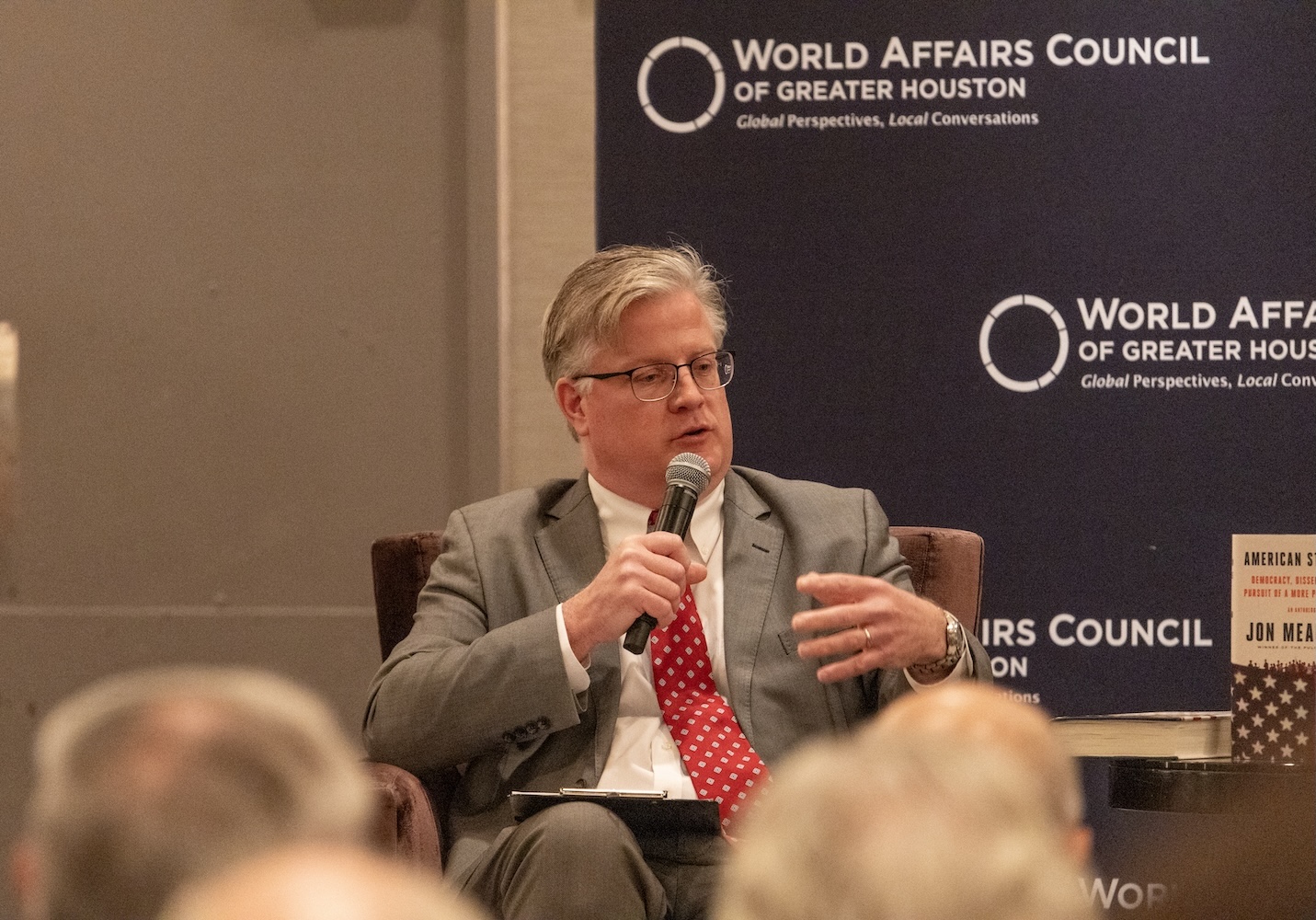
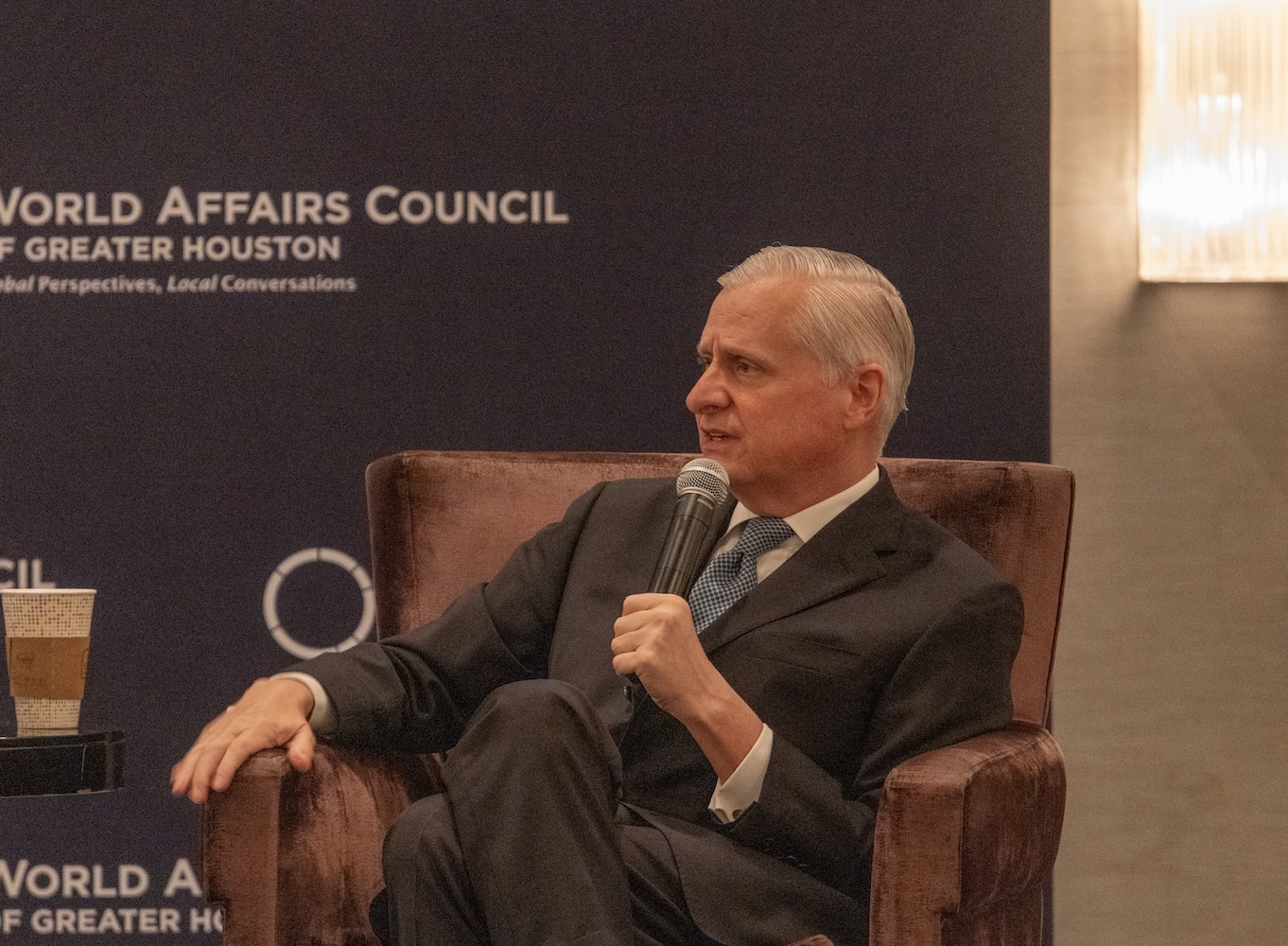
Saturday, February 28th was an eventful day for LEAP students! We travelled to the Royal Sonesta Hotel in Houston for a book talk on Pulitzer Prize Winner Jon Meacham’s new anthology American Struggle, which explores the history of politics.
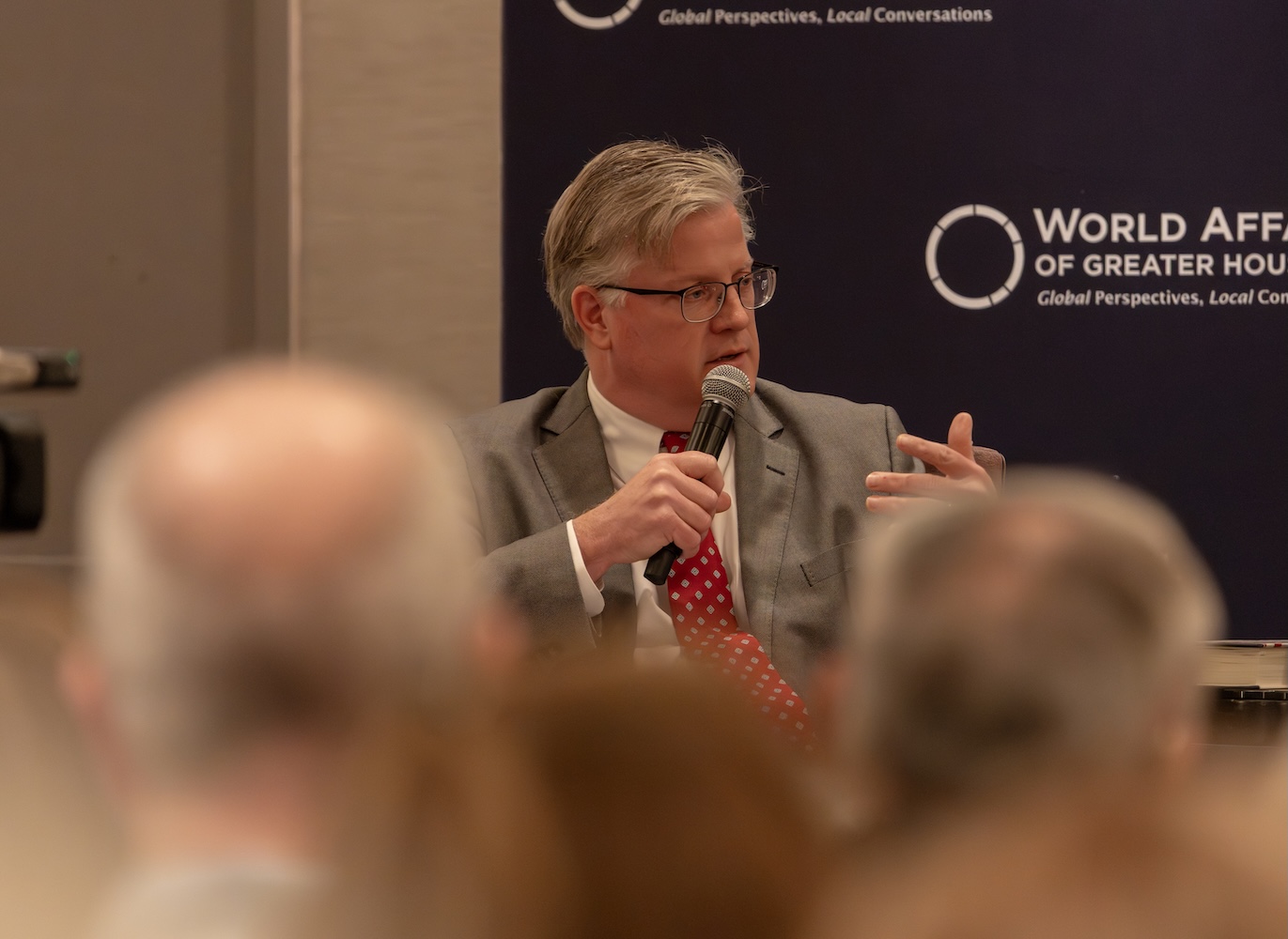
…and moderated by Chief Programs Officer Ronan O’Malley…
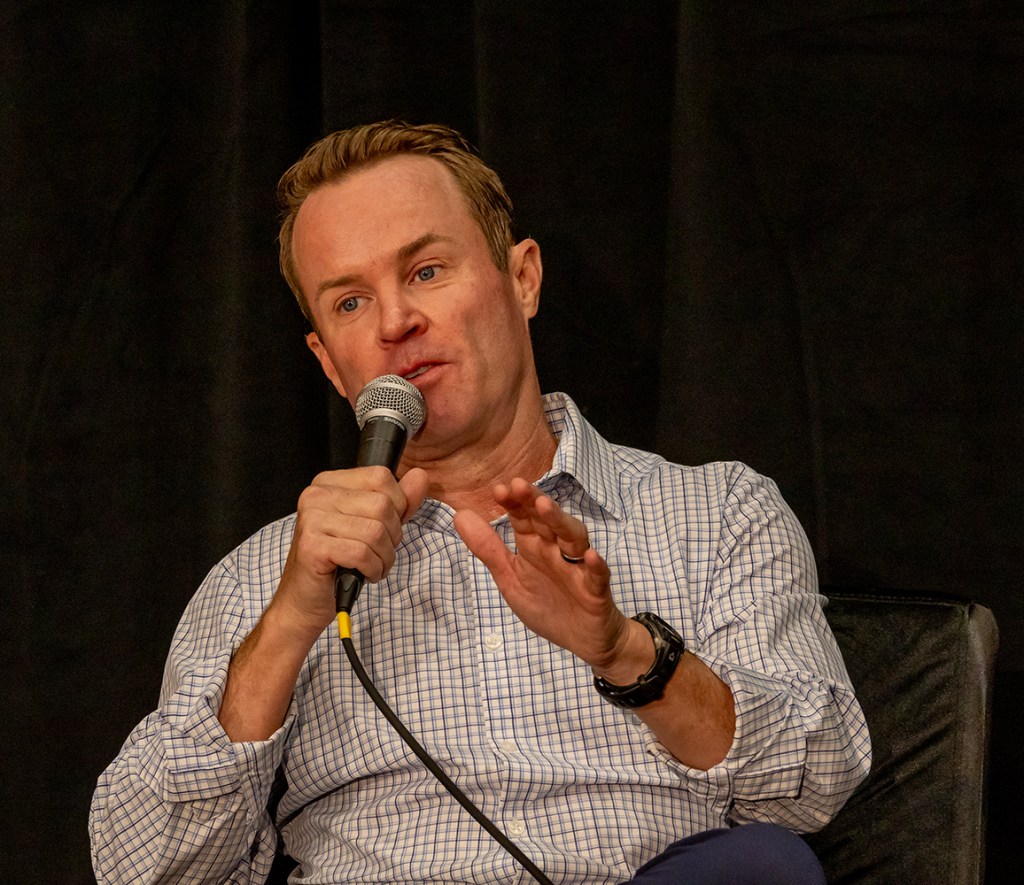
…Meacham discussed American political history, getting into the nitty gritty of the division of party lines with witty humor and anecdotes.
In addition to the United States’ religious roots, he explored the impact of African Americans as far back as the Civil War, such as Frederick Douglass, on the development of political ideology– more specifically, the creation of the Republican party.
Meacham had several interesting points on the distinction between an “anti-slavery” and “abolitionist” person in the 1800s. These two ideas were once very different, yet today, most Americans would consider them the same thing. This kind of trend is frequent in politics, as ideology and morality evolves. He also unpacked the lasting effect of the World Wars, Great Depression, and Cold War, describing the general idea of modern American politics as “a vigorous debate, from 1932 to 2016, between [the ideas of] FDR and Reagan.”
He also reflected on the development of factions within the two major political parties, such as the John Birchers of the 1950s. On today’s politics, he determined that while we do live in a time of political upheaval due to party extremism, this “crisis” is not unprecedented. America’s political history has been littered with events that were perhaps more destabilizing than what we experience today, such as the Great Depression, the rise of the Ku Klux Klan, and the fight for Civil Rights in the 60s. These events shook Americans to their core. While today’s Americans may feel like they exist in a space of political turmoil, the moral and financial roots of a nation were shaken during these events. He suggested that history serves not as a roadmap, but as a diagnostic tool, helping citizens understand how democratic institutions have survived moments of extremism in the past.
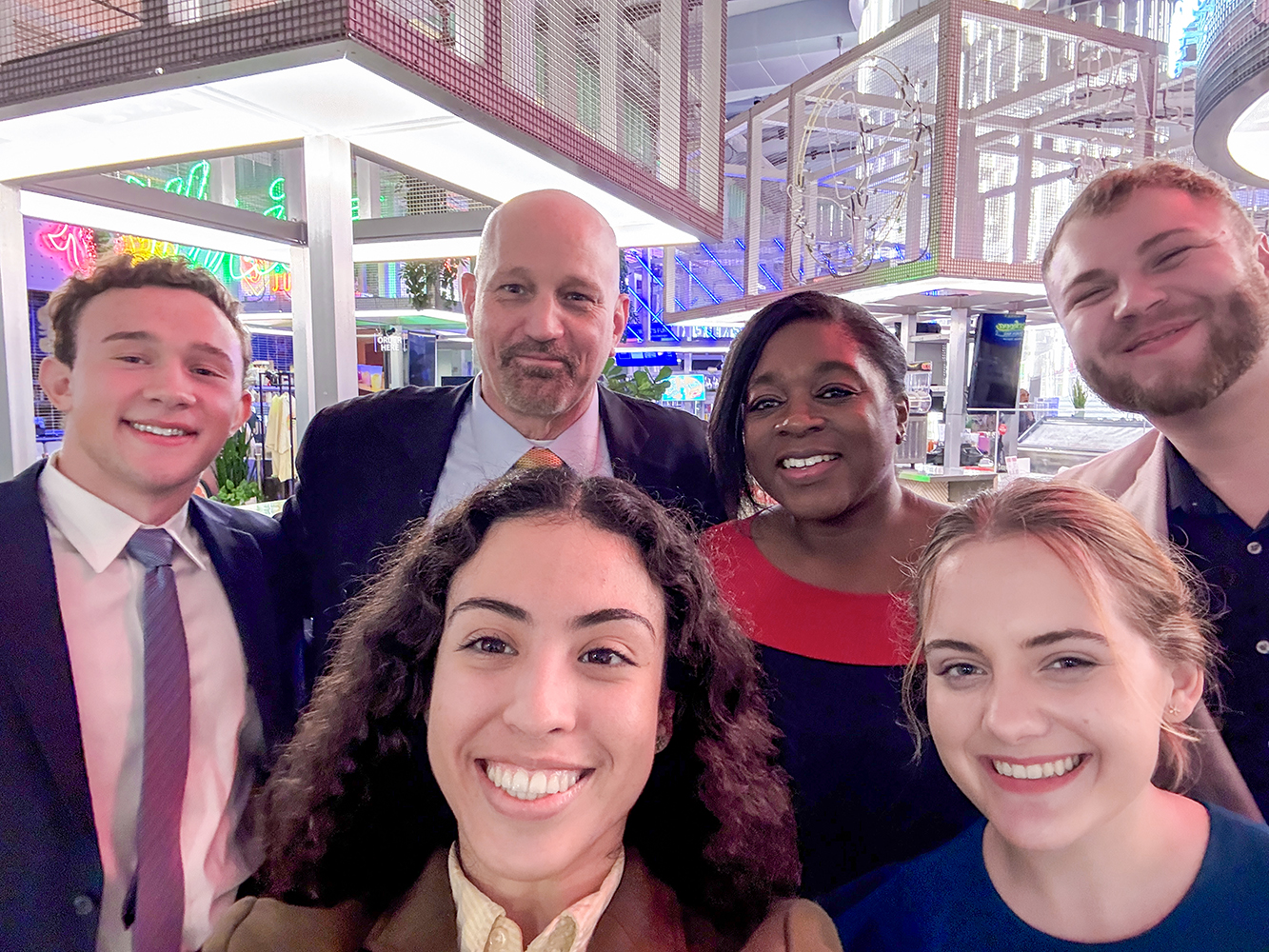
Following the talk, we were surprised to see Jean Becker, whose book event we had attended at the Bush School of Government and Public Service just days earlier. After a brief conversation and a quick selfie, we had the opportunity to introduce ourselves to Meacham– a memorable end to a day that brought American political history to life.
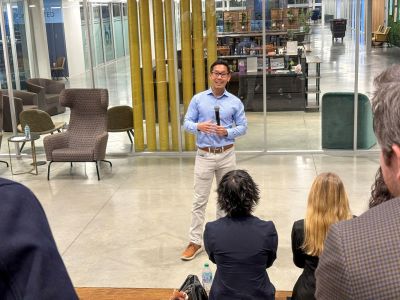
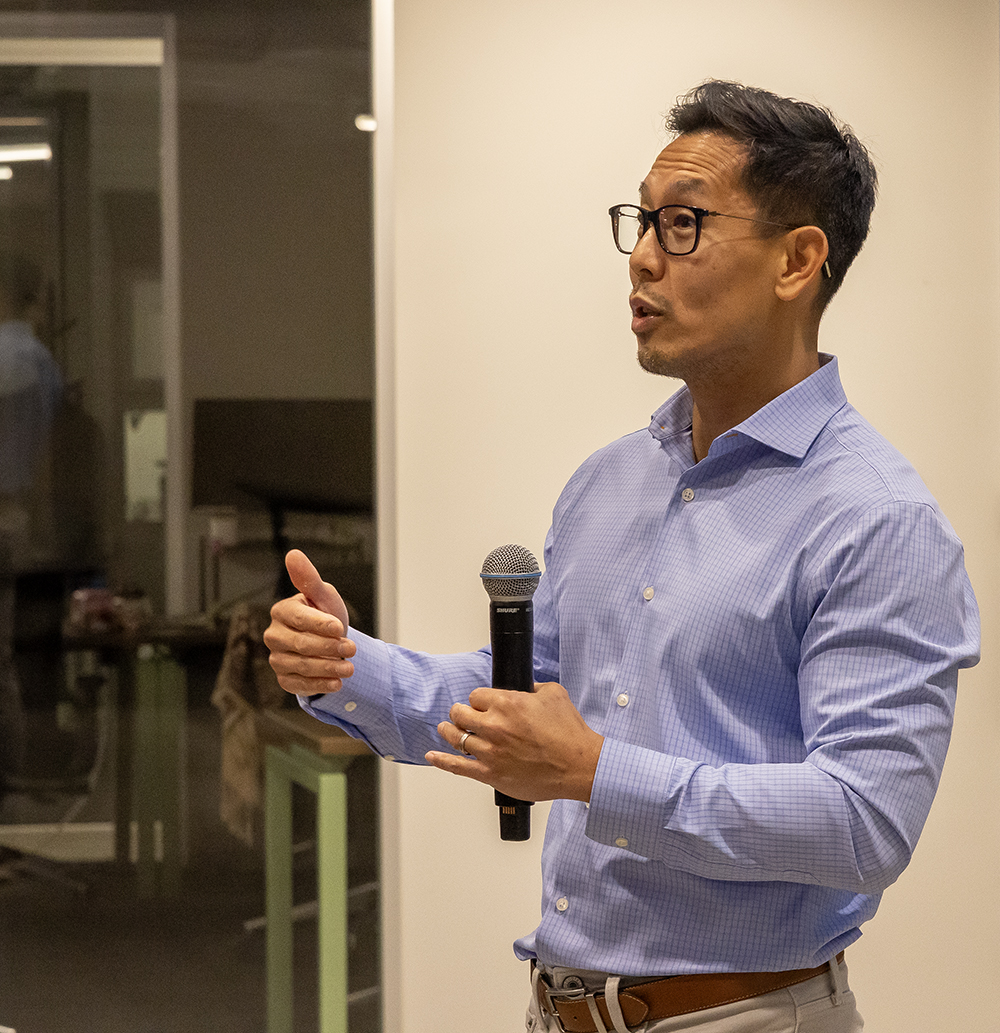
I have attended many World Affairs Council Events, but none has caught my interest in the way that Dr. Tam Dao did with his presentation on “Sexpionage”–the use of sex in the world of espionage.
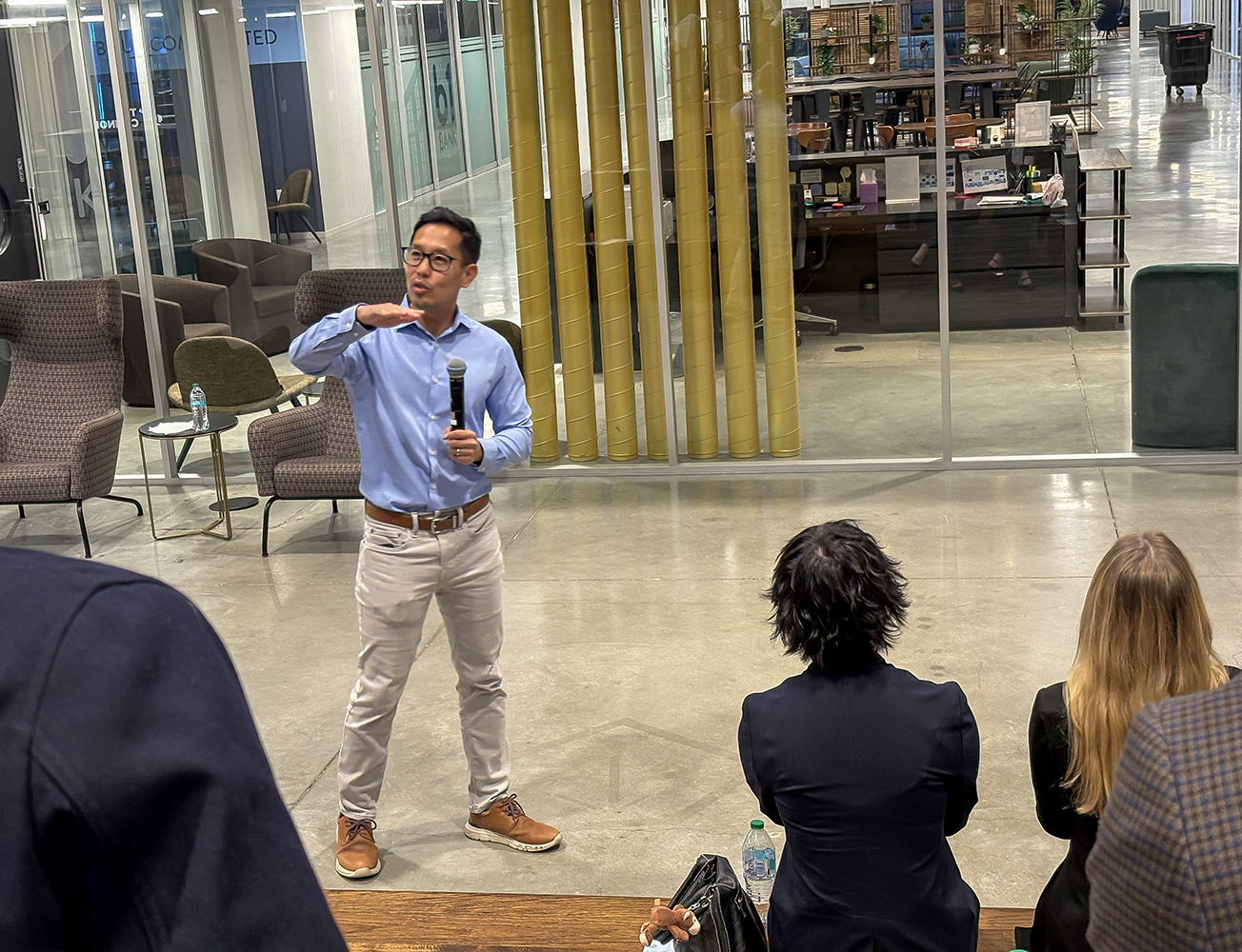
Dr. Doa is the Associate Vice President for Campus Safety and Research Security at Rice University. Before joining Rice University, Dr. Dao held various positions at the FBI, including work in the counterintelligence task force, classified briefings, and as a certified hostage negotiator.
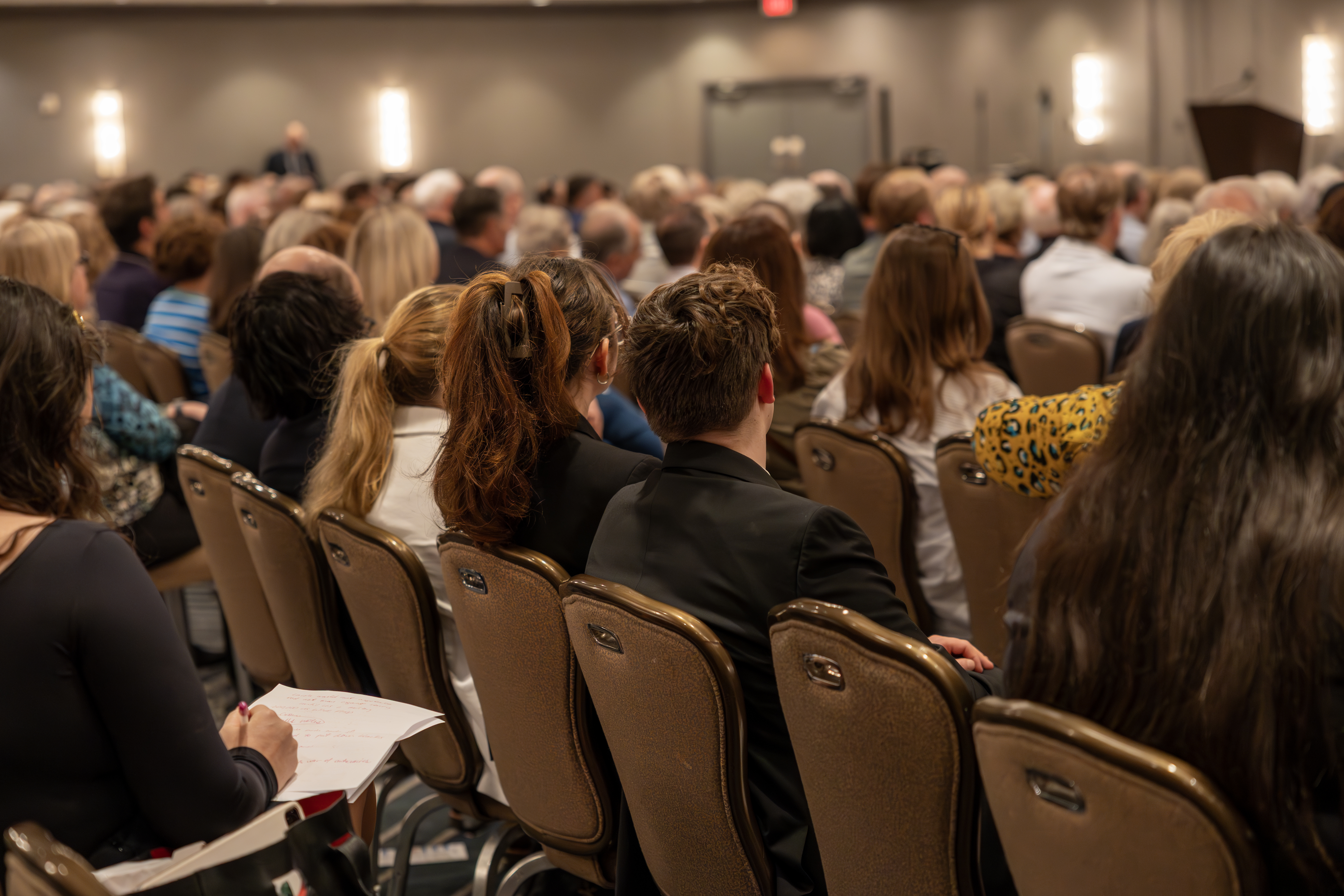
The event was in a smaller setting, making it more intimate and interactive.
Dao noted that men are much likely to be “victims” of sexpionage than women, and the examples he offered, such as Lt. Col. Benjamin Bishop, bore that out. We also discussed the case of Robert Hanssen, although this was not a true “sexpionage” case.
Not all the cases, however, were as high profile as the above. In many cases, the “espionage” is the process of surreptitiously gaining access to professors’ academic research. Interestingly, Dao noted, many of the people who are seeking this information are doing it for the love of their native countries–despite the fact that they live in the United States and enjoy the opportunities the US affords them.
Dao, an immigrant himself, finds this behavior curious and ironic. While acknowledging flaws in the US culture, politics, and economic system, he praised the US for the opportunities it has offered him and his family.
This was one of the most enjoyable of the WACs we have attended, a sentiment we shared with Dr. Dao following his presentation.
Katz’s Deli
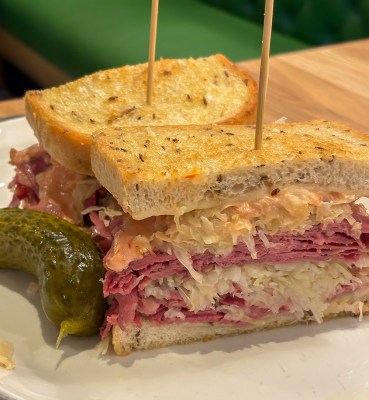
Following the WAC event, we stopped at Katz’s Deli, where we enjoyed various deli-type sandwiches, including a Lox sandwich, a Reuben…
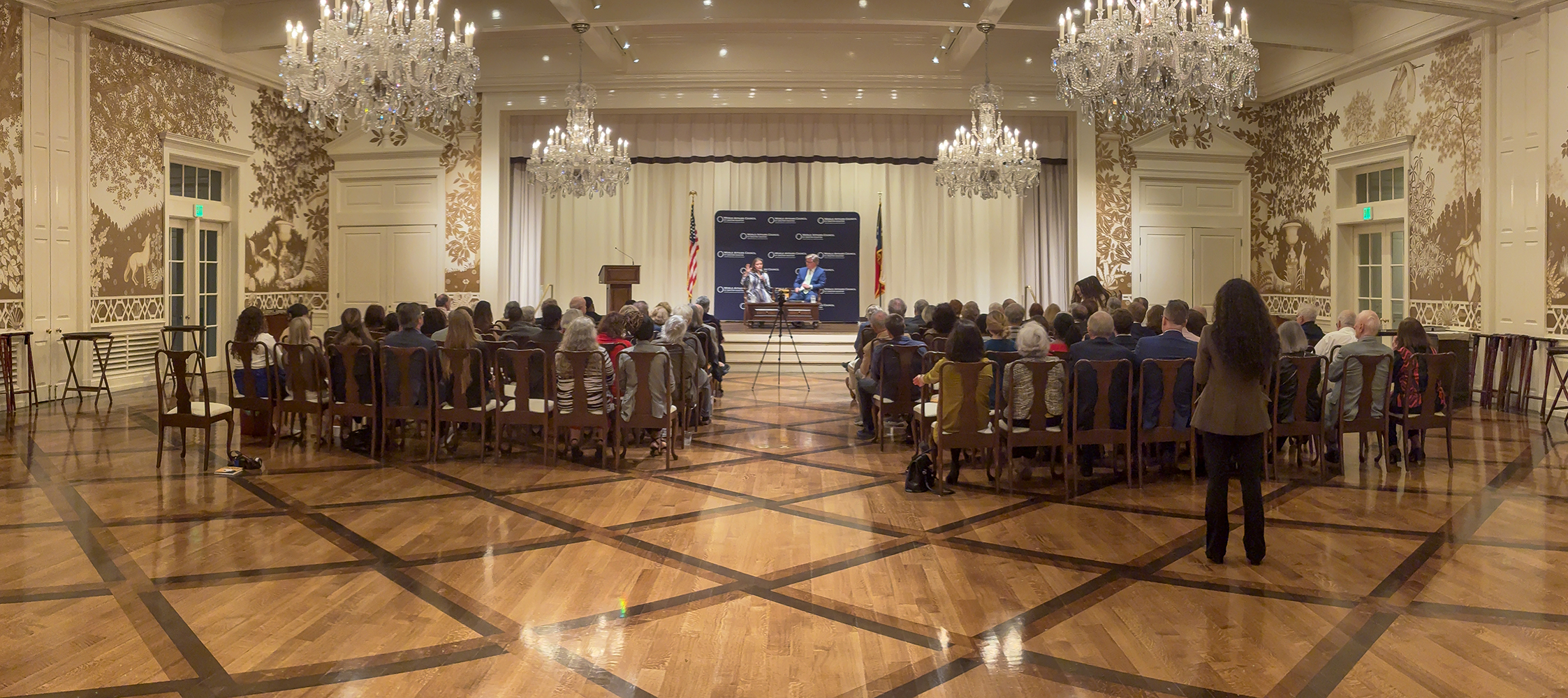
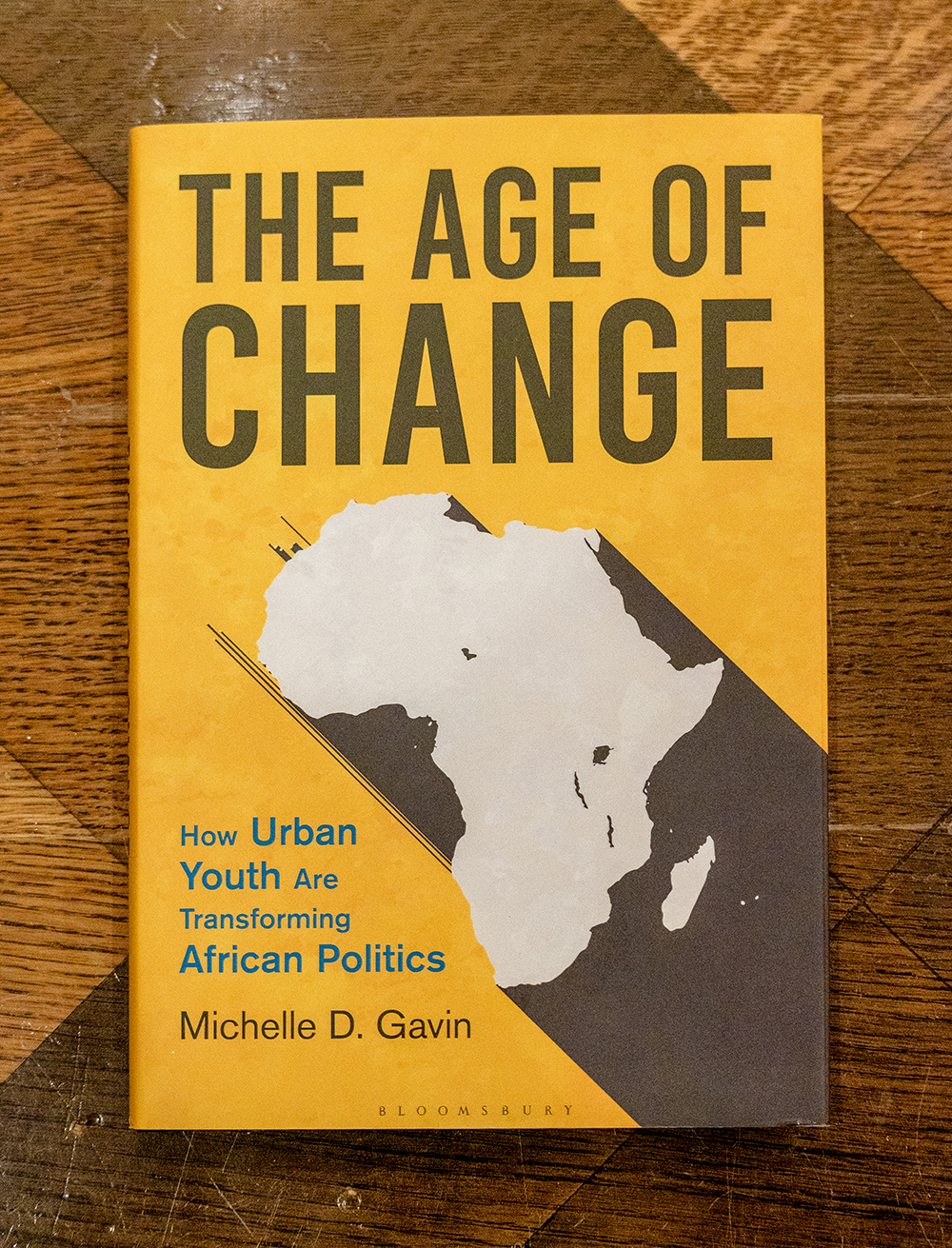
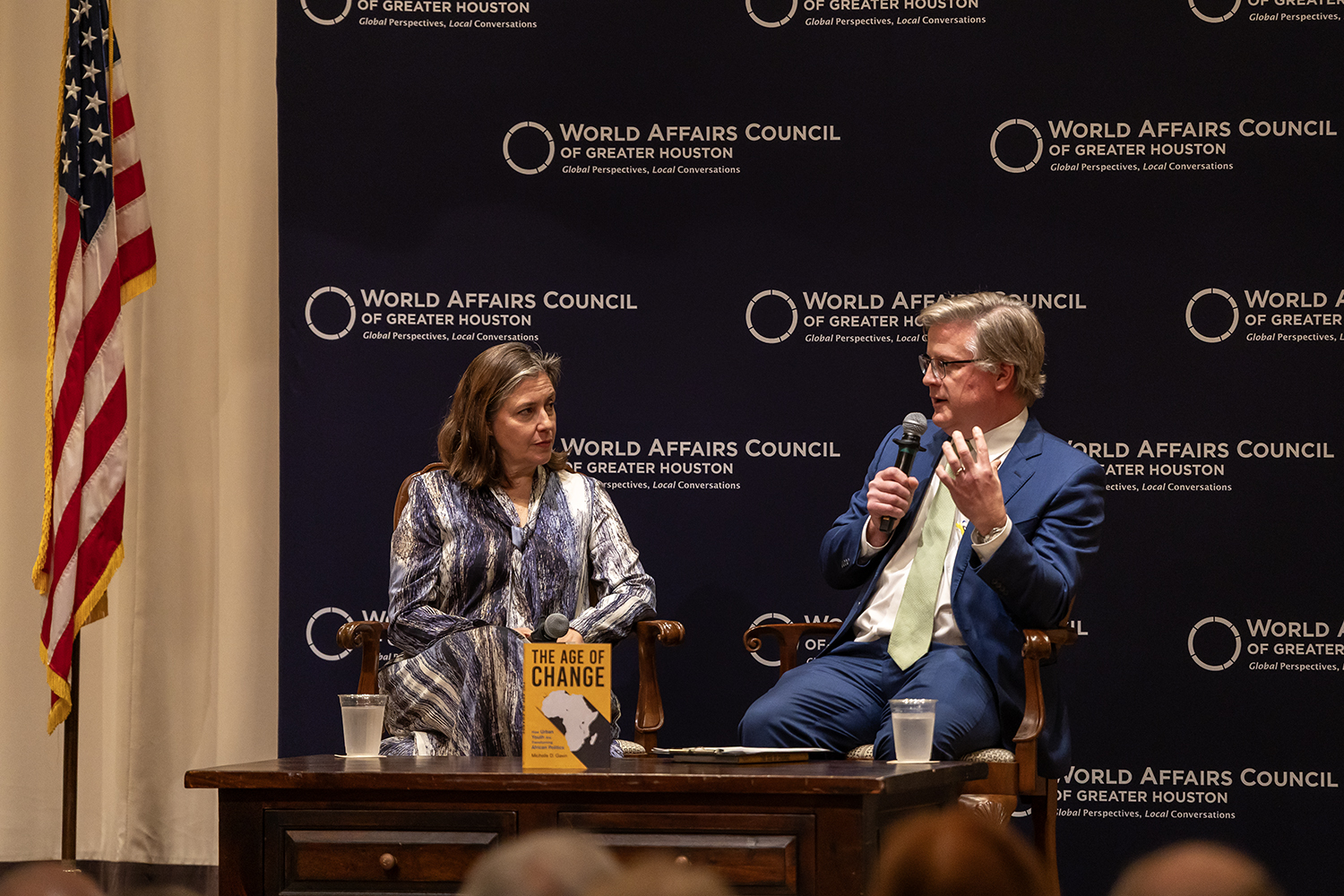
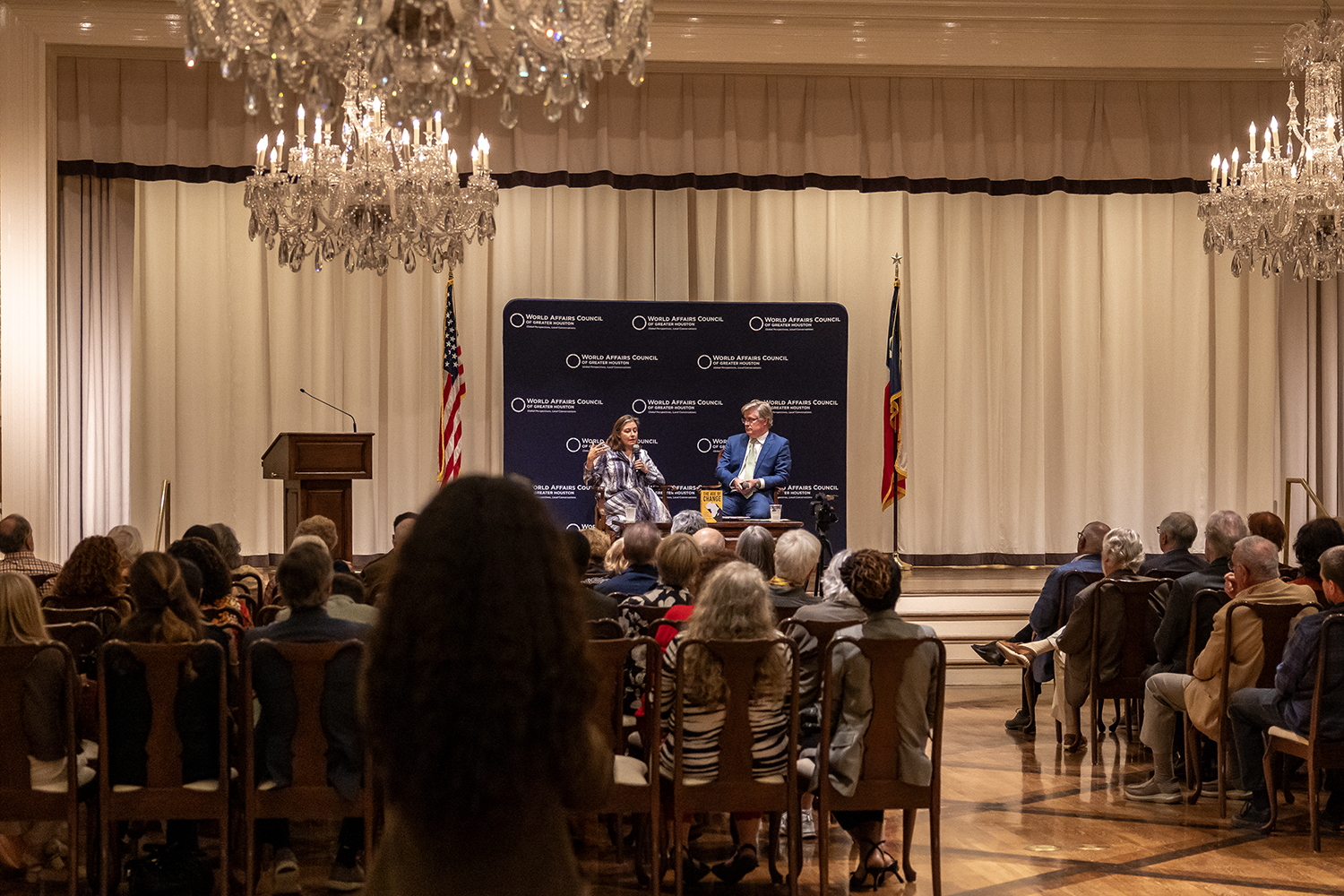
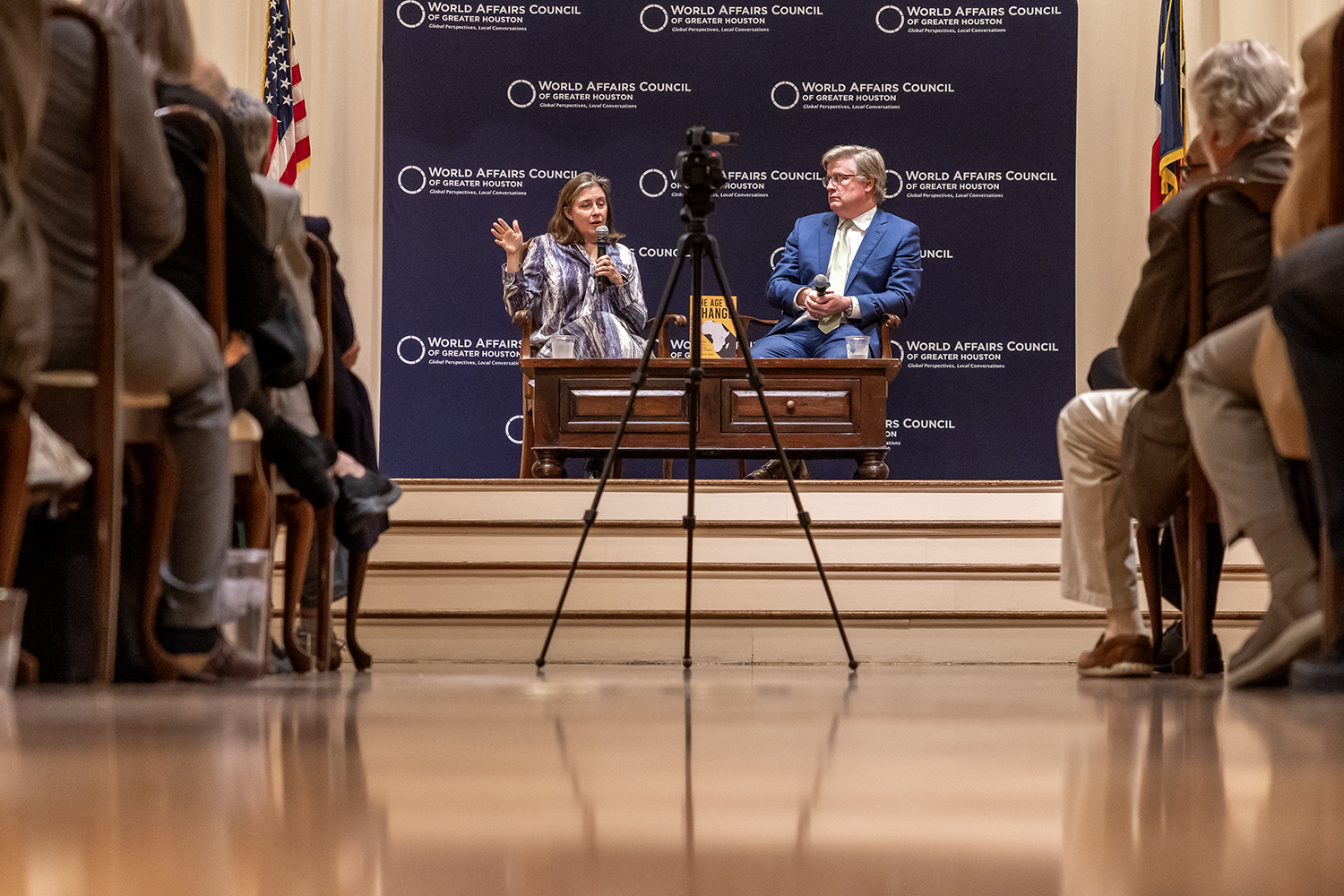
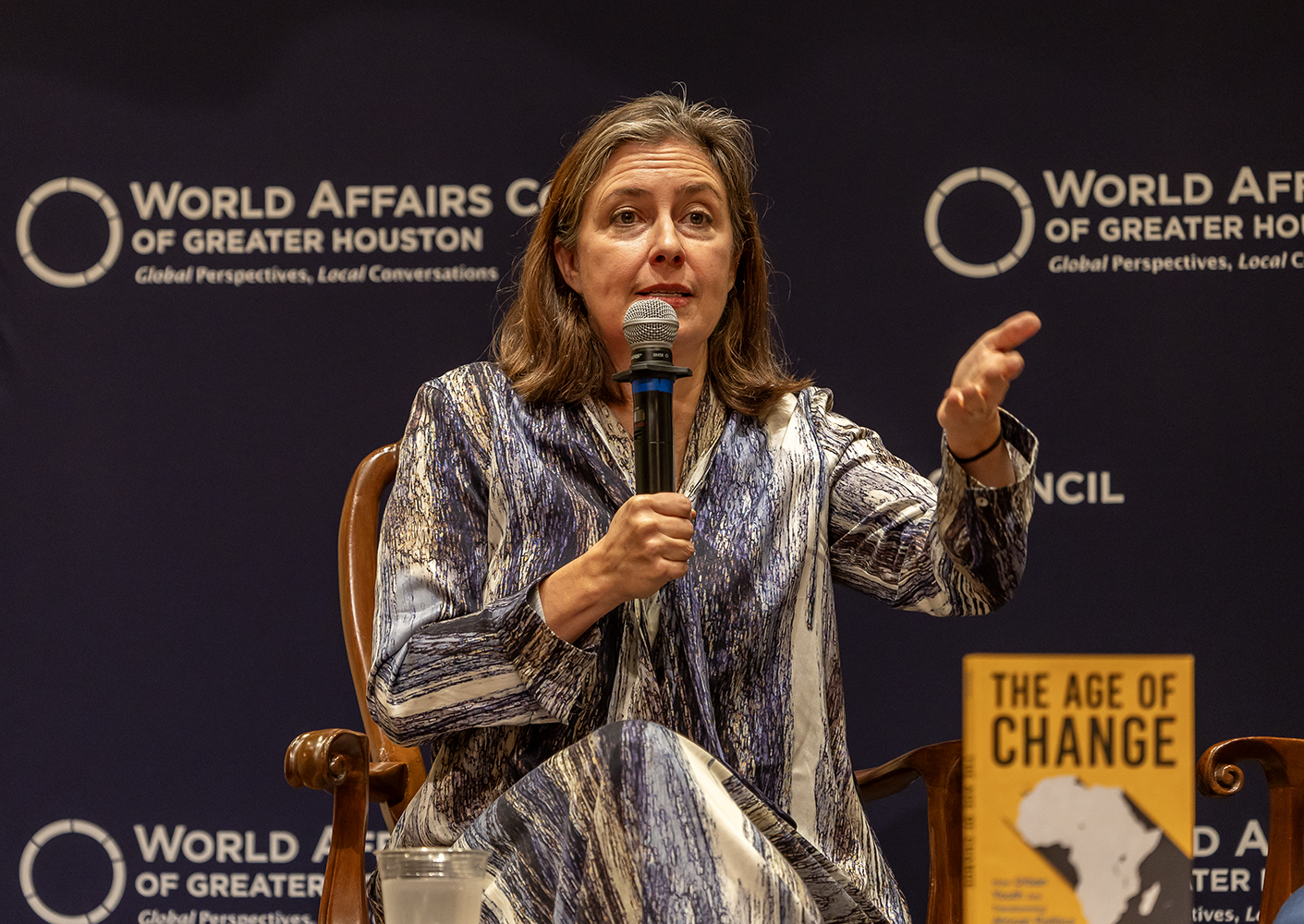
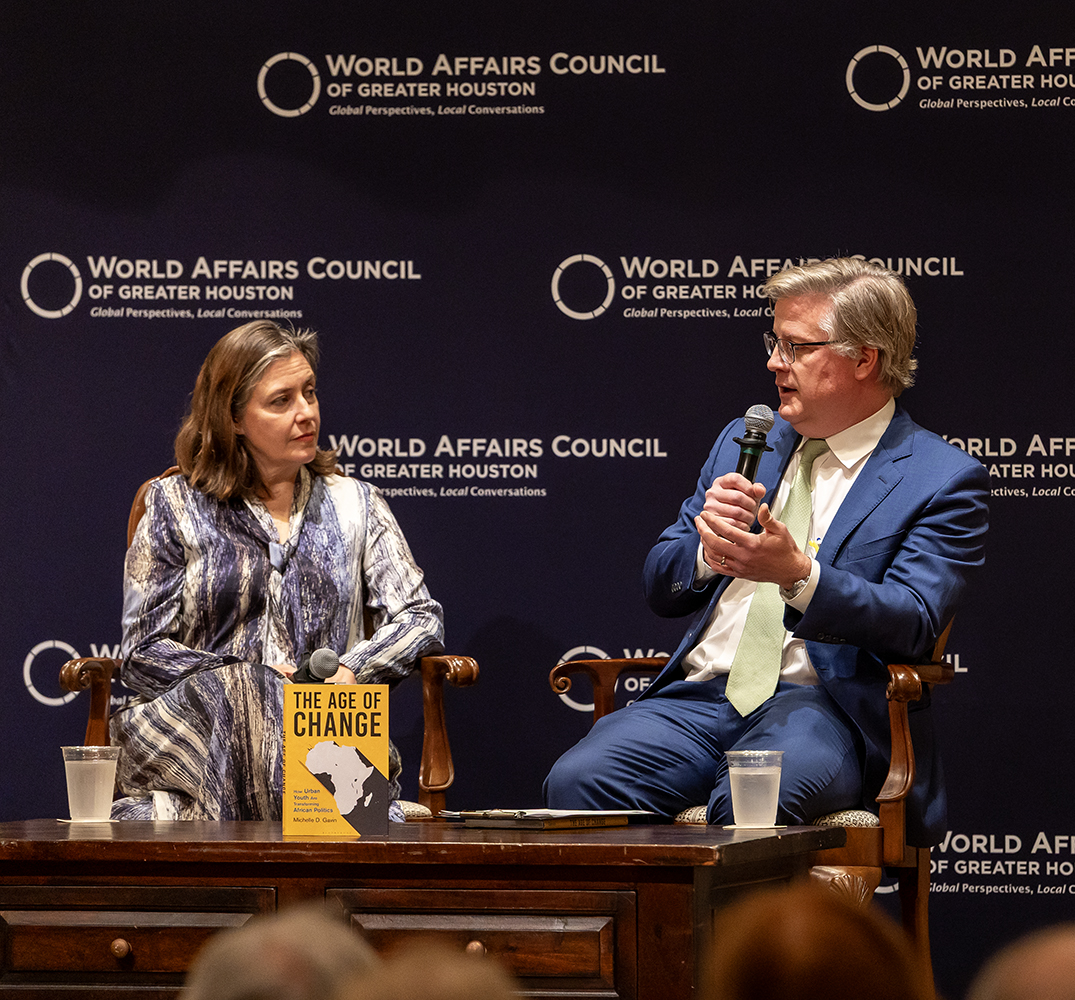
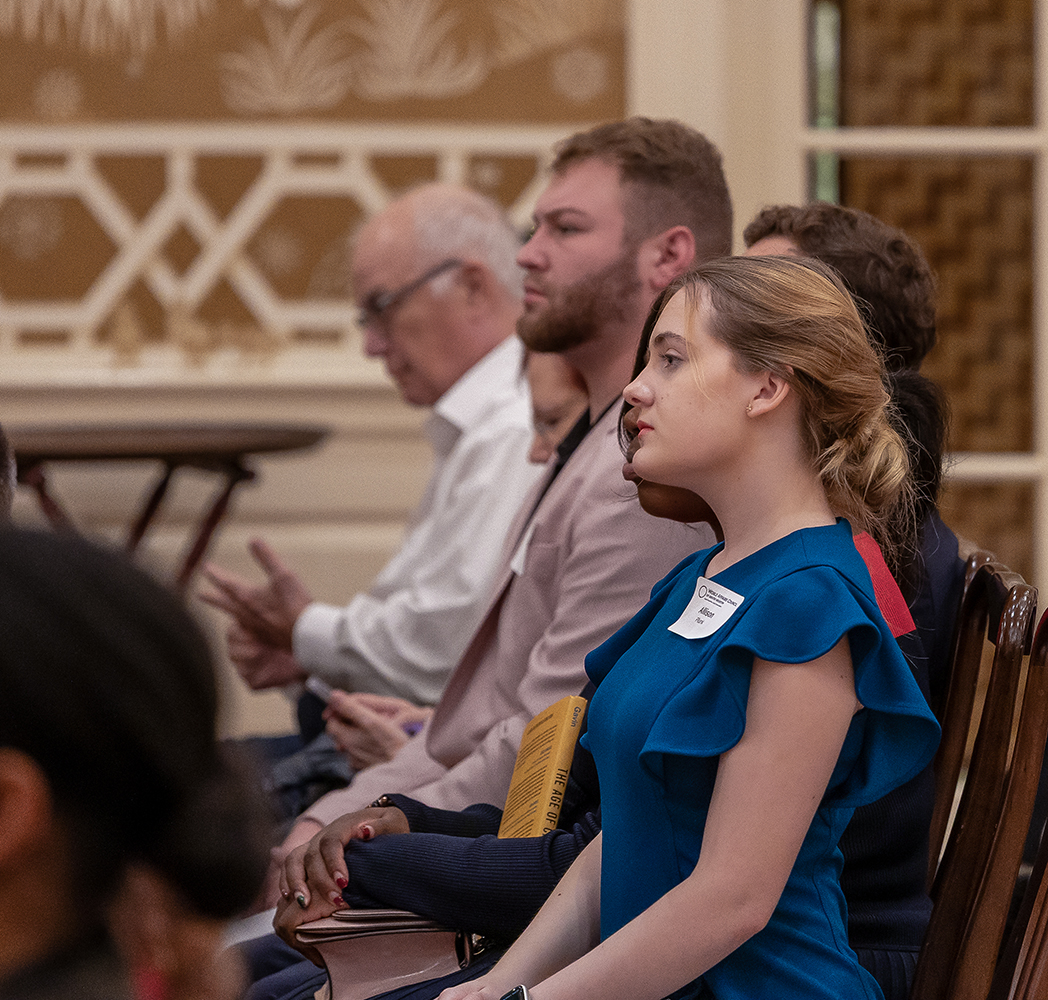
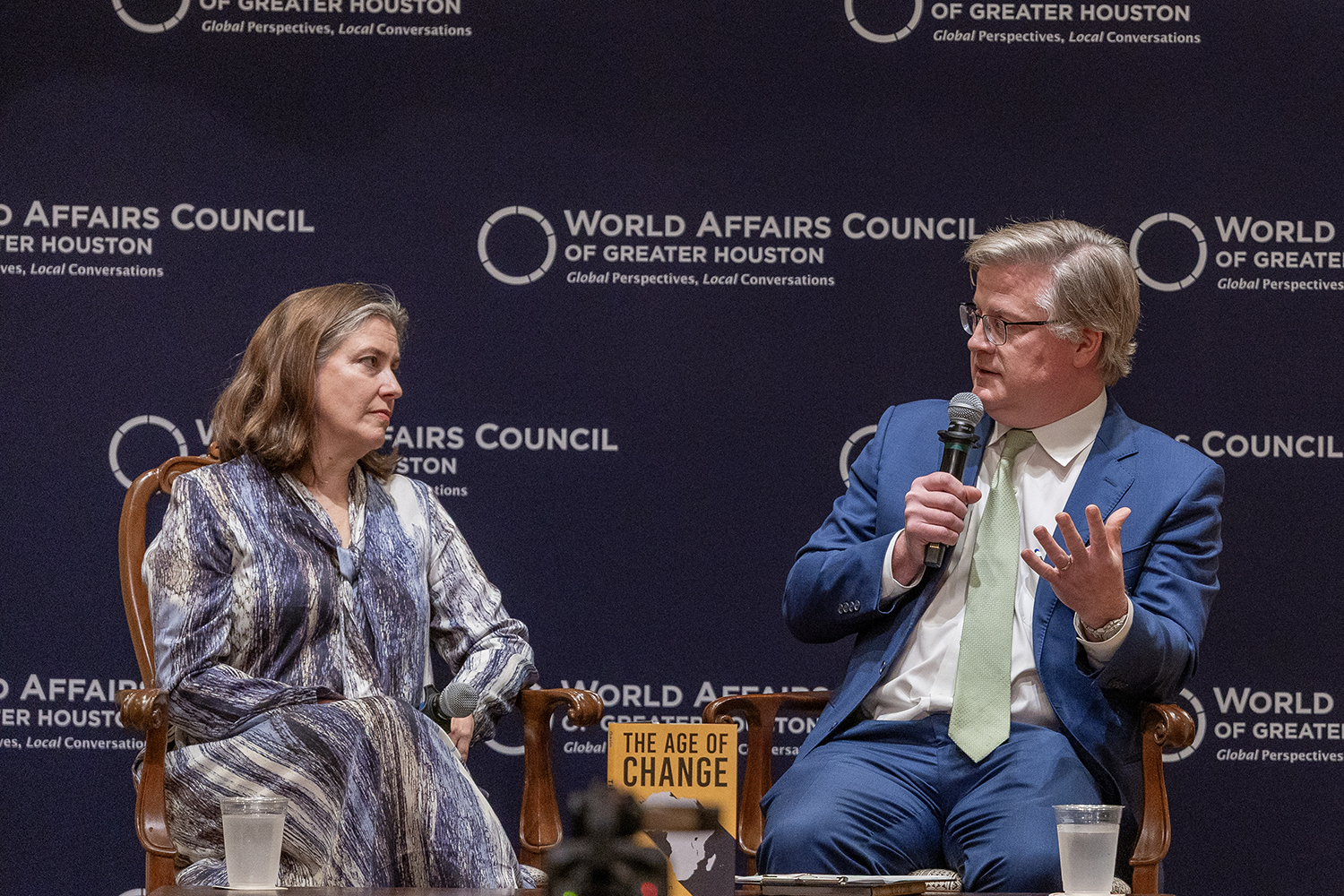
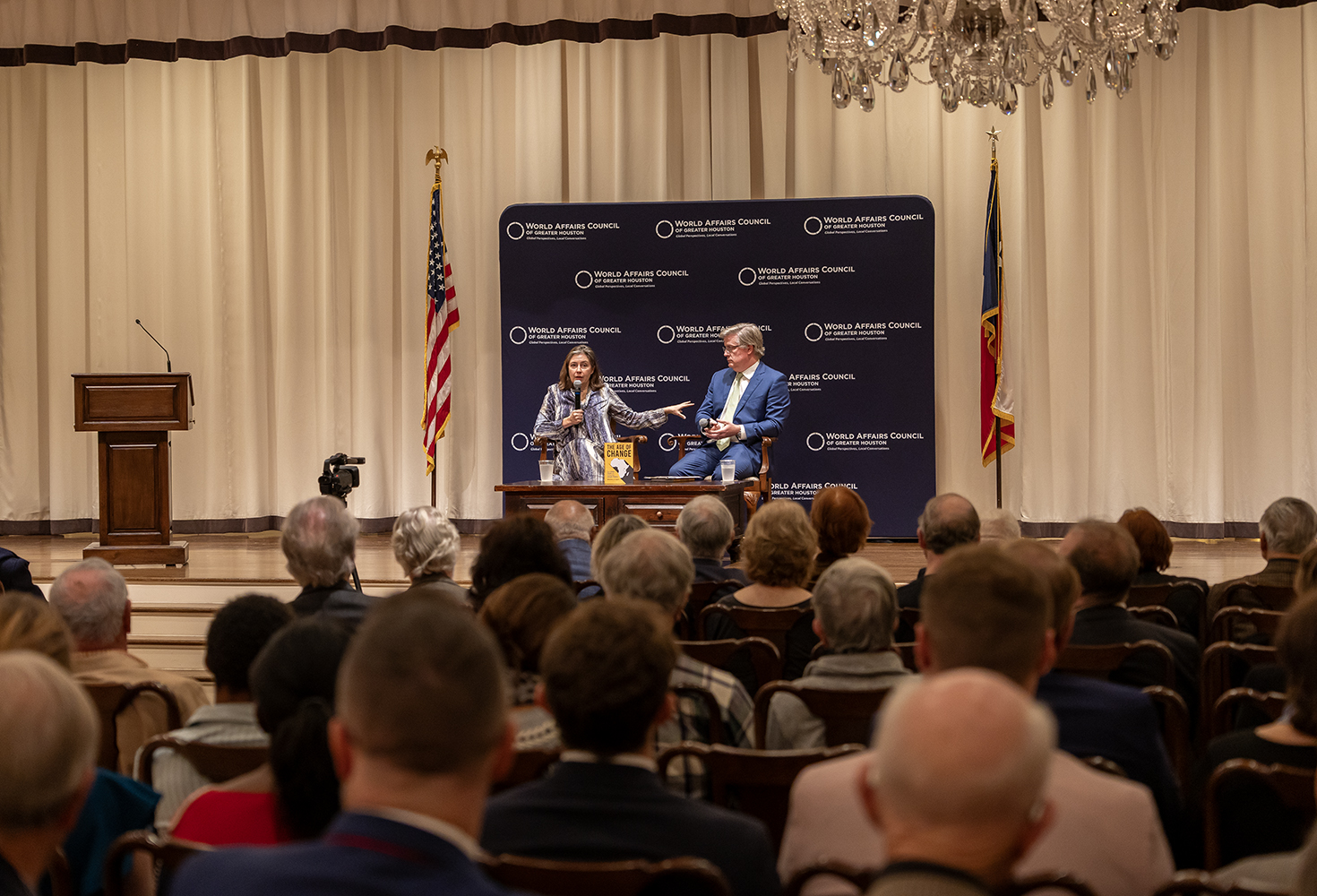
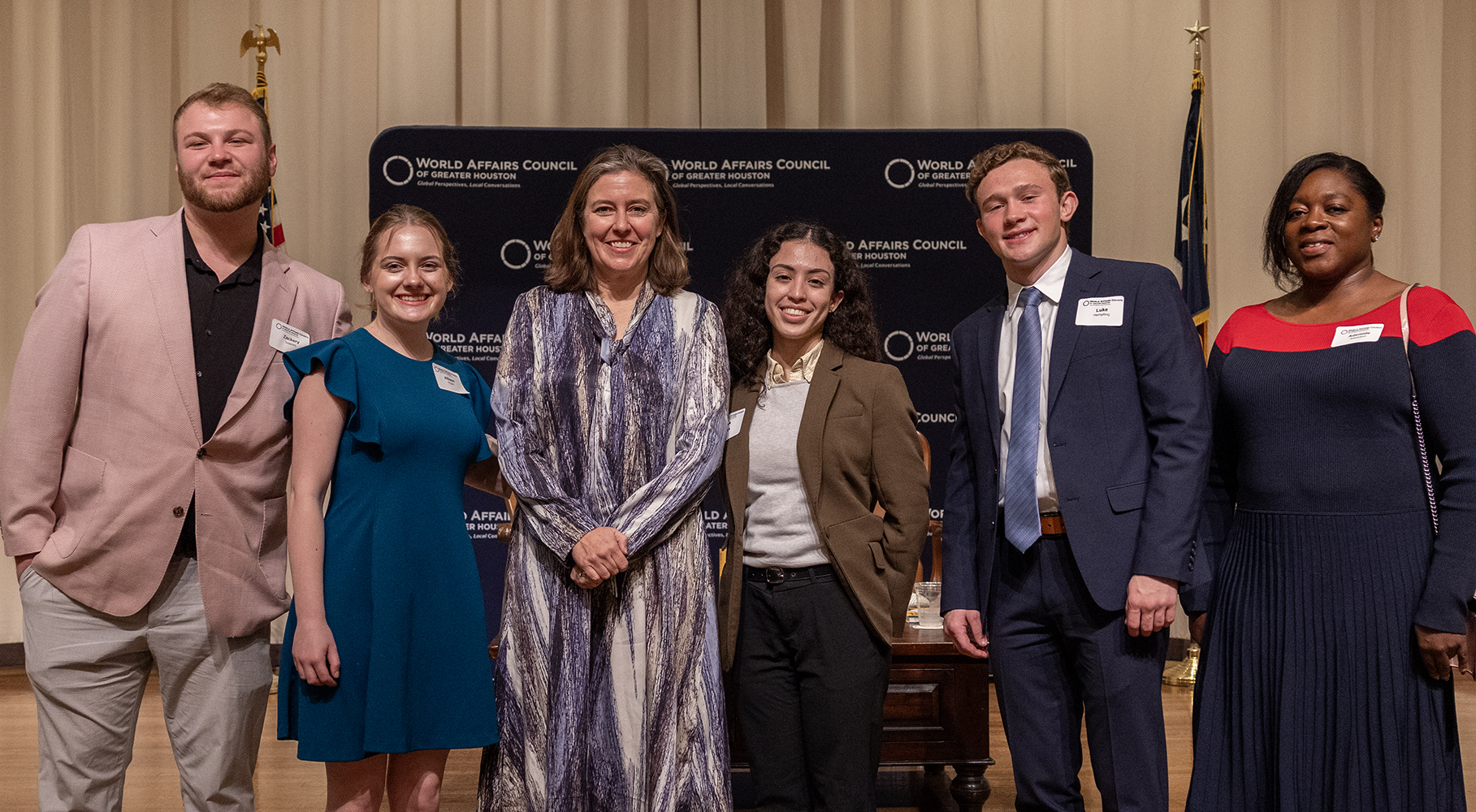
On February 2, LEAP students Zackery Isaacks, Mikaela Baires, Luke Hempfling, and I accompanied Professor Yawn and former Junior Fellow/LEAP Ambassador Ademide Adedokun to the Junior League of Houston to hear Ambassador Michelle Gavin speak about the rapid changes occurring in African politics– and what that might mean for the futures of African youth.
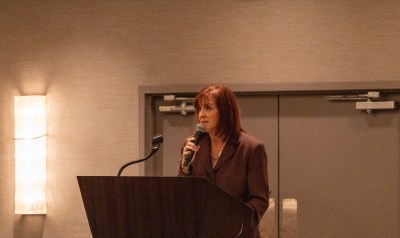
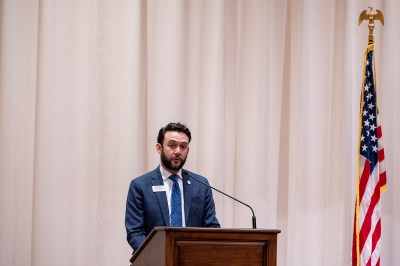
After Jahan Jafarpour, the Director of Programs, offered a brief introduction…
…our favorite moderator, Ronan O’Malley, began the interview, discussing some of the ideas Ambassador Gavin explores in her book, The Age of Change. One of these is the concept of a “demographic dividend,” which means a big boost to national productivity due to the increase of labor force and decrease of dependents, and this is occurring in a large number of Africa’s 54 countries.
While young people are gaining power in numbers and entering the job market, older generations are still running the government. Ambassador Gavin highlighted the example of Paul Biya, the President of Cameroon, who has been president for forty-three years, and he was just re-elected in October for another seven-year term. While some may political stability, others may see the potential for corruption and a stale–rather than dynamic–political culture.
Such regimes, according to Gavin, may not last much longer, as the African youth are becoming increasingly urbanized and have more resources to be connected. Under such circumstances, political organization becomes possible and real change can occur.
There are models of successful democracies in Africa, and if young people use countries such as Botswana as models, it is realistic to think that democracy can spread. Botswana has maintained peace and stability by electing good leaders, preventing corruption, and using their greatest natural resources (diamonds) wisely. In terms of governance, they use “Kgotla meetings,” something akin to “town halls,” which allow citizens to bring questions and concerns to community leaders. This provides for a sense of interconnectedness, promotes accountability, and allows for clear and frequent communication.
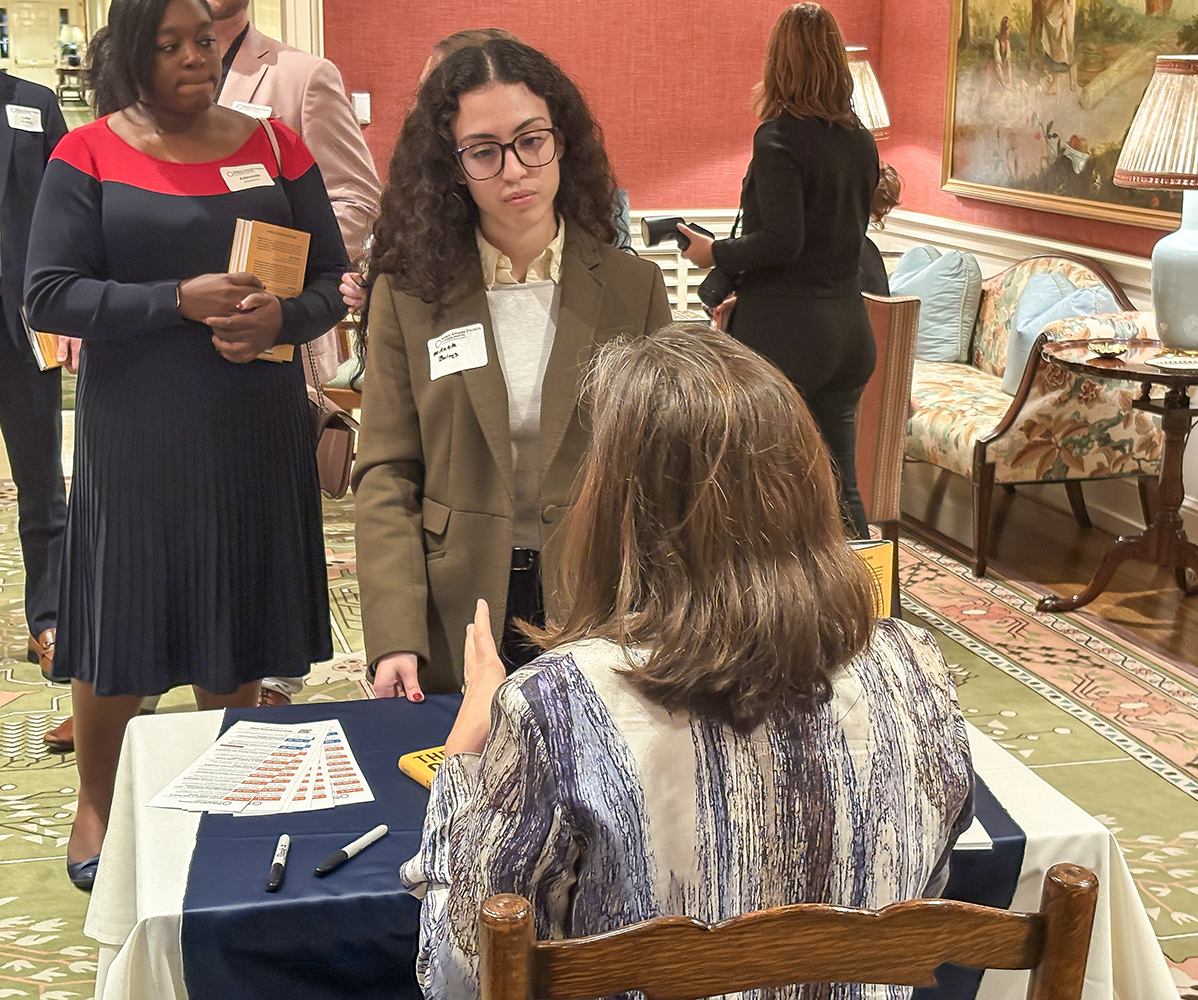
Following the talk, Maria Guarache swept us up to see Ambassador Gavin, and we were able to get photographs and our books signed, capping off a wonderful program.
And, to further enhance the evening, we joined Ms. Adedokun at ChopnBlok for some African food. Many of us had never tried African food before, so it was a nice way to add even more educational aspects to the field trip, while also learning more about Ms. Adedokun and her career, her perception of African politics, and a little bit of LEAP history, all wrapped into a top-notch meal by a James Beard Award-winning chef.
Although our foray into The Texas Tribune Festival brought us to different panels, focusing on different levels of government, and from different branches of government, a common theme pervaded: government works best when it isn’t dominated by one figure or one branch. It’s perhaps no surprise to hear federal judges push back against pressure from the executive branch, but it was more unusual to hear former Texas Speaker of the House Dade Phelan share the same sentiment.
Nonetheless, this is what we heard as we ventured into the Bethel Hall at St. David’s Episcopal Church. Despite the presence of the Texas Tribune Editor-in-Chief Matthew Watkins and Political Reporter Eleanor Kilbanoff, the focus was on former Texas House Speaker Dade Phelan, who recently announced his retirement from the Texas House.
Somewhat unusually, this elicited a comment from President Donald Trump weighed in on Phelan’s impending retirement: “Fortunately for the Great State of Texas, their Former Speaker, who is no longer Speaker, Dade Phelan, is quitting politics…” Trump’s unhappiness with Phelan probably stems from 2023, when the then-Speaker brought impeachment proceedings against Attorney General Ken Paxton, a close Trump ally. President Trump went on to endorse Phelan’s primary opponent in his next election, although Phelan was able to manage a win in a closely-contested runoff.
Ultimately, however, Phelan made a choice not to run for Speaker: “I couldn’t ask the House Republicans to choose between me and President Trump.” Noting that he wasn’t a MAGA Republican, he felt like his confrontations with the President would make things difficult for his constituents (the members of the House of Representatives) if he continued as Speaker.
President Trump also dominated the discussion at “Living Document” panel, in which UT Law Professor Grove moderated a discussion with former Federal District Judges Royal Ferguson, Lee Yeakel, and Vanessa Gilmore.
The words “messy,” “wrong,” and “unprecedented” popped up again and again like literary motifs throughout the hourlong session. A recurring theme was the role of the “Shadow Docket” of the Supreme Court, which are often decided without full oral arguments and in unsigned form. President Trump has filed 20 “emergency applications” in seven months to the shadow docket, and the Court has, at least for now, seemingly expanded Trump’s control over the executive branch.
This has resulted in the overturning of many appellate and district-level decisions, the latter of which was particularly unsettling to the panel. “The District Court level,” noted Judge Ferguson, “is where the facts are settled.” The judge and the jury have the ability to assess the credibility of the witnesses and, at times, the defendant beyond merely reading a transcript. Overturning these cases with such regularity is, according to the panel, disregarding the role of fact assessment in reaching a verdict.
Equally as appalling to the panel have been the “attacks on the judiciary,” a point Judge Gilmore noted repeatedly. Top level executive branch officials have called for impeaching judges (something that has rarely occurred throughout history) or used harsh language to criticize judges for rulings adverse to the administration.
More alarming, however, are the increasing threats against judges. Last year there were more than 500 threats to federal judges, and the threats are becoming increasingly personal. In many cases, pizzas are being delivered to the judges’ homes, ordered by a “Daniel Anderl”–the name of a judge’s son who was murdered at his front door in 2020. Such “pizza doxxings” are a clear message to judges, a reminder of their vulnerability.
It is also a clear and concerning repudiation of the philosophical foundations on which the US Government was built, laid out in the Constitution and in Madison’s Federalist #51, in which he said, “it is evident that each department should have a will of its own; and consequently should be so constituted that the members of each should have as little agency as possible in the appointment of the members of the others…”
On that discordant, we retreated to the Voltron Room at the Capitol Factory, where we listened to the soothing sounds of Texan singer Mollie Danel and contemplated the responsibilities of citizenship.
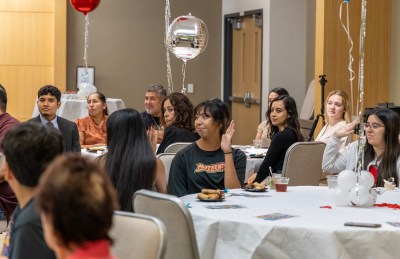
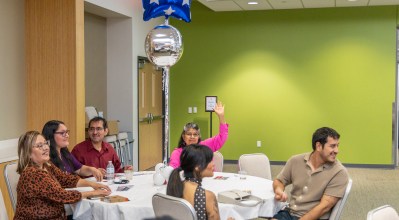
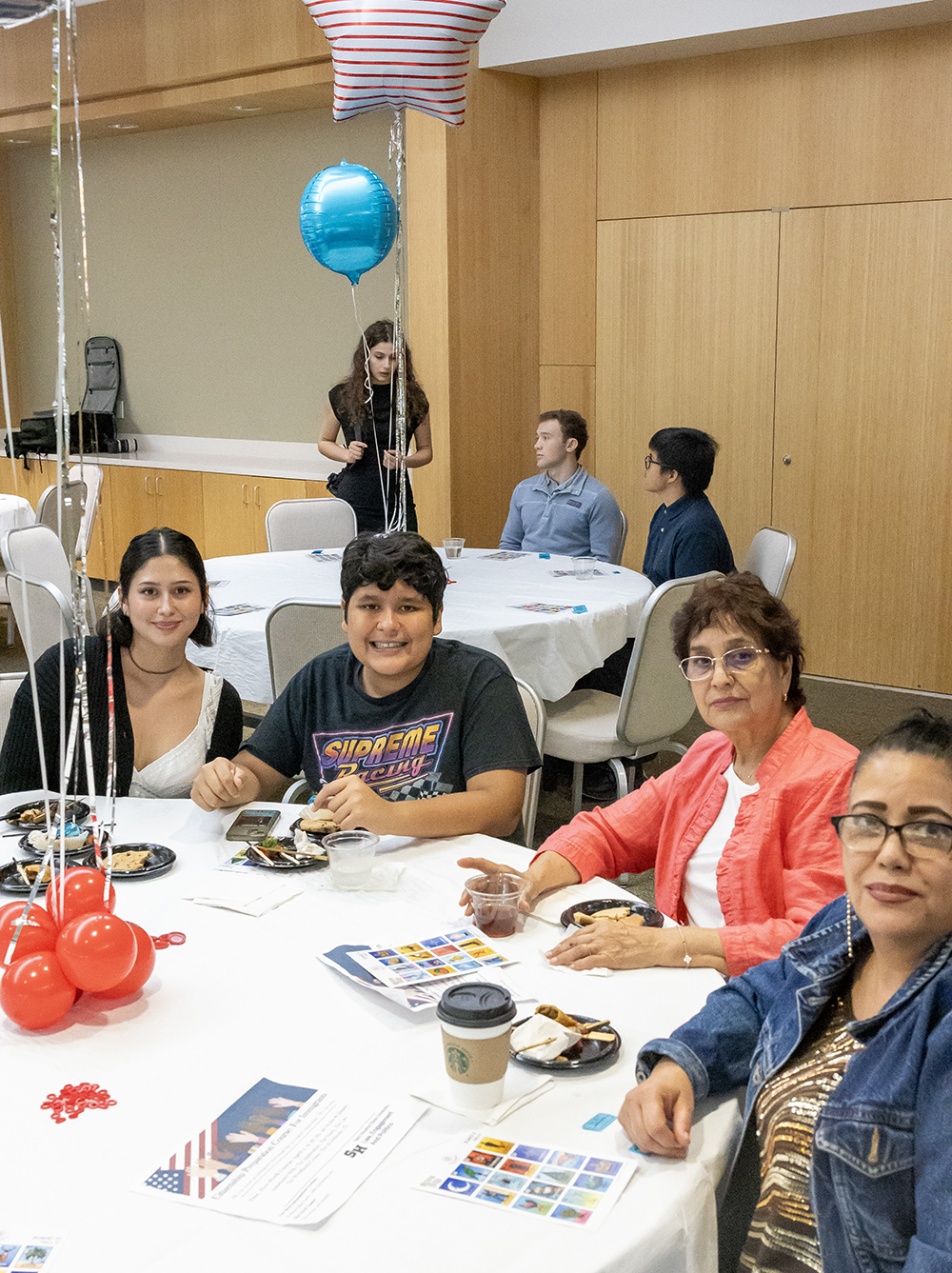
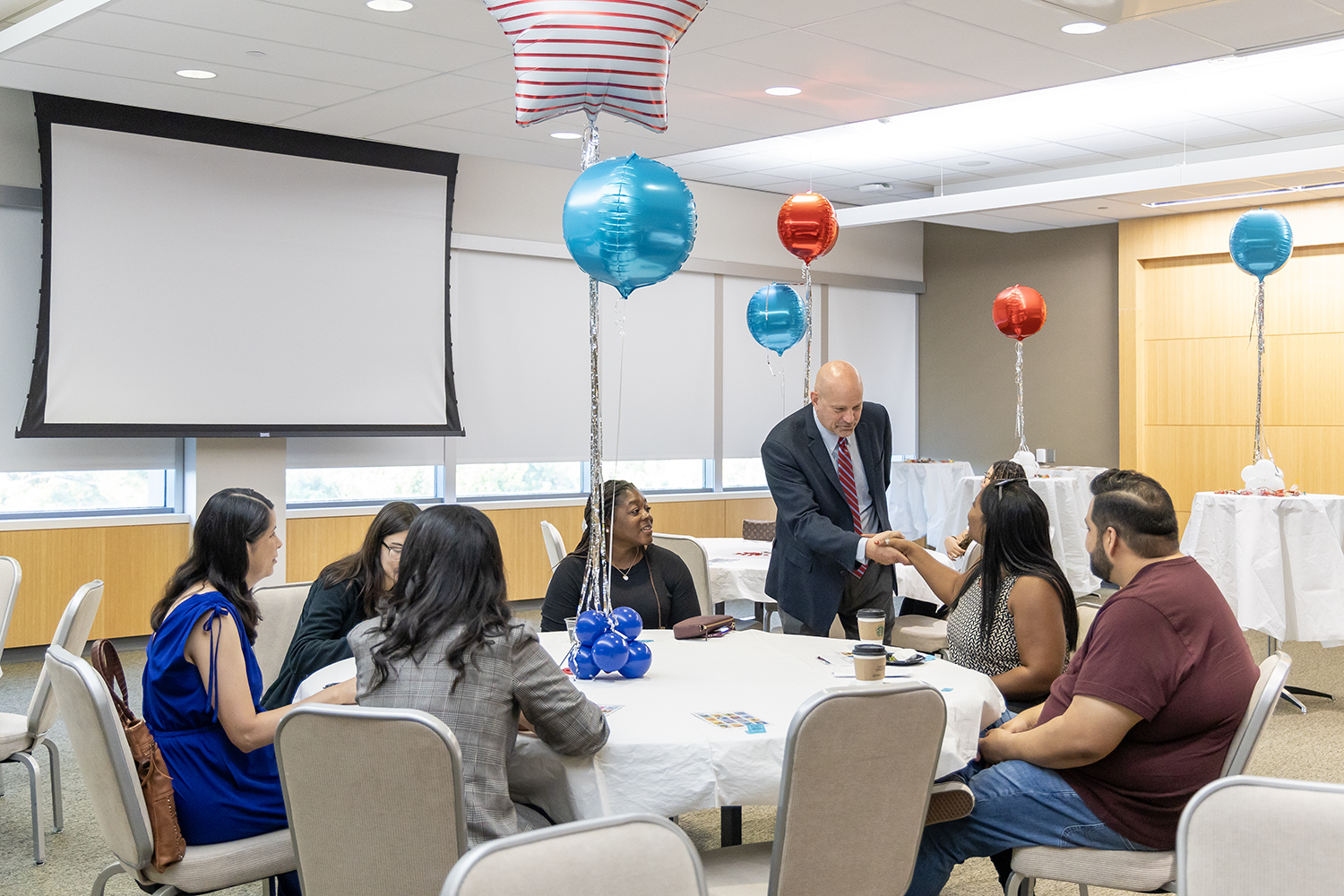
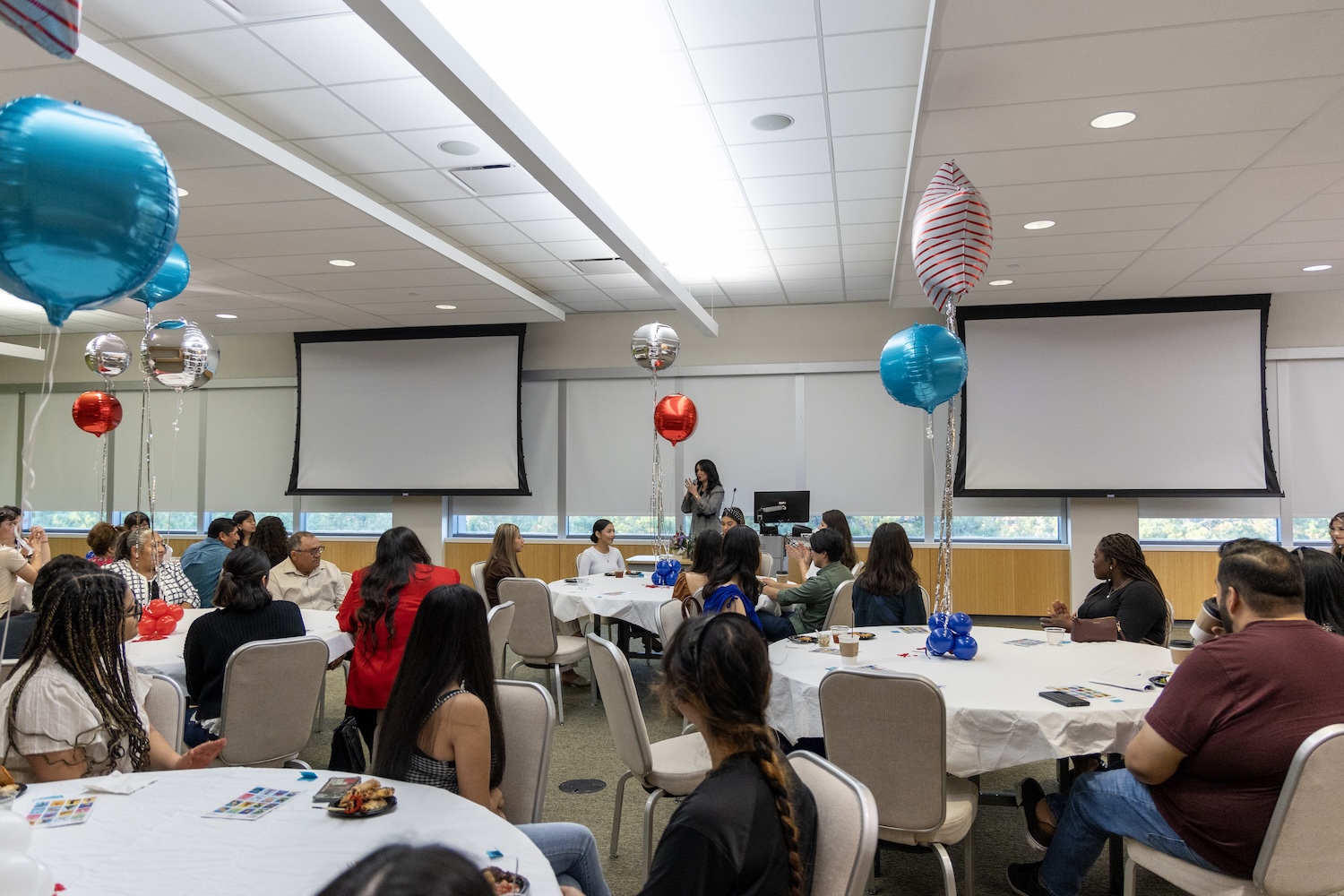
After months of anticipation and careful planning, we opened the doors to our Citizenship Celebration at The Woodlands Center–an evening that marked not just a milestone, but the launch of an exciting new chapter for our existing citizenship program.
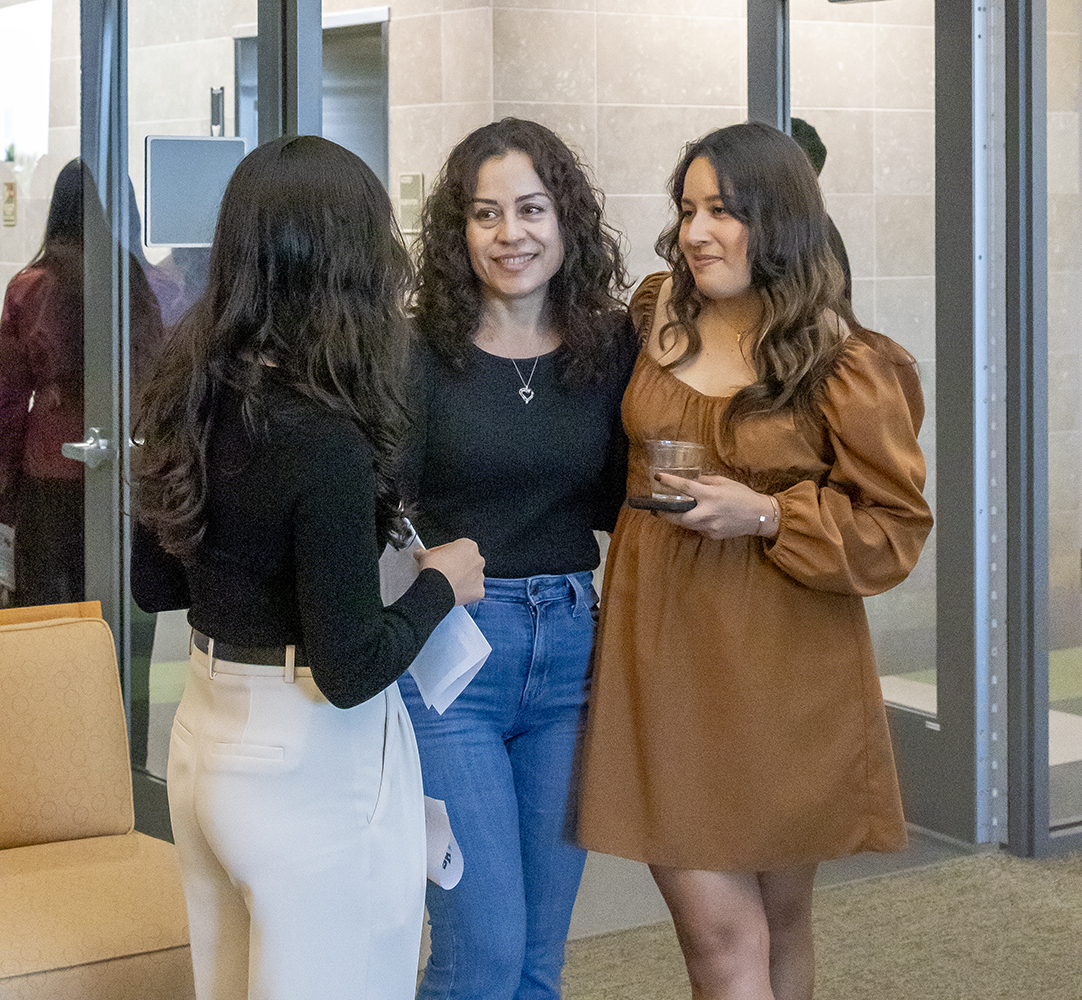
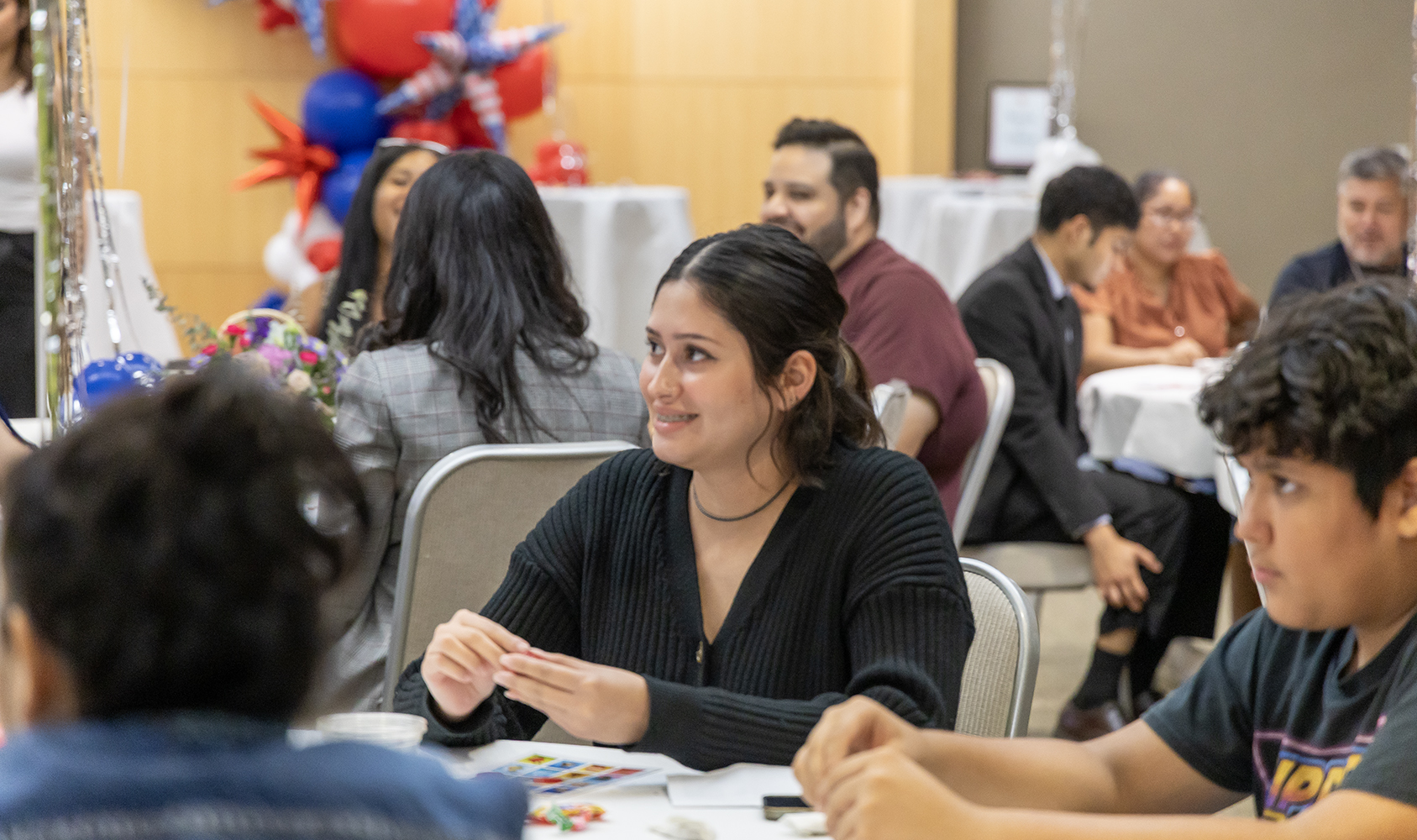
The celebration brought together naturalized citizens, aspiring citizens, LEAP friends and alumni, all united by a shared support for those on their journey toward citizenship and the program.
What began in 2008 as a local initiative in Walker County has grown far beyond its original scope. Thanks to National Partnership for New Americans, the program now reaches into Montgomery County, creating new connections and expanding the community in meaningful ways.
One of the many goals for this celebration was to ensure every guest left with a meaningful takeaway. This is always easier when everyone shares a common purpose. For us, this growth brought new connections in the Montgomery area, including volunteers from Caney Creek High School…
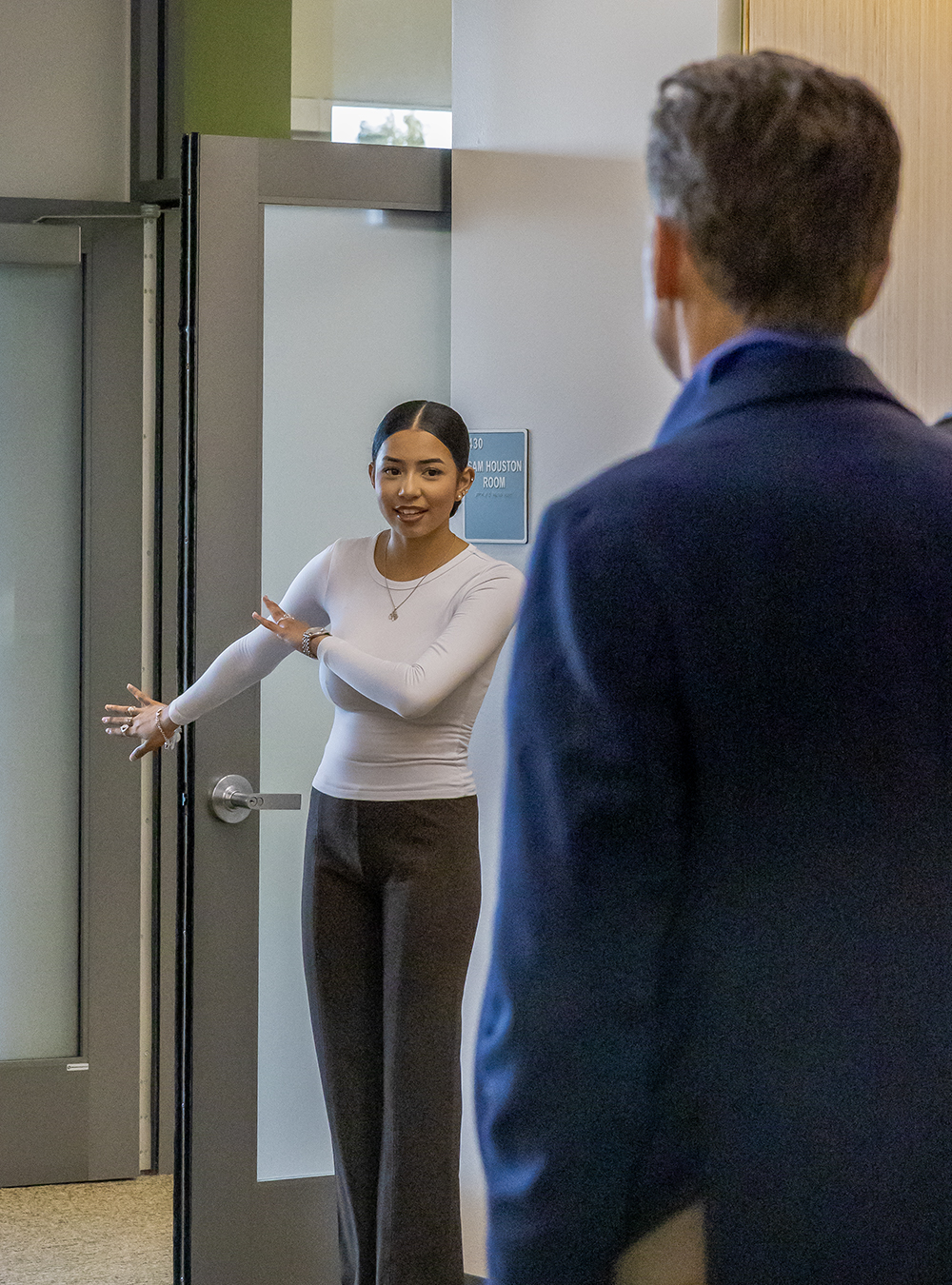
…who joined SHSU students to create a welcoming, vibrant atmosphere for the guests as they arrive.
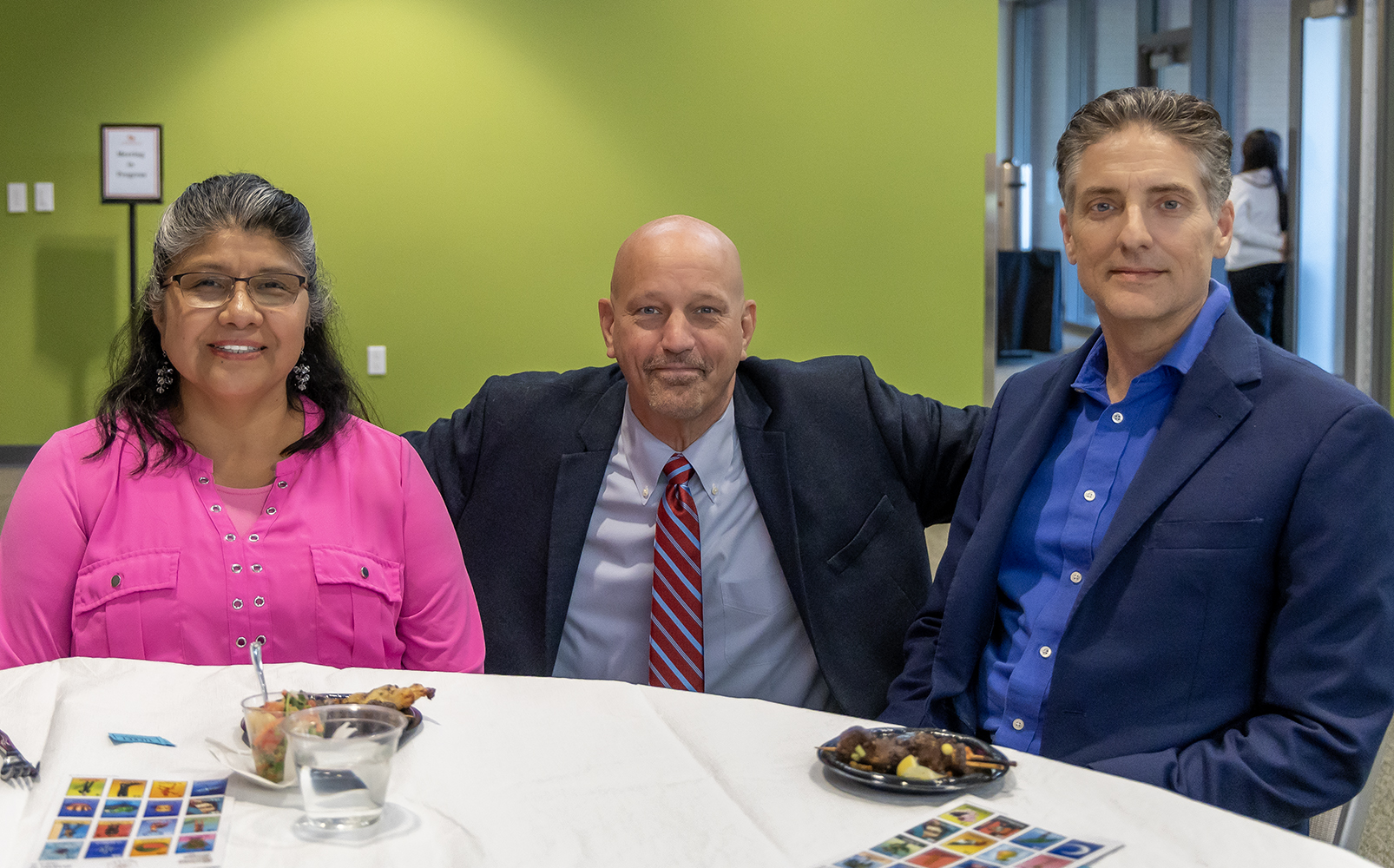
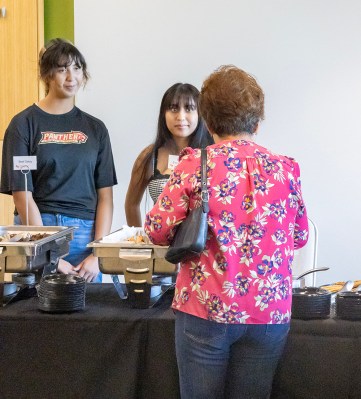
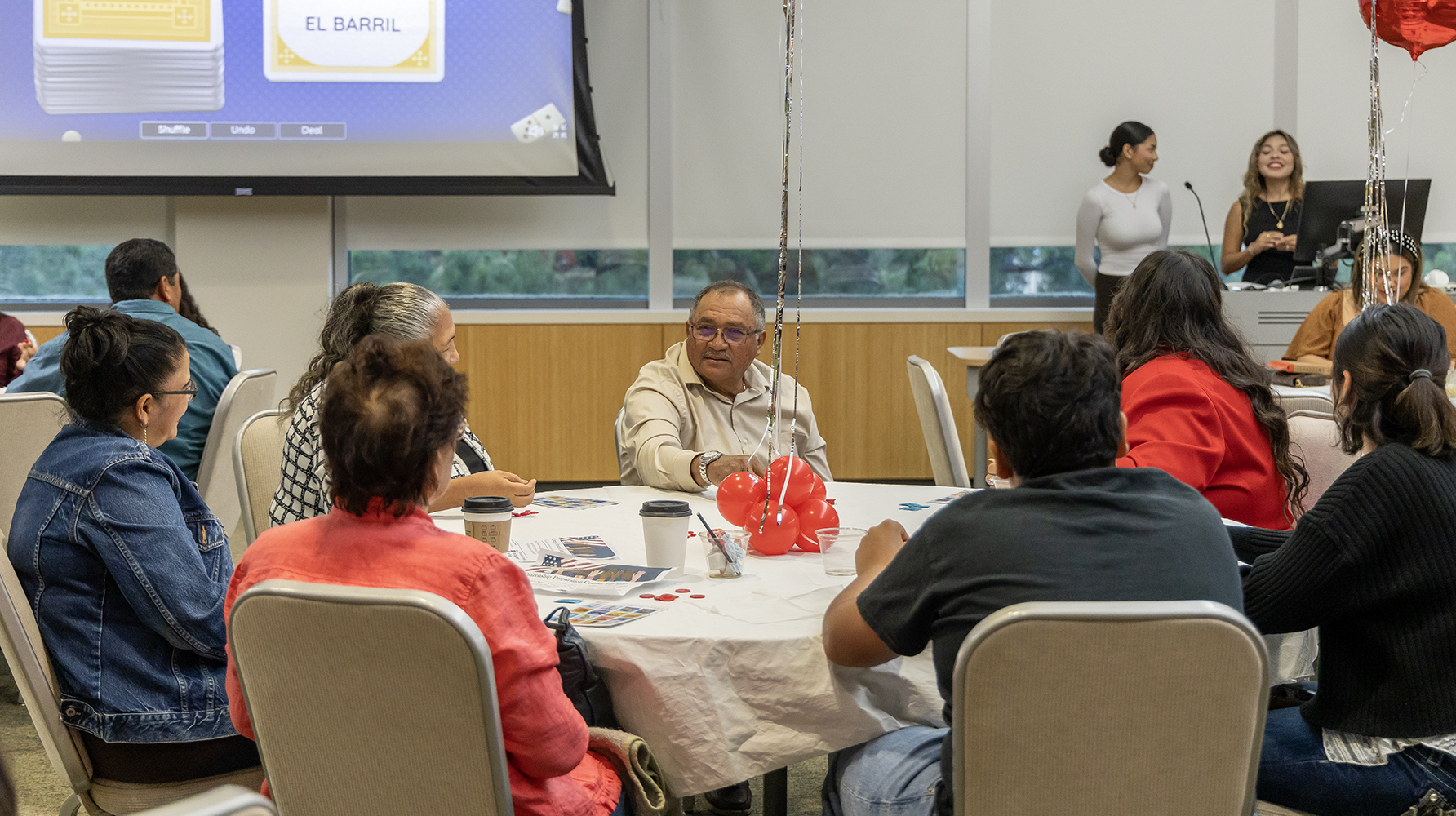
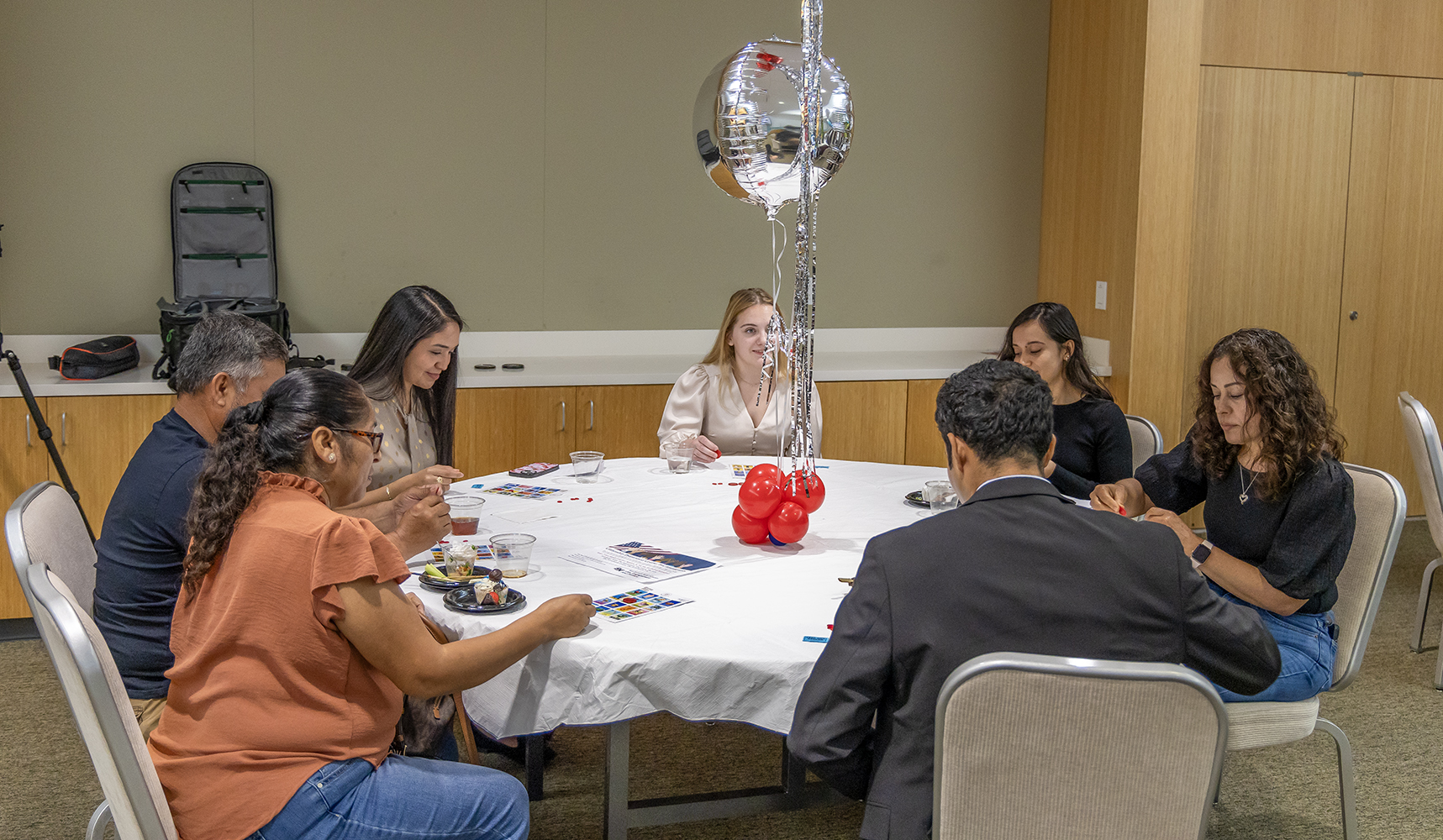
As guests arrived, they settled in with plates of delicious food–empanadas, beef satay, ceviche, and an array of other cultural dishes–setting the stage for an evening of culture and connections. The room itself was beautifully decorated with a patriotic theme symbolizing the civic pride and sense of belonging that come with citizenship.
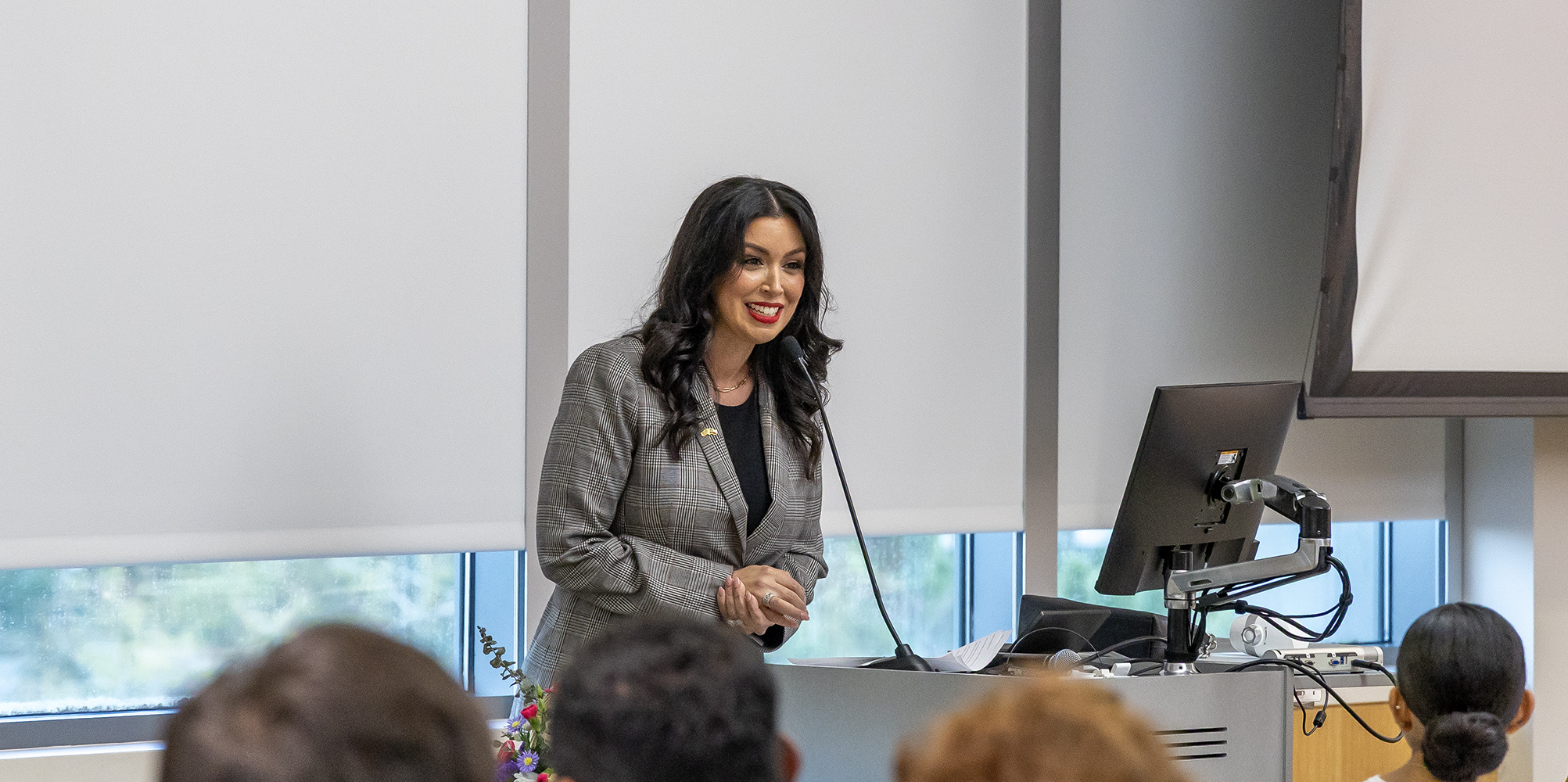
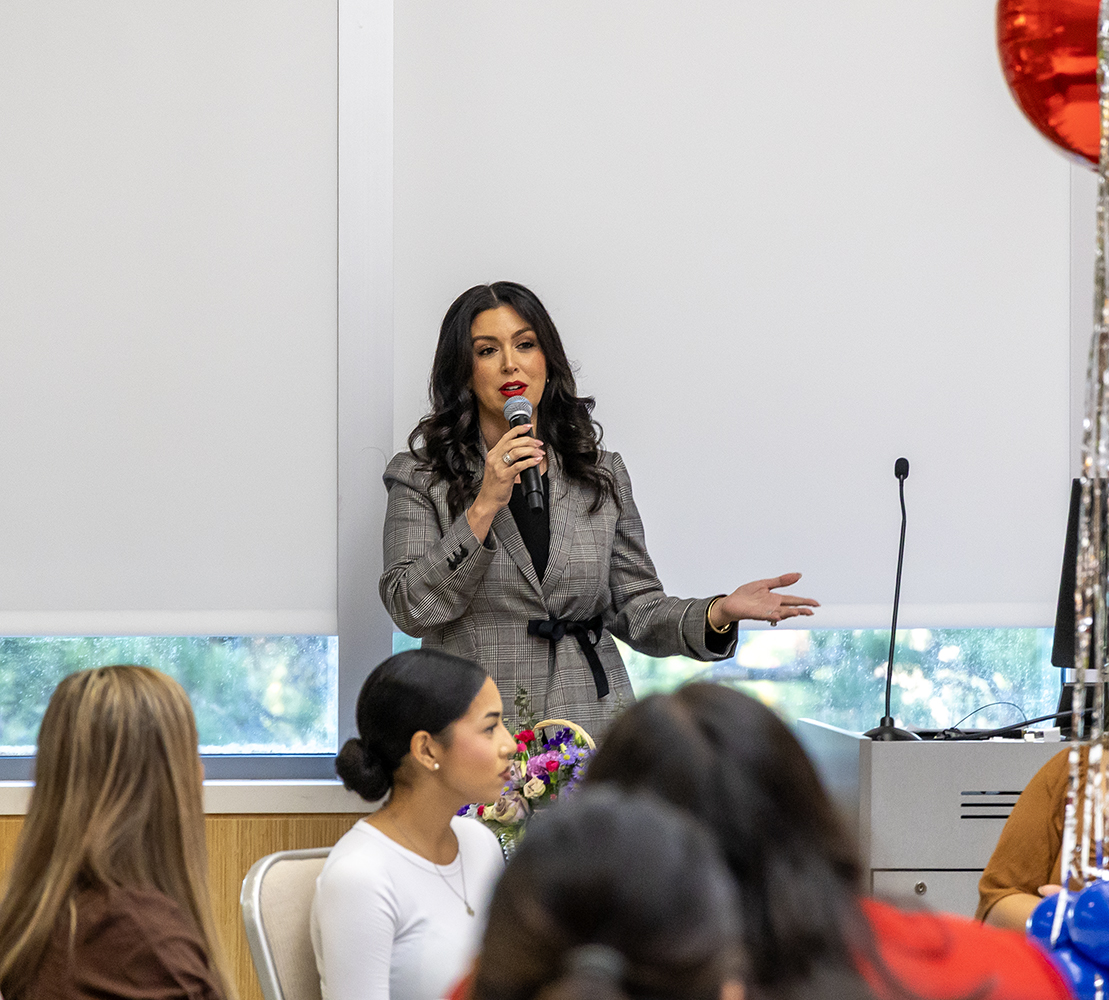
The ceremony began with Professor Yawn, who welcomed attendees and explained how LEAP’s citizenship program is expanding beyond Walker County.
The audience included familiar faces like Gregoria McGuire and Roxana Woychesin, former course participants, alongside eager newcomers ready to begin their journey.
LEAP alumni–Brian Aldaco, Bianca Saldierna, Ademide Adedokun, and Megan Chapa–also in attendance, perfectly timed to coincide with LEAP’s upcoming 20th anniversary celebration and the launch of new initiatives.
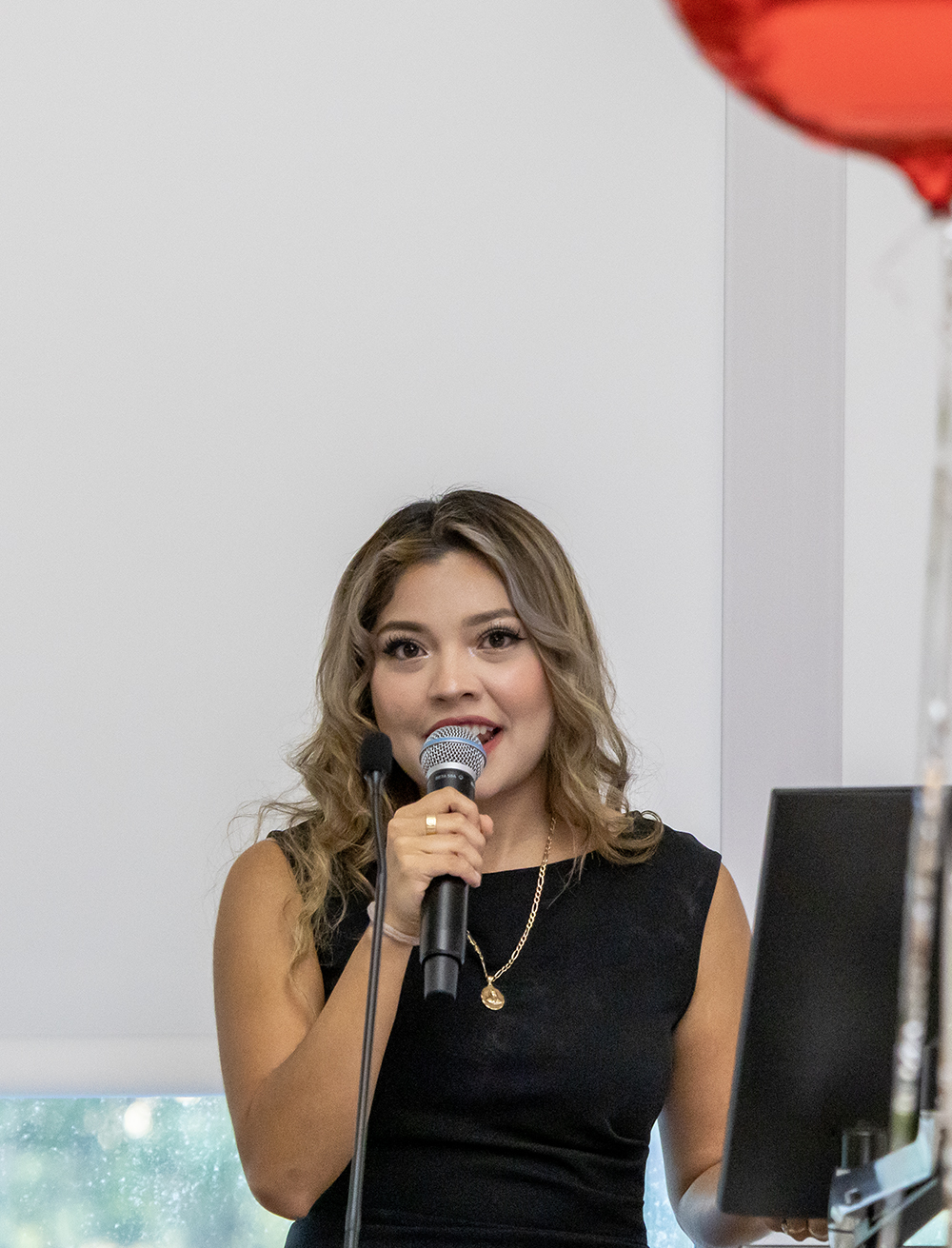
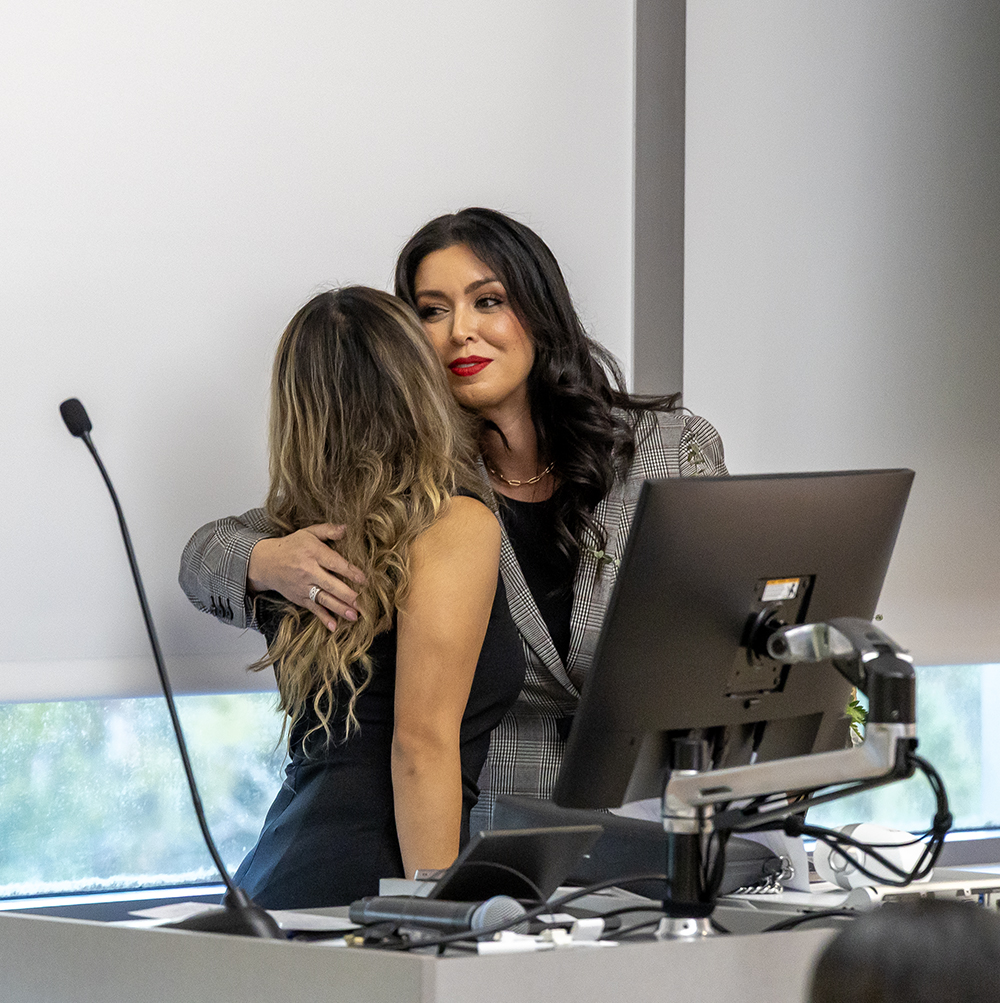
I then had the chance to offer my own words of welcome — thanking everyone for their incredible support and emphasizing that this event was truly a celebration for all: those who had been naturalized, those beginning the journey, and those supporting this civic milestone.
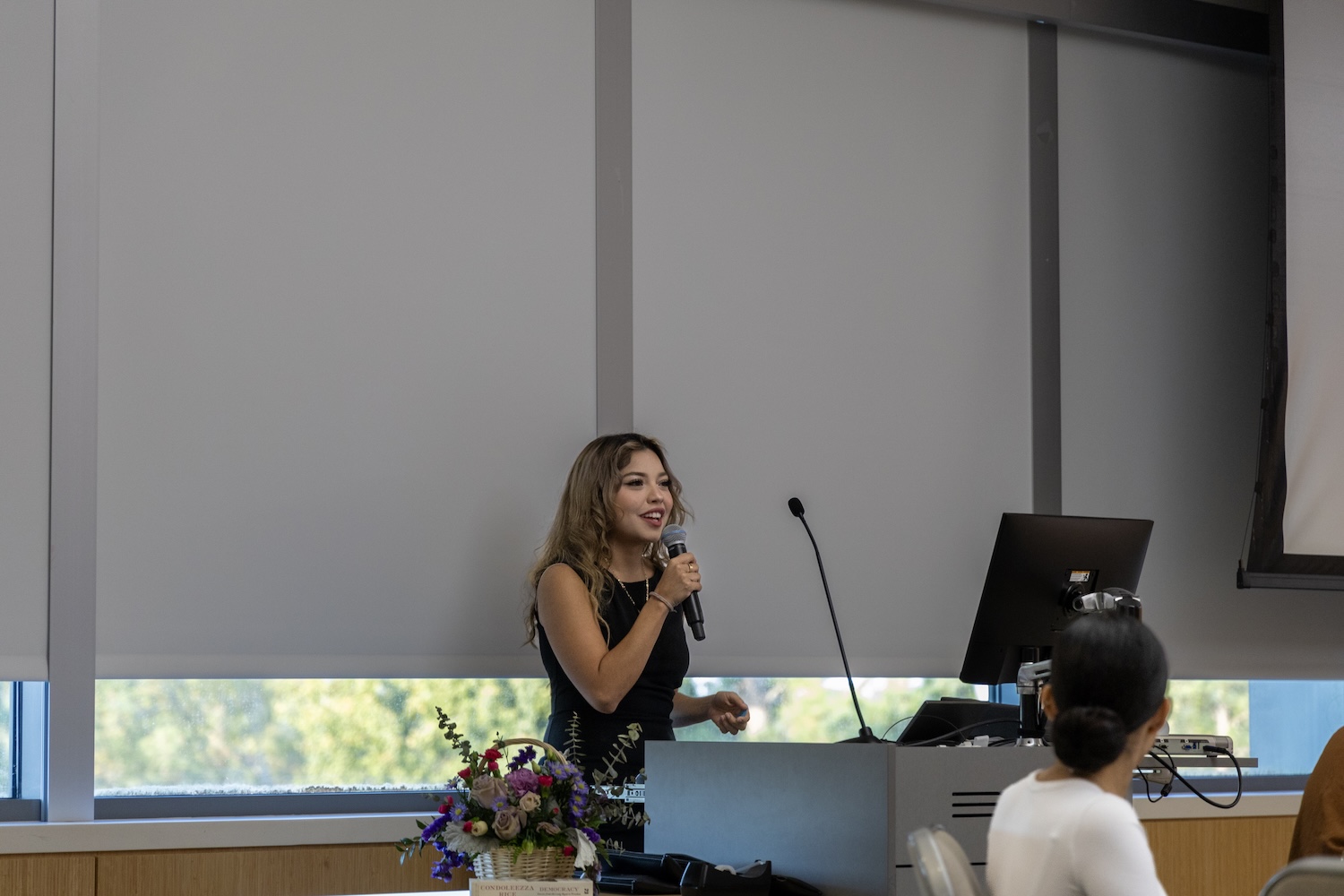
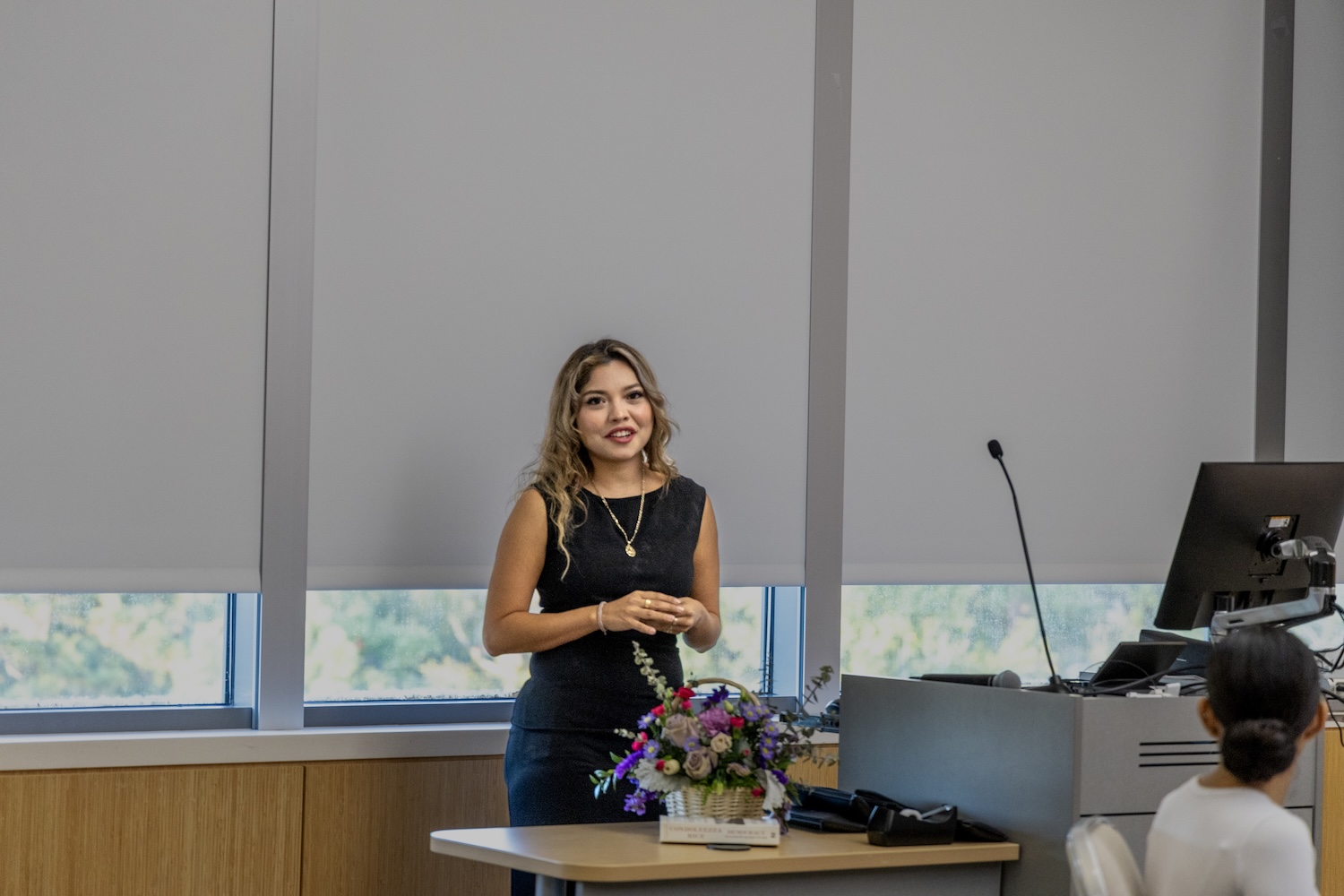
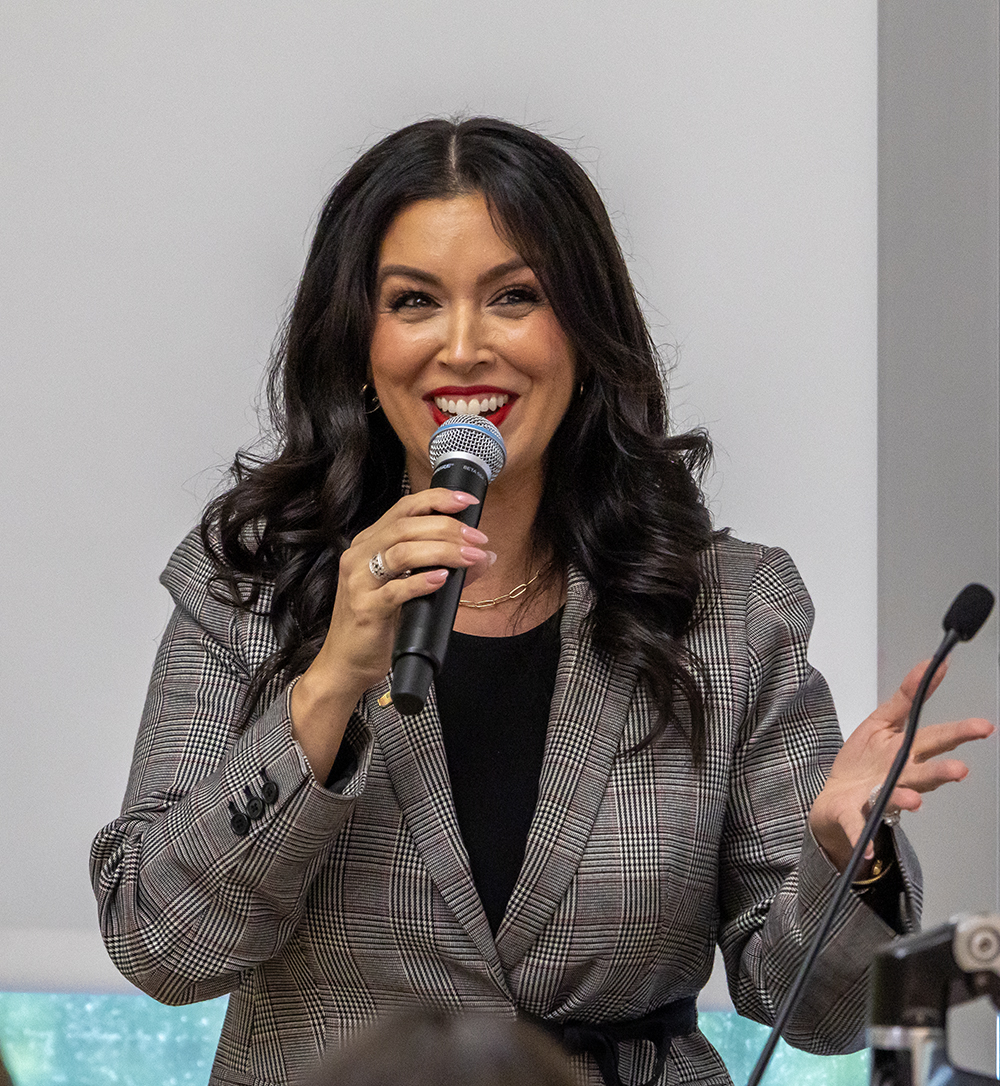
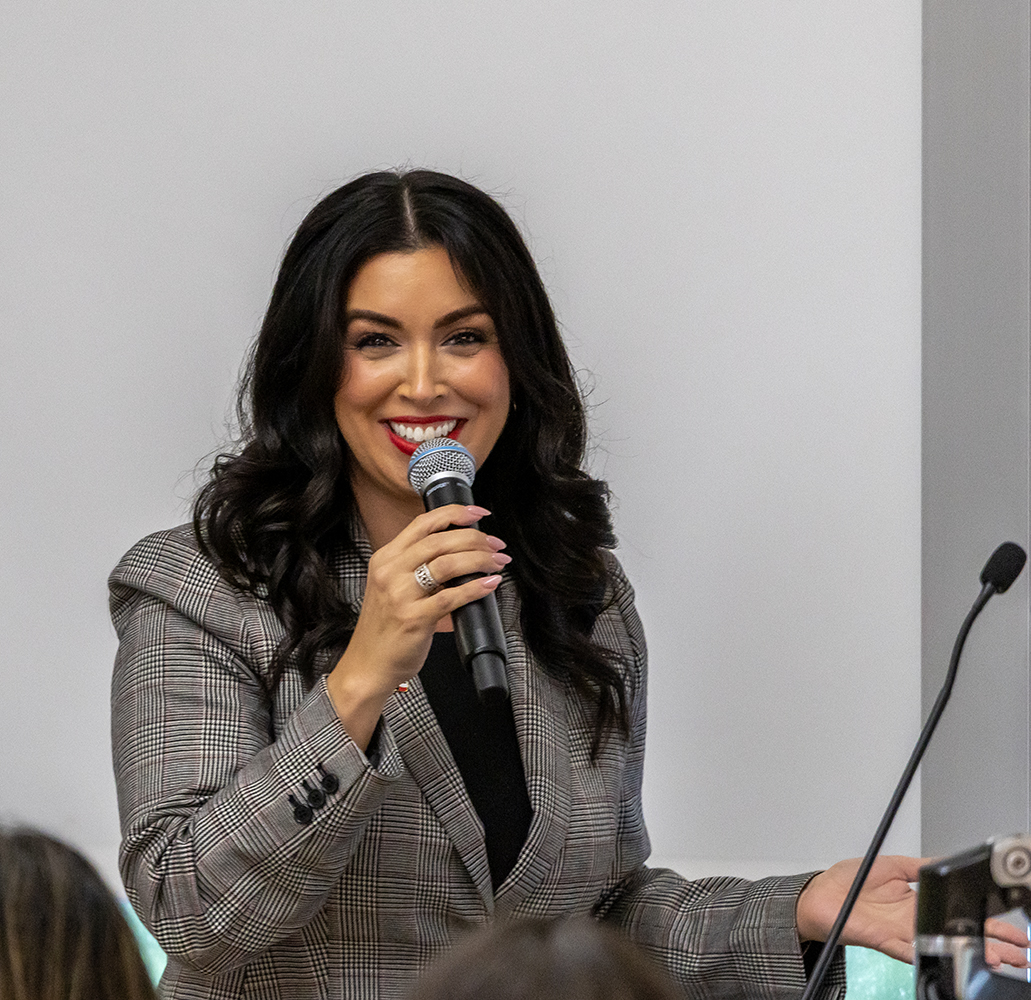
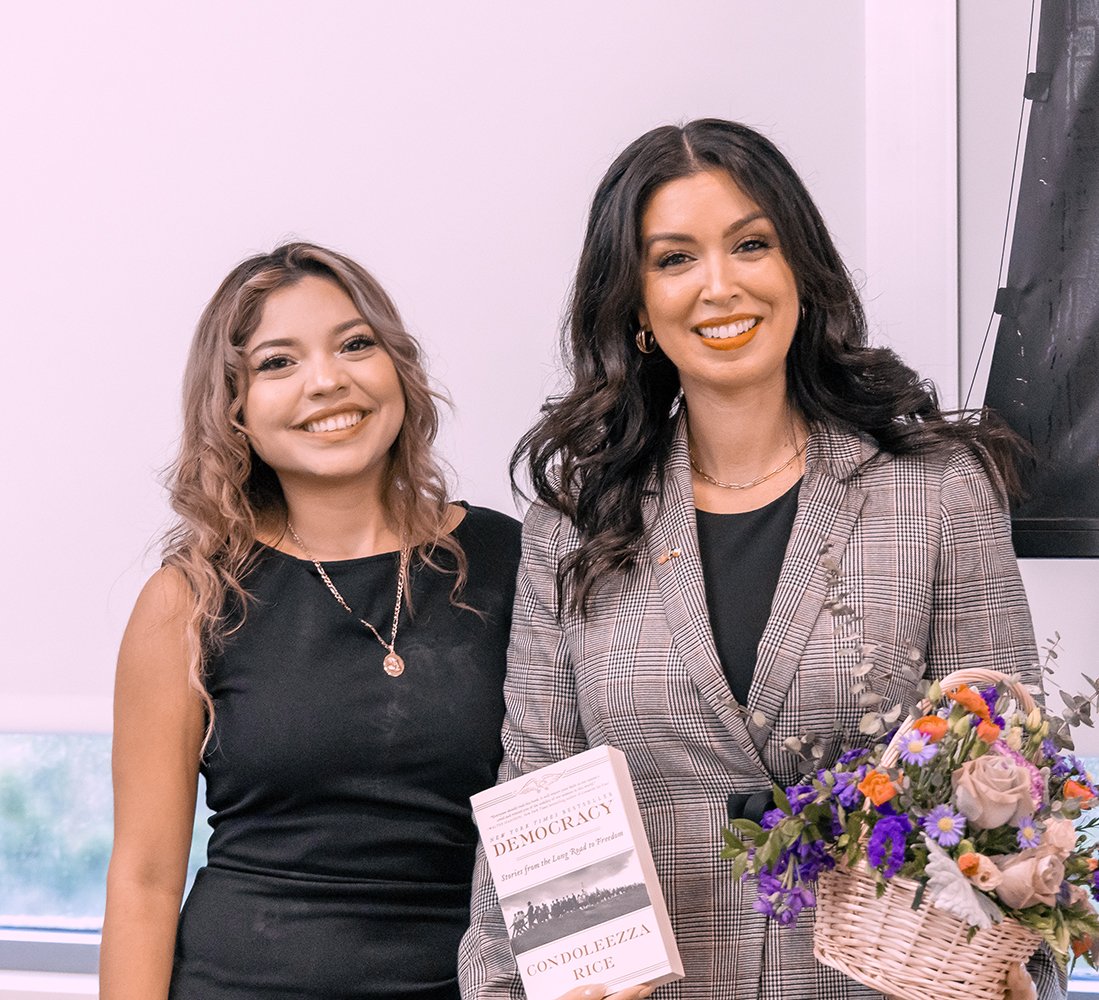
Then came the moment I’d been looking forward to — introducing Christina Sato, who so graciously agreed to share her journey and beautiful words with us. Christina Sato is an accomplished actress, singer, and University of Texas at Austin graduate who interned for former U.S. Senator Kay Bailey Hutchison and has built an impressive career bridging entertainment and public service.
Christina spoke beautifully about three important themes, with one particularly powerful message about the importance of an invitation…
…recalling that she first met Professor Yawn in an elevator, three years ago. That chance meeting, followed by some networking, led to the invitation to speak at this event.
She tied this concept perfectly to the crowd and their purpose, making everyone feel the significance of being present and being welcomed into community.
Her story was one of unexpected turns and beautiful detours. Sato shared how she began her career with aspirations in public service, only to find life taking her down different paths-through entertainment, through various roles and opportunities that she never initially imagined. Rather than viewing these changes as setbacks, she embraced them as part of life’s natural rhythm. Her journey wasn’t linear, and she owned that truth with grace and authenticity.
For the naturalized citizens in the room– many of whom had taken long, winding roads to reach that point–her story struck a personal note. For those still on their journey toward citizenship, her message offered hope, encouragement, and a reminder that every experience brings us closer to where we’re meant to be.
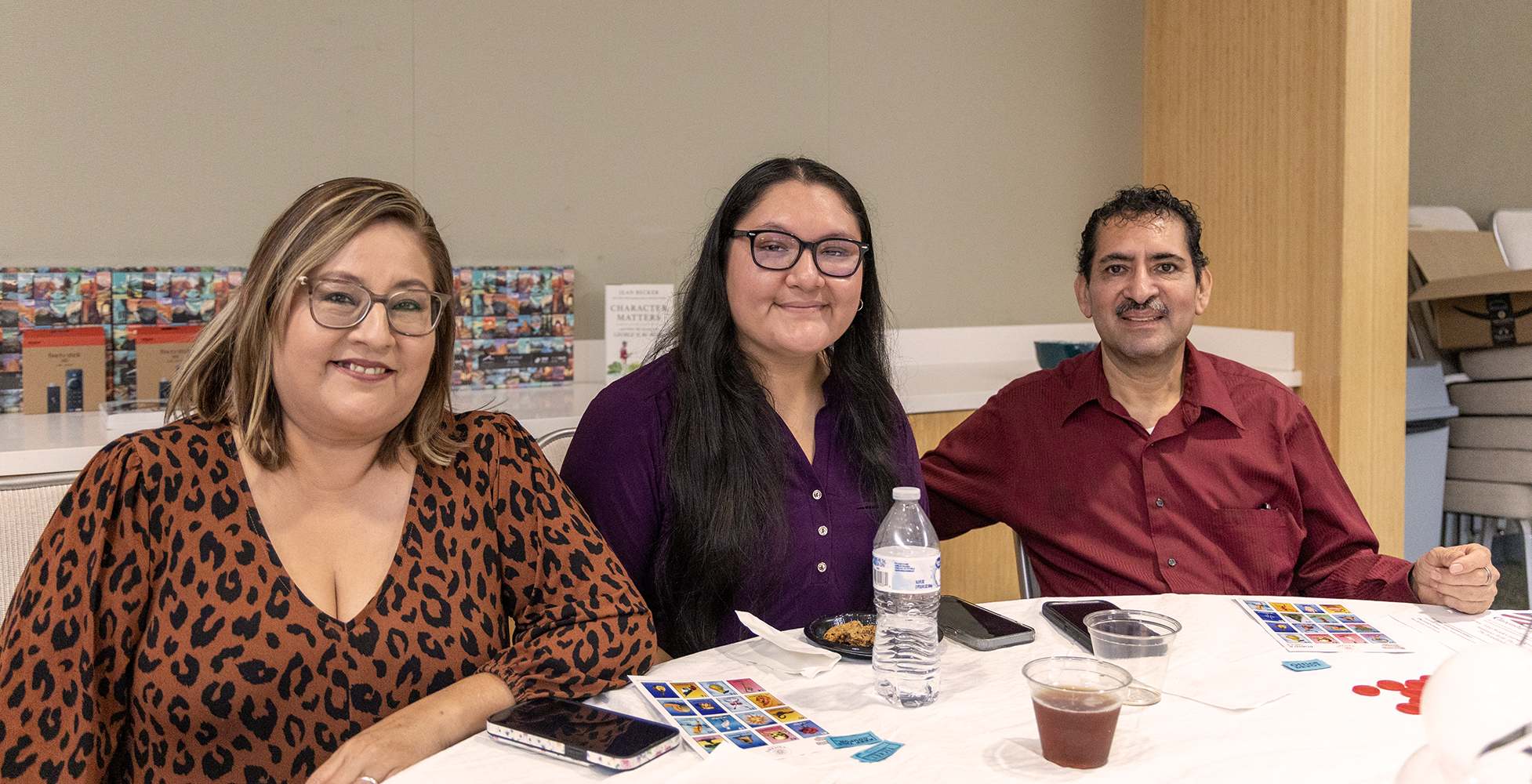
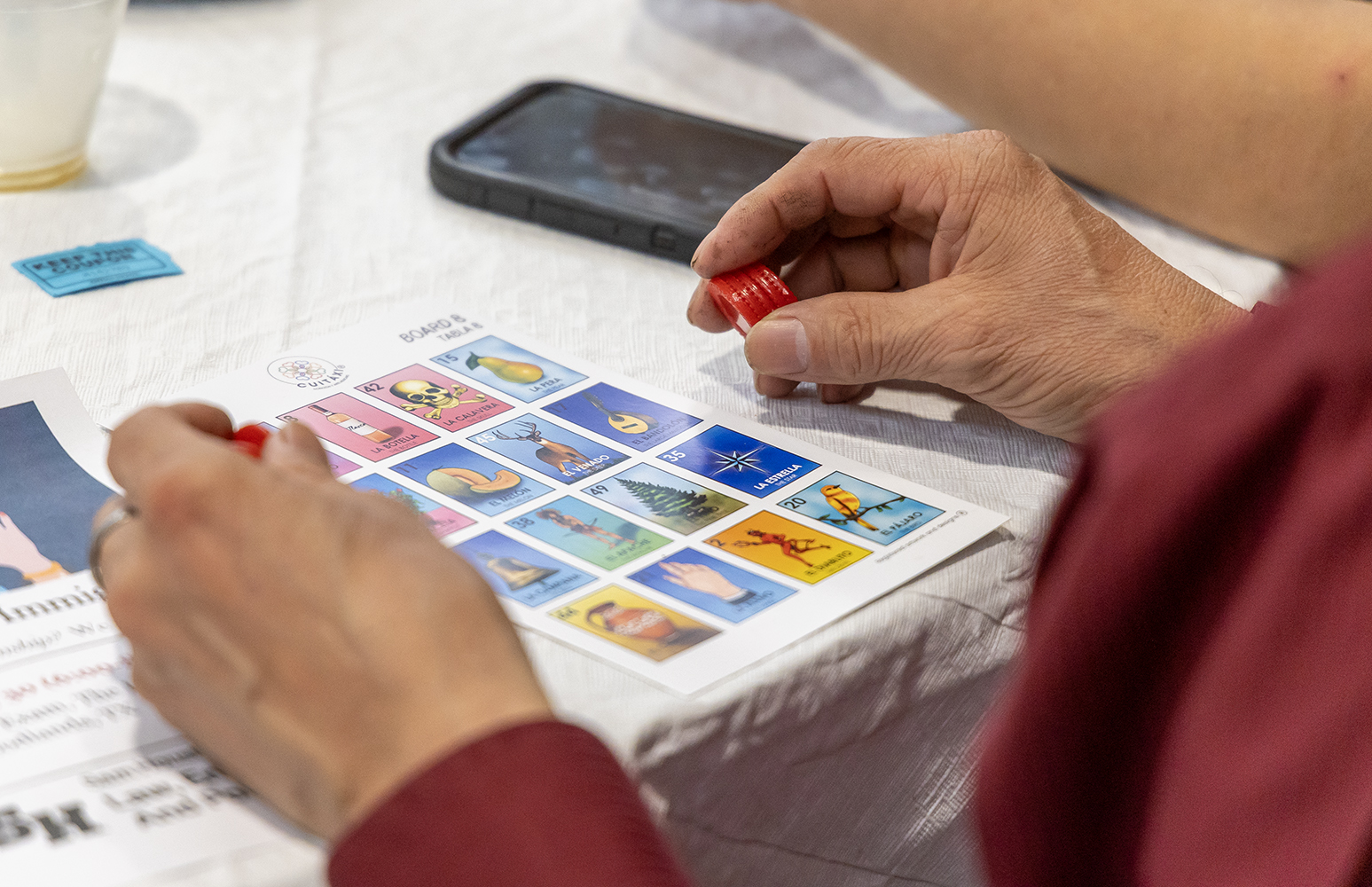
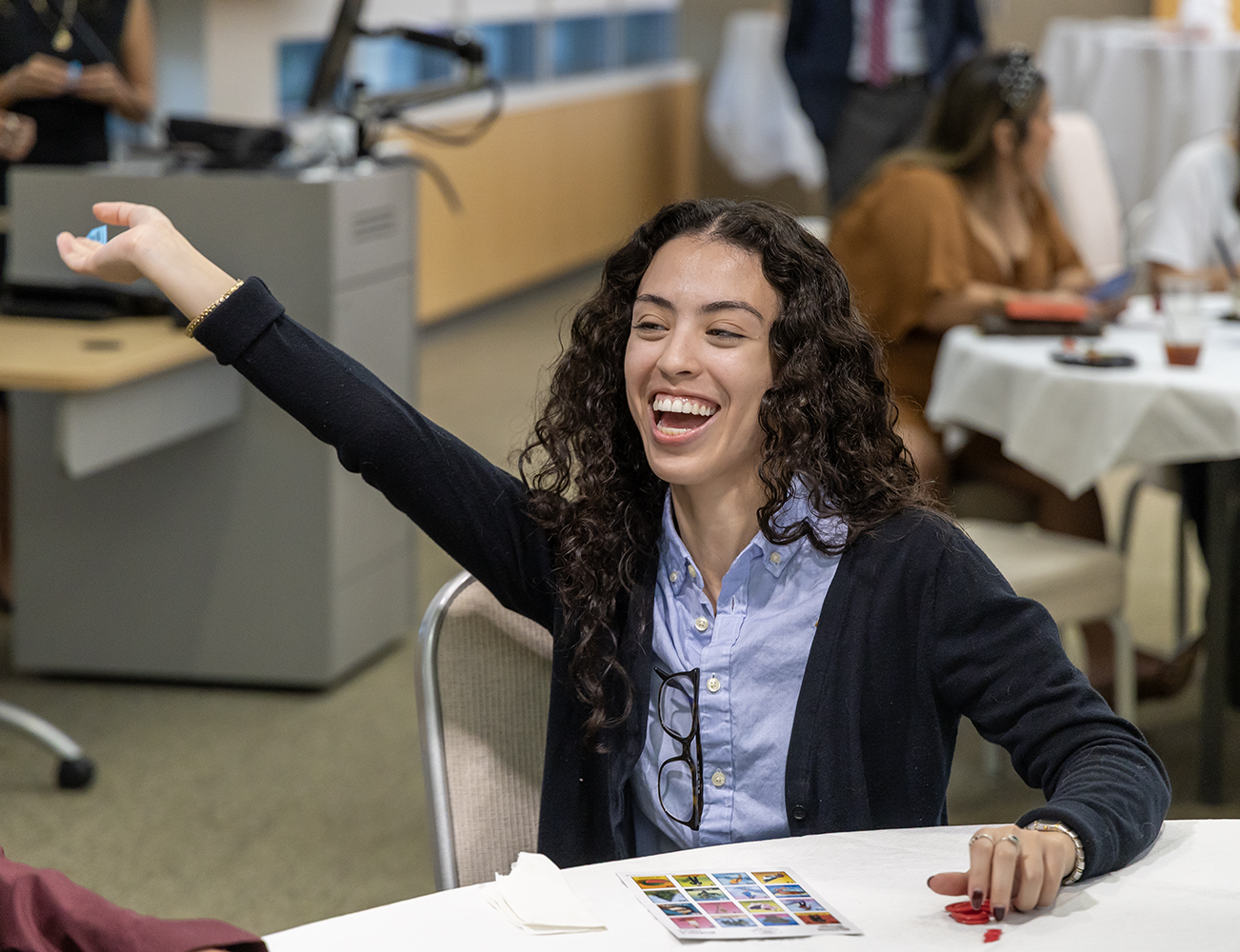
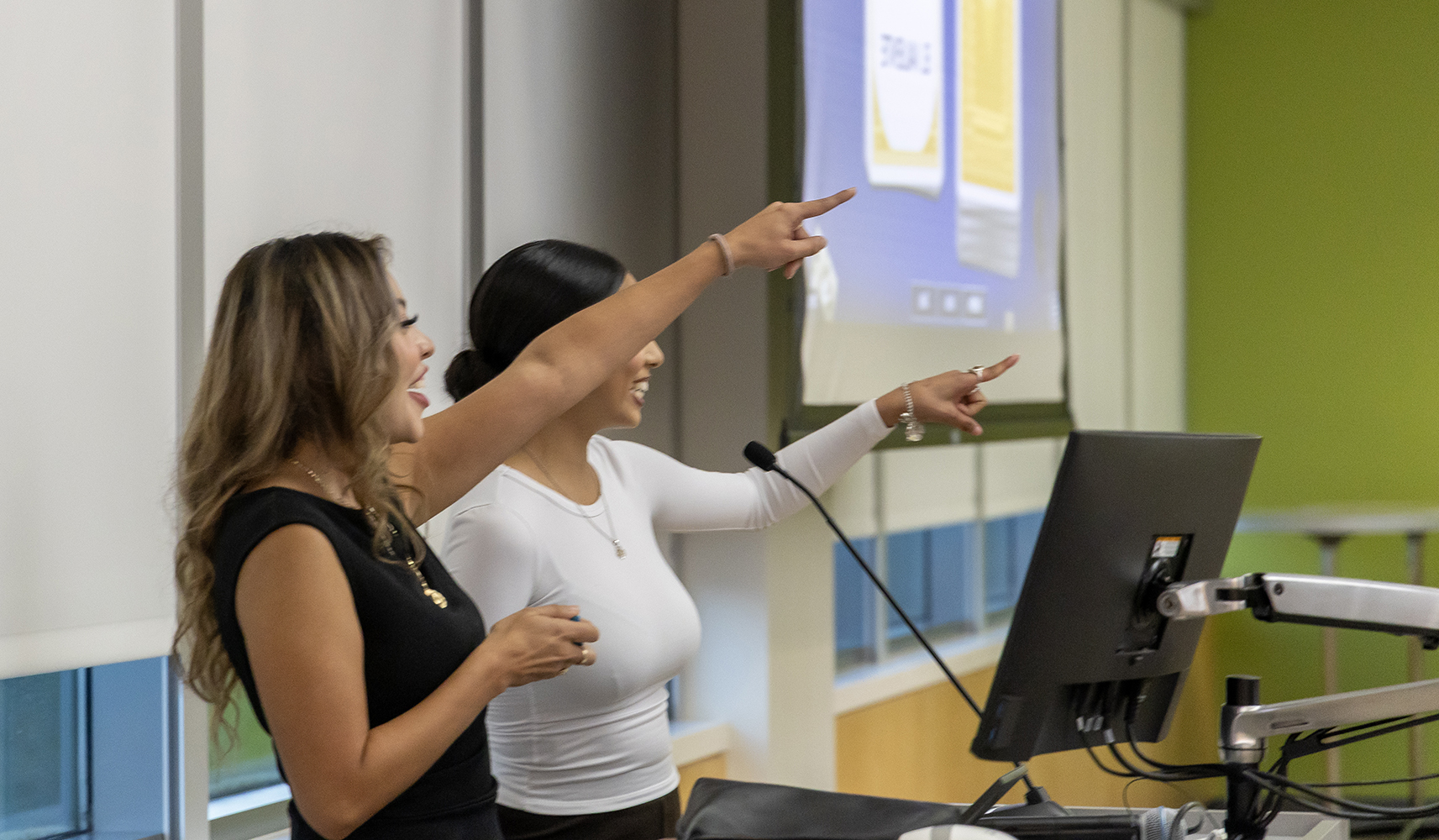
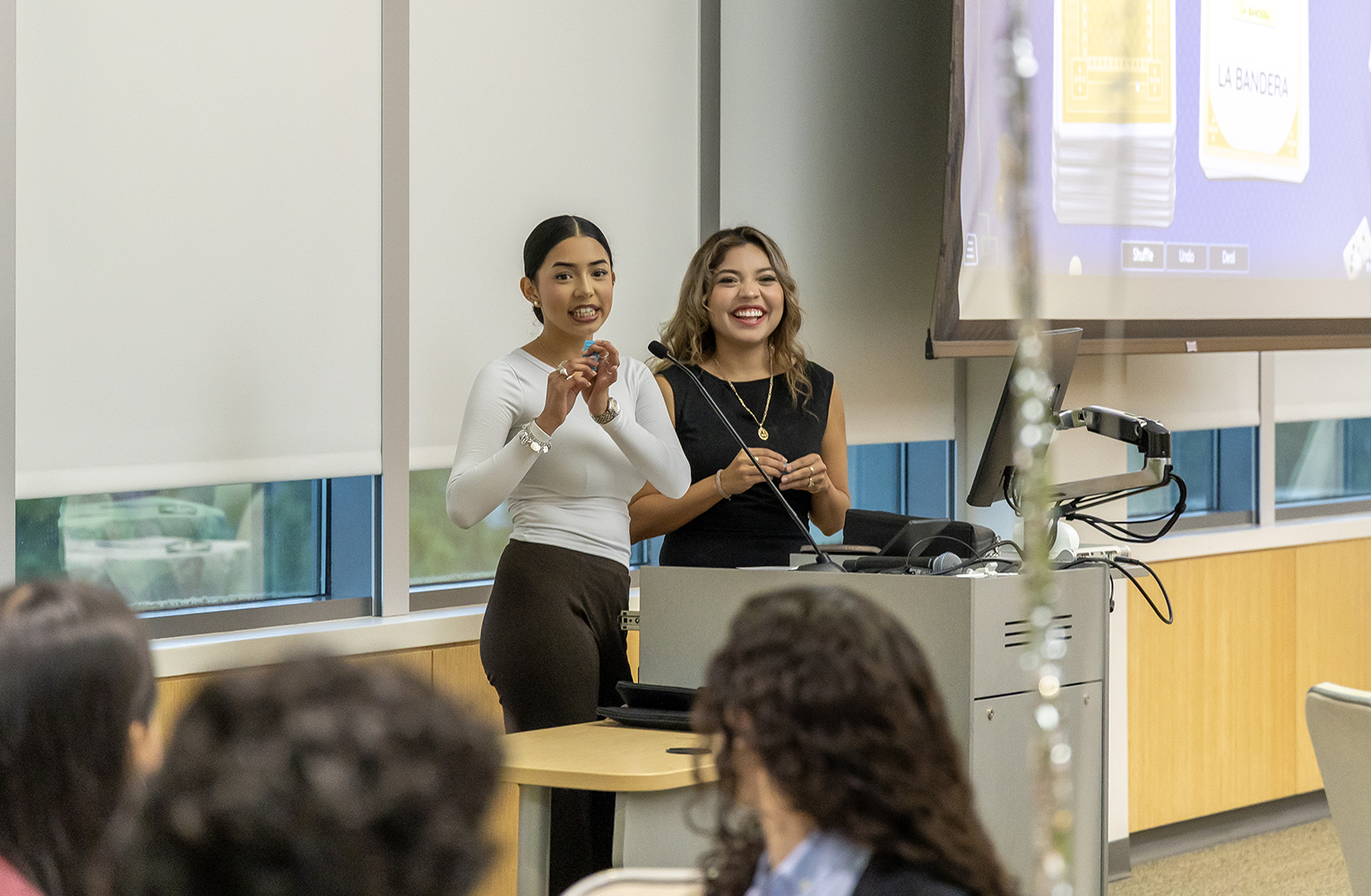
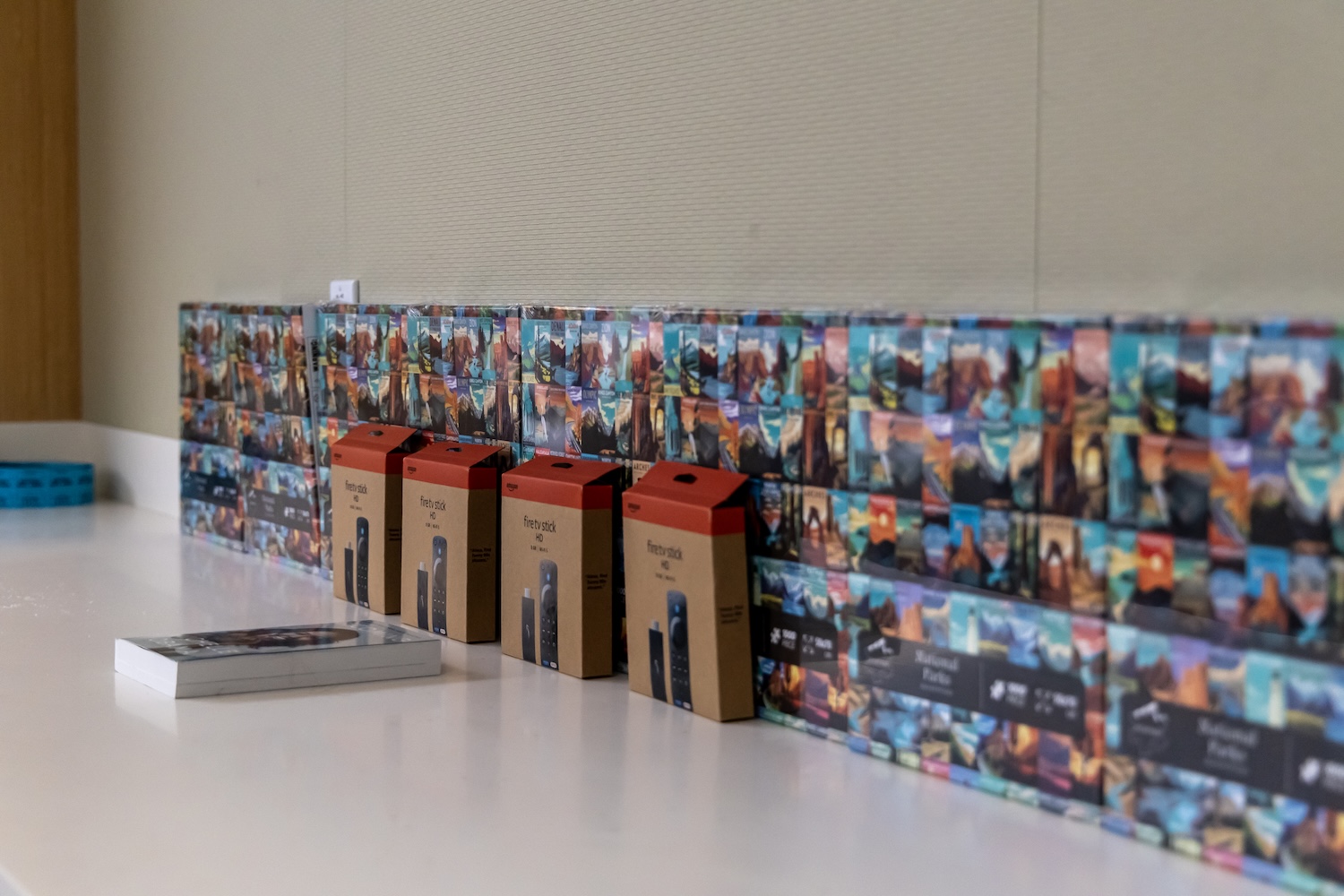
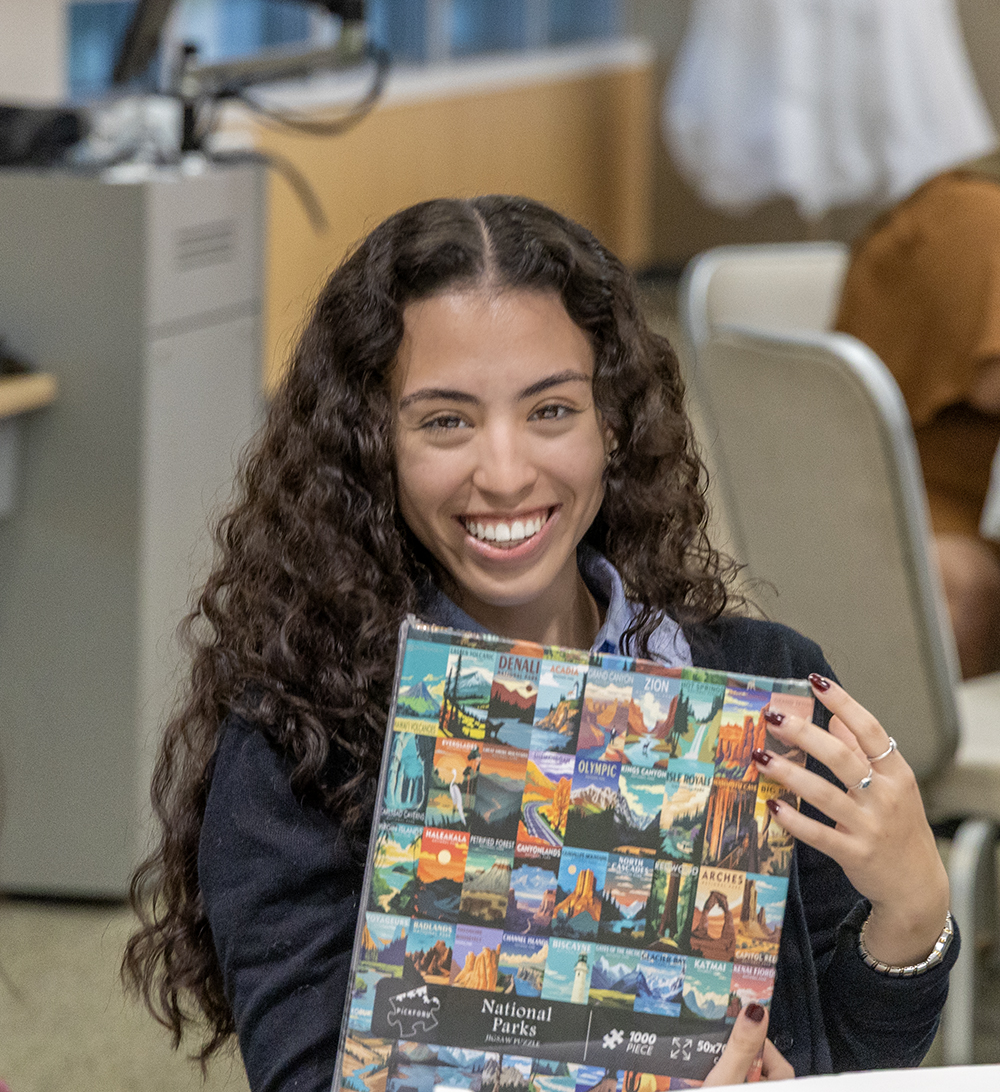
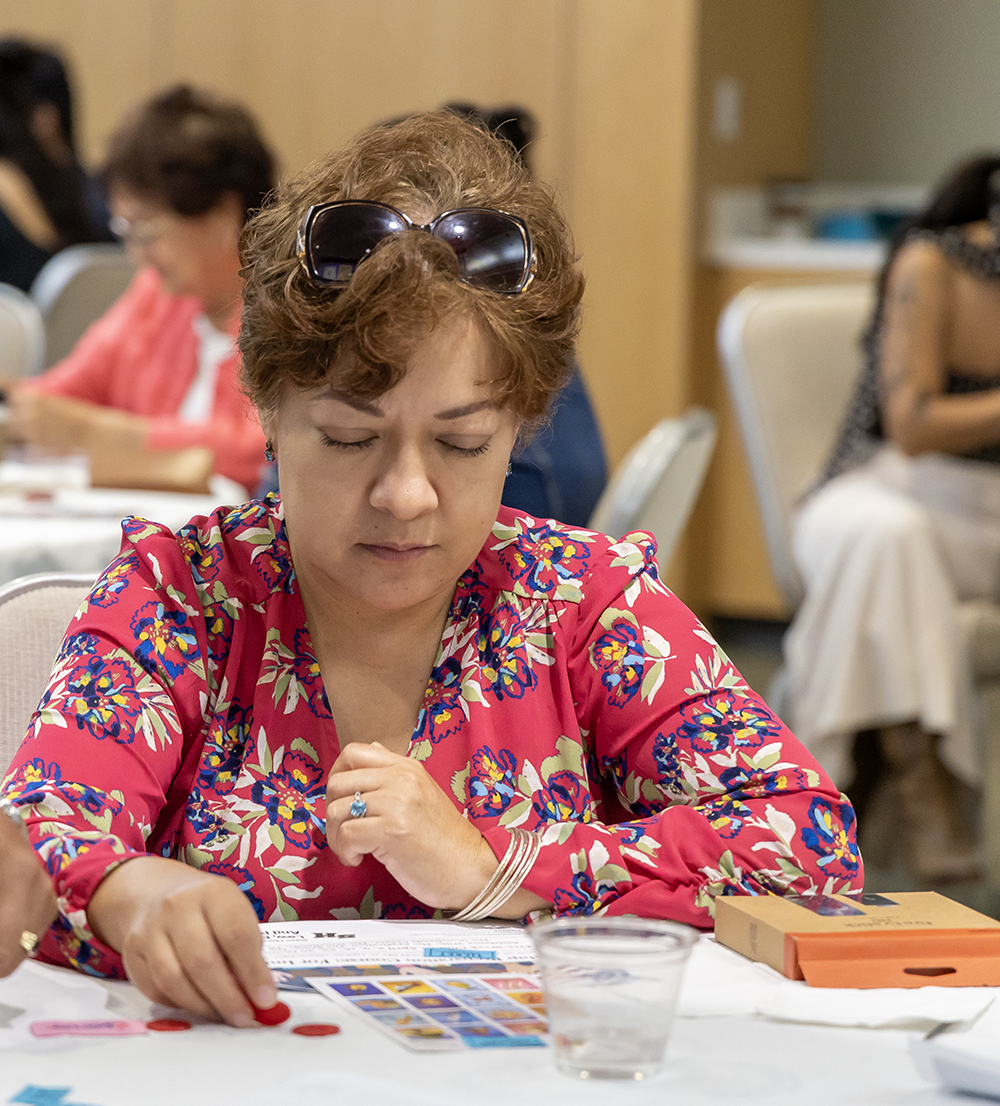
The evening then shifted to something wonderfully fun–Lotería! For those unfamiliar with this traditional game, it’s similar to bingo but with a uniquely cultural twist.
We played a couple of rounds, giving away prizes to lucky winners throughout the evening, with the help of volunteers Andrea Torres, Olivia Discon, and Laura Juarez Ordonez.
It was a beautiful reminder that while we gather for serious purposes – citizenship, community, growth – we also come together to celebrate, to play, and to enjoy each other’s company.
As the celebration concluded, we announced the next phase of our program: our Spring 2026 Citizenship Course. This course will be held on April 2nd, 9th, 16th, 23rd, and 30th at The Woodlands Center, to support immigrants as they work toward their citizenship, providing the resources, guidance, and encouragement they need to succeed.
A heartfelt thank-you to everyone who made this evening possible: thevolunteers and LEAP alumni whose ongoing support sustains the program, Christina Sato for generously sharing her time, inspiring story, and wisdom, and most importantly, the naturalized citizens and immigrants whose journeys continue to inspire this program and remind us of why it initially started.
Here’s to the journey ahead–and to all the events yet to come!
For more information about LEAP’s citizenship program or our upcoming Spring course, email Professor Mike Yawn at mikeyawn@shsu.edu.
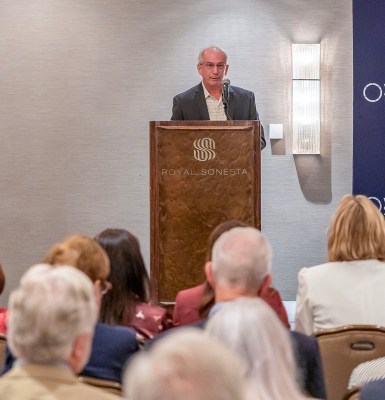
One of the most valuable aspects of the LEAP experience is the chance to learn from leaders who have dedicated their lives to public service. The World Affairs Council regularly provides such opportunities, and at the Royal Sonesta in Houston, we had the privilege of hearing from Admiral John Kirby.
Admiral Kirby began his career in the United States Navy as a Public Affairs Officer, which eventually led him to serve as Press Secretary for the Pentagon and later as Coordinator for Strategic Communications at the National Security Council. Having worked under both the Obama and Biden administrations, Admiral Kirby has long been at the center of national security, communications, and public affairs.
The evening’s conversation, emceed by Sandiya Bayot…
…and introduced by WAC Board Chair Ken Tubman (President of PPA Resources)…
…and moderated by our good friend Ronan O’Malley, touched on a wide range of issues: foreign affairs with superpower nations, military missions and operations, the role of the media, and the importance of sharing information responsibly.
One of Admiral Kirby’s first reflections was on the difficulty of his role: explaining tough decisions to the American people. He emphasized that while he could not alter the facts or decisions already made, his responsibility was to provide clarity about why those decisions were in the nation’s best interest and how different choices might have carried heavier consequences.
On military matters, Admiral Kirby spoke about the Russia-Ukraine conflict, Afghanistan, and broader concerns about military culture. Regarding Russia, he explained how U.S. intelligence delayed some of Vladimir Putin’s plans and stressed the importance of declassifying information when possible. By making certain intelligence public, the U.S. can share insights with allies and citizens without compromising sources.
Reflecting on Afghanistan, he noted how the Vietnam War left a strained relationship between the press and the military. Later, steps were taken to rebuild trust, such as embedding reporters with platoons during the Bush administration. This gave journalists firsthand experience and allowed them to write more accurate, informed accounts for the American people.
Even with these improvements, Admiral Kirby expressed concern that military service is increasingly becoming “a family business,” passed down through generations. While traditions of service are admirable, he worries this could widen the divide between those who serve and the broader public. For him, bridging that gap remains essential.
A recurring theme throughout the evening was the power of stories and information. Admiral Kirby explained that every story matters, and sharing them connects the military to the people it serves. Stories, he said, keep the world turning.
The conversation then turned toward media and technology. Admiral Kirby noted that while the rapid spread of information makes misinformation difficult to contain, it also provides powerful opportunities when used correctly. He drew comparisons across history: President Kennedy mastering live television, Roosevelt using photography, and Lincoln embracing the telegraph. For today’s leaders, the revolutionizing force is technology and social media, and Admiral Kirby stressed the importance of adapting to it.
One of his most powerful points was that, regardless of political party, Americans ultimately want “information, not confirmation.” Rational decision-making, he reminded us, depends on honest, clear information.
On a personal note, I had the chance to meet Admiral Kirby before the event. As we arranged for a group photo, he asked me about my studies and future goals. When I shared that I wanted to become an attorney and later involve myself in politics, he responded with a smile: “You’ve got it, go get ’em!”
That moment reflected what made the entire evening so meaningful. Admiral Kirby has a rare ability to connect with people, whether addressing an audience of hundreds or speaking one-on-one. His insights were powerful, but it was his ability to inspire and make each person feel included in the conversation that left a lasting impression.
This event will remain one of my favorites from the World Affairs Council.
The LEAP Center is known for its interdisciplinary adventures, and today was no different, as we visited another state capitol, the estate of literary lion, and a Guatemalan restaurant–in Hartford, CT, no less!
Connecticut State House
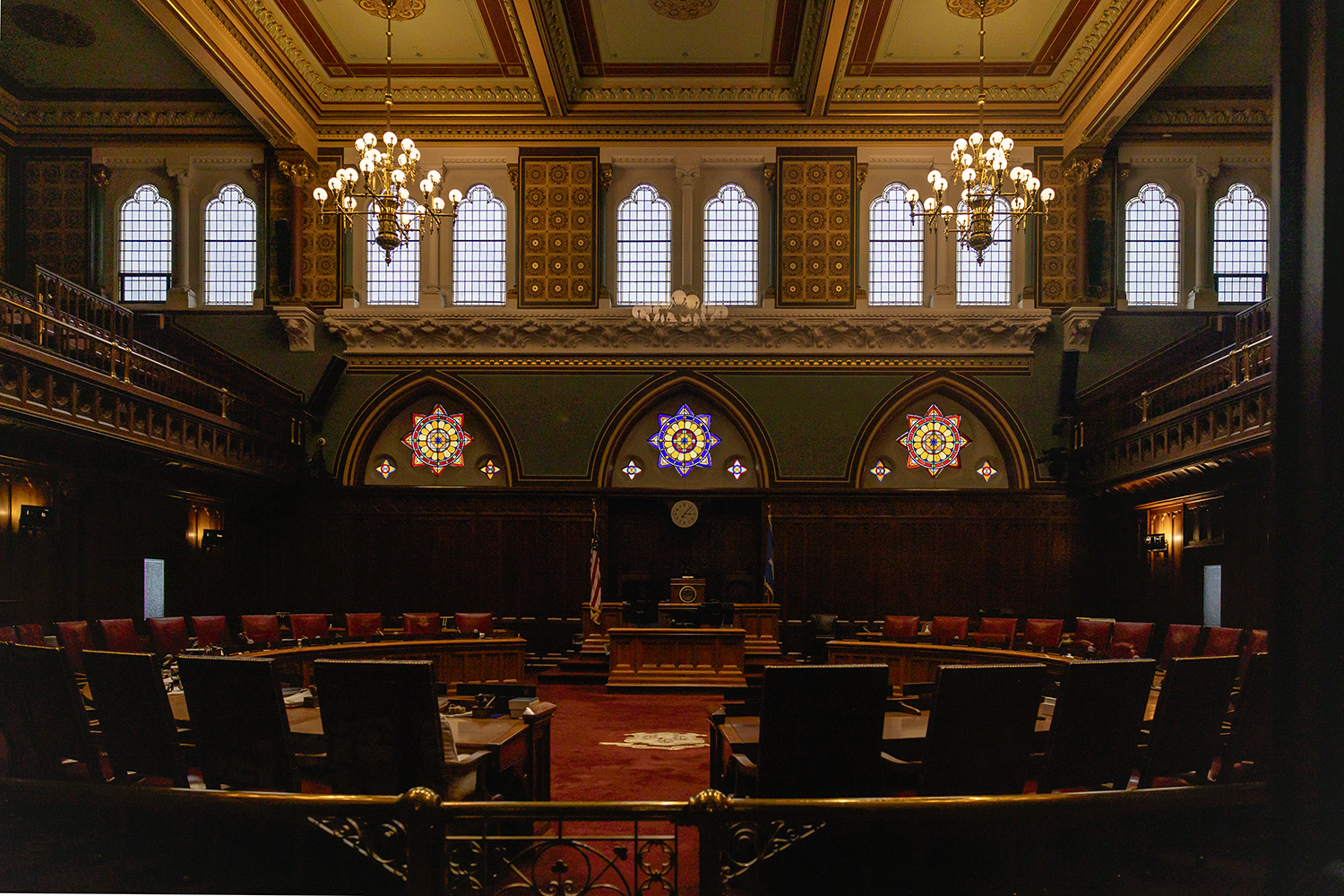
Nestled in the 41-acre Bushnell Memorial Park in Hartford, the Connecticut State Capitol first welcomed the General Assembly in January 1879 after eight years of planning and construction. A commission formed in 1871 selected architect Richard M. Upjohn, whose father also worked on the Boston Commons, providing us with generational and geographical continuity, even as we visit different sites built in different locations.
James G. Batterson supervised construction, and he significantly altered Upjohn’s design. Using marble and granite from New England, he built a beautiful sculpture that prompted the New York Times to note, that in the sun, the building “sparkled like a fairy palace of frost work.”
It didn’t sparkle on the day we visited; it rained, which also discouraged us from getting a shot of the exterior, but the LEAP Ambassadors of 2018 took a photo on a similar trip.
The building features a gold-leaf dome, and the structure is sometimes referred to as “high Victorian” and sometimes as “Eastlake,” a confusion caused, in part, by the competing visions of the architect and construction supervisor.
Both the exterior and interior feature emblems of the state’s past. One of the more interesting of these is the Charter Oak. Connecticut had a royal charter that largely gave it control over its own governance, but this was threatened in the late 1600s, when King James II tried to revoke the Charter and exert more control. When the King’s men tried to take the Charter, the colonists–Captain Joseph Wadsworth, in particular–took the document and hid it in a white oak tree, which is, not surprisingly, the state tree.
That tree became known as the Charter Oak, and although a storm toppled the tree in 1856, the wood was used to create other items, some of which can be found in the capitol. Its image is also featured on the state’s quarter and on a stamp.
Of course, the Capitol also houses both legislative chambers—the State Senate Chamber and the Hall of the House of Representatives—as well as offices for the Governor, Lieutenant Governor, and Secretary of the State.
It also houses “The Genius of Connecticut,” a 17 foot, 10 inch statue created by Randolph Rogers. The winged figure holds immortalis in her right hand; a mountain laurel (the state flower) in her right; and her head is wreathed in leaves from the white oak.
Formerly, “The Genius of Connecticut” was perched atop the capitol, but she was removed following a hurricane. The statue was melted to make ammunition during World War II. Fortunately, however, the original plaster model was found, and in 2009, a replica of the original was returned to the capitol, albeit in the rotunda rather than in the cupola/dome.
Aurora’s Restaurant
Texans believe that eating Latino cuisine outside of a border state is questionable at best and potentially dangerous. But we are not faint of heart, and we know that immigrants who know food are not limited in where they settle, so we happily braved the rain to visit Aurora’s Restaurant, which serves Guatemalan food, in Hartford, Connecticut.
The staff were welcoming and courteous. They spoke Spanish when not speaking to us, adding to what would prove to be a rewarding an authentic culinary experience.
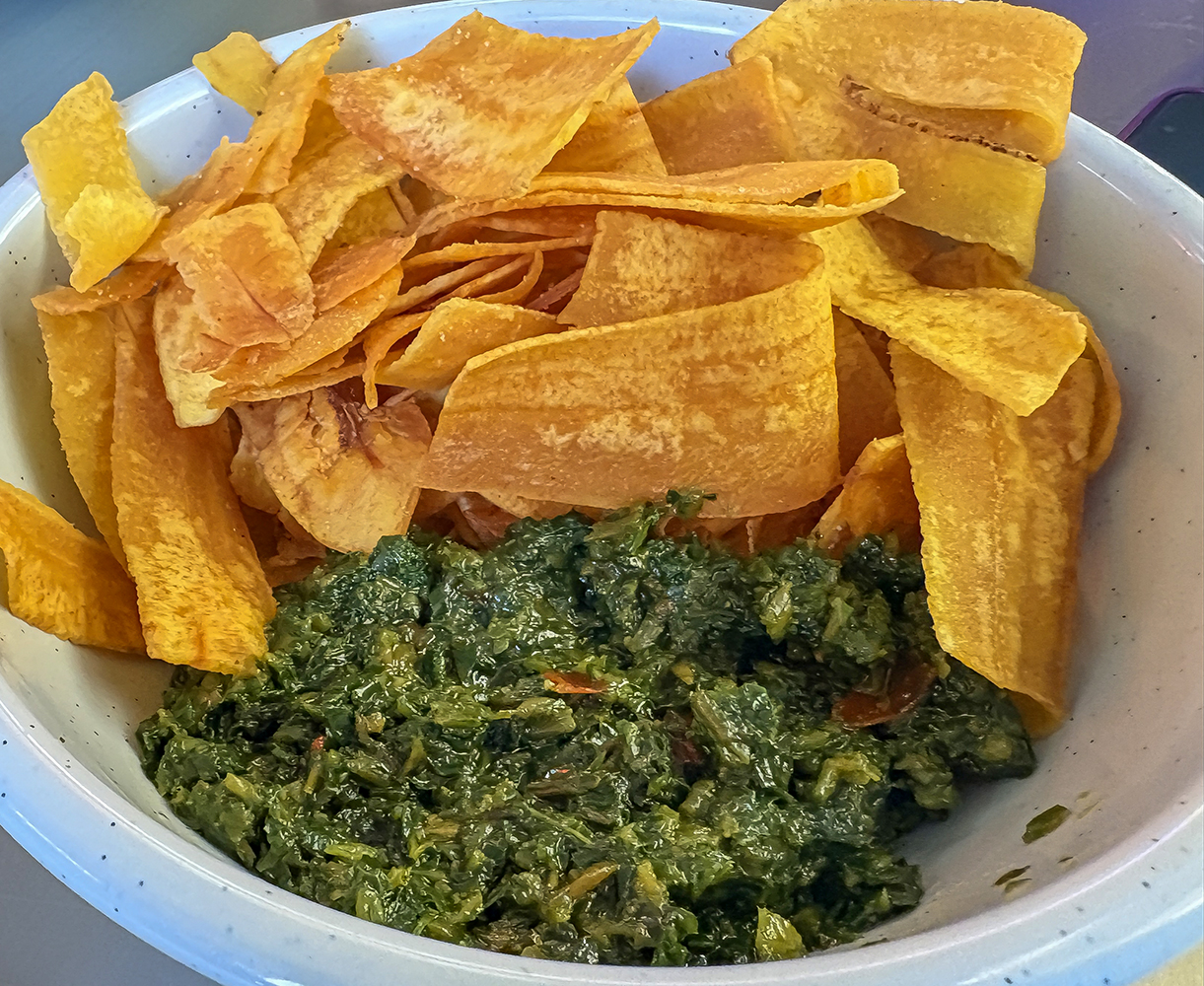
We sampled a variety of dishes, including the Burrito Bowl, Tortillas con Chorizo, an Aurora Bowl, and plantains–the latter drizzled with crema and topped with queso fresca. All of the dishes were excellent, but the plantains were among the best we had ever had.
We left with full stomachs, and also ever more aware that, to paraphrase Mark Twain, travel is fatal to preconceptions.
Mark Twain House
by Olivia Discon
Samuel Clemens—better known as Mark Twain—was one of America’s most influential authors and storytellers. His works such The Adventures of Huckleberry Finn and Life on the Mississippi are classics. But while his writing is widely known, fewer people know about the man himself, the life he led, or his stunning Victorian home in Hartford, Connecticut.
We weren’t allowed to take photos inside, but our tour guide, Josh, brought the house to life with vivid stories. The home has had many lives—at one point an apartment building, later a school, and even a library—before being restored as a museum. Over time, renovations stripped away original touches, including designs by Louis Comfort Tiffany (which, to my dismay, were once considered unfashionable). Thankfully, the museum has worked to restore the home as closely as possible to how it looked when the Clemens family lived there, guided in part by the memories of their daughter, Clara.
The library was the most charming room. Its mantelpiece, a hand-carved work from Ireland, is extravagant. Whimsical portraits—a cat, a rabbit, and a woman in blue affectionately named Eveline by the Clemens daughters–hung on the walls. Each night, Twain would spin bedtime stories using these characters. If he ever repeated a storyline, his daughters would call him out, forcing him to start fresh. According to Josh, Twain may have done this intentionally just to test whether they were paying attention. The library also included a small conservatory filled with greenery, along with a decorative frog—a playful nod to Twain’s famous short story, The Celebrated Jumping Frog of Calaveras County.
We also visited Twain’s office, which doubled as his billiard room. It was here that he wrote, smoked cigars, played pool, and paced while working through drafts. A shelf of cubbies held his unfinished manuscripts—something I secretly envied.
The house also carries the weight of the family’s tragedies. Their daughter Susy died of meningitis in the home at just 24 years old. And, owing to financial difficulties, the family eventually had to sell the home, much to Twain’s chagrin.
Even with its history of sorrow, Twain often described the Hartford house as the setting for some of the happiest years of his life. It was, he noted, “the loveliest home that ever was.” Walking through its cozy, richly detailed rooms, we found ourselves understanding that sentiment.
Photo Ops
Following our day in Hartford, we headed north, toward Stockbridge, MA, preparing ourselves for another full day tomorrow. But along the way, we stopped to see Herman Melville’s home, “Arrowhead”…
Herman Mellville’s “Arrowhead,” (Photo by Daderot)
…and “The Mount,” the home of Edith Wharton.
Edit Wharton’s “The Mount” (Photo by David Dashiell)
Concluding Thoughts
It’s difficult to organize disparate adventures into a memorable and cohesive learning experience. But through some preparation, a desire for new experiences, and an open mind, we managed to see quite a lot and assimilate almost as much. A beautiful state capitol designed by Richard M. Upjohn, a great Guatemalan restaurant in the heart of Hartford, and the “loveliest home that ever was” by the quintessential American author–all in the day of LEAP Ambassador.
























 Center for Law, Engagement, and Politics
,_Pittsfield,_Massachusetts.JPG)