The City of Huntsville made a major move toward modernization in 1925, providing for a better funded and more professional fire department. This past weekend, the City of Huntsville celebrated that progress, with a community-wide birthday party for the Huntsville Fire Department.
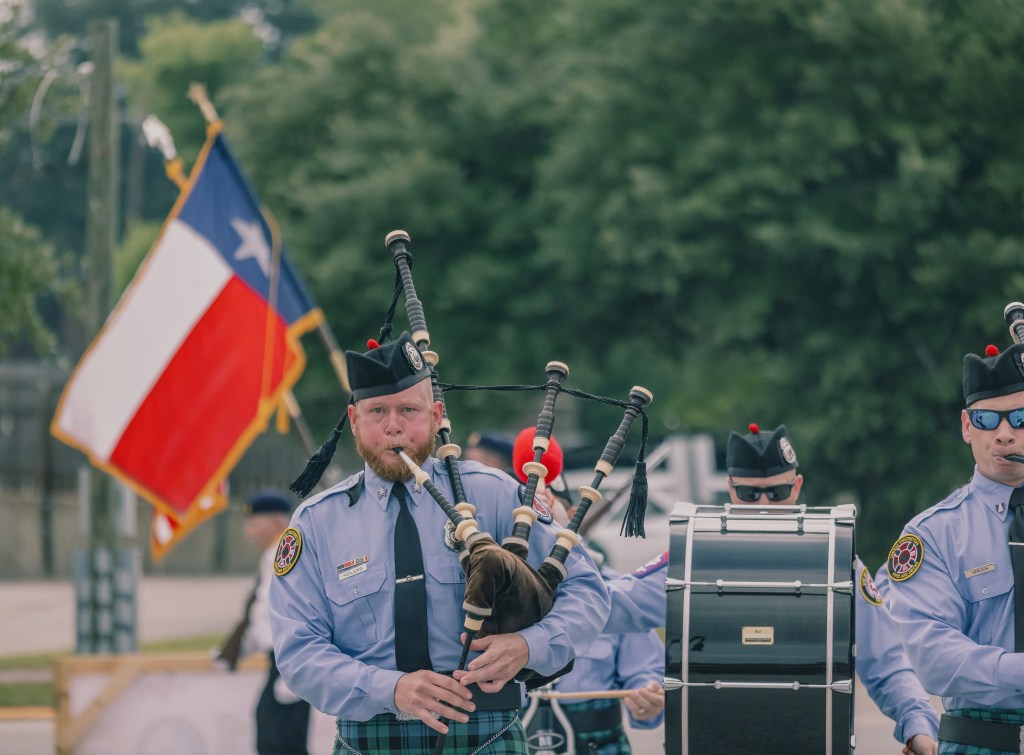
The all-day event, which lasted from 10am-4pm, opened with a prayer…
…posting of colors…
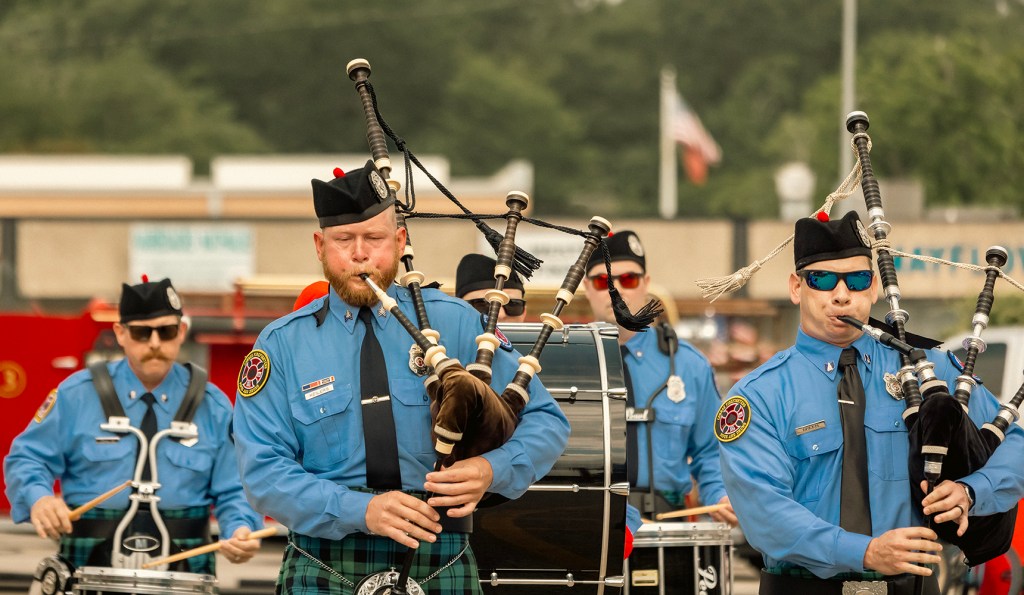
…and the playing of bagpipes.
Following this solemn opening was a day of community camaraderie, exploration, some fun, some eye-raising demonstrations, and a trip back in time.
Fire Departments and emergency services departments from surrounding communities were on hand to add to the educational breadth of the event, while also offering a type of “community policing” from the fire departments.
The Trinity Fire Department brought out trucks from 1949, 1939, and 1915–the earliest of the fire vehicles on display.
The Huntsville Fire Department offered a number of hands-on activities for children. There was a three-man hose relay…
…which rarely resulted in the successful conveyance of water.
There was also an obstacle course, which involved climbing, hauling. and running.
What child wouldn’t have fun? There were even trophies for the winners.
There was a surplus of SWAT-like trucks; and the Montgomery County Bomb Squad brought two robots, one of which almost attacked Macey–briefly getting our hopes up of a Macey-free Huntsville.
Car-entry techniques were also on display, with firemen illuminating the process for entering a vehicle and extricating trapped passengers.
And the Huntsville Fire Department also did burn demonstrations, illuminating the manner in which fire personnel approach fire suppression.
Topping off the event, at least for us, was the sense of history and community. Chief Mathis was there, as was Chief Grisham and former assistant Chief John Hobbs, highlighting a line of service dating back to the 1970s.
Mac and Leanne Woodward were there; as were John and (County Clerk) Kari French, County Judge Colt Christian, and Councilmembers McKenzie, Lyle, Denman, and Antwine.
Tracy Rikard was there as part of the planning committee, helping things run smoothly.
And we were there to soak in the event, learning more about the community, its history, and having an enjoyable day with the people who make Huntsville such a pleasant community in which to live.
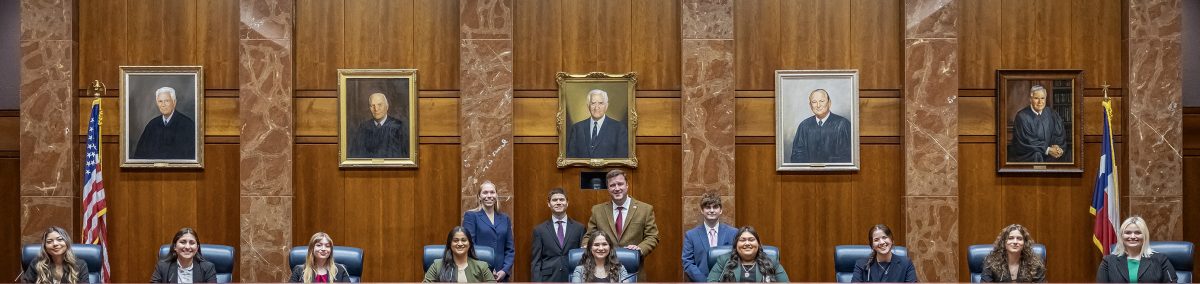
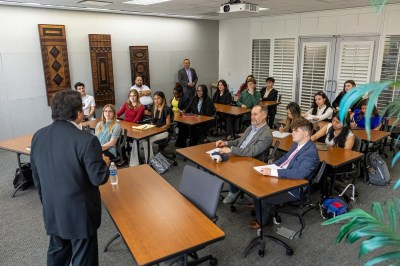
To round off an eventful week, we had the honor of hearing Judge Alberto Gonzales provide both inspiring and informative perspectives. Known for his distinguished career in law, government, and academia–which Olivia Discon shared with us in her introduction…
…Gonzales shared invaluable insights, drawing from his extensive experience as the 80th U.S. Attorney General, White House Counsel to President George W. Bush, Texas Supreme Court Justice, and, most recently, as the Dean of Belmont Law School.
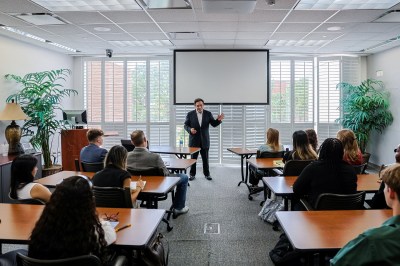
Judge Gonzales began with a visual presentation that showcased personal photographs from his time in the White House, and President George W. Bush, as well as images from his early years.
These visuals setting the tone as powerful reminders of how far a dedicated individual can go—from humble beginnings to the highest levels of government.
But it was principles taught to him by his parents, he explained, that guided him from his humble beginnings as one of eight children born to a construction worker through the highest levels of government service. Gonzales underscored the guiding principles that shaped his path, particularly the importance of “showing up,” his father both literally and figuratively taught him, which he emphasized as a key tenet of the work ethic he hopes to instill in any student.
The presentation seamlessly transitioned into an insightful comparison of Gonzales’ two high-profile roles: White House Counsel and U.S. Attorney General. Judge Gonzales, having held both prestigious positions, offered unique perspectives on these roles that few Americans can provide.
He explained that while both positions serve the American people, they do so in vastly different ways—the White House Counsel advises the President and a select group of legal advisors, while the Attorney General leads the nation’s legal apparatus, overseeing thousands of lawyers, acting as the chief law enforcement officer, and spending a lot of time on television.
Perhaps one of Gonzales’s most memorable moments was being the “designated survivor” by President during the 2007 State of the Union Address.
Using this opportunity to explain the presidential line of succession—from Vice President to Speaker of the House and beyond—and his own astonishment at the possibility that, under catastrophic circumstances, he could have become President of the United States.
Gonzales also focused on the importance of professional networks, sharing his own journey–from serving in the Air Force to attending Rice and then Harvard Law–which led to meeting Governor George W. Bush. This connection would profoundly shape Gonzales’s career–and it is clear his appreciation for this impact remains deeply felt.
When Jacob Wessels asked Gonzales what his most difficult action as Attorney General was, the former AG mentioned the investigation of former Congressman William Jefferson, which involved a search of the Representative’s congressional office.
While law-enforcement officials argued that the search was necessary to nail down a conviction, Gonzales was concerned about long-held principles relating to the separation of powers. He authorized the search, which was challenged in court (eventually being ruled partially unconstitutional), but Congressman Jefferson was ultimately convicted and sentenced to 13 years in prison-the longest such sentence imposed on a member of congress.
Having served many prestigious roles, Judge Gonzales distilled his philosophy into three key characteristics: integrity, vision, and discipline—qualities he emphasized as essential for success in both law and public service.
In addition to his reflections on leadership and ethics, Gonzales offered practical advice for students considering law school as Dean of Belmont Law–to which we listened attentively!
His advice was both practical and powerful: highlighting the importance of staying informed about current legal issues and honing strong writing skills—fundamental abilities for anyone pursuing a career in law and government careers. Gonzales also offered advice to students hoping to go to law school, from what to include on personal statements to the importance of GPA and LSAT scores.
Throughout the session, students were able to pose a range of thoughtful questions.
I had the chance to ask about Gonzales’s time on the TX Supreme Court, which he indicated he wasn’t sure was right for him. Gonzales had spent little time in a courtroom, and he had never been a judge before the appointment. Eventually, though, he decided that service was his calling, and this position led to his eventual appointment as White House Counsel and US Attorney General.
For SHSU students, this interactive discussion proved a great learning experience. As a thank you, LEAP ambassador Chrissy provided Judge Gonzales with a signed copy of the “The FBI Code” by former Assistant FBI Director Frank Figliuzzi. Grateful for his time and wisdom, we left the event motivated to dream big and stay committed to our paths of service and leadership!
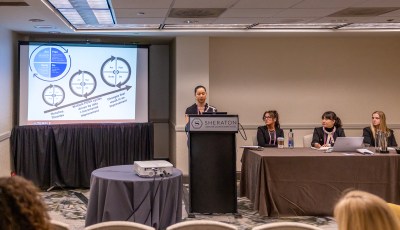
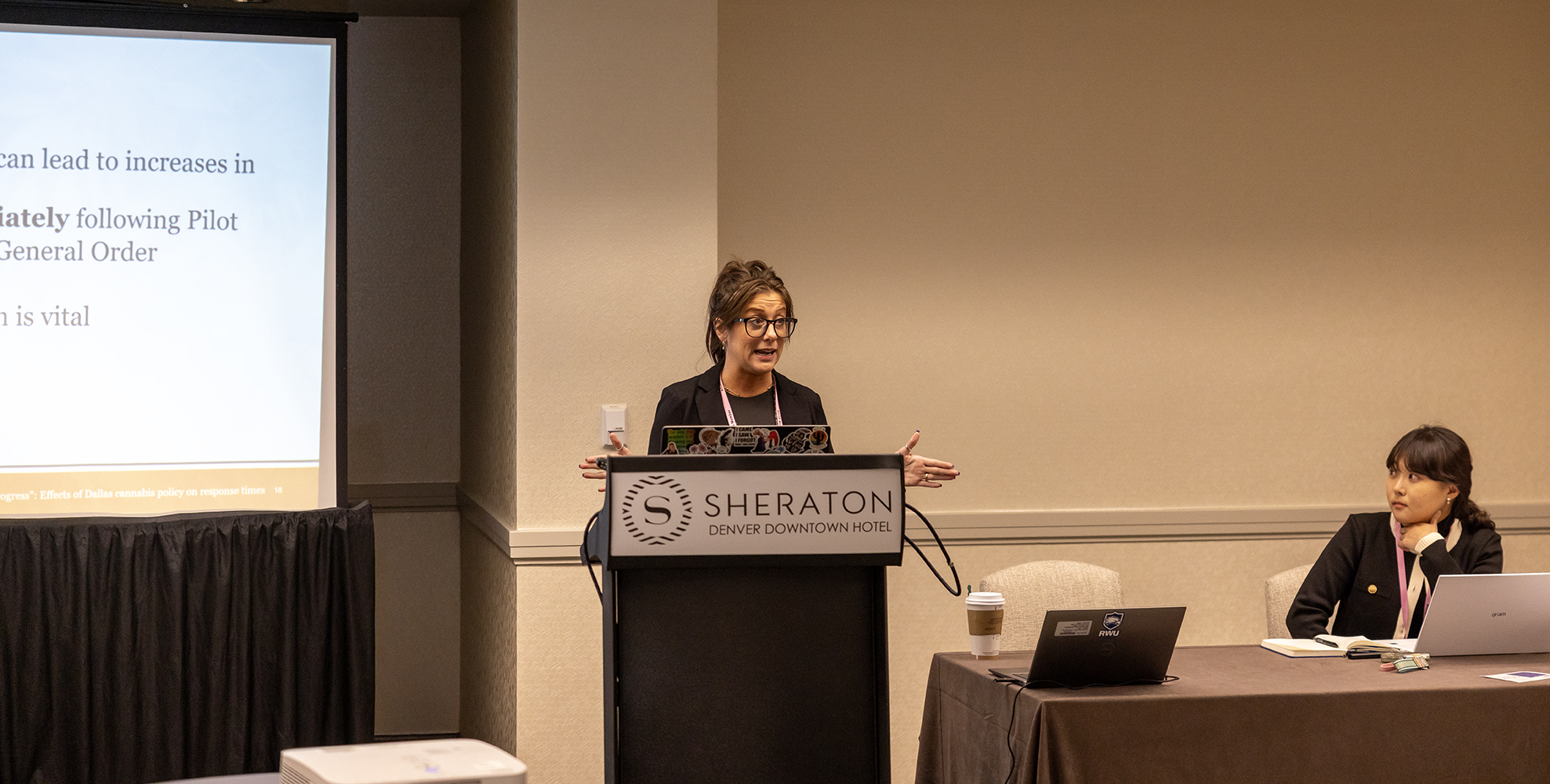
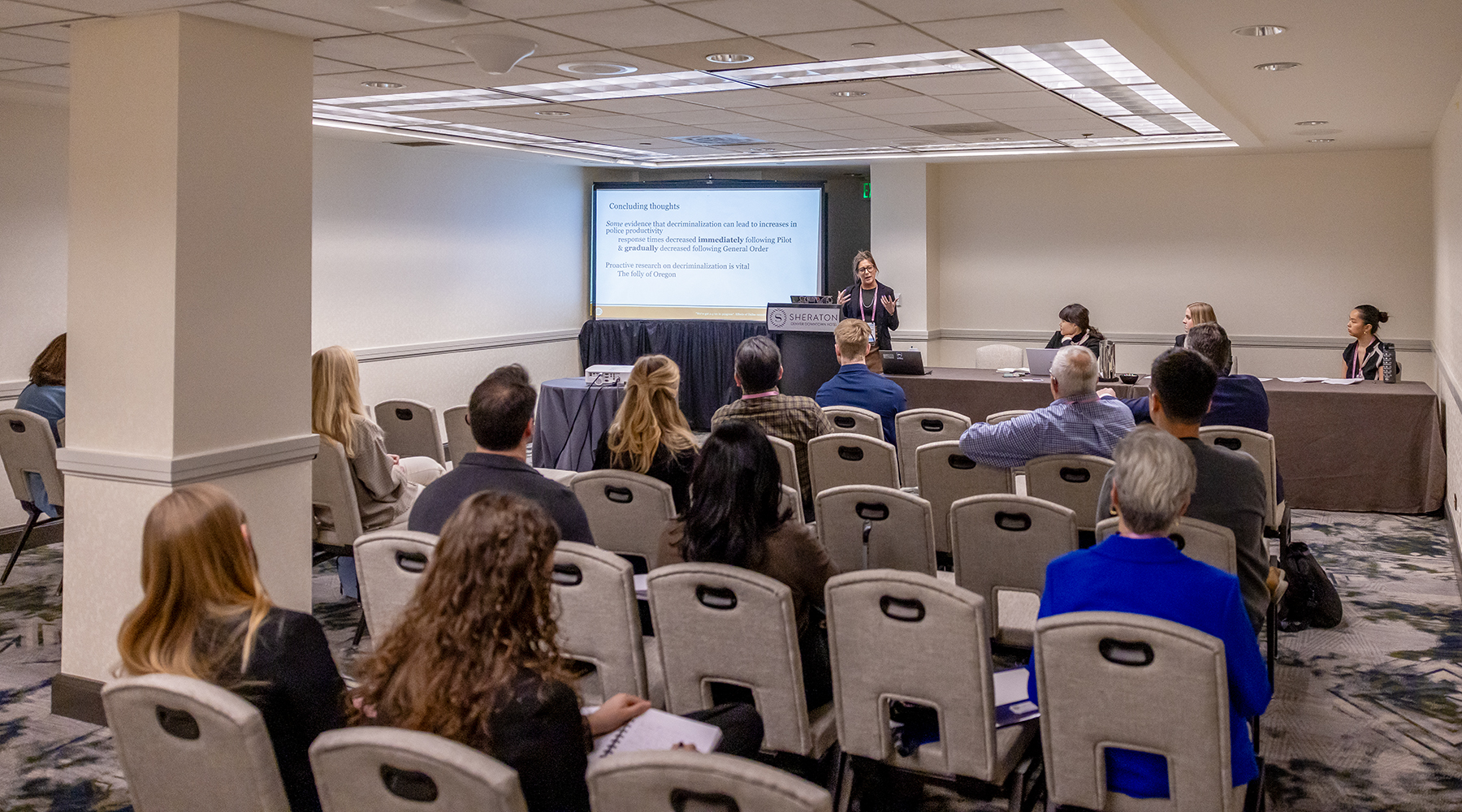
After months of compiling data, conducting interviews, and researching, Professor Yawn, Chrissy, and I finally had the opportunity to present our work at the ACJS Conference in Denver, CO. This experience was unlike anything I’d encountered before, and presenting research at an academic conference as an undergraduate was both exhilarating and nerve-wracking.
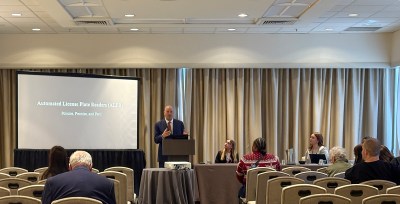
So, what is our research about? In short, our group is examining the implementation of police technology in home-rule cities across Texas. Contrary to common perception, innovation in cities isn’t driven by a single department, organization, or state entity. Instead, it emerges from a complex interplay of governance. Our primary focus is on Automatic License Plate Readers (ALPRs), which rapidly scan license plates to aid in crime prevention. From a policy perspective, ALPRs are particularly interesting because they raise important questions about efficiency, privacy, and local governance.
Professor Yawn, who chaired the panel, led the presentation. As the primary researcher on this project, he has created an incredible opportunity for Chrissy and me to contribute meaningfully to the work.
While we still have a way to go before we “reach saturation” in our research, presenting at ACJS and receiving feedback from an engaged audience was invaluable.
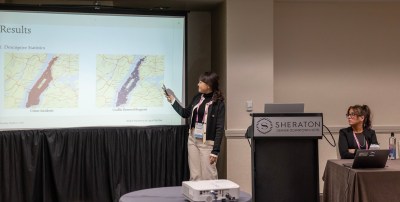
Chrissy, who spearheaded our quantitative data collection, presented the methodology and preliminary findings. She did an excellent job of breaking down the statistical nuances and translating them into clear, digestible insights for us common folk.
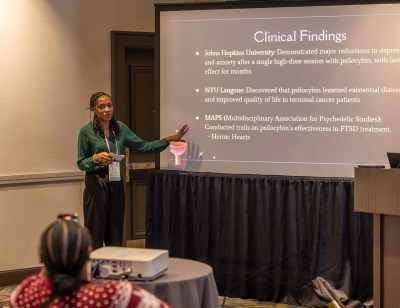
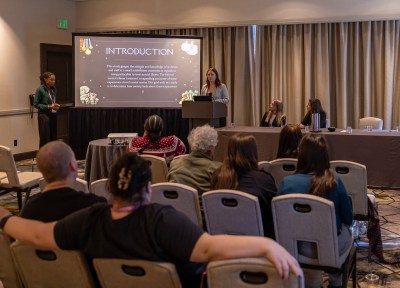
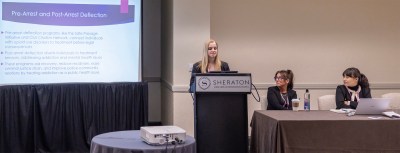
Our session also featured a presentation from Tiffin University (TU), where undergraduates Zaria Moore…
…and Lauren Swartzlander…
…shared their public health study on mental health and alternative treatments.
They pursued this research voluntarily with strong mentorship support from TU faculty.
After both presentations, we engaged in a Q&A session with the audience…
…whose thoughtful questions and feedback left us excited to refine and expand our work further.
Safety, Crime, and Health in Urban Spaces
After our presentation, we attended another fascinating session on urban crime patterns and community development. One standout presentation came from Lauren Perron of Temple University, who examined agency collaboration in response to opioid use disorder.
She explored how organizational structure, leadership, and policy decisions impact the outcomes of the opioid crisis, particularly in the context of steering committees.
My favorite presentation of the session was Broken Windows in the Age of Big Data, which focused on Graffiti-Free NYC, a program led by the New York Sanitation Department. The study examined the correlation between quality-of-life indicators—such as graffiti removal and cleanliness—and crime rates.
While perceptions of crime can be subjective, this research provided compelling data-driven correlations that reinforced the impact of environmental factors on urban safety.
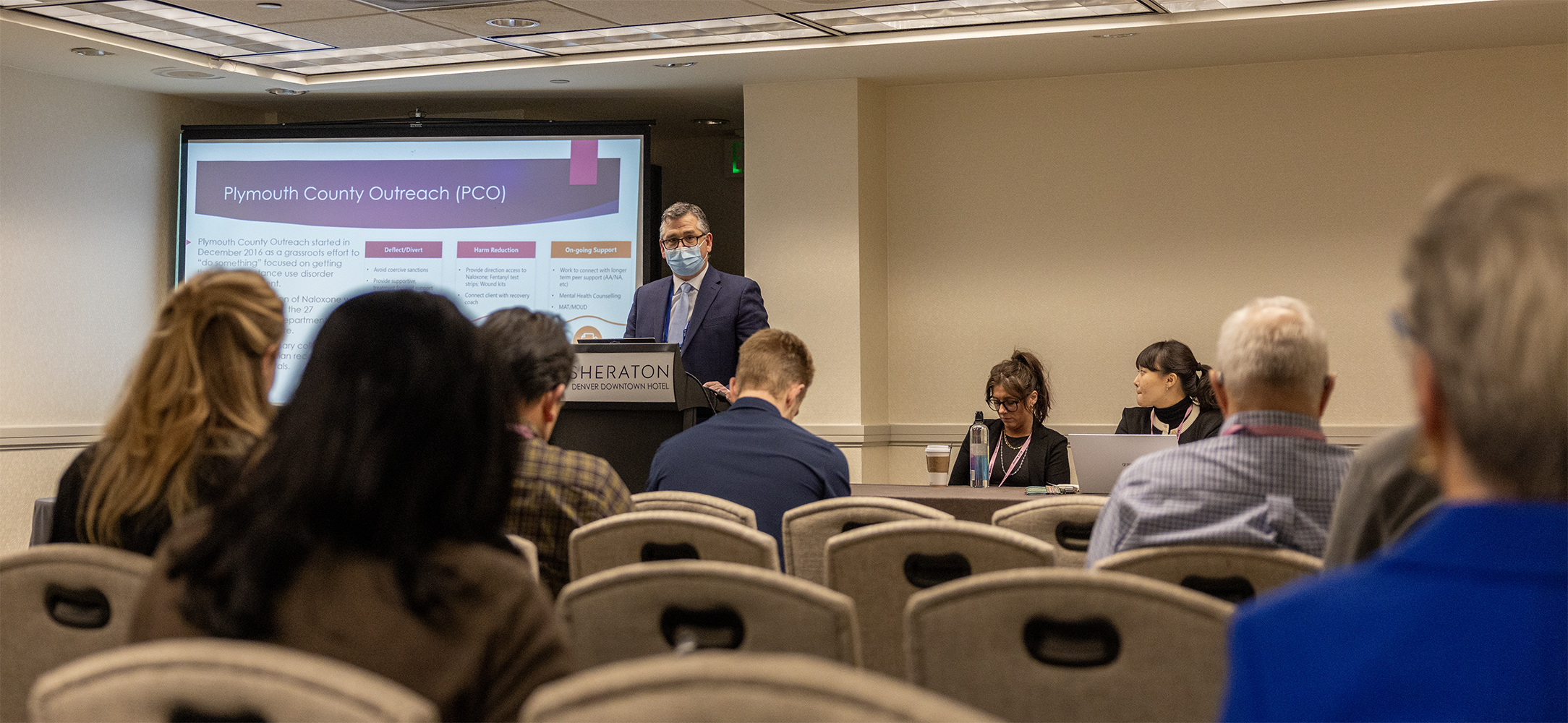
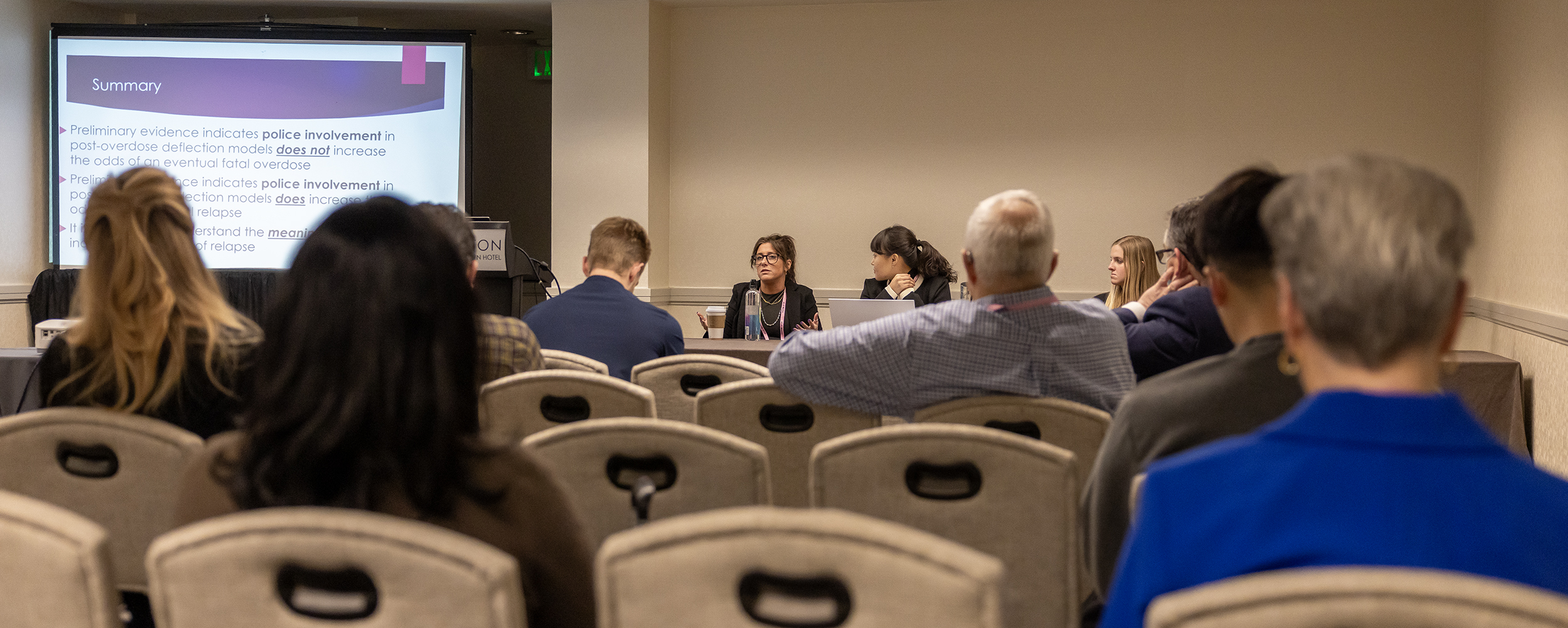
Chrissy’s favorite session was Policing the Opioid Crisis, which analyzed police-led deflection programs in Plymouth County, Massachusetts.
This case study, conducted by Professor Sean Verano and student Niki Poutre, explored the effectiveness of these programs in helping individuals struggling with addiction and how police officers ranked the anticipated success of different approaches.
One particularly striking finding was that while deflection programs increased the odds of relapse, they did not significantly impact fatal overdoses.
This session was our favorite of the conference—not just because we could finally relax after our own presentation, but because the discussions were incredibly thought-provoking. The insights we gained from these panels will undoubtedly inform our research moving forward.
Presenting at ACJS was a milestone experience, giving us the chance to engage with experts in the field, refine our work, and gain a deeper appreciation for the complexity of crime, policing, and policy implementation.
Dinner at Le French
by Chrissy Biello
Feeling the weight lifted off our shoulders, we headed to Le French for dinner. Founded by Senegalese-French sisters Aminata Dia and Rougui Dia, Le French is known for its combination of many worldwide influences and modern French cuisine. As semifinalists for the James Beard Best Chef in the Mountain Region in 2024, the Dia sisters have brought their culinary expertise to the forefront, making this dining experience even more exciting.
Through LEAP, my peers and I have had the unique opportunity to dine at James Beard-nominated and award-winning restaurants, and this was another highly anticipated experience for Olivia and me. Having not eaten much due to nerves, we were more than ready to indulge in what promised to be a great meal after a long day.
With little experience in French cuisine, Olivia and I found many menu items intriguing. To sample a variety of dishes, Olivia opted for the prix fixe menu. For her starter, she chose French Onion Soup, a dish she had never tried before.
When it arrived, she was thrilled with her choice. Not only did she enjoy a new experience, but she also discovered a dish she truly liked.
Professor Yawn and Stephanie ordered the escargot as their appetizer, and they were equally pleased with their selection.
For our main courses, I ordered the Saumon Fumé Savory Crepe, Olivia got the Suprême de Poulet Sauce Champagne (chicken breast with champagne sauce), Professor Yawn chose the Colorado Bass et Plantains, and Stephanie decided on the French Onion Soup.
When our meals arrived, we were all delighted with our choices. In true LEAP fashion, we made sure to sample each other’s dishes. Every selection turned out to be excellent, giving us a variety of flavors to experience.
For dessert, Olivia had the Panna Cotta, a dish featuring hibiscus, citrus, and marmalade berries. This was another first for her. Additionally, we shared a crème brûlée as a table.
It was a day full of firsts, from trying great new foods to presenting at our first academic conference. Nevertheless, we are especially grateful for the guidance of Professor Yawn and Stephanie. Their insights and encouragement, even their lighthearted stories to ease our nerves, were invaluable and something we could not have found elsewhere.
The Yard Milkshake Bar
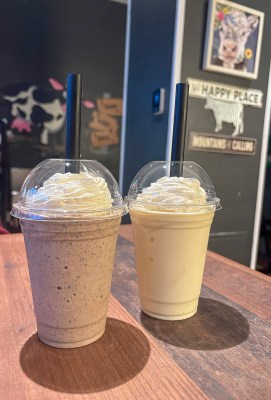
Later in the night, after doing some laundry, Olivia and I walked to The Yard Milkshake Bar for another sweet treat. I chose the Cookies and Cream Cheesecake milkshake, while Olivia went for the Cake Batter milkshake. Both were delicious and well worth the walk from our hotel.
With the stress behind us, we are excited to continue our trip, filled with fun, learning, and new experiences.
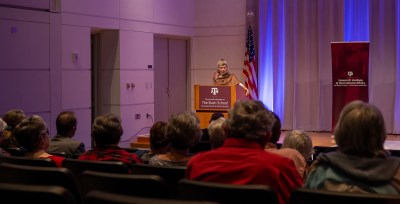
There are few people who know the world better than Diana Negroponte–who has a law degree from American University, a PhD in International Affairs from Georgetown University, has written two books, and who is married to John Negroponte, former US Deputy Secretary of State, Director of National Intelligence, and Ambassador to the UN. We got a glimpse of Negroponte’s wisdom, intelligence, and knowledge at the Bush School last week.
The author’s subject was James Baker, whom she refers to as a “Master Negotiator” (which is also the name of her book on Baker), while highlighting four of Baker’s major accomplishments and how his work offers insights into today’s problems.
To take just one of these issues, Dr. Negroponte brought up the issue of Germany’s reunification as the USSR was crumbling. In the United States, there were hardliners who wanted Premier Gorbachev to fail, and many of these believed that working too closely with him would be a form of capitulation. On the other hand, a complete failure by Gorbachev would give Soviet hardliners a chance to retrench and exert a more powerful control over the Soviet Union.
Baker suggested a step-by-step approach, one that would allow for continued progress but not provoke retrenchment among what President Reagan called “The Evil Empire.” There were also Europeans who were not crazy about the idea of a German reunification–remembering that a unified Germany had once wreaked havoc across the continent.
Baker provided a steady hand. As the Berlin Wall began to crumble–metaphorically and then literally–Baker proposed four principles by which reunification should be considered:
Self-determination should be pursued;
Reunification, should it occur, should take place within the context of NATO and the larger European community;
The process should be peaceful, gradual, and in steps;
The “inviolability of existing borders should be respected (meaning the existing Polish-German border).”
Baker’s approach held sway, and while the US refused to “dance on the rubble” of the Wall, they did become increasingly adamant that reunification proceed. In part, this reflected the Bush Administration’s belief that they had to get ahead of the process to help guide it and ensure that it unfolded properly.
This approach, which proved successful, was marriage “between idealism and realism.” While idealists sometimes sacrificed lives and treasure for unobtainable ideals, and while realists sometimes sacrificed American ideals in the name of order, Baker sought to use a realistic approach in pursuit of gradual policies that would ultimately secure human rights.
Negroponte communicated these complex thoughts in an impeccable English–something much commented on–with a vaguely European or Ivy League accent.
She also took questions, with the help of moderator Andrew Natsios–who was the former Director of USAID (which came up in the discussion), a former state legislator (MA), US Special Envoy to Sudan, a Professor, and an author.
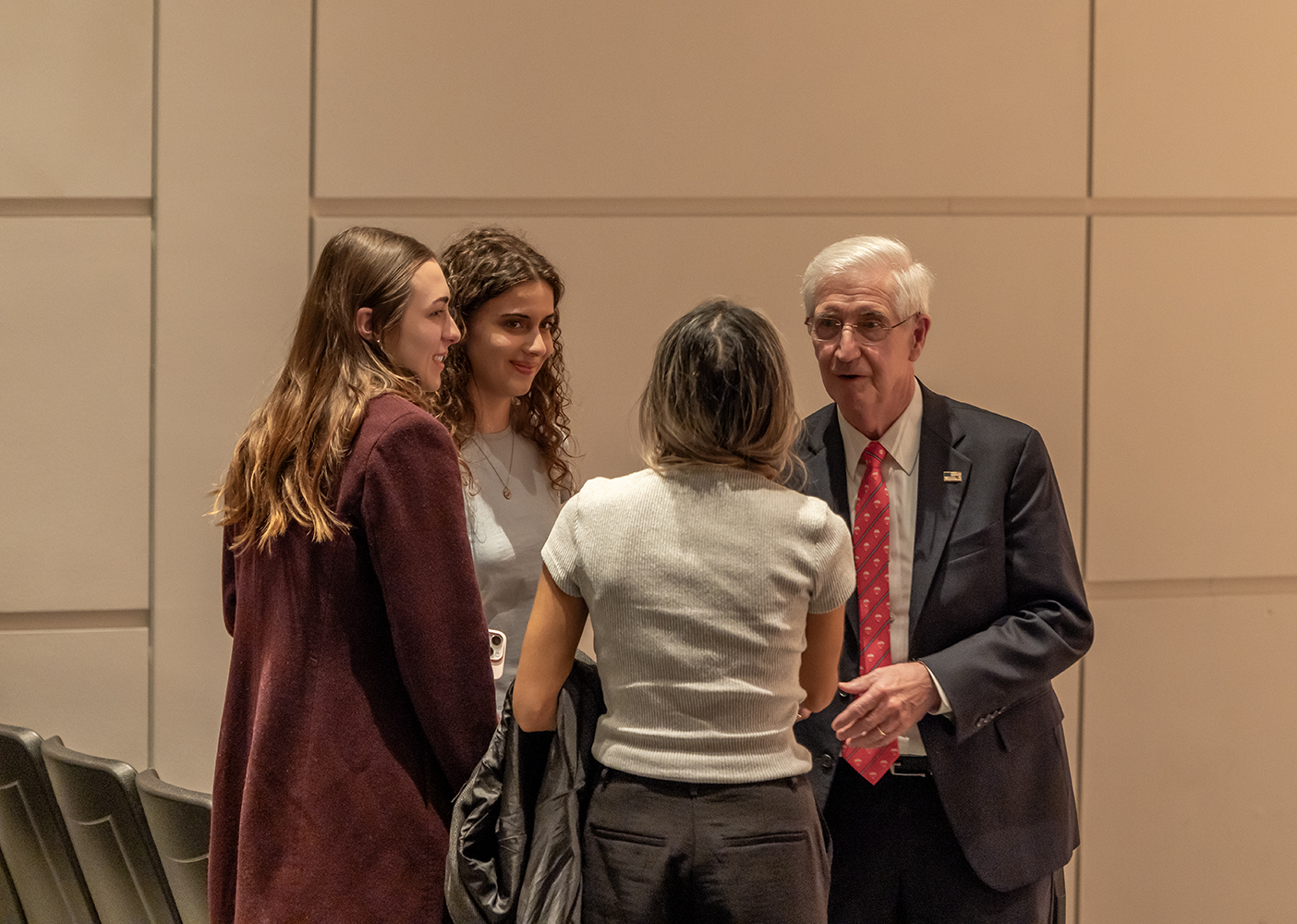
Afterward, Ms. Negroponte kindly signed our books, took a photo with us, and shared a few more stories.
We also had the opportunity to meet Andy Card…
…who, after serving in the Massachusetts Legislature, served in three presidential administrations: (1) Deputy Assistant to the President during the Reagan Administration; (2) Secretary of Transportation for President G.W.H. Bush; and (3) Chief of Staff for President G.W. Bush. He is perhaps best known for informing President Bush of the attack on the World Trade Center on September 11, 2001.
It was a perfect cap to an event that took us across centuries of political history, around the world, and a hand-shake away from some of the people who helped shape that history.
In the fall, summer, and spring, the LEAP Center opens up internship opportunities to all SHSU students. These internships are paid, come with a modest scholarship, and provide unique professional development opportunities.
The program is called “City Fellows,” because students are placed primarily–but not exclusively–with the City of Huntsville. The students may work for Huntsville Main Street, the Wynne Home Arts and Visitors Center, Economic Development, Public Works, Parks & Recreation, Development Services, the Huntsville Public Library, or in the non-profit sector, with organizations such as the Boys & Girls Club, CASA of Walker County, the Old Town Theatre, or the like.
Students can earn anywhere from 3-6 hours of academic credit in these positions, while also working on a project-based job. Examples may include helping to plan Scare on the Square, assist with a hiring fair, developing a marketing plan for an office, or putting together a fundraising plan.
Moreover, students have the opportunity for extensive learning. Not only do students learn on the job, but a couple of times a month, they engage in professional development activities. Over the course of the semester, these include (1) leading a tour of their work environments and discussing their class project…
(2) going on a tour of Eastham-Thomason Park to learn about the environment and tax base;…
(3) touring the Huntsville Police Department…
(4) learning Parliamentary Procedures…(5) volunteering in the community…and
(6) presenting to community officials about their work.
The program is designed to meet real needs in the community, while also allowing students to develop needed skills for their own careers and the workforce more generally.
The program begins accepting applications on April 1 for the summer; August 1 for the fall; and November 1 for the spring. Students can learn more here. Government offices, non-profits, or law firms can contact Professor Mike Yawn at mike.yawn@shsu.edu.
On our first day in New York City, we decided it would be a good idea to explore the area and familiarize ourselves with the surroundings, including the subway system. It turned out to be a great decision, as we encountered many fascinating and exciting sights along the way!
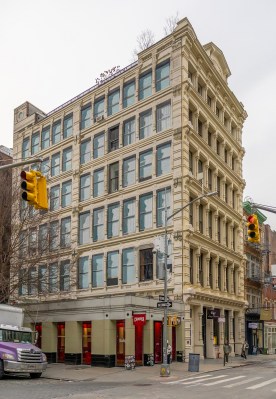
As we began walking through the city, Professor Yawn noticed our proximity to the historic Prince Street. Along this notable street stands the first Richard Haas mural, which Olivia enthusiastically recognized and pointed out as we approached.
Richard Haas’s First Mural, 1974
The mural, gracing 112 Prince Street since 1974, features intricate details that have been thoughtfully added over the years. But even as an early work, it reflects Haas’s artistic and architectural sensibilities, as well as his ability to transform a space through art.
Haas, who lives in New York, once spent a summer working for Frank Lloyd Wright, before embarking on a successful career as what the New York Times referred to as an “urbanologist.”
Thanks to the work of Linda Pease, Haas brought his Urbanology to Huntsville, TX, where he has completed 15 exterior murals–the most of any city. Thus, despite being strangers in the strange land of New York City, we felt oddly at home.
Continuing our walk, Chinatown emerged as a fascinating destination; its narrow streets offered an authentic glimpse into this vibrant New York neighborhood.
To our delight, we found the New York City Hall, a magnificent French Renaissance Revival structure still bearing the inscription “New Amsterdam;” a beautiful reminder of the city’s Dutch origins.
Next on our route was Federal Hall, which was erected in the 19th century as a Customs House. Prior the construction of the present building, however, the site hosted many milestones in the formulation of the United States government. The US Congress, such as it was, met here in the 1780s, when the (semi) United States of America was governed under the Articles of Confederation, and even as the US Constitution was written to supersede the Articles, the First Congress met on this site–and the Bill of Rights was first proposed here. More relevant to our current trip, George Washington was inaugurated on the balcony of the old Federal Building–the first-ever US Presidential inauguration! Standing on this site, therefore felt particularly resonant, considering we will be witnessing the 47th presidential inauguration in DC on Monday!
Approaching the Brooklyn Bridge, we began to make the long way up; winds from the surrounding waters grew increasingly cold.
This suspension bridge, one of the oldest in the United States, goes over the East River and connects Manhattan and Brooklyn.
When we reached the top, the spectacular view, however, made the chilly walk (the wind chill was in the teens) entirely worthwhile!
A shift in the atmosphere became apparent when we visited the 9/11 Memorial. The names etched in bronze, the twin waterfall pools, and the One World Trade Center made us all feel reflective. Saturday, we will get the chance to visit the museum, something we are greatly looking forward to as it will allow us to educate ourselves more on that disastrous day.
Before heading back to prepare for our evening of theater (Hadestown and Sunset Boulevard), we stopped at Zuccotti Park to observe Mark di Suvero’s “Joie de Vivre.” The 70-foot red steel sculpture definitely stands out against the Financial District backdrop, with its modern design creating an interesting contrast with the surrounding area.
Finally, we returned to the subway, hoping our earlier experiences had made us experts. Despite our optimism, we still struggled to navigate the system (particularly myself), but successfully made our way back to the hotel to prepare for an evening of theater.
Katz’s Deli
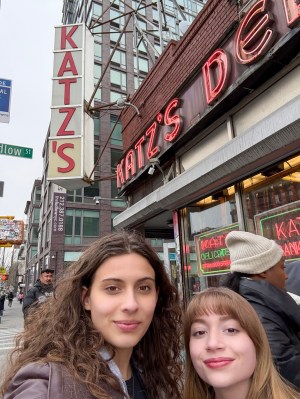
Although our time in NYC is short, we hope to squeeze in as many quality (and affordable) restaurants (and coffee shops) as possible. Thus, amidst our rambles on New York’s sidewalks, we espied Katz’s Deli, which was rated as the “Best Deli” in the Big Apple by Zagat, while also regularly appearing in the New York Times’ various “best of” lists. It is also notable for the many films that have set scenes in the Deli, including Donnie Brasco, We Own the Night, The Sidewalks of New York, and most famously, When Harry Met Sally.
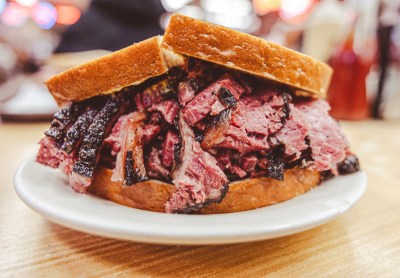
Being new to the place, we weren’t familiar with the unique ordering system of Katz’s. When you enter, you are handed a ticket, which you then take to a counter where one of approximately 15 “cutters” are stationed. The cutters, so named because they cut the meat in front of you, offer suggestions and samples, and so it was that Professor Yawn ordered Pastrami…
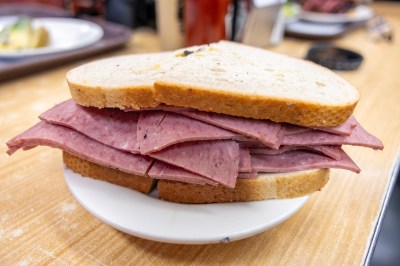
…and Olivia ordered a Reuben.
Chrissy, for her part, took a different approach, veering from the “I’ll have what she’s having” custom at Katz’s. To hear Chrissy tell of her upbringing–an upbringing that changes upon retelling, depending on her energy level and degree of coherence–she was fed baloney, almost exclusively, for the first six or seven years of her life.
If we followed this narrative correctly, this prompted her to order “soft salami.” Despite gentle nudges from the cutter to consider the pastrami, Ms. Biello remained obdurate, insisting on the salami. The cutter, clearly disappointed, complied, although his look of disappointment was palpable.
Just because we ordered separate foods, however, doesn’t mean we actually ate separately. Chrissy shared in both the pastrami and the Reuben, while all of us sampled all the food at our table.
While we can’t compare Katz’s to other NY Delis, we were in general agreement that we don’t get Pastrami or Corned Beef as good in Texas…and we have a full appreciation for why the New York Times called this institution–in business since 1888–the “king of New York delis.”
Hadestown on Broadway
by Olivia Discon
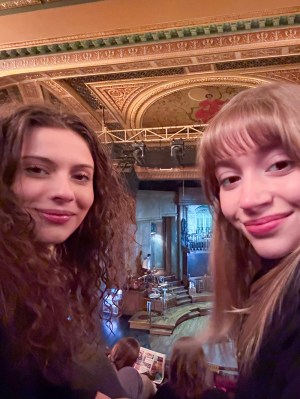
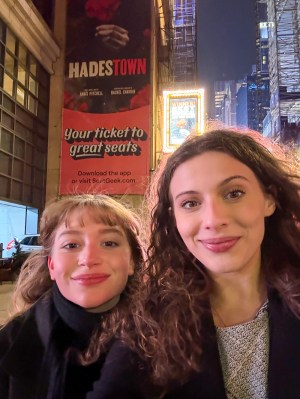
After spending the day exploring New York, Chrissy and I ended the night with a Broadway show—Hadestownat the Walter Kerr Theatre. Watching a production in this historic venue was an incredible experience, and Hadestown lived up to its reputation as one of Broadway’s best.
Written by Anaïs Mitchell, Hadestown is a retelling of the ancient Greek myth of Orpheus and Eurydice. The story follows Orpheus, a musician, and his journey to the Underworld to rescue his love, Eurydice, from Hades. The story covers some heavy hitting subjects while successfully executing a modern day retelling of the tragedy.
Chrissy and I both thoroughly enjoyed the set design.
The stage featured three spinning circles that worked like a treadmill, adding fluidity to the choreography and creating a sense of constant motion. This small but awesome detail elevated the performance and made every scene feel dynamic and alive.
The live jazz band, positioned on stage, was another highlight. Their presence both in song and in sound effects elevated the entire experience. It sort of reminded me of the live band that played at the first play I saw with LEAP, Chicago!
For Chrissy, Hermes (played by Malcolm Armwood) was the standout character, while I loved Persephone (played by Allison Russell). Both actors were incredibly talented and brought vastly different elements to the production. This cast can sing!
Seeing Hadestown has been a dream of mine for years, and getting to experience it with LEAP made it even more special. It’s a night I’ll cherish for a long time.
SHAIP Lunch & Learn: Insights at the Texas State University System Office
by Cinthia Villarreal
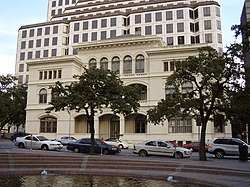
With a few days of Capitol work under our belts, the SHAIP interns attended our first lunch-and-learn at the Texas State University System (TSUS) administrative headquarters, O. Henry Hall. The building, formerly a Post Office, Federal Court House, and University of Texas System headquarters is a historical and educational marvel in and of itself, making for an excellent site to learn more about the capital of Texas.
We had the privilege of sharing lunch with Chancellor Brian McCall, Vice Chancellor for Governmental Relations Sean Cunningham, Assistant Vice Chancellor for Governmental Relations Johanna Sheffield, Vice Chancellor for Academic & Health Affairs John Hayek, Director of External Relations Malú González, and Vice Chancellor for Marketing & Communications Mike Wintemute. Joining us were LEAP students Macey Schank, Michelle Moya, and TSUS Student Regent Olivia Discon.
Chancellor McCall explained the role TSUS has throughout the legislative process, including the vitality of state funds the system receives. Vice Chancellor Hayek also shared a few fascinating facts, noting that TSUS, established in 1911, was the first higher education system in Texas. It now serves over 95,000 students across seven institutions, including Sam Houston State University.
A highlight of the lunch was hearing from Vice Chancellor Cunningham, who reflected on his own internship experience working for then-Representative McCall, giving us valuable perspective on how these opportunities can shape careers.
After lunch, Assistant Vice Chancellor Sheffield took us to the TSUS balcony, where we enjoyed a stunning view of Austin’s lively downtown.
We are sincerely grateful to the TSUS leadership for taking the time to meet with us, share their insights, and offer their support as we begin our journey.
Learning from Leaders: Melva Gomez and Steve Munisteri
by Olivia Discon
Following our visit to the Texas State University System (TSUS), the LEAP Ambassadors had the privilege of meeting with Melva Gomez, a former LEAP Ambassador who has risen to impressive heights in her career. Melva recently transitioned from her role as Chief of Staff for Representative Caroline Harris to serving as a Legislative Liaison in Governor Greg Abbott’s office.
Congratulations to Melva on this remarkable achievement! As current LEAP Ambassadors, we found it inspiring to see the impact of Sam Houston State University alumni in such important roles within the Capitol.
Pictured: Melva Gomez and Mac Woodward, 2012
During our visit, we admired a Tom Lea painting in the Governor’s Office—a nod to Texas history—before heading to Steve Munisteri’s office.
Munisteri, who has an incredible career spanning politics, martial arts, and now serving as Senior Advisor to the Governor’s Office, shared fascinating stories and artifacts with us. He graciously showed us a bit around his office, which was lined with incredible artifacts spanning his career. We were amazed at the opportunity!
A Quick Tour of the Texas Capitol
by Macey Schank
Visiting the Capitol was the highlight of my trip, especially since it was my first time there. As soon as I stepped inside, I was struck by the building’s beauty and the meticulous attention to detail, right down to the custom door hinges. Every element of the design brings attention to the Capitol’s historic significance, making it a must-see for anyone visiting Austin.
During my tour, I had the opportunity to visit several important spaces, including the House of Representatives and the Senate chambers. It was so cool to stand in places where many important decisions have been, and continue to be, made.
Pictured: LEAP Students in the Texas House of Representatives
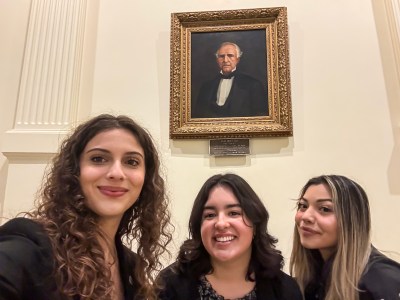
One neat part of the visit was discovering multiple iterations of Sam Houston, including a portrait of him hanging in the Capitol in recognition of his time as Governor of Texas. As a student at Sam Houston State University, it was especially meaningful to see these tributes to such an important figure in Texas history, which of course we had to take a selfie with!
It filled me with a sense of pride to be attending a school named after such a remarkable man.
Overall, my visit to the Capitol was an unforgettable experience. I had a great time exploring the building and learning about its history and the important work that takes place inside.
ASTI Trattoria
by Michelle Moya
To finish off our short but eventful Austin trip, we ended with a dinner at ASTI Trattoria to celebrate the SHAIP interns before their busy session ahead! The moment we stepped inside, the restaurant’s warmth and soft lighting truly cultivated the vibe of the restaurant perfectly. Notably, the kind of cozy that promises the Italian hospitality making you forget about the freezing Austin weather entirely!
We kicked off our feast with appetizers that set the tone for the night. We ordered the stuffed mushrooms and the polpetti. While mushrooms aren’t usually my thing, even I had to admire their presentation. Polpetti, being comprised of meatballs, came drenched in a rich red sauce that beautifully displayed a proper introduction to ASTI’s commitment to authentic Italian flavors!
When it came to main courses, our table truly showcased everyone’s love for pasta. Three of our group—Olivia, Cinthia, and Michelle—chose the Rigatoni Amatriciana, each plate crowned with a shower of freshly grated cheese.
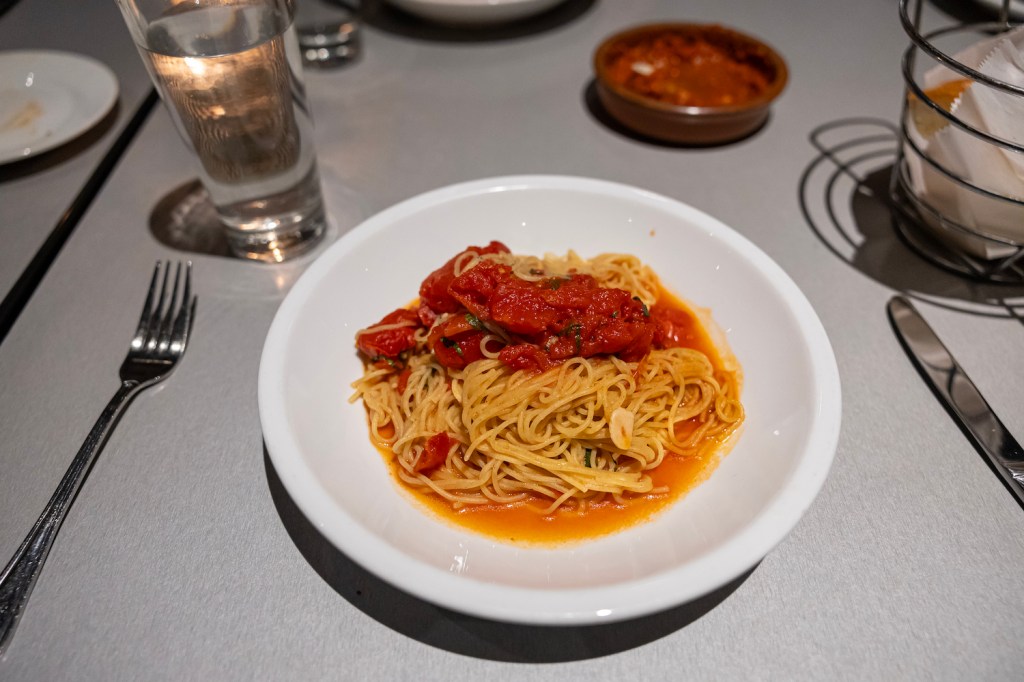
Saara decided to branch out and get the Capellini Neopolitano, and Macey and Sarah synchronized their orders with the spaghetti carbonara, while Professor Yawn went for the Lasagna Rotolo, which, at first glance, I mistook for soup. I veered off the pasta path and chose the grilled rainbow trout. It came perched atop sweet potato ricotta gnocchi—which truly was great! The lemon on the side really pulled it together.
Dessert was where things got interesting. This is where we decided to venture out and ordered a little bit of everything: a Ricotta Brulee that put an Italian spin on the French classic, an Affogato, which is coffee and ice cream mixed, a classic Tiramisu, and a homemade ice cream topped with chocolate syrup. Thanks to past LEAP events I’ve attended, I’ve developed quite the palate for crème brûlée variations, but that Tiramisu? I have to give it to the Tiramisu for the night.
We capped off the evening with a photo alongside Chef Bryan Beneke, the prime mover behind our feast. As far as farewell dinners go, ASTI Trattoria proved that nothing brings people together quite like good company and great food. The SHAIP interns might be heading into a busy session, but at least they’re going with full hearts and a happy stomach!
…we were determined to make it worthwhile, so we hit a couple of must-dos on our way back to Texas, finals, and preparation for next semester.
Café du Monde
While we had done a good job of sampling New Orlean’s food scene, we had yet to visit the legendary Cafe Du Monde and sample their legendary beignets.
We learned they were messy before we learned they were good, but their quality was, in fact, soon confirmed, bringing smiles to our faces!
Louisiana State Capitol Building
by Chrissy Biello
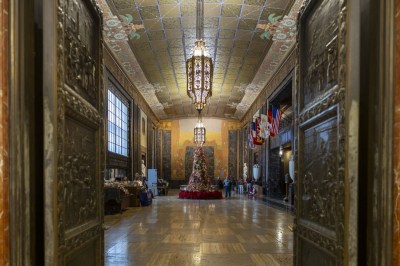
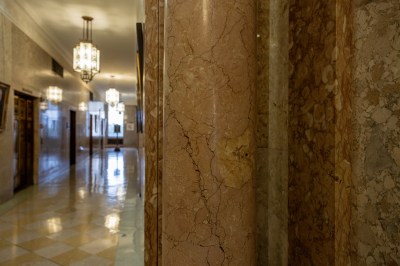
On our way back home to Huntsville, we had the opportunity to stop in Baton Rouge to see the Louisiana State Capitol. As we approached the building, Professor Yawn sparked our curiosity by challenging us to guess its architectural style. I initially thought it looked modern, while Olivia suggested post-modern. Up close, we discovered the building was a stunning example of Art Deco architecture!
The interior immediately welcomed us with a decorated Christmas tree that transformed the governmental space into something unexpectedly warm.
Professor Yawn first took us to the area where Huey Long, the 40th Governor of Louisiana from 1928 to 1932, was assassinated inside the Capitol. The assassin, Dr. Carl Weiss, killed Governor Long after he was trying to get a redistricting bill passed. However, after the bill was passed, Long entered the hallway and was shot by Dr. Weiss. Professor Yawn then pointed out the preserved bullet hole in the wall!
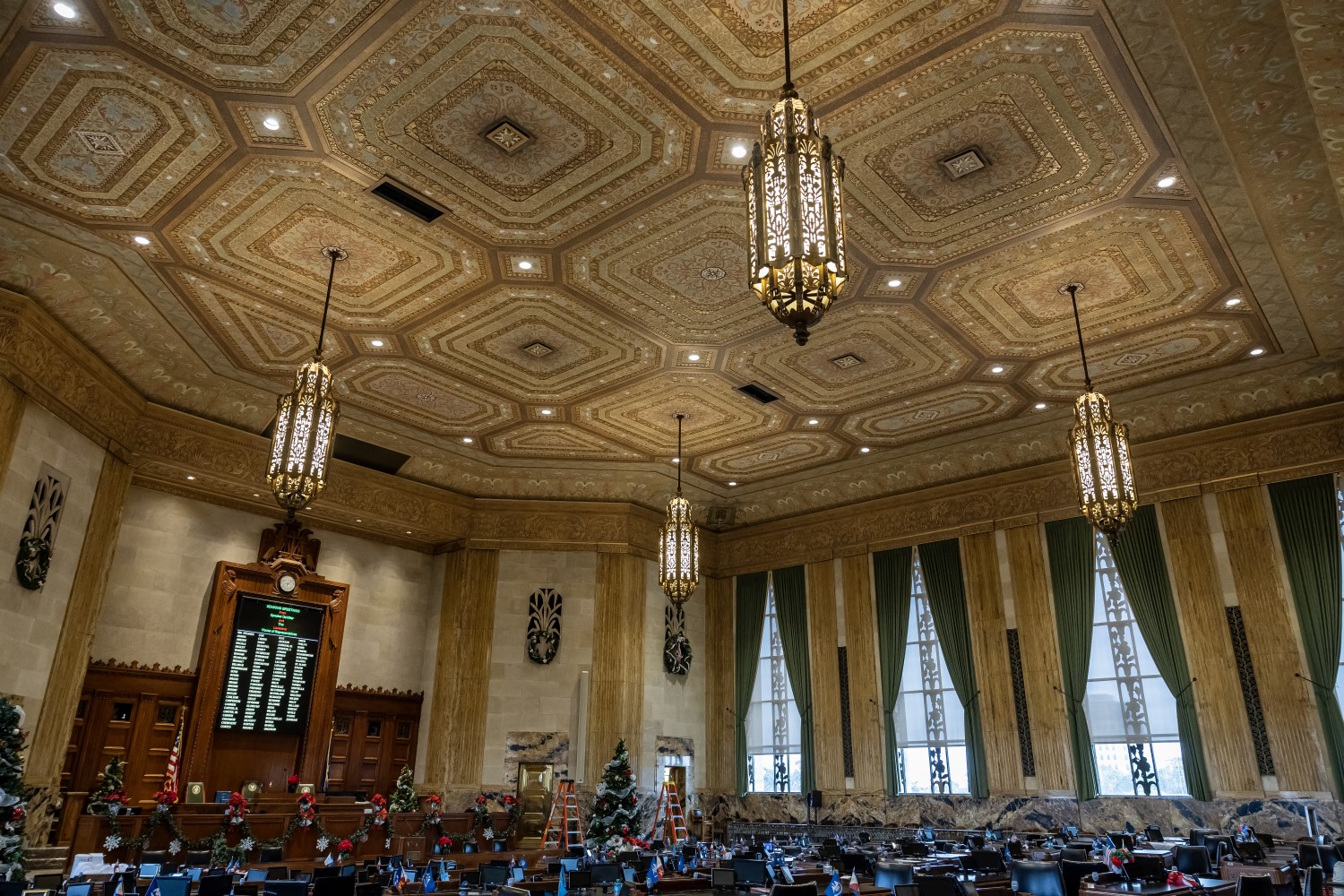
Nevertheless, the House Chambers offered a striking contrast to the earlier sad story. Holiday decorations filled the room, with vibrant poinsettias creating a festive atmosphere.
Yet, the ceiling was what really caught our attention; its intricate design and beautiful gold color added something special to the space.
We moved on to the Senate chambers, getting a view we thought might be similar to where press members usually sit during sessions.
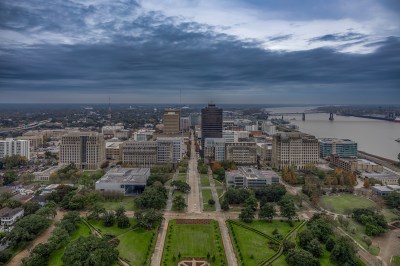
Next, we made our way to the elevators so we could reach the tower. From the tower, we could see the entire landscape in front of the building. I recognized the design as a radial layout.
Moreover, there were interesting Art Deco themes that could be seen from above, such as the geometrically shaped parking lot!
Before leaving, we walked down to the grounds and noticed something quite funny; the Huey Long statue was holding Mardi Gras beads!
After noticing this humorous detail, we ensured to get a group photo in front of the Capitol building, making us look incredibly small in comparison.
In all, visiting the Louisiana State Capitol was a great way to conclude our Council of State Governments National Conference trip. Michelle, Olivia, and I left with new experiences, whether educational, cultural or simply memorable moments to look back on!






















































 Center for Law, Engagement, and Politics