It was six months ago that Monica Dike went to Austin to interview for a job. She may have been a little starstruck by the capitol building.
She was the first–of what would eventually be 11 SHSU interns–to get a job. She was hired by Rep. Senfronia Thompson to work for the 86th legislative session. We had them go through a series of orientations to help them get their legs under them.
And she soon started getting comfortable in the Capitol.
And after a few months, she began branching out, and on one of those excursions, she had a chance to meet Beto O’Rourke, as can be noted on this video clip.
Another of the many reasons the Austin Internship Program is a rewarding opportunity for students!
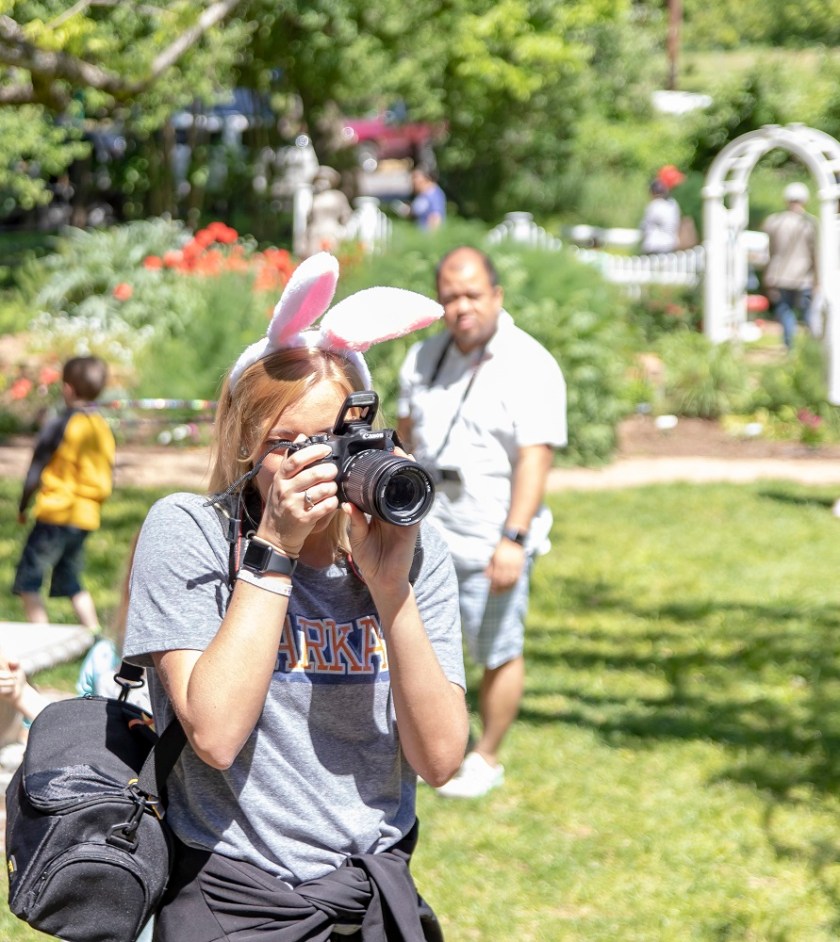
The Wynne Home Arts Center has hosted a community Easter Egg Hunt for at least seven years, but none as successful as the one offered this year. The 2019 event attracted some 300 people over the course of the day, with children of all ages enjoying sack races, hula hoops, bubble-blowing, ring tosses, photos with the Easter Bunny, free hot dogs, and, of course, an Easter Egg Hunt.
The Wynne Home Arts Center is a wonderful 19th Century home that was donated to the City of Huntsville in the 1990s. Since then, it’s been the community’s center for the arts, as well as many civic, cultural, and civic activities. Managed by a staff of two (Linda Pease as the Cultural Services Coordinator; and Lauren Clay as the Program Coordinator) and an intern (Princess Hutson), the Wynne Home hosts or sponsors approximately 100 events per year.
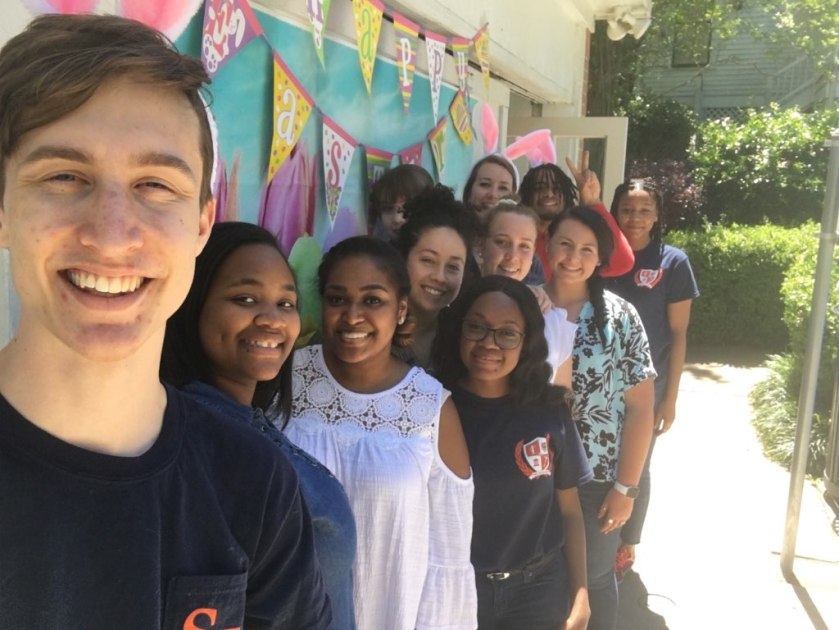
To assist with this year’s event, the LEAP Ambassadors and members of the Pre-Law Society were on hand to lead the activities, cook the food (some of which was sponsored by the wonderful “Friends of the Wynne“), and otherwise ensure that things unfolded smoothly. So, we arrived at 8am, and we got to work, hiding eggs, placing games, putting up decorations, and so on.
This slideshow requires JavaScript.
The itinerary for the day was as follows:
10:30-11:05am: Sidewalk Chalk, Ring-Toss, Hula Hoops, Streamers, and Crafts
11:05-11:35am: Sack Races
11:35-Noon: Donut on a String
Noon: Easter Egg Hunt
12:15: Picnic Lunch
Although the event didn’t officially begin until 11:00am, we just take it for granted that people will arrive early. And that was certainly true this year. By 10:50am, we had about 50 people on hand, with numerous activities available for entertainment.
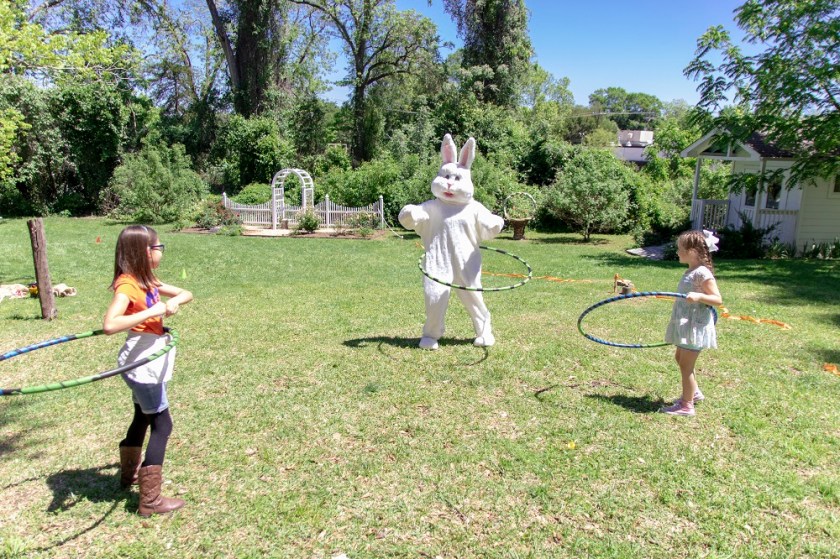
At the stroke of eleven, the Easter Bunny made her debut, and she was a huge hit with the children, numerous mothers, and a few fathers.
Shortly thereafter, we kicked off our sack races, running approximately 10 heats of six children each, partitioned into ages (a) 0-4, (b) 5-8, and (c) 9 and up.
The winner of each hit won a ticket, which they could redeem at the prize table. Popular prizes included fidget spinners among the youngsters, although older kids seemed attracted to the bubbles.
It was also nice to see the media on hand. Josh Criswell from the Item, Wade Thibodeaux from Walker County Press, and Megan Montgomery from The Houstonian.
At 11:35am, we kicked off the donut-on-a-string event, which is more popular with the parents, perhaps, than the children. The rules of this game are simple: eat the donut off the string, without using your hands or allowing the donut to fall to the ground.
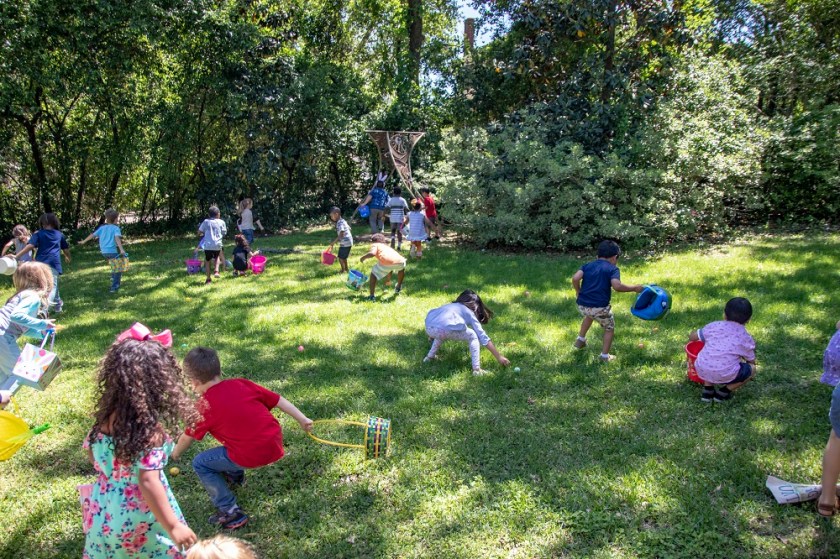
At noon, we had the culminating event: the Easter Egg Hunt. Although the Wynne Home is large, wooded, and adorned, it is a challenge to find places to hide 800 eggs, particularly when hiding from extraordinarily determined children (and a few parents). As with the sack and donut contests, the hunt is divided into three age groups. In each of these sections, we hid “golden eggs,” which were redeemable for a large chocolate Easter Bunny. Because the kids are so determined, the hunt is a short one.
By 12:02, about 90 percent of the eggs had been found, some by very determined parents.
The quick hunt allowed the families approximately an hour to eat the free hot dogs provided by the Wynne Home (with drinks, cookies, and chips), take additional photos, and play more games.
At its peak attendance, we realized we had 265 people and only 100 hot dogs, so we called Dr. Ralph Pease, who made an emergency run to the grocery store. With these heroics, we were able to provide food for everyone.
During this relative down time, the Easter Bunny had the opportunity to show off her hopping skills, engaging in a sack race with youngsters.
This slideshow requires JavaScript.
And she also showed off her hula hoop skills.
As the event began to wind down, the volunteers had the opportunity to engage in a little fun. We had an all-volunteer sack race, won by Sawyer Massie (males) and Alina Ward (females).
And when 1:00pm hit and the event ended, we had the opportunity to eat lunch, finishing up the hot dogs purchased by Dr. Pease.
It was a relaxing end to an enjoyable day. We had a chance to catch up with Lauren Clay, Linda and Ralph Pease, and reflect on another wonderful community event offered by the Wynne Home Arts Center.
The LEAP Ambassadors would like to thank the unpaid volunteers for the event, including: Sawyer Massie (LEAP Ambassador), Makayla Mason (LEAP Ambassador), Victoria McClendon-Leggett (LEAP Ambassasdor), Valerie Wilson (Pre-Law Society), Olivia Kelly (Pre-Law Society), Ethan Stephens (Pre-Law Society), Alina Ward, Megan Arnold, Susan Sanders (Texas Thyme Unit of the Herb Society of America), Haley, Kayla, and the Friends of the Wynne.
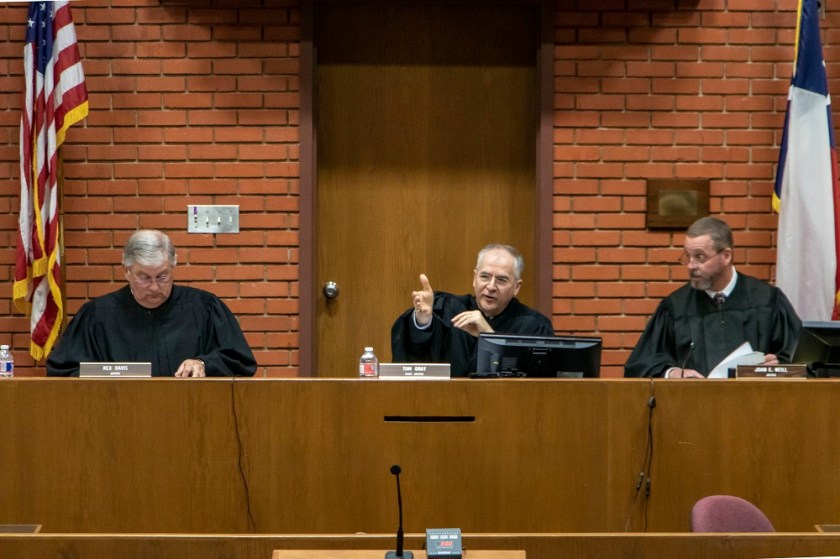
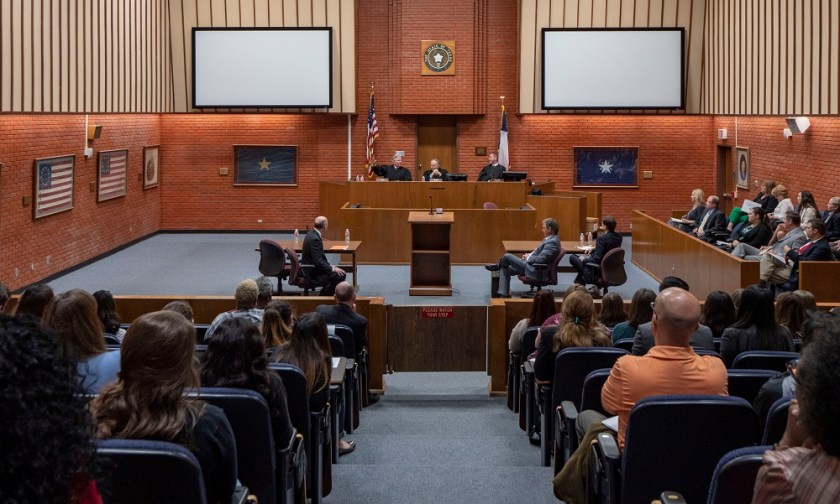
Every year, the LEAP Center hosts the 10th Court of Appeals, which hears 3-4 cases on Sam Houston State University’s campus. The three Justices serving on the 10th Court of Appeals are Chief Justice Tom Gray of Waco, who is also an SHSU College of Business Administration alumnus; Justice Rex Davis of Waco; and newly-appointed Justice John E. Neill of Burleson.
Our job is primarily to (1) market the event, (2) take care of the logistics, (3) arrange lunch, and (4) learn as much as possible. We rotate greeting duties at the door, while other Ambassadors join the spectators inside, giving us all the opportunity to see at least two cases.
We had several elected officials join us, including County-Court-At-Law Judge Tracy Sorenson…
…District Judge Don Kramer…
…and County Judge Danny Pierce…
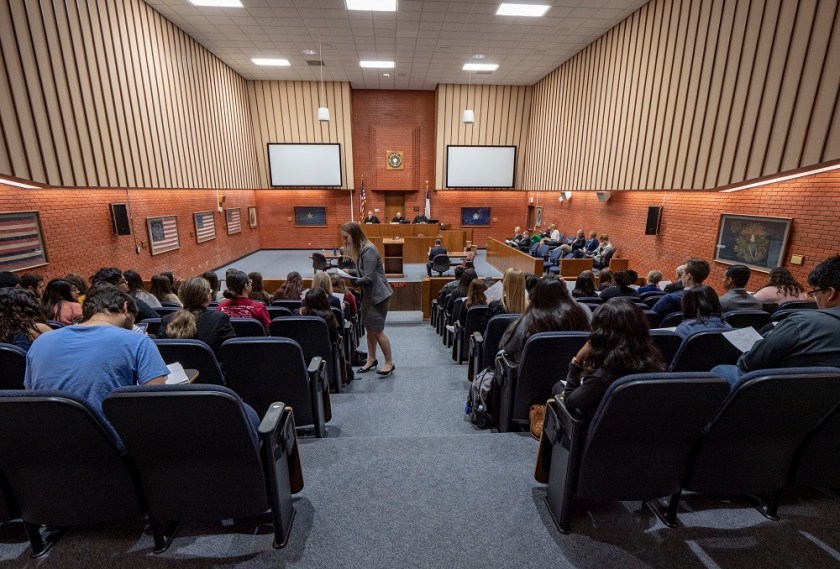
They were part of a crowd that totaled some 240 students, staff, faculty, administrators, and members of the public, making for a strong audience.
Before each case, Justice Tom Gray introduces the justices and the attorneys…
…educates the public on how an appeal hearing unfolds…
…and lays out the courtroom etiquette.
The first case was Deanna Kathryn Lara v. The State of Texas. In this case, appellant Lara was found guilty by a jury of three counts of sexual assault of a child and five counts of improper relationship between educator and student. The appeal addresses whether a 17-year-old can, in fact, consent to a relationship with an educator when the Texas Penal Code bans school employees from arguing the defense of consent.
It’s not easy, of course, to make a case for a person who molested young people, particularly when there were three victims. The District Court sentenced Lara to three concurrent terms, which made us wonder why having one of the cases dismissed would be beneficial to Ms. Lara. Her attorney, however, educated us, pointing out that the number of convictions can make a difference during the parole hearing.
The second case involved a similar crime. In Everett Dale Webb v. The State of Texas, appellant Webb was found guilty by a jury of Indecency with a Child. The appeal questions the introduction of “extraneous offense evidence” allowed into the trial.
One of the aspects of the hearings that are different from the normal unfolding of an appeals hearing is that the Justices permit us to take photographs and they allow the attorneys to spend three minutes turning to the audience and explaining the “facts of the case.”
This helps us as students understand the legal arguments better, and also provides a more dynamic experience than a hearing would normally offer.
In this case, the attorney highlighted exactly what was meant by “extraneous evidence” and how he believes it inappropriately influenced the verdict, while the prosecutor, of course, argued that no extraneous information was admitted, and if extraneous information was admitted, it didn’t affect the outcome.
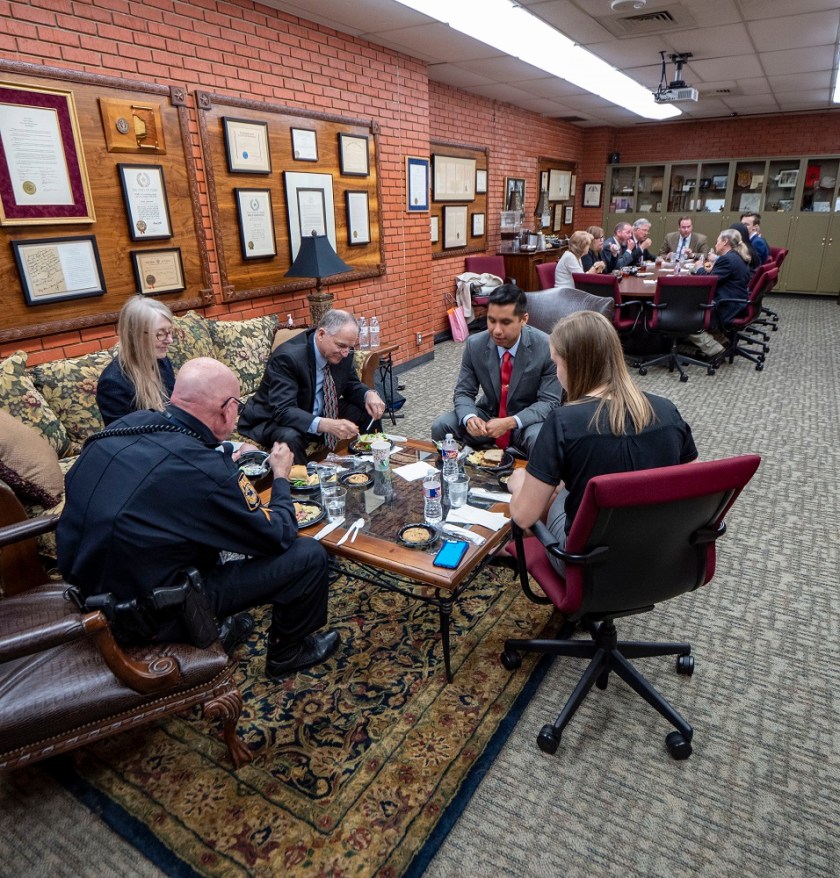
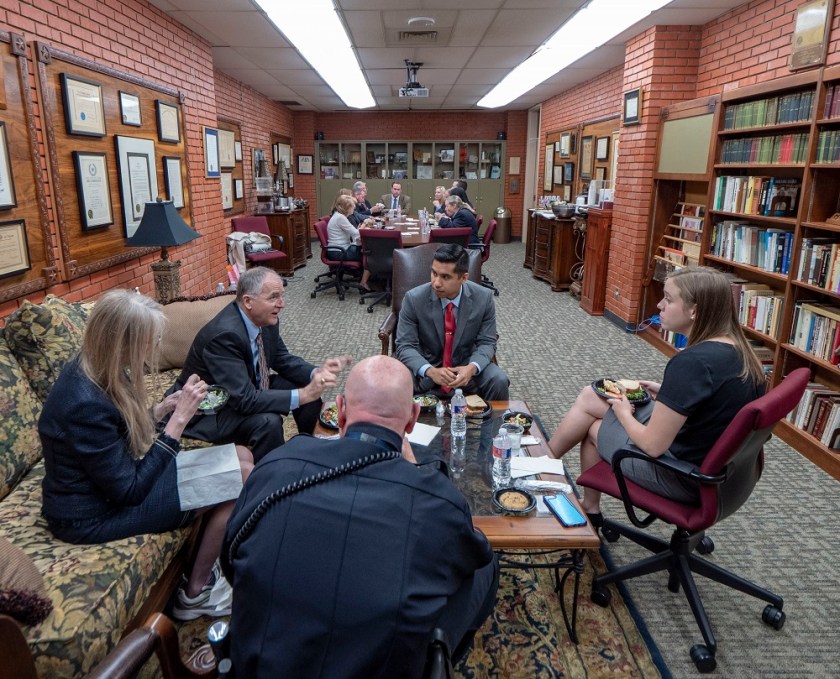
Following the second case, we have the privilege of having lunch with the Justices. Traditionally, we invite elected officials, University administrators, or local attorneys to join us, and this year, we invited Judge Sorensen and Associate Vice-Provost Chris Maynard to join us.
The discussion during lunch is far-reaching, encompassing the mascots of various schools (“Why isn’t the ‘Kats’ in Bearkats spelled with a ‘C’?)…
….to the nuances of family law…
…to the activities of the LEAP Ambassadors.
It really is a wonderful opportunity for us to expand our professional network, while also learning substantively about the law. But it is a short lunch, because the third hearing begins at one.
Our last case of the day involved Gary L. Tyson, Sr. v. The State of Texas, in which appellant Tyson was convicted of manufacturing or delivery of a controlled substance. His attorneys argue that (1) a witness’s allegedly prejudicial statements should have constituted a mistrial and (2) the charges were inappropriately based on the total weight of the ten cocaine rocks when the state failed to demonstrate that each of the rocks did, in fact, contain cocaine.
Because the arrest was made in Walker County, it involved local officers and the newly-elected Walker County DA, Will Durham. This was also unusual because the appellant was actually in the courtroom.
In this case, the defense again led off with the facts of the case.
And we did have a chance to see DA Durham make the County’s case before the Justices…
This was perhaps the most interesting case, and was most definitely the most full.
Following the case, the Justices permitted the audience to ask questions.
Victoria asked the first question, “What percentage of the cases that you hear results in you overturning the lower-court’s decision?” The answer was probably not heartening to the defendant in the courtroom: 2-5 percent.
Other questions included whether “race can influence the court’s decision” and “what the sentences are for different volumes of cocaine.” To the latter question, the court deferred to DA Durham, who emphasized that, while he was only “90 days on the job,” believed that the minimum sentence could more than double.
Following the final case, we had a chance to ask some more individualized questions to the Justices…
…and then we took formal photos.
It is a real pleasure and honor to host the court each year, and we are very grateful for Dean Lyons (COCJ), Officer Thornton, Deputies Barak and Walker, Tim Mullings, Amanda Burris, and Sabrina Rowley for their assistance and hospitality.
The day after returning from New York, we were back in the car and headed to….College Station. It’s not a long trip, but it came at a busy time; it was, however, a highly worthwhile endeavor.
We found our seats and waited to hear from our expert, Robert Booth, who worked for the State Department as a counterintelligence officer for 28 years, and he had plenty of stories to share with the crowd about how other governments attempt to gain access to classified American information. Following introductions by Andrew Natsios…
…and Jim Olson…
Booth began his talk by informing us that attempts to spy on the U.S. have been made since our country’s very conception.
He then taught us about how there are two types of Americans who ended up spying for foreign countries: (1) diplomatic or intelligence officers who have made careers out of espionage and (2) U.S. citizens that have access to sensitive information and are willing to share it with another government. The latter is considered more threatening to the United States, since citizens can deal with highly classified information that would be harmful if put into the wrong hands.
Booth then went on to discuss the 4 different reasons for betrayal by these nefarious characters: money, ideology, leaks, and ego.
Money is the most common reason that people betray their country, but they also do so because of ideologies that align with other governments.
They think that certain secrets should be shared with the public and typically enjoy knowing and sharing certain information that the people around them are clueless about. Booth stated that the biggest threat to national security is economic espionage, and he shared a couple of stories about times when he had to help protect American trade secrets.
The crowd asked questions about the Mueller report and whether or not he thought it should be published, to which he replied that to do so would compromise methods and sources.
When asked what his advice would be to anyone looking to have any sort of career like his, his response was to first become fluent in another language.
The time ran out before all the questions could be answered, but before we left, we were able to meet with Booth and with Bush School Professor James Olson, who also knows a bit about this topic–having served as chief of counterintelligence for the CIA.
For dinner we stopped at Tanaka Ramen, a College Station favorite among LEAP Ambassadors.
This slideshow requires JavaScript.
It was Samantha’s first time to try the Japanese delicacy, but she gave her spicy chicken Ramen great reviews!
We thanked our waitress and then headed back home to Huntsville.
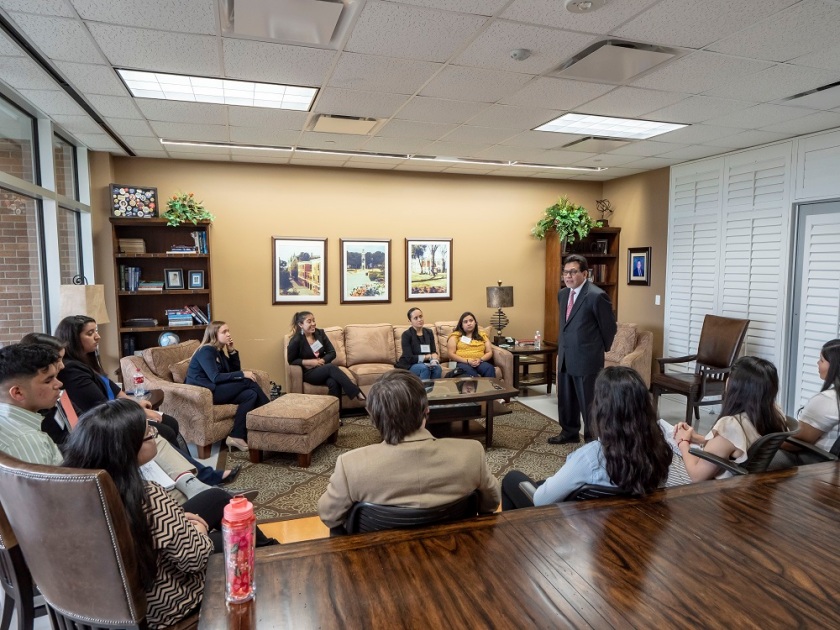
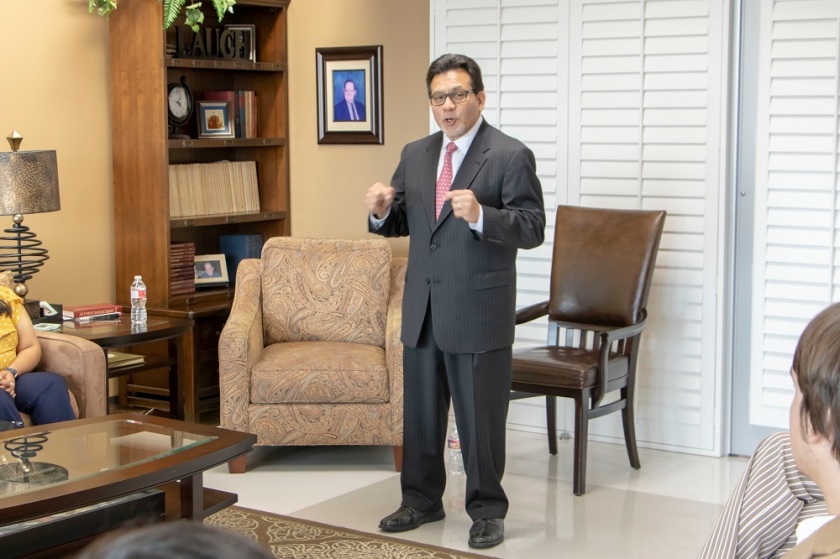
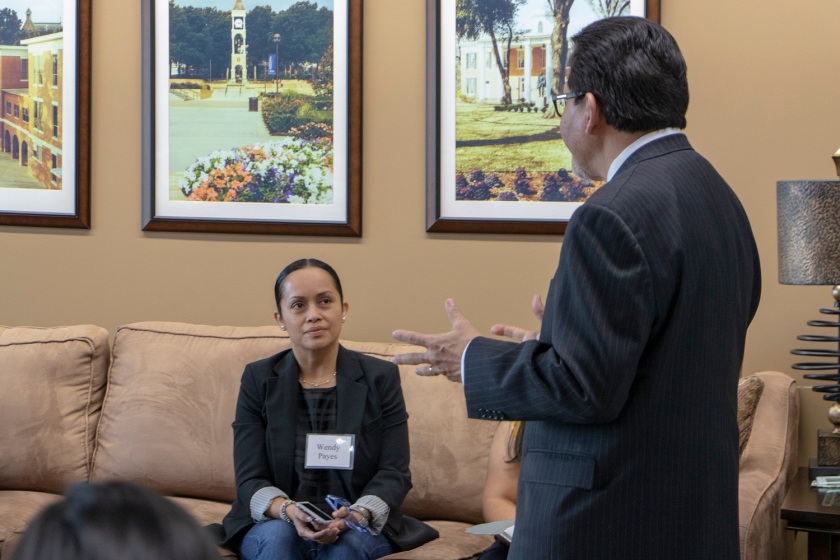
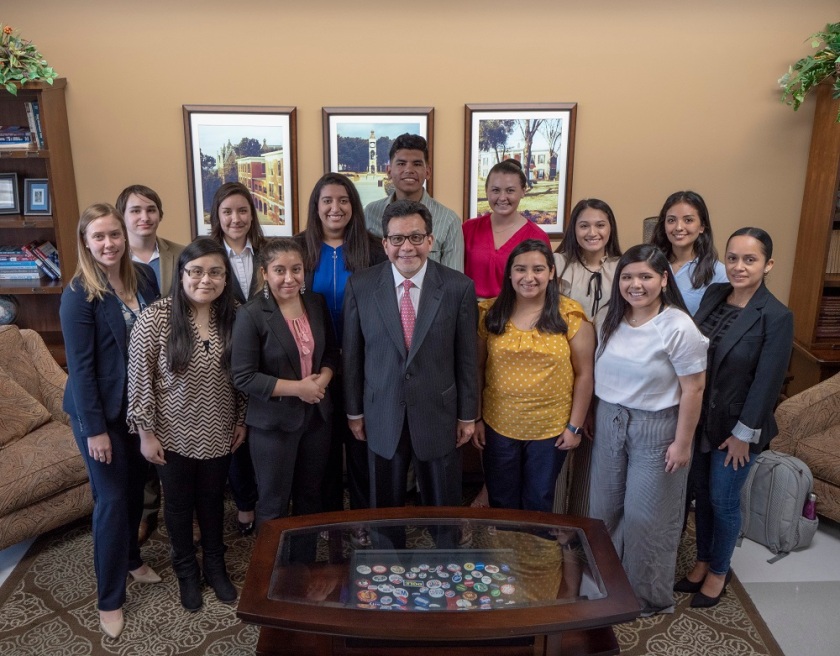
This semester, we hosted former Attorney General Alberto Gonzales again at SHSU. A group of about 12 students were selected to ask him questions about his career and solicit his advice on a number of topics.
He told us a bit about himself and his journey to the White House. Born in Humble, Texas he graduated high school and joined the Air Force. After attending the Air Force Academy, he went to Rice University and later moved on to Harvard Law School. He worked for several years in the private sector and eventually became partner at one of Texas’s largest law firms: Vinson & Elkins (interestingly, this law firm was founded by Judge James Elkins, a Huntsville resident). Then, he served as a Texas Supreme Court Justice before moving on to the White House to serve as White House Counsel and, subsequently, Attorney General. Most notably, he was our country’s first Hispanic Attorney General under President George W. Bush.
After a brief overview of his life, he asked us about our aspirations. Many of us told him that we hoped to go to law school. Being the current Dean of Belmont University College of Law, he was able to offer advice and shared with us what his school looks for in applicants.
Unlike the previous 4-5 times he’s visited, Judge Gonzales dismissed a prepared discussion and simply jumped into an interactive discussion. One student, Conner Flynt, asked about the portrayal of Dick Cheney in “Vice.” Gonzales, who hasn’t seen the film, asked Flynt how Cheney was portrayed, to which Flynt responded, “As the person who told President Bush what to do.” Gonzales dispelled that portrayal, noting that, while Cheney was a powerful VP, President Bush made the decisions. All the members of the Cabinet were invited to provide opinions–even forceful opinions–but once the decisions were made, President Bush expected people to be on board.
Other questions pertained to Gonzales’s ethnic background and whether being Hispanic hurt him in his political career. Gonzales shrugged this off a bit, noting that he knows there were some people rooting against him because of his ethnicity, while also noting that opportunities were opened to him because of his ethnicity. He specifically mentioned that, after being appointed to the TX Supreme Court, President Bush was asked whether Gonzales’s Hispannic background was a factor in his selection. President Bush responded, “Yes. I wanted a qualified Hispanic on the court, because I think it’s important that the Texas Supreme Court look like Texas.” (Incidentally, Bush also appointed the first African American Justice to the Supreme Court, Wallace Jefferson.)
Gonzales further intrigued us with his discussion of 9-11, when he was stranded at an airport after all planes were grounded. As it turned out, he was flown back to the Washington, DC by a Navy pilot.
He also reminisced about the time that he was “designated survivor” during a State of the Union speech. He was given the option to be flown around on Air Force One or go to an “undisclosed location.” He opted for Air Force One, in which he was briefed on various National Security issues that would immediately be relevant should a tragedy befall the US Capitol Building.
As Judge Gonzales began his closing, he encouraged us to make things happen, which can only begin when students take opportunities. By taking those opportunities, new opportunities will arise, and one of those may be the kind of life-changing opportunity he had when President Bush asked him to be on the Texas Supreme Court.
Colonel Yebra, wrapped up the conversation with some encouraging words, and Judge Gonzales thanked Yebra for his service (Yebra did three tours in the Middle East) and called him a “hero.”
When the discussion was completely over, we paused for a group photo…
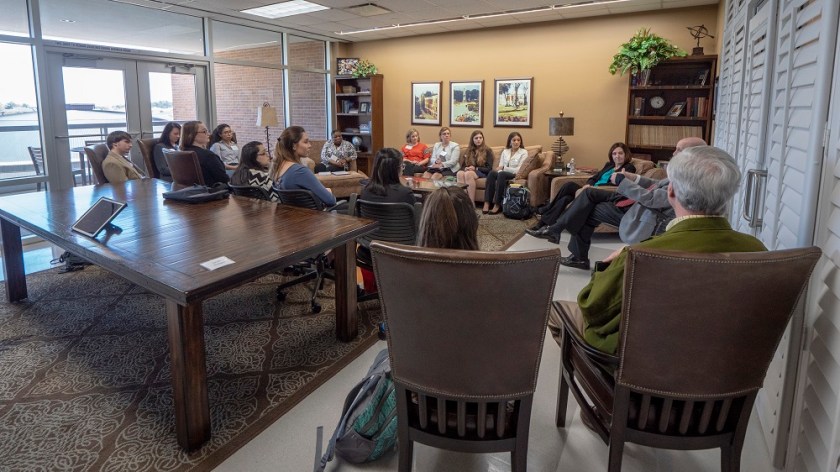
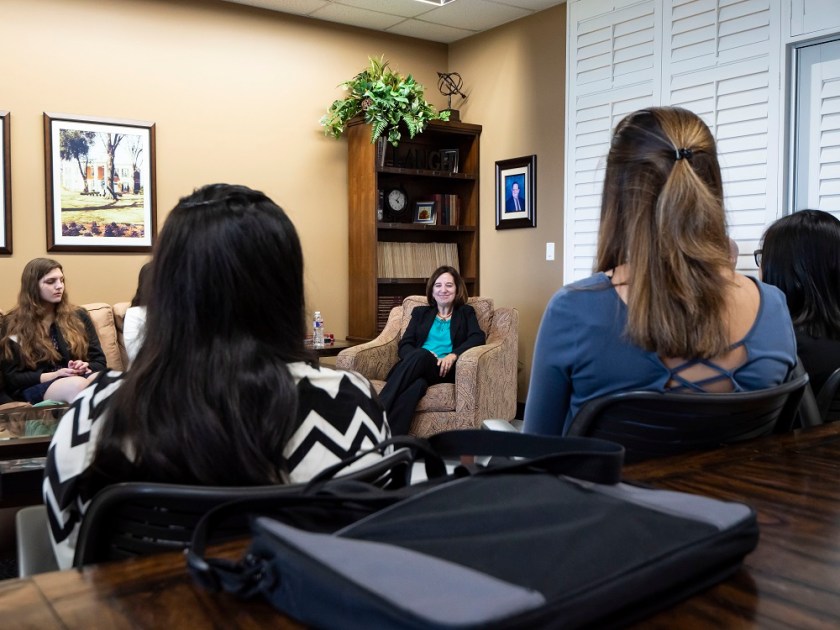
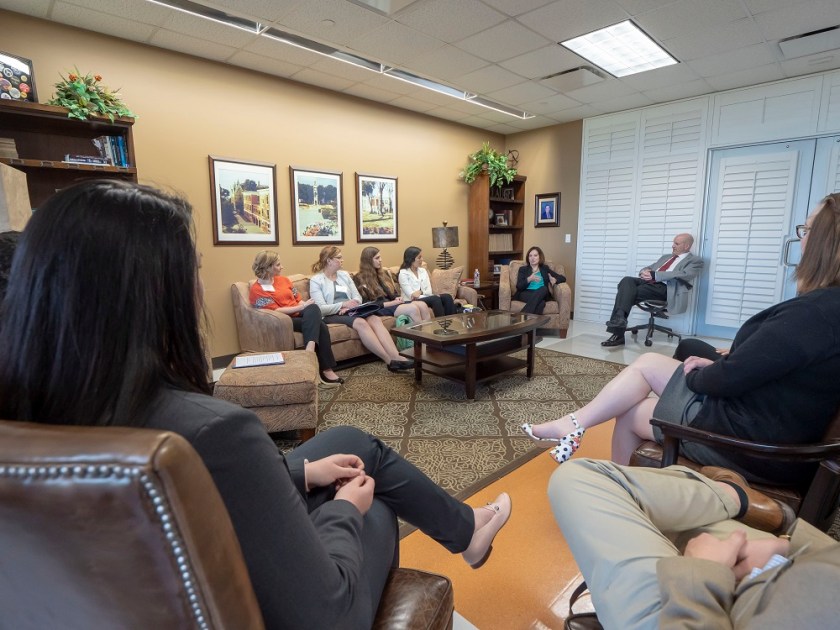
A few times a semester the LEAP Center brings in guest speakers to educate students on opportunities and to share their stories. Having heard Julie Kavanagh speak at a World Affairs Council event, we were honored to have her come to SHSU and speak to a select group of students.
Mrs. Kavanagh is the Diplomat in Residence for Texas for the U.S. Department of State. She has been working for the Foreign Service for more than 29 years and has had the opportunity to travel all around the world having been stationed in countries such as Brazil, Singapore, Columbia, China, and Russia.
She began by telling us exactly what she does for the Foreign Service, which currently entails recruiting promising individuals. She then walked us through the process one must go through when applying for a position, with the first step being to take the Foreign Service Officer Test.
She then emphasized how important learning a language is in order to work in another country. She is fluent in Mandarin, Spanish, Portuguese and rudimentary Russian, all of which she learned after she was hired in preparation for living in those countries.
Mrs. Kavanagh then shared stories about her time and work experiences while working in these different places around the world. She expressed how she truly felt the Foreign Service makes a difference in the world.
Students asked how she was able to balance her personal life with her work life as she moved from country to country. She explained that she was in a unique situation where her husband was also in the Foreign Service, and they had to make sacrifices and decisions in order to stay in the same countries for the majority of their careers.
As the Q&A began to wrap up, students were able to ask Mrs. Kavanagh questions one-on-one in order to obtain more insight into the life of a successful diplomat.
We enjoyed hosting Mrs. Kavanagh, and we look forward to seeing her in the future.
After every trip, LEAP Ambassadors independently arrive at their favorite stops along the way, and then compare notes. This not only provides some reflection, but also gives others who might be traveling in this direction some tips for stops they might make in this area (New England).
Our first category is Art Museums. The students visited seven art Museums: MOMA (NYC), Whitney (NYC), the Met (NYC), Mass MOCA (North Adams, MA), Norman Rockwell Museum (Stockbridge, MA), Wadsworth Museum (Hartford, CT), Rhode Island School of Design (Providence, RI), Boston Museum of Fine Arts, and the Isabella Stewart Gardner Museum (Boston, MA).
The favorites were….
3. Norman Rockwell (Stockbridge, MA): This was a fun Museum, and it came at just the right time. After five or six Museums focusing on Modern Art, the Rockwell Museum offered a traditional and nostalgic at American Art. In addition to seeing his famous pieces that you expected to see, there are pieces that you forgot you knew, and pieces that were a bit unusual for him. Our favorite was probably “The New Kids…”
One of the nice things about the Museum is the informative docents, who provided excellent commentary on the life of Rockwell and the story behind his paintings. Also of interest is that many of Rockwell’s models stop by the Museum to discuss posing for his iconic artworks.
2. Mass MOCA (North Adams, MA): Undoubtedly, the reason this was a favorite was the nine James Turrell pieces at the Museum. They were amazing. We’ve been to Turrell’s Skyspaces, as well as some of his light-related art at the Museum of Fine Arts in Houston, but these were more interactive and diverse. Unfortunately, photos were mostly prohibited, but all of his pieces were interesting, and “Perfectly Clear” was amazing and, not surprisingly, was the group’s consensus for favorite art piece.
Museum of Modern Art (NYC): This Museum had the typical representation of art by major artists, including Pollock, Degas, Picasso, Van Gogh, Monet, and the like. But what separated this for us was the major pieces that the Museum displays by these artists. A lot of us don’t know much about art, so when we see a piece we know, we get that it must be a really famous piece!
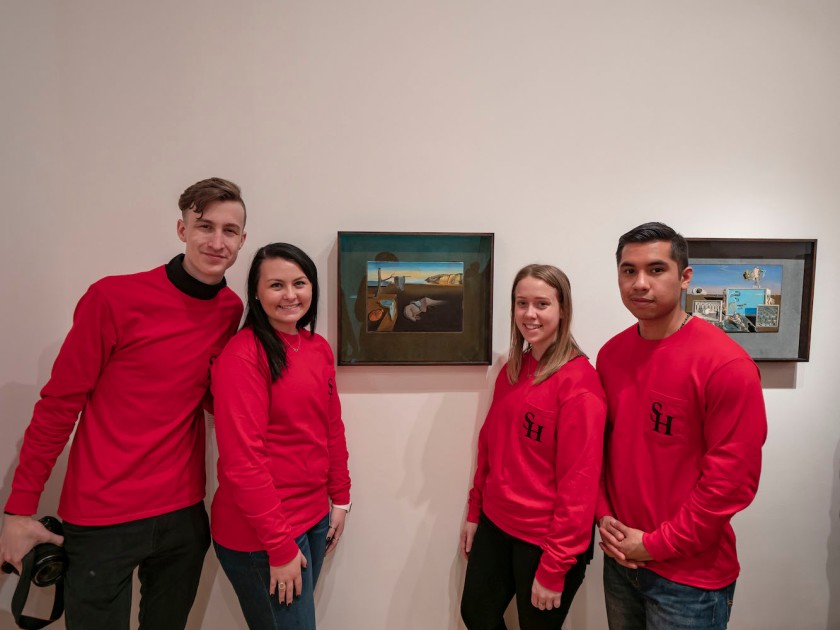
And no one can argue against “Starry Night” or “Persistence of Memory…”
__________________________________
Our second category is Historical Sites. We saw a lot of history: The United Nations, Lizzie Borden’s Home, two Presidential Libraries (JFK and FDR), a Presidential home place (TR), the 9-11 Museum, Boston’s Freedom Walk, the Brooklyn Bridge, Mark Twain’s House, Walden Pond, the New York Public Library, and Plymouth Rock. We didn’t have a lot of consensus on this, but by our voting rules, the top three were:
Honorable Mention: The Brooklyn Bridge. This wasn’t explicitly voted in the top three, but we got together before the trip and watched a Ken Burns’ documentary on the Bridge, which was very interesting.
3. Freedom Walk in Boston: This took a while to get through (getting around Boston wasn’t that easy for us), but we enjoyed seeing the historical sites, such as Samuel Adams’ grave and Paul Revere’s House. Afterward, we stopped at Cheers, which is near–but obviously not on–the Freedom Trail.
2. The United Nations. This was our first stop, and we got a good mix of Human Rights, politics, and even art.
Our favorite historical site was the 9-11 Museum. While too young to remember 9-11, we certainly knew of it, but this Museum brings it to a very personal and emotional level.
________________________________________
Our third category was state capitol buildings, of which we saw four: Albany, NY; Hartford, CT; Providence, RI; and Boston, MA.
Coming in at second was Providence, RI, largely because of our tour guide, Liam. He is a History major at a nearby University, and he brought energy, enthusiasm, and knowledge to the tour.
Throw in a beautiful building, and you’ve got a wonderful time.
Our top Capitol was the NY Capitol Building in Albany. We also had a good tour guide here, and the building was super impressive. And numerous of the governors had become president or a presidential candidate, which added to the historic ambiance.
This slideshow requires JavaScript.
___________________________________
Our next category was “favorite restaurant.” Our goal was mostly to eat in affordable places and to eat quickly, so that we could see more sites. But we can recommend the following:
Eisenburg’s Deli: Old-school Jewish deli in New York City.
Providence Oyster Bar: Good seafood in Providence, Rhode Island.
Maurice’s Pearl Street Deli: Another strong deli, this time in Albany, NY.
__________________________________
Finally, we had two favorite miscellaneous activities. We enjoyed tubing near Concord, MA….
And, of course, we loved the musical “Chicago” on Broadway.
We definitely believe we got the most out of our trip, seeing thousands of pieces of art; architectural wonders; dozens of historical sites relating to politics, civil rights, and literature; as well as having the opportunity to meet interesting people and, we hope, represent SHSU well in the process.
We wanted our last full day in New England to be memorable, so we made sure we had a memorable day!
Isabella Stewart Gardner Museum
The memories began with the Isabella Stewart Gardner Museum. The Museum was established by, you guessed it, Isabella Stewart Gardner, who was an art collector throughout her life. Her generous endowment came with an odd requirement: the art could never be changed.
As such, the Museum looks much like it has since 1903, when it was established. The building was designed by Willard Sears, who crafted it to look like a 15th Century Venetian Palace.
The art in the Museum consists of works collected by Gardner during her lifetime (1840-1924). They are hung salon style, with separate gallery guides for each wall. Given that the Museum is fairly crowded (at least it was on this Saturday), and that each room contains copious art works, it can be time consuming to ascertain the creator of each art work.
The rooms are beautiful.
And the art is rich, with pieces by artists as diverse as William James, the famous psychologist who painted his brother, writer Henry James…
…and Rembrandt…
…Rubens…
…Titian…
…and John Singer Sargent.
The Museum was the victim of a 1990 robbery, when 13 paintings were stolen by thieves whose identities are still unknown. The paintings were never recovered. Amazingly, the Museum did not have insurance, which seems incomprehensible. Interestingly, even if it had insurance, it wouldn’t have been able to replace the works with other works–because of Gardner’s legal insistence that the collection never be changed. So, currently, the Museum simply hangs the empty frames where the 13 masterpieces used to be.
While these frames are a reminder of the world’s most costly burglary, the remainder of the collection evokes the beauty of the still extant works.
Harvard University Visit – Victoria McClendon-Leggett
Harvard University was founded in 1636 and has a track record of producing notable attorneys, judges, congressmen, and boasts having contributed to the education of a total of 8 presidents. It is for this reason that the political science students among us were particularly excited to see the campus.
We hopped out of the van with our cameras and were immediately drawn to the buildings lining Harvard Square, which is the most historic location in Cambridge. We found Massachusetts Hall (the oldest building on campus, built in 1720) and the main library before ducking into a small café that faced the square for a reprieve from the blustery winds that made it feel several degrees colder than it actually was. When we got our bearings, we set off across campus with the goal of seeing their law school – one of the most famous in the world. At many universities, the law school is confined to one single building, at Harvard however, it is comprised of several. We were only able to get into the foyer of the law school library to have a look around.
We had done some light research beforehand and read that the views of Cambridge from the terrace on the science building was the best on campus. This proved to be quite true. We stood high up in the gusty wind to capture a few pictures of the area. The only downside to our visit was that because Harvard is such a heavily visited tourist area, many of the buildings were inaccessible without a student I.D. This did not deter us from taking in the atmosphere on campus, though. We were able to see Annenberg Hall, which was one of the prettiest buildings we came across while in Cambridge and is apparently where freshmen students eat their meals.
While on campus, we saw two black sculptures by artists we were already familiar with, one by Alexander Calder…
…and another by Louise Nevelson.
We left the Harvard Square and explored the streets around it, discovering a trompe l’oeil mural done by Joshua Winer that strongly reminded us of some of the works we’ve seen on this trip by muralist Richard Haas.
After a brief respite in the gift shop, we hopped in the van and had a one more stop before our day was over.
Snow Tubing at Nashoba – Makayla Mason
As soon as we pulled into the parking lot, our excitement grew when we saw the sun shining on the shimmering slopes of Nashoba Valley Ski Area. We put on our tags, grabbed a tube, and ran to the magic carpet, a conveyer belt that took us to the top. For most of us it was our first time participating in a snow-filled activity, so the anticipation grew even more as we waited our turn.
There were many different lanes that we could choose from, but we leaned more towards the ones that curved and had more potential to send us airborne.
We went down as many times as we could, and would sometimes go down in groups of two, three, or all four, holding on to each other’s feet to stay connected.
The most exciting was going backwards as a group and hitting bumps that sent us soaring a few times on the way down!
As the sun started to set, we sadly made our way off the slopes. We all had windburned faces and were full of bliss from the new experiences and fun we had.
The rapidly setting sun signified the inevitable longing that we were sure to feel from the first day, that our trip in the Northeast was concluding–except for one more stop.
Walden Pond
As we were driving back to the hotel, we realized that we were only a few miles from the famous Walden Pond, where Henry David Thoreau went to live for two years. His time there inspired his “Walden: Or, a Life in the Woods,” a classic of American literature.
Today, it is part of a state park, which contains a model of his cabin and a statue of Thoreau….
…as well as the Pond.
The Pond was partially frozen over, and it–along with the sunset–added to the location’s beauty.
Following Walden Pond, we stopped by the town of Concord, MA for dinner. Intriguingly, this is also where many famous authors are buried–writers such as Thoreau…
…Emerson…
…Louisa May Alcott…
…and Nathaniel Hawthorne.
Incongruently, this area, so rich with the presence of 19th century authors, is also the general area where Walter Gropius and his wife decided to build. The “Gropius House” is a Bauhaus oddity, built with traditional materials while combining a bit of modern and post-modern stylistics.
While somewhat out of character with our day’s explorations, it fit with the overall eclecticism of the trip.





























 Center for Law, Engagement, and Politics