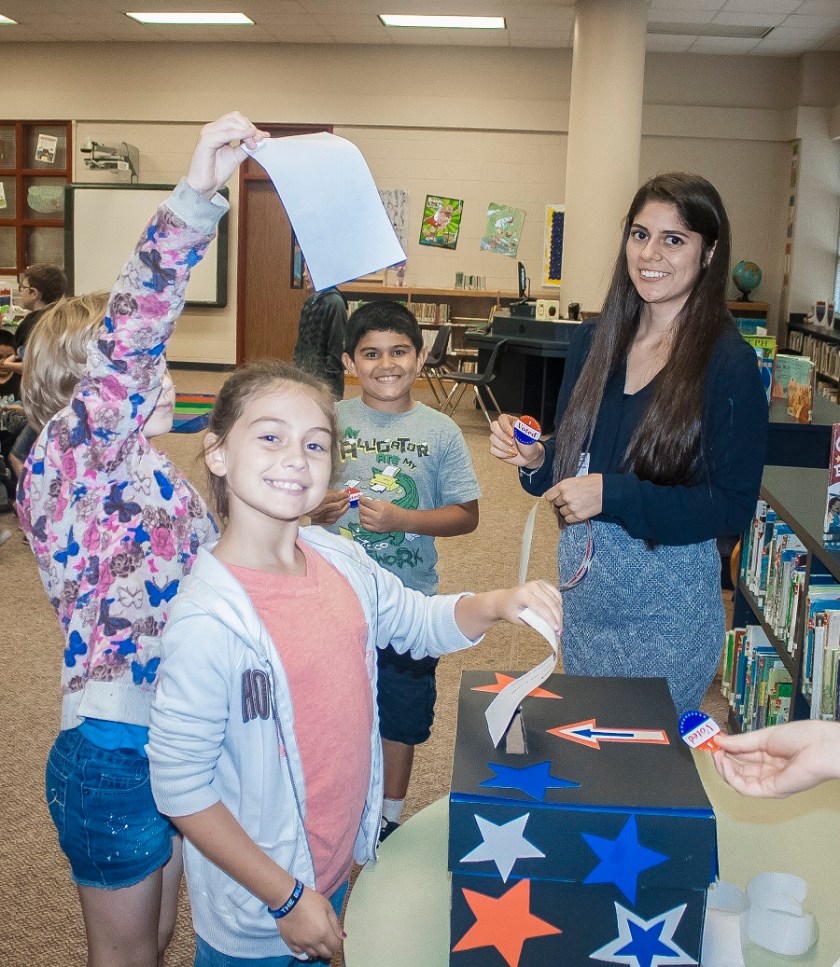
Amidst the political commotion of the current Presidential Election, LEAP Ambassadors participated in educational civic engagement by hosting Mock Elections for 1st, 2nd, 3rd, and 4th grade students at Estella Stewart Elementary School. We arrived as the school bells signaled the start of the school day. To prepare for our students, we set up our polling stations inside the library, relying on colorful voting stations and patriotically designed ballot boxes.
Our goal was to teach the elementary students about the election process and to habituate them to the act of voting.
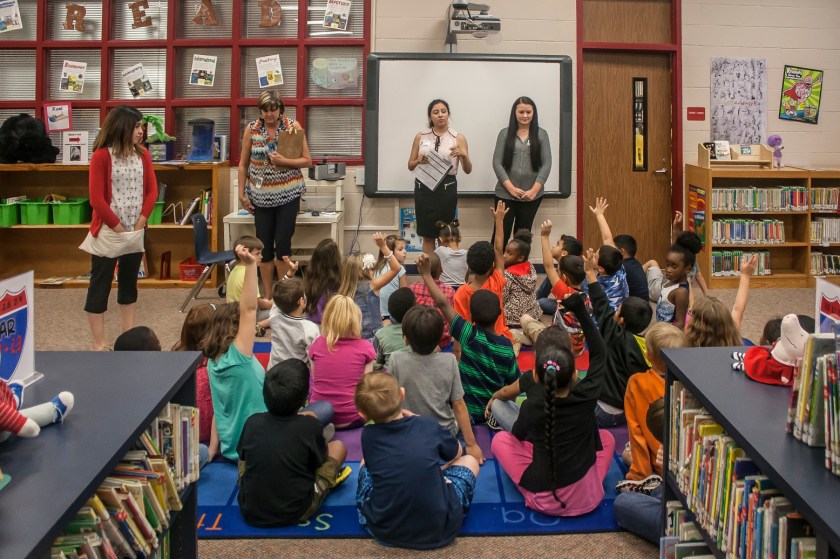
When the first group of students arrived, they were promptly seated for their first lesson aimed at teaching them about local government. LEAP Ambassadors acted as teachers, educating students about who our government leaders are, how those leaders get elected, and how to participate in the electoral process.
From group to group, the conversations with students varied depending on their questions, but each lesson ended with excited students lining up to cast their votes.
First and second graders were given ballots with pictures to help them identify their choice for president, while fourth graders were given regular ballots with only the candidates’ names on them. The rules for voting were enforced to ensure that our mock elections were as realistic as possible. Talking and looking at others ballots were prohibited. The children were so used to this routine that some, after casting their votes, were worried that they had not written their name on their ballots. We calmed them down by explaining the anonymity of the voting process.
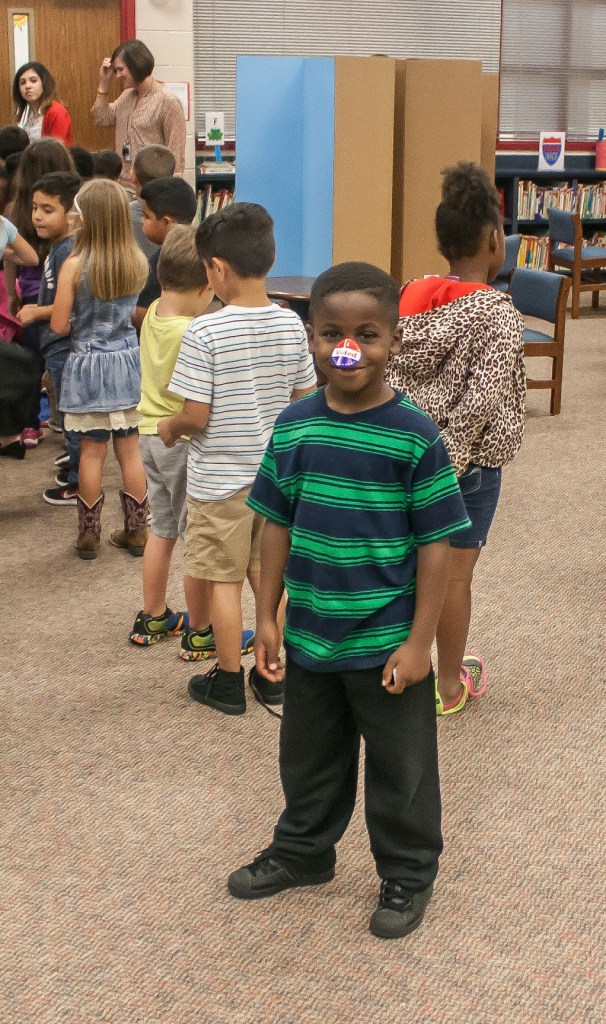
As each student slipped their vote into the ballot box, it was rewarding to see the smiling students excited about voting in their first election! Wearing their “I Voted” stickers with great pride, each student left the room ready to turn 18 and cast their real votes.
Although though the true results will come to light next week, for these mock elections the ballots were counted with Hillary Clinton winning with 64% of the vote.
We suspect that the actual election will be much closer, although we suspect the end result will be the same.
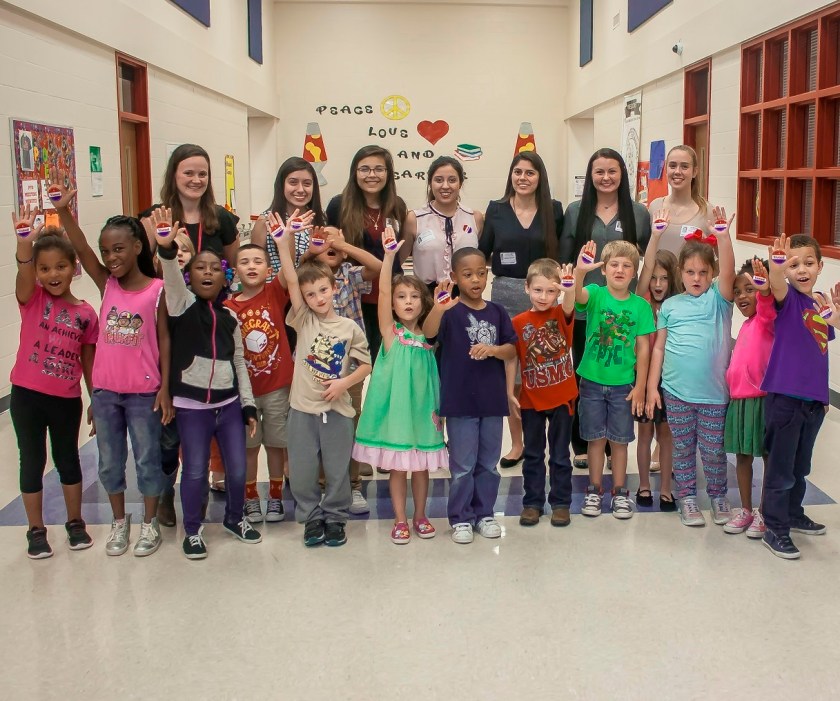
With the jolly goodbyes from a group of happy little voters…
…we left the elementary excited by the children’s excitement in civic engagement. Thank you to Estella Stewart Elementary School for allowing us to visit and contribute to the success of a future generation of voters!
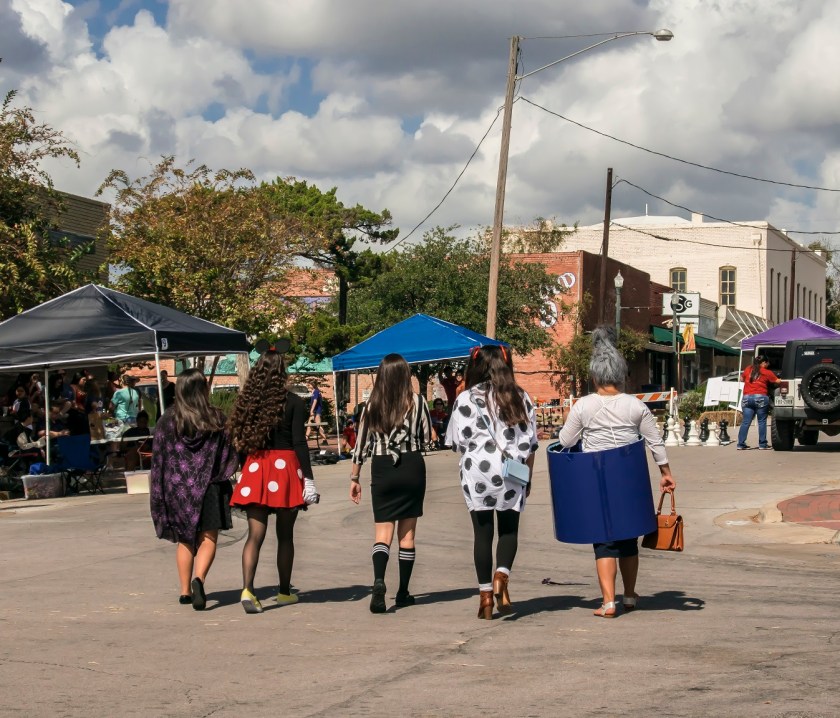
Ring after ring flew from their hands, aimed at the point of a witch’s hat. Three at the floor, one hitting the mark, and one hitting a human hotdog. But alas, at least one hat had been hooped around by the ring and was merit for a prize of chalk or bubbles. Why so much scary, carnival fun at the square? Why, it was the annual Huntsville Scare on the Square.
Last Saturday the LEAP Center hosted a booth at Scare on the Square. Scare on the Square is an annual Halloween event sponsored by The Huntsville Main Street Program. About 40 different businesses, schools, and local organizations host games and activities for community children. Scare on the Square is sponsored by local businesses and it is a safe atmosphere for families to enjoy themselves.
If you are creative and wear a costume it will spare you from having to pay the entrance fee of one dollar. Embracing this costume-wearing practice, the LEAP students arrived in a variety of costumes themselves from Minnie Mouse to Charlie Chaplin.
With weeks of anticipation prior to Scare on the Square, the LEAP center engineering team (aka a few of the LEAPsters) designed a game built to increase levels of happiness to the maximum. In the end, we created the “Witch’s Hat Ring Toss.” Similar to a bean bag toss, it required the competitor to loop hat dressed cones with a pool ring. Let’s just say that hand-eye coordination was important in order to successfully master this enchanted game.
This slideshow requires JavaScript.
With smiling faces, all the children (and even some LEAPsters) patiently waited in line to play, ready to ring one or two witch hats.
We had a few future athletes who knew at exactly what angle to throw the rings. Yet even more children measured wind speed, warmed up their best throwing arm, made their marks, and walked right up to the cones to place the ring into the hat.
In between handing out rings and giving out candy, we amused ourselves by noticing the creative Spidermen, Pikachus, Elsas, Super Girls (we even had our own superwoman!), as well as some actually frightening costumes.
But even more rewarding was the look on their faces when they looped a hat (without cheating).
With the LEAP center’s 1800 pieces of candy gone, we packed our tent and witchy game satisfied with the 400 plus jolly children that had visited us. We are grateful for the sponsors and coordinators of these events that allow us to interact with the community!
“Sam Houston State vs Baylor” blared the speakers. But this wasn’t a football game. Instead, it was a Moot Court playoff round, albeit still in the scrimmage stage.
The teams made their way up towards the front of the room for a coin toss to let fate decide whom they would represent, the petitioner or the respondent. As our team members–consisting of Austin Taylor and Kristyn Couvillion–won the toss, they chose the petitioner role.
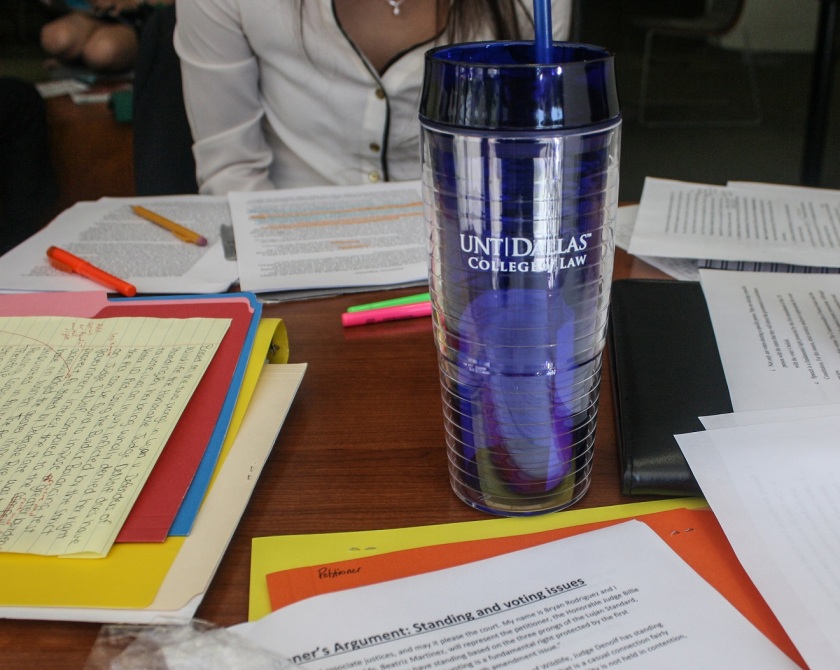
About three hours prior to that coin toss, our alarms blasted, and we rose from bed to hastily get ready for our exciting second day of the UNT Invitational Moot Court Tournament. This invitational is especially helpful to the new team members as it provides them a chance to see and experience a real tournament. Additionally, it prepares them for the regional competition which will take place on November 18th – 19th at Texas Tech.
While navigating the inner streets of Dallas, Kristyn Couvillion and Austin Taylor began mentally preparing for their competition of the day. Their hard work and dedication had paid off as they had made it to the top 32! Kaitlyn, Bryan, Beatriz and I were excited to support our advancing team in their competitive endeavor of the day.
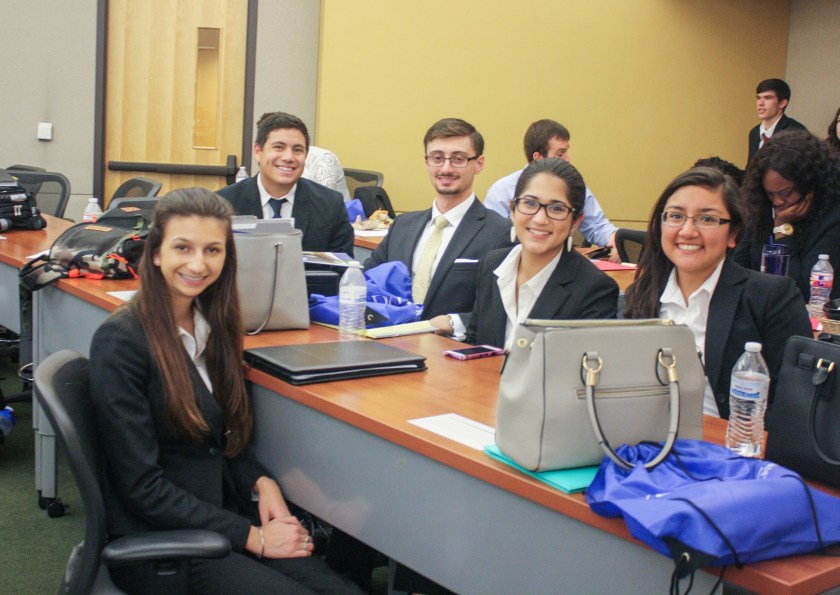
When we arrived at UNT Law school, we checked in, and went up to the meeting room where all of the other schools waited in anticipation for the rounds to be announced. Each round would consist of two teams pinned against each other from the top 32 teams that were announced the day before, Kristen and Austin included in those teams.
We sat in anticipation waiting for the three judges to arrive so that the round would begin. We observed and quietly rooted for our team members while they argued their case with passion and quick mindedness. By watching both of the teams, we also gained skills. After the judges had scored both teams and offered their advice, we rushed back to the meeting room and waited in agony for the results to be announced. The round was decided in a 2 to 1 split decision, in favor of Baylor.
Even though we had no further advancements in the Invitational, we stayed to watch Josue and David, two students whom we had befriended at our Boot Camp. During the competition, we were impressed by the poise and arguments of the opposing team from the Air Force Academy. Sadly, Josue and David did not advance, but the team which they were against actually ended up placing first for the entire competition!
After the round we decided that it was time to bid UNT farewell and ease into dinner. After much arguing (and still more to decide on dinner) we finally decided to visit a small sidewalk café, the Veracruz Café. With a motto to “Celebrate life,” the restaurant adequately captured the Veracruz spirit of amazing cuisine and beautiful vistas. Consisting of various herbs and spices, there was a myriad of flavorful dishes to be tasted. The Café brought to us a little bit of Veracruz with food ranging from MesoAmerican, Mayan, Huasteco, and Aztec cuisine. Everyone chose their preferred food choice. Dishes ranged from an enormous fajita plate to a spicy chile relleno, from crunchy flautas to cheesy quesadillas. Every single dish as scrumptious as the other.
After we finished our lunch at the Veracruz Café, we decided to go explore the variety of shops that lined along the Bishop Art District. Chairs lining an old gas-station-turned-furniture-store, people milling around, enticing smells, and interesting window displays worked like a hypnotic swirl of curiosities that compelled us to immerse ourselves deeper into the street. Among the stores was an art gallery which we visited called the Ginger Fox Art Gallery.
A West Texas native, Ginger Fox was a self-taught artist disciplined in painting murals, trompe l’oeil, grisaille, and replicating the masters. Her style of magical realism was reflected on her canvases which meshed real and imaginary dimensions together with the purpose of invocating thoughts of how we, as humans, can better coexist with the natural world. We got to see various of this style in the art gallery. One in particular caught our attention.
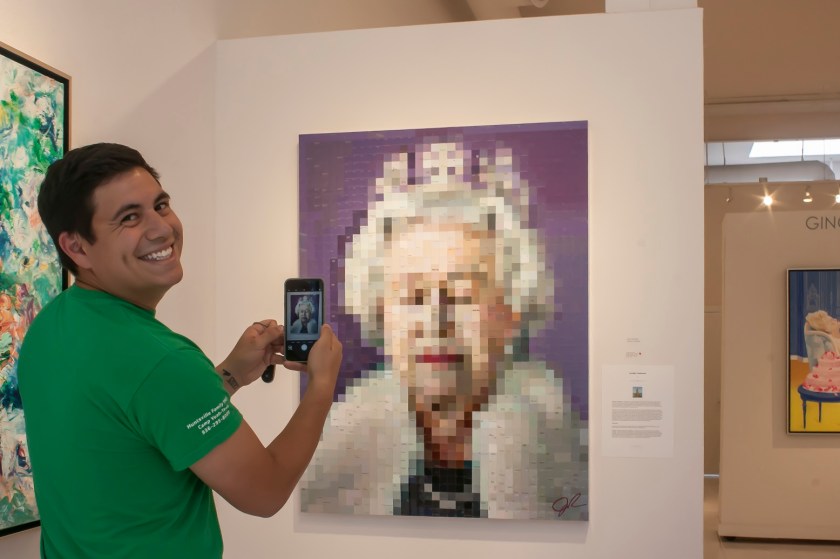
There was a picture of Queen Elizabeth made entirely of blurry paint chips, making it almost impossible to disambiguate the painting. However, when looked at through a camera, the pixelated image grew into sharper focus.
We the wonderful art gallery as our last stop we decided to end our trip and head on home. After a long day of tiresome litigation, exotic eatery, and mind boggling art, nothing compared to the quiet, peaceful ride down I45 back to Huntsville.
124 competitors. All impeccably dressed in suits. All vigorously trained. All eager for the challenge ahead. All vying for that one top prestigious position. All gathered at the University of North Texas College of Law where the beginning of something intriguing and educational was about to commence.
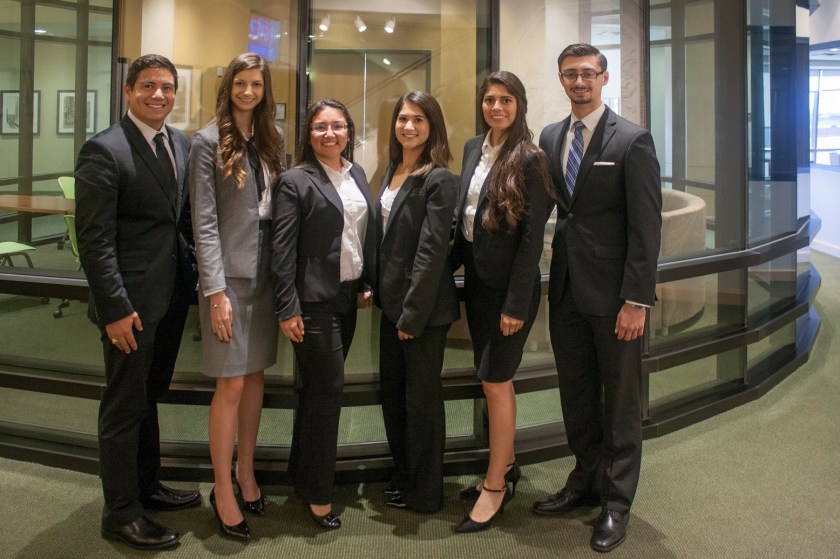
On October 21st, participants arrived at their very first Moot Court Scrimmage of the year. More than 13 different schools from all over the region had come to partake in this unique event. In the midst of all of this was the SHSU Moot Court team, comprised of Kaitlyn Tyra, Alejandra Galvan, Austin Taylor, Kristyn Couvillion, Bryan Rodriguez, and Beatriz Martinez. Since the beginning of the school year, these future attorneys have been preparing for an extremely challenging competition. Not only would they have to prove their worth to their opponents, but also to the law students, lawyers, and other experts in judicial procedures that would be serving as judges.
“Being in the moot court is very tough and challenges its competitors in ways most would otherwise not experience until they attend law school,” noted Mooter Kaitlyn Tyra.
The competition lasted for two days, whereupon each round included two moot court teams (comprised of two people) that presented in front of a panel of judges and argued on both sides of the problem case at bar. After the end of the first day, only the top 32 teams would go on to the next day for their second set of rounds.
Students spend much time reading case briefs, analyzing them, preparing their arguments, and presenting them in practices. Moot court helps enhance public speaking (which is most people’s worst nightmare), increasing confidence, time management, literacy improvement, and other essential qualities to succeed in law-driven career. It also enhances a student’s law-school resume.
Having arrived a bit early, SHSU’s six moot court members decided to go over their arguments a bit more before the competition began. After their diligent preparations, the SHSU students decided to go eat at the local Italian restaurant, Porta di Roma. A local favorite among the UNT students, this quaint, little restaurant offered succulent Italian dishes. Known for its amazing pizza, many of the students decided to try the special of the day. Others were a bit more adventurous and tasted the lasagna.
As 1 pm approached, the SHSU students headed back to the UNT campus to wait for the real adventure to begin. Each team was destined to go through three different rounds, competing against different teams during each round. Judges evaluated each speaker on the basis of their knowledge, argument organization, forensic skill, and response to questions.
When the last round ended, everyone met back at the common area of the UNT campus and waited anxiously for the results to come in.Most of us ranked near the middle of the pack, in the mid-50s or mid-60s, but Austin Taylor ranked among the top third of students, coming in at 38th (out of 124 participants).
Then the results everyone had been waiting for arrived. Out of 62 teams, only 32 could advance to the second day. One of our SHSU Moot Court teams made it onto the Round of 32! Austin Taylor (one of the first-year students) and Kristyn Couvillion (a second-year student) made it to the second round. Our team let out a great victorious whoop (customary if one of your teammates manages to advance).
Finally, the end of the day arrived and everyone went home to rest after a day full of challenges. That is except for Austin and Kristyn, who had one more day of suits, challenges, and a day of tantalizing victory for the number one spot.
With the nearing of Veterans Day, the H.E.A.R.T.S. Veterans Museum hosted a flag dedication ceremony to honor the men and women who have served our nation. Organized by Jeff Bradley, and executed by the great staff at the HEARTS Veterans Museum, the ceremony brought in some of our elected officials and many local notables.
Mark Robinson, the director of the HEARTS Museum, began the ceremony. The Huntsville Men’s Choir led “The Star-Spangled Banner” and everyone joined in. A few special guests were introduced: Senator Charles Schwertner; Mayor of Huntsville Andy Brauninger; Todd Stevens, the District Director for Congressman Brady; and others.
Following the introductions, the flags were dedicated. The United State Army Flag was donated by Champe and Virginia Miller in honor of Captain Robert H. Rucker and Captain William A. Miller. The United States Navy Flag was donated by Phyllis and Walt Pinegar in honor of W.M. Bill Pinegar and W.E. Walt Pinegar. The United States Marine Corps Flag was donated by Mr. and Mrs. Tom Freeman in honor of Captain Stephen P. Freeman. The United States Air Force Flag was donated by Sue Trammell Whitfield in honor of William F. Whitfield. Lastly, the United States Coast Guard Flag was donated by Tom and Charlotte Oleinik in honor of Clarence Magee.
While the flags were being raised, the Huntsville Men’s Choir sang the Armed Forces Medley. It was a beautiful ceremony full of love, respect, and pride for our country.
At the conclusion of the ceremony, the guests were welcomed into the Museum for refreshments and desserts. In order to continue honoring of veterans and the Armed Forces, the HEARTS Museum remained open with free admissions until noon that day. Some wandered through the museum enjoying the articles from past wars and learning about our military’s history, while others enjoyed conversation with current military members and veterans who were in attendance.
As noon came around, people began to shuffle out and thanked the staff for a wonderful ceremony.
With the flags flying high and the echo of the Men’s Choir’s chants resonating in our ears, we all made our way out from the Museum feeling proud of attending the ceremony.
With early elections around the corner, more and more candidates on the November ballots are upping the ante in order to secure a victory this November 8th. This is especially true of Congressman Will Hurd’s campaign in District 23 against Pete Gallego, which has made it the most contested district in Texas. As Congressman Hurd’s re-election campaign draws to a close, Republican officials from varying levels of government have assisted in his efforts, including Paul Ryan, Gregg Abbot, Tom Mechler (Chairman of the Texas Republican Party), and others.
This past Friday, Congressman Pete Olson and his staff flew from DC to join the list of party officials to contribute to the Republican success in the district. Among the staff members and the Congressman who convoyed from Sugar Land to Del Rio there was a group of volunteers ready and eager to help in Hurd’s Campaign. I spent my Friday afternoon completing the six-hour trip down to the border town of Del Rio and canvassing in favor of Congressman Hurd on Saturday.
With staffers located in DC, many of those in the convoy were more than happy to finally be in their home state of Texas, Congressman Olson included. On the way to Del Rio I was placed with a volunteer from Richmond (a retiree who had worked for the TSA in DC, the Corrections Board in Baltimore, and traveled around the world), a District Director for Congressman Olson, and a DC intern (freshly graduated from A&M who was among those ready to indulge in the Texas spirit). Passing through old Texas towns, vast free-range pastures, and some barren patches, the road became longer and lonelier as we got near border. From pines and oaks, the landscape turned into shrubs, sand, and mesquites, a desolate land with a few settlement’s along the way. After crossing the border patrol check point, marking the 25 mile mark before arriving to Mexico, we remarked how there was still no signs of civilization as we neared Del Rio. Eventually however, we neared a medium-sized building which advertised fajitas and tortilla chips; we had finally entered Del Rio.
As our first time in Del Rio for all of us, and the first time that close to the border for most, Ms. Dana Benoit (Congressman Olson’s campaign manger) deemed it apt, some may say necessary, to dine with a feast of Mexican cuisine. So being we entered Manuel’s Steakhouse, where those DC émigrés relished upon the savor of fajitas, tacos, and margaritas (a taste of authentic Mexican which they had long been waiting for). With conversation about the hectic DC lifestyle, the night soon came to an end. We then retired to our hotel rooms to rest and get ready for the block-walk-filled Saturday.
Upon waking up in the little Del Rio hotel, we packed our bags and met inside the local Chick-Fil-A. There we met campaign staffers from the Hurd team, Hurd’s Chief of Staff included. After a briefing of the day’s plan, and some words of encouragement from Congressman Olson, we climbed into our assigned cars and immersed ourselves within the Del Rio community.
The team I was assigned to included Stoney Burke (Congressman Hurd’s chief of staff) and Jorge (a student from the University of Houston), who had traveled with us from Sugarland. With a majority hispanic constituency, Being able to speak Spanish was a real benefit for Jorge and me because we were able to communicate better with the voters we met during the day. Like any other block-walking operation, however, the number of constituents that answered the door was minimal. However, those that did answer were friendly and cared about their community, considering it highly important to choose the best to represent them at DC. Through meeting with constituents we learned how their major concerns rested on border security, adequate care of veterans, and the proper maintenance of Highway 277. We continued block walking, driving through houses of all shapes and sizes that resembled Mexican architecture, until we finished two sets of walk books.
With only a few constituents declaring that they will not vote for Hurd, those from the Hurd and Olson campaign alike considered the day a very positive indicator of what the results would be come November 8.
After we all finished our assignments, we regrouped at Chick-Fil-A to get ready for our drive back to Sugar Land. We then said our goodbyes to the Hurd Campaign, extremely grateful to help Congressman Hurd, and bid farewell to Del Rio. With the sun bearing its last rays on the endless pastures of green and hay, we sped through highway 90 en route to Sugar Land. As we left the border town we sympathized with that dimming twilight which shone its last glimmering lights to make way for the unknown night. With such an uncertain presidential election, all we can do now is wait for November 8th to come and hope that our contributions will at least yield victory at the local level.
The LEAP Center does not engage in partisan politics. The Center does provide internship and volunteer opportunities for students. In the past two years, we’ve worked with students who have interned or volunteered for the Democratic, Republican, and Green Parties.
As a public service to the community, the Walker County Republican Women hosted a “candidates’ forum” on Monday night, inviting candidates at all levels and of all stripes to meet the public. With five minutes to discuss their intentions and platform and an almost unlimited time to mingle, the forum provided a key service to the voting public.
The Walker County Hospital District candidates were the first to speak. With three positions up for election and six candidates running for the position, the meet and greet was important to decide on who to elect this November. Two of the candidates currently serve on the board while the other four are seeking election for the first time. This was an informative meeting; we learned about the important distinction between the Walker County Hospital District Board and the Huntsville Memorial Hospital Board. The Hospital Board is a board of directors composed of community leaders who oversee the broad direction of the Hospital. The Hospital District Board, on the other hand, is made up of elected officials responsible for overseeing the District, its finances, its physical structures, and its health care. Although this latter district has the ability to tax, such revenues only make up a small portion of the hospital’s overall revenues.
The Huntsville City Council candidates also participated with their own five-minute overviews. They also engaged in a Q&A by the audience, and addressed the bond election. The voters of Huntsville will decide on three bond propositions:
Proposition One: Improve Public Safety Facilities (not to exceed 31,000,000)
Proposition Two: Improve City Service Facilities (not to exceed 24,000,000)
Proposition Three: Improve City Waterworks and Sewer Facilitiies (not to exceed 73,000,000)
With these weighty matters on our minds, we thanked the Republican Women for organizing the event, and we exited pondering upcoming decisions.
As has been SHSU’s tradition, every legislative session the LEAP Center finds exemplary students to intern at the capitol with the state legislators. From a week of mid-terms to a weekend of new legislative terms, the LEAP students traveled to Austin to tour the capital, interview in legislative offices, and explore the rest of the city.
Interviews, by Vincent Melore
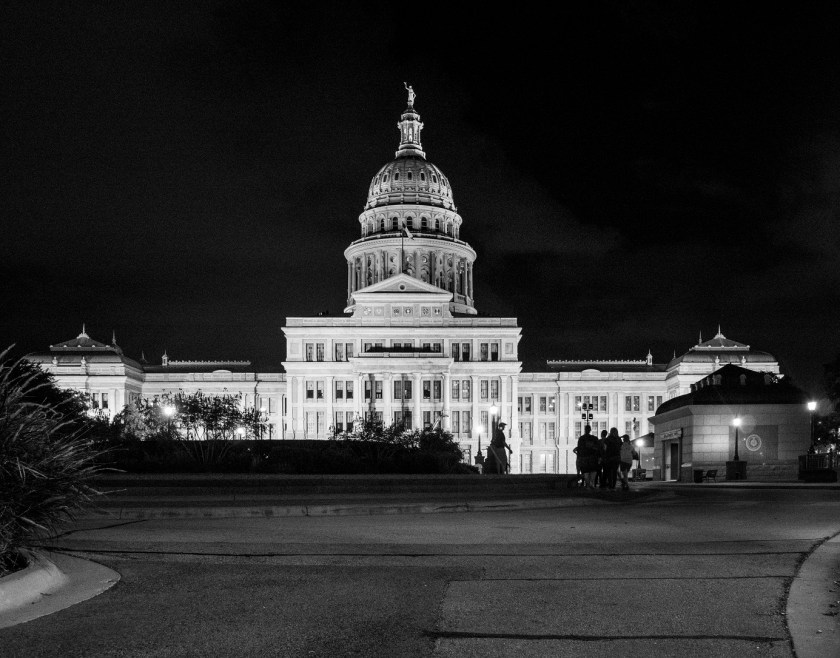
It was six o’clock in the morning when we LEAPed out of bed, awaiting the opportunity of a life time. Donning our newly pressed suits, we eagerly anticipated the ride to the capitol, where we would interview with three staff members representing various legislative candidates. When we arrived at the front gates of the capitol we were struck with awe. Magnificent coal black gates surrounded a structure like no other in the state of Texas. The capitol, dressed with genuine Texas red granite and topped with the gorgeous guardian of liberty, was truly a testament to all the opportunities that Texas provides.
LEAP Center Students Sit in on Appropriations Committee
Soon after the group arrived at the capitol, we interviewed staffers from numerous offices including: Benjamin Williams, Director of Administration for Representative Jim Murphy; Eiman Siddiqui, future chief of staff for Representative-elect Tom Oliverson; and Nick Raymond, future chief of staff for Representative-elect Ernest Bailes. The interviews were indeed a learning experience as potential Austin interns Vincent Melore, Christina Perez, and Isabela Gonzalez were interviewed simultaneously for their first interview of the morning. During the interview, the group was asked typical interview questions, hypothetical interview questions, and some questions that seemed unusual but were used to get an understanding of our unique personalities and whether or not they would fit well in their offices.
As we continued interviewing throughout the day, we also toured through a few of the offices to gain a feel for the environment and expectations of each office (just in case we get placed). We soon understood how important it would be to maintain a professional and positive attitude. As the frontline of the representative’s office we would be responsible for ensuring the integrity and security of that office. Although we all knew we would be in for the workload of a lifetime, this in no way stifled our determination and drive to serve the legislature.
Site-Seeing, by Victoria McClendon-Leggett
Meanwhile, with a muggy and dull sky, LEAP students without impending interviews began their day differently. As we poured out of the van, we filed through the gates and paused as we took a moment to gaze up at the Texas State Capitol. “I’m going to go park. Will you see about getting a tour?” Professor Yawn said to Beatriz. She turned on her heels and began to lead the group towards the edifice that towered in front of them. The façade looked almost pink in contrast to the grey sky. The building was a beautiful example of the renaissance revival style. The walls were smooth, polished red marble. Columns surrounded the rotunda that rose high above the rest of the building, and all around it the pediments of each individual wing came to form four separate peaks.
Some of the students had been here before, but we were all just as mesmerized by the ornate capitol details surrounding us. While waiting for the next tour to start we had time to admire the general splendor. The floor was terrazzo marble that somehow managed to gleam in what little light from outside had found its way in through the 900+ windows that functionally adorn the Capitol building. Professor Yawn eventually joined us and we followed the tour guide as he ushered us up wrought iron staircases, down hallways with more than twenty identical doorways, and past portraits of former Texas governors.
The tour itself lasted only about forty minutes, and then afterwards the group had to go their separate ways. Some had interviews for prospective internships, some had already landed their internships and simply wanted to visit different offices…
LEAP Center Students in Senator Schwertner’s Office, with Staff Member Deandra Porter
and some were left to amuse themselves for the day. Eventually, we all made our way through the winding halls and tunnels of the capitol and regrouped at the Reference Library before going to lunch.
LEAP Center Students, Ever-Studious, in the Capitol Reference Library
Food, by Christina Perez
After an adventurous morning at the capitol, we headed to Frank and Angie’s Pizzeria. The options for pizza pies seemed endless. The first suggestion was pepperoni, but we all decided that we should explore different options. After a vote across the table, we decided to order the “Chairman of the Board” which was Frank Sinatra’s nickname after he founded Reprise Records in 1960. We also decided to try “white pizza.” This take on pizza strays away from the path of familiarity for some of us as the tomato sauce is replaced with alfredo. In true Austin spirit, we embraced the change and decided to go for the strange. While enjoying the delicious pizza pies, with expressive eyes we discussed how we could see of the town. Eventually we figured out the best routes through the city that would take us through housing options for the spring.
More Food, Brian Aldaco
Tired of looking through countless apartment complexes, a bit weary from the costly Austin living, we found it apt to unwind with a visit to the ever favorite Clay Pit. From the Guadalupe St rumbling echoes of traffic, we crossed into the cozy, calm Indian cuisine restaurant. As we were seated, the spicy aromas which filled the air prompted us to get ready for this trip down savory lane. As their eyes met the different menu items, students who had never been to an Indian restaurant looked perplexed, perhaps even frightened. Items such as Goat Curry, Lamb Roganjosh, Boti Kabab, (whose pronunciation was just as ambiguous as its ingredients) were met with curiosity but ordered nonetheless.
For dessert, we agreed on the savory treat of creme-brulee, Gulab Jamun, and the Hot and Cold Love (a unique combination of vanilla ice-cream and specially prepared carrot puree). After hearty conversation, good food, and a couple of table mishaps here and there…
Sadie McLaughlin, Following a Water-Drinking Mishap
…we managed to get off our seats and take a night walk through UT Campus and the Capitol.
We strolled through the city until we reached the UT Campus. As we neared the glowing UT Tower, we surveyed the South lookout from our viewpoint.
Standing on that pebbled ground we stayed contemplating at the bright vista of a very beautiful Texas Capitol dome. Night crawling through more of Austin we re-visited the State Capitol and pensively strolled down the perimeter of the legislative building.
With a day full of weary and a tomorrow full of mystery, it was nice to walk worry free, soaking in the pleasant moon glow and shine from our Texas seal. Our little weekend adventure had come to its end.
With a drive back to Huntsville in the morning, we took our last glances of the capitol, gave our last sighs, and agreed on how pleasant the day as a whole had been. Even though nerves ran high, and results are yet to be seen, at least we got to spend an adventurous day at Austin with great friends.






 Center for Law, Engagement, and Politics