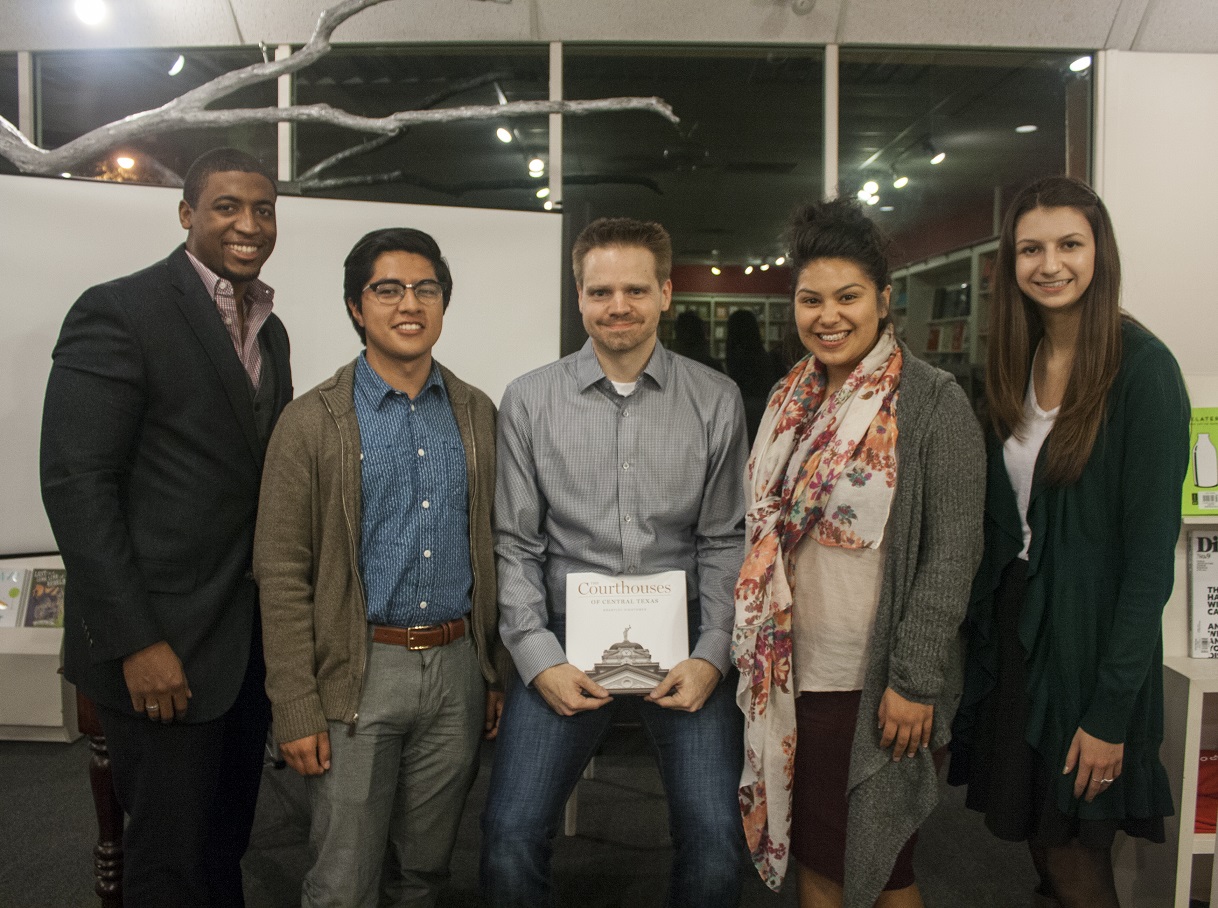
Welcome back to the LEAP Blog! Hopefully, you had a great winter break and you are ready to follow us throughout what we hope will be an amazing Spring 2016 journey! Our first stop of the year took us to the Brazos Bookstore in Houston, Texas to speak with Brantley Hightower, who wrote The Courthouses of Central Texas.
While teaching a course on Architecture, Hightower was inspired by some of the work of his students to explore the different architectural designs and meanings of the courthouse of central Texas. The courthouse, he explained, was for much of Texas’s history, the main meeting place for most areas in Texas. As such, its look and materials and spaces reflected the values of that area.
Although an architect, Hightower was a skilled presented, perhaps reflecting his prior work in teaching and also his interest in the topic.
As an architect, Hightower was interested not only in the look of the buildings, but also some of their technical features, and he described different techniques that the builders of these courthouses used in yesteryear to cool the structures and their occupants. Through the use of courtyards or cupolas that promoted air circulation, courthouses could reduce the temperature by 17-18 degrees.
Mr. Hightower also discussed some of the shifts sociologically that have resulted in a transformation of courthouses. In the late 19th century or early 20th century, the courthouse was a structure that expressed the aspirations of a community: it towered over other buildings, it was grand, and it was beautiful, or at least distinguished. But as time has marched on, people have moved to cities; City Hall has become the focal point of local government moreso than counties. Moreover, citizens look to government for more functional purposes today rather than for the symbolic expressions of community will and aspirations.
The presentation was interesting, a prismatic look at the functions and aesthetics of government buildings, and we hope to have the opportunity to meet with Mr. Hightower again.
The Black Walnut Café definitely lived up to its wonderful reviews and reputation. With a smooth, sleek, and wood-laden design the aromas of the kitchen captivated our taste buds! Some of us went with soup, others with pasta, and one with an evening omelet, however, the two standout dishes of the night were the all American cheeseburger and the “North of the Border Fajita Tacos”.
Of course, we did have to some delicious Gelato ice cream!
After following in the ways of our courthouse founders, with fellowship over a meal, we headed back to Huntsville to continue our prep for our upcoming events!
The lives and events in these books played a central in his discussions with Huntsville residents. With Christmas around the corner, several asked about his work on Santa Claus, and Mr. Guinn provided some intriguing and entertaining responses. Why does Santa Claus wear red and white trim, you may wonder? Because the real St. Nicholas was a bishop, and red and white attire was customary for bishops.
Such conversations took began over dinner at the Homestead, with local residents and LEAP Ambassadors on hand.
For Megan Chapa, of greater interest was Guinn’s work on Bonnie and Clyde, which she read (twice) in class. Guinn supplemented some of the information in the book with background stories about Warren Beatty, Faye Dunaway, and Estelle Parsons, who starred in the 1968 classic film, Bonnie And Clyde. Interestingly, the duo had been known as “Clyde and Bonnie” until that time; it was the film that cemented “Bonnie and Clyde” into the nation’s consciousness.
Guinn also spoke to two of Professor Yawn’s classes. One, an Introduction to Texas Government…
…heard much about Bonnie and Clyde, and the early days of law enforcement (and prison life) in Texas. Interestingly, Clyde Barrow was imprisoned in both the Eastham Unit and the Walls Unit, giving him a direct connection to Huntsville.
In Yawn’s Politics and Media, the students heard more about the impact that Bonnie and Clyde, Charles Manson, and Jim Jones (his current book subject) had on the media. Bonnie and Clyde, for example, were one of the first subjects to have photos of themselves wired across the nation. In fact, without this technological development, they likely would have simply been locally known. With the infamous photo of Bonnie Parker with cigar and gun…
…being wired across the US, however, the duo became nationally famous. Similarly, Charles Manson and his high-profile attacks (of actress Sharon Tate) brought in Hollywood and seemed to typify the California lifestyle of the 1960s and 1970s.
Following classes, 25 students and faculty had a low-profile lunch with Mr. Guinn, who continued to discuss the impact of the subjects he has studied, much to the delight of those attending.
According to Bella Abril, who had also read “Go Down Together,” the meeting was “very interesting,” even if she finds hearing about Manson and Jim Jones a bit disturbing.
Interestingly, Guinn has a practice of including the names of people he meets into his novels (when not publishing books on biographical subjects, he publishes fiction such as Glorious and Buffalo Trail). On this trip, LEAP Ambassador Austin Campbell was designated as a character in Guinn’s next novel. This doesn’t mean, of course, that Austin will actually be in the novel, but his name will be given to a character, although (ominously) Guinn does not guarantee which character will get that name…
Also of interest is that Guinn offered several of the LEAP Ambassadors the opportunity to go with him to do research on his next book subject. While the subject hasn’t been formally released, it will involved border towns in Texas, New Mexico, and Arizona. The Ambassadors are packing for a future road trip!
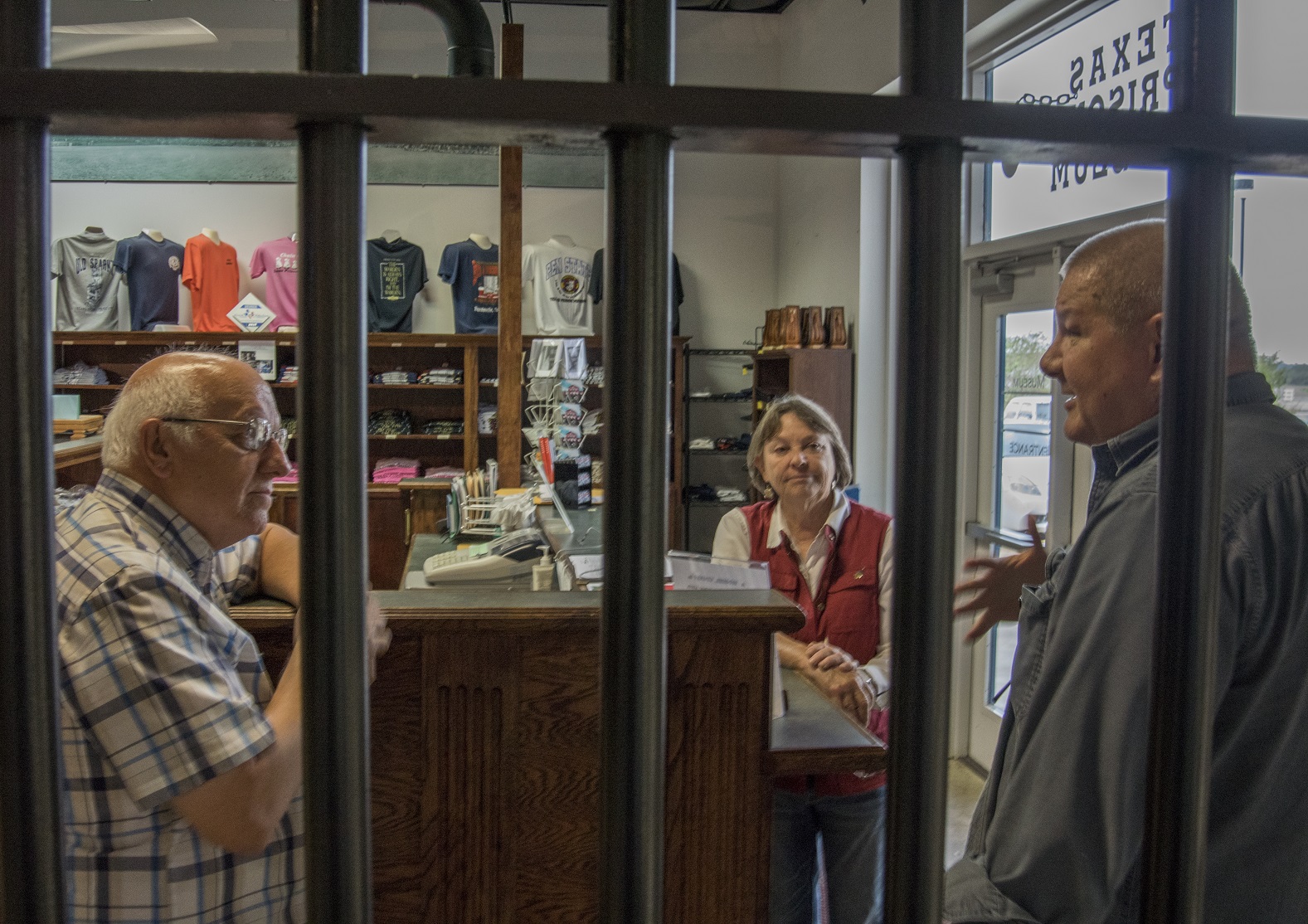
On his way out of Huntsville, Mr. Guinn stopped by the Texas Prison Museum to visit old friends Sandy Rogers and Jim Willett, who provided information and access to Guinn when he wrote about Bonnie and Clyde.
He signed more than a dozen copies of his books for sale at the TPM, and headed out of town–eager, we hope, to return next year to Huntsville, Texas.
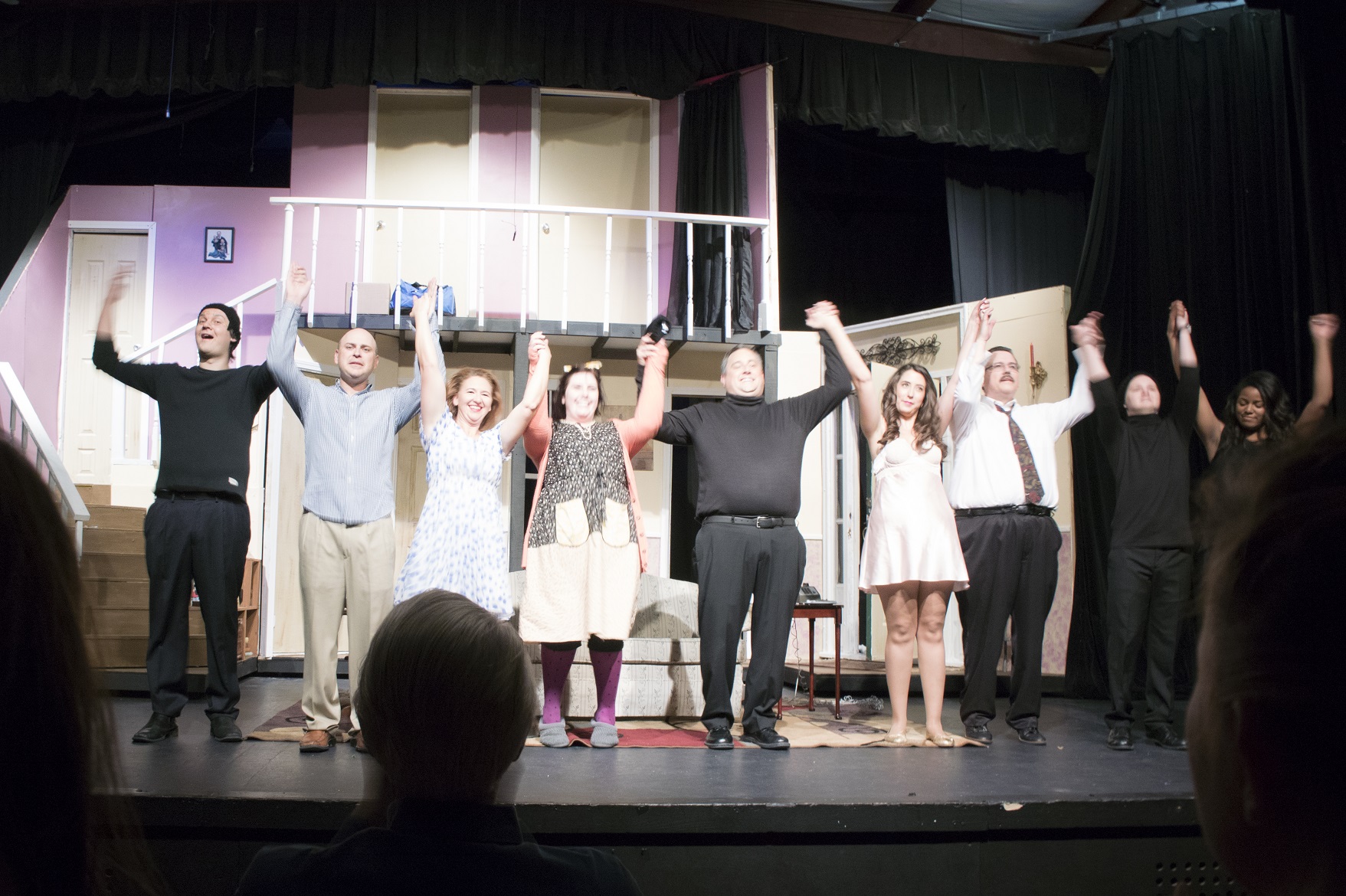
While many students take weekends off from school and learning opportunities, LEAP students took this Saturday to grow culturally by going to dinner together and attending a play in Houston. We began the evening by dining at a small cafe near our main entertainment for the evening: Cafe Express. The Cafe Express provided us with an abundance of choices ranging from flavorful salads to decadent pastas. I enjoyed their Harvest Salad, which included fresh spinach, strawberries, blueberries, walnuts, feta cheese and delicious strawberry vinaigrette dressing. While conversing about the beginning of school and classes, we got our fill of salads and pastas before the play. It was a wonderful choice as our meal before we headed down to Playhouse 1960 for the showing of “Noises Off”.
Playhouse 1960 is a non-profit community theatre that was founded in 1973 and has since been providing their community with memorable theatre productions. “Noises Off” was very much a memorable play. The first act made it very clear to the audience that it was a play within a play, and when everyone was focused on watching the stage, we were caught off guard when we heard the voice of the director, Lloyd Dallas, shout from behind our backs. Act One is the actor’s disorganized dress rehearsal, which presented us with ditzy actors missing lines, prop malfunctions and confusion coming from the stage.
It delivered abundant laughter in the audience. The intermission gave everyone a chance to catch their breath from the laughter.
Interestingly, the intermission also gave us the chance to see the stage machinations in action. Unlike most theaters, much of the scenery changing occurred with open curtains.
Act Two was a behind the scenes look at the matinee performance of “Nothing On”. This act showed the entangled romantic relationships among the cast, which led to many on-stage missteps and misspoken lines. While all of the other characters were caught in their romantic turmoil, Selsdon Mowbray (the burglar with a fondness for alcohol) provided plenty of comedic relief along with the comical actions that were taking place back stage. This act was filled with behind-the-scenes whispering and misunderstandings among the cast while they performed their play. The act ended with a cliffhanger with the announcement of a pregnancy, which left us wanting to know more.
In Act Three, the actors are on their last show of the tour. With all of the relationship mishaps between the actors, we could see the growing tensions. The tensions were resolved with the more rational actors trying their best to tie up the play. Once the play had reached a point of no return, it ended with a quick confusing wedding ceremony. The entirety of “Noises Off” had us laughing until the end.
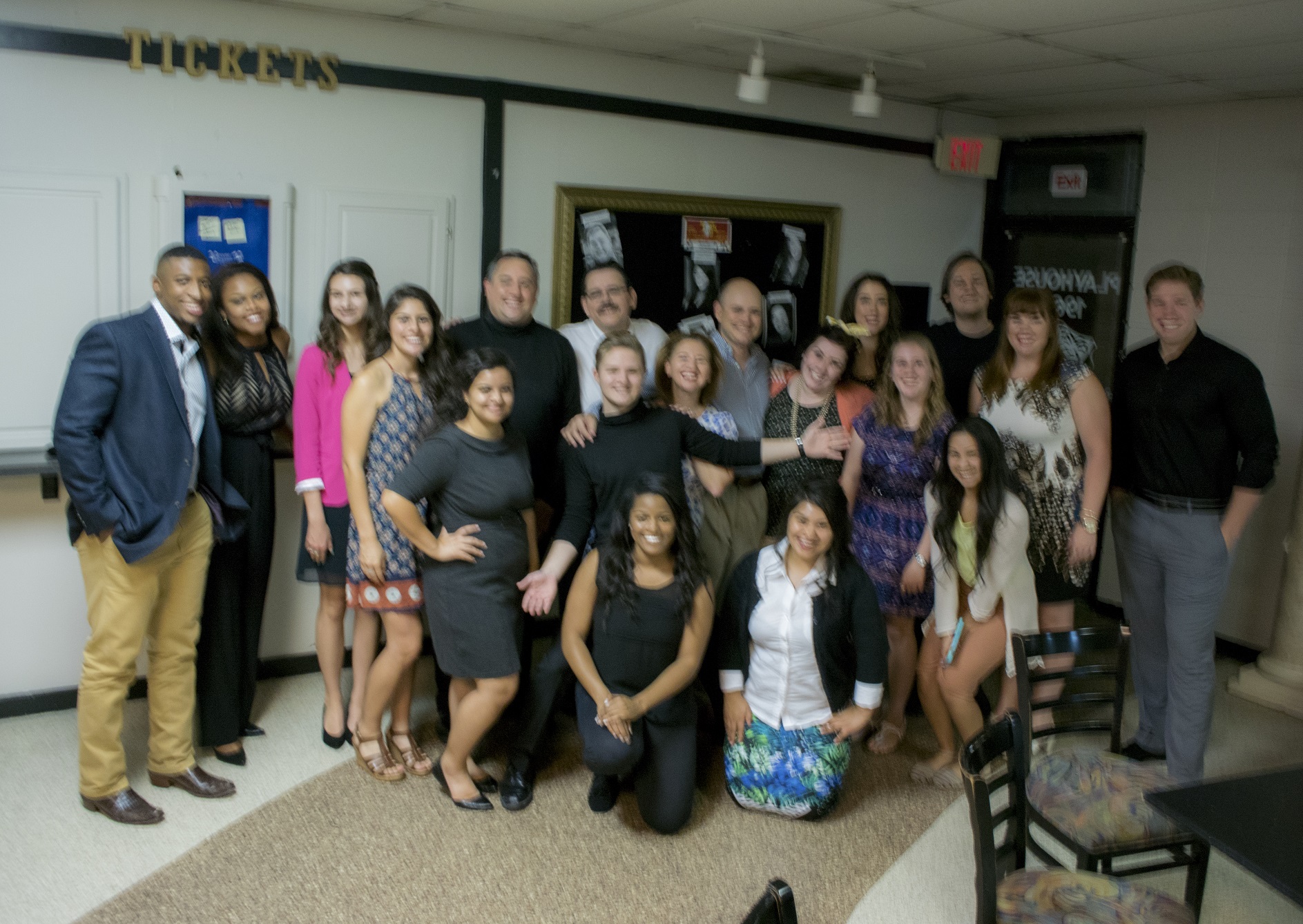
Afterwards we were even able to have our group picture taken with the entire cast!
It was the final day of our trip, and we wanted it to count as much as the previous days.
We began with a quick walk around the French Quarter, checking out the shops, restaurants, art galleries, all the things you don’t see in our home towns. We then went to the New Orleans City Park, which houses the New Orleans Museum of Art and the Besthoff Sculpture Garden. It’s a wonderful city park, with jogging trails, playing fields, large oak trees, botanical gardens, a kids’ section, a mini-railway, a lake, and waterways.
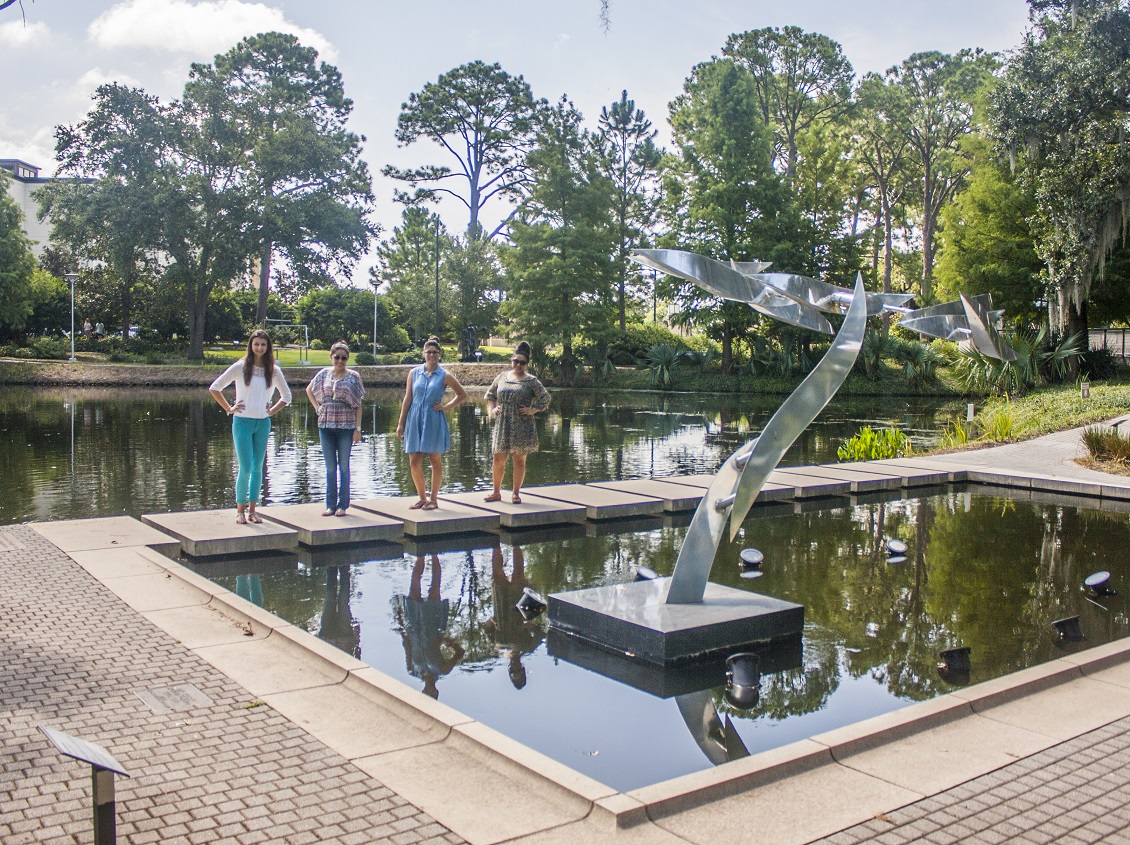
We explored the whole park briefly, then tackled the sculpture garden, which was beautiful and wonderfully interactive.
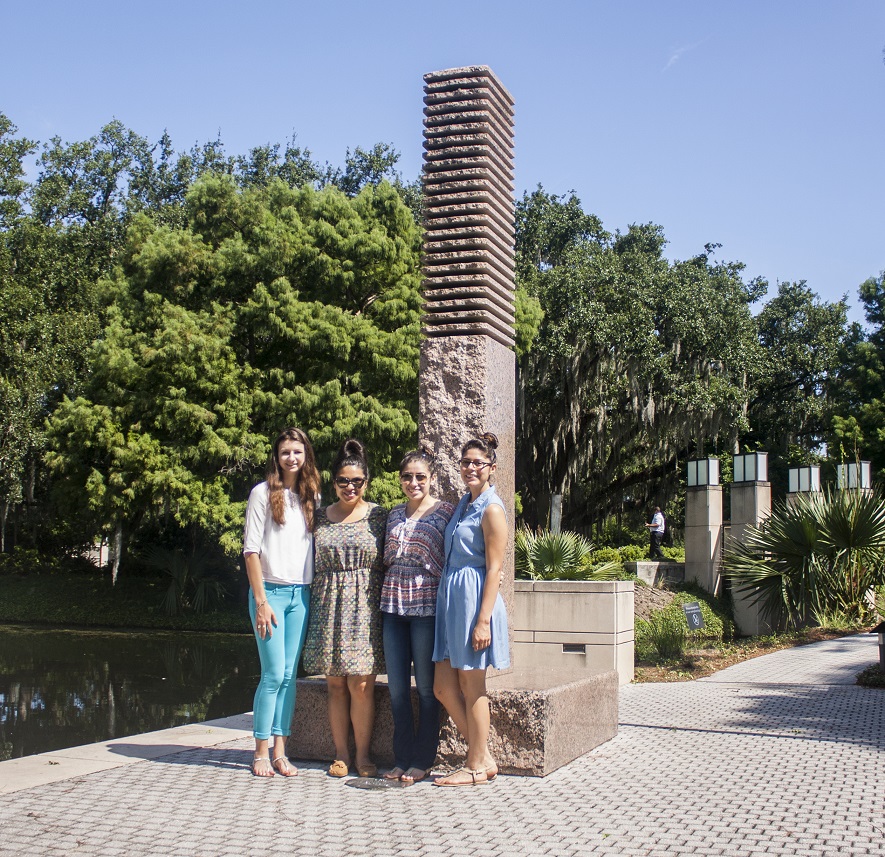
Interestingly, we saw art works by artists we had seen on other parts of our trip and on other trips. One of the first sculptures we saw, for example, was a totem by Jesus Moroles…
This slideshow requires JavaScript.
…we had seen his work in Birmingham, at UT when we traveled there in June, and of course at our own University, SHSU. But we don’t know a lot about art, so it’s an interesting find when we come across art we do know.
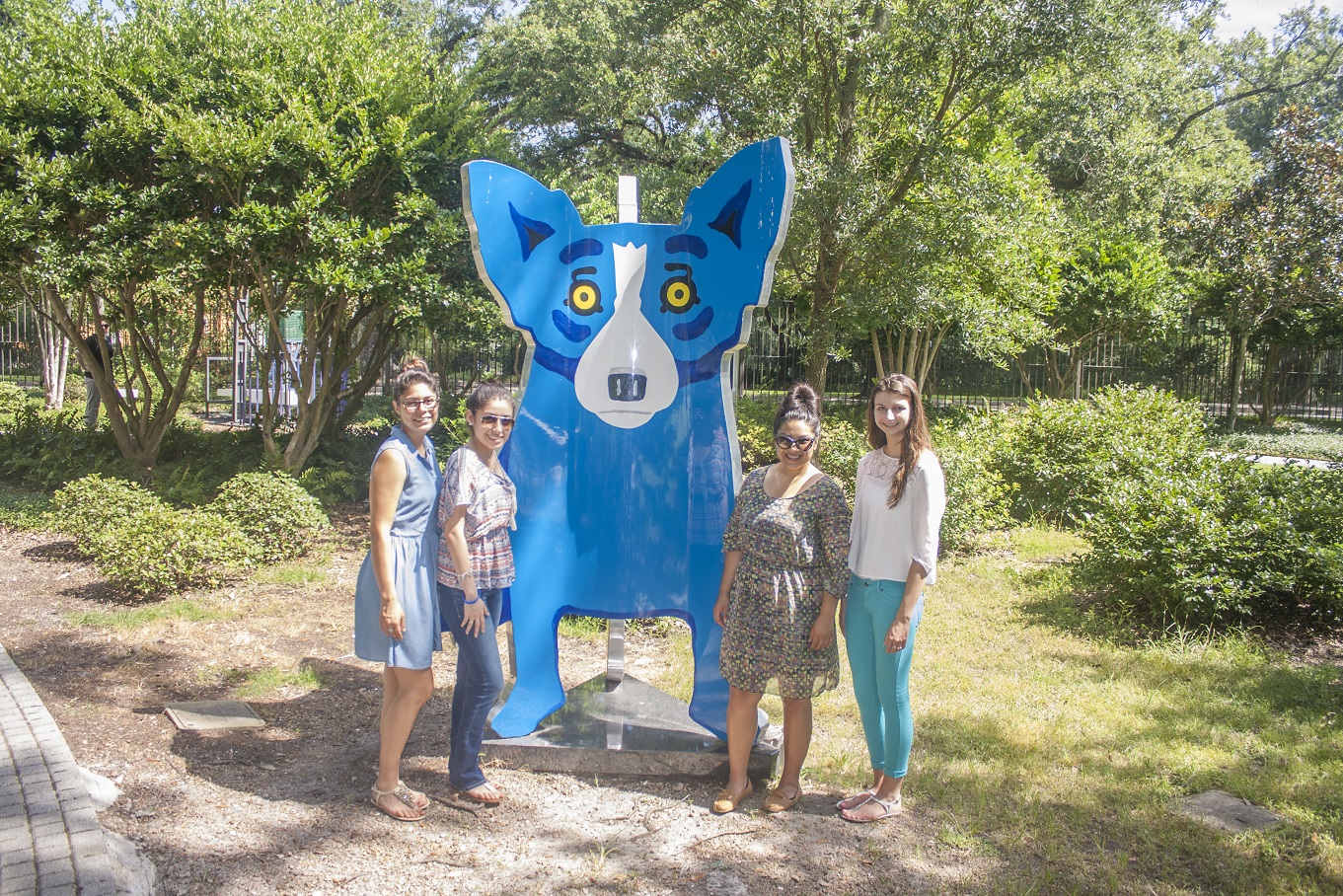
We also saw the “Blue Dog” by George Rodrigue, whose gallery we had seen the night before in New Orleans.
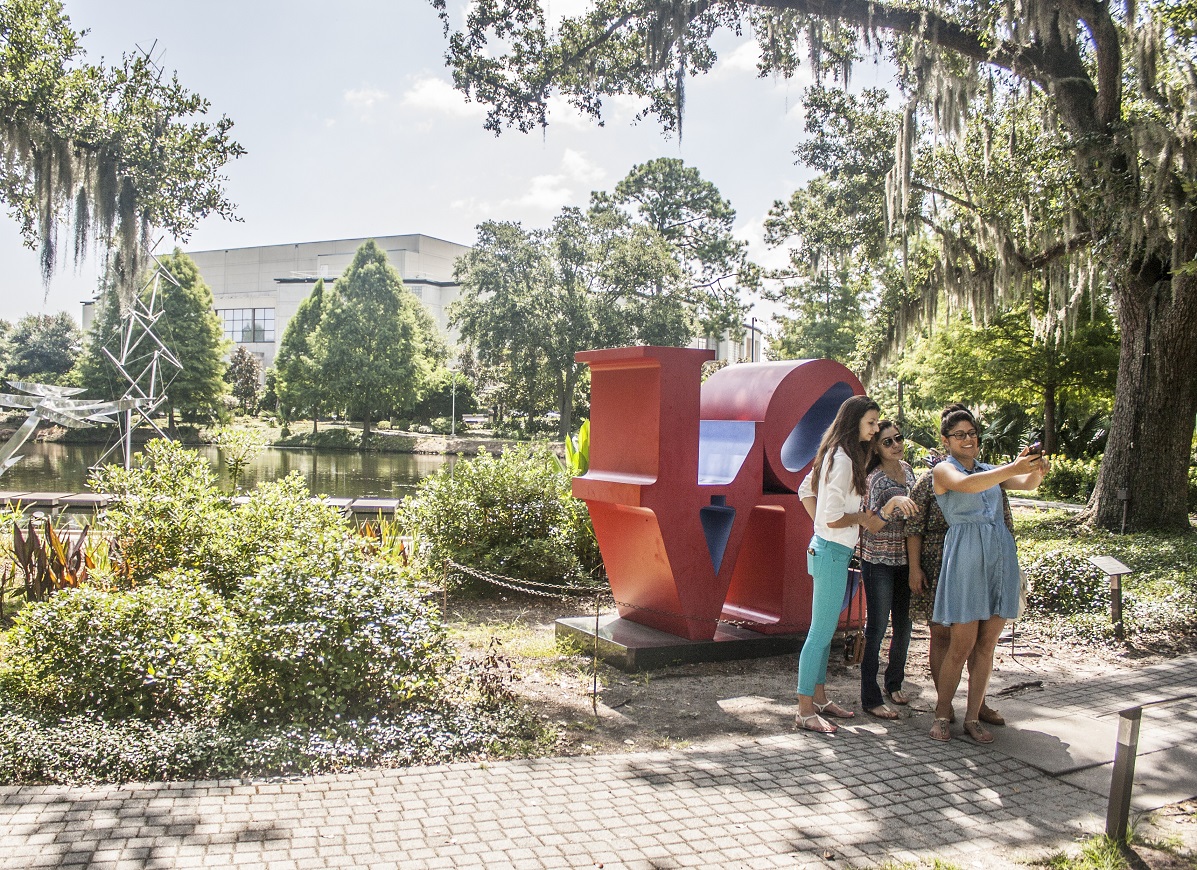
And we saw Robert Indiana’s famous “LOVE” sculpture, which inspired The Beatles to write, “All you need is love.”
…similar to one we had also seen at the University of Texas. Interestingly, when we drove around the Garden District, we saw one in someone’s front lawn! One of these pieces costs about $219,000, or about the cost of a nice home in Huntsville, Texas.
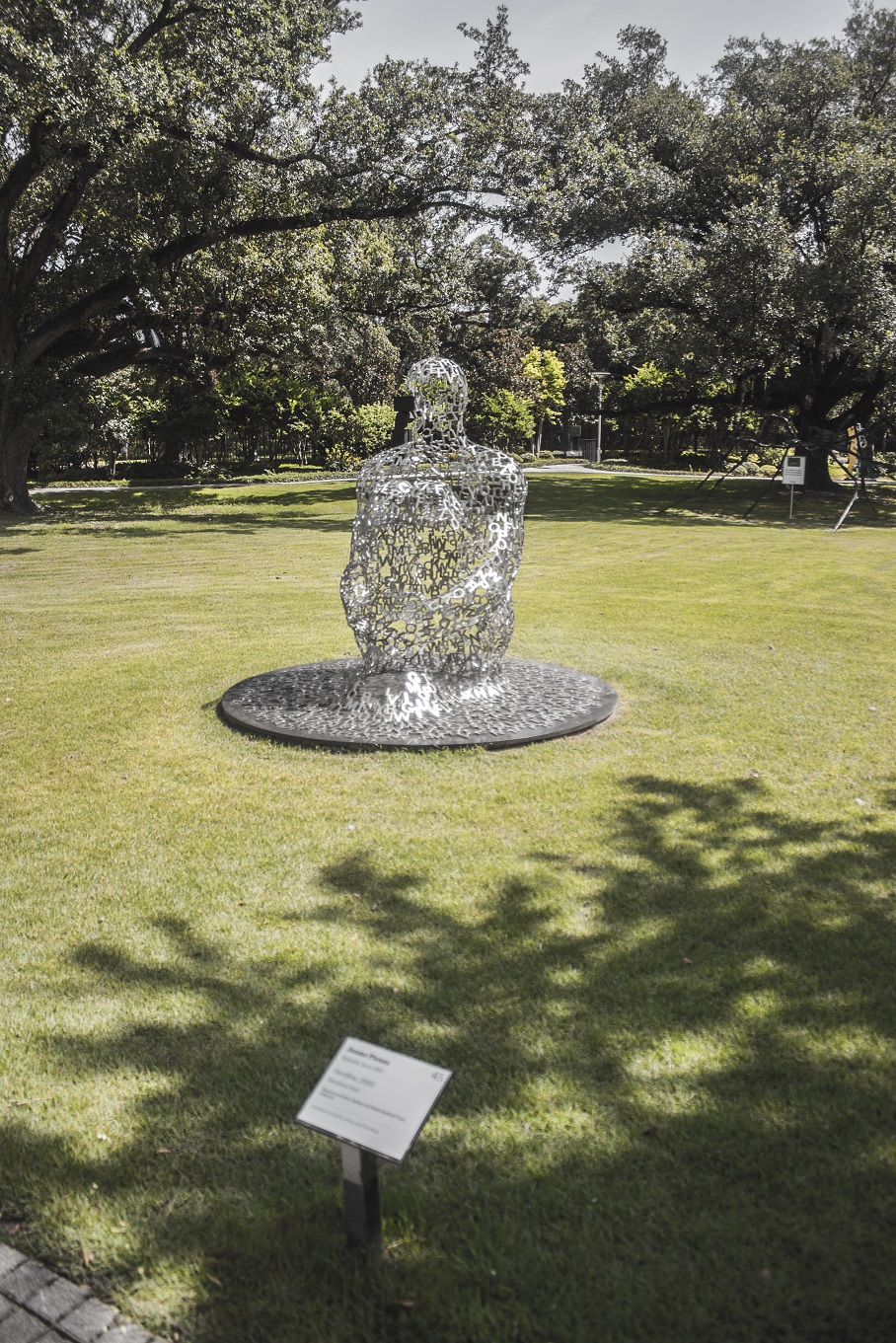
We also saw a piece by famous Spanish artist Jaume Plensa. This one was called “Overflow”….
…but it is very similar to the set of sculptures he has around Buffalo Bayou in Houston, called “Tolerance.” Plemsa also did the “Crown Fountain” at Millennium Park.
Finally, we saw work by Louise Bourgeois, who is famous for her large spiders.
In passing, we saw works by Henry Moore, Rodin, George Segal, Anish Kapoor (who did “Cloud Gate” in Millennium Park) and Paul Manship. It was a fun and educational morning, and much more fun than a typical sculpture garden!
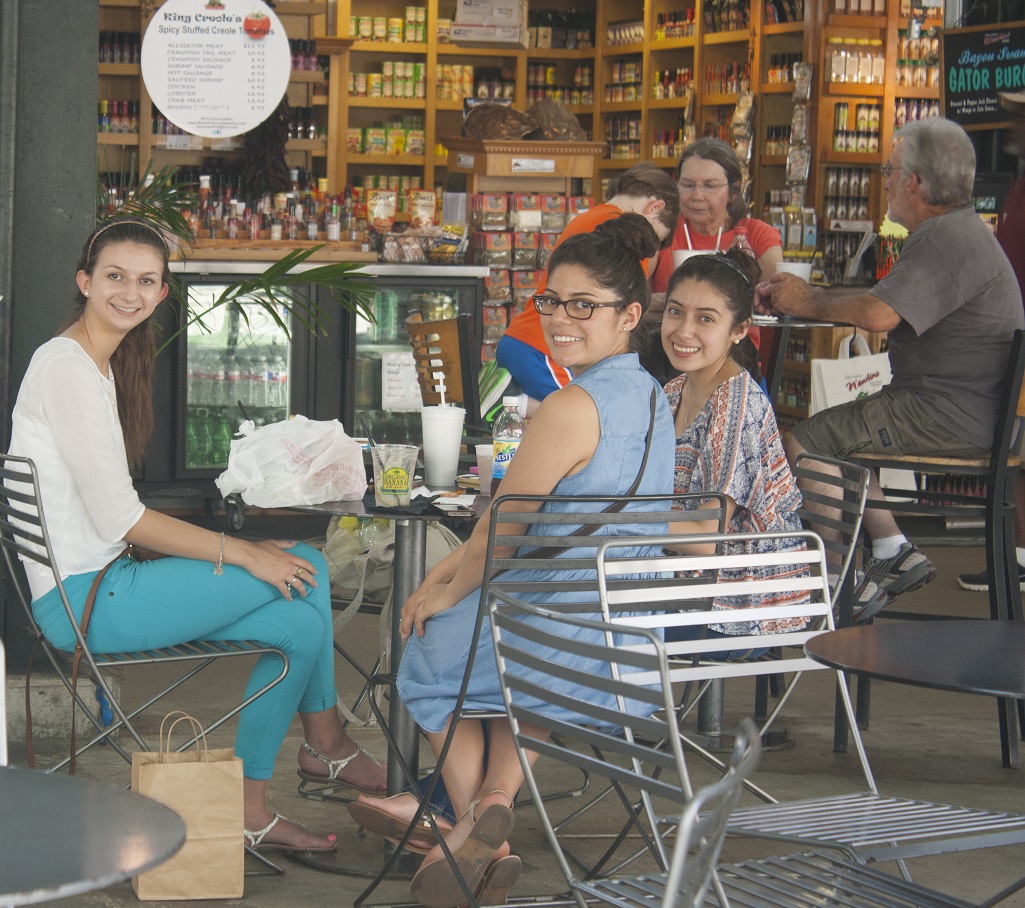
Following the art garden, we booked it back to the French Quarter and visited the market. We mostly went our own ways, shopping and having lunch.
None of the food we tried really stood out, but it was functional and allowed us to maximize our time looking at shops and such, along with a final picture of Jackson Square.
With a sad goodbye, we turned our back on New Orleans…
…and headed back to Huntsville–via Baton Rouge.
In Baton Rouge, we visited our fourth state capitol building of the trip. Amazingly, we (the students) had only visited the Texas capitol, so we each increased our total numbers of capitols visited by a factor of five!
The Louisiana Capitol isn’t the prettiest one in the country, but it is the tallest.
It also is historically interesting. Besides sitting beside the Mississippi…
…it is the location of the Huey Long assassination. There is a small exhibit on the first floor marking the site of the assassination, along with some basic facts. One interesting item is that they aren’t entirely sure that the “assassin” killed Long. The Senator’s bodyguards fired dozens of bullets at the assassin, and it’s at least possible one of them killed the governor. One of the bullet holes is still visible in one of the marble columns.
The capitol building has beautiful chambers for the House and Senate…
This slideshow requires JavaScript.
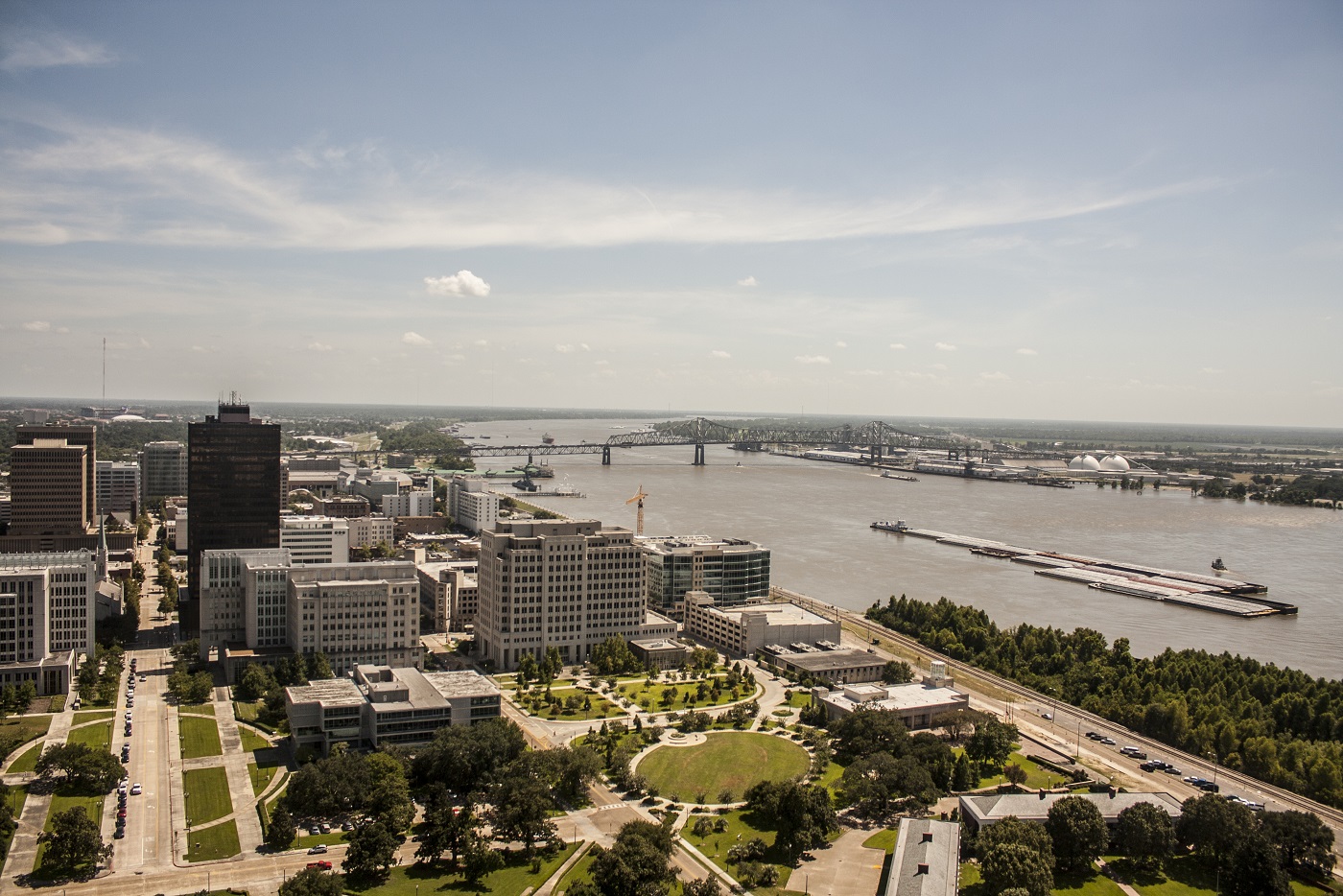
…and also has an observation deck on the 27th floor…
…which allows for good views of the aforementioned Mississippi, the armory, and the gardens.
This slideshow requires JavaScript.
This 360 degree view…
…was a fitting conclusion to a trip that gave us a similarly panoramic view of the south, its culture, and its politics.
Sad to leave Savannah, we awoke early this morning before sun rise to begin our travels. Montgomery was our first destination of the day. Before heading into the city, we visited Liger’s Bakery for sweet treats to kick off the day. For a few of us, a doughnut was a perfect way to boost our energy after little sleep.
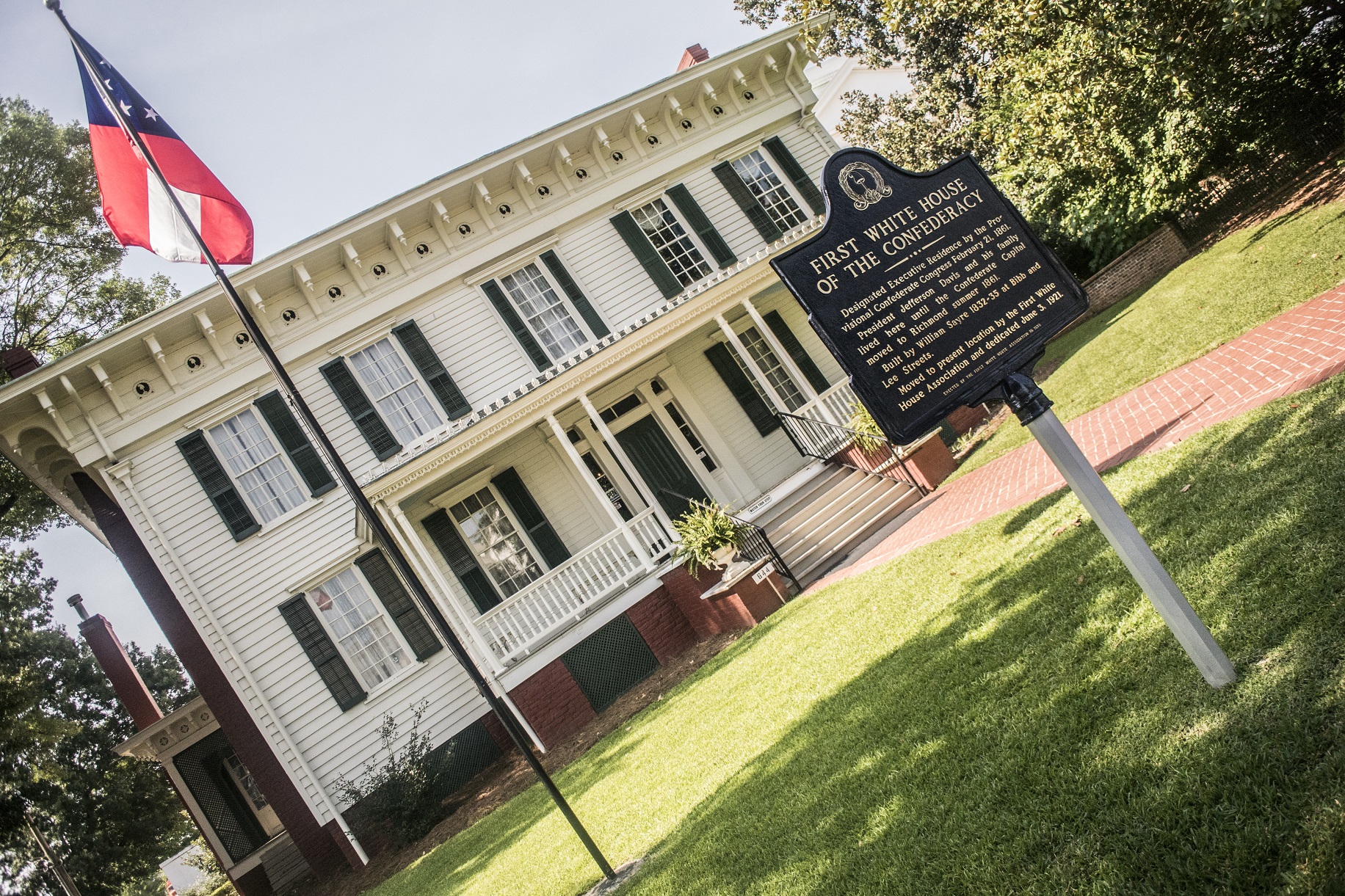
Once chosen for its central location within the Confederacy and for its easy access to travel routes, Montgomery was the perfect place to build the first Confederate White House during the Civil War. Since then, the building has been moved to its new location on the South side of the Alabama State Capitol. President of the Confederate White House, Jefferson Davis and his family lived in the home from the time it was built in 1835 until the time the Confederate Capitol was moved to Richmond in 1861. The home showcased two bedrooms, the First Parlor, the Second Parlor, the Dining Room, and the President’s Study. The first of the two bedrooms was Jefferson Davis’s bedroom which included artifacts from throughout his life, such as his slippers and Bible.
Another interesting room, the President’s Study contained many pieces of furniture used by Jefferson Davis and was a room where many important decisions were made for the Confederacy. Amidst the current controversy surrounding the Confederate Flag, the Confederate White House in Montgomery seemed unbothered by the dispute and fit in with the surrounding landscape with the capitol.
Against this strong backdrop of confederate history, more modern history also played out in Montgomery–the civil rights movement. Rosa Parks was a thriving civil rights activist along with Martin Luther King Jr. and Reverend E.D. Nixon. She was born and raised in Tuskegee, Alabama. Because her mother was an educator, she was taught to read and write and later attended the city Industrial School for Girls.
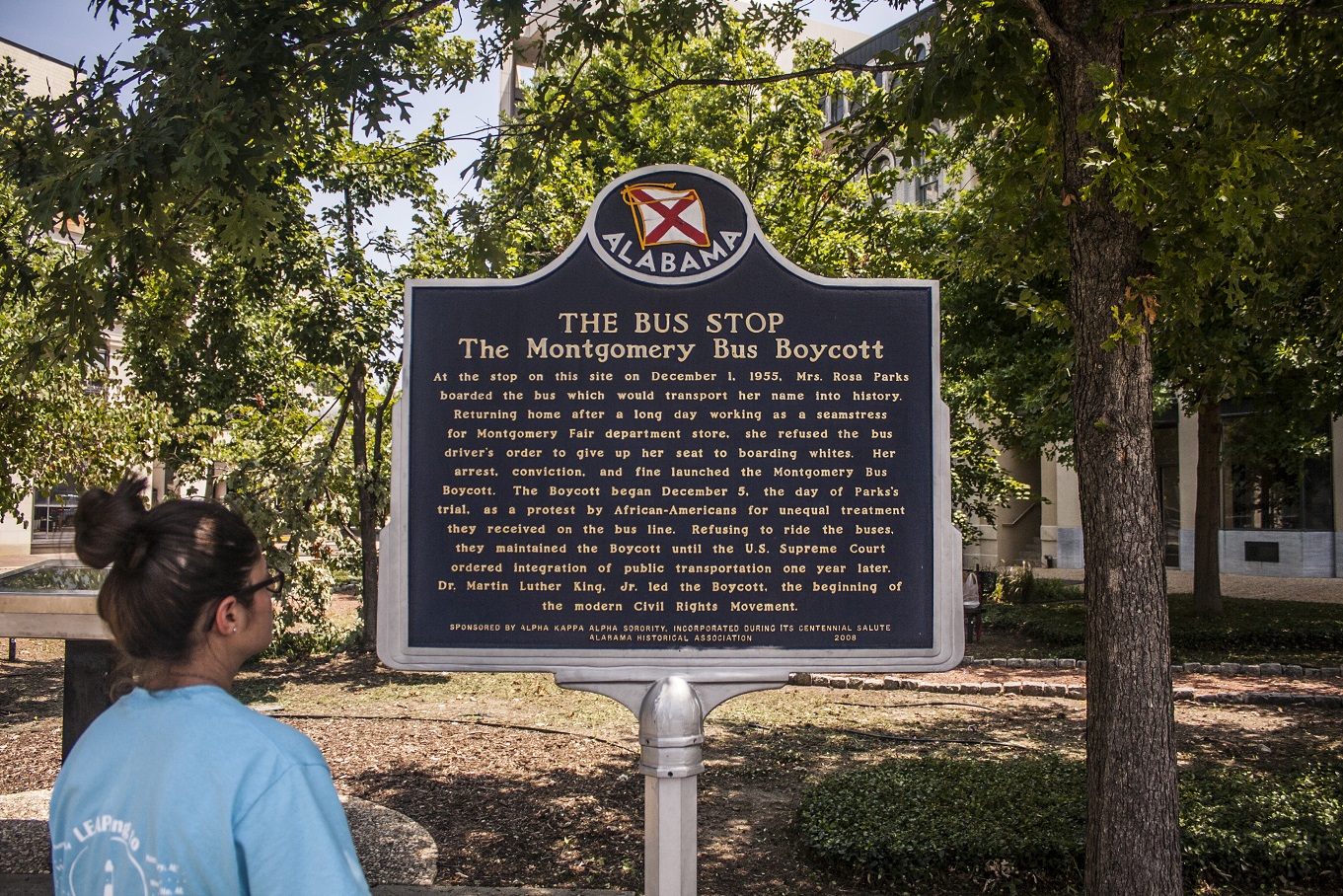
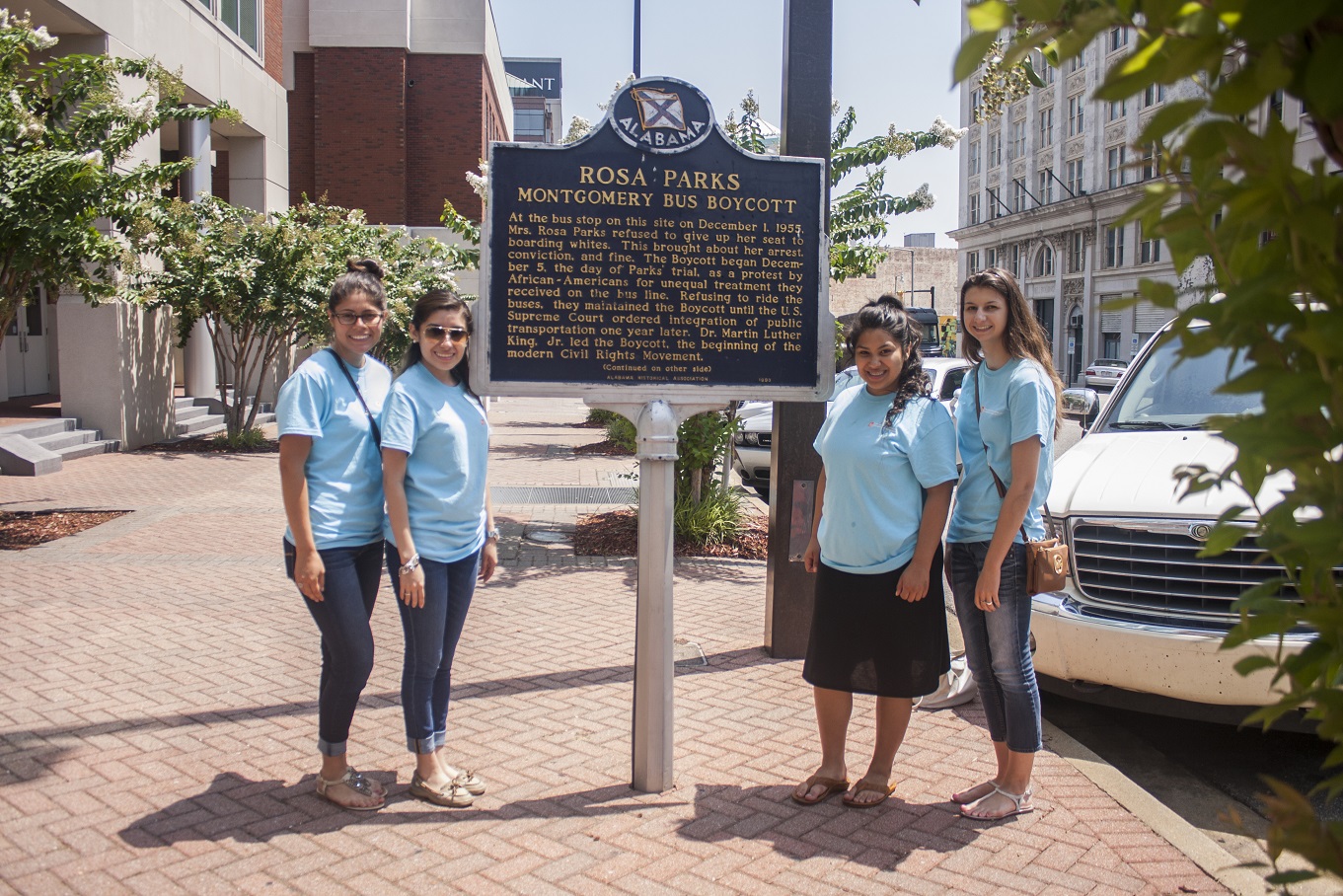
We had the opportunity to not only visit the museum dedicated to her and the history she impacted, but also the exact spot Rosa Parks boarded the segregated bus…
…and the bus stop where she was arrested.
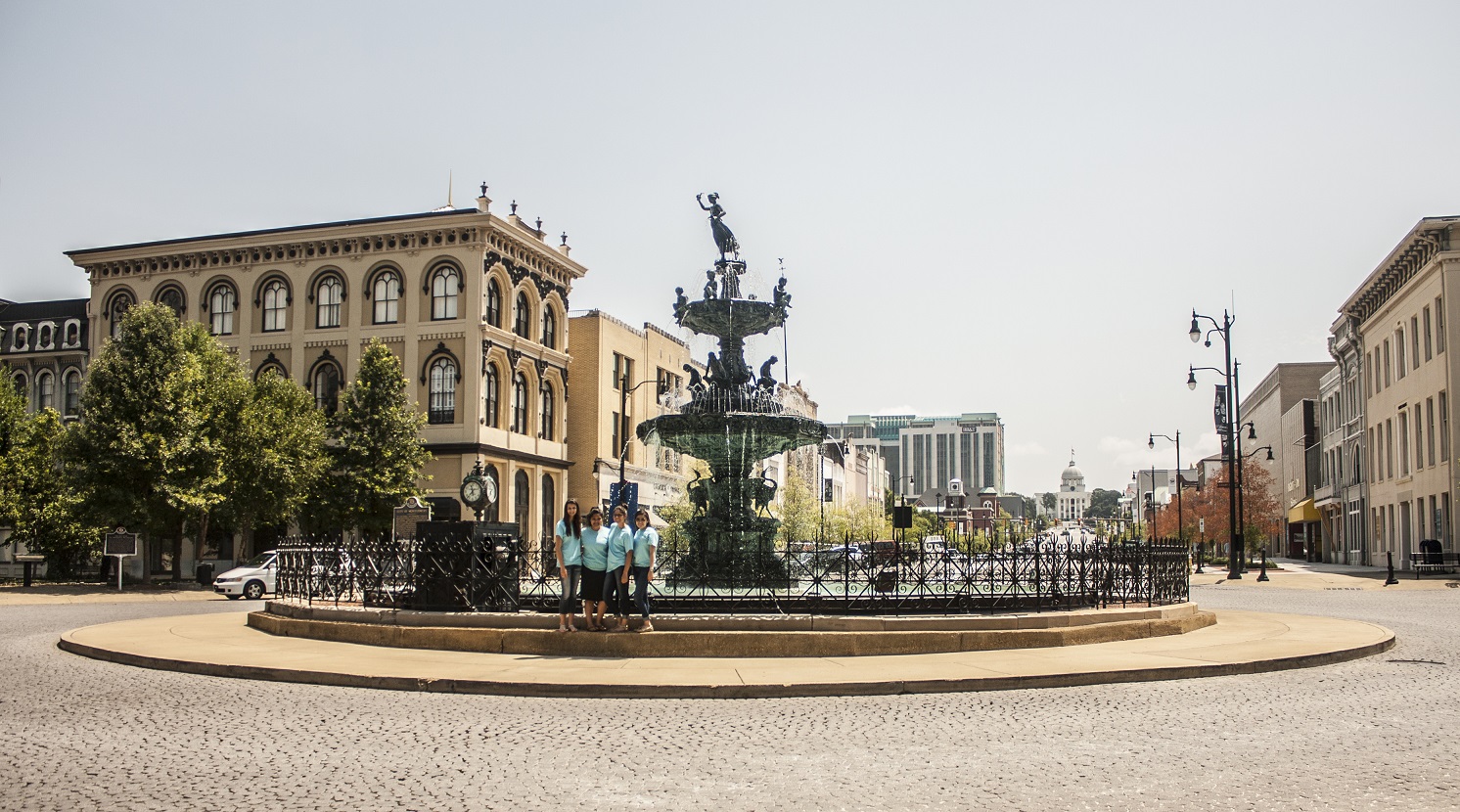
The Rosa Parks Library and Museum tour began with background history of Mrs. Rosa Parks and her involvement in the Civil Rights Movement. She was the secretary of the NAACP and worked very closely with Dr. King and Rev. Nixon in the nonviolent protest for equality. Mrs. Parks refused to give up her seat on the bus and was arrested. This was a transition point for the state of Alabama and segregation laws. This also prompted the Bus Boycott that caused the bus companies to lose thousands of dollars. In order to support the boycott African Americans refused to ride the bus, so they walked or carpooled around town. This boycott lasted 13 months until justice was served. Rosa Parks was the perfect example of using educational and spiritual guidance to seek justice. Her and many other Civil Rights leaders have paved the way for many Americans today. Following the tour of the museum, we walked across the street to stand at the spot she was arrested. It was an honor standing in a place where a brave woman had made up her mind to be treated nothing less than equal. With conviction and respect, we stood reflecting upon how different America would be today without Rosa Parks contribution and leadership in the Civil Rights Movement. Time was running short so we made our way to visit the Alabama State Capitol, after briefly checking out some of the beautiful architecture, art, and history in the downtown.
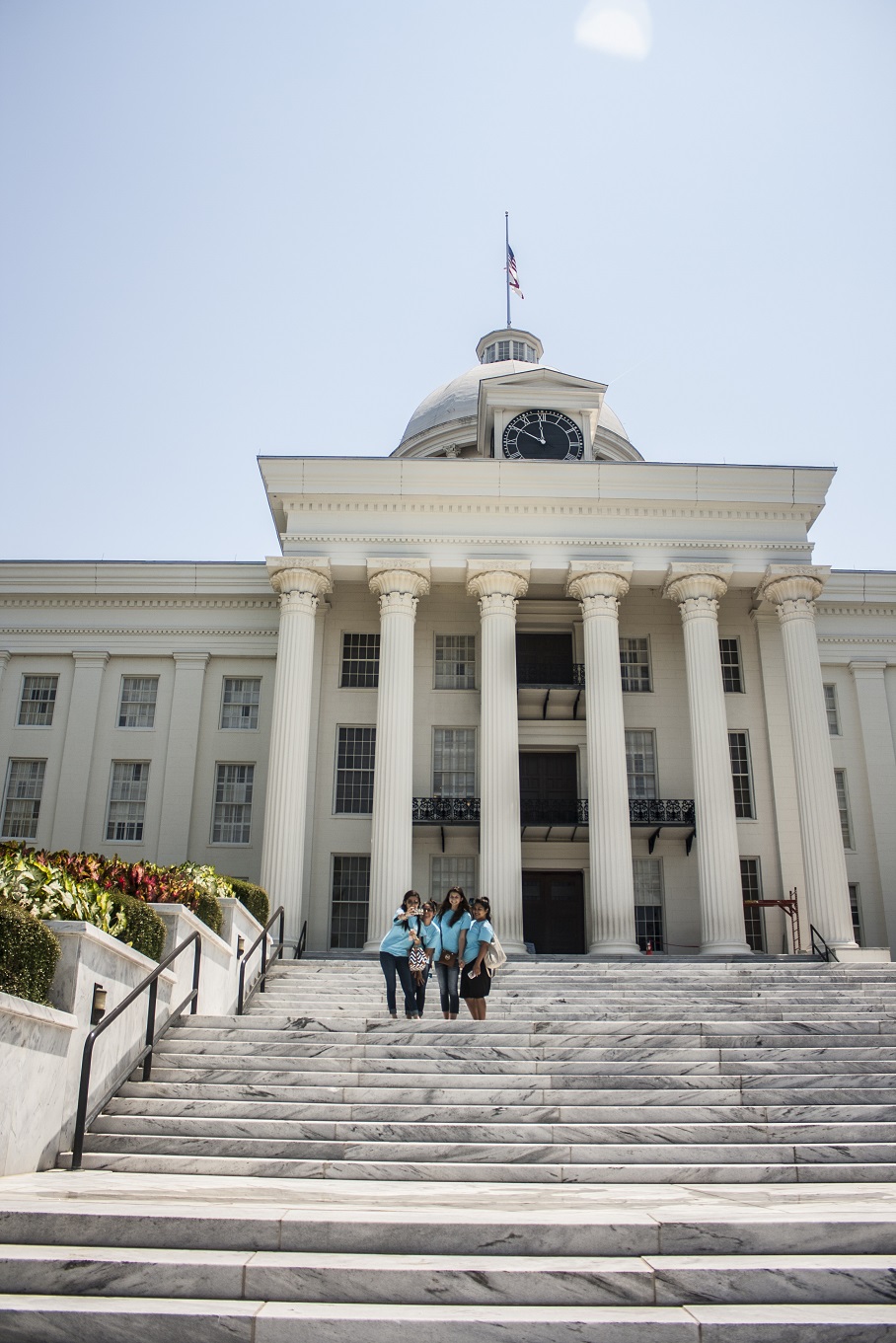
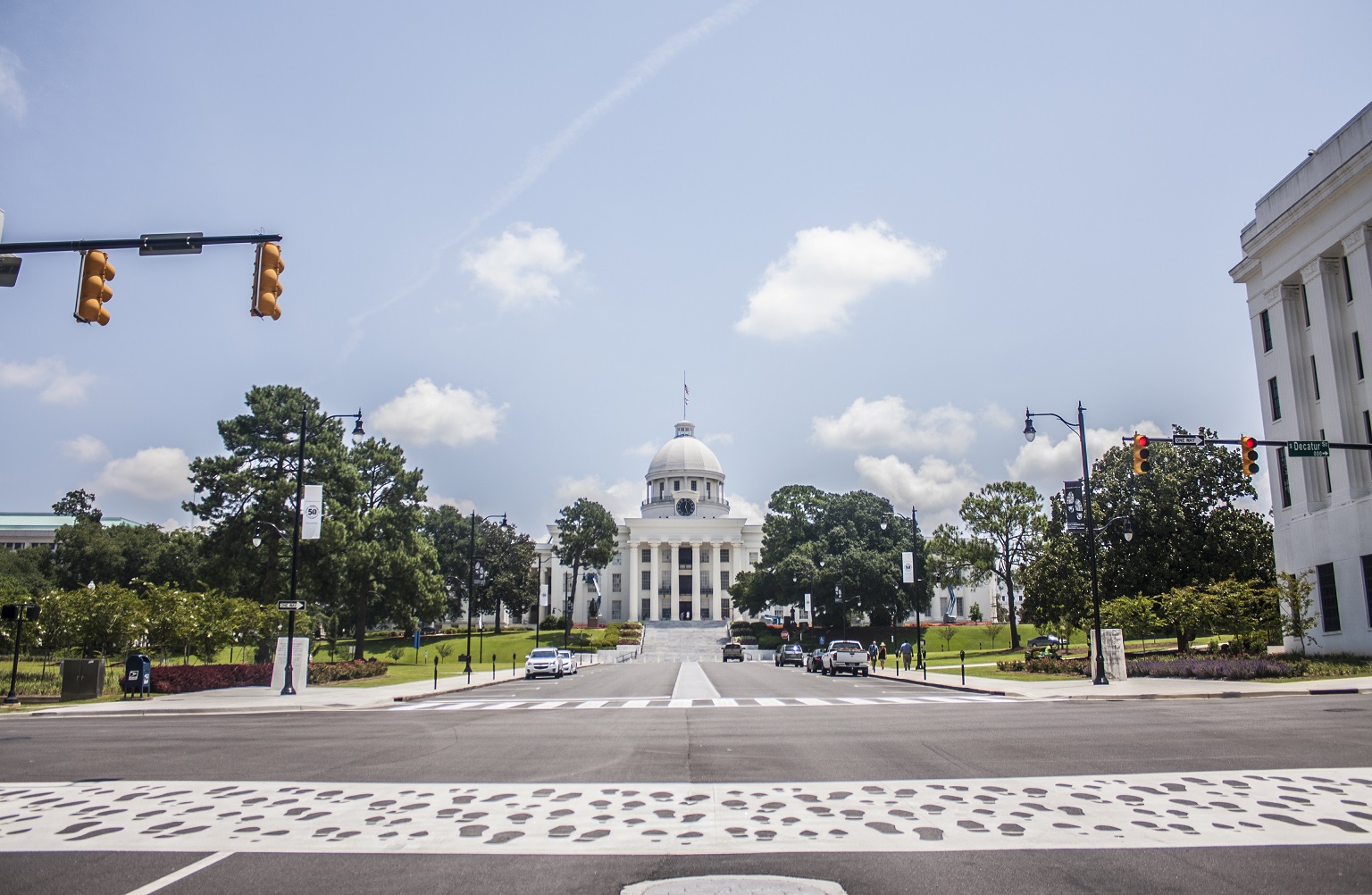
Architecturally, the Alabama State Capitol modestly resembles the United States White House.
Much smaller than the Texas State Capitol, many offices have moved out of the main Capitol building and into various buildings bordering the Capitol building.
Our self-guided tour began in the Governor’s Hall, a common feature of state capitol buildings. Here, we admired the portraits of previous Alabama Governors leading up to the current Governor’s office. Also, on the first floor we were able to see the previous Supreme Courtroom which has now been converted into a World War Memorial. On the second floor, the previous House and Senate Chambers are now open for public viewing.
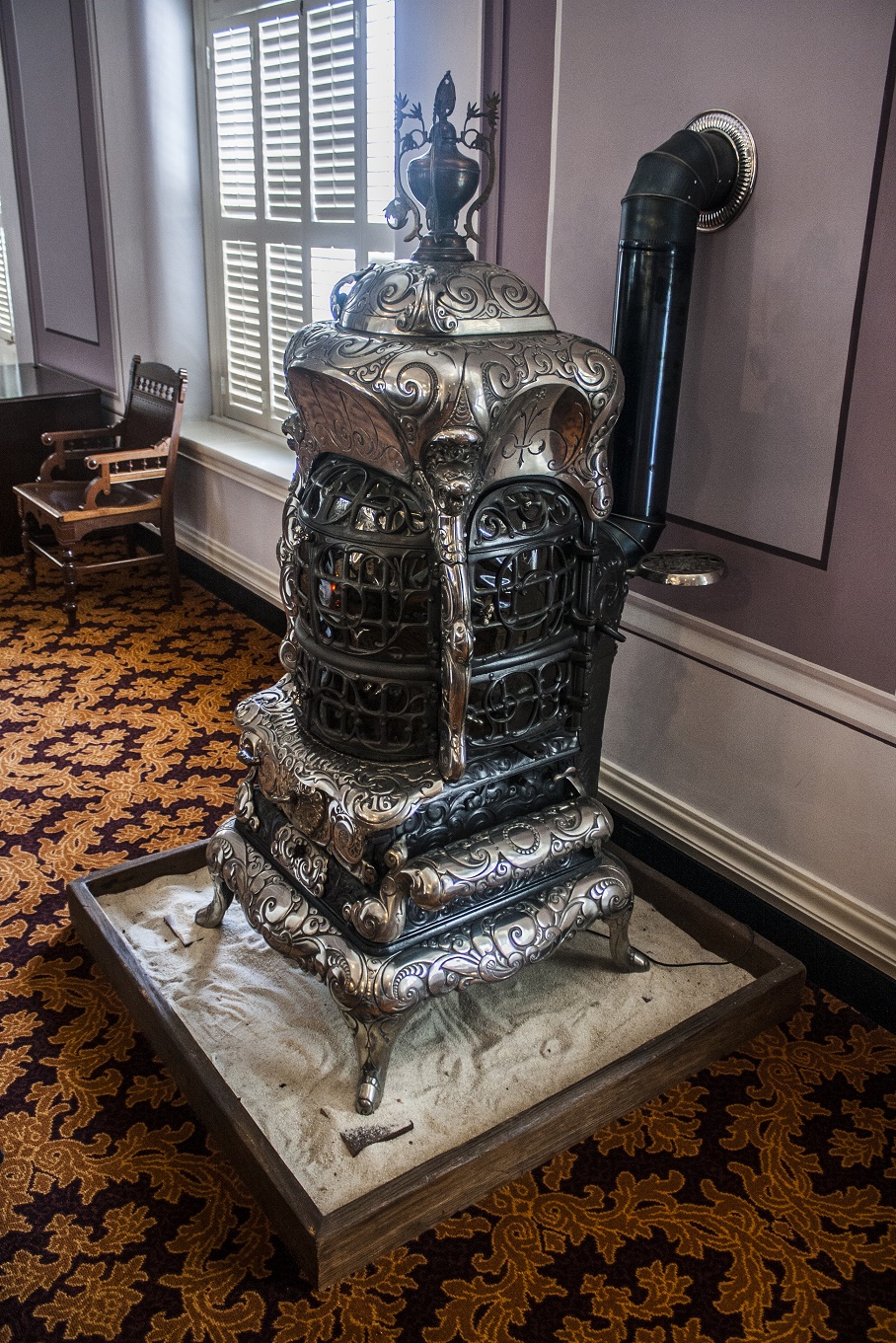
Stove in AL House of Reps
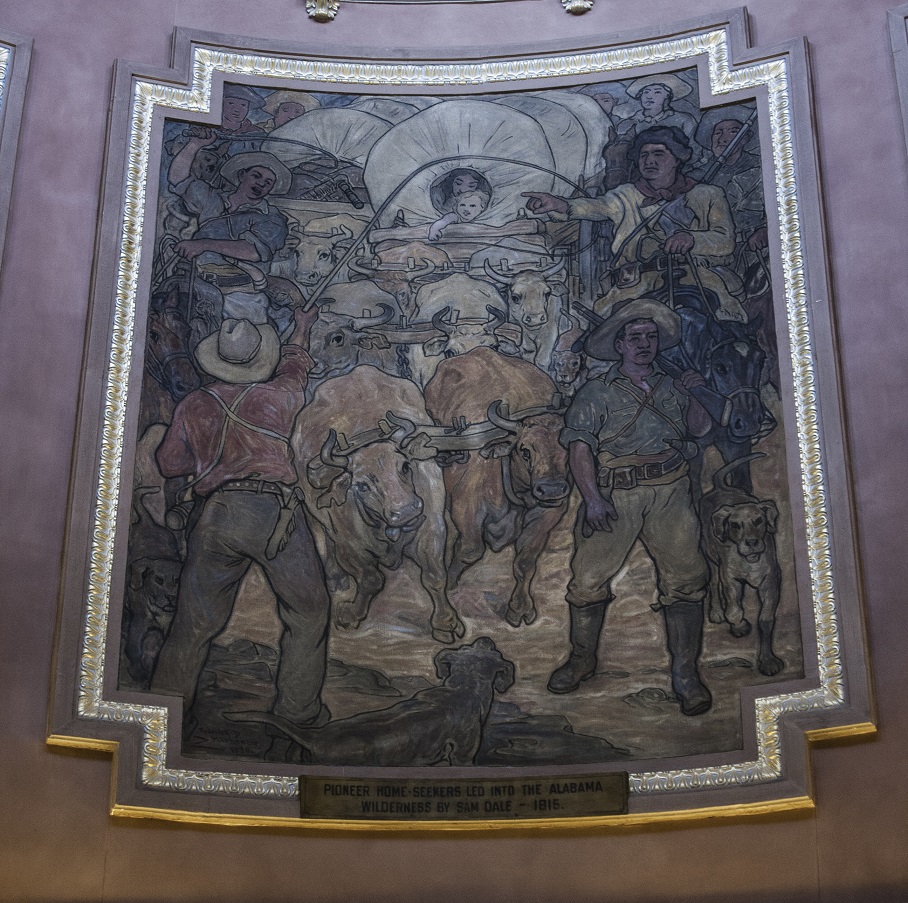
Reflective of the Antebellum Era, much of the furniture and fixtures were original from when the capitol building was originally built in 1849. Part of the second floor opened up to the rotunda, richly decorated in warm colors with scenes throughout Alabama’s history.
Finally, the third floor consisted of the House and Senate gallery where citizens could come and observe the legislature in session. One of the most interesting locations at the Alabama State Capitol is the location where Jefferson Davis was sworn in as President of the Confederacy. Marked by a bronze star, everyday visitors are able to stand in the same spot Jefferson Davis entered office for the confederacy. The Alabama State Capitol is our third state capitol to visit on our Tour of the Deep South. Not only has it been interesting to learn about their architectural similarities and differences, but also to learn about how the state government works in each state. In order to stay on schedule, we hurried over to the Dexter Avenue King Memorial Baptist Church where Dr. Martin Luther King Jr. preached for six years of his life to read the historical marker and take a quick picture.
Interestingly, the cross-walk in front of the church is marked by painted shoeprints. The shoeprints not only decorate the city scape, but also reflect MLK’s march from Selma to Montgomery, but also the African-American’s bus boycott, which required them to walk rather than take the bus.
For lunch we went to Chris’, home of the world famous hot dogs in Montgomery, Alabama. Chris’ opened in 1917, celebrating their 98th year anniversary May 1st of this year. The restaurant is mostly known for their hot dogs. Their special hot dog comes with 2 dogs, sauerkraut, chili, onions, and mustard. The addition of their famous Chris’ chili gives its world famous recognition. Not only did the restaurant have great lunch food, it also has an interesting history. Hank Williams, a famous country musician often visited Chris’, making it one of the hottest places to hangout in the mid nineteen hundreds.
The restaurant also advertises their support of equality during the Civil Rights Movement where their served African American citizens alongside white citizens. In the end, this was a neat place to have a comfortable lunch in the heart of downtown Montgomery.
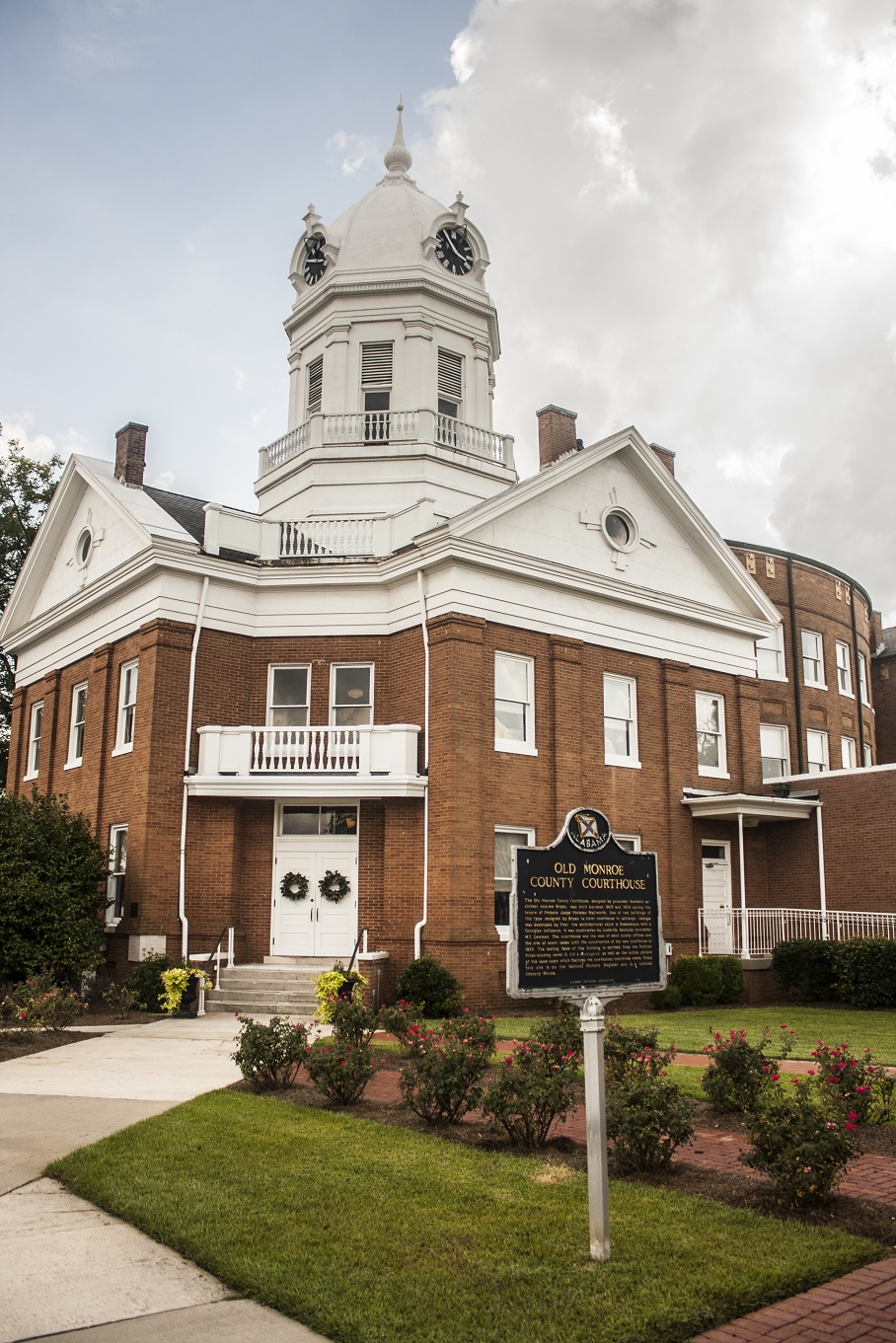
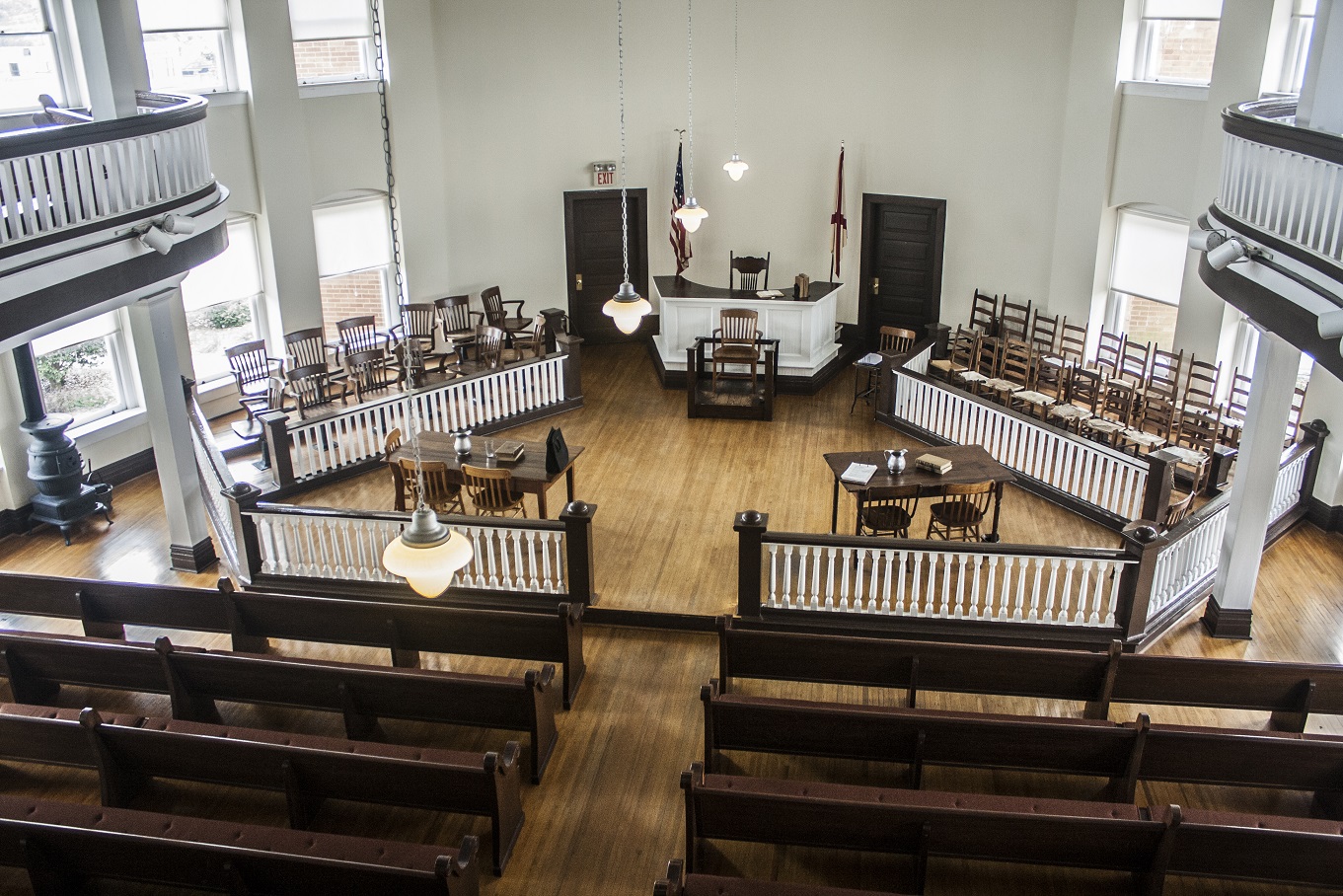
After lunch we embarked on our trip to Monroeville, Alabama. Once we arrived in Monroeville we stopped to tour the Old Monroe County Courthouse to learn more about Harper Lee and her friend, Truman Capote.
Harper Lee is the author of “To Kill a Mockingbird” and Truman Capote is the author of “In Cold Blood” and “Breakfast at Tiffany’s”. The Old Monroe County Court House was restored to its 1930’s appearance. The courthouse is also the model for the courtroom in the To Kill A Mockingbird movie.
Many people think that the movie was filmed in the Monroeville courthouse but it was actually recreated onto a Hollywood sound stage by Henry Bumstead. Fans of the novel and movie visit Monroeville because it is Harper Lee’s hometown which she based Maycomb on. The court house became a famous attraction which prompted Monroeville to build a separate court house and turning the Old Court House into a museum. We were able to wander through the museum and read Harper Lee’s words regarding her book being turned into a movie and learn about Truman Capote’s childhood. One of the quotes that I liked best from Harper Lee was “In an abundant society where people have laptops, cell phones, iPods, and minds like empty rooms, I still plod along with books. Instant information is not for me. I prefer to search library stacks because when I work to learn something, I remember it.” Capote also had much to say about Harper Lee and through his words I learned that Harper Lee longed to become a lawyer like her father and almost did before realizing her calling was really writing. My favorite thing in the museum was a piece of “the famous tree” where Dill, Jem and Scout found the pieces of gum, marbles and a watch left by Boo Radley. Once everyone had the opportunity to look around we hoped back in the van, checked out some of the city’s homages to Lee…
…and to Truman Capote’s boyhood home…
As we arrived in Biloxi, we searched to find dinner. In the end, we chose Adventurous Pub and Spirits. A few members of the group shared the seafood platter with a combination of fried shrimp, oysters, catfish, and fries. Biloxi’s location to the Gulf of Mexico, made seafood an easy choice for dinner. Although, it was a much different restaurant than what we expected, the group enjoyed it and headed to check into our hotel to catch up on extra rest. Tomorrow, we have another eventful day of sightseeing and traveling as we head to New Orleans.
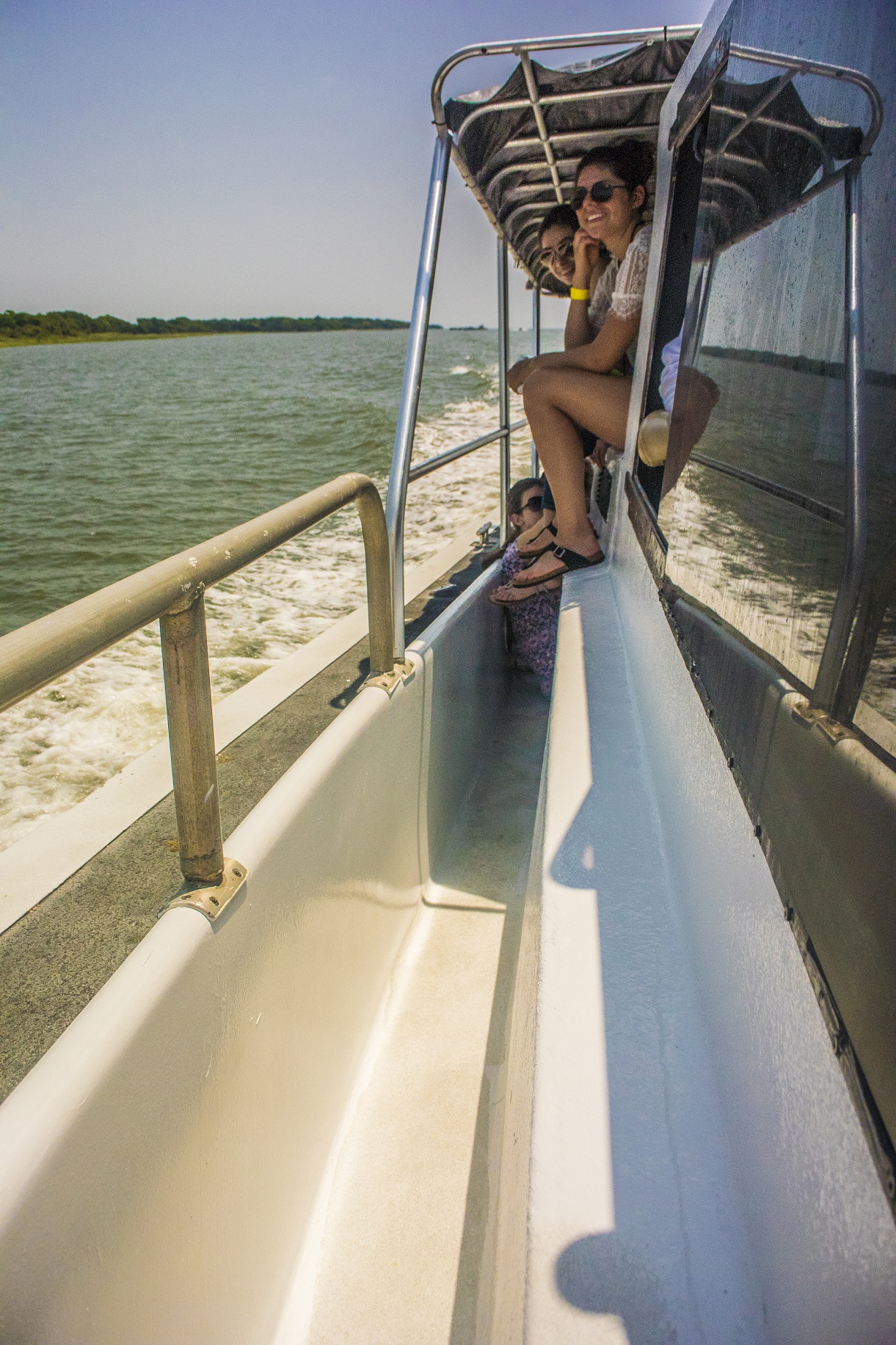
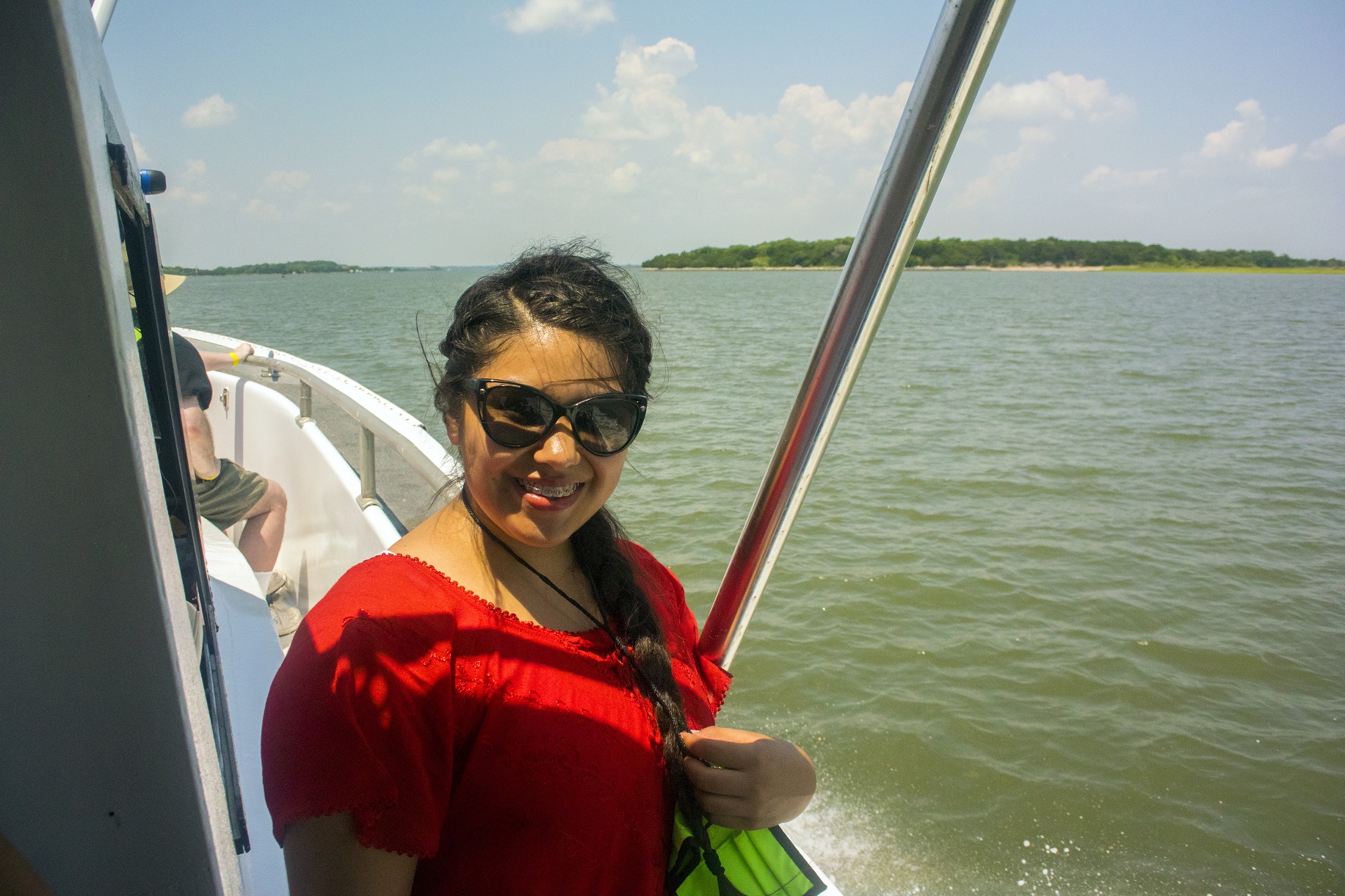
We began our last day in Savannah embarking on an adventure. We went on a dolphin tour through the Savannah River and Atlantic Ocean. It was a sunny day, perfect weather for a boat ride.
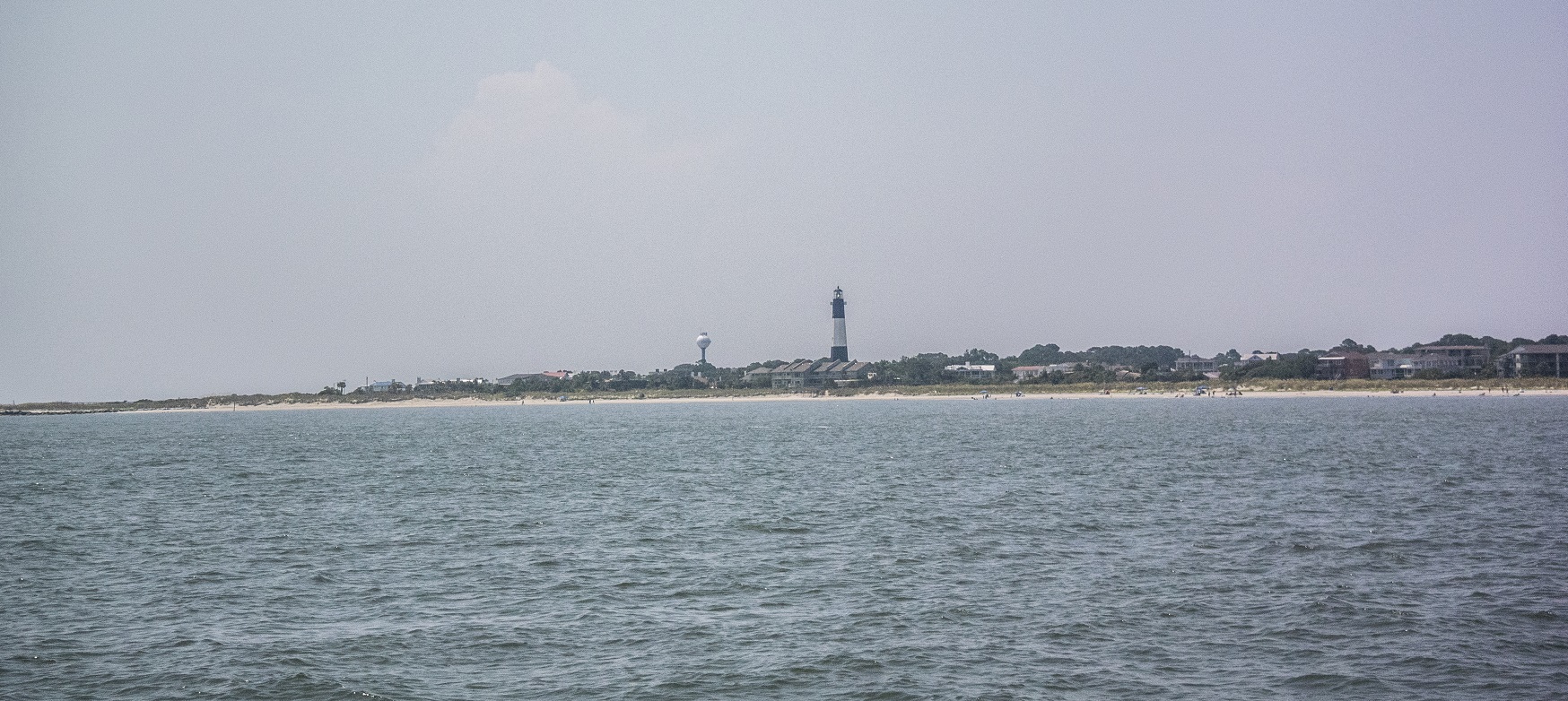
Our tour took us past Tybee Island and into the Atlantic Ocean.
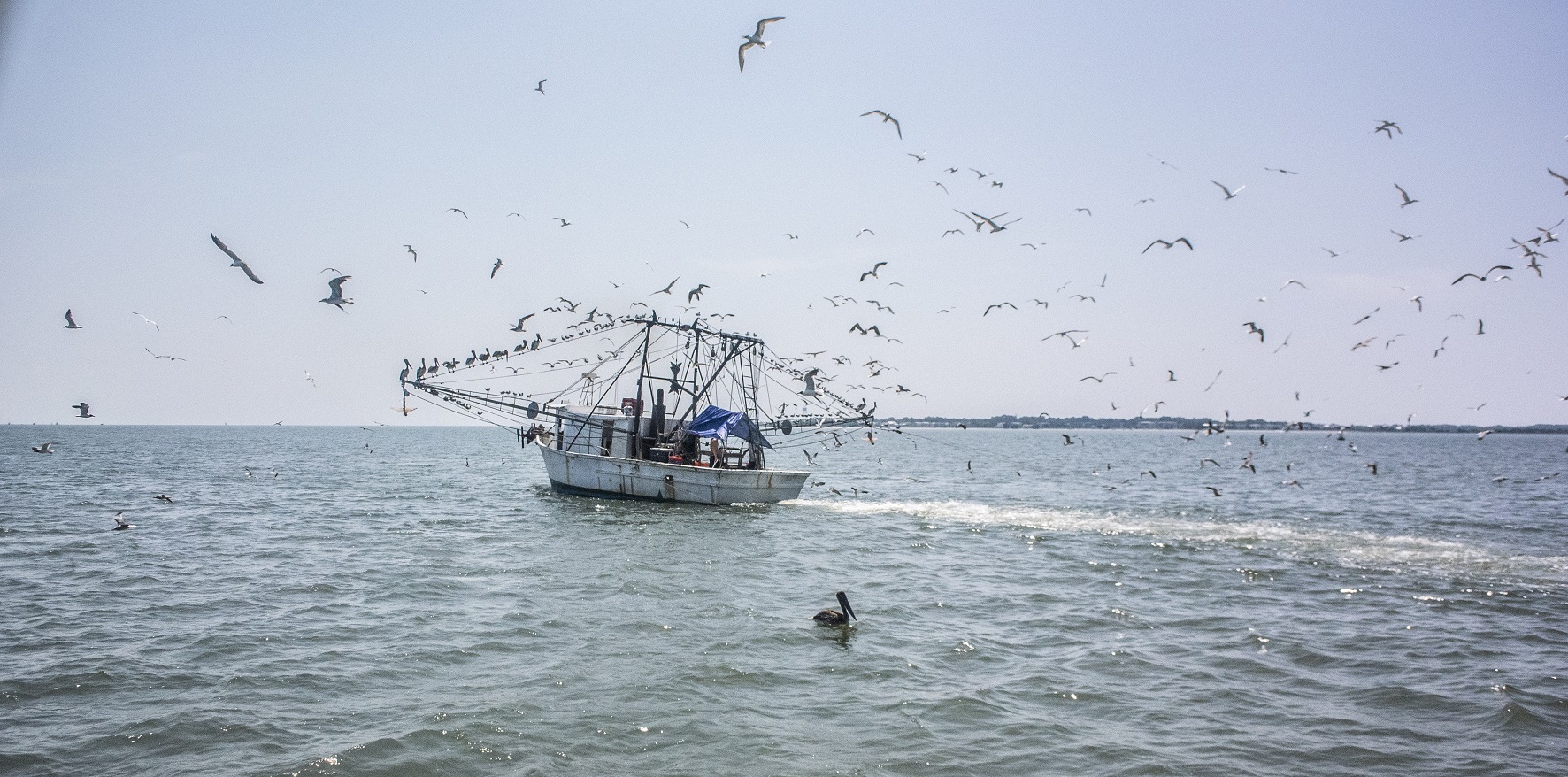
The view of Tybee Island from the ocean was nice. We encountered a shrimping boat that attracted many pelicans and dolphins.
The majority of the dolphins we saw today gathered around the boat because they feed off anything the shrimpers throw back into the ocean. My personal favorite was a baby and momma dolphin swimming together!
The Southern Legislative Conference provided us with lunch on our dolphin tour. We had packed sandwiches, chips, fruit, and a cookie for dessert. It was an okay lunch with a great view.
We learned much in the process. For example, the US government has established several “bird islands,” where birds can go to nest. Predators’ populations are controlled and care is taken to ensure that birds have a natural habitat.
The tour also highlighted several forts, energy plants, and bordering states.
As the tour came to a conclusion, it started raining. Fortunately, we dodged any serious storms. The tour was perfect way to begin our last day in Savannah, however we still had a long day ahead of us.
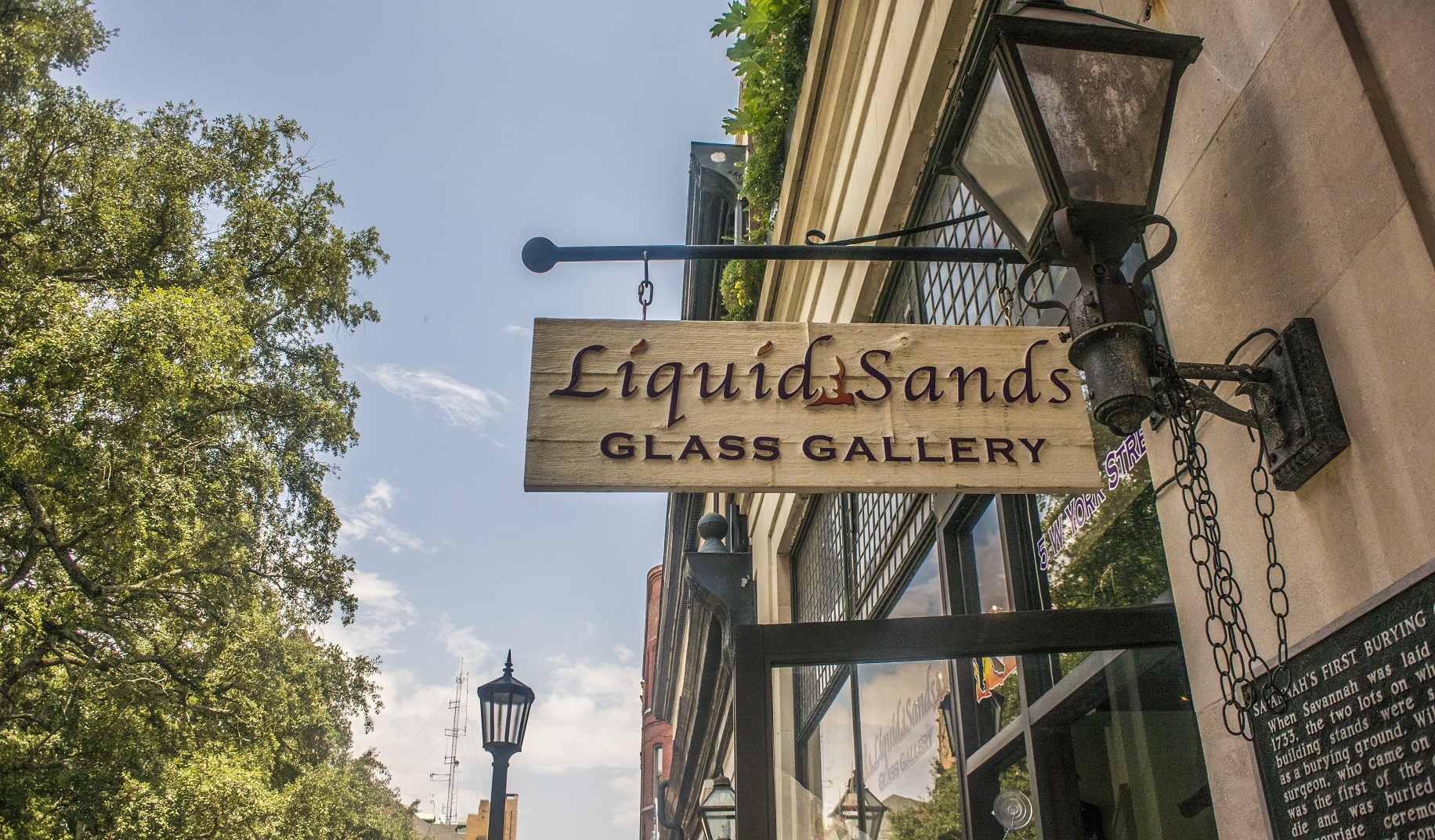
After briefly freshening up, we headed out to the Liquid Sand Glass Gallery to look at the glass art.
We browsed the store and a couple of us bought glass nail filers that we’re pretty excited about. On our way back to the car, we stopped at a nifty shop right next door that sold many natural products such as soaps, seasonings, and oils.
After some shopping, we visited the birthplace of Juliette Gordon Low…
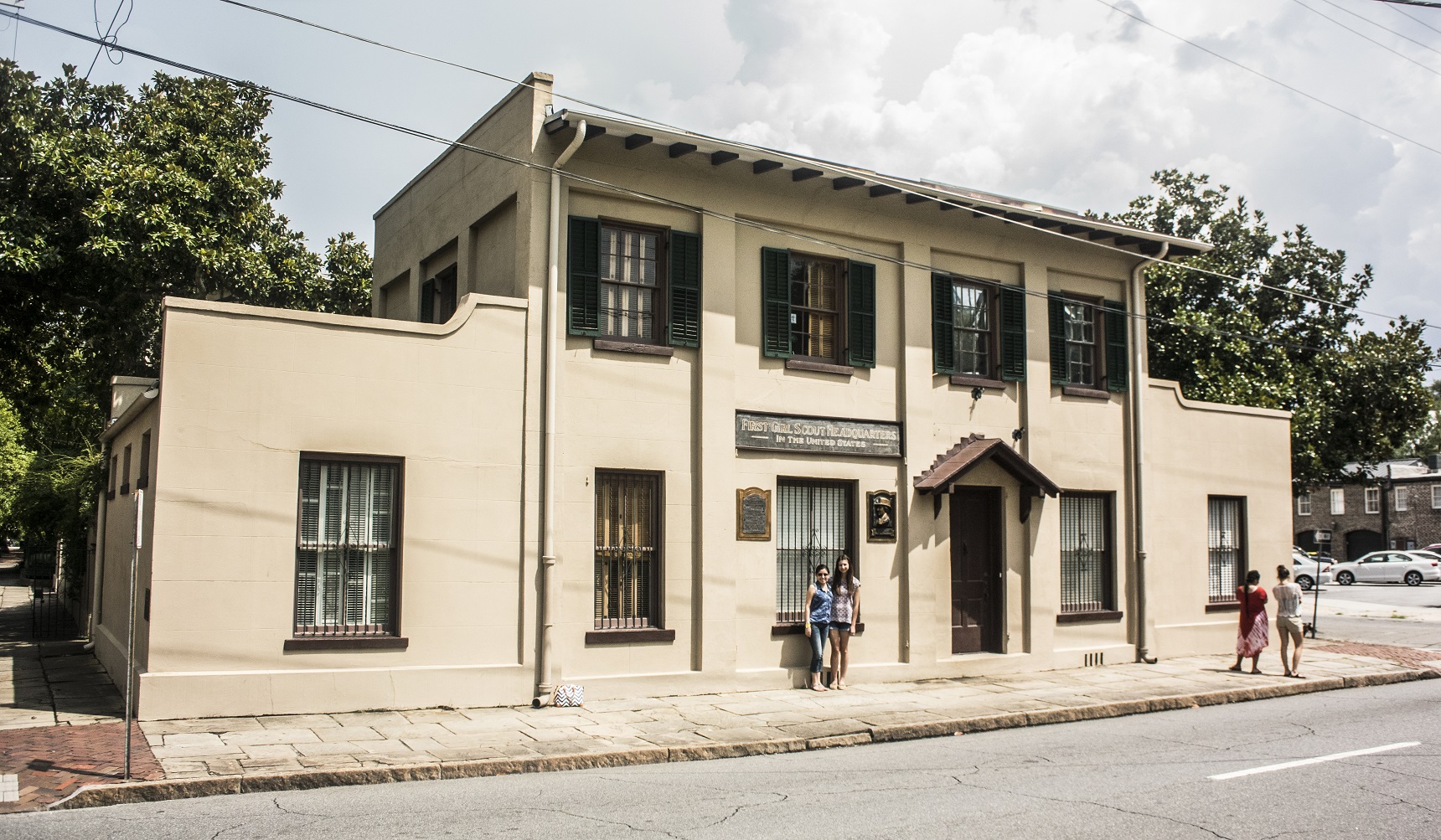
…and, a few blocks away, her carriage house, where she founded the Girl Scouts of America.
Megan and Alex tried to get into the Girl Scouts photo with us, but they weren’t Girl Scouts, so we wouldn’t let them be in the picture. Well, they were in the picture, but not in any official capacity. The photographer captured them sulking in the background.
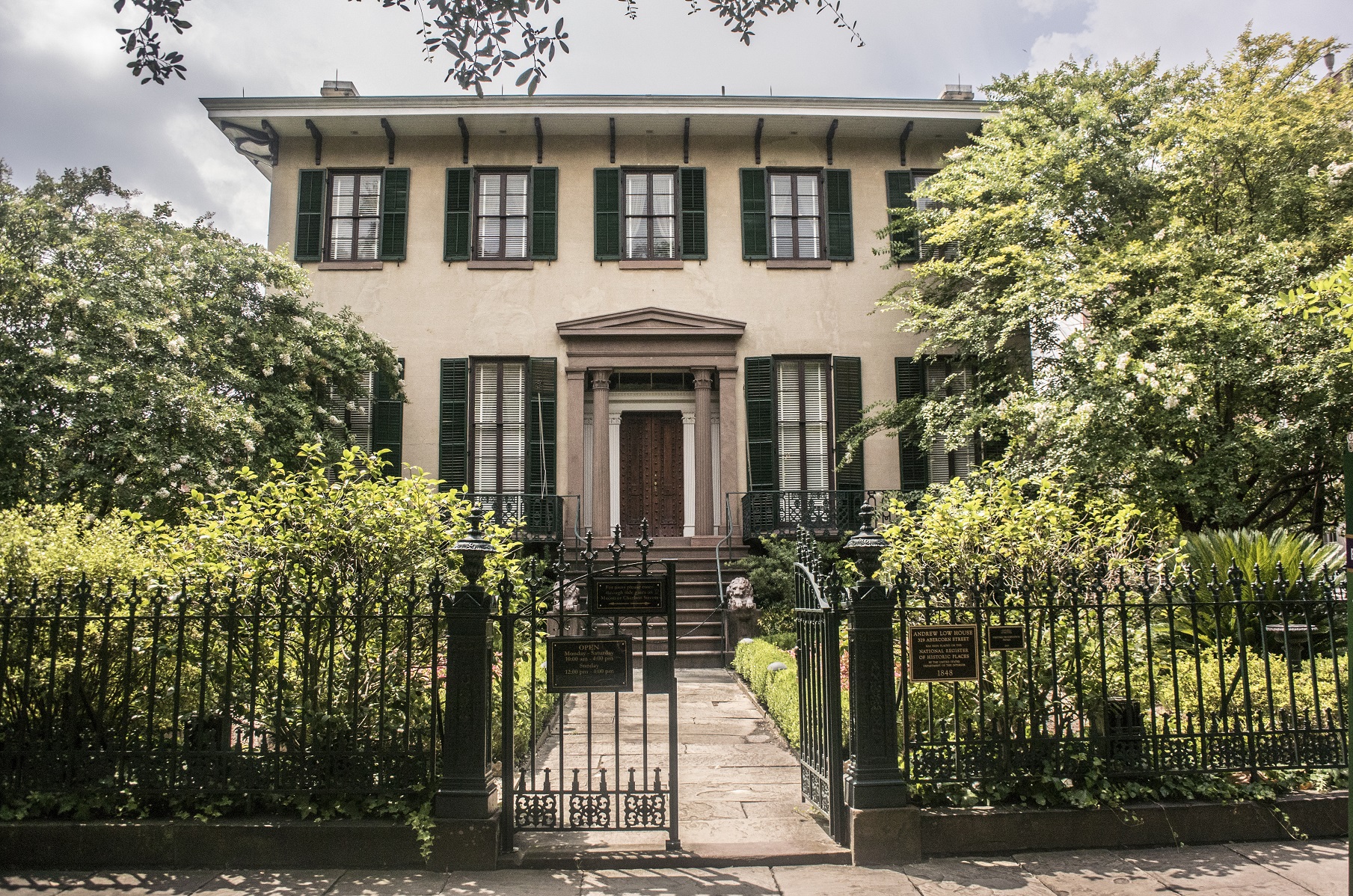
We also took another look at the Andrew Low House (Juliette Gordon Low’s Father in Law).
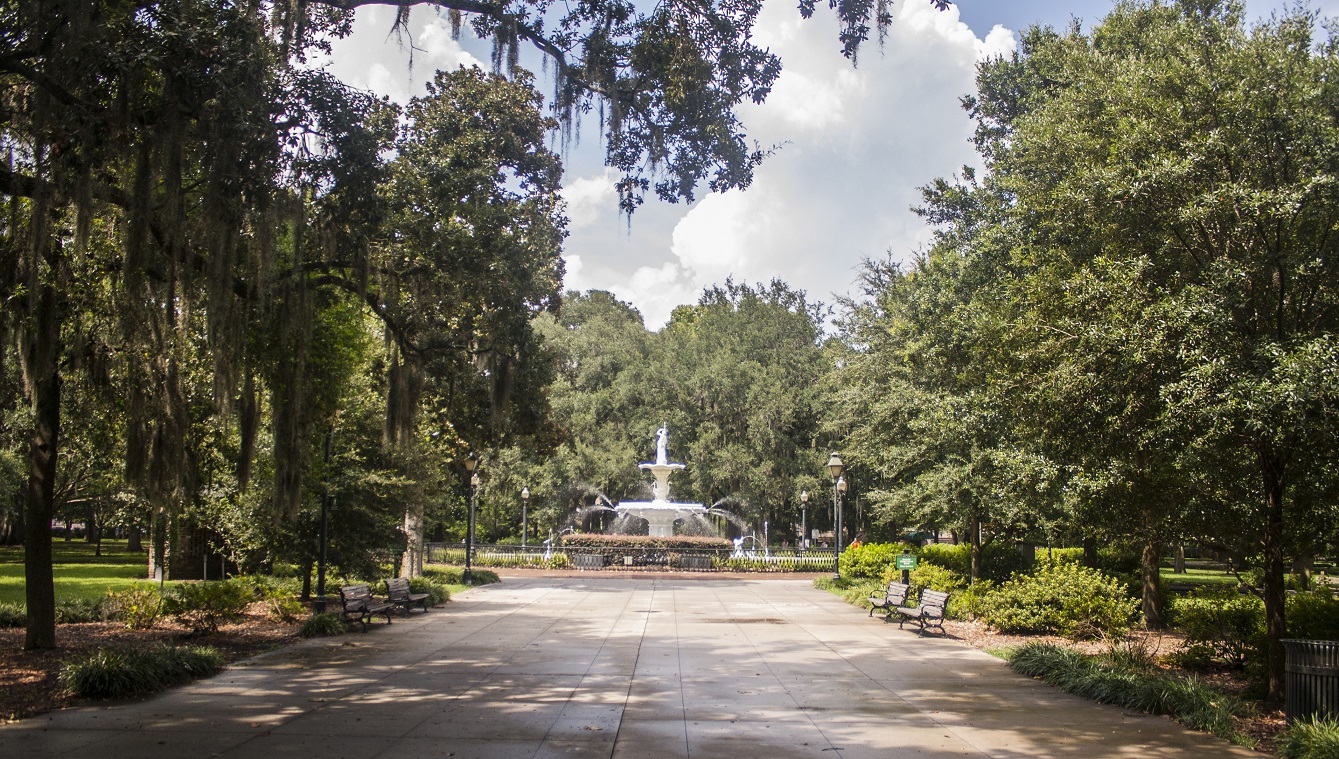
After taking photos, we made our way to Forsyth Park to see the famous Savannah water fountain that was built in 1858.
The fountain is striking from a distance…
…and from up close…
While at the fountain we took some selfies, group photos and tried to capture the beauty of the fountain.
This slideshow requires JavaScript.
Forsyth Park was laid out in the 1840’s so we really enjoyed the giant Oak trees covered in Spanish moss.
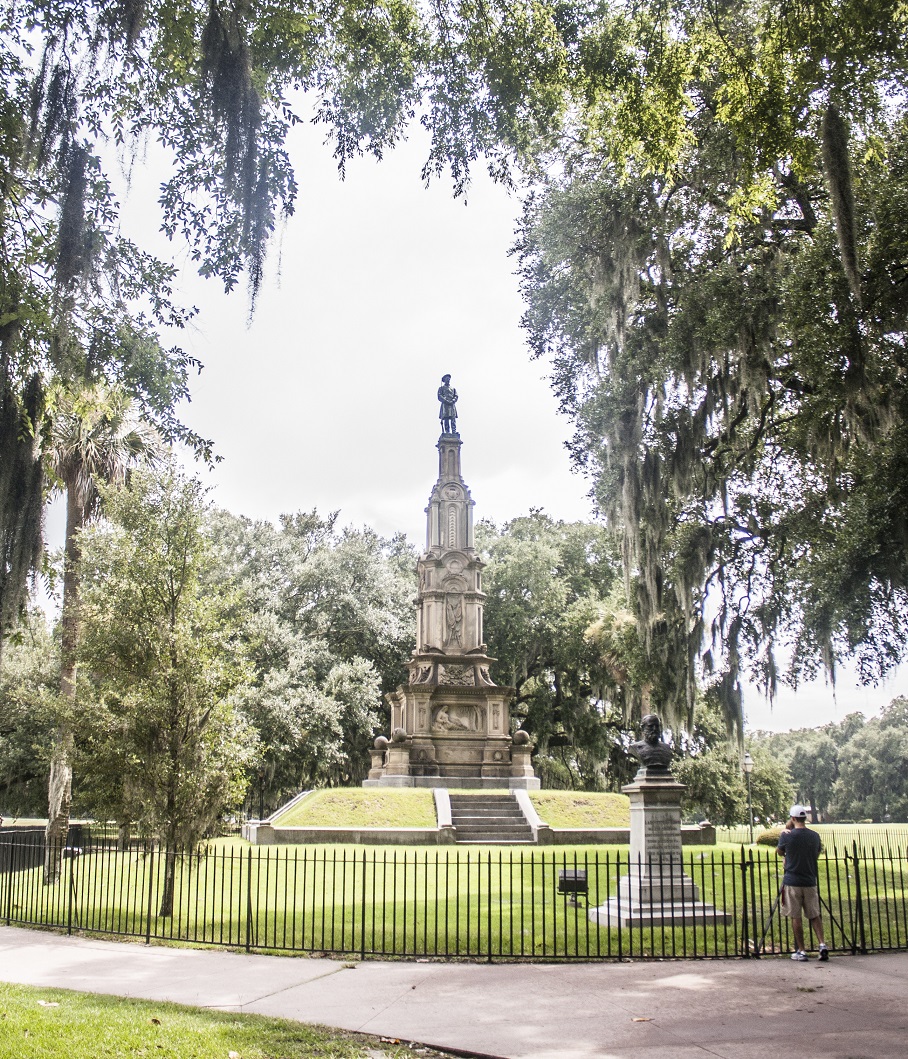
We also took a look at the Confederate War Monument in the Park, one of many veterans memorials in Savannah.
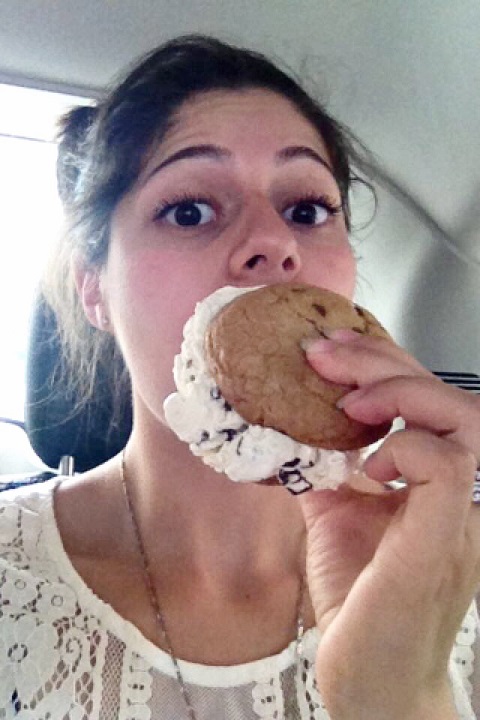
By the time we were done “modeling” for the camera at the fountain, we were all ready for Leopold’s Ice Cream. Leopold’s Ice Cream was founded in 1919 by three immigrant brothers from Greece and has been visited by many including Johnny Mercer, the famed lyricist.
We each tried Leopold’s famous Ice cream sandwiches. They were absolutely delectable!
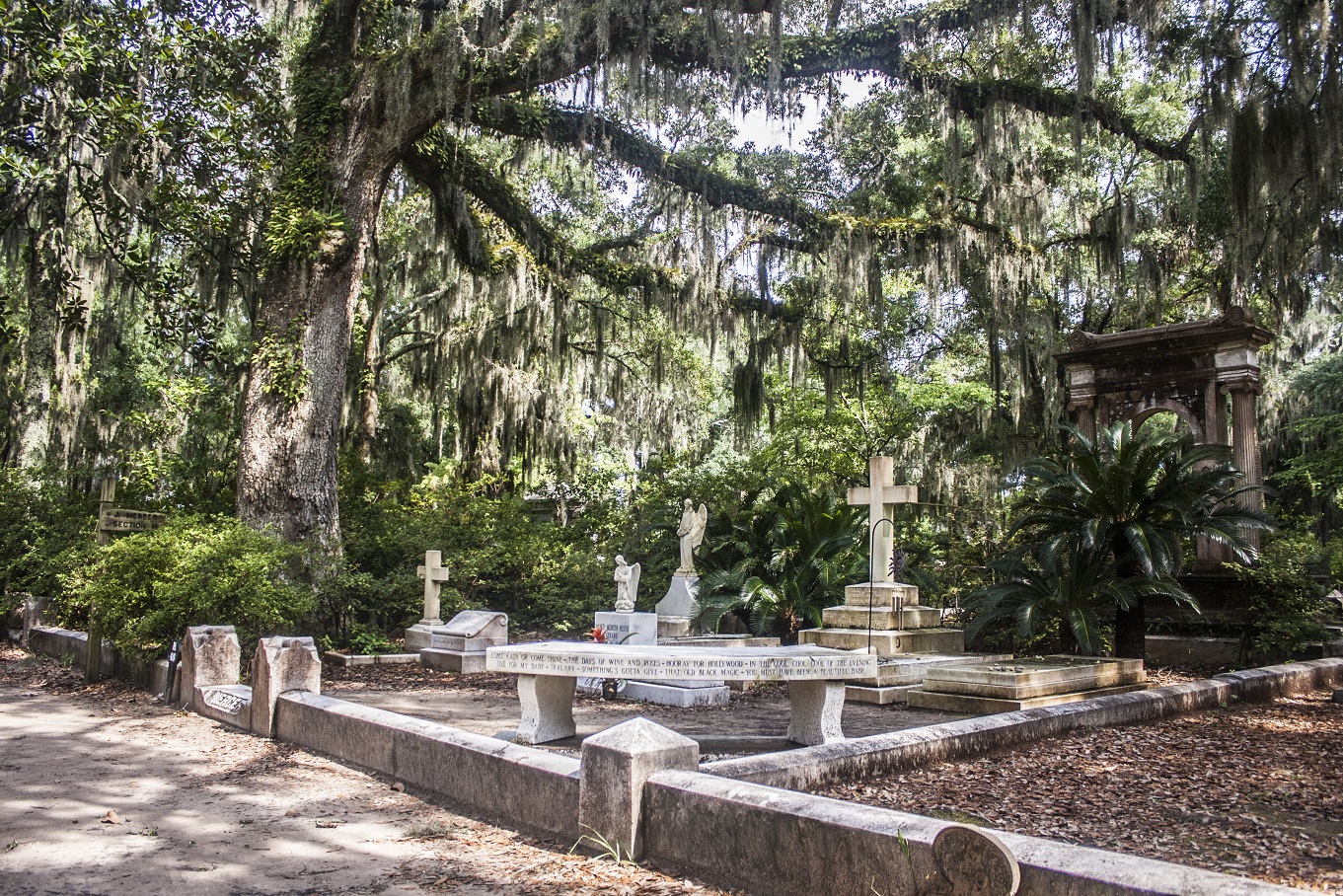
Before wrapping up our time in Savannah with the State Dinner, we made a pit stop at Bonaventure Cemetery in Savannah. Bonaventure Cemetery is where Savannah native, Johnny Mercer is buried. Johnny Mercer is relevant to the state of Georgia for many reasons. He was a thriving lyricist with over 850 songs and founder of Capitol records.
He wrote a hit song called Moon River and today he still makes profits from his music. The cemetery overlooks the Moon River, so while there we snapped some photos of us and the famous river.
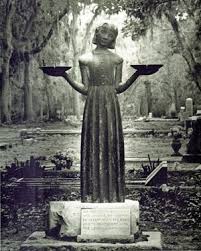
For many years, the Bonaventure Cemetery was the home of “The Bird Girl,” a statue featured on the best-selling book, “Midnight in the Garden of Good and Evil.” Because of the success of that movie, however, visitors flocked to the cemetery, and the sculpture was moved to Jepson Art Center.
The visit to the cemetery was interesting. While leaving flowers at gravesites is popular, we saw rocks on tombstones at this particular one. We couldn’t figure out what they represented, but they were different and some rocks were beautiful. Because we were running short on time, we didn’t spend as much time as we would have liked to, but nevertheless we enjoyed our time learning about Mr. Mercer and Moon River.
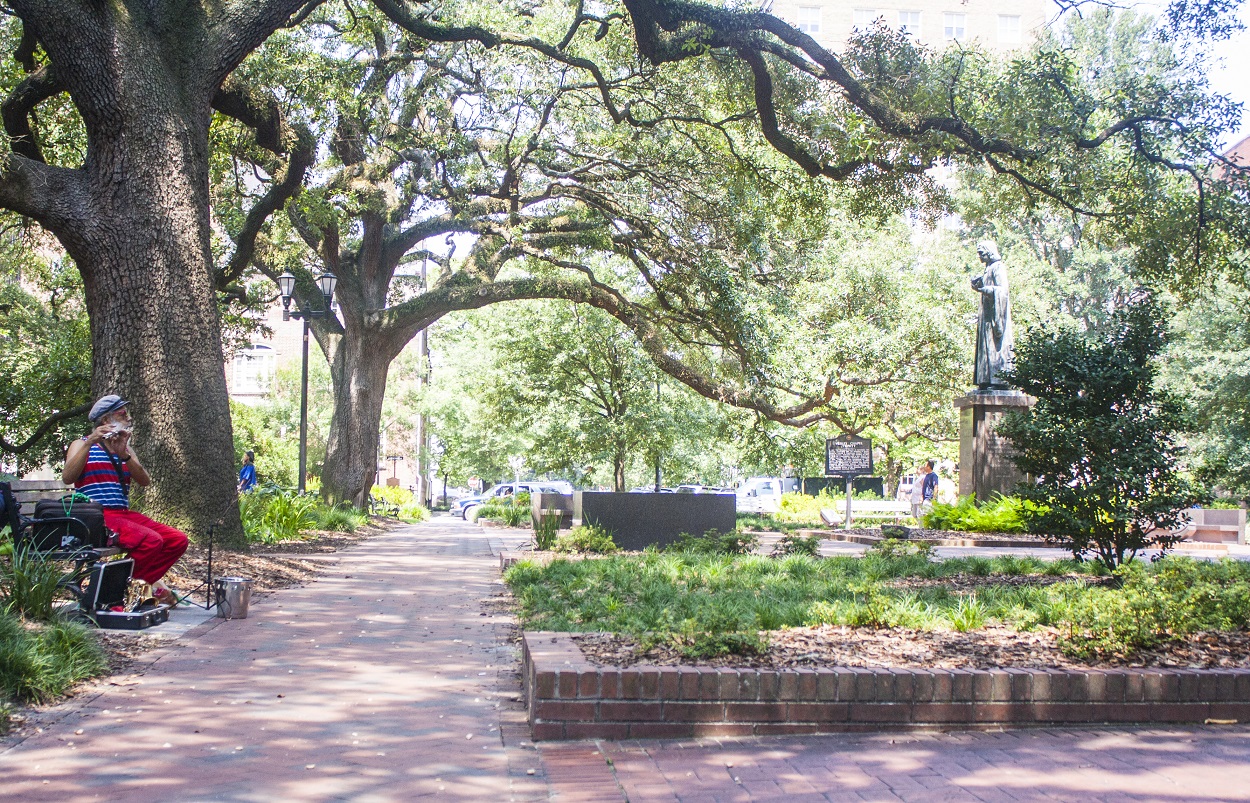
Following a few more photographs of local scenes…
…and street performers…
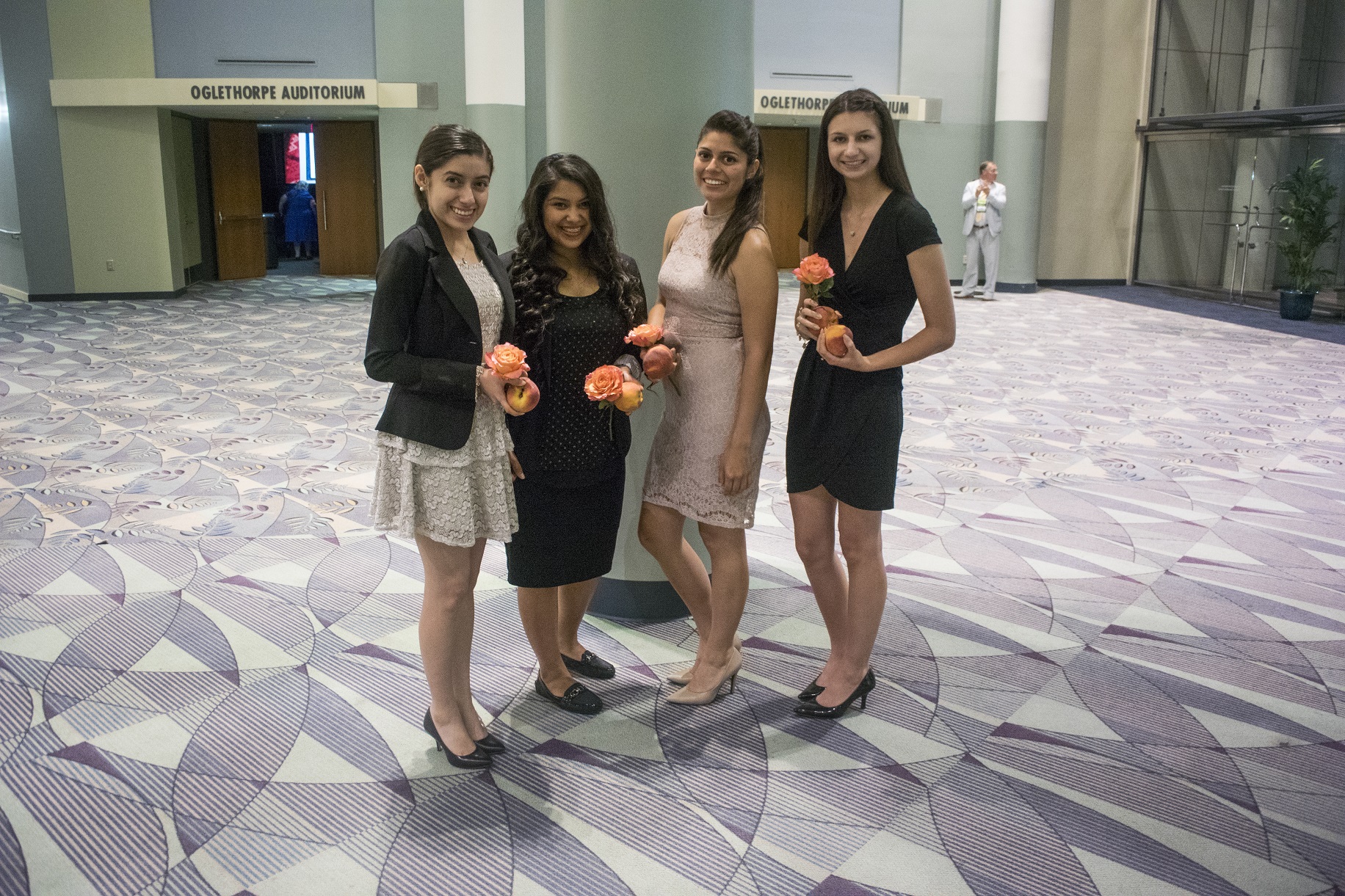
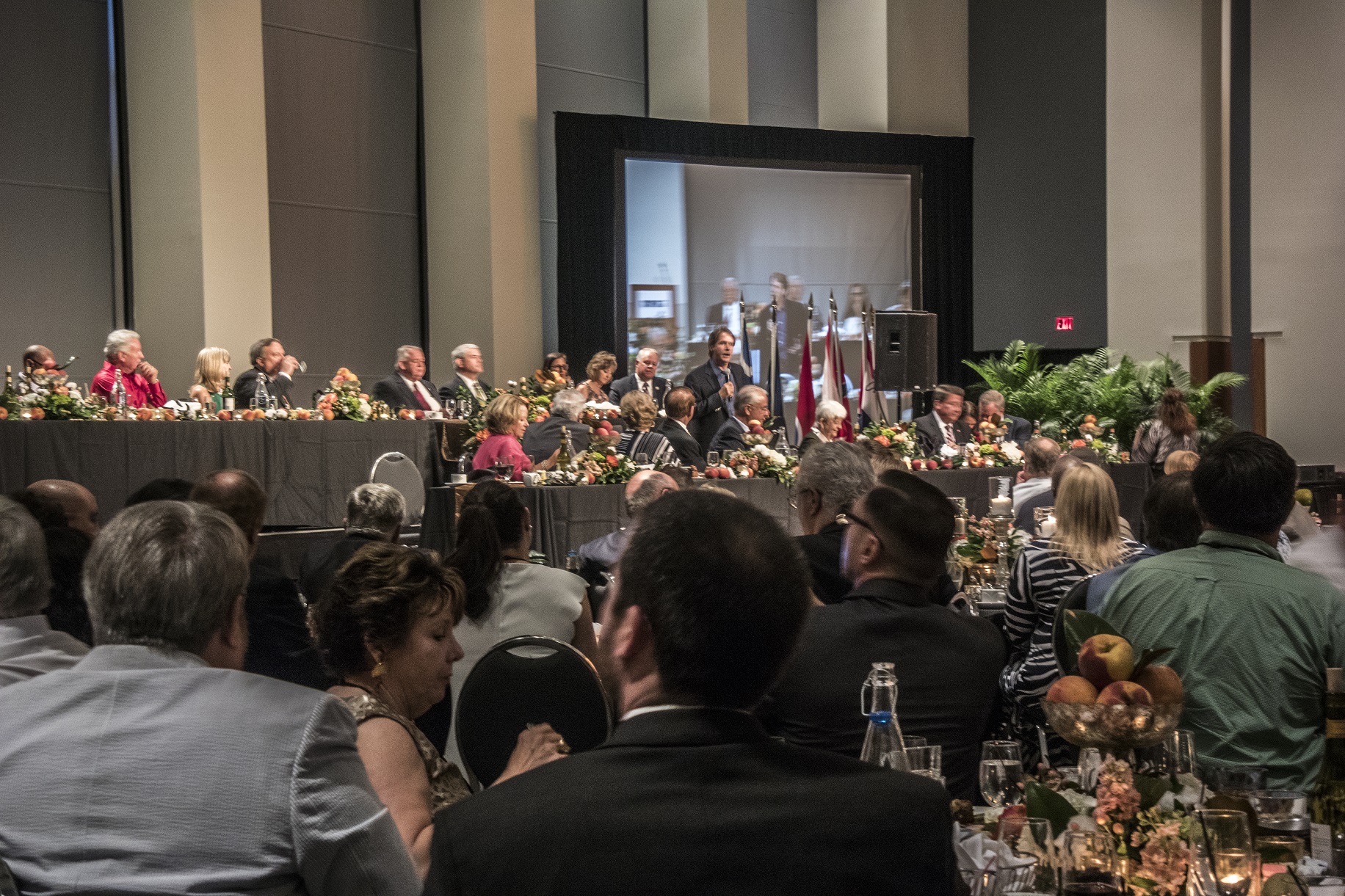
Every evening, the conference has hosted a reception for socializing and networking. Each night, the receptions have been fun and memorable. This evening, the final night of the Southern Legislative Conference, we attended the State Dinner, which featured presentations and speeches by elected officials and entertainment. The dinner theme was “Georgia on my mind.” All the details of the décor reflected Georgia and its signature items, such as peaches and cotton.
We were pleasantly surprised when the LSC staff asked the four SHSU students to represent Texas in the flag parade.
While elected officials represented most of the 15 states attending, Texas was represented by four college students!
Alex, Megan, Karla, Kaitlyn Represent TX at SLC
Following the parade, the Georgia Speaker of the House, David Ralston welcomed the conference attendees and thanked everyone for their dedication to the conference.
Dinner began where we enjoyed the filet mignon and peach glazed chicken among sweet tea and southern style sides.
Our table consisted of our group and Mr. & Mrs. Hickman. Mr. Hickman is the Deputy Staff Director of the Senate Finance Committee in the Virginia Capitol. Both Mr. and Ms. Hickman were knowledgeable and very welcoming, they offered interesting history facts about their hometown of Richmond, Virginia and travel tips for when we have the opportunity to visit Virginia. Our dinner conversation was pleasant and we were happy to have met them.
For entertainment, Jeff Foxworthy delivered hilarious comedy material, which everyone enjoyed.
Although most of his set was new material, he closed with some redneck jokes, including:
If your matching salad bowls all say, “Cool Whip,” you might be a redneck.
If your son’s name is Dale, Jr., but your name isn’t Dale, you might be a redneck.
Comedy was an amusing way to end dinner.
Comedy did not end the evening, however. That honor fell to Sheila Raye Charles, the daughter of the late Ray Charles. She sang some new materials, some covers of various artists (including Maroon 5) and covers of songs made famous by her father.
Just before we left, Ms. Hickman, introduced us to her friend and Virginia State Senator, Barbara Favola.
LEAP Center Students and Senator Favola
Senator Favola offered her advice and experiences on how to pursue a career path in politics one day. She was very knowledgeable and gave us some insight to her career. Throughout our Tour of the Deep South, it has been interesting to learn about how state legislatures differ from Texas’s. Thank you to Ms. Hickman for introducing us to Senator Favola!
After a few final pictures, we headed back to the hotel to get ready for our early morning departure and next full day of sightseeing in Alabama and Mississippi. Reflecting back on our time in Savannah, we have learned a lot about the rich history of the city and immensely enjoyed all the sightseeing. Thankful for the opportunity to attend the Southern Legislative Conference, we are sad to leave the beautiful city of Savannah…
Girls Contemplate Leaving Savannah, GA
…but excited about visiting more cities in our Tour of the Deep South!
We knew that today would be great because we were going to spend part of the day shopping! Early Monday morning we hit the squares to find souvenirs, clothes, and candy. City Market is full of small shops that are all unique. As we were shopping we also had the opportunity to visit many of the areas within the historical district we learned about the day before. After we finished City Market, we also walked down River Street (conveniently named for its location on the Savannah River) to do some last minute shopping and enjoy the view. The group bought gifts for our family members, including lots of candy from the Savannah Candy Kitchen. We all have thoroughly enjoyed the pralines. Savannah has the best by far! With all the purchases and walking around the squares we worked up quite an appetite and we decided to try a local pizzeria called Your Pie.
Your Pie was a welcome break from the heat and humidity Savannah summers offer. We decided to split the ten inch pizzas, which turned out to be the perfect sharing size. However, before the pizza arrived, we indulged in cheese sticks, but we considered them to be more like cheese bread. Megan and Alex decided to custom make their pizza, while Kaitlyn and Karla opted for a specialty pizza called “The Nat”. When the pizzas arrived, we were not disappointed at all. Fresh out of the wood fire oven, the cheese was perfectly gooey.
Rumored to have the best cupcakes in Savannah, we wanted to see for ourselves! After ordering various flavors, we agreed that the Rich Butter Vanilla cupcake was our favorite.
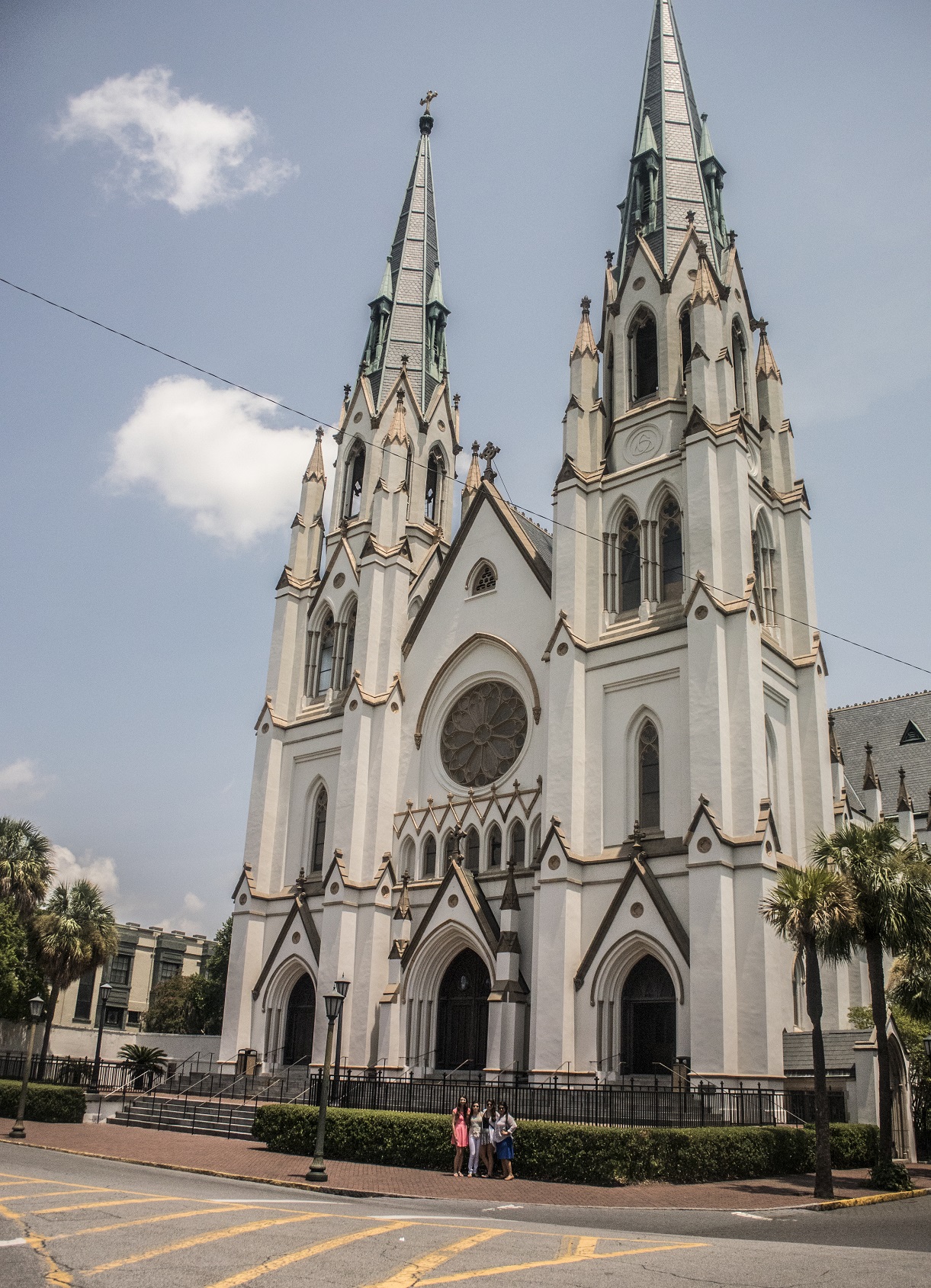
After lunch, we continued our sightseeing of historic Savannah. Our first stop was to the Cathedral of St. John the Baptist. Built in 1863, the cathedral is one of the tallest structures in Savannah.
When walking in, we all paused in amazement of the intricacies and beautiful interior of the Cathedral.
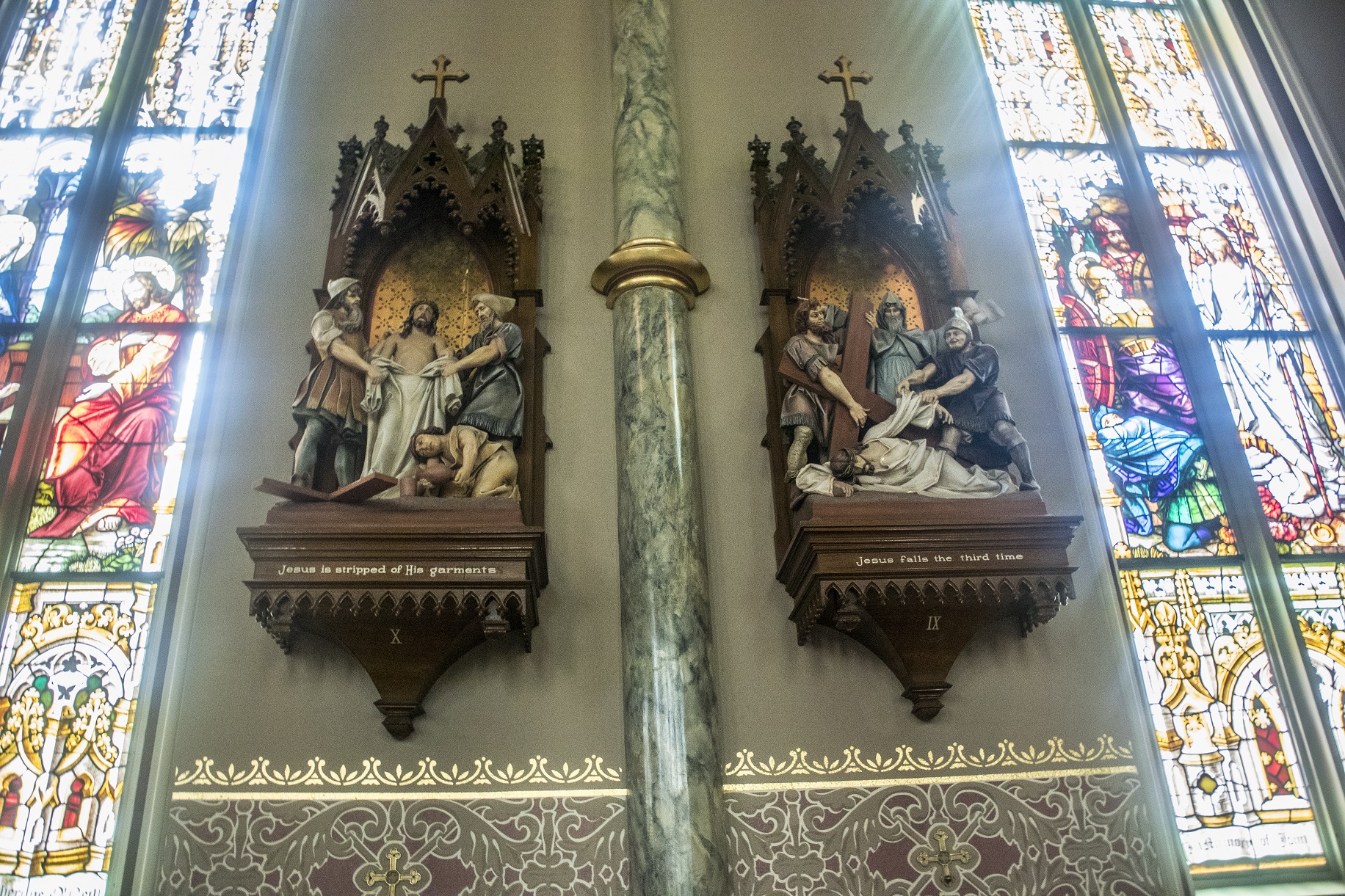
The church brings many visitors every year because of its beauty and Gothic architecture. One of the intricate details of the church included numerous stained glass windows with detailed biblical scenes on them.
The walls also had decorative narratives from the Bible.
The grandeur of the Cathedral can be observed from every angle which we thoroughly enjoyed.
Also, in our free time we visited Chipewa Square where Forrest Gump filmed a scene where Forrest famously says “Life is like a box of chocolates, you never know what you’re going to get.” In an effort to recreate the picture, we searched the bench where the scene was filmed, but came to the conclusion that the bench had been moved for the purpose of filming the movie and chose one with a similar view.
This slideshow requires JavaScript.
And a group photo at the fountain.
Once we we’re finished touring and shopping at Historic Savannah, we headed to Tybee Island. While in Tybee we visited the Tybee Island Light Station and Museum.
Although it sounded daunting, we were excited to begin the 178 step climb up to the top of the light house. The climb up to the light house served as a great workout for us!
This slideshow requires JavaScript.
We eventually all reached the top of the light house which is 145 feet tall and 154 feet above sea level. Some of us were nervous to step out onto the ledge of the light house but everyone eventually got to enjoy the view despite the phobia of heights. We even got a peek at the lighthouse lens, which was always on and required a 1,000 watt bulb–the brightness of which was amplified by numerous and layered reflectors.
The system that was put in place consists of two lightbulbs, one in use and one ready to light up when the other burns out.
The top was windy, but it didn’t stop us from taking selfies…
…and group shots…
and shots of the view from the top.
This slideshow requires JavaScript.
After taking many pictures at the top and enjoying the view along with the breeze, we descended down the flight of stairs again. Once we finally reached the ground we were able to tour the homes of the Lighthouse Keepers that were built in 1881. We enjoyed wandering inside the homes and finding old metal irons and telephones that had once been used.
Karla Goes Old School
We exited the Tybee Lighthouse and Museum through the gift shop and headed across the street to the Fort Screven Museum.
In the museum, we learned about the origin of the settlers and meaning of Tybee. The Spanish were the first to arrive on Tybee and we also learned that “Tybee” is a Native American word for salt. As we walked through the museum, we were able to see how much has changed in the past century. We saw an old diving outfit that had a helmet which weighed 31 pounds! We also walked through an exhibit that showed the evolution of the swimsuit, which we found very interesting. The museum had an exit onto the roof top so we went up and enjoyed the beachfront view for a while before heading to dinner.
After the adventurous tour at the light house and Fort Screven, we headed to the Crab Shack for dinner. Throughout our travels, many people recommended the restaurant to us, making it a must try! The restaurant’s decor was interesting and the food was great (visitors be warned: no air-conditioning). We had their specialty sampler dish for three with shrimp, crab, crawfish, mussels, potatoes, sausage, and corn. Our food was served on one larger tray which brought enough food for the entire group of six to eat.
Crab Shack Sampler for Three
The restaurant also has a mini-gator farm, where patrons can feed the baby gators with “gator treats” (for $3…).
Since we were extremely close to the ocean, we hoped the seafood would live up to our grand expectations and we were satisfied when we walked away.
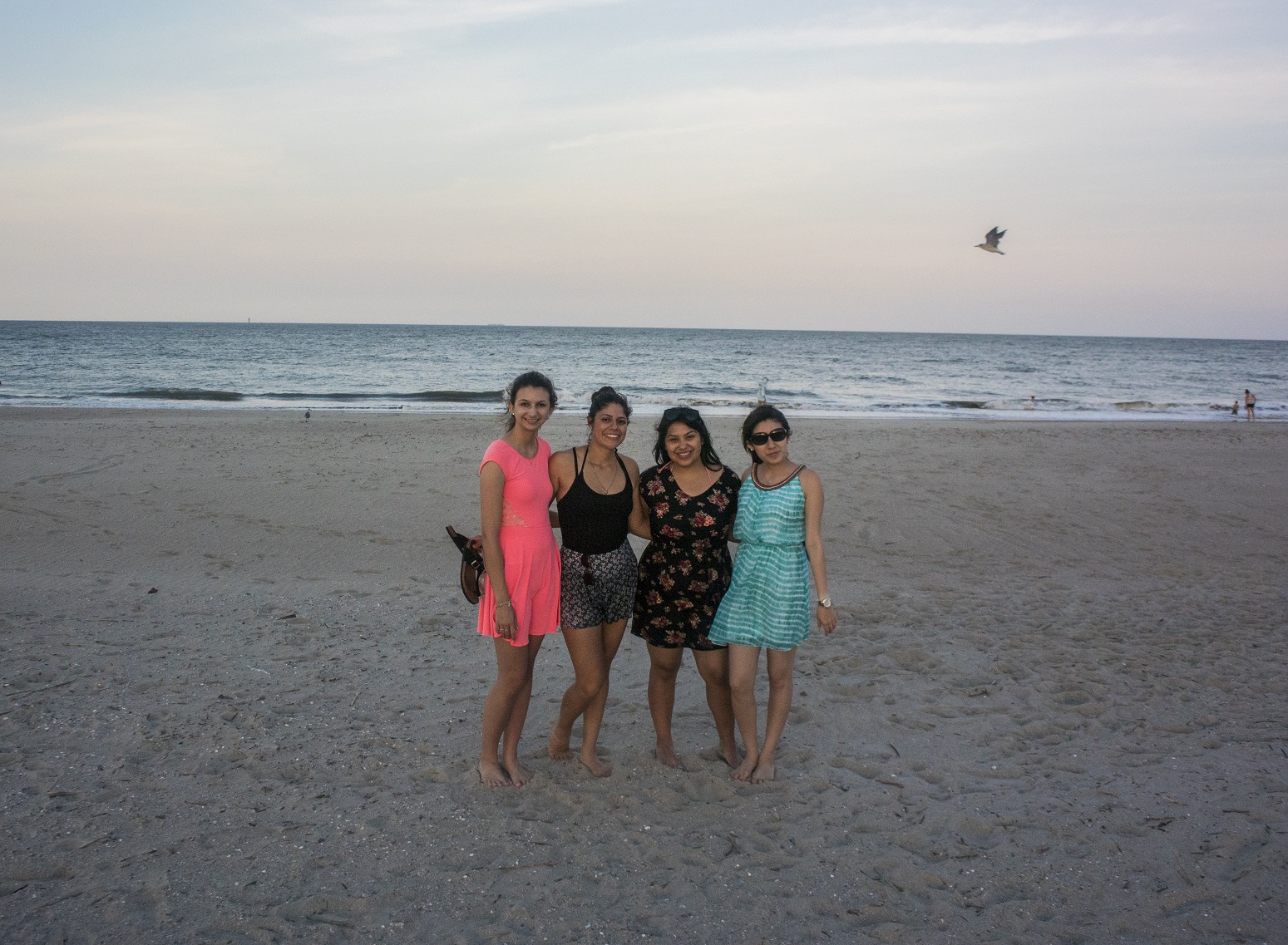
At the beach, we enjoyed the waves and the sunshine.
While some of us searched for seashells on the beach, others went swimming in the Atlantic Ocean. Luckily for us, it was perfect weather for a day at the beach. Of course, before we left, we took some nice pictures on the beach, one with our backs to the beach…
…and one facing the beach…
…and even one of us jumping…
Ending our delicious dinner and fun times at the beach, was time to get back to the hotel to freshen up for the Kentucky Kick off Reception.
As the day came to a close, we joined the other participants of the STL conference on the Kentucky Bourbon Trail. This was a kickoff social for the upcoming STL Conference in Lexington, Kentucky next year. Governor Beshear of Kentucky, Kentucky Speaker of the House, the Kentucky President of the Senate, and the Mayor of Lexington flew in and gave an introductory speech and expressed their excitement for the upcoming STL Conference in Lexington by formally inviting guests.
This slideshow requires JavaScript.
The highlight of the speeches was Governor Beshear’s, which highlighted themes of togetherness:
I want to talk about what brings us together. You know about Kentucky’s horses, and the Kentucky Derby; you know about the first Saturday in May; you know about our history; but I want to stress more substantive things, what really brings people together: short, tall, black, white, male, female. Kentucky Bourbon!
Kentucky Governor Steve Beshear
He also highlighted the success they’ve had in the production of bourbon. Kentucky has 4.4 million residents and 5 million barrels of bourbon, how fascinating is that? “That’s one barrel for every resident, and the rest is for you!,” he exclaimed, to much applause.As it turns out, Kentucky produces 95% of the world’s bourbon, and the other 5%, according to Governor Beshear, “is counterfeit.”
The group closed with a serviceable rendition of “My Old Kentucky Home,” and many in the audience knew enough words to follow along. The song was written by Stephen Foster, the “father of American Music,” who also wrote “Oh! Susannah” and “Camptown Races.”
Sadly, no one offered to sing “The Eyes of Texas” or “Deep in the Heart of Texas.”
There were small refreshments for us to enjoy throughout the night. We tasted the ham and beef mini sandwiches. Also, the homemade bread pudding was scrumptious. I think all of us would agree that we have had the best and second best versions of bread pudding we’ve ever tried, although we were in disagreement as to whether the Paula Deen bread pudding (with rum sauce) was better, or whether the Kentucky version (with bourbon and more icing) was the best. Our plan was to wait on the bread pudding until we got to its home, New Orleans, but that plan went out the window.
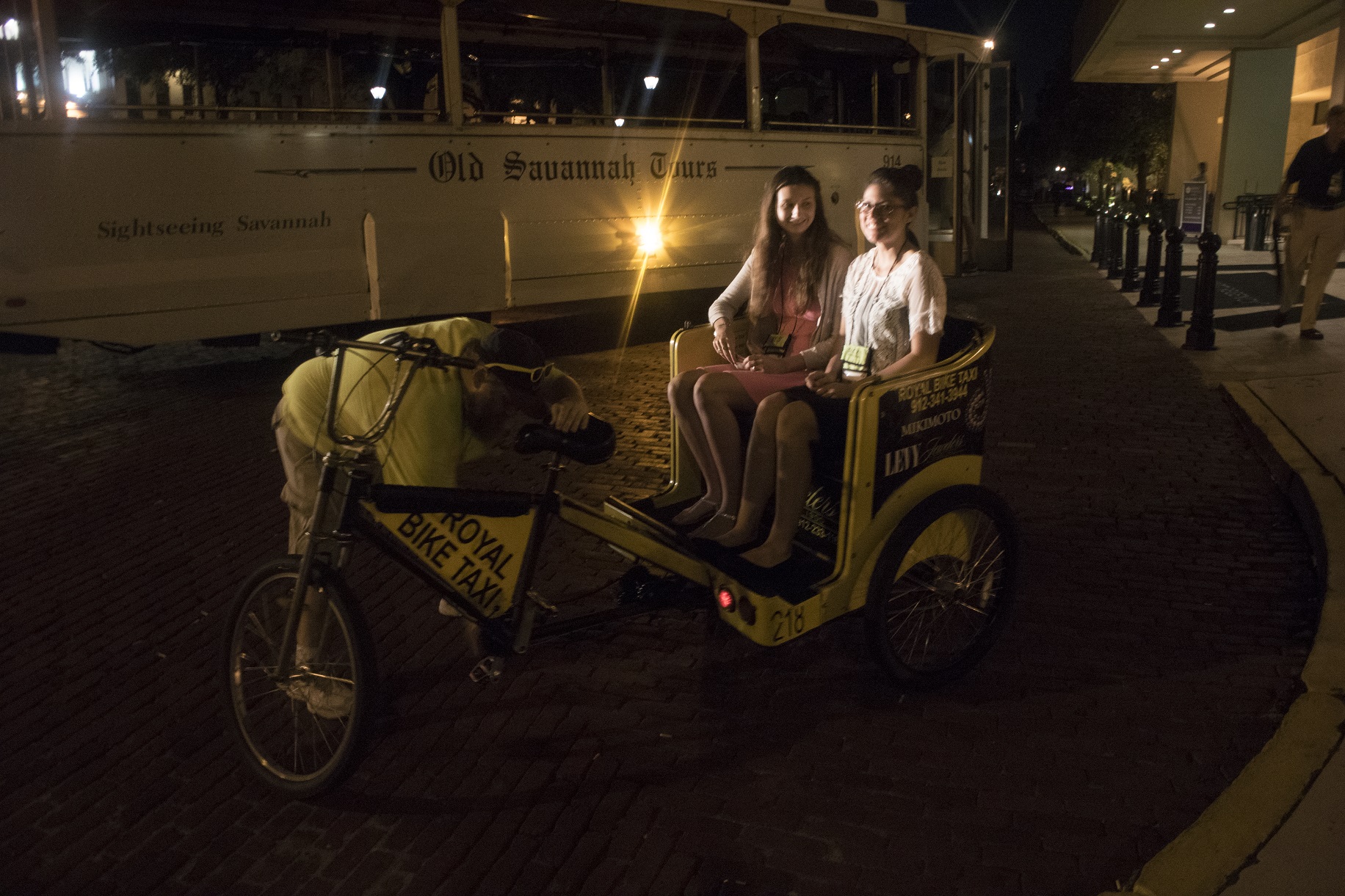
The others tried the various cheeses that were available and seemed to have been a fan. Kentucky did a great job of putting out the best of the state. We watched the mingling for a while and after a while decided that tomorrow will come early, so it was time to head back to the hotel. On the walk home I reflected in the day and was kind of sad that my stay in Savannah will soon be over. For a few of us, Professor Yawn treated us to a bike taxi which was a fun way to end the evening and see a little more of beautiful Savannah!
Each day, we’ve been having a great time learning and experiencing new things. Tomorrow, we will make the most of the day…for it will be our last day full day in Savannah.
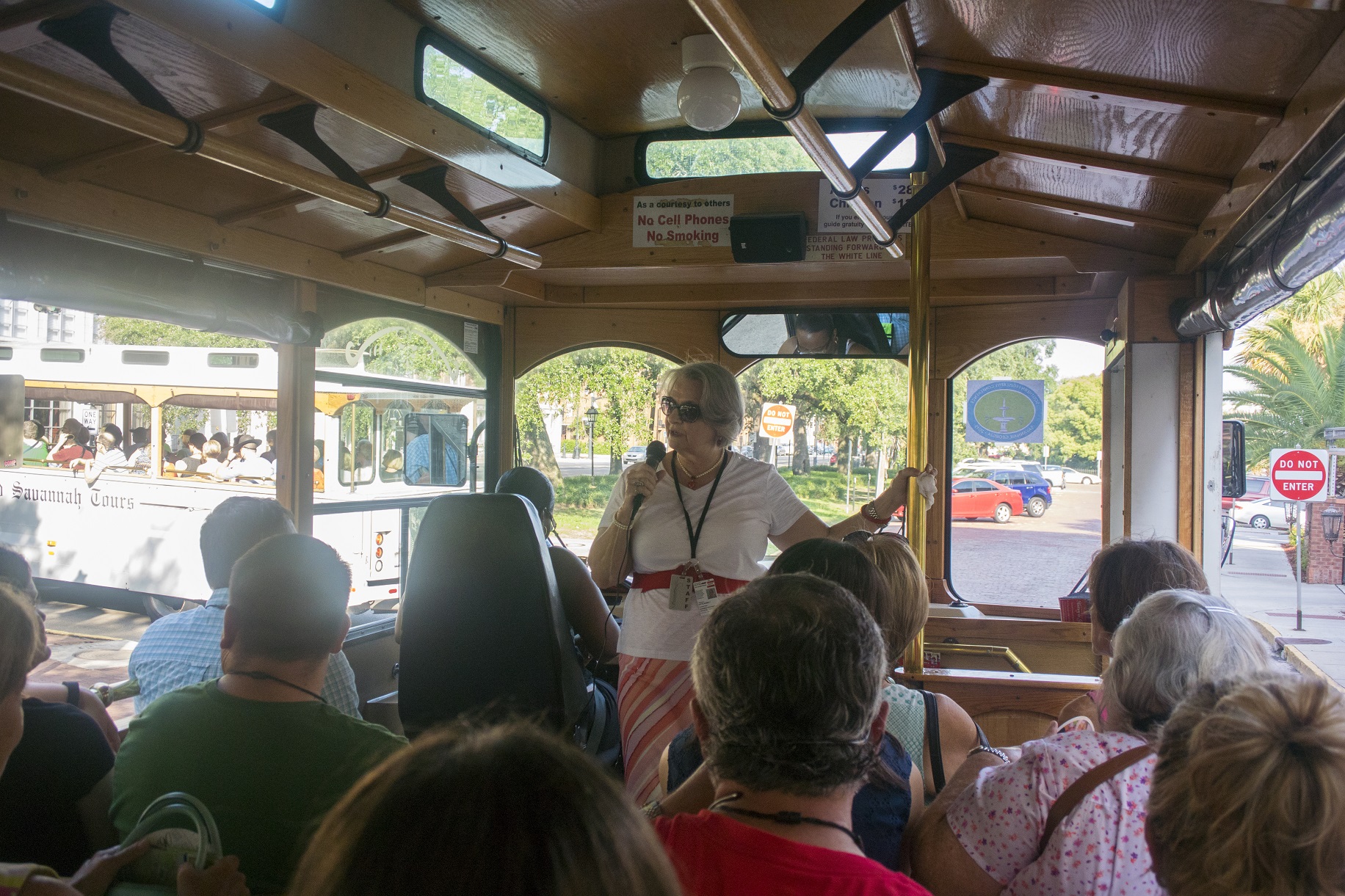
After a long nights rest, we were ready to take on Savannah, Georgia and all of its rich history. Thanks to the Southern Legislative Conference we were able to go on a trolley tour of Historic Savannah. As we drove through all 22 squares, our tour guide, Dotty, gave us a brief history of them and what all the statues located in them represent.
We learned much about James Oglethorpe, the man who founded Savannah. We also learned that he worked closely with Native American Chief Tomochichi who is buried in one of the beautiful squares. We were able to stop and take a tour of the Andrew Low house that was built in 1848. Low was not only a prominent member of Savannah’s business and social classes, but he was the father-in-law of Juliette Gordon Low, who founded the Girl Scouts in the early 20th century. In fact, she founded the Girl Scouts in the carriage house of the Andrew Low House.
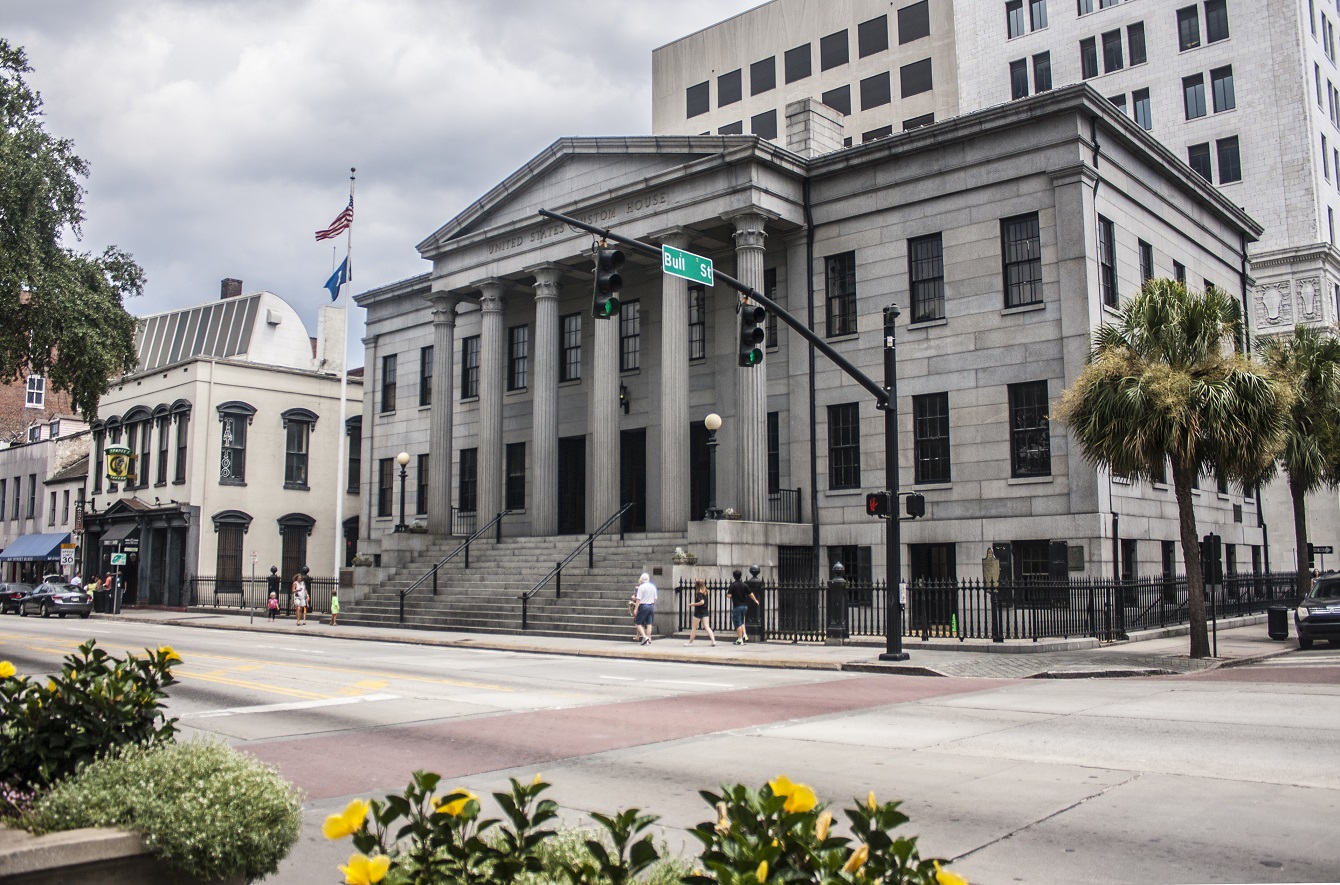
The Low house was also interesting because it was designed by a prominent architect in Savannah, John Norris. In addition to the Low House, he also designed the Mercer-Williams home…
…the US Customs House in Savannah…
…and other local landmarks, in a town filled with architectural wonders.
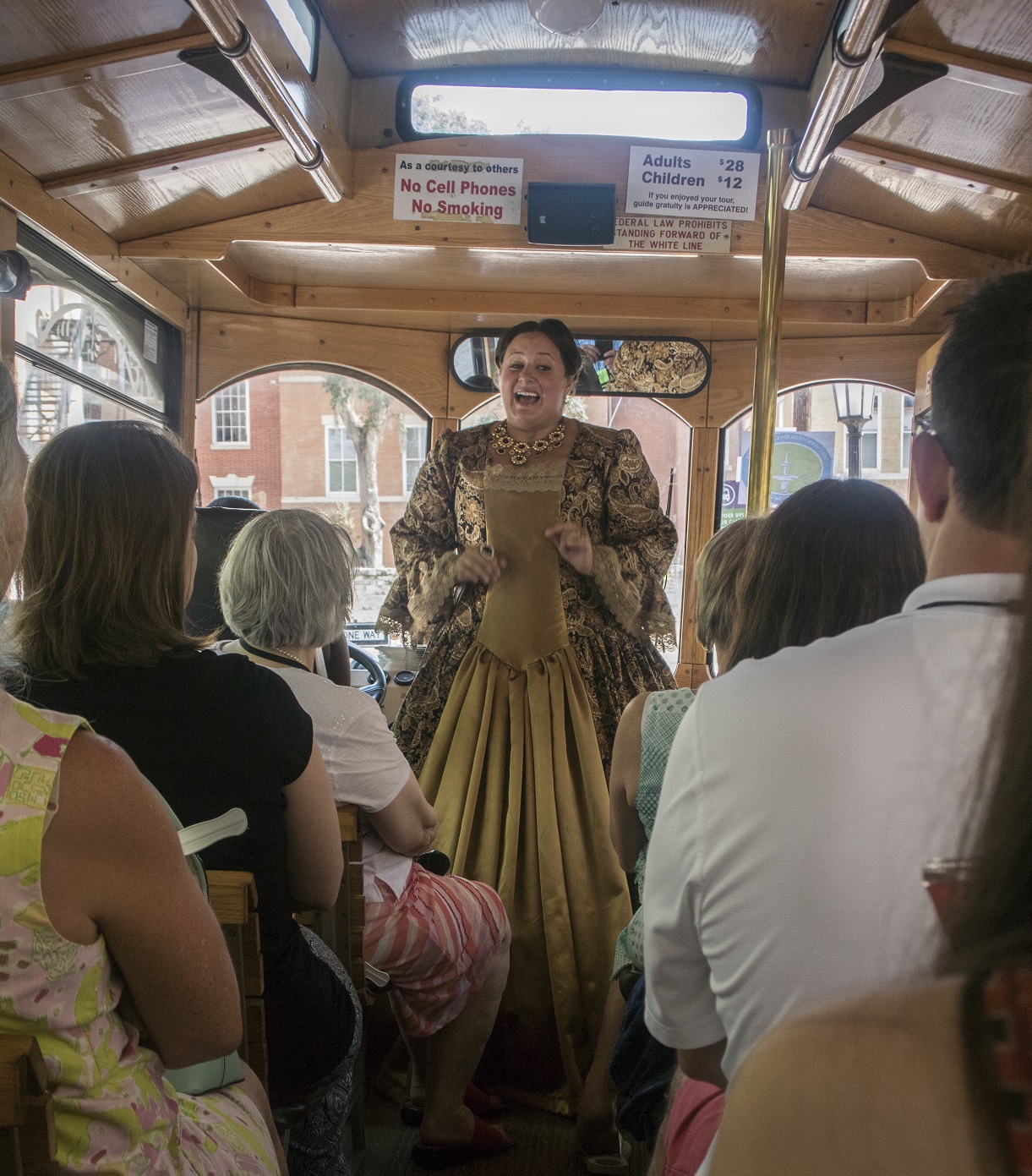
After we left the home tour we settled back in the trolley to continue our tour of historic Savannah and were able to see beautiful homes and learn the history behind local schools and churches. We also had an actress from the local theater tell the story of Fanny Kemble, whose published journals about slavery helped turn British opinion against the confederacy.
It was a long trolley ride (3 hours), but it was fun together time, and a great way to learn the history of a history-rich area.
After all the learning, we were ready to eat a delicious meal at Lady and Sons.
Our historic trolley tour of Savannah ended with lunch at The Lady & Sons, Chef Paula Deen’s restaurant. After spending the morning touring the city by trolley, our group was eager to enjoy traditional Southern food. Our lunch included access to the buffet, the salad bar, and our choice of dessert. Many of us enjoyed the sweet tea, which is not only a staple in the South, but also very refreshing. Among the buffet, our choices included: Paula Deen’s famous fried chicken, pulled pork, mashed potatoes, green beans, sweet potatoes, macaroni and cheese, and a variety of additional southern sides. For dessert, we chose from banana pudding, peach cobbler, and gooey butter cake. In addition, we ordered the bread pudding to sample. The bread pudding was especially delicious because it was topped with a warm butter-rum sauce. In addition, we sampled the other desserts, with the gooey butter cake winning our hearts, but all were delicious and filling. Keeping with the theme of the Southern Legislative Conference, Paula Deen’s restaurant fit in perfectly! With full stomachs, we left for an afternoon of exploring historic Savannah!
Next, we headed to the hotel to freshen up to head out to the local souvenir shops along the river. Luckily our hotel concierge gave us a map and directions to assist in making our shopping experience easy and enjoyable. He also took the time to warn us about the 200 year old steps that many find intimidating–even he is afraid. We decided to use the historic steps anyway and quickly learned why we were warned. The steps were extremely small and steep! Once we climbed down the steps we began our shopping adventures. It was unfortunate that our shopping ended quickly when a sudden storm rolled into Savannah. We rapidly headed to the closest destination to shelter us from the storm. Luckily we were able to catch a shuttle back to our hotel.
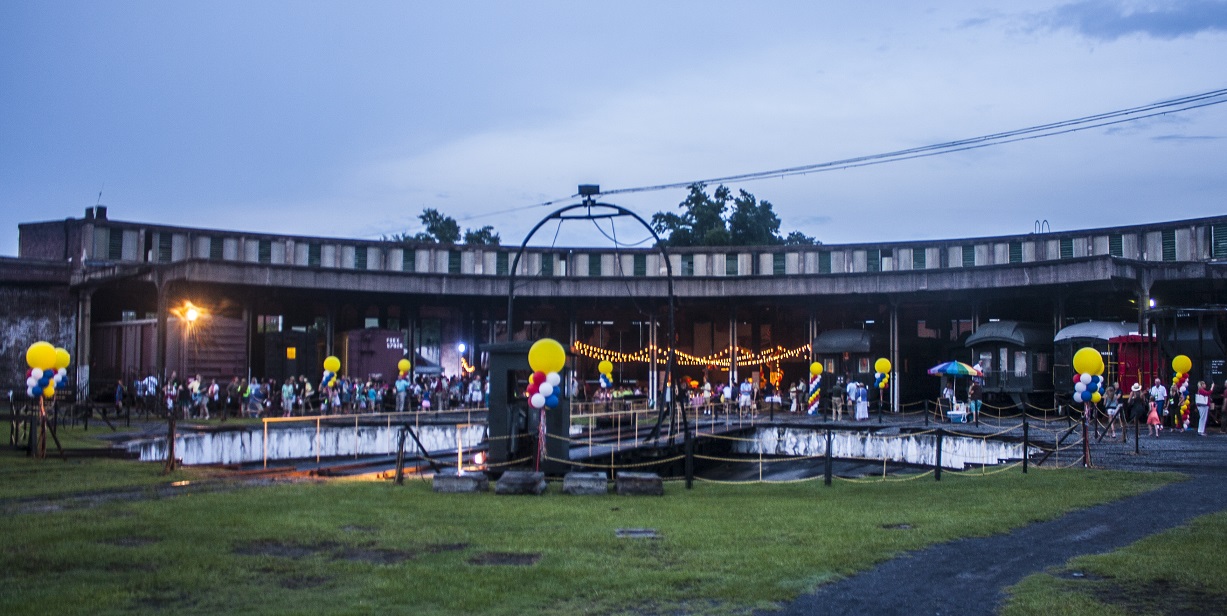
After some time to rest from the long day of tours and shopping, we made our way to the Southern Legislative Convention’s Family Night. The venue was Georgia State Railroad Museum. The railroad station was established in 1833 as only a central system and within seven years the railroad expanded 190 miles.
It is also known as one of the first businesses to have integrated workers in the deep South. The need for skilled workers was more important than prejudice. The train house was lit up with lights and southern style décor.
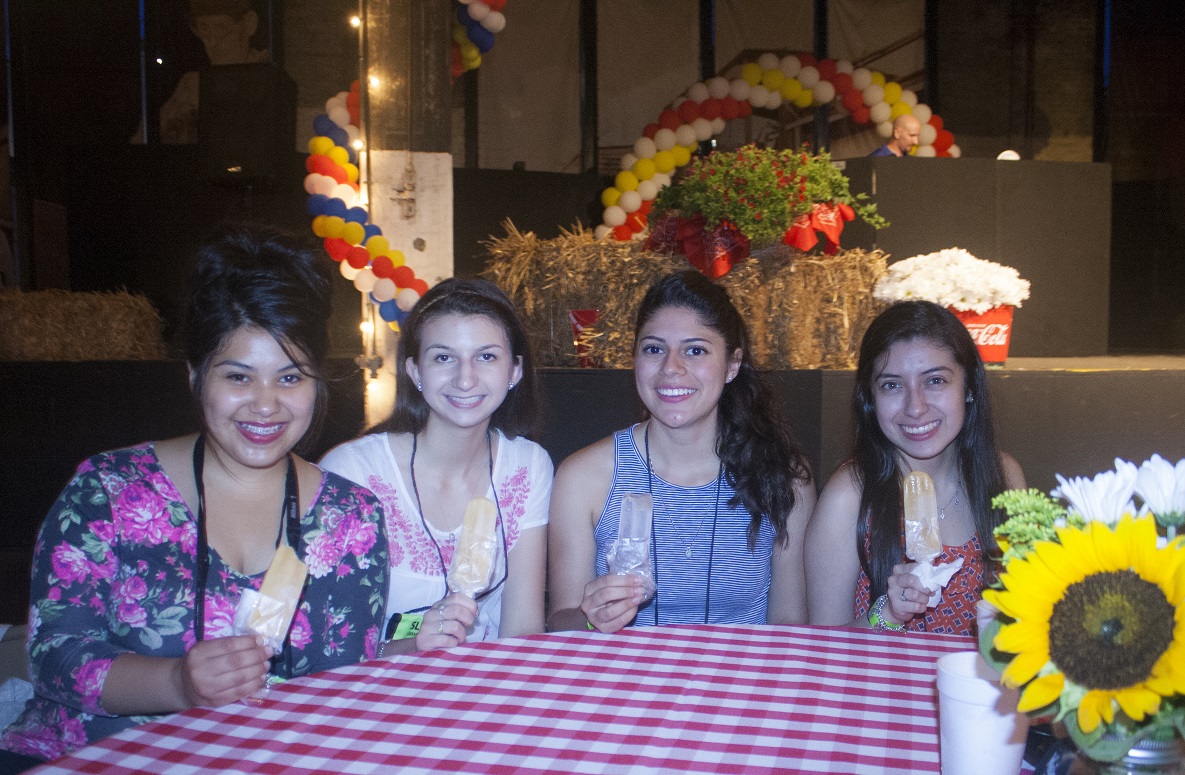
There were numerous activity stations for us to enjoy as the sun set. Music filled the background and families were participating in the night’s festivities. We started with a bar-b-que dinner and banana pudding for dessert. After, we indulged in more dessert from local King of Pops, they were refreshing and delicious!
The train ride of the museum was our last activity.
On the ride we learned fascinating facts about the history of the railroad.
This particular railroad is one of the only standing Victorian style railroads, and we had fun riding the rails…
…
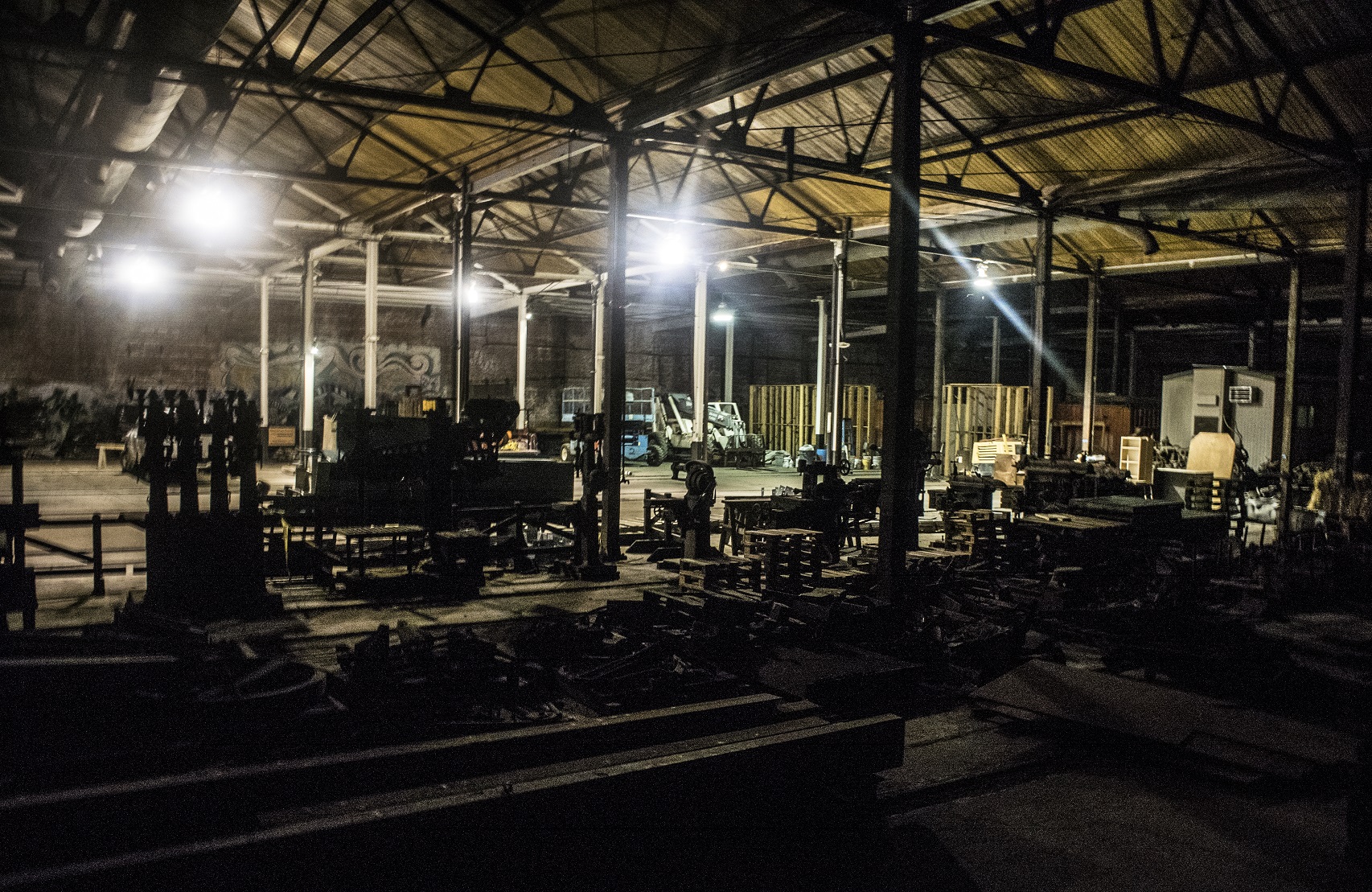
It also houses an original turntable and oldest steam engine. The night was perfect and, as always, we learned a lot.











































 Center for Law, Engagement, and Politics