The City of Huntsville knows how to put on a party–especially a birthday party. In this case, it was the nation’s 245th birthday. To celebrate, the City’s Parks and Leisure department offered residents numerous activities, including rock-wall climbing, mechanical bull riding, face-painting, balloon art, dunk-the-local celebrity, watermelon-eating contests, numerous vendors providing food and fourth-of-July fare, and more.
Parks Director Penny Joiner Welcomes Residents to the Independence Day Celebration
Residents had their pick of activities. One of the most popular was the bull-riding, which could be adapted for the participant’s age (and fear). Kids often took a ride on the bull, then headed straight for the line again, to go at it another time. Of course, some adults found the fun irresistible, too.
When kids weren’t on the bull, they headed to the rockwall, where the goal was to climb to the top and ring the bell. A few made it!
Not all the kids made it all the way up, but they had fun, with staff lending encouraging words.
The crowd size was steady, peaking around five-thirty, but was never so large as to be overwhelming or intrude on the fun.
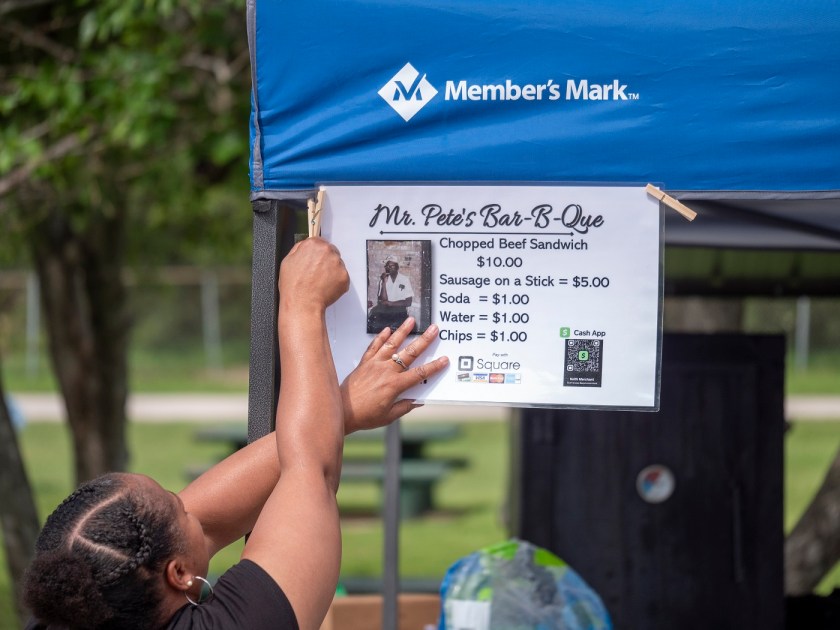
If residents got tired or hungry, there were vendors on hand to stem the cravings.
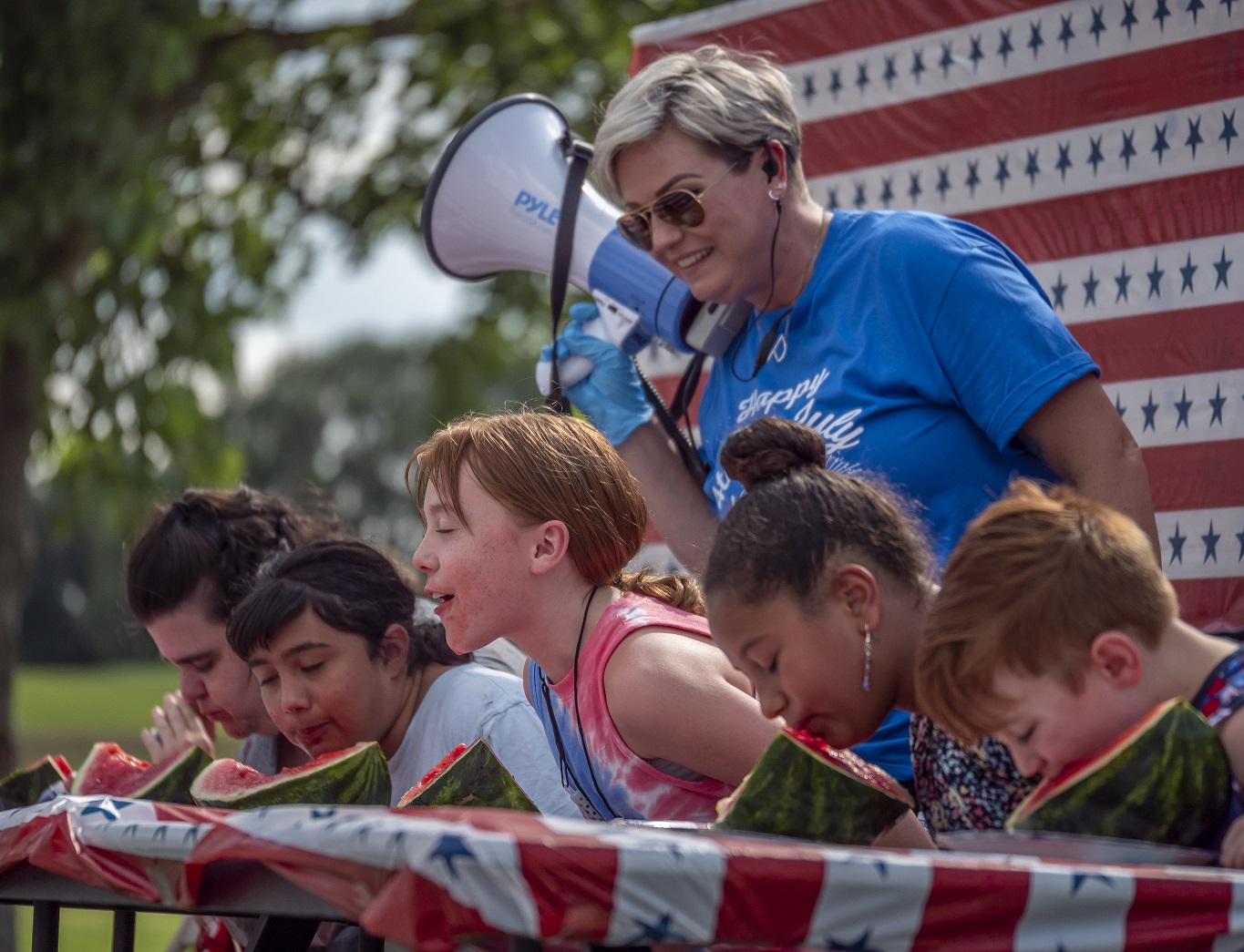
And every forty-five minutes, there was a watermelon-eating contest to occupy the crowd, either by participating or enjoying the show.
The good news is no one got sick! The better news is that everyone had fun.
Of course, even with all the fun, sometimes the agony of defeat was difficult to handle.
Of course, there was always staff on hand watching over things…
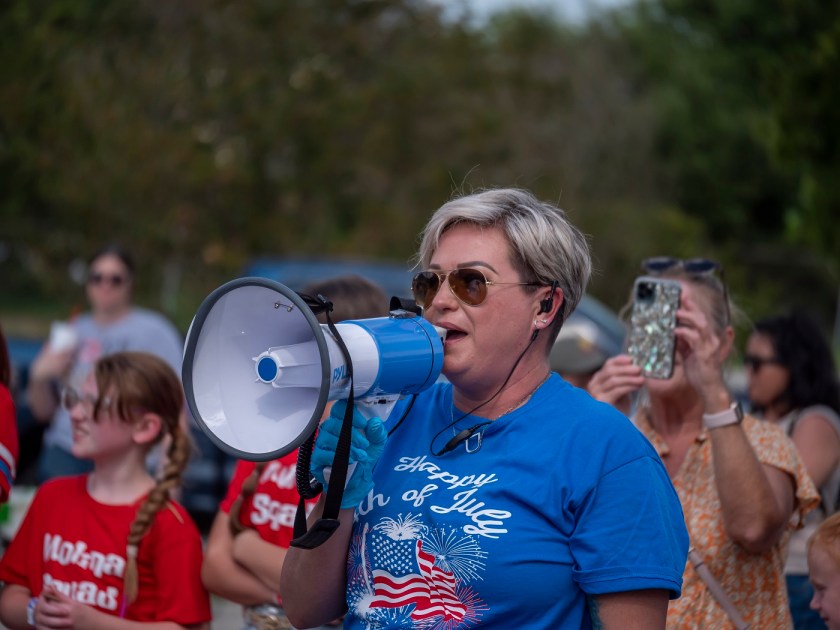
…or providing instructions…
But a lot of the fun was just seeing people who were enjoying themselves.
If people needed a break, there was a coloring booth, which occupied many.
And if people were feeling feisty, they could attempt to “dunk the local celebrity,” which included folks such as KSAM’s Glenn Edwards, the City of Huntsville’s Deputy City Manager Rick Rudometkin, and the City’s Chief of the Fire Department, Greg Mathis. Greg was dunked the most, perhaps because he had the most fun with the participants.
It was a great day, spearheaded by Penny Joiner, Kristy Wheeler, and with help from many other City of Huntsville staff, including intern Jade Jones.
Recently, Quinn and I had the opportunity to go on a private tour of the Houston Holocaust Museum, courtesy of the World Affairs Council. Although the tour was on Juneteenth, we thought a post date of July 4th would be appropriate, as a reminder of the sacrifice and responsibility that comes with being free and aspiring to be a better people and nation–the legacy of both Juneteenth and July 4th.
To begin the event, Quinn (who is half Jewish) and I went to a Jewish Deli, Kenny & Ziggy’s. We stayed pretty basic (I always stay basic in terms of food…), but we enjoyed the restaurant, trying something new, and staying with the theme of the day’s education.
Following our themed lunch, we arrived at the Holocaust Museum, met our fellow young professionals (including old friend Rebeca Becker), the always-friendly World Affairs Council staff, and were greeted by our knowledgeable docent, Rhonda Goldberg. She noted that this Museum opened in 1996, and it is the nation’s fourth largest Holocaust Museum.
The tour was a little less than two hours and it started promptly at 2:00 PM, with the Memorial Room exhibit. Within this small room there was a whole wall, created by artist Patricia Moss-Vreeland, dedicated to hand-painted and light-reflective tiles featuring tears to represent the 6 million Jews lost because of the Holocaust.
The day of our tour was sunny, and there was much light coming through, but Mrs. Goldberg pointed out that the mood of the art piece changes with the weather. On a dark or rainy day, for example, the public’s perception of the “tears” would be different.
Even more somber was a short, half-moon pedestal that contained six small square sections holding a sample of the soil from the six extermination camps, Auschwitz-Birkenau, Belzec, Chelmno, Majdanek, Sobibor, and Treblinka. This room is for survivors or for those who lost someone dear to them, providing a place for meditation and to remember those who died.
The Morgan Family Welcome Center offers a Welcome Center Video, which provides information on the lives of Jews before World War I and the anti-Semitism they experienced. It was difficult to learn of the hardships they faced, and I actually began to experience a heaviness in my chest–a sense that increased when we moved to the “Bearing Witness Exhibit.”
What followed was a valuable lesson in history, as we learned more of the Jews losing civil rights, having to register with the State as Jews in Germany, and, eventually, being shipped to the camps.
Perhaps the most surreal aspect of the tour was walking into a train car like the ones used in 1942 Germany, and standing there, imagining how hundreds of Jews were packed into such a car, to be shipped to forced labor and, ultimately, death.
The next closest thing to this was a replica of the Danish Rescue Boat, K123, where Jews had been transported out of Denmark to a safe place in Sweden. Although we were not able to board it, the place where the fisherman would hide the Jews was visible and it is just hard to imagine that this happened in such a small space.
Learning of the Germans’ plans for the “final solution” was sobering and depressing, but there were moments of redemptions, too. We learned of children who escaped (two of whom ended up being active members of the Museum), Jews’ lives after the War, and the Nuremberg Trials. As aspiring lawyers, this last aspect added a layer of interest.
The tour ended on a note appropriate for today: the Human Rights Gallery reminds us of our rights, highlights the accomplishments of Civil Rights leaders, and inspires us to stand up for ourselves and others.
Before leaving we had the opportunity to converse with Mrs. Goldberg, and we asked about the beautiful butterfly display that hangs from the ceiling, down all three of the museum’s floors.
There were 1,500 butterflies, representing the 1.5 million children who died during the Holocaust, approximately 25 percent of the total lives lost.
This was a very somber learning experience of the events that happened before, leading up to, and after the Holocaust that provided me with a different insight to this tragedy. It was my first time being to the Holocaust Museum and despite Quinn having had visited it before, he had a different take since there had been changes to the exhibits.
Because the Museum was closed the day we visited, and because we were visiting with a small group, the experience was perhaps more somber and intimate than normal. We also benefited from Ms. Goldberg’s insights and knowledge, including her closeness to many Holocaust survivors, and this added to the poignancy of the experience.
On behalf of Sam Houston State University and the LEAP Center, we thanked the World Affairs Council staff, Ms. Goldberg, and we said goodbye to our new friends.
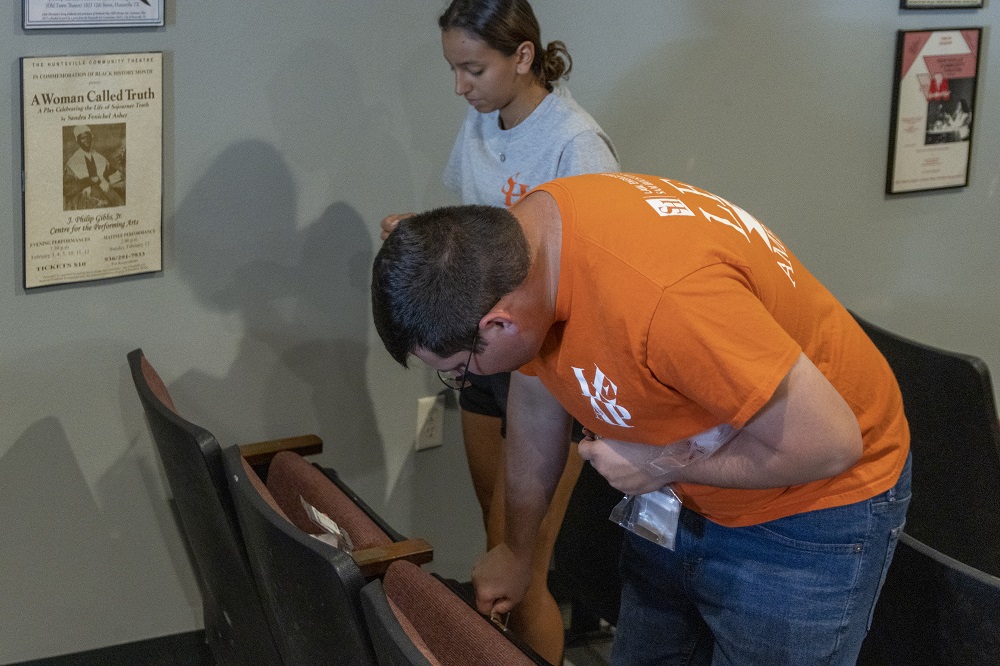
Fresh off volunteering at the Wynne Home Arts and Visitor Center, we also wanted to help out in the downtown area. So, with rivet-gun in hand, we headed to the Old Town Theatre to do some light cleaning and affix numerals to the Theatre’s chairs.
The theatre is the only vintage venue in Huntsville, and it is the community’s finest example of Art Deco architecture–while also featuring the art work of world-renowned muralist Richard Haas.
And while it may be an local architectural treasure and a work of art in itself, it also had a disordered numbering system on the seats, which makes ushering pretty difficult.
So, we set about correcting that. With only one rivet gun, we set up a system of three people helping: one advance man putting in the number plates and rivets, one riveter, and one person taking left-over parts….
While three were riveting, others were cleaning, and we took turns doing all the tasks, so that we’d all be cross-trained. Stephanie did her best Carol Burnett impression….
…Quinn tried to get a break from Yvette and Morgan, and Morgan even tried her hand at vacuum repair.
About three hours later, we had a mostly-clean theatre, seats with a correct numbering system, and more skilled volunteer force….
…and some ideas for some fall activities–all of this in time for our sold-out Gene Watson show!
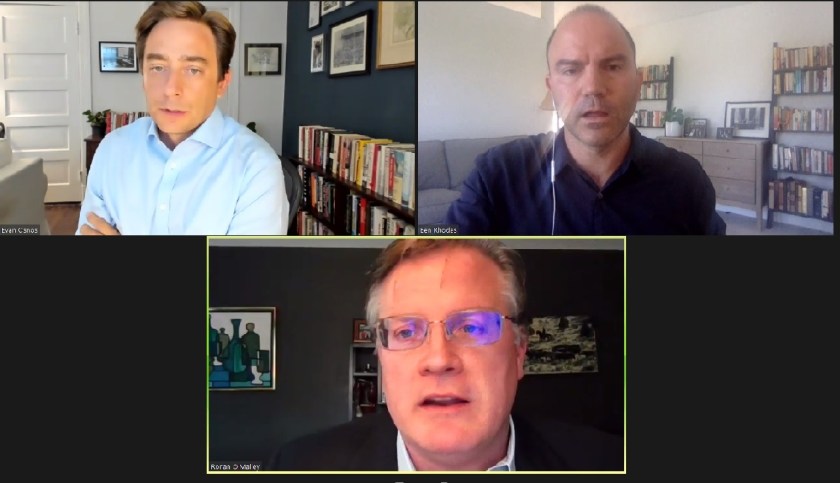
LEAP is always eager to hear from World Affairs Council speakers, and that is especially true when Ben Rhodes presents to the Council. Rhodes, a former speechwriter and advisor to President Obama, discussed his latest book, After the Fall: Being American in the World We’ve Made, with the New Yorker’s Evan Osnos as the moderator.
Following eight years of working long hours for the Obama administration, Rhodes found himself with a lot of time on his hands, a need for decompression, and wrestling with the Presidency of Donald Trump. So, he decided to write a book and, as he says, announce himself as a writer to the world.
What struck Rhodes, as he reflected and traveled and reflected some more, is how parts of the world were “turning to nationalism and authoritarianism,” particularly Hungary, Russia, China, and the United States. Key to this period, according to Rhodes, was the great recession of 2008, which is “when the narrative of liberalism and democracy collapsed.” With this narrative, Osnos readily and frequently agreed.
Rhodes is, at times, a bit morose, identifying this period as “the fall” to which the title alludes. This fall emboldened China and Russia, freeing them to mock capitalism and democracy, and emboldening nationalistic elements in Europe (particularly Hungary). He characterizes presidents from GHW Bush to Obama as “collectively wrong” and “hubristic,” while also criticizing the NBA, the media, and “the entire mass entertainment industry.” (see here for other views he’s expressed about the media).
Rhodes responded best during the Q&A period, during which Ronan O’Malley stepped in.
Rhodes argues that the China-Russia relationship is “shallow,” united by their “interest in the discrediting of democracy.”
When asked about the “personalization” of politics and regimes, Rhodes suggests that the rise of social media contributes to this movement, while also noting that the election of Biden was a countermovement to this trend.
Rhodes struggled to find silver linings. “There is one megatrend in the world,” he lamented, “and it’s not good.” But he argues, not entirely convincingly, that the “mass mobilization” in the world is happening and good; that people “are much more aware” (polls indicate otherwise); and there are civil rights in certain world regions than there were 30 years ago. It’s not a lot to hang on to, but it’s what we can look to, he says, “after the fall.”
On Saturday, June 27, the LEAP Ambassadors drove in from most parts of Texas to help out our adopted community of Huntsville. One of us drove from San Antonio, one drove from Tyler, one drove from Houston. Our destination was the Wynne Home, for an afternoon of painting and cleaning.
To build some energy, we stopped by the friendly and local confines of Mr. Hamburger, where some of had our first taste of this local favorite. We enjoyed the burgers and shakes!
Apart from exploring local culinary options, our mission today was to help out at the Wynne Home. The Wynne Home has a staff of 2.5 employees, and is, therefore, heavily reliant on volunteers. And in this regard, the Wynne Home is a hub of sorts in the community. The Texas Thyme Unit of the Herb Society of America assists the Wynne Home with its Ella Ruth Herb and Children’s Sensory gardens, the Friends of the Wynne support the arts at the Wynne Home (and in the community), and numerous citizens volunteer their time to serve on the Wynne Homes committees. So, it was an honor to help out by doing some touch-up painting in the children’s garden and some basic cleaning.
The Children’s Sensory Garden has a number of plants, and students are invited to touch, smell, taste, and even hear the plants and each of those sensory sections.
Among those plants are stones for hopscotch, and these were a little worse for the wear.
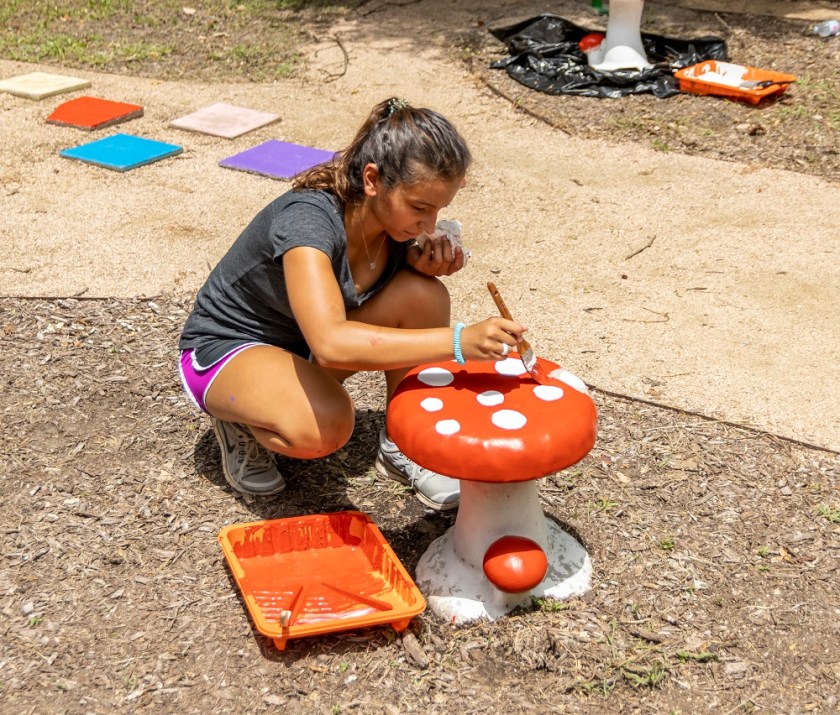
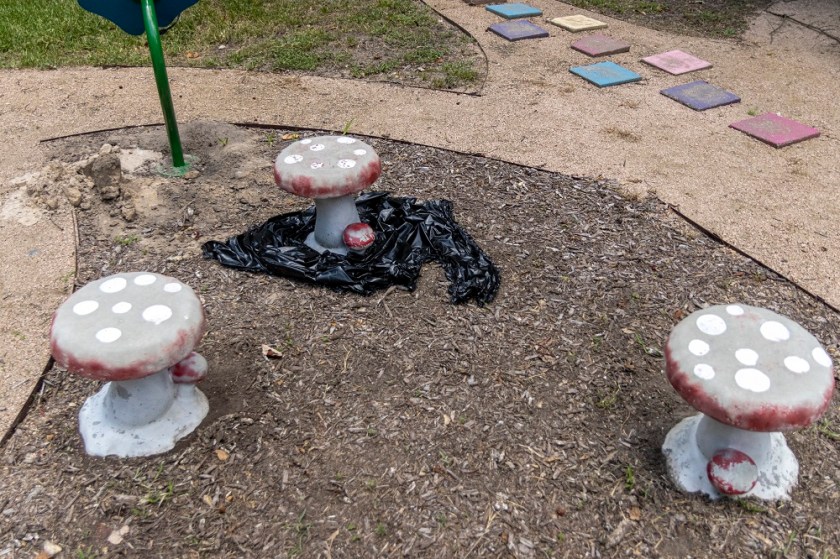
Concrete mushrooms also grow throughout the garden, and these, too, had seen better days.
With improvement in mind, we tackled the easy ones first: the stones.
The colors chosen by the Wynne Home staff were vivid, and even with just the first coat of paint, the colors were popping.
Although the temperature was only 93, it seemed much warmer. We estimated the humidity to be approximately 4,000,000, and so an unexpected challenge was having our sweat drip into the paint and dilute the colors. Fortunately, the Ms. Sarah Faulkner kept us hydrated, and we continued to plug away.
We quickly learned who was in the best shape, and to protect reputations, we will not discuss this matter further. Although we would note that we had to help Professor Yawn up the Wynne Home stairs after about an hour…
One of the nice things about painting is that it provide some immediate gratification, as you see the designs take shape and the colors become more vivid.
Following the painting, we turned our attention to the Wynne Home sign up front, which had weathered snow, ice, heat, humidity, and high winds, just in the last six months!
After much scrubbing, we were happy with the new-ish look, and we at times felt we were in the clouds!
It was a wonderful day. The Wynne Home was beautiful prior to the touchups, and we felt we had a little role in beautifying it further!
After an introduction from WAC Director Maryanne Maldonado…
…the event began with Basmah Ghauri – the Director of International Programs for the World Affairs Council – moderating.
The discussion started off with an overview of the Syrian Civil War, and who the key players are in the fight for control.
According to Dr. Landis, a vast majority of people in Syria have been hoping for a change in leadership. The Ba’ath Party has held leadership for decades, and is the political party of the current president, Bashar Hafez al-Assad.
The Assad family has been ruling as dictators for nearly 40 years, and it has long been the objective of the Syrian population that dictatorships such as this one be brought to an end. One major reason for this has been the class disparity and major income gap. As wealth made its way into Syria, and the upper class began driving fancy cars when most people had no car at all, the class differences became all too clear.
Landis proceeded to point out some of the challenges facing Syria throughout its military, social, and economic struggles. One of these is the international sanctions placed on Syria by the United States. Landis noted that these have been devastating to the Syrian regime and has done more harm to its people than its leaders. These sanctions have also been extended to anyone who does business in or with Syria, and so their amount of trade partners have begun shrinking.
Another of these challenges is the substantial cost of rebuilding Syria. Landis explained that it would cost nearly $300 billion to restore Syria, however the GDP is currently $9 billion, and the government only has $1 billion set aside for rebuilding.
Dr. Landis then discussed Syria’s rocky relationship with the United States. Ms. Ghauri asked whether there would be any leniency due to COVID-19. Landis said that the European Union has asked as much, but the United States government has said no, which means the aforementioned sanctions will remain in place.
The U.S. also has a strained relationship with the Kurdish population of Syria, which it enlisted to help in the war against ISIS. Apparently, as soon as ISIS was defeated, President Trump withdrew American troops and ended the U.S.’ alliance with the Kurds in order to avoid conflict with Turkey (whose government views the Kurdish population as a violent and radical group). America had no intention of supporting the Kurds long-term. As Landis explained it, “You sometimes have to use deceit to get your way in war.”
In order to come to a peaceful resolution, the United States is requiring regime transitions, United Nations backed elections, and for the Iranian military to vacate Syria to prevent Russia from having a foothold in the Middle East.
The main takeaway from the conversation was that, while U.S. sanctions and economic deprival may prevent Syria from becoming a threat, it also hurts the people of Syria, those of the lower and middle class, and prevents the nation from being rebuilt and having structure and peace once again.
I appreciate Dr. Landis and Ms. Ghauri taking the time to discuss the situation in Syria. I definitely learned a great deal about a topic I knew very little about, which is something I find myself saying after most WAC events!
Thanks to the World Affairs Council, select LEAP students stayed engaged with international affairs–and the ever-present COVID-19–even as SHSU remains on remote-only learning. The WAC contiunes to host programs via webinar with already scheduled speakers and additional guests and Wednesday evening was no exception.
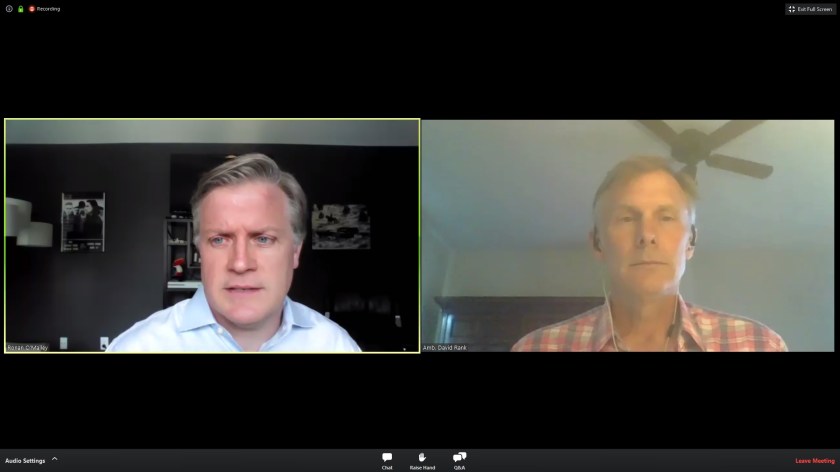
Ambassador Rank is the United States’ former acting Ambassador for China and served in the US Foreign Service from 1990-2017. After an introduction by WAC Executive Director Maryanne Maldonado, the event moderator, Ronan O’Malley, opened the webinar by prompting Ambassador Rank to provide some basic introductory information about China’s political and economic principles–before steering the conversation towards the elephant in the room, COVID-19.
With an economy second only to ours, China has had an increasing economic and political influence across the globe. However, there have been concerns with their current leadership, President Xi. Despite their unusual communist-capitalist hybrid system (Ronan called it an “oxymoron”), President Xi’s autocratic ruling has caused concern for the decreasing political freedoms and basic human rights of the Chinese citizens living in China.
Ambassador Rank indicated that he considers the outbreak a textbook Chinese scenario, with the initial confusion and coverup before transitioning into an astounding and complete shutdown. He also suggested that China has been willing to pump aid around the world following the outbreak as a way to step into a more powerful global leadership role. Despite a few missteps, Ambassador Rank gave credit to China for legitimately trying to get supplies where supplies are needed.
One of the key problems addressed by Ambassador Rank is the US’s (over) reliance on foreign sources (chiefly China) for emergency supplies. Might the US change its production or source of supplies? According to Rank, “I suspect that when it’s ‘all said and done,’ more will be said than done.”
To continue with the US quality of life, specialization and global supply chains will likely continue, although we can hope we will be prepared with greater supplies and sources for the next emergency.
O’Malley asked Rank about his assessment of the State Department and the difficulties they are having keeping career civil servants. Rank pointed out that, with the US withdrawing from many international organizations and treaties, civil servants have a very difficult job of maintaining relationships. “They didn’t sign up for that,” noted Rank, and the result has been a depleted staff, arguably at a time when that experience is most needed. As the US has voluntarily withdrawn from global leadership, Rank expects to see China step in to fill that vacuum.
In wrapping up the discussion, Ambassador Rank used the opportunity to remind everyone listening that the only way to fight misinformation is by caring about your sources. He then gave some advice for those considering a career in international relations or foreign service by encouraging students to not only learn a foreign language but learn its culture as well. Exposure to the people and the way they communicate is essential to being successful in a foreign nation.
As always, the LEAP Center thanks the World Affairs Council for its programs. LEAP Ambassadors Quinn Kobrin, Makayla Mason, and Maggie Denena would also like to thank future Bearkat Ethan Chang for participating in the event virtually, and they hope to be able to welcome him to SHSU in person once life returns to ‘normal.’
Dr. Christine Blackburne, the Assistant Director of the Scowcroft Institute’s Pandemic and Biosecurity Policy Program at the Bush School of Government Affairs and Public Service (whew!), conducts a weekly update on the COVID-19 virus, and those have proved informative to the LEAP Ambassadors, so we continue to tune in.
This week, she began the video with discussing masks, stating that masks are more designed to keep those who are infected from spreading it than protecting those who do not have it from becoming infected. She explained a few basic rules for using masks such as:
Masks need to be properly fitted.
When taking masks off, do not touch your mouth area, and immediately wash your hands.
Do NOT put masks on children under 2, anyone with breathing problems, or individuals who cannot remove the mask themselves.
Some people have been frustrated or confused by the changing policy on masks. Originally, only infected people were encouraged to wear masks. Now, everyone is encouraged to wear a mask. Why the change? Originally, the medical community had no idea there were so many asymptomatic carriers, and we wanted to ensure that sufficient masks existed for health care providers. Now we know that it’s very possible that 50 percent (or more) of the infected could be carriers without even knowing it, it’s important that as many as people as possible wear masks.
She then moved into answering the questions.
The first question asked if there were predictive models about the economic impact, if there are approaches for bringing people back to work, and if there are ways to “pandemic proof” the economy? The problem, she noted, is that without accurate information, we cannot make good comparisons of life and economics, and it will be difficult to get this information before 3-4 months of data.
Some people have called for allowing greater mobility, letting people catch it (especially if so many people are asymptomatic), and developing herd immunity. She points out, though, that we don’t know with accuracy what the reproductive number is (R nought). Some estimates have been in the 6 range, and this would mean that 82 percent of the people would need to be infected before herd immunity took effect.
The next question asked if the social distancing measures are just extending the curve, when do we decide to go to “Plan B,” and when do we decide it is not containable? Dr. Blackburne’s response was that social distancing measures do expand the amount of time, but this allows for medical resources to stay under capacity. If we “flatten the curve,” this will keep the number of people coming into the hospital under the capacity, and hospitals will not have to decide who lives and who dies due to lack of resources. If each wave can be kept under capacity, lives are being saved because the medical field can work. She believes that we are currently working “Plan B” and that if we start re-opening now, there will be a lot of unnecessary deaths. She thinks we are in a mitigation phase and no longer able to contain, but able to mitigate the impact caused.
The third question asked if there is proof that someone can develop antibodies and not get infected? Dr. Blackburne said yes, but with 14% of people testing positive a second time, it is unclear if they are being re-infected, or if it went dormant (it’s also possible they had a false positive and were never really infected).
There were a few questions about Texas specifically. Dr. Blackburne thinks Texas will play a big role in developing a vaccine. In regard to Texas’ peak, there are two different models, University of Washington and University of Texas at Austin, that show different peaks, both occurring before June.
Although, many scientists believe there will be a second wave in the fall…




































 Center for Law, Engagement, and Politics