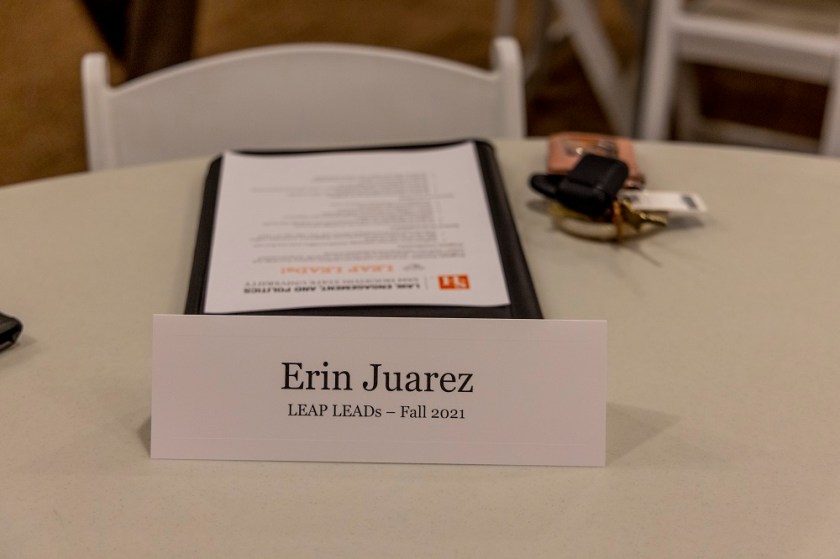
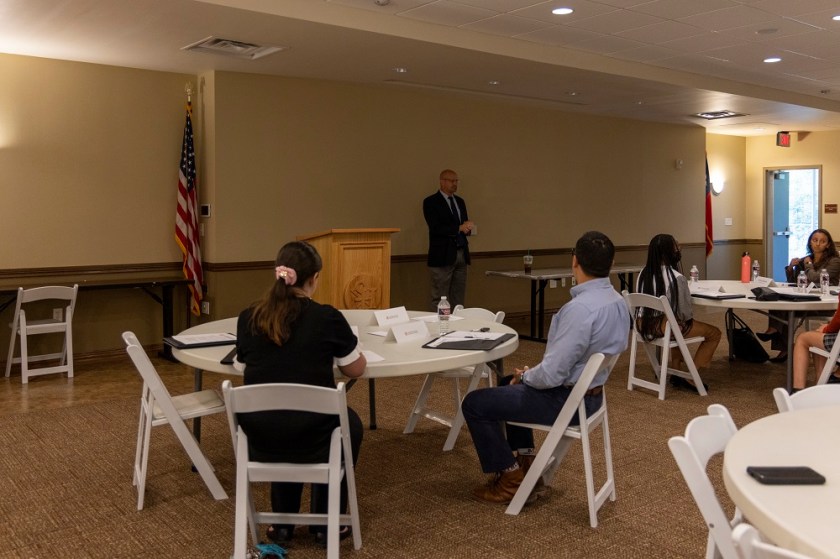
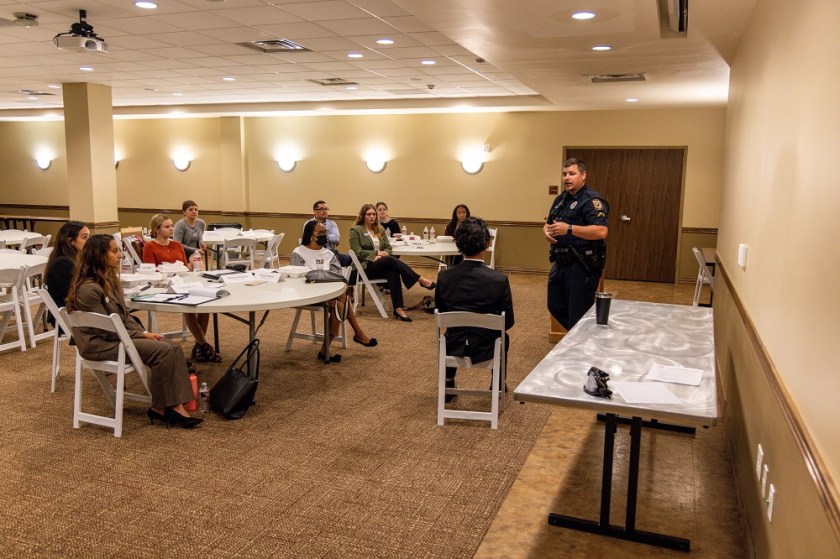
The newly selected LEAP LEADs group had their first meeting of the semester at the Sam Houston Walker Education Center. LEAP LEADs is a program designed to help connect students with the community and to assist in developing our professional and social skills through engagement in diverse opportunities.
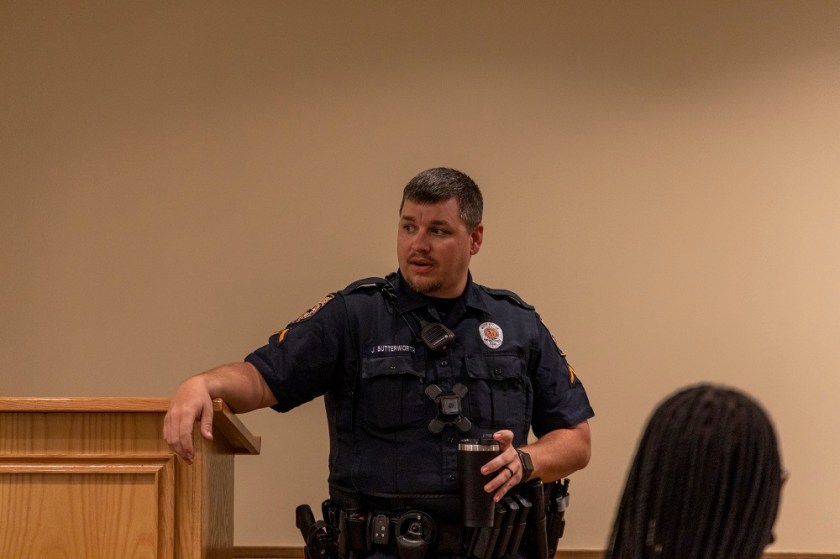
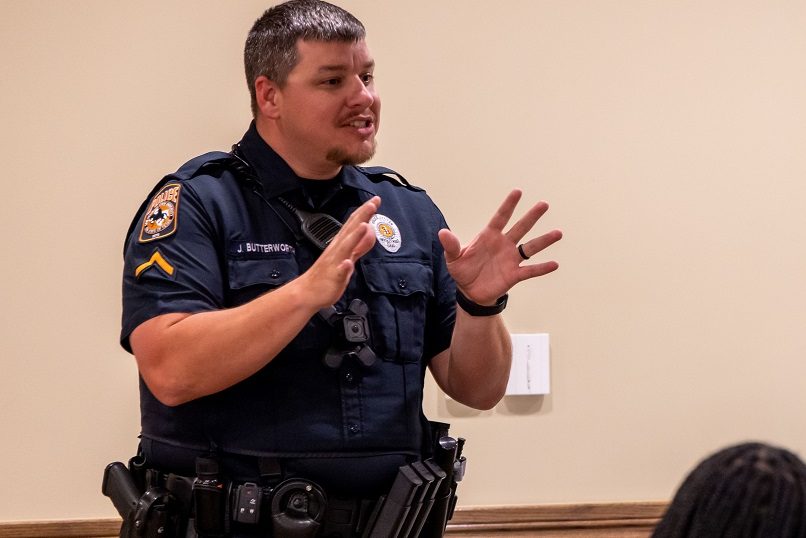
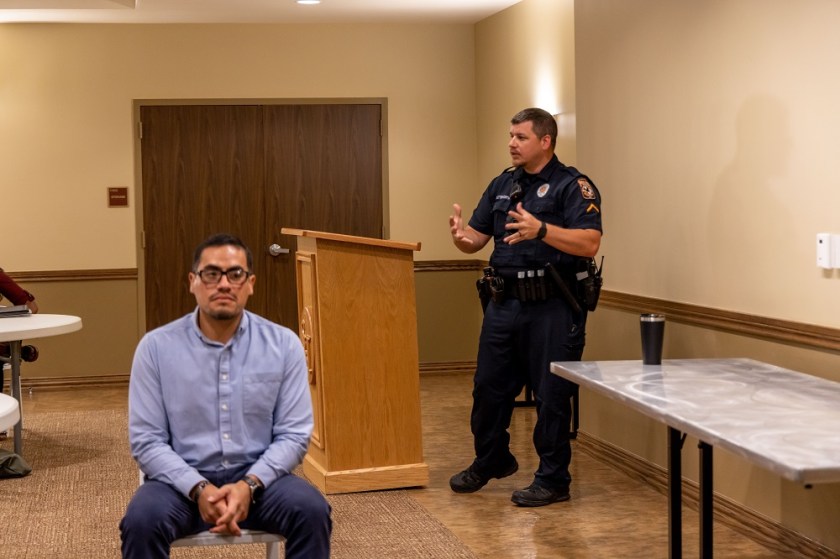
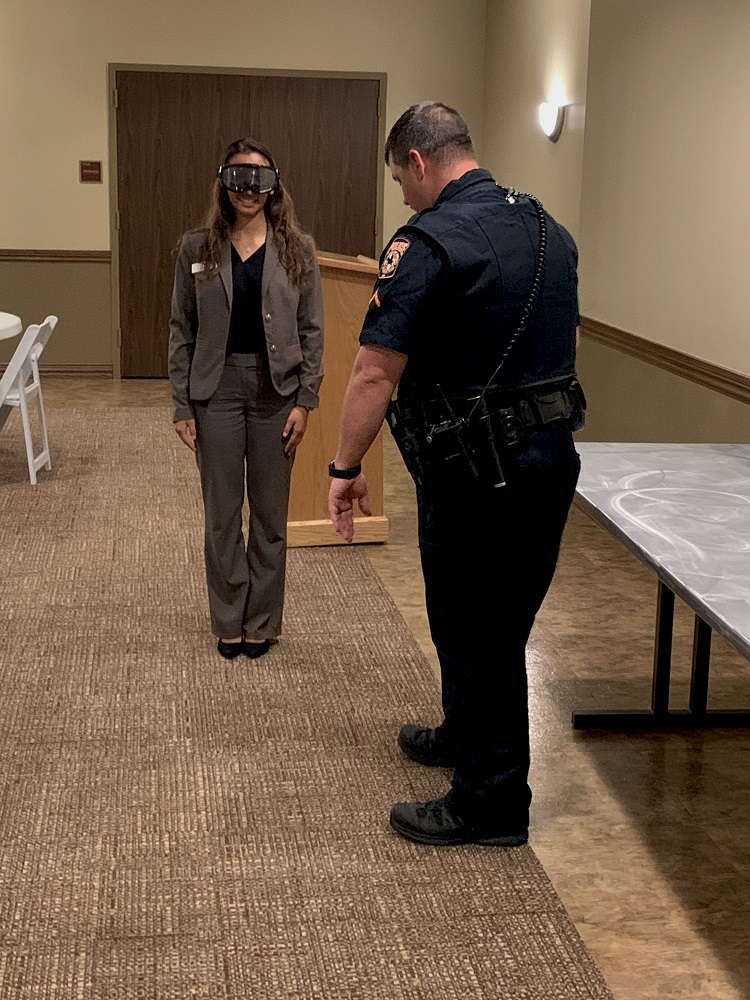
…who gave us advice on how to interact with an officer through a couple of different simulations, where students volunteered.
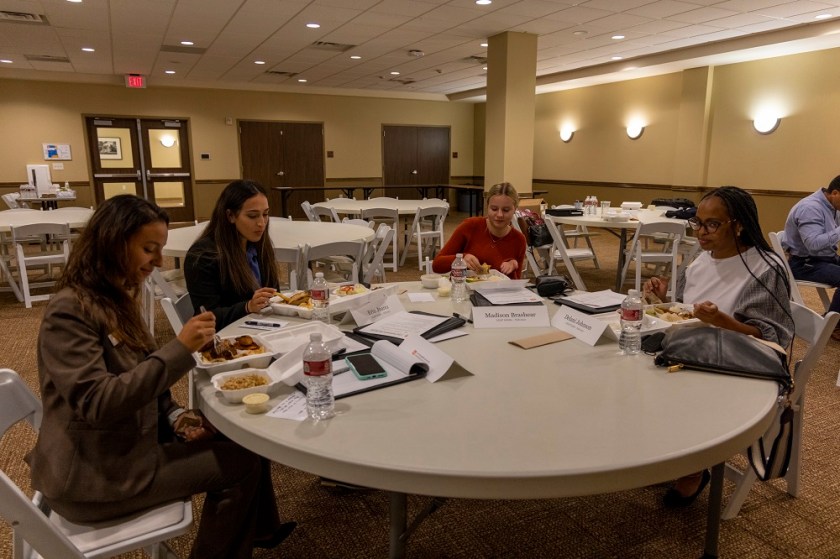
Before Officer Butterworth arrived, each one of us introduced ourselves to the group and shared what we hope to get out of this program. In LEAP, we are always open to new experiences, whether it may be trying new foods or restaurants, and cultures through art, music, etc.–which ties in perfectly with dinner that evening since we had a Salvadorian Cuisine from El Carbonero. The plates varied from chicken, beef tacos, plantains, rice, charro beans, Cajun pasta, pupusas, and cheese enchiladas. It was a delightful cuisine and potentially a first timer for many of us.
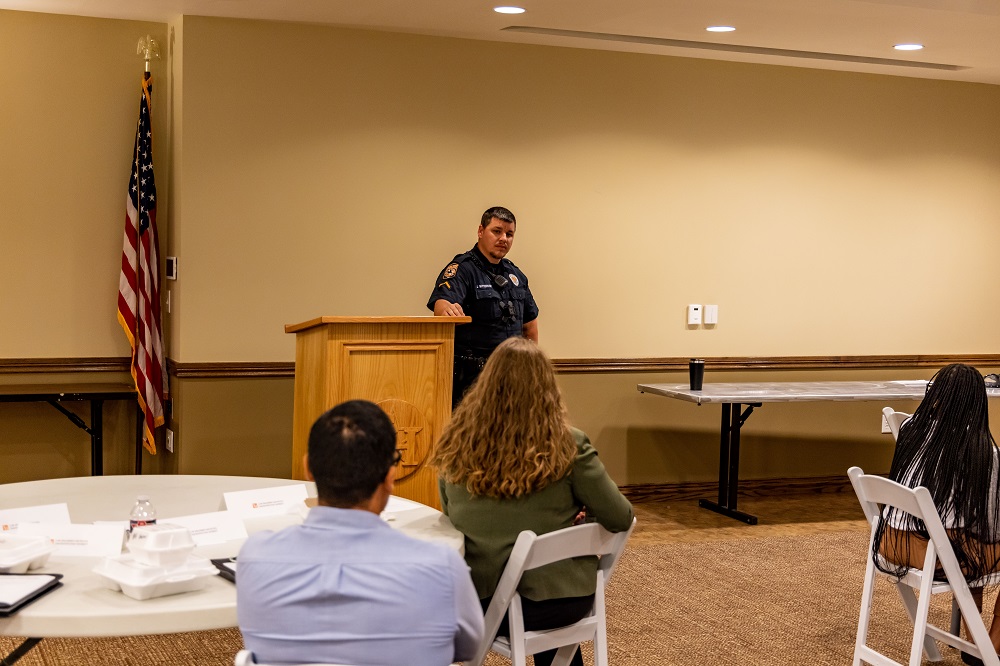
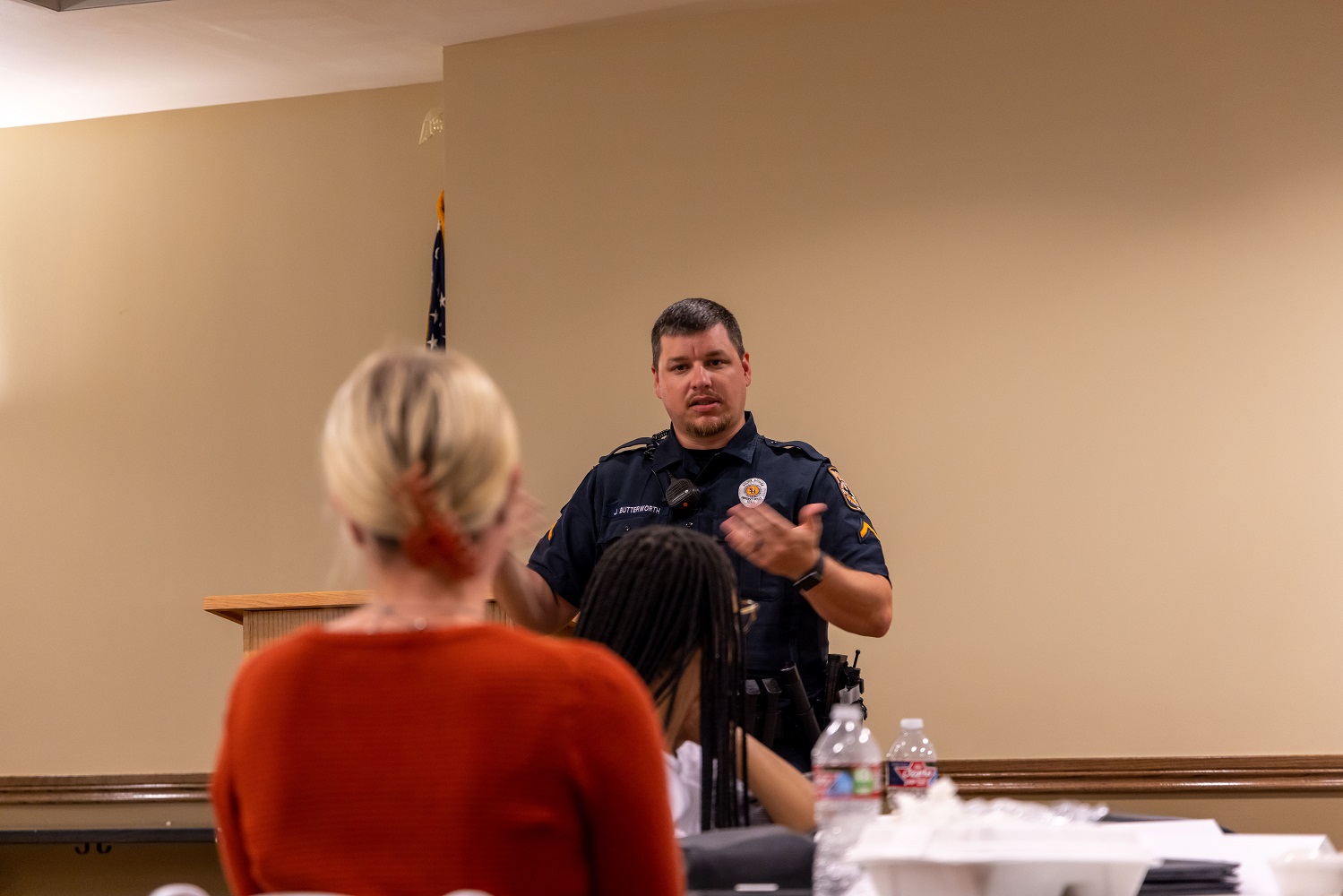
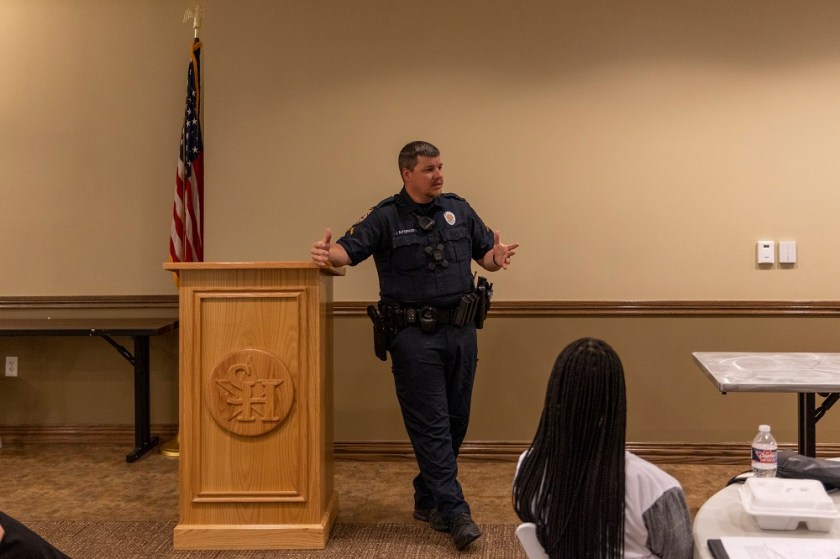
Upon Officer Butterworth’s arrival, Professor Yawn…
…passed the baton to him to help us answer and inform us more about the law enforcement agencies in Huntsville. As a collective group, we were able to name a few such as UPD, HPD, Parks & Wildlife (state & federal in Huntsville), Sheriff and Deputies, Constables, and TDCJ – Prison Patrol. Office Butterworth then filled in the rest of the existing law enforcement agencies in Huntsville which include the Walker County Environmental cop (in charge of sewage, littering, etc.), the District Attorney and investigators, Texas Ranger (one left in Huntsville), Child Protection Services, and Fire Marshalls. Officer Butterworth, an alumni from Sam Houston State University, has been a cop in Huntsville since 2012 and has been involved with LEAP for over five to six years now.
The main topics that Officer Butterworth discussed with us were public intoxication, driving under the influence, minor possession-contribution, and noise complaints.
These happen to be the most common issues that the UPD deals with when it comes to college students. When educating us about what it means to be a minor in possession, such a charge may involve a student simply guarding or holding a cup for a friend while they go to the restroom. For the other topics he had students volunteer in a scenario where a student has been pulled over.
For this scenario, Mario Ocampo volunteered and answered questions such as what you would do if a police officer turned on their lights? Where would you pull over? What to do while you wait for the officer to approach you? And such.
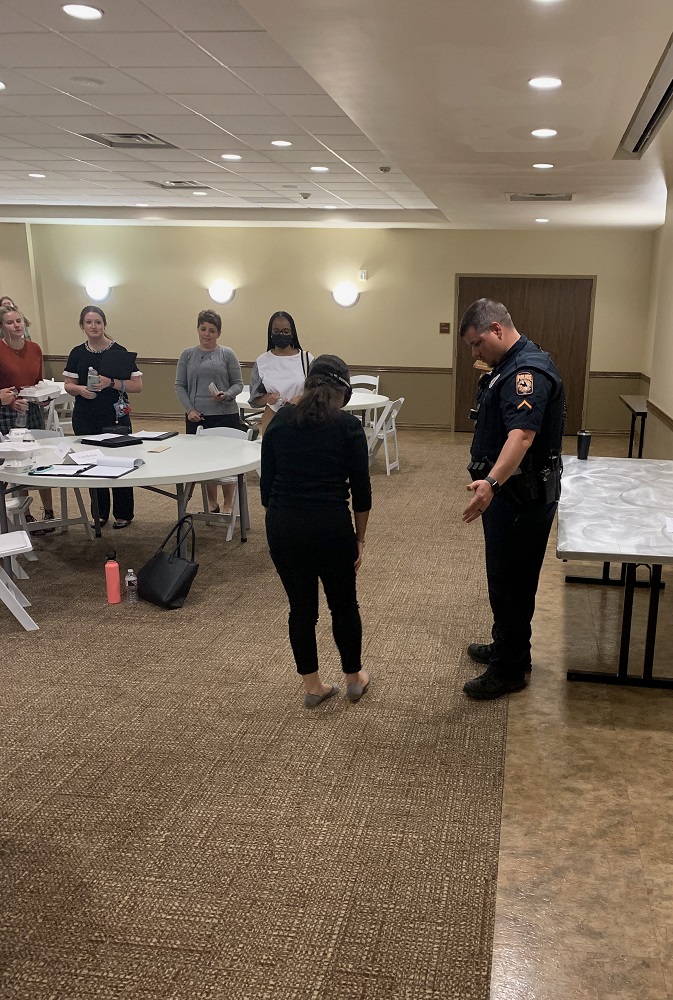
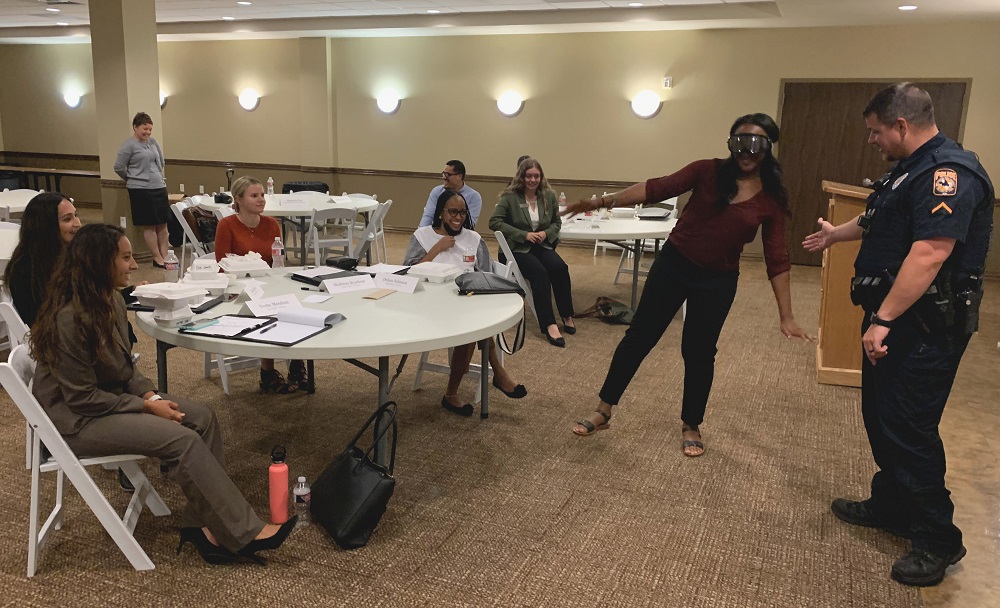
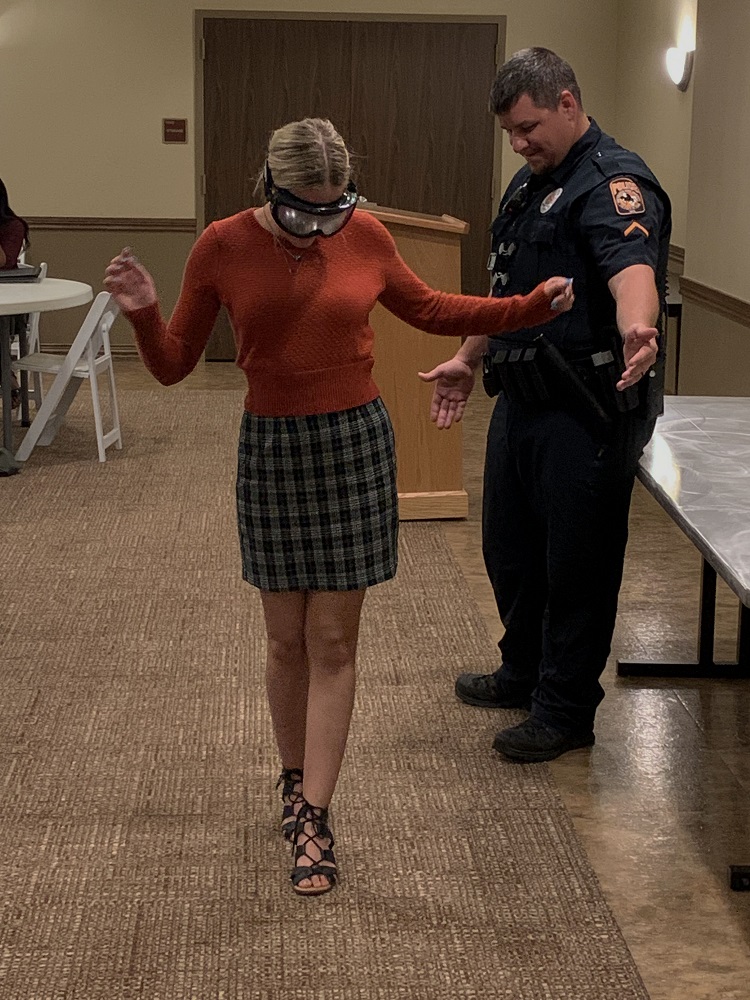
Another scenario that he presented to us were different types of field sobriety tests, such as the heel to toe walk and keeping one leg above the ground. Two of the LEAP Leads members, Madison Brashear, and Yvette Mendoza, volunteered to do a mock field sobriety test. Now, you would think that it was to be easily done except they did all of this with a twist, they had “beer goggles” on!
Meanwhile they volunteered to do the field sobriety tests, the rest of us watched and got to witness what Officers see when they pull over someone who is intoxicated, and it was amusing to see!
On behalf of LEAP LEADs I would like to thank Officer Butterworth for coming to speak to us and doing so in an interactive way through Q&As and “simulations.” We learned a lot about police interactions and their way of thinking as they approach a situation as I am sure Officer Butterworth learned from us about the student’s point of view. Thank you to Officer Butterworth for keeping our campus and community safe!
On the evening of 9/11, the LEAP Ambassadors and Jocelyn Vazquez volunteered at the Old Town Theatre, where Marty Haggard–son of Merle Haggard– where an appreciative crowd enjoyed the show.
To our delightful surprise, there was an opening act by rising country singer Stephen Sweeten. While he sang and his guitarist strummed, his wife and son were selling his merchandise and recording his performance. Unfortunately, since we were either ushering guests to their seats, selling raffle tickets, or taking photographs, we were unable to sit in for the show but given that the theatre has excellent acoustics, we were able to hear him. We even had a chance to work with his son to take a few photos of Sweeten.
The audience enjoyed the music, as did we, as Sweeten played a mix of covers and originals.
When Sweeten’s set ended, we announced the winners of the raffle…
…which made a few audience members happy. They have tickets to see Moe Bandy on December 3 (buy tickets here!)
If ever there was a down-to-earth performer, Marty Haggard is that performer. He remained seated throughout the show, after telling he was a singer, not an “actor.”
Sitting or standing, however, he was a hit, performing the hits of his father, whom he described as “the greatest country music singer-songwriter in history.”
He did the songs justice, and he resembles a thinner version of his father.
As the event was wrapping up and the Old Town Theatre was getting ready to close, we stood by the doors and thanked the guests for coming while providing them with a calendar of upcoming events.
The crowd, however, was more interested in spending time with Mr. Haggard.
And that included us:
It was a good night, with strong performances all around.
By the way, the Old Town Theatre’s next event is on September 25th at 7:00pm, featuring a Frank Sinatra tribute. Purchase your tickets today and do not miss the Sinatra experience!
On behalf of the LEAP Center, I would like to thank the friends of the Old Town Theatre for giving us the opportunity to help in our community!
Although our volunteerism was complete, our night wasn’t. We moved on over to the wonderful Sam’s Table, where we had dinner and desert. We had eaten here previously, and it has great ambience and food, so we were eager to return.
The event was close to Yvette’s 19th Birthday, so we celebrated that, too, with pie…
…and cake.
After a nice night of volunteerism and eating, we left as happy as Yvette looked!
Students from various LEAP programs got together with KSAM’s News Director, Larry Crippen, to discuss their fall activities. In this manner, Candace Simpson (LEAP LEADs), Hayley Matthews (City Fellows), and Yvette Mendoza (LEAP Ambassadors, LEAP LEADs) came together to discuss classes, internships, programs, speakers, and volunteerism.
Students, of course, are best situated to discuss LEAP’s activities, but this process is also great practice for communicated clearly and concisely–necessary approaches for a radio interview. And, in this regard, each student got their turn, although at least one was outright suspicious.
But they got over their jitters and did a fine job. Hayley Matthews discussed her internship at the Huntsville Public Library–as well as some of the other internship opportunities.
Yvette Mendoza discussed the LEAP Ambassador’s trip to Nashville, TN this summer…
And the ever-suspicious Candace Simpson discussed…
…our first LEAP LEADs program, as well as upcoming events (HPD tour, anyone?).
It was a great way to get the word out about fall activities, bring together multiple programs with a common cause, and teach students the world of ratio communication.
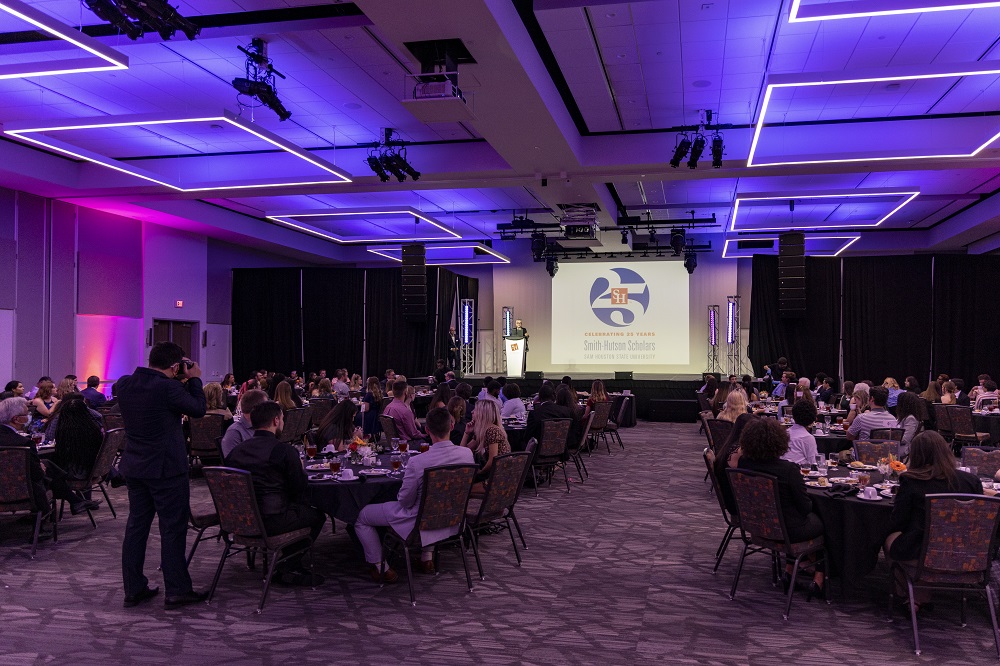
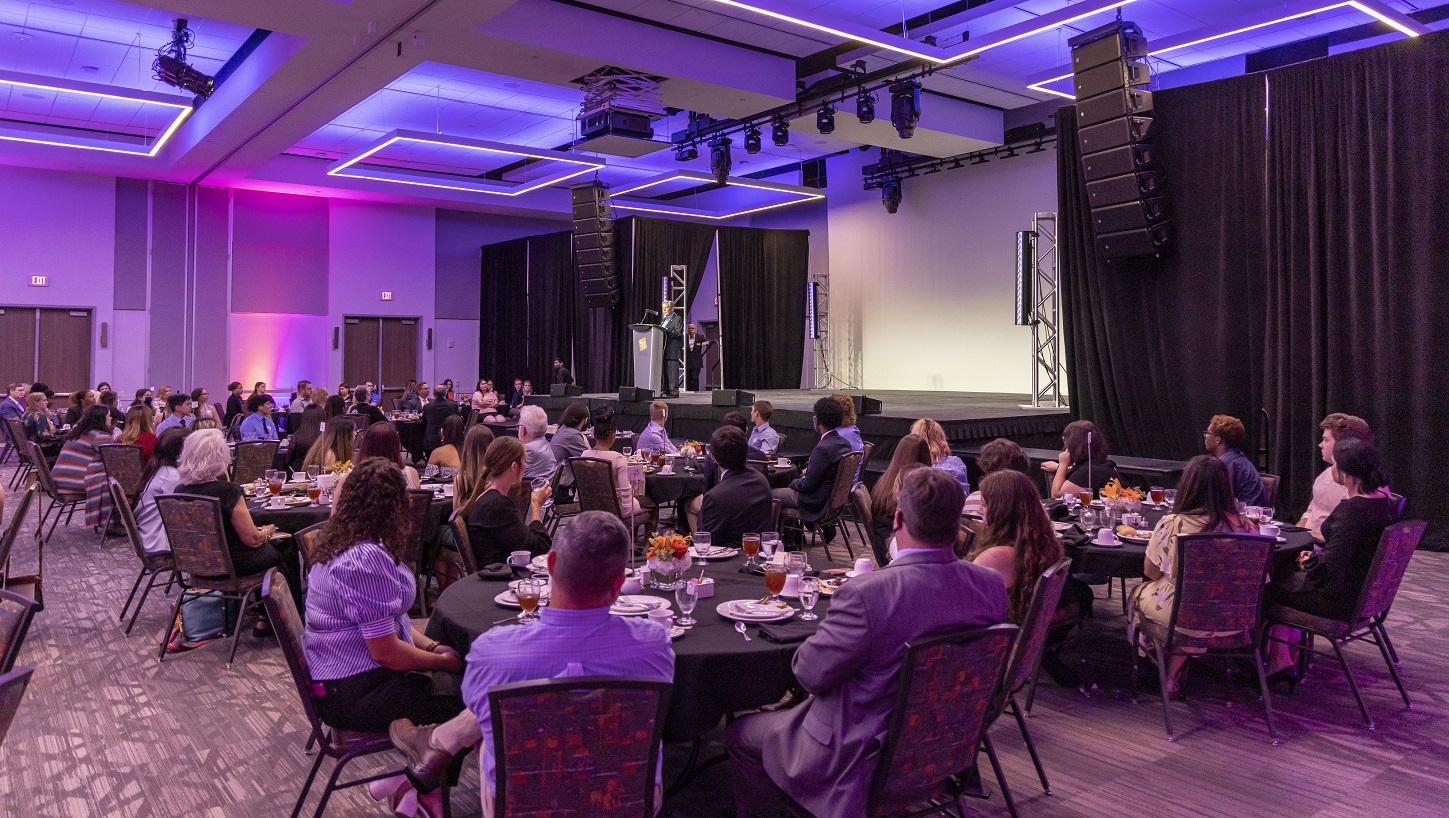
One of the happy aspects of SHSU more or less fully reopening is the return to get-togethers that help build camaraderie and provide great information to faculty, staff, and students alike. And this perfectly reflects the spirit of the annual Smith Hutson gala.
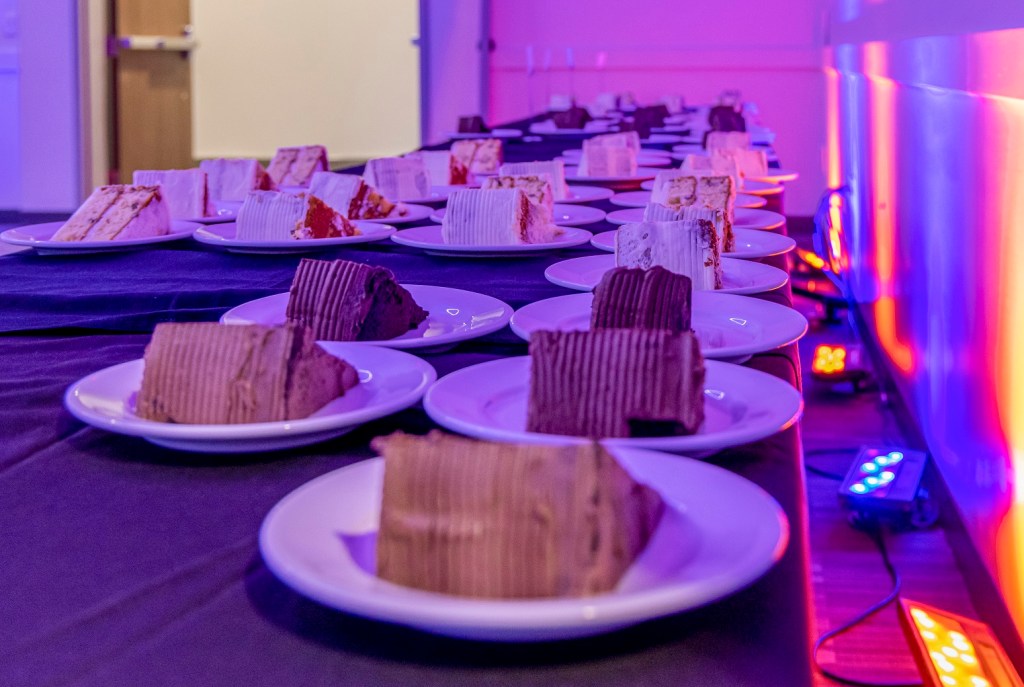
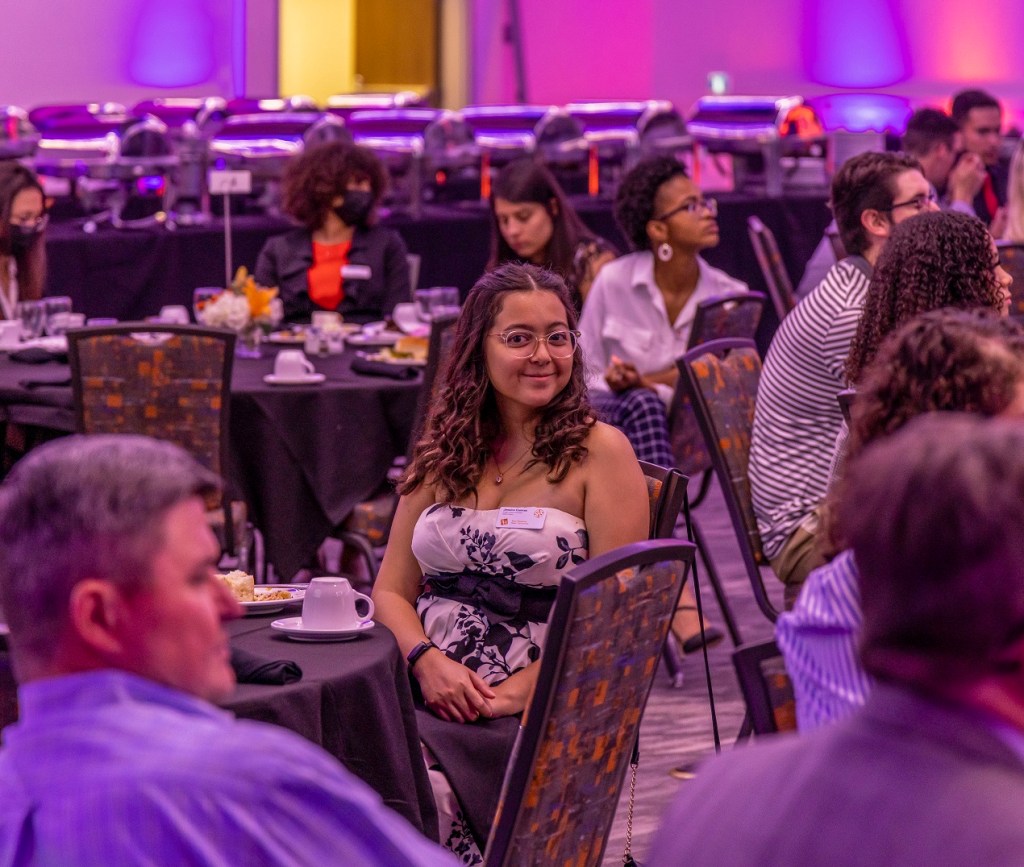
In addition to the great food offered by Smith-Hutson…
…students (and faculty and staff) learn much about the Smith-Hutson Scholarship program. Endowed by an anonymous donor, facilitated by the Hutson family, and administered at SHSU by Chris Garcia, the Smith Hutson scholarship program serves more than 100 SHSU students.
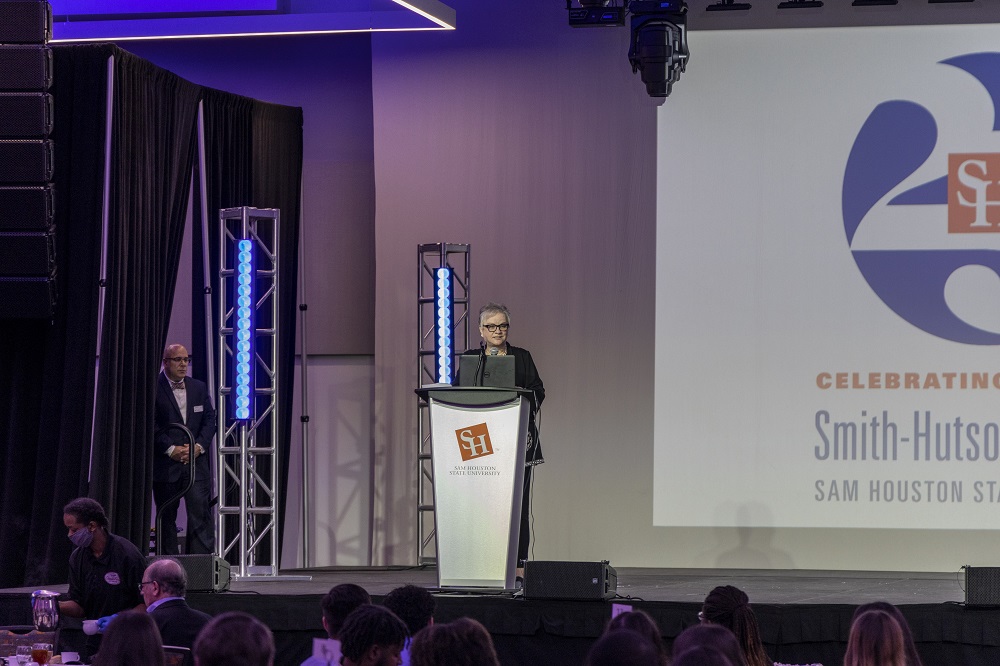
Garcia kicked off the evening, but was soon joined by President White at the podium, who shared her gratitude for the donors, while also encouraging the Smith-Hutson scholars to continue to excel.
Balancing empathy and inspiration, President White spoke skillfully, highlighting her background in communications.
Following a fine meal, Mr. Hutson spoke, going into detail about the program. I learned, for example, that the Smith-Hutson scholarship was no distributed to Lamar University, Lamar Tech, Stephen F. Austin, and Angelina College–although Mr. Hutson stressed that SHSU remains the “home of the program.” Moreover, Mr. Hutson also mentioned that while the state averages a four-year graduation rate of 38 percent, Smith-Hutson scholars average 78 percent!
A representative from Capital Bank then provided students with useful information about careers in banking–careers that not only involve finance, but also marketing, legal, and human resources.
Mr. Garcia opened the floor to Monica Rodriguez, who attended SHSU in the early 2000s. She described, at times in depth, her time at SHSU and her subsequent career.
The President of the Smith-Hutson Scholars’ executive council, Amanda Rincon-Morales, also spoke, expressing her gratitude for the scholarship and encouraging her peers in the program to give back to the program that provides so much to them.
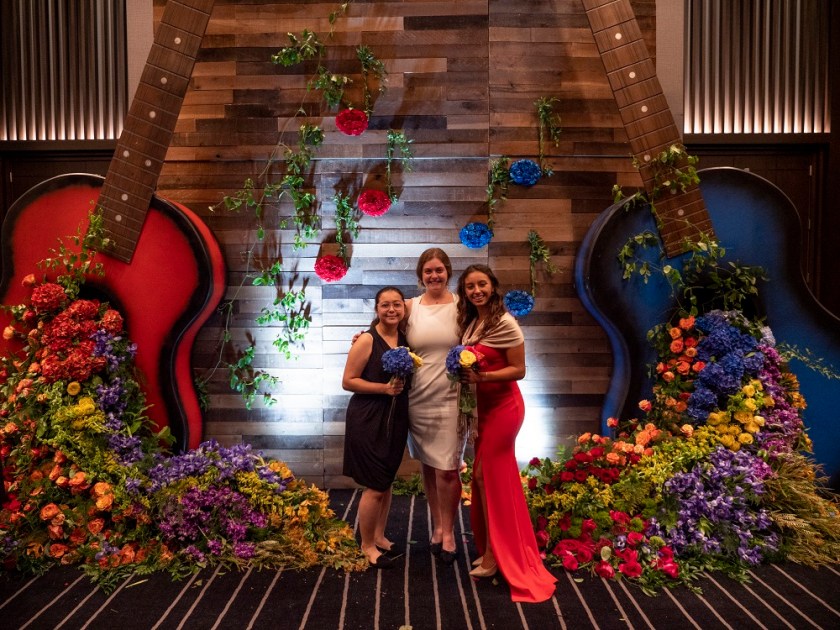
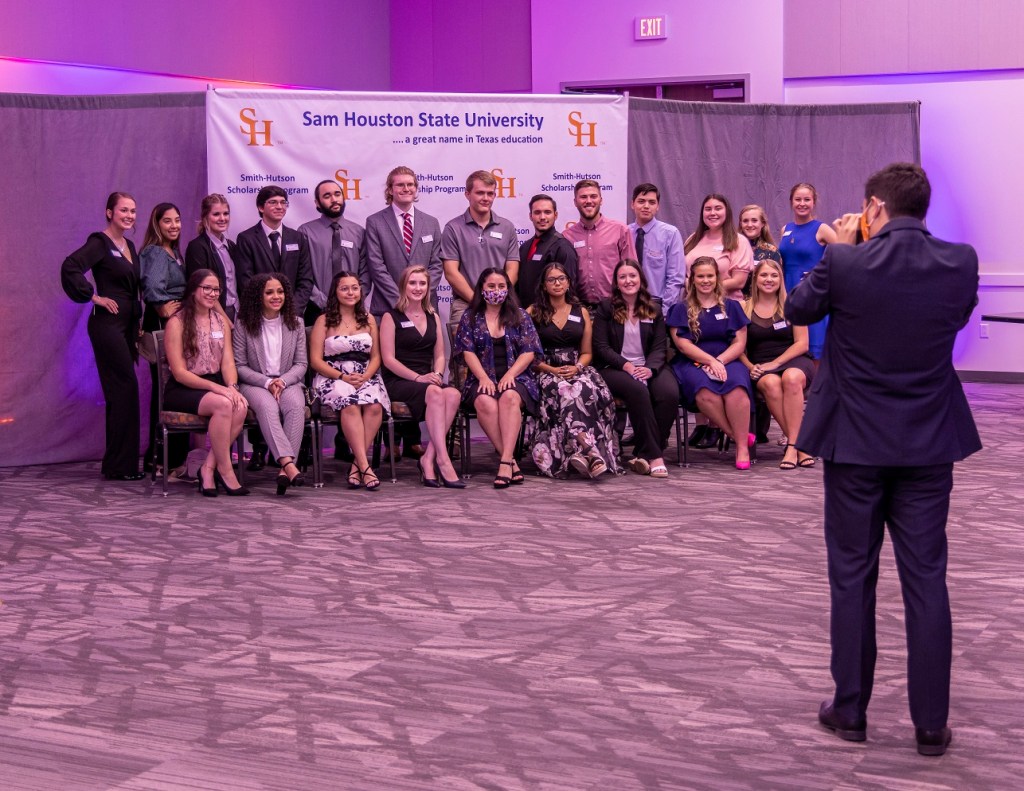
Following the program–which was attended by a majority of the Deans, as well as the President Provost–Smith-Hutson scholars gathered for some photographs.
And with that, a pleasant and informative night was over, as more than 100 Smith-Hutson scholars resumed their path to excellence at SHSU.
One Smith-Hutson scholar serves as a LEAP Ambassador; one Smith-Hutson scholar serves as a member of LEAP LEADs; and one of the LEAP Staff members serves on the Smith-Hutson faculty-staff council.
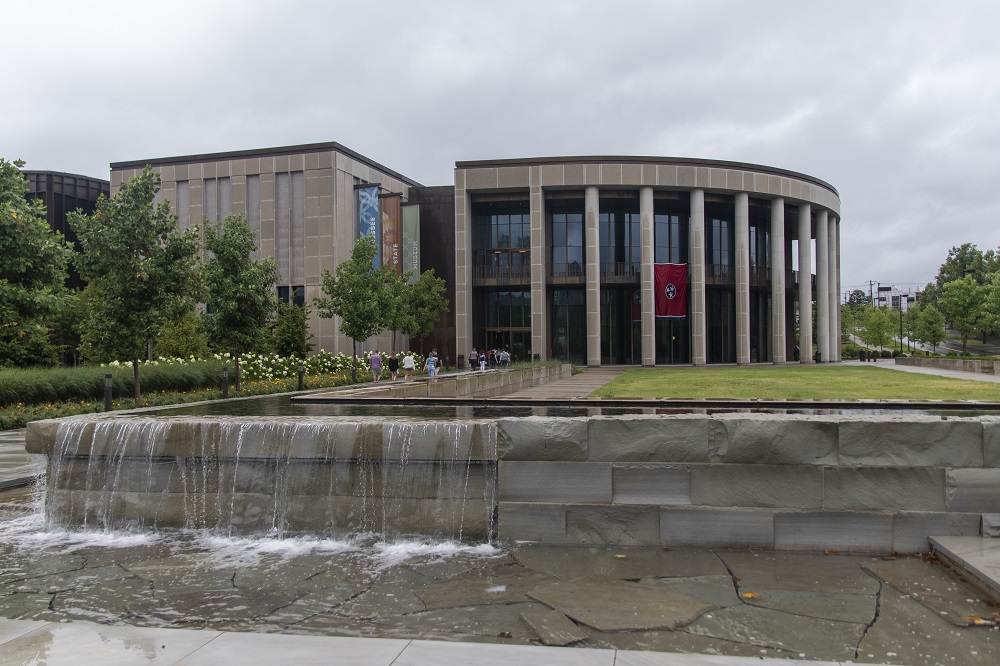
Once again, waking up to a rainy morning, the LEAP Ambassadors made their way to join the next bus of SLC attendees headed towards the TN State Museum and the local Farmers market.
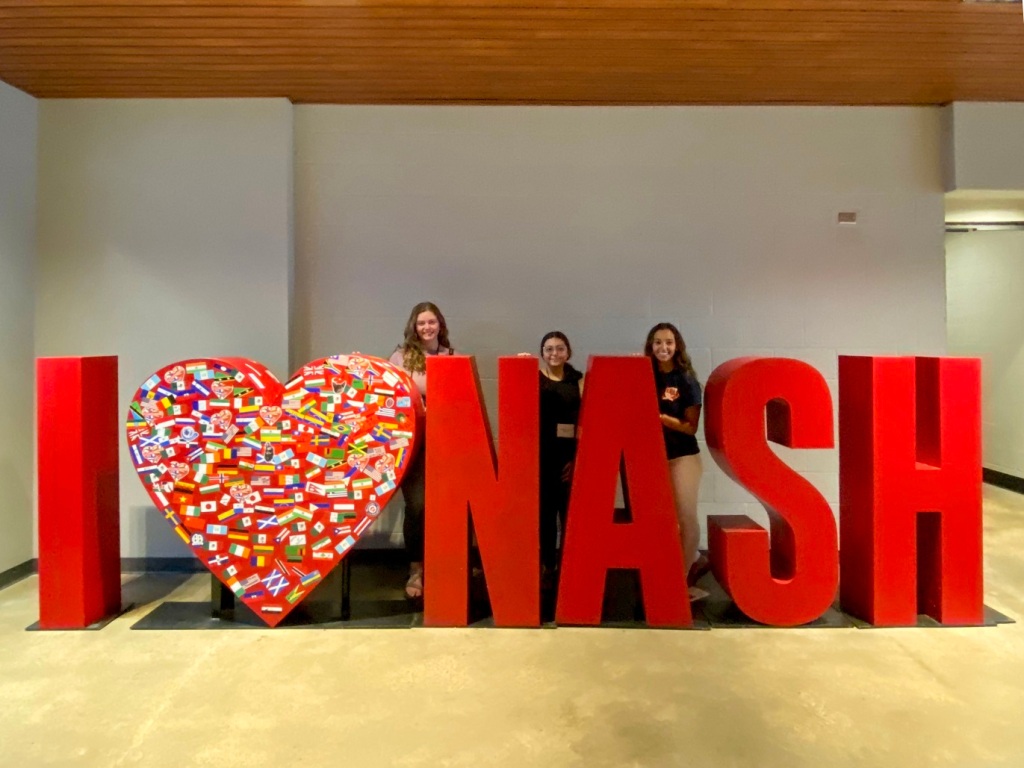
The Nashville farmers market brings aspects of a traditional market setting and scenes of trendy modern aspects. Greeted by the “I heart NASH” sign, we took advantage of the photo-op and posed with our first Nashville sign.
The first room we entered resembled a food court type area full of enticing smells.
Almost magnetically drawn to the nearest coffee vendor, we begin to look over the menu of Farm City Coffee. As opposed to a traditional coffee house, the coffees and blends seemed to represent local and floral flavors. Yvette got some bubble tea.
The coffee and tea were nice additions to the afternoon as we continued to explore around the rest of the market.
The Exterior market resembled a more traditional look, with a pitched tent covering the different tables adorned with homegrown and homemade goods, it was difficult to not stop and smell or gaze at everything. Booths ranging from veggies, to handcrafted jewelry, candles, soaps, and pottery; there were choices for everyone.
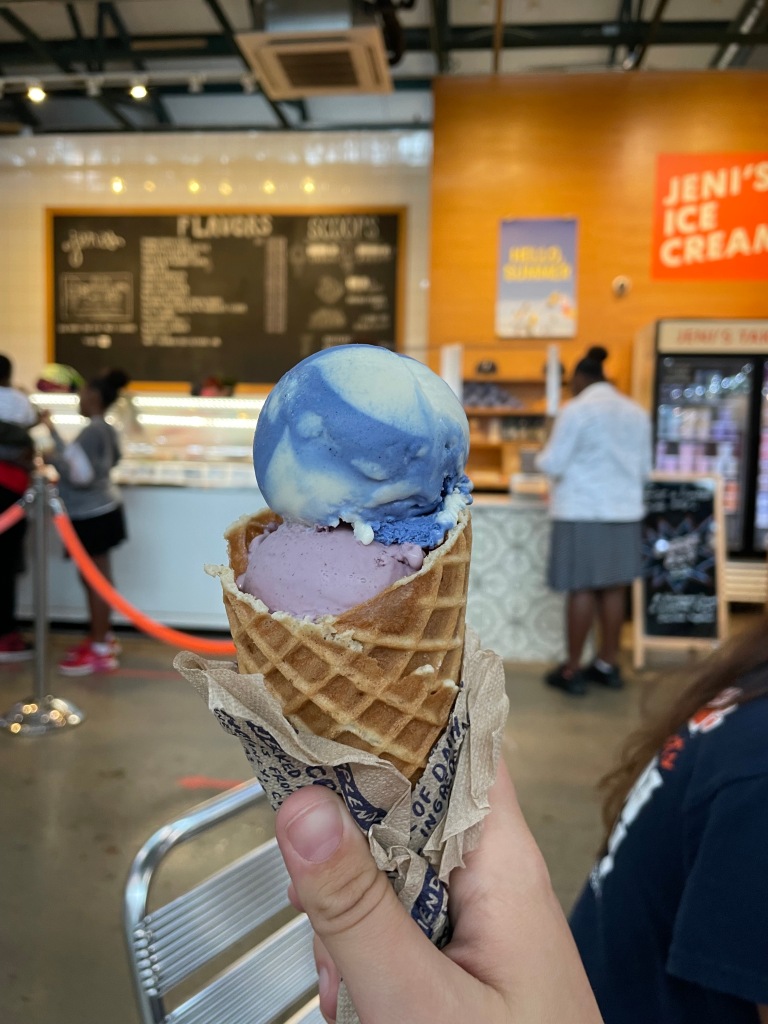
Rounding out of adventure, we stopped at a local ice cream joint, Jeni’s, for a sweet treat. Again the flavors seemed to represent the local feel and personality of Nashville. The homemade waffle cones became a favorite at the table, which surprised members who usually prefer cups to cones. Our flavor choices ranged from brambleberry, rocketpop (blueberry and pineapple), wild lavender, salted caramel, and peanut butter.
Pressed for time, we absorbed all that we could and made our way back, leaving the farmers market with light and fresh spirits.
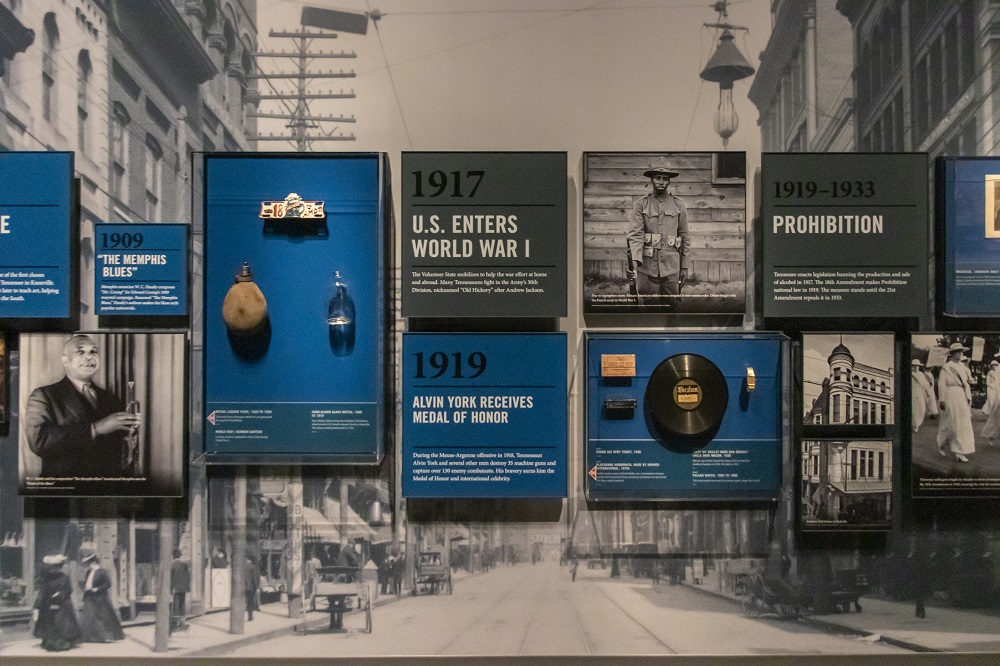
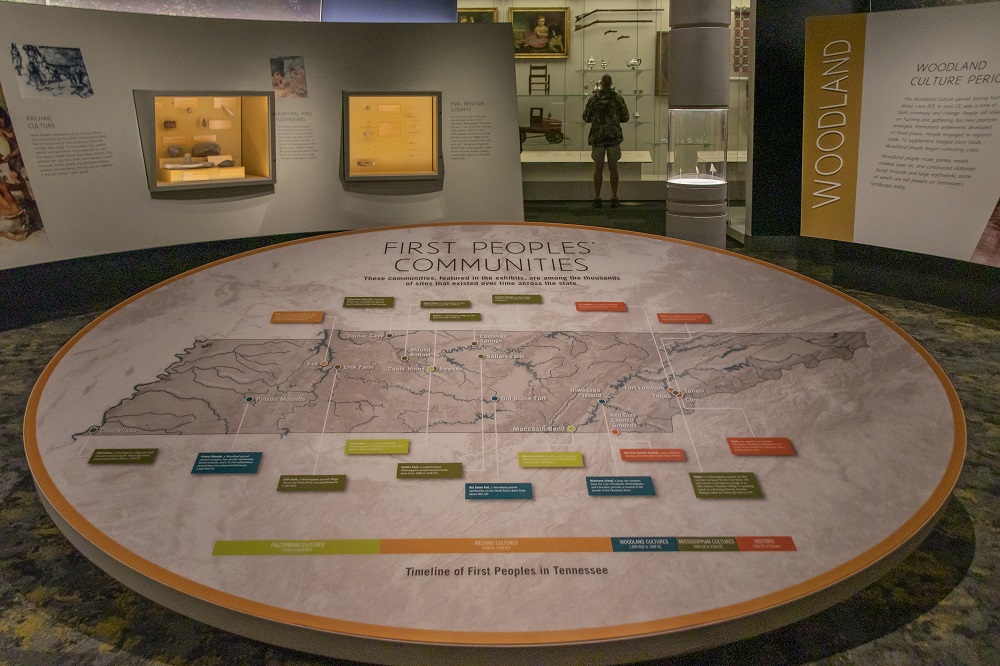
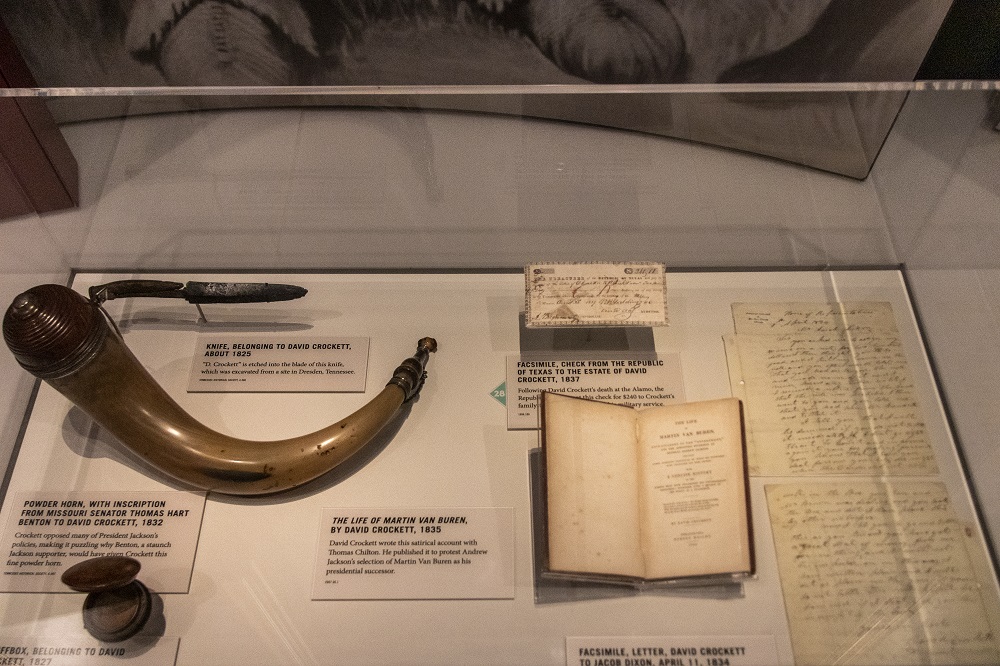
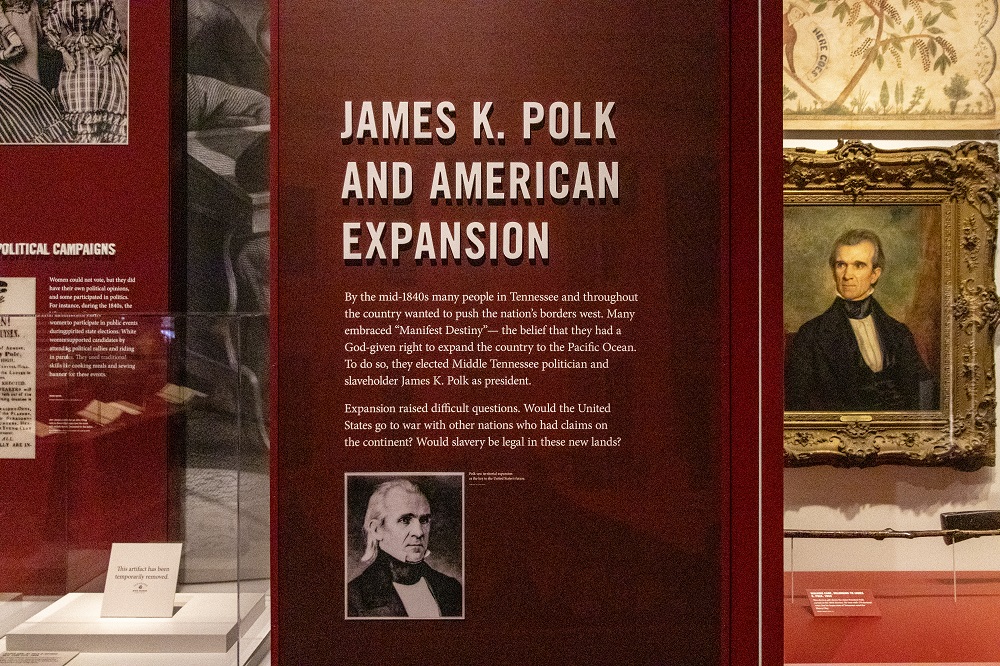
Of course, we also spent some time at the state historical museum, which was nice because we had all visited the Bullock Museum in Texas, giving us a limited chance to compare the venues.
TN has a rich history, much like Texas. In fact, many of those histories overlap. We were provided an overview of TN history….
…that ranged from the first people in TN…
…to the modern day. Along the way, of course, we learned about pioneers…
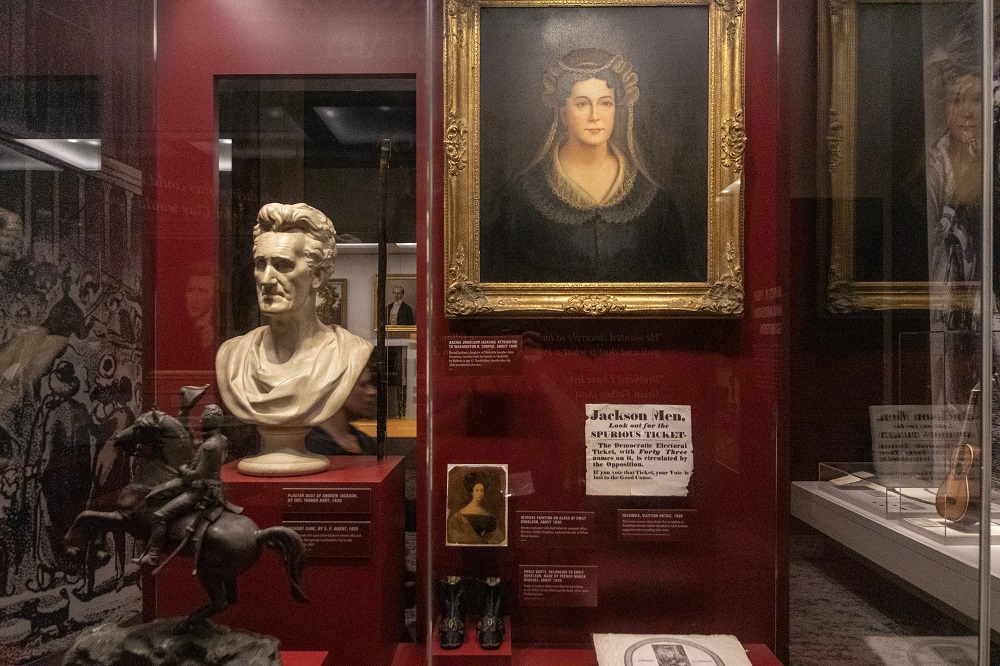
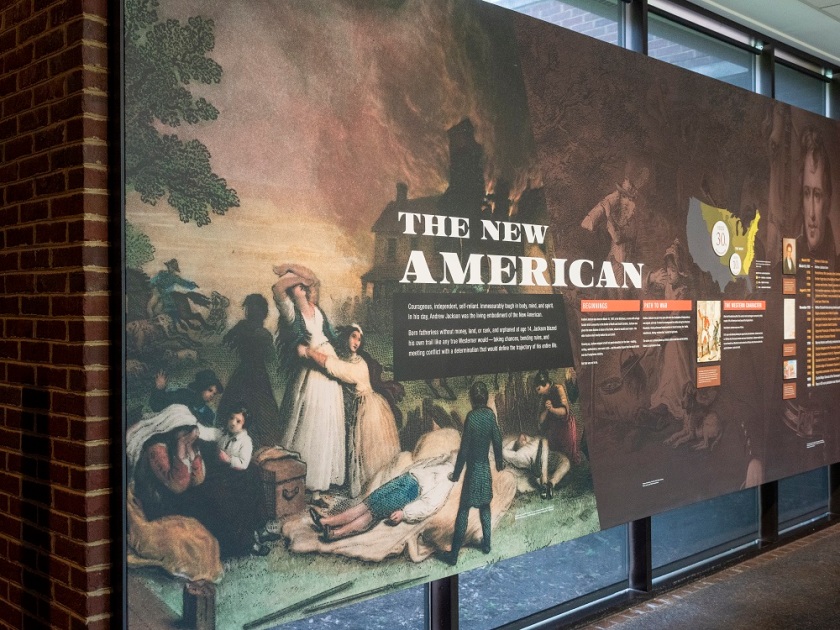
…Andy Jackson (building on our trip to the Hermitage)…
…President James Polk (under whose Presidency Texas was admitted to the Union)….
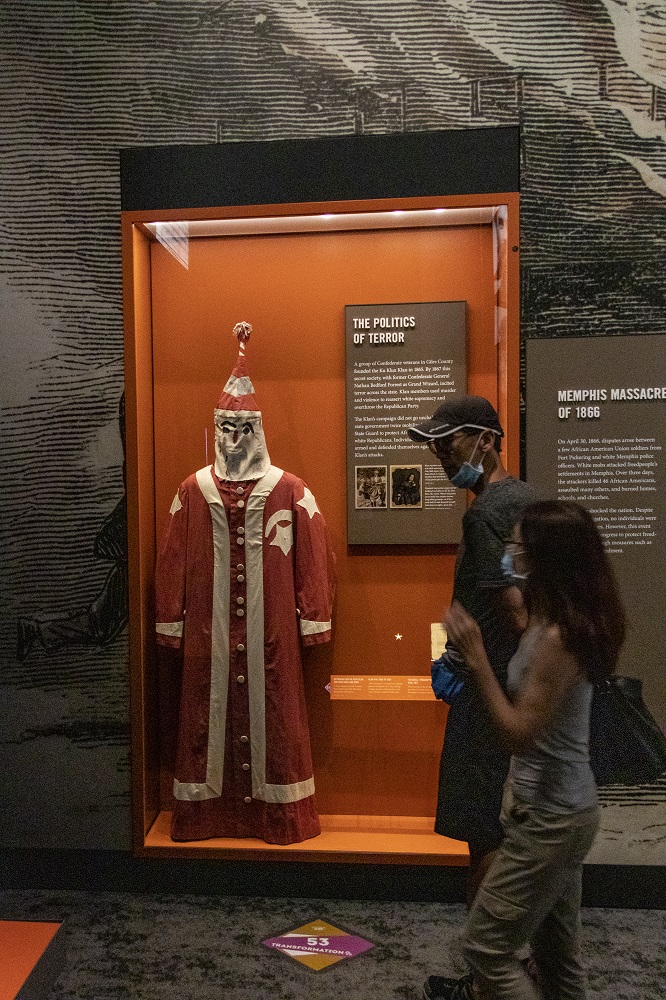
…state heroes such as Alvin York; the unfortunate Jim Crow era, which afflicted much or all of the south…
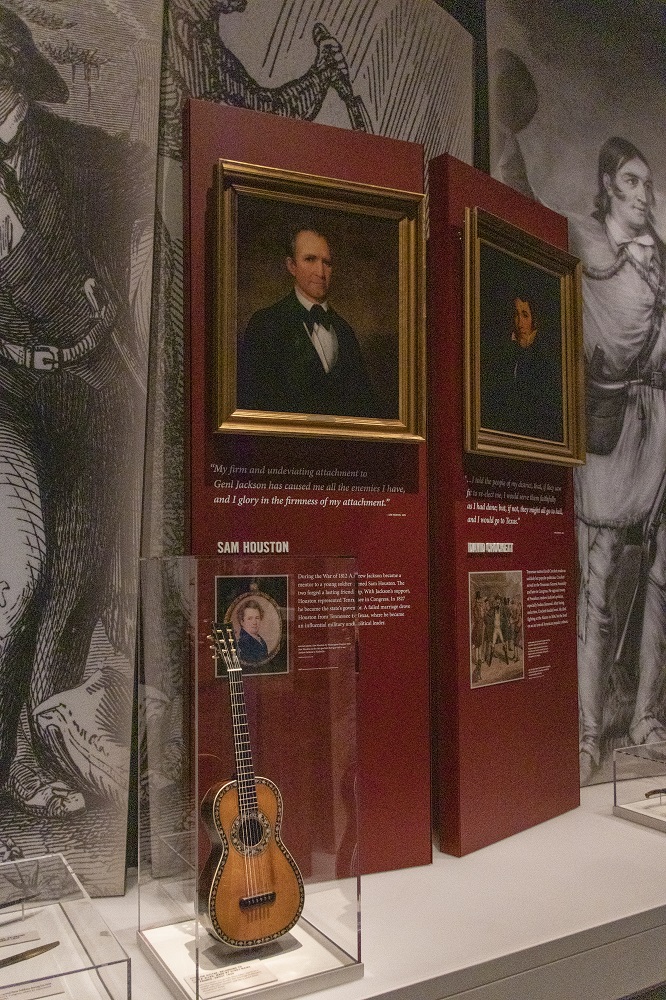
…and even more about the great Sam Houston!
It was a nice museum, with the opportunity for much learning!
Pucketts BBQ
Yvette Mendoza
Coming from Texas we sure know BBQ is a phenomenon so of course we decided to give another southern state a try. At Nashville’s local Puckett’s the busy downtown scene seemed to filter over into the restaurant itself. Morgan and Ms. Stephanie went to pick up the food, to eat back at the hotel for a quieter lunch. With high expectations we opened the to-go boxes and gave Tennessee BBQ a try. Eating southern classics gave us an opportunity to try pulled pork, philly cheese steak, and chicken salad on a sourdough bun.
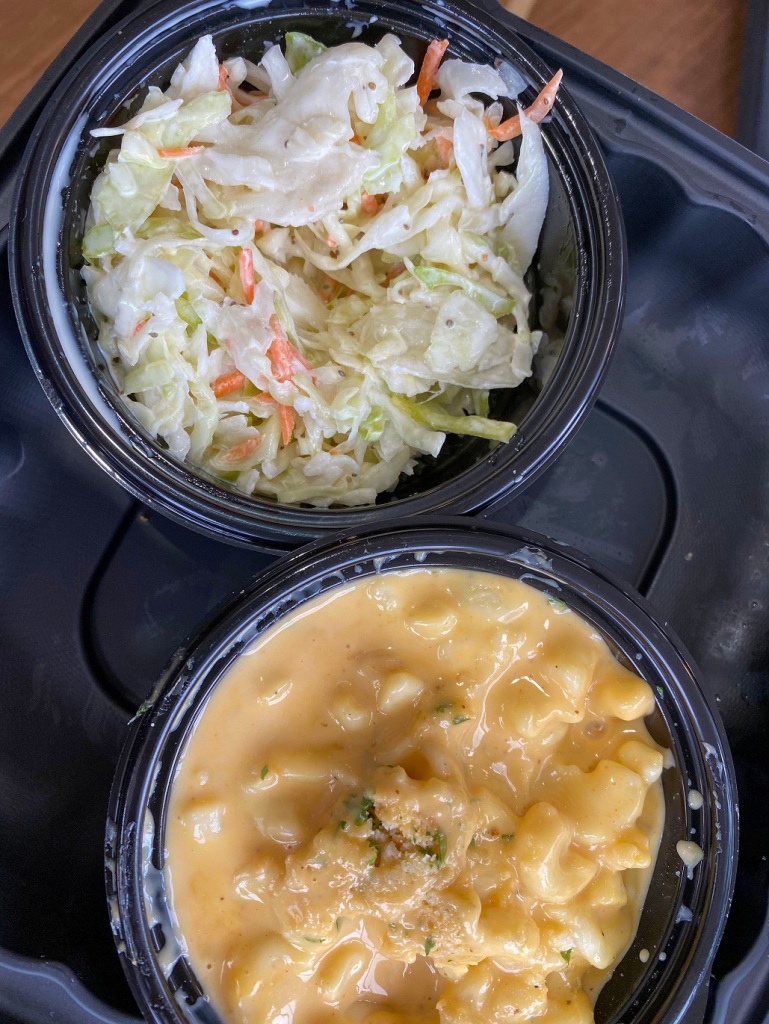
As for our sides, everyone went with boring french fries, but I decided to try the coleslaw and the skillet mac and cheese, which were both creamy and filling by itself.
With each menu item being appetizing, we found the Nashville HOT BBQ sauce gave us the true taste of Tennessee. The BBQ at Puckett’s can definitely hold its own compared to Texas BBQ, but as for the 3 Texans we sure do love our BBQ.
Family Night at TopGolf
Jessica Cuevas
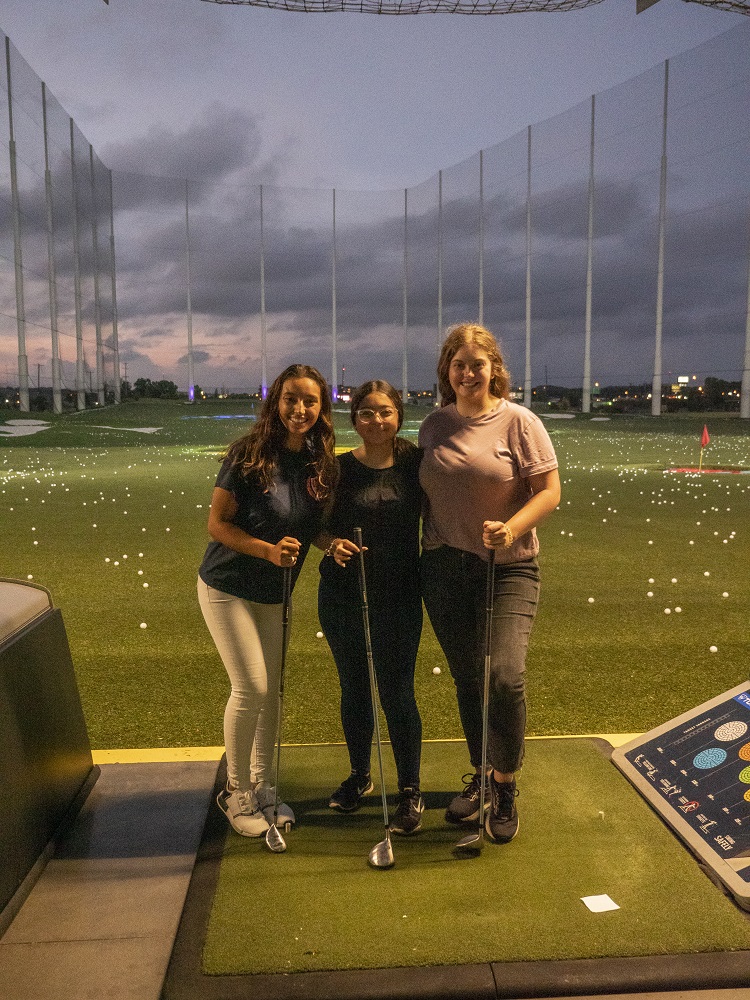
All LEAP Ambassadors have had different experiences at playing golf, with me having the skills of a novice: this would be my first time, not only at a Top Golf, but also playing golf in general. Yvette, whose skills were more advanced than mine, taught me the “proper” way to hold a golf club, how far back to swing and stand from the tee, and even about the different types of clubs.
They have clubs for right and left-handed people and ones specifically for men or women. The golf clubs range from irons, which are better for short distances, to woods, which are recommended for longer distances.
Our first round was for us to practice hitting the balls and for me to get an idea of how to play before participating in a competitive manner. I used the 8-iron golf club, 3 hybrid, and the 3 wood to get a feel of different clubs but found the hybrid and wood more efficient.
Once everyone got in a few practice shots, the real game began. Yvette, Morgan, and I to just play for fun, but we all knew we were “secretly” playing to outdo the others.
We cheered each other on for hitting the ball, which as a novice was an accomplishment in itself, and when we hit the red, yellow, and green nets. My first round was the best out of the two, call it beginner’s luck, since I placed second with 31 points, 18 points more than my score on the second round. Morgan’s best round was also the first, with 50 points, and Yvette’s best round was the second where she scored about 40 points. Ms. Stephanie scored the highest of us all, leaving us impressed with her golfing skills.
Before we had our own bay to play at, we had delightful Tex-Mex cuisine with chicken or steak fajitas, white cilantro rice, and black beans, with a variety of sides to add on ranging from shredded cheese, red garden salsa, creamy queso, guacamole, sour cream and much more.
There were even donut holes that you could inject different fillings such as raspberry syrup and chocolate chip cookies for dessert–all of which satisfied our sweet tooth.
Family night at TopGolf was much more fun than I would have anticipated, and we all had a good time. We met two couples, one of whom played golf with us. Their jobs ranged from elected official (state representative) to business owners, and they were all nice and companionable. This, along with the fun and food, made for a very successful night.
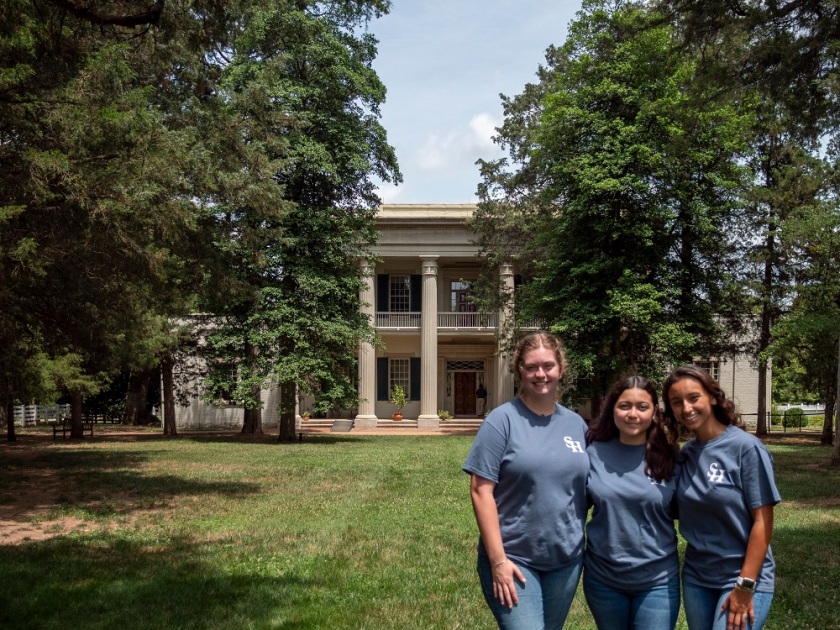
Seeking another historic home on day four, the LEAP Ambassadors ventured to Andrew Jackson’s Hermitage. This visit gave us a vivid perspective of the 1800’s lifestyle through his marvelous home and informative museum alongside it. In addition to having a tour of the Hermitage we walked through his personal idyllic garden and the cemetery where Andrew Jackson and his family currently rest.
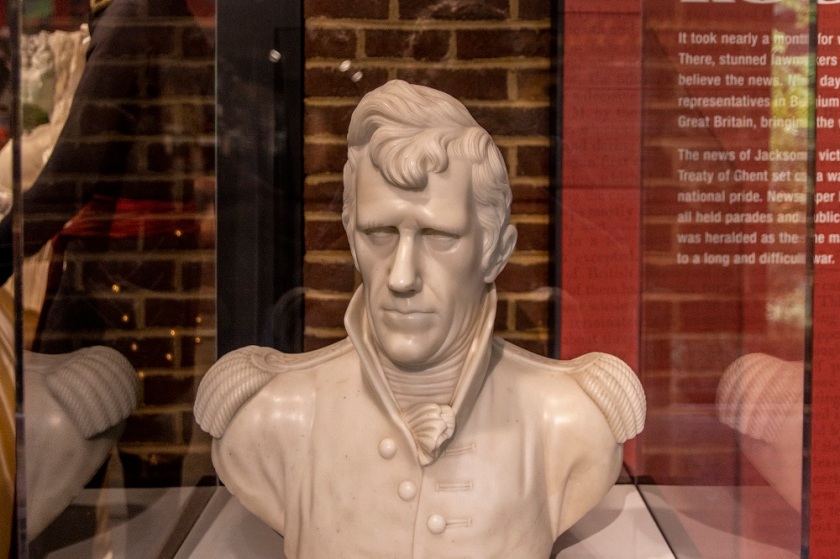
Former president Andrew Jackson was known as “the People’s President,” because he was the first “frontier” President, and he broadened the voting process, resulting in many changes in society.
Walking through the Museum we saw his accomplishments as an attorney, soldier, and president of the United States. Viewing artifacts, Jackson effectively led the battle of the Creek War in 1801 as Colonel of Tennessee and the battle of New Orleans in 1812. After courageously serving in these wars fighting the British and the Indians, Jackson was elected president, and he is now known as the founder of the Democratic party.
As for Jackson’s day-to-day life he lived with his wife Rachel Jackson and adopted children in a Greek-styled home where he allowed any guest comfort in his home with food and a place to stay.
Jackson was known to receive many visitors, including Sam Houston and former presidents, at his 1,120 acres of land at the Hermitage. Having guests stay made it a hectic household from managing the farm, servants, and attending to important guests.
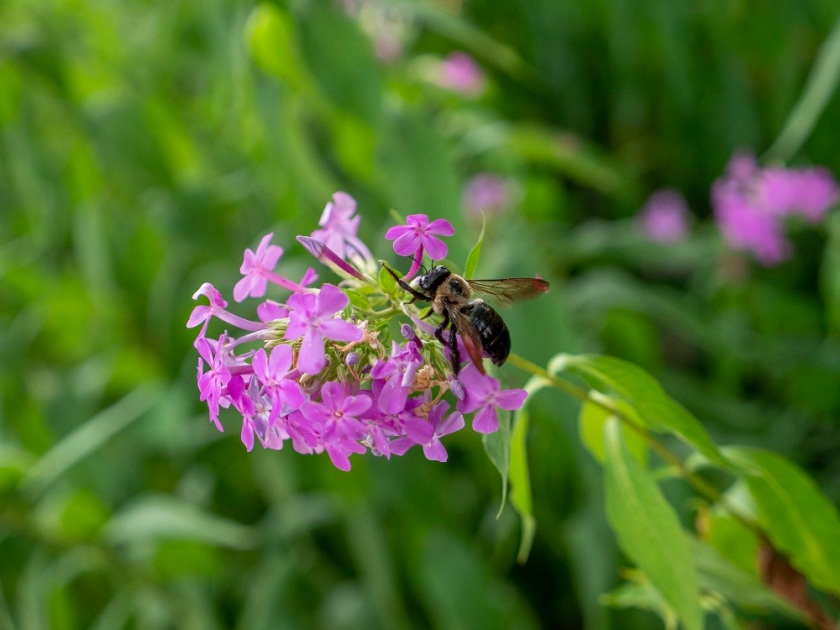
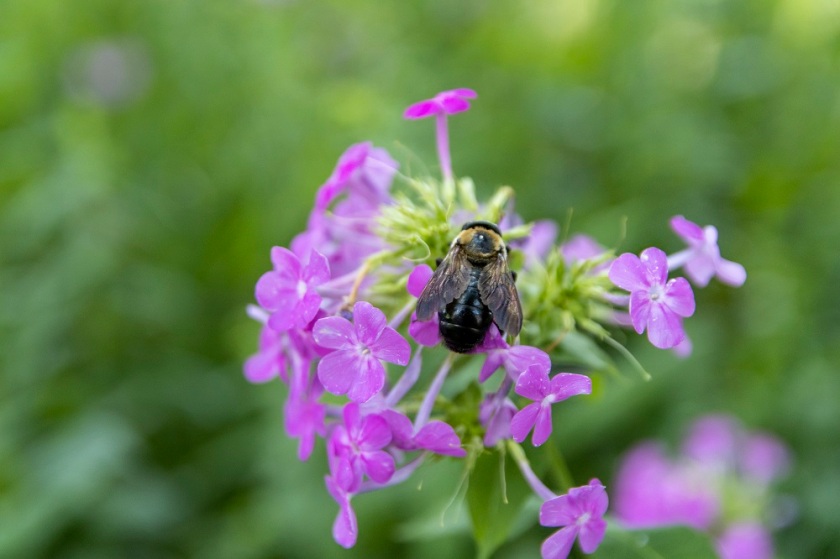
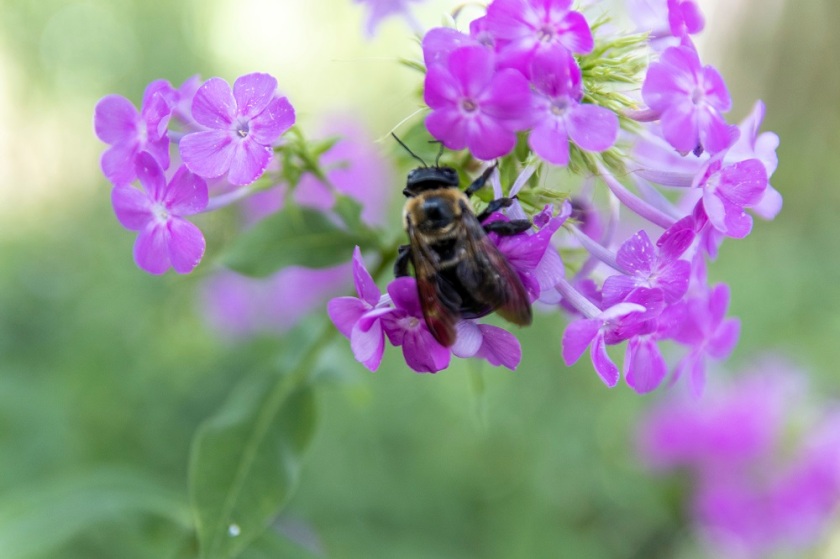
Each LEAP Ambassador had their own favorite part of the Hermitage Jessica being the massive newspapers in Jackson’s library. Morgan enjoyed the kitchen outside since it was like Sam Houston’s kitchen in Huntsville, Texas. Whereas mine was farther away from the home being the garden. As we all entered the garden I fell in love with the bumblebees flying around the brightly colored flowers that all led up to the tombstones.
The garden and grave site rounded off a nice sentimental testament to our 7th president.
Lunch
Yvette Mendoza
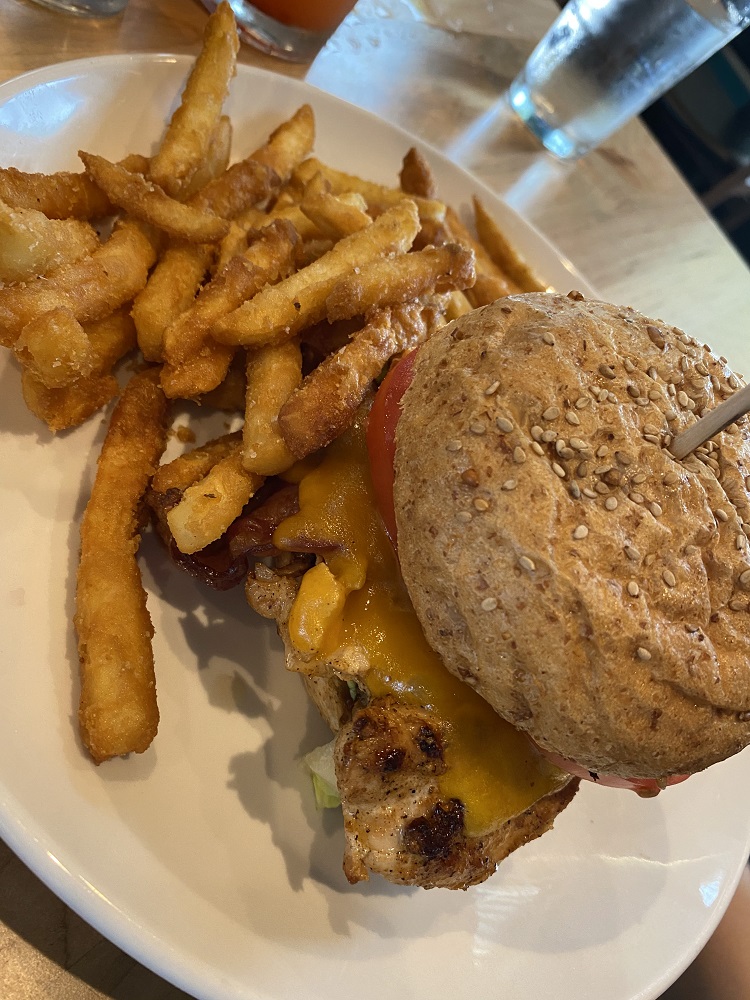
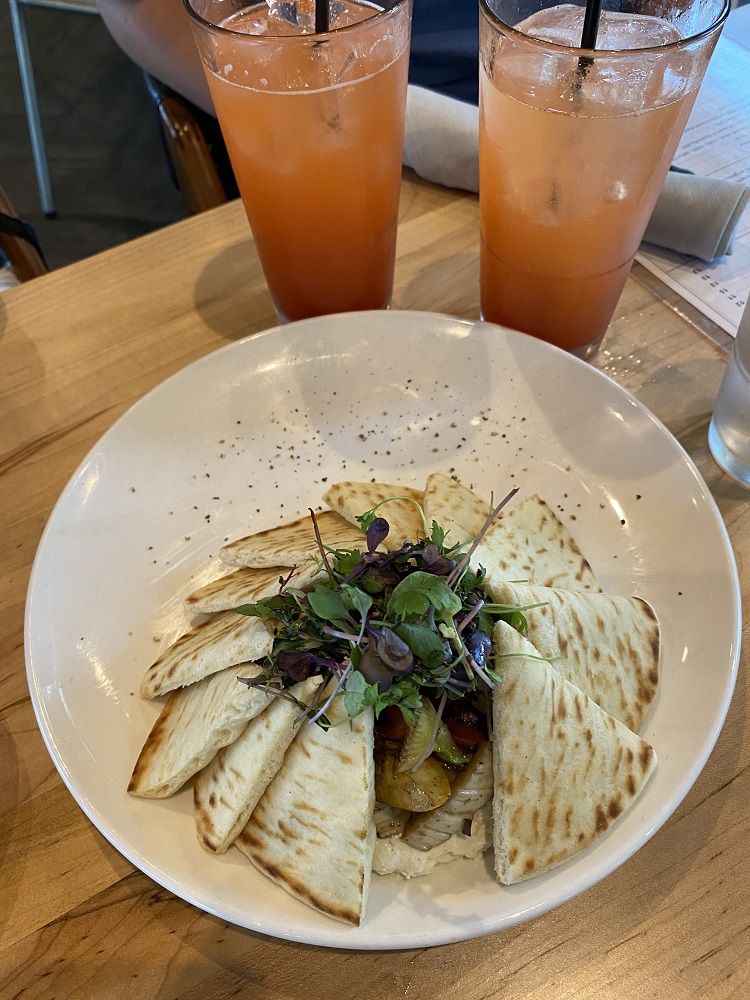
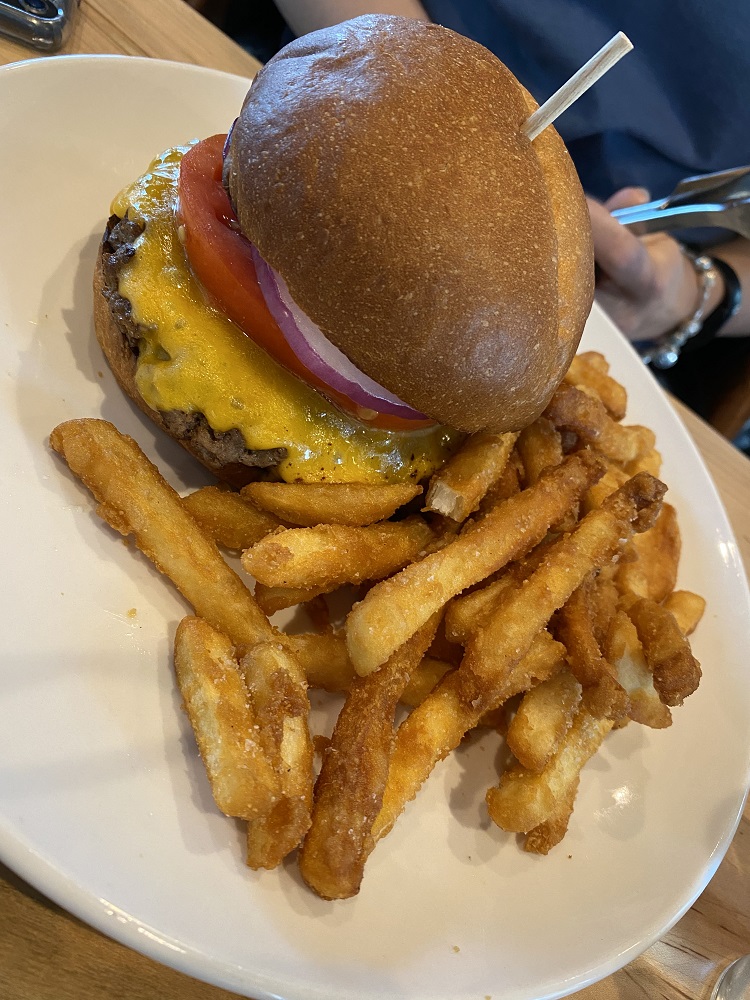
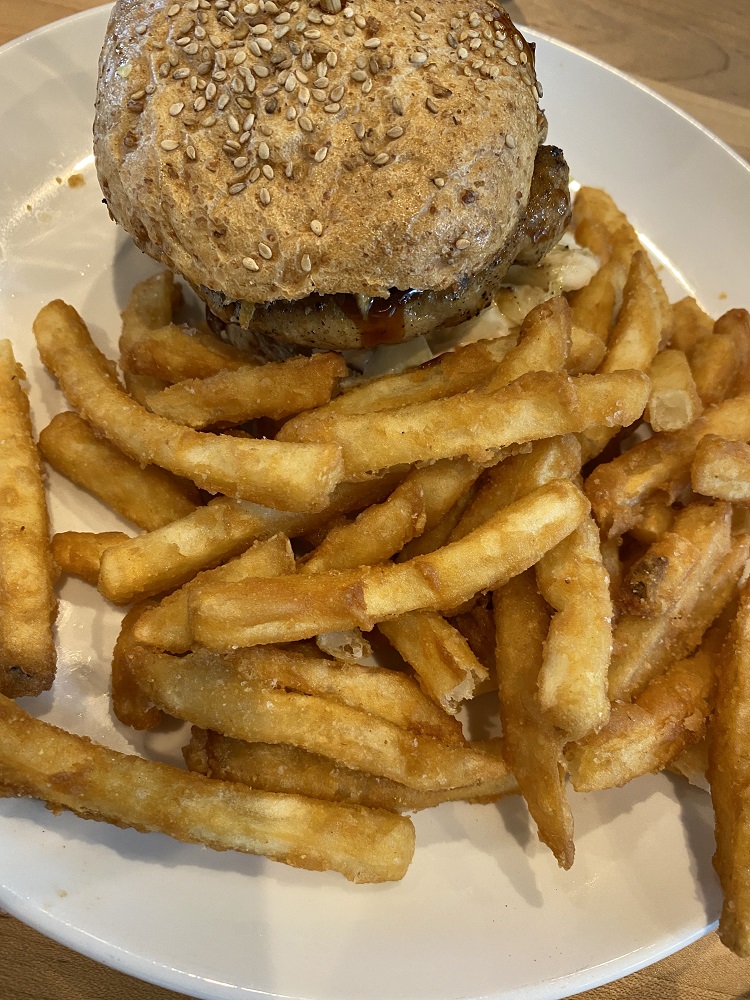
Diving into our first meal in Nashville at the Flat Iron southern fare restaurant ended up being a perfect choice. With the menu full of variety we started off with American classics by ordering whipped goat cheese filled with grilled cucumbers, onion, and tomatoes served with fresh warm pita. For our meals Morgan and Jessica got burgers, one being a tuna-patty burger and the other a grilled chicken burger. As for me, I got a waffle grilled cheese with a complimentary tomato bisque dipper. Each meal was delectable, and everyone had a delicious side of french fries. Our first taste of Nashville made us eager to try more.
Parthenon Tour
Morgan Robertson
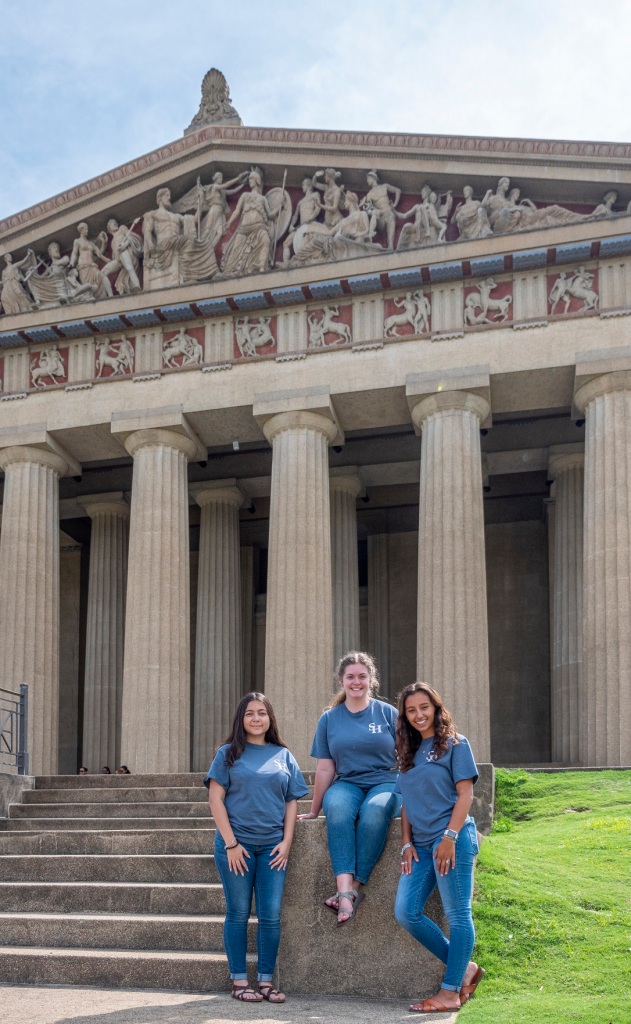
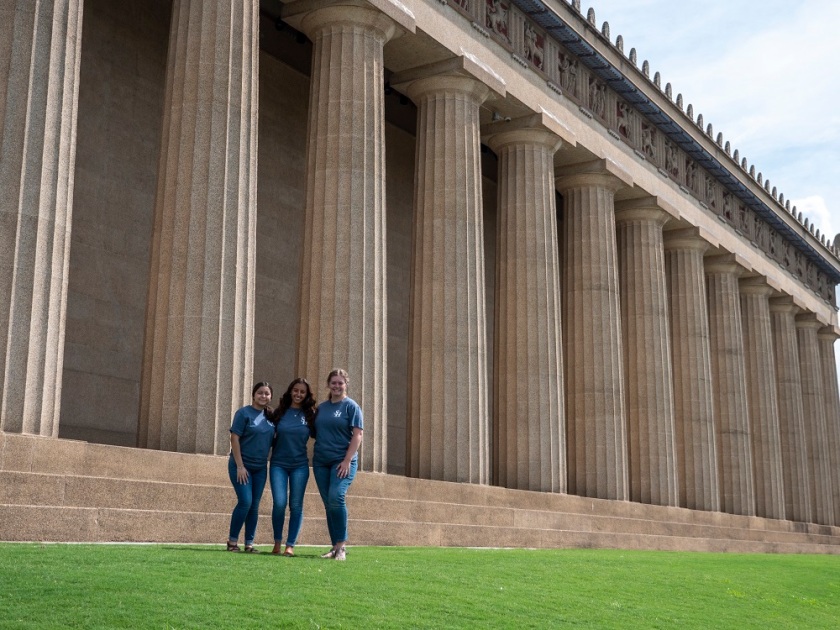
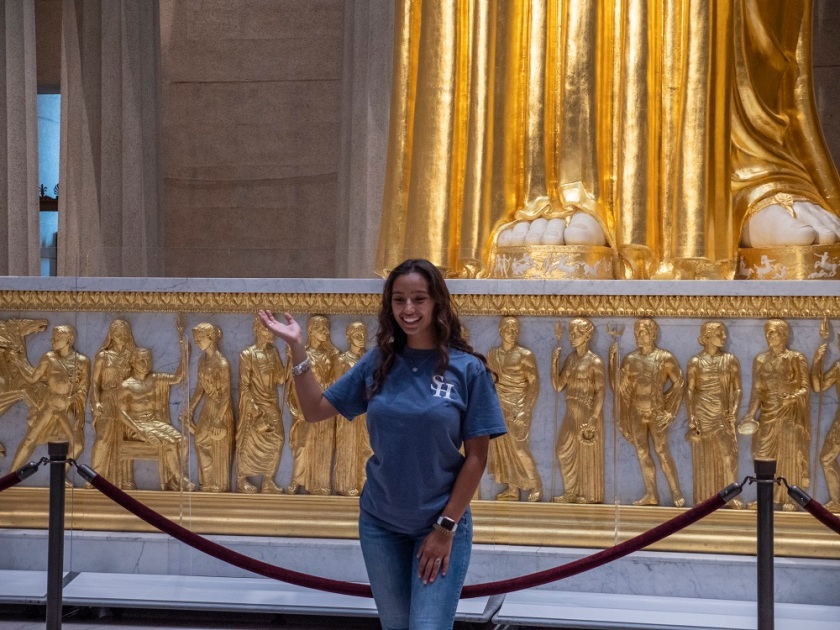
After seeing General Jackson’s home, we ventured into a City formerly known as “the Athens of the United States”–Nashville, where the great Parthenon in Athens, Greece is replicated. Initially, the project was supposed to be a temporary attraction like everything else commissioned for Tennessee’s 1897 Centennial Explosion. However, people were so impressed with its beauty and the cross-cultural connection, the Parthenon was preserved, becoming the focal point in what is now Centennial Park.
While the Nashville Parthenon is a well depicted replica of the authentic one in Athens, there are some major differences. The first difference being the materials in which the structure was constructed. The Parthenon in Greece is made of white marble, which would have been easily accessible at the time. However, in Nashville, Tennessee, there are no quarries of white marble. Using what was at hand, Architect William Crawford Smith designed the structure with wood, brick and stone, giving the Parthenon a yellowish-brown color.
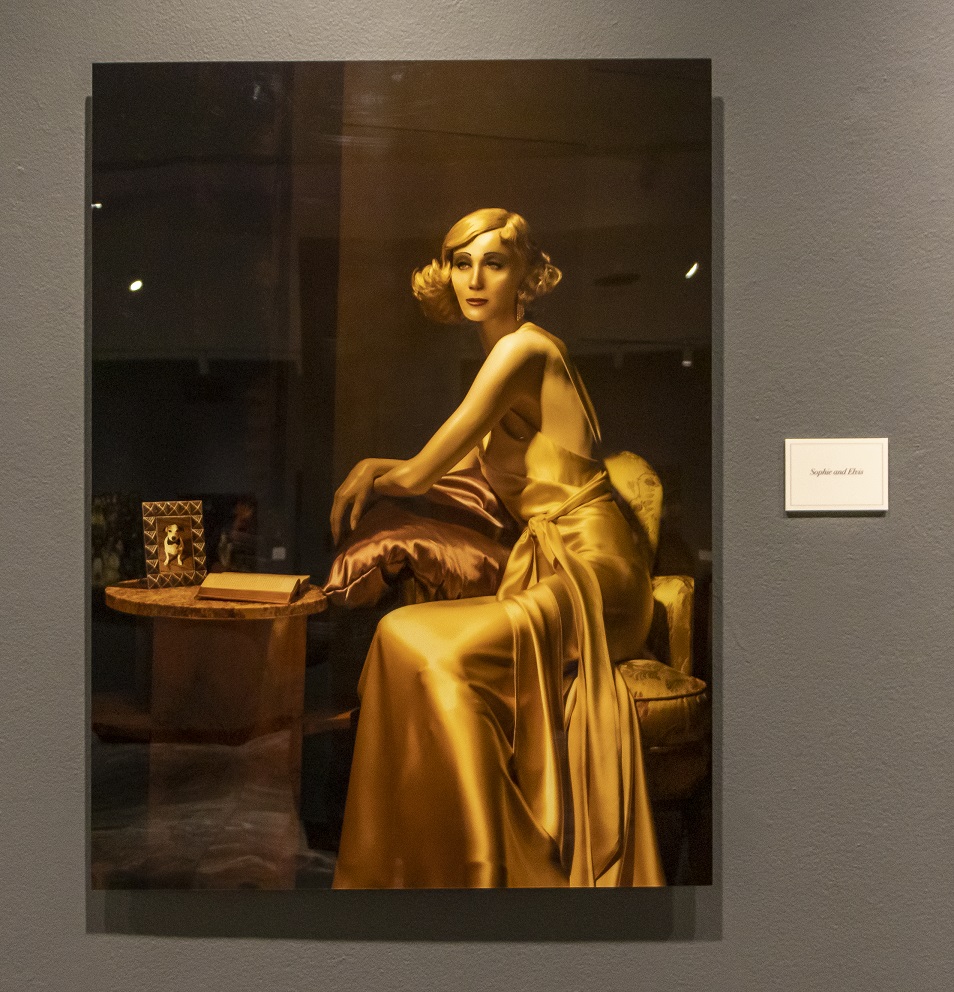
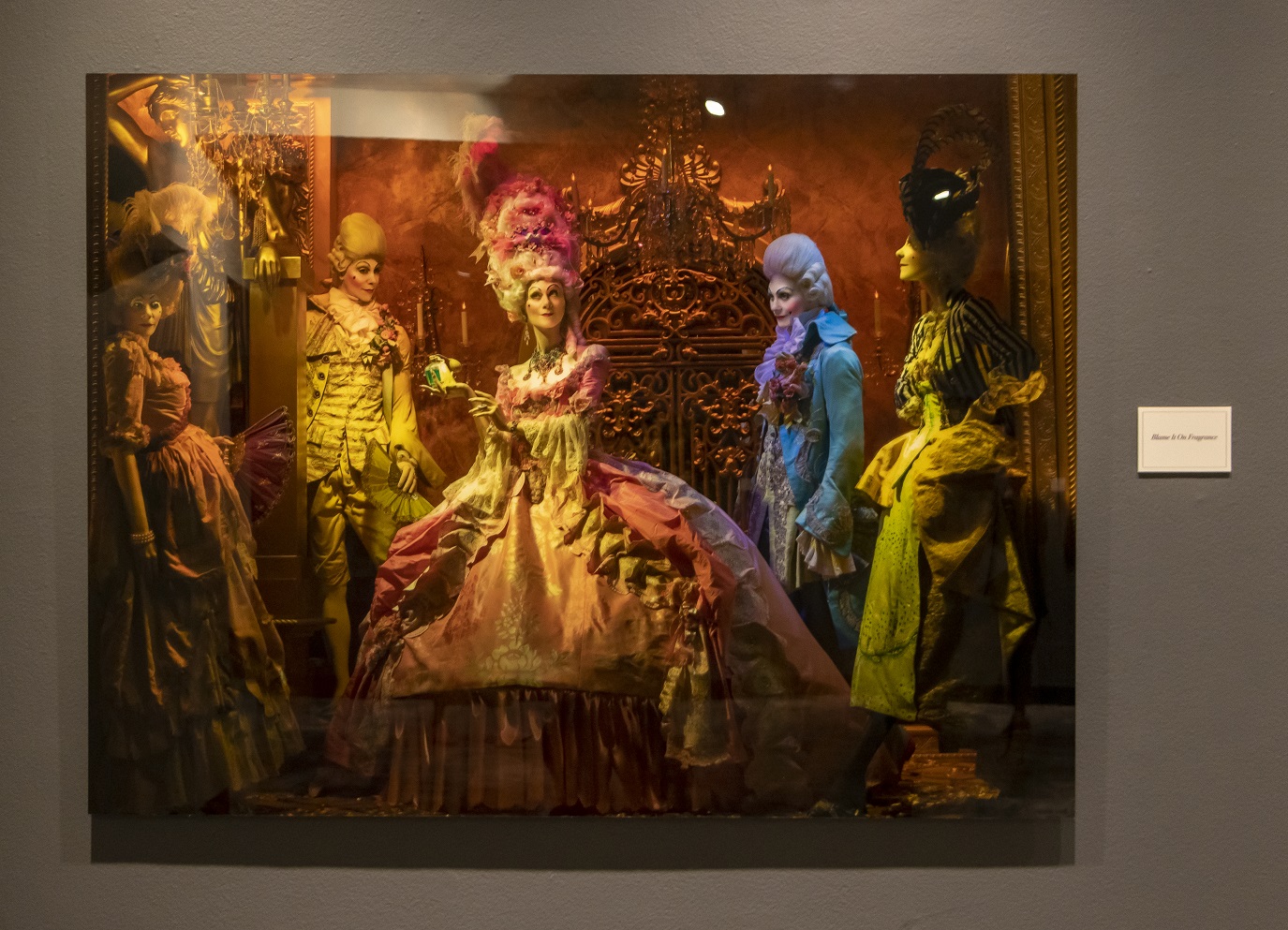
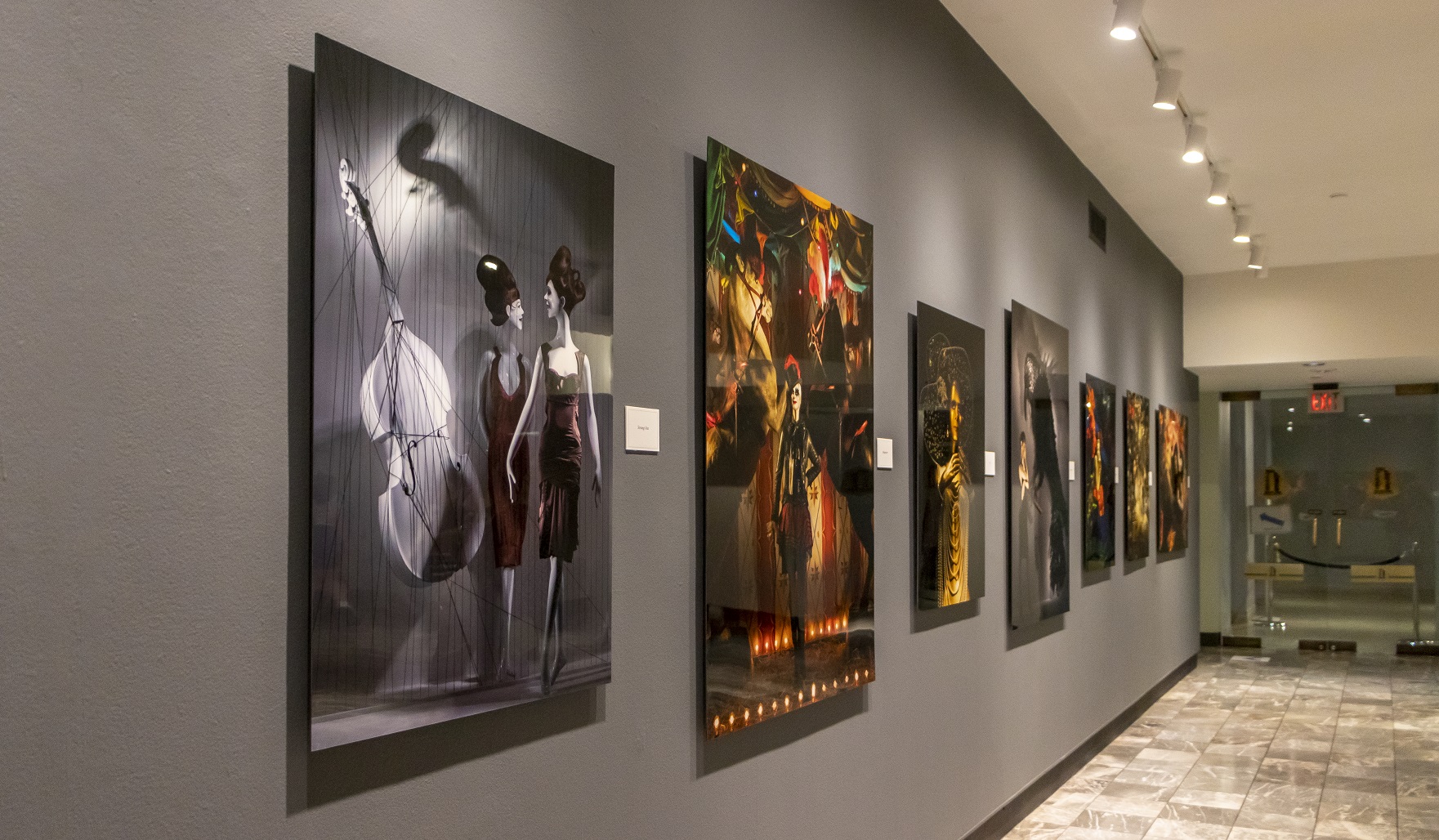
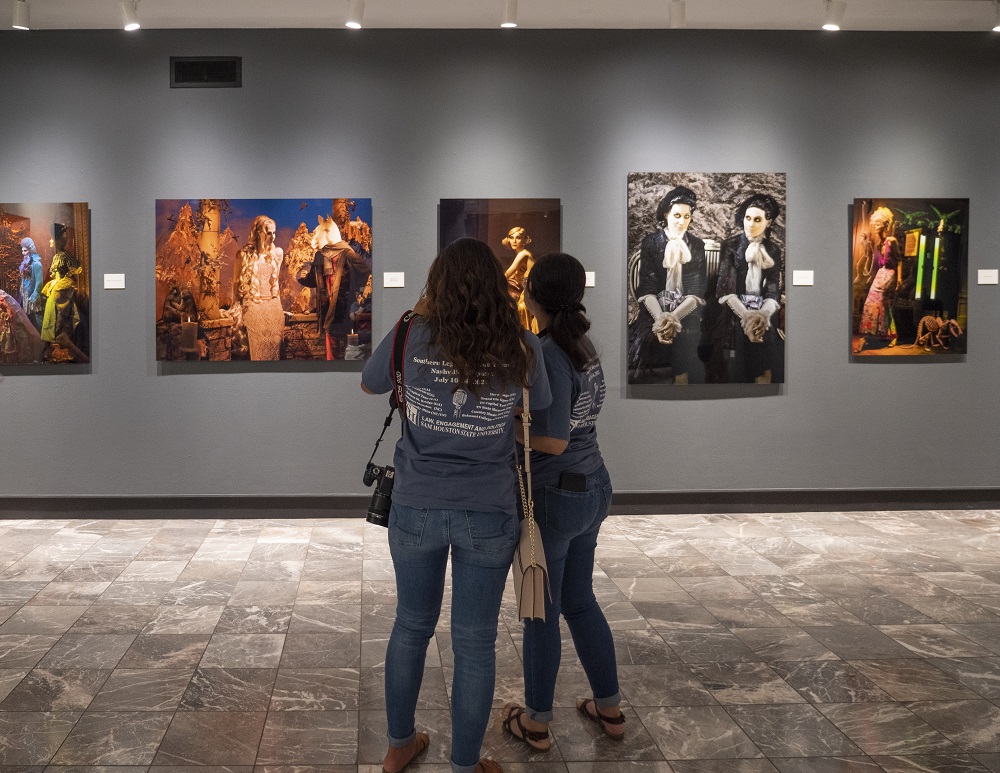
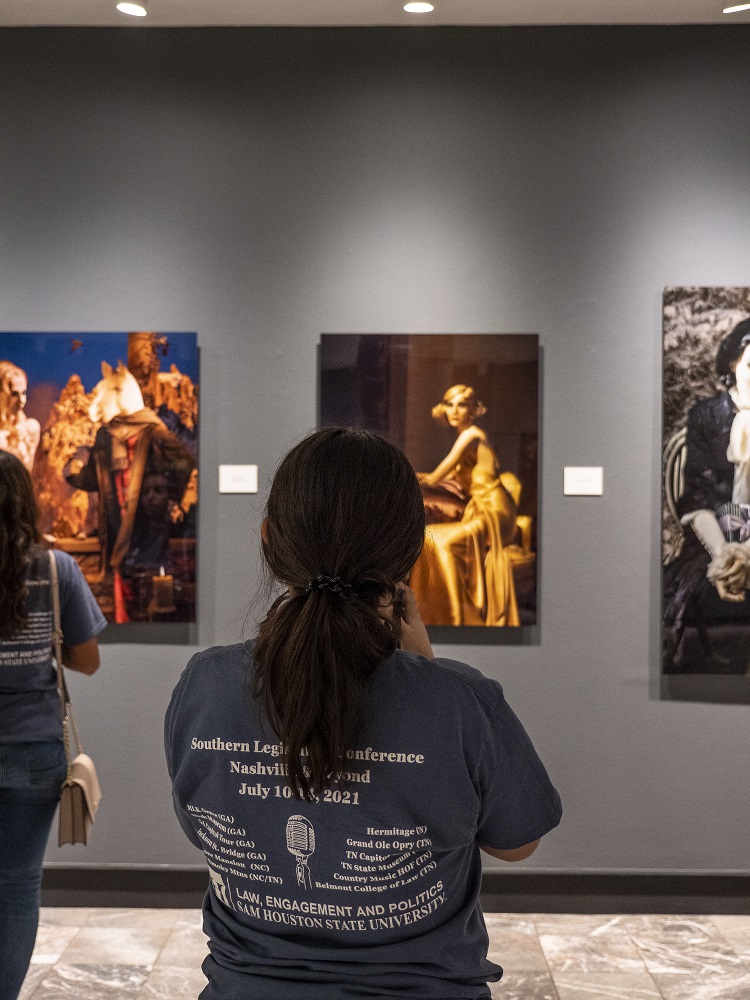
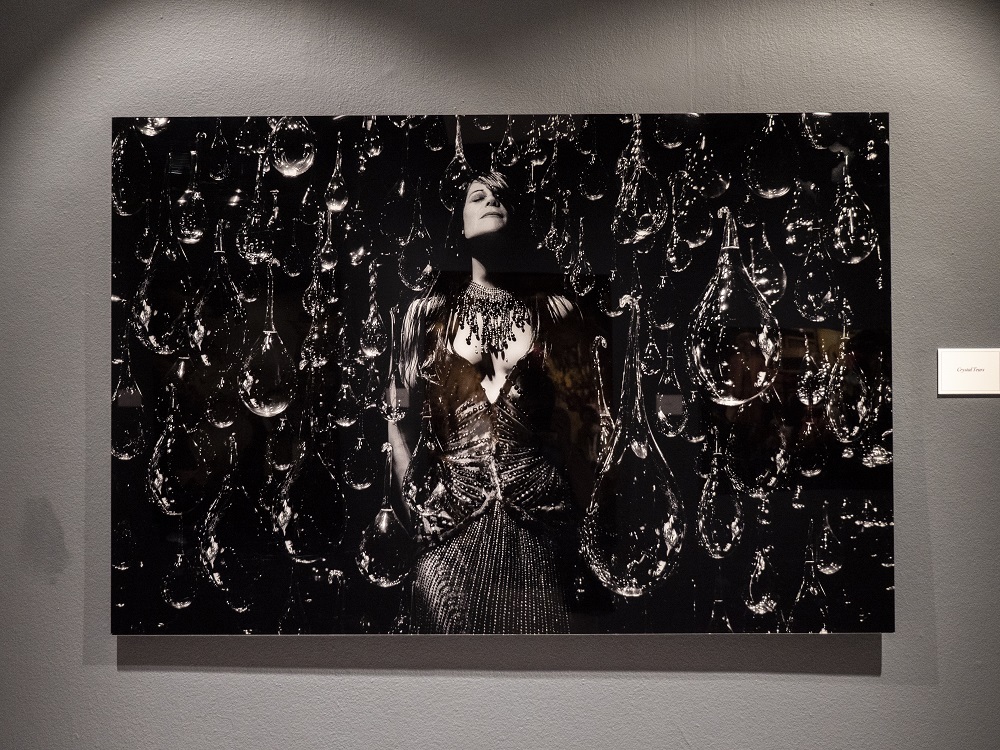
Another interesting feature that I was not expecting was the art museum on the lower floor of the Parthenon. In one of the rooms was an exhibit for artist Lynn Goldsmith whose interesting photography art is printed on metal, with each photo containing up to fifty exposures.
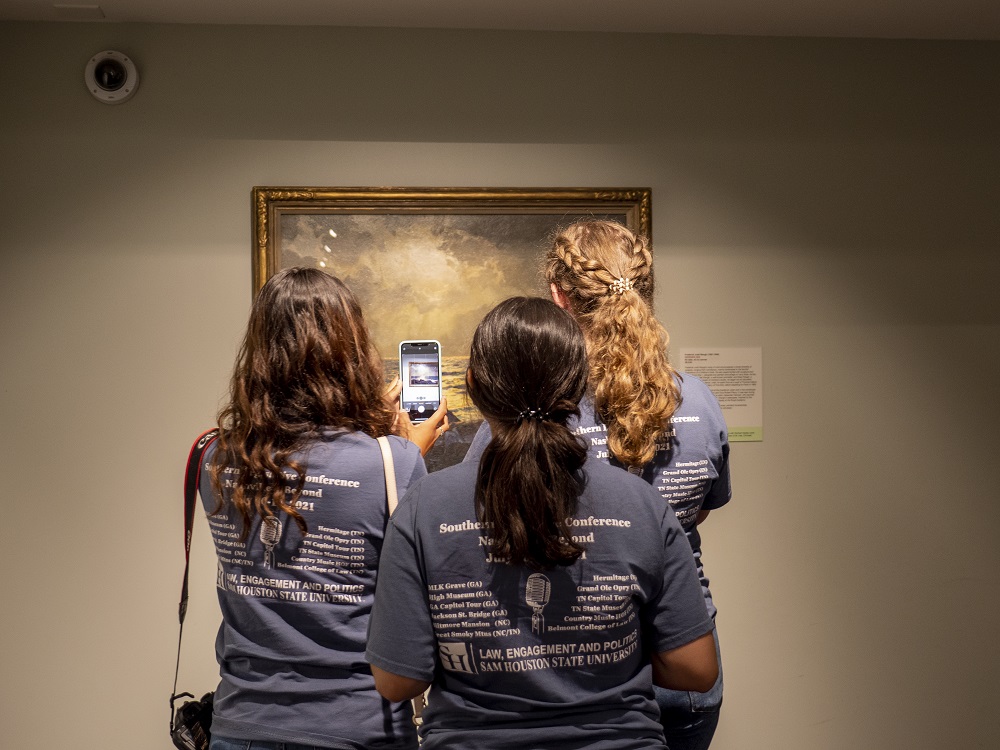
The second space was James M. Cowan’s personal collection of American art, including pieces from Durham, Moran, and Bierstadt, serving as a nice contrast to the first collection.
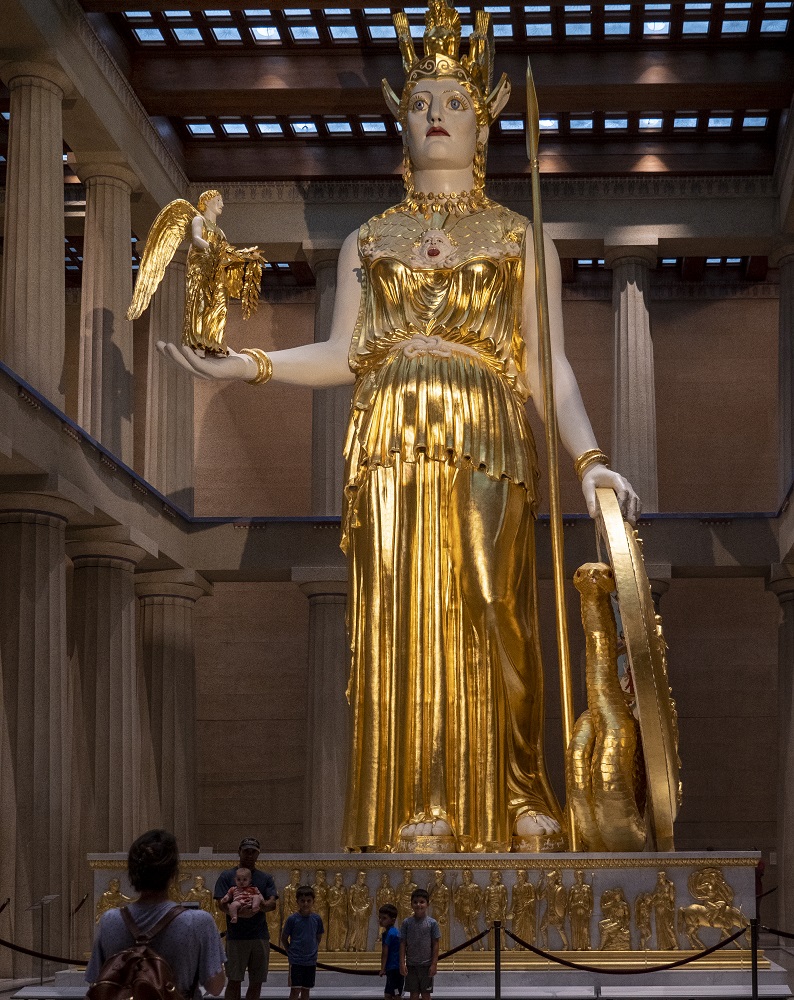
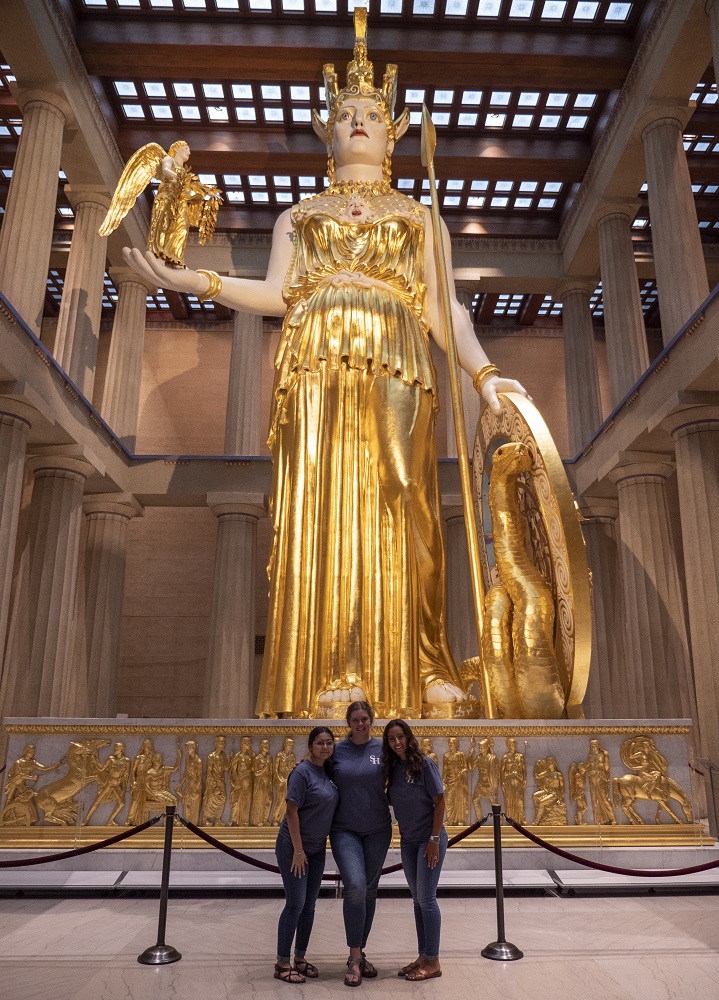
Keeping with the Greek style and culture, a 42-foot-tall statue of the Goddess Athena resides in the central room of the Parthenon. Standing tall as the Goddess of Wisdom, Athena holds the god Nike in her right hand with a shield and a snake to her left. When entering the central room of the Parthenon, the goddess is visible between the massive Doric columns, with her gold dress and accessories appearing as though they are glowing.
Surprisingly, we found the Parthenon to be a popular picture spot for tourists and natives. There were two Quinceañera parties, a baseball team, and even a wedding set up for pictures. We of course joined the trend and posed for several pictures inside and outside of the Parthenon before heading back to await for what would come next.
Opening Night at the Country Music Hall of Fame and Museum
Jessica Cuevas
It is the opening night of the Southern Legislative Conference in Nashville, Tennessee. The LEAP Ambassadors were curious to know what to expect at the Country Music Hall of Fame and Museum as they walked to join the line for the trolley across the street. We congregated with the other attendees and waited for our turn to board the trolley. We met two friendly lobbyists from New York, Jonathan and Monisha, and a policy analyst from Ohio who each talked to us about what they do, how they got to their positions, and future advice for young professionals. Our conversations carried on into the short trolley ride on our way to the Country Music Hall of Fame and Museum. It was refreshing to meet people so passionate about their work, and who are living what we are actively learning.
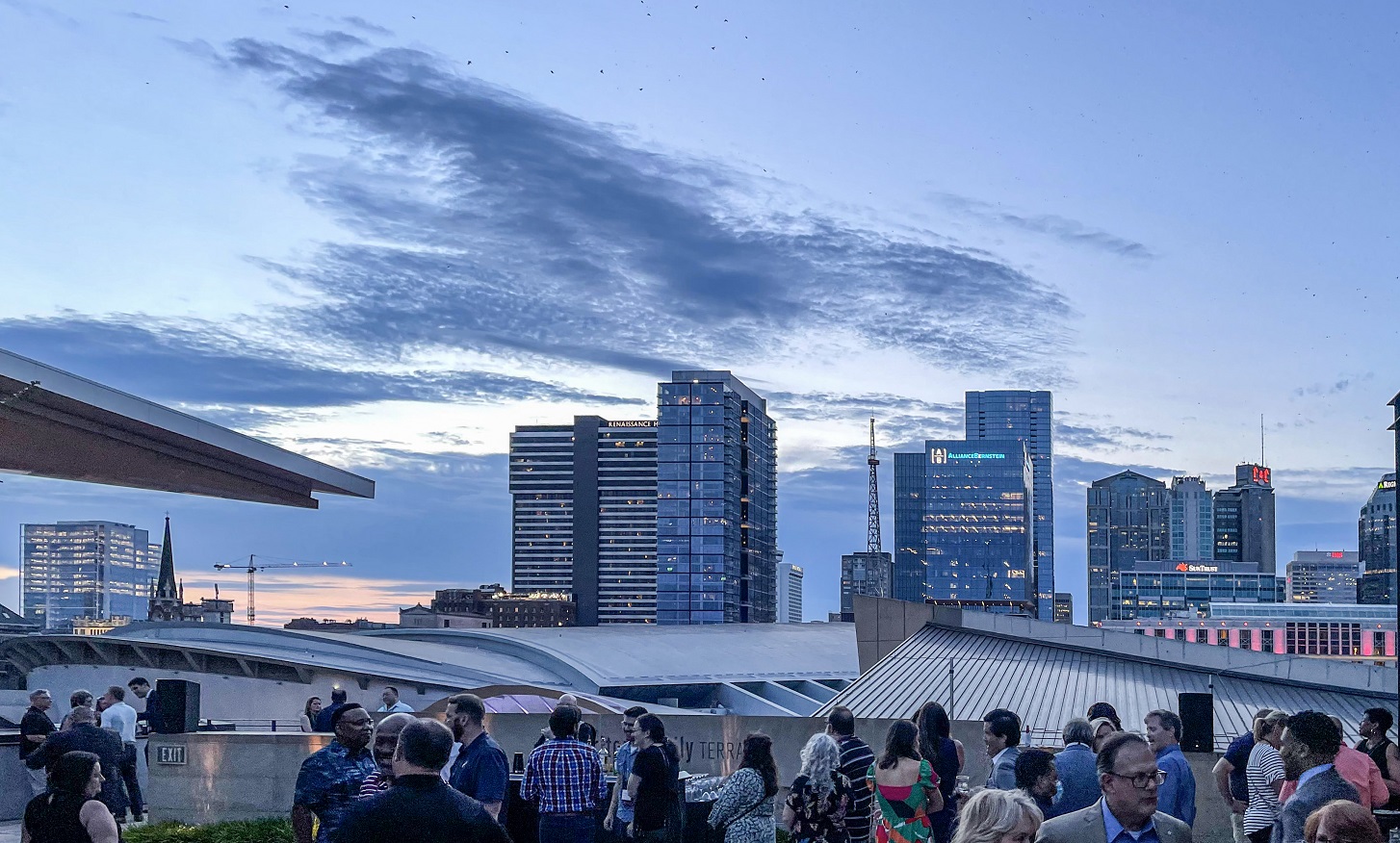
Once we arrived we were given the option to go up to the sixth floor for food or start off at the museum on the third floor. We listened to our stomachs, which drove us to the sixth floor to be greeted by live music and lots of people.
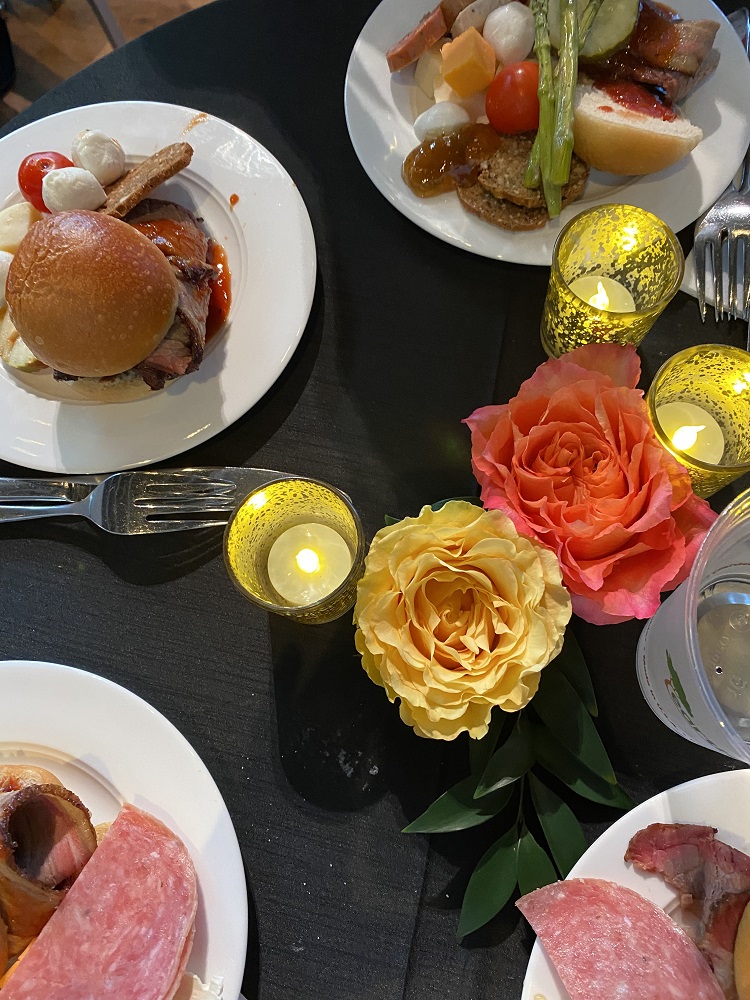
The LEAP Ambassadors were able to meet and converse with a Tennessee Senator before making our way to the colorful assortment of a Charcuterie board with different cheese, bread, cold meats, and vegetables.
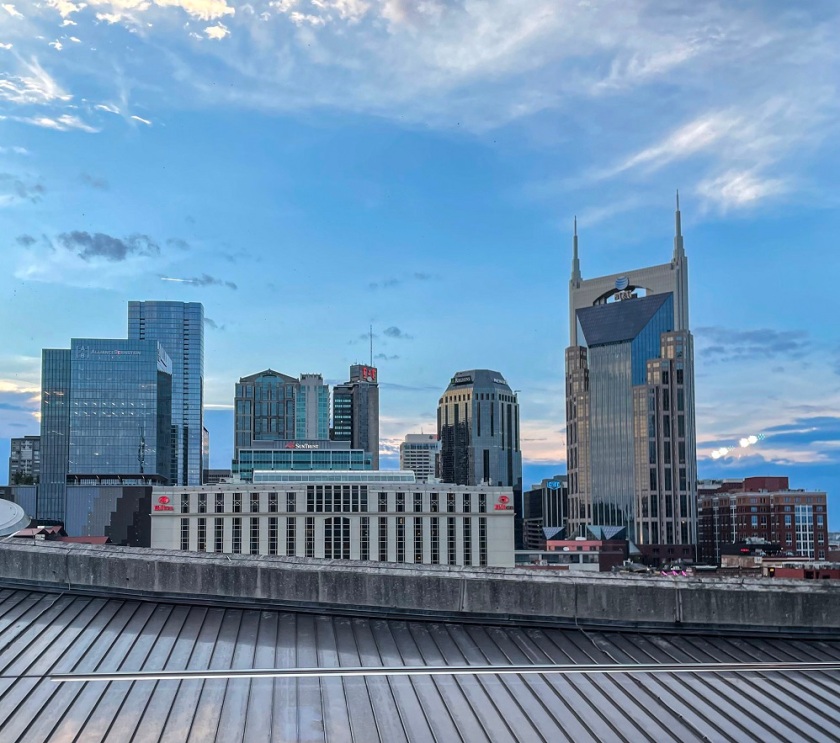
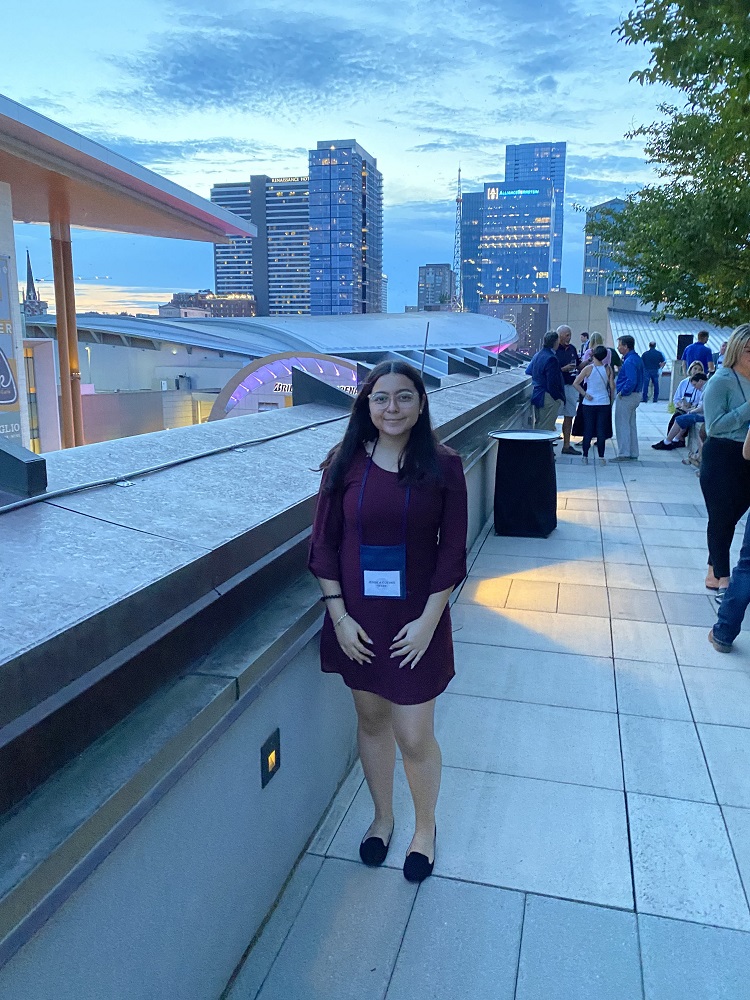
There was a beautiful view of downtown Nashville…
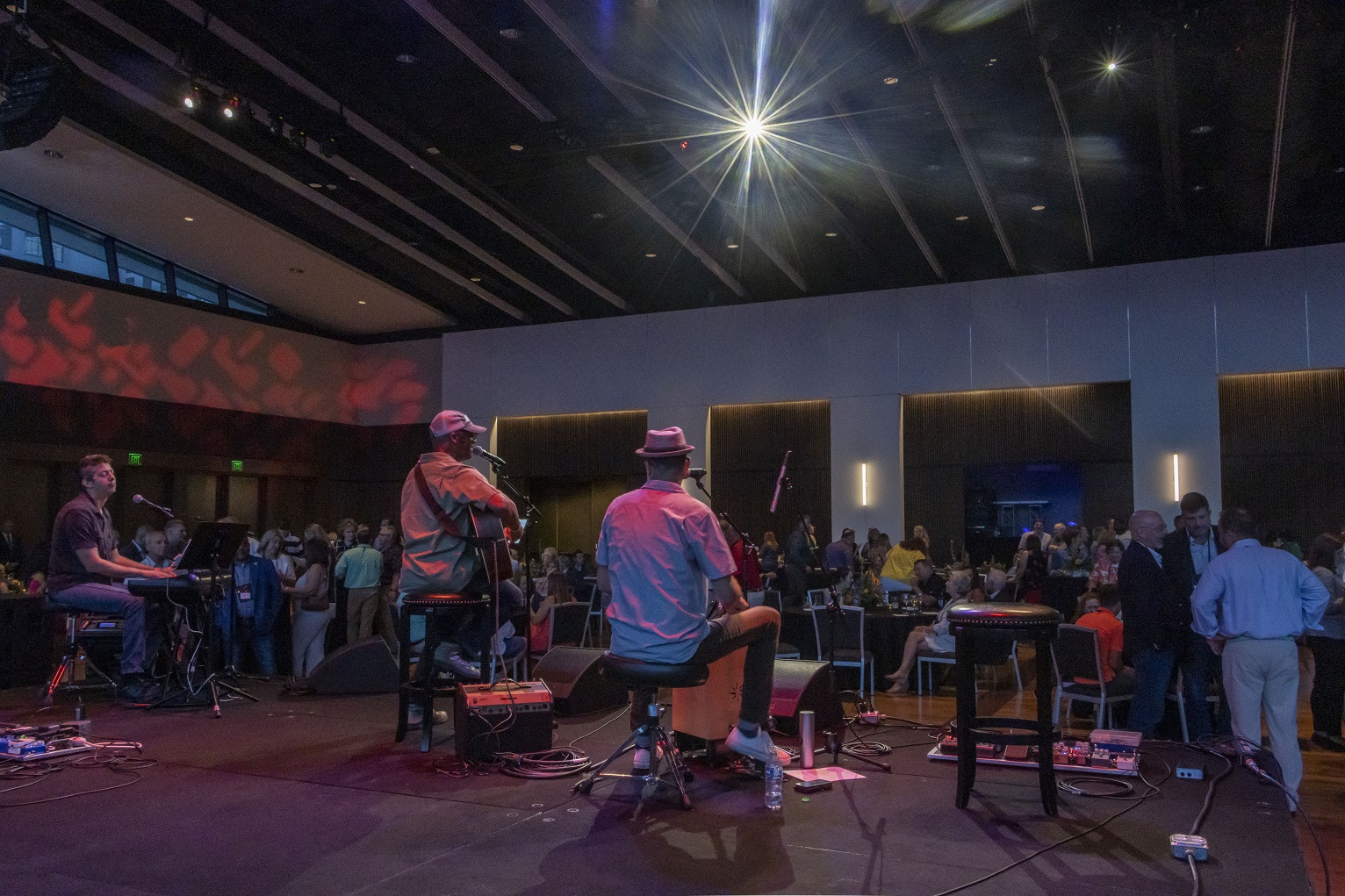
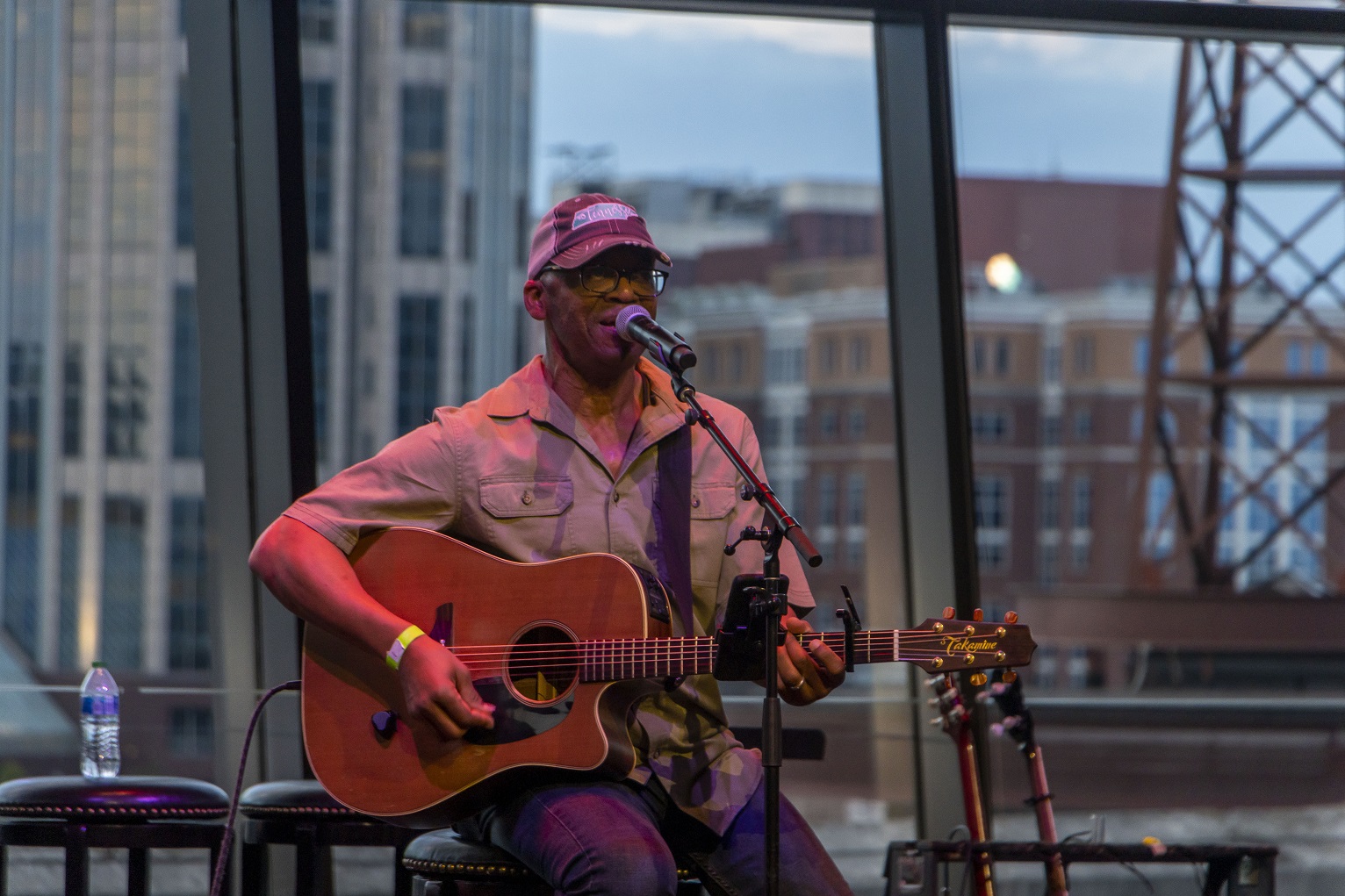
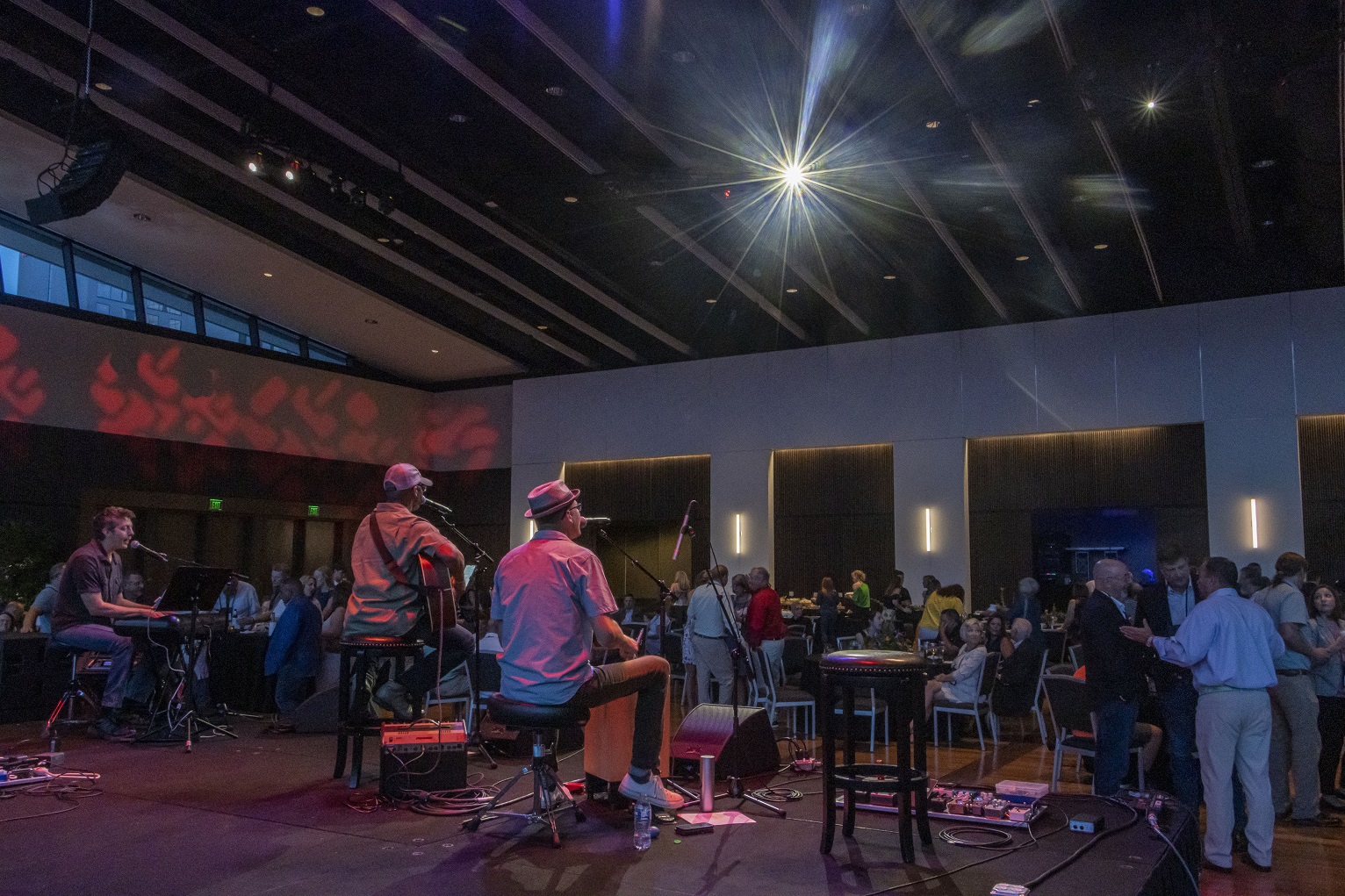
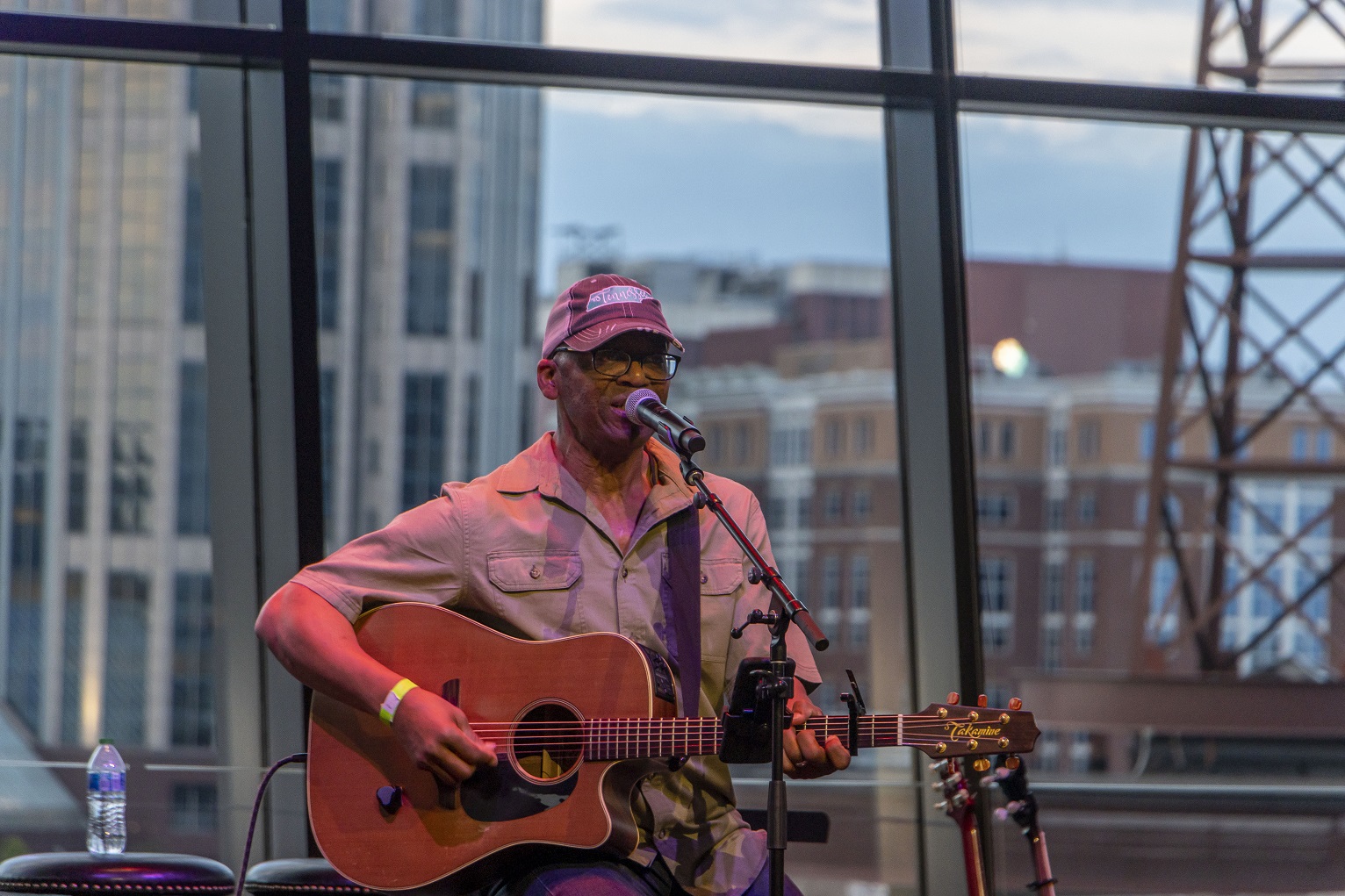
…and a live band playing covers of artists such as Willie Nelson, The Beatles, The Nitty Gritty Dirt Band.
On the balcony, where families were playing Jenga, Corn Hole, and enjoying the nice weather, the view of the Nashville skyline was amazing.
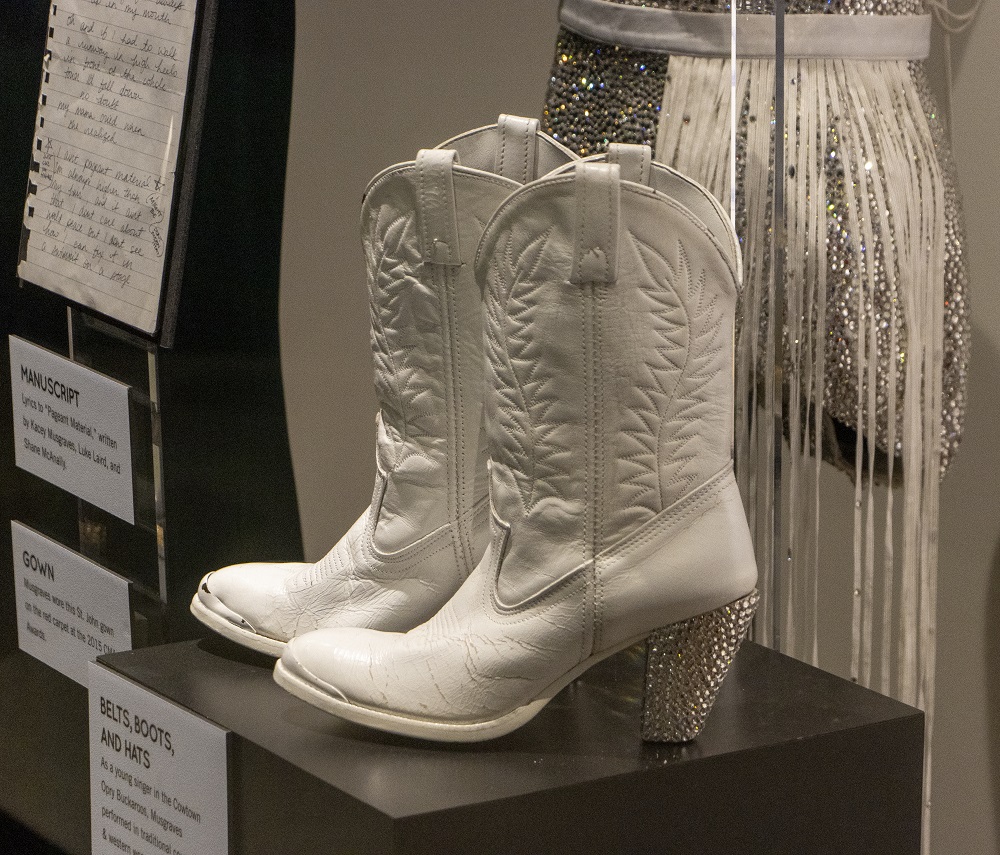
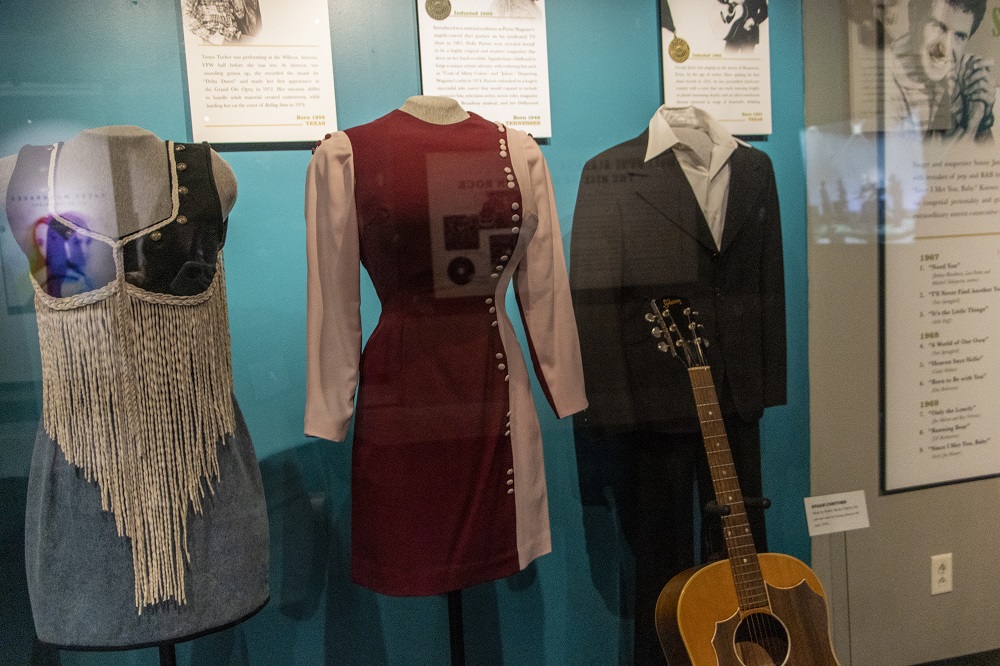
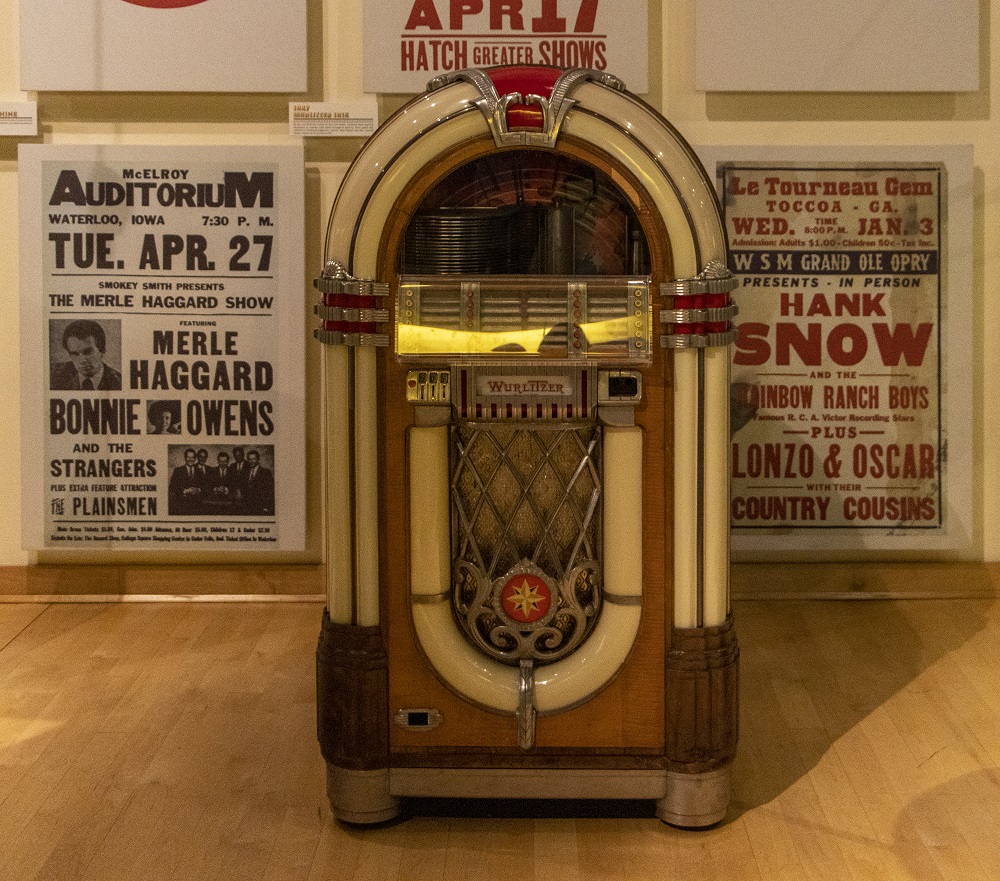
After dinner, we toured the museum, where there were artifacts such as their costumes and suits….
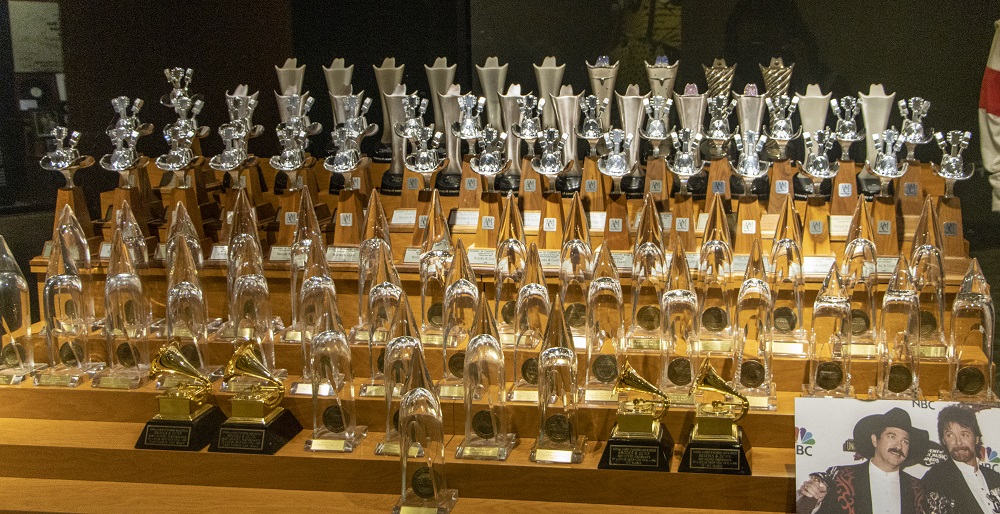
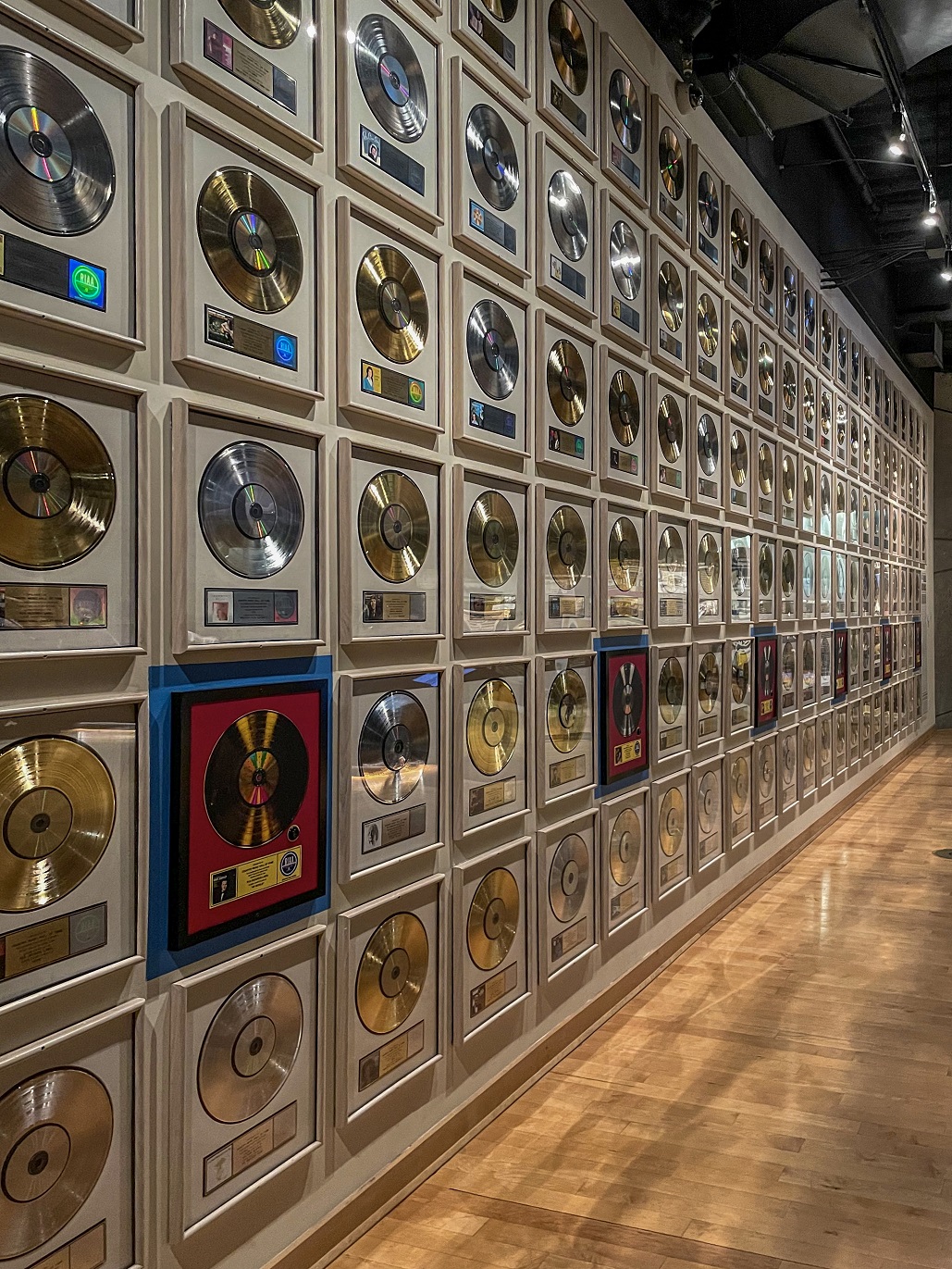
…cars, guitars, fiddles, drafts of written songs, even a whole wall dedicated to the golden records of many of the singers .
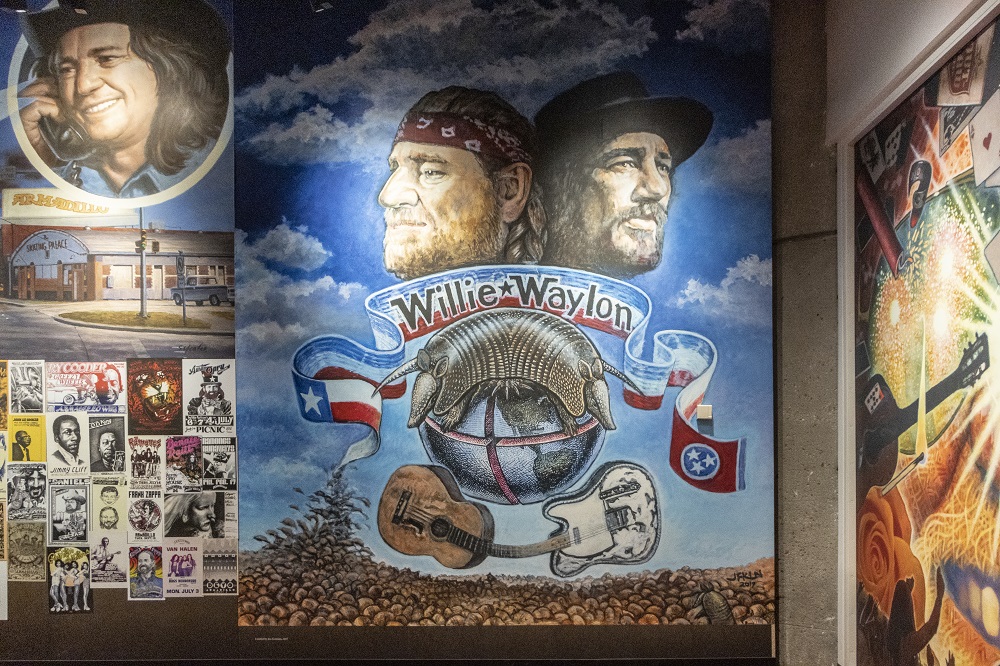
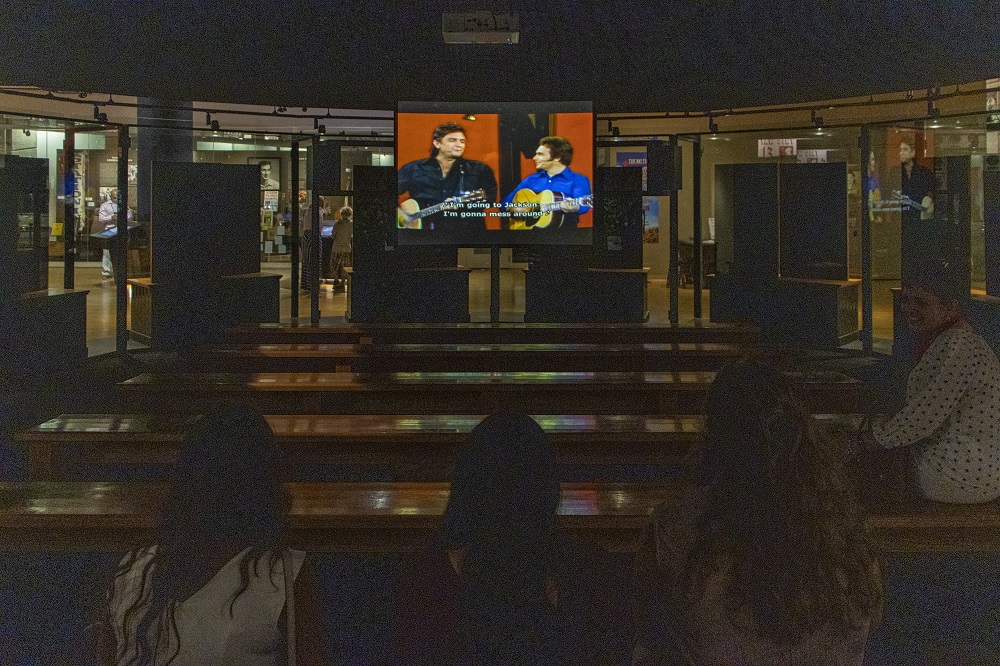
Many of these artifacts were associated with famous acts such as Johnny Cash, Elvis Presley, Dolly Parton (whose statue we saw the night before), and Willie Nelson.
Our night ended with a trolley ride back to the hotel taking in the view of the city after dark. The trolley ride should have been a 4-minute drive back to the hotel, the half mile drive seemed to take twice that time if not longer due to traffic and nightlife. The glowing city was buzzing and alive, as we were full and amazed by the opening night of the conference.
Lunch at The Farmhouse Mercantile & Coffee Bar and Cosmic Blast Off food truck, Jessica Cuevas
In the antique style strip mall in Sylva, North Carolina we walked into a warm and cozy coffee shop, The Farmhouse Mercantile & Coffee Bar. walking in was relaxing and aesthetically pleasing, as our eyes roamed over all the decor and furniture. Everything from the restrooms to the chairs were done in contemporary country style. Even on the counter, where we began to order, was displayed a Yama cold drip tower. Feeling a bit adventurous, Yvette, despite not liking coffee, tried the London Fog; Morgan ordered the White Chocolate Mocha, and I went with my usual order of a Mocha Frappuccino.
We then boarded a rocket and were blasted off to the Cosmic Blast Off food truck and ordered the heaviest food anyone could get prior to a hike. Nonetheless, I ordered the Bronco Burger, the local favorite Blast Off Burger for Yvette, the Sweet Potato Quesadilla for Morgan. Each burger was freshly grilled and had the proper amount of juiciness. As for the quesadilla, it had a southwest flavor and a dash of sweetness from the potatoes. We then topped it off with hand-cut French fries, which added a pleasing salty finish to our meal.
We ate all this during a “parking-lot picnic,” one with a view!
Great Smoky Mountains National Park, Morgan Robertson
Despite it being a rainy day, we did not let it get in the way of embarking on our journey through the Great Smoky Mountains. After a caffeine kick off from a trendy coffee house, and lunch from a local food truck, we made our way further into the mountains. The more we drove up the curvy mountainous roads, the wider my smile became. This being my first national park, it is now the my basis of comparison for other park visits.
There are a total of six entrances to the GSMNP, a park that spans over a total of 800 square miles.
We did not see the entire Park, but what we did see was truly amazing. Winding roads led us past flowing creeks, enormous mountains, countless trailheads, some random wildlife…
…and much more. The GSMNP straddles Tennessee and North Carolina, and we traversed this boundary from East (NC) to West (TN)…
… amazed by the size and beauty of the Park.
After spending some time testing our rock-climbing abilities…
…and of course snapping pictures, we faced the hike to the tallest point in the park: Clingmans Dome.
The girls begin the “hike” up Clingmann’s Dome
Embarking on mine and Jessica’s first National Park hike, I shifted my gaze upward at the steep incline of the paved trail. Seeing the variety of trees, quickly moving fog, and the crisp cool breeze of wind helped keep us motivated to make it to the top.
One of the most interesting parts to me was an entrance to the 2,190 mile Appalachian Trail. Stepping foot past the sign, I can now say that I have walked on the famous Appalachian Trail.
Peaking around the corner, was a winding cement trail that led to the top of Clingmans Dome observatory platform.
The LEAP Ambassadors were rejoicing when we knew we had made it to the top!
Eventually (editor’s note: an hour later…), we made it down from the top of the dome…
…feeling a little exulted that we accomplished mile-long, round-trip hike.
We also stopped at the Rockefeller Monument, where FDR, in 1940, dedicated the Park.
…part of our ongoing learning about the Park System and its creation. Here, we also had a chance to take another few steps on the Appalachian Trail…
…although we certainly made no attempt to get to Maine, the trail’s end!
Alongside the road were what seemed like hundreds of different lookout points. Wanting to stop at each one, I was reminded by Professor Yawn, who is more familiar with the park, that there are a vast number of exceptional sights to see, and that we had to keep moving. My personal favorite part of the parks is not found high up in the tree line but lying low rushing through the various pebbles and boulders were the sparkling rivers and creeks of the GSMNP.
This immediately sparked a child-like freedom in me to want to run, splash, and slip on the rocks. Finding pure bliss amongst the time old smooth river rocks and swirling currents, I admired the great creation that is the GSMNP. Of course, proceeding with caution, Yvette, Jessica, and I were able to pursue our adventurous personalities, while listening to the babbling waters which brought relaxing mindsets.
As I felt the crisp cool waters rush through my toes, I stared at the pebbles and rocks under my feet thinking of how long they had resided there.
Surrounding the rivers and adorned with green trees, the vast mountains stand on a scale all to their own. With the day’s weather we were able to see great depth to the fog-covered mountain tops, breathing in every aspect of the enormous Mountains, it was difficult to focus on just one part.
Yvette even described one particular lookout as “not even looking real” but more as something that had been hand painted.
The worst part was tearing my gaze away from the perfect sights and heading back towards the van. Although my spirits were immediately lifted when the next amazing sight was viewable. In its entirety the park and especially the mountains seem intimidating but taking in piece by piece allows for a deeper understanding of the park.
Concluding our journey, we finished with a riverside picnic of turkey and chicken sandwiches, fruits, and chips.
Eating as quickly as I could while still enjoying the fun dinner with Yvette and Jessica…
…I emptied my pockets once again to run into the river. This time I ventured farther into the cold water and slick stones and ungracefully made my way to a semi-dry rock in the middle to enjoy the view. After receiving a whistle and a wave signaling it was time to come back, I continued my trek across the river to the other side and ended up across the bridge.
With just a little time left, we still had time for more adventure, though, and we made the most of it. First, we saw more wildlife…
…including, in what was a highlight of the trip, a fairly close encounter with a bear. This bear was lurking near a path that we were traversing, and it popped its head out several times to get a better look at us!
We were amazed, while also being grateful that the momma bear, wherever she was, felt no need to intrude.
This left us with a fairly peaceful enjoyment of a nearby waterfall.
Living up to every possible expectation, the GSMNP was and will always be one of my favorite places on Earth. Completely amazed by the wildlife, greenery, and rivers I left the park with a whole new mind set and appreciation for nature.
Postscript: On the way out of the Park, and in the spirit of seeing more mountainous peaks, we had to stop at the Sevierville County Courthouse and get a photo with Dolly Parton.
It may be summer, but that doesn’t mean we aren’t learning, and for the next two weeks, we plan to learn a lot, while also having some fun. This opportunity comes from the LEAP Center and the Southern Legislative Conference, with the latter hosting their annual conference in July in Nashville, TN. We are expanding that a bit by also visiting Asheville, North Carolina and, Atlanta, GA.
First Flight, Jessica Cuevas
It was early in the morning and the sun had not risen yet, but the LEAP students were all on their way to their closest airport, each departing from their hometown, (Houston, San Antonio, and Dallas) to catch their early flight and embark on their new journey that would begin in Atlanta, Georgia.
Having never stepped foot into an airport or airplane, I was feeling a bit nervous and overwhelmed. Thankfully, there were signs all over the airport directing me, and I also had my Morgan (flying out of DFW) and Yvette (flying out of San Antonio) as resources, and, of course, I could ask airport staff.
I made it through the luggage check, then to security, all the while experiencing a bit of anxiety and feeling a little overwhelmed. Fortunately, I was not selected for additional screening by TSA, and I made my way for some coffee. After purchasing a tall drink at the price of a grande (airports mark up prices, I learned), I settled in to wait on my flight.
As I went through the process of boarding the plane, bit became surreal, and I thought, “I really am doing this all on my own and for the first time.” I listened more intently to the safety protocols and paid attention to the plane (a Boeing B737-900), and sat in wonder during takeoff, the flight, and the landing.
It would be two hours before I stepped foot on the ground
Georgia’s State Capitol, Yvette Mendoza
Although it wasn’t my first time in Atlanta, it was my first time to really put my feet on the ground and explore, and the first place in this exploration was Atlanta’s Capitol grounds.
Part of our education as LEAP Ambassadors includes the basics of architecture, and the Capitol building was a great school room in that sense. The capitol dome is covered in 24K gold leaf, symbolizing the fact that Georgia was the site of the country’s first gold rush–in 1828 in Dahlonega. Apart from this piece of “bling,” the capitol was nicely configured in traditional Greek and Roman architectural features–pediments above entrances, grand columns (corinthian, mostly), and arched windows.
Continuing our walk into the capitol we first caught our eye on the circular, golden plate Great Seal of Georgia that displays three pillars stating their motto “Wisdom, Justice, and Moderation” and the year of the Declaration of Independence, 1776. Then, walking up the staircase we finally entered one of the grand wings of the capitol.
Seeing the overly-sized painted portraits of former Governors dating back to the 1800s was astonishing. Not only did we admire the portraits, but we took a closer look at the numerous chandelier dispersed throughout the interior, which, built in the 1890s, were designed to be used by gas or electric methods.
As is true in most capitols, the rotunda was both literally and figuratively the center of the building. This rotunda was a bit more subdued, but nice nonetheless.
In addition, we were able to stand on the glass flooring, which allows light to spread to multiple floors.
Surrounding us in the rotunda are the portraits of the founding fathers that were placed there because Georgia was a part of the 13 colonies. Walking around seeing more portraits we learned that Jimmy Carter was not only a president but a former Governor of Georgia. Alongside the portraits are offices for the Governor, secretary of state, House of Representatives, and many more.
We enjoyed the large spaces in the capitol, as well as the details amidst the largeness. The doors, for example, have the state seal intricately carved into the knob, and the seats in the House and the Senate include original desks provided to the members.
On the top floor, the Capitol have displays capturing the history of Georgia, as well as facts about the state.
Everyone knows, for example, that the official state fruit is the peach, but did you know its official bird is the brown thrasher?
Wrapping up our tour, we came across a photo opportunity: a podium with the state seal.
For a moment, we had a chance to be Governor and host our own press conferences. It was a fitting end to a fun and educational tour.
High Museum of Art, Yvette Mendoza
As we transitioned from politics and architecture to art, a heavy rainfall began, but it was unable to wash away the LEAP Ambassadors’ excitement to the works on display at the High Museum of Art. At the entrance, we were hit by an optical illusion created by Roy Lichtenstein, called House III. Painted in primary colors and in a triangular shape, the perspective changes as you move alongside it, from convex to concave and back again. This was a great introduction to the fun and engaging art in the building–and the building, by the way, was its own piece of art, designed by Richard Meier.
As a further introduction to the High, we were greeted by a lady wearing a dress clearly inspired by Piet Mondrian, with its grid and primary-color design. All of this, intriguingly, was before we got inside!
Inside, we saw work by Ellsworth Kelly and other major artists, but we beelined it to the Picasso-Calder exhibit. While their art is not typically seen as similar, their grandsons created this exhibit, which emphasized similarities in the artists’ approaches, subjects, and output. The exhibit featured dozens of pieces, including pieces large and small by both artists.
We took turns posing in front of our favorites. Morgan’s, for example, was “The Acrobat,” by Picasso…
…mine was “La Grande Vitesse” by Calder…
…and Jessica’s was the simple “The Bull,” by Picasso.
We didn’t have time to explore all the floors, but we got our fill of Picasso and Calder!
And we did see their American collection, which included many of the “decorative arts,” including works by Frank Lloyd Wright, Charles and Ray Eames, and Isamu Noguchi.
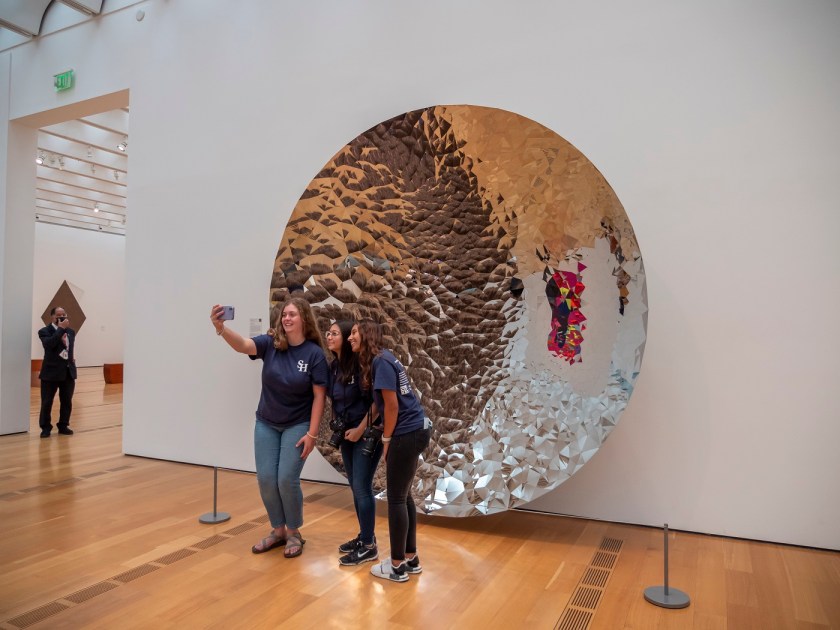
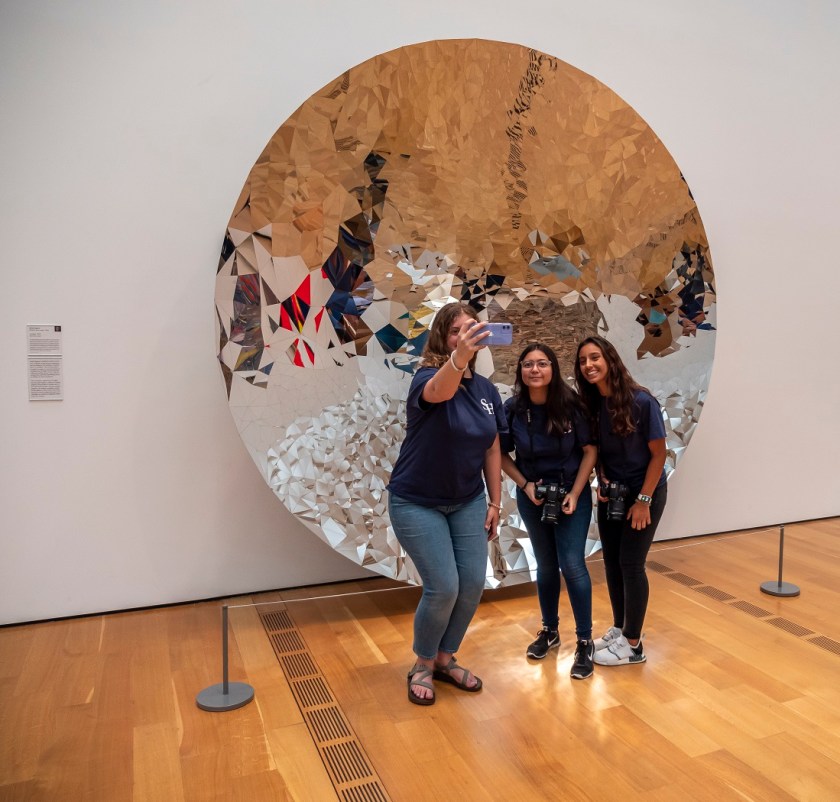
We also saw paintings by John Singer Sargent, Childe Hassam, and Georgia O’Keeffe. Among the modern artists, we were particularly struck by Anish Kapoor’s untitled piece, which had interesting aural and visual effects. This was the most popular piece in the museum.
Our last stop in the museum was the gift shop, where we continued to learn about great artists such as Frida Kahlo and Grant Wood. We bought magnets, flower vases, and postcards to help us remember the beautiful High Museum of Art!
Atlanta Botanical Garden, Morgan Robertson
The SHSU Leap Ambassadors started the afternoon off with a caffeine jumpstart from Caribou Coffee. The coffee house on Peachtree St. offered a wide variety of drinks including drip coffee, cold brew, mochas, lattes, teas, and for non caffeinated options, smoothies, shakes, and pastries. The coffee house served as a good break before heading to the Atlanta Botanical Garden.
The 30-acre garden strategically lays out pathways leading you past countless landscape features and works of art (this would be a good introduction to landscaping architecture, which will learn more about at the Biltmore Estate, landscaped by Frederick Law Olmsted). Upon entering the garden, the bright gradient canopy created by Shearn looks as though it is suspended by nothing as it guides your walk on the Kendeda Canopy walk.
The hand-tied streamer-like pieces (more than 79,000 of them) flow with the wind while simultaneously curving with the treeline and the path of the 40 foot tall walkway.
The art and architecture work together in order to create vivid movement through the garden.
One of the major and most memorable works of art employs the use of 18,000 different kinds of flowers to create the Earth Goddess.
Lounging with complete serenity, the Earth Goddess extends a hand pouring water into the pond.
Taking advantage of the scenery, LEAP Ambassadors posed for a picture, some poses emulating the Goddess herself.
The garden is also home to a large collection of Dale Chihuly glass and painted pieces in the botanical garden.
After learning and hearing about his works on past trips, this was our first time seeing a Chihuly in person and our expectations were exceeded. The glass blown into shapes of flowers and different spirals and sprigs creates a mass of individual pieces working together, which fit perfectly within the garden itself.
The botanical garden mission is “to develop and maintain plant collections for the purposes of display, education, conservation, research and enjoyment.” This mission statement is employed in every aspect of the garden, especially through the most obvious way: the plants. From edible gardens, to neon flowers, and trees that make you want to guess their age, the botanical garden is a place to get lost in wonderment and adoration of something that has been around since the beginning of time.
My personal favorite collection of flowers stems from the orchid conservation lab and greenhouse.
This fragile, common house flower dominates in the climate-controlled greenhouse (72 degrees during the day, 52 degrees at night). Orchids growing in every imaginable way from wall hangings, to in the ground the collection brings a new appreciation to the flower.
Keeping with the colorful flower trend, Yvette’s favorite plant was the hydrangeas.
Commenting on how the color did not even look real, Yvette was able to snap some pictures of the beautiful flowers.
The tropical greenhouse gave an impressive depiction of a rainforest complete with the sounds of frogs and birds. Jessica admired the edible garden in which visitors are able to smell herbs such as rosemary, mint, oregano, basil, and marigolds, but have to imagine what the sweet snap peas or the juicy tomatoes would taste like.
We also had an opportunity to see 16 separate installations by Jason Gamrath, a glassmaker from Seattle–he studied art at Dale Chihuly’s school.
His pieces were large, and they complemented both Shearn’s work and the garden itself.
Between Shearn, Gamrath, and Chihuly, we were in good company throughout our walk.
The floral and green experience creates a longing to step back into nature. And even for some LEAP Ambassadors a desire to develop a green thumb.
Jackson Street Bridge, Morgan Robertson
A little while after sunset, the LEAP Ambassadors walked across the Jackson St. bridge for a picturesque view. Most known for its appearance in the tv show The Walking Dead, The Jackson St. bridge plays a distinct role in the post-apocalyptic show. As a single sheriff trots, he passes by hundreds of abandoned cars toward downtown Atlanta on a horse. The shot is taken from Jackson St. Bridge.
The bridge allows for an excellent shot of the skyline of downtown Atlanta, and a nice teaching experience for photography. Experimenting with different shutter speeds, angles and other functions, we were able to capture several images of the skyline.
Other sightseers had the same ideas about the bridge as we did. Upon walking up to the bridge there were several groups snapping always on cameras, phones, and even drones.
Culinary Adventures, Jessica Cuevas
Although we rest our legs while taking a break for meals, we don’t stop exploring. Thus for lunch, we were treated to Mediterranean Food at a small local restaurant La Shish Kabab in Atlanta, Georgia. Having only eaten this cuisine twice previously (both times with LEAP), I tried the Chicken Shwarma, a simple chicken dish with rice served with pita.
Yvette got the Gyro meat platter, which had beef and lamb….
… and Morgan ordered the Beef Kafta.
Many of the flavors are not in our day-to-day diet, so it was an enjoyable experience comparing each other’s choices. It was a nice meal to tide us over for the next couple of hours.
It was past 10:00 PM and we were arriving dangerously close to not finding any open restaurant that we could dine in, with most kitchens being closed for the night early. Thankfully, we eventually found The Corner Tavern. We made our way to the restaurant where we were greeted with rain (in the parking lot) and a friendly staff (in the restaurant). To start, we ordered chips, queso, garden salsa, and fried artichoke hearts. For our entrees, Yvette ordered a burger with French fries…
…Morgan had the tavern club sandwich with Pimento mac and cheese, and I had the buffalo chicken burger with tater tots. This last meal wasn’t particularly adventurous, but by the time we were able to find an open restaurant, we were pleased just to have food before bed.
And thus with full stomachs, following a full day, we began to burn the midnight oil blogging about our day of adventure…






































 Center for Law, Engagement, and Politics