
It was an excursion day at the conference, where guests had the opportunity to go to Newport, Rhode Island and see some of the Host State’s most intriguing sites. In Rhode Island, this involves a slew of Gilded Age Mansions, and we managed to fit in three separate homes: The Breakers, the Marble House, and Rosecliff.

Newport, Rhode Island has beauty, temperate summers, and its location on a picturesque coastline have made it an ideal location for summer homes for the wealthy. Over the decades, however, not all of the owners’ descendants have wanted to maintain these homes, nor is it easy to find buyers for structures worth, according to recent estimates, 500 million.

Fortunately, the Preservation Society of Newport County purchased many of these homes over the past sixty years, and they have made them available for touring to the general public. For those interested, ticket options include The Breakers + 1 or The Breakers + 2 or specialty tours (e.g., “Under The Breakers Tour”). We opted for The Breakers + 1, with the idea that after seeing the main attraction, we would “breakup” and see different houses (Moya and Discon: Rosecliff; Mike and Stephanie: The Marble House).
The Marble House
The wealthy had lived in Newport prior to the construction of “The Marble House” by William Vanderbilt, but this home was the first of the stone-built mansions that would eventually dot the coastline. An aptly-named structure if ever there was one, the Marble House was designed by Richard Morris Hunt, featured fifty rooms, 140,000 square feet of space, and 500,000 cubic feet of marble.

William Vanderbilt gave it to Alva as a gift for her 39th birthday, which makes you wonder what he would have given to her for, say, her fiftieth birthday. We’ll never know, because she divorced him not long after, and she kept the house.
Done largely in a Beaux-Arts style, the home was unparalleled in opulence when it was completed in 1892. It sits on the Atlantic coast, overlooking the ocean, features two-story Corinthian columns, and its western facade somewhat resembles the White House. With its size and splendor, the home has been the setting for many films and television shows, including The Great Gatsby (1974), 27 Dresses, The Buccaneers, and The Gilded Age.
For those visiting in person, however, the entry is through two doors (with WV on the front) that weigh one-and-a-half tons each, an entry that offers a breath-taking view of the grand staircase.

This two-level room is inspired by both the Palace of Versailles and the Louvre. The banister is wrought iron with bronze gilding, the room gleams with yellow Siena marble, and an eighteenth century mural graces the ceiling, above a gold and crystal chandelier.
Each room offers similarly notable features. The dining room–which was unlike any room we have dined in–showcases a large table with bronze chairs with gold leaf–each weighing seventy-five pounds.

The ceiling decor included game such that might be served for dinner.

The gold room is, as one might expect, predominately gold, but it is accented by green silk drapes (by Prelle) and black.

The most ornate room, however, was the gothic room, which featured Alva Vanderbilt’s collection of medieval art and artifacts, all situated in a room with gothic elements.

By itself, the Marble House offers a class in architecture, interior design, art, history, and excess.


But it is also interesting as a window to an age in which the wealthy competed with each other for even greater conspicuous splendor, which we weren’t sure was even possible until we visited The Breakers.
The Breakers
by Olivia Discon
It’s difficult to select a favorite house, but there is a reason that The Breakers is common to most of the tours. Built in 1895 and designed by Richard Morris Hunt for the Cornelius Vanderbilt family, the home boasts 70 rooms and 138,000 square feet. With a fortune built on shipping and railroads, the Vanderbilts were one of America’s wealthiest families, and their wealth is evident everywhere in the home.

Visitors to the home first see “The Great Hall,” which was inspired by an Italian Courtyard. Not wanting a true open roof, the family opted for a ceiling with a trompe l’oeil mural to mimic the open sky.

Built in a perfect cube–50 by 50 by 50–this single room is larger than the average American house. The term “great” simply doesn’t do the hall justice.
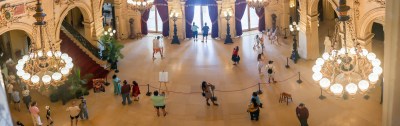
The Billiard Room was another favorite of the group. The mosaic floor was adorned with coastal details, the walls featured “arches” painted in gold leaf, and the room was designed with numerous elements, making for a fun “I Spy” type game for visitors.

Although we were a bit tired from waking up so early, we couldn’t help but fall in love with the “Morning Room.” The room faces east, allowing the sun to pour into the chamber, and the warm lighting and yellow-hued adornments provided a welcoming warmth. The idea of having a room so opulent and just for the morning hours is such a Vanderbilt type of luxury.

One of most interesting aspects of the house is that each room offers intricate and elaborate details that are ripe for overlooking things. To take an example, the Morning Room features panels with cherubs, which, at first glance, appear to simply be classically-themed lagniappe. Upon closer look, however, you see that one cherub is holding an anchor; the other is holding a railroad spike and hammer. Both tie back into the source of the Vanderbilt’s income–the income that made such decor possible.

Each room offered something special. The Loggia offered a breath-taking view of the ocean;

…the bedrooms, although described by the owners as more “austere” than the public-facing rooms, were still opulent, each featuring separate baths, dressing rooms, and walk-in closets;


…and the library was perhaps the most stunning, with the wood doors that had gold leaf pressed into them to give an appearance of a storybook cover, and upper walls lined with green Spanish leather, providing the look of a hide-bound book.

It’s difficult to fathom that such a home was used for only part of the year, a reminder that we live in different worlds and a different age than the Vanderbilts.

Rosecliff
by Michelle Moya
After exploring The Breakers, Olivia and I were especially excited to visit another Newport mansion renowned for its elegance and beauty—Rosecliff Mansion—and it absolutely lived up to its reputation.

Commissioned in 1899 by silver heiress Teresa “Tessie” Fair Oelrichs and designed by architect Stanford White, Rosecliff draws inspiration from the Grand Trianon at Versailles. Its pale limestone façade and French neoclassical design create an elegant lightness that sets it apart from Newport’s other grand estates. While Olivia and I are still learning about various architectural styles, visiting both these homes provided a perfect opportunity to deepen our understanding.

Rosecliff’s history includes dramatic turns: it was sold for a mere $21,000 in 1941, but endured severe winter damage before the Monroes refurbished it in 1947. In 1971, the Preservation Society received the mansion as a donation, and it is now considered a historic house museum, event space, and more.
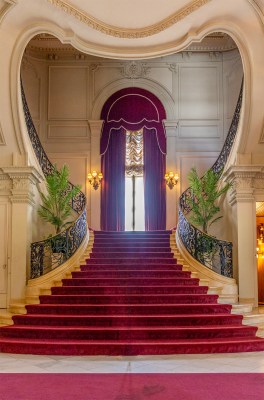
Upon entering, the first thing that caught our eye was the stunning heart-shaped frame surrounding the staircase. This feature lends the entrance hall a theatrical elegance—a design element I found particularly beautiful.
Our self-guided tour began in the French Renaissance salon, which quickly became my favorite space.

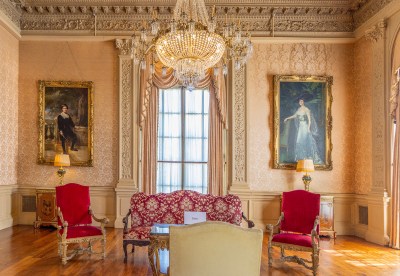
The room has coffered ceilings and classical pilasters, with chandeliers adorned by musical instruments—a homage to Teresa’s talents as a master of the flute, piano, guitar, mandolin, and banjo! Similarly, portraits of society members, painted in the grand European tradition, line the walls.
Next, the tour leads to the mansion’s crown jewel: its ballroom. The ballroom measures 40 by 80 feet with high 22-foot ceilings, making it Newport’s largest private ballroom. There are windows along both sides, creating an airy ambiance, while a masterful trompe-l’œil ceiling depicts a sky-like garden landscape. This room was Olivia’s favorite, and it’s easy to see why.

While we were reading about this space, we also learned that Teresa Fair Oelrichs truly embodied Gilded Age excess, especially in fashion. Wealthy families ordered wardrobes from Charles Frederick Worth in Paris, with ladies visiting the House of Worth twice yearly, spending roughly $30,000 per visit, the equivalent of $600,000 today. This translates to annual clothing expenditures of about $1.2 million in today’s currency, which we found absolutely crazy!
The first floor also houses the Library (or Billiard Room), showcasing Stanford White’s Jacobean styling with bleached English oak paneling and a distinctive white paint.

Additionally, the Dining Room, which is now painted white, having been originally pea-green walls, was filled gold accents, silk draperies by Jules Allard, and landscape panels.

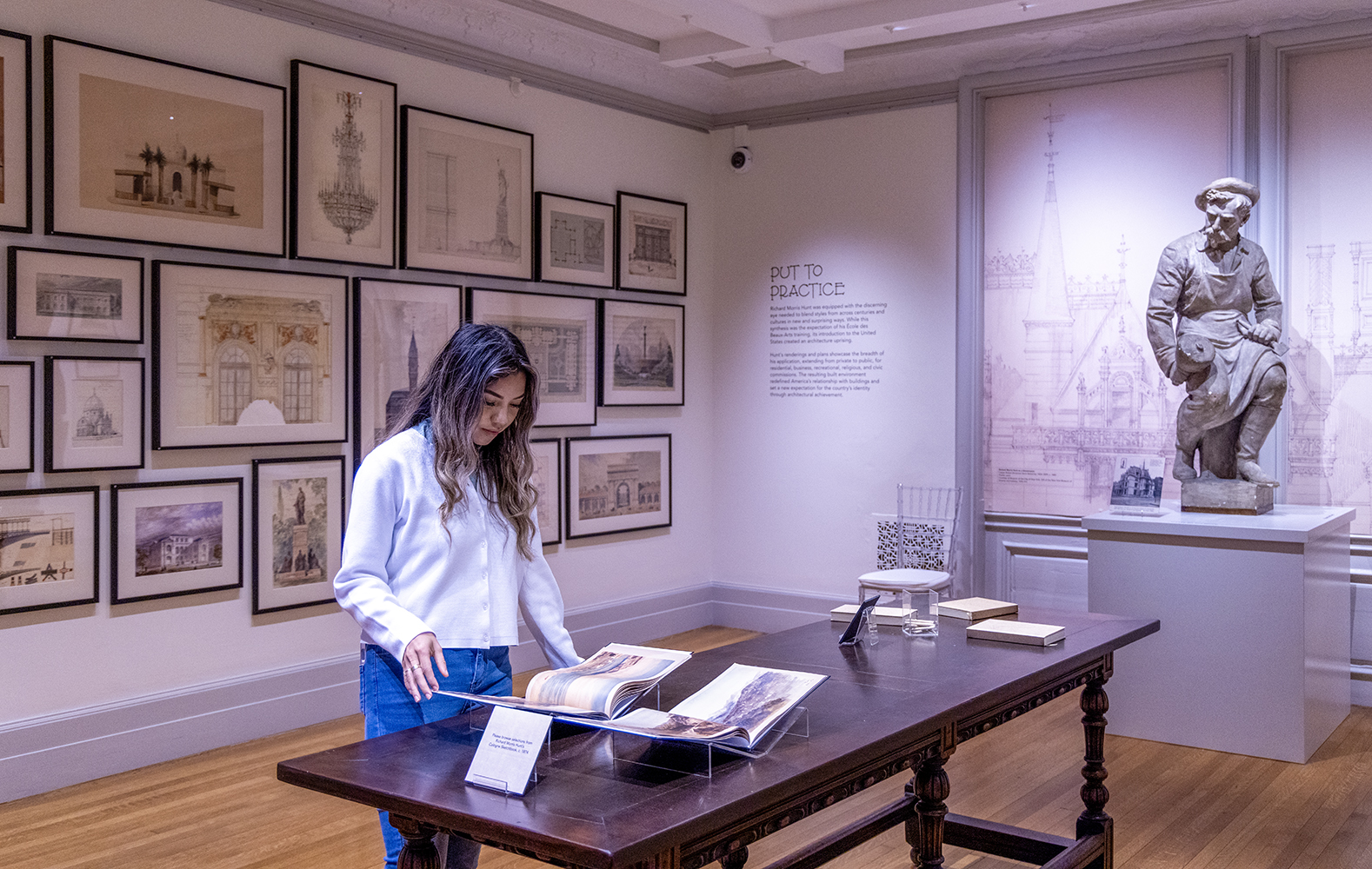
The second floor of the mansion offers additional rooms and rotating exhibits. Currently, the room hosts “Richard Morris Hunt: In a New Light,” showcasing the architect’s contributions and career.

The exhibit displayed his personal sketchbooks…

patron collections, and his creative journey…


After a stop at the gift shop, the tour led us to the mansion’s rear, where a walkway opens onto breathtaking grounds—a view we both instantly fell in love with. Rosecliff’s 21 acres of formal gardens…

oceanfront landscapes…

…and beautiful rear exterior…

…create a stunning contrast between refined architecture and Rhode Island’s rugged coastline.

Today, Rosecliff continues to host elegant gatherings and has appeared in films such as the The Great Gatsby, True Lies, Heaven’s Gate, Amistad, 27 Dresses, and many more. It stands as a great reminder of Gilded Age grandeur and a cultural treasure that Olivia and I loved exploring!

Concluding Thoughts
As noted above, The Great Gatsby, written by F. Scott Fitzgerald, was filmed at various locations on the Newport Coast. The film tries to capture visually the spirit of the book, which addresses themes such as the American Dream and materialism of the Gilded Age and its vestiges that carried over through the 1920s, when the novel was written. It’s a harsh view of the United States, and it is perhaps unfair.
But our visit to the Newport Mansions did drive home a point made by Fitzgerald in a short story described as “an extension of ‘The Great Gatsby’, “Let me tell you about the very rich. They are different from you and me….They think, deep in their hearts, that they are better than we are because we had to discover the compensations and refuges of life for ourselves….They are different.”
Our visit to the Newport Mansions was a wonderful learning experience. We had a rare chance to see the splendor that only a few people ever get to experience, and even fewer have a chance to experience as a way of life. It was a moment to soak in, a chance to see the beauty, the craftsmanship, and the intricacy that the world’s great artists and architects could create, and it was a reminder that those who lived here enjoyed very different lives than the rest of us.


























































 Center for Law, Engagement, and Politics