
As part of the LEAP Center’s ongoing work to expose students to the broader culture, a group of alumni and current students gathered in Houston to see Stanley Kubrick’s “The Shining.” Originally released in 1980, the film is being re-released on IMAX theatres across the country as part of its 45th anniversary.
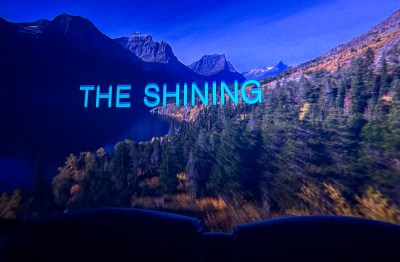
For about half those attending, it was a first exposure to a Stanley Kubrick film. Accordingly, we began with a brief background of Kubrick and his films. Of all the great directors, Kubrick produced the fewest films (13 over a 45-year career), a fact that has not deterred scholars from giving as much thought and ink to Kubrick’s work as that of Hitchcock, Welles, Spielberg, or Martin Scorsese.
Of Kubrick’s films, “The Shining” has received perhaps the most attention. The film is based on Stephen King’s novel of the same title, and it was met with a mixed critical reception on its release, although its stature has grown, and it is now considered a horror classic.
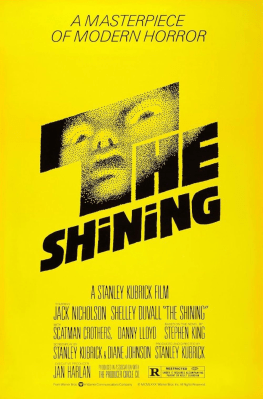
It embodies several cinematic traits of the Kubrick oeuvre: a longish running time, attention-grabbing visuals, riffs on various literary themes, and an enigmatic approach to storytelling that occasionally leaves viewers unsure what they just watched. All of these were on display in “The Shining.”
In this viewing, the visuals were most prominent, perhaps because we were watching this on an IMAX screen. The opening scenes, shot from a helicopter, including a scene where we (perceiving things through the camera) seem to pass the Torrance family on the “sidewinder” road…

…on the way to the Overlook Hotel.
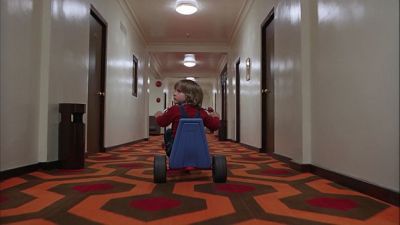
Kubrick also made full use of the Steadi-Cam, which had been introduced on film in 1976. Kubrick used it throughout “The Shining,” and he innovated with it, devising an apparatus that could shoot from about 18 inches above the ground–most notably used in the film to follow Danny on his tricycle, as he traversed the maze-like corridors of The Overlook.
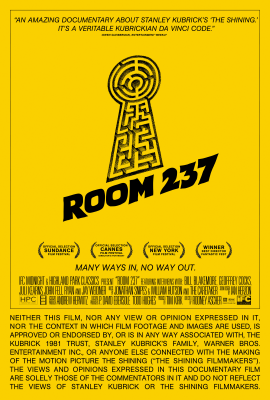
Kubrick’s films are often sprawling affairs and they are deeply studied by scholars and enthusiasts, so it’s no surprise that all manner of symbols and themes have been “discovered” in the director’s body of work. This is probably most true in “The Shining,” as reflected in the interesting and bizarre theories expressed in the documentary Room 237.
Professor Robert Kolker, an author of several Kubrick books and an expert on cinema, suggests that the film can be seen through an Oedipal lens (spoiler alert). Danny’s “shining” is a type of oracular vision not unlike that of the prophecies offered at Delphi, including the one offered to Oedipus. And while Danny wasn’t as close to his mother as was Oedipus, she serves as his caretaker and protector; in the end, she carries him to safety, saving his life.

Danny doesn’t proactively kill his father at a crossroads as does Oedipus, he does leave his lame father to die of exposure in a labyrinth. Of note: Jack Torrance suffers from a foot/ankle injury following a fall down stairs; he literally embodies the term “Oedipus,” which means “swollen foot.”
Whether such messages were intentional or not (it’s worth noting that Kubrick mentioned he read a lot of Freud prior to filming “The Shining”), the film is replete with sufficient ambiguities to provide fodder for the active imagination.

There are some imponderables in the film; it does, after all, involve the supernatural. But even in the logic of the supernatural, what is the purpose of the bathroom scene…

…in which Nicholson embraces a young, naked and beautiful woman, only to find her decay into a rotting but living corpse? Why is there a parlor full of fully-dressed corpses in the hotel? And what about the scene involving a man in a bare-backed bear costume and a man in a tuxedo?

This latter question was posed by many in our group (answered by none), and such questions may reflect Kubrick’s very approach to filmmaking: “if you can get people to the point where they have to think a moment what it is you’re getting at, and then discover it, the thrill of discovery goes right through the heart.”

While we probably didn’t reach “discovery” on many of the scenes, we did “think a moment” or more on the film and its many scenes. The experience offered an accessible and exciting introduction to Stanley Kubrick and his work, gave us all an excuse to get together during the holiday break, and provided us endless material for reflection (and, for some of us, concern…)!

 Center for Law, Engagement, and Politics