
Written by: Allie Plunk
On the first day of our LEAP Retreat, LEAP students travelled to the Alley Theatre for a performance of Stephen King’s Misery. To make this event even more memorable, we were joined by several alumni which gave us a group of 19 people!
The story follows author Paul Sheldon (Chris Hutchinson), who has finally written what he thinks will be his masterpiece when he gets into a car accident that shatters his legs. He is rescued by his self-professed “number one fan,” a woman by the name of Annie Wilkes (Elizabeth Bunch). At first, she acts normal enough, but things very quickly take a turn for the worst. Married in real life, the actors gave a wonderful performance, leaving us wondering how they manage to create such believable characters while still going home together each night. Having just seen the movie a few weeks before, it was very interesting to see the difference in the details and presentation of the story as it was adapted for the stage.
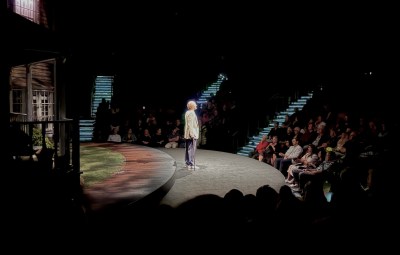
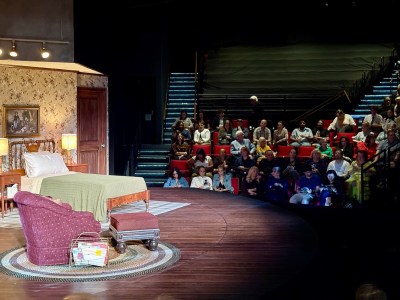
One of the most striking elements of the play was the set. Split into three distinct parts, the set rotated on a turntable to create a seamless transition between the room where Paul is held captive, the rest of the house, and outside. We were all astonished by the level of detail that went into the set, from the numerous images of Paul Sheldon, to the inclusion of a working staircase. Another practical piece of the performance that we enjoyed were the special effects. We had a good time figuring out how they incorporated stage blood and prosthetics to enhance the gorier elements of the story.
Having finally finished the Misery trifecta– the novel, movie, and play– I found the differences between the three mediums incredibly striking. The novel contained much more prosaic passages, as well as backstory and lengthened character development, especially for Annie Wilkes, than either the movie or play. The movie, however, shifted and condensed elements of the novel, such as the addiction that Paul develops to the pain medication Annie provides him and his reliance on imagination to endure his captivity, while adding in the perspective of the town Sheriff that is investigating his disappearance. The play retains many of these elements, several lines of dialogue taken directly from the movie, though Annie’s characterization relies on much more of the actor’s discretion, removing much of her backstory entirely. Despite these differences, each preserves the core of the story: the dangerous, disruptive nature of obsession.

Overall, Misery proved to be a fascinating example of how a story can evolve across different mediums while retaining its central themes. Both entertaining and thought-provoking, it was a memorable highlight of our retreat and gave us a deeper appreciation for the art of adaptation.


