After three days attending the Texas Tribune Festival, LEAP students prepared themselves for a somewhat relaxed day of learning about art. But first, the crew headed out for lunch at the New World Deli.
Lunch at New World Deli – Ilexus Williams
After getting to sleep in a bit after a long weekend traversing the Festival, we started our last half-day in Austin with brunch at New World Deli. We were greeted by friendly staff, and all ordered various soups and sandwiches. Among the many dishes ordered, a common one was the Broccoli and Cheese soup, which everyone agreed was scrumptious!
The sandwiches that we ordered weren’t the only things grilled at the table; Professor Yawn questioned each of us in turn about our favorite activities of the trip. First, we were asked to reflect on our favorite Texas Tribune panels, which included “Education Reform That Makes the Grade,” “From Deployment to Employment,” to “The Consequences of Gun Violence.”
Then we were asked which speaker we enjoyed hearing from the most. The answers ranged from Beto O’Rourke and Eva Guzman to Wendy Davis. Next, we all tried to distinguish our favorite group activity. However, no one could choose between Mr. Arredondo’s art studio…
and the Segway tour!
Both were unique and unforgettable experiences in their own regard.
After finishing our meals, we ordered a smorgasbord of sweet treats. We finished out our time at the New World Deli with brownies, chocolate cake, gluten free cookies, and key lime pie. After indulging in dessert, we made our way to our last stop: The Blanton Museum of Art.
The Blanton Museum of Art – Elena Castillo
At the Blanton Museum of Art…
…we were taken back to a time when art was a catalyst of revolution and change. Today we wandered through centuries of historic change from different cultures and societies. As we walked through The Blanton Museum of Art each piece held a different message. We saw many pieces by many of LEAP’s favorite artists such as Thomas Hart Benton…
….Ellsworth Kelly…
…George Segal…
…and Andy Warhol.
My personal favorite was one of the pieces from the Carl & Marilynn Thomas collection known as “La Muerte de San Jose,” which translates to “The Death of Saint Joseph.” This piece was filled with many colors that blended so smoothly together that it was hard to understand where the focal point was but it was clear that the painting represented something important. It also added to the reality of Saint Joseph’s death, from the angels above his body, to his pale skin, and finally by Jesus placing a final blessing on him as he dies.
I was so captivated that I didn’t realize the rest of the group had continued on to the next exhibit and had to catch up!
Another favorite among the group was a piece by Cildo Meireles. It is a contemplative space that is meant to symbolize the Jesuit oppression of the indigenous Tupi-Guarani peoples of Brazil during colonial times.
The installation uses a line of 800 communion wafers that is strung from a ceiling made of 200 cattle bones and hangs down and connects to the floor which is strewn with around 600,000 pennies. The entire piece is shrouded in black gauzy fabric which is meant to represent life and death. The string of wafers connecting the bones and coins symbolizes the connection that spiritual power had between the suffering of the indigenous peoples and material wealth that resulted from their colonization.
After meandering all the way through the museum, it was time to explore “Austin” which is perhaps more well known simply as the Ellsworth Kelly chapel. As it is relatively empty, we only spent a short while taking it in.
The different designs of stained-glass windows at each of the three different ends of the chapel cast different colors on all the walls inside.
The Kelly pieces were beautiful, with each wing of the chapel showing off the art in a different way.
…and being just right for photographs.
For many, this was our first time to the Blanton Museum, and for a couple it was our first trip to an art museum ever. We learned so much during this weekend, and were grateful for the opportunity to visit our state’s capital and learn and experience so many new things there. Until next time, Austin!
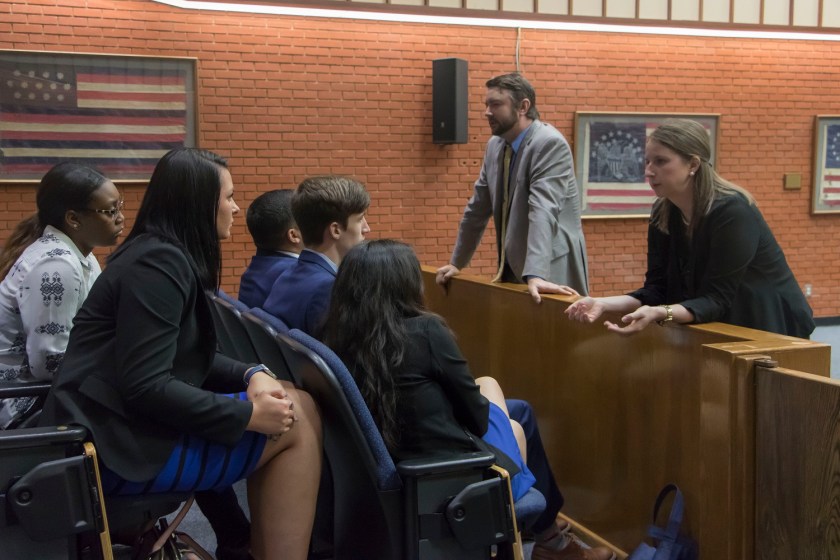
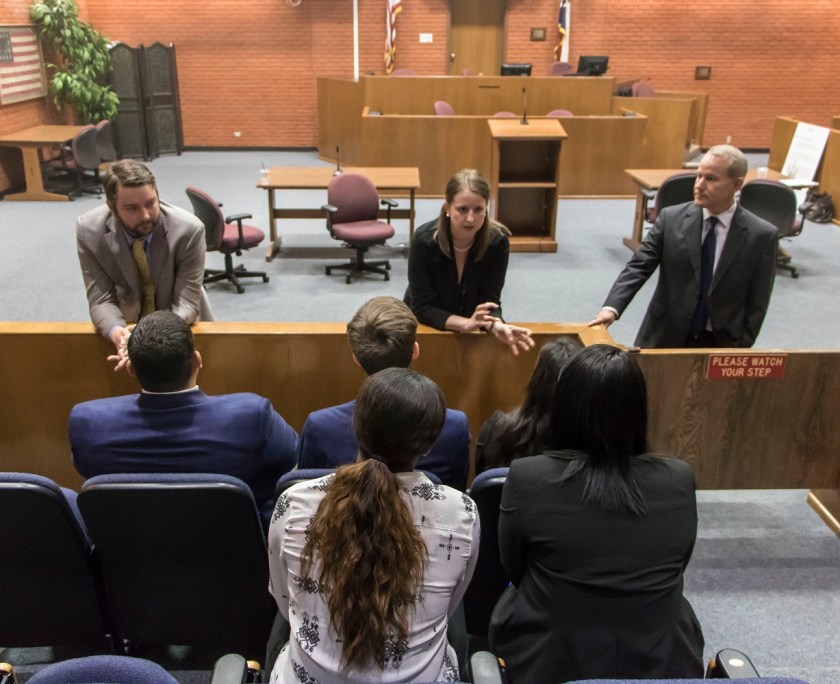
Just one day after hearing three appellate cases in the Kerper Court Room, the Leapsters were back and ready for more!
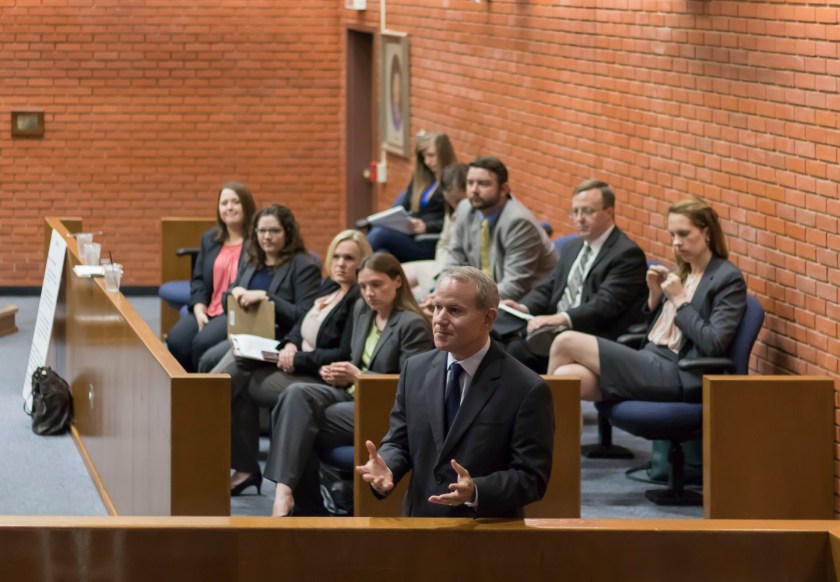
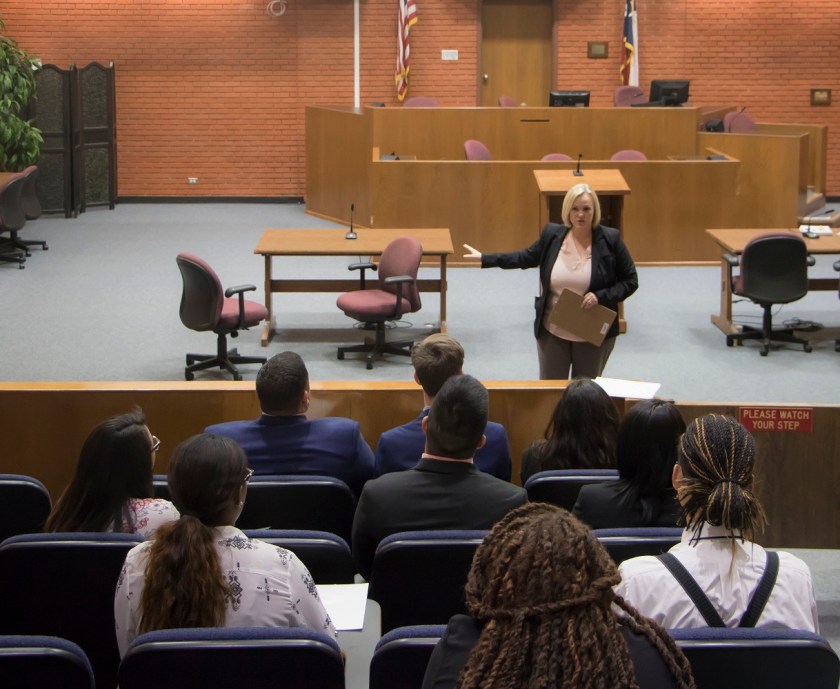
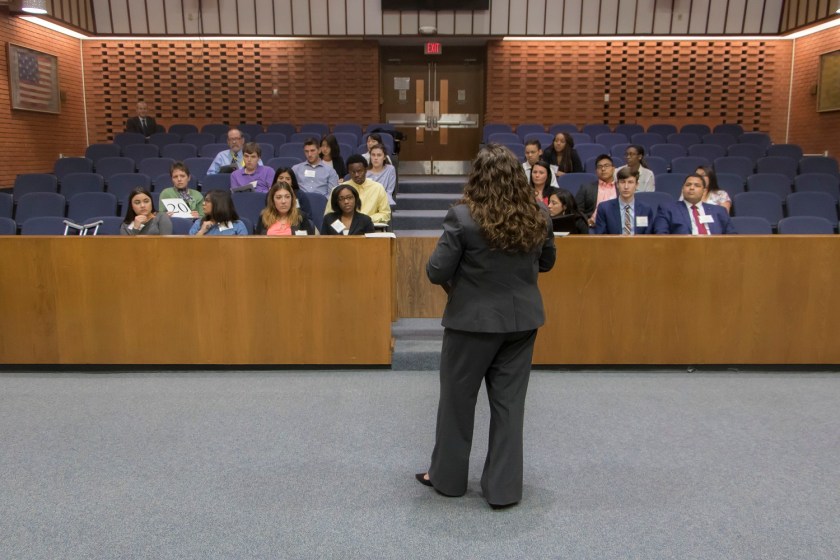
Today, we were going to take part in a Voir Dire training for the Texas Special Prosecution Unit. The SPU was established in 1999 to handle cases involving sexual offenders who have been convicted of two sexual offenses, incarcerated for at least one of them, and are about to be released back into society. The cases they work are to determine if the individual has a behavior abnormality and should be sent to a rehabilitation facility. These cases are unique in that they are civil cases, but they still have a twelve-person jury decide the outcome. Hence, the Voir Dire team is there to understand each person as an individual and see the potentiality of being fair and impartial throughout the trial, which is not always an easy process. During Voir Dire, the prosecution and the defense will ask a series of questions in order to select the best possible jury for their client.
After receiving the background information about the Special Prosecution Unit, we were given a fake identity to role-play for the Voir Dire. My identity was a single, 28 year old, with no children, who worked at a correctional facility. I knew, according to my provided profile, someone who had been sexually assaulted, but I could still be fair and impartial.
The prosecutors then took turns asking us questions and giving us hypotheticals.
If an individual agreed or disagreed with a statement, the prosecutor would ask that individual more questions.
Everyone in the Courtroom had a different character they had to play.
They were give certain guidelines such as mine but it was up to them to play their part as best as possible.
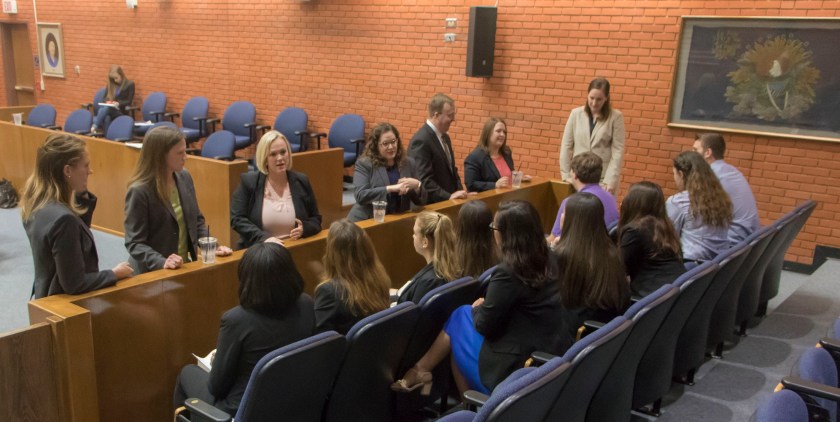
After the Voir Dire session, some students stayed to ask the prosecutors questions about Voir Dire process….
…how they became a part of the SPU…
and the cases they have worked.
I asked Erin, one of the prosecutors, how many cases have there been where the jury found that the individual did not need to go to the rehabilitation facility. She replied with very impressive numbers. She stated that the Special Prosecution Unit has handled a little over 400 cases and out of those cases, only five individuals were found by the jury to not have a behavioral abnormality.
Out of all the individuals who have been sent to the rehabilitation facility, only six have been released back into society and none of them has reoffended. Likewise, the other lawyers had very similar stories to tell and experiences that they went through. We also received law school advice, such as in Karla’s case who wants to go to Texas Tech. One of the lawyers was a Texas Tech alumni, and so they spoke about the different opportunities that Texas Tech had to offer. Everyone was sad to leave, as the conversations were very interesting. However, we all learned so much from this experience, not only of the process of Voir Dire and law school.
Many thanks to the Texas Special Prosecutors Unit, particularly Jack Choate and Erin Faseler, for partnering with SHSU on this rewarding activity.
For our last day at the American Society for Public Administration annual conference, we got an early start so we could squeeze in one last half-day of learning before we made our way out to Rocky Mountain National Park. Again, the Leapsters decided to divide and conquer and tackle two different panels. “Public Service Motivation” and “Social Equity and Its Importance on Government” were our choices for our last conference day, and they were excellent ones!
Public Service Motivation, by Karla Rosales
One of our last conference panels was “Public Service Motivation” by Hyeong Ha, a post-doctoral fellow from the Social Science Korea Research Team-Yonsei University in Seoul, Korea, Mehmet Akif Demicioglu, an Assistant Professor at the National University of Singapore, and Taha Maneduddin, a doctoral student at Indiana University. The panelists focused on different components that affect motivation of employees in public service from organizational image to social media use.
Public service motivation is a rising concept among businesses today, and various sectors have made it their mission to understand how to keep public service involvement by their employees at high levels. There are different ideas that affect motivation, but organizational image actually has a great impact on public employee motivation. Public employees are motivated by the perceived image of the organization as a whole. If the organization is seen as one with high prestige, then there is more motivation among its employees to serve the public because they have a greater sense of satisfaction when the organization is successful at accomplishing its mission. The image of the institution in this context includes both the internal and external.
We also learned about the effects of social media usage on an employee’s job motivation. The fact that almost all public agencies use social media makes it an important aspect when considering employee motivation. Social media affects transparency, accountability, and innovation in the public sector. Therefore, social media use by companies actually increases employee motivation because it allows for the employees to have more job engagement.
Social Equity and Its Impact on Governance by Victoria McClendon-Leggett
In the panel titled “Social Equity and its Impact on Governance,” we heard a variety of presentations from speakers from all over the world.
First was Professor Samantha Larson, University of Wisconsin-Oshkosh, and she demonstrated participatory photomapping software and how it can be used to fix issues in communities. When a picture of an issue in a community is taken, the software will save the photo and plot a point on a map where it was taken so that the local government can address it and come up with a solution.
Second, we heard about affirmative action in Brazilian higher education and how it has helped to combat social inequities across Brazil from Professor Fatima Bayma de Oliveira from the Fundacao Getulio Vargas Foundation in Rio De Janeiro.
Lastly, Professor Annie Miller from the University of Denver addressed how combating social inequity here at home can, in turn, help prevent terrorist organizations from recruiting marginalized American citizens. It was altogether a very interesting and informative panel.
We were disappointed to see the end of the ASPA conference and we couldn’t help but take one more glance behind us as we left.
However, that disappointment was short-lived, as we looked forward to visiting a National Park. Indeed, it made us feel like dancing.
This slideshow requires JavaScript.
Rocky Mountains, by Bianca Saldierna
Wildlife, frozen lakes, and snow sleds. Today was the day! Our long-awaited trek to the acclaimed Rocky Mountain National Park had arrived. We left our last ASPA panel and headed back to our hotel to change from suits into warmer threads, and hit the road.
For some of the LEAP ambassadors this was their eighth visit to a national park, while others among us were first-timers.
Either way, the excitement among the group was palpable. After climbing trails and photographing the snow-covered mountains, we were fortunate enough to spot some of the wildlife that call some of the 358 square miles of park their home.
This slideshow requires JavaScript.
We admired elk as they grazed and the Steller’s jays with their deep blue colored bodies and black heads. Since it was our first time seeing elk, the Leapsters gave them (and the Leapsters themselves) an extensive photoshoot in their natural habitat…
Although we were entranced by the Elk, we continued to look to look to our left, where we saw Longs Peak , which is the highest summit in Rocky Mountain National Park, standing proudly at over 14,ooo feet. This peak has a special place in our hearts, because our friend Mark Burns did a wonderful photograph of Longs Peak for his National Parks Photography Project…
…and one of our favorite paintings from the trip thus far was Birger Sandzen’s version of Long’s Peak.
We did get a few photos of our own of Long’s Peak, perhaps emphasizing us than the Peak, but made for a great background!
But, really, we had a beautiful backdrop, no matter which direction we turned…
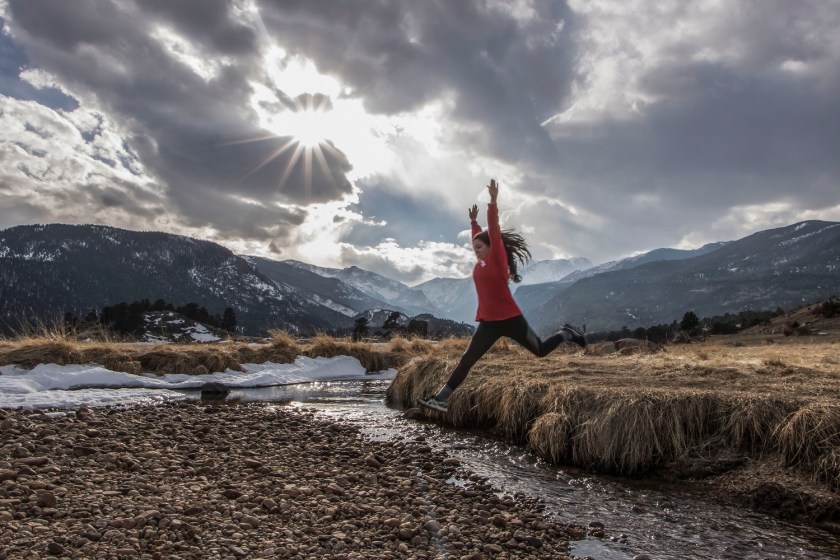
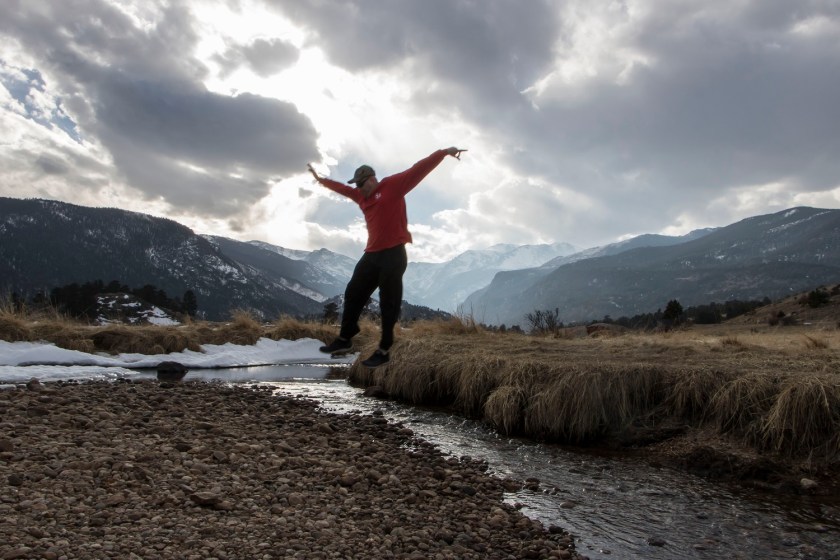
And, we took turns doing our now traditional “LEAP Photo”; by we, I mean Christina Perez…
…Bianca Saldierna…
…and even Professor Yawn…
…who jumped the highest and the longest…and who also adds last minute changes to the blog…
Although we enjoyed observing the wildlife immensely, we decided to take a break from admiring our surroundings to try our hand at sledding!
This slideshow requires JavaScript.
After a brief trek out to Bear Lake, we found a good location to hone our sledding skills. Some of the Leapsters were more successful than others, but everyone had a smile on their face, even when they fell.
Our last goal for the day was to photograph the sun as it slipped behind the mountains from across frozen Lake Sprague. Although we barely missed the sunset, we were still fortunate enough to witness some of its vivid colors behind the mountains, and Professor Yawn showed us all how to capture them with a camera even in low light.
Without a doubt, the Ambassadors agreed that the spectacular views of the mountains were their favorite part of this trip. That magical moment would forever be imprinted in our heads.
In The Mediterranean by Christina Perez
Ravenous after our time spent traipsing around “RoMo” National Park, we decided to pass through a new city to try a new place for dinner. A town of about 108,090, Boulder is home to the University of Colorado, Boulder.
Christina, surprisingly, picked out a Mediterranean place for dinner. It was called “The Mediterranean” or “The Med” for short and it is in the heart of downtown Boulder.
Although we weren’t dressed appropriately for a nicer restaurant they accommodated us without batting an eye. We began our meal by sampling several of their tasty tapas including Burrata Caprese, Ratatouille, Falafel, Baba Ganouj.
Our entrée, Paella, was served family style so we all shared the Spanish dish. Paella is traditionally cooked with a variety of different meats and seafoods in one dish, and ours consisted of chicken, shrimp, muscles, chorizo, and clams over Spanish rice.
While we finished up dinner we celebrated the success of one of our own. Karla, a senior LEAP Ambassador, had just received her first acceptance letter to law school earlier in the afternoon!
We left Boulder with big smiles and full hearts ready to make the most of the second half of our ten-day trip.
“Congratulations!
Today is your day.
You’re off to Great Places!
You’re off and away!
–“Oh, the Places You’ll Go” by Dr. Seuss
Our long-time friend, Ms. Bocskor, was back in our small town of Huntsville last week. After many travels across the world, a stop at the quiet yet merry town of Huntsville was overdue. As a “democracy coach,” Ms. Bocskor travels throughout various countries as a trainer, consultant, and expert in democracy. She advocates for people to participate in their political system and teaches them effective ways to fundraise for and otherwise promote their cause. She has even written a book titled,“Go Fish: How to Catch (and Keep) Contributors.” Having worked in various campaigns, she also encourages people, especially women, to be more engaged in politics, giving them advice for how to work in the political world and even how to run for office.
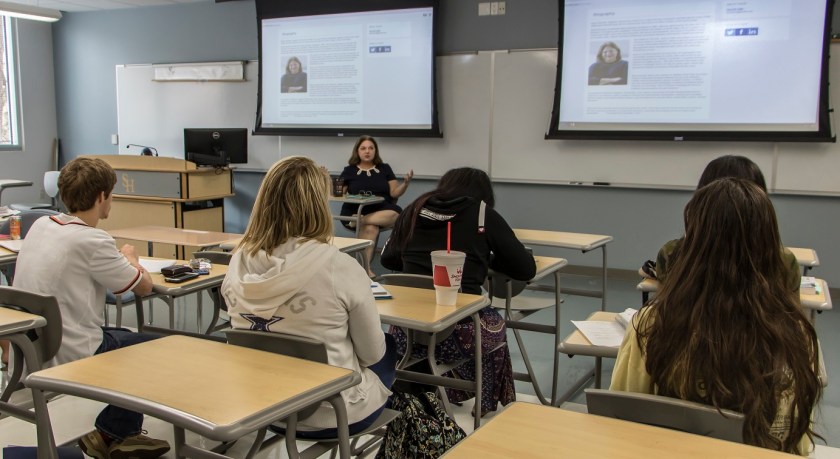
Over a three-day period, Ms. Bocskor spoke to about 10 different groups. One such event was to talk to students in the classes of Dr. Mahoney and Dr. Evans.
Students were regaled with stories about her travels as a democracy coach. One of her favorite sayings, and motto that she has lived by, is “If you are not at the table, you are on the menu.” With these encouraging words, she proceeded to explain the importance of being involved in politics and government, whether it be local, state, or federal. Without that kind of political engagement, it is very hard for problems in our communities to be fixed. Ms. Bocskor motivated for students “to pull up a chair to the table” and become involved in making decisions.
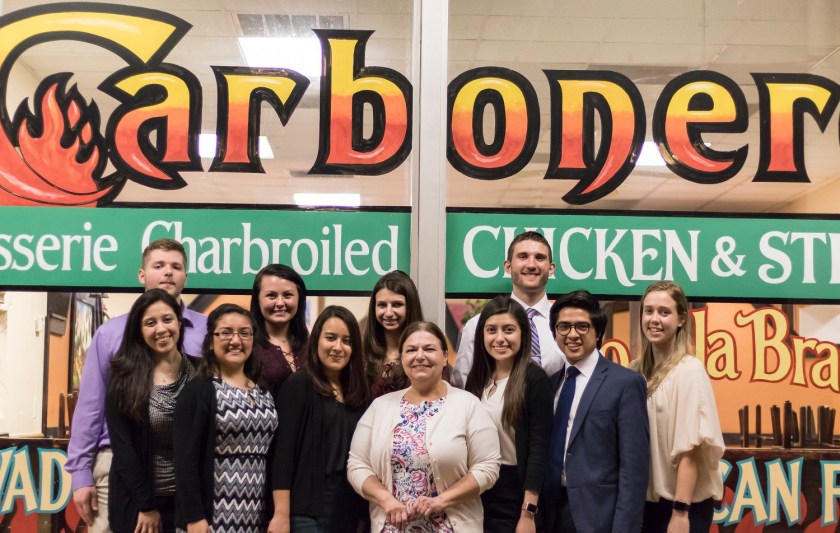
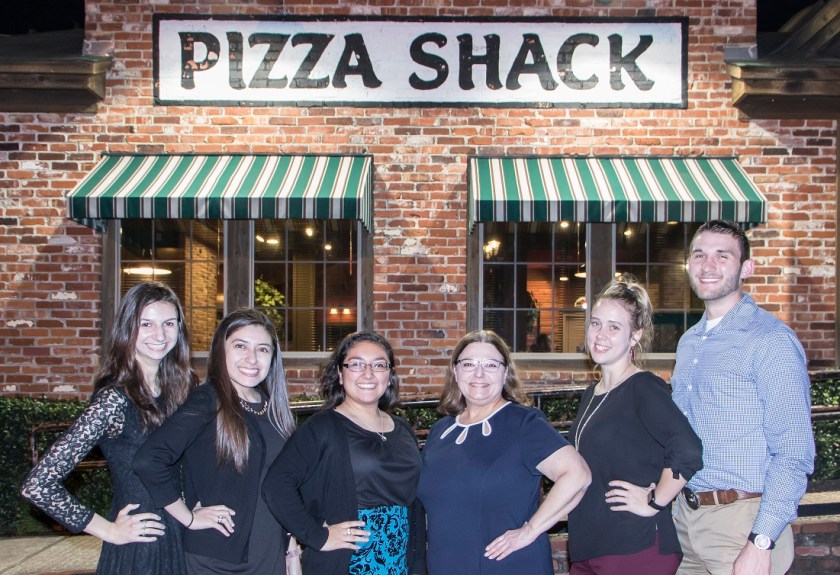
These kinds of invigorating discussions continued throughout lunch and dinner. Throughout the three days, we visited many of our local Huntsville restaurants such as 1836 Steakhouse…
Luigi’s…
Farmhouse Sweets and Eats, and Carbonero.
Meanwhile, Ms. Bocskor met with various people from around the community, such as Mrs. Terry Stivers, Katy Russell, and SHSU Associate Director of Career Services, Vinessa Mundorff, along with the LEAP Ambassadors, to give them advice on fundraising, engagement in politics, and her many programs.
There was never a dull moment when dining with her, and Ms. Bocskor proceeded to enchant us with stories about the lives that had been impacted with the programs she had begun in different countries such as Egypt, Russia, Nigeria, and Lithuania, to name a few. One of the most current programs that she had been working on was one was geared to help doctors and bankers specifically to run for office.
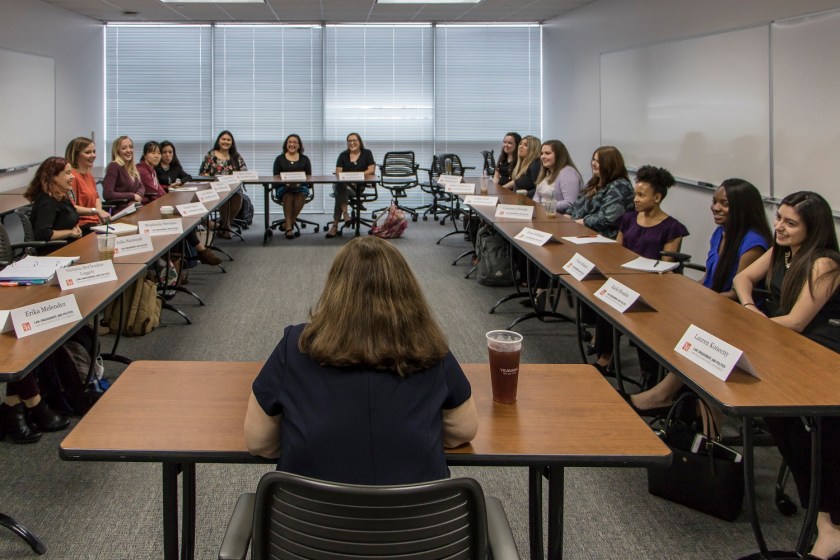
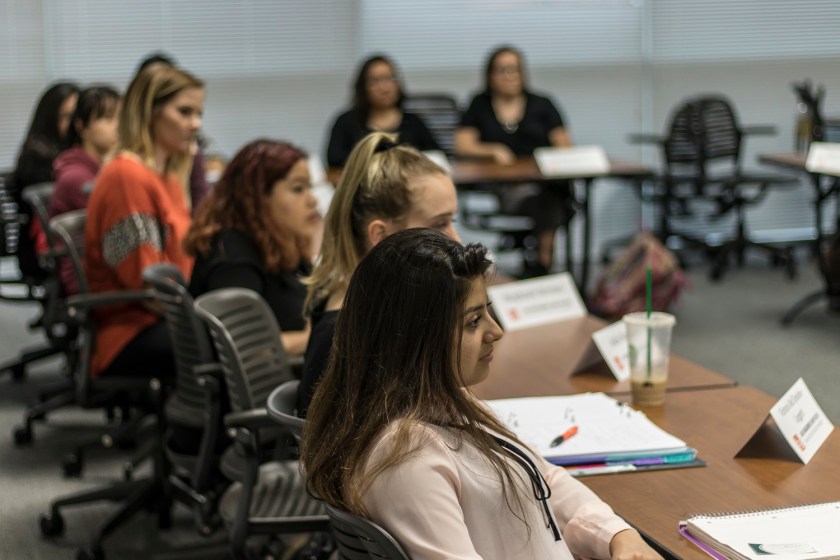
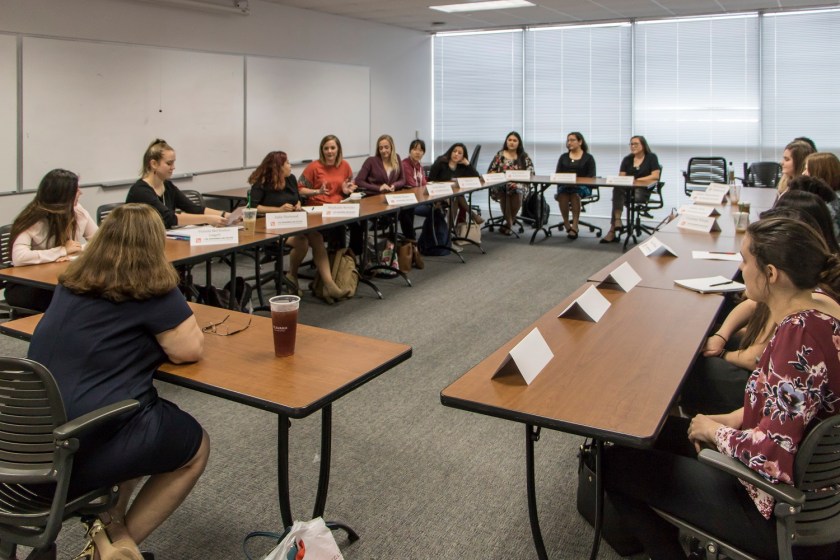
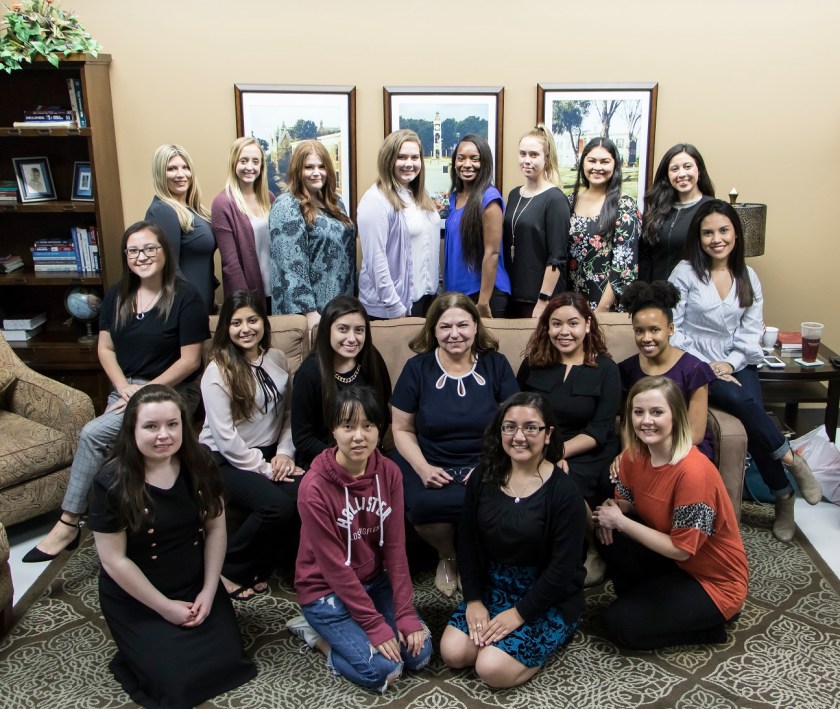
However, the main event during Ms. Bocskor’s stay was the small women’s group meeting hosted on our SHSU campus. Around 20 female students attended a meet and greet with Ms. Bocskor and were able to listen to her empowering advice and experience.
Having worked in various campaigns and legislative offices, Ms. Bocskor motivated these young women to persevere and be successful in politics and disregard the superstition that they could not be triumphant, especially with a family.
She gave various testimonies of powerful women who had not given in to that type of mindset and had lead prosperous careers throughout their life.
By allowing the heart and passion of an individual, as well as a strategic plan, there were opportunities to be taken.
On that last note, Ms. Bocskor had to depart on another adventure, but she left behind invigorated individuals to continue her legacy. It is always a pleasure to visit with Ms. Bocskor and listen to her invigorating tales. We were all disappointed when our time was up because she has a wealth of knowledge about so various topics, and we thoroughly enjoyed the conversation, but we understood that she must help so many other people that are not as fortunate. We just hope to be able to follow her advice, especially the Leapsters, and other people who hope to be engaged in politics.
“You have brains in your head.
You have feet in your shoes.
You can steer yourself
any direction you choose.
You’re on your own. And you know what you know.
And YOU are the guy who’ll decide where to go.”
With SHSU gearing up for finals, the LEAP students didn’t spend a full day in Austin, but with help from veteran LEAP Ambassadors, they made the most of the time they had.
Following a late night (blogs submitted at 1:38am), Megan Chapa, Staci Antu, and Jennifer Holton awoke early to manage visits to the TX Capitol and the LBJ Presidential Library.
____________________________________________
Texas Capitol Building
The visit to the Capitol was immensely rewarding, beginning with a short tour, where we learned that the TX Capitol:
Is the sixth tallest capitol building in the US and is, in fact, larger than the US Capitol;
Is the largest in square footage (the extension alone is 670,000 feet);
has doors so heavy that 17.5 pound door hinges are required.
Of course, a highlight was the “whispering gallery” in the rotunda, where you can stand, speak, and hear your own instantaneous echo.
We also saw the old Texas Supreme Court building, a small room in the Capitol! It’s really no wonder they moved.
It wasn’t all fun and games. Christina Perez, intern for Rep. Jim Murphy, led us on a tour of the Capitol building, where we learned a lot and had some fun, too!
Part of the fun was visiting the offices of the interns with whom we shared dinner the night before. It was a great chance to see their work environment, learning more about how things work, and seeing their passion for their job.
Alex Galvan, Brian Aldaco (who showed off his fancy lobbyist-provided calculator), and Karla Rosales served as office guides.
Christina also took us to the House and Senate galleries, where we watched some of the action on the floor…
…and posed for photos…
…and even got a waiver on the “no-standing” rule for one photograph…
We’re not sure, but we think Megan’s repeated winking at the Marshal may have encouraged him to let us break the rules a bit.
Although it was a short visit, it was a nice counterpart to our previous evening’s stroll around the capitol grounds, and we really appreciate Christina and the other Austin Interns/LEAP Ambassadors providing support of our tour. Although Megan was a veteran of the state capitol and Staci had visited previously, it was Jennifer’s first time, and a great way to experience her first visit to the Texas Legislature.
____________________________________________
LBJ Presidential Library
Again, Megan was a veteran of the LBJ Presidential Library, and Presidential Libraries in general–she’s been to four–but it was Staci and Jennifer’s first time in a presidential library. It’s a lot more fun than it sounds!
We began by watching an eleven-minute overview of LBJ’s life…
…got a good taste of the Johnson Treatment…
…saw some Johnson Humor…
…and generally enjoyed the exhibits.
The most substantive areas, however, were the exhibits on legislation that Johnson passed, and there was much to see! Obviously, Civil Rights is Johnson’s most impressive legacy…
…and this area was the highlight of the Museum.
Or perhaps the most impressive aspect was being able to see how much he was able to accomplish in only five years, while also seeing the history that transpired during his life–from the advent of flight, WWI and WWII, the Civil Rights movement, and the moon landing. It was a great way to learn not only about LBJ, but also about the 20th century.
It was also a beautiful day in Austin. To cap off the day, our trip, and interactions with some truly wonderful people–from Jeff Guinn and Stephen Harrigan to the Austin Interns–we captured some of Austin’s beauty and one of its most notable landmarks in a farewell photo outside of the Library.
The National Book Award Festival (NBAF) at SHSU is the product of hard work by Dr. Amanda Nowlin-Obanion, who has once again brought a group of award-winning authors to Sam. Sponsored by the CHSS, the NBAF featured the young-adult trilogy March, by John Lewis and Andrew Aydin and illustrated by Nate Powell. The three spent 24 hours or so at SHSU, mingling with students, faculty, and staff at a reception, formal presentation, and a breakfast.
The evening kicked off with a reception for 80 or so stakeho0lders in the Lowman Student Center, where Lewis, Aydin, and Powell patiently shook hands…
…mingled…
…discussed politics, literature, and the weather…
…and, of course, signed books.
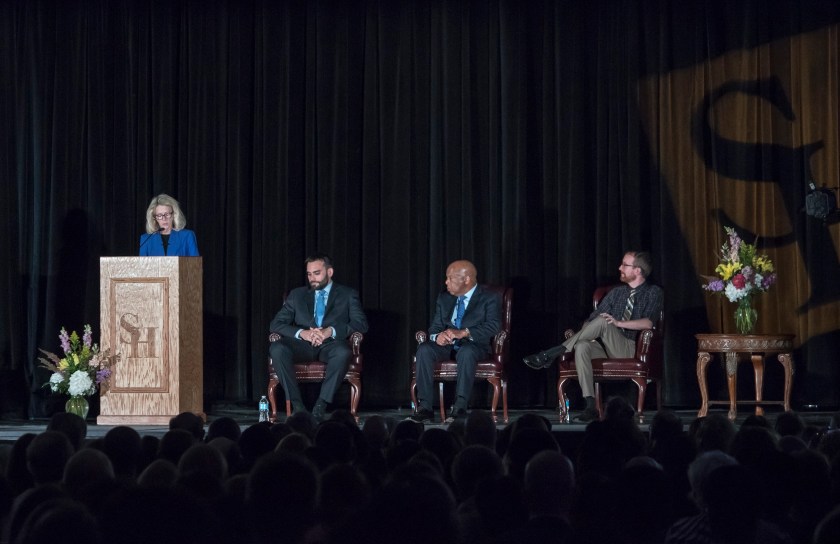
From there, the authors migrated to the LSC Ballroom, where they took turns discussing their book and life experiences for about an hour and a half. Introduced by Dean Abbey Zink, Benjamin Samuel (NBA Director of Programs), and President Dana Hoyt, the three authors spoke to a packed house of approximately 650 people.
Illustrator Nate Powell discussed the challenges of drawing pictures that not only advanced the narrative, but also captured the raw emotions of the events: violence, courage, and passion.
Author Andrew Aydin discussed his career with Congressman Lewis, from his beginnings handling mail to working with emergent digital technologies. He also took credit for the idea of a graphic novel, as a means of achieving Lewis’s goal of reaching a younger audience. Pushing a “comic book,” he noted, was a tough sell, but one that Lewis warmed up to over time.
The crowd was clearly there to hear Rep. Lewis, who responded with a moving biographical discussion and rousing calls to action. He reminisced about his days on a farm in Alabama, his lack of access to college education, his parents’ admonitions “not to get in trouble,” and his own tendency to push the envelope for the right cause.
It’s a strategy that has served Lewis well over some six decades in public life. He has served in elective office for 46 years, 41 of them in US Congress. And he encouraged the young people in the audience to heed a similar call: to pursue activism for the right cause, to “get into trouble” for a good cause.
Whatever your thoughts about getting in trouble, the night was clearly a good cause, one supported by hundreds of staff, faculty, students, and locals, who offered thanks with multiple standing ovations and the purchase of probably 200 books.
LEAP students were privileged to be a small part of the proceedings, serving as somewhat ineffectual ushers (people sat where ever they wanted mostly, irrespective of instructions).
Following the event, we were able to pose with a group shot of the authors, the Dean, and event organizers, a special coda to a special evening.
Many kudos to Dr. Nowlin-Obanion, Dean Abbey Zink, and the staff of CHSS for putting on a first-class event.
As the LEAP ambassadors’ research drew to a close, still more adventures await them on the road. Although the various activities we got to engage in on the way to Detroit were elucidating and interesting, the true focus of our trip was as stated previously, to help Jeff Guinn in researching the Vagabonds.
For that effort, from Monday to Thursday, we followed the same routine; getting to the Henry Ford Museum’s research library around 9 a.m., researching for a few hours, getting lunch with Mr. Guinn and Mr. Fuquay, researching some more, and finally spending an hour touring the museum or the adjacent Greenfield Village.
This was a phenomenal opportunity to see a best-selling author in the research environment. Additionally, we got to hear many stories and see many amazing artifacts.
Research
One highlight was being taken back into the conservation section of the Henry Ford, where we were shown a Lincoln refrigerated truck that was being restored.
1922 Car Used by Vagabonds
Incredibly, this was the very refrigerated truck that Henry Ford, Harvey Firestone, and Thomas Edison had taken along with them on a few of their camping trips! We got to stand next to real history, and see how the team of the Henry Ford is working to preserve and restore such artifacts for future generations to enjoy.
Another special treat was being able to help Jeff Guinn pick out pictures for his book from the Henry Ford’s digital collection.
Reviewing Vagabonds Photographs for Mr. Guinn’s Book
We sat down and looked through 231 pictures, narrowing these down to about 40. Mr. Guinn will look through other sources before settling on which ones he wants to see appear in the book. At that point, the marketing team for Simon & Schuster, Mr. Guinn’s publisher, will dissect his choices, and they will make the final decisions.
During our breaks, where we could wander freely in the museums. Following our first day, which we spent focusing primarily on the Beatles Exhibit and automobiles in the Henry Ford Museum, we spent the last couple of days looking over planes, civil rights exhibits, Americana, and even furniture.
Henry Ford Museum
But this was no ordinary furniture; many of the pieces were owned by highly accomplished gentlemen. We saw a desk used by Edgar Allen Poe for most of his adult life, for example. It is possible that some of the stories and poems that are so loved today, like “The Raven,” “The Telltale Heart,” or “The Pit and the Pendulum,” were scribed at this very desk.
Edgar Allan Poe’s Writing Desk
We also got to see John Hancock’s card table and Mark Twain’s writing table!
Mark Twin Portrait & Writing Table
In the planes section, the Museum had a replica of the Wright Brothers’ plane…
Replica of Wright Brothers’ Plane
…and a little known Ford plane, which never really proved successful commercially.
Ford Company’s Unsuccessful Plane
In the Americana section, they had a copy of Thomas Paine’s “Common Sense”….
Thomas Paine’s “Common Sense”
… and the chair in which Abraham Lincoln was sitting when he was assassinated.
The Abraham Lincoln from Ford Theater
As the above suggests, some of the artifacts were unusual, even unsettling.
On a more inspirational level, the Museum had the bus on which Rosa Parks refused to take a back seat, both literally and metaphorically.
The Bus on Which Rosa Parks Refused to Take a Back Seat
Amazingly, people were even allowed to sit in the seat she refused to relinquish. The Museum also had guidelines of the “Montgomery Improvement Association” (led by Martin Luther King, Jr.) distributed to African Americans which helped them stand for their rights without putting themselves or others in undue danger.
Wrapping Up
Finally though, Thursday afternoon rolled around, and our time at the Henry Ford drew to a close. We said our goodbyes to Jeff Guinn and Jim Fuquay while thanking them for giving us the opportunity to work with them for a week.
L-R: Jim Fuquay, Brian Aldaco, Jeff Guinn, Paul Oliver
Besides being a great researcher and a great teacher, he is a very personable and amiable man, who really does love his work. The joy he takes in his research is reflected in both his books and in his interactions with others. After spending a week with Jeff Guinn, you can’t help but be interested in whatever subject he’s writing about!
It seemed too soon to reminisce about the first half of our trip, which was filled with fun activities and meeting great people. But, as we packed for our next destination early in the morning, contemplated the great people we had met and the fun of visiting Little Rock, Memphis, Nashville, Louisville, Lexington, and Frankfort.
Ambassadors with Cameron Ludwick and Blair Hess, Authors of “My Old Kentucky Road Trip”
But with St. Louis on our destination list for today, we hastened to pack and headed out at 4am, a bit groggy, but excited for the Midwest section of the trip.
The Old Courthouse, St. Louis
Five hours later, we were able to make our first stop: the Old Courthouse.
The Old Courthouse, Where the Dred Scott Case Originated, St. Louis, MO
We were out on the road again until we reached St. Louis, Missouri where our first stop was the Old Courthouse. This courthouse is especially important because this is where the famous Dred Scott case was brought to trial. Dred Scott and his wife, Harriet, were slaves that filed a suit for their freedom against Irene Emerson, their slave owner. They tried to take advantage of the Missouri law that would allow them to buy their freedom, and after many years of hardship the judges finally came to a conclusion. In 1857, it was decided that they were not to be considered citizens of Missouri; therefore they could not sue for their freedom. Having grown tired of the slave family, the Emerson family sold them to the Blow family where the Scotts were finally set free. Sadly, Dred Scott enjoyed his freedom only for a short while as he died a year later in 1858.
There is an exhibit in the Old Courthouse where the courtroom in which this trial was heard is displayed. It was filled with chairs for the jury, two desks for the attorneys, a desk for a bailiff, and a clerk, a chair for witnesses, and a chair for the presiding judge. We even recreated the trial ourselves!
LEAP Ambassadors Re-Enact Dred Scott Case
Apart from its historic value, the courthouse is a beautiful structure, with a beautiful dome designed by William Rumbold.
Old Courthouse Dome, Designed by William Rumbold with Murals by Karl Wimar
As part of LEAP, we are always seeking ways to expand our knowledge. So it is only fitting that we visit the monumental symbol of the westward expansion as our next stop.
The Gateway Arch, St. Louis
Gateway Arch, St. Louis, Designed by Eero Saarinen in 1947
The westward expansion, aided greatly by the Louisiana Purchase, doubled the size of the United States in 1803. In honor of America moving into a more prosperous and hopeful state, The Arch was built as the “gateway to the west.” The Arch proudly stands at an intimidating 630 feet making it the tallest man-made monument in the nation.
The architect, Eero Saarinen, was an immigrant from Finland and was granted this opportunity after winning a contest by the Jefferson National Expansion Memorial in 1947. After studying architecture at Yale, he believed this was the opportunity to establish himself as an architect in America and it was. Although the design for this structure was completed in 1947, the real structure was not completed until 1965! We learned that this monument was brilliantly made with 142 stainless steel triangle sections that are each 12 feet in length held together by tension bars and truss. It took 13 years to raise the 13 million dollars needed to fund this project. In 1967, a trans system was built inside the north and south legs of the arch allowing 40 people at a time to view the impressive view. It was through these same legs that we rode through in our capsules.
Gateway Arch “Elevator” or Travel Pod
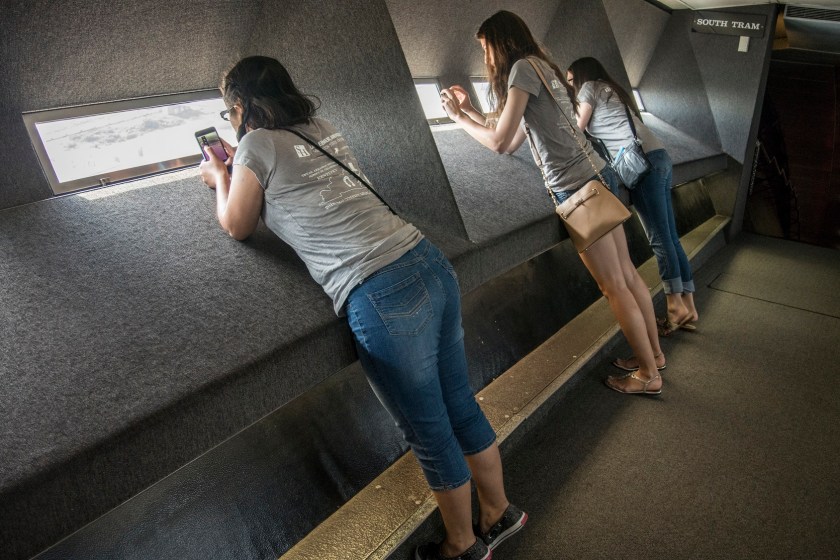
It was tremendously fun to be able to enjoy the arch’s view…
Beatriz, Kaitlyn, and Karla at Top of Gateway Arch
…and see parts of St. Louis that we looked forward to exploring.
St. Louis from the top of the Gateway Arch
Once back on the ground, we were also able to watch an informative documentary about the arch and its history. Expansion in 1803 meant a hopeful future for some and that is our motivation as we expand our education in college and on our trips.
Originally, we had planned to visit the city garden that was near the courthouse. With its luscious greenery, sparkling fountains, and marvelous art we were all prepared to relax and enjoy the perfect view of the arch it would offer. Or so we imagined. Unfortunately, time didn’t permit a trip to that destination.
Photo Ops in St. Louis
Remaining undaunted, we decided to go on a photo op adventure instead. Our first photo op stop was a Richard Haas mural. With two of our students having been interns at the Wynne Home, his work has a special meaning to us, and fourteen of his works dot the downtown of Huntsville.
LEAP Ambassadors in front of Richard Haas Mural
None of the ones in Huntsville, however, cover the 110,000 square feet of the one adorning the Old Edison Stores Building in St. Louis.
Next, we headed over to the St. Louis Union Station Building, which is a beautiful structure, now a Doubletree by Hilton. But its interiors were what we found most intriguing…
Union Station in St. Louis, MO
…even the entrance to the bathrooms were interesting!
But the grand hall was the most beautiful part.
Grand Hall at Union Station (Doubletree Hotel) in St. Louis, MO
Across the street is the Milles Fountain, which is also impressive and offers a nice view of the exterior of the Union Station.
Milles Fountain at Aloe Plaza
Amighetti’s in The Hill, St. Louis
After a morning of westward exploration and photo ops in St. Louis, we took a quick stroll down The Hill to Amighetti’s.
Amighetti’s, in The Hill Section of St. Louis, MO
Located in what could be considered St. Louis’ Little Italy, the restaurant provided a prime venue for a satisfying lunch. Under what seemed an authentic tin-lined ceiling, we looked over the menu which included, but was not limited to, the Amighetti’s Special, a ravioli plate, and Little Bit of Italy sandwich.
A Little Taste of Italy, at Amighetti’s in St. Louis, MO
As for the Amighetti’s Special, the sandwich accomplished its main goal; completely stuff its eater. Made up of ham, roast beef, and Genoa salami, blanketed with a rich layer of brick cheese on a 9 inch loaf of French style bread, it was a near challenge to take a bite. However, the extra effort to open one’s jaw was worth it, for every bite was an opportunity to taste the delicious sandwich. To improve on the experience, the menu presented St. Louis’ own Ritz root-beer. The effervescent, sweet, and smooth root-beer was an enjoyable company to Amighetti’s Special. To close off our lunch we also ordered a round of gelato. Within the group we were able to enjoy a cup of a sour, but satisfying lemon ice, cherry peach, strawberry, and vanilla, all of which we considered of excellent taste. As we stood up from our seat, with a content belly and a cooled off palate, we regained the energy needed to continue our St. Louis exploration at the Frank Lloyd Wright’s Kraus Home.
On previous adventures, Alex and Ryan had already encountered this one-of-a-kind home a numerous times. Therefore, Professor Yawn decided to give them the opportunity to explore new land by the name of the St. Louis Art Museum. After dropping them off we rerouted to the Kraus home.
Frank Lloyd Wright Home at Ebsworth Park
Hidden behind lush greenery, Frank Lloyd Wright’s Kraus Home is located in the upscale Kirkwood neighborhood of Saint Louis. Taking a short drive from the art museum, we arrived for a special tour. Normally, tours are not available on Wednesday afternoons, but the staff of the home were generous enough to arrange a tour for us today! Upon arrival, we immediately gaped in awe of the unique architecture and the natural beauty surrounding the home.
Frank Lloyd Wright Home at Ebsworth Park
To begin our tour, we watched an introductory video about the Kraus home and its architect. Frank Lloyd Wright was born in 1867 and designed more than 500 structures throughout the United States. Represented in the Kraus home were parallelograms, hexagons, and horizontal lines, all of which accentuated the Usonian vision of Wright. The Kraus home sits on 10.5 acres of land now owned by Saint Louis County as part of its parks system.
In the mid 1940’s, Russell Kraus, a Frank Lloyd Wright enthusiast, wrote to Frank Lloyd Wright requesting him to design a small and less expensive home. Nearly ten years later in 1955, the home would finally reach completion. Mr. Kraus lived there until 2001, when a non-profit raised money to purchase the home and the land was deeded to Saint Louis County.
Throughout the tour, Professor Yawn was quick to point out the horizontal attributes of the home, noting even the grooves between the brick walls were designed to draw the eye horizontally instead of vertically. The Kraus home was designed as two hexagons partially overlapping one another. The entire home is made up of these two hexagons or its subcomponents (parallelograms and triangles).
Even the bed, for example, is a parallelogram.
We were fascinated throughout the entire tour. In order to preserve the beauty of the home, we were not allowed to take any photographs inside the home. However, we finished our tour with a few photos on the balcony…
Balcony of Kraus Home at Ebsworth Park, Designed by Frank Lloyd Wright
…and the exterior.
St. Louis Art Museum
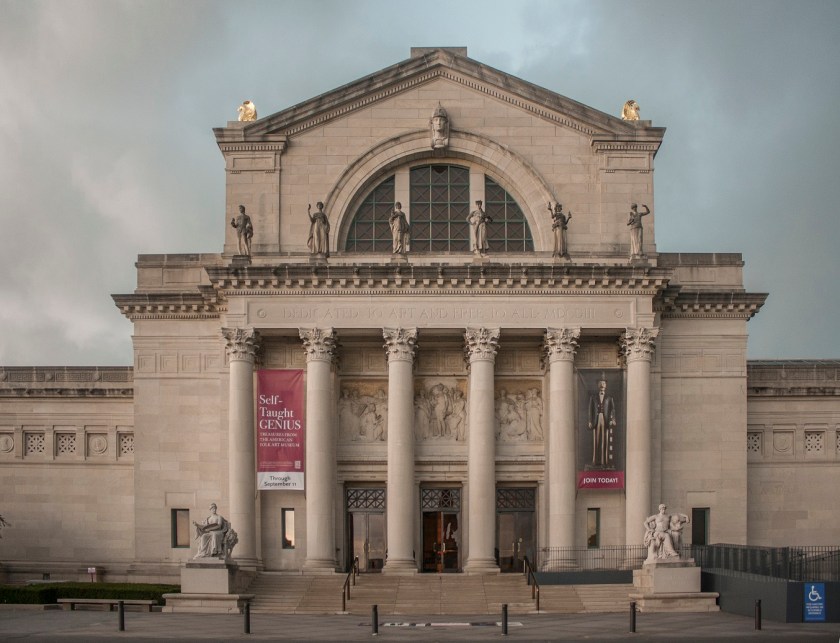
Meanwhile, in the St. Louis Art Museum, Ryan and Alex were being exposed to various forms of art.
St. Louis Art Museum
One of the major aspects Missouri has to offer is the free admission into museums (excluding special exhibits). On the three levels of the museum, there were paintings, sculptures, and artifacts from as early as 500-600 BCE to as recent as present day and everything in between. There were pieces of art from all around the world including Asia, the Americas, Africa and Europe. Several famous artists’ works could be found at the museum including Monet…
Monet’s “Water Lilies” at the St. Louis Art Museum
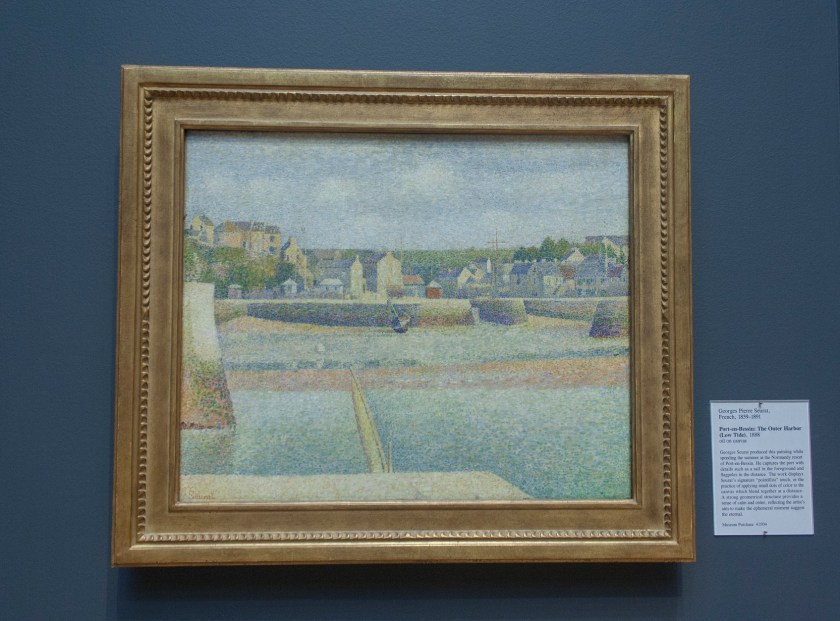
…van Gogh, Picasso, Seurat…
George Seurat’s “Outer Harbor” at the St. Louis Art Museum
…Degas, Rodin, Kandinsky, Warhol, Segal, O’Keeffe, and many more. Outside, there was a short path through a small sculpture garden, mostly made up of pieces from Henry Moore.
Henry Moore’s “Two-Piece Reclining Figures” at St. Louis Art Museum
As we were leaving, a huge storm rolled in, cutting out our trip to a sculpture garden in the downtown area. So instead, we headed towards Bentonville, stopping for a photo-op at the world’s largest fork, and afterwards, stopping for dinner.
Dinner at Cafe Cusco, Springfield, MO
Being the home of the world’s largest fork…
World’s Tallest Fork, Springfield, MO
…Springfield appropriately offers numerous eateries from which to choose.
We choose Cafe Cusco, a Peruvian restaurant that has all the attributes of good Peruvian food, without the risk of Zika.
With the buildings soaking in the last rays of the day on Commercial St., we crossed the threshold into the Peruvian cuisine restaurant. As Peruvian folk music sounded its harmonious guitar in the background, we looked through the menu. With a variety of “platos” or dishes, from vegan salads to meaty steaks, the appetite of some of us were attracted to the fried rabbit, fajita saltada, BBQ pork panca, and lomo saltado. First, however, we began our taste of Peru with a seafood dip and fried avocado appetizer.
Seafood Dip and Fried Avocado at Cafe Cusco
As the initial dishes were cleared, we readied ourselves for our main course. Soon the table was enveloped in the spicy aromas of the various dishes. As for the lomo saltado, a dish of steak cooked with bell pepper and onions served with fries and rice, each scoop of the fork brought to one’s mouth the zesty spice of Peruvian flavor. Perhaps the best of the dishes, however, was the rabbit, which Ryan enjoyed immensely.
The Rabbit Dish at Cafe Cusco
In all, the restaurant was more than enough to make us go back to the corner block venue as we were forever in love with these flavorful dishes. For the meantime however, it was time get back to our traveling van for we still had half a state left to ride through.