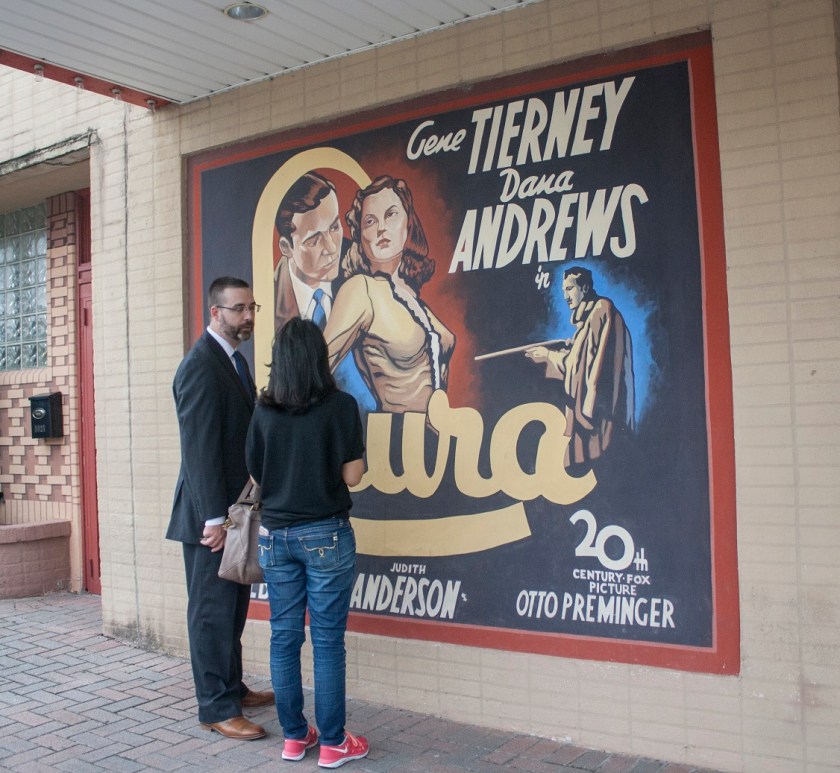
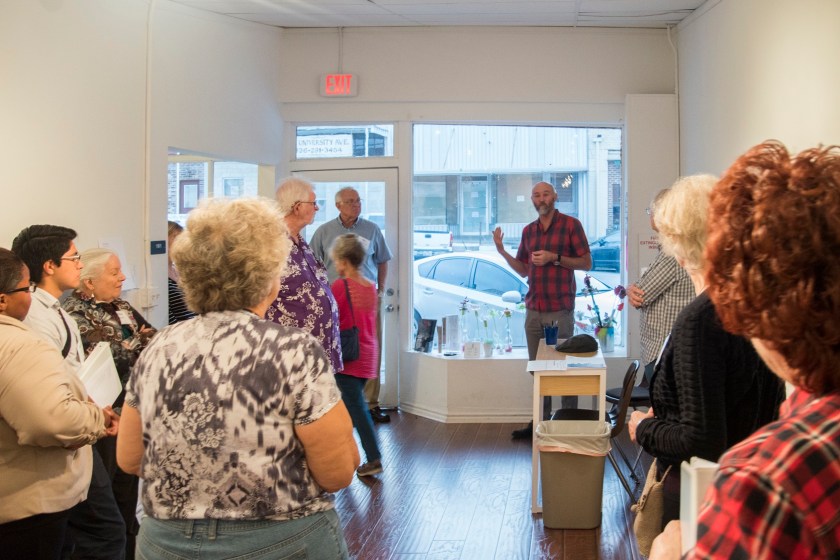
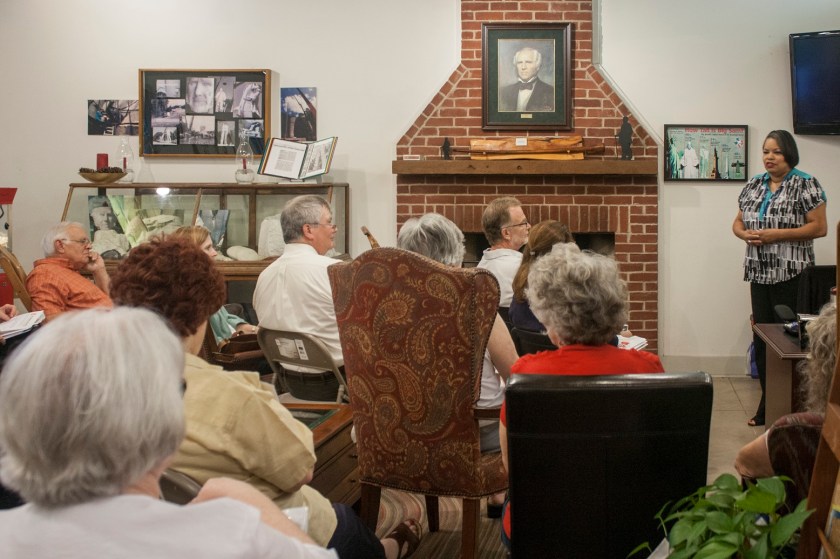
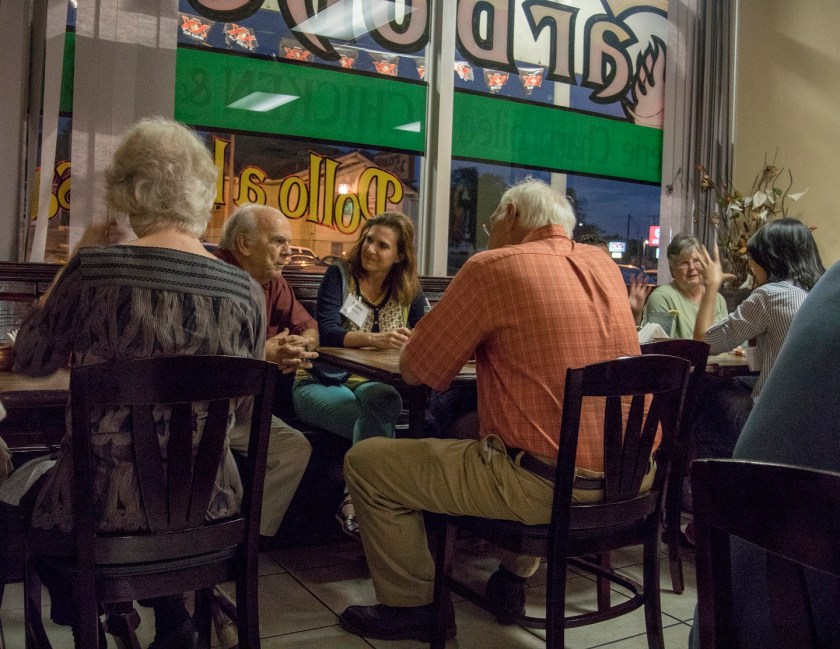
There’s no better way to appreciate heART of Huntsville than by visiting the picturesque Town Square. On this week’s session that’s exactly what we did, learning, along the way, of our town’s successful efforts to bring back the spark that once made our town the “Athens of Texas.”
Although we had to alter our original itinerary due to the imminent rain, as they say the show must go on. Our first stop for the night was Old Town Theatre on 12th Street.The historic theatre has been converted since 1997 into a non-profit community theatre for the enjoyment of the many Huntsvillian drama fans. Upon entering, we climbed the 33 narrow steps towards the balcony where we learned about the history of the theatre. Apart from hearing from Professor Yawn and Dr. Pease, those members of the community familiar with the theatre since childhood shared different stories about the early years of the amazing establishment. One interesting aspect of the theatre was its architecture, which forced technicians to develop non-conventual methods to light the stage. After that, we headed down stairs where we were able to get a backstage tour. The colorful sets of a preparing rehearsal made the tour even more exciting. Through the back of the stage, we made our way through a small hallway and into the dressing rooms. Not surprisingly, we were amused by how the women’s dressing room was larger than the men’s.
We were additionally taken into stardom delusion by the Hollywood lighting on the mirrors. Very sublime indeed!
As we headed for the rest of our adventure, Linda Pease, Wynne Home Arts Center Director, gave us a little background about the Richard Haas murals on the exterior of the building.
She explained that Richard Haas thoroughly researched the location of his murals before pitching an idea. Consequently, he found it apt to incorporate the renowned Hollywood actor, Dana Andrews, into the theater’s facade due to the star’s Huntsville birth.
It must be noted that Huntsville prides itself in having numerous Haas murals from this world famous artist who is also exhibited in the streets of New York, St. Louis, Chicago, and many more American cities. The renowned muralist was once a pupil of the celebrated architect Frank Lloyd Wright in the 1950s, and he chose Huntsville, Texas as home to the largest collection of his trompe l’oeil works. We are truly lucky to have this great Urban Artist’s mesmerizing works of art decorating our city!
After appreciating the Richard Haas murals we walked down the street to the Huntsville Main Street office where we met with Ms. Jasmine Moss.
Ms. Moss, interim Main Street Director and proud Bearkat, took a break from her studying to teach us about Huntsville Main Street’s mission to revitalize downtown. Huntsville Main Street hosts events year round that help market the city’s thriving cultural and community wealth. It is in charge of the nine city blocks that make up the Square, three parks, and 90+ local businesses. We were thankful that Ms. Moss was able to teach us more about our city.
The last stop before dinner was the Satellite Art Gallery.
Run by the Sam Houston State’s art department, pacing through the pair of halls of the gallery we were able to admire the photography of now accomplished artists who attended SHSU during the 70’s.
This slideshow requires JavaScript.
It was evident that the participants all enjoyed the wide range of subjects depicted in the color and black and white film, from landscapes, to still photography, to artistic portraits and everything imaginable.
This slideshow requires JavaScript.
Followed thereafter we stepped onto the dimming streets of Huntsville’s downtown and crossed over to the corner of the Roche Building.
Across the Huntsville Courthouse, we were greeted with great enthusiasm inside Patio on the Square Cafe. We had chicken pasta, fresh fruit, and some luscious salad, paired with our choice of ranch, Italian, or blue cheese dressings. It was evident that everyone enjoyed the wonderful flavor of the meal (which is exciting for a college student who lives 3 hours away from mother), and for dessert we had delicious cupcakes from Huntsville’s own Baking Sweet Memories. When the night ended we headed home in hopes to catch the presidential debate, but that’s a story for another blog. With the shine of the square’s streets, silver from the rain, we all bid farewell to our night of art, history, laughs, and memories, a bit melancholic as next week our heART of Huntsville strolls will meet their end.
After a fun and successful first week of heART of Huntsville, we were excited to begin the second week. We started our session at the Huntsville Statue and Visitor Center where we met the Tourism & Cultural Services Director, Kimm Thomas.
City of Huntsville’s Tourism Director, Kimm Thomas, Discuss “Big Sam”
She began by giving us an overview of the different tourism attractions within Huntsville like the magnificent Big Sam statue. She then entertained us with an animated video designed by the Animation Department at SHSU. The video, developed in partnership with SHSU students and City of Huntsville staff, amusingly explained the history behind General Sam Houston and the complex process of erecting the statue. As the clip met its end it was time to marvel at this Huntsville treasure.
Once at the foot of the towering statue, the group deemed it apt to snap a quick group picture.
Our excitement was further stimulated for we would soon have a chance to mingle with the sculptor of the 67-foot-tall Texas Hero, David Adickes.
First, however, we headed for a tour of outdoor sculptures around town led by Huntsville expert Professor Yawn.
Our first stop was the Reclining Figure by John Stewart laying its stone body along Sam Houston Avenue in front of Fire Station 1. Stewart sculpted this piece to commemorate the deceased astronauts aboard the Challenger in 1986. Our next stop was the Smither Sculpture by Andy Emmons. The artistic assortment of glass covered plaster shaped into lions, dragons, and other mystical beasts includes a silvery figure (the Protector of Child) as the center piece with little children sitting on his arm. After very crafty maneuvering by our accomplished bus driver, we arrived at City Hall for a quick view of Charles Pebworth’s sculpture Totem Number One.
Totem One, by Charles Pebworth
Along with a great work of art, City Hall is also home to a great amphitheater which sometimes hosts concerts. It was great to see the reactions of the participants as some of the life long residents had no idea about these great attractions.
After this final stop, we drove around the city admiring more sculptures such as Wynne Home’s exterior ornamented with Jesus Moroles artistic granite, the sculpture on Sam Houston’s Grave by Pompeo Coppini, and other sculptures along the way.
With hungry stomachs and a head full of art we headed to Carbonero for dinner. With the great assortment of Salvadorian cuisine we enjoyed mouthwatering tacos, enchiladas, and pupusas (a favorite among the LEAP Ambassadors). As always, food was great!
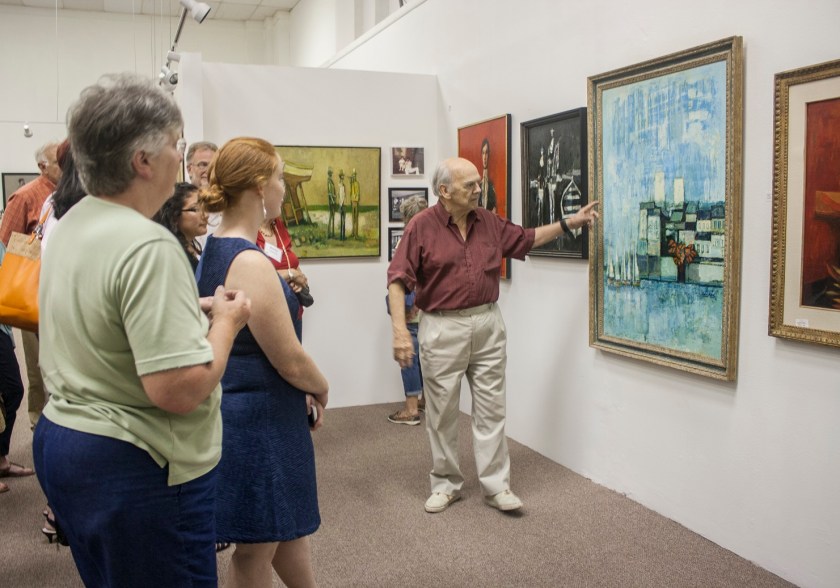
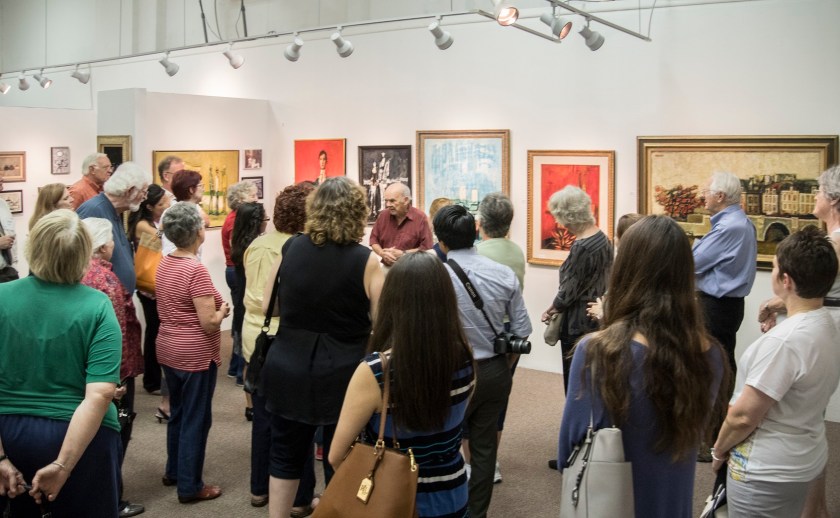
After dinner we went to the Adickes Foundation, the moment we had all been waiting for. For some of us it wasn’t our first time entering this surreal emporium of art. Regardless, the repurposed High School’s walls and hallways decorated with Adickes’ wondrous paintings are always breath taking. To welcome us to his foundation, Mr. Adickes offered a brief introduction about some of his favorite works.
With Mr. Adickes’ great enthusiasm to tell tales of Houston’s historic art culture, we were even more excited to tour the gallery. Among the collections was a series of three paintings along with a picture of Elvis Presley’s living room. This living room was all the more intriguing as it was clearly visible that on the King’s walls hung the very same trio of paintings on the corner wall of the foundation. Apparently Mr. Adickes discovered that Elvis had previously bought a copule of his paintings, which he had to buy from the Elvis estate to display in his own foundation. Other paintings fascinated us by the unconventional techniques and materials used during it’s inception, such as implementing the use of sand and coffee beans.Many of us looked around for our favorite piece of art, but with Adickes’ talent in styles ranging from cubism to realism and everything in between, this was a tough decision.
After enjoying friendly conversation, we ended our tour sharing a selfie with Mr. Adickes and other community friends in front of one of the artist’s favorite pieces.
LEAP Ambassadors with David Adickes
As a great finale to a great tour of the city, we ended our evening back at the Sam Houston Statue ready for next week’s heART of Huntsville adventure!
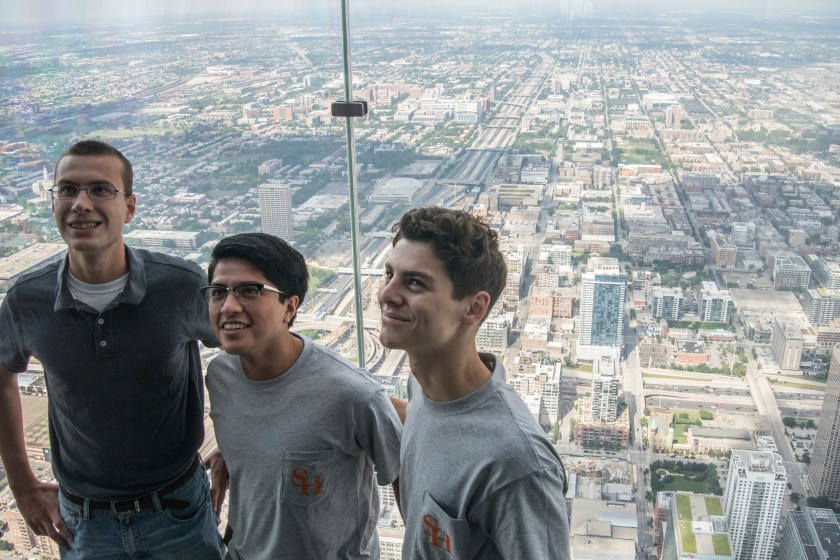
On our Sunday Chicago adventure, the LEAP Ambassadors continued on the path of artistic enlightenment by visiting the Chicago Institute of Art and Frank Lloyd Wright’s Robie Home. This as part of our Vagabond Research Trip which would lead us our first meeting with New York Times bestseller author Jeff Guinn, which we would soon meet with in Dearborn, Michigan. However, to shake off our morning drowsiness we climbed up Willis Tower to hover over Chicago in the skyscraper’s Skydeck.
Willis Tower Skydeck–by Brian Aldaco
Upon entrance of the tower, with grounded pillars exposed so as to view the building’s essential elements to its prominent stature, we joined the crowed who anxiously await the hundred-and-three-story ascent to the glass viewing enclosure. Huddled inside the elevator we arrived at our floor of destination after a minute long ride (the same climb which takes ninety seconds to complete during windy weather). At the top of the 1,730 ft building, a size comparable to 283 vertical Barack Obamas, the view of the Windy City was breathtaking.
Chicago Skyline from Skydeck at Willis Tower
Whether this was caused by the vista from the clouds or the vertigo of being on their level, our hearts were firmly set on forcing our bodies to step over the ledge onto the clear-glass viewing deck. Suspended over the city, with feet seemingly floating over the ground, sweaty palms, and throbbing heads nervous about the deck’s ability to keep us safely enclosed…
The LEAP Guys on the Skydeck
…Professor Yawn wisely suggested that we create a photo-op by jumping upon the skydeck. This turned out to be more fun than dangerous, but ultimately futile as a photo-op because the skydeck photographers couldn’t time the photos correctly.
Art Institute of Chicago, by Brian Aldaco and Paul Oliver
Having experienced our elevated adventure, our next stop was the Art Institute of Chicago; a sprawling, labyrinthine art museum that contained art from a myraid of different cultures and ages.
Paul Plans his Route in the Art Institute of Chicago
We had the opportunity to see several famous pieces, such as Grant Wood’s American Gothic…
American Gothic, by Grant Wood
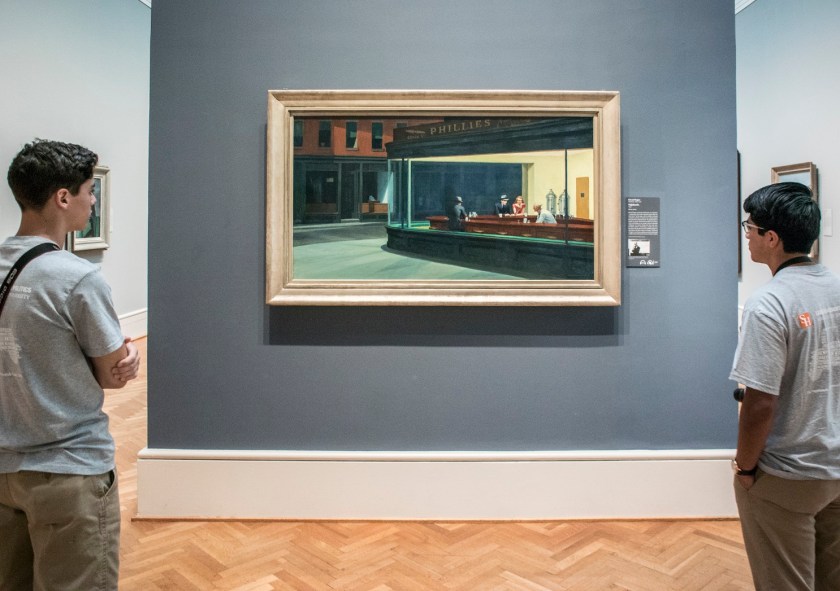
Seurat’s A Sunday on La Grande Jatte, and of course, Edward Hopper’s Nighthawks.
After viewing Nighthawks together…
…we went our separate ways. Paul traveled back in time to Ancient Greece and Rome, looking at the Roman statuary, Greek pottery, and Byzantine pieces on display. Of special note in this section was a Roman reproduction of the Aphrodite of Knidos. The original Aphrodite was a Greek statue, and it was contentious in its time, for it was the first instance of a goddess being depicted in the nude. Also of interest were the Greek amphoras, kylixes, and other pottery pieces. The amphora is a larger container that presents a larger space for the artist, whereas the kylix is a smaller, but broad object, that was used as a wine goblet. The amount of wine that could be held by a kylix looks substantial, but the Greeks believed it to be a mark of the barbarian to drink wine unmixed. Therefore, they would add water to it, which perhaps justifies the size of the kylixes. The pottery itself takes two styles generally; black figure and red figure. The color refers to what hue the people depicted are, so on a black figure amphora, the heroes or gods represented are black, and the background is red. The reverse is true for a red figure work. Paul also went to see the Medieval Arms & Armor section, but unfortunately it was not open yet!
Simultaneously on the Modern Wing of the museum, Professor Yawn, Brian Aldaco, and Ryan Brim viewed multiple works from artists of diverse periods in art history. The turn of 20th century was captured by works of artists such as Mary Cassatt, John Singer Sargent, and James Whistler, the latter of whom helped usher in impressionism in the United States.
James Whistler’s “Nocturne–Blue and Gold”
In further floors we also viewed works from Great Depression artists such as Grant Wood, Thomas Hart Benton and Edward Hopper whose desire to capture everyday rural and urban American life was astonishing. We also attempted to study the abstractions and surrealism behind the works of Salvador Dalí, Rene Magritte, and Pablo Picasso.
Picasso’s “The Old Guitarist”
To further strain our left analytic hemisphere, we viewed the works of conceptual artists such as Andy Warhol, Mark Rothko, Jackson Pollock and other contemporary artists.
Jackson Pollock’s “Number 17A”
Millennium Park, by Brian Aldaco
Having completed our journey through a century’s worth of art, we joined the pedestrian throng towards Millennium Park. As we passed Jaume Plensa’s Crowne Fountain, where happy children frolicked under the spewing gush of water (which shot from the mouths of the fountain’s face-depicting pillars); its refreshing spray was welcoming against the city’s heat. Going along the park we found its signature Cloud Gate sculpture, most commonly known as “The Bean.” With its mirror image of the surrounding skyline which warped as the rounded angles revolved around the sculpture, we neared it’s metal surface and seemingly became part of the picturesque vista. Soon after taking a couple of pictures of us LEAPing by the sculpture…
This slideshow requires JavaScript.
…we ordered a Chicago-style hotdog at a nearby stand. Thus, we lunched in true Chicago style over the city’s patrimonial treasure.
Frank Lloyd Wright’s “The Robie House,” by Ryan Brim
After some the authentic Chicago-style hot dogs in Millennium Park, we headed over to the campus of the University of Chicago, where we toured the Robie House, built by architect Frank Lloyd Wright in 1909. Like many of his other homes, Wright built the prairie style house by accentuating long horizontal lines to draw one’s eye across the house.
Frank Lloyd Wright’s “Robie House”
Before we entered the front door, we were met with a low ceiling that was similar in height and in material to the one just inside the greeting area. This created a sort of transition space that allows a guest to have a seamless transition between the outside and inside. Once we went up the stairs to the main living area and dining area, the ceiling became taller, and the room brighter. This is another one of his techniques called “compress and release,” forcing people out of the dimly-lit greeting area and into the bright living space. Although there are no doors separating the dining and living areas, there is a fireplace that breaks up the two spaces.
Living Area in “The Robie House”
Mr. Wright believed that there should be as few enclosed rooms in a house as possible, so he made an opening at the top of the fireplace so that someone in one room could see the continuing ceiling across the whole floor. He did this by diverting the smoke into two separate chimneys, leaving the middle open from obstruction. There were also many windows and French doors all along the room connecting the exterior with the interior and making the room seem much bigger. In the dining area, there would have been a dining table with pillars as legs extending above its surface on which one could set lights. Similarly the table was fashioned with high backed chairs, so when people would eat dinner together there they would have sufficient lighting and the high chairs made the table seem to be a space within a space. On the third level were the bedrooms and bathrooms, each with natural lighting from many windows. The servants quarters and kitchen were on the second level, keeping them level with the rest of the family for according to Wright’s philosophy everyone was of equal worth. Just above the servant’s quarters was the car garage where the gift shop is today.
Moving On
After leaving the beautiful home, we made our way through Illinois and Indiana to finally reach Michigan. Somewhere along the state in need of a place to switch drivers and stretch our legs, we stopped at Coloma, Michigan, to go to the Chocolate Garden. The small business which specializes in chocolate truffles, according to one of the ladies working there, was started in 1998 as an online business. The eventual physical location was built in an old barn, but quickly expanded. Notably, the Chocolate Garden has been featured on the Food Network, which helped propel it to fame.
In addition to the Chocolate Garden’s wide assortment in chlorate truffles, it also has a “tasting bar.”
Chocolate Garden’s Truffles at the Tasting Bar
It is here where for a small fee it is possible to taste up to three different types of these truffles of chocolatey delight. Professor Yawn lamented that the LEAP ladies were not along on this trip, as they surely would have enjoyed this stop. With this in mind, we joyously sampled the rich, delectable chocolate truffles. The “Darkest Dark” truffle and the “Vanilla Rose” were both exceptionally scrumptious. It was truly a must-stop for any chocolate aficionado and a tragedy that the ladies were not with us.
As we left, Professor Yawn, in a seemingly magnanimous gesture, proffered us a truffle he had purchased. Brian and Paul both took the sample from him and enjoyed the chocolate taste for a brief second. As it turned out, though, the truffle was a “Cayenne Kick,” which packed a nasty spice that only becomes apparent after a few seconds. Needless to say, Professor Yawn got a kick out of our reactions.
After our sweet treat we continued on our trip where we eventually entered Dearborn ready to soothe our growling stomachs at Rex’s Golden Grill. With a diner menu of fish and chips and burgers, we were very much satisfied with the evening’s repast. It was so that we finished our Sunday evening in Dearborn, ready to start our first day of Vagabond research early in the morning.
The LEAP Center’s mission is to offer unique educational opportunities for students. An example of this is the Center’s annual trip to the Southern Legislative Conference, to which the LEAP Ambassadors are invited to attend. While the conference offers the opportunity to learn about policies among 15 southern (and near-southern) states, the travel to and from the conference also presents learning opportunities.
Following the students’ 11-day trip across eight states and more than 20 educational sites, the seven students selected their favorite destinations across categories such as food, historical landmark, museums, and cities. The results are below:
Favorite Cities:
Eureka Springs, AR: This quaint little town proved to be the favorite of the group, with almost every student placing it on their top three.
LEAP Ambassadors in Front of “Flatiron Building” in Eureka Springs, AR
Lexington, KY: The site of our conference also proved popular. With its beautiful horse farms, pretty downtown, and attractive parks, students enjoyed four days in the horse capitol of the country.
The LEAP Ambassadors at Triangle Park, Lexington
Hot Springs, AR: This was a surprise to our professor, but the students enjoyed seeing the springs, the historic architecture, and meeting other SHSU students by happenstance!
LEAP Ambassadors in Front of Ozark Bathhouse, Hot Springs, AR
Little towns ruled the culinary arts on this tour!
Favorite Works of Architecture:
Frank Lloyd Wright House (Bachman-Wilson House) at Crystal Bridges was the favorite, edging out some other top designs. The large living room won the day!
LEAP Ambassadors Outside of Frank Lloyd Wright’s Bachman-Wilson Home
Anthony Chapel at Garvin Gardens, Hot Spring, AR was one of three Fay Jones’ Chapels the student saw, and it proved the favorite. Although larger than the other two (which are in Bella Vista and Eureka Springs), the three designs are very similar.
Garvin Gardens by Fay Jones, Hot Springs, AR
Honorable Mention should go to several structures. The students very much enjoyed the Gateway Arch in St. Louis, the Union Station in St. Louis…
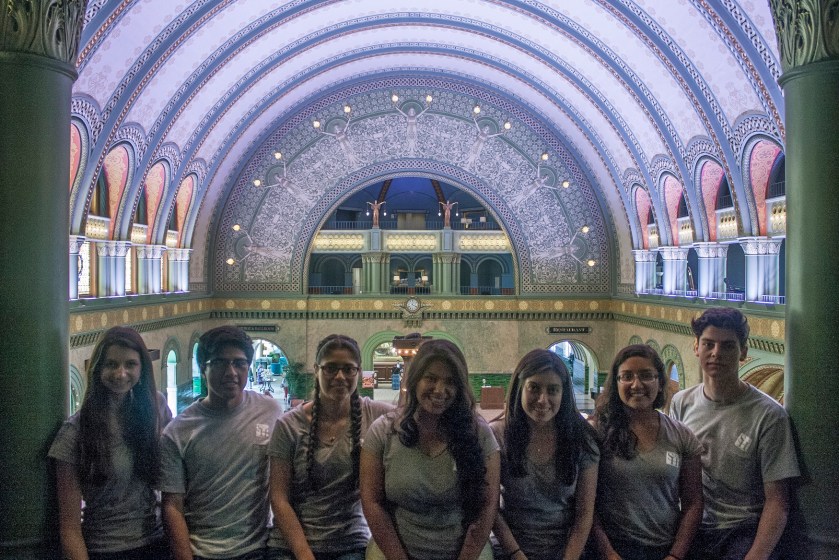
LEAP Ambassadors at Union Station, St. Louis, MO
…the Old Mill is always a favorite stop.
LEAP Ambassadors at Old Mill, Little Rock, AR
…and The Parthenon proved a favorite as well.
The LEAP Ambassadors at the Parthenon, Nashville, Tennessee
Favorite Works of Art
The Turrell Skyscape, “The Way of Color” at Crystal Bridges:
This slideshow requires JavaScript.
Au Cafe, by Stanton MacDonald-Wright was also popular, providing much head-scratching and discussion.
“Au Cafe,” by Stanton MacDonald-Wright
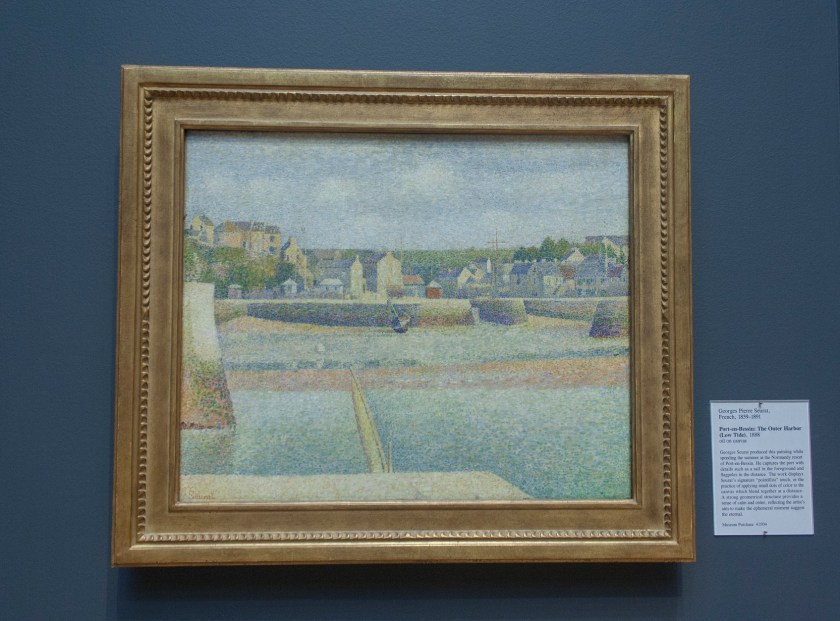
George Seurat’s “Outer Harbor” at the Crystal Bridges Museum
George Seurat’s “Outer Harbor” at the St. Louis Art Museum
Activities
Hiking: The students enjoyed both their hike at Pinnacle Mountain…
LEAP Abassadors at the Peak of Pinnacle Mountain
…and Devil’s Den State Park…
LEAP Ambassadors at Devil’s Den State Park
Ropes Course at Megacavern in Louisville, KY
Karla Rosales and Ryan Brim at the MegaCavern
Tie: Skeet Shooting…
Brian Aldaco Hitting Targets
…and meeting Blair Hess and Cameron Ludwick, authors of “My Old Kentucky Road Trip.”
LEAP Ambassadors with Authors Blair Hess and Cameron Ludwick
It was another enormously rewarding road trip, providing us with the opportunity to learn about history, art, architecture, civil rights, politics, law, and public policy. It was a happy eleven days!
Even as we entered the homestretch, nearing the end of our trip, we remained excited about our time in Northwest Arkansas. With trips to Eureka Springs, the Thorncrown Chapel, and the Crystal Bridges Museum of American Art ahead of us, we were ready for a day of fun and education.
Eureka Springs, Arkansas Written by: Brian Aldaco, Megan Chapa, and Kaitlyn Tyra
After hearing about how great of a little town Eureka Springs was from all of the people that we had met at the Southern Legislative Conference, we were all ready to go see it for ourselves! Before our planned bus tour we visited Fresh Harvest, a fine olive oil shop near the visitors center. None of us had ever been to an olive oil tasting, so this was another “first” to write off in our books! One of the workers kindly walked us through some of the different kind of olive oils and explained the differences among them.
During the explanations of the oils, we were given the chance to taste each one until we had found the ones we loved. They had everything ranging from balsamic and vinaigrettes to jams that contained rich olive oil. We were also informed that they are made in house and are even bottled there. After wandering around the aisles filled with canisters of oil and tasting all of those that sounded appealing (such as white peach and raspberry), we chose some of our favorites, checked out and scurried to our bus tour.
Once we all made it out of Fresh Harvest, we leaped into the bus and began riding through the winding roads of Eureka Springs to tour through a one-of-a-kind city. Eureka Springs is most famously known for its system of freshwater springs that can be spotted all around the town. We began the tour by getting on highway 62, leaving the town behind as the bus snaked it’s way through woods and cliffs. On the roadside one could see various motels curiously built amidst the rocky mountains of what could be perceived as a town of low significance. However, such a statement does in no way describe Eureka Springs. With a rich history of Native American tribes, our guide described the importance of the Osage, the tribe which roamed the area before the Europeans made their way though the hidden Ozark Valley. The tribe, fierce protectors of their territory, would even share their healing spring water with their warring enemy tribes. It was en route to a scenic roadside view of this valley that we could appreciate the rugged terrain these tribes and early settlers of the town would have faced in settling on that land. Through hills of endless forests we continued on to an unobstructed vista of the White River along with its green, vast valley.
The White River, Near Eureka Springs, AR
Doctor Alba Jackson used the Blue Spring waters to treat Confederate and Union soldiers during the Civil War after discovering it’s “healing effects” from treating his son’s failing eyes. It was after this destructive time period that many sought healing via Eureka Spring’s natural waters. As word spread through the nation of the town’s natural spring water, (which could allegedly be used to treat and cure any type of illness from the common cold down to yellow fever and more) the once forested Hidden Ozark Valley was cleared in order to build what would become Eureka Springs. From one day to another, the small settlement went from a few cabins to Arkansas second largest city in 1878.
On our way back towards Eureka, we drove though a winding driveway, and through the heavy foliage, one could barley see a towering, gray structure which deliberately blended itself with its natural surroundings known as Thorncrown Chapel. Designed by E. Fay Jones (a student of renowned architect Frank Lloyd Wright), the forty-eight feet tall wooden chapel was awarded the American Institute of Architects’ Design of the Decade Award in the 1980’s.
The Thorncrown Chapel in Eureka Springs, AR
We all sat in awe of the towering chapel that blended with the surrounding nature and compared it to the Anthony Chapel we had previously seen. After leaving the chapel, we went into the city’s historic loop, Kings Highway, also known as Ojo and Summit and about 10 other names, in true Eureka Springs fashion. Home to only three chain restaurants, the city prides itself in keeping it’s commercial culture untainted by chain food. Such an autonomy has preserved the city as the old town it used to be.
The Crescent Hotel is one of the buildings of the town that has stood the test of time as it still towers over Eureka Springs.
The Crescent Hotel in Eureka Springs, AR
Although the winding roads were scary for some of us, the visit to this historical hotel was the scariest part of the tour. Seated high above “Mysterious” Valley, the hotel is supposedly the most haunted hotel in the country. In 1886 the Hotel was opened at a resort for the wealthy to vacation. Since then, it has changed ownership many times. It served as the Crescent College and Conservatory for Young Women at one point; at another point, a scam artist took over, making it into a fraudulent cancer hospital.
With this history, it’s no wonder that some guests have reported supernatural experiences. For example, each night between 12-3 am a women dressed in white has been reported to fall from the third story balcony. The story goes that during the hotel’s time as a College and Conservatory, a young woman committed suicide after she learned of her pregnancy, which was frowned upon during her time. Today, this is just one of the stories that tour guides tell visitors from all over the country during the many ghost tours given daily.
LEAP Ambassadors on Balcony of Crescent Hotel
After a stop full of fascinating stories (some believable and some not so much) we boarded the bus to visit many of the springs from which the city is rightfully named.
Last week, we visited Hot Springs, Arkansas to learn about the bath houses and natural spring waters. This week, in Eureka Springs, we learned the waters are similar except for one major difference, the temperature! Eureka Springs consists of cold spring fed waters that are much more refreshing than the hot springs whose water is always 100+ degrees. While visiting at least four of the springs (the city is home to many more) our tour guide kindly narrated interesting stories that caught our attention like the reason why doing laundry at the Laundry Spring is now a misdemeanor crime.
Tour Guide John Thomas Shows The LEAP Ambassadors Aspects of the Springs
We learned that the way to spot a spring is to look out for a garden. The tenants of the springs would plant gardens outside to make their cave more home like. We also toured downtown Eureka Springs, which lies partially underground in the tunnel system that benefits the city by adding additional real estate for the tourist shops and restaurants.
Because the city lies within the northwest Arkansas hills, the streets are extremely winding and occasionally bumpy. This created many strange angles for real estate, but it is also a symbol of Eureka Spring’s unique style. We stopped for a few quick photo opportunities and to admire the view one last time before closing our tour.
LEAP Ambassadors View the Crescent Hotel
Many thanks to Mr. John Thomas of Eureka Van Tours for an energetic, informative, and jam-packed tour of Eureka Springs! Following our informative tour, we headed downtown for a quick lunch at Mud Street Café. This cafe was built in 1888 under the city’s surface. The venue’s name originates from the very street on which it was built. Because of the dirt roads and underground spring, floods were habitual and caused the street to become muddy. The cafe had original limestone walls, oak tables, and Victorian carpet making it exclusive. Orders around the table varied. Megan ordered the Cajun wrap and others ordered a variety of burgers and sandwiches. We even sampled the crème sodas and the coffee with peppermint schnapps!
Burger at Mud Street Cafe, Eureka Springs, AR
The food and drinks were delicious, leaving some of us a little drowsy. We managed to fight our sleepiness because we wanted to check out the small shops along the historic downtown Eureka.
LEAP Ambassadors in Front of “Flatiron Building” in Eureka Springs, AR
With menacing rain clouds forming in the sky, we hurriedly boarded our van ready to drive towards Bentonville.
Crystal Bridges Written by: Beatriz Martinez, and Karla Rosales
Upon arrival, the pitter patter of the raindrops on our heads hurried us into the Crystal Bridges Museum of American Art. We navigated through the halls in order to reach our tour guide. We eagerly waited for out tour to start because we all knew that we were about to explore another of Frank Lloyd Wright’s architectural masterpieces; the Bachman-Wilson home.
Similar to the Kraus house we had visited in St. Louis, the Bachman-Wilson home was designed as a Usonian-style home. Derived from the abbreviation of “United States of North America”, this form of organic architecture was invented by Wright to create homes that would be compatible with nature and stand alone as American without other influences. The original owners of the home were Gloria and Abraham Wilson. Having seen the Shavin house, they implored for Mr. Wright to make them a home of their own. After continuous requests to Wright, one day the Wilsons received a telegram saying, “I suppose I am still here to do houses for such as you.”
Frank Lloyd Wright’s homes are well-known for their small, yet comfortable size; compression and expansion of spaces; radiant heat; and clerestory patterns (this one being of a Samara design).
Frank Lloyd Wright Home at Crystal Bridges
The home was originally built along the Millstone River in New Jersey during the year of 1956, however, after the Wilson’s divorce a year later they decided to sell their home which led to a series of events that ends with the home finding its home at Crystal Bridges. Unfortunately, the location on which the house had been built suffered from the problem of flooding. At one point, the home was 6 feet underwater!
Lawrence and Sharon Tarantino bought the home in 1988. Recognizing the worth of this wonderful home, they decided to sell it to an institution that would preserve and relocate it to a place where it would not be harmed. Interestingly enough, the blueprints of the building were tracked down and unearthed. The endeavor was a tedious task, one that required the home to be taken apart piece-by-piece, individually marked, and bubble wrapped, and transported to its new location.
Although the home wasn’t built at Crystal Bridges, our tour guide argues that it was destined for the site, as it exemplifies the type of architecture of Crystal Bridges (designed by Moshe Safdie) and that of Arkansas’s most famous architect, E. Fay Jones.
LEAP Ambassadors Outside of Frank Lloyd Wright’s Bachman-Wilson Home
Enjoying the work of one of America’s most renowned architects, we continued on inside to take a look at the other forms of American art that Crystal Bridges had to offer.
The first exhibit in the museum displayed colonial to mid-nineteenth century American art titled “From the Colonies to the Civil War”. The time frame begins in 1621 when Mayflower pilgrims found Plymouth colony to 1860 when Abraham Lincoln was elected president. This exhibit displayed a lot of portraits painted in oil on canvas. In that same mid-nineteenth century we got to see artwork by Roxy Paine called “Bad Lawn;” it is a plant sculpture formed from industrial materials that was then painted by hand.
Roxy Paine’s “Bad Lawn” at Crystal Bridges
This work, “Bad Lawn,” is very different than her typical stainless steel structures, but like her other work, it is designed to make viewers reconsider their relationship with nature. To emphasize this point, the Curator at Crystal Bridges placed the work in the same room as many of the 19th century’s foremost nature painters: Asher Durand, Thomas Moran, Tom Cole, and Albert Bierstadt.
Then we moved on to Professor Yawn’s favorite exhibit, late nineteenth-century art titled “American Art Flourishes at Home and Abroad.” The time frame for this exhibit ranged from the Civil War to the founding of the NAACP in the early 1900’s. The exhibit displayed an abundance of landscape paintings because landscape painters were interacting with the outdoors and celebrating the natural world.
Harriet Whitney Frishmuth’s “The Bubble” at Crystal Bridges
A key example of this art is Harriet Whitney Frishmuth’s “The Bubble,” in which she pictures a model dancing with an orb.
Before the 20th century exhibit, we stopped to see a small exhibit called “Reel Women, Icons and Identity in Film” which displayed photography of popular actresses during the Golden Age of Hollywood between 1930 and 1960. The 20th century exhibit titled “Depicting Change in a Modern World” displayed great events in history the like the roaring twenties in America, the Great Depression, and World War II. The art in this exhibit was much more modern and colorful.
In this exhibit, Karla found her favorite piece of art by artist Stanton Macdonald-Wright titled “Au Cafe.”
“Au Cafe,” by Stanton McDonald-Wright, at the Crystal Bridges Museum of American Art
At first it appears to be simply abstraction, but as you look closer you can see the artist with his wife drinking a martini depicted in colorful shapes. The final exhibit was 1940’s to Now, it displayed a timeline of important events during this time frame. Amazingly, we have visited many of the places where these important events took place.
Two pieces of art that made some students cringe and others awe at the realistic figures were pieces of hyperrealism by Evan Penny and Duane Hanson. Penny’s work was a self-portrait, titled “Old Self,” and it was indeed very realistic.
Evan Penny’s “Old Self” at Crystal Bridges Museum
We were fascinated by the detail that Penny put into the piece; indeed, some of us were even started as we entered the room, thinking that it was a real person we were seeing.
Duane Hanson’s “Man on Bench” was just as realistic, but more sad.
Duane Hanson’s “Man on Bench” at the Crystal Bridges
It was very interesting how the sculptures looked so realistic!
Another piece that captured the interest of all of us was the “Untitled” piece by Felix Gonzalez Torres that invited us to not only touch, but eat a piece of the art!
Felix Gonzales-Torres’s “Untitled” at Crystal Bridges
After making additional stops to see a Picasso…
Picasso’s “Seated Woman” at Crystal Bridges
…Jackson Pollock…
Jackson Pollock’s “Reclining Woman” at Crystal Bridges
…Thomas Hart Benton…
Thomas Hart Benton’s “Steel Mill”
…Lyonel Feininger…
Feinenger’s “Schlossgasse” at Crystal Bridges
…and Andy Warhol…
Andy Warhol’s “Coca Cola”
…we headed outside to see the sculpture garden.
Here, we posed for a photo next to Robert Indiana’s “LOVE,” which we’ve seen in several locations.
Robert Indiana’s “LOVE”
Another sculptor we have seen much of is Louise Bourgeois and Crystal Bridges has a particularly fine sculpture by her, “Maman,” meaning “mommy.” “Maman,” like many of her sculptures, is a spider, this one carrying 20 eggs.
Louise Bourgeois’s “Maman,” at Crystal Bridges
We were especially interested in a sculpture by James Turrell called “The Way of Color.” it is made with stone, concrete stainless steel, and LED lights. The lights inside the sculpture change color as the sun rises in the morning and sets at night. Luckily, we got there right at sunset and were able to view the different colors!
This slideshow requires JavaScript.
Walking around and through the museum was a timeless journey. The students loved being able to chronologically view the art and watch it change over the decades and adapt to its time. Some of us loved walking into an exhibit and immediately recognizing pieces by artists such as Lichtenstein, Georgia O’Keeffe, Gilbert Stewart, Andy Warhol and Norman Rockwell.
Crystal Bridges Museum of American Art, Designed by Moshie Sofdie
Even though it seemed like a timeless journey, once we looked at our watches it was a little past 9 PM, so we knew that our dinning options would be limited.
The Foxhole
The Foxhole was our dinner destination and we were excited to eat after a long day of exploring. As one of the highest rated places to eat in Bentonville, we were intrigued by what awaited us. They offered a twist on the Korean dish “Steam Buns.” The group was split on the food, with a majority liking them very much, being particularly impressed by the tender and flavorful meat, which one newspaper described as a “flavor-forward, hand-held entree” that “really shine(s).” We also enjoyed the homemade creme sodas, the chips and aioli dip. After sipping down the little bit of soda left in our glasses, we all gathered into the van and made our way back to the comfort of our hotel for a good nights rest to energize us for our law class in the morning!
It seemed too soon to reminisce about the first half of our trip, which was filled with fun activities and meeting great people. But, as we packed for our next destination early in the morning, contemplated the great people we had met and the fun of visiting Little Rock, Memphis, Nashville, Louisville, Lexington, and Frankfort.
Ambassadors with Cameron Ludwick and Blair Hess, Authors of “My Old Kentucky Road Trip”
But with St. Louis on our destination list for today, we hastened to pack and headed out at 4am, a bit groggy, but excited for the Midwest section of the trip.
The Old Courthouse, St. Louis
Five hours later, we were able to make our first stop: the Old Courthouse.
The Old Courthouse, Where the Dred Scott Case Originated, St. Louis, MO
We were out on the road again until we reached St. Louis, Missouri where our first stop was the Old Courthouse. This courthouse is especially important because this is where the famous Dred Scott case was brought to trial. Dred Scott and his wife, Harriet, were slaves that filed a suit for their freedom against Irene Emerson, their slave owner. They tried to take advantage of the Missouri law that would allow them to buy their freedom, and after many years of hardship the judges finally came to a conclusion. In 1857, it was decided that they were not to be considered citizens of Missouri; therefore they could not sue for their freedom. Having grown tired of the slave family, the Emerson family sold them to the Blow family where the Scotts were finally set free. Sadly, Dred Scott enjoyed his freedom only for a short while as he died a year later in 1858.
There is an exhibit in the Old Courthouse where the courtroom in which this trial was heard is displayed. It was filled with chairs for the jury, two desks for the attorneys, a desk for a bailiff, and a clerk, a chair for witnesses, and a chair for the presiding judge. We even recreated the trial ourselves!
LEAP Ambassadors Re-Enact Dred Scott Case
Apart from its historic value, the courthouse is a beautiful structure, with a beautiful dome designed by William Rumbold.
Old Courthouse Dome, Designed by William Rumbold with Murals by Karl Wimar
As part of LEAP, we are always seeking ways to expand our knowledge. So it is only fitting that we visit the monumental symbol of the westward expansion as our next stop.
The Gateway Arch, St. Louis
Gateway Arch, St. Louis, Designed by Eero Saarinen in 1947
The westward expansion, aided greatly by the Louisiana Purchase, doubled the size of the United States in 1803. In honor of America moving into a more prosperous and hopeful state, The Arch was built as the “gateway to the west.” The Arch proudly stands at an intimidating 630 feet making it the tallest man-made monument in the nation.
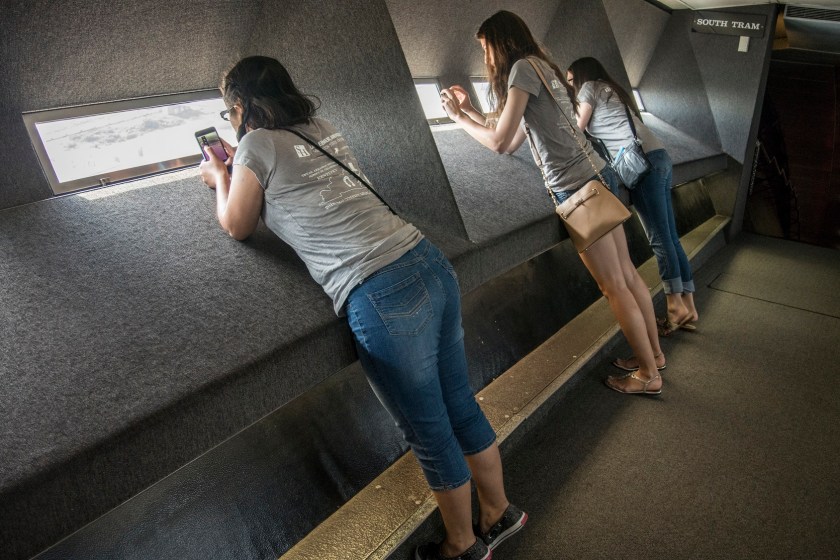
The architect, Eero Saarinen, was an immigrant from Finland and was granted this opportunity after winning a contest by the Jefferson National Expansion Memorial in 1947. After studying architecture at Yale, he believed this was the opportunity to establish himself as an architect in America and it was. Although the design for this structure was completed in 1947, the real structure was not completed until 1965! We learned that this monument was brilliantly made with 142 stainless steel triangle sections that are each 12 feet in length held together by tension bars and truss. It took 13 years to raise the 13 million dollars needed to fund this project. In 1967, a trans system was built inside the north and south legs of the arch allowing 40 people at a time to view the impressive view. It was through these same legs that we rode through in our capsules.
Gateway Arch “Elevator” or Travel Pod
It was tremendously fun to be able to enjoy the arch’s view…
Beatriz, Kaitlyn, and Karla at Top of Gateway Arch
…and see parts of St. Louis that we looked forward to exploring.
St. Louis from the top of the Gateway Arch
Once back on the ground, we were also able to watch an informative documentary about the arch and its history. Expansion in 1803 meant a hopeful future for some and that is our motivation as we expand our education in college and on our trips.
Originally, we had planned to visit the city garden that was near the courthouse. With its luscious greenery, sparkling fountains, and marvelous art we were all prepared to relax and enjoy the perfect view of the arch it would offer. Or so we imagined. Unfortunately, time didn’t permit a trip to that destination.
Photo Ops in St. Louis
Remaining undaunted, we decided to go on a photo op adventure instead. Our first photo op stop was a Richard Haas mural. With two of our students having been interns at the Wynne Home, his work has a special meaning to us, and fourteen of his works dot the downtown of Huntsville.
LEAP Ambassadors in front of Richard Haas Mural
None of the ones in Huntsville, however, cover the 110,000 square feet of the one adorning the Old Edison Stores Building in St. Louis.
Next, we headed over to the St. Louis Union Station Building, which is a beautiful structure, now a Doubletree by Hilton. But its interiors were what we found most intriguing…
Union Station in St. Louis, MO
…even the entrance to the bathrooms were interesting!
But the grand hall was the most beautiful part.
Grand Hall at Union Station (Doubletree Hotel) in St. Louis, MO
Across the street is the Milles Fountain, which is also impressive and offers a nice view of the exterior of the Union Station.
Milles Fountain at Aloe Plaza
Amighetti’s in The Hill, St. Louis
After a morning of westward exploration and photo ops in St. Louis, we took a quick stroll down The Hill to Amighetti’s.
Amighetti’s, in The Hill Section of St. Louis, MO
Located in what could be considered St. Louis’ Little Italy, the restaurant provided a prime venue for a satisfying lunch. Under what seemed an authentic tin-lined ceiling, we looked over the menu which included, but was not limited to, the Amighetti’s Special, a ravioli plate, and Little Bit of Italy sandwich.
A Little Taste of Italy, at Amighetti’s in St. Louis, MO
As for the Amighetti’s Special, the sandwich accomplished its main goal; completely stuff its eater. Made up of ham, roast beef, and Genoa salami, blanketed with a rich layer of brick cheese on a 9 inch loaf of French style bread, it was a near challenge to take a bite. However, the extra effort to open one’s jaw was worth it, for every bite was an opportunity to taste the delicious sandwich. To improve on the experience, the menu presented St. Louis’ own Ritz root-beer. The effervescent, sweet, and smooth root-beer was an enjoyable company to Amighetti’s Special. To close off our lunch we also ordered a round of gelato. Within the group we were able to enjoy a cup of a sour, but satisfying lemon ice, cherry peach, strawberry, and vanilla, all of which we considered of excellent taste. As we stood up from our seat, with a content belly and a cooled off palate, we regained the energy needed to continue our St. Louis exploration at the Frank Lloyd Wright’s Kraus Home.
On previous adventures, Alex and Ryan had already encountered this one-of-a-kind home a numerous times. Therefore, Professor Yawn decided to give them the opportunity to explore new land by the name of the St. Louis Art Museum. After dropping them off we rerouted to the Kraus home.
Frank Lloyd Wright Home at Ebsworth Park
Hidden behind lush greenery, Frank Lloyd Wright’s Kraus Home is located in the upscale Kirkwood neighborhood of Saint Louis. Taking a short drive from the art museum, we arrived for a special tour. Normally, tours are not available on Wednesday afternoons, but the staff of the home were generous enough to arrange a tour for us today! Upon arrival, we immediately gaped in awe of the unique architecture and the natural beauty surrounding the home.
Frank Lloyd Wright Home at Ebsworth Park
To begin our tour, we watched an introductory video about the Kraus home and its architect. Frank Lloyd Wright was born in 1867 and designed more than 500 structures throughout the United States. Represented in the Kraus home were parallelograms, hexagons, and horizontal lines, all of which accentuated the Usonian vision of Wright. The Kraus home sits on 10.5 acres of land now owned by Saint Louis County as part of its parks system.
In the mid 1940’s, Russell Kraus, a Frank Lloyd Wright enthusiast, wrote to Frank Lloyd Wright requesting him to design a small and less expensive home. Nearly ten years later in 1955, the home would finally reach completion. Mr. Kraus lived there until 2001, when a non-profit raised money to purchase the home and the land was deeded to Saint Louis County.
Throughout the tour, Professor Yawn was quick to point out the horizontal attributes of the home, noting even the grooves between the brick walls were designed to draw the eye horizontally instead of vertically. The Kraus home was designed as two hexagons partially overlapping one another. The entire home is made up of these two hexagons or its subcomponents (parallelograms and triangles).
Even the bed, for example, is a parallelogram.
We were fascinated throughout the entire tour. In order to preserve the beauty of the home, we were not allowed to take any photographs inside the home. However, we finished our tour with a few photos on the balcony…
Balcony of Kraus Home at Ebsworth Park, Designed by Frank Lloyd Wright
…and the exterior.
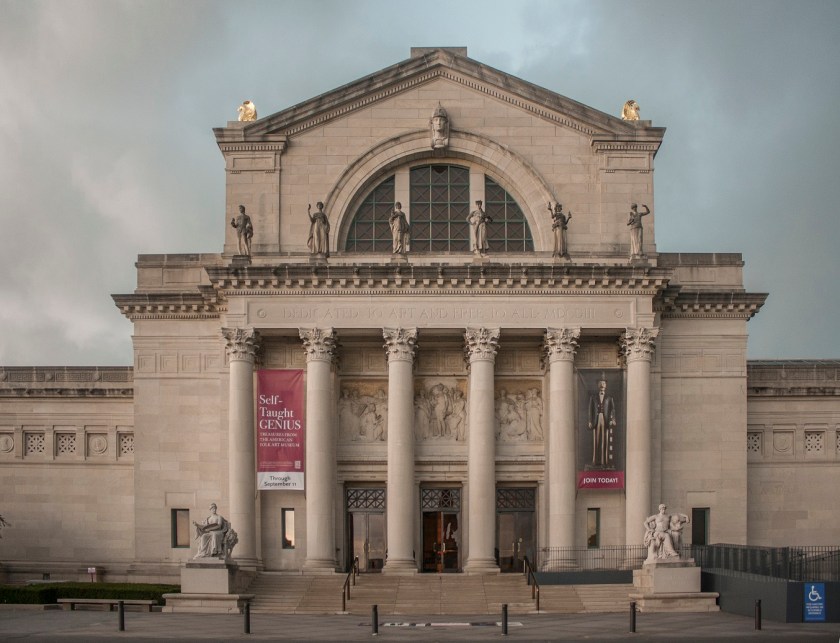
St. Louis Art Museum
Meanwhile, in the St. Louis Art Museum, Ryan and Alex were being exposed to various forms of art.
St. Louis Art Museum
One of the major aspects Missouri has to offer is the free admission into museums (excluding special exhibits). On the three levels of the museum, there were paintings, sculptures, and artifacts from as early as 500-600 BCE to as recent as present day and everything in between. There were pieces of art from all around the world including Asia, the Americas, Africa and Europe. Several famous artists’ works could be found at the museum including Monet…
Monet’s “Water Lilies” at the St. Louis Art Museum
…van Gogh, Picasso, Seurat…
George Seurat’s “Outer Harbor” at the St. Louis Art Museum
…Degas, Rodin, Kandinsky, Warhol, Segal, O’Keeffe, and many more. Outside, there was a short path through a small sculpture garden, mostly made up of pieces from Henry Moore.
Henry Moore’s “Two-Piece Reclining Figures” at St. Louis Art Museum
As we were leaving, a huge storm rolled in, cutting out our trip to a sculpture garden in the downtown area. So instead, we headed towards Bentonville, stopping for a photo-op at the world’s largest fork, and afterwards, stopping for dinner.
Dinner at Cafe Cusco, Springfield, MO
Being the home of the world’s largest fork…
World’s Tallest Fork, Springfield, MO
…Springfield appropriately offers numerous eateries from which to choose.
We choose Cafe Cusco, a Peruvian restaurant that has all the attributes of good Peruvian food, without the risk of Zika.
With the buildings soaking in the last rays of the day on Commercial St., we crossed the threshold into the Peruvian cuisine restaurant. As Peruvian folk music sounded its harmonious guitar in the background, we looked through the menu. With a variety of “platos” or dishes, from vegan salads to meaty steaks, the appetite of some of us were attracted to the fried rabbit, fajita saltada, BBQ pork panca, and lomo saltado. First, however, we began our taste of Peru with a seafood dip and fried avocado appetizer.
Seafood Dip and Fried Avocado at Cafe Cusco
As the initial dishes were cleared, we readied ourselves for our main course. Soon the table was enveloped in the spicy aromas of the various dishes. As for the lomo saltado, a dish of steak cooked with bell pepper and onions served with fries and rice, each scoop of the fork brought to one’s mouth the zesty spice of Peruvian flavor. Perhaps the best of the dishes, however, was the rabbit, which Ryan enjoyed immensely.
The Rabbit Dish at Cafe Cusco
In all, the restaurant was more than enough to make us go back to the corner block venue as we were forever in love with these flavorful dishes. For the meantime however, it was time get back to our traveling van for we still had half a state left to ride through.
Our morning brought excitement with a splash of sadness, both from the prospect of our first day of rain and facing what would be our final day of the Southern Legislative Conference. With that in mind, we vowed to make the most of the day, with experiences extending to the world of politics, liquor, and musical entertainment.
We boarded our ever-familiar tour bus bound for Kentucky’s capital city of Frankfort, and enjoyed the green rolling hills on the short drive from Lexington (~45 minutes). As we neared the bend that would lead into Frankfort’s main street, the trees embraced the city, making it seem every building was surrounded by its own mini forest, an impressive landscape.
The Old Statehouse
Our first stop was the state’s third capitol building, “The Old Capitol,” built in 1803. Its location was the same as the first two state capitol buildings, both of which met their demise through fire. Following the second fire, officials requested submissions for a new design, which would be selected through a competitive process. The winning design was submitted by Gideon Shryock (fresh out of college!) on a dare.
The Greek revival structure was erected as a symbol of Kentucky’s democratic strength, the massive pillars flanking the entry underlining that statement.
Old State Capitol: Frankfort, Kentucky
The limestone walls, quarried from the Kentucky River, stand as impressive as the day as they were placed. Through this grand, but windowless, entrance, we turned first into the “new” library, relocated from its original second-floor location due to weather damage to the books. In the corner of this room stood a desk that had belonged to then-Governor, Thomas Bramllette. Under his orders, the desk was ordered to contain a secret compartment. However, upon arrival, there was no sign of any such compartment. After complaining to the cabinetmaker and demanding that he be told the whereabouts of the desk’s secret, the designer refused to reveal it for “if [he] were to reveal it then it wouldn’t be a secret anymore.” The secret compartment was never found.
We left the library, and gathered under a floating staircase. Reputedly one of the only staircases of its kind in a public building, the whole structure will supposedly stay in place regardless of whether walls stand around it – it requires no external support. As designed by architect Shryock, this is an impressive feat of architectural and aesthetic design. As we walked up the staircase, admiring its simple yet intriguing structure, quite a few tour participants not-so-surreptitiously checked out the number of people on the stairs at once.
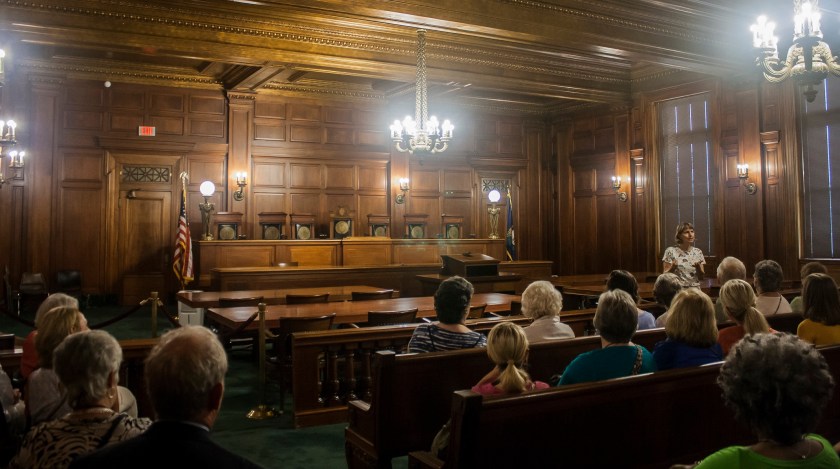
Another pleasant detail was found in the plaster floral designs on the ceiling. As with most capitol buildings, the legislative chambers were the largest. At the entrance of the Senate and House chambers, we were greeted with lighting from magnificent gold French chandeliers, as lavish as when they were lit for the first time. In the House, the desks were sectioned for two legislators to share one table. As we walked onto the senate chamber, we entered a much more intimate room. We sat down on both the house and senate desks, taking in the building’s history, imagining what it would have been like in the past. When the visit of the Old Statehouse was over, we were very sad. However, our hopes were regained after remembering that this was only the beginning of our grand tour.
Center for Kentucky History
Because we spent so much time in the Capitol building, our next stop was correspondingly curtailed. Thus, we only had about 15 minutes at the modern Center for Kentucky History, which was clearly not sufficient. Some of us went into the gift shop while others toured the Hall of Governors, which consisted of painted portraits and biographies of Kentucky’s governors. It started with Isaac Shelby, the first governor of the state. He was an interesting character. Even though he served two full terms believing and practicing his constitutional duties, in his autobiography of four hundred plus pages, he only included one sentence of his tenure as governor. Another notable character was Martha Layne Collins, the first female governor. She was known for bringing a Toyota plant to Kentucky, which provided many economic opportunities to the state. Despite the brief time allotted to this portion of the tour, we enjoyed the artifacts and exhibits we saw.
Governor’s Mansion
After the tour of the Kentucky History Center, we visited the Governor’s Mansion for lunch with the Lieutenant Governor of Kentucky. As we approached the mansion, we were fascinated by the beautiful architecture and colorful garden.
Kentucky Governor’s Mansion: Frankfort, Kentucky
We learned that the architecture was designed to model Queen Marie Antoinette’s villa of the palace of Versailles in France—not the last time we would find French influences in the Bluegrass State. The interior also reflected the French interest of the Beaux-Arts period. Walking into this grand architecture, the Lieutenant Governor, Jenean Hampton, and some of her staff, greeted us. We were then directed to the dining room for lunch.
She welcomed our group very warmly into the governor’s home and spoke about the great state of Kentucky.
Kentucky Lt. Governor Jenean Hampton at the KY Governor’s Mansion
After learning we were from Texas, she expressed her love for the Lone Star State.
LEAP Ambassadors with Lieutenant Governor Jenean Hapton
We felt that she was very genuine and kind! After having greeted her, we then proceeded to eat lunch consisting of a traditional Caesar salad and grilled chicken.
Kaitlyn Tyra and Megan Chapa at the Kentucky Governor’s Mansion
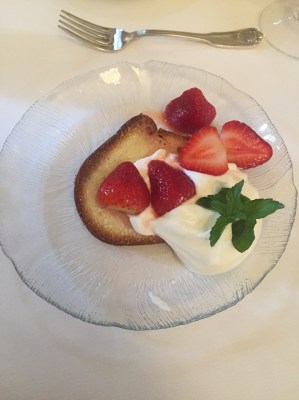
For dessert, we had a light, summery strawberry shortcake.
And as an added desert of sorts, we had the wonderful opportunity to explore the Governor’s Mansion.
LEAP Ambassadors Relax at the Kentucky Governor’s Mansion
Kentucky State Capitol
Following the lunch at the Governor’s mansion, we toured the fourth and current Kentucky state capitol. Our tour began in the rotunda with five large statues, each a famous (or infamous) Kentuckian. These include Henry Clay, Alben Berkley, Jefferson Davis, Ephraim McDowell, and Abraham Lincoln.
Abraham Lincoln, with Jefferson Davis in the Background
The dome that sits above the rotunda is inspired by Les Invalides, Napoleon’s tomb. Interestingly, the interior of the dome changes colors periodically…
This slideshow requires JavaScript.
The building houses all three branches of government: the executive is on the first floor, the judicial is on the second, and the legislative is on the third. This is one of very few state capitols that still houses three branches. In the state supreme court, the judges convene about three days a month, hearing about only nine cases a month.
Kentucky Capitol: Supreme Court
The justices can serve as many ten-year terms as they can get elected to.
The Kentucky legislature is unusual in that they only meet for 90 days every two years. During even numbered years, the Kentucky legislature will meet for up to 60 days, and in odd numbered years, the 38 Senators and 100 House members will meet for no more than 30 days.
House of Representatives, Kentucky
House members, as well as Senators, have two year terms, but no term limits.
Overall, we were impressed by the symmetrical design of the capitol, both the interior…
Kentucky Capitol Interior
…and the exterior…
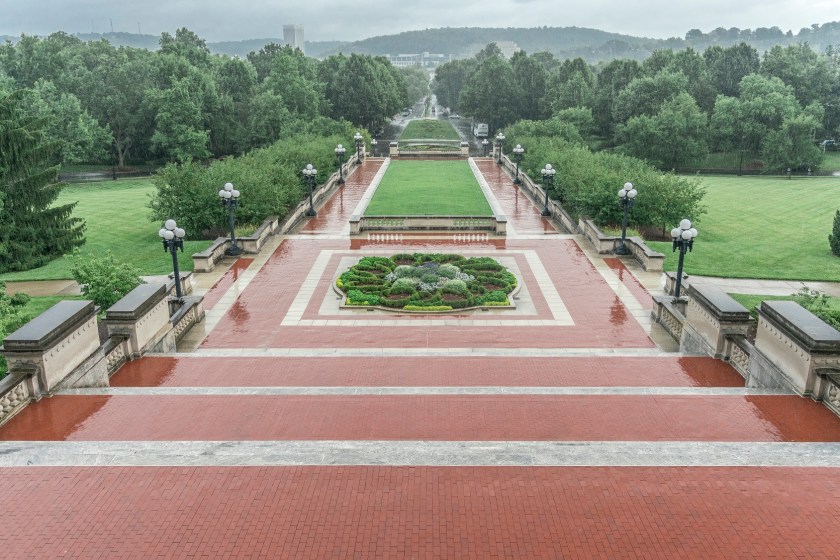
Walkway to the Kentucky Capitol
…as well as the views from the balcony.
This slideshow requires JavaScript.
In fact, it’s rare in a capitol to even be allowed on the balcony, so this was a treat indeed.
Buffalo Trace Distillery
No doubt the offices of the Kentucky Capitol building were witness to much drinking, in order to, as one politician told us, “lubricate the wheels of governance.” Some of those drinks were likely distilled, aged, and bottled in our next destination: Buffalo Trace. Liquor has been manufactured on the site of Buffalo Trace since 1787, when Willis and Hancock Lee first built a still. Although the companies of liquor and processes have changed, the site—located near the Kentucky Capitol building— has always been dedicated to distilling primarily bourbon.
Buffalo Trace Distillery in Frankfort, Kentucky
This was true even during Prohibition. As our tour guide noted, alcohol could still be manufactured for “medicinal purposes.” Each “patient” could be prescribed up to a pint every ten days. During this period, the illnesses must have been both “contagious and chronic,” because often an entire family would need the prescriptions refilled indefinitely. This legal loophole allowed the distillery to stay in business.
Thankfully, that subterfuge was no longer necessary following Prohibition, and the distillery could distribute its liquor the old-fashioned way. In more recent years, there has been a type of anti-prohibition, and bourbon drinking has become fashionable. In fact, Buffalo Trace is in the process of tripling the size of its operations, expanding from 140 to 420 acres.
Some people believe that only Kentucky sells bourbon. That’s not true, but as our tour guide says, most of the bourbon in the US comes from Kentucky. “Kentucky sells 95% of the nation’s bourbon,” he clarified, “and 100 % of the good bourbon.”
Much of that comes from Buffalo Trace. Indeed, they recently manufactured their six-millionth barrel. That’s a lot of bourbon, especially when each barrel contains about 200 bottles.
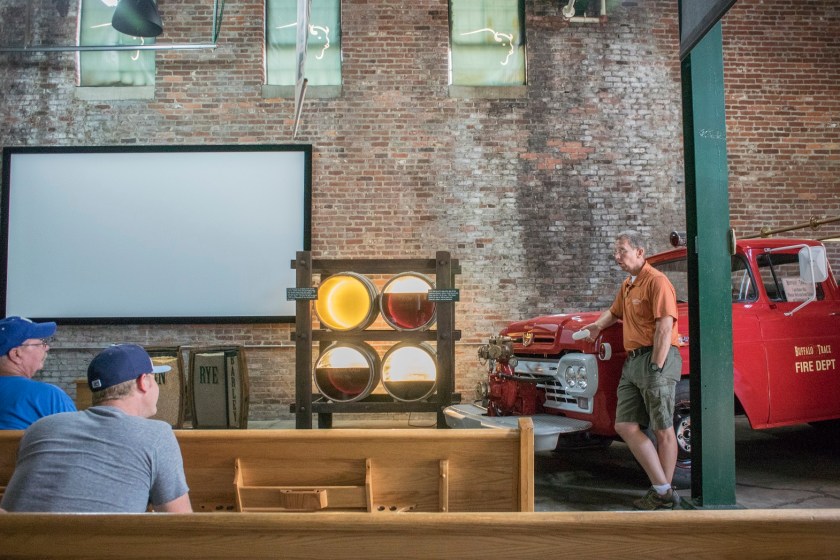
Bourbon Barrels, Buffalo Trace Distillery
And it is this process that is perhaps most interesting. To qualify legally as bourbon, the liquor must meet six criteria:
Its content must be at least 51 % corn;
Distilled to no more than 160 proof;
Barreled at no more than 125 proof;
Aged in new, charred barrels;
Bottled at 80 proof or higher;
And, all of this must occur in the United States.
The Aging Process of Bourbon, Buffalo Trace Distillery
This last requirement stems from the fact that in 1964 the US Congress passed a resolution recognizing bourbon as indigenous to the United States, much in the same way, for example, that Scotch is associated with Scotland.
This was a lot of information to take in, especially for some of the students who had almost no exposure to alcohol. But even for those more familiar with the product, the distinctive and specific process was a lot to ingest.
And speaking of ingesting, our tour concluded with a whiskey tasting. The under-21 crowd skipped this part, but a few of the students had a chance to distinguish (in very small doses!) the difference between four types of whiskey: (1) a blended vodka, (2) a mash whiskey at 125 proof, (3) an 8-9 year old bottle of bourbon, and a (4) 10 year-old bourbon aged on a lower floor of the storage. (The lower floor is a cooler location, which means less mixing with the barrel, which, in turns, less of the woody or caramel flavor.)
Bourbon Tasting at the Buffalo Trace Distillery
Opinions from the group were positive toward the bourbon, but there was general agreement that the 125 proof mash was strong medicine indeed.
Our samples were far too small to lubricate any kind of political deals at the conference, but that doesn’t mean we weren’t interested in expanding our professional networks and seeing what opportunities we could find. To that end, we headed back to Lexington, where we planned to socialize at the state dinner.
State Dinner
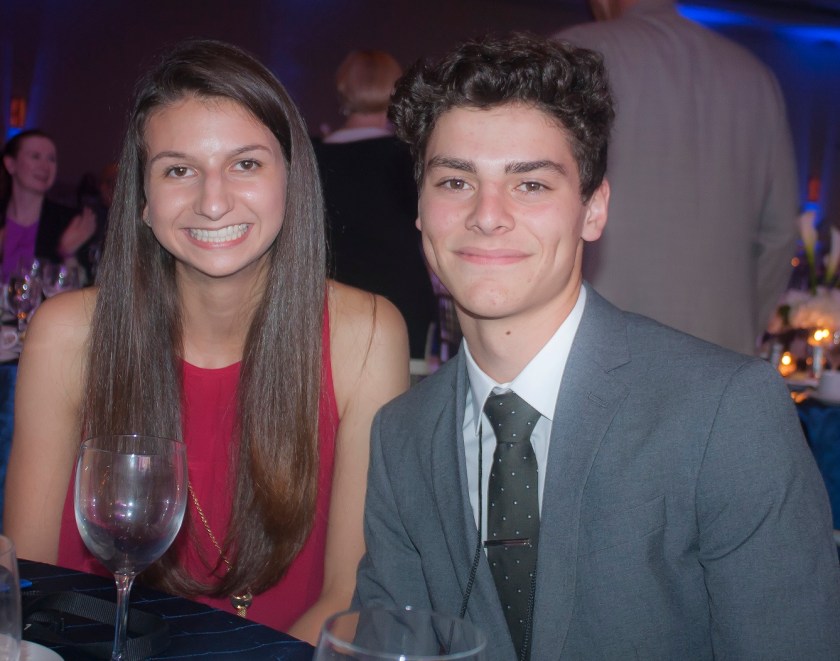
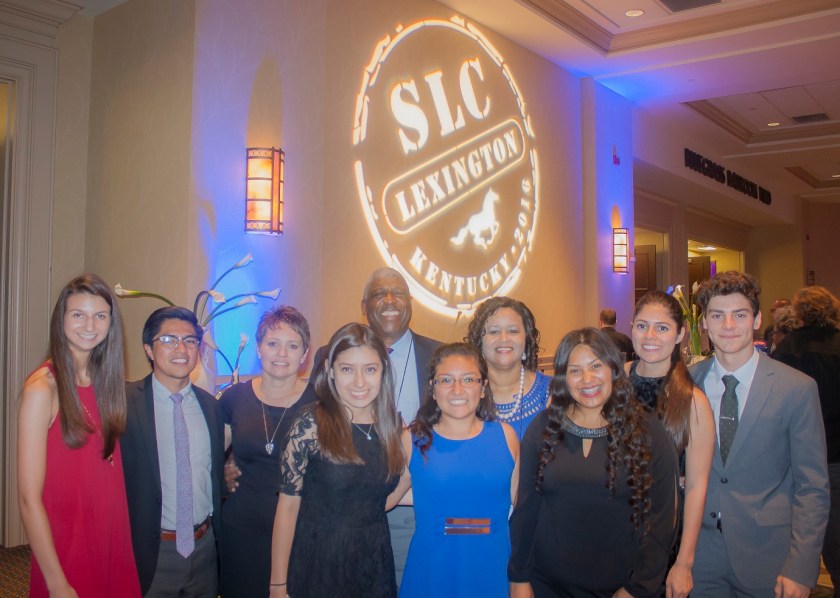
Dressed to the nines, the LEAPsters strode into the Rupp Arena Ballroom. Although we were prepared to enjoy the State Dinner…
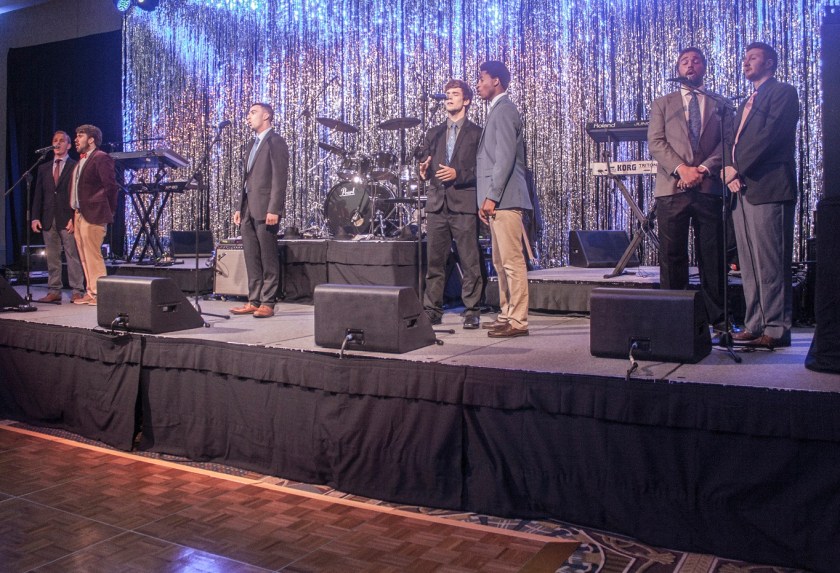
…we were not prepared for the beautiful sounds of the a capella group acoUstiKats, from the University of Kentucky. They introduced the evening with a wonderful rendition of the “Star Spangled Banner” and “My Old Kentucky Home.”
The acoUstiKats from the University of Kentucky
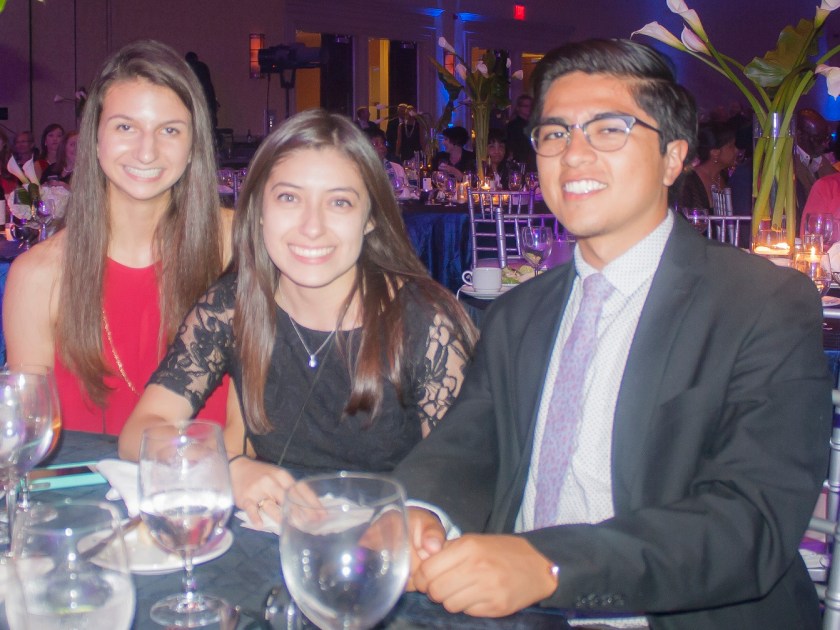
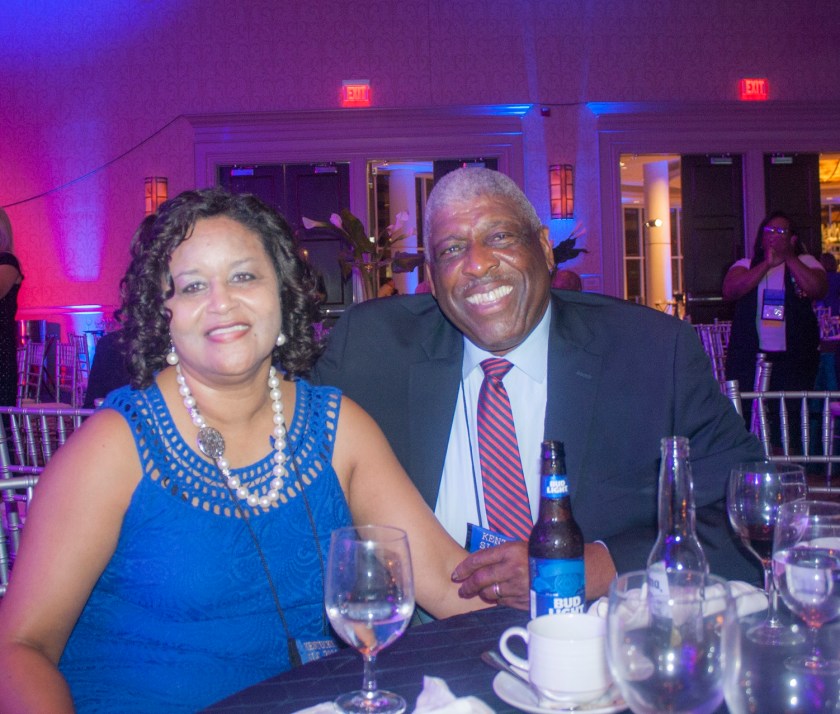
Our dinner mates included Senator Floyd Nicholson and his wife, Mamie, who were from South Carolina and very nice!
Senator (SC) Floyd Nicholson and his wife, Mamie
Later, Kentucky Senator Stivers gave a speech and recognized two different programs for their work under the STAR program. This program promotes the creation of innovative ideas for more programs to help communities. The most proactive are chosen and recognized for their accomplishments.
After the meal was over and we had finished the last bit of cheesecake…
…the entertainment started. Rick Dees kicked off the evening’s entertainment…
Rick Dees at the Southern Legislative Conference State Dinner
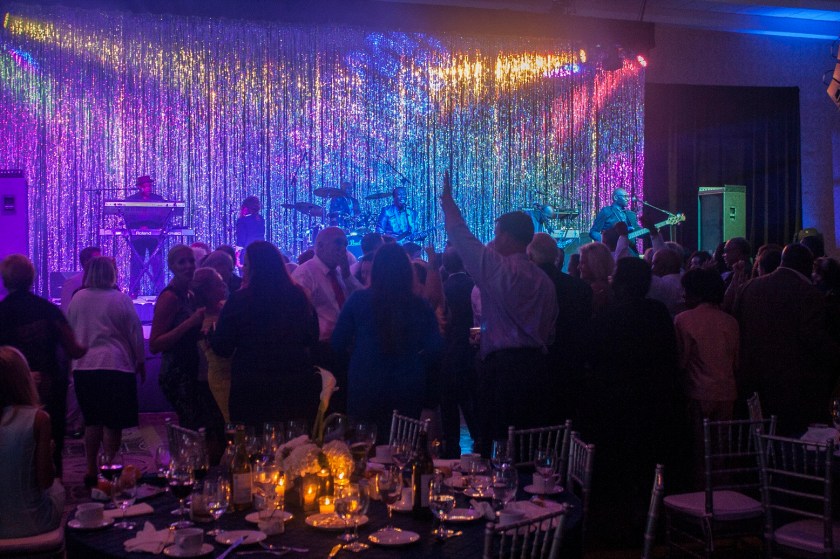
…but he soon turned it over to Midnight Star, an R&B band who enjoyed many hits in the 1970s and 1980s, including “Operator,” “No Parking on the Dance Floor,” and others.
Midnight Star Performs at the Southern Legislative Conference
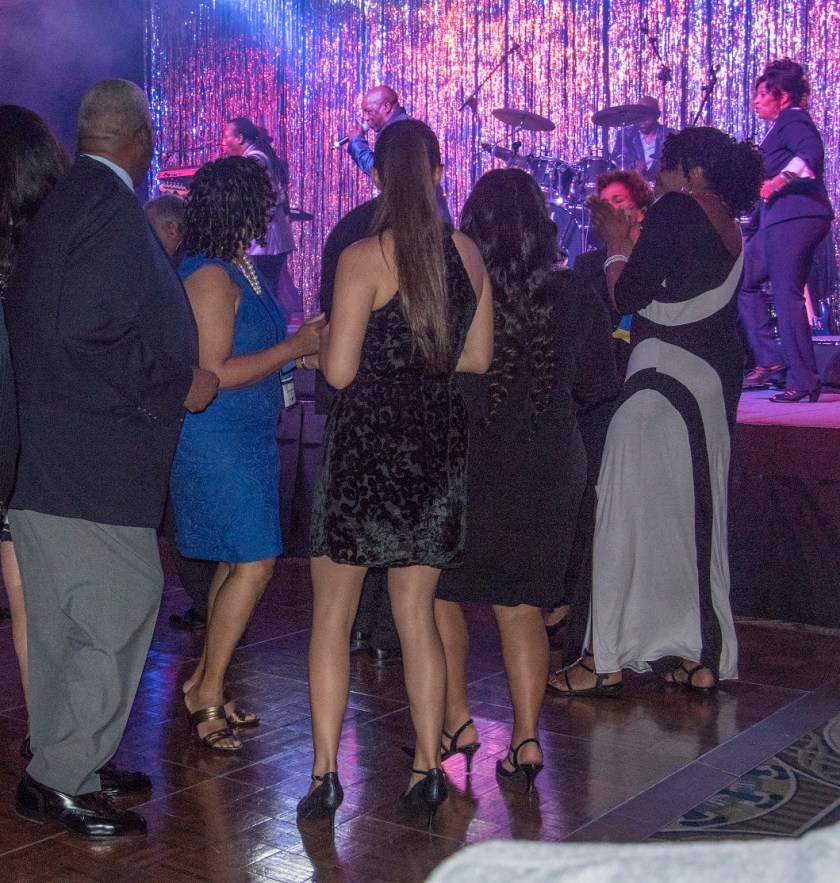
Their music soon drew a crowd of dancers, many of whom were elected officials apparently drawn to the dance floor by courage borne of bourbon.
Not to be outdone, the LEAP Ambassadors showed off their adaptability and busted out a few dance moves of their own.
LEAP Ambassadors Dance at State Dinner
Others, of course, mostly stayed rooted to the dinner table…
Nonetheless, it was an energetic end to a four-day tour of Kentucky and its world of politics, entertainment, and history.
LEAP Ambassadors with Floyd and Mamie Nicholson at the SLC State Dinner
But with a four am departure looming, we posed for a final Kentucky photo op…
LEAP Ambassadors Enjoy Lexington, the Horse Capital of the World
…we headed back to the hotel. Our sleep was destined to be brief, but we were eager to awake to the Midwestern leg of our southern/Midwestern tour of the United States.
Tennessee is known as the volunteer state, so named because of the disproportionate number of volunteers they have provided to the US Military in wartime. While none of the LEAP Ambassadors have served during wartime, we do volunteer a lot, so we felt a distant kind of kinship.
The first stop planned for our third day of the Southern leg of our trip was The Hermitage, Andrew Jackson’s home.
Our tour began with museum exhibits describing the history of the seventh President of the United States in chronological displays. The exhibit began with the wars in which Andrew Jackson played important roles, the War of 1812 and the Battle of New Orleans in 1815.
Original artifacts, such as swords used by the British and the Americans during these historical events, were also displayed in glass cases allowing each visitor to stop and admire the details of each. Larger artifacts, such as his carriage, were displayed on the floor of the exhibit space.
The exhibits were packed with history, but also well-organized, making it easy to follow and understand.
We learned not only about Andrew Jackson’s life, but also much about his wife, Rachel.
After the indoor museum exhibits, we moved on to a self-guided audio tour of the grounds that led us to Jackson’s mansion.
The guides on the tour discussed every room in the 8,000 sq. foot mansion. The parlor downstairs off the entryway was covered in elegant wallpaper that General Jackson ordered from France, along with many original artifacts. Although the mansion was beautiful, it does not have all the modern conveniences that homes today have, such as indoor plumbing! The second floor houses guest rooms and the grandchildren’s rooms. And as a special treat, the upstairs tour guide pointed out one of the guest rooms where Sam Houston slept during one of his visits to see General Jackson.
After the mansion tour, we meandered the garden, still guided by the audio tour. In the garden, elaborate for its time, we saw the tombs of the Jacksons, along with several family members.
The garden was originally made for Rachel as a place for her to relax, a much-needed respite from the stress of her husband’s political career. Sadly, she passed away days after Andrew Jackson was elected President; and it is said that the political stress caused her death. After the tour of the museum exhibits, the mansion, the garden, and a quick photo-op on the $20 bill…
…we had worked up an appetite, so we made our way to The Pharmacy for a quick fix.
We know what you’re thinking, but no, we didn’t go to the local drugstore for lunch! The Pharmacy is actually a burger parlor and beer garden, although we didn’t sample the latter. The restaurant has been named the “wurst burger joint” around because of the German influences in their food and beverages. The phosphate and crème sodas, Wurst, and beer make this Nashville spot distinct and popular. The restaurant was cozy with a large outside patio garden. The patio was beautiful; however, we sat inside to cool off after a morning of sunshine at The Hermitage.
We ordered different varieties of burgers made from 100% Tennessee beef. Beatriz, ordered the Farm Burger, with bacon, egg, and ham and other fixings, while others tried the Biergarten Platter, which had a variety of wurst sausages and mustards. All the food and cream sodas were satisfying and we were more than ready for our next stop, The Parthenon.
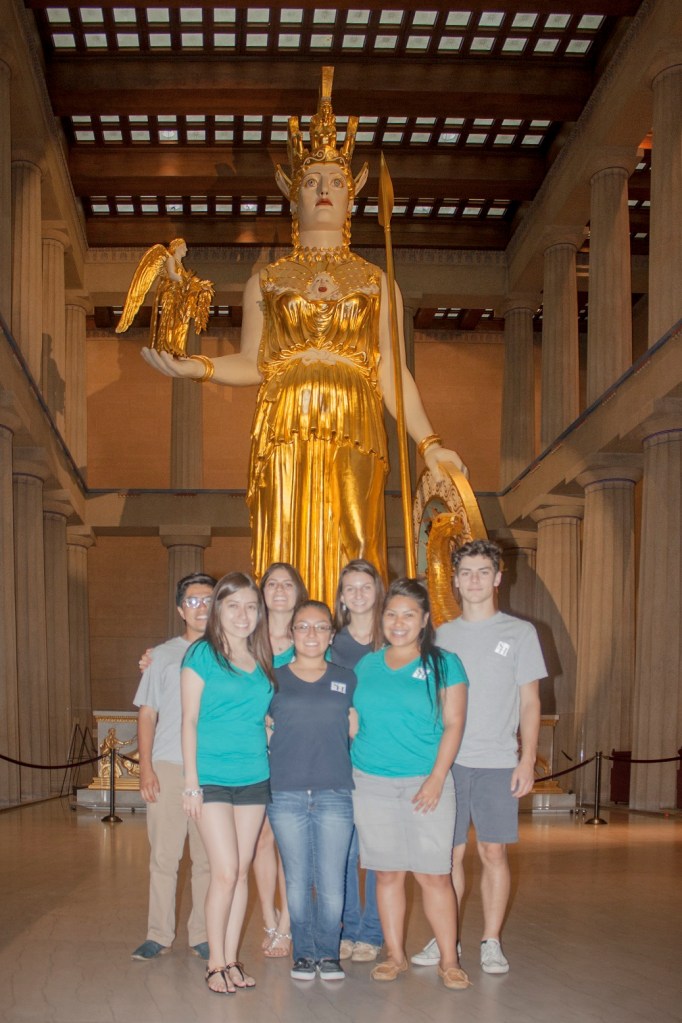
Gryphons stared down at us serenely as we climbed up the steps of Nashville’s Parthenon. We entered through the west side, noticing that atop the majestically stoic Doric columns a scene was unfolding depicting Athena being crowned by Nike (the winged goddess of victory, not the shoe brand). Built in 1897, this replica Athena’s shrine was at one point meant to be temporary. Due to Nashville’s love of the thought of having their own Parthenon (they were known as “the Athens of the South”) and since it had quickly grown in popularity, it stayed.
LEAP Ambassadors at the Parthenon–Nashville, Tennessee
As we set foot into the structure of classical architectural style, not only did we travel across space towards Athens, Greece where the real Parthenon lay, but we also stepped into a place of art. Literally. The Parthenon is both a bona fide replica of the authentic Parthenon and a museum housing more than 60 pieces of art donated by Mr. James M. Cowan under a strange circumstance…he had donated the pieces of art with only one condition: that he remain anonymous as the donor until after his death.
We moved upstairs where we were able to see the goddess of wisdom herself. Made of a number of materials, including 3.6kg of gold leaf, she stands impressively tall with Nike in her right hand and her faithful shield in the other.
One of the many interesting things about Nashville’s Parthenon are the gargantuan bronze doors. Measuring up to 6.5 ft. in height and weighing about 7.5 tons, these doors are thought to be the largest set of bronze doors in the world. However, even the smallest of our group could easily move them.
After digesting much great Greek mythology, art, and architecture, we passed by a gryphon one last time…
…Beatriz giving it a fist bump of gratitude for its great work at guarding Athena.
With that last goodbye, and a last glance at the great Athena, we left wiser on the subjects of art, architecture, Nashville history, and a bit of the goddess of wisdom herself.
From there, we visited the Tennessee Capitol.
Like many other major building projects, construction of their capitol was behind on schedule and way over budget, taking fourteen years instead of three, and costing about three times as much as the initial budget.
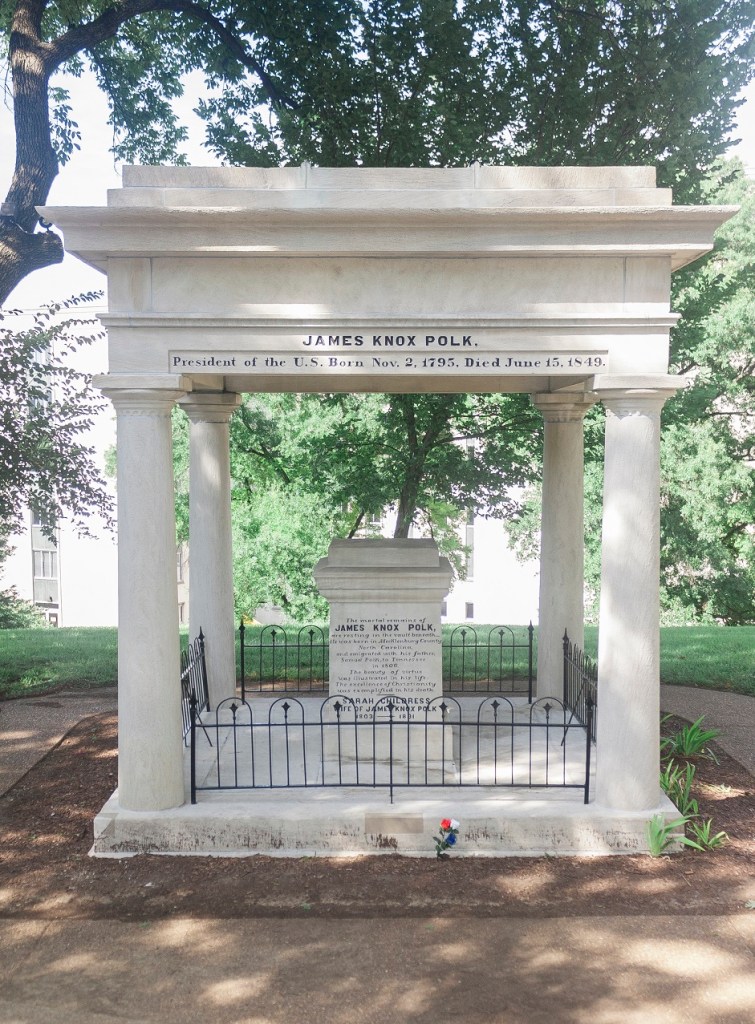
The Tennessee Capitol is one of 13 state capitols which does not have a dome. Instead, it was built in a Greek revival style. Not only is it different in architecture, but this capitol is the only one to be home to three deceased people, the first being the architect who designed it, William Strickland. Strickland is buried in the walls of the building, which he regarded as his greatest work. Along with Strickland, Samuel Morgan, the original building commissioner, is also buried on the site (actually, in the walls of the building). And wrapping up the list are President James K. Polk, and Polk’s wife, Sarah, are bured on the grounds (but not in the walls).
We learned much about Polk and the other two presidents from Tennessee (Andrew Jackson and Andrew Johnson). As we went along our tour, our guide (who was very knowledgeable and one of the best tour guides we’ve had!)…
…pointed out a bearded Sam Houston, who was governor of both Tennessee and Texas.
Although one LEAPster, who shall remain nameless (Megan), failed to recognize him, it was nice to see that General Houston was given credit for the work he’d done in Tennessee.
Tired of waiting for the entire capitol building to be built, the Supreme Court of Tennessee decided to move right in and start hearing cases. One judicial record, the tour guide explained, indicates the Court held a construction company in contempt of court for making too much noise while working on the building.
Even so, the tour was great, filled with humor and interesting facts, such as the two occasions in which a president chose a vice-president with the last name Johnson, which didn’t work out so well for the presidents, who both ended up dying in office. Our cheerful tour guide made the tour one of the most interesting capitol tours we’ve been on.
This slideshow requires JavaScript.
To top it off, we even got to use the old-timey state seal press to emboss our programs.
So, as the day and the tour came to a close…
…we knew it was time to move on to our next destination, Louisville, Kentucky.
The LEAPsters are always up for adventure no matter how frightening it may appear. One member of group stated that completing the fully-underground, aerial ropes challenge course at Louisville Mega Cavern truly embodied the LEAP spirit.
As we opened the front “door,” it was apparent that the cavern’s interior had been refurbished with artificial ceilings and walls in order to accommodate the recreational attractions inside. Louisville Mega Cavern houses a bike course, ropes course, “mega” zip line, and holds tours of the cavern’s mines.
This night we were set for the elevated, trapeze-style obstacles on the ropes course.
Several of us are not fond of heights, and regardless of the multiple, secure straps attached to every elevated obstacle, fear of falling was still prominent.
Our pseudo phobias did not deter us from trying as many hanging rope bridges within our time limit, though. Bridges between the platforms varied in size, shape, difficulty and amount of balance required to traverse, from suspended, unbalanced planks to tension ropes to challenges that simply cannot be described without seeing them.
For Alex, acrophobia kicked in while trying to balance over this system of suspended ropes and planks: At these moments my blood would rush in anticipation of hitting the ground, my palms would start to perspire inside my leather gloves making them almost slide off my hands, and my head would be showered in more sweat as I noticed how high off the ground my struggling body hovered. I would tightly clench the rope from which each overpass was suspended and inch my way through with each move coordinated to keep balance. No matter how much I wished to stay safely footed on the floor, I mustered all the courage my shaky spirit could supply.
For the most part, though, we successfully walked, crawled, and hopped, and prayed over the obstacles without falling.
And all the LEAPsters made it to the grand finale: the zip line.
Some jumped off, some slid off, and at least one asked to be pushed off, but we all made it off the platform at least once. We wrapped up the late night and with blistering hands and muscles strained from the continuous stress of cheating an unwelcome dive to the hard ground, we climbed in our traveling van, ready to reach our hotel for some much-needed rest.