Skip to content

Center for Law, Engagement, and Politics

Leap At SHSU!

  • About LEAP
  • LEAP Ambassadors
Center for Law, Engagement, and Politics

Category: Law

College and Politics

By Juan Alonso

In our sixth and final meeting in September for LEAP LEADs, we had the privilege of learning from SHSU Vice-Provost Chris Maynard and legendary Washington Post reporter (and author) Bob Woodward. The night was as entertaining as it was educational.

SHSU, LEAP Center, Center for Law Engagement And Politics, Dr. Chris Maynard, Jim Baker

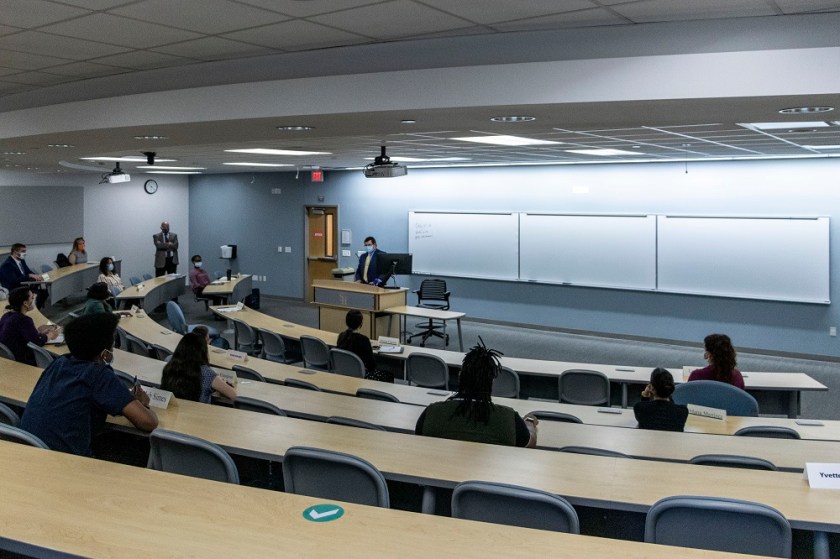
Dr. Chris Maynard serves as Vice Provost, a position that is a mystery to most students. He attended our LEAP LEADs meeting to help de-mystify that position and to provide larger lessons about the University structure.

Dr. Maynard drew on a wealth of experience: he has been a Dean, Chair, (University of North Alabama) and a Professor (University of North Alabama and Dakota State University). The conversation with Dr. Maynard was as broad as his education and experience.

SHSU, LEAP Center, Center for Law Engagement And Politics, Dr. Chris Maynard, Jim Baker

He provided advice to students considering law or graduate school (“Have a game plan–make sure you pursuing goals and that those degrees fit in with those goals”) and on being successful in our chosen fields (“find successful people in our area, and learn as much as possible from them”–good advice for people doing just that in LEAP LEADs!).

SHSU, LEAP Center, Center for Law Engagement And Politics, Dr. Chris Maynard, Jim Baker

He also discussed the disruption caused by COVID, from everything to changing the way we market and offer classes, to dealing with media concerns, to providing students the “University” experience. He was adamant that, despite the vexations caused by COVID, the University degree and experience is valuable and worthwhile–something with which we all agree.

We also had a chance to ask Dr. Maynard about his area of expertise: political history. And while he did discuss history (see below), he also discussed the future and the challenge we face in cybersecurity. During the Cold War, there were two super powers and their allies coalesced against each other, but there was a type of stability. Now, “a person with the right skill set and a laptop can hack into a government’s system and wreak havoc.”

SHSU, LEAP Center, Center for Law Engagement And Politics, Dr. Chris Maynard, Jim Baker

Of course, we also asked many questions about the end of the Cold War and the careers of Ronald Reagan, George H. W. Bush, and James Baker. He described the different styles of Reagan and Bush, while also discussing the unique talents of James Baker, about whom we also had the pleasure of watching a Texas Tribune Festival presentation (featuring Mark Updegrove, Susan Glasser, and Peter Baker).

SHSU, LEAP Center, Center for Law Engagement And Politics, Dr. Chris Maynard, Jim Baker

The discussion of these men and their accomplishments set the stage, bathed in high-contrast light, for our final event of the evening: hearing Bob Woodward discuss his new book, “Rage,” on the Trump Administration.

SHSU, LEAP Center, Center for Law Engagement And Politics, Bob Woodward, Donald Trump, Texas Tribune Festival

We enjoyed our dinner from Carbonero as we watched Woodward discuss the Trump Administration and the conclusions he drew from 17 separate interviews with President Trump–both before and after the COVID-19 outbreak.

Woodward’s report, which sometimes contained various expletives (all while quoting Trump administration officials), portrayed Trump as a contradictory figure. At times the President acknowledged the danger posed by COVID; other times, he seemed indifferent or dismissive of the threats it presented. And even as these important discussions were taking place, Trump, according to Woodward, would be fixated on things like photos he took with world leaders. It was an unsettling discussion, one made more unsettling by the news that broke shortly thereafter about the President contracting COVID.

SHSU, LEAP Center, Center for Law Engagement And Politics, Bob Woodward, Donald Trump, Texas Tribune Festival

We’ve learned quite a lot this fall, but one thing has been made most clear: all these discussions–whether on local government, University administration, national politics, or COVID–are all related.

Unknown's avatarAuthor mikeyawnPosted on October 7, 2020October 7, 2020Format AsideCategories Civic Engagement, Food, Health, Law, PoliticsTags Bob Woodward, Center for Law Engagement And Politics, Dr. Chris Maynard, Jim Baker, LEAP Center, SHSULeave a comment on College and Politics

A Life in Law: Chris Tritico

The Pre-Law Society, Virtually

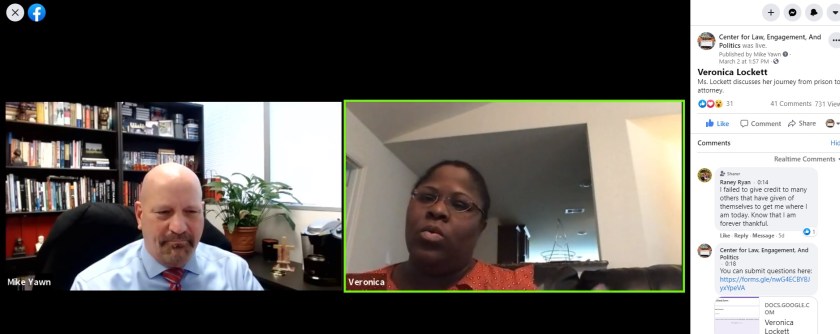
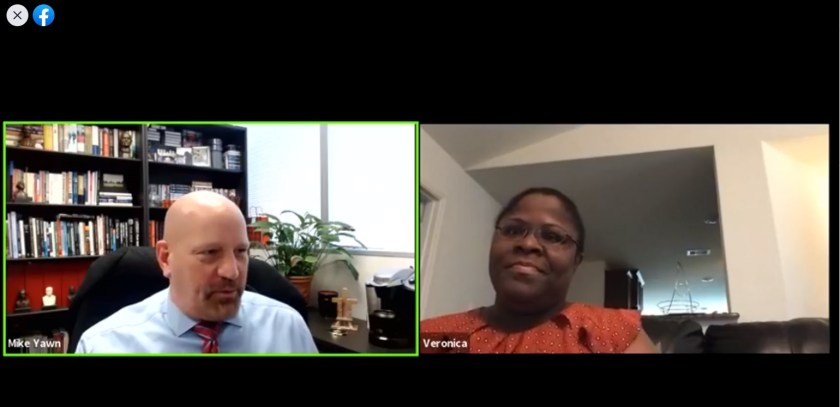
Amid the limitations of COVID-19, the Pre-Law Society kicked off the new semester virtually by way a Facebook Live interview with attorney and SHSU alum Chris Tritico!

SHSU, LEAP Center, Center for Law Engagement And Politics, Chris Tritico, Tritico-Rainey, Pre-Law Society

Tritico had many great stories and advice to share, including his time working with the legendary Richard “Racehorse” Haynes.

SHSU, LEAP Center, Center for Law Engagement And Politics, Chris Tritico, Tritico-Rainey, Pre-Law Society, Richard "Racehorse" Haynes

He talked about how Haynes could cross-examine a witness by slicing questions – or slightly changing the question – until he got the answer he felt was the truth.

He then shared a story about Haynes and his work on the trial of Morgana, the “Kissing Bandit,” a woman with large breasts…

SHSU, LEAP Center, Center for Law Engagement And Politics, Chris Tritico, Tritico-Rainey, Pre-Law Society, Richard Racehorse Haynes, Morganna the Kissing Bandit

…who had a habit of interrupting baseball games by running across the field to kiss a player.  She did this once during an Astro’s game, and kissed Nolan Ryan.

SHSU, LEAP Center, Center for Law Engagement And Politics, Chris Tritico, Tritico-Rainey, Pre-Law Society, Morganna the Kissing Bandit, Nolan Ryan, Richard Racehorse Haynes

She was arrested for this and charged with trespassing. When the case went to trial, she hired Haynes to represent her, and when asked what her defense was for trespassing, Hayne said simply, “Gravity.” He argued that she was trying to catch a foul ball, ended up falling over the fence, and decided to kiss Nolan Ryan while she was there. The case against her was dropped.

Tritico went on to discuss his own career, sharing that he eventually left and started his own law firm. Early on in his career, he became a go-to for educational law. He met someone who had been arrested and was a member of a teacher’s union, in search of representation. He told the person to go to his union, and find out who their attorney was, and sent him on his way. Shortly thereafter, a grateful leader within the teacher’s union – which happened to be the American Federation of Teachers – offered the role of union lawyer to Tritico. From then on, he became an expert in educational law.

One of the most moving stories of the evening was the story of Old Main, the most architecturally interesting building on SHSU’s campus.

SHSU, LEAP Center, Center for Law Engagement And Politics, Chris Tritico, Tritico-Rainey, Pre-Law Society, Old Main SHSU

In the early morning in February 1982, when Tritico was President of the student body, he got a call that Old Main was on fire.  He rushed to the scene and asked Dean Powell what he could do. He was told to keep students away from the fire and wait for someone to relieve him. He ended up standing there for 17 hours.

SHSU, LEAP Center, Center for Law Engagement And Politics, Chris Tritico, Tritico-Rainey, Pre-Law Society, Old Main SHSU

The discussion came to the long-awaited topic: Tritico’s time representing Timothy McVeigh in the wake of the Oklahoma City bombing.

SHSU, LEAP Center, Center for Law Engagement And Politics, Chris Tritico, Tritico-Rainey, Pre-Law Society, Murrah Bombing, OKC, McVeigh

When interviewing with the existing attorneys to see whether he would be hired, Tritico was told that the attorneys were hoping to bring on a woman as additional counsel.  Tritico responded, “If it means that much to you, I’ll wear a dress!” With that comment, he was hired, and worked on one of the biggest cases of domestic terrorism to that date.

SHSU, LEAP Center, Center for Law Engagement And Politics, Chris Tritico, Tritico-Rainey, Pre-Law Society, Murrah Bombing, OKC, McVeigh

We wrapped the evening up with a brief Q&A session. (Disclaimer: questions and answers are paraphrased.)

Q: How do you represent guys like McVeigh?

A: My job is not to support or condone the actions people take, my job is to protect and uphold the rights guaranteed by the Constitution.

Q: Can you tell us about “Potty-gate?”

A: There was a woman at a George Strait concert at the Astrodome who needed to go to the bathroom, but there were more men’s restrooms than women’s, so she went into a men’s bathroom and did her business. When she came out, two police officers were there to arrest her for violating an ordinance not allowing people to use the restroom of the opposite gender to cause a disturbance. She was acquitted after two days.

Q: Can you tell us more about the painting behind you?

SHSU, LEAP Center, Center for Law Engagement And Politics, Chris Tritico, Tritico-Rainey, Pre-Law Society

A: This was painted by my wife, Debbie, and shows the reunion of me with my one-year-old son following my return from the McVeigh case. It brings tears to my eyes because I was away for a work often when he was younger. (This story brought tears to everyone’s eyes.)

SHSU, LEAP Center, Center for Law Engagement And Politics, Chris Tritico, Tritico-Rainey, Pre-Law Society

In spite of the challenges presented by COVID-19, we are excited to get started with a new semester in the Pre-Law Society! We look forward to talking with guests we may not always be able to talk to in person, finding creative new ways to interact with each other, and learning as much as we can about the law.

Unknown's avatarAuthor mikeyawnPosted on September 23, 2020Format AsideCategories Art, Civic Engagement, Civil Rights, Law, PoliticsTags Center for Law Engagement And Politics, Chris Tritico, LEAP Center, Pre-Law Society, SHSU, Tritico-RaineyLeave a comment on A Life in Law: Chris Tritico

LEAP LEADs: Meeting Two

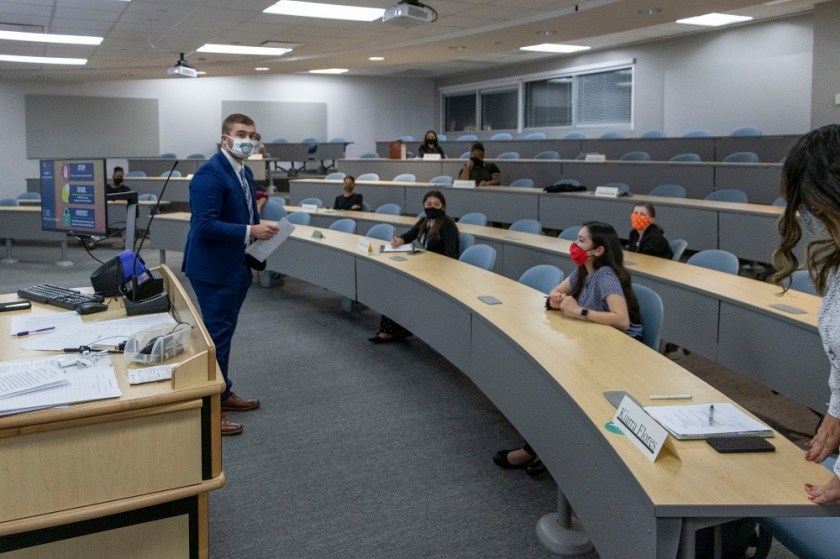
To start off our second meeting of the semester, we had the four LEAP interns join us as well as Commissioner Bill Daugette and his wife, with Officer Butterworth of Sam Houston UPD as the first speaker of the evening. One might know of him through Bearkat Orientation, through the various other events that he has spoken at regarding campus safety, the job of university police, or how to deal with certain situations common to campus life.

SHSU, LEAP Center, Center for Law Engagement And Politics, University Policy Department, LEAP LEADs, Officer Jeffrey Butterworth

During our meeting, he focused on different scenarios that college students might experience when interacting with the police: One being a party situation where minors and alcohol are involved, and the other, a simple traffic stop. At the end of his time with us, three volunteers were able to put on “drunk goggles” (which impair balance and cognitive processes, allowing the individual to appear as if they were drunk) and go through common sobriety tests with Officer Butterworth.

SHSU, LEAP Center, Center for Law Engagement And Politics, University Policy Department, LEAP LEADs, Officer Jeffrey Butterworth

The results were entertaining, since none of the participants could keep their balance or pass their sobriety tests (with the exception of Quinn, who miraculously kept his balance during his test).

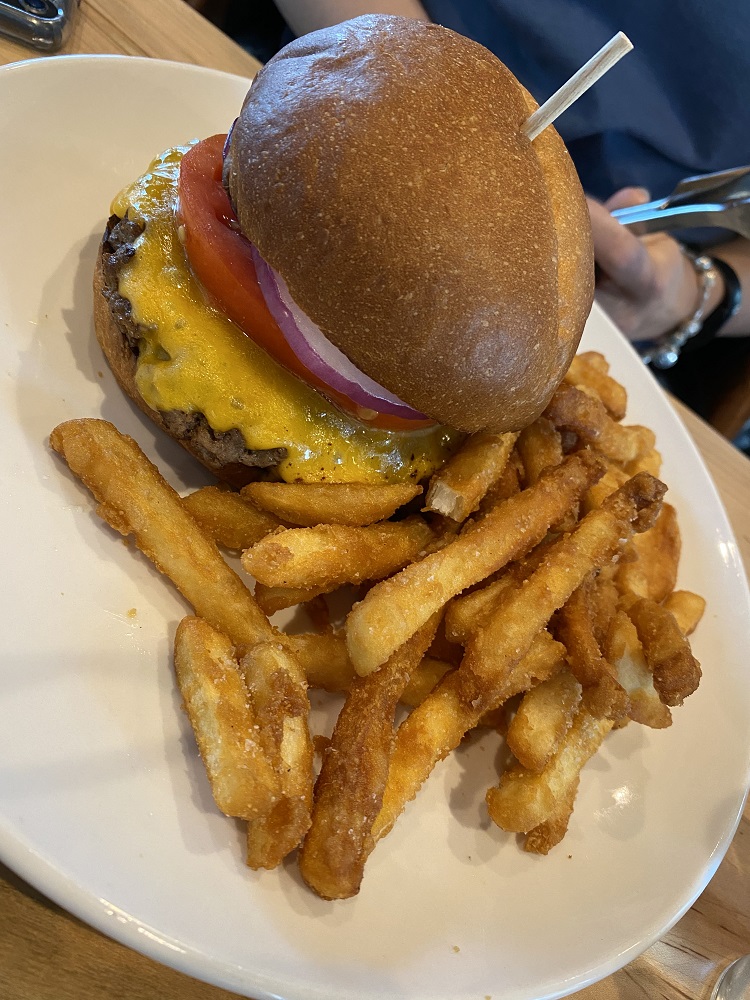
After Officer Butterworth’s interactive and extremely informative presentation, we were served dinner catered by McKenzie’s Barbeque and Burgers, a local favorite.

During dinner we watched the Texas Tribune Festival’s discussion where the six mayors of the most populated cities in Texas were asked about the effects of COVID-19 and race relations in their respective cities.

SHSU, LEAP Center, Center for Law Engagement And Politics, University Policy Department, LEAP LEADs, Texas Tribune Festival, Big City Mayors

The mayors who participated were from the cities of Austin, Fort Worth, Dallas, Houston, El Paso, and San Antonio. All of the mayors expressed how their cities have lost severe amounts of money due to COVID-19, most notably with the city of Houston that has a loss of $162 million. In regard to race relations, the mayors alluded to the fact that they have all been working together in order to arrive at proper solutions for their cities. Mayor Johnson of Dallas was the most hopeful, citing that he was glad that “…COVID-19 has allowed people to be introspective and think about racial issues.”

SHSU, LEAP Center, Center for Law Engagement And Politics, University Policy Department, LEAP LEADs, Texas Tribune Festival, Big City Mayors, Eric Johnson

The discussion was a nice display of teamwork and hope for the future that each of the mayors held.

Lastly, we were able to have a discussion with Walker County Commissioner, Bill Daugette.

SHSU, LEAP Center, Center for Law Engagement And Politics, LEAP LEADs, Commissioner, Texas Tribune Festival, Bill Daugette

He is an alum from Sam Houston, having gone back to school to Sam Houston to get his undergraduate in Political Science and a minor in Finance. He encouraged us all to consider going into public service since the majority of us there are interested in going into law and that his works in public service have allowed him to “make the world a better place.” He walked us through the response that Walker County had to COVID-19 and how the county prepared for the worst, quickly declaring a disaster when COVID-19 struck. He also explained what the responsibilities of the county are and how “people put counties and cities in a tough spot” since many residents demand services but refuse to have their taxes raised, which would pay for said services. He was asked about his most memorable moment of serving the community of Walker County, which was during the time of hurricane Katrina where 10s of thousands of people were traveling through his precinct. The individuals fleeing the threat of the storm would become stuck on the road and he personally delivered gasoline to these individuals which was “taking these people from nothing to get them to something” as Commissioner Daugette described the feat. The night was ended with his last bit of advice to all of us and should be shared amongst our fellow peers: “being a young person you can change the world, don’t give up on that.”


Unknown's avatarAuthor mikeyawnPosted on September 17, 2020Format AsideCategories Civic Engagement, Civil Rights, Food, Law, PoliticsTags Center for Law Engagement And Politics, Commissioner, LEAP Center, LEAP LEADs, SHSU, Texas Tribune FestivalLeave a comment on LEAP LEADs: Meeting Two

LEAP in DC: Day 4

Tuesday, 20200310

NLC Conference: General Session (MD)

LEAPsters faced another early morning for the closing day of the National League of Cities’ Congressional City Conference.

SHSU, LEAP Center, Center for Law Engagement And Politics, National League of Cities Congressional City Conference

NLC Second Vice President and Mayor of Union City, Georgia, Vince Williams, called the session to order.SHSU, LEAP Center, Center for Law Engagement And Politics, National League of Cities Congressional City Conferenc, Vince Williams

The session opening featured a panel discussion on homelessness with representatives from the Washington Metro Police Department and the National Alliance to End Homelessness as well as elected officials. Ending homelessness has become a high priority in recent years as the homelessness population continues to grow. Local and federal governments have been searching for a solution to this growing problem, and the experienced panel offered possible housing solutions, including shelters, affordable housing, and low income and veterans’ housing options. They also covered diversion programs, which divert the homeless with substance abuse or mental health problems to a health department instead of the police department.

SHSU, LEAP Center, Center for Law Engagement And Politics, National League of Cities Congressional City Conference

The (knowledgeable and clearly passionate) panel also discussed implementation of education and workforce development programs as a longer-term solution, and ultimately, about the importance of providing a safe and healthy living environment to all residents.

SHSU, LEAP Center, Center for Law Engagement And Politics, National League of Cities Congressional City Conference

A “town hall meeting” on COVID-19 with Dr. E. Oscar Alleyne, Senior Advisor for Public Health Programs, National Association of County and City Health Officials, closed out the morning general session.

SHSU, LEAP Center, Center for Law Engagement And Politics, National League of Cities Congressional City Conference

Through an extremely informative Q&A format, Alleyne discussed the difference between COVID-19 ad the flu, and updated the audience on the current (but ever expanding) status of the COVID-19 outbreak in both the US and foreign countries.

SHSU, LEAP Center, Center for Law Engagement And Politics, National League of Cities Congressional City Conference

Alleyne was able to convert medical and science jargon into easily absorbed information, thankfully.  It was a bit scary, though, to learn about the coming microbial-resistance of future viruses because of the overuse of sanitizers and soaps in our everyday use.

SHSU, LEAP Center, Center for Law Engagement And Politics, National League of Cities Congressional City Conference

On that note, we all sanitized our hands (maybe a bit sheepishly) and headed to the next session!

NLC Conference: Cybersecurity: City Data and the 2020 Census (EM)

SHSU, LEAP Center, Center for Law Engagement And Politics, National League of Cities Congressional City Conference

With the country’s change to an online census and the upcoming presidential election, this panel provided some great advice to prevent cyberattacks within their cities at a low cost.

SHSU, LEAP Center, Center for Law Engagement And Politics, National League of Cities Congressional City Conference

Some advice included the following items, along with a reference to https://www.dhs.gov/be-cyber-smart:

  • Enabling multi-factor authentication (MFA) to guarantee you’re the only person that has access to your log-ins.
  • Avoiding automatic updates and an all-access pass containing personal information on installed applications.
  • Setting privacy preferences to a restrictive setting by disabling geotags that will give your followers the ability to see your location.
  • NOT clicking on any link sent by a suspicious email address.

It is difficult to find a “one-size fits all” solution to address cybersecurity. And, accountability for cybersecurity is ultimately everyone’s responsibility—to understand and adopt preventative measures. According to the website referenced above, 47% of American adults have been attacked by a cybercriminal for their personal information.  Notably, Miranda asked a question at this session.

SHSU, LEAP Center, Center for Law Engagement And Politics, National League of Cities Congressional City Conference, Miranda Estrada

NLC Conference: Closing General Session, with Lunch (ME)

All attendees headed into the ballroom for the closing session,…

SHSU, LEAP Center, Center for Law Engagement And Politics, National League of Cities Congressional City Conference

…which included a catered lunch—Caesar salad, chicken with vegetables and rice, and a large slice of rich chocolate cake–that turned out decent!

SHSU, LEAP Center, Center for Law Engagement And Politics, National League of Cities Congressional City Conference

NLC President Joe Buscaino kicked off the closing session with a few words, followed closely by officials who spoke on greenhouse emissions and plans to pass comprehensive legislation for regulating those emissions that should be based on science, and without partisan politics.  They emphasized that, while this is an important issue, much misinformation abounds regarding efforts to reduce emissions. They indicated that several states have had success reducing their footprint, with Georgia making tremendous gains with a 22% reduction, and that the US is the global leader in reducing these emissions.

Buscaino next introduced Ms. Una Garvey, the Convention Center and Tourism Director for the City of Tampa, Florida. Tampa will host NLC’s annual City Summit this fall.   Garvey invited everyone to the conference and shared a video from Mayor Jane Castor, who encouraged everyone to attend the Summit and immerse themselves into all the city had to offer from food to entertainment.  Following that video, Buscaino presented the “President’s Award” to Congresswoman Anna Eshoo (not present) for her tireless efforts on the Hill to advocate for cities and local government.  

Buscaino then introduced our keynote speaker as “the woman who needs no introduction,” current Speaker of the House Nancy Pelosi. Pelosi walked onstage to a standing ovation.

SHSU, LEAP Center, Center for Law Engagement And Politics, National League of Cities Congressional City Conference, Nancy Pelosi

She started by thanking the crowd for their efforts for their public service, and spoke about how not only are public servants the eyes and ears of their cities but that their success was America’s success. Speaker Pelosi spoke on Congress’ commitment to working with local governments, especially considering the COVID-19 outbreak, by recently passing an economic response package that allocates funds directly to assist state and local governments. Pelosi also spoke about infrastructure needs affecting our communities, gun control (being adamant that it not be about politics or party but about keeping the future safe), and ended her time commenting on how it is our moral responsibility to be good stewards of this planet.

SHSU, LEAP Center, Center for Law Engagement And Politics, National League of Cities Congressional City Conference

Washington National Cathedral (EM) [https://cathedral.org/]

We next found ourselves on the grounds of the Cathedral Church of Saint Peter and Saint Paul in the City and Diocese of Washington, better known as the Washington National Cathedral.  We were fascinated by the exterior of the architecture, and of course, could not resist posing in front!

This slideshow requires JavaScript.

Before our tour, we visited the gift shop where a LEGO replica of the Cathedral was being built, and where which we could purchase and install a LEGO brick.  (Of course we did!)

SHSU, LEAP Center, Center for Law Engagement And Politics, Washington DC, National Cathedral

During the 2011 earthquake the Cathedral suffered extensive damage, and the LEGO installation is helping fund repairs.

SHSU, LEAP Center, Center for Law Engagement And Politics, Washington DC, National Cathedral

Repairs continue as funding become available; current estimates put the completion at 2-3 more years. Phase I repairs to the Cathedral interior were completed in June 2015; Phase II will pivot towards the damaged pinnacles of the central tower and to the various chapels found throughout the Cathedral.

During our tour, we learned that it cost $65B to the build the Cathedral, completely from donations, and that it took 83 years to complete. The Washington National Cathedral is the sixth largest cathedral in the world and the second largest in the United States. Approximately 418,000 worshippers and tourists visit the Cathedral annually.

SHSU, LEAP Center, Center for Law Engagement And Politics, Washington DC, National Cathedral

We were in awe when we caught sight of one of the Cathedral’s showpieces, the Rose Window, a 26-foot window made of over 10,500 pieces of stained glass, created by artisan Rowan LeCompte and fabricated by Dieter Goldkuhle.

SHSU, LEAP Center, Center for Law Engagement And Politics, Washington DC, National Cathedral

Another favorite among the 215 stained glass windows was the Space Window, donated by former NASA astronaut Thomas O. Paine.  Photographs taken during the Apollo 11 space flight inspired the design for the Space Window, and amazingly, the Space Window actually contains a small piece of moon rock.

SHSU, LEAP Center, Center for Law Engagement And Politics, Washington DC, National Cathedral

The Cathedral contains many other interesting finds, such as:

  • The Canterbury Pulpit, carved from stone from the Canterbury Cathedral in England; from which many have preached, including Reverend Martin Luther King Jr., who preached his last Sunday sermon before his assassination from there;
  • A Children’s’ Chapel, donated by parents who had lost their six-year-old son;
  • A Chapel dedicated to the wars of the world;
  • A Chapel with paintings completed by renowned American painter N.C. Wyeth; and
  • President Woodrow Wilson’s tomb.

SHSU, LEAP Center, Center for Law Engagement And Politics, Washington DC, National Cathedral

We saw many carvings, stained glass windows and beautiful chapels and did not even begin to cover the other areas of the Cathedral.  Inspired to return for the “behind-the-scenes” tour someday, we headed back to the hotel, joined by even our taxi driver in proclaiming just how beautiful the Cathedral truly is.

SHSU, LEAP Center, Center for Law Engagement And Politics, Washington DC, National Cathedral

 Ted’s Bulletin, Capitol Hill (ME) [https://www.tedsbulletin.com/]

We took the Metro (being experts by now) to try a DC favorite, Ted’s Bulletin, on the recommendation of one of our two special guests, former Junior Fellows Ademide Adedokun and Justin Veillon.  Ademide and Justin both live and work for different governmental agencies in the DC area.

Over appetizers (Candied Nueske Bacon, Loaded Tots, and Pretzel Bites), we learned a little more about their journeys to DC. Both Ademide and Justin had interned and/or worked for Congressman Kevin Brady (our Huntsville Rep!) and although they had different paths, they each found their way to Capitol Hill. They also shared their internship experiences – both had interned with the City of Huntsville, a connection we could all make and talk about, as former & current interns and part-time employees.

We quizzed Ademide and Justin about how D.C. works, and without job-specific detail, they each described a typical day: the commute; the day-to-day work (sometimes explosively interesting, sometimes soul-grinding, but somehow always interesting); and the importance of maintaining a life-work balance. Ademide provided a little more background on transitioning between different positions and agencies, and how she has been successful navigating some of the DC “waters.”  She recently bought a house, so we all congratulated her on that.  Justin recently started a new position and, while his days are long, he shared that he does love about his work that he is in an environment of people who work hard and tirelessly every day.

Over our entrees (a variety of burgers and chicken dishes), we also shared our after-graduation plans and took in any advice offered. Ademide and Justin were great in offering insight on our different career paths.  One thing they insisted on, though, is that no one ever has it figured out, and if you’re willing to take a LEAP at opportunities, sometimes you can find something you really enjoy.

SHSU, LEAP Center, Center for Law Engagement And Politics, Washington DC

Either way we leaned—wanting to move to DC, or maybe just planning another visit—we truly appreciated their insight. (And we really appreciate Justin dropping us at the National Mall – we got to chat a little more on the drive, and we were spared one Metro ride – thanks again, JV!)

National Mall, Monuments @ Night (MD)

Our first stop was the Lincoln Memorial.

SHSU, LEAP Center, Center for Law Engagement And Politics, Washington DC, Lincoln Memorial

We had heard that the National Mall is exceptionally popular (and pretty) at night, with the monuments lit. On our arrival at the Lincoln Memorial, we headed up the intimidating steps, surprised by the sheer size of the statue and monument. Lucky for us, there was lull in tourists taking pictures at the base of the statue, so we stepped in for a few shots.

A little on the Lincoln Memorial: President Abraham Lincoln was assassinated on April 15, 1865. Following his assassination, Congress created the Lincoln Monument Association to build a memorial for the former President and his legacy. On February 12, 1914 the Lincoln Memorial was dedicated and construction began the following month. On May 30, 1922, a dedication ceremony was held with Lincoln’s only surviving son in attendance.

We next walked through the Vietnam Veterans Memorial. The Vietnam Veterans Memorial Wall was commissioned to Maya Lin, an American designer and architect most known for her work on this Memorial, completed in 1982.

SHSU, LEAP Center, Center for Law Engagement And Politics, Washington DC, Vietnam Memorial

“The Wall” memorializes American veterans who died in the Vietnam War. Veterans’ names are listed in the order that they died or became unaccounted for while overseas. Symbolically, Lin designed the wall to appear as a “wound that is closing and healing,” and is a form of land art that was popular in the 1960s. Built on a 125-degree angle, one wall points toward the Lincoln Memorial and the other points towards the Washington Monument. We visited all three “parts” to the Memorial, including The Three Soldiers and the Vietnam Woman’s Memorial, but we all agreed that The Wall was the most impressive.

Finishing up the night, we arrived at the WWII Memorial, which includes 56 pillars representing the United States and territories involved in WWII. One side of the memorial represents the “Atlantic” and the other side the “Pacific,” symbolizing the global impact and extent of WWII. Because of the season, the fountain and reflecting pool had been drained, but we could still feel the impact of the Memorial, dedicated by President George W. Bush on May 29, 2004.

SHSU, LEAP Center, Center for Law Engagement And Politics, Washington DC, World War II Memorial

Luckily, we got some pictures before our visit was cut short by rain!

SHSU, LEAP Center, Center for Law Engagement And Politics, Washington DC, Lincoln Memorial

+ + + + +


Unknown's avatarAuthor mikeyawnPosted on September 6, 2020Format AsideCategories Art, Civic Engagement, Civil Rights, Food, Law, Politics, TravelTags Center for Law Engagement And Politics, LEAP Center, National League of Cities Congressional City Conferenc, SHSU, Washington DCLeave a comment on LEAP in DC: Day 4

LEAP In DC: Day 3

 NLC Conference: Opening General Session (EM)

Kathy Maness, first vice president for National League of Cities and current council member for Lexington, South Carolina, welcomed us to the 55th annual National League of Cities (NLC) Congressional Cities Conference, accompanied by singing of the national anthem and the presentation of the colors by students from St. John’s College High School. She touched on the 2020 census, concerns about the coronavirus, federal authorities’ involvement in local government, and the importance of development and infrastructure at the local level.

SHSU, LEAP Center, Center for Law Engagement And Politics, Washington DC, National League of Cities, Congressional City Conference 2020, Kathy Maness

Like many speakers during the opening session, Maness expressed the impact and importance of local government in our country.

Following Maness, Bryan Barnett, President of the United States Conference of Mayors (USCM) and Mayor of Rochester Hills, Michigan, took the stage. Barnett spoke on the lack of trust between constituents and federal governmental agencies, claiming that the federal level of mistrust is much higher than at the local level.

SHSU, LEAP Center, Center for Law Engagement And Politics, Washington DC, National League of Cities, Congressional City Conference 2020

Instead, he stated that local and federal governments need strength and trust to achieve goals, over any partisanship.

Next up, Joe Buscaino, NLC President and Los Angeles District 15 Councilmember, came to the stage to much applause.

Buscaino, a 15-year veteran of the Los Angeles Police Department, led his talk with his role in creating in 2011 LAPD’s Teen Community Police Advisory Board, an entity that provides teens the opportunity to resolve issues between teens and police.

Buscaino was a favorite speaker amongst the group for the day!

SHSU, LEAP Center, Center for Law Engagement And Politics, Washington DC, National League of Cities, Congressional City Conference 2020

Similar to Barnett, Buscaino brimmed with passion about partnerships to help obtain grants and resources from the federal government, frequently citing the motto “Lead with urgency.” He encouraged the officials present to lead to building sustainable infrastructure, to creating a skilled workforce, and to ending homelessness – the NLC’s current priorities. He continued to express the importance of strengthening leadership through knowledge and building local innovation, with a bent toward preventing unemployment.

Then he went off script (he announced he was doing so).  His presentation took on a visible emotional change when he brought up on stage Brent Jaramillo, NLC Board of Director member and Councilmember from Questa, New Mexico.  He unveiled Jaramillo’s dedication to NLC despite battling cancer, and that Jaramillo recently had found out he was cancer-free.

SHSU, LEAP Center, Center for Law Engagement And Politics, Washington DC, National League of Cities, Congressional City Conference 2020

Two brief presentations then followed: one by Peter Wright, Assistant Administrator for the United States Environmental Protection Agency (EPA), who spoke on the EPA’s plans to prevent a water crisis and recent changes in recycling; and then a short welcome from the Mayor of Washington, D.C., Muriel Bowser who invited and encouraged us to visit our historical and beautiful capital.

SHSU, LEAP Center, Center for Law Engagement And Politics, Washington DC, National League of Cities, Congressional City Conference 2020, Mayor Muriel Bowser

The opening session’s keynote speaker finally took the stage.  Former Speaker of the House, Paul Ryan, held a moderated conversation with NLC’s Executive Director and CEO, Clarence Anthony.

SHSU, LEAP Center, Center for Law Engagement And Politics, Washington DC, National League of Cities, Congressional City Conference 2020, Speaker Paul Ryan

Anthony introduced the former Speaker, citing programs that made an impact while he served that role: reforming taxes, rebuilding our national defense system, addressing the opioid crisis, reforming the criminal justice system, and promoting economic opportunity. Ryan spoke briefly of his mentor, Jack Kemp, former Secretary of Housing and Urban Development (HUD), and the major influences that shepherded Ryan into politics. He answered a number of questions about local governments’ involvement with the federal government, among other topics, but keeping to the ideal of a pay for performance model, in which local governments develop a proven structure before seeking funding.

SHSU, LEAP Center, Center for Law Engagement And Politics, Washington DC, National League of Cities, Congressional City Conference 2020, Speaker Paul Ryan

It was a great opening session!  But, it was time for us to move to the second session for the day…

NLC Conference: Practical Tools for Fighting Preemption (ME) [https://ccc.nlc.org/seminar/practical-tools-for-fighting-preemption/]

One of our first sessions tackled an issue local governments everywhere face: preemption. While preemption is a neutral, legal tool, and it can be used for both “good” and “bad” reasons, recently, state and federal legislators and policymakers practicing preemption have caused major restrictions on local entities. While no one agency is inherently the “bad guy,” the three levels of government must work together to put citizens’ and community residents’ needs first. Local government officials are the most trusted of government officials; their citizens rely heavily on them and need to know that their (the citizens’) interests are a priority.

SHSU, LEAP Center, Center for Law Engagement And Politics, Washington DC, National League of Cities, Congressional City Conference 2020, Premption

Several panelists spoke of the impact of preemption in their cities.  Most of these issues primarily affect lower classes, with some of the preemption policies put in place make it nearly impossible to improve living conditions for a large amount of residents. Mayor of Chattanooga, Tennessee, Andy Berke spoke on the issues of installing broadband and/or raising the minimum wage.

SHSU, LEAP Center, Center for Law Engagement And Politics, Washington DC, National League of Cities, Congressional City Conference 2020, Preemption

Kim Haddow explained that hundreds of communities are facing a power struggle between the state and local governments.  Along with NLC researcher Dr. Christy McFarland, Haddow has suggested updates to “home rule” municipalities. They created the project to help cities and especially to comply with heavily populated cities.

SHSU, LEAP Center, Center for Law Engagement And Politics, Washington DC, National League of Cities, Congressional City Conference 2020

NLC Conference: Investing in a Skilled Workforce: WIOA Reauthorization (SF) [https://ccc.nlc.org/seminar/investing-in-a-skilled-workforce-wioa-reauthorization/]

This panel, moderated by Katie Spiker, Director of Government Affairs for the National Skills Coalition, focused on training or learning on the job, a current hot topic, and any effects, if any, that could be ascertained about the (recent) Workforce Innovation and Opportunity Act (“WIOA”).

Katie Spiker

Passed in 2014, final regulations were not developed until 2016, so implementation was truly not effective until 2017.  Given the long timeframe from passing to implementation, and turnover in Congress, one ongoing challenge has been to educate the original intent of the legislation.

Of the three speakers on this panel, who each were well-spoken and notably passionate about their work and their roles in promoting technical skills trades, on-the-job-training and a host of other options (“college is not for everyone and everyone is not for college”), the most passionate was an elected official who was actually a substitute for the initial speaker.

Mayor Lioneld Jordan of Fayetteville, AR (so this was an extra surprise, as former LEAP “friend of” Ryan Brim attends the University of Arkansas and works for the City of Fayetteville), spoke most passionately about what the City is doing to promote skills training programs in Fayetteville, a major city in northwest Arkansas. He cited his own background, which made him the perfect spokesperson for this topic—with no finances for college, Jordan attended an apprentice program at UA, accrued 1400 hours of OTJ training, and after four years, was given a certificate to operate as a licensed journeyman carpenter.  He ran for office in 2000, and has since become Fayetteville’s first-ever three-time mayor.

Office of the Mayor | Fayetteville, AR - Official Website

So what is Fayetteville doing?  Apparently, a lot.  The audience of elected officials clapped numerous times as he explained they passed a $226M bond in 2019, with $1.5M dedicated to workforce training.  With a low unemployment rate (only 2.6%), Fayetteville has recognized a serious problem with having a high (18-20%) poverty rate.  He stated that these funds are going to help pay for skilled trades and technology jobs, in “getting back to the basics”; that it should help those who can’t otherwise obtain funding for trades schools (as it isn’t as easy as for attending college). He received hearty applause for stating, “You have to give people hope for their future – and start where they are.  Not everyone is going to college, folks, but everyone needs to be able to earn a wage.”

Main points made by the two other speakers included:

  • The State of New York is trying to align economic and workforce development – ensuring that the law remains local (that local agencies know what to do and have local flexibility and responsibility), especially in the light of the vast majority of jobs being created in NY start at less than $32K; and
  • Northern Virginia Community College has been successful at creating programs that allow for a lot of “transfer” in or credit for certificate programs by forming partnerships with companies and remaining highly flexible (quoting multiple changes per year to the program, a pace relatively unheard of in higher education).

Naanwise (ME) [https://www.naanwise.com/]

With a short break for lunch, we headed to Naanwise, to have some traditional Indian dishes. As we walked in, the aroma of spices and fresh baked pita greeted us. For lunch, Maggie and Stephanie opted for the bountiful buffet; Esme was daring and tried the hottest dish – the chicken vindaloo with potatoes in a thick tangy gravy; and Miranda stuck to her all-time favorite – Chicken Korma. We also enjoyed three different types of Naan (original, garlic, & cheese) with our entrees.

This slideshow requires JavaScript.

Stuffed, we trudged back up the hill to the conference.

NLC Conference: Legal Updates: How Action from the Supreme Court and Lower Courts Impact Cities (MD)

Lisa Soronen led this presentation.  As Executive Director of the State and Local Legal Center, her primary roles is to file amicus curiae briefs to the Supreme Court on behalf of the “Big Seven” (National Governors Association, National Conference of State Legislatures, Council of State Governments, National League of Cities, United States Conference of Mayors, National Association of Counties, and International City/County Management Association).

SHSU, LEAP Center, Center for Law Engagement And Politics, Washington DC, National League of Cities, Congressional City Conference 2020, Lisa Saronen

She started with an introduction to the Supreme Court Justices and their role and tenure on the Supreme Court, going into detail on the significant leadership role played by the Chief Justice (John Roberts, since September 2005). According to Soronen, 50% of cases heard by the Supreme Court are unanimous, while 20% of cases garner a 5-4 vote. It was clear that Soronen had spent time researching chief justices’ voting history and habits. I enjoyed hearing about partisan habits of chief justices as well as interpretation techniques admirable in a chief justice. As Soronen described, a perfect chief justice is “pragmatic, moderate, and conservative.”

Se dedicated the second part of the session to an overview of previous and current legislation brought before the Supreme Court where results have had an impact on local and state municipalities. These topics ranged from controversial issues like abortion, to complicated issues like the relationship between social media and elected officials, to the Clean Water Act and other environmental legislation.  The Supreme Court can closely–and quickly–affect our local government and government leaders.

NLC Conference: University Communities Council Meeting (ME)

Our last session of the day focused directly on communities home to small and large universities, just like our Huntsville. The council meeting featured updates and notices on upcoming events from several Board of Directors and the International Town and Gown Association.

SHSU, LEAP Center, Center for Law Engagement And Politics, Washington DC, National League of Cities, Congressional City Conference 2020

With the 2020 election fast approaching along with the start of Census 2020, the Chair invited NLC Fellow Gianna Judkins to speak about her initiative, Cities Vote, which engages cities to encourage voter turnout among college students. The Cities Vote program tackles issues like voter accessibility with transportation to polls and encouraging voting for local elections.

Then, Amy Cohen, Executive Director of the Honey W. Nashman Center for Civic Engagement and Public Service at George Washington University, spoke about her work engaging student voter turnout that involved educating students on not only candidates but also how to use the US Postal System, a challenge for the Millennials, and now especially the Generation Z-ers.

Amy Cohen, Executive Director of the Honey W. Nashman Center for Civic Engagement and Public Service at George Washington University

We learned more about several other programs: Turbo Votes, used to identify areas that need the most help; NLC’s progress on advocating for the Leading Together plan; and Moving Together, a program for  advocating for infrastructure improvement support in the form of grants for smaller cities.

Several officials spoke passionately on a major topic affecting university cities, the rise of short-term rentals (aka STRs), when single-family homes are turned into rental units, such as through Air-BNB. STRs are usually not profitable for cities because occupants do not pay hotel occupancy taxes, nor do they usually have to pass the city inspections that hotels do. STRs can also cause a strain to the housing market, but cities are also facing preemption from the state level about banning these kinds of arrangements. Different cities cited using a variety of methods including requiring permits, but many cities lack the resources to tackle this growing issue effectively.
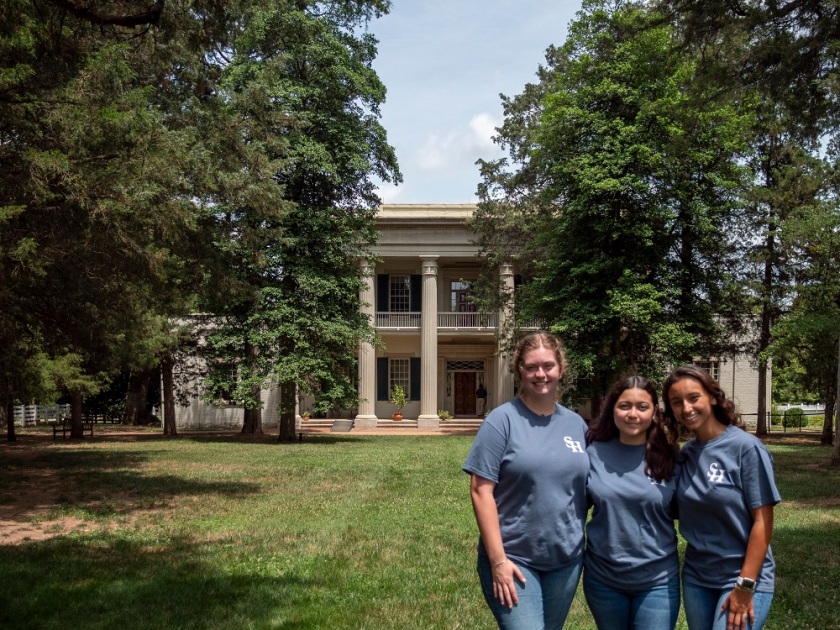
Following these sessions, on our way to the Metro, we discussed what we learned and whether or not the City of Huntsville could/should expect to see soon these issues that other communities are facing.

Smithsonian – National Portrait Gallery (EM) [https://npg.si.edu/home/national-portrait-gallery%5D

After today’s conference, we were off to the National Portrait Gallery, housed in the Smithsonian American Art Museum.  We had a goal to recognize our favorite artist works, with a list to work from…

SHSU, LEAP Center, Center for Law Engagement And Politics, Washington DC, National League of Cities, Congressional City Conference 2020, National Portrait Gallery

The Museum is one of the largest collections of American art!  From Folk Art to Modernism and America’s Presidents, the museum offers an array of exhibits that highlights great American art, with an obvious emphasis on portraiture. Even so, there was great diversity throughout the museum—different forms of art through various periods of time, and different styles–from Impressionism to Modern and more, each that gave us a better sense of art history.

After quizzing each other on the different artists throughout the various exhibits, we were able to locate several familiar artists’ works throughout the Museum: Claes Oldenburg, Chuck Close…

SHSU, LEAP Center, Center for Law Engagement And Politics, Washington DC, Smithsonian American Art Museum, SAAM,

…Thomas Hart Benton, Georgia O’Keeffe…

SHSU, LEAP Center, Center for Law Engagement And Politics, Washington DC, National League of Cities, Congressional City Conference 2020, National Portrait Gallery, Okeeffe

Alexander Calder, and James Surls (from SHSU)….

SHSU, LEAP Center, Center for Law Engagement And Politics, Washington DC, National League of Cities, Congressional City Conference 2020, National Portrait Gallery, James Surls

…to name a few.

We saw work by Kehinde Wiley (famous for doing President Obama’s questionable portrait)…

SHSU, LEAP Center, Center for Law Engagement And Politics, Washington DC, National League of Cities, Congressional City Conference 2020, National Portrait Gallery, Kehinde Wiley

…as well as work by one of our favorites: Deborah Butterfield.

SHSU, LEAP Center, Center for Law Engagement And Politics, Washington DC, National League of Cities, Congressional City Conference 2020, National Portrait Gallery, Deborah Butterfield


We also saw the Sam Houston bronze bust made by Henry Dexter in 1860!

SHSU, LEAP Center, Center for Law Engagement And Politics, Washington DC, National League of Cities, Congressional City Conference 2020, National Portrait Gallery, Henry Dexter, Sam Houston


The Way Back to the Hotel: Compass Coffee, Ford’s Theater, & Roti Mediterranean (SF) [https://www.compasscoffee.com/; https://www.fords.org/; https://roti.com/]

At Compass Coffee, we regrouped & planned for the rest of the evening, buying coffee for one of DC’s SWAT team members, in line in front of us, getting coffee before heading across the street to help with security for the evening’s WWE event (no, not on our itinerary!).  The coffee was great, and the pastries were good, too.  We have noticed that the “lavender latte” craze seems to predominate the local DC coffee shop menus, but we have liked both hot and cold versions.

Filtering through the multi-block long line of WWE fans, we headed toward the nearest Metro station.  We made sure, though, to wind our way through the streets to pass by Ford’s Theater, the site of President Abraham Lincoln’s assassination, and just across the street, the house where President Lincoln was taken after being shot, and where he died.

SHSU, LEAP Center, Center for Law Engagement And Politics, Washington DC, National League of Cities, Congressional City Conference 2020, Ford's Theatre

It was a bit sobering to know we were in that place where such a monumental event in the country’s history took place.  As everything was closed, we only had time for a quick snap before moving on.

On our final leg to the hotel, we stopped around the corner for a quick bite to eat at Roti Modern Mediterranean, where we picked up Mediterranean “bowls.”

SHSU, LEAP Center, Center for Law Engagement And Politics, Washington DC, Naanwise

We took them “to go” as we had some catching up on blogs, Spring Break assignments, and (hopefully) some sleep!

+ + + + +


Unknown's avatarAuthor mikeyawnPosted on August 28, 2020August 28, 2020Format AsideCategories Art, Civic Engagement, Civil Rights, Law, Politics, TravelTags Center for Law Engagement And Politics, Chuck Close, Congressional City Conference 2020, Deborah Butterfield, Ford's Theatre, Georgia O'Keeffe, James Surls, Kehinde Wiley, LEAP Center, National League of Cities, National Portrait Gallery, Sam Houston, SHSU, Washington DCLeave a comment on LEAP In DC: Day 3

Celebrating Civil Rights: The Americans With Disabilities Act at 30

Thirty years ago, President Bush signed the Americans with Disabilities Act into law.  In the speech announcing the enactment, President Bush noted that “We will not accept…discrimination in America” and his desire to  “take a sledgehammer to another wall,” effectively equating this legislation to the end of Communism as a marker for freedom.

SHSU, LEAP Center, Center for Law Engagement And Politics, Americans with Disabilities Act, President George H. W. Bush, Bush School at TAMU

Surrounded by disabled Americans who had worked on the legislation, President Bush empathized: “prejudices,” he noted, “separated Americans from a freedom they could glimpse but could not grasp.”  He closed by exhorting businesses to help make this a success by complying with the law and its requirements, and encouraged all Americans to help ensure that the “shameful wall of exclusion” will “come tumbling down.”

That was 30 years, but near the anniversary of the signing (which was on July 26, 1990), the Bush School at TAMU brought in PBS News Hour journalist Judy Woodruff to moderate a great panel–all of whom had something to do with the Act’s passage.

Indeed, the Bush School thought this so momentous an occasion that they invited President Obama to introduce the event…

SHSU, LEAP Center, Center for Law Engagement And Politics, Americans with Disabilities Act, President George H. W. Bush, Bush School at TAMU

…because the first section addressed a new documentary–produced by the Obamas–called “Crip Camp,” about one of the few places in the 1960s-1970s that allowed the disabled freedom to be who they were and participate in what most Americans consider everyday things.

SHSU, LEAP Center, Center for Law Engagement And Politics, Americans with Disabilities Act, President George H. W. Bush, Bush School at TAMU

The co-directors, Jim Lebrecht (who attended the camp) and Nicole Newnham…

https://www.imdb.com/title/tt8923484/?ref_=fn_al_tt_1

…were on hand to discuss it.  You can learn more about the film here, and you can watch it here.

Woodruff then brought in one of the Senate heroes of the bill: Senator Bob Dole, who had just celebrated his 97th birthday.

SHSU, LEAP Center, Center for Law Engagement And Politics, Americans with Disabilities Act, President George H. W. Bush, Bush School at TAMU

Dole is now in a wheelchair, but his disabilities stem back some 80 years, when he was in World War II.  He was shot by a machine gun, which hit his shoulder and right arm. Soldiers who found him expected him to die, but they administered morphine and, using Dole’s blood as ink, wrote “M” on his forehead, so that in the event he was found by medics, they would not administer a second (and potentially fatal) dose of the medicine.

Dole survived, but barely.  He was in a body cast for 9 months, paralyzed from the waist down.  When he got out of his cast, the 6′ 3″ former athlete weighed 110 pounds.  He would recover movement in his lower body, but the right side of his body would be partially immobilized for the rest of his life.

Dole said a few words, and then turned over the discussion to Carolyn Osolinik (former Chief Counsel for Senator Ted Kennedy) and Audrey Coleman (archivist at Robert J. Dole Institute of Politics) who discussed the strategies of getting the bill through the US Senate.  Osolonik called the bill a “sea change,” and emphasized that the bill was about “empowerment.”  It was not a bill to give away things; it was a bill to remove barriers so they could achieve what they were capable of.  Senator Kennedy called it the “emancipation proclamation for people with disabilities.”

SHSU, LEAP Center, Center for Law Engagement And Politics, Americans with Disabilities Act, President George H. W. Bush, Bush School at TAMU

Kennedy’s Counsel: “sea change” “empowerment.”  Kennedy called it “emancipation proclamation for people with disabilities”

Serving his first time in the US Senate during this time was Tom Harkin, the Chair of the Senate Policy Committee, who ultimately introduced the bill on the Senate floor.  For part of the introduction, he introduced the bill in sign language so that his brother, who is deaf, could follow along.  Harkin joined the panel to discuss his recollections…

SHSU, LEAP Center, Center for Law Engagement And Politics, Americans with Disabilities Act, President George H. W. Bush, Bush School at TAMU

…noting that the bill had four main goals:

    • Full participation of disabled in US society;
    • Equal opportunity;
    • Independent living;
    • Economic self sufficiency.

Harkin noted that the bill was ambitious: “we wanted these things to be the norm, the baseline, not an aspiration.”  To this end, he noted, “President Bush never wavered.  He stood behind the bill from the very beginning.”

Tony Coehlo, who helped engineer the bill’s passage in the House, was also on hand.

SHSU, LEAP Center, Center for Law Engagement And Politics, Americans with Disabilities Act, President George H. W. Bush, Bush School at TAMU

The bill encountered much more resistance in the House, where it was actually assigned to five different committees (typically a delaying tactic by leadership).  The bill did not lack support from rank-and-file members–it would eventually pass with 252 sponsors, but in the legislature, leadership is crucial, and without that support, passage was delayed.

One way to break through legislative logjams is through White House support, so Woodruff invited C. Boyden Gray (White House Consel), Lex Frieden (a disabled activist), and John Sonunu (White House Chief of Staff) to the show to discuss these efforts.

SHSU, LEAP Center, Center for Law Engagement And Politics, Americans with Disabilities Act, President George H. W. Bush, Bush School at TAMU

Frieden, interestingly, was scheduled to meet with President Ronald Reagan in 1986, to provide a recommendation of a bill such as ADA.  That day, however, the Space Shuttle Challenger exploded on liftoff, and the meeting was “rerouted” to the Vice President.  While this was no doubt disappointing to Frieden and the other activists on hand, it turned out to be fortuitous.  Vice-President Bush discussed his sympathies with the bill’s sentiment, and he said he thought the bill could become the “voice for 36 million Americans.” When he became President two years later, the passage of the bill became a potential reality.   And a year and a half after he became President, the bill was signed into law.


SHSU, LEAP Center, Center for Law Engagement And Politics, Americans with Disabilities Act, President George H. W. Bush, Bush School at TAMU

This bill was different than other civil rights legislation in that it imposed proactive requirements on businesses, governments, and non-profits.  It was seeking simply to remove impediments; it was requiring bearing actual costs: building ramps, adding elevators, reconfiguring buildings.  In some cases these costs were enormously expensive, and it took much political will to convince people that it was the correct thing to do.

Of course, the bill’s passage has not ended the barriers that the disabled face.  To discuss these challenges, Woodruff invited former Governor Tom Ridge (he also served as Director of Homeland Security) to discuss his role as Chair of the National Organization on Disability.

SHSU, LEAP Center, Center for Law Engagement And Politics, Americans with Disabilities Act, President George H. W. Bush, Bush School at TAMU

He was joined by Carol Glazer (President, National Organization on Disability), who argued that the most progress has been made in physical accessibility, symbolic areas (as more people with disabilities achieve positions of prominence), but, as expected, fighting people’s prejudices is the most difficult aspect of achieving progress.  The work ahead, she noted, will deal with fighting the “stigma” of disabilities, the “locked-in stereotypes,” and the “tyranny of low expectations.”

With Glazer and Ridge were William “Tipper” Thomas, an engineer, and actor Danny Woodburn.  Thomas was “4 or 5” when this passed, but in his senior year in high school, he was the innocent victim of a shooting, one which ended his football career and relegated him to a wheelchair.  He is now the principal engineer for Northrop Gruman Corporation.

SHSU, LEAP Center, Center for Law Engagement And Politics, Americans with Disabilities Act, President George H. W. Bush, Bush School at TAMU

Danny Woodburn is a little person and an actor (IMDB here), with, as he describes it, “strikingly good looks.”  When he was born, his doctor told his parents: “You’re son is a midget, like what you see in a circus.”  Woodburn noted much progress, but also said that there is little engagement with the disabled in civil rights conversations, noting that he’s often told, “We’re going to focus on cultural or racial diversity.”

Jack Chen (Product Counsel for Google) and Moeena Das (Chie of Staff, National Organization on Disability) also discussed their experiences navigating the still-difficult post-ADA waters.

SHSU, LEAP Center, Center for Law Engagement And Politics, Americans with Disabilities Act, President George H. W. Bush, Bush School at TAMU

Chen, for example, noted that while he works in the field of technology, which can make things better for people, it can also exacerbate inequalities, something most people don’t consider.

To conclude the program, Judy Woodruff invited former President George W. Bush on.  This, too, was fitting, because in the early 2000s, the Supreme Court ruled against some of the requirements of the ADA, and the way to help the law fulfill its original objectives was to amend the legislation in a manner that met Court scrutiny.  President Bush signed those amendments into law, with his dad (far left) looking on…

SHSU, LEAP Center, Center for Law Engagement And Politics, Americans with Disabilities Act, President George H. W. Bush, Bush School at TAMU

George W. Bush said that he believed the bill was what his father was most proud of accomplishing, and described his father as a “man of enormous compassion, who cared about all people, and the ADA reflected that spirit.”

SHSU, LEAP Center, Center for Law Engagement And Politics, Americans with Disabilities Act, President George H. W. Bush, Bush School at TAMU

By the end of his life, President George H. W. Bush was also disabled.  Parkinsons disease had attacked his body, and he began using a walker and then a wheelchair.  But that didn’t stop him from parachuting out of a helicopter at the age of 90!

SHSU, LEAP Center, Center for Law Engagement And Politics, Americans with Disabilities Act, President George H. W. Bush, Bush School at TAMU


Also of note, Director of the Bush Foundation, Andy Card…

SHSU, LEAP Center, Center for Law Engagement And Politics, Americans with Disabilities Act, President George H. W. Bush, Bush School at TAMU

…came on to note that, with the help of Lex Frieden (which he called the “conscious” of the ADA), they would be issuing  a new Bush Medal to “those making a difference to the disability community.”

SHSU, LEAP Center, Center for Law Engagement And Politics, Americans with Disabilities Act, President George H. W. Bush, Bush School at TAMU

In the midst of coronavirus and civil unrest, which in many ways have hit the disabled community the hardest, this program on the ADA and the progress made was a welcome reflection.

SHSU, LEAP Center, Center for Law Engagement And Politics, Americans with Disabilities Act, President George H. W. Bush, Bush School at TAMU

Many thanks to the Bush School at TAMU for the opportunity to experience these programs.  You can see this event in its entirety here.


Unknown's avatarAuthor mikeyawnPosted on July 30, 2020Format AsideCategories Civic Engagement, Civil Rights, Law, PoliticsTags Americans with Disabilities Act, Bush School at TAMU, Center for Law Engagement And Politics, LEAP Center, President George H. W. Bush, SHSULeave a comment on Celebrating Civil Rights: The Americans With Disabilities Act at 30

Talking Fiction with John Grisham and Michael Connelly

In an unusual treat, ironically made possible by the coronavirus, Waterstones bookstores offered book lovers an opportunity to hear from two of the 21st century’s most successful authors: Michael Connelly and John Grisham.

In a wide-reaching conversation, moderator Phil Williams did a fine job of navigating the authors body of work, current works, hobbies, writing habits, and influences, with a little discussion of movies, too.

SHSU, LEAP Center, Center for Law Engagement And Politics, Michael Connelly, John Grisham, Waterstones, Phil Williams

The occasion was the recent release of Grisham’s Camino Winds, and Connelly’s Fair Warning.

Connolly, who has written more than 30 novels, is most associated with the Harry Bosch novels, which are currently being filmed on Amazon’s “Bosch.”  But he is also well known for his “Lincoln Lawyer” novels, which also spawned a hit film starring Matthew McConaughey.  Williams asked Connelly if, when he was writing his novels, he ever “heard” the voice of Titus Welliver (who plays Bosch in the Amazon series) or McConaughey.  Connelly noted that he had written Bosch for 25 years before the books were filmed, and his pre-existing image of Harry Bosch is “impenetrable.”  But he did not that when writing his Lincoln Lawyer novels (the last of which will come out in November), he does see or hear McConaughey.

SHSU, LEAP Center, Center for Law Engagement And Politics, Michael Connelly, John Grisham, Waterstones, Phil Williams

Interestingly, McConaughey also started in the film version of a Grisham Novel: A Time to Kill.  It is just one of many Grisham novels made into a film, including: The Firm, Runaway Jury, The Pelican Brief, The Chamber, The Gingerbread Man, A Painted House, Christmas with the Kranks, The Rainmaker, and The Client.  Grisham did note that, despite having numerous successful films with the biggest of movie stars, no film has been made from his novels in more than 15 years.

SHSU, LEAP Center, Center for Law Engagement And Politics, Michael Connelly, John Grisham, Waterstones, Phil Williams

Williams asked the authors what they are currently reading.  Connelly begged off a little, noting that he spends most of his time writing, but that he does listen to audio books while exercising.  He listed Thomas Harris’s “Red Dragon” as an influential book that helped prompt him to begin writing.

Grisham was more voluble on the subject, citing Ian Rankin, Harlan Coben, Scott Turow, and Erik Larson.  He also noted that his COVID project was reading all the novels of Walker Percy.  Grisham cited Scott Turow’s “Presumed Innocent” as highly influential and the book that prompted him to get to writing.

Both are book collectors.  When asked to identify their most prized possession, Connelly cited a first edition of a Ross McDonald novel–along with the signed contract for the book.  Grisham cited owning all of F. Scott Fitzgerald’s novel in first edition.

SHSU, LEAP Center, Center for Law Engagement And Politics, Michael Connelly, John Grisham, Waterstones, Phil Williams

In terms of approaches to writing, Connelly doesn’t outline, but he also doesn’t begin writing until he “knows the beginning and end of the novel.”  Grisham does outline–fairly extensively–and writes summaries or key moments in each chapter.

SHSU, LEAP Center, Center for Law Engagement And Politics, Michael Connelly, John Grisham, Waterstones, Phil Williams

For those of you may have never read a Grisham or Connelly, Williams asked each author where they would advise a reader to start.  Connelly suggested 2016’s “The Wrong Side of Goodbye,” which features both Bosch and Mickey Haller (the “Lincoln Lawyer”).  I wasn’t asked, but I would recommend “The Poet,” which involves a serial killer and Edgar Allan Poe.

John Grisham, surprisingly, suggested that readers should begin with “The Innocent Man,” his only non-fiction book.  I would suggest “The Firm.”

The authors are not only entertaining, but they have a special place for LEAP Ambassadors.  Michael Connelly was a journalist, writing for the LA Times and covering crime.  While not many LEAP Ambassadors go into journalism, many LEAP Ambassadors major in English and Criminal Justice. And the LEAP Ambassadors have actually met Connelly, and our advisor, Mike Yawn, interviewed him for an article.

SHSU, LEAP Center, Center for Law Engagement And Politics, Michael Connelly, Murder by the Book, The Black Box

And John Grisham, of course, is an attorney, and he also served three terms in the Mississippi House of Representatives, mixing law, politics, and civic duty.  In short, these author reflect a lot of the interests pursued by the LEAP Center, and we were grateful to have the opportunity to hear from them.

SHSU, LEAP Center, Center for Law Engagement And Politics, Michael Connelly, John Grisham, Waterstones, Phil Williams

Unknown's avatarAuthor mikeyawnPosted on May 30, 2020Format AsideCategories Civic Engagement, Law, Literature, PoliticsTags Center for Law Engagement And Politics, John Grisham, LEAP Center, Michael Connelly, Phil Williams, SHSU, WaterstonesLeave a comment on Talking Fiction with John Grisham and Michael Connelly

White House Warriors: The World Affairs Council and John Gans

As an unconventional roller coaster of a semester draws to a close, LEAP ambassadors take comfort in the high quality educational and informational opportunities provided by the World Affairs Council (WAC) of Houston.

WAC Executive Director Maryanne Maldonado…

SHSU, LEAP Center, Center for Law Engagement And Politics, John Gans, White House Warriors, World Affairs Council Houston, International Relations, Foreign Policy, Maryanne Maldonado

…introduced John Gans, a Washington, D.C. speechwriter who has worked for such entities as the Office of the Speaker of the House and the U.S. Secretary of Defense.  Gans discussed his recent book, White House Warriors: How the National Security Council Transformed the American Way of War, and about the role of the National Security Council in general.

SHSU, LEAP Center, Center for Law Engagement And Politics, John Gans, White House Warriors, World Affairs Council Houston, International Relations, Foreign Policy

As someone interested in policy, history, and communications, I LEAPed at the opportunity to participate in the moderated discussion and write this blog.

In this interview, Dr. Gans – moderated by WAC’s Ronan O’Malley – began by giving an in-depth history regarding the inception and development of the National Security Council (NSC).

SHSU, LEAP Center, Center for Law Engagement And Politics, John Gans, White House Warriors, World Affairs Council Houston, International Relations, Foreign Policy

As he explains it, the NSC was founded by Harry Truman as a result of Franklin D. Roosevelt’s secretive behavior and compartmentalized organization during WWII. FDR, consulting only his closest advisors and Winston Churchill, left the rest of Washington in suspense of decisions made regarding war efforts. (Indeed, he had not even informed VP Harry Truman of the Manhattan Project!)

Believing that no president should have so much freedom and unchecked power during wartime, Truman established the NSC to advise, instruct, and coordinate between the White House and the rest of Washington. Originally an organization of nearly twelve individuals, the National Security Council has grown into one of the most powerful organizations in Washington.

After explaining the origins of the NSC, Gans went on to discuss how the role of the organization has evolved over the decades and become a pivotal part of the development of foreign policy. He claims that, over the years, there would often be certain NSC staffers who would step up and influence the course of policies and wars.

Next, Ronan asked about Henry Kissinger, who, as Gans stated, made the position of National Security Advisor a “household title.” According to Gans, Kissinger assembled one of the “best-credentialed NSC staff in history.” In spite of this, the council often found that they had nothing to do, due to Kissinger’s lack of trust. Famously, he would take the drafts of memos written by members of the NSC, change the conclusions, and present them as his own, generally with an optimistic outlook. His process created tension and distrust among his staff, and eventually led to some of the first wiretaps involved with Watergate. In Kissinger’s time, Gans suggests, if you were considered disloyal, you may be spied on, and if you were considered loyal, you rose in power and rank.

SHSU, LEAP Center, Center for Law Engagement And Politics, John Gans, White House Warriors, World Affairs Council Houston, International Relations, Foreign Policy

As disconcerting as this process was, even more so is the fact that the NSC is not subject to congressional oversight. Although some staffers have testified under oath, they are not required to, which has been a cause of concern for many leaders in Washington. Due to this freedom from oversight, the NSC has grown as an authority in foreign policy. Gans contends that this remains an issue to this day.

Gans also shared a number of anecdotes about the “most egregious” events in NSC history, including that of the only NSC staffer to die in the line of duty (in a car accident) and the story of a staffer who “assumed an army uniform and picked up a rifle” to go on patrol in Afghanistan.  Conversely, he identified the George H. W. Bush National Security Council as “the high point” in organization and decision making since the Council’s inception–a heartening conclusion, given that we will be hearing from Condi Rice in a few days (she was part of that NSC).

Gans argues that, in times, the NSC has “gotten in the way of the chain of command” and have come to run strategy in both war and foreign policy in general. He also stated that government, like business, boils down to trust, which is why many presidents have come to rely on the staff of the NSC as individuals who have their best interests in mind. As a result, a great amount of authority falls under the scope of the NSC.

SHSU, LEAP Center, Center for Law Engagement And Politics, John Gans, White House Warriors, World Affairs Council Houston, International Relations, Foreign Policy

After a few questions from the audience, the conversation ended. Despite being a virtual event, as many things are right now, this has been one of my favorite WAC discussions. In such a short amount of time, I learned a great deal about a very influential part of the United States’ foreign policy. Dr. Gans offered an interesting, engaging, and in-depth perspective into the National Security Council, and I am excited to read his book and learn more about its history and development. LEAP is, as always, appreciative of the World Affairs Council for arranging such a high quality conversation.

Unknown's avatarAuthor mikeyawnPosted on May 29, 2020Format AsideCategories Civic Engagement, Law, PoliticsTags Center for Law Engagement And Politics, Foreign Policy, International Relations, John Gans, LEAP Center, SHSU, White House Warriors, World Affairs Council HoustonLeave a comment on White House Warriors: The World Affairs Council and John Gans

Posts pagination

Previous page Page 1 … Page 21 Page 22 Page 23 … Page 44 Next page

LEAP Ambassadors Are Involved!

This slideshow requires JavaScript.

Follow Us On Facebook!

Follow Us On Facebook!

Catch Up With Us

  • Chamber After Hours Showcases Senior Center’s Vital Programs April 24, 2026
  • Building Future Leaders: Lessons from TX Supreme Court Justice James Sullivan April 23, 2026
  • Ambassador Rahul Chhabra speaks on India’s Global Leadership April 21, 2026
  • Mortar & Pestle Brings Joy and Jean Becker April 20, 2026
  • Remembering You, David Adickes April 17, 2026

Join The Conversation!

Multi-Platform Media… on Fun and Flavor: Chilly at the…
Highlights from the… on Glazing-A-Trail with Lauren…
The Civic Leadership… on Foundational Activities of the…
The Civic Leadership… on The Philosophical Foundations…
LEAPing Into Action… on The Philosophical Foundations…

Find Previous Posts

We also have Twitter!

My Tweets

LEAPing Into LEARNing

This slideshow requires JavaScript.

  • About LEAP
  • LEAP Ambassadors
Center for Law, Engagement, and Politics Blog at WordPress.com.
  • Subscribe Subscribed
    • Center for Law, Engagement, and Politics
    • Join 490 other subscribers
    • Already have a WordPress.com account? Log in now.
    • Center for Law, Engagement, and Politics
    • Subscribe Subscribed
    • Sign up
    • Log in
    • Report this content
    • View site in Reader
    • Manage subscriptions
    • Collapse this bar
 

Loading Comments...