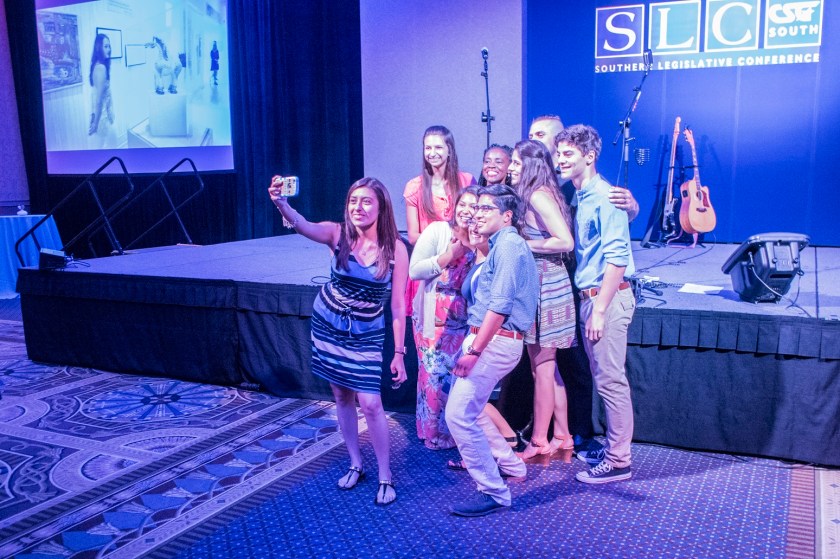
The LEAP Center’s mission is to offer unique educational opportunities for students. An example of this is the Center’s annual trip to the Southern Legislative Conference, to which the LEAP Ambassadors are invited to attend. While the conference offers the opportunity to learn about policies among 15 southern (and near-southern) states, the travel to and from the conference also presents learning opportunities.
Following the students’ 11-day trip across eight states and more than 20 educational sites, the seven students selected their favorite destinations across categories such as food, historical landmark, museums, and cities. The results are below:
Favorite Cities:
Eureka Springs, AR: This quaint little town proved to be the favorite of the group, with almost every student placing it on their top three.
LEAP Ambassadors in Front of “Flatiron Building” in Eureka Springs, AR
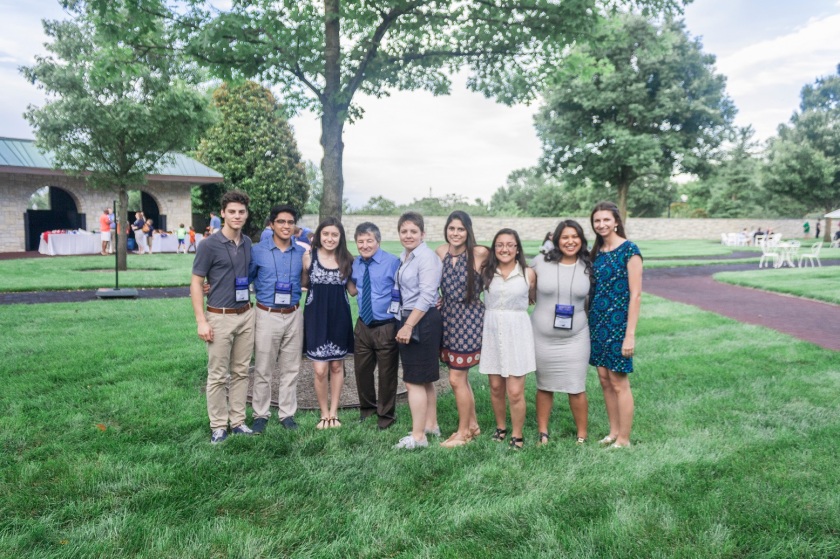
Lexington, KY: The site of our conference also proved popular. With its beautiful horse farms, pretty downtown, and attractive parks, students enjoyed four days in the horse capitol of the country.
The LEAP Ambassadors at Triangle Park, Lexington
Hot Springs, AR: This was a surprise to our professor, but the students enjoyed seeing the springs, the historic architecture, and meeting other SHSU students by happenstance!
LEAP Ambassadors in Front of Ozark Bathhouse, Hot Springs, AR
Little towns ruled the culinary arts on this tour!
Favorite Works of Architecture:
Frank Lloyd Wright House (Bachman-Wilson House) at Crystal Bridges was the favorite, edging out some other top designs. The large living room won the day!
LEAP Ambassadors Outside of Frank Lloyd Wright’s Bachman-Wilson Home
Anthony Chapel at Garvin Gardens, Hot Spring, AR was one of three Fay Jones’ Chapels the student saw, and it proved the favorite. Although larger than the other two (which are in Bella Vista and Eureka Springs), the three designs are very similar.
Garvin Gardens by Fay Jones, Hot Springs, AR
Honorable Mention should go to several structures. The students very much enjoyed the Gateway Arch in St. Louis, the Union Station in St. Louis…
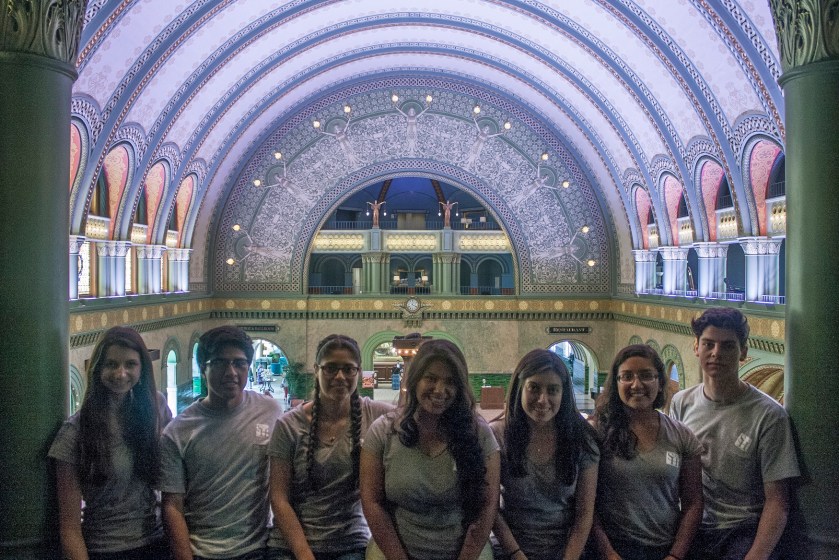
LEAP Ambassadors at Union Station, St. Louis, MO
…the Old Mill is always a favorite stop.
LEAP Ambassadors at Old Mill, Little Rock, AR
…and The Parthenon proved a favorite as well.
The LEAP Ambassadors at the Parthenon, Nashville, Tennessee
Favorite Works of Art
The Turrell Skyscape, “The Way of Color” at Crystal Bridges:
This slideshow requires JavaScript.
Au Cafe, by Stanton MacDonald-Wright was also popular, providing much head-scratching and discussion.
“Au Cafe,” by Stanton MacDonald-Wright
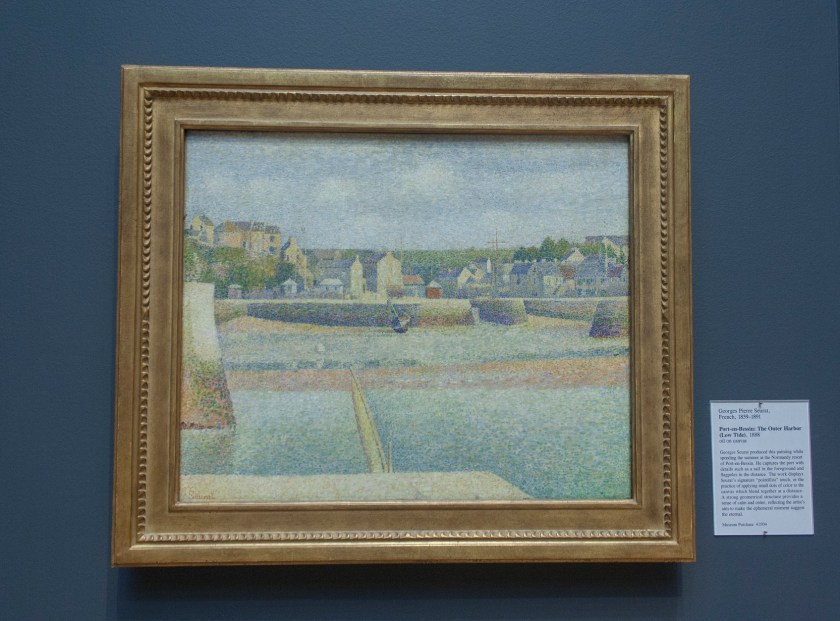
George Seurat’s “Outer Harbor” at the Crystal Bridges Museum
George Seurat’s “Outer Harbor” at the St. Louis Art Museum
Activities
Hiking: The students enjoyed both their hike at Pinnacle Mountain…
LEAP Abassadors at the Peak of Pinnacle Mountain
…and Devil’s Den State Park…
LEAP Ambassadors at Devil’s Den State Park
Ropes Course at Megacavern in Louisville, KY
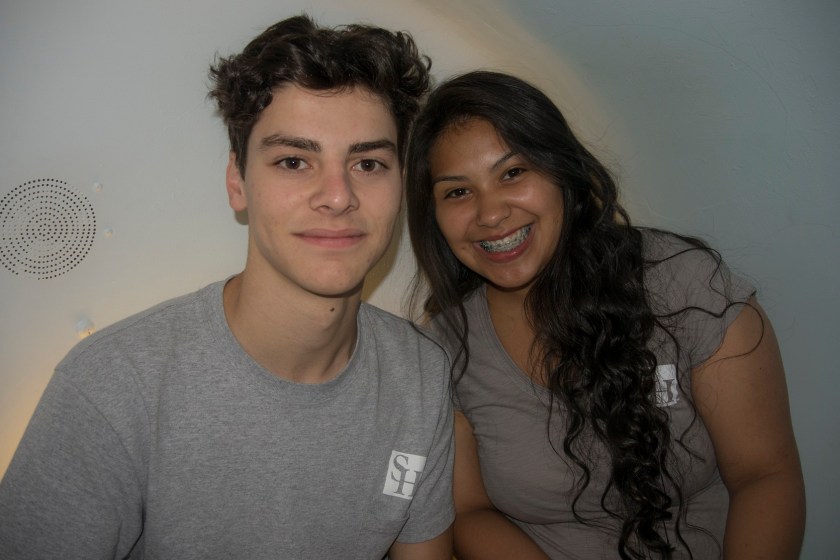
Karla Rosales and Ryan Brim at the MegaCavern
Tie: Skeet Shooting…
Brian Aldaco Hitting Targets
…and meeting Blair Hess and Cameron Ludwick, authors of “My Old Kentucky Road Trip.”
LEAP Ambassadors with Authors Blair Hess and Cameron Ludwick
It was another enormously rewarding road trip, providing us with the opportunity to learn about history, art, architecture, civil rights, politics, law, and public policy. It was a happy eleven days!
It seemed too soon to reminisce about the first half of our trip, which was filled with fun activities and meeting great people. But, as we packed for our next destination early in the morning, contemplated the great people we had met and the fun of visiting Little Rock, Memphis, Nashville, Louisville, Lexington, and Frankfort.
Ambassadors with Cameron Ludwick and Blair Hess, Authors of “My Old Kentucky Road Trip”
But with St. Louis on our destination list for today, we hastened to pack and headed out at 4am, a bit groggy, but excited for the Midwest section of the trip.
The Old Courthouse, St. Louis
Five hours later, we were able to make our first stop: the Old Courthouse.
The Old Courthouse, Where the Dred Scott Case Originated, St. Louis, MO
We were out on the road again until we reached St. Louis, Missouri where our first stop was the Old Courthouse. This courthouse is especially important because this is where the famous Dred Scott case was brought to trial. Dred Scott and his wife, Harriet, were slaves that filed a suit for their freedom against Irene Emerson, their slave owner. They tried to take advantage of the Missouri law that would allow them to buy their freedom, and after many years of hardship the judges finally came to a conclusion. In 1857, it was decided that they were not to be considered citizens of Missouri; therefore they could not sue for their freedom. Having grown tired of the slave family, the Emerson family sold them to the Blow family where the Scotts were finally set free. Sadly, Dred Scott enjoyed his freedom only for a short while as he died a year later in 1858.
There is an exhibit in the Old Courthouse where the courtroom in which this trial was heard is displayed. It was filled with chairs for the jury, two desks for the attorneys, a desk for a bailiff, and a clerk, a chair for witnesses, and a chair for the presiding judge. We even recreated the trial ourselves!
LEAP Ambassadors Re-Enact Dred Scott Case
Apart from its historic value, the courthouse is a beautiful structure, with a beautiful dome designed by William Rumbold.
Old Courthouse Dome, Designed by William Rumbold with Murals by Karl Wimar
As part of LEAP, we are always seeking ways to expand our knowledge. So it is only fitting that we visit the monumental symbol of the westward expansion as our next stop.
The Gateway Arch, St. Louis
Gateway Arch, St. Louis, Designed by Eero Saarinen in 1947
The westward expansion, aided greatly by the Louisiana Purchase, doubled the size of the United States in 1803. In honor of America moving into a more prosperous and hopeful state, The Arch was built as the “gateway to the west.” The Arch proudly stands at an intimidating 630 feet making it the tallest man-made monument in the nation.
The architect, Eero Saarinen, was an immigrant from Finland and was granted this opportunity after winning a contest by the Jefferson National Expansion Memorial in 1947. After studying architecture at Yale, he believed this was the opportunity to establish himself as an architect in America and it was. Although the design for this structure was completed in 1947, the real structure was not completed until 1965! We learned that this monument was brilliantly made with 142 stainless steel triangle sections that are each 12 feet in length held together by tension bars and truss. It took 13 years to raise the 13 million dollars needed to fund this project. In 1967, a trans system was built inside the north and south legs of the arch allowing 40 people at a time to view the impressive view. It was through these same legs that we rode through in our capsules.
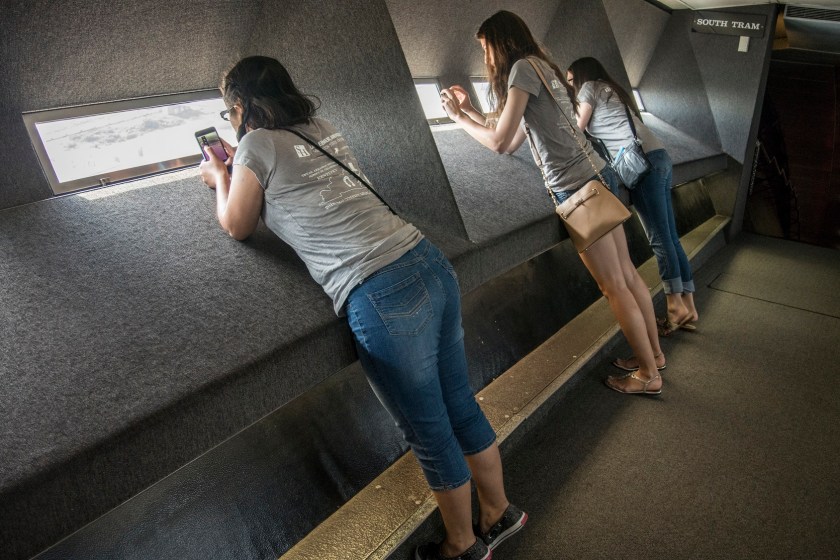
Gateway Arch “Elevator” or Travel Pod
It was tremendously fun to be able to enjoy the arch’s view…
Beatriz, Kaitlyn, and Karla at Top of Gateway Arch
…and see parts of St. Louis that we looked forward to exploring.
St. Louis from the top of the Gateway Arch
Once back on the ground, we were also able to watch an informative documentary about the arch and its history. Expansion in 1803 meant a hopeful future for some and that is our motivation as we expand our education in college and on our trips.
Originally, we had planned to visit the city garden that was near the courthouse. With its luscious greenery, sparkling fountains, and marvelous art we were all prepared to relax and enjoy the perfect view of the arch it would offer. Or so we imagined. Unfortunately, time didn’t permit a trip to that destination.
Photo Ops in St. Louis
Remaining undaunted, we decided to go on a photo op adventure instead. Our first photo op stop was a Richard Haas mural. With two of our students having been interns at the Wynne Home, his work has a special meaning to us, and fourteen of his works dot the downtown of Huntsville.
LEAP Ambassadors in front of Richard Haas Mural
None of the ones in Huntsville, however, cover the 110,000 square feet of the one adorning the Old Edison Stores Building in St. Louis.
Next, we headed over to the St. Louis Union Station Building, which is a beautiful structure, now a Doubletree by Hilton. But its interiors were what we found most intriguing…
Union Station in St. Louis, MO
…even the entrance to the bathrooms were interesting!
But the grand hall was the most beautiful part.
Grand Hall at Union Station (Doubletree Hotel) in St. Louis, MO
Across the street is the Milles Fountain, which is also impressive and offers a nice view of the exterior of the Union Station.
Milles Fountain at Aloe Plaza
Amighetti’s in The Hill, St. Louis
After a morning of westward exploration and photo ops in St. Louis, we took a quick stroll down The Hill to Amighetti’s.
Amighetti’s, in The Hill Section of St. Louis, MO
Located in what could be considered St. Louis’ Little Italy, the restaurant provided a prime venue for a satisfying lunch. Under what seemed an authentic tin-lined ceiling, we looked over the menu which included, but was not limited to, the Amighetti’s Special, a ravioli plate, and Little Bit of Italy sandwich.
A Little Taste of Italy, at Amighetti’s in St. Louis, MO
As for the Amighetti’s Special, the sandwich accomplished its main goal; completely stuff its eater. Made up of ham, roast beef, and Genoa salami, blanketed with a rich layer of brick cheese on a 9 inch loaf of French style bread, it was a near challenge to take a bite. However, the extra effort to open one’s jaw was worth it, for every bite was an opportunity to taste the delicious sandwich. To improve on the experience, the menu presented St. Louis’ own Ritz root-beer. The effervescent, sweet, and smooth root-beer was an enjoyable company to Amighetti’s Special. To close off our lunch we also ordered a round of gelato. Within the group we were able to enjoy a cup of a sour, but satisfying lemon ice, cherry peach, strawberry, and vanilla, all of which we considered of excellent taste. As we stood up from our seat, with a content belly and a cooled off palate, we regained the energy needed to continue our St. Louis exploration at the Frank Lloyd Wright’s Kraus Home.
On previous adventures, Alex and Ryan had already encountered this one-of-a-kind home a numerous times. Therefore, Professor Yawn decided to give them the opportunity to explore new land by the name of the St. Louis Art Museum. After dropping them off we rerouted to the Kraus home.
Frank Lloyd Wright Home at Ebsworth Park
Hidden behind lush greenery, Frank Lloyd Wright’s Kraus Home is located in the upscale Kirkwood neighborhood of Saint Louis. Taking a short drive from the art museum, we arrived for a special tour. Normally, tours are not available on Wednesday afternoons, but the staff of the home were generous enough to arrange a tour for us today! Upon arrival, we immediately gaped in awe of the unique architecture and the natural beauty surrounding the home.
Frank Lloyd Wright Home at Ebsworth Park
To begin our tour, we watched an introductory video about the Kraus home and its architect. Frank Lloyd Wright was born in 1867 and designed more than 500 structures throughout the United States. Represented in the Kraus home were parallelograms, hexagons, and horizontal lines, all of which accentuated the Usonian vision of Wright. The Kraus home sits on 10.5 acres of land now owned by Saint Louis County as part of its parks system.
In the mid 1940’s, Russell Kraus, a Frank Lloyd Wright enthusiast, wrote to Frank Lloyd Wright requesting him to design a small and less expensive home. Nearly ten years later in 1955, the home would finally reach completion. Mr. Kraus lived there until 2001, when a non-profit raised money to purchase the home and the land was deeded to Saint Louis County.
Throughout the tour, Professor Yawn was quick to point out the horizontal attributes of the home, noting even the grooves between the brick walls were designed to draw the eye horizontally instead of vertically. The Kraus home was designed as two hexagons partially overlapping one another. The entire home is made up of these two hexagons or its subcomponents (parallelograms and triangles).
Even the bed, for example, is a parallelogram.
We were fascinated throughout the entire tour. In order to preserve the beauty of the home, we were not allowed to take any photographs inside the home. However, we finished our tour with a few photos on the balcony…
Balcony of Kraus Home at Ebsworth Park, Designed by Frank Lloyd Wright
…and the exterior.
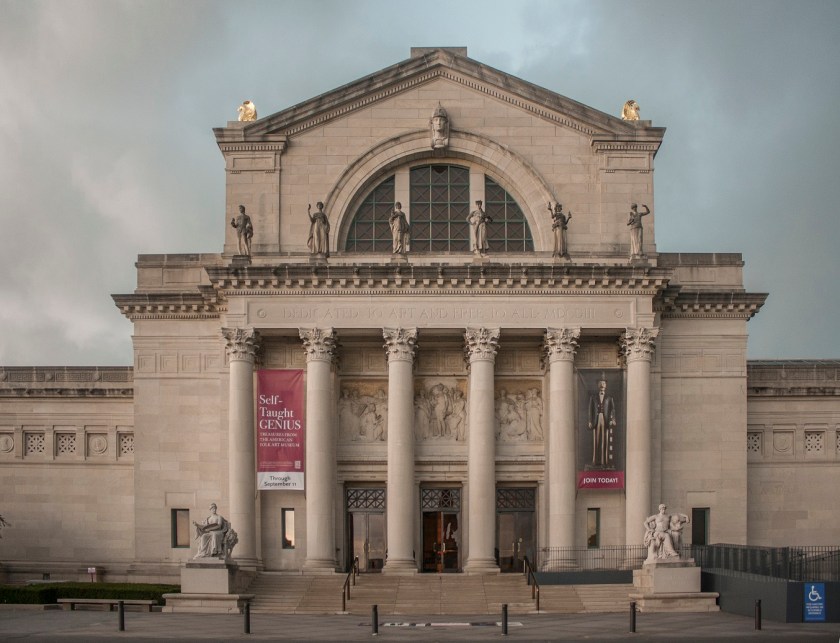
St. Louis Art Museum
Meanwhile, in the St. Louis Art Museum, Ryan and Alex were being exposed to various forms of art.
St. Louis Art Museum
One of the major aspects Missouri has to offer is the free admission into museums (excluding special exhibits). On the three levels of the museum, there were paintings, sculptures, and artifacts from as early as 500-600 BCE to as recent as present day and everything in between. There were pieces of art from all around the world including Asia, the Americas, Africa and Europe. Several famous artists’ works could be found at the museum including Monet…
Monet’s “Water Lilies” at the St. Louis Art Museum
…van Gogh, Picasso, Seurat…
George Seurat’s “Outer Harbor” at the St. Louis Art Museum
…Degas, Rodin, Kandinsky, Warhol, Segal, O’Keeffe, and many more. Outside, there was a short path through a small sculpture garden, mostly made up of pieces from Henry Moore.
Henry Moore’s “Two-Piece Reclining Figures” at St. Louis Art Museum
As we were leaving, a huge storm rolled in, cutting out our trip to a sculpture garden in the downtown area. So instead, we headed towards Bentonville, stopping for a photo-op at the world’s largest fork, and afterwards, stopping for dinner.
Dinner at Cafe Cusco, Springfield, MO
Being the home of the world’s largest fork…
World’s Tallest Fork, Springfield, MO
…Springfield appropriately offers numerous eateries from which to choose.
We choose Cafe Cusco, a Peruvian restaurant that has all the attributes of good Peruvian food, without the risk of Zika.
With the buildings soaking in the last rays of the day on Commercial St., we crossed the threshold into the Peruvian cuisine restaurant. As Peruvian folk music sounded its harmonious guitar in the background, we looked through the menu. With a variety of “platos” or dishes, from vegan salads to meaty steaks, the appetite of some of us were attracted to the fried rabbit, fajita saltada, BBQ pork panca, and lomo saltado. First, however, we began our taste of Peru with a seafood dip and fried avocado appetizer.
Seafood Dip and Fried Avocado at Cafe Cusco
As the initial dishes were cleared, we readied ourselves for our main course. Soon the table was enveloped in the spicy aromas of the various dishes. As for the lomo saltado, a dish of steak cooked with bell pepper and onions served with fries and rice, each scoop of the fork brought to one’s mouth the zesty spice of Peruvian flavor. Perhaps the best of the dishes, however, was the rabbit, which Ryan enjoyed immensely.
The Rabbit Dish at Cafe Cusco
In all, the restaurant was more than enough to make us go back to the corner block venue as we were forever in love with these flavorful dishes. For the meantime however, it was time get back to our traveling van for we still had half a state left to ride through.
Our morning brought excitement with a splash of sadness, both from the prospect of our first day of rain and facing what would be our final day of the Southern Legislative Conference. With that in mind, we vowed to make the most of the day, with experiences extending to the world of politics, liquor, and musical entertainment.
We boarded our ever-familiar tour bus bound for Kentucky’s capital city of Frankfort, and enjoyed the green rolling hills on the short drive from Lexington (~45 minutes). As we neared the bend that would lead into Frankfort’s main street, the trees embraced the city, making it seem every building was surrounded by its own mini forest, an impressive landscape.
The Old Statehouse
Our first stop was the state’s third capitol building, “The Old Capitol,” built in 1803. Its location was the same as the first two state capitol buildings, both of which met their demise through fire. Following the second fire, officials requested submissions for a new design, which would be selected through a competitive process. The winning design was submitted by Gideon Shryock (fresh out of college!) on a dare.
The Greek revival structure was erected as a symbol of Kentucky’s democratic strength, the massive pillars flanking the entry underlining that statement.
Old State Capitol: Frankfort, Kentucky
The limestone walls, quarried from the Kentucky River, stand as impressive as the day as they were placed. Through this grand, but windowless, entrance, we turned first into the “new” library, relocated from its original second-floor location due to weather damage to the books. In the corner of this room stood a desk that had belonged to then-Governor, Thomas Bramllette. Under his orders, the desk was ordered to contain a secret compartment. However, upon arrival, there was no sign of any such compartment. After complaining to the cabinetmaker and demanding that he be told the whereabouts of the desk’s secret, the designer refused to reveal it for “if [he] were to reveal it then it wouldn’t be a secret anymore.” The secret compartment was never found.
We left the library, and gathered under a floating staircase. Reputedly one of the only staircases of its kind in a public building, the whole structure will supposedly stay in place regardless of whether walls stand around it – it requires no external support. As designed by architect Shryock, this is an impressive feat of architectural and aesthetic design. As we walked up the staircase, admiring its simple yet intriguing structure, quite a few tour participants not-so-surreptitiously checked out the number of people on the stairs at once.
Another pleasant detail was found in the plaster floral designs on the ceiling. As with most capitol buildings, the legislative chambers were the largest. At the entrance of the Senate and House chambers, we were greeted with lighting from magnificent gold French chandeliers, as lavish as when they were lit for the first time. In the House, the desks were sectioned for two legislators to share one table. As we walked onto the senate chamber, we entered a much more intimate room. We sat down on both the house and senate desks, taking in the building’s history, imagining what it would have been like in the past. When the visit of the Old Statehouse was over, we were very sad. However, our hopes were regained after remembering that this was only the beginning of our grand tour.
Center for Kentucky History
Because we spent so much time in the Capitol building, our next stop was correspondingly curtailed. Thus, we only had about 15 minutes at the modern Center for Kentucky History, which was clearly not sufficient. Some of us went into the gift shop while others toured the Hall of Governors, which consisted of painted portraits and biographies of Kentucky’s governors. It started with Isaac Shelby, the first governor of the state. He was an interesting character. Even though he served two full terms believing and practicing his constitutional duties, in his autobiography of four hundred plus pages, he only included one sentence of his tenure as governor. Another notable character was Martha Layne Collins, the first female governor. She was known for bringing a Toyota plant to Kentucky, which provided many economic opportunities to the state. Despite the brief time allotted to this portion of the tour, we enjoyed the artifacts and exhibits we saw.
Governor’s Mansion
After the tour of the Kentucky History Center, we visited the Governor’s Mansion for lunch with the Lieutenant Governor of Kentucky. As we approached the mansion, we were fascinated by the beautiful architecture and colorful garden.
Kentucky Governor’s Mansion: Frankfort, Kentucky
We learned that the architecture was designed to model Queen Marie Antoinette’s villa of the palace of Versailles in France—not the last time we would find French influences in the Bluegrass State. The interior also reflected the French interest of the Beaux-Arts period. Walking into this grand architecture, the Lieutenant Governor, Jenean Hampton, and some of her staff, greeted us. We were then directed to the dining room for lunch.
She welcomed our group very warmly into the governor’s home and spoke about the great state of Kentucky.
Kentucky Lt. Governor Jenean Hampton at the KY Governor’s Mansion
After learning we were from Texas, she expressed her love for the Lone Star State.
LEAP Ambassadors with Lieutenant Governor Jenean Hapton
We felt that she was very genuine and kind! After having greeted her, we then proceeded to eat lunch consisting of a traditional Caesar salad and grilled chicken.
Kaitlyn Tyra and Megan Chapa at the Kentucky Governor’s Mansion
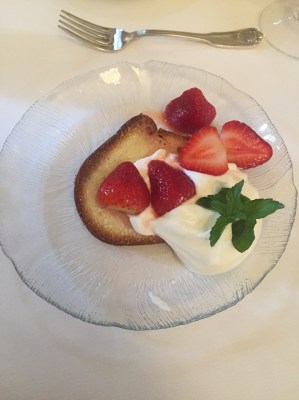
For dessert, we had a light, summery strawberry shortcake.
And as an added desert of sorts, we had the wonderful opportunity to explore the Governor’s Mansion.
LEAP Ambassadors Relax at the Kentucky Governor’s Mansion
Kentucky State Capitol
Following the lunch at the Governor’s mansion, we toured the fourth and current Kentucky state capitol. Our tour began in the rotunda with five large statues, each a famous (or infamous) Kentuckian. These include Henry Clay, Alben Berkley, Jefferson Davis, Ephraim McDowell, and Abraham Lincoln.
Abraham Lincoln, with Jefferson Davis in the Background
The dome that sits above the rotunda is inspired by Les Invalides, Napoleon’s tomb. Interestingly, the interior of the dome changes colors periodically…
This slideshow requires JavaScript.
The building houses all three branches of government: the executive is on the first floor, the judicial is on the second, and the legislative is on the third. This is one of very few state capitols that still houses three branches. In the state supreme court, the judges convene about three days a month, hearing about only nine cases a month.
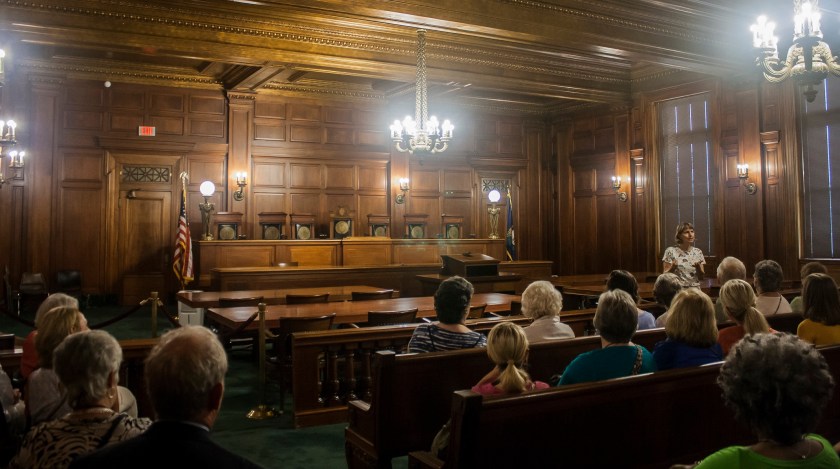
Kentucky Capitol: Supreme Court
The justices can serve as many ten-year terms as they can get elected to.
The Kentucky legislature is unusual in that they only meet for 90 days every two years. During even numbered years, the Kentucky legislature will meet for up to 60 days, and in odd numbered years, the 38 Senators and 100 House members will meet for no more than 30 days.
House of Representatives, Kentucky
House members, as well as Senators, have two year terms, but no term limits.
Overall, we were impressed by the symmetrical design of the capitol, both the interior…
Kentucky Capitol Interior
…and the exterior…
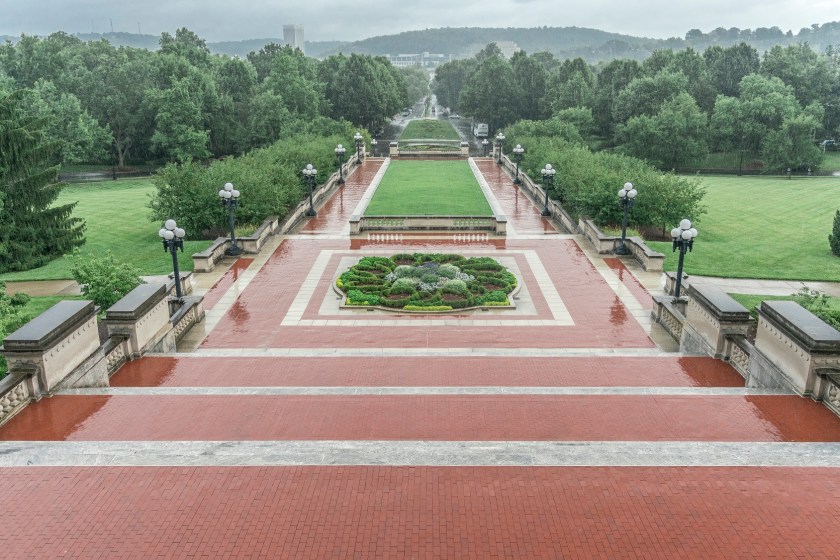
Walkway to the Kentucky Capitol
…as well as the views from the balcony.
This slideshow requires JavaScript.
In fact, it’s rare in a capitol to even be allowed on the balcony, so this was a treat indeed.
Buffalo Trace Distillery
No doubt the offices of the Kentucky Capitol building were witness to much drinking, in order to, as one politician told us, “lubricate the wheels of governance.” Some of those drinks were likely distilled, aged, and bottled in our next destination: Buffalo Trace. Liquor has been manufactured on the site of Buffalo Trace since 1787, when Willis and Hancock Lee first built a still. Although the companies of liquor and processes have changed, the site—located near the Kentucky Capitol building— has always been dedicated to distilling primarily bourbon.
Buffalo Trace Distillery in Frankfort, Kentucky
This was true even during Prohibition. As our tour guide noted, alcohol could still be manufactured for “medicinal purposes.” Each “patient” could be prescribed up to a pint every ten days. During this period, the illnesses must have been both “contagious and chronic,” because often an entire family would need the prescriptions refilled indefinitely. This legal loophole allowed the distillery to stay in business.
Thankfully, that subterfuge was no longer necessary following Prohibition, and the distillery could distribute its liquor the old-fashioned way. In more recent years, there has been a type of anti-prohibition, and bourbon drinking has become fashionable. In fact, Buffalo Trace is in the process of tripling the size of its operations, expanding from 140 to 420 acres.
Some people believe that only Kentucky sells bourbon. That’s not true, but as our tour guide says, most of the bourbon in the US comes from Kentucky. “Kentucky sells 95% of the nation’s bourbon,” he clarified, “and 100 % of the good bourbon.”
Much of that comes from Buffalo Trace. Indeed, they recently manufactured their six-millionth barrel. That’s a lot of bourbon, especially when each barrel contains about 200 bottles.
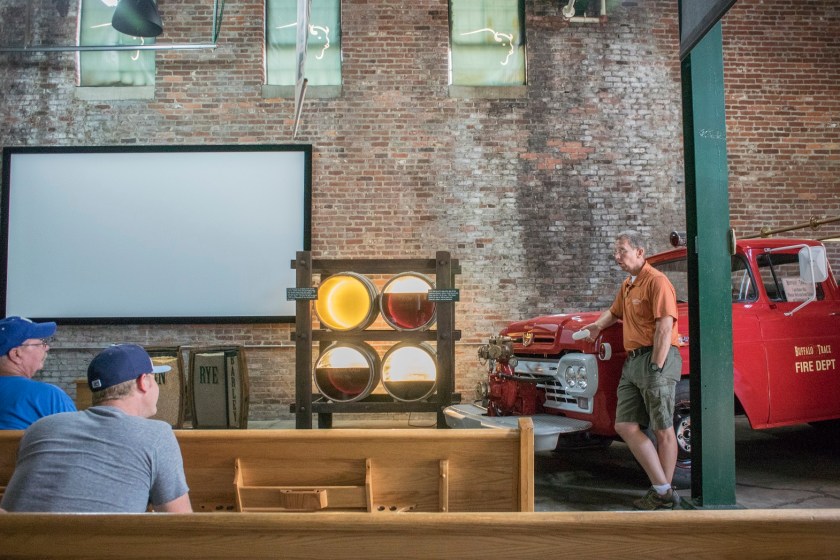
Bourbon Barrels, Buffalo Trace Distillery
And it is this process that is perhaps most interesting. To qualify legally as bourbon, the liquor must meet six criteria:
Its content must be at least 51 % corn;
Distilled to no more than 160 proof;
Barreled at no more than 125 proof;
Aged in new, charred barrels;
Bottled at 80 proof or higher;
And, all of this must occur in the United States.
The Aging Process of Bourbon, Buffalo Trace Distillery
This last requirement stems from the fact that in 1964 the US Congress passed a resolution recognizing bourbon as indigenous to the United States, much in the same way, for example, that Scotch is associated with Scotland.
This was a lot of information to take in, especially for some of the students who had almost no exposure to alcohol. But even for those more familiar with the product, the distinctive and specific process was a lot to ingest.
And speaking of ingesting, our tour concluded with a whiskey tasting. The under-21 crowd skipped this part, but a few of the students had a chance to distinguish (in very small doses!) the difference between four types of whiskey: (1) a blended vodka, (2) a mash whiskey at 125 proof, (3) an 8-9 year old bottle of bourbon, and a (4) 10 year-old bourbon aged on a lower floor of the storage. (The lower floor is a cooler location, which means less mixing with the barrel, which, in turns, less of the woody or caramel flavor.)
Bourbon Tasting at the Buffalo Trace Distillery
Opinions from the group were positive toward the bourbon, but there was general agreement that the 125 proof mash was strong medicine indeed.
Our samples were far too small to lubricate any kind of political deals at the conference, but that doesn’t mean we weren’t interested in expanding our professional networks and seeing what opportunities we could find. To that end, we headed back to Lexington, where we planned to socialize at the state dinner.
State Dinner
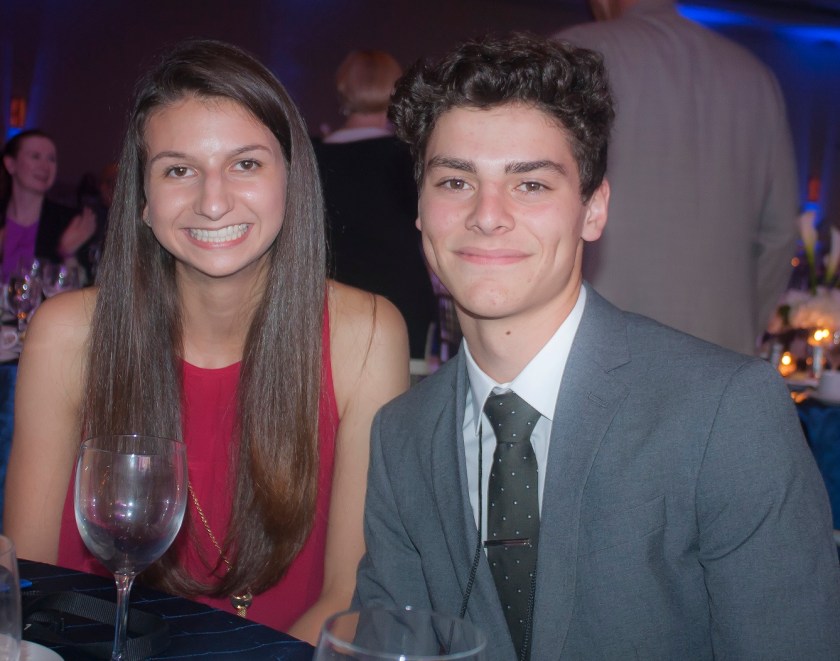
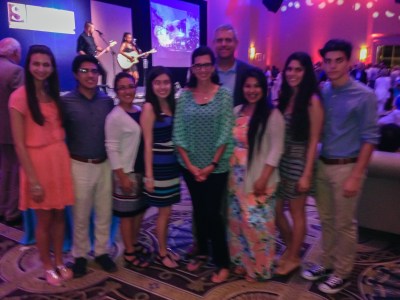
Dressed to the nines, the LEAPsters strode into the Rupp Arena Ballroom. Although we were prepared to enjoy the State Dinner…
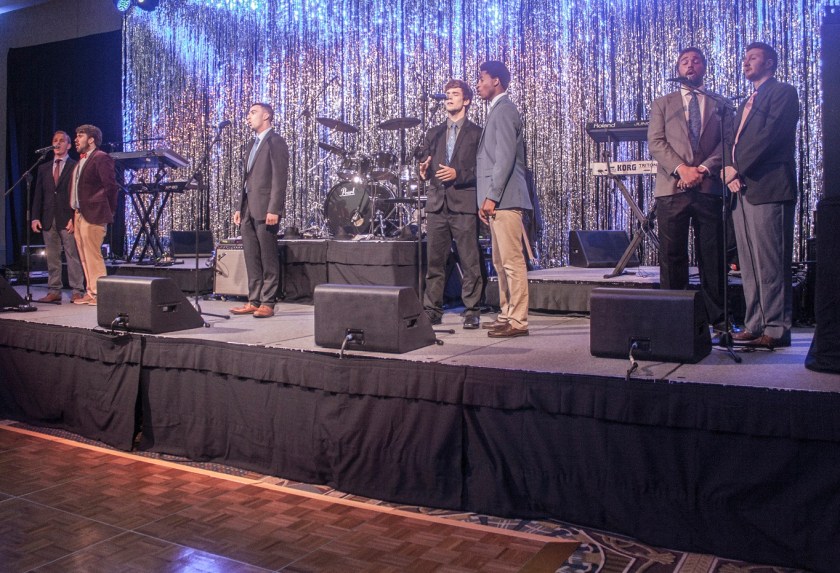
…we were not prepared for the beautiful sounds of the a capella group acoUstiKats, from the University of Kentucky. They introduced the evening with a wonderful rendition of the “Star Spangled Banner” and “My Old Kentucky Home.”
The acoUstiKats from the University of Kentucky
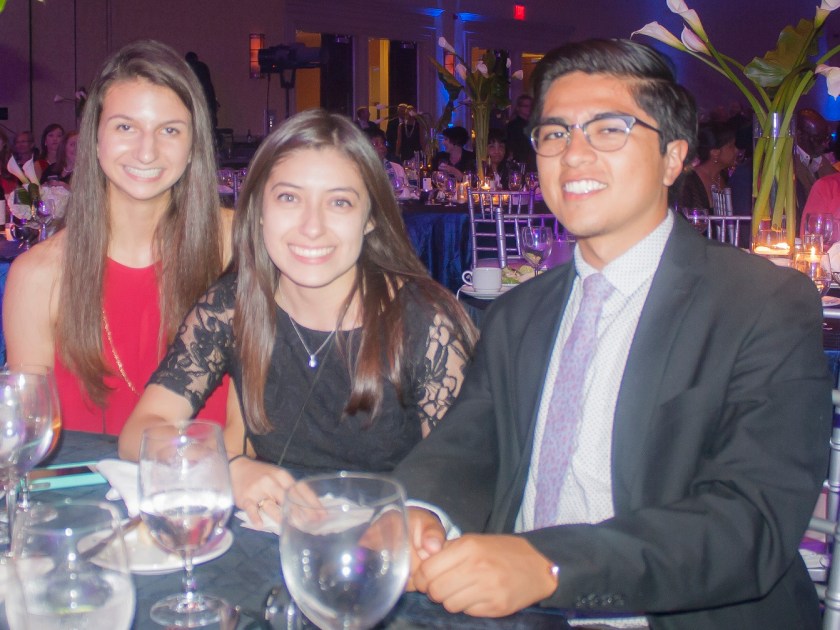
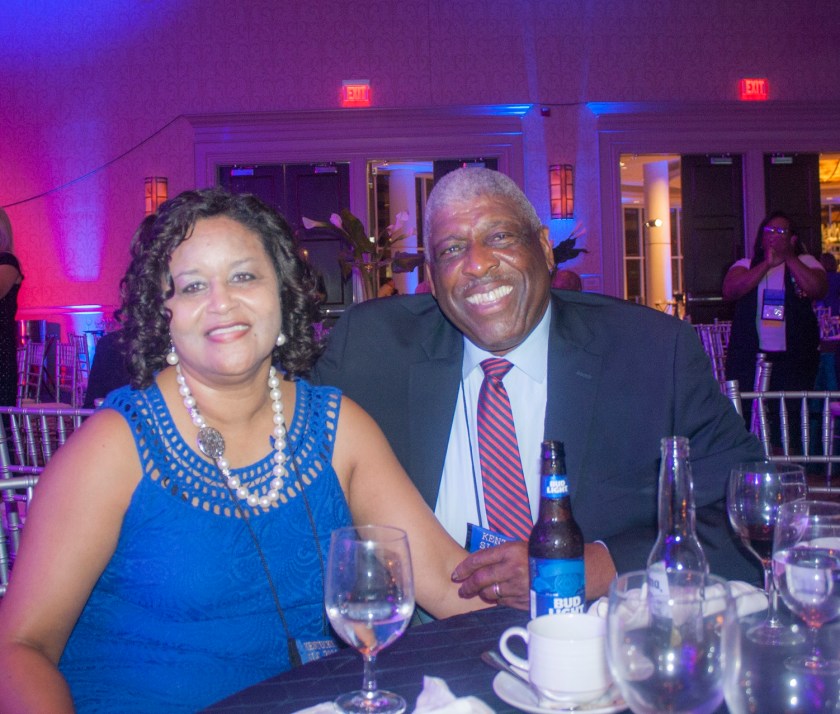
Our dinner mates included Senator Floyd Nicholson and his wife, Mamie, who were from South Carolina and very nice!
Senator (SC) Floyd Nicholson and his wife, Mamie
Later, Kentucky Senator Stivers gave a speech and recognized two different programs for their work under the STAR program. This program promotes the creation of innovative ideas for more programs to help communities. The most proactive are chosen and recognized for their accomplishments.
After the meal was over and we had finished the last bit of cheesecake…
…the entertainment started. Rick Dees kicked off the evening’s entertainment…
Rick Dees at the Southern Legislative Conference State Dinner
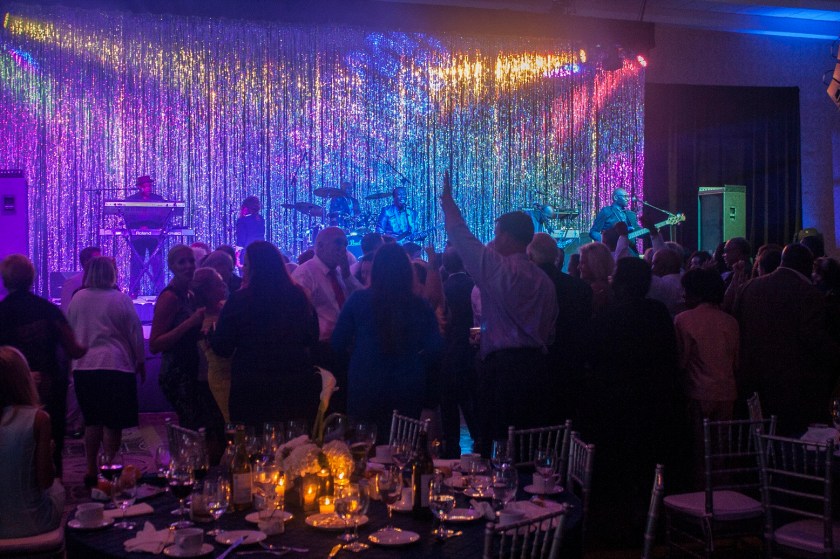
…but he soon turned it over to Midnight Star, an R&B band who enjoyed many hits in the 1970s and 1980s, including “Operator,” “No Parking on the Dance Floor,” and others.
Midnight Star Performs at the Southern Legislative Conference
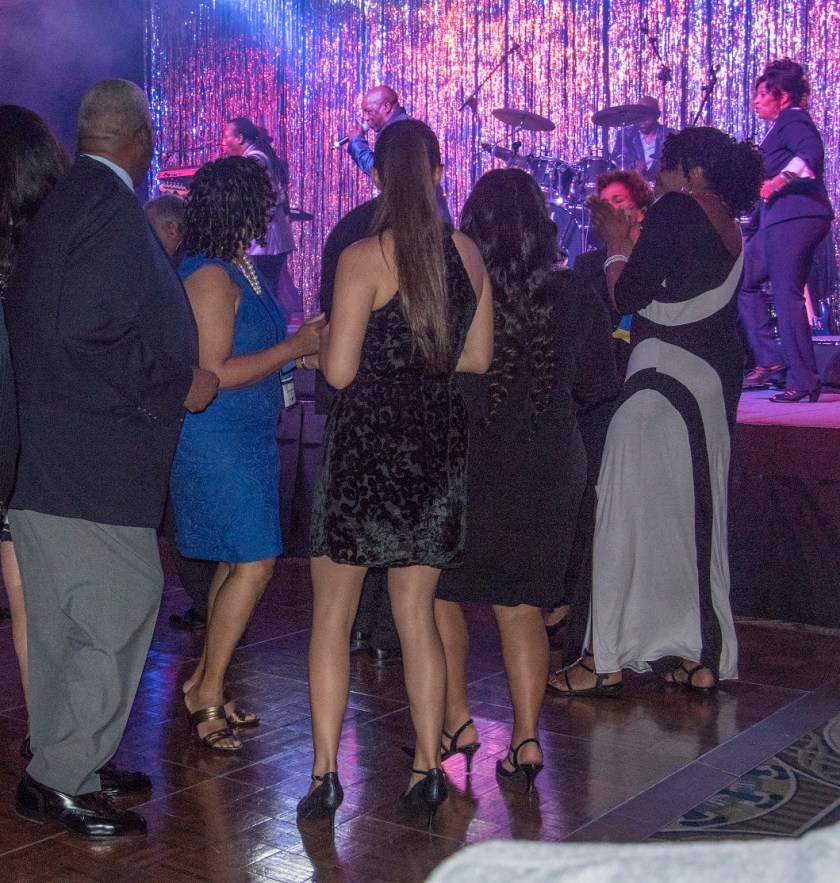
Their music soon drew a crowd of dancers, many of whom were elected officials apparently drawn to the dance floor by courage borne of bourbon.
Not to be outdone, the LEAP Ambassadors showed off their adaptability and busted out a few dance moves of their own.
LEAP Ambassadors Dance at State Dinner
Others, of course, mostly stayed rooted to the dinner table…
Nonetheless, it was an energetic end to a four-day tour of Kentucky and its world of politics, entertainment, and history.
LEAP Ambassadors with Floyd and Mamie Nicholson at the SLC State Dinner
But with a four am departure looming, we posed for a final Kentucky photo op…
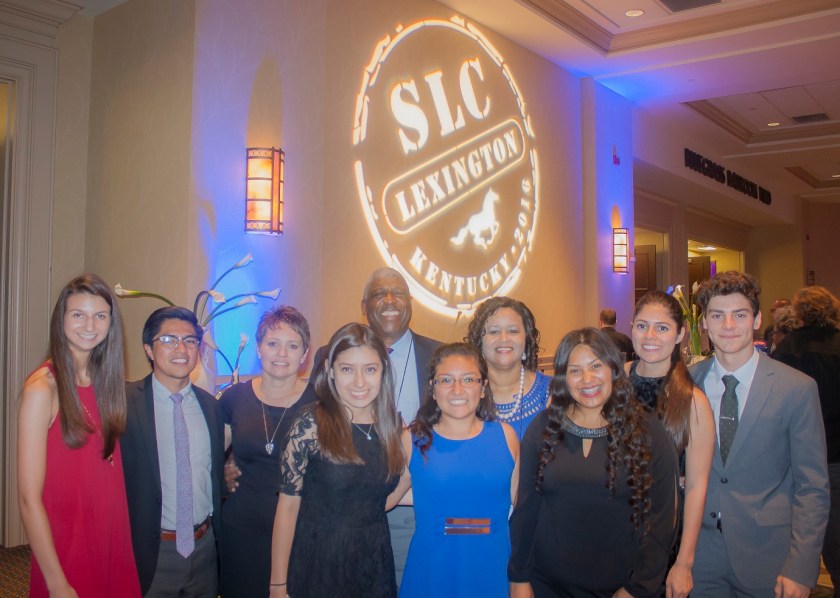
LEAP Ambassadors Enjoy Lexington, the Horse Capital of the World
…we headed back to the hotel. Our sleep was destined to be brief, but we were eager to awake to the Midwestern leg of our southern/Midwestern tour of the United States.
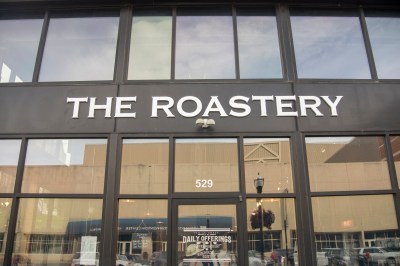
With a busy day planned ahead of us, we began our morning with a light breakfast at Daily Offerings Coffee Roastery…
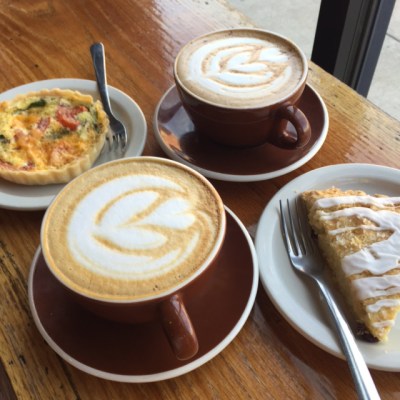
…a Southern hipster coffee shop offering several adventurous and traditional options. One of the more daring ambassadors tried the Lavender Honey Latte, and as Alex described it, “it felt like my mouth had just taken a bath.”
Others went for coconut or caramel lattes, and pastries to complement their drinks: coffee cakes, chocolate cookies, and blueberry scones. Once everyone had their fill, we departed for our first destination and activity of the day, a trip to Shaker Village in Pleasant Hill.
The Shakers fled England and first settled in New Lebanon, New York. In 1805, a group of 44 Shakers settled in Kentucky. Today there are no surviving Shakers in Kentucky and only a handful in Maine, but much of their settlement is still intact within the Pleasant Hill site. The historic farms of the village are maintained by the village’s employees, and crops and livestock are used at Pleasant Hill’s restaurant.
Our drive to Shaker Village through the Kentucky countryside was beautiful — a truly pleasant ride to start the day. Upon our arrival, we exchanged our charter bus for a school bus needed to maneuver a narrow, winding road to the Kentucky River a few miles away. There we boarded the Dixie Belle Riverboat for
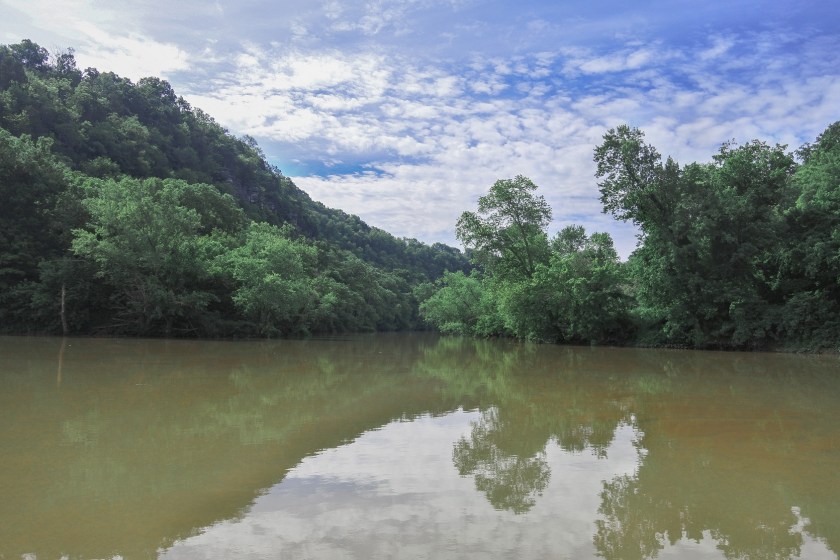
…a trip downriver through the Kentucky River Palisades, so named for the steep limestone cliffs and scenic outcroppings.
The Shakers used to travel the Kentucky River to New Orleans once or twice a year to trade goods they produced. At the time, this was a significant endeavor and few Shakers actually traveled on behalf of the community. The captain explained that the Kentucky River is 255 miles long and is normally a deep shade of green, but due to the recent rains, the water was a muddy brown (and over 14 feet deep).
We cruised alongside the limestone cliffs and the lush green trees that stood high above the riverbank, ever alert for signs of wildlife. The river is home to many types of turtles (including snapping turtles!) and snakes. Although we weren’t lucky enough to see any river critters, we enjoyed the scenic view and relaxing breeze before traveling back to the Village for the second half of the tour.
The Village tour began with a walk down one of the main streets, the guide noting the limestone buildings among green fields, and explaining to us that during the Shaker’s lifetime in the settlement very little of the land would be left vacant. Shakers did not believe in unusable land, so they worked every plot as efficiently as possible — whether to build family dwellings, grow crops, graze livestock, or build an ice house.
Shakers were a religious group who believed the way to enhance their worship of God was to live as simply as possible and as purely as Jesus Christ. They were not Luddites, though, and believed in using technological advances to help them live simple lives. In their attempts to be close to Christ, one of the sacrifices in joining the congregation was to become celibate. Men and woman stayed segregated among family dwellings, with one half of the buildings dedicated to men and the other half to women. Men and women also maintained an arm’s length distance away from each other and had their own staircase to travel among floors in their living quarters.
The Shakers also preached a need for equality. All Shakers were equal and none deserved more attention than another, a quite different viewpoint in 1805 when several types of groups did not have equal rights. The village’s ministry, the governing religious body for each community, was composed of both men and women from various communities appointed by the Shaker’s central ministry in New Lebanon. This helped remove community ministry leaders’ potential prejudices against other members of the village. The community was further regulated by segregating the leaders to their own living quarters and workshops, both of which we were able to tour. It was an interesting twist to community governing for the political science majors in the group.
Shaker Attire Worn by Brian and Kaitlyn, Standing the Traditional Distance Apart
Unlike traditional Christian services, Shakers did not believe in one designated leader preaching at all times. Although they did make use of the King James Bible, and participated in prayer, services were led by “whoever was moved by the Holy Spirit” on that particular day. Their religious ceremonies were not constrained by time, with the shortest service in Pleasant Hill recorded at only 15 minutes and the longest at 23 hours!
During worship the Shakers were known to sing songs, especially those who were “filled with the spirit,” and members were encouraged to record their songs (in writing) and share among members of the community and of other villages. Lyrics would come from a member’s need to express their devotion towards God, and reportedly sometimes by God himself, taking hold of a member’s body and using them as a vessel, as our tour guide described it.
Further, Shakers did not believe in using instruments nor in solo demonstrations; they believed that complex musical arrangements only took away from the song’s devotional message. From these lively worships (of which non-Shakers were invited to attend) the group was termed as the Shaking Quakers, for seldom had anyone seen such an enthusiastic mode of worship composed of dancing and singing. After a brief demonstration of a few “Shaker” songs, we were ready for our next Kentucky adventure.
We didn’t have to go far, though. We met up with the other part of our group and walked the two short blocks from our hotel to the street party the SLC had planned for attendees and their families. We reached the 5/3 Pavilion at Cheapside Park and mingled with other guests. While we were there we ran into two new friends, Chris and Marisela Darminin. We had previously met Chris during skeet shooting, and were excited to meet Marisela. They were both from Texas and glad to visit with fellow Texans at SLC, as were we!
After speaking to them for a while and learning much about their careers and the great organizations that they support, we headed to our dinner destination, The Village Idiot.
Local Lexington icon The Village Idiot is in a building encompassing part of Lexington’s oldest post office building, dating back to 1825. We were all eager to try their fare since we had heard great things about the restaurant. Before our food arrived, we enjoyed bowls of fries and the cheese and sausage dip. Some of us had their famous (or maybe infamous?) “Idiot Burger,” a burger patty topped with an onion ring filled with pulled pork and topped off with a pretzel bun…it looked like quite the challenge!
Others shared the duck & waffles (on those, Beatriz said, “The sweet taste of the waffles combined with the succulence of the duck was such a great combination that [she] was left drooling for more”); the Village Idiot Cheese Platter; and a Caprese Burger. With great gusto, we savored these delightful dishes, enjoying this picturesque place rich in food and history. We left satisfied that The Village Idiot had been the “smartest” choice for dinner.
After a filling dinner, we were all ready to enjoy another event, the “preview reception” for next year’s conference, as put on by that host state. In this case, it was – and will be –Mississippi. As soon as we arrived, we were warmly greeted by numerous elected Senators and Representatives (and other representatives) from Mississippi who were handing out warm welcomes (and goodie bags) at the door.
We had arrived in time to hear an enthusiastic, well-written speech from the Speaker of the Mississippi House of Representatives, Philip Gunn, who captured our attention and left us wanting to visit Mississippi, the home to great names such as: Jerry Rice, Jerry Lee Lewis, and John Grisham. We even had the chance to chat for a few minutes with him and his wife (who is actually a Texan!)…
and get a quick pic.
We also met up with an acquaintance from the night before, Ms. Leslie Hafner, who was the Senior Policy Advisor to the Governor of Tennessee. She was very nice, and we were grateful to be able to get a photo with her before leaving the conference.
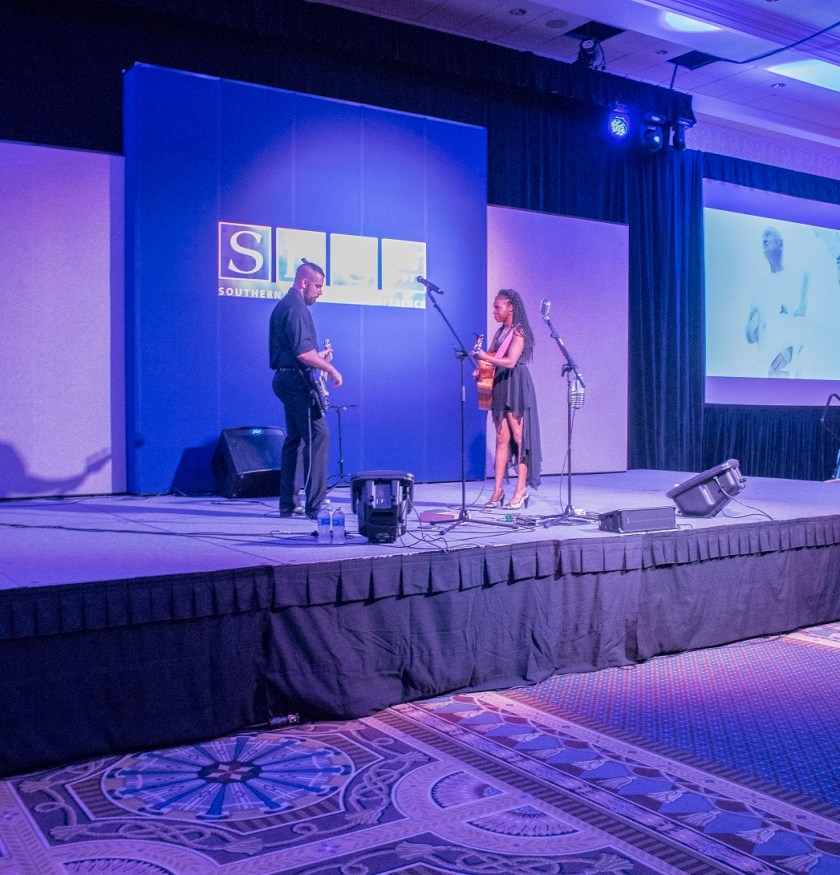
The evening’s entertainment, native-Mississippi jazz singer, Teneia Sanders-Eichelberger, as joined by her husband, Ben Eichelberger, was great to listen to while chatting with other guests.
She had a unique blend of blues, soul, and southern music, and we were able to briefly meet them after their performance, as well.
After an eventful night filled with great music and great people, we left to many cheers of “See you in Biloxi!” as we trudged off toward our hotel, anxious to reenergize for the next day’s activities.
Saturday was our first day to awake in “The Bluegrass State,” and we had a full day ahead of us. As part of the Southern Legislative Conference, which is hosted each year in a different city, and brings together legislative members from all across the south for a week of idea sharing and networking.
Leaving Louisville
Our first objective was to hit a couple of sites in Louisville, and then head to Lexington, the host city for the conference. Although there is much to do in Louisville, we first wanted to see Thomas Edison’s home, where he lived briefly while evolving into the inventor he would later become.
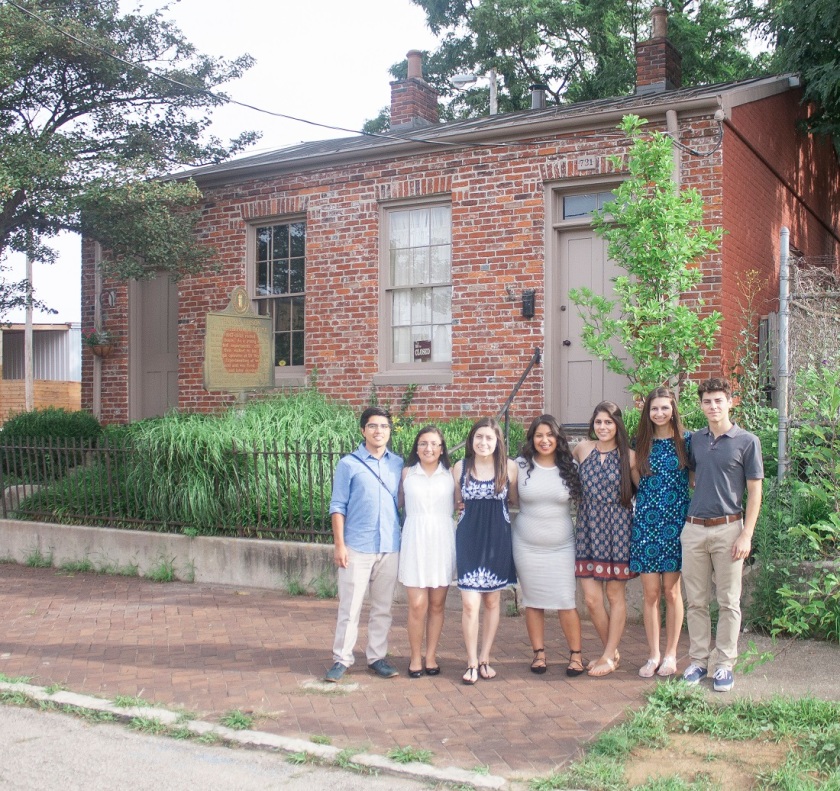
LEAP Ambassadors Outside Edison’s Butchertown Home
Although Edison lived in this home only from 1866-1867, his work there pre-figured his role as an inventor (he was fired for experimenting on the job). Similarly, it prefigures our work in a couple of weeks, when some LEAP Ambassadors will be heading to Detroit to work with Jeff Guinn, who is writing a book on Thomas Edison (and Henry Ford, Harvey Firestone, and others).
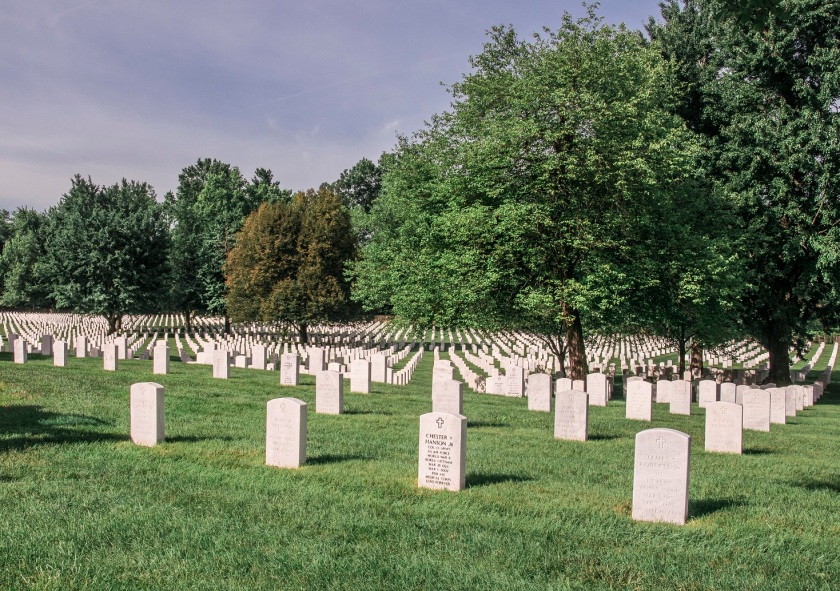
A second must-see stop for us was the Zachary Taylor cemetery, one of seven National Cemeteries in Kentucky.
Some of the 14,000 Soldiers Interred at the Zachary Taylor National Cemetery
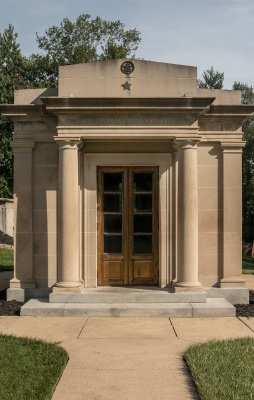
Although more than 14,000 people–including two medal of honor winners–are interred in this cemetery from six wars, the most notable grave is that of Taylor, who served as the nation’s 12th president.
Zachary Taylor’s Grave
..and a monument to his service to the country.
Alex Galvan at Zachary Taylor Monument
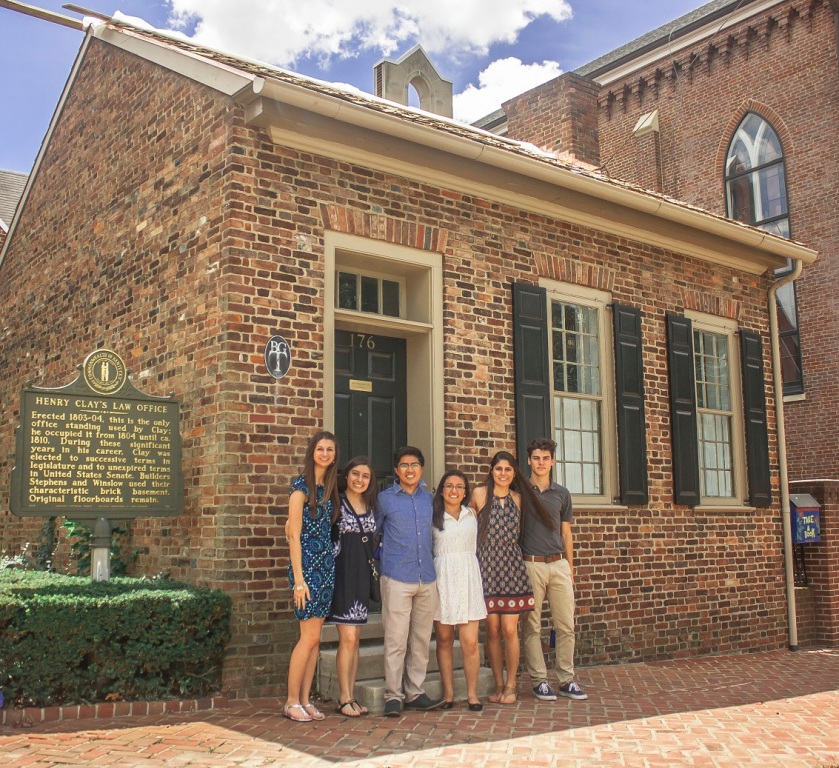
We started out with a walking (“plus”) tour of historic downtown Lexington. A few blocks from our start, we arrived in Gratz Park, one of Lexington’s oldest and most beautiful areas. With the help from our knowledgeable tour guide (who was the Curator of the Henry Clay Home), we passed the city park, a beautiful centerpiece for the neighborhood, and several historic homes, such as: Bodley-Bullock House, which served as both the Union and Confederate Headquarters at times when each side controlled the city; Transylvania University, which was the first university in Kentucky. Also on our walk, we saw the Christ Church Episcopal Cathedral where Henry Clay and his wife attended, and the office where Henry Clay practiced law, which was quite a treat for aspiring lawyers.
LEAP Ambassadors Outside of Henry Clay’s Law Office
The visit was a nice precursors to our impending visit to Ashland, the home of Henry Clay, “The Great Compromiser.”
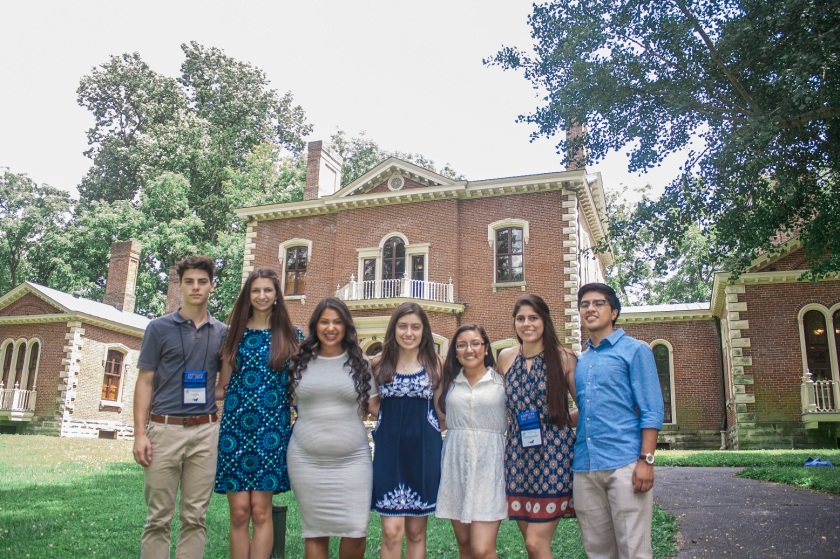
Ashland: The Henry Clay Estate
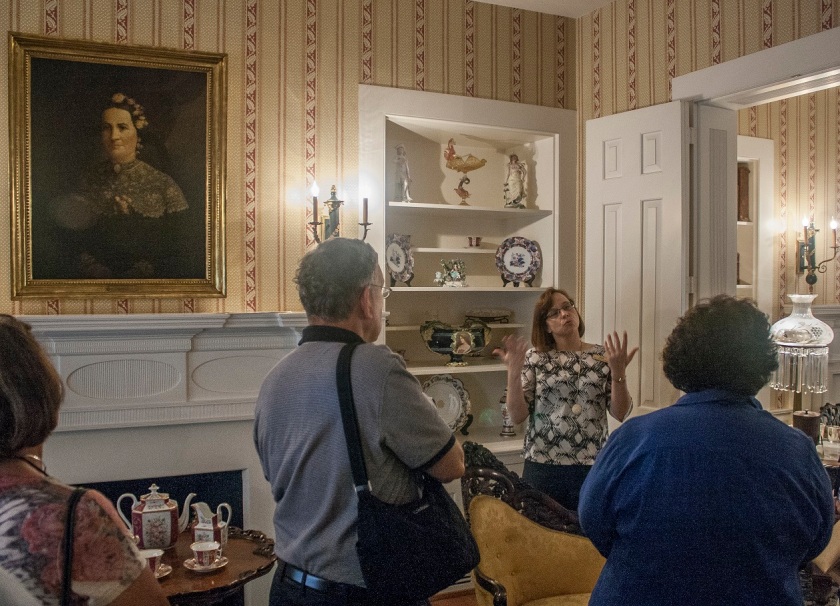
Entering the ash tree-covered estate, from which the home bears its name, we saw a grand portrait of Clay painted by Matthew Jouett when the Senator was 45. Walking through the estate (which does not allow interior photography), it was impressive to learn that the home had stayed in the family from its construction in 1804 until it was sold to the Henry Clay Memorial Foundation in 1959. In fact, family preservation of the home was only interrupted after the Civil War when the house was appropriated by Transylvania University to house its president, from 1865-1882.
One of the parlor rooms, which accommodated the first piano to be brought to Lexington, also held a large portrait of Henry Clay, Jr., and his wife, Lucretia Hart Clay. These paintings were hung in honor of the Clays’ favorite son, who was killed in the battle of Buena Vista in the Mexican-American War, by the woman who is credited with the preservation of the home.
Leaving the front parlors, we turned into the east wing of the home, into one of Clays’ most cherished rooms in the home. Here Clay would have spent most of his time working at his desk, reading his law books, and perhaps preparing his winning defense of Aaron Burr’s trial for treason. The small study now exhibits many of Clay’s personal items, such as a clock from 1832 during his presidential campaign against Andrew Jackson, a bookcase from his law office, a book written by Clay on the subject of agriculture and horse breeding, and some of his correspondence while serving as a senator.
On the subject of horses, he was known as an expert, as he bred his own Thoroughbreds and Standardbreds on the estate. Kentucky, therefore, attributes much of it horse history to the Senator’s fondness for equines. His affection for his livestock was represented in “The Eventful Day of Henry Clay,” a painting by Alvan Fisher depicting Clay and his favorite, prize bull Orizimbo. Legend also has it that in Clay’s study his ghost manifests itself to guests appearing near the mantle.
Even though we did not see his spirit, we did learn much about it. A great orator, Henry Clay was considered a “rock star” of his time. He was depicted thus in a painting in his library, right off his study, in which the vivacious Clay is delivering a speech to an attentive crowd, which includes a very eager Lincoln, cupping his left ear to catch every word of Clay’s speech. Such a sight would be common when Clay delivered a speech – drawing upwards of 100-200 thousand spectators at times.
We learned that not only were his public appearances notable, his deliberations in the Senate were also remarkable. At times, “The Great Compromiser” would stand on the senate floor to for upwards of four hours to deliver his valued opinion on any given piece of legislation. Such may have been true as he developed the Missouri Compromise of 1820, the Tariff Compromise of 1833, and the Great Comprise of 1860. A man of great social networking skills, Clay was also friends with Benjamin Henry Latrobe, the first American architect, who designed the wings of the Ashland estate and is best known for designing the Capitol in Washington, D.C.
As we stepped upstairs, the oak wood staircase (which replaced the previous staircase, making it the “newest” renovation to the home, in 1892) gave way to a landing upon which the John Neagle portrait of Clay is presented. A rendition of his unsuccessful 1844 presidential campaign, Clay stands with disappointed hands pointed towards a fallen American flag over white stone pillars while his gaze is fixed upon a field of grazing bulls. Although depicted as such, even at an advanced age (67) and having suffered a heart attack, many thought this would have been Clay’s last chance to run for the presidency. However, as Clay was a true, relentless Kentuckian, he ran again in 1848, his sixth failed attempt at the presidency.
One of the most notable facts about Clay was his lifelong feud with President Andrew Jackson. After the alleged “corrupt bargain” between John Q. Adams and Henry Clay, which ensured Adams’ victory in the presidency, both Clay and Jackson harbored similar grudges against each other. The hatred was such that Clay once swore that if he ever saw Jackson again, “he would shoot John C. Calhoun,” (Jackson’s Vice President), “and hang Andrew Jackson.”
In the master bedroom a Freemasons’ apron which was laid on Clay’s casket during his funeral was displayed. It was at this point that our guide informed us that on the day of our tour, exactly 164 years previously, Clay’s body had returned to his estate to reach his final resting place.
As we descended the stairs, with the smell of oak and sound of creaking steps, we ended our tour inside the room where Clay’s casket was likely displayed for his funeral. After a quick gift shop stop and photo op…
LEAP Ambassadors Outside of Henry Clay Home
we headed back to the conference bus for our next, and last destination on this tour, the Mary Todd Lincoln home.
Todds and Lincolns in Kentucky
Originally built as an inn and not a residence, the Mary Todd Lincoln residence was purchased when Mary was 13. In all, some 16 children would have spent time in the house–Mary and her 15 siblings–not counting cousins and other more distant relatives.
LEAP Ambassadors Tour Mary Todd Lincoln Home
At an early age, Mary began attending a finishing school where she studied literature and became fluent in French. When her father died of cholera, he had no will, so all of the items he owned were liquidated, including their collection of over 350 books. As a result, the museum has very few pieces of furniture original to the house, although they do have pieces that date from that time.
When Mary was about 20, she went to live with her sister, Elizabeth, for an extended period of time. Elizabeth and her husband lived in Springfield, Illinois, which is where Mary met and later married Abraham Lincoln. There was talk about Mary’s visions of becoming a First Lady long before she married Lincoln, and much credit is given to her for his rise up the political ranks.
All was not smooth, though. While in the White House, Mary spent the a large sum of money on redecorating the White House in the first six months of their stay, which led to some talk about how extravagant she was. Some of the President’s opponents tried to use the fact that many of Mary’s brothers and sisters were either fighting for the Confederacy or married to Confederate soldiers against him. In fact, while she was living in her family home, the Todds had anywhere between three and five slaves.
After Lincoln’s death, Mary went into perpetual mourning, and only wore black from then until her own death. She lived in Europe twice with Tad, one of two sons who were still alive at the time, although Tad, too, died young, like both Willy, in 1862, and Eddie, in 1850. In 1875, Mary had a premonition that Robert, her last remaining son was in peril, so she went to him. Given her behavior, he had her declared insane and committed her to a private sanitarium, although she was released after only a few months.
Recently, the Washington Post speculated that her illness might have been caused by a vitamin deficiency, our tour guide explained, although there are many theories as to her mental state, especially after losing two sons and her husband. Altogether, the tour was interesting and informative (and Ryan’s favorite stop on the tour).
Our awesome downtown tour was long (about four hours), so the LEAP Ambassadors had a late lunch at Stella’s Kentucky Deli, a locavore restaurant in downtown Lexington. The options weren’t too exotic, but Brian tried a lamb-burger (“pretty good”) and Kaitlyn loved her fried green tomato BLT. The rest of us were not too impressed with our dishes. As with any new experiences, sometimes it’s a hit and other times it’s a miss. We are always happy to try new things though – that’s part of what keeps our trips interesting!
Keeneland: Betting on Fun!
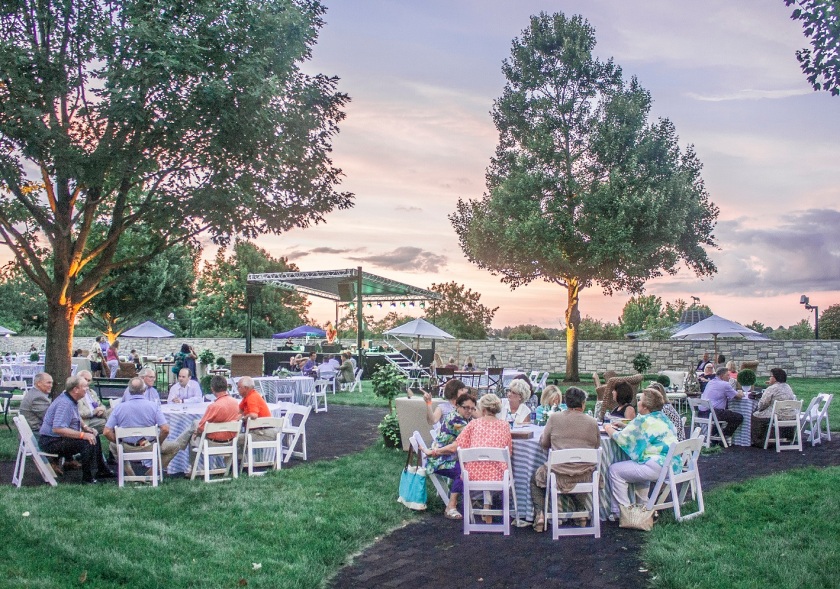
Later in the afternoon, we were all eager for the bus ride to Keeneland, a Thoroughbred racing facility and sales complex for SLC “family night.” We passed through various luscious green pastures, and were greeted with music, and excited to sample varieties of the well-known, authentic Kentucky bourbon and barbecue. Not to be disappointed, we arrived at the main patio area where different tables and serving areas had been set up.
Opening Night of Southern Legislative Conference–Keeneland
We piled our plates high with savory brisket and ribs. Next we hit the barbecue sauce table where sweet tea, pineapple ginger and smoked tomato flavored barbecue sauces were available for sampling as well.
After we finished the delicious offerings, we met retired jockey Jean Cruguet, who kindly gave us his autograph and posed with us for a group shot.
LEAP Ambassadors with Triple Crown Winner Jean Cruguet
Cruguet is a legendary jockey, one who rode Seattle Slew to a triple-crown victory in 1977, the only undefeated horse ever to do so. In the final leg of that crown, Slew was leading by four lengths heading into the stretch, and Cruguet, in an act of bravado, stood on the stirrups, raised his riding whip in the air, and declared victory 20 yards prior to the finish line.
Jean Cruguet on Seattle Slew
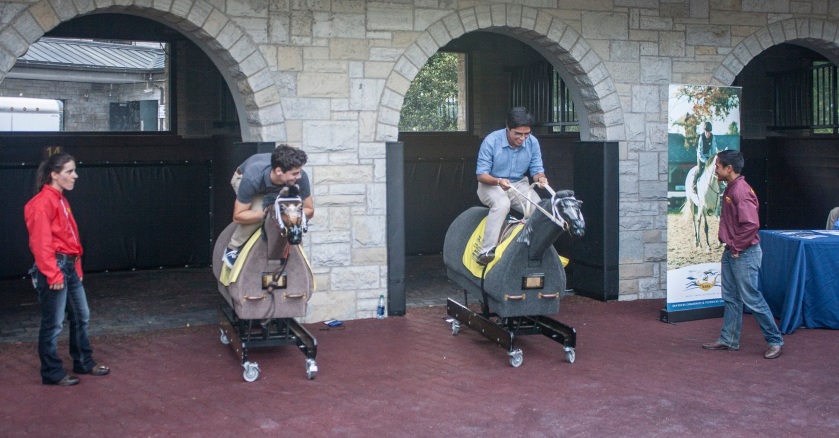
Perhaps inspired by this meeting, both Ryan and Brian (named B-Ryan for the purposes of our trip), got on horse simulators to experience the horse-racing experience.
Ryan Brim and Brian Aldaco on Mechanical Horses
Brian and Ryan experienced what it would have been like to be a professional jockey, giving the practice horse a tryout ride. Both had great “natural talent” and, perhaps a bit presumptuously, felt ready to take on an actual horse race after their practice.
To see some real horses, we headed to the stables. Everyone took turns approaching the majestic horses for some tender, loving pats on the nose.
This slideshow requires JavaScript.
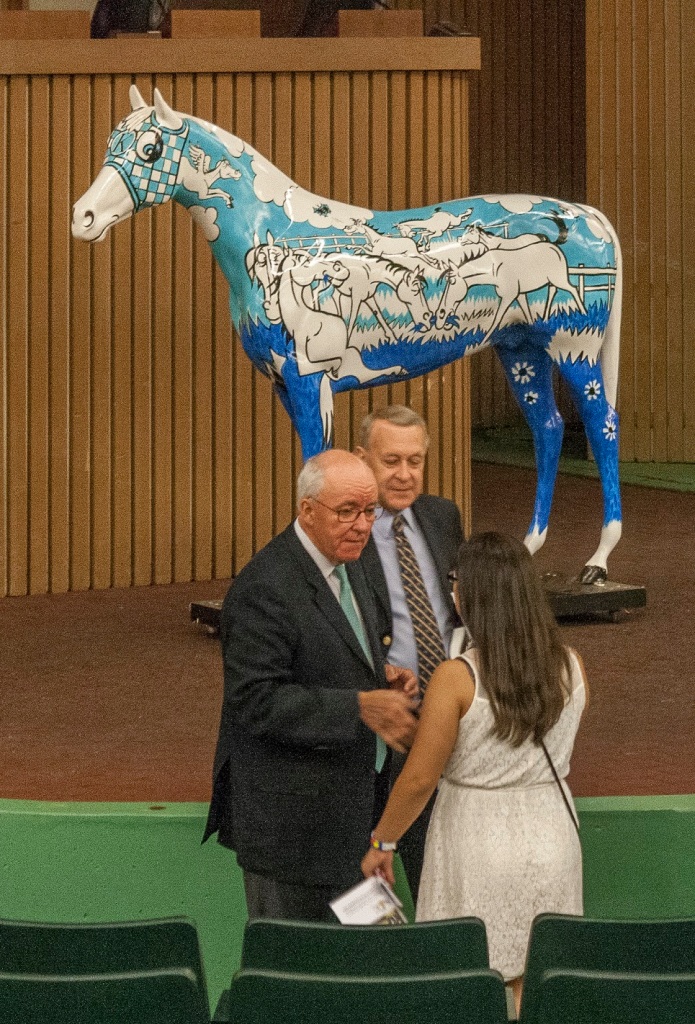
Having checked in with the breadwinners of the stables, we moved on to a more educational event Keeneland sponsored, the mock auction. Unfortunately, we arrived late, only in time for the tail end of a Q&A session with Mr. Cruguet.
Beatriz, though, didn’t let the end of the session slow her down. She met briefly with the auctioneers for her own private Q&A, to find out more about the process of horse auctions, as well as the amount one could spend on a horse: Did you know that the highest bid they have ever had for a horse is 3.6 million dollars? Did you know that Keeneland had 500 million dollars in horse sales last year? I found that pretty impressive.
Beatriz Martinez with Keeneland Auctioneers
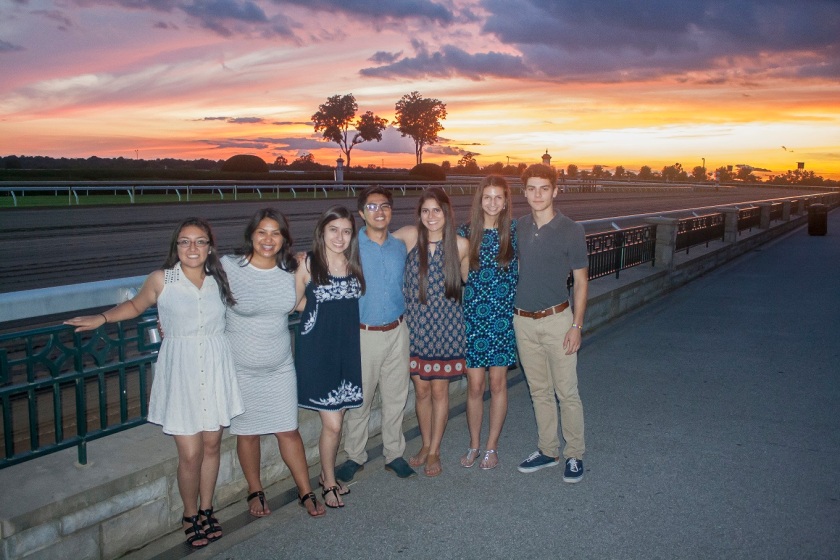
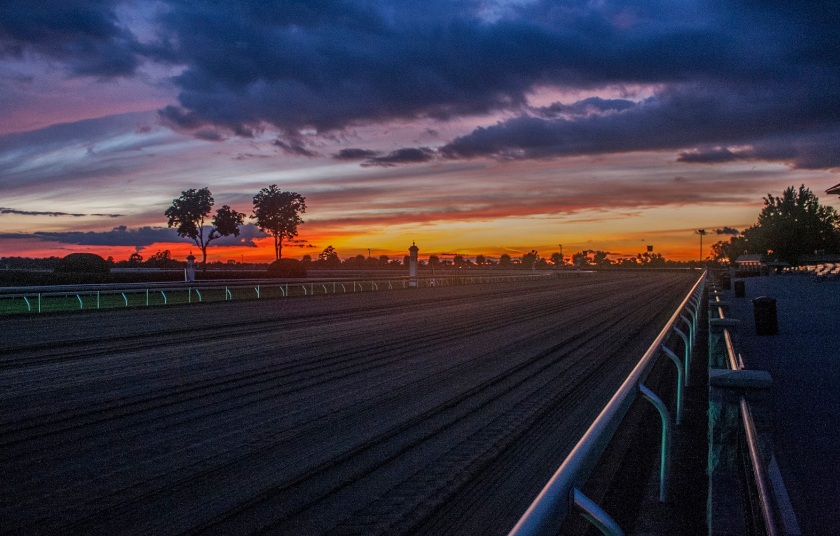
We made some last rounds at Keeneland, enjoying the last round of music by local band Sundy Best, “Home,” as we took pictures in the sunset at the track.
LEAP Ambassadors at Keeneland Race Track
None of us has ever been to a horse race, but being so close to the track does hint at the kind of excitement that might be possible during a two-minute race.
Having a beautiful sunset also helps.
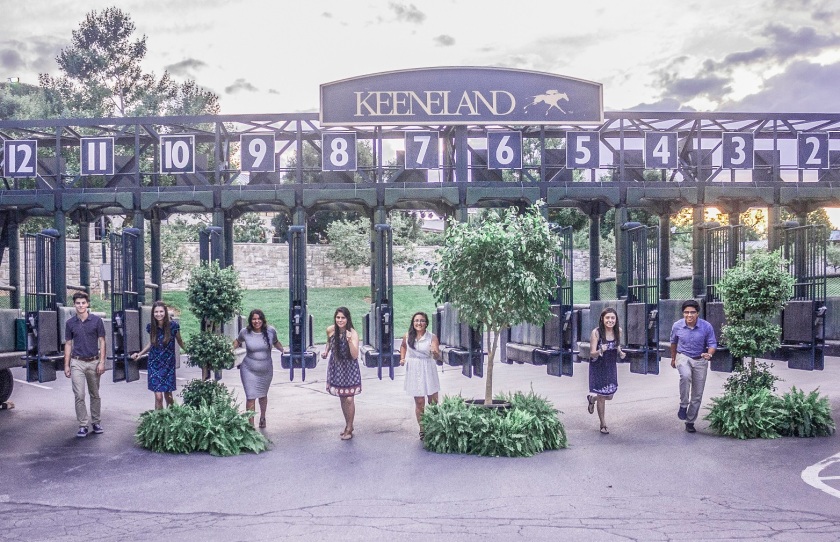
We also posed in Keeneland’s Starting Gates. Incidentally, Brian was stationed in the same gate as American Pharaoh, the last triple crown winner (2015) and, with a victory at the Breeder’s Cup, stands as the only horse to win the “Grand Slam” of horse racing. Fittingly, American Pharaoh was bred in Kentucky.
LEAP Ambassadors in Position at Keeneland
With one last look around Keeneland, we agreed with the band, Sundy Best, that, “Yeah it’s time to go home.” So we headed back to the hotel!
Triangle Park
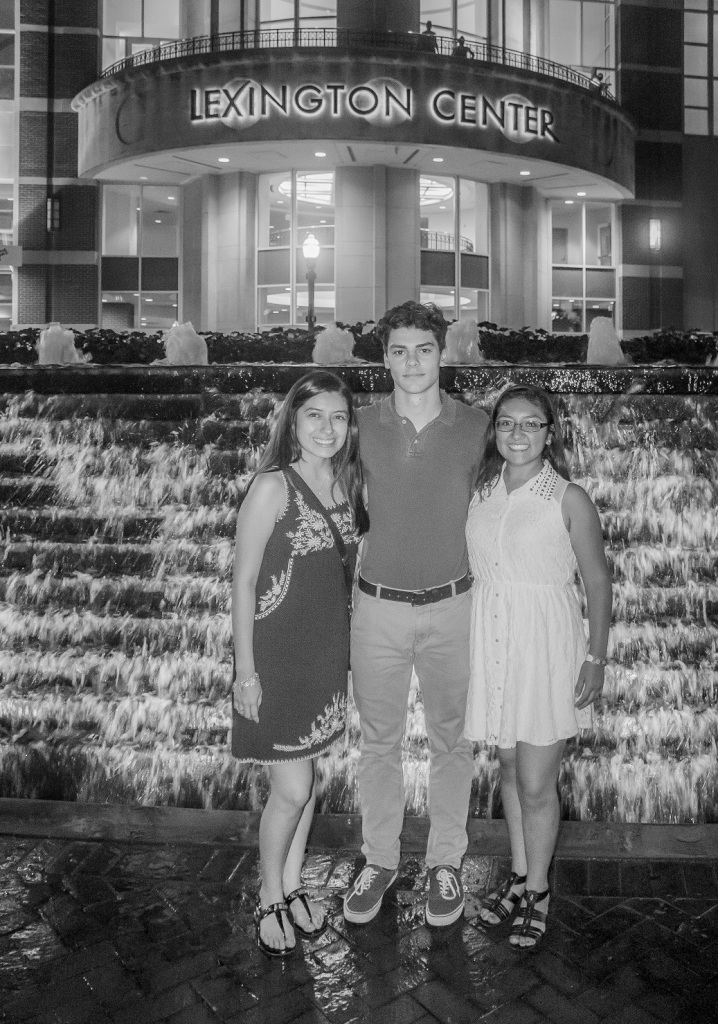
Before we were fully able to call it a night, we explored the city park by our hotel, Triangle Park. It is a beautiful gathering space, with splash pads, a “democracy wall,” and a beautiful fountain that covers more than an entire city block.
Triangle Park, Lexington, KY
With the calming splash of the water and the peaceful, happy ambiance of the park, and the satisfaction of a full-day of activities, we called it a day.
Tennessee is known as the volunteer state, so named because of the disproportionate number of volunteers they have provided to the US Military in wartime. While none of the LEAP Ambassadors have served during wartime, we do volunteer a lot, so we felt a distant kind of kinship.
The first stop planned for our third day of the Southern leg of our trip was The Hermitage, Andrew Jackson’s home.
Our tour began with museum exhibits describing the history of the seventh President of the United States in chronological displays. The exhibit began with the wars in which Andrew Jackson played important roles, the War of 1812 and the Battle of New Orleans in 1815.
Original artifacts, such as swords used by the British and the Americans during these historical events, were also displayed in glass cases allowing each visitor to stop and admire the details of each. Larger artifacts, such as his carriage, were displayed on the floor of the exhibit space.
The exhibits were packed with history, but also well-organized, making it easy to follow and understand.
We learned not only about Andrew Jackson’s life, but also much about his wife, Rachel.
After the indoor museum exhibits, we moved on to a self-guided audio tour of the grounds that led us to Jackson’s mansion.
The guides on the tour discussed every room in the 8,000 sq. foot mansion. The parlor downstairs off the entryway was covered in elegant wallpaper that General Jackson ordered from France, along with many original artifacts. Although the mansion was beautiful, it does not have all the modern conveniences that homes today have, such as indoor plumbing! The second floor houses guest rooms and the grandchildren’s rooms. And as a special treat, the upstairs tour guide pointed out one of the guest rooms where Sam Houston slept during one of his visits to see General Jackson.
After the mansion tour, we meandered the garden, still guided by the audio tour. In the garden, elaborate for its time, we saw the tombs of the Jacksons, along with several family members.
The garden was originally made for Rachel as a place for her to relax, a much-needed respite from the stress of her husband’s political career. Sadly, she passed away days after Andrew Jackson was elected President; and it is said that the political stress caused her death. After the tour of the museum exhibits, the mansion, the garden, and a quick photo-op on the $20 bill…
…we had worked up an appetite, so we made our way to The Pharmacy for a quick fix.
We know what you’re thinking, but no, we didn’t go to the local drugstore for lunch! The Pharmacy is actually a burger parlor and beer garden, although we didn’t sample the latter. The restaurant has been named the “wurst burger joint” around because of the German influences in their food and beverages. The phosphate and crème sodas, Wurst, and beer make this Nashville spot distinct and popular. The restaurant was cozy with a large outside patio garden. The patio was beautiful; however, we sat inside to cool off after a morning of sunshine at The Hermitage.
We ordered different varieties of burgers made from 100% Tennessee beef. Beatriz, ordered the Farm Burger, with bacon, egg, and ham and other fixings, while others tried the Biergarten Platter, which had a variety of wurst sausages and mustards. All the food and cream sodas were satisfying and we were more than ready for our next stop, The Parthenon.
Gryphons stared down at us serenely as we climbed up the steps of Nashville’s Parthenon. We entered through the west side, noticing that atop the majestically stoic Doric columns a scene was unfolding depicting Athena being crowned by Nike (the winged goddess of victory, not the shoe brand). Built in 1897, this replica Athena’s shrine was at one point meant to be temporary. Due to Nashville’s love of the thought of having their own Parthenon (they were known as “the Athens of the South”) and since it had quickly grown in popularity, it stayed.
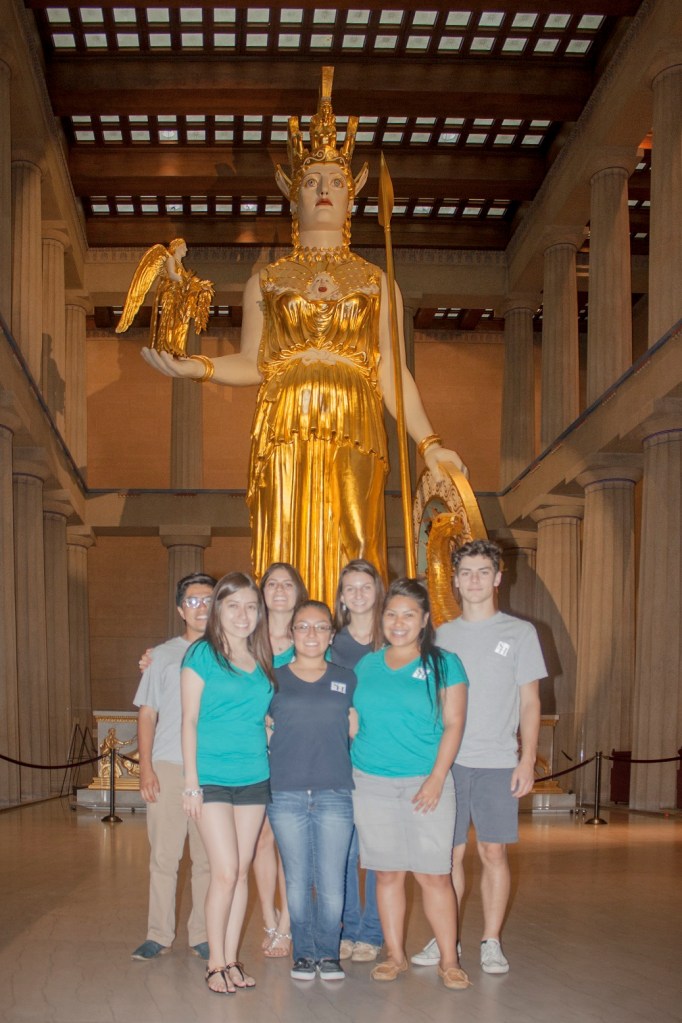
LEAP Ambassadors at the Parthenon–Nashville, Tennessee
As we set foot into the structure of classical architectural style, not only did we travel across space towards Athens, Greece where the real Parthenon lay, but we also stepped into a place of art. Literally. The Parthenon is both a bona fide replica of the authentic Parthenon and a museum housing more than 60 pieces of art donated by Mr. James M. Cowan under a strange circumstance…he had donated the pieces of art with only one condition: that he remain anonymous as the donor until after his death.
We moved upstairs where we were able to see the goddess of wisdom herself. Made of a number of materials, including 3.6kg of gold leaf, she stands impressively tall with Nike in her right hand and her faithful shield in the other.
One of the many interesting things about Nashville’s Parthenon are the gargantuan bronze doors. Measuring up to 6.5 ft. in height and weighing about 7.5 tons, these doors are thought to be the largest set of bronze doors in the world. However, even the smallest of our group could easily move them.
After digesting much great Greek mythology, art, and architecture, we passed by a gryphon one last time…
…Beatriz giving it a fist bump of gratitude for its great work at guarding Athena.
With that last goodbye, and a last glance at the great Athena, we left wiser on the subjects of art, architecture, Nashville history, and a bit of the goddess of wisdom herself.
From there, we visited the Tennessee Capitol.
Like many other major building projects, construction of their capitol was behind on schedule and way over budget, taking fourteen years instead of three, and costing about three times as much as the initial budget.
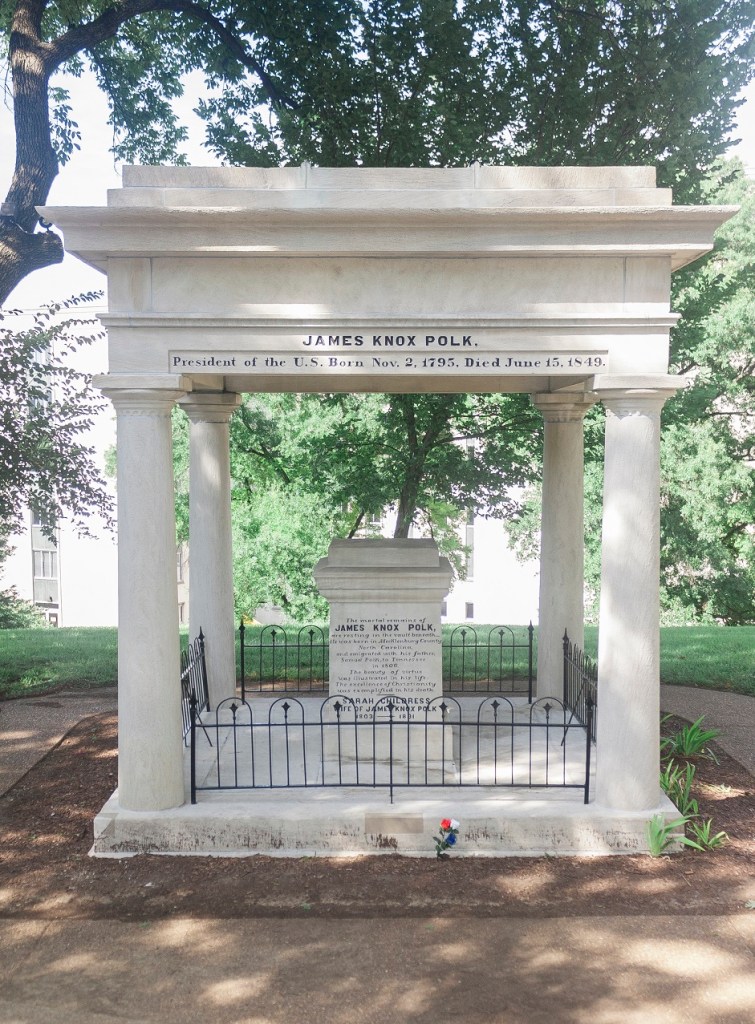
The Tennessee Capitol is one of 13 state capitols which does not have a dome. Instead, it was built in a Greek revival style. Not only is it different in architecture, but this capitol is the only one to be home to three deceased people, the first being the architect who designed it, William Strickland. Strickland is buried in the walls of the building, which he regarded as his greatest work. Along with Strickland, Samuel Morgan, the original building commissioner, is also buried on the site (actually, in the walls of the building). And wrapping up the list are President James K. Polk, and Polk’s wife, Sarah, are bured on the grounds (but not in the walls).
We learned much about Polk and the other two presidents from Tennessee (Andrew Jackson and Andrew Johnson). As we went along our tour, our guide (who was very knowledgeable and one of the best tour guides we’ve had!)…
…pointed out a bearded Sam Houston, who was governor of both Tennessee and Texas.
Although one LEAPster, who shall remain nameless (Megan), failed to recognize him, it was nice to see that General Houston was given credit for the work he’d done in Tennessee.
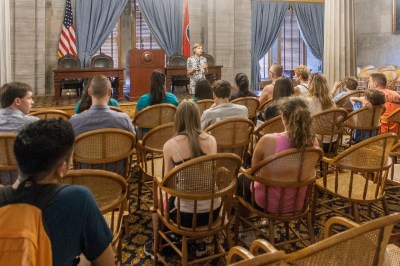
Tired of waiting for the entire capitol building to be built, the Supreme Court of Tennessee decided to move right in and start hearing cases. One judicial record, the tour guide explained, indicates the Court held a construction company in contempt of court for making too much noise while working on the building.
Even so, the tour was great, filled with humor and interesting facts, such as the two occasions in which a president chose a vice-president with the last name Johnson, which didn’t work out so well for the presidents, who both ended up dying in office. Our cheerful tour guide made the tour one of the most interesting capitol tours we’ve been on.
This slideshow requires JavaScript.
To top it off, we even got to use the old-timey state seal press to emboss our programs.
So, as the day and the tour came to a close…
…we knew it was time to move on to our next destination, Louisville, Kentucky.
The LEAPsters are always up for adventure no matter how frightening it may appear. One member of group stated that completing the fully-underground, aerial ropes challenge course at Louisville Mega Cavern truly embodied the LEAP spirit.
As we opened the front “door,” it was apparent that the cavern’s interior had been refurbished with artificial ceilings and walls in order to accommodate the recreational attractions inside. Louisville Mega Cavern houses a bike course, ropes course, “mega” zip line, and holds tours of the cavern’s mines.
This night we were set for the elevated, trapeze-style obstacles on the ropes course.
Several of us are not fond of heights, and regardless of the multiple, secure straps attached to every elevated obstacle, fear of falling was still prominent.
Our pseudo phobias did not deter us from trying as many hanging rope bridges within our time limit, though. Bridges between the platforms varied in size, shape, difficulty and amount of balance required to traverse, from suspended, unbalanced planks to tension ropes to challenges that simply cannot be described without seeing them.
For Alex, acrophobia kicked in while trying to balance over this system of suspended ropes and planks: At these moments my blood would rush in anticipation of hitting the ground, my palms would start to perspire inside my leather gloves making them almost slide off my hands, and my head would be showered in more sweat as I noticed how high off the ground my struggling body hovered. I would tightly clench the rope from which each overpass was suspended and inch my way through with each move coordinated to keep balance. No matter how much I wished to stay safely footed on the floor, I mustered all the courage my shaky spirit could supply.
For the most part, though, we successfully walked, crawled, and hopped, and prayed over the obstacles without falling.
And all the LEAPsters made it to the grand finale: the zip line.
Some jumped off, some slid off, and at least one asked to be pushed off, but we all made it off the platform at least once. We wrapped up the late night and with blistering hands and muscles strained from the continuous stress of cheating an unwelcome dive to the hard ground, we climbed in our traveling van, ready to reach our hotel for some much-needed rest.
After a long hike last night, and a much-needed sleep, we began the second day of our Midwest/Southern Tour with what is now a traditional scenic stop at The Old Mill, the final extant set of Gone With the Wind.
Most of us had been to The Old Mill before, but we were still very excited to jump out of the van and take in the beauty The Old Mill has to offer. Moreover, Beatriz actually hadn’t been there, so she got her first taste of The Old Mill.
Interestingly, the LEAP Center and Junior Fellows have photos at The Old Mill dating back to around 2006, making it almost a ritual among the organization.
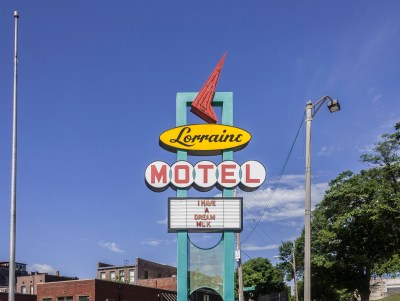
After some exploration, and a few photo ops, of course, we all hopped back into the van for our next destination: the National Civil Rights Museum at the Lorraine Motel in Memphis, Tennessee.
On the way to the museum, though, we stopped by Graceland, the home of Elvis Presley, to leave a few messages on the stone wall.
And take a group photo.
We began the tour of the National Civil Rights Museum…
…with a special exhibit by artist Baret Boisson. Her work, themed “Inspiring Greatness through Words and Deeds,” focuses on portraits of heroes such as Mahatma Ghandi, Muhammad Ali, Rosa Parks, Abraham Lincoln, JFK, and her most recent–Martin Luther King, Jr.
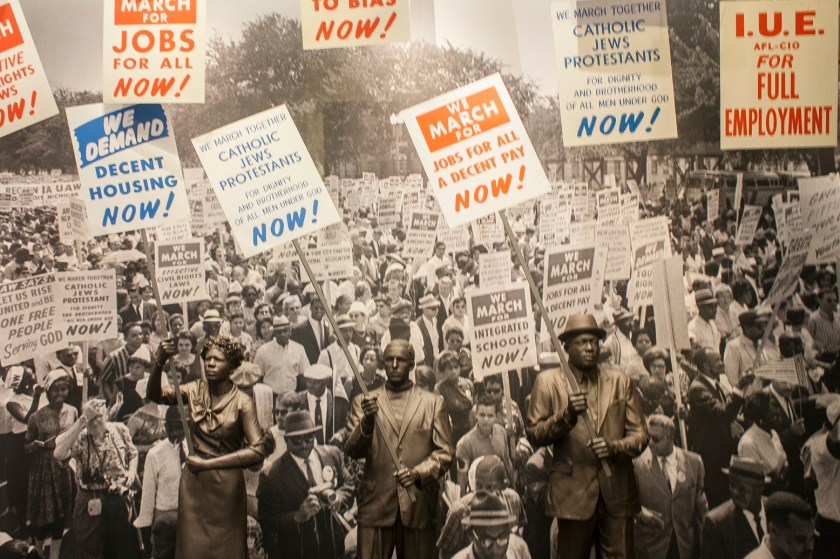
The museum portrayed the process of the civil rights movement from the beginning to present in a very detailed and educational manner, and really emphasized the important role that civil disobedience and non-violent protest played thought the years.
The museum’s first exhibit focused on the beginning of slavery. Slaves were considered property and were sold in exchange for items such as 40 pounds of gun powder, two iron bars, one copper bar, or even a mere five pieces of cotton cloth (an average cost of about $200 in the early 1800s). As they were bought they were expected to do heavy labor such as tending acres of tobacco plants.
The slave trade lasted about 366 years, and we were able to see the process of change in America through the museum’s many exhibits. The exhibits were displayed in order beginning with the Montgomery Bus Boycotts…
…followed by Freedom Rides, and the decision in Brown v. Board of Education.
The final exhibit included the two hotel rooms where MLK was staying at the Lorraine Motel when he was assassinated. The rooms have been restored to what their actual state at the time, including a clear view of the balcony where he was assassinated.
After touring the National Civil Rights Museum, we made our way through a stretch of decorative Memphis buildings to Gus’s World Famous Fried Chicken. We were astonished by how many visitors were crammed inside the small building. With elbows grazing, eager tourists and locals ready to indulge in the restaurant’s signature hot and spicy fried chicken, we LEAPsters pondered whether this chicken was worth the claustrophobia. As tables were cleared and re-filled and waiters rushed through the cracks of the narrow table arrangements, we took our seats.
Soon after ordering, our waiter made his way towards us with an arrangement of fried chicken, coleslaw, fried pickles, beans, fried okra, and seasoned fries hovering over his hand. As his arm motioned this behemoth lunch to float down to the table’s center, our senses where overwhelmed by the scent of fried heaven. Our hunger took hold of us, and after taking a second to strategize distribution of our food, we went through legs, wings, and breasts until there was only left some bones and a some shavings of breaded fibers. Each bite was an experience in itself, with the spice piercing, but not stabbing, at every taste bud, the layer of breading just right. It was clear that this meal was not the typical greasy chain-restaurant type of fried chicken. As our empty plates were lifted and our tables cleared it seemed that we were in need of more bites from this joint’s menu. We satisfied this with a shared slice of chess pie – the sweet, creamy treat was perfect to send us off onto our next Memphis adventure.
Memphis, also known as “Home of the Blues” and the “Birthplace of Rock and Roll,” boasts a small gem that has contributed to music we love and cherish, Sun Studio.
Sun Studio recorded legends during the 50’s and 60’s that most of us still know and love. After a bit of looking around on our own…
…and going through old records…
To begin the tour, we learned about Sam Phillips, founder of Memphis Recording Services, which later became Sun Studio. Phillips originally opened the recording service using only a tape recorder to create recordings! Phillips primarily recorded blues music with artists like Howling Wolf, country music with a familiar name, Johnny Cash, and later transitioning into rock-n-roll with names like Jackie Brenston.
Even though many legends got their big break at Sun Studio, the fact that the most famous star to get his start at Sun Studio was Elvis Presley is hardly ever argued. In 1952, Memphis Recording Services transitioned to Sun Studio and began producing their own labels. Shortly after graduating high school in 1953, Elvis recorded his first tape at Sun Studio with a sliver of hope that he would be “discovered” by Sam Phillips. It took time for Elvis to win over Phillips, who was interested mainly in blues music, but with a push from Phillips’ secretary (who actually recorded the future “King of Rock-n-Roll”), he finally decided to give Elvis a chance.
Mixing old blues and country, a combination that hadn’t been experimented with yet, Elvis finally got his shot when his song (“That’s All Right (Mama)”) was played on the radio one afternoon in Memphis. The radio station’s phones were ringing off the hook. Finally, Sam Phillips knew that he had someone special in his studio.
We visited the actual studio where Elvis recorded his music, on the last part of the tour. Our ears were ringing with joy while listening to the original recordings of some of Elvis’ songs! Carl Perkins, Johnny Cash, and Jerry Lee Lewis were also discovered by and signed with Sun Records. Known as the “Million Dollar Quartet,” or the “Class of ‘55,” these four musicians would all shine fame on Sun Studio.
To end the tour, we had the opportunity to take pictures with the only original piece of equipment left from the heyday of Sun Records, a microphone that was most likely used by the members of the “Million Dollar Quartet,” and Elvis himself!
This slideshow requires JavaScript.
In the spirit of historical research–which has nothing to do with the fact that she finds him handsome–Megan searched out a photo of Elvis to pose beside.
After rolling through the ages, the spirit of rock-n-roll stayed with us as we headed to Nashville and the Cheekwood Botanical Garden and Museum of Art. We began with the art museum in the Cheek mansion, which is not only large and beautiful, but is also graced by a large Steve Tobin sculpture in the front yard.
The home was previously owned by Leslie and Mabel Cheek from 1933-35. Their daughter, Huldah Cheek Sharp, then offered the home to be used as a botanical garden in the 1950s. Now, the mansion is home to and furnished with many elegant works of art.
The current exhibit allowed us to roll through the various ages of art, from American Impressionism to abstract work. Also, like musicians’ attempts to provoke sensations in their audiences, these artists’ works are a direct translation of their life experiences — evident throughout the museum. Perhaps most interesting to us was a chandelier by Bruce Munro, an artist we saw at the High Museum of Art in Atlanta last year…
The compositions that filled the 55-room home were moving and memorable. Artists such as Childe Hassam used impressionistic paintings of nature that struck a different chord with art enthusiasts and provided a lasting respect for self-interpreting environmental art.
Megan: “My favorite painting was called, “Outskirts of East Gloucester.” The loose brushstrokes of a countryside brought a sense of home to me and happened to be a theme of the Cheek mansion. How often does one have the opportunity to look at beautiful art in a beautiful mansion? The garden and museum were definitely a “top hit” with the LEAP Ambassadors.”
Still in the spirit of rock-n-roll, we began rocking the trails in search of the Carrell Woodland Trail’s sculptures (pun fully intended). The botanical garden was beautiful. Instead of arrangements of beautiful flowers, the parts we visited reminded us more of a state park. With cedar trees standing tall and proud, the sweet melody of the birds chirping and the cicada drone, we meandered across the trails looking for the sculptures.
As part of the trail, we passed the Cheekwood Prime Matter, Untitled, Steeple Dance, and Glass Bridge, among others.
Last on our list was James Turrell’s Blue Pesher. The whole purpose of this chamber was to create a space where one could reflect by making their perceptions more sensitive. We sat inside, staring up the hole in the ceiling, into the sky, pondering on how to face the music of our lives. As the plaque outside the Blue Pesher puts it, “In this room, discover a commentary on the heavens and what it looks like from the inside of the chamber.” (Interestingly, “commentary” is the definition of the Hebrew pesher.)
The sky at dusk as seen from the floor of Turrell’s Skyscape, Blue Pesher
With the sunset, the symphony within ourselves had to come to a slow and soft end, as the sky could no longer be seen. We headed back to the van knowing that the melody in our hearts had been heard and that our self-perspectives would be seen in a new light.
To continue enjoying our Nashville evening, we had dinner at Mitchell Delicatessen. Housed within a wooden facade that resembled a country home, the deli offered an eclectic assortment of sandwiches. From tofu to BBQ brisket to a Tennessee Tuna Melt to an Asian flank steak, it was a challenge to narrow down which to choose.
Megan: I chose the Asian flank steak. This renowned deli magnum opus (which was apparently featured in the Travel Channel) was unlike any other sandwich I had ever had the honor to taste. With steak smothered in provolone cheese on a bed of sliced bell, banana pepper, celery, carrots, and olives, this deli delicacy was enough to send my palate down a ride of flavorful delight. To make the experience even more interesting and add tad of an effervescente ride, my meal was accompanied by one of the eatery’s own draft cola.
We rounded out our second day of the trip with a very satisfying repast from Nashville’s culinary spectrum and headed to our hotel for a good night’s rest.
Brian Aldaco is a freshman at SHSU who spent the last month in upstate New York working on a congressional campaign. For a student who hadn’t spent much time outside of his home state, it was a great window into the world of politics and the opportunities of travel.
This blog entry is his second addressing the campaign work he did in June 2016.
As the culmination of the New York District 19 Republican Primary drew near, campaign volunteers were tasked to muster up every single ounce of energy to go through our block walking assignments and ensure a Heaney victory. As before, this included going to the various towns and villages of the district; from the Hudson Valley and through Catskill Mountains we marched from house to house in hopes of being heard.
Additionally, as a means to operate more effectively, we were relocated to a country home in the candidate’s home town of Millbrook. With creaking wooden floors, book shelves filled with literature, and antique house decorations, we could get a feel for the home’s historic spirit. This also allowed us to experience the region’s house culture, which is replete with historic homes. In fact, it’s not uncommon to see the year the home was built on or near the doors of the homes, with many of the years dating back to the 19th century.
Two days before the election we came together to phone bank. This tedious process included being placed on a call queue, waiting for a voter to answer, and hope that the prospective voter doesn’t hang up or yell at you. Although these were common responses, we continued to call, ever eager to reach out to voters. On Monday, alone, we were able to reach 1,600 voters.
As dawn broke on June 28, we awoke with a sense of excitement. Finally, the day we had all been working for had come. Finally, our month-long work was about to pay off, to hopefully gain a victory. With these high hopes, we drove 45 minutes to campaign headquarters, in Hyde Park.
Inside the office, decorated with pictures of Winston Churchill and FDR, we were tasked with completing phone banks. Thus began one of the most extensive endeavors in which I had ever participated. By this time, the voters had begun to tire of the frequent calls from candidates’ staffs, and they let us know it–loudly and frequently. The day progressed, and an assignment of 500 calls morphed into an assignment of 600 calls, then 1,000. Collectively, we became a calling machine, reaching more than 20,000 voters in a two-day period.
At 7:30, with a sore, throbbing ear and exhausted vocal cords, I regrouped with the volunteers, Joe Williams, and Campaign Manager David O’Connell for one last briefing. It had all come to a close; there was no more we could do but wait for the polling results and head on over to Mr. Heaney’s viewing party.
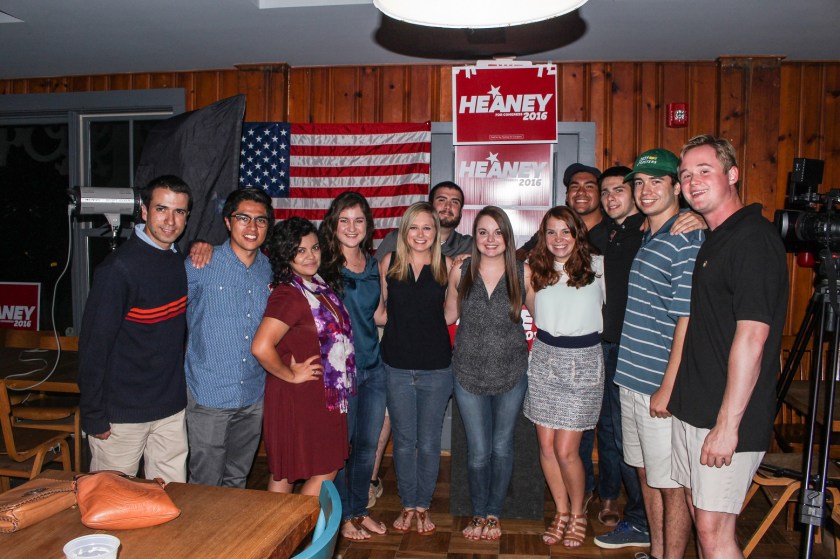
As we crossed the threshold of the bar and grill we stepped into an assembly of celebrating campaign sympathizers and friends. No matter what the polling results would yield, we had all worked just as hard, the campaign had become our purpose, every single door we had knocked and number we had dialed, we did so as to ensure Mr. Heaney’s victory. For a month we had become the campaign and on that night it would end.
As the Congressional District 19’s results were posted it was evident that our candidate was not receiving the support it needed to win the primary. After the majority of precincts reported the results, it was clear that Mr. Heaney would not make it to the general election.
Nonetheless, we all held our head high with pride. For the volunteers, it was the first time we had worked in such an extensive campaign. Even though I was not able to see my candidate win the primary, I was just as grateful for being part of his efforts. We all learned an extensive amount of the political world that we could not learned anywhere else. For that reason alone I am grateful to Grassroots Consultant Joe Williams, Campaign Manager David O’Connell, and Mr. Andrew Heaney.










































 Center for Law, Engagement, and Politics