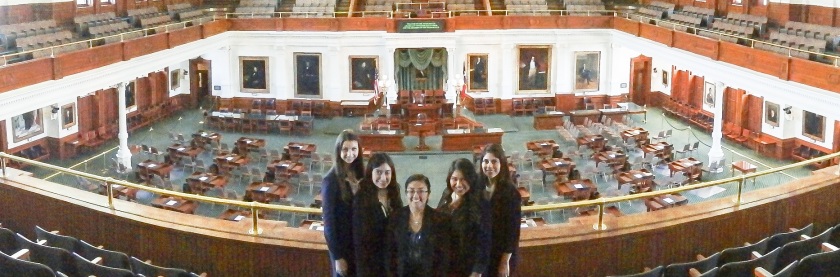
With ten SHSU students in Austin and two more in DC, Bearkats are gaining experiential learning in political hotspots. These internships, which last for the entire legislative session, teach students scheduling, bill analysis, research, public relations, and even bill drafting.
The internships also give the students a chance to have every so often, and learn about things through a more hands-on and fun approach.
Karla Rosales, for example, took a capitol dome tour, which culminates with the trip up the stairs below.
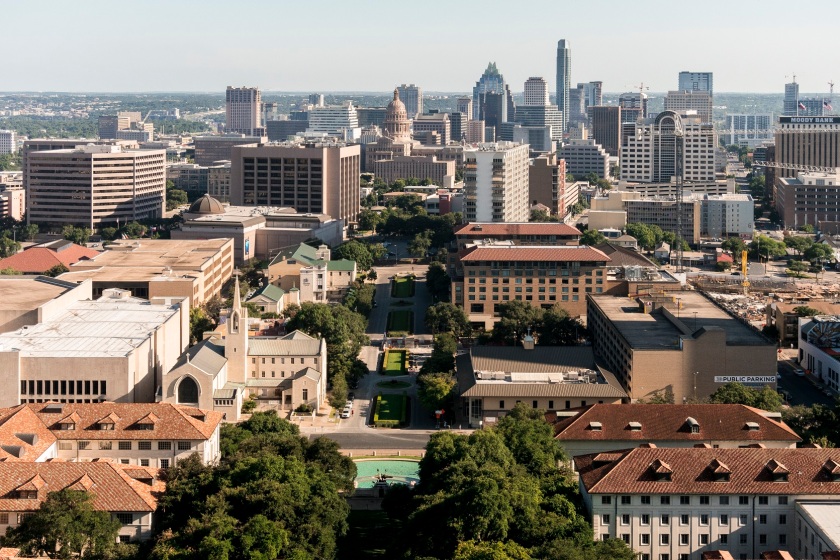
But the trip is worth it, with a wonderful view of Austin!
Meanwhile, Alex Galvan spent time in helicopters…
…and even on tanks…
Beatriz Martinez also got a taste of the helicopter, producing a big grin…
The breeze blew in the trees, and the sun shone down on the flowers that surround SHSU’s beautiful campus. Amidst this scenery, most students made their way home from class, hearing the last chimes of the clock tower echoing around the brick buildings on campus. But for the LEAP Ambassadors, the 5 o’clock chimes were a call to gallop to our volunteer duties at the Walker Education Center for the western-themed Republican Roundup.
We all were assigned our stations and were ready for the rowdy crowd to come. Some of us were in charge of check-in tables…
…front and back, check-in tables…
….while other were in charge of serving an all American cuisine composed of hot dogs, potato salad, sweet tea, Blue Bell ice cream, and apple pie!
As the crowds drew into the decorated ballroom and found their seats amongst the sunflower center pieces that brightened up each table, Mrs. McKenzie, Chair of the Walker County Republican Party, welcomed people to the event.
After the applause died down from the crowd, the time most of us were most looking forward to had come – time to meet November’s candidates! Each candidate whose name will be on the upcoming November-election ballot was introduced and those with contested positions made their concise speeches while asking for everyone’s support. Once each candidate finished speaking, the crowd applauded them for their courage to run for office and make a difference in their communities.
This slideshow requires JavaScript.
Even though the event was quickly wrapping up, many stayed to mingle (while enjoying dessert)…
….with candidates and those who already hold a position in office.
As the night ended with many shaken hands, the crowd made their way towards the doors ready to make an informed decision on the upcoming elections.
Huntsville is home to many hidden architectural treasures that make this town a special place. On the last heART of Huntsville, we decided to pay a visit to three of these many gems. We started off the night at one of the local homes built by Dan Phillips: The Boot Home.
The Boot Home has been the subject of much conversation, due to its location on busy 11th street (aka, HWY 30) and its obvious resemblance to the Texas boot.
To introduce Mr. Phillips told us about his construction company, Phoenix Commotion. As founder of the company, Mr. Phillips focuses on eliminating construct waste and building environmentally-friendly homes for low-income individuals. Apart from doing his best to help those in need, he also explores his own artistic abilities.
He told us how there are two kinds of people, those of Apollonian and Dionysian thought. Whereas the Apollonians want everything to be perfect where perfection may not be possible, the Dionysians don’t care for perfection and are more organic. Mr. Phillips told us how he sees the world in this non-perfectionist view, where you can make things in different shapes, sizes, and forms using unconventional methods to create a one-of-a-kind Dionysian home. Every one of his homes has his own signature quirk; a tree house with a glass floor, a home made out of bones, a story-book home, a beer home, the list goes on with unimaginable creativity.
After we heard about the inspiration behind the homes, we were ready to go inside this wonderful piece of art. The Boot was not big enough for our whole group to go into at once; therefore, we had to take turns. Inside the Boot there are two bedrooms, a kitchen, a bathroom, a study (or small bedroom), and a living room (just enough for a small family). As you travel up the stairs (located within the boot)…
…you are brought to a beautiful deck overlooking the neighborhood. It is a very creative use of the extra space. Everyone enjoyed taking photos of the Boot,
…and, of course, conversing with its creator, Dan Phillips, , as we began to venture onto our next stop: The Kellogg-Pritchett Home.
Mary Laura Gibbs bought the home in 2006 and renovated it while maintaining its original Folk Victorian architecture. The home has beautiful architecture on the inside and outside, reminiscent of Huntsville’s early days. One of these features were the rolling doors between the two main parlors whose great, wooden grain was used to divide the rooms during special events. She also set out a painting that dated back to the 50’s, which showed us how the home and property originally looked like in the early 19th century.
As we walked through the home, Ms. Gibbs told us how the kitchen was originally detached from the home, how there was a farm area for the family, and how the home housed the first tennis court in the city of Huntsville. We then moved on to the beautiful dinning room, made even greater with a mural painted by Lee Jamison.
It was painted to look like a gazebo and it included lots of little creatures that are home to Texas and even a few that were created by the artist. He had us try to find the U.S.A snake and Texas painted butterfly.
It was a beautiful room with lots of detail. Everyone was in awe of his work and the beauty he was able to create. We then moved on to the kitchen that was painted red and yellow (popular kitchen colors in Europe). She also showed us her beloved water pump. Everyone was impressed by how it is still fully functioning today!
With the night coming to an end, we concluded our tour of the lovely Kellogg-Pritchett Home by sharing our appreciation and love for the home.
And, while most of us moved on eagerly to the Wynne Home, the Peases enjoyed a peaceful moment on the porch swing…
We then moved on to our last location of the night (and heART of Huntsville) the always beautiful Wynne Home.
At the Wynne Home, we were welcomed with the smell of wonderful food and great company provided by the Friends of the Wynne. We were welcomed to tour the home as Ms. Gaertner and Ms. Maloney finished preparing our Thanksgiving-like feast. Former interns, Beatriz Martinez and Jessica Northam, along with current intern Karen Tinajero, helped give tours to the group and tell the rich history of the home. The guests were delighted to hear of the home’s 1883 inception, the family history, and how it was donated to the city and is now Huntsville’s own Cultural Center. After roaming around the Wynne Home, everyone settled down to enjoy their delicious meal and take their final quiz, which would demonstrate what they had learned the past four weeks.
After the food, those interested purchased a Jamison Austin College print autographed by the artist.
As the ambassadors stayed to help finish cleaning up after the meal…
…the rest of our guests expressed how impressed they had been with the program and promised to come back next year for more art-filled adventures! We are immensity grateful to the Friends of Wynne’s exceptional dinner and to our amazing program participants who made the experience so amazing.
With the 85th Legislative Session on the horizon, the LEAP Center invited a trio of accomplished State Legislative staffers to participate in a discussion panel/ Q&A Session addressing careers in government. Gathered to see the panel were 25 SHSU students, with interests ranging from law school, to the legislature, to an Austin Internship en route to a career in government. Whatever their end goal, however, all the students gained a better understanding of how to make it in the professional world following college.
On hand were Sarah Tillman (District Director for Rep. Will Metcalf)…
Zachary Stephenson (Chief of Staff for Rep. Will Metcalf)…
and Eiman Siddiqui (Chief of Staff for Rep. Tom Oliverson).
Interestingly, both Representatives Metcalf and Oliverson are SHSU Alums.
Tillman offered students wisdom on maintaining appropriate social media sites. Even though her advice was targeted to prospective Austi interns, it was applicable to the entire professional world. Zach Stephenson also emphasized professionalism, discussing the pitfalls that can plague young people who get caught up in the Austin bar scene. Whether outside of work or on social media, interns represent the office for which they work, and an unprofessional facebook post or an arrest harms not only the student, but also the office.
The panelists also discussed the skill set desired by legislative offices. While the offices desire intelligence, the most important qualities are the ability to deal effectively with people, a positive and professional attitude, flexibility, and writing skills, the latter being especially stressed by Eiman Siddiqui.
During the session, hours are long and the pay is small, so many of the people with the skill set described above move on when the session is over. But the high turnover rate is also an opportunity for young people to move up in the legislative environment, making a career in the legislature a real possibility. Indeed, all of the panelists were in their 20s or early 30s.
The panelists’ youth and their wisdom allowed them to relate to us, and we plan to lean heavily on them if we are fortunate enough to spend next semester in Austin!
When the first leaves start to fall in the pine country we all know what time it is. No, not football season, but the annual HEARTS Museum garage sale. The HEARTS Veterans Museum of Texas is a museum that honors those who have fought for our freedom in many different wars. Apart from serving as an engaging Veterans museum (not a military museum) it is a unique addition to our community. With proceeds that often exceed $10,000, the Garage Sale contributes directly to preservation of the Museum’s collection.
The Museum is also one of the LEAP Ambassadors foremost philanthropic causes, with the Ambassadors volunteering at key events throughout the year. This weekend was no different, with the ambassadors participating as cashiers…
…hot dog sales(wo)men, and even box builders.
As with any HEARTS Museum event, in this writer’s opinion, “the best thing about volunteering are the stories the veterans share.”
Some of the items that were sold at the garage sale included clothes, hats, books, tea sets, and other marvelous curiosities. With the non-stop rush of Huntsvillians in the shopping spirit, the Ambassadors were plenty busy, at times carrying cart-full of antiques through the Storm Shelter doors. Although the garage sale is labor-intensive work, we had a lot of fun.
And, after our shifts were over, we were able to shop around and stock up on nifty knickknacks.
In all, the active volunteering and shopping made it a great way to spend a weekend!
The LEAP Ambassadors would like to thank Letty Clark, for her great work at the HEARTS Museum and for being such a pleasure to work with and for!
To kick off to the semester the LEAP Center opened up its doors to incoming freshman, transfer and current students to come by and see what LEAP is all about. With about roughly 70 students throughout the night, we enjoyed delicious ice cream, cookies, sweet tea, and the chance to see school friends again.
In preparation, we set up The Holcombe Room with decorations, a prize wheel…
Brian Aldaco As Pat Sajak
…and, of course, ice cream and other snacks and refreshments.
As might be expected with free food on campus, there was a line awaiting the open of the event. Later, we would have a packed house.
We were happy to note that, in addition to many students…
Alexis Gordon and Alex Galvan
…Dean Zink, Dean Nardone, Dr. Waggener, Dr. Mahoney, Dr. Svenson, Dr. Bittick, Dr. Enia. Dr. Haase, Dr. Wang, Dr. Evans, Kristin Trojacek, Belinda Myers, Deanna Briones, and Jennifer Knapp all attended as well.
Although folks seemed to enjoy the prizes, the t-shirts were definitely the most wished for. But even after the prizes were gone, many of the students hung around, catching up on their summer activities and their plans for the fall.
We hope that some of those plans will involve LEAP Center events, the dates for which were provided at the ice-cream social. For those of you who missed it, here’s a calendar for the next month or so:
September 12, 19, 26, and October 3: heART of Huntsville
September 14 (4:30-6:00): LEAP Open House (LSC Art Gallery)
September 20 (2:30-3:45): Legislative Staff Panel
September 21 (6:00-7:15pm): Pre-Law Society Meeting
September 30 (6:00-8:30): Walter Brennan/John Wayne Film Festival
As we wend our way home from “The Motor City,” we stopped in Indianapolis to see a heap of historic sites, from extensions of our research on The Vagabonds, to the Indy 500, to a presidential home, a capitol, and a fine art museum. Although it was our second-to-last day on the road, it promised to be a full one.
Indianapolis Motor Speedway
We have friends who have been to the races here, and they indicate it’s pretty incredible. The Museum, however, is not incredible. It’s actually quite boring.
The Museum itself consists of approximately three rooms: a large show-case style room, a smaller room beyond the main room, and a room to the left which houses “special exhibits.” The main room has a timeline, which consists of a series of photographs on the walls, and then the winning cars from the past 100 years of races.
Indy-Winning Cars on Display at the Speedway Museum
Although it is of some interest to see the evolution of cars from long ago to today (mostly, the long-ago cars were cooler), there wasn’t a whole lot of context or the interesting tidbits you can learn from even small museums.
After looking around and wondering, “Is this all there is?”, we opted for the “short video” that provided “background.” It was short–about 8 minutes–but it provided almost no background. It was an eight-minute commercial for the special “spirit” of the Indianapolis 500. It provided little or no substantive information about the origin of the race, why Indianapolis became home to racing, or how things have changed over the years. It, too, was a disappointment.
Indiana State Capitol
Undaunted by the Speedway disappointment, we sped out of there and had breakfast at the City Cafe in downtown Indianapolis before heading to the Indiana State Capitol building.
Upon entrance to the Indiana capitol we noticed the nice but fairly typical exterior…
Indianapolis State Capitol Building
…but we were truly struck by the interior.
Indianapolis Capitol Dome
Interestingly, it houses all three branches of government; executive, legislative, and judicial. Thus we were able to see the working Governor’s office…
Governor Mike Pence’s Office
…the House and Senate chambers, and the court room of the Indiana Supreme Court, which doesn’t resemble a lot of the past statehouse tours.
Indiana Supreme Court
The interior of the Indiana Capitol is made of smooth, polished Vermont marble and Indiana limestone. The architecture is evocative of the Italian style. The rotunda at the heart of the building boasts an impressive stained-glass ceiling, and two wings that extend outwards in each direction.
The wings mirror each other, and have large open areas that go four floors upward before terminating in a glass ceiling that lets natural light filter down to the floor. Each open space is surrounded by walkways set into the walls and supported by columns in a colonnade fashion. Of special note was the fact that all three of the classical Greek styles of columns were represented. The first floor showcased doric columns; the second floor was supported by imposing, almost un-ornamented ionic columns; and the third floor was held up by thinner, more artistic corinthian columns. All of the columns were made of grey-white marble, and lacked fluting (vertical lines running up and down the length of the column).
Our tour guide led us through this pleasant architectural feat, showing off various interesting busts of famous Hoosiers.
He also made sure to impress upon us some pertinent facts about Indiana. We learned that the state bird is the cardinal, the state flower is the peony, the state tree is the tulip poplar, and the state song is “On the Banks of the Wabash, Far Away.” Most importantly, he told us that Indiana is one of only four states with an official state pie, which for Indiana is the sugar-cream pie. It was a nice tour, with a very nice tour guide.
And although we missed seeing Governor Pence at the Capitol, we did see people protesting Pence.
Trump/Pence Protestors at Indiana State Capitol
Indiana Soldiers’ and Sailors’ Memorial
But before heading to our next historic home, we decided to go to the Indiana Soldiers’ and Sailors’ memorial.
View of Indiana Solders’ and Sailors’ Memorial from the Capitol
This edifice boasts a pool and fountain beneath a circular, raised dais decorated by various sculptures. Soaring above it all is a tower that rears upwards toward the clouds.
You can actually climb up a set of 330 stairs on the inside of the obelisk, or take an elevator to the top for a small fee. Prof. Yawn elected to pay, while Brian and Paul adventurously took the stairs all the way to the top, compelled to do so after all of the vertigo-filled adventures of the trip. It was a beautiful view from up above, making the climb up worth it.
Brian and Paul from the Memorial’s Observation Deck
Our feat of athleticism was soon rewarded by a short visit to the Chocolate Cafe right across the street from the memorial. While sipping on a very sweet, creamy Chocolate Chai and nibbling on a very rich caramel sea salt chocolate, we people-watched. This was made more interesting by the gathering of people in our midst. There was, for example, a convention of sorts for Mennonites, who sang on a town square…
Circling them, on a pedal-powered bar (“The Pickled Pedaler) was a party of some sort (perhaps a wedding based on the sign on the back, which read, “Congratulations Tom & Ed”).
How you effectively avoid Mennonites and traffic in a town the size of Indianapolis–while drinking alcohol–is beyond us. It’s also not clear how this doesn’t violate some drinking and driving ordinance. Presumably, the steering-wheel operator doesn’t drink, but the people providing the power do.
Amidst all of this, it was also Gen-Con, a convention of strange people dressed as super-heroes and other characters.
It wasn’t quite the bar scene in Star Wars, but it wasn’t far off, and it wasn’t what we were expecting from Indianpolis, “The Crossroads of America.”
Benjamin Harrison Home
Benjamin Harrison, the 23rd President of the United States of America, was a native of Indiana. He raised a regiment during the Civil War, and fought as a general on the Union side. Interestingly, he was preceded in the presidency by Grover Cleveland and was, oddly enough, succeeded by the same man! Other aspects of his presidency were how his federal spending exceeded $1 billion for the first time in American history; he started the process of preserving places of natural beauty; and he strengthened the United States by modernizing the navy, making it the 5th most powerful in the world. This later may have come in handy for the coming First World War.
As a very interesting president, his home was just as special in that 70-80% of the furniture is both authentic (not replicas) and on display.
Benjamin Harrison’s Parlor
You can see his prodigious library, the many of the gifts that he was given in life, including a strange chair given by a Texan…
Benjamin Harrison’s Chair
…made of Longhorn horns, a bobcat hide seat, and the overall look of Texas tacky. We also saw his death bed, which was covered with the same comforter he used…
Benjamin Harrison’s Bed
…which was not Texas-Tacky, but was tacky-cool.
Harrison was a volunteer fireman, and the staircase was fashioned from a fireman’s hose…
…the home’s foyer was adorned with a 38-star flag (reflecting the number of states when Harrison took office)…
…and his desk was the height of 19th-century organization which, in our book, beats 21st century simplicity.
Benjamin Harrison Desk
However, such an artifact was in no way detrimental to the rest of the home’s beauty…
Paul Oliver and Brian Aldaco at the Harrison Home
…almost comparable to our next item on the day’s itinerary.
Indianapolis Museum of Art
After leaving the home, we soon reached the Indianapolis Museum of Art. The art museum, to our pleasant surprise, shared a few similarities with Harrison’s home in that within the halls were exhibited works by Jacob Cox. Cox’s works were also present inside the Hoosier president’s parlor room. He and other Indiana artists were being commemorated in the “19th Stars” special museum exhibit which included renewed artists of talent such as T.C. Steele, Robert Indiana, and George Rickey among others.
George Rickey Art
After appreciating sights of silver mobiles, beautiful landscapes, and painted canvases with the intent to reflect on society’s morals, all from the creativity of Indiana natives, we continued on through the halls of the museum.
Nearing the first exhibit room we noticed that the art had been arranged in chronological order, allowing us to view a sort of art evolution. Beginning with the realist school of American painters such as Charles Wilson Peale…
“George Washington,” by Charles Wilson Peale
…Albert Bierstadt…
“Alaska” by Albert Bierstadt
and John Haberle, we were further schooled in the art of capturing the essence of reality. Such an aspect in art was truly captured in Haberle’s depiction of American currency in U.S.A. (1889). The oil painting was mistaken for real money upon unveiling which caused near tremulous sensation as viewers claimed the artist had glued money on a canvas. We later saw paintings of other American artists which we had seen on previous museums such as those by Georgia O’Keefe and a very expressive Norman Rockwell by the name of The Love Song.
“Love Song,” by Norman Rockwell
Throughout the other rooms we viewed other artists of remarkable ability, one of which was George Seurat who rightfully deserves the description. His pioneered pointillism-style of expression inspired fellow talented impressionists of his time such as Paul Signac, Henry Van de Velde, Camille Pissarro (these being among Brian’s favorites), and Van Gogh.
Van Gogh Landscape
Wandering through the other rooms we were delighted upon nearing a ver peculiar modernist painting by the name of Man and Woman. In a style resembling that of Picasso’s cubism, the shapes of color and shadows form two figures, a man and a woman, embracing each other’s kiss. Even though the depiction in itself was phenomenal, it was the man behind the brush strokes, Fernand Leger, that caught our attention. Between the years of 1948 and 1950 a young Huntsville artist by the name of David Adickes traveled to France to study art under the teachings of Leger. Adickes, as any Hunstvillian may know, was the talented sculptor who erected the Sam Houston statute which towers at the town’s edge. Satisfied that we were able to identify with one of the celebrated artists, we toured some more of the halls to later exit onto the grounds. With a scenic gushing fountain, the grounds were decorated by sculptures by Roy Lichtenstein…
Brian and Roy Lichtenstein
…and Robert Indiana’s famous LOVE sculpture, which we have seen at three or more art museums throughout the US.
Robert Indiana and Roy Lichtenstein’s Artwork on the Lawn of Indianapolis Museum of Art
Robert Indiana, interestingly, was born Robert Clark. But he changed his name to honor his home state. Interestingly, one of his pieces, a 12-foot LOVE sculpture (which are obviously not unique) recently sold for 4.1 million dollars.
After enjoying the green fields of artistic delight, we regrouped in our mini-van and buckled up for our stretch towards the end of our trip. As we only have one more day left in our Mid-Western tour, we arrived in our hotel late at night eager to get some rest and prepare for an exciting last day of our odyssey, in Little Rock, Arkansas.
After four days of researching the Vagabonds with Jeff Guinn and Jim Fuquay at the Henry Ford Museum, other attractions were bound to be something of a let down. But the Toledo Museum of Art offered a surprisingly nice collection and a truly inspired special exhibit by Jaume Plensa.
With a Greek entrance of white marble pillars, artistically grand in its own right, the art within was just as impressive. However, before viewing the fine arts we examined the art of the political campaign thanks to the museum’s special exhibit I Approve this Message: Decoding Political Ads.
Paul Oliver Examines Political Ads at the Toledo Museum of Art
As political science majors, Brian and Paul ventured through the floor to examine such ads as Reagan’s “The Bear” ad . This ad showcased a prowling bear through the forest and a man who forces the beast to retreat by standing up to it. Thanks to the exhibit’s captions we discovered that the bear was a symbol for Russia, thus the ad implied that Ronald Reagan’s strong will would be able to defeat the Russian menace of the time. So being we went over our president’s ads and those who had gone against them during the age of Television.
Brian Aldaco Runs for Office with Unfortunate Results
Leaving the floor we walked to the east wing to view the contemporary art. There we saw works by various renowned artists such as Pablo Picasso…
Picasso, in his Blue Period
…Chuck Close…
Chuck Close Artwork
…Childe Hassam…
…Claude Monet…
…as well as Alexander Calder, Henry Moore, and Louise Nevelson.
There was a sense of satisfaction in being able to recognize these and other artists from within the collection.
To appreciate the sculpture garden, we stepped outside to view a George Rickey silver mobile…
…Tony Smith’s Moses…
and other sculptures…
…most notably those of Jaume Plensa (who had a whole floor dedicated to his work inside the museum.)
But before examining the indoors art, we sat on a very peculiar Polar Bear Bench by artist Judy McKie.
Not only did this sculpture offer an appropriate resting spot, it also allowed us to find a glass walled building from which the interior glistened with hues of clear, colorful glass. Upon further inspection, with a silver Chihuly hanging from the ceiling…
…we entered the museum’s annexed Glass Pavilion. Inside we found a wide assortment of glass sculptures from the quirky glass moquettes of modern venues by Emily Brock to Roman glass decor dating back to the 4th century (all in the pristine condition from when it was first blown!) It was clear that the glass blowing techniques of the time were advanced, a technique that we witnessed inside the pavilion.
Apart from the beautiful art within the exhibit hall, there is also a glass blowing workshop.
Inside the room stand ovens heating up to a temperature of about 2150 degrees fahrenheit, undoubtedly no ordinary oven. However, these high temperatures are essential for molding the crystalline medium. So much is the nicety to keep the glass at near melting condition that if its temperate cools off before the intended time, the modeling tools can break the glass and ruin the whole sculpture. As the team of sculptures, on who molded the glowing vase and another who blew at it to expand it from the rod’s other end, continued their process of inserting the glass in the oven followed by a spinning of the material to give it its shape, we left the workshop to view the rest of the museum on its main campus.
Upon entrance to the museum we turned to the opposite wing of which we had already toured. With pieces from Van Gogh, Claude Monet, Paul Signac…
…and Piet Mondrian.
…we wandered through the canvasses of bright colors, swift burst strokes, and dream-like landscapes onto a grand hall of a more a classic collection. Under the twinkling chandelier the prominence of the works exhibited were accentuated to create an effect of awe. With works by Ralph Albert Blakelock, El Greco, and we moved through the hall into a vast room with elongated heads of women.
Even though the sight may sound a bit macabre, the warmly lit room featured the works of Jaume Plensa and created a near meditative trance.
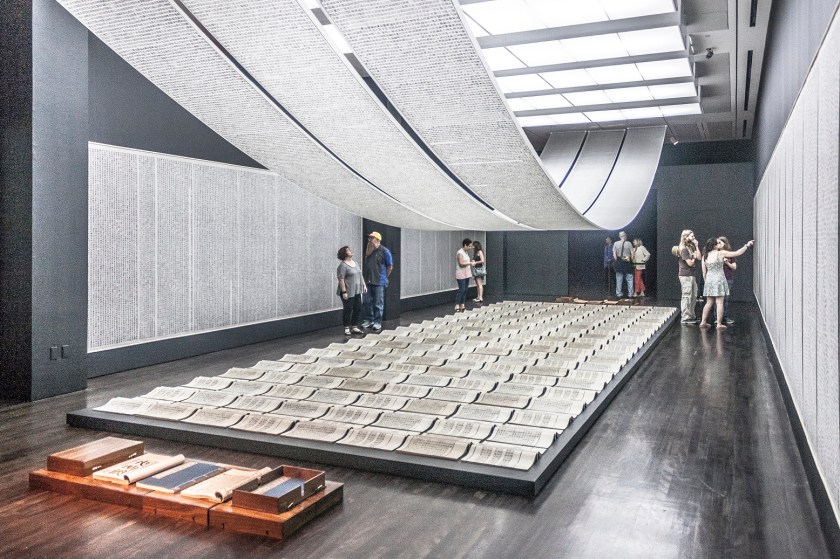
Perhaps the most appealing may have been Silent Rain. With fragments from poems attached to wires hanging from the ceiling, creating an effect of raining phrases, we were astounded.
We felt a similar pleasure and wonder from Plensa’s See no Evil, Hear No Evil, Speak No Evil…
…but whether it was a sculpture or painting from Plensa the same was true.
His works are successful in priming the viewer into a meditative reflection on the human spirit and expression.
So much were we drawn to each piece that soon the doors around us were being locked, lights were being shut off, and halls were flooded with darkness. The museum was closing, therefore we left the campus to complete our evening’s drive to our resting spot. After driving through the night scene of Rutherford B. Hayes’ home in Fremont, Ohio, we reached our hotel in Milan, Ohio. So being, we finished another exciting, educational day of our return-to-home part of the trip, with high spirits and persistent a strong will to continue our LEAP adventures.