When the first leaves start to fall in the pine country we all know what time it is. No, not football season, but the annual HEARTS Museum garage sale. The HEARTS Veterans Museum of Texas is a museum that honors those who have fought for our freedom in many different wars. Apart from serving as an engaging Veterans museum (not a military museum) it is a unique addition to our community. With proceeds that often exceed $10,000, the Garage Sale contributes directly to preservation of the Museum’s collection.
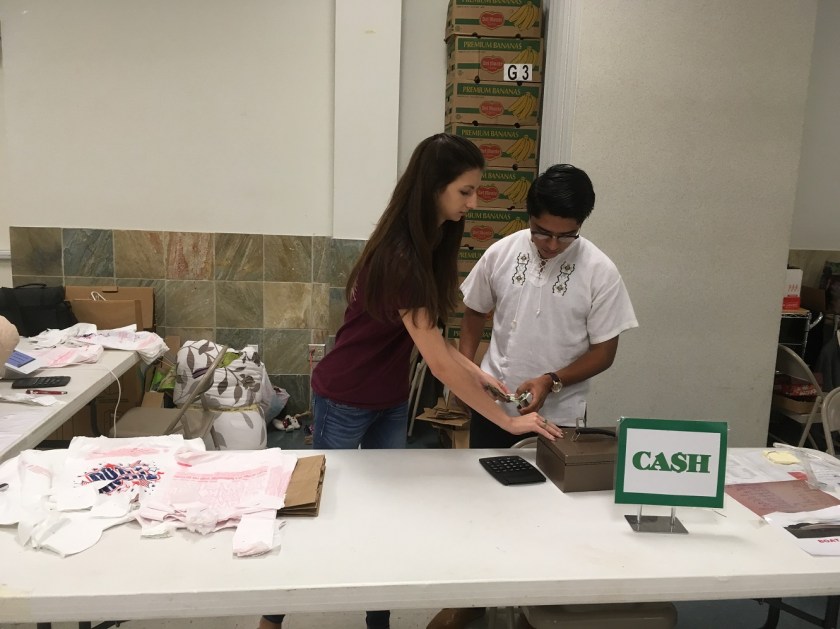
The Museum is also one of the LEAP Ambassadors foremost philanthropic causes, with the Ambassadors volunteering at key events throughout the year. This weekend was no different, with the ambassadors participating as cashiers…
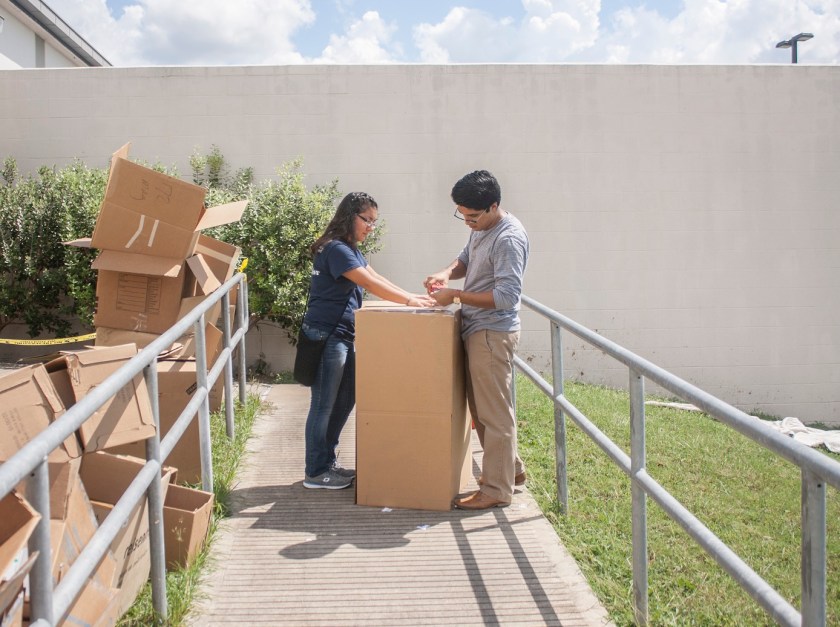
…hot dog sales(wo)men, and even box builders.
As with any HEARTS Museum event, in this writer’s opinion, “the best thing about volunteering are the stories the veterans share.”
Some of the items that were sold at the garage sale included clothes, hats, books, tea sets, and other marvelous curiosities. With the non-stop rush of Huntsvillians in the shopping spirit, the Ambassadors were plenty busy, at times carrying cart-full of antiques through the Storm Shelter doors. Although the garage sale is labor-intensive work, we had a lot of fun.
And, after our shifts were over, we were able to shop around and stock up on nifty knickknacks.
In all, the active volunteering and shopping made it a great way to spend a weekend!
The LEAP Ambassadors would like to thank Letty Clark, for her great work at the HEARTS Museum and for being such a pleasure to work with and for!
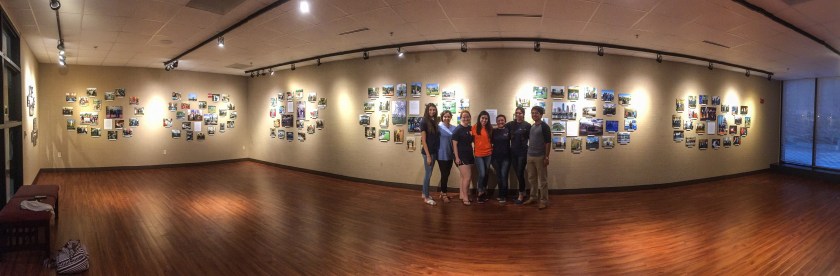
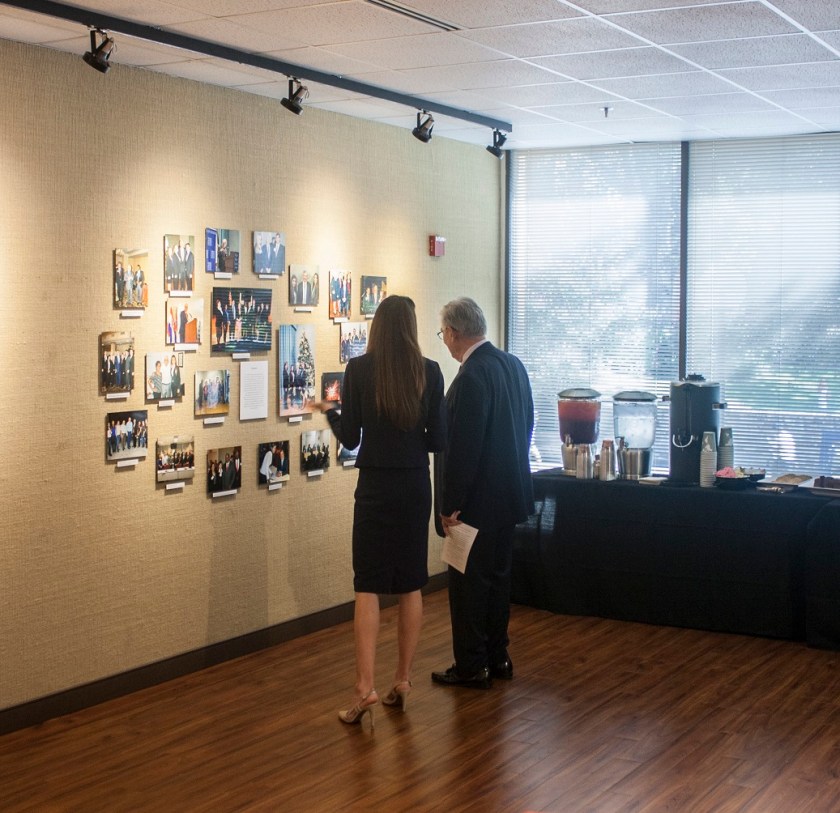
In an effort to educate the campus and community about what the LEAP Center is, the LEAP Ambassadors compiled pictures of events to showcase the organization in the LSC Art Gallery.
The exhibit, which was open from September 2-September 16, showcased some 160 photographs (culled down from more than 90,000) across six categories: speakers, travel, fine arts, volunteerism, experiential learning, and programs.
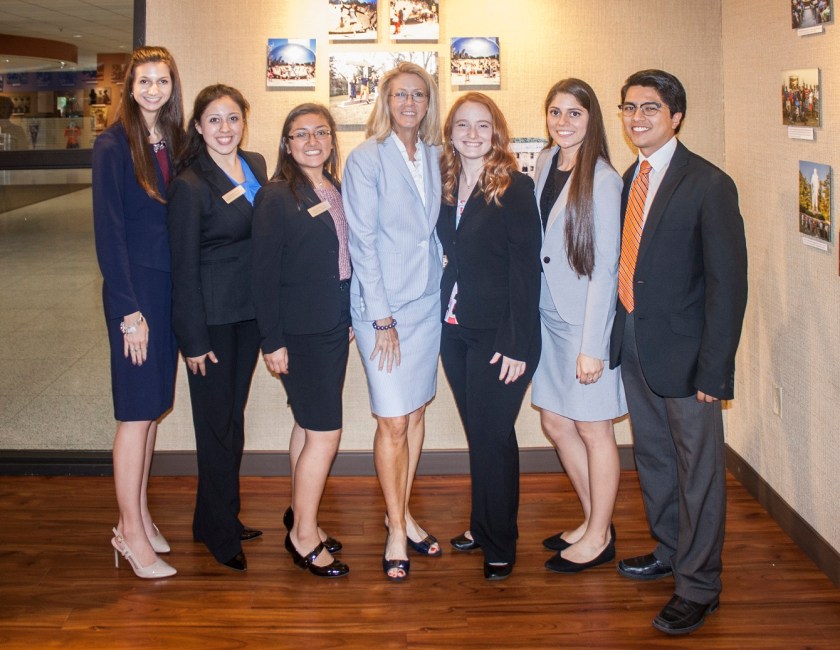
LEAP Ambassadors Following Installation of Art Exhibit
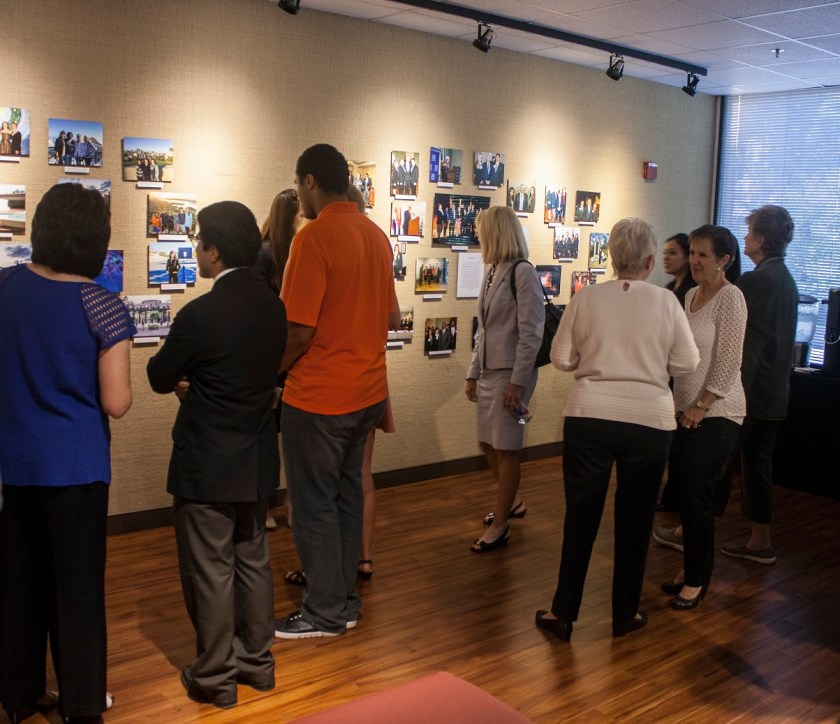
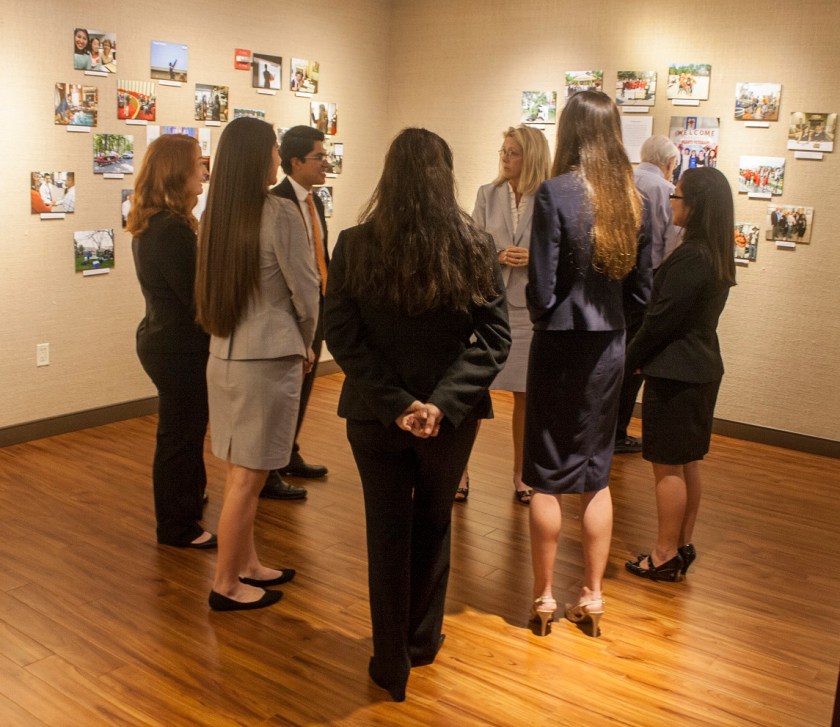
This past September 14th the LEAP Center hosted an opening reception for the art exhibit. Many students, University staff, and community members came out to support the LEAP Ambassadors and learn more about what the LEAP Center does.
Each category emphasized our favorite and most notable events. For example, LEAP Ambassadors have traveled twice to see Stephen Hawking present a lecture, and we have also seen public figures such as Alan Alda, Bill Schneider, Douglas Brinkley, Governor Abbott, and Vicente Fox. All of these photos appeared under “Speakers” and, of course, additional photos were featured in the other categories.
The LEAP Center is thankful for the opportunity to showcase the organization. Numerous students attended, some of whom might make for good LEAP Ambassadors themselves someday!
We were also grateful for the support from University officials such as Provost Eglsaer…
…President Hoyt…
…Mac Woodward, Charlie Vienne, Gene Roberts, and many others. We also had a chance to see some of our favorite community people, including Linda Pease, Terry Stivers, Carol Hays, and others.
Excited murmurs could be heard from Art Building F as people were flooding in for the LEAP Centers’ 2nd annual heART of Huntsville program. Art enthusiasts from SHSU and the community are annually invited to this four-week program where they can explore various art media created by local artists around the SHSU campus and the picturesque town of Huntsville.
We started out in one of the many classrooms of the Art Department. The LEAP ambassadors were elated to see many of our community friends such as former mayor Mac Woodward and Wynne Home Director, Linda Pease; as well as friends on campus such as English Professor, Dr. Ralph Pease and Political Science Professors, Dr. Tom Haase and Wen-Jiun Wang.
After everyone had finished their survey of local art and artists (not without a few grumbles), Dr. Micheal Henderson, chair of the art department, welcomed us to the the Gaddis-Geeslin Gallery.
Inside the gallery, Dr. Henderson presented us the “Selections” exhibit by revealing the type of art that could be found within. The art gallery consisted of creations from alumni dating as far back as the late 1930’s up until the Spring semester of 2016. There were many pieces from former SHSU professor Ken Zonker. The artist had a special resonance for Leap ambassador Beatriz Martinez, a previous Wynne Home Intern who had organized a Zonker exhibit.
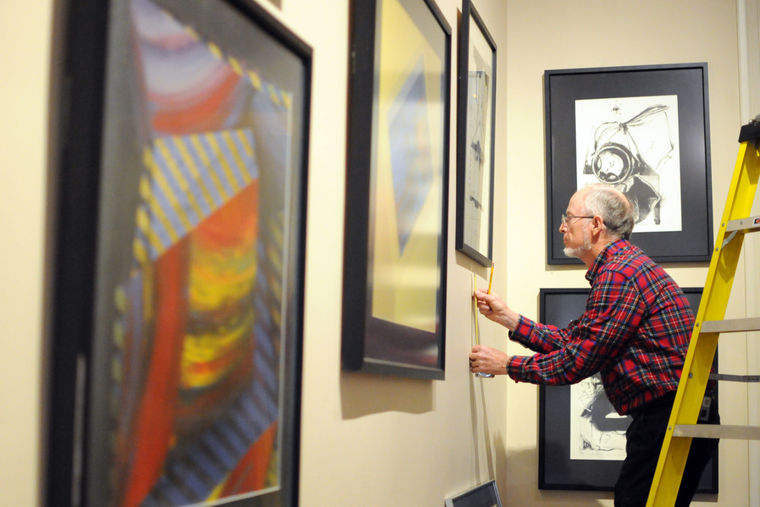
Dr. Wes Sanders Hangs Art by Ken Zonker at the Wynne Home
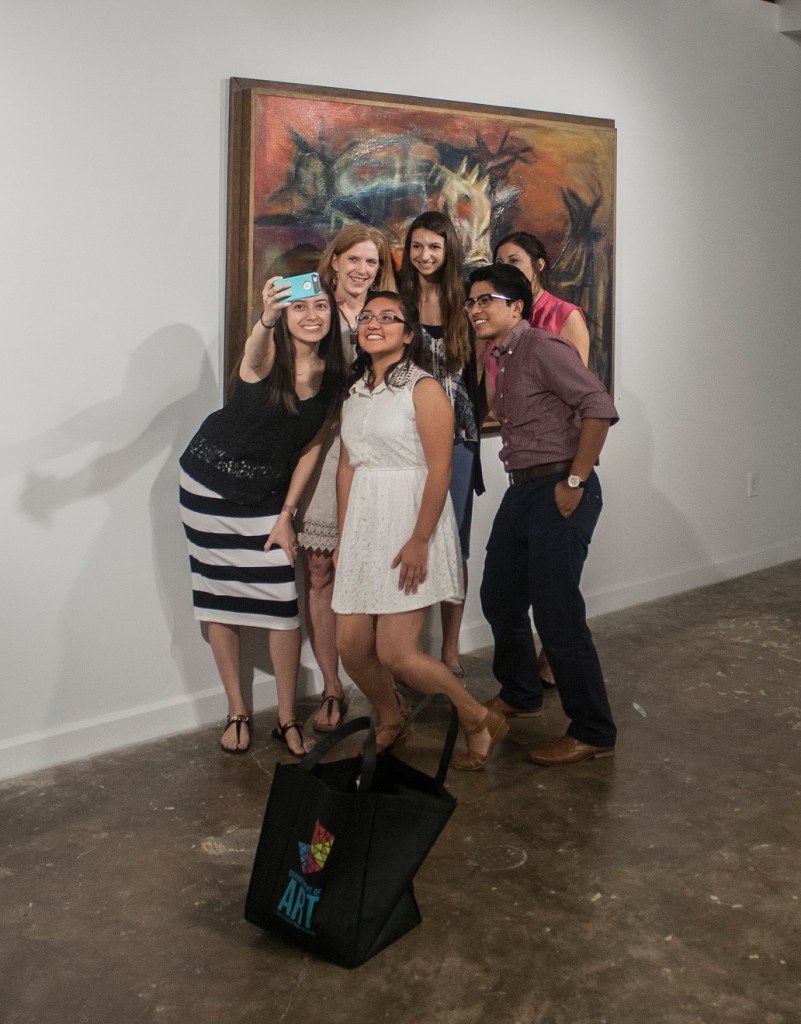
There were also pieces by Zonker’s apprentice, J Miller, who had actually painted a portrait of Mr. Zonker. Exhibited was also a painting by the renowned sculptor James Surls (whose art would appear later in the tour). Titled Cockfight, Surls produced the work in the late 1960s while he was still a student at SHSU. At this, few of the attendants revealed how the had been friends of Surls at a younger age, and we spoke with Dr. Keri Rogers, who several years ago helped hang this piece in the LSC.
LEAP Ambassadors and Keri Rogers With James Surls’ “Cockfight”
After seeing more SHSU faculty and alumni art…
…we decide to head on over to the second stop: the College of Humanities and Social Sciences (CHSS).
As we got closer to the CHSS building, we stopped outside to gaze at the Water Wall by Jesus Moroles. This 9-ft wall was erected to harmonize the elements of earth, stone, and water. The attendees where then amused by how Jesus Moroles (as a lover of multimedia art), had planned to unveil the sculpture by having SHSU dance majors dance atop the CHSS building’s roof.
Fortunately for us (and the dancers), their platform became the top of the Water Wall. The Water Wall’s intended function was to offer a venue for outside lectures. Currently it is most often used as a great study spot for students, and is occasionally seen hosting CHSS socials. Once inside, we saw a piece by Bruce Marion, Confluence, lining the walls. Seeing as how the Humanities and Social Sciences college deals with human interactions and circle of connections, Marion transitioned colors and interwove circles to showcase these two ideals.
The group later traversed through the summer heat to the Lowman Student Center Art Gallery, which was probably the LEAP Ambassadors’ favorite gallery, as they had spent many hours, nails, and mounting squares in order to set up their very own LEAP exhibit. Showcasing the various features of the LEAP center, such as special speakers, fine arts, volunteerism, experiential learning, programs, and travel, it gave heART of Huntsville participants an opportunity to gain a further insight of the different fields in which LEAP Ambassadors engage.
From there, we went to the Nancy Gaertner Performing Arts Center where Craig Brossman, the facilities manager of the building,was waiting to give us a tour.
We toured the Concert Hall, which impressed the heArt of Huntsville participants as it has been named one of 25 best art venues in the nation. Equally impressive was the dance theater with a sprung floor which is tailored to fit a dancer’s needs. There are only 2 or 3 like it in the state, and about a dozen in the nation. We proceeded to view Kathleen Ash’s Elements, Stanley Lea’s Four Seasons, and a serpentine marble sculpture by Jesus Moroles. The most prominent installation was the 16 ft, wood and steel, Around the Flower Wall by James Surls. We also got to see some art from Charles Pebworth, whose first and biggest sculpture lies in the Woodlands at about 40ft tall. As we were exiting, we saw Jason Lawrence’s Firedance, our last beacon of crystalline light as we retired for the night.
Or at least until we got to Austin Hall. This historic building awaited us with food to be deliciously devoured upon as we interacted with the other participants and shared our anticipation for next Monday’s adventure, which will start at the grand Sam Houston Statue on Monday, September 19.
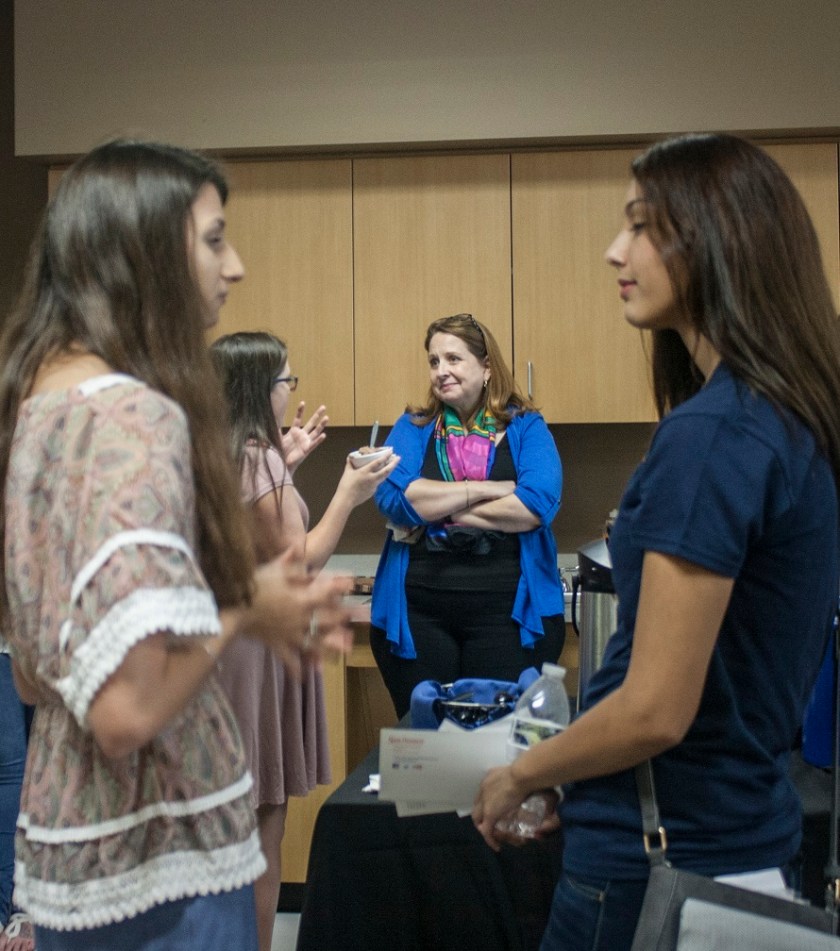
To kick off to the semester the LEAP Center opened up its doors to incoming freshman, transfer and current students to come by and see what LEAP is all about. With about roughly 70 students throughout the night, we enjoyed delicious ice cream, cookies, sweet tea, and the chance to see school friends again.
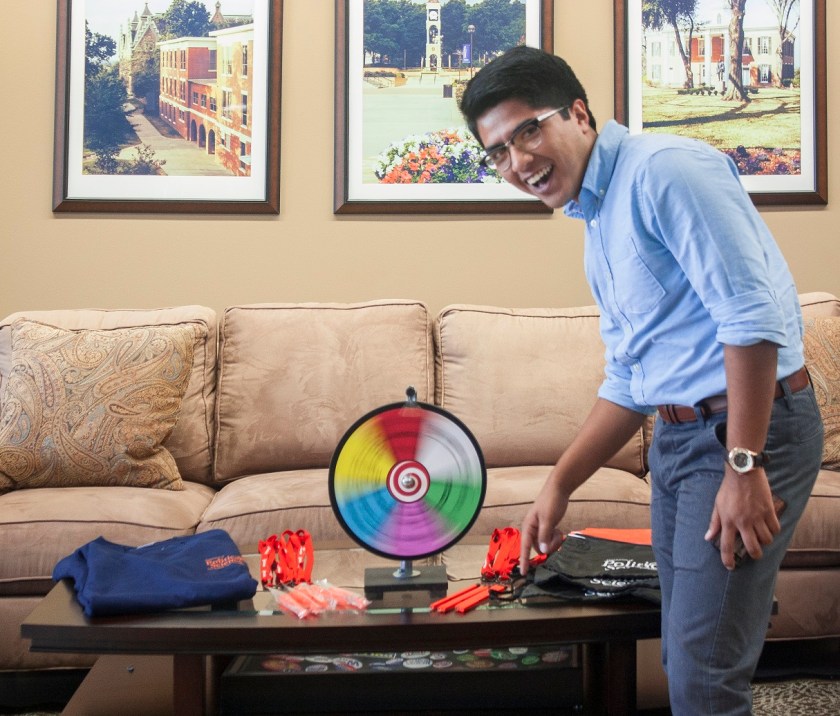
In preparation, we set up The Holcombe Room with decorations, a prize wheel…
Brian Aldaco As Pat Sajak
…and, of course, ice cream and other snacks and refreshments.
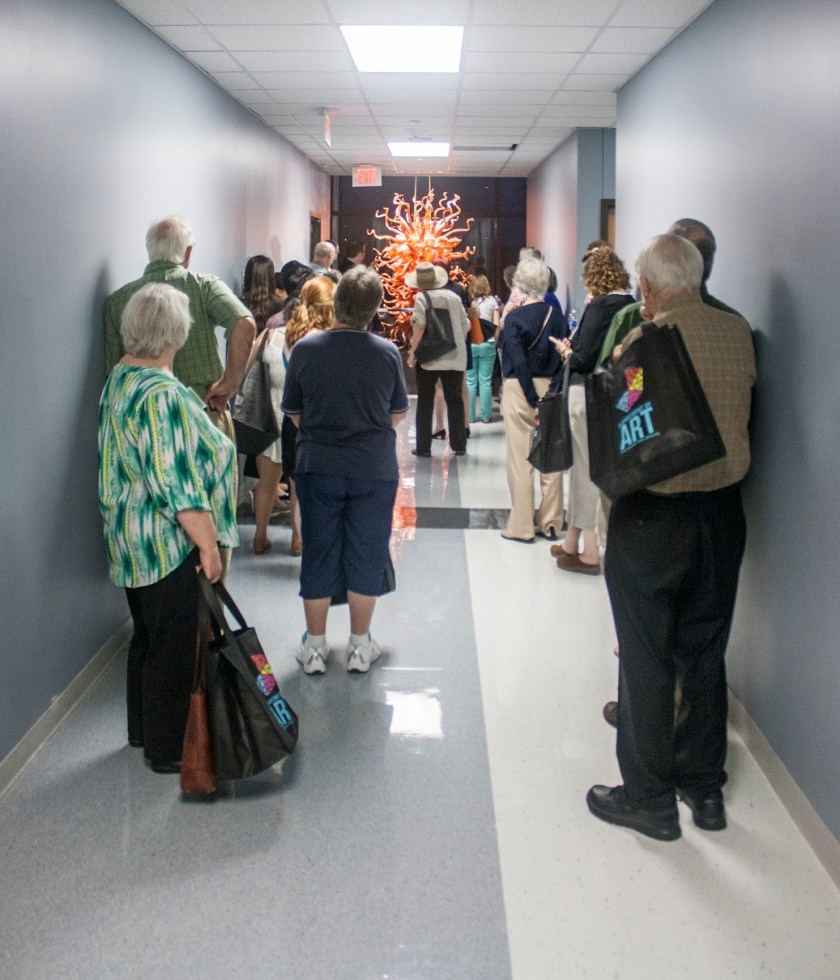
As might be expected with free food on campus, there was a line awaiting the open of the event. Later, we would have a packed house.
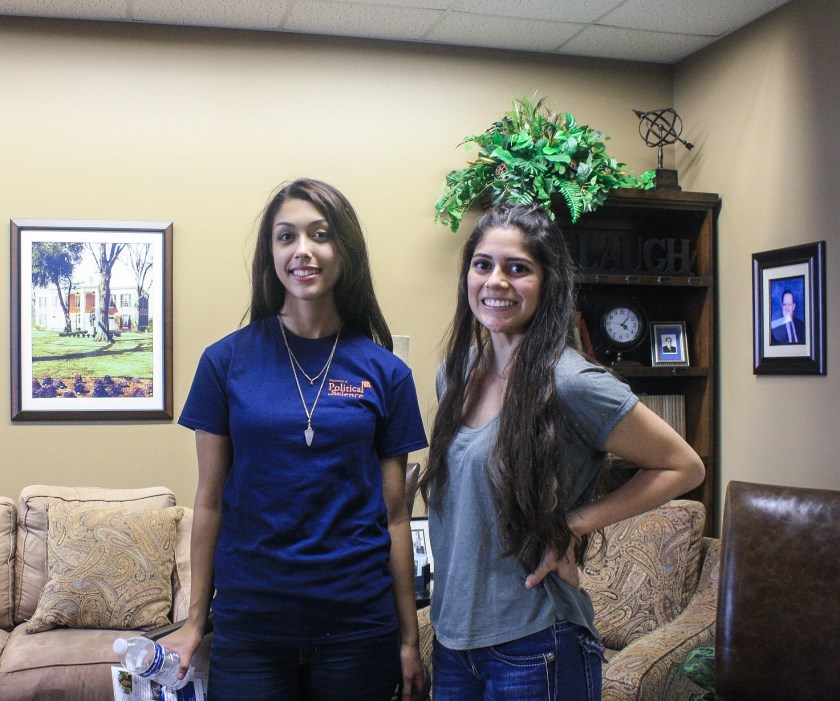
We were happy to note that, in addition to many students…
Alexis Gordon and Alex Galvan
…Dean Zink, Dean Nardone, Dr. Waggener, Dr. Mahoney, Dr. Svenson, Dr. Bittick, Dr. Enia. Dr. Haase, Dr. Wang, Dr. Evans, Kristin Trojacek, Belinda Myers, Deanna Briones, and Jennifer Knapp all attended as well.
Although folks seemed to enjoy the prizes, the t-shirts were definitely the most wished for. But even after the prizes were gone, many of the students hung around, catching up on their summer activities and their plans for the fall.
We hope that some of those plans will involve LEAP Center events, the dates for which were provided at the ice-cream social. For those of you who missed it, here’s a calendar for the next month or so:
September 12, 19, 26, and October 3: heART of Huntsville
September 14 (4:30-6:00): LEAP Open House (LSC Art Gallery)
September 20 (2:30-3:45): Legislative Staff Panel
September 21 (6:00-7:15pm): Pre-Law Society Meeting
September 30 (6:00-8:30): Walter Brennan/John Wayne Film Festival
With the presidential elections around the bend, the LEAP Ambassadors attended the Walker County Republican Women’s non-partisan meeting on the various aspects of voting this Monday, August 29. The evening’s agenda included speakers focused on new voting ID requirements, the history of political parties, and the nearly unfathomable electoral college. The LEAPsters therefore were more than delighted to start off the semester with proper political education.
The first speaker, County Tax Assessor and Elections Officer Diana McRae, headed the conversation on new voter ID laws.
Walker County Tax Assessor Collector Diana McRae
With experience running more than fifty elections, McRae outlined the various kinds of identification that a voter may present at their polling station. From a normal driver’s license (acceptable even if expired for up to four years), to military identifications, those present are at peace knowing that this upcoming November they will be ready to present the proper requirements to vote.
Followed thereafter was SHSU’s own Political Science Professor Yawn. With a presentation focused around the history of political parties Yawn touched on the early years of American politics from the Federalists and the Anti Federalists, the Whigs, the Democratic- Republican party, finally reaching our present day decided political spectrum.
Professor Mike Yawn Speaks About the History of Political Parties
Highlighted were also presidents that shaped those political parties such as George Washington, Abraham Lincoln, John F. Kennedy and many more. As her first time seeing Professor Yawn teach outside the classroom, Christina (one of the newest additions to the LEAP Ambassadors) deemed the presentation “as a very interesting one.” As a political science major however, this was to be expected. As for the rest of the non-student audience, they occasionally responded to Yawn’s presentation with laughter–not out of spite but as a result of the amusing presidential tales from Yawn’s dynamic presentation.
To finish the evening’s meeting Michael Ethridge, Huntsville’s field representative for U.S Congressman Kevin Brady, elucidated the audience on “How the President Really gets Elected.”
Michael Ethridge Discuss Presidential Elections
His main topic was the electoral college and how it affects the way presidents are voted into office. He showed us how one county can change the outcome of the entire state, like Ohio. He also answered questions related to our electoral college, and the process of voting. He showed a time line of the electoral process between November and January of election years. One thing he emphasized on was that voting is important. As college students who share his beliefs, the LEAP Ambassadors all thought it was an important message to share. Likewise the efforts of the Walker County Republican Women reflected this political responsibility of educating the community on voting, political history, and the electoral process.
As we wend our way home from “The Motor City,” we stopped in Indianapolis to see a heap of historic sites, from extensions of our research on The Vagabonds, to the Indy 500, to a presidential home, a capitol, and a fine art museum. Although it was our second-to-last day on the road, it promised to be a full one.
Indianapolis Motor Speedway
We have friends who have been to the races here, and they indicate it’s pretty incredible. The Museum, however, is not incredible. It’s actually quite boring.
The Museum itself consists of approximately three rooms: a large show-case style room, a smaller room beyond the main room, and a room to the left which houses “special exhibits.” The main room has a timeline, which consists of a series of photographs on the walls, and then the winning cars from the past 100 years of races.
Indy-Winning Cars on Display at the Speedway Museum
Although it is of some interest to see the evolution of cars from long ago to today (mostly, the long-ago cars were cooler), there wasn’t a whole lot of context or the interesting tidbits you can learn from even small museums.
After looking around and wondering, “Is this all there is?”, we opted for the “short video” that provided “background.” It was short–about 8 minutes–but it provided almost no background. It was an eight-minute commercial for the special “spirit” of the Indianapolis 500. It provided little or no substantive information about the origin of the race, why Indianapolis became home to racing, or how things have changed over the years. It, too, was a disappointment.
Indiana State Capitol
Undaunted by the Speedway disappointment, we sped out of there and had breakfast at the City Cafe in downtown Indianapolis before heading to the Indiana State Capitol building.
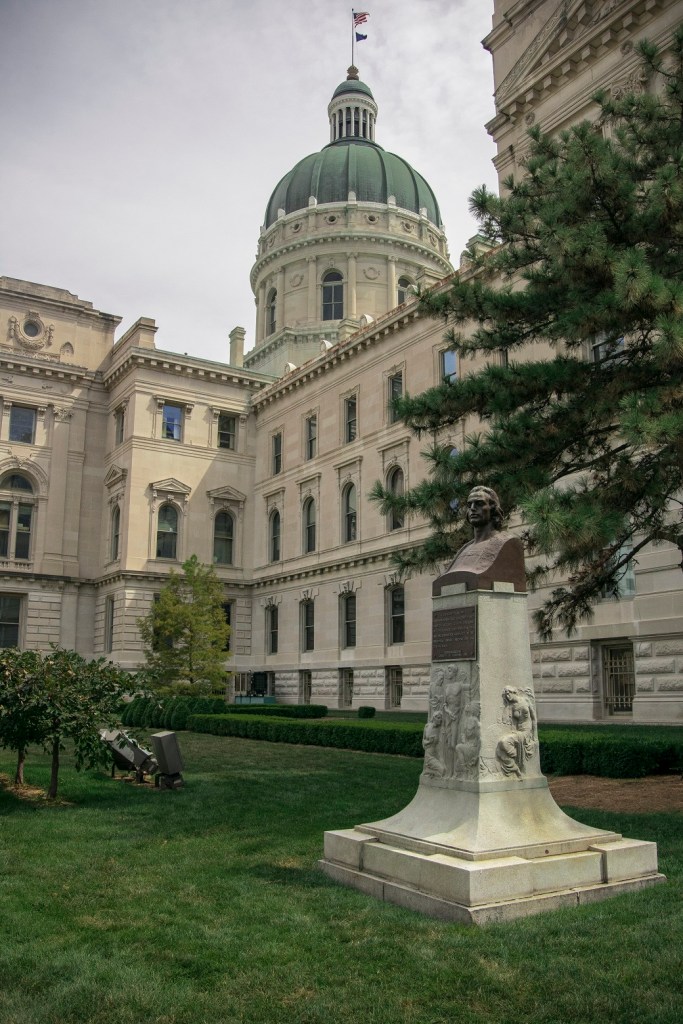
Upon entrance to the Indiana capitol we noticed the nice but fairly typical exterior…
Indianapolis State Capitol Building
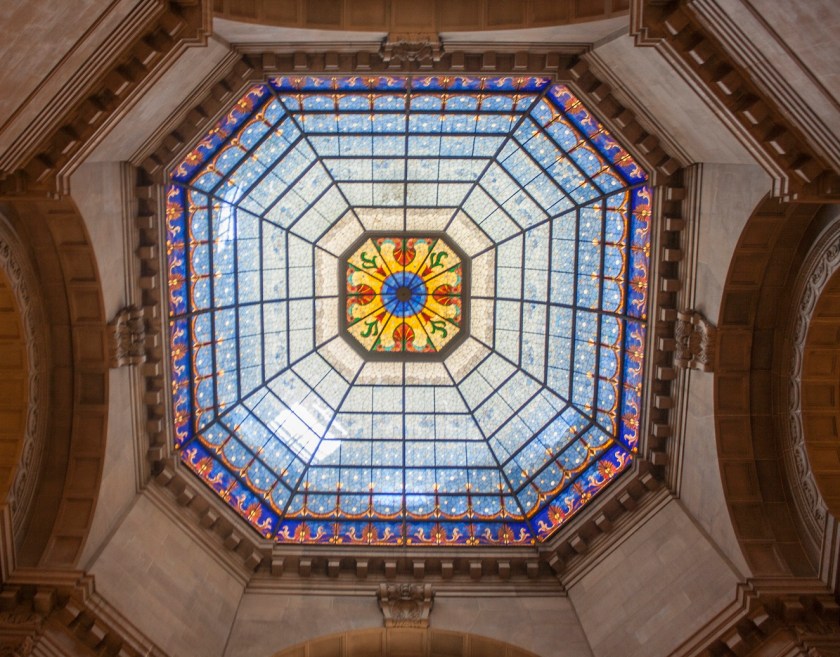
…but we were truly struck by the interior.
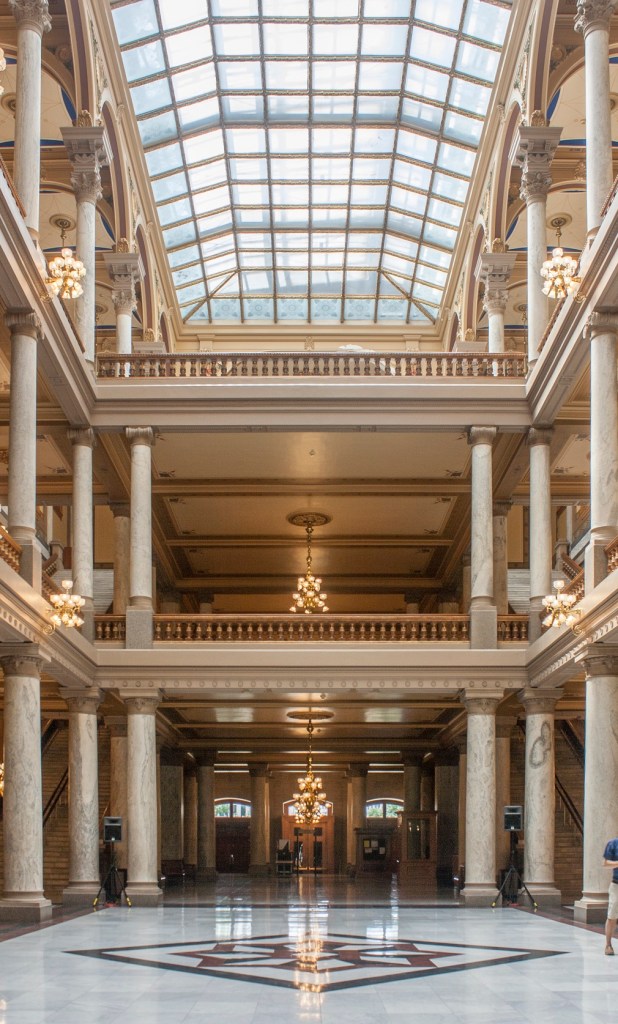
Indianapolis Capitol Dome
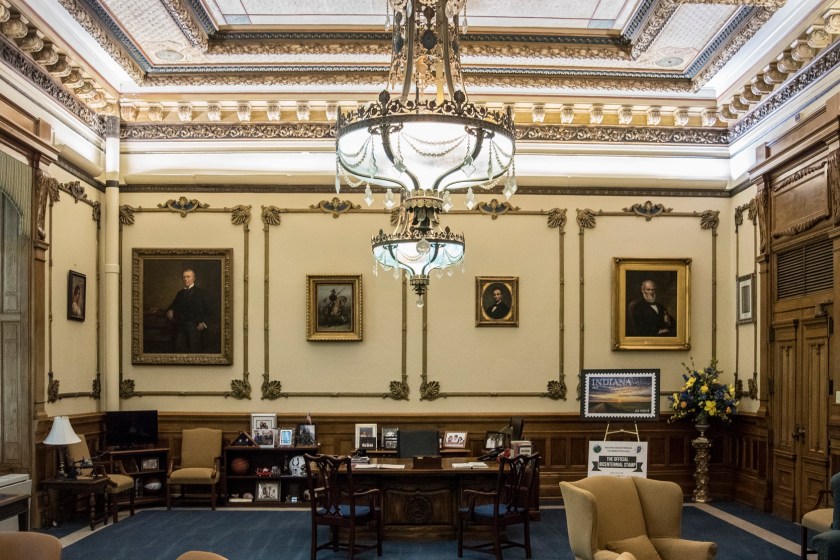
Interestingly, it houses all three branches of government; executive, legislative, and judicial. Thus we were able to see the working Governor’s office…
Governor Mike Pence’s Office
…the House and Senate chambers, and the court room of the Indiana Supreme Court, which doesn’t resemble a lot of the past statehouse tours.
Indiana Supreme Court
The interior of the Indiana Capitol is made of smooth, polished Vermont marble and Indiana limestone. The architecture is evocative of the Italian style. The rotunda at the heart of the building boasts an impressive stained-glass ceiling, and two wings that extend outwards in each direction.
The wings mirror each other, and have large open areas that go four floors upward before terminating in a glass ceiling that lets natural light filter down to the floor. Each open space is surrounded by walkways set into the walls and supported by columns in a colonnade fashion. Of special note was the fact that all three of the classical Greek styles of columns were represented. The first floor showcased doric columns; the second floor was supported by imposing, almost un-ornamented ionic columns; and the third floor was held up by thinner, more artistic corinthian columns. All of the columns were made of grey-white marble, and lacked fluting (vertical lines running up and down the length of the column).
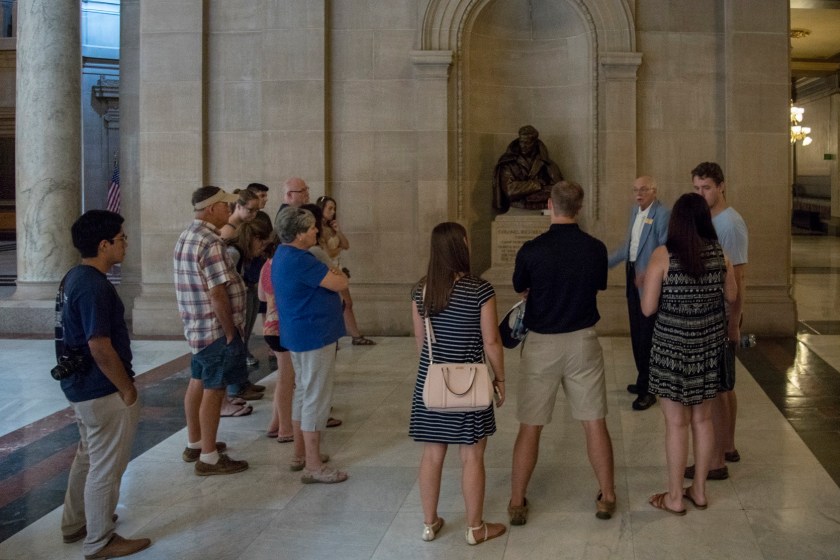
Our tour guide led us through this pleasant architectural feat, showing off various interesting busts of famous Hoosiers.
He also made sure to impress upon us some pertinent facts about Indiana. We learned that the state bird is the cardinal, the state flower is the peony, the state tree is the tulip poplar, and the state song is “On the Banks of the Wabash, Far Away.” Most importantly, he told us that Indiana is one of only four states with an official state pie, which for Indiana is the sugar-cream pie. It was a nice tour, with a very nice tour guide.
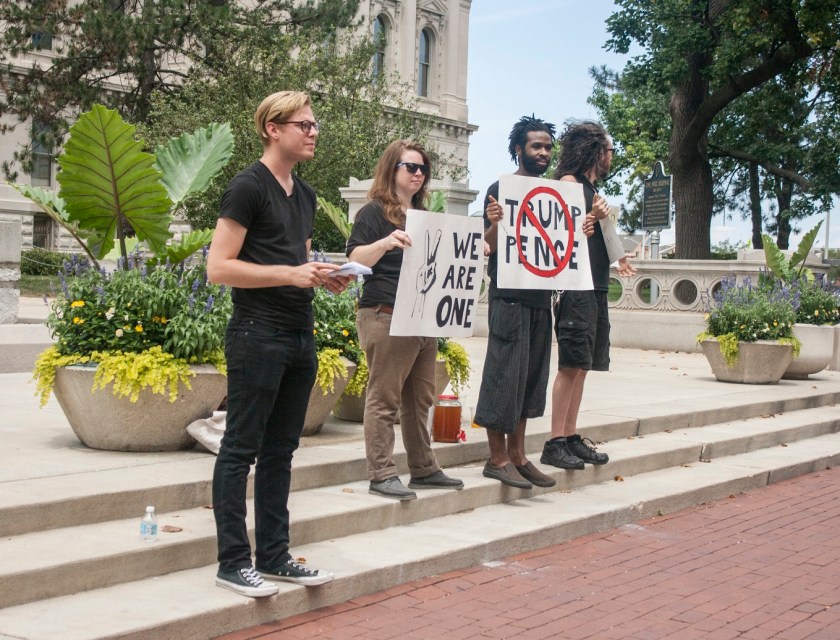
And although we missed seeing Governor Pence at the Capitol, we did see people protesting Pence.
Trump/Pence Protestors at Indiana State Capitol
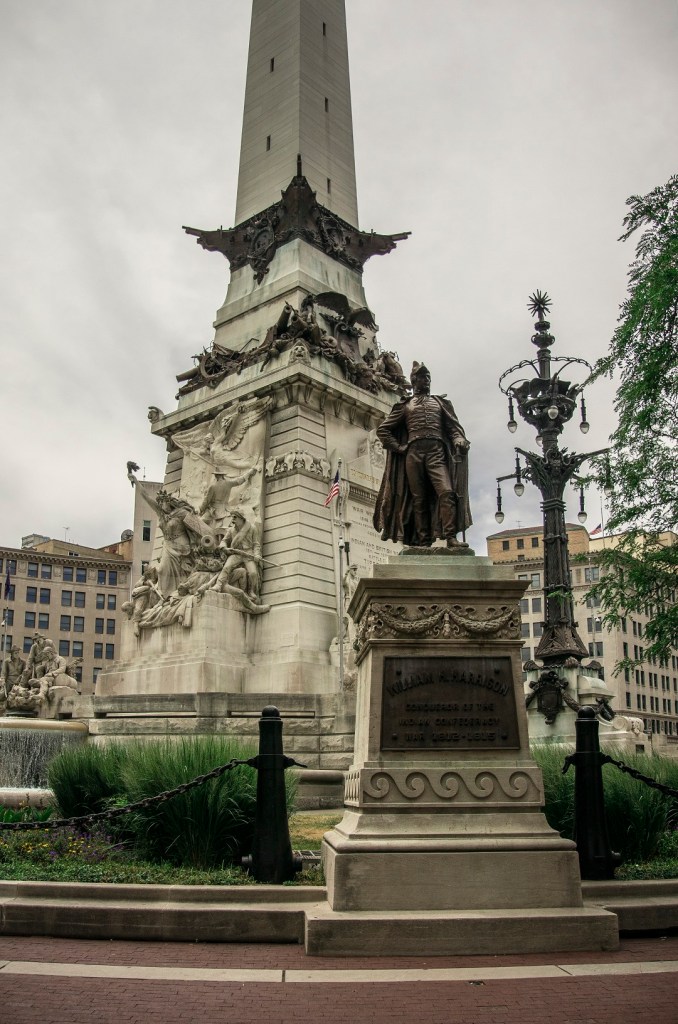
Indiana Soldiers’ and Sailors’ Memorial
But before heading to our next historic home, we decided to go to the Indiana Soldiers’ and Sailors’ memorial.
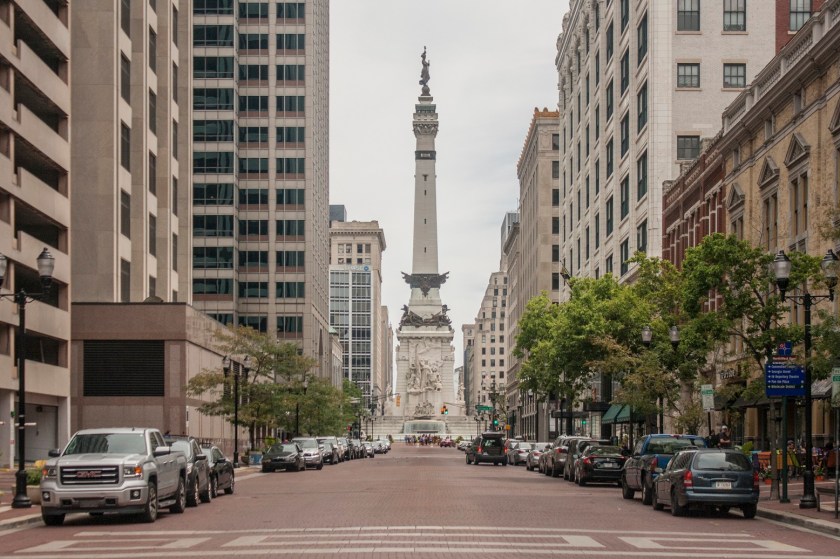
View of Indiana Solders’ and Sailors’ Memorial from the Capitol
This edifice boasts a pool and fountain beneath a circular, raised dais decorated by various sculptures. Soaring above it all is a tower that rears upwards toward the clouds.
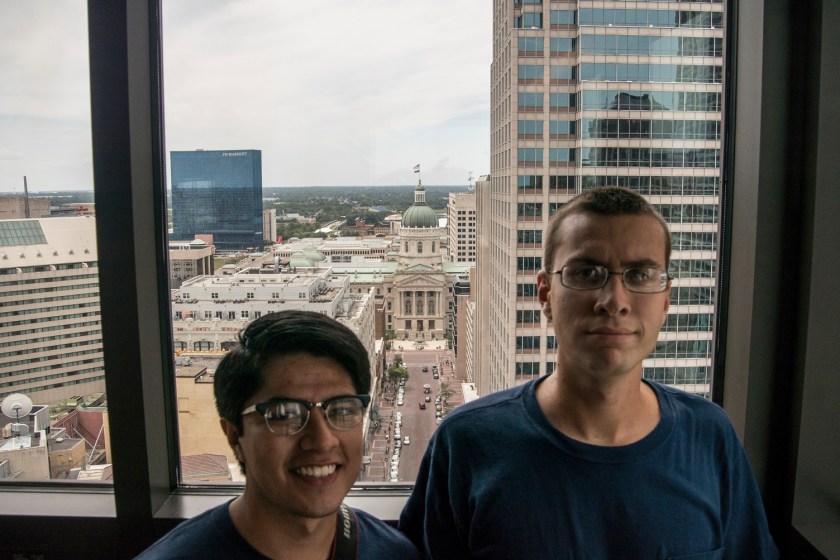
You can actually climb up a set of 330 stairs on the inside of the obelisk, or take an elevator to the top for a small fee. Prof. Yawn elected to pay, while Brian and Paul adventurously took the stairs all the way to the top, compelled to do so after all of the vertigo-filled adventures of the trip. It was a beautiful view from up above, making the climb up worth it.
Brian and Paul from the Memorial’s Observation Deck
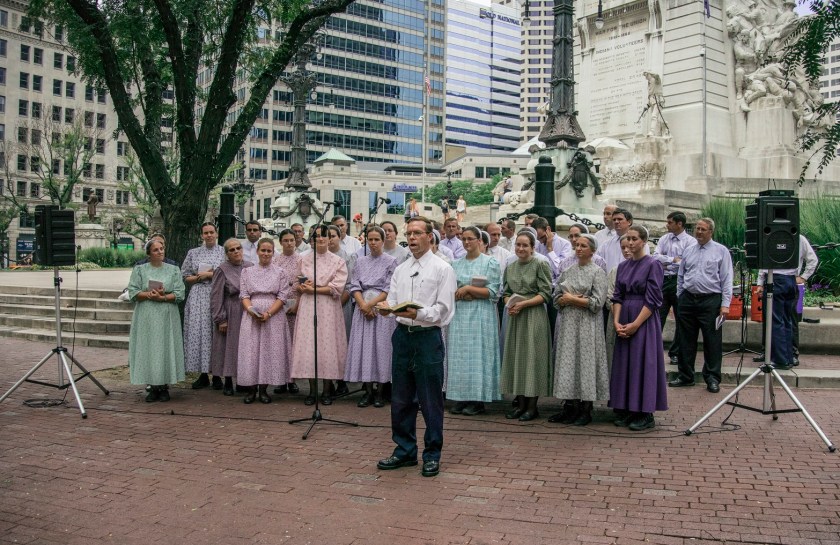
Our feat of athleticism was soon rewarded by a short visit to the Chocolate Cafe right across the street from the memorial. While sipping on a very sweet, creamy Chocolate Chai and nibbling on a very rich caramel sea salt chocolate, we people-watched. This was made more interesting by the gathering of people in our midst. There was, for example, a convention of sorts for Mennonites, who sang on a town square…
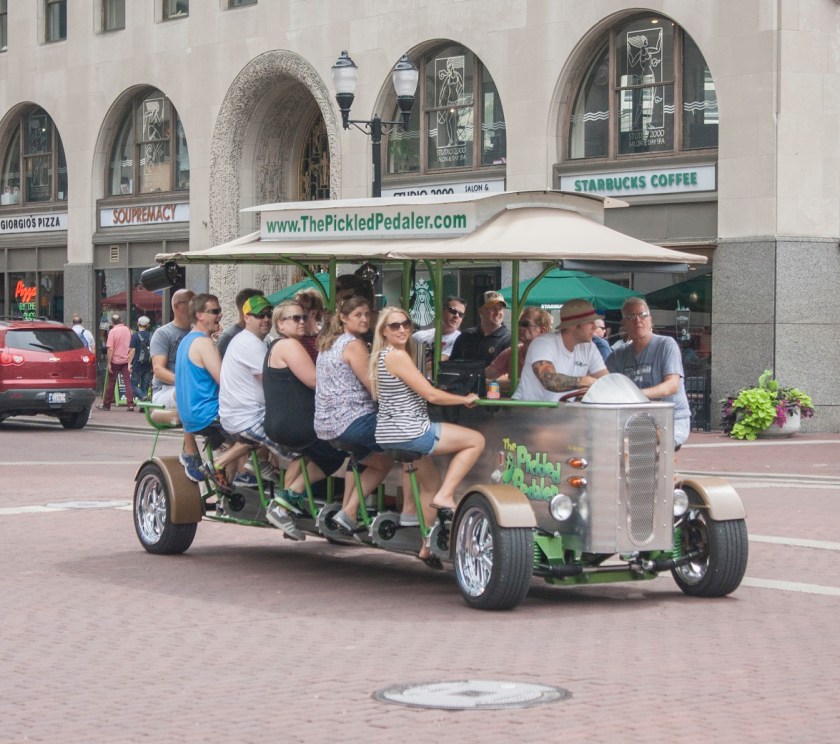
Circling them, on a pedal-powered bar (“The Pickled Pedaler) was a party of some sort (perhaps a wedding based on the sign on the back, which read, “Congratulations Tom & Ed”).
How you effectively avoid Mennonites and traffic in a town the size of Indianapolis–while drinking alcohol–is beyond us. It’s also not clear how this doesn’t violate some drinking and driving ordinance. Presumably, the steering-wheel operator doesn’t drink, but the people providing the power do.
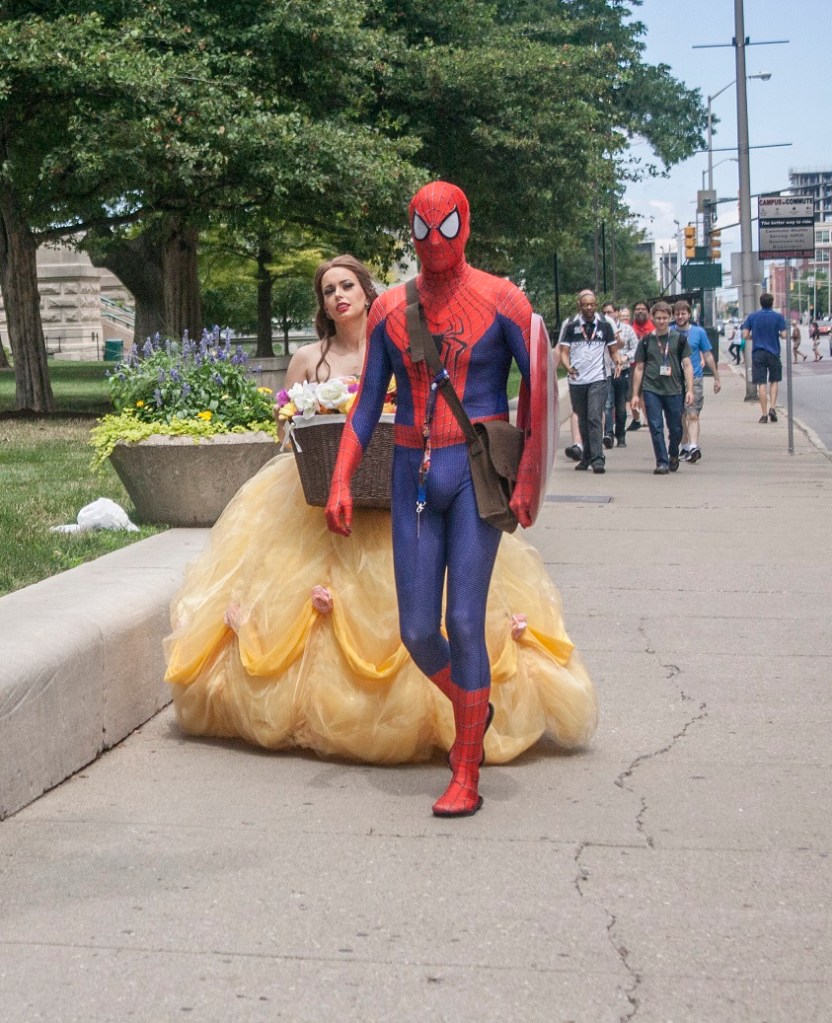
Amidst all of this, it was also Gen-Con, a convention of strange people dressed as super-heroes and other characters.
It wasn’t quite the bar scene in Star Wars, but it wasn’t far off, and it wasn’t what we were expecting from Indianpolis, “The Crossroads of America.”
Benjamin Harrison Home
Benjamin Harrison, the 23rd President of the United States of America, was a native of Indiana. He raised a regiment during the Civil War, and fought as a general on the Union side. Interestingly, he was preceded in the presidency by Grover Cleveland and was, oddly enough, succeeded by the same man! Other aspects of his presidency were how his federal spending exceeded $1 billion for the first time in American history; he started the process of preserving places of natural beauty; and he strengthened the United States by modernizing the navy, making it the 5th most powerful in the world. This later may have come in handy for the coming First World War.
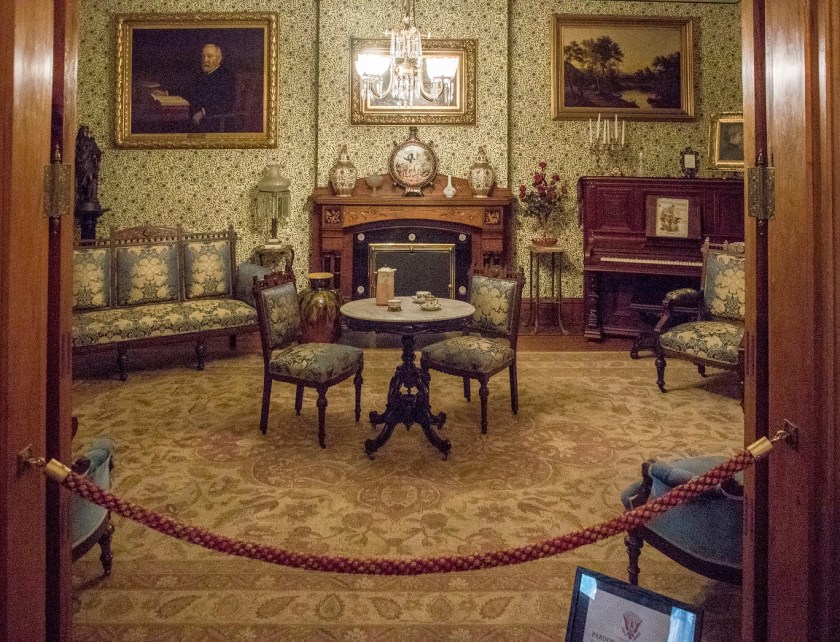
As a very interesting president, his home was just as special in that 70-80% of the furniture is both authentic (not replicas) and on display.
Benjamin Harrison’s Parlor
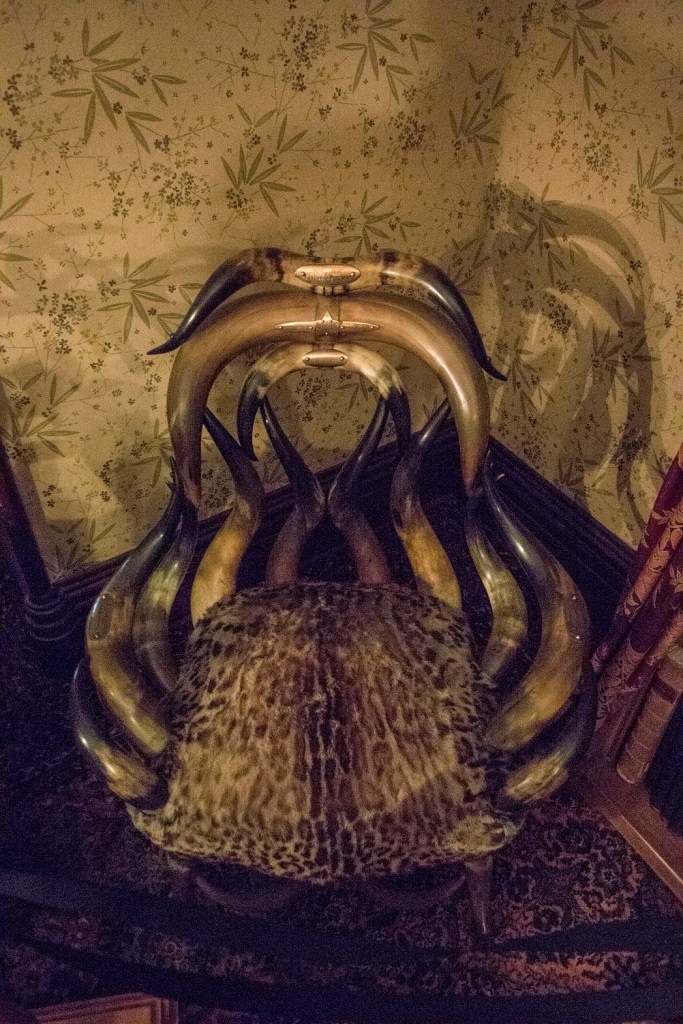
You can see his prodigious library, the many of the gifts that he was given in life, including a strange chair given by a Texan…
Benjamin Harrison’s Chair
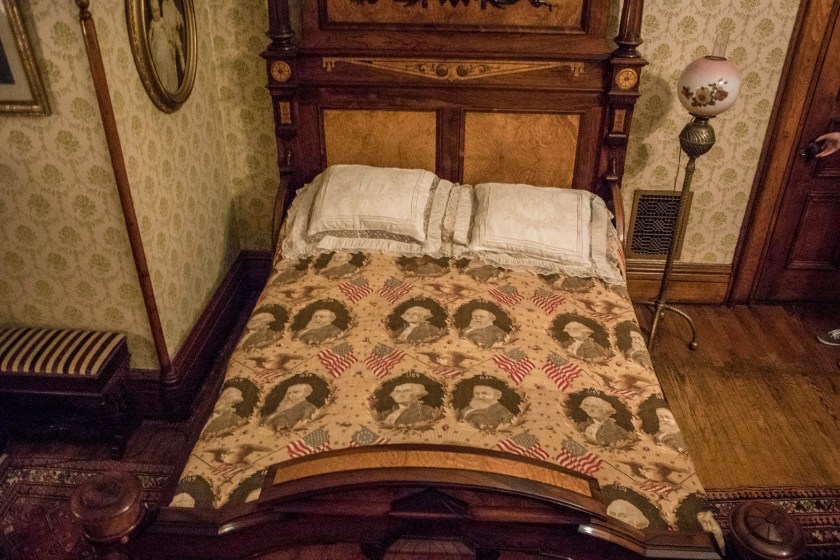
…made of Longhorn horns, a bobcat hide seat, and the overall look of Texas tacky. We also saw his death bed, which was covered with the same comforter he used…
Benjamin Harrison’s Bed
…which was not Texas-Tacky, but was tacky-cool.
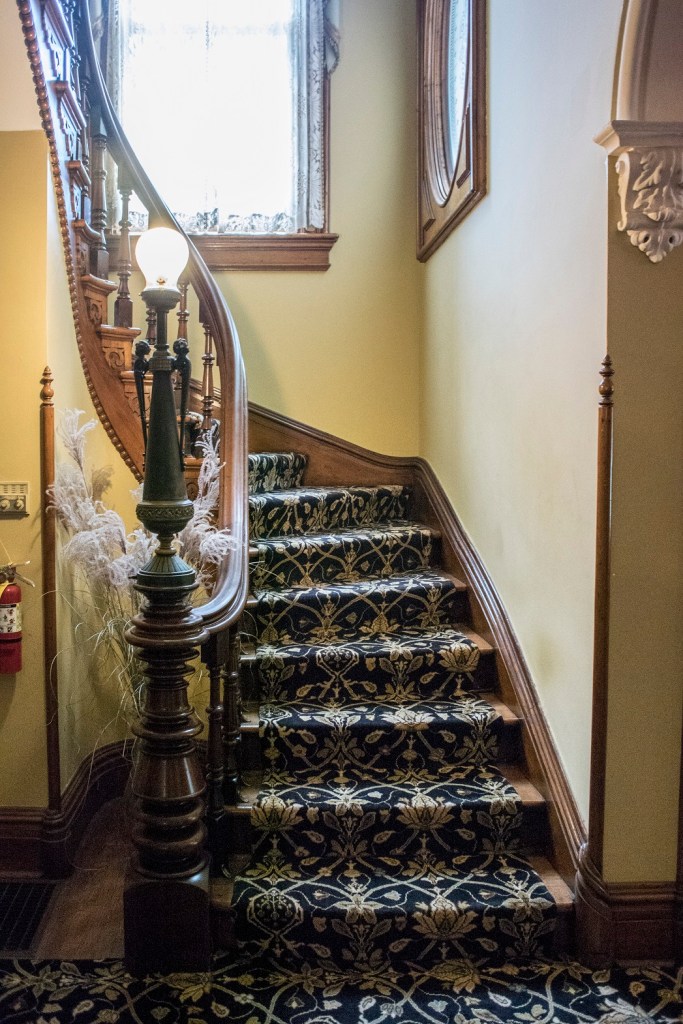
Harrison was a volunteer fireman, and the staircase was fashioned from a fireman’s hose…
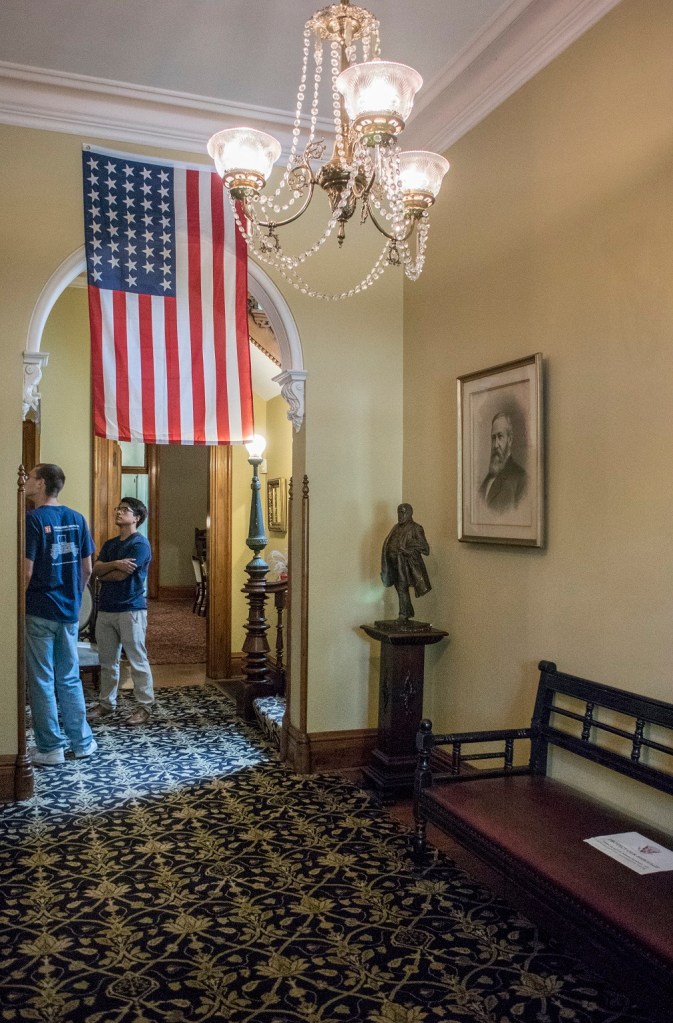
…the home’s foyer was adorned with a 38-star flag (reflecting the number of states when Harrison took office)…
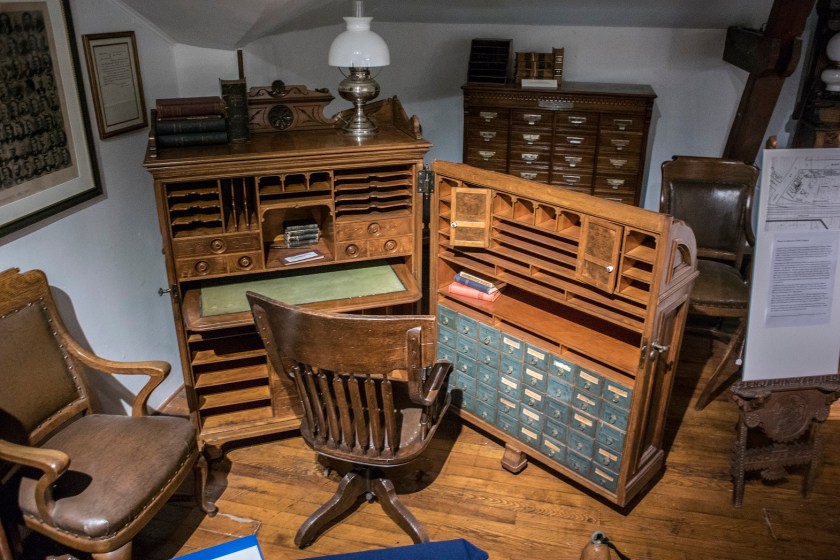
…and his desk was the height of 19th-century organization which, in our book, beats 21st century simplicity.
Benjamin Harrison Desk
However, such an artifact was in no way detrimental to the rest of the home’s beauty…
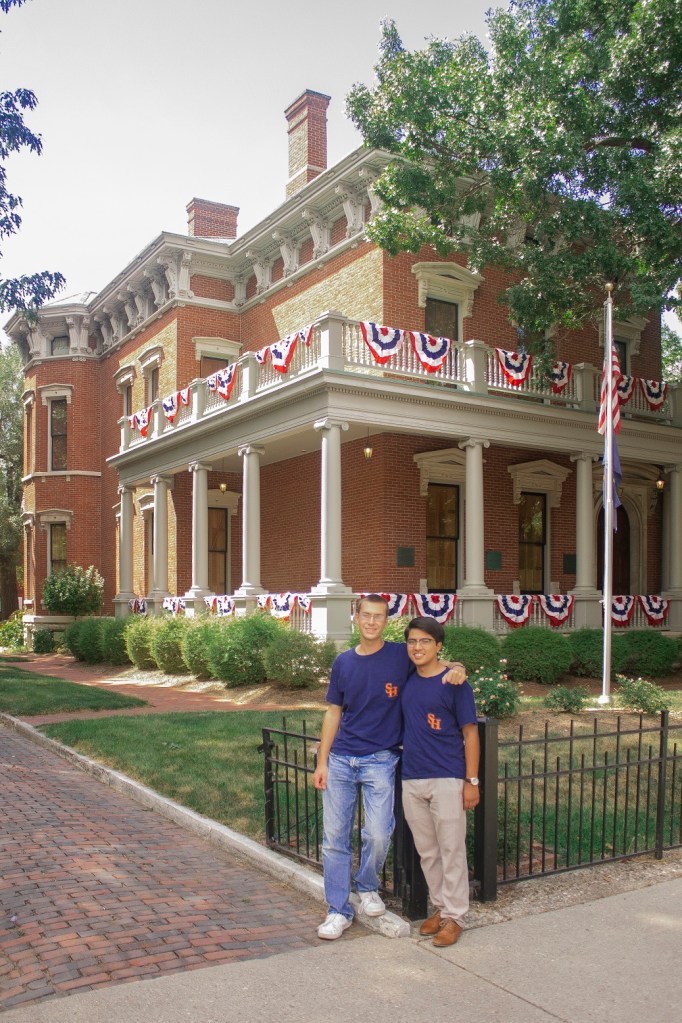
Paul Oliver and Brian Aldaco at the Harrison Home
…almost comparable to our next item on the day’s itinerary.
Indianapolis Museum of Art
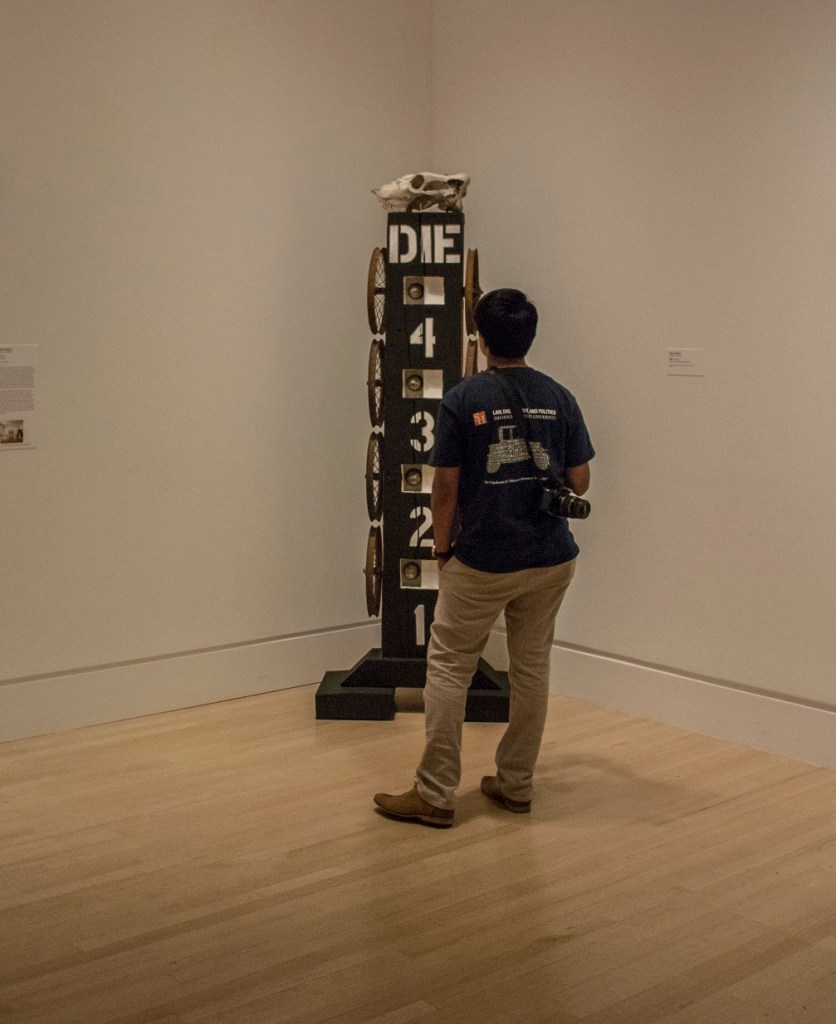
After leaving the home, we soon reached the Indianapolis Museum of Art. The art museum, to our pleasant surprise, shared a few similarities with Harrison’s home in that within the halls were exhibited works by Jacob Cox. Cox’s works were also present inside the Hoosier president’s parlor room. He and other Indiana artists were being commemorated in the “19th Stars” special museum exhibit which included renewed artists of talent such as T.C. Steele, Robert Indiana, and George Rickey among others.
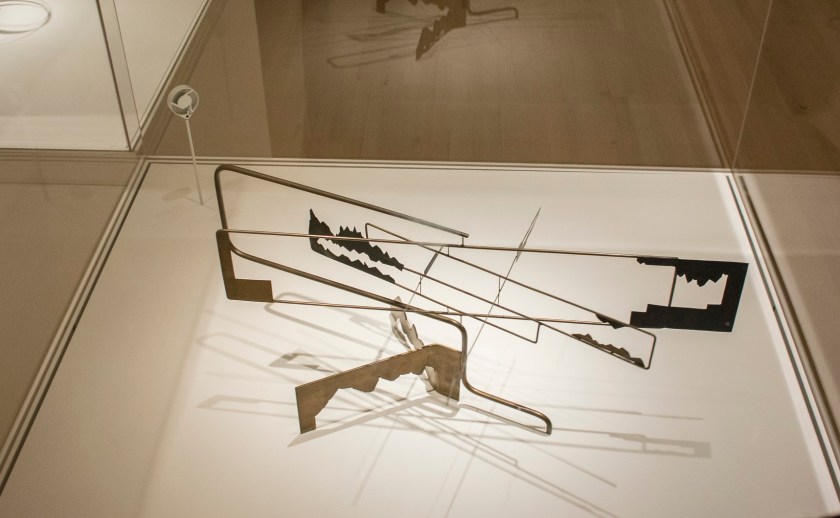
George Rickey Art
After appreciating sights of silver mobiles, beautiful landscapes, and painted canvases with the intent to reflect on society’s morals, all from the creativity of Indiana natives, we continued on through the halls of the museum.
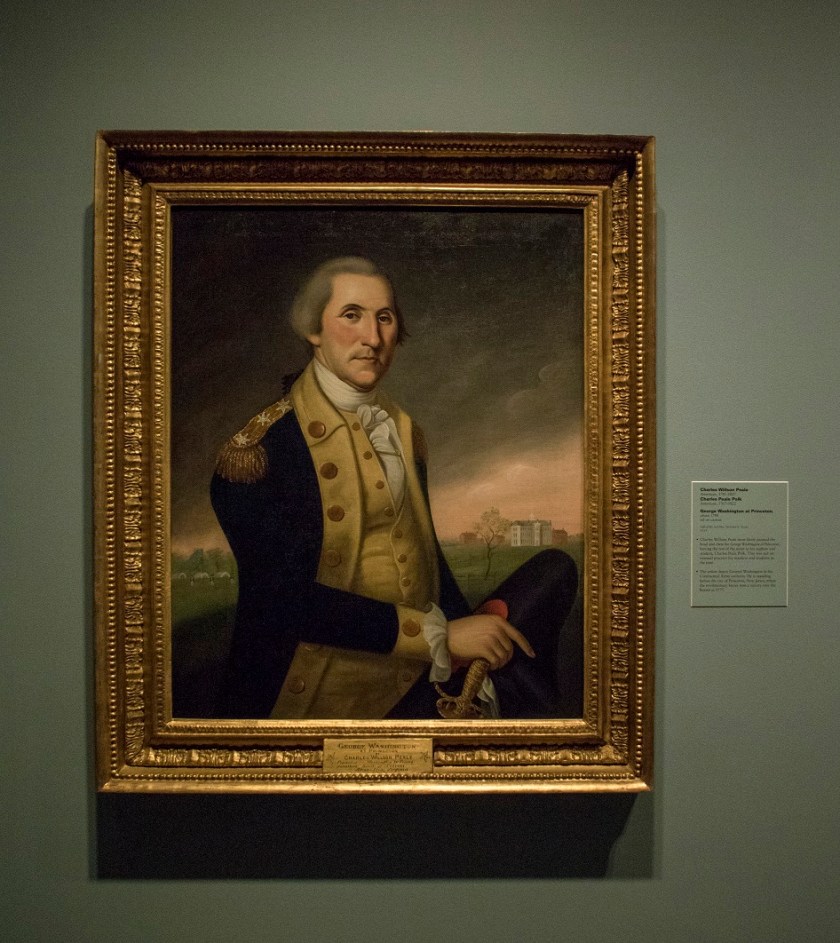
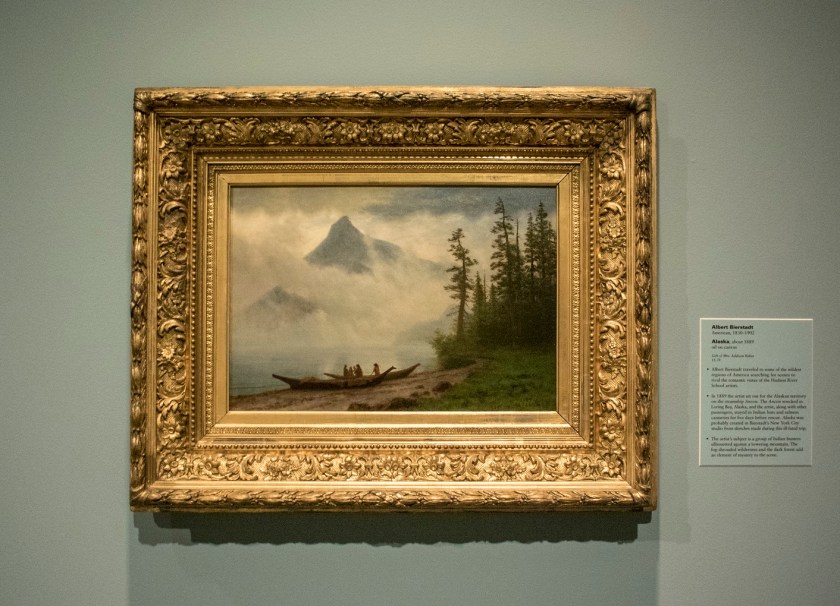
Nearing the first exhibit room we noticed that the art had been arranged in chronological order, allowing us to view a sort of art evolution. Beginning with the realist school of American painters such as Charles Wilson Peale…
“George Washington,” by Charles Wilson Peale
…Albert Bierstadt…
“Alaska” by Albert Bierstadt
and John Haberle, we were further schooled in the art of capturing the essence of reality. Such an aspect in art was truly captured in Haberle’s depiction of American currency in U.S.A. (1889). The oil painting was mistaken for real money upon unveiling which caused near tremulous sensation as viewers claimed the artist had glued money on a canvas. We later saw paintings of other American artists which we had seen on previous museums such as those by Georgia O’Keefe and a very expressive Norman Rockwell by the name of The Love Song.
“Love Song,” by Norman Rockwell
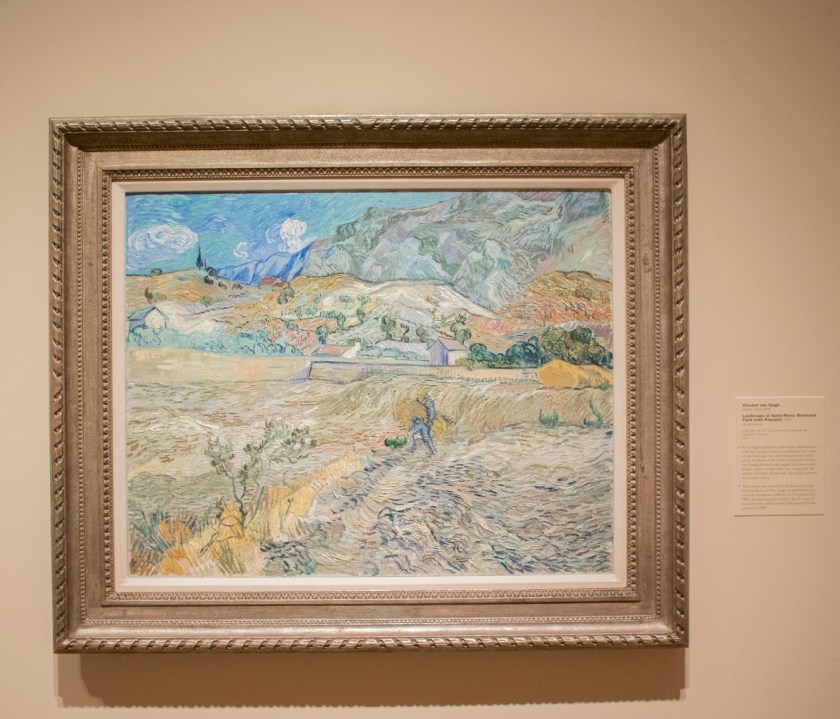
Throughout the other rooms we viewed other artists of remarkable ability, one of which was George Seurat who rightfully deserves the description. His pioneered pointillism-style of expression inspired fellow talented impressionists of his time such as Paul Signac, Henry Van de Velde, Camille Pissarro (these being among Brian’s favorites), and Van Gogh.
Van Gogh Landscape
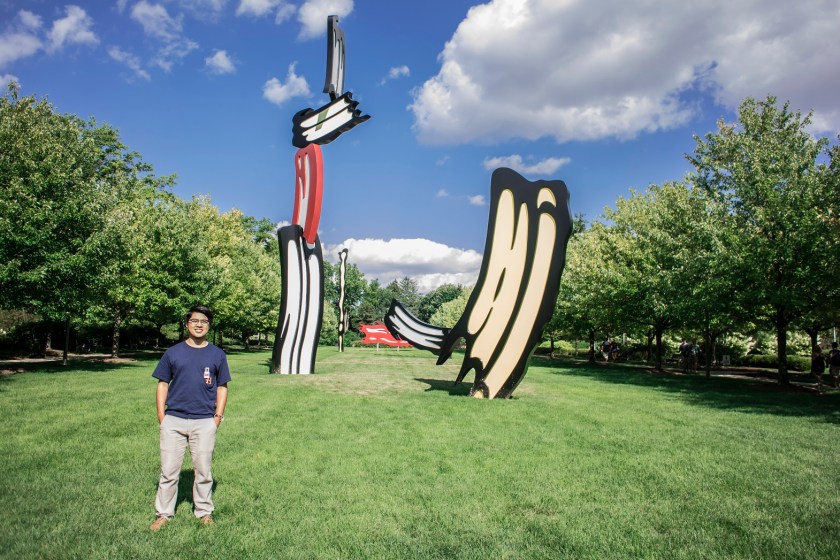
Wandering through the other rooms we were delighted upon nearing a ver peculiar modernist painting by the name of Man and Woman. In a style resembling that of Picasso’s cubism, the shapes of color and shadows form two figures, a man and a woman, embracing each other’s kiss. Even though the depiction in itself was phenomenal, it was the man behind the brush strokes, Fernand Leger, that caught our attention. Between the years of 1948 and 1950 a young Huntsville artist by the name of David Adickes traveled to France to study art under the teachings of Leger. Adickes, as any Hunstvillian may know, was the talented sculptor who erected the Sam Houston statute which towers at the town’s edge. Satisfied that we were able to identify with one of the celebrated artists, we toured some more of the halls to later exit onto the grounds. With a scenic gushing fountain, the grounds were decorated by sculptures by Roy Lichtenstein…
Brian and Roy Lichtenstein
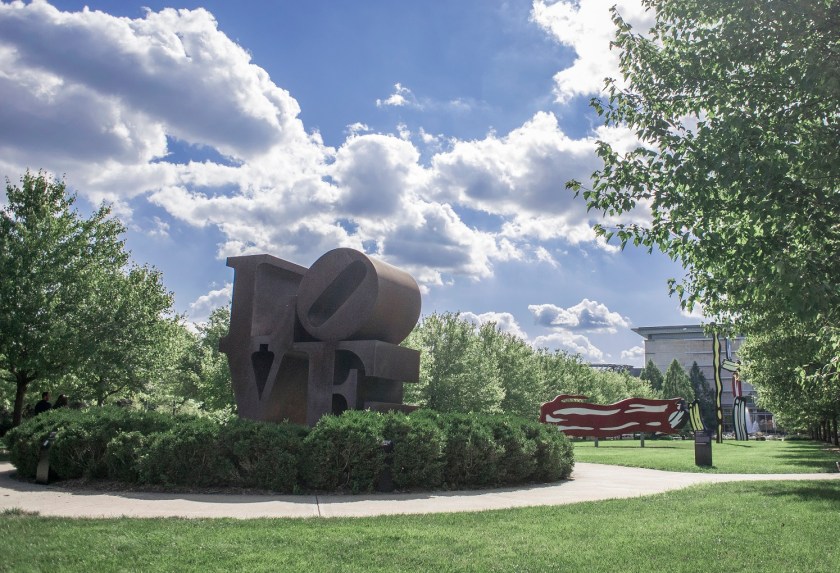
…and Robert Indiana’s famous LOVE sculpture, which we have seen at three or more art museums throughout the US.
Robert Indiana and Roy Lichtenstein’s Artwork on the Lawn of Indianapolis Museum of Art
Robert Indiana, interestingly, was born Robert Clark. But he changed his name to honor his home state. Interestingly, one of his pieces, a 12-foot LOVE sculpture (which are obviously not unique) recently sold for 4.1 million dollars.
After enjoying the green fields of artistic delight, we regrouped in our mini-van and buckled up for our stretch towards the end of our trip. As we only have one more day left in our Mid-Western tour, we arrived in our hotel late at night eager to get some rest and prepare for an exciting last day of our odyssey, in Little Rock, Arkansas.
The LEAP Ambassadors are on the road again as we return from Dearborn, Michigan. Even though we left yesterday, our trip back to Huntsville is, in LEAP style, exploiting the learning opportunities along the way. Driving through the Midwest, we have been enjoying fields of green, skies of blue and white ornamented with sunny streaks, while visiting locations of historic prominence. From the birthplace of one of the fathers of the modern age to the resting place of our nation’s 29th president, we knew that our Friday itinerary would be as fun as any of the previous adventures in our Vagabond trip.
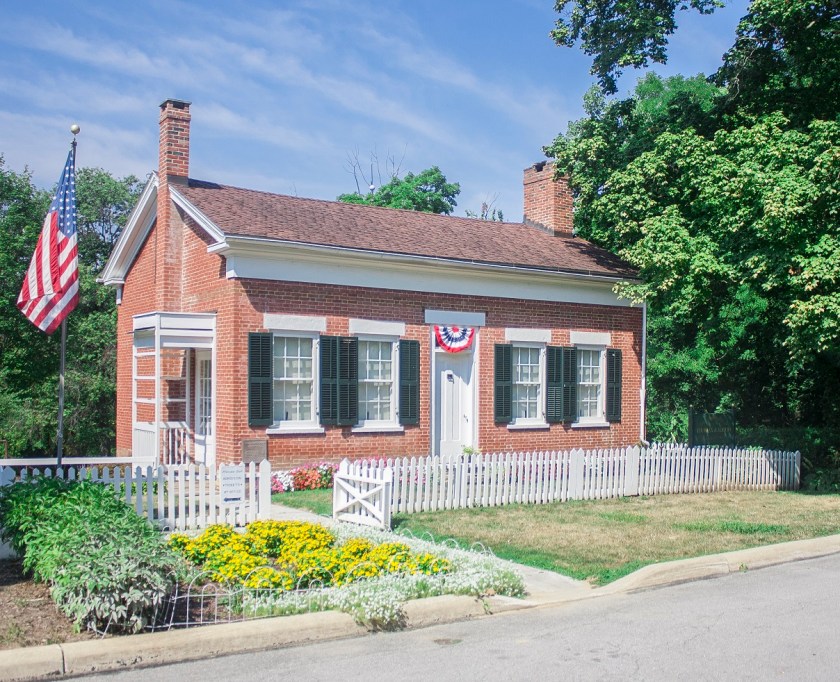
Constructed along the banks of the Milan Canal in 1839, this modest home was where young Edison spent his childhood until he was seven-years old. Even though the family left in 1854 due to the town’s low job opportunities, the home would be owned again by the original family when Marion (older sister of Thomas) bought the home. Eventually the home was bought by Tomas Edison and efforts from his wife and sister were later made to turn the home into a historic site. These finally came to fruition in 1947 when the home was inaugurated as a museum on 100th anniversary of Edison’s birth.
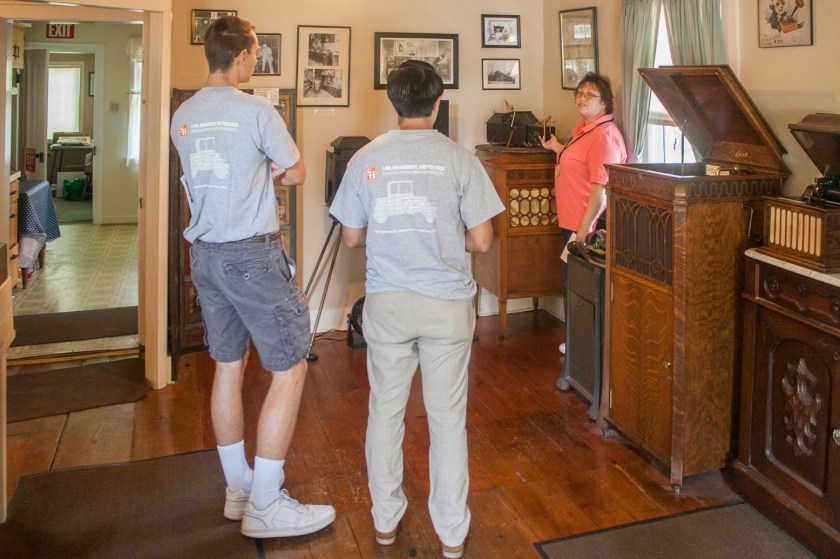
Upon arrival to the restored home along Edison Avenue, seemingly as common as the neighboring homes, we stepped into the birthplace of one of the most important inventors of all time. On the living room stood a cradling bench, one that would have been used to cradle young Edison. What was of greater interest was the adjacent room. In a small, four-walled enclosure, intended for the younger children’s living quarters, stood a complimentary rope bed. Mother Nancy Edison moved to the warmer, oven-heated space on which she gave birth to her youngest child. We stood on the threshold of where Thomas Edison had been born on a February evening in 1847. As we stepped upstairs we were able to sense young Edison’s childhood.
The first bedroom we went into would have been young Marion’s room, now decorated with her christening gown and a knitted tapestry on the wall which she chose not to finish. We then crossed to the opposite room which Thomas and wife Mina Millar used as a bedroom after purchasing the home. Various pieces of apparel owned by the Wizard of Menlo Park were exhibited in the closets. One garment which we found amusing was a pair of slippers, the preferred footwear for the insomniac inventor who would often nap on the strategically placed cots located around his laboratory in Orange, New Jersey.
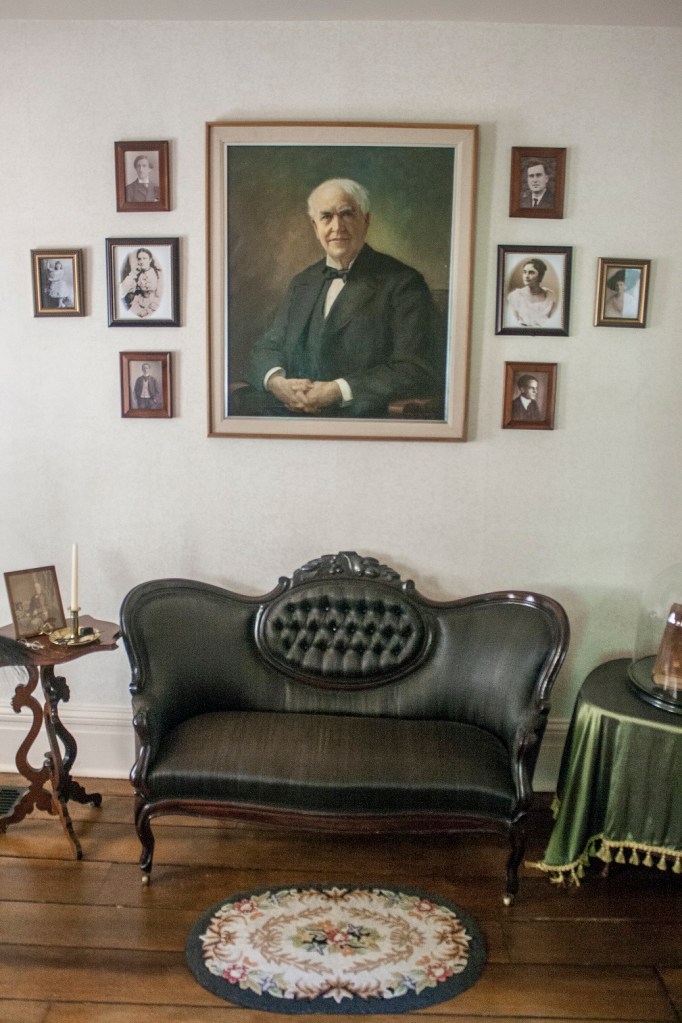
As we walked downstairs into the parlor room we spotted a portrait which depicted Edison on a fireside’s edge telling a story to a group of children and friends, on of which we recognized as a very attentive man with the name of Henry Ford. As we had spent a week researching the pairs’ 1915-1926 trips across the nation, it was exciting to view signs of their great friendship. We were further amazed, however, by the small space behind the parlor room. On this small storage room stood dozens of artifacts that the inventor had patented during his lifetime. As T. Edison held a list of over 1000 patents, it was rewarding to view artifacts such as the electric pen and the talking doll (the first toy of its kind in the US.) Other items included one of his first successful lightbulbs of bamboo filament (the lightbulb still works), a Western Union telegraph machine which he sold for $40,000 after its creation, and Edison spark plugs, which further helped solidify his connection with Ford.
With our tour ending at the home’s basement, in which artifacts from the period such as a pole latter and a waffle maker were shown to us, we took our last glimpse of the home and started on our way towards Marion, Ohio.
Before reaching the home town of William G. Harding, however, our homesickness was too strong. Along the road, we came across Tackett’s Southern Bar-B-Que. After overlooking the menu, Paul ordered a brisket sandwich, Professor Yawn chose a plate of pork, and Brian ordered a meal of St. Louis ribs, a bit incongruous considering the venue’s advertised title. Regardless of the cut’s name, the ribs of mouthwatering delight, along with the other meats, were savory to our southern palates. Accompanied with a side of coleslaw and beans (which were bathed in barbecue with a trace of meat) our lunch was more than enough to satisfy our appetite for Texas cuisine.
Warren G. Harding Historic Sites, by Paul Oliver
After lunch we headed to the Warren G. Harding home. Harding was President of the United States after Woodrow Wilson. This meant the he had to oversee the period immediately following the First World War. Importantly, for the purposes of our trip, Harding was also a Vagabond camper, having joined Henry Ford, Thomas Edison, and Harvey Firestone on their 1921 trip.
Ford, Edison, Harding, Firestone “Camping”
Unfortunately for us, we were running short on time, therefore, could no take the tour of the home, only visit some of its exhibits, tour the grounds, and look over the gift shop.
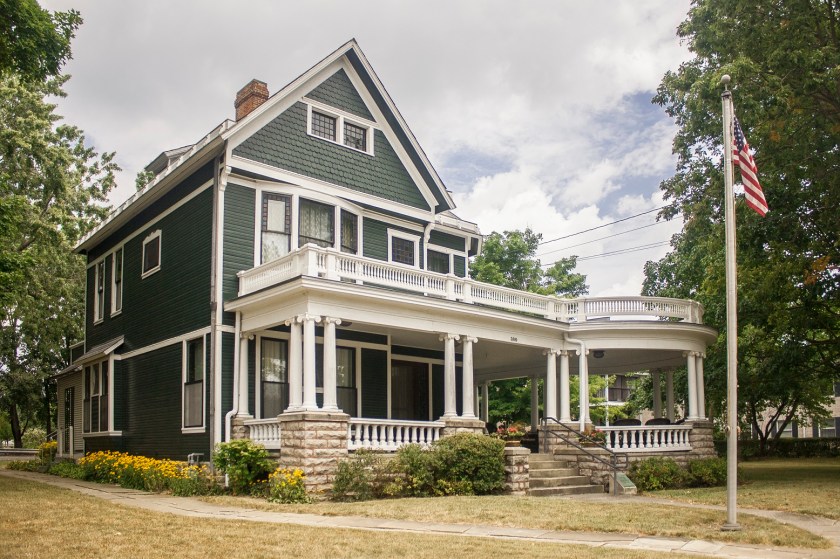
Warren G. Harding Home
However, we did manage to head down the street to the Tomb of the both President Harding and the First Lady.
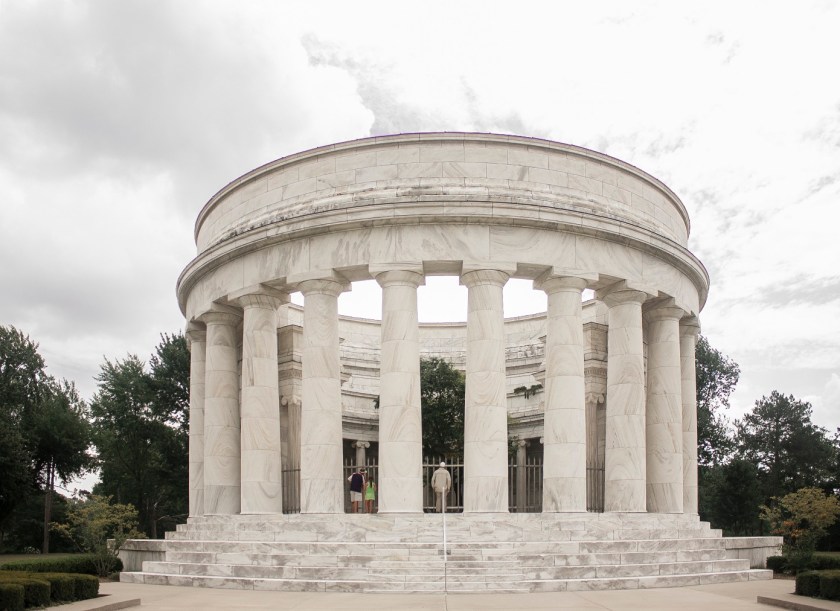
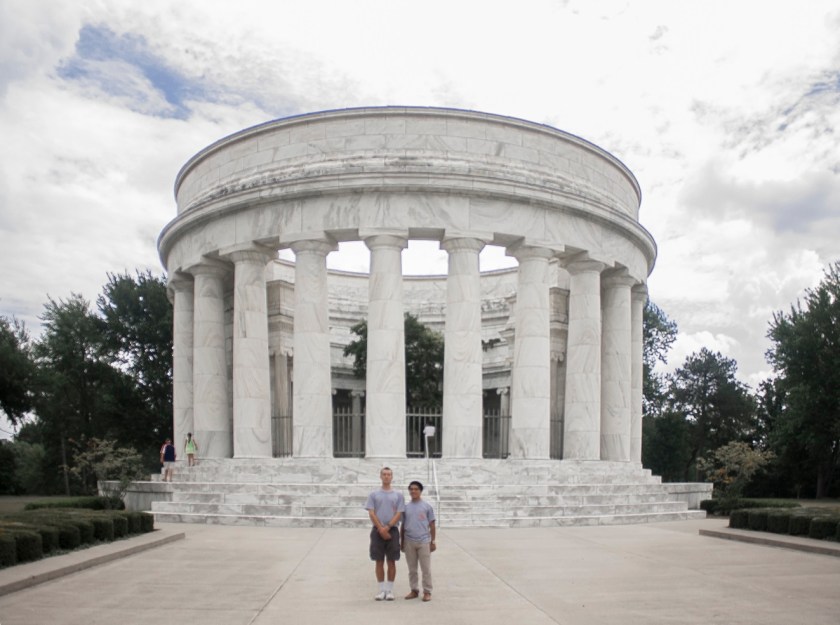
Warren G. Harding Tomb
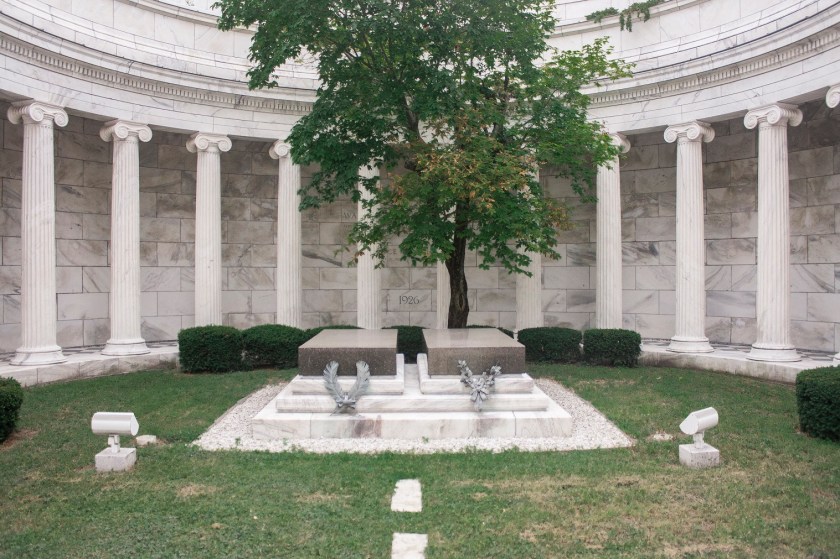
The tomb is a beautiful structure. Circular columns form the exterior. These columns themselves stand upon a massive base of what appeared to be white marble or polished granite. Inside the pillar arrangement was a walkway, shaded by an overhang above. This overhang was in turn supported by an interior range of columns, of the slight ornate iconic order. In the center of the tomb was a circle of green grass, bushes, and a tall tree whose branches seemed to reach upwards towards the sun, with roots streaming down on to two large grey sarcophagi.
Behind the twin stone coffins of Mr. and Mrs. Harding was an inscription carved into the back wall which contained their names and dates of death. It was an impressive monument to a President from a bygone era.
Ohio Capitol, by Paul Oliver
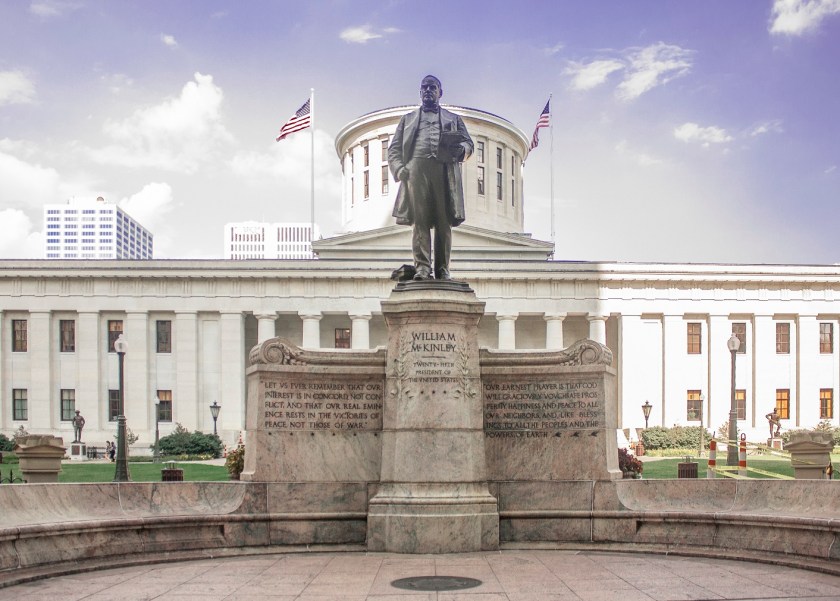
After touring the monument, the three of us jumped back into the van, and set off towards Columbus to tour the capitol of Ohio. We arrived just in time to join the tour, and were treated to an hour-long walk through of the grand statehouse. Interestingly, unlike most capitals, the Ohio capitols is not domed, at least not from the exterior.
Rather, it was built with a towering cupola perched atop its roof. The interior of the capitol, however, offered a view from the rotunda of what appeared, from the interior, to be a dome.
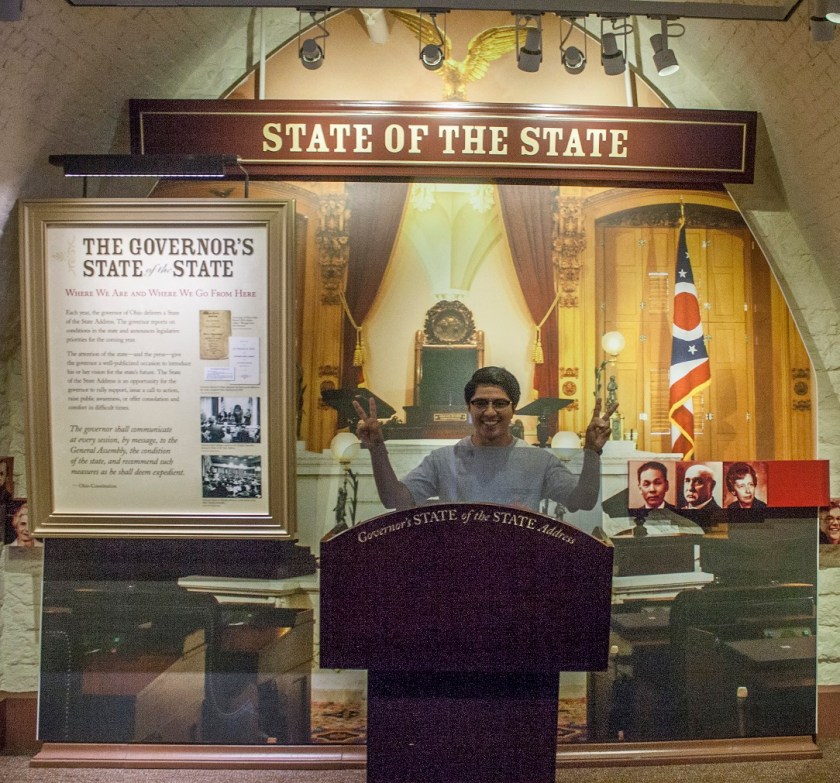
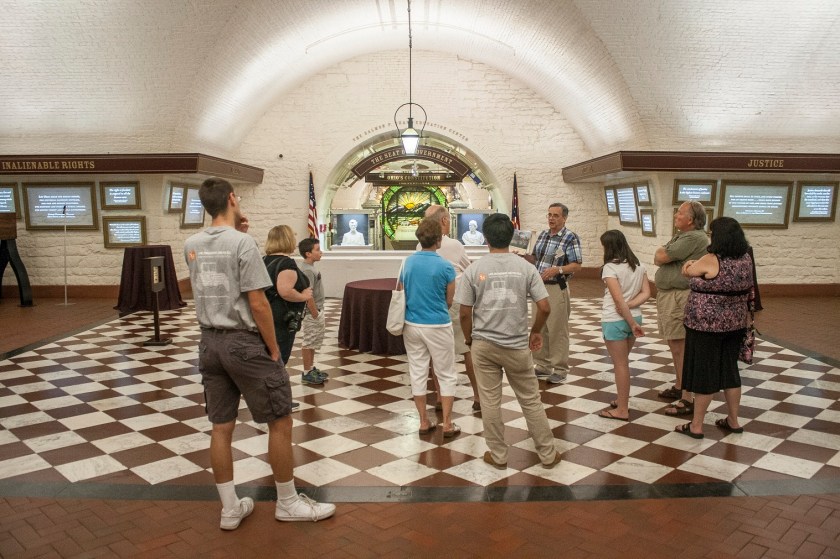
The capitol was built earlier than most capitols (construction began in 1838), so it was somewhat less grand than many others (say, the Texas Capitol). But it offered interesting exhibits and interactive features…
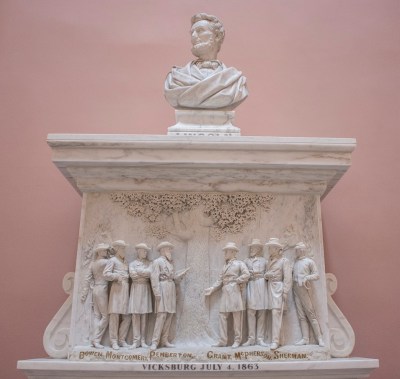
…as well as some interesting interior art.
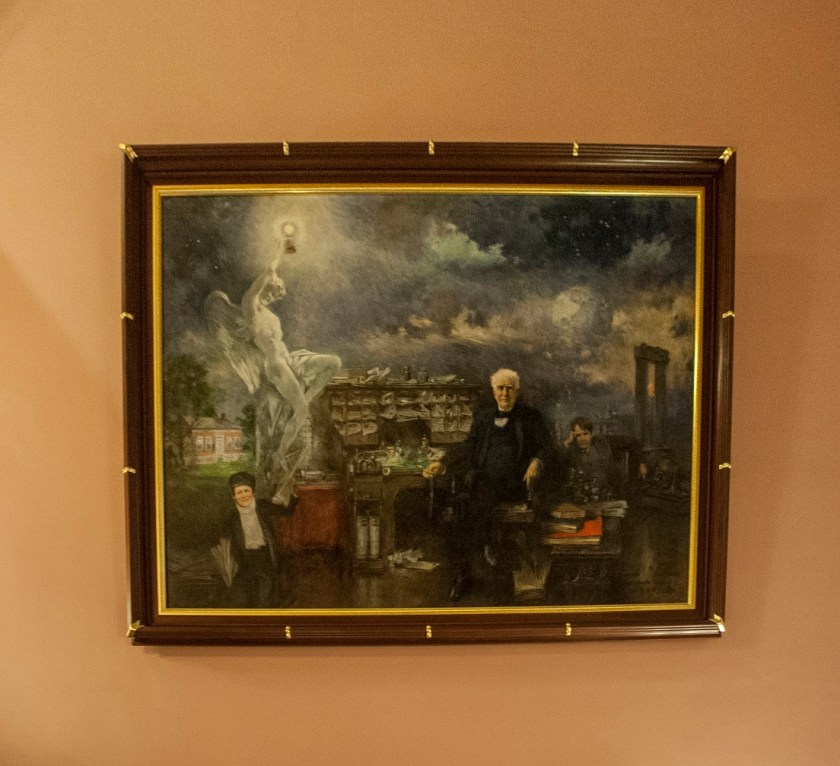
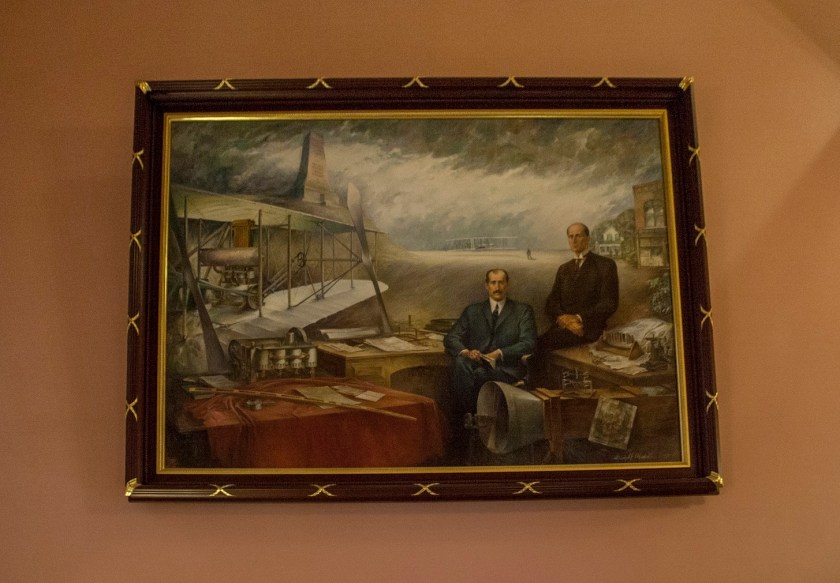
Interestingly, for a state that produced eight presidents, the large portraits on their walls were dedicated not to these presidents but to Thomas Edison on one side…
…and the Wright Brothers on the other side.
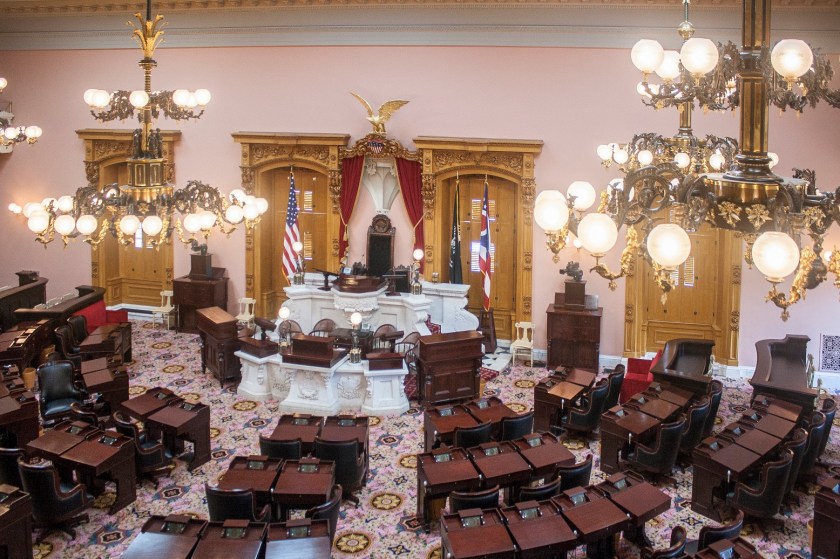
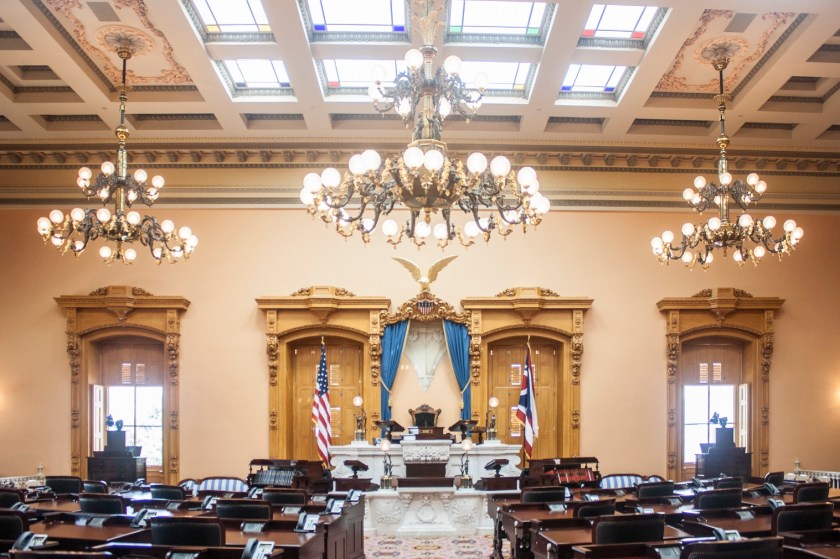
Aside from the art, we were able to visit both the House…
…and the senate.
Although not a spectacular capitol, it was a stop well worth our time, and we enjoyed the tour very much.
As we finished our capitol tour to step outside and view a little of Columbus architecture, we continued on our 160-mile journey towards Indianapolis, Indiana. We arrived at the city accordingly for we were already getting hungry. Therefore, we stopped for dinner at a deli which served exceptionally good subs. Paul enjoyed a 12” Italian sandwich, while Brian and Professor Yawn shared an Italian and a Reuben sandwich between them. After a cookie desert, tired from a long trip and days’ adventure, we retired to our hotel. We contemplated how tomorrow we would have a long day of sight-seeing and total of 7-hours of driving. But with the proper LEAP attitude, we greet tomorrow and days to come, anticipating the best of adventures.
After four days of researching the Vagabonds with Jeff Guinn and Jim Fuquay at the Henry Ford Museum, other attractions were bound to be something of a let down. But the Toledo Museum of Art offered a surprisingly nice collection and a truly inspired special exhibit by Jaume Plensa.
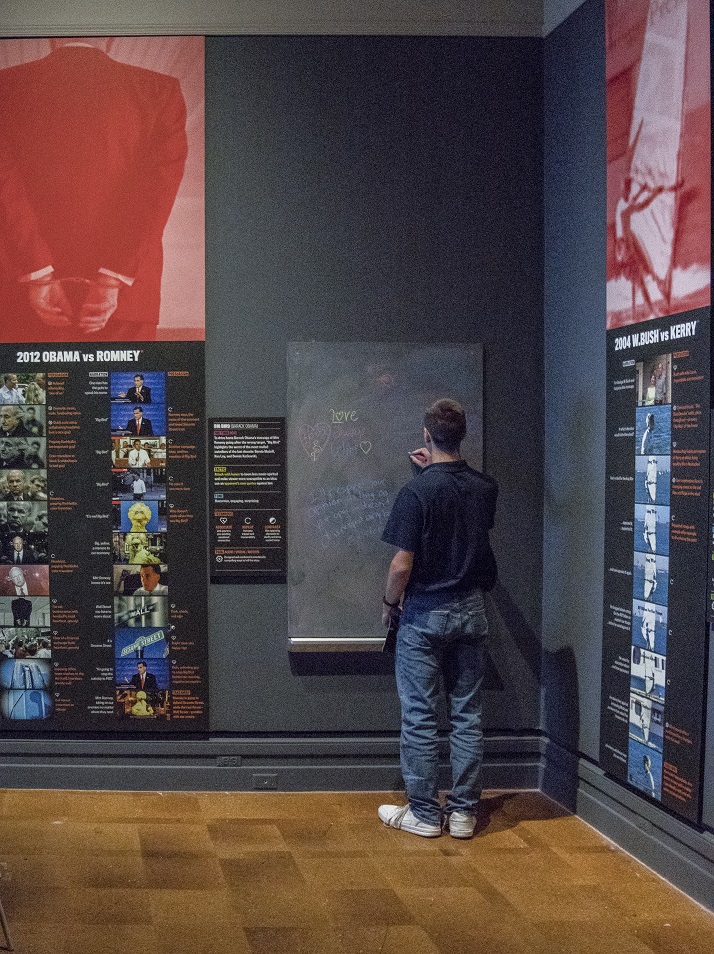
With a Greek entrance of white marble pillars, artistically grand in its own right, the art within was just as impressive. However, before viewing the fine arts we examined the art of the political campaign thanks to the museum’s special exhibit I Approve this Message: Decoding Political Ads.
Paul Oliver Examines Political Ads at the Toledo Museum of Art
As political science majors, Brian and Paul ventured through the floor to examine such ads as Reagan’s “The Bear” ad . This ad showcased a prowling bear through the forest and a man who forces the beast to retreat by standing up to it. Thanks to the exhibit’s captions we discovered that the bear was a symbol for Russia, thus the ad implied that Ronald Reagan’s strong will would be able to defeat the Russian menace of the time. So being we went over our president’s ads and those who had gone against them during the age of Television.
Brian Aldaco Runs for Office with Unfortunate Results
Leaving the floor we walked to the east wing to view the contemporary art. There we saw works by various renowned artists such as Pablo Picasso…
Picasso, in his Blue Period
…Chuck Close…
Chuck Close Artwork
…Childe Hassam…
…Claude Monet…
…as well as Alexander Calder, Henry Moore, and Louise Nevelson.
There was a sense of satisfaction in being able to recognize these and other artists from within the collection.
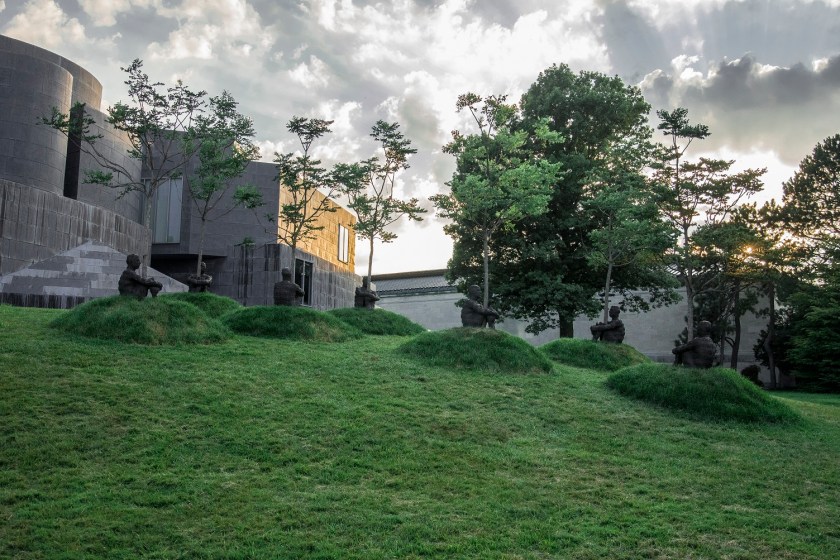
To appreciate the sculpture garden, we stepped outside to view a George Rickey silver mobile…
…Tony Smith’s Moses…
and other sculptures…
…most notably those of Jaume Plensa (who had a whole floor dedicated to his work inside the museum.)
But before examining the indoors art, we sat on a very peculiar Polar Bear Bench by artist Judy McKie.
Not only did this sculpture offer an appropriate resting spot, it also allowed us to find a glass walled building from which the interior glistened with hues of clear, colorful glass. Upon further inspection, with a silver Chihuly hanging from the ceiling…
…we entered the museum’s annexed Glass Pavilion. Inside we found a wide assortment of glass sculptures from the quirky glass moquettes of modern venues by Emily Brock to Roman glass decor dating back to the 4th century (all in the pristine condition from when it was first blown!) It was clear that the glass blowing techniques of the time were advanced, a technique that we witnessed inside the pavilion.
Apart from the beautiful art within the exhibit hall, there is also a glass blowing workshop.
Inside the room stand ovens heating up to a temperature of about 2150 degrees fahrenheit, undoubtedly no ordinary oven. However, these high temperatures are essential for molding the crystalline medium. So much is the nicety to keep the glass at near melting condition that if its temperate cools off before the intended time, the modeling tools can break the glass and ruin the whole sculpture. As the team of sculptures, on who molded the glowing vase and another who blew at it to expand it from the rod’s other end, continued their process of inserting the glass in the oven followed by a spinning of the material to give it its shape, we left the workshop to view the rest of the museum on its main campus.
Upon entrance to the museum we turned to the opposite wing of which we had already toured. With pieces from Van Gogh, Claude Monet, Paul Signac…
…and Piet Mondrian.
…we wandered through the canvasses of bright colors, swift burst strokes, and dream-like landscapes onto a grand hall of a more a classic collection. Under the twinkling chandelier the prominence of the works exhibited were accentuated to create an effect of awe. With works by Ralph Albert Blakelock, El Greco, and we moved through the hall into a vast room with elongated heads of women.
Even though the sight may sound a bit macabre, the warmly lit room featured the works of Jaume Plensa and created a near meditative trance.
Perhaps the most appealing may have been Silent Rain. With fragments from poems attached to wires hanging from the ceiling, creating an effect of raining phrases, we were astounded.
We felt a similar pleasure and wonder from Plensa’s See no Evil, Hear No Evil, Speak No Evil…
…but whether it was a sculpture or painting from Plensa the same was true.
His works are successful in priming the viewer into a meditative reflection on the human spirit and expression.
So much were we drawn to each piece that soon the doors around us were being locked, lights were being shut off, and halls were flooded with darkness. The museum was closing, therefore we left the campus to complete our evening’s drive to our resting spot. After driving through the night scene of Rutherford B. Hayes’ home in Fremont, Ohio, we reached our hotel in Milan, Ohio. So being, we finished another exciting, educational day of our return-to-home part of the trip, with high spirits and persistent a strong will to continue our LEAP adventures.

















 Center for Law, Engagement, and Politics