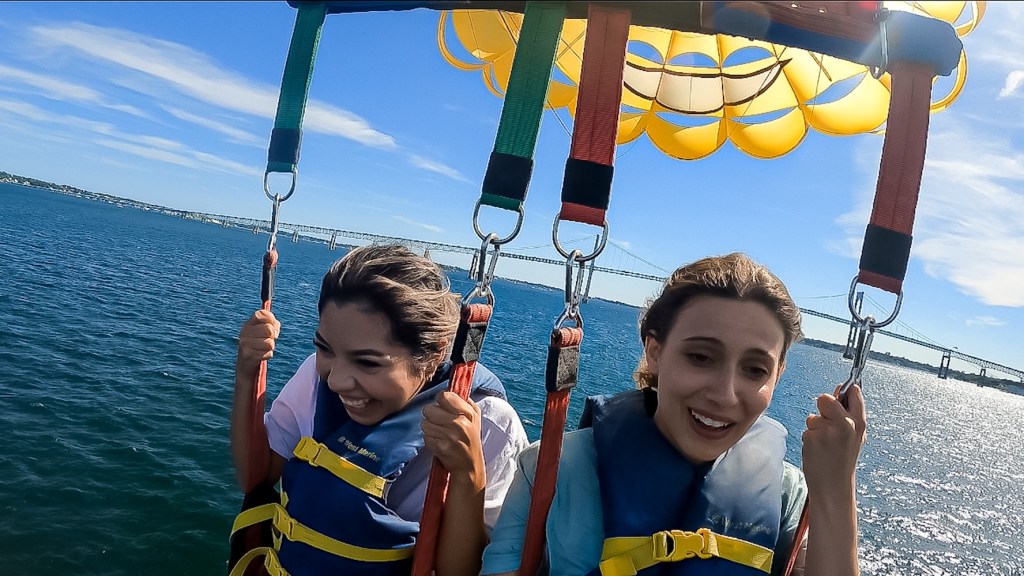
Rhode Island is the smallest state in the Union, but that hasn’t stopped us from having a big time. Whether learning about the health care system, apprenticeships, utility provision, or the criminal justice system, we’ve found the conference rewarding. Moreover, we’ve benefitted from some amazing networking opportunities and some off-site excursions–which included parasailing! But our last day of the official conference promised more learning and interest.
A Silver Lining to our Last Session
by Michelle Moya
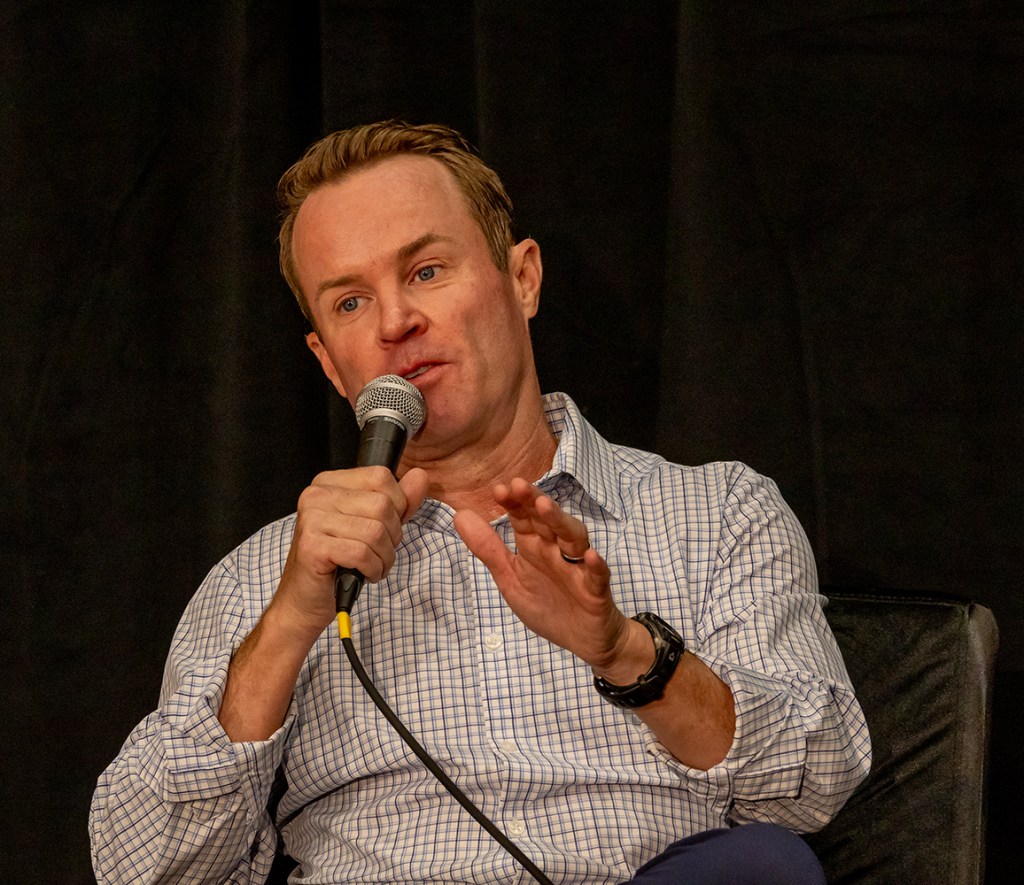
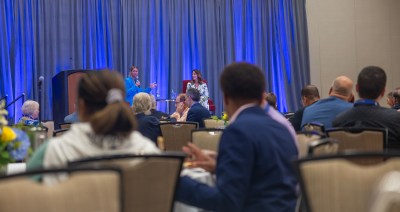
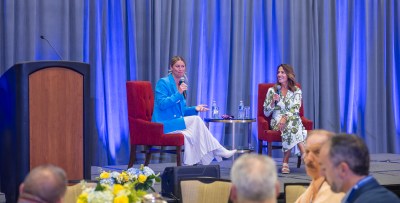
As our final day in Providence drew to a close, Olivia and I attended a farewell session that offered a refreshing departure from the usual conference format. Instead of policy panels and legislative discussions, we found ourselves in a fireside chat with three-time Olympian Elizabeth Beisel, hosted by Margie O’Brien, with breakfast served alongside inspiration.
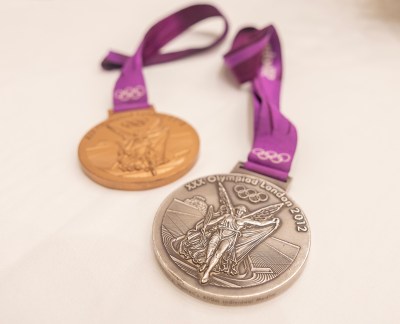
The session started off with something special: Beisel passed around her actual Olympic medals—silver from London 2012 and bronze from Beijing 2008—for everyone to see and hold.
The weight of these medals surprised me, both literally and figuratively, but I snapped a photo holding both…
Beisel’s story begins in Rhode Island, the “Ocean State.” At just 15, while still a high school sophomore, she made the U.S. Olympic team for Beijing 2008. What makes her journey particularly remarkable is her decision to stay and train in Rhode Island rather than relocating to traditional swimming powerhouses like Florida or California.
This choice to remain rooted in her home state would become a recurring theme throughout her career—the value of staying true to your origins and finding excellence in unexpected places.
Perhaps the most compelling aspect of our conversation centered around Beisel’s 2012 London Olympics silver medal, which she’s transformed from a simple athletic achievement into a life philosophy. Her book, titled “Silver Lining,” explores the emotions of accomplishing something extraordinary that still falls short of your ultimate dream.
After retiring at 24, Beisel embraced opportunities she’d spent years declining during her competitive career. This included an appearance on Survivor, where she lived outdoors for 30 days with no food, shelter, or supplies beyond basic tools and access to water. While the experience tested her in entirely new ways, it proved rewarding in an unexpected manner—she met her future husband on the show.
Her post-competition journey illustrates an important lesson about saying “yes” to new experiences and remaining open to life’s unexpected directions, themes that emerged repeatedly throughout our conference discussions about career transitions and public service.
The conversation took a more serious turn as Beisel shared her experience caring for her father during his battle with pancreatic cancer. The diagnostic process stretched nearly a year, and once treatment began, she found herself becoming his advocate within a complex healthcare system—a challenge that has also been a recurring theme of our conference sessions.
The most moving portion of our session focused on Beisel’s 10.5-mile swim from Block Island to mainland Rhode Island, which raised $700,000 for pancreatic cancer research. The swim was canceled three times due to weather conditions before she finally completed it in 5 hours and 18 minutes—tragically, after her father had already passed away.
During the swim, facing cold conditions in just a regular swimsuit (marathon swimming regulations prohibit wetsuits), she found herself struggling with the elements. “Dad, give me the sun,” she whispered to her late father. Within 30 seconds, the sun emerged and remained with her throughout the remainder of the swim.
She also discovered a painted rock at her favorite seawall spot that read “Never give up” right after the third cancellation, when she was considering abandoning the project—a sign she interpreted as encouragement from her father to attempt the swim one final time.
Now working in sports journalism, Beisel covers swimming for various media outlets while preparing for 2028 LA Olympics coverage. Her transition from athlete to journalist demonstrates another form of public service—using expertise and platform to educate and inform others.
As we prepared to leave Providence, Beisel’s message reminded us that excellence takes many forms, that setbacks often lead to unexpected opportunities, and that meaningful service can emerge from personal challenges. Her story provided a fitting conclusion to our conference experience—one that emphasized resilience, adaptability, and hard work.
Rhode Island Capitol
by Michelle Moya
On our last morning in Providence, we knew there was only one fitting way to wrap up our time in the city: a visit to the Rhode Island State House. The structure combines both majesty and beauty.
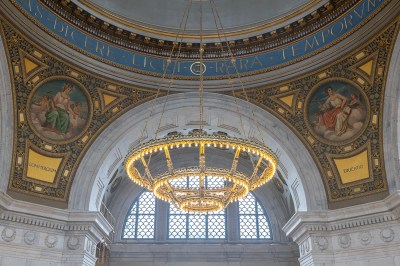
Our guide, Tony–who proved excellent–began in the rotunda beneath what he called the “inner dome”—the fourth-largest self-supporting marble dome in the world.
Unlike the U.S. Capitol’s iron framework, Rhode Island’s dome is pure Georgian Cherokee marble, standing under its own weight.
As you look up, Tony explained that what seems like one mural is actually four vignettes depicting the state’s founding story: Roger Williams meeting with Narragansett chiefs Canonicus and Miantonom. Williams, a radical preacher who argued for separation of church and state—an unthinkable idea in 1635 Massachusetts—would go on to define Rhode Island’s independent spirit.
Banished from Massachusetts that same year, Williams trekked south, fell ill, and was nursed back to health by Massasoit before settling at a spring given by the Narragansetts. From there grew Providence. For a century, the “General Assembly” rotated between four towns, and for nearly 200 years the state juggled five separate capitols.
Finally, in 1890, Rhode Island commissioned McKim, Mead & White—the nation’s leading architectural firm—to design a permanent home. Completed in 1904, it was one of the first capitols to integrate electricity, a fact architect Charles McKim made clear by leaving lightbulbs exposed throughout.
Encircling the dome is a phrase from Tacitus: “Happy are those times when you can think what you want and say what you think.” Four allegorical figures—Justice, Literature, Commerce, and Education—peer down from above, all allegedly modeled after the artist’s wife.
Crowning the dome, 220 feet overhead, stands the Independent Man. During a recent cleaning the statue nearly toppled, prompting an emergency rescue and full regilding. While it was displayed inside for restoration, many visitors had the chance to take photos with him upon waiting for restoration!
From there we moved into the House chamber, the building’s largest room. This nearly 50-foot cube houses 75 representatives serving the state’s one million residents. What impressed me most was its accessibility: when not in session, visitors may walk directly onto the chamber floor and speak with legislators, something we can definitely not expect in Texas!
The Senate chamber, by contrast, felt more formal, framed by Carrara marble columns. Thirteen golden discs circle the room to represent the colonies, with Rhode Island proudly centered as the decisive 13th state to ratify the Constitution. Tony pointed out the chamber’s perfect symmetry, aligned along an axis from the Senate President’s chair through the House Speaker’s podium.
Our next stop was the State Library, with a working archive with 40,000 volumes and another 170,000 in storage. Mahogany walls surround iron staircases cleverly painted to resemble wood, and the ceiling itself mimics the look of book bindings. Renaissance printer logos decorate the cornice. In a bit of rivalry, McKim included Harvard’s insignia, despite Brown University being the nearest. Governor T.F. Green, a Brown alumnus, later had it replaced with William Caxton’s printer’s mark.
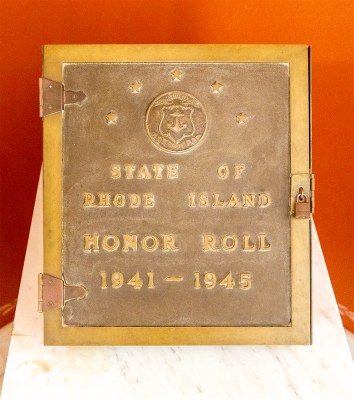
Nearby we also found the Book of Honor, listing 1,700 Rhode Islanders who died in World War II. Locked for preservation, it can be opened for families searching for loved ones’ names.
We finished off in the State Room which holds some of the building’s greatest treasures, including an original 1803 Gilbert Stuart portrait of George Washington as President, with a rainbow of hope in the background.
The room also honors Rhode Island heroes such as Oliver Hazard Perry, John Barry, and Nathanael Greene, the Quaker-turned-general who rose to become Washington’s second-in-command.
Our final stop was the museum, which preserves the state’s most important artifacts. At its center is the 1663 Royal Charter, written on animal hide and displayed in a quarter-million-dollar protective case. Granted by King Charles II, it offered Rhode Island unprecedented autonomy and religious freedom. The museum also displays the Portsmouth and Providence compacts of the 1630s, Native American land deeds signed with bow-and-arrow drawings, and even Roger Williams’ own compass and sundial.
With Rhode Island now marking my fifth capitol and Olivia’s thirteenth, this tour proved the perfect send-off to our time in Providence before hitting the road for our next state!
Concluding Thoughts
It was our last day in Rhode Island, a state we had come to admire for its beauty, history, and hospitality. Although a small state–King Ranch in Texas is larger–there was much for us to see, and we didn’t, of course, see all of it. So, it was with a tinge of sadness that we bought coffee at the charming “Rise ‘N Shine.”
Although we had to say goodbye to Rhode Island, we were heading to other green pastures, and that silver lining brought some smiles, as we thought of our impending travels to “The Constitution State,” Connecticut.



































































 Center for Law, Engagement, and Politics